MCQ 1511 Mark
If the equivalent resistance is to be increased, then the number of resistances should be connected in:
AnswerEquivalent resistance is maximum and current flow is minimum when number of resistances are connected in series.
$R_{\text {eq }}=R_1+R_2+R_3$; where $R_1, R_2, R_3$ are resistances.
View full question & answer→MCQ 1521 Mark
In potentiometer a balance point is obtained, when:
- A
The $e.m.f.$ of the battery becomes equal to the $e.m.f.$ of the experimental cell.
- ✓
The $p.d.$ of the wire between the $+ve$ end of battery to jockey becomes equal to the $e.m.f.$ of the experimental cell.
- C
The $p.d.$ of the wire between $+ve$ point of cell and jockey becomes equal to the $e.m.f.$ of the battery.
- D
The $p.d.$ across the potentiometer wire becomes equal to the $e.m.f.$ of the battery.
AnswerCorrect option: B. The $p.d.$ of the wire between the $+ve$ end of battery to jockey becomes equal to the $e.m.f.$ of the experimental cell.
View full question & answer→MCQ 1531 Mark
The net resistance of a voltmeter should be large to ensure that:
- A
It does not get overheated.
- B
It does not draw excessive current.
- C
It can measure large potential differences.
- ✓
It does not appreciably change the potential difference to be measured.
AnswerCorrect option: D. It does not appreciably change the potential difference to be measured.
The net resistance of a voltmeter should be large to ensure that it does not appreciably change the potential difference to be measured.
View full question & answer→MCQ 1541 Mark
The sensitivity of a potentiometer can be increased by:
$a.$ increasing the series resistance in the primary circuit.
$b.$ decreasing the length of the potentiometer wire.
$c.$ using a thin and high resistivity wire as a potentiometer wire.
$d.$ increasing the length of the wire.
- A
$a$ and $c$ are correct.
- B
$b$ and $d$ are correct.
- C
$b$ and $c$ are correct.
- ✓
$a$ and $d$ are correct.
AnswerCorrect option: D. $a$ and $d$ are correct.
The sensitivity of potentiometer is inversely proportional to the potential gradient.
With increase in the series resistance the potential gradient of the wire decreases thereby helps us to measure the emf more accurately.
Increase in the length of the wire decrease the potential gradient of the wire thereby helps us to measure the emf more accurately.
View full question & answer→MCQ 1551 Mark
To minimise the power loss in the transmission cables connecting the power stations to homes and factories, the transmission cables carry current:
- A
- ✓
- C
At $220$ volt.
- D
Neither at a very high voltage nor at a very low voltage.
View full question & answer→MCQ 1561 Mark
Give the SI unit of current density and its dimensional formula.
- ✓
$Am ^{-2},\left[A^1 L^{-2}\right]$
- B
$Am ^2,\left[A^1 L^2\right]$
- C
$Am ^{-1},\left[A^1 L^{-1}\right]$
- D
$Am ^1,\left[A^1 L^1\right]$
AnswerCorrect option: A. $Am ^{-2},\left[A^1 L^{-2}\right]$
a. $Am ^{-2},\left[A^1 L^{-2}\right]$
Explanation:
Current density is the amount of charge flowing per second through a unit area.
The SI unit of current density is ampere per square metre $\left( Am ^{-2}\right)$ and its dimensions are $\left[A^1 L^{-2}\right]$.
View full question & answer→MCQ 1571 Mark
Calculate the value of current $I_4$
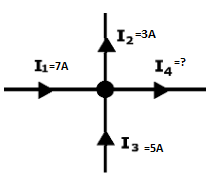
AnswerCurrent $I_4$ can be calculated using Kirchhoff’s first law. The sum of current arriving at a junction is equal to the currents leaving the junction.
Here, Currents arriving at a junction: $7A + 5A = 12A$
Currents leaving the junction: $3A + I_4$
Equating both the currents: $12A = 3A +I_4$
$I_4 = 9A$
View full question & answer→MCQ 1581 Mark
Identify the material whose resistivity lie between $10^{-6} \Omega m$ and $10^4 \Omega m$.
AnswerThe resistivities of semiconductors lie between $10^{-6} \Omega m$ and $10^4 \Omega m$.. A semiconductor material has an electrical conductivity value falling between that of a conductor, such as metallic aluminum, and an insulator, such as wood. Silicon and germanium are typical semiconductors.
View full question & answer→MCQ 1591 Mark
Which of the following characteristics of electrons determines the current in a conductor?
- ✓
- B
- C
Both drift velocity and thermal velocity.
- D
Neither drift nor thermal velocity.
View full question & answer→MCQ 1601 Mark
The internal resistance of dry cell is $...A...,$ than the internal resistance of common electrolytic cell. Here, $A$ refers to:
View full question & answer→MCQ 1611 Mark
Which among the following can be used to analyze circuits?
AnswerKirchhoff’s Law is used to analyze circuits. This law is important because they represent connections of a circuit. Kirchhoff’s Law provide the constraints that let us find the current flowing and voltage across every circuit element.
View full question & answer→MCQ 1621 Mark
With increase in temperature the conductivity of:
- A
Metals increases and of semiconductor decreases.
- ✓
Semeconductors increases and metals decreases.
- C
In both metals and semiconductors increases.
- D
In both metal and semiconductor decreases.
AnswerCorrect option: B. Semeconductors increases and metals decreases.
View full question & answer→MCQ 1631 Mark
Sensitivity of potentiometer can be increased by:
AnswerCorrect option: B. Increasing the length of the potentiometer.
View full question & answer→MCQ 1641 Mark
Kirchoff’s first law, i.e., $S i = 0$ at a junction, deals with the conservation of:
View full question & answer→MCQ 1651 Mark
Kirchoff's junction law is equivalent to $......$.
- A
- ✓
- C
Conservation of electric potential.
- D
Conservation of electric flux.
AnswerKirchhoff's junction rule is an application of the principle of conservation of electric charge: current is flow of charge per time, and if current is constant, that which flows into a point in a circuit must equal that which flows out of it.
View full question & answer→MCQ 1661 Mark
Pick out the application of potentiometer from the following.
- A
- ✓
It measures internal resistance.
- C
It measures external resistance.
- D
It is used to compare two currents.
AnswerCorrect option: B. It measures internal resistance.
Potentiometer is an electric instrument used to measure internal resistance, electromotive force $(emf)$, and it is also used for comparing the emfs of different cells. Potentiometer can be used as a variable resistor as well.
View full question & answer→MCQ 1671 Mark
In a large building, there are $15$ bulbs of $40W, 5$ bulbs of $100W, 5$ fans of $80W$ and $1$ heater of $1kW$. The voltage of electric mains is $220V$. The minimum capacity of the main fuse of the building will be:
- A
$8A.$
- B
$10A.$
- ✓
$12A.$
- D
$14A.$
AnswerCorrect option: C. $12A.$
View full question & answer→MCQ 1681 Mark
Which of the following quantities do not change when a resistor connected to a battery is heated due to the current?
- A
- B
- C
- ✓
Number of free electrons.
AnswerCorrect option: D. Number of free electrons.
When a resistor connected to a battery is heated due to the current that causes drift speed, resistivity $\&$ resistance may e change But number of free electrons remains same.
View full question & answer→MCQ 1691 Mark
If in the experiment of Wheatstone’s bridge, the positions of cells and galvanometer are interchanged, then balance point will:
- A
- ✓
- C
Depend on the internal resistance of cell and resistance of galvanometer.
- D
View full question & answer→MCQ 1701 Mark
The unit of specific resistance is:
AnswerCorrect option: C. $\Omega1$
View full question & answer→MCQ 1711 Mark
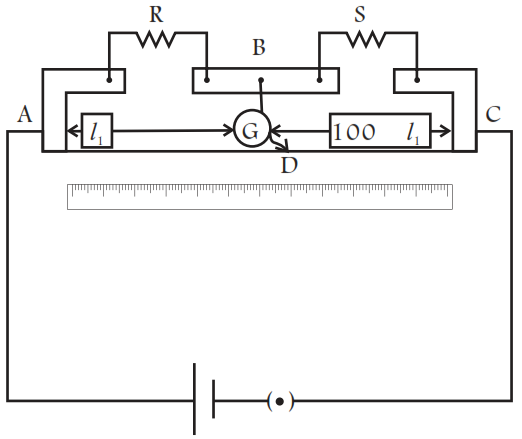
In a meter bridge the point D is a neutral point (Fig).
- A
The meter bridge can have no other neutral point for this set of resistances.
- B
When the jockey contacts a point on meter wire left of D, current flows to B from the wire.
- C
When the jockey contacts a point on the meter wire to the right of D, current flows from B to the wire through galvanometer.
- ✓
AnswerSolution:
Key concept: Meter bridge: In case of meter bridge, the resistance wire AC is 100cm long. Varying the position of tapping point B, bridge is balanced. If in balanced position of bridge AB = l, BC = (100 - l) so that $\frac{\text{Q}}{\text{P}}=\frac{(100-\text{I})}{\text{I}}$. Also $\frac{\text{P}}{\text{Q}}=\frac{\text{R}}{\text{S}}>\text{S}=\frac{(100-\text{I})}{\text{I R}}$.
When there is no deflection in galvanometer there is no current across the galvanometer, then points B and D are at same potential. That point at which galvanometer shows no deflection is called null point, then potential at B and neutral point D are same. When the jockey contacts a point on the meter wire to the right of D, the potential drop across AD is more than potential drop across AB, which brings the potential of point D less than that of B, hence current flows from B to D in the galvanometer wire.
View full question & answer→MCQ 1721 Mark
Unit of $e.m.f.$ of a cell is:
AnswerEmf is voltage generated by the battery and hence, the unit of emf is same as that of voltage,which is volts.
View full question & answer→MCQ 1731 Mark
A source of electromotive force $(emf) $ is a:
AnswerA source of $\text{EMF}$ can be cell, battery or generator.
View full question & answer→MCQ 1741 Mark
Which of the following is an example of a non$-$ohmic conductor?
AnswerSilicon is an example of a non$-$ohmic conductor. It exhibits non$-$linear behaviour. After a certain voltage, the current decreases as the voltage increases. The $V-I$ plot for silicon is non-linear.
View full question & answer→MCQ 1751 Mark
Which among the following has weak temperature dependence values with resistivity?
AnswerAlloys have high resistivity. The resistivity of nichrome has weak temperature dependence. At absolute zero, a pure metal has negligibly small resistivity while an alloy like nichrome has some residual resistivity.
View full question & answer→MCQ 1761 Mark
As the temperature of a conductor increases, its resistivity and conductivity change. The ratio of resistivity to conductivity:
- ✓
- B
- C
- D
May increase or decrease, depending on the actual temperature.
AnswerTemperature of a cunductor increases that causes resistivity $(r)$ is increases due conductivity $(s)$ is decrease.
$\therefore\sigma=\frac{1}{\rho}$
$\Rightarrow\text{ratio of}\frac{\text{resistivity}}{\text{conductivity}}=\frac{\rho}{\sigma}=\rho^2$ is increase.
View full question & answer→MCQ 1771 Mark
Which instrument is used as the null detector in the Wheatstone bridge?
AnswerA galvanometer is used as the null detector in a Wheatstone bridge. The null point means the situation in which no current flows through the circuit. The galvanometer is used for measuring the current and also to determine the voltage between any two points of the circuit. Galvanometer is used due to its sensitivity and therefore, even small currents can be measured.
View full question & answer→MCQ 1781 Mark
The example of non$-$ohmic resistance is:
View full question & answer→MCQ 1791 Mark
Wheatstones’s bridge cannot be used for measurement of very $......$ resistances.
AnswerFrom wheatstone bridge while measuring For resistances of very low value like few ohms , the effect of other components of the circuit like wires , galvanometer etc. might come into account. these components might introduce stray resistance to the calculation.
View full question & answer→MCQ 1801 Mark
A graph is plotted between the potential difference $($applied across the ends of a conductor$)$ and the current $($following through the conductor$)$. The graph is a straight line
AnswerAccording to $Ohm's$ law, the potential difference across a conductor is directly proportional to the current through it.
$V = IR$
Hence the curve is a straight line passing through origin.
View full question & answer→MCQ 1811 Mark
A strip of copper and another of germanium are cooled from room temperature to $80K$. The resistance of:
- A
- B
- C
Copper strip increases and that of germanium decreases.
- ✓
Copper strip decreases and that of germanium increases.
AnswerCorrect option: D. Copper strip decreases and that of germanium increases.
View full question & answer→MCQ 1821 Mark
The specific resistance of a rod of copper as compared to that of thin wire of copper is:
- A
- B
- ✓
- D
Depends upon the length and area of wire
AnswerSpecific resistance of a conductor depends on the nature of material but is independent of the dimension of the conductor. Thus specific resistance of rod of copper as compared to that of thin wire of copper is same.
View full question & answer→MCQ 1831 Mark
When a potential difference $V$ is applied across a conductor at a temperature $T$, the drift velocity of electrons is proportional to:
- A
$\text{V}$
- ✓
$\sqrt{\text{V}}$
- C
$\text{T}$
- D
$\sqrt{\text{T}}$
AnswerCorrect option: B. $\sqrt{\text{V}}$
View full question & answer→MCQ 1841 Mark
An engine uses $30A$ of current. The resistance offered is $15$ ohms. Calculate the power consumed by the engine in horse power.
- ✓
$18hp$
- B
$19hp$
- C
$17hp$
- D
$13500hp$
AnswerCorrect option: A. $18hp$
a. $18 hp$
Explanation:
Current used $=30 A$; Resistance $=15$ ohms
The required equation is: Power $=$ current $^2 \times$ resistance
$=30 \times 30 \times 15$
$=13,500 Watts$
We know that, $1$ Watt $= 746$ horse power (hp).
So, $13,500$ Watts $=18.096 hp$, which can approximately be equal to 18 hp .
View full question & answer→MCQ 1851 Mark
In the electrolysis of $\text{NaCl:}$
- ✓
$Cl ^{-}$is oxidised at anode.
- B
$Cl ^{-}$ is reduced at anode.
- C
$Cl ^{-}$ is reduced at cathode.
- D
$Cl ^{-}$ is neither reduced nor oxidised.
AnswerCorrect option: A. $Cl ^{-}$is oxidised at anode.
Electrolysis of an aqueous solution of table salt $(\text{NaCl}$, or sodium chloride$)$ produces aqueous sodium hydroxide and chlorine, although usually only in minute amounts. $\text{NaCl} ($aq$)$ can be reliably electrolysed to produce hydrogen. Hydrogen gas will be seen to bubble up at the cathode, and chlorine gas will bubble at the anode.
As the electricity from the battery passes through and between the electrodes, the water splits into hydrogen and chlorine gas, which collect as very tiny bubbles around the electrode tips. Hydrogen collects around the cathode and chlorine gas collects around the anode.
View full question & answer→MCQ 1861 Mark
$36$ cells, each of emf $4V$ are connected in series and kept in a box. The combination shows an emf of $88V$ on the outside. Calculate the number of cells reversed.
AnswerNumber of cells $(n)=36$; Emf of each cell $(e)=4 V$; Total emf $(E)=88 V$;
Let the number of reversed cells be ' $y$ '
The required equation: $E_{E F F}= n \times e -2 y \times e$
$88=36 \times 4-2 y \times 4$
$88=144-8 y$
$8 y=56$
$y=7$
View full question & answer→MCQ 1871 Mark
Find the false statement.
- A
Wheatstone bridge is analogous to simple level system.
- B
A galvanometer with low resistance in series is an ammeter.
- C
Wheatstone bridge cannot be used forprecision measurement because of the error introduced in contact resistance.
- ✓
Wheatstone bridge is susceptible to high dc current.
AnswerCorrect option: D. Wheatstone bridge is susceptible to high dc current.
The false statement is Wheatstone bridge is susceptible to high dc current. It is actually not susceptible to high dc current and can give inaccurate readings if not balanced. The Wheatstone bridge measures resistance from few ohms tomega ohms.All the other statements are valid.
View full question & answer→MCQ 1881 Mark
What is the driving force in a working Electrical Circuit?
AnswerWhen a potential difference is applied across a resistor then randomly moving free electrons start to move towards positive terminal due to force applied by electric field generated due to voltage difference. thus a start to Current Flows from High Voltage to Low Voltage.
Voltage is cause and current is effect.
View full question & answer→MCQ 1891 Mark
Carbon resistors are of two types:
- ✓
Composition type resistor and film type resistor.
- B
Rheostat and film type resistor.
- C
Rheostat and variable resistor.
- D
Composition type resistor and rheostat.
AnswerCorrect option: A. Composition type resistor and film type resistor.
Carbon resistors are of two types composition type resistor and film type resistor.
There are a number of different types of fixed resistor:
Carbon composition: These types were once very common, but are now seldom used.
Carbon film: This resistor type is formed by "cracking" a hydrocarbon onto a ceramic former.
View full question & answer→MCQ 1901 Mark
Consider a capacitor$-$charging circuit. Let $Q_1$ be the charge given to the capacitor in a time interval of $10 \ ms$ and $Q_2$ be the charge given in the next time interval of $10 \ ms$ . Let $10 \ mC$ charge be deposited in time interval $t _1$ and another $10 \ mC$ charge be deposited in the next time interval $t _2$.
AnswerCorrect option: B. $Q _1> Q _2, t _1< t _2$
Condition for charging capacitor-
$\text{Q}=\text{Q}_0\Big(1-\text{e}^\frac{-\text{t}}{\text{Rc}}\Big)$
$\text{Q}=\text{Q}_0\Big(1-\text{e}^\frac{-10\text{m}}{\text{Rc}}\Big)\ ...(1)$
$\text{Q}_1=\text{Q}_2=\text{Q}_0\Big(1-\text{e}^\frac{{-(10\text{m}+10\text{m})}}{\text{Rc}}\Big)$
$\text{Q}_1=\text{Q}_2=\text{Q}_0\Big(1-\text{e}^\frac{{-20\text{m}}}{\text{Rc}}\Big)\ ...(2)$
From eq. $(1)$ and $(2)$ we get-
$\text{Q}_1 > \text{Q}_2$
Given
$\text{Q}=\text{Q}_0\Big(1-\text{e}^\frac{-\text{t}}{\text{Rc}}\Big)$
$10\text{mc}=\text{Q}_0\Big(1-\text{e}^{\frac{-\text{t}}{\text{Rc}}}\Big)\ ...(3)$
$10\mu\text{c}+10\mu\text{c}=\text{Q}_0\Big(1-\text{e}^{\frac{-(\text{t}_1+\text{t}_2)}{\text{Rc}}}\Big)\rightarrow$
$20\mu\text{c}=\text{Q}_0\Big(1-\text{e}^{\frac{-(\text{t}_1+\text{t}_2)}{\text{Rc}}}\Big)\ ...(4)$
From eq. $(3)$ and $(4)$ we get,
$\text{t}_2 > \text{t}_1$
View full question & answer→MCQ 1911 Mark
If the length of potentiometer wire is increased, then the length of the previously obtained balance point will:
AnswerWhen the length of potentiometer wire is increased, the potential gradient decreases and the length of previous balance point is increased.
View full question & answer→MCQ 1921 Mark
A capacitor of capacitance $500\mu\text{F}$ is connected to a battery through a $10\text{k}\Omega$ resistor. The charge stored in the capacitor in the first $5s$ is larger than the charge stored in the next:
AnswerCorrect option: C. $500s$
$\text{Q}=\text{CE}\Big(1-\text{e}^{\frac{-\text{t}}{\text{Rc}}}\Big)$
$\text{C}-500\times10^{-6}\text{F}$
$\text{R}=10^4\text{W}$
$\text{t}=\text{Rc}=10^4\times500\times10^{-6}=5$
$\text{t}=5\text{sec}$
$\text{Q}=\text{C}\in\Big(1-\text{e}^{-\text{t}}\Big)=\text{C}\in\Big(1-\frac{1}{\text{e}}\Big)=0.63\text{c}\in$
Thus, $63\%$ of the maximum charge is deposited in one time constant.
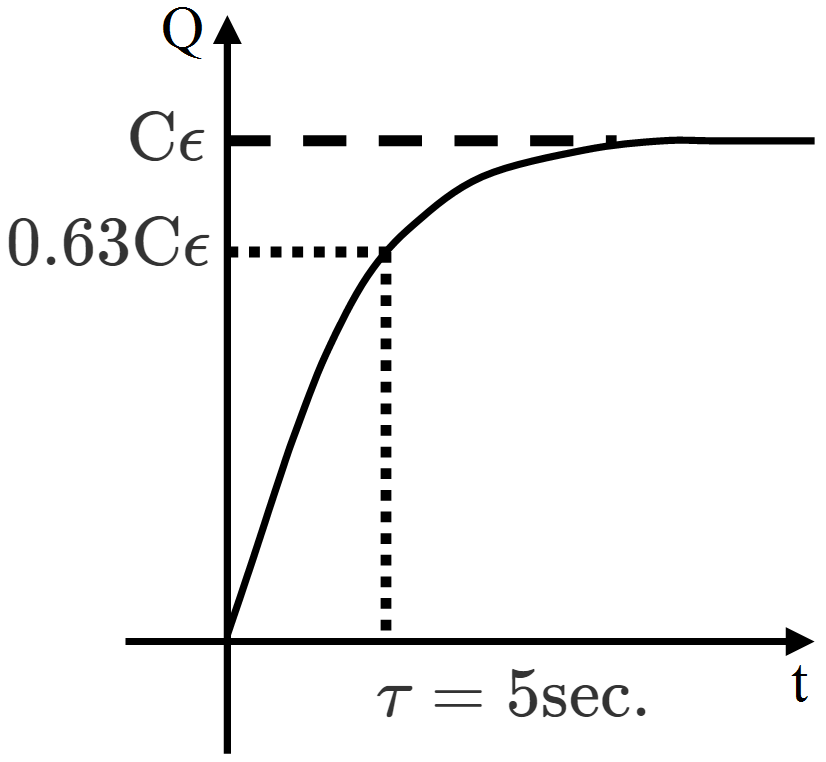
With the help of the figure we can say that the capacitor in the first $5s$ is larger than the charge stored in the next any second.
$\Rightarrow\text{at}\ \text{t}=\infty$
$\text{Q}=\text{Q}_0\Big(1-\text{e}^{-\infty}\Big)=\text{Q}_0=\text{C}\in$
$\therefore\text{t}_\infty-\text{t}_5=\text{C}\in-63=37$
after $t = 5 \sec$., maximum charge is deposited is only $37\%.$
View full question & answer→MCQ 1931 Mark
Consider a current carrying wire $($current $I)$ in the shape of a circle. Note that as the current progresses along the wire, the direction of j $($current density$)$ changes in an exact manner, while the current $I$ remain unaffected. The agent that is essentially responsible for is:
- A
- ✓
Electric field produced by charges accumulated on the surface of wire.
- C
The charges just behind a given segment of wire which push them just the right way by repulsion.
- D
AnswerCorrect option: B. Electric field produced by charges accumulated on the surface of wire.
Key concept: Current per unit area $($taken normal to the current$), \frac{\text{I}}{\text{A}}$, is called current density and is denoted by $\vec{\text{J}}$.
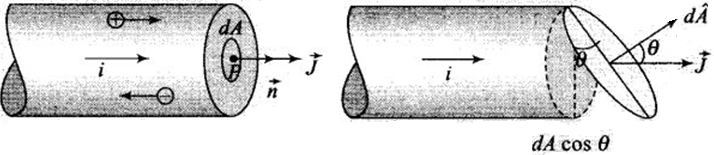
The is unti of the currnt density are $\frac{\text{A}}{\text{m}^2}$. The current density is also directed along $E$ and which is also a vector quantity and the relationship is given by
$\vec{\text{J}}=\sigma\vec{\text{E}}=\frac{\vec{\text{E}}}{\rho}$
where $\sigma$ = conductivity and $\rho =$ resistivity of specific resistance of the the surface of wire.
View full question & answer→MCQ 1941 Mark
Which of the following is the correct statement regarding electrochemical cell?
- ✓
It converts chemical energy to electrical energy.
- B
It converts electric energy to chemical energy.
- C
It converts chemical energy to thermal energy.
- D
It does not maintain the flow of charge in a circuit.
AnswerCorrect option: A. It converts chemical energy to electrical energy.
An electrochemical cell is a device which converts chemical energy to electric energy, and maintains the flow of charge in a circuit. There are $2$ types of electrochemical cells $–$ Galvanic cell and Electrolytic cell.
View full question & answer→MCQ 1951 Mark
In conductor when electrons move between two collisions, their paths are $... A...$ when external fields are absent and $... B...$ when external filed is present. Here, $A$ and $B$ refer to:
- ✓
Straight lines, straight lines.
- B
Straight lines, curved lines.
- C
Curved lines, straight lines.
- D
Curved lines, curved lines.
AnswerCorrect option: A. Straight lines, straight lines.
View full question & answer→MCQ 1961 Mark
Temperature dependence of resistivity $\rho\text{(T)}$ of semiconductors, insulators and metals is significantly based on the following factors:
- A
Number of charge carriers can change with temperature T.
- B
Time interval between two successive collisions can depend on T.
- C
Length of material can be a function of T.
- ✓
AnswerSolution:
Resistivity is the intrinsic property of the substance.
For a metallic conductor, resistivity is given by
$\rho=\frac{\text{m}}{\text{ne}^2\tau}$
where n is the number of charge carries per unit volume (number density) whcih can change with temperature T and $\tau$ is relaxation time (time interval between two successive collisions) which decreases with the increase of temperature $\bigg(\text{T}\propto\frac{1}{\tau}\bigg)$.
View full question & answer→MCQ 1971 Mark
Which of the following statements are true?
- A
During electrolysis, charge flows through electrolytic solution via electrons.
- ✓
The randomly moving electrons in a metal wire will start moving in a particular direction when a potential difference is applied across it.
- C
A negatively charged particle has higher electric potential than a positively charged particle.
- D
Charge flows only through negative charge carriers like electrons.
AnswerCorrect option: B. The randomly moving electrons in a metal wire will start moving in a particular direction when a potential difference is applied across it.
The electrons in any conductor are under continuous motion but in random way. There's no net crossing of charge carriers through a given cross-section. Without potential difference, the electrons move randomly in all directions.The randomly moving electrons in a metal wire will start moving in a particular direction when a potential difference is applied across it.
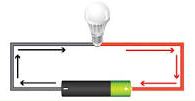
View full question & answer→MCQ 1981 Mark
A metal rod of length $10\ cm$ and a rectangular cross$-$section of $1\text{cm}\times\frac{1}{2}\text{cm}$ is connected to a battery across opposite faces. The resistance will be:
- ✓
Maximum when the battery is connected across $1\text{cm}\times\frac{1}{2}\text{cm}$ faces.
- B
Maximum when the battery is connected across $10\text{cm}\times\frac{1}{2}\text{cm}$ faces.
- C
Maximum when the battery is connected across $10\text{cm}\times\frac{1}{2}\text{cm}$ faces.
- D
Same irrespective of the three faces.
AnswerCorrect option: A. Maximum when the battery is connected across $1\text{cm}\times\frac{1}{2}\text{cm}$ faces.
As, $\text{R}=\rho\Big(\frac{\text{I}}{\text{A}}\Big)$
If we calculate $R$ with the help of above relation then,
From option $(a)$ we will get $\text{R}=20\rho\Omega$
From option $(b)$ we will get $\text{R}=\Big(\frac{\rho}{20}\Big)\Omega$
From option $(c)$ we will get $\text{R}=\Big(\frac{\rho}{5}\Big)\Omega$
Clearly, the resistance will be maximum when the battery is connected across $1\text{cm}\times\frac{1}{2}\text{cm}$ faces.
View full question & answer→MCQ 1991 Mark
Which color band in the resistor is having highest tolerance?
AnswerTolerance level of
Green: $0.5\%$
Blue: $0.25\%$
Violet: $0.1\%$
View full question & answer→MCQ 2001 Mark
Ten identical cells connected in series are needed to heat a wire of length one meter and radius $‘r’$ by $10^\circ C$ in time $‘t’.$ How many cells will be required to heat the wire of length two meter of the same radius by the same temperature in time $‘t’$?
View full question & answer→