Questions

5 Marks Questions

Take a timed test

20 questions · self-marked practice — reveal the answer and mark yourself.

Question 15 Marks
For going to a city B from city A, there is a route via city C such that $\text{AC}\perp\text{CB},$ AC = 2x km and CB = 2(x + 7)km. It is proposed to construct a 26km highway which directly connects the two cities A and B. Find how much distance will be saved in reaching city B from city A after the construction of the highway.
Answer
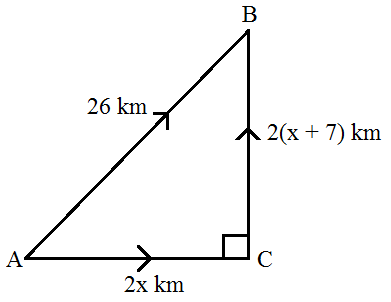

Distance saved by direct highway = (AC + BC) - AB
$\therefore\text{AC}\perp\text{CB}$ so by pythagoras theorem
$AC^2 + BC^2 = AB^2$
$\Rightarrow (2x)^2 + [2(x + 7)]^2 = 26^2$
$\Rightarrow 2^2x^2 + 2^2(x + 7)^2 = 676$
$\Rightarrow 4x^2 + 4(x^2 + 49 + 14x) = 676$
$\Rightarrow 4[x^2 + x^2 + 49 + 14x] = 676$
$\Rightarrow2\text{x}^2+14\text{x}+49=\frac{676}{4}$
$\Rightarrow 2x^2 + 14x + 49 = 169$
$\Rightarrow 2x^2 + 14x + 49 - 169 = 0$
$\Rightarrow 2x^2 + 14x - 120 = 0$
$\Rightarrow x^2 + 7x - 60 = 0$
$\Rightarrow x^2 + 12x - 5x - 60 = 0$
$\Rightarrow x(x + 12) - 5(x + 12) = 0$
$\Rightarrow (x + 12)(x - 5) = 0$
$\Rightarrow x + 12 = 0 or x - 5$
$\Rightarrow x = -12 or x = 5$
$\Rightarrow x = -12$(rejected)
$\because\text{x}=5$
$\therefore$ The required distance $= AC + BC - AB$
$= 2x + 2x + 14 - 26$
$= 4x - 12 $$[\because\text{x}=5]$
$= 4 × 5 - 12$
$= 20 - 12$
= 8km
Hence, the distance saved by highway is 8km.
View full question & answer
Question 25 Marks
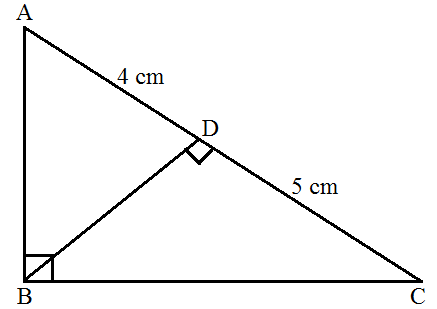
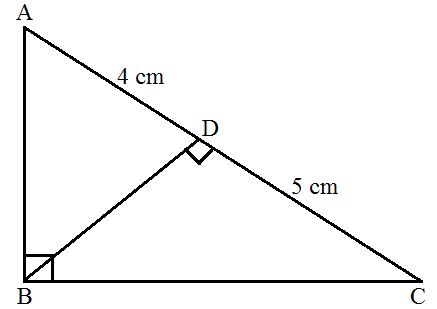
ABC is a triangle right angled at B and $\text{BD}\perp\text{AC}.$ If AD = 4cm, and CD = 5cm, find BD and AB.
Answer

In $\triangle\text{ABC},$
$\angle\text{ABC}=90^\circ$ [Given]
$\text{BD}\perp\text{AC}$ [Hypotenuse]
$\therefore\text{BD}^2=\text{DA}\times\text{DC}$
$\Rightarrow\text{BD}^2=4\times5$
$\Rightarrow\text{BD}=2\sqrt{5}\text{cm}$
In right angled $\triangle\text{BDA},$
$\text{BD}\perp\text{AC}$ [Given]
$\therefore\angle\text{BDA}=90^\circ$
$\Rightarrow\text{AB}^2=\text{AD}^2+\text{BD}^2$ [by Pythagoras theorem]
$\Rightarrow\text{AB}^2=4^2+(2\sqrt{5})^2$
$\Rightarrow\text{AB}^2=16+20$
$\Rightarrow\text{AB}^2=36$
$\Rightarrow\text{AB}=6\text{cm}$
Hence proved.
View full question & answer
Question 35 Marks
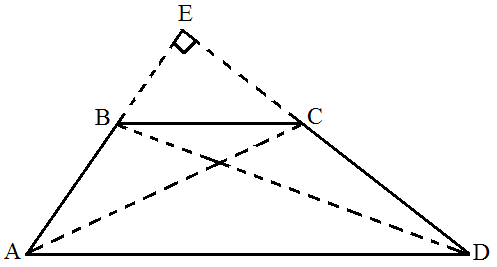
In a quadrilateral ABCD, $\angle\text{A}+\angle\text{D}=90^\circ.$ Prove that $AC^2 + BD^2 = AD^2 + BC^2.$
[Hint: Produce AB and DC to meet at E]
Answer

Given: A quadrilateral ABCD in which $\angle\text{A}+\angle\text{D}=90^\circ.$
To prove: $AC^2 + BD^2 = AD^2 + BC^2$​​​​​​​
Construction: Join AC and BD.
Produce AB and BC to meet at E.
Proof: In $\triangle\text{ADE}$
$\angle\text{BAD}+\angle\text{CDA}=90^\circ$ [Given]
$\angle\text{E}=90^\circ$ [Int. angle of a $\triangle$]
By Pythagoras theorem in $\triangle\text{ADE}$ and $\triangle\text{BCR},$
$AD^2 = AE^2 + DE^2 ......(i)$
$\Rightarrow BC^2 = BE^2 + EC^2 ......(ii)$
Adding (i) and (ii), we get
$AD^2 + BC^2 = AE^2 + EC^2 + DE^2 + BE^2 ......(iii)$
By Pythagoras theorem in $\triangle\text{ECA}$ and $\triangle\text{EBD},$
$AC^2 = AE^2 + CE^2 ......(iv)$
$\Rightarrow BD^2 = BE^2 + DE^2 ......(v)$
$\Rightarrow AD^2 + BC^2 = AE^2 + EC^2 + DE^2 + BE^2 .......(vi)$ [Adding (iv) and (v)]
$\Rightarrow AC^2 + BD^2 = AD^2 + BC^2​​​​​​​$​​​​​​​ [Using (iii)]
Hence, proved.
View full question & answer
Question 45 Marks
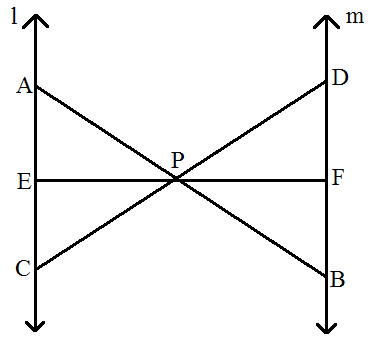
$\text{l}\parallel\text{m}$ and line segments AB, CD and EF are concurrent at point P. Proved that $\frac{\text{AE}}{\text{BF}}=\frac{\text{AC}}{\text{BD}}=\frac{\text{CE}}{\text{FD}}.$
Answer

Given: $\text{l}\parallel\text{m}$
Line segments AB, CD and EF intersect at P.
Points A, E and C are on line l.
Points D, F and B are on line m.
To prove: $\frac{\text{AE}}{\text{BF}}=\frac{\text{AC}}{\text{BD}}=\frac{\text{CE}}{\text{FD}}\ .........(\text{i})$
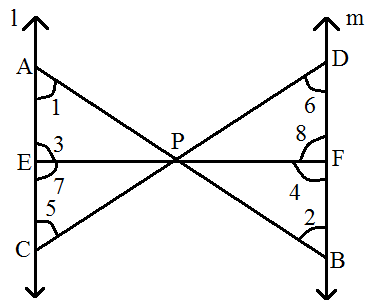
Proof: In $\triangle\text{AEP}$ and $\triangle\text{BFP},$
$\text{l}\parallel\text{m}$ [Given]
$\angle1=\angle2$ [Alternate interior angles]
$\angle3=\angle4$ [Alternate interior angles]
$\therefore\triangle\text{AEP}\sim\triangle\text{BFP}$ [By AA simillarity criterion]
In $\triangle\text{CEP}$ and $\triangle\text{DFP},$
$\text{l}\parallel\text{m}$ [Given]
$\angle7=\angle8$ [Alternate interior angles]
$\angle5=\angle6$ [Alternate interior angles]
$\therefore\triangle\text{CEP}\sim\triangle\text{DFP}$ [By AA simillarity criterion]
$\Rightarrow\frac{\text{CE}}{\text{DF}}=\frac{\text{CP}}{\text{DP}}=\frac{\text{EP}}{\text{FP}}\ ........(\text{ii})$
In $\triangle\text{ACP}$ and $\triangle\text{BDP},$
$\text{l}\parallel\text{m}$ [Given]
$\angle1=\angle2$ [Alternate interior angles]
$\angle5=\angle6$ [Alternate interior angles]
$\therefore\triangle\text{ACP}\sim\triangle\text{BDP}$ [By AA simillarity criterion]
$\Rightarrow\frac{\text{AC}}{\text{BD}}=\frac{\text{AP}}{\text{BP}}=\frac{\text{CP}}{\text{DP}}\ ......(\text{iii})$
$\Rightarrow\frac{\text{AP}}{\text{PB}}=\frac{\text{AC}}{\text{BP}}=\frac{\text{CP}}{\text{DP}}=\frac{\text{CE}}{\text{DF}}=\frac{\text{EP}}{\text{FP}}=\frac{\text{AE}}{\text{BF}}$
$\Rightarrow\frac{\text{AC}}{\text{BD}}=\frac{\text{AE}}{\text{BF}}=\frac{\text{CF}}{\text{DF}}$
Hence, proved
View full question & answer
Question 55 Marks
Prove that if a line is drawn parallel to one side of a triangle to intersect the other two sides, then the two sides are divided in the same ratio.
Answer
Given: In $\triangle\text{ABC},$ $\text{DE}\parallel\text{BC}$To prove: $\frac{\text{AD}}{\text{DB}}=\frac{\text{AE}}{\text{EC}}$
Construction: Draw $\text{EF}\perp\text{AB}$ and $\text{DG}\perp\text{AC}$ joine BC and BE.Proof: $\frac{\text{ar}(\triangle\text{ADE})}{{\text{ar}(\triangle\text{DBE})}}=\frac{\frac{1}{2}\text{AD}\times\text{EF}}{\frac{1}{2}\text{DB}\times\text{EF}}=\frac{\text{AD}}{\text{DB}}\ ....(\text{i})$
and $\frac{\text{ar}(\triangle\text{ADE})}{{\text{ar}(\triangle\text{ECD})}}=\frac{\frac{1}{2}\text{AE}\times\text{DG}}{\frac{1}{2}\text{EC}\times\text{DG}}=\frac{\text{AE}}{\text{EC}}\ .....(\text{ii})$ Note that $\triangle\text{DBE}$ and $\triangle\text{ECD}$ are on same base DE and batween same parallel lines DE and BC. $\therefore\text{ar}(\triangle\text{DBE})=\text{ar}(\triangle\text{ECD})\ .......(\text{iii})$ From equations (ii) and (iii), we have $\frac{\text{ar}(\triangle\text{ADE})}{{\text{ar}(\triangle\text{DBE})}}=\frac{\text{AE}}{\text{EC}}\ ........(\text{iv})$ From equtions (i) and (iv), we have $\frac{\text{AD}}{\text{DB}}=\frac{\text{AE}}{\text{EC}}$ Hence, proved.
View full question & answer
Question 65 Marks
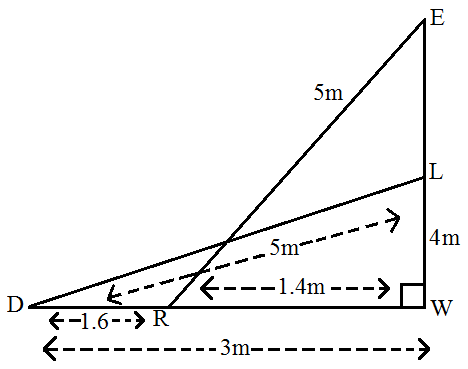
A 5m long ladder is placed leaning towards a vertical wall such that it reaches the wall at a point 4m high. If the foot of the ladder is moved 1.6m to towards the wall, then find the distance by which the top of the ladder would slide upwards on the wall.
Answer


Case I: In right angled $\triangle\text{LWD},$
$DW^2 = DL^2 - LW^2$
$\Rightarrow DW^2 = 5^2 - 4^2$
$\Rightarrow DW^2 = 25 - 16$
$\Rightarrow DW^2 = 9$
$\Rightarrow DW = 3m$​​​​​​​
Case II: $RW = DW - DR$
$\Rightarrow RW = 3 - 1.6$
$\Rightarrow RW = 1.4m$
In right angled triangle RWE,
$EW^2 = RE^2 - RW^2$
$\Rightarrow EW^2 = 5^2 - 1.4^2$
$\Rightarrow EW^2 = 25 - 1.96$
$\Rightarrow EW^2 = 23.04$
$\Rightarrow\text{EW}=\sqrt{23.04}$
⇒ EW = 4.8m
$\therefore$ The distance by which the ladder shifted upward = EL = 4.8m - 4m = 08m
Hence, the ladder would slied upword on wall by 0.8m.
View full question & answer
Question 75 Marks
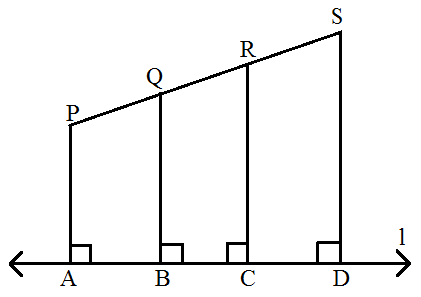
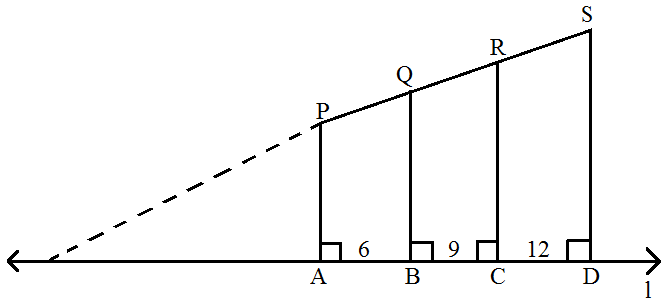
In PA, QB, RC and SD are all perpendiculars to a line l, AB = 6cm, BC = 9cm, CD = 12cm and SP = 36cm. Find PQ, QR and RS.
Answer
Given: PA, QB, RC and SD are perpendiculars on line l.
AB = 6cm, BC = 9cm, CD = 12cm

To find: PQ, QR and RS
Construction: Produce SP and I to meet each other at E.
Proof: In $\triangle\text{EDS},$
AP || BQ || DS || CR [Given]
⇒ PQ : QR : RS = AB : BC : CD
⇒ PQ : QR : RS = 6 : 9 : 12
Let PQ = 6x
Then = 9x
and RS = 12x
⇒ PQ + QR + RS = 36cm
⇒ 6x + 9x + 12x = 36
⇒ 27x = 36
$\Rightarrow\text{x}=\frac{36}{27}=\frac{4}{3}$
$\therefore\text{PQ}=6\times\frac{4}{3}=8\text{cm}$
$\text{QR}=9\times\frac{4}{3}=12\text{cm}$
$\text{RS}=12\times\frac{4}{3}=16\text{cm}$
View full question & answer
Question 85 Marks
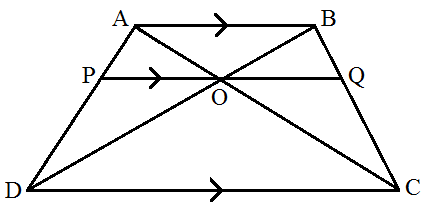
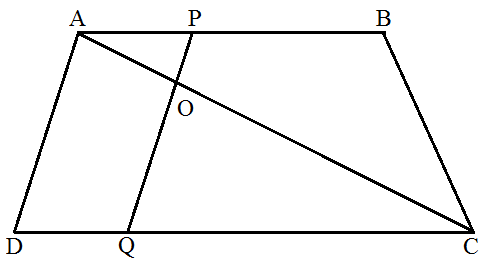
O is the point of intersection of the diagonals AC and BD of a trapezium ABCD with AB || DC. Through O, a line segment PQ is drawn parallel AB meeting AD in P and BC in Q. Prove that PO = QO.
Answer

Given: In trapezium ABCD, AB || DC
Diagonals BD and AC intersect at O and POQ || DC || AB
To Prove: PO = QO
Proof: In $\triangle\text{ABD},$
$\text{PO}\parallel\text{AB}$ [Given]
$\therefore\frac{\text{AP}}{\text{PD}}=\frac{\text{BO}}{\text{OD}}\ .....(\text{i})$
Similarly, in $\triangle\text{BDC},$
$\text{OQ}\parallel\text{DC}$
$\therefore\frac{\text{BO}}{\text{OD}}=\frac{\text{BQ}}{\text{QC}}\ .....(\text{ii})$
From (i) and (ii), we have
$\frac{\text{AP}}{\text{PD}}=\frac{\text{BQ}}{\text{QC}}$
$\Rightarrow\frac{\text{AP}}{\text{PD}}+1=\frac{\text{BQ}}{\text{QC}}+1$ [Adding 1 on both sides]
$\Rightarrow\frac{\text{AP+PD}}{\text{PD}}=\frac{\text{BQ+QC}}{\text{QC}}$
$\Rightarrow\frac{\text{AD}}{\text{PD}}=\frac{\text{BC}}{\text{QC}}\text{ or }\frac{\text{PD}}{\text{AD}}=\frac{\text{QC}}{\text{BC}}\ .....(\text{iii})$
In $\triangle\text{DOP}$ and $\triangle\text{DBA},$
$\text{AB}\parallel\text{PO}$ [Given]
$\therefore\angle\text{DPO}=\angle\text{DAB}$ [Corresponding angles]
$\therefore\angle\text{DOP}=\angle\text{DBA}$ [Corresponding angles]
$\therefore\triangle\text{DOP}\sim\triangle\text{DBA}$
$\Rightarrow\frac{\text{PO}}{\text{AB}}=\frac{\text{DP}}{\text{DA}}\ .....(\text{iv})$
Similarly, $\triangle\text{COQ}\sim\triangle\text{CAB}$ [By AA similarity criterion]
$\therefore\frac{\text{OQ}}{\text{AB}}=\frac{\text{QC}}{\text{BC}}\ .....(\text{v})$
From (iii), (iv) and (v), we have
$\frac{\text{PO}}{\text{AB}}=\frac{\text{OQ}}{\text{AB}} $
$\Rightarrow\text{PO}={\text{OQ}}$
Hence, proved.
View full question & answer
Question 95 Marks
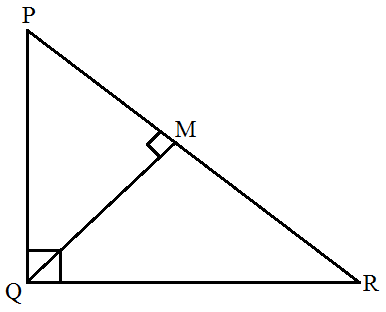
In a $\triangle\text{PQR},\text{PR}^2-\text{PQ}^2=\text{QR}^2$ and M is a point on side PR such that $\text{QM}\perp\text{PR}$ Provr that- $QM^2 = PM \times MR.$
Answer
Given in A $PQR,$
$PR^2 - PQ^2 = QR^2$
and $\text{QM}\perp\text{PR}$
To Prove $QM^2 = PM \times MR$
Proof since, $PR^2 - PQ^2 = QR^2$

So, $\triangle\text{PQR}$ is right angled triangle at Q.
In $\triangle\text{QMR},\triangle\text{PMR}$
$\angle\text{M}=\angle\text{M}$ [each $90^\circ$]
$\angle\text{MQR}=\angle\text{QPM}$ $[\text{each equal to } 90^\circ-\angle\text{R}]$
$\therefore\triangle\text{QMR}\sim\triangle\text{PMQ}$ [by AAA similarity criterion]
Now, using property of area of similar triangles, we get
$\frac{\text{ar}(\triangle\text{QMR})}{{\text{ar}(\triangle\text{PMQ})}}=\frac{(\text{QM})^2}{(\text{PM})^2}$
$\Rightarrow\frac{\frac{1}{2}\times\text{RM}\times\text{QM}}{\frac{1}{2}\times\text{PM}\times\text{QM}}=\frac{(\text{QM})^2}{(\text{PM})^2}$ $[\because\text{area of triangle}=\frac{1}{2}\times\text{base}\times\text{height}]$
$\Rightarrow\text{QM}^2=\text{PM}\times\text{RM}$ Hence proved.
View full question & answer
Question 105 Marks
if AB || DC and AC and PQ intersect each other at the point O, prove that OA × CQ = OC × AP
Answer
Given AC and PQ intersect each other at the point O and AB || DC
Prove that OA × CQ = OC × AP
Proof in $\triangle\text{AOP}$ and $\triangle\text{COQ},$
$\angle\text{AOP}=\angle\text{COQ}$ [vertically opposite angles]
$\angle\text{APO}=\angle\text{COQ}$
[Since, AB || DC and PQ is transversal, so alternate angles]
$\therefore\triangle\text{AOP}\sim\triangle\text{COQ}$ [by AAA similarity citerion]
Then $\frac{\text{OA}}{\text{OC}}=\frac{\text{AP}}{\text{CQ}}$ [Since, corresponding sides are proportional]
⇒ OA × CQ = OC × AP Hence proved.
View full question & answer
Question 115 Marks
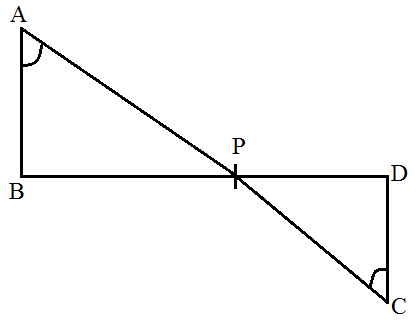
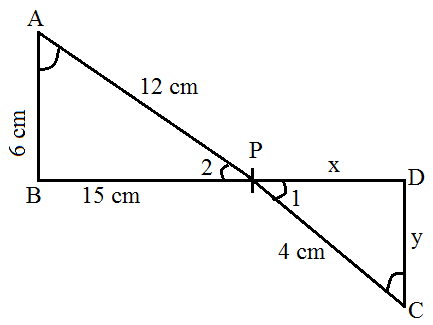
In $\angle\text{A}=\angle\text{C},$ AB = 6cm, BP = 15cm, AP = 12cm and CP = 4cm, then find the lengths of PD and CD.
Answer

In $\triangle\text{ABP}$ and $\triangle\text{CDP},$
$\angle\text{A}=\angle\text{C}$ [Given]
$\angle1=\angle2$ [Vertically opposite angles]
$\therefore\triangle\text{ABP}\sim\triangle\text{CDP}$ [By AAA similarity criterion]
$\Rightarrow\frac{\text{AB}}{\text{CD}}=\frac{\text{AP}}{\text{CP}}=\frac{\text{BP}}{\text{DP}}$
$\Rightarrow\frac{6}{\text{y}}=\frac{12}{4}=\frac{15}{\text{x}}$ $\Rightarrow\frac{15}{\text{x}}=\frac{12}{4}$
$\Rightarrow\frac{6}{\text{y}}=\frac{12}{4}$ $\Rightarrow\frac{15}{3}=\text{x}$
$\Rightarrow\text{y}=\frac{6}{3}=2\text{cm}$ $\Rightarrow\text{x}=5\text{cm}$
$\therefore\text{PD}=5\text{cm}\text{ and }\text{DC}=2\text{cm}$
View full question & answer
Question 125 Marks
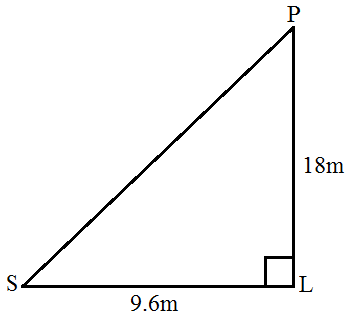
A flag pole 18m high casts a shadow 9.6m long. Find the distance of the top of the pole from the far end of the shadow.
Answer

Pole PL = 18m casts shadow LS = 9.6m
The required distance between top of pole and far end of shadow is equal to PS as pole is vertical so $\angle\text{L}=90^\circ.$
$\therefore$ By pythagoras theorem,
$PS^2 = 18^2 + 9.6^2$
$\Rightarrow PS^2 = 324 + 92.16$
$\Rightarrow PS^2 = 416.16$
$\Rightarrow PS = 20.4m$
Hence, the required distance = 20.4m
View full question & answer
Question 135 Marks
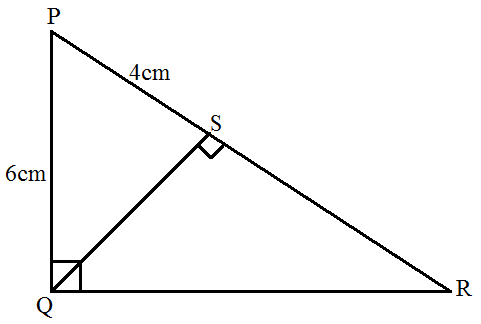
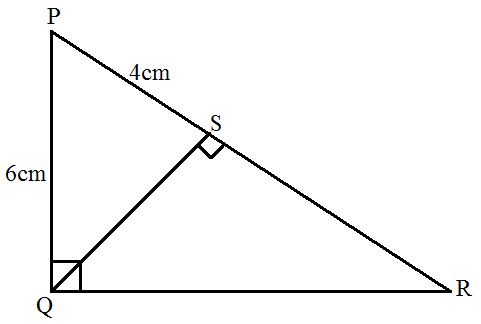
PQR is a right triangle right anmgled at Q and $\text{QS}\perp\text{PR}.$ If PQ = 6cm and PS = 4cm, find QS, RS and QR.
Answer


In $\triangle\text{PQR},$
$\angle\text{PQR}=90^\circ$[Given]
$\text{QS}\perp\text{PR}$
[From vertex Q to hypotenuse PR]
$QS^2 = PS \times SR ......(i)$
Now, in $\triangle\text{PSQ},$ we have
$QS^2 = PQ^2 - PS^2$
$\Rightarrow QS^2 = 6^2 - 4^2$
$\Rightarrow QS^2 = 36 - 16$
$\Rightarrow QS^2 = 20$
$\Rightarrow\text{QS}=2\sqrt{5}$
$\Rightarrow\text{QS}=\text{PS}\times\text{SR}\ .......({\text{i}})$
$\Rightarrow(2\sqrt{5})^2=4\times\text{5}$
$\Rightarrow\frac{20}{4}=\text{SR}$
$\Rightarrow\text{SR}=5\text{cm}$
Now, $\text{QS}\perp\text{PR}$
$\therefore\angle\text{QSR}=90^\circ$
$\Rightarrow\text{QR}^2=\text{QS}^2+\text{SR}^2$
$\Rightarrow\text{QR}^2=(2\sqrt{5})^2+5^2$
$\Rightarrow\text{QR}^2=20+25$
$\Rightarrow\text{QR}^2=45$
$\Rightarrow\text{QR}^2=3\sqrt{5}\text{cm}$
Hence, $\text{QS}=2\sqrt{5},$ $\text{RS}=5\text{cm}$ and $\text{QR}=3\sqrt{5}\text{cm}.$
View full question & answer
Question 145 Marks
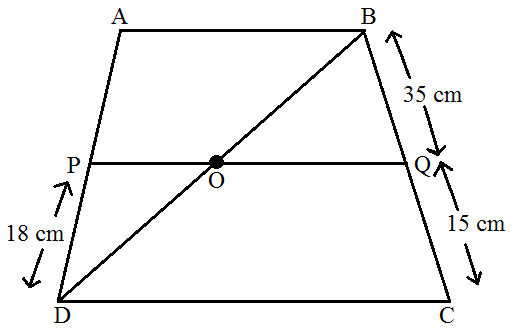
ABCD is a trapezium in which AB || DC and P and Q are points on AD and BC, respectively such that PQ || DC. If PD = 18cm, BQ = 35cm and QC = 15cm, find AD.
Answer
Given, a trapezium ABCD in which AB || DC. P and Q are points on AD and BC, respectively such that PQ || DC. Thus, AB || PQ || DC.

Join BD
$\text{In }\triangle\text{ABD},$
$\text{PO }\parallel\text{ AB}\ [\because\text{PO}\parallel\text{AB}]$
By basic proportionality theorem,
$\frac{\text{DP}}{\text{AP}}=\frac{\text{DO}}{\text{OB}}\ .....(\text{i})$
$\text{In }\triangle\text{BDC},$
$\text{OQ }\parallel\text{ DC}\ [\because\text{PQ}\parallel\text{DC}]$
By basic proportionality theorem,
$\frac{\text{BQ}}{\text{QC}}=\frac{\text{OB}}{\text{OD}}$
$\Rightarrow\frac{\text{QC}}{\text{BQ}}=\frac{\text{OB}}{\text{OD}}\ .....(\text{ii})$
From Eq. (i) and (ii),
$\frac{\text{DP}}{\text{AP}}=\frac{\text{QC}}{\text{BQ}}$
$\Rightarrow\frac{\text{18}}{\text{AP}}=\frac{\text{15}}{\text{35}}$
$\Rightarrow\text{AP}=\frac{18\times35}{15}=42$
$\therefore$ $\text{AD}=\text{AP}+\text{DP}$
$\text{AD}=42+18$
$\text{AD}=60\text{cm}$
View full question & answer
Question 155 Marks
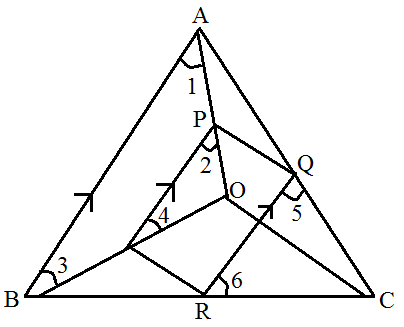
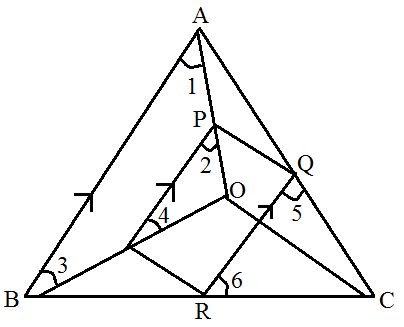
If PQRS is a parallelogram and AB || PS, then prove that OC || SR.
Answer
Given: In $\triangle\text{ABC},$ O is any point in the interior of $\triangle\text{ABC}.$ OA, OB, OC are joined. PQRS is a parallelogram such that P, Q, R and S lies on segments OA, AC, BC and OB and PS || AB.
To prove: OC || SR
Proof: In $\triangle\text{OAB}$ and $\triangle\text{OPS}$
$\text{PS}\parallel\text{AB}$ [Given]
$\therefore\angle1=\angle2$ [Corresponding angles]
$\therefore\angle3=\angle4$ [Corresponding angles]
$\therefore\triangle\text{OPS}\sim\triangle\text{OAB}$ [by AA similarity criterion]
$\Rightarrow\frac{\text{OP}}{\text{OA}}=\frac{\text{OS}}{\text{OB}}=\frac{\text{PS}}{\text{AB}}\ .....(\text{i})$
PQRS is a parallelogram so PS || QR. .......(ii)
QR || AB ....... (iii) [from (i), (ii)]
In $\triangle\text{CQR}$ and $\triangle\text{CAB},$
$\text{QR }\parallel\text{ AB}\ .....(\text{iii}) $
$\therefore\angle\text{CAB}=\angle5$ [Corresponding angle]
$\therefore\angle\text{CBA}=\angle6$ [Corresponding angle]
$\therefore\triangle\text{CQR}\sim\triangle\text{CAB}$ [by AA similarity criterion]
$\Rightarrow\frac{\text{CQ}}{\text{CA}}=\frac{\text{CR}}{\text{CB}}=\frac{\text{QR}}{\text{AB}}$
PQRS is a parallelogram.
$\therefore\text{PS }\parallel\text{ QR}$
$\therefore\frac{\text{PS}}{\text{AB}}=\frac{\text{CR}}{\text{CB}}=\frac{\text{CQ}}{\text{CA}}\ ......(\text{iv})$
$\Rightarrow\frac{\text{CR}}{\text{CB}}=\frac{\text{OS}}{\text{OB}}$ [from (i) and (iv)]
These are the ratios of two sides of $\triangle\text{BOC}$ and are equal so by converse of BPT, SR || OC.
Hence proved.
View full question & answer
Question 165 Marks
Prove that the area of the semicircle drawn on the hypotenuse of a right angled triangle is equal to the sum of the areas of the semicircles drawn on the other two sides of triangle.
Answer

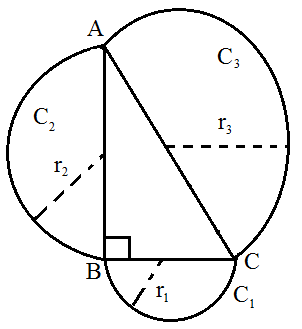
Given: $\triangle\text{ABC}$ is right angled at B. Three semi-circles taking as the sides BC, AB and AC of triangle ABC as diameter $C_1, C_2$ and $C_3$ are drawn.
To prove: Area of semicircles $(C_1 + C_2)$ = Area of semi-circle $C_3$
Proof: In $\triangle\text{ABC},$
$\angle\text{B}=90^\circ$
$\therefore$ $\text{BC}^2+\text{AB}^2+\text{} =\text{AC}^{2}$
$\Rightarrow (2\text{r}_{1})^{2} + (2\text{r}_{2})^{2} = (2\text{r}_{3})^{2}$
[From figure as BC, AB and AC are diameters]
$\Rightarrow 4(\text{r}_{1}^{2} + \text{r}^{2}_{2}) = 4\text{r}^{2}_{3} $
$\Rightarrow \text{r}^{2}_{1} + \text{r}^{2}_{2}+\text{r}^{2}_{3}$'
$\Rightarrow \frac{1}{2} \pi \text{r}_{1}^{2} + \frac{1}{2} \pi \text{r}_{2}^{2} = \frac{1}{2} \pi \text{r}_{3}^{2}$
$\operatorname{ar}\left(\right.$ semi-circle $\left.C_1\right)+\operatorname{ar}\left(\right.$ semi-circle $\left.C_2\right)=\operatorname{ar}\left(\right.$ semi-circle $\left.C_3\right)$
Hence, proved.
View full question & answer
Question 175 Marks
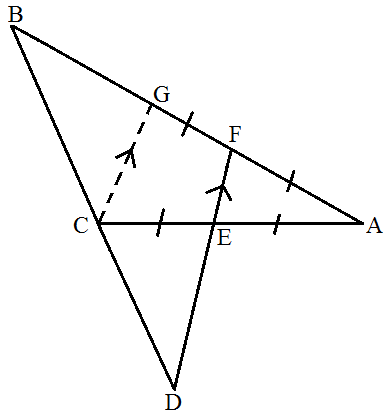
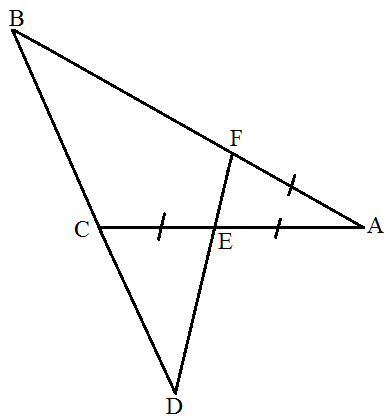
In line segment DF intersect the side AC of a triangle ABC at the point E such that E is the mid-point of CA and $\angle\text{AEF}=\angle\text{AFE}.$ Prove that $\frac{\text{BD}}{\text{CD}}=\frac{\text{BF}}{\text{CE}}.$
[Hint: Take point G on AB such that CG || DF]
Answer

In the given figure of $\triangle\text{ABC},$
EA = AF = EC
EF and BC meets at D.
To Prove: $\frac{\text{BD}}{\text{CD}}=\frac{\text{BF}}{\text{CE}}$
Construction: Draw CG || EF.
Proof: In $\triangle\text{ACG},\text{CG }\parallel\text{ EF}$
E is mid point at AC
F will be the mid point of AG.
⇒ FG = FA
⇒ EC = EA = AF [Given]
⇒ FG = FA = EA = EC .....(i)
In $\triangle\text{BCG}$ and BDF,
CG || EF [by construction]
$\therefore\frac{\text{BC}}{\text{CD}}=\frac{\text{BG}}{\text{GF}}$
$\Rightarrow\frac{\text{BC}}{\text{CD}}+1=\frac{\text{BG}}{\text{GF}}+1$
$\Rightarrow\frac{\text{BC}+{\text{CD}}}{\text{CD}}=\frac{\text{BG}+{\text{CD}}}{\text{GF}}$
$\Rightarrow\frac{\text{BD}}{\text{CD}}=\frac{\text{BF}}{\text{GF}}$
$\Rightarrow\text{FG}={\text{CE}}$ [From (i)]
$\Rightarrow\frac{\text{BD}}{\text{CD}}=\frac{\text{BF}}{\text{CE}}$
Hence, provede.
View full question & answer
Question 185 Marks
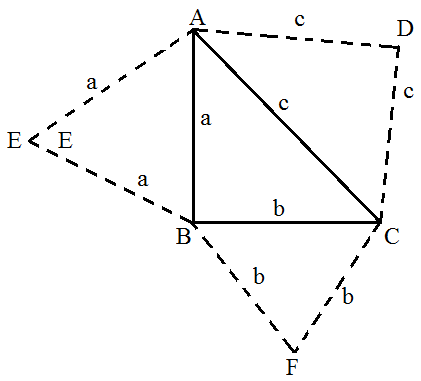
Prove that the area of the equilateral triangle drawn on the hypotenuse of a right angled triangle is equal to the sum of the areas of the equilateral triangles drawn on the other two sides of the triangle.
Answer

Given: A right triangle ABC.
Let AB = a, BC = b, AC = C and $\text{B}=\angle\text{90}^\circ$
Equilateral triangle with sides AB = a, BC = b and AC = C are drawn respectively.
To prove: Area of equilateral triangle with side hypotenuse (c) is equal to the area of equilateral triangle with side a and b.
$\text{or}\frac{\sqrt{3}}{4}\text{c}^2=\frac{\sqrt{3}}{4}\text{a}^2=\frac{\sqrt{3}}{4}\text{b}^2$
Proof: In $\triangle\text{ABC},$
$\angle\text{ABC}=90^\circ$ [Given]
$\therefore\text{AC}^2=\text{AB}^2+\text{BC}^2$ [by Pythagoras theorem]
$\Rightarrow\text{c}^2=\text{a}^2+\text{b}^2$
$\Rightarrow\frac{\sqrt{3}}{4}\text{c}^2=\frac{\sqrt{3}}{4}\text{a}^2=\frac{\sqrt{3}}{4}\text{b}^2$
[Multiplying by $\frac{\sqrt{3}}{4}$ to both sides]
(Area of equilateral $\triangle$ with side c) = (Area of equilateral $\triangle$ with side a) + (Area of equilateral $\triangle$ with side b)
Hence, the area of equilateral $\triangle$ With hypotenuse is equal to the sum Hence, proved.
View full question & answer
Question 195 Marks
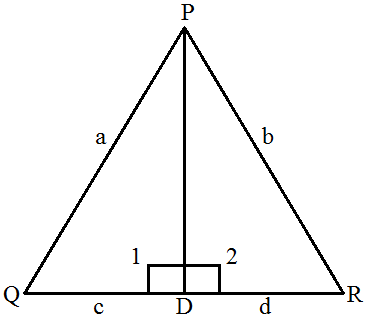
In $\triangle\text{PQR},\text{PD}\perp\text{QR}$ such that D lies on QR. If PQ = a, PR = b, QD = C and DR = d, prove that (a + b)(a - b)=(a + b)(c - d).
Answer

Given: In $\triangle\text{PQR},\text{PD}\perp\text{QR}$ so $\angle1=\angle2$
PQ = a, PR = b, QD = C and DR = d,
To prove: (a + b)(a - b) = (c + d)(c - d)
prove: In right angle $\triangle\text{PQR},$
$PD^2 = PQ^2 - QD^2$​​​​​​​ [by Pythagoras theorem]
$\Rightarrow PD^2 = a^2 - c^2 .......(i)$
Similarly, in right angled $\triangle\text{PQR},$
$PD^2 = PR^2 - DR^2$
$\Rightarrow PD^2 = b^2 - a^2 ......(ii)$
From (i) and (ii), we have
$a^2- c^2 = b^2 - d^2$
$\Rightarrow a^2 - b^2 = c^2 - d^2$
$\Rightarrow (a - b)(a + b) = (c - d)(c + d)$
Hence, proved.
View full question & answer
Question 205 Marks
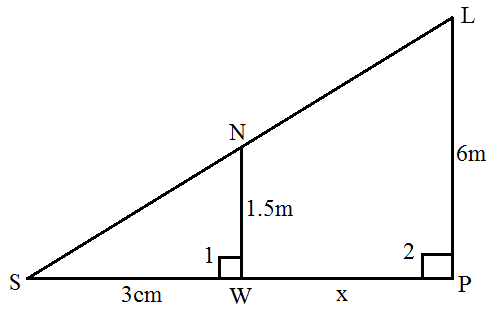
A street light bulb is fixed on a pole 6m above the level of the street. If a woman of height 1.5m casts a shadow of 3m, find how far she is away from the base of the pole.
Answer

In $\triangle\text{LPS}$ and $\triangle\text{NWS},$
Bulb L is fixed at a height of 6m above the road SP.
Woman and pole are vertical.
$\therefore\angle1=\angle2=90^\circ$
$\angle\text{S}=\angle\text{S}$ [Common]
$\therefore\triangle\text{LPS}\sim\triangle\text{NWS}$ [By AA similarity criterion]
$\Rightarrow\frac{\text{LP}}{\text{NW}}=\frac{\text{LS}}{\text{NS}}=\frac{\text{PS}}{\text{WS}}$
$\Rightarrow\frac{6\text{m}}{15\text{m}}=\frac{\text{LS}}{\text{NS}}=\frac{3+\text{x}}{3}$
$\Rightarrow\frac{6}{15}=\frac{3+\text{x}}{3}$
$\Rightarrow6\times3=1.5(3+\text{ x})$
$\Rightarrow18=4.5+1.5\text{x}$
$\Rightarrow1.5\text{x}=4.5-18$
$\Rightarrow1.5\text{x}=13.5$
$\Rightarrow\text{x}=\frac{13.5}{1.5}$
$\Rightarrow9\text{m}$
Hence, the woman is 9m away from the pole.
View full question & answer