Questions

5 Marks Questions

Take a timed test

31 questions · self-marked practice — reveal the answer and mark yourself.

Question 15 Marks
Find out from newspapers and popular science articles any new fossil discoveries or controversies about evolution.
Answer
Chimps are more evolved than humans (The Times of India):
Chimpanzees are more evolved than humans, a study suggests. There is no doubt that humans are the more advanced species. But a comparison of 14,000 human and chimpanzee genes shows the forces of natural selection have and the greatest impact on our ape cousins. The researchers' discovery challenges the common assumption that our large brains and high intelligence were the gifts of natural selection. Humans and chimps followed different evolutionary paths from a common ape ancestor about 5 million years ago. Both underwent changes as the fittest survived to pass their genes on to future generations. But the US study shows that humans possess a 'substantially smaller' number of positively-selected genes than chimps.
View full question & answer
Question 25 Marks
Using various resources such as your school Library or the internet and discussions with your teacher, trace the evolutionary stages of any one animal say horse.
Answer
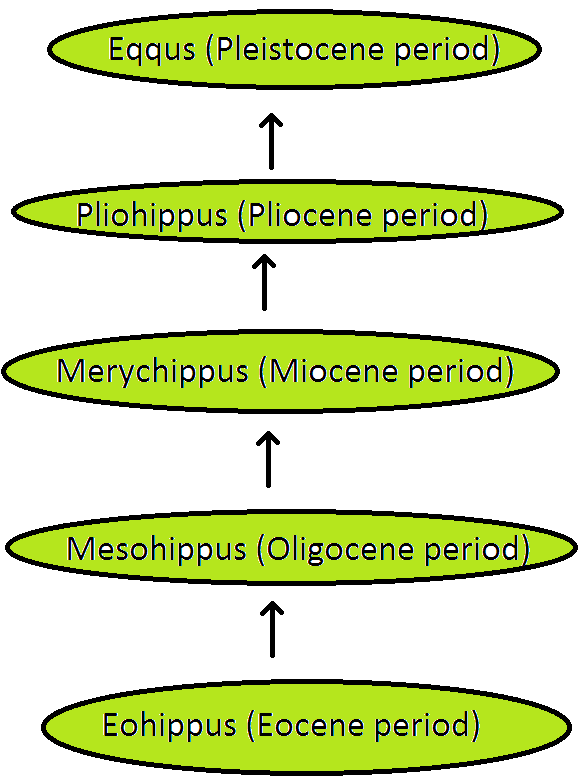
The evolution of horse started with Eohippus during Eocene period.
It involved the following evolutionary stages:
  • Gradual increase in body size.
  • Elongation of head and neck region.
  • Increase in the length of limbs and feet.
  • Gradual reduction of lateral digits.
  • Enlargement of third functional toe.
  • Strengthening of the back.
  • Development of brain and sensory organsn.
  • Crease in the complexity of teeth for feeding on grass.
The evolution of horse is represented as,
  1. Eohippus: It had a short head and neck. It had four functional toes and a splint of 1 and 5 on each hind limb and a splint of 1 and 3 in each forelimb. The molars were short crowned that were adapted for grinding the plant diet.
  2. Mesohippus: It was slightly taller than Eohippus. It had three toes in each foot.
  3. Merychippus: It had the size of approximately 100 cm. Although it still had three toes in each foot, but it could run on one toe. The side toe did not touch the ground. The molars were adapted for chewing the grass.
  4. Pliohippus: It resembled the modern horse and was around 108 cm tall. It had a single functional toe with splint of $2^{nd}$ and $4^{th}$ in each limb.​​​​​​​
  5. Equus: Pliohippus gave rise to Equus or the modern horse with one toe in each foot. They have incisors for cutting grass and molars for grinding food.​​​​​​​
View full question & answer
Question 35 Marks
Try to trace the various components of human evolution (hint: brain size and function, skeletal structure, dietary preference, etc.)
Answer
The various components of human evolution are as follows.
  1. Brain capacity.
  2. Posture iii. Food/ dietary preference and other important features.
 
Name
Brain capacity
Posture
Food
Features
1.
Dryopithec us africans
---
Knuckle walker, walked similar to gorillas and chimpanzees (was more ape-like)
soft fruit and leaves
Canines large, arms and legs are of equal size
2.
Ramapithe cus
-
-
-
Semi-erect (more man-like)
Seeds, nuts
Canines were small while molars were large.
3.
Australopit hecus africanus
$ 450 \mathrm{~cm}^3 $
Full erect posture, height (1.05 m)
Herbivor ous (ate fruits)
Hunted with stone weapons, lived at trees, canines and incisors were small.
4.
Homo habilis
$ 735 \mathrm{~cm}^3 $
Full erect posture, height (1.05 m)
Carniv orous
Canines were small. They were first tool makers.
5.
Homo erectus
$ 8001100 \mathrm{~cm}^3$
Full erect posture, height (1.5, 1.8 m)
Omniv orous
They used stone and bone tools for hunting games.
6.
Homo neandertha Insis
$13001600 \mathrm{~cm}^3$
Full erect posture, height (1.5-1.66 m)
Omniv orous
Cave dwellers, used hides to protect their bodies, and buried their dead.
View full question & answer
Question 45 Marks
List 10 modern-day animals and using the internet resources link it to a corresponding ancient fossil. Name both.
Answer
Animals Fossils
Man Homo Sapiens
Dog Leptocyon
Chimpanzee Dryopithecus
Elephant Moerither
Horse Eohippus
Gorilla Dryopithecus
Camel Protylopus
Whale Protocetus
Fish Arandaspis
Octopus Belemnite
View full question & answer
Question 55 Marks
Vicky's mother was using the same mosquito repellent cream from last six years. She was regularly complaining that this cream has no effects on mosquitoes now. Hearing this, Vicky advised his mother to change the cream as regular usage has led the mosquitoes to develop resistance against it. His mother changed the cream and could notice its effect on mosquitoes.
  1. Explain how mosquitoes were not affected by the previous cream?
  2. On what factors, Darwin's theory was based?
  3. Can you relate this incident to Darwin's concept? How?
  4. Identify the values shown by Vicky.
Answer
  1. Mosquitoes were not affected by the previous cream because they got adapted to the cream and became resistant.
  2. Darwin's theory was based on the fact the organisms which adapt well will survive more in nature and gets selected by nature through the mode of natural selection.
  3. Yes, the excess use of the cream leads to selection of mosquitoes in a short duration of time.
  4. Vicky is knowledegble, scientific and observant.
View full question & answer
Question 65 Marks
Ranjana and Shilpi had a hot argument whether or not life is still originating on the earth today. Their neighbour, Mr. Kamal Mishra, a retired professor, who happened to be listening to the girls, called them and explained the matter in detail.
  1. As a student of biology, what is your answer to the above problem? And why?
  2. Recall the experiment of Miller, which simulated the primitive atmosphere.
  1. What were the products obtained in his experiment?
  2. How was energy provided in the experiment?
  1. What would have been the energy source for origin of life on the earth?
  2. Indicate the values shown by Mr. Kamal Mishra?
Answer
  1. There is no origin of life on earth today, because:
  1. The atmosphere is oxidising and any molecule formed will be oxidized.
  2. Any molecule formed will be devoured by other organisms.
  1.  
  1. Amino acids
  2. Energy was provided
  • by an electric discharge.
  • by heating the water chamber.
  1. Sunlight, (UV-rays) and lightning (electrical discharges).
  2. His knowledge of the subject, desire to disseminate the knowledge and the concern for his neighbours.
View full question & answer
Question 75 Marks
What are the key concepts in the evolution theory of Darwin?
Answer
Branching descent and natural selection are the two key concepts of Darwinian Theory of Evolution.
  • The novelty and brilliant insight of Darwin was this: He asserted that variations, which are heritable and which make resource utilisation better for few (adapted to habitat better) will enable only those to reproduce and leave more progeny. Hence for a period of time, over many generations, survivors will leave more progeny and there would be a change in population characteristic and hence new forms appear to arise.
  • The fitness, according to Darwin, refers ultimately and only to reproductive fitness. Hence, those who are better fit in an environment, leave more progeny than others. These, therefore, will survive more and hence are selected by nature. He called it natural selection and implied it as a mechanism of evolution.
View full question & answer
Question 85 Marks
Samya visited a zoo with her mother, on watching the cheetah, she wondered how he uses his forelimbs for running. While the same forelimbs in bats are used for flying. She wanted to know more about it and so asked her mother (a biology teacher) about it. Her mother explained her how forelimbs are modified in different animal groups for different functions.
  1. What are such organs called?
  2. Give an example of such organs from the plant world.
  3. What led to the origin of such organs?
  4. What are the values shown by Samya?
Answer
  1. Such organs are called homologous organs, i.e. organs of different species which look different and perform different functions, but have the similar basic structure and embryonic origin.
  2. Thorns of Bougainvillea and tendrils of Cucurbita are homologous organs in plants.
  3. Divergent evolution.
  4. Samya is inquisitive, intelligent and observant.
View full question & answer
Question 95 Marks
During the biology class on theories of evolution, the teacher was telling about Lamarckism. Katy was confused after listening to it and went to her teacher to clear her doubts. She asked if characters can be passed to generations, then why she does not have the tatoo that her mother has on her arm. The teacher smiled and told Katy that this is the reason why Lamarck's theory was rejected. The teacher explained her the other theories as well.
  1. Name the book in which Lamarckism was explained.
  2. What are the three factors of this theory?
  3. What are the other theories of evolution?
  4. What are the values shown by teacher?
Answer
  1. Philosophie Zoologique in 1809.
  2.  
  1. New needs in respect to changing environment.
  2. Acquisition of characters.
  3. Inheritance of acquired characters.
  1. Other theories are:
  1. Darwin's theory of natural selection.
  2. de Vries mutation theory.
  3. Modern synthetic theory of evolution.
  1. The teacher was patient, knowledgeable and understanding.
View full question & answer
Question 105 Marks
State and explain any three factors affecting allele frequency in populations.
Answer
Following are the three out of five factors which affect allele frequency in populations:
  1. Genetic Drift: The change in the frequency of a gene variant in a population due to random sampling is called genetic drift. Genetic drift may cause a gene variant to disappear completely and result in reduced genetic variation.
  2. Genetic Recombination: Production of offspring with traits which differ from parents is called genetic recombination.
  3. Natural Selection: This theory is based on the premise that nature selects only those traits which help an organism to survive in the changed conditions. Natural selection leads to survival of the fittest. Those which are not fit to survive perish in the long run; paving the way for evolution of a new species.
View full question & answer
Question 115 Marks
How do you express the meaning of words like race, breed, cultivars or variety?
Answer
Race: A race is an informal taxon and is kept below the species. This means that members from different races of the same species can interbreed.Breed: A breed is a specific group of domestic animals which are homogenous in appearance. This homogeneity has been achieved through selective breeding.
Cultivar: A selected group of plants which can be raised through vegetative propagation is called cultivar.
Variety: Variety is similar to a race but is used for the plants. Thus, a variety is an informal taxon which is kept below the species in the plant kingdom.
View full question & answer
Question 125 Marks
We are told that evolution is a continuing phenomenon for all living things. Are humans also evolving? Justify your answer.
Answer
Some scientists have been studying this aspect of human evolution and have come with interesting observations which suggest the evolution is indeed taking place in modern humans. Some of the observations are as follows:
  • Human evolution has accelerated since the discovery of farming about 10,000 years ago. There is substantial genetic difference between hunter gatherers and current humans.
  • Human reproductive period has prolonged than it was 10,000 years ago. Earlier, the average life expectancy of human beings was about 30 years which is now more than double.
  • Lactase persistence into adulthood is another sign of human evolution. All other mammals develop lactose intolerance because young ones are weaned away from mother’s milk after a certain age. Unlike humans; other mammals do not have the facility to consume other mammal’s milk. But human beings consume milk throughout their life because they get it from domesticated animals.
  • Humans have also developed resistance to many infectious diseases. This is another sign of evolution.
However, evolution of modern humans cannot happen through geographical isolation because modern means of transport has blurred geographical boundaries. But evolution can happen because of genetic drift.
View full question & answer
Question 135 Marks
  1. Explain Darwinian theory of evolution with the help of one suitable example.
  2. State the two key concepts of the theory.
  3. Amongst pea tendril, Opuntia spines, lemon thorn and Cucurbita tendrils, which ones are homologous structures. Why do you call them so?
Answer
  1. Any population has built in variation for every character.
Individuals with those characters which enable them to survive better in the given environment, would outbreed the others, who are less adapted. Fitness, according to Darwin, is reproductive fitness, i.e. individuals who are more fit in an environment leave more progeny than others.

These progenies survive better and more and more fit individuals are added to the population, i.e. natural selection.

The population thus comes to possess more fit individuals, i.e. nature selects the better fit invididuals and over a long period of time, through a number of generations, the population slowly becomes modified into a different form or a species, in the process called evolution, e.g. evolution of DDT-resistant mosquitoes.
  1. The two key concepts of Darwinian theory are:
  • Branching descent.
  • Natural selection.
  1.  
  • Lemon thorn and Cucurbita tendrils are homologous-as both are stem modified
  • Opuntia spines and pea tendrils are homologousas both are leaf modifications.
  • Homologous organs are those organs in different groups of organisms, that are similar in basic structural and developmental patterns, but perform different functions and are superficially distinct.
View full question & answer
Question 145 Marks
  1. List any four evidences of evolution.
  2. Explain any one of the evidences that helps to understand the concept of evolution.
Answer
  1. Evidences that evolution of life forms took place on earth came from palaeontology, comparative anatomy and morphology, biochemical evidences and biogeographical evidences.
  2. Palaeontological Evidences: Palaeontology is the study of fossils (i.e. remains of hard pans of life forms found in rocks). Rocks form sediments and a cross-section of the earth's crust depicts the arrangement of these sediments one over the other, during the long history of earth. Sediments of different aged rocks contain fossils of different life forms that lived and died during the formation of a particular segment. Some of them appear similar to modern organisms. They represent extinct organisms, like dinosaurs. The study of fossil in different sedimentary layers indicates the geological period in which they existed, the life forms varied over time and life forms that are restricted to certain geological time scale. Hence, new forms of life have evolved at different times in the history of earth. All this forms palaeontological evidence. The ages of these fossils are estimated by using methods like radiocarbon dating.
View full question & answer
Question 155 Marks
Write about the various theories of evolution.
Answer
Main theories of evolution are:
  1. Lamarckism or Theory of Inheritance of Acquired characters.
  2. Darwinism or Theory of Natural Selection.
  3. Mutation theory of De Vries.
  4. Neo-Darwinism or Modern concept or Synthetic theory of evolution.
View full question & answer
Question 165 Marks
  1. How did Hardy-Weinberg explain that allelic frequencies in a population are stable and are constant from generation to generation?
  2. Why does genetic equilibrium get disturbed in a population? Give reasons.
Answer
  1. The sum total of allelic frequencies in a stable population is 1.
  1. Individual frequencies of alleles A and a can be taken as p and q, i.e., the frequencies of AA in the population is $p^2$, of aa is $q^2$ and that of Aa is 2pq.
  2. Hence, $p^2+2 p q+q^2=1$
  3. When the frequency actually measured differs from the expected values, the difference indicates the extent of evolutionary change.
  1. Genetic equilibrium is disturbed by following factors-
  1. Gene migration.
  2. Genetic drift.
  3. Mutation.
  4. Gene recombination during gamete formation.
View full question & answer
Question 175 Marks
Fitness is the end result of the ability to adapt and get selected by nature. Explain with suitable example.
Answer
  1. Fitness, according to Darwin, refers ultimately and only to reproductive fitness.
  2. Those individuals who are better fit in an environment leave more progeny than the others; the population comes to possess more fit individuals, as nature selects for fitness.
  3. The so-called fitness is based on characteristics which are inherited; hence there must be a genetic basis for getting selected and to evolve.
  4. In other words, adaptive ability is inherited and has a genetic basis; fitness is the ability to adapt and get selected by nature.
View full question & answer
Question 185 Marks
Show that Darwin's natural selection is based on theoretical factual observations, with an example for each.
Answer
Industrial Melanism: Industrial melanism in peppered moth (Biston betularia) is an example of natural selection. In England, 1850s before industrialisation there were more white-winged moths on trees than dark-winged or melanic forms. But after industrialisation, i.e. in 1920, dark-winged moths became more than white-winged moths. This is because during industrialisation, the tree trunks covered by white lichens became dark due to air pollution (dust and soot particles). Due to this, white-winged moths could be easily seen and eaten by the predators as they failed in camouflaging (hide or disguise the presence of a person, animal or object). This shows that in a mixed population, those that can adapt, survive better and increase their population size.
Chemical Resistance: It is another example of natural selection. The excess use of herbicides and pesticides leads to selection of resistant varieties of microbes in very less time. Likewise due to these anthropogenic actions antibiotic resistant bacteria are also appearing now-a-days. The above said industrial melanism and chemical resistance are also examples of evolution by anthoropogenic action. This tells us that evolution is a stochastic process, based on chance events in nature and chance mutation in the organism.
View full question & answer
Question 195 Marks
Describe Miller and Urey’s experiment, along with the product obtained. What is the significance of this experiment?
Answer
Experimental evidence of chemical evolution/ Miller’s experiment:
  • Experiment was performed by S.L. Miller and H.C. Urey in 1953.
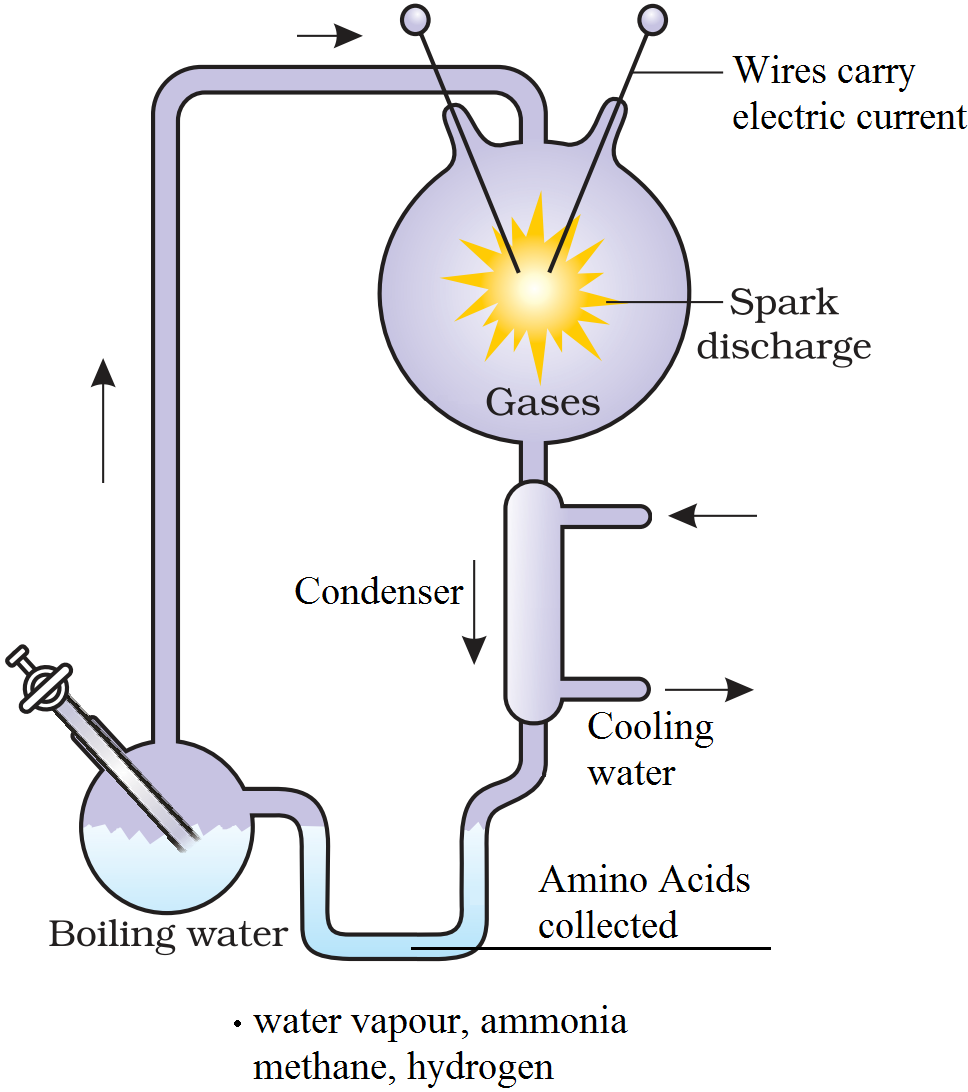
  • Experimental set-up: In a closed flask containing $\mathrm{CH}_4, \mathrm{H}_2, \mathrm{NH}_3$ and water vapour at 800°C, electric discharge was created. The conditions were similar to those in primitive atmosphere.
  • Observations: After a week, they observed presence of amino acids and complex molecules like sugars, nitrogen bases, pigments and fats in the flask.
  • Conclusions:
  1. It provides experimental evidence for the theory of chemical origin.
  2. It showed that the first non-cellular form of life was created about 3 billion years ago.
  3. It showed that non-cellular biomolecules exist in the form of DNA, RNA, polysaccharides and protein.
View full question & answer
Question 205 Marks
Trace the origin and evolution of Man.
Answer
Evolution of Man:
S. NO
Human Ancestors
Time of Origin
General FeaturesGeneral Features
(i)
Dryopithecus
25 mya
Ape-like, hairy, arms and legs of same length, large brain, ate soft fruits and leaves, walked like gorillas and chimpanzees.
(ii)
Ramapithecus
15 mya
More man-like, walked more erect, teeth like modern man.
(iii)
Australopithecus
2 mya
Fossils found in Tanzania and Ethiopia, man-like primates, 4 feet tall, walked upright, ate fruit, hunted with stone weapons, brain capacity was 400–600 cc.
(iv)
Homo habilis
2 mya
Fossils found in East Africa, first human-like being, brain
capacity 650–800 cc, did not eat meat.
(v)
Homo erectus(Java man)
1.5 mya
Fossils found in Java, brain capacity 900 cc, ate meat.
(vi)
Homo sapiensneanderthalensis(Neanderthal man)
100,000 - 40,000year ago
Fossils found in east and central Asia, brain size 1400 cc, used hides to protect body, buried their dead.
(vii)
Homo sapiens(Modern man)
75,000 - 10,000years ago
Developed cave art, agriculture, started human civilisation.
View full question & answer
Question 215 Marks
List 10 modern day animals and using the various resources available link it to a corresponding ancient fossil. Name both of them.
Answer
Animal Ancient Fossil
Horse Pliohippus
Camel procamelus
Elephant Stegolophodon
Octopus Belemnite
Nautilus Gyrouros
Gibbon Propliopithecus
Orangutan Dryopithecus
Man Homo sapiens neanderthalensis
Chimpanzee Dryopithecus
Gorilla Dryopithecus
View full question & answer
Question 225 Marks
Explain the process of divergent evolution in detail. Also, write down the driving force behind it.
Answer
Divergent evolution is the evolution of a number of different forms of animals or plants froms of a common ancestral form. The driving force behind, it is adaptations to newly involved habitat and the prevailing environmental conditions there. As the original population increases in size, it spreads out from its centre of origin to exploit new habitas and food resources. In this results in a number of populations each adapted to its particular habitat eventually these populations will differ from each other sufficiently to become new species. A good example of this process is the evolution of the Australian marsupials into species adapted as carnivores, herbivores, burrowers, fliers, etc. Another example is that of peritadactyl limb in mammals.
View full question & answer
Question 235 Marks
Two organisms occupying a particular geographical area (say desert) show similar adaptive strategies. Taking examples, describe the phenomenon.
Answer
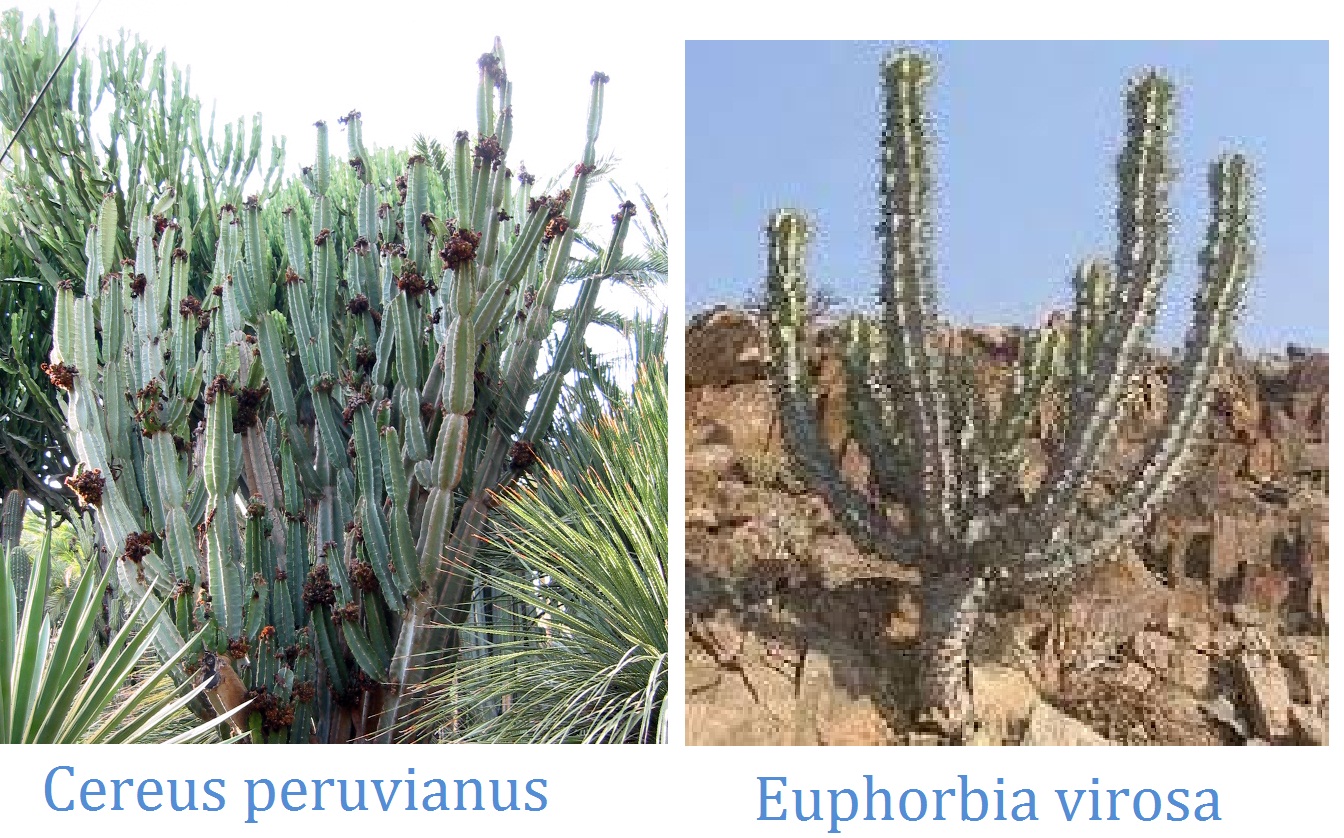
When two organisms in a particular geographical area show similar adaptive strategies, this is called convergent evolution. Many desert plants show convergent evolution in spite of the fact that they are not closely related. Cereus peruvianus is a species of cactus which is primarily found in the South America. Euphorbia virosa is found in most parts of the world.
Both the plants are unrelated but show similar adaptations in order to conserve water. Following are some similarities in them:
  • Stem is modified into fleshy succulent greenish parts which store water and carry out photosynthesis.
  • Leaves are modified into spines in order to prevent water loss through transpiration.
  • Roots penetrate much deeper in the ground to access water.
These examples show analogous organs which are manifestations of convergent evolution.
View full question & answer
Question 245 Marks
You have studied the story of Pepper moths in England. Had the industries been removed, what impact could it have on the moth population? Discuss.
Answer
Before industrialisation population of white-winged moths was more than the black-winged moth. This is because white wings of moth helped them in camouflaging. Thus, they were not picked by the predators and survived. But dark-winged moths were picked up by the predators due to their contrasting colour.
When lichens did not survive and tree trunks become dark because of industrial smoke or soot. This resulted in better chances of survival of dark wings in moths. This showed that evolution is apparently reversible. The same theory would apply when industries will be removed. Removal of industries would help in bringing down population level. This will help in lichens to once again flourish on tree trunks and the tree trunks will gain a whitish layer of lichens. This will result in survival of more white wings in the moths.
View full question & answer
Question 255 Marks
Describe the evidence of evolution from comparative anatomy and morphology?
Answer
Morphological and comparative anatomical evidences:
  • The phylogenetic history can be revealed by comparative study of external and internal structures.
  • The organs with same structural design and origin but different functions are called homologous organs. For example, the forelimbs of some animals like whales, bats and cheetah have similar anatomical structure, i.e., humerus, radius, ulna, carpals, metacarpals and phalanges.
  • Due to different needs, some structures developed differently. This is called divergent evolution.
  • Other examples include vertebrate hearts or brains in animals; thorn and tendrils of Bougainvillea and cucurbita in plants.
  • The organs which are anatomically different but functionally similar are called analogous organs. For example, wings of butterfly and birds.
  • Due to same function, different structures evolve similarly. This is called convergent evolution.
  • Other examples include eye of octopus and mammals; flippers of penguins and dolphins; sweet potato (root modification) and potato (stem modification).
View full question & answer
Question 265 Marks
  1. Explain taking one example of vertebrates anatomy that evolution of life has occurred on earth.
  2. 'Nature selects for fittest.' Explain with suitable examples.
Answer
  1. The forelimbs of cheetah, bats and human have a similar anatomical structure. These have bones, humerus, radius, ulna, carpals, metacarpals and phalanges. It indicates divergent evolution, where the same structure has developed along different directions as adaption to different needs. Such structures are called homologous organs and homology indicates common ancestry.
  2. The members of a population vary in characteristics even though they look similar. The population will increase exponentially but the natural resources are limited leading to more competition. The individuals which are fit and adapt themselves are able to survive. They grow reproduce and survive. This is called natural selection by Darwin.
View full question & answer
Question 275 Marks
Show that Darwin’s natural selection is based on natural observation, with an example for each.
Answer
  1. The resources of the nature are limited, so the size of population of a species is limited.
  2. The size of the population is fixed, except for some seasonal fluctuations.
  3. Each and every member of a population shows variation for every character.
  4. It is found in microbial or bacterial population growing in a culture that if everybody in a population reproduces to its maximum capacity, the population will grow exponentially.
  5. The population size in an ecosystem is limited–due to competition among individuals for limited resources and only those fit individuals utilise the resources at the cost of other to reproduce. Darwin suggested that nature creates some pressure on the population which eliminates some individuals and some better adapted ones survive. This natural pressure at each and every generation creates some small variation in a population, accumulation of which for many generations leads to origin of new species.
View full question & answer
Question 285 Marks
  1. How does the study of fossils help to understand evolution?
  2. How did SL Miller provide an experimental evidence in favour of Oparin and Haldane's hypothesis? Explain.
Answer
  1. Fossils help in tracing the organic evolution in following ways:
  1. Fossils represent modes of preservation of ancient species.
  2. Fossils help in establishing evolutionary traits among organisms and their ancestors.
  3. Fossils help in establishing the time period in which organisms lived.
  4. Fossils provide good evidence of the structure and lifestyle of animals (and even plants) from the past.
  5. They provide a record of the remains of long-extinct species.
  1. Miller Urey Experiment:
Miller and Urey were two scientists who believed Oparin and Haldane and wanted to prove their theory. So, they performed the famous ‘Miller- Urey experiment’ in the lab.
  • They replicated the environmental and atmospheric conditions that may have existed in the primitive earth in their lab by taking gases like methane, ammonia, hydrogen and water vapour in a closed vessel.
  • When they came back to check the results of their experiment after a week, they detected the presence of amino acids, nitrogen bases, fats, and sugar.
  • With these results, the theory of gradual chemical evolution was accepted.
  • This experiment gave the other scientists to piece the remaining pieces together.
View full question & answer
Question 295 Marks
State the modifications of forelimb in animals as an example of homology.
Answer
The forelimb of vertebrates are pentadactyl, i.e. consist of same bones humerus, radius, ulna, carpals, metacarpals and phalanges, but differ in their function in different organisms The forelimbs of the following animals got modified as shown below.
  1. Whale are modified for swimming.
  2. Bat and bird are modified for flying.
  3. Horse are modified for running.
  4. Frog are modified for leaping.
  5. Man are modified for grasping. This indicates common ancestry and homology based on divergent evolution.
View full question & answer
Question 305 Marks
Name the law that states that the sum of allelic frequencies in a population remains constant. What are the five factors that influence these values?
Answer
Hardy weinberg principle: This principle says that the sum of allelic frequencies in a population remains constant and remains the same through generations. The sum total of allelic frequencies in a population is 1. If p represents the frequency of allele A and q represents the frequency of allele a then in a diploid individual the frequency of allele AA can be shown by $p^2$ and that of allele aa can be shown by $q^2$ Additionally, frequency of alleles Aa can be shown by 2pq. This can be shown by the following equation which is derived from the algebraic identity $(p+q)^2=p^2+2 p q+q^2=1$
When a measured frequency differs from this value; it indicates the extent of evolutionary change.
Following five factors influence these values:
  1. Gene migration or gene flow.
  2. Genetic drift.
  3. Genetic recombination.
  4. Mutation.
  5. Natural selection.
View full question & answer
Question 315 Marks
Had Darwin been aware of Mendel’s work, would he been able to explain the origin of variations. Discuss.
Answer
Mendel conducted a series of experiments on pea plants to come out with his theories on variations. For this, Mendel observed reproduction of pea plants for many generations and tabulated and analysed those findings. He could attribute the origin of variations to some ‘factors’ which may have been present in the organism. At that time, scientists did not know about genes.
Darwin was about 10 years older than Mendel and hence it can be said that he was born in the same era. He would have had access to same technology and information as Mendel had. Moreover, he was on an exploration in which conducting a Mendelian experiment could not have been possible. While Mendel’s study was focused on a single species; Darwin’s study was encompassing much wider scope, i.e. of almost the whole species present at that time. Their respective goals of study were also entirely different.
There is least likelihood that Darwin would have been able to explain the origin of variations.
View full question & answer