MCQ 11 Mark
Hardening of leather in tanning industry is based on:
Answer
- The chemical used in process of tanning is known as Tannin.
- It contains negatively charged colloidal particles whereas leather contains positively charged colloidal particles.
- When the leather is soaked in tannin, due to the difference in charges, mutual coagulation occurs.
- This coagulation results in the hardening of the leather after tanning process.
View full question & answer→MCQ 21 Mark
Which of the following statements regarding catalyst is not true?
- A
A catalyst remains uncharged in composition and quantity at the end of the reaction.
- ✓
A catalyst can initiate a reaction.
- C
A catalyst does not alter the equilibrium in a reversible reaction.
- D
Catalysts are sometimes very specific in respect of reaction.
AnswerCorrect option: B. A catalyst can initiate a reaction.
A catalyst is a substance, which increases the rate of reaction without itself being consumed at the end of the reaction, and the phenomenon is called catalysis. There are some catalysts which decrease the rate of reaction and such catalysts are called negative catalyst. Obviously, the catalyst accelerating the rate will be positive catalyst. However, the term positive is seldom used and catalyst itself implies positive catalyst. Catalysts are generally foreign substances but sometimes one of the product formed may act as a catalyst and such a catalyst is called "auto catalyst" and the phenomenon is called auto catalysis.
View full question & answer→MCQ 31 Mark
Cow milk, an example of natural emulsion is stabilised by:
MCQ 41 Mark
The stabilizer used in the preparation of colloidal sol of mercury and sulphur is:
- A
- B
- C
$\text{KOH}.$
- ✓
Both $A$ and $B.$
AnswerCorrect option: D. Both $A$ and $B.$
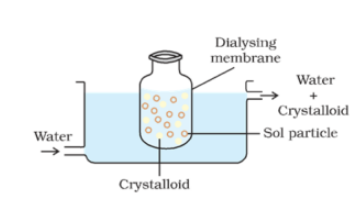
A colloidal solution of certain elements such as mercury and sulphur are obtained by passing their vapours through cold water containing a stabilizer $($an ammonium salt or a citrate$).$
View full question & answer→MCQ 51 Mark
An example of autocatalytic reaction is:
AnswerCorrect option: A. Decomposition of nitroglycerine.
A chemical reaction is called autocatalytic if at least one of the reaction products acts as a catalyst in the same or in one of the coupled reactions. $\mathrm{N}_2$ is one of the products of decomposition of nitroglycerine plays the role of an autocatalyst.
View full question & answer→MCQ 61 Mark
Cleansing action of soap occurs because:
- ✓
Oil and grease can be absorbed into the hydrophobic centres of soap micelles and washed away.
- B
Oil and grease can be absorbed into hydrophilic centres of soap micelles and washed away.
- C
Oil and grease can be absorbed into both hydrophilic and hydrophobic centres but cannot be washed away.
- D
Cleansing action is not related to micelles.
AnswerCorrect option: A. Oil and grease can be absorbed into the hydrophobic centres of soap micelles and washed away.
View full question & answer→MCQ 71 Mark
- A
Sodium salts of fatty acids.
- B
Potassium salts of fatty acids, containing excess of free alkali.
- ✓
Potassium salts of fatty acids, containing no free alkali.
- D
Calcium salts of fatty acids.
AnswerCorrect option: C. Potassium salts of fatty acids, containing no free alkali.
Potassium salts of fatty acids, containing no free alkali, are called soft soaps.
View full question & answer→MCQ 81 Mark
- ✓
A solid dispersed in a liquid.
- B
A liquid dispersed in a gas.
- C
A gas dispersed in a liquid.
- D
A gas dispersed in a solid.
AnswerCorrect option: A. A solid dispersed in a liquid.
Sol is a colloidal suspension when a solid is dispersed in a liquid.
An example of sol is a gel, blood, paint, etc.
A liquid is dispersed in a gas called aerosols.
A gas dispersed in liquid or solid called foam.
View full question & answer→MCQ 91 Mark
The moles of $\text{HCl}$ required to neutralise left $NH_3$ solution after adsorption is:
- A
$0.123$
- ✓
$0.175$
- C
$0.145$
- D
$0.153$
AnswerCorrect option: B. $0.175$
Total moles of $NH_3$ adsorbed on surface$=\frac{1.415\times10^{22}}{6.023\times10^{23}}=0.0235$
Moles of $NH_3$ before adsorption$=\frac{100\times2}{1000}=0.2.$
So, moles of $NH_3$ left after adosrption $=$ moles of $\text{HCl}$ required $= 0.2 − 0.0235 = 0.175.$
View full question & answer→MCQ 101 Mark
Burning of coal is represented as $\mathrm{C}(\mathrm{s})+\mathrm{O}_2(\mathrm{\sim g}) \rightarrow \mathrm{CO}_2(\mathrm{\sim g})$ The rate of this reaction is increased by:
- A
Decreasing in the concentration of oxygen.
- ✓
Powdering the lumps of coal.
- C
Decreasing the temperature of coal.
- D
Providing inert atmosphere.
AnswerCorrect option: B. Powdering the lumps of coal.
$\text{FACTORS AFFECTING THE RATE OF REACTION}:$
$(i)$ Concentration: Law of mass action enunciates that greater is the conc. of the reactants, the more rapidly the reaction proceeds.
$(ii)$ Pressure $($Gaseous reaction$):$ On increasing the pressure, volume decreases and conc. increases and hence the rate increases.
$(iii)$ Temperature: It is generally observed that rise in temperature increases the reaction rate.
$(iv)$ Nature of the reactants: The rate depends upon specific bonds involved and hence on the nature of reactants.
$(v)$ Surface area of the reactants: In heterogeneous reactions, more powdered is the form of reactants, more is the velocity$. [$as more active centres are provided$]$
View full question & answer→MCQ 111 Mark
Which of the following is incorrect for physisorption?
- A
- ✓
Increases with increase in temperature.
- C
- D
Increases with increase in surface area.
AnswerCorrect option: B. Increases with increase in temperature.
Since the adsorption process is exothermic, the physical adsorption occurs readily at low temperature and decreases with increase in temperature $($Le$-$Chatelier's principle$).$
View full question & answer→MCQ 121 Mark
Which of the following is not a favourable condition for physical adsorption?
AnswerHigh temperature is not favourable for physical adsorption since it is an exothermic process.
View full question & answer→MCQ 131 Mark
Which metal is used as a catalyst in the hydrogenation of oils?
AnswerRaney Nickel is used as a catalyst in the hydrogenation of oils.Hydrogenation $–$ to treat with hydrogen $–$ is a chemical reaction between molecular hydrogen $(H_2)$ and another compound or element, usually in the presence of a catalyst such as nickel, palladium or platinum. The process is commonly employed to reduce or saturate organic compounds.
View full question & answer→MCQ 141 Mark
Freshly prepared precipitate sometimes gets converted to colloidal solution by $........$
AnswerPeptisation is the process of converting freshly prepared precipitate into colloid.
View full question & answer→MCQ 151 Mark
The emulsifying agent used in $o/ w$ emulsion is:
- ✓
- B
- C
- D
Heavy metal salts of fatty acids.
AnswerThe emulsifying agent used in oil in water emulsion is protein. Milk is an example of oil in water emulsion. It consists of liquid fat dispersed in water. Milk proteins act as an emulsifying agent.
View full question & answer→MCQ 161 Mark
To which of the following category does ice-cream belong?
AnswerAn emulsion is a colloid of two or more immiscible liquids where one liquid contains a dispersion of the other liquids. In other words, an emulsion is a special type of mixture made by combining two liquids that normally don't mix.
Oil and water mixtures are emulsions when shaken together. The oil will form drops and disperse throughout the water.
View full question & answer→MCQ 171 Mark
The catalyst used in making $\mathrm{H}_2 \mathrm{SO}_4$ in contact process is:
- ✓
$ \mathrm{V}_2 \mathrm{O}_5 $
- B
$ \mathrm{Fe}_2 \mathrm{O}_3 $
- C
$ \mathrm{Cr}_2 \mathrm{O}_3 $
- D
$ \mathrm{CrO}_3 $
AnswerCorrect option: A. $ \mathrm{V}_2 \mathrm{O}_5 $
The contact process is the current method of producing sulfuric acid in the high concentrations needed for industrial processes. Platinum used to be the catalyst for this reaction. However, as it is susceptible to reacting.
View full question & answer→MCQ 181 Mark
The catalyst used in preparation of oxygen from hydrogen peroxide is:
AnswerManganese dioxide lowers the activation energy which makes the reaction of decomposition of hydrogen peroxide to oxygen fast. It allows more molecules of $H_2O_2$ to undergo decomposition in a shorter period of time.
Balanced chemical equation of reaction is:
$2\text{H}_2\text{O}_2(\text{aq})\rightarrow{\text{MnO}_2(\text{s})}2\text{H}_2\text{O(l)+O}_2(\text{g})$
View full question & answer→MCQ 191 Mark
An emulsifier is a substance:
- ✓
which stabilises an emulsion.
- B
which breaks the emulsion into its constituent liquids.
- C
which can convert liquid into an emulsion.
- D
which bring about coagulation of an emulsion.
AnswerCorrect option: A. which stabilises an emulsion.
An emulsifier is a substance that acts as a stabilizer in an emulsion and prevents the mixing of two solutions.
An emulsifier has a water$-$loving hydrophilic head and an oil$-$loving hydrophobic tail.
The hydrophilic head is for the aqueous phase and the hydrophobic tail is for the oil phase.
e.g. lecithin.
View full question & answer→MCQ 201 Mark
The efficiency of an enzyme in catalyzing a reaction is due to its capacity $.......$
AnswerCorrect option: D. To lower the activation energy of the reaction.
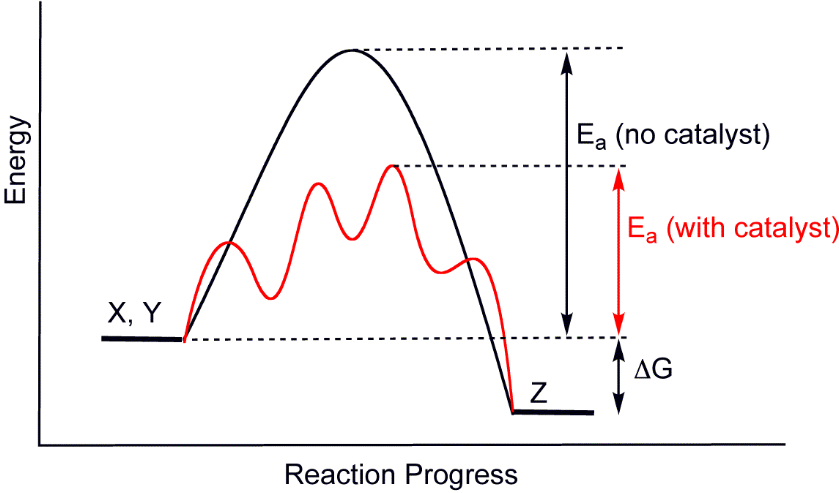
A catalyst is a substance, which increases the rate of reaction without itself being consumed at the end of the reaction, and the phenomenon is called catalysis. There are some catalysts which decrease the rate of reaction and such catalysts are called negative catalyst. Obviously, the catalyst accelerating the rate will be positive catalyst. However, the term positive is seldom used and catalyst itself implies positive catalyst. Enzymes acts as catalyst for biological process and lower activation energy and it increases efficiency.
View full question & answer→MCQ 211 Mark
The process of passing of a precipitate into colloidal solution, on adding an electrolyte is called:
AnswerThe process of formation or conversion of a precipitate into a colloidal solution is called peptisation.
View full question & answer→MCQ 221 Mark
The values of colligative properties of colloidal solution are of small order in comparison to those shown by true solutions of same concentration because of colloidal particles $.......$
- A
Exhibit enormous surface area.
- B
Remain suspended in the dispersion medium.
- C
- ✓
Are comparatively less in number
AnswerCorrect option: D. Are comparatively less in number
Colloidal particles being bigger aggregates, the number of particles in a colloidal solution is comparatively small as compared to a true solution. Hence, the values of colligative properties $($osmotic pressure, lowering in vapour pressure, depression in freezing point and elevation in boiling point$)$ are of small order as compared to values shown by true solutions at same concentration.
View full question & answer→MCQ 231 Mark
Hydrophobic is another name for a substance which:
AnswerHydrophobic is another name for a substance which bonds weakly to water. Hydrophobic means " water fearing". These compounds do not dissolve easily in water, and are usually non$-$polar. Oils and other long hydrocarbons are hydrophobic.
View full question & answer→MCQ 241 Mark
The substance added to increase the stability of a lyophobic sol are called:
AnswerStabilizers are the substance that are added in lyophobic sols to increase their stability.
Examples of stabilizers are an ammonium salt and a citrate.
View full question & answer→MCQ 251 Mark
The physical adsorption of gases on the solid surface is due to:
AnswerWhen the force of attraction existing between adsorbate and adsorbent are weak Vanderwaal forces of attraction, the process is called Physical Adsorption or Physisorption. When the force of attraction existing between adsorbate and adsorbent are chemical forces of attraction or chemical bond, the process is called Chemical Adsorption.
View full question & answer→MCQ 261 Mark
Which of the following process is not responsible for the presence of electric charge on the sol particles?
- A
Electron capture by sol particles.
- B
Adsorption of ionic species from solution.
- C
Formation of Helmholtz electrical double layer.
- ✓
Absorption of ionic species from solution.
AnswerCorrect option: D. Absorption of ionic species from solution.
The charge on the sol particles is due to one or more reasons, Viz.,
- Due to electron capture by sol particles during electro dispersion of metals.
- Due to preferential adsorption of ions from solution and/or.
- Due to formulation of electrical double layer.
View full question & answer→MCQ 271 Mark
On the basis of data given below predict which of the following gases shows least adsorption on a definite amount of charcoal?
| Gas |
$\text{CO}_2$ |
$\text{SO}_2$ |
$\text{CH}_4$ |
$\text{H}_2$ |
| Critical temp$./K$ |
$304$ |
$630$ |
$190$ |
$33$ |
- A
$\text{CO}_2$
- B
$\text{SO}_2$
- C
$\text{CH}_4$
- ✓
$\text{H}_2$
AnswerCorrect option: D. $\text{H}_2$
The lesser the value of critical temperature of gases the lesser will be the extent of adsorption. Here $H_2$ has lowest value of critical temperature, i.e.$, 33.$
Hence, hydrogen gas shows least adsorption on a definite amount of charcoal.
View full question & answer→MCQ 281 Mark
Tanning of leather is the:
- A
Colouring of leather by chemicals.
- B
Drying process to make the leather hard.
- C
Polishing of leather to make it look attractive.
- ✓
Coagulative hardening of the leather by chemicals.
AnswerCorrect option: D. Coagulative hardening of the leather by chemicals.
Tanning is the process that converts the protein of the raw hide or skin into a stable material which will not putrefy and is suitable for a wide variety of end applications. The principal difference between raw hides and tanned hides is that raw hides dry out to form a hard inflexible material that can putrefy when re$-$wetted $($wetted back$),$ while tanned material dries out to a flexible form that does not become putrid when wetted back. A large number of different tanning methods and materials can be used. The choice is ultimately dependent on the end application of the leather. The most commonly used tanning material is chromium, which leaves the leather, once tanned, a pale blue colour $($due to the chromium$),$ this product is commonly called wet blue.
View full question & answer→MCQ 291 Mark
Which of the following rules states that with the increase of every $10^\circ$C temperature the rate of metabolic activity gets doubled?
AnswerVan't Hoff's rule states that the velocity or the metabolic activity is doubled for every rise of $10^\circ$C in temperature.
Bergmann's rule states that species of larger size are found in colder environments and species of smaller size are found in warmer environments.
Allen's rule states that body form is linear in warm climates and more rounded and compact in cold climates. Round body shapes give a smaller surface area to volume ratio.
Jordon's rule states that fin ray, vertebrae or scale numbers increase with the decrease in temperature.
View full question & answer→MCQ 301 Mark
Peptization is a process of:
- A
Recipitating colloidal particles.
- B
Purifying colloidal particles.
- ✓
Dispersing the precipitate into colloidal state.
- D
AnswerCorrect option: C. Dispersing the precipitate into colloidal state.
Peptization is a process of passing of a precipitate into colloidal particles on adding suitable electrolyte. The electrolyte added is known as peptizing agent.
For example: A reddish brown colored colloidal solution is obtained by adding small quantity of ferric chloride solution to the freshly precipitated ferric hydroxide.
View full question & answer→MCQ 311 Mark
Gelatin is often used as an ingredient in the manufacture of ice$-$cream. The reason for this is:
- A
To prevent the formation of a colloid.
- ✓
To stabilize the colloid and prevent crystal growth.
- C
To cause the mixture to solidify.
- D
AnswerCorrect option: B. To stabilize the colloid and prevent crystal growth.
Gelatin is a translucent, colourless, brittle $($when dry$),$ flavourless foodstuff derived from collagen obtained from various animal by$-$products. It is commonly used as a gelling agent in food, pharmaceuticals. Substances containing gelatin or functioning in a similar way are called gelatinous. Gelatin is an irreversibly hydrolyzed form of collagen. It is often used as an ingredient in the manufacture of ice$-$cream to stabilize the colloid and prevent crystal growth and works as protective colloid.
View full question & answer→MCQ 321 Mark
Extent of physisorption of a gas increases with $........$
- A
- ✓
- C
Decrease in surface area of adsorbent.
- D
Decrease in strength of van der Waals forces.
AnswerSince the adsorption $($Solid $+$ Gas $=$ Gas/ Solid $+$ Heat$)$ process is exothermic, the physical adsorption occurs readily at low temperature and decreases with increasing temperature as the equilibrium will shift in backward direction$. ($Le$-$Chatelier’s principle$)$
View full question & answer→MCQ 331 Mark
Freundlich adsorption isotherm is given by the expression $\frac{\text{x}}{\text{m}}=\text{k}\ \text{p}^\frac{1}{\text{n}}$ which of the following conclusions can be drawn from this expression.
$a.$ When $\frac{1}{\text{n}}=0,$ the adsorption is independent of pressure.
$b.$ When $\frac{1}{\text{n}}=0,$ the adsorption is directly proportional to pressure.
$c.$ When $\text{n}=0,\ \frac{\text{x}}{\text{m}}\ vs\ p$ graph is a line parallel to $x-$axis.
$d.$ When $\text{n}=0,$ plot of $\frac{\text{x}}{\text{m}}\ vs\ p$ is a curve.
- ✓
$a$ and $c$
- B
$a$ and $b$
- C
$b$ and $d$
- D
$a$ and $d$
AnswerCorrect option: A. $a$ and $c$
$(\text{a},\text{c})\frac{\text{x}}{\text{m}}=\text{k}\ \text{p}^\frac{1}{\text{n}}$
Whan $\frac{1}{\text{n}}=0,\ \frac{\text{x}}{\text{m}}=$ constant, the adsorption is indendent of the pressure.
When $\text{n}=0,\frac{\text{x}}{\text{m}}$ versus $p$ graph is a line parallel to $x-$axis
View full question & answer→MCQ 341 Mark
Rate of physisorption increases with:
- ✓
- B
- C
- D
Decrease in surface area.
AnswerThe rate of physisorption is inversely proportional to temperature. The rate of physisorption increases with the decrease in temperature as it is an exothermic process.
View full question & answer→MCQ 351 Mark
In physisorption adsorbent does not show specificity for any particular gas because $......$
- ✓
Involved van der Waals forces are universal.
- B
Gases involved behave like ideal gases.
- C
Enthalpy of adsorption is low.
- D
It is a reversible process.
AnswerCorrect option: A. Involved van der Waals forces are universal.
Physisorption is not specific to any gas since it involves van der Waals forces and no specific bonds are formed.
View full question & answer→MCQ 361 Mark
Cod liver is an example of:
AnswerThe emulsion in which water forms the dispersed phase, and the oil acts as the dispersion medium is called a water$-$in$-$oil emulsion. These emulsions are also termed oil emulsions. Butter and cold cream are typical examples of these types of emulsions. Other examples are cod liver oil etc.
Cod liver oil is a dietary supplement derived from liver of cod fish. As with most fish oils, it contains the omega$-3$ fatty acids eicosapentaenoic acid and docosahexaenoic acid.
View full question & answer→MCQ 371 Mark
The peptizing agent used in Peptization is a/ an:
AnswerPeptization is the process responsible for the formation of stable dispersion of colloidal particles in dispersion medium. In other words it may be defined as a process of converting a precipitate into colloidal sol by shaking it with dispersion medium in the presence of small amount of electrolyte. The electrolyte used in this process is called as peptizing agent.
View full question & answer→MCQ 381 Mark
Carbocation having more stability is:
- A
$1^\circ$ carbocation.
- B
$2^\circ$ carbocation.
- ✓
$3^\circ$ carbocation.
- D
AnswerCorrect option: C. $3^\circ$ carbocation.
View full question & answer→MCQ 391 Mark
Rate of physical adsorption increases with:
- A
Decrease in surface area.
- ✓
- C
- D
View full question & answer→MCQ 401 Mark
AnswerArgyrol is a silver sol and is used as an eye lotion.It is manufactured in the chemical industry to pharmaceutical grade only, using denatured pharmaceutical$-$grade protein for ophthalmic application and elemental silver, to produce the silver protein molecule.
View full question & answer→MCQ 411 Mark
On adding few drops of dilute $\text{HCl}$ or $\text{FeCl}_3$ to freshly precipitated ferric hydroxide, a red coloured colloidal solution is obtained. This phenomenon is known as:
AnswerThe phenomenon of converting a freshly precipitated mass into colloidal state by the action of solute or solvent is known as peptization.
In biochemistry, dialysis is the process of separating molecules in solution by the difference in their rates of diffusion through a semi$-$permeable membrane, such as dialysis tubing.
Dissolution is the process by which a solute forms a solution in a solvent. The solute, in the case of solids, has its crystalline structure disintegrated as separate ions, atoms and molecules form.
View full question & answer→MCQ 421 Mark
Which of the following metals adsorb hydrogen?
AnswerPlatinum and Palladium adsorb hydrogen on its surface.Platinum and Palladium are nobel/ inert metals they do not react with hydrogen.
View full question & answer→MCQ 431 Mark
$H_2$ gas is adsorbed on activated charcoal to a very little extent in comparison to easily liquefiable gases due to $.......$
$a.$ Very strong van der Waal’s interaction.
$b.$ Very weak van der Waals forces.
$c.$ Very low critical temperature.
$d.$ Very high critical temperature.
- A
$a$ and $b$
- B
$a$ and $c$
- ✓
$b$ and $c$
- D
$a$ and $d$
AnswerCorrect option: C. $b$ and $c$
$H_2$ molecule on an activated charcoal is adsorbed to a very little extent in comparison to easily liquefiable gases because it has
$(a)$ Very weak van der Waals force of attraction
$(b)$ Very low critical temperature
View full question & answer→MCQ 441 Mark
The cleansing action of soaps happens with the formation of micelles above the Critical Micelle Concentration. This occurs at:
- ✓
Above Critical Micelle Temperature.
- B
Below Critical Micelle Temperature.
- C
Equal Critical Micelle Temperature.
- D
AnswerCorrect option: A. Above Critical Micelle Temperature.
A molecule of soap has two dissimilar ends. At one end is the hydrocarbon chain, which is water repellent and the other end is carboxylate anion which is polar end.
When soap is dissolved in water, many molecules come together and from a group called micelle. These micelles are formed because their hydrocarbon chains come together and the polar ends are projected outward.
When a Cloth with a spot of oil is soaked into a soap solution, soap dissolves tiny oil droplets by the hydrophobic end in the middle of the micelle. Due to the outer polar ends, these micelles dissolve in water and are washed away. In this way cloth gets cleaned.
View full question & answer→MCQ 451 Mark
Substances, which are added to soaps change their properties in order to make them more useful for a particular application, are called $.......$
AnswerSubstances, which are added to soaps change their properties in order to make them more useful for a particular application, are called fillers. Fillers make the soap harder, harsher on the skin and lower the cost.
View full question & answer→MCQ 461 Mark
The colour of the colloidal solution formed by combination of ferric chloride and freshly prepared ferric hydroxide is:
AnswerCorrect option: B. Reddish$-$brown.
View full question & answer→MCQ 471 Mark
In the presence of a catalyst, the heat evolved or absorbed during the reaction:
- A
- B
- ✓
- D
May increase or decrease.
AnswerThe enthalpy change value of the reaction will not be affected by a catalyst. A catalyst will only lower the required activation energy for the reactions. Since it will lower the activation energy for both the forward and reverse reactions to the same extent, the net change in enthalpy is zero.
View full question & answer→MCQ 481 Mark
Which on adding to freshly precipitated aluminium hydroxide and shaking produces sol of aluminium hydroxide?
- A
Insufficient quantity of conc $\text{HCl}.$
- B
Sufficient quantity of conc $\text{HCl}.$
- ✓
Insufficient quantity of very dil $\text{HCl}.$
- D
Sufficient quantity of very dil $\text{HCl}.$
AnswerCorrect option: C. Insufficient quantity of very dil $\text{HCl}.$
On adding insufficient quantity of very dilute $\text{HCl}$ solution to the freshly precipitated aluminium hydroxide, a sol of aluminium hydroxide is obtained. When small amount of very dilute solution of $\text{HClHCl}$ is added to freshly precipitated aluminium hydroxid $\left(\mathrm{Al}(\mathrm{OH})_3,\left(\mathrm{Al}(\mathrm{OH})_3\right.\right.$, a colloidal solution of $\mathrm{Al}(\mathrm{OH})_3 \ \mathrm{Al}(\mathrm{OH})_3$ is obtained.
View full question & answer→MCQ 491 Mark
The heat of physisorption lie in the range of:
AnswerCorrect option: B. $20$ to $40kJ\ mol^{-1}$
The heat of physisorption lie in the range of $20$ to $40kJ/ mol.$ The value is small as weak van der waals forces are involved. It has negative sign as the adsorption is an exothermic reaction.
View full question & answer→MCQ 501 Mark
- A
Positive catalyst increases the rate of reaction
- B
During the course of the reaction, specific reaction rate remains constant.
- C
Rate constant always increases with rise in temperature whether the reaction is endothermic or exothermic.
- ✓
Answer$(A)$ Positive catalyst increases the rate of reaction. It increases the rate of forward as well as reverse reaction. Hence, equilibrium is quickly attained.
$(B)$ During the course of the reaction, specific reaction rate remains constant. It is independent of the reactant concentration and varies only with temperature.
$(C)$ Rate constant always increases with rise in temperature whether the reaction is endothermic or exothermic. This is in accordance with Arrhenius equation which gives the temperature dependence of reaction rates.
View full question & answer→MCQ 511 Mark
Intermediate compound formation theory explains:
MCQ 521 Mark
What is the function of germ pore ?
- A
Absorption of water for seed germination.
- ✓
Initiation of pollen tube.
- C
- D
Release of female gametes.
AnswerCorrect option: B. Initiation of pollen tube.
A germ pore is a small pore in the outer wall of fungal pore which is used for initiation of pollen tube.
View full question & answer→MCQ 531 Mark
AnswerCorrect option: C. Large aggregates of $S−$molecules.
Sulphur sols are highly dispersed sols containing nearly $0.08\%$ of sulphur and are prepared by reduction of sulphur dioxide.
It can also be prepared by passing a very hot sulphur vapour into water that is air free.
A large aggregate of sulphur would be formed.
View full question & answer→MCQ 541 Mark
Peptisation is a process in which:
- A
Precipitation becomes true solution.
- B
True solution becomes a suspension.
- C
A colloid gets coagulation.
- ✓
A suspension gets converted into a colloid.
AnswerCorrect option: D. A suspension gets converted into a colloid.
Peptisation is a method of preparation of colloids in which a freshly formed precipitate is stirred with a peptizing agent $($suitable electrolyte$).$ The adsorption of the ions of the electrolyte by the particles of the precipitate leads to peptisation.
View full question & answer→MCQ 551 Mark
The metal used as a catalyst in the hydrogenation of oil is:
AnswerIt is a well known fact that the metal used as a catalyst in the hydrogenation of oil is nickel.
View full question & answer→MCQ 561 Mark
On adding dilute $\text{HCl}$ to chalk piece$, \mathrm{CO}_2$ is evolved. This is an example of:
AnswerHeterogeneous reactions are chemical reactions in which the reactants and products are in a different phase.
Dilute $\text{HCl}$ is a liquid, chalk piece is solid. Both react with each other to form $\mathrm{CO}_2$ gas. So this reaction is a heterogeneous reaction.
$2 \mathrm{HCl}(\mathrm{l})+\mathrm{CaCO}_3(\mathrm{s}) \rightarrow \mathrm{CaOCl}_2(\mathrm{s})+\mathrm{CO}_2(\mathrm{g})$
View full question & answer→MCQ 571 Mark
Which of the following process is responsible for the formation of delta at a place where rivers meet the sea?
AnswerRiver water is a colloidal solution of clay. Sea water contains a number of electrolytes. When river water meets the sea water, the electrolytes present in sea water coagulate the colloidal solution of clay resulting in its deposition with the formation of delta.
View full question & answer→MCQ 581 Mark
Which of the following explains the increase of the reaction rate by catalyst ?
- A
Catalyst decreases the rate of backward reaction so that the rate of forward reaction increases.
- B
Catalyst provides extra energy to reacting molecules so that they may produce effective collisions.
- ✓
Catalyst provides an alternative path o lower activation energy to the reactants.
- D
Catalyst increases the number of collisions between the reacting molecules.
AnswerCorrect option: C. Catalyst provides an alternative path o lower activation energy to the reactants.
A catalyst is a substance, which increases the rate of reaction without itself being consumed at the end of the reaction, and the phenomenon is called catalysis. There are some catalysts which decrease the rate of reaction and such catalysts are called negative catalyst. Obviously, the catalyst accelerating the rate will be positive catalyst. However, the term positive is seldom used and catalyst itself implies positive catalyst.
Characteristics of catalyst are as follows:
$(i)$ A catalyst remains unchanged chemically at the end of reaction, however its physical state may change.
$(ii)$ A catalyst never initiate a chemical reaction. It simply influences the rate of reaction.
$(iii)$ A small quantity of catalyst is sufficient to influence the rate of reaction.
$(iv)$ A catalyst does not influence the equilibrium constant of reaction. It simply helps in attaining equilibrium earlier. It alters the rate of forward $\ \&\ $ backward reactions equally.
$(v)$ Catalyst’s activity is more or less specific.
A catalyst for one reaction is not necessary to catalyse the another reaction.
View full question & answer→MCQ 591 Mark
- A
- B
Colloidal dispersion of micelles in water.
- C
- ✓
AnswerWhen soap is dissolved in water, its hydrophobic ends attach themselves to dirt and remove it from the cloth.
First, the molecules of soap arrange themselves in micelle formation and trap the dirt at the center of the cluster.
These micelles remain suspended in water like particles in colloidal solution.
The various micelle present in water does not come together to form a precipitate as each micelle repels the other because of the ion$-$ion repulsion.
Thus, the dust particle remains trapped in micelles$($which remains suspended$)$ and are easily rinsed away with water.
View full question & answer→MCQ 601 Mark
From the following which is not an emulsifer?
AnswerThe substances that stabilise emulsions are called emulsifiers. Agar, gum and soap all are emulsifier while milk is an emulsion, not an emulsifier.
View full question & answer→MCQ 611 Mark
Which phenomenon occurs when an electric field is applied to a colloidal solution and electrophoresis is prevented?
Reverse osmosis takes place.
Electroosmosis takes place.
Dispersion medium begins to move.
Dispersion medium becomes stationary.
- A
$c$ and $d$
- B
$a$ and $b$
- C
$a$ and $d$
- ✓
$b$ and $c$
AnswerCorrect option: D. $b$ and $c$
When electrophoresis, i.e., movement of particles is prevented by some suitable means, it is observed that the dispersion medium begins to move in an electric field. This phenomenon is termed electro osmosis.
View full question & answer→MCQ 621 Mark
Soap lather is an example of:
AnswerSoap lather is an example of foam. Dispersion medium is liquid and dispersed phase is gas.
View full question & answer→MCQ 631 Mark
A colloidal system having a solid substance as a dispersed phase and a liquid as a dispersion medium is classified as $......$
AnswerSolid $+$ liquid $=$ sol $($here solid is the dispersed phase and liquid is the dispersion medium$.)$
View full question & answer→MCQ 641 Mark
The pollutants released by jet aeroplanes in the atmosphere as chlorofluorocarbons are called:
- ✓
- B
Photochemical reductants.
- C
- D
AnswerAerosols are emitted into the air in the form of vapour or fine mist. Jet airplanes emit aerosols containing chlorofluorocarbons $\left(\mathrm{CCl}_2 \mathrm{F}_2\right)$ and $\left(\mathrm{CCl}_3 \mathrm{F}\right)$.
The aerosols deplete ozone layer in the atmosphere.
View full question & answer→MCQ 651 Mark
Example of an intrinsic colloid is:
AnswerBased on the nature of the interaction between the dispersed phase and the dispersion medium:
Colloids are classified into two categories$-$lyophilic and lyophobic.
$(a)$ Colloidal solutions in which the dispersed phase has a great affinity or love for the dispersion medium are termed lyophilic colloids. Such substances have a tendency to pass directly into colloidal solution when brought in contact with the dispersion medium. The lyophilic colloids are also called intrinsic colloids. Egg$-$albumin is an inherent or essential sol.
$(b)$ Lyophobic colloids: Substances which when mixed with the dispersion medium do not form the colloidal sol but their sols can be prepared by special methods.
They are also called extrinsic colloids. Example: Sols of metal sulfides, sols of metallic hydroxides, etc.
View full question & answer→MCQ 661 Mark
Which of the following phenomenon is applicable to the process shown in the?
- A
- ✓
- C
- D
Emulsification.
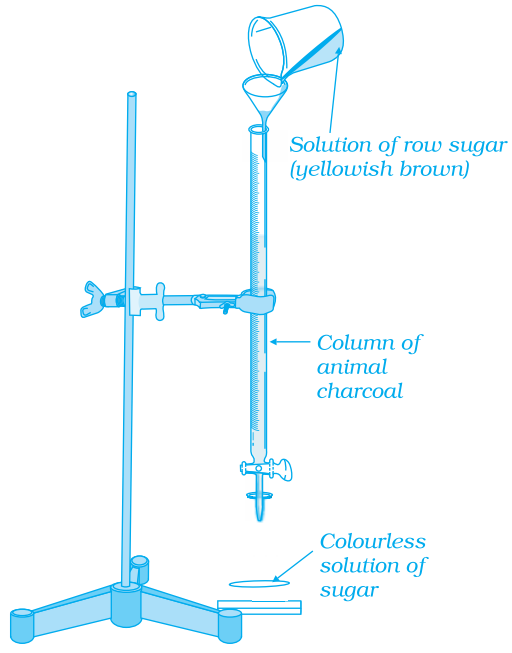
AnswerIn the figure adsorption of coloured particle from charcoal is shown. Solution of raw sugar is filtered by animal charcoal and yellowish brown colour of raw sugar is adsorbed and filterate is colourless which gives white colour on crystallization.
View full question & answer→MCQ 671 Mark
The colloidal system in which the disperse phase and dispersion medium are both liquids is known as:
AnswerEmulsions are the colloidal solutions of two immiscible liquids in which one liquid acts as the dispersed phase and the other as the dispersion medium. In emulsion, the suspended droplets $($dispersed phase$)$ are larger than the particles of dispersion medium.
View full question & answer→MCQ 681 Mark
Detergents are better than soaps because:
- A
They wash clothes better.
- B
They absorb the hardness of water.
- ✓
They are less affected by hard water.
- D
AnswerCorrect option: C. They are less affected by hard water.
Detergents are better than soaps because they are less affected by hard water, as the hydrocarbon chains in detergents do not precipitate with calcium, magnesium and other metal ions.
View full question & answer→MCQ 691 Mark
Butter is an emulsion of type:
AnswerOil in water $(o/ w)$ type : In these emulsions, oil forms the dispersed phase and water, the dispersion medium. For example, milk, vanishing cream, etc. These are also called aqueous emulsions.
Water in oil $(w/ o)$ type : In these emulsions, water is in the dispersed phase and oil in the dispersion medium. For example, butter, cold cream etc. are also called oil emulsions.
View full question & answer→MCQ 701 Mark
AnswerCod liver oil is extracted from the liver of the codfish and is enriched with omega$-3$ fatty acids.
Cod liver oil is an emulsion i.e. liquid in liquid type solution. In Cod liver oil, water acts as a dispersed phase while oil acts as a dispersion medium. we use acacia gum as an emulsifying agent.
View full question & answer→MCQ 711 Mark
The process of passing of a precipitate into colloidal solution on adding an electrolyte is called:
MCQ 721 Mark
- A
Changes $\triangle \text{G}\triangle \text{G}$ for an equation.
- B
Acts by increasing the rate of the forward reaction more than the reverse reaction.
- C
Raises the equilibrium constant of a system.
- ✓
May have a molecular weight as low as $1$ or higher than $200, 000.$
AnswerCorrect option: D. May have a molecular weight as low as $1$ or higher than $200, 000.$
A catalyst :
Does not change $\triangle \text{G}$ for a reaction.
Acts by increasing the rate of forward reaction and backward reaction by equal amounts.
Does not affect the value of equilibrium constant.
May have a molecular weight as low as $1$ or higher than $200, 000.$
$\therefore$ The only correct choice is that a catalyst may have a molecular weight as low as $1$ or higher than $200, 000.$
View full question & answer→MCQ 731 Mark
Smoke precipitator works on the principle of:
AnswerCorrect option: B. Neutralization of charge on colloids.
Smoke precipitator works on the principle of neutralization of charge on colloids.
Smoke coming out of the chimneys contain a lot of unburnt carbon particle.
Smoke is the colloidal solution of the solid particles such as carbon, arsenic, dust particles etc. These particles are injurious to health and have to be precipitated.
Carbon particle is charged particles and can not be precipitated. Thus, a metal plate of an oppositely charged particle is used for their precipitation.
This is done by the Cottrell smoke precipitator which neutralizes the charge on the carbon particles and neutralizes them.
In this way, smoke coming out of the chimneys gets free from the charged particles.
View full question & answer→MCQ 741 Mark
Which of the following pairs of colloidal solutions have dispersed phase as liquid and dispersed medium as gas?
AnswerFog: Dispersed phase $-$ Liquid and Dispersed medium $-$ Gas
Mist: Dispersed phase $-$ Liquid and Dispersed medium $-$ Gas
Butter: Dispersed phase $-$ Liquid and Dispersed medium $-$ Solid
Milk: Dispersed phase $-$ Liquid and Dispersed medium $-$ Liquid
Smoke: Dispersed phase $-$ Solid and Dispersed medium $-$ Gas
View full question & answer→MCQ 751 Mark
What happens when a lyophilic sol is added to a lyophobic sol?
$A.$ Lyophobic sol is protected.
$B.$ Lyophilic sol is protected.
$C.$ Film of lyophilic sol is formed over lyophobic sol.
$D.$ Film of lyophobic sol is formed over lyophilic sol.
- A
$A$ and $B$
- ✓
$A$ and $C$
- C
$B$ and $C$
- D
$B$ and $D$
AnswerCorrect option: B. $A$ and $C$
Lyophobic sols are protected due to formation of film of lyophobic sol.
View full question & answer→MCQ 761 Mark
Which of the following is homogeneous?
AnswerThe emulsion is a colloidal system consisting of immiscible liquids. Milk is an example of emulsion in which particles of liquid fat are dispersed in water. In common occurrence, however, one of the liquids is water and the other, and oily substance insoluble in it. The suspended droplets are larger than the particles of the sols. It is because of the density differences between the phases being small.
View full question & answer→MCQ 771 Mark
- A
Calcium salts of higher fatty acids.
- B
Magnesium salts of higher fatty acids.
- C
Potassium salts of higher fatty acids.
- ✓
Sodium salts of higher fatty acids.
AnswerCorrect option: D. Sodium salts of higher fatty acids.
Sodium salts of higher fatty acids are called hard soaps. A good example is sodium stearate$(\mathrm{C}_{12} \mathrm{H}_{35} \mathrm{COONa}).$
View full question & answer→MCQ 781 Mark
AnswerAn emulsion is a colloid of two or more immiscible liquids where one liquid contains a dispersion of the other liquids. In other words, an emulsion is a special type of mixture made by combining two liquids that normally don't mix. The word emulsion comes from the Latin word meaning "to milk" $($milk is one example of an emulsion of fat and water$).$ The process of turning a liquid mixture into an emulsion is called emulsification.
View full question & answer→MCQ 791 Mark
Which of the following process does not occur at the interface of phases?
AnswerIn homogeneous catalysis, only, the reactant and product are in same phase and composition is uniform throughout.
View full question & answer→MCQ 801 Mark
Method by which lyophobic sol can be protected.
- A
By addition of oppositely charged sol.
- B
By addition of an electrolyte.
- ✓
By addition of lyophilic sol.
- D
AnswerCorrect option: C. By addition of lyophilic sol.
Lyophilic colloids have a unique property of protecting lyophobic colloids. When a lyophilic sol is added to the lyophobic sol, the lyophilic particles form a layer around lyophobic particles and thus protect the latter from electrolytes. Lyophilic colloids used for this purpose are called protective colloids.
View full question & answer→MCQ 811 Mark
Which of the following catalyst is used in contact process for manufacture of $\mathrm{H}_2 \mathrm{SO}_4?$
AnswerCorrect option: B. $ \mathrm{V}_2 \mathrm{O}_5 $
Vanadium $(V)$ Oxide$, \mathrm{Fe}_2 \mathrm{O}_3 $ is used as catalyst in this reaction. It increases the rate of the reaction, thus reducing the need for a high temperature.
View full question & answer→MCQ 821 Mark
At high concentration of soap in water, soap behaves as $.......$
AnswerAqueous solution of soap above critical micelle concentration leads to the formation of colloidal solution. Tyndall effect is a characteristic of colloidal solution in which colloidal particles show a coloured appearance when sunlight is passes through it and seen perpendicularly.
View full question & answer→MCQ 831 Mark
Colloidal sols are more effective for medical purposes because:
- A
They have smaller surface area.
- ✓
They have larger surface area.
- C
Their assimilation is difficult.
- D
They can be easily prepared.
AnswerCorrect option: B. They have larger surface area.
Colloidal sols have larger surface area which provides larger sites for reactions.So,they are more effective for medical purposes.
View full question & answer→MCQ 841 Mark
Decomposition of $\ce{H_2O_2}$ is prevented in presence of :
AnswerDecomposition of $\ce{H_2O_2}$ is prevented in the presence of acetanilide. Acetanilide acts as a stabilizer which when added to the solutions retards the decomposition.
View full question & answer→MCQ 851 Mark
Which of the following statements are correct?
$a.$ Mixing two oppositely charged sols neutralises their charges and stabilises the colloid.
$b.$ Presence of equal and similar charges on colloidal particles provides stability to the colloids.
$c.$ Any amount of dispersed liquid can be added to emulsion without destabilising it.
$d.$ Brownian movement stabilises sols.
- A
$a$ and $b$
- B
$b$ and $c$
- C
$a$ and $c$
- ✓
$b$ and $d$
AnswerCorrect option: D. $b$ and $d$
Presence of equal and similar charges on colloidal particles provides stability to colloids as repulsive forces between charge particles having same charge prevent them from colliding when they come closer to each other.
View full question & answer→MCQ 861 Mark
- A
Colloidal sol of cellulose nitrate in water.
- B
Colloidal sol of cellulose acetate in ethyl alcohol.
- ✓
Colloidal sol of cellulose nitrate in ethyl alcohol.
- D
Colloidal sol of cellulose acetate in water.
AnswerCorrect option: C. Colloidal sol of cellulose nitrate in ethyl alcohol.
Collodion is a colloidal sol of cellulose nitrate in ethyl alcohol.
View full question & answer→MCQ 871 Mark
The $........$ colloidal dispersions are called emulsions.
- ✓
Liquid$-$liquid.
- B
Solid$-$solid.
- C
Gas$-$gas.
- D
$A$ and $C.$
AnswerCorrect option: A. Liquid$-$liquid.
The liquid$-$liquid colloidal dispersions are called emulsions.
In these systems, one liquid is dispersed in another liquid immiscible with it.
For example, milk is an emulsion of oil in water.
The particles of liquid fat are dispersed in water.
Cod liver oil is an emulsion of water in oil. It consists of particles of water dispersed in oil.
View full question & answer→MCQ 881 Mark
A catalyst promoter $......$ the efficiency of a catalyst while a poison $......$ the efficiency of the catalyst.
AnswerA catalyst promoter increases the efficiency of a catalyst while a poison decreases the efficiency of the catalyst. Substances which themselves are not catalysts but when mixed in small quantities with the catalysts increase their efficiency are called as promoters or activators. For example, in the Haber process for the synthesis of ammonia, traces of molybdenum increase the activity of finely divided iron which acts as a catalyst. Substances that destroy the activity of the catalyst by their presence are known as catalytic poisons. For example, the platinum catalyst used in the oxidation of hydrogen is poisoned by $CO.$
View full question & answer→MCQ 891 Mark
$\mathrm{Fe}(\mathrm{OH})_3$ sol is:
AnswerWhen a large number of atoms of a substance combine in a dispersion medium having size in the colloidal, the filmed solutions are called multimolecular colloids.
Sulphur solution consists of particles containing about a thousands of $S_8$ molecules$. \ce{Fe(OH)_3}$ is a multimolecular colloids.
View full question & answer→MCQ 901 Mark
Soaking of water by a sponge is an example of:
AnswerSoaking of water by a sponge is an example of physical adsorption.
Water molecules are held to the surface of the sponge by weak van der Waals forces.
View full question & answer→MCQ 911 Mark
An example of colloidal sol in which the affinity of the sol particles for the medium is due to hydrogen bonding is:
AnswerProtein water is an example of colloidal sol in which the affinity of the sol particles for the medium is due to hydrogen bonding.
View full question & answer→MCQ 921 Mark
The polar end in soap is called:
AnswerWhen used for cleaning, soap allows insoluble particles to become soluble in water and rinsed away. The insoluble fat molecules become associated inside micelles tiny spheres formed from soap molecules with polar hydrophilic groups on outside and lipophilic pocket which shields the fat molecule from the water making it soluble.
View full question & answer→MCQ 931 Mark
Which of the following options are correct?
$a.$ Micelle formation by soap in aqueous solution is possible at all temperatures.
$b.$ Micelle formation by soap in aqueous solution occurs above a particular concentration.
$c.$ On dilution of soap solution micelles may revert to individual ions.
$d.$ Soap solution behaves as a normal strong electrolyte at all concentrations.
- A
$a$ and $b$
- ✓
$b$ and $c$
- C
$a$ and $c$
- D
$a$ and $d$
AnswerCorrect option: B. $b$ and $c$
Micelle formation is possible only above critical micelle concentration and on dilution the micelles may form electrolytes.
View full question & answer→MCQ 941 Mark
At the equilibrium position in the process of adsorption $.......$
- A
$\triangle\text{H}>0$
- ✓
$\triangle\text{H}=\text{T}\triangle\text{S}$
- C
$\triangle\text{H}>\text{T}\triangle\text{S}$
- D
$\triangle\text{H}<\text{T}\triangle\text{S}$
AnswerCorrect option: B. $\triangle\text{H}=\text{T}\triangle\text{S}$
At equilibrium position adsorption$, \triangle\text{G}=\triangle\text{H}-\text{T}\triangle\text{S}=0$ so that $\triangle\text{H}=\text{T}\triangle\text{H}.$
View full question & answer→MCQ 951 Mark
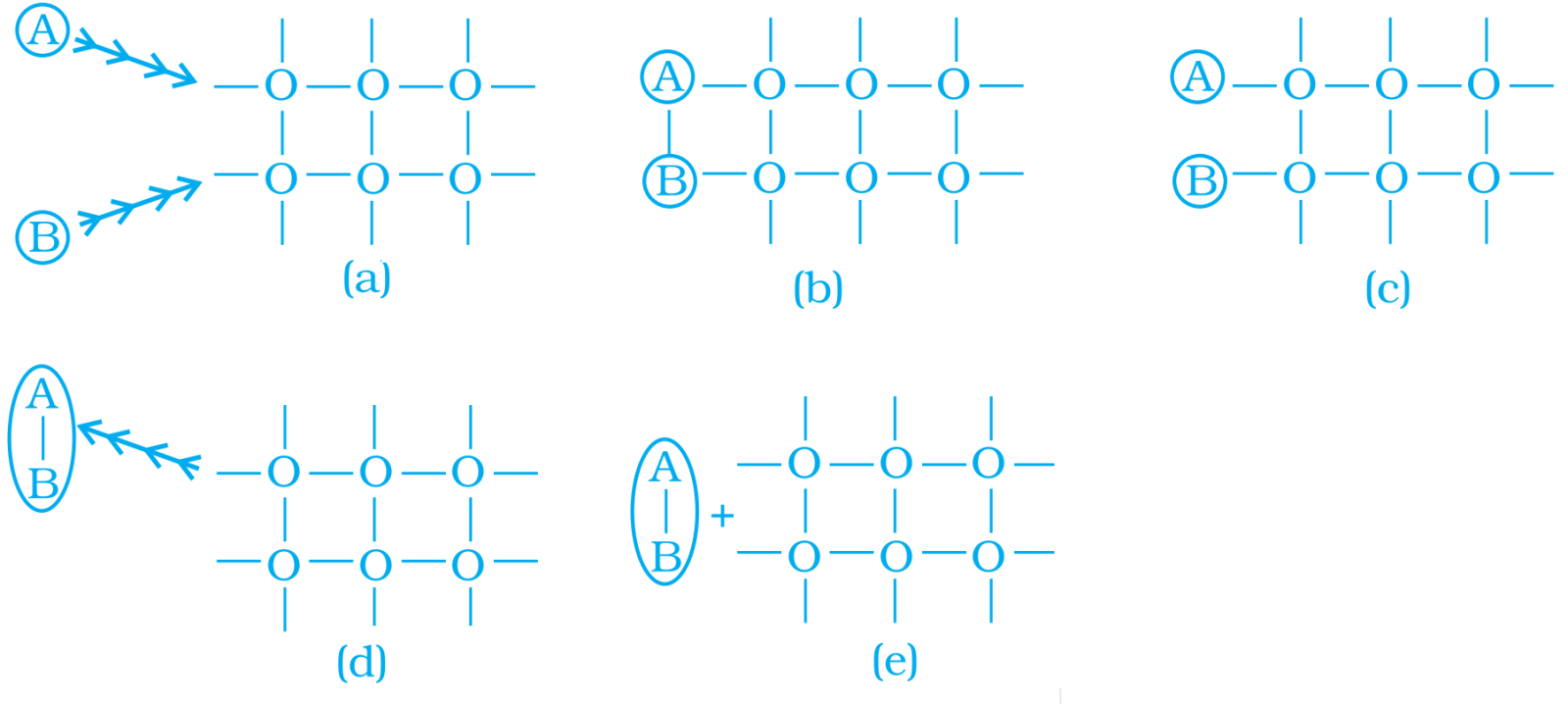
Arrange the following diagrams in correct sequence of steps involved in the mechanism of catalysis, in accordance with modern adsorption theory.
- A
$a ⎯\rightarrow b ⎯\rightarrow c ⎯\rightarrow d ⎯\rightarrow e$
- ✓
$a ⎯\rightarrow c ⎯\rightarrow b ⎯\rightarrow d ⎯\rightarrow e$
- C
$a ⎯\rightarrow c ⎯\rightarrow b ⎯\rightarrow e ⎯\rightarrow d$
- D
$a ⎯\rightarrow b ⎯\rightarrow c ⎯\rightarrow e ⎯\rightarrow d$
AnswerCorrect option: B. $a ⎯\rightarrow c ⎯\rightarrow b ⎯\rightarrow d ⎯\rightarrow e$
Each transformation denotes a meaningful process as follows
- Adsorption of $A$ and $B$ on surface.
- Interaction between $A$ and $B$ to form intermediate.
- Starting desorption of $A-B.$
- Complete desorption.
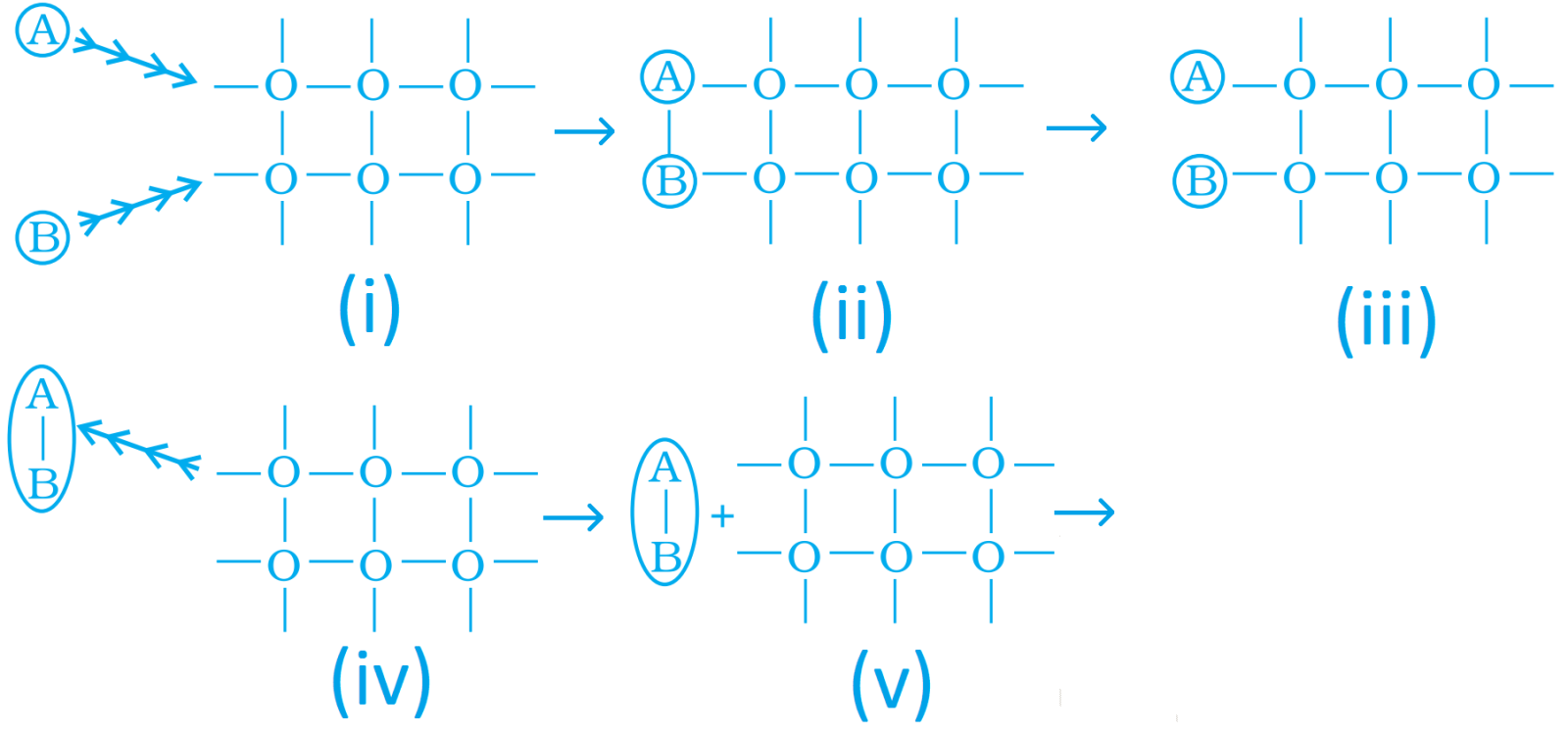
View full question & answer→MCQ 961 Mark
Which one of the following systems has the smallest sized domains in its dispersed phase?
AnswerThe average diameter of droplets in macro-emulsion is close to one millimeter $($i.e., $10^{-3} \mathrm{\sim m}).$ Therefore, since micromeans $10^{-6}$ and emulsion implies that droplets of the dispersed phase have diameters close to $10^{-3} \mathrm{\sim m},$ the microemulsion denotes a system with the size range of the dispersed phase in the $10^{-6} \times 10^{-3} \mathrm{\sim m}=10^{-9} \mathrm{\sim m}$ range.
View full question & answer→MCQ 971 Mark
Which of the following statements are correct about solid catalyst?
$a.$ Same reactants may give different product by using different catalysts.
$b.$ Catalyst does not change $\triangle\text{H}$ of reaction.
$c.$ Catalyst is required in large quantities to catalyse reactions.
$d.$ Catalytic activity of a solid catalyst does not depend upon the strength of chemisorption.
- ✓
$a$ and $b$
- B
$a$ and $c$
- C
$b$ and $c$
- D
$a$ and $d$
AnswerCorrect option: A. $a$ and $b$
Action of a catalyst is highly selective in nature, i.e., a given substance can act as a catalyst only in a particular reaction and not for all the reactions. It means that a substance which acts as a catalyst in one reaction may fail to catalyse another reaction. Catalyst does not change the enthalpy of reaction.
View full question & answer→MCQ 981 Mark
The adhering of the molecules of gas on the surface of a solid is called $......?$
AnswerThe adhering of the molecules of gas on the surface of a solid is called adsorption. It is a surface phenomenon. It is defined as the phenomenon of accumulation of higher concentration of one substance on the surface of another than in the bulk.
View full question & answer→MCQ 991 Mark
Delta formation at the mouth of river takes place by:
- A
Coagulation of negative salt ions and positive river particles.
- ✓
Coagulation of positive salt ions and negative river particles.
- C
Coagulation of positive salt ions and positive river particles.
- D
Coagulation of negative salt ions and negative river particles.
AnswerCorrect option: B. Coagulation of positive salt ions and negative river particles.
River water contains charged colloidal particles of clay, sand and many other materials. Sea water is very big store house of a variety of electrolytes dissolved in it. As soon as river water comes in contact with sea water coagulate the suspended colloidal particles which ultimately settle down at the point of contact. Thus the level of the river bed rises. As a result, water adopts a different course and delta is formed in due course of time.
View full question & answer→MCQ 1001 Mark
The term ‘sorption’ stands for $......$
- A
- B
- ✓
Both absorption and adsorption
- D
AnswerCorrect option: C. Both absorption and adsorption
Adsorption and absorption when take place together, it is known as sorption.
View full question & answer→MCQ 1011 Mark
Which one of the following is an emulsion?
AnswerAn emulsion is a liquid dispersed in either a liquid or solid.
Milk is an emulsion. It is an example of oil in water emulsion. It consists of particles of liquid fat dispersed in water.
View full question & answer→MCQ 1021 Mark
Soap molecules have two parts $-$ a polar and a non$-$polar. When soap is added to water:
AnswerCorrect option: C. Polar part dissolves in water.
As we know that like dissolved like, polar part dissolves in water, since water is a polar solvent.
View full question & answer→MCQ 1031 Mark
Which one of the following can form micelle?
AnswerCorrect option: A. $\text{NaCoo ..... R ..... CooNa}$
Micelles are lipid molecules that arrange themselves in a spherical form in aqueous solutions. They contain both hydrophilic regions $($polar head groups$)$ as well as hydrophobic regions $($the long hydrophobic chain$).$
View full question & answer→MCQ 1041 Mark
Physical adsorption is appreciable at $.......$ temperature.
AnswerPhysical adsorption is appreciable at low temperature.
In physical adsorption, equilibrium is established between the adsorbate and the fluid phase. In solid or gas systems, at not too high
pressures, the extent of physical adsorption increases with increase in gas pressure and usually decreases with increasing temperature.
Since physical adsorption is an exothermic process, the rate of physical adsorption is inversely proportional to temperature.
View full question & answer→MCQ 1051 Mark
If the adsorbate is held on the surface of an adsorbent by force of van der Waals type, the adsorption is called:
- A
Van der Waals adsorption.
- B
- C
- ✓
View full question & answer→MCQ 1061 Mark
Which one of the following is not applicable to the phenomenon of adsorption?
- ✓
$\triangle\text{H}>0$
- B
$\triangle\text{G}<0$
- C
$\triangle\text{S}<0$
- D
$\triangle\text{H}<0$
AnswerCorrect option: A. $\triangle\text{H}>0$
Since adsorption is an exothermic process $\triangle H$ cannot be greater than zero.
View full question & answer→MCQ 1071 Mark
Activated charcoal is used to remove colouring matter from pure substances. It works by:
MCQ 1081 Mark
$\text{TEL},$ tetraethyl lead, acts as an anti$-$knocking agent. It acts as:
Answer$\text{TEL}$ act as a negative catalyst. It is an anti$-$knocking substance is added to petrol to decrease the ignition of petrol vapours.
View full question & answer→MCQ 1091 Mark
Which of the following is regarded as a solid sol?
AnswerCorrect option: C. Both $A$ and $B.$
In solid sol, dispersed phase is solid and dispersion medium is also solid. Pigmented plastics, coloured glasses are examples of solid sol.
View full question & answer→MCQ 1101 Mark
In a reaction, catalyst changes $.........$
$A.$ Physically.
$B.$ Qualitatively.
$C.$ Chemically.
$D.$ Quantitatively.
- ✓
$A$ and $B$
- B
$A$ and $C$
- C
$B$ and $C$
- D
$A$ and $D$
AnswerCorrect option: A. $A$ and $B$
In a reaction catalyst changes physically and qualitatively as it is unaltered during the reaction and remains quantitatively intact after completion of reaction, and does not change chemically.
View full question & answer→MCQ 1111 Mark
Which of the following is a property of physisorption?
AnswerCorrect option: C. Non$-$specificity.
If the accumulation of gas on the surface of a solid occurs on account of weak van der Waals’ forces, the adsorption is termed as physical adsorption or physisorption.
Various properties of Physisorption are$-$
Lack of specificity: A given surface of an adsorbent does not show any preference for a particular gas as the van der Waals’ forces are universal.
Nature of adsorbate: The amount of gas adsorbed by a solid depends on the nature of gas.
Reversible nature: Physical adsorption of a gas by a solid is generally reversible.
View full question & answer→MCQ 1121 Mark
AnswerGelatin is lyophilic sol. Lyophilic sol are formed by the direct mixing of substance in effective dispersing medium. These sols have strong force of interaction between dispersed phase and dispersed medium.
Gold sol$, \mathrm{As}_2 \mathrm{O}_3$ and $\mathrm{Fe}(\mathrm{OH})_3$ are lyophobic sols. Lyophobic sols have weaker force of interaction between dispersed phase and dispersed medium.
When a lyophilic sol is added to lyophobic sol, then a protective layer of lyophilic sol formed around each colloidal particle of the lyophobic sol which protects them from coagulation caused by electrolytes.
View full question & answer→MCQ 1131 Mark
In adsorption, the substance which accumulates on the surface of the other substance is termed as:
AnswerIn adsorption, the substance which accumulates on the surface of the other substance $($adsorbent$)$ is termed as adsorbate.
For example, anhydrous calcium chloride $($adsorbent$)$ adsorbs water $($adsorbate$).$
View full question & answer→MCQ 1141 Mark
Which of the following will show Tyndall effect?
- A
Aqueous solution of soap below critical micelle concentration.
- ✓
Aqueous solution of soap above critical micelle concentration.
- C
Aqueous solution of sodium chloride.
- D
Aqueous solution of sugar.
AnswerCorrect option: B. Aqueous solution of soap above critical micelle concentration.
Tyndall effect is the optical property shown by the colloidal particle. Above critical micelle concentration, a solution of soap behaves as associated colloid that is why it shows tyndall effect.
View full question & answer→MCQ 1151 Mark
Which of the following element is responsible for oxidation of water to $\mathrm{O}_2$ is biological processes?
AnswerWater oxidation is catalyzed by a manganese$-$containing cofactor contained in photosystem $II$ known as the oxygen$-$evolving complex. Manganese is an important cofactor, and calcium and chloride are also required for the reaction to occur.
View full question & answer→MCQ 1161 Mark
- A
- B
- ✓
Breaking and dispersion into colloidal state.
- D
Precipitation of solid from colloidal dispersion.
AnswerCorrect option: C. Breaking and dispersion into colloidal state.
Peptization is a process in which colloidal solution is prepared by adding electrolyte to a precipitate. The electrolyte is added called as peptizing agent. This peptization process also called as deflocculation when the ferric chloride solution is added to the ferric hydroxide precipitate, it gives sol of ferric hydroxide. Therefore, we can say that in peptization, precipitate breaks and disperse into a colloidal solution.
View full question & answer→MCQ 1171 Mark
Which of the following electrolytes will have maximum coagulating value for $\text{AgI}/ \text{Ag}^+$ sol?
AnswerCorrect option: B. $\text{Na}_3\text{PO}_4 $
According to Hardy$-$Schulze law, the greater the charge on anion, the greater will be its coagulating power.
| Electrolytes |
Anionic part |
Charge on anion |
| $\text{Na}_2\text{S}$ |
$\text{S}^{2-}$ |
$2$ |
| $\text{Na}_3\text{PO}_4 $ |
$\text{PO}_4^{3-}$ |
$3$ |
| $\text{Na}_2\text{SO}_4$ |
$\text{SO}_4^{2-}$ |
$2$ |
| $\text{NaCl}$ |
$\text{Cl}^-$ |
$1$ |
Here$, \text{PO}_4^{3-}$ have highest charge. hence$, \text{PO}_4^{3-}$ have highest coagulating power. View full question & answer→MCQ 1181 Mark
In an experiment$, 200\ ml.$ of $0.5$ oxalic acid is shaken with $10g$ of activated charcoal and fiftered. The concentration of the filtrate is reduced to $0.4M.$ The amount of adsorption $(x/ m)$ is$?$
- A
$0.9$
- B
$1.8$
- ✓
$0.18$
- D
$8.09$
AnswerCorrect option: C. $0.18$
View full question & answer→MCQ 1191 Mark
Which of the following interface cannot be obtained?
- A
Liquid$-$liquid.
- B
Solid$-$liquid.
- C
Liquid$-$gas.
- ✓
Gas$-$gas.
AnswerCorrect option: D. Gas$-$gas.
Because gas$-$gas forms homogeneous composition.
View full question & answer→MCQ 1201 Mark
Which of these can be one of the uses of colloids?
- A
Colloids act as transport vector.
- B
Colloids are used in intravenous therapy.
- C
Movement of enzyme molecules in water is because of colloid action.
- ✓
AnswerColloid acts as a transport vector of different contaminants in water surfaces. For example, heavy metals and radionucleides are absorbed on colloid surface and are carried throughout the water Enzymes, which are important biomolecules in human body, freely move about in the water because of colloid action. Colloids are used in intravenous therapy where they increase the intravascular volume and maintain a high colloid osmotic pressure in the blood.
View full question & answer→MCQ 1211 Mark
Finely powered or colloidal catalyst particles having small surface area are rich in free valencies.State whether the statement is True or False
- A
- ✓
- C
- D
Finely powered or colloidal catalyst particles having large surface area are rich in free valencies.
AnswerFinely powered or colloidal catalyst particles having small surface area cannot be rich in free valencies. When the catalyst is finely powdered the surface area of the particle is small but total surface area is very large.
View full question & answer→MCQ 1221 Mark
In the adsorption of oxalic acid on activated charcoal, the activated charcoal is called :
AnswerAdsorption: The phenomenon of attracting and retaining the molecules of a substance on the surface of a liquid or a solid resulting into a higher concentration of the molecules on the surface is called adsorption.
Adsorption of a gas by charcoal: Finely divided activated charcoal has a tendency to adsorb a number of gases like ammonia, sulphur dioxide, chlorine, phosgene, etc. In this case, charcoal acts as an adsorbent while gas molecules act as adsorbate.
Adsorption of oxalic acid on activated charcoal: The molecules of gases or liquids or the solutes in solutions get adhered to the surface of the solids. In adsorption process two substances are involved. One is the solid or the liquid on which adsorption occurs and it is called adsorbent. The second is the adsorbate, which is the gas or liquid or the solute from a solution which gets adsorbed on the surface.
View full question & answer→MCQ 1231 Mark
A substance which alters the rate of reaction:
AnswerCatalyst is a substance that changes $($usually increases$)$ the rate of a reaction, without being involved in the reaction. A catalyst provides large surface area to one of the reactants, providing it an exposure to be reacted upon by the other reactant.
View full question & answer→MCQ 1241 Mark
The metal used as a catalyst in the hydrogenation of oils is:
Answer$Ni$ as catalyst binds both the $\mathrm{H}_2$ and the unsaturated substrate and facilitates their union which is the mechanism of hydrogenation of oil while other given element can't able to do so.
$Ni$ is used for most reaction as the catalyst because of it is cheaper to run the reaction with it, in commercial world cost-effectiveness is best and desired pathway.
View full question & answer→MCQ 1251 Mark
Which of the following is an example of absorption?
- A
- ✓
Water on calcium chloride.
- C
Hydrogen on finely divided nickel.
- D
AnswerCorrect option: B. Water on calcium chloride.
Absorption implies that a substance is uniformly distributed, through the body of the solid or liquid.
View full question & answer→MCQ 1261 Mark
In which of the following reactions heterogenous catalysis is involved?
- $2\text{SO}_2(\text{g})+\text{O}_2(\text{g})\xrightarrow{\text{NO(g)}}2\text{SO}_3(\text{g})$
- $2\text{SO}_2(\text{g})\xrightarrow{\text{Pt(s)}}2\text{SO}_3\text{(g)}$
- $\text{N}_2(\text{g})+3\text{H}_2\text{(g)}\xrightarrow{\text{Fe(s)}}2\text{NH}_3\text{(g)}$
- $\text{CH}_3\text{COOCH}_3(1)\text{H}_2\text{O}(1)\xrightarrow{\text{HC}(1)}\text{CH}_3\text{COOH}\text(\text{aq})+\text{CH}_3\text{OH}(\text{aq})$
- ✓
$(b), (c)$
- B
$(b), (c), (d)$
- C
$(a), (b), (c)$
- D
$(d)$
AnswerCorrect option: A. $(b), (c)$
When the reactant and catalyst are in different phase it is known as heterogeneous catalysis.
View full question & answer→MCQ 1271 Mark
An oil$-$soluble dye is mixed with emulsion and the emulsion remains colourless. Then, it is:
AnswerAn oil$-$soluble dye is mixed with emulsion and the emulsion remains colourless. Then, it is oil in water emulsion.
Oil is the dispersed phase and water is the dispersion medium. Such emulsions are called aqueous emulsions.
View full question & answer→MCQ 1281 Mark
Animal charcoal is used in decolorising colour of liquids because it is a good:
AnswerAdsorbate adsorbs impurities from surface of substance Animal charcoal is good adsorbate. The impurities adsorb on its surface and thus it decolourises colour of liquids.
View full question & answer→MCQ 1291 Mark
Which of the following is $\text{NOT}$ used in making photographic plates using colloidal sols?
AnswerArgyrol is a silver sol and is used as an eye lotion. Silver bromide, gelatin and glass plate are used in the making photographic plates.
View full question & answer→MCQ 1301 Mark
AnswerMilk is an emulsion of fat and water, along with other components.In an emulsion, one liquid $($the dispersed phase$)$ is dispersed in the other $($the continuous phase$).$ Examples of emulsions include vinaigrettes, homogenized milk, mayonnaise, and some cutting fluids for metal working.
View full question & answer→MCQ 1311 Mark
Adsorption is a process in which a substance accumulates on the $.........$ of the other substance.
AnswerAdsorption is a process in which a substance accumulates on the surface of the other substance. It occurs when a gas or liquid solute accumulates on the surface of a solid or a liquid $($adsorbent$)$ forming a molecular or atomic film $($the adsorbate$).$ It is different from absorption in which a substance diffuses into a liquid or solid to form a solution. Thus adsorption is surface phenomenon whereas absorption is bulk property.
View full question & answer→MCQ 1321 Mark
Physical adsorption of a gaseous species may change to chemical adsorption with $.......$
- A
- ✓
- C
Increase in surface area of adsorbent.
- D
Decrease in surface area of adsorbent.
AnswerOn increasing temperature physisorption changes to chemisorption. As the temperature increases, energy of activation of adsorbate particles increases which leads to formation of chemical bond between adsorbate and adsorbent. Hence, physisorption transform into chemisorptions.
View full question & answer→MCQ 1331 Mark
When $\ce{KClO_3}$ is heated, it decomposes into $\text{KCl}$ and $O_2.$ If some $\ce{MnO_2}$ is added, the reaction goes much faster because:
- A
$\ce{MnO_2}$ decomposes to give $O_2$
- B
$\ce{MnO_2}$ provides heat by reacting
- C
better contact is provided by $\ce{MnO_2}$
- ✓
$\ce{MnO_2}$ acts as a catalyst
AnswerCorrect option: D. $\ce{MnO_2}$ acts as a catalyst
The decomposition of $\ce{KClO_3}$ in presence of $\ce{MnO_2}$ can be given as follow:
$2\text{KClO}_3\xrightarrow{\text{MnO}_2}\text{2KCl}+3\text{O}_2$
In this reaction, the $\ce{MnO_2}$ acts as a catalyst. Thus, it increases the rate of the reaction.
View full question & answer→MCQ 1341 Mark
Milk is an example of water in oil emulsions.
AnswerOil in water $(o/ w)$ type: In these emulsions, oil forms the dispersed phase and water, the dispersion medium. For example, milk, vanishing cream, etc. These are also called aqueous emulsions.
Water in oil $(w/ o)$ type: In these emulsions, water is in the dispersed phase and oil in the dispersion medium.
For example, butter, cold cream etc. are also called oil emulsions.
View full question & answer→MCQ 1351 Mark
Which of the following sol is not prepared using Bredig's arc method?
AnswerBredig's arc method is a method of preparation of the colidal solution of metals such as silver, gold, platinum etc. Copper sol is not prepared using Bredig's arc method.
View full question & answer→MCQ 1361 Mark
AnswerAerosols are a colloidal solution of liquid and gas.
A true solution is a homogeneous solution in which the solute particles have diameters less than $10^{-7}cm.$
In an emulsion, one liquid $($the dispersed phase$)$ is dispersed in the other liquid $($the continuous phase$).$
View full question & answer→MCQ 1371 Mark
he substance on whose surface adsorption takes place is called an $.......$
AnswerThe substance on whose surface adsorption takes place is called an absorbent.
In other words, a substance which adsorbs another substance $($adsorbate$)$ on its surface is called an adsorbent.
For example, when hydrogen gas is adsorbed on the surface of $Pt$ metal, hydrogen is called adsorbate and $Pt$ is called adsorbent.
View full question & answer→MCQ 1381 Mark
A catalyst is a substance which:
- A
Increases the equilibrium concentration of the product.
- B
Changes the equilibrium constant of the reaction.
- ✓
Shortens the time to reach equilibrium.
- D
Supplies energy to the reaction.
AnswerCorrect option: C. Shortens the time to reach equilibrium.
A catalyst is a substance, which increases the rate of reaction without itself being consumed at the end of the reaction, and the phenomenon is called catalysis. There are some catalysts which decrease the rate of reaction and such catalysts are called negative catalyst. Obviously, the catalyst accelerating the rate will be positive catalyst. However, the term positive is seldom used and catalyst itself implies positive catalyst. Catalysts are generally foreign substances but sometimes one of the product formed may act as a catalyst and such a catalyst is called "auto catalyst" and the phenomenon is called auto catalysis.
View full question & answer→MCQ 1391 Mark
AnswerSoap is an excellent cleanser because of its ability to act as an emulsifying agent. An emulsifier is capable of dispersing one liquid into another immiscible liquid. This means that while oil $($which attracts dirt$)$ doesn't naturally mix with water, soap can suspend oil/ dirt in such a way that it can be removed. Grease and oil are nonpolar and insoluble in water. When soap and soiling oils are mixed, the nonpolar hydrocarbon portion of the micelles breaks up the nonpolar oil molecules. A different type of micelle then forms, with nonpolar soiling molecules in the centre. Thus, grease and oil and the 'dirt' attached to them are caught inside the micelle and can be rinsed away.
View full question & answer→MCQ 1401 Mark
The process of adsorption of hydrogen over palladium surface is called:
AnswerAdsorption of gas on the surface of solid is also known as occlusion.
View full question & answer→MCQ 1411 Mark
An example of a colloid which is an emulsion is:
AnswerMayonnaise often abbreviated as mayo is a thick, creamy dressing often used as a condiment.
It is a stable emulsion of oil, egg yolk, and acid, either vinegar or lemon juice, with many options for embellishment with other herbs and spices. It is an emulsion.
Whereas Whipped cream is a colloid. It consists of a gas in a liquid, so it is foam, Fog is an example of liquid aerosol, Gelatin is a sol.
View full question & answer→MCQ 1421 Mark
Mention catalyst in the following reaction$:\ \mathrm{KClO}_3 \rightarrow \mathrm{KCl}+\mathrm{O}_2$
AnswerCorrect option: A. $\mathrm{MnO}_2$
The catalyst used for the reaction $\mathrm{KClO}_3 \rightarrow \mathrm{KCl}+\mathrm{O}_2$ reaction is $\mathrm{MnO}_2$. The $\mathrm{MnO}_2,$ causes the reaction to take place more rapidly at a lower temperature.
The given reaction is a decomposition reaction of potassium chlorate used to obtain oxygen.
View full question & answer→MCQ 1431 Mark
The process of separating of cream from milk is called:
AnswerThe process of separation of two liquids of an emulsion into separate layers is known as demulsification. It can be brought about by heating, centrifuging etc. For example, cream is separated from milk by centrifuging.
View full question & answer→MCQ 1441 Mark
A colloidal sol can be prepared by:
- A
Breaking the bulky substance into fine particles of colloidal dimensions.
- B
Increasing the size of molecular particles to form larger aggregates.
- C
Mixing a substance directly with a dispersion medium.
- ✓
AnswerA colloidal sol can be prepared by:
$(1)$ Mixing directly a substance with a dispersion medium.
$(2)$ By formation of aggregates by increasing size of molecular particles.
$(3)$ Breaking the bulky substance into fine particles of colloidal dimensions
View full question & answer→MCQ 1451 Mark
Which of the following is $\text{NOT}$ a condensation method?
- A
- B
Physical state change method.
- ✓
- D
View full question & answer→MCQ 1461 Mark
Which is incorrect for a catalyst?
- ✓
A catalyst can initiate a reaction.
- B
A catalyst remains unchanged in quality and composition at the end of reaction.
- C
It does not alter the position of equilibrium in a reversible reaction.
- D
Catalysts are sometimes very specific in reaction.
AnswerCorrect option: A. A catalyst can initiate a reaction.
View full question & answer→MCQ 1471 Mark
The colloidal dispersion of a liquid in a liquid is called:
AnswerThe colloidal dispersion of a liquid in a liquid is called emulsion.
In these systems, one liquid is dispersed in another liquid immiscible with it.
For example, milk is an emulsion of oil in water. The particles of liquid fat are dispersed in water.
Codliver oil is an emulsion of water in oil. consists of particles of water dispersed in oil.
View full question & answer→MCQ 1481 Mark
Mark the correct statement in a reversible reaction:
- A
A catalyst catalyzes the forward reaction.
- B
A catalyst catalyzes the backward reaction.
- ✓
A catalyst influences a direct and reverse reaction to the same extent.
- D
A catalyst increases the rate of forward reaction and decreases the rate of backward reaction.
AnswerCorrect option: C. A catalyst influences a direct and reverse reaction to the same extent.
A catalyst is a substance, which increases the rate of reaction without itself being consumed at the end of the reaction, and the phenomenon is called catalysis. There are some catalysts which decrease the rate of reaction and such catalysts are called negative catalyst. Obviously, the catalyst accelerating the rate will be positive catalyst. However, the term positive is seldom used and catalyst itself implies positive catalyst. Catalysts are generally foreign substances but sometimes one of the product formed may act as a catalyst and such a catalyst is called "auto catalyst" and the phenomenon is called auto catalysis.
View full question & answer→MCQ 1491 Mark
Which of the following examples is/ are oil$-$in$-$water$-$type emulsion?
AnswerOil in water $(o/ w)$ type: In these emulsions, oil forms the dispersed phase and water, the dispersion medium. For example: milk, vanishing cream, etc. They are are also called aqueous emulsions.
Water in oil $(w/ o)$ type: In these emulsions, water is in the dispersed phase and oil is in the dispersion medium. For example: butter, cold cream etc. They are also called oil emulsions.
View full question & answer→MCQ 1501 Mark
Soaps do not create water pollution because:
AnswerCorrect option: C. Soaps are fairly bio$-$degradable.
Soaps do not create water pollution because they are biodegradable. Biodegradable are the substances that can be decomposed by bacteria and thereby avoiding pollution.
View full question & answer→MCQ 1511 Mark
Which sol can be prepared directly by mixing the dispersed phase with dispersion medium?
AnswerSol is those in which the dispersed phase exhibits a definite affinity for the dispersion medium$($liquid$)$ or the solvent. For eg. Dispersion of starch, gum$,\ \&\ $ protein in water. The affinity of sol particles for the medium is due to hydrogen bonding with water$($dispersion medium$).$ They may have little or no charge at all $\ \&\ $ they do not exhibit Tyndall effect. These sols are reversible in nature i.e., if two constituents of the sol are separated by any means $($such as evaporation$),$ then the sol can be prepared again by simply mixing the dispersion medium with the dispersion phase and shaking the mixture.
View full question & answer→MCQ 1521 Mark
An emulsifier is an agent which:
- A
Accelerates the dispersion.
- B
- ✓
- D
Aids the flocculation of an emulsion.
AnswerExplanation for correct option:
First, let us understand what colloids are:
Colloids are formed by the mixing of the dispersion medium and the dispersed phase which are neither true solutions nor suspensions. The dispersed medium in a colloidal system refers to the medium in which colloidal particles are dispersed while the dispersed phase is the phase dispersed through the medium. Together, dispersed phase and dispersion medium form colloidal systems or colloids.
Coming to the term ‘emulsion’, we see that:
In order to prepare stable emulsions, it is important to add a third component known as an emulsifier or emulsifying agent in suitable amounts. Several types of emulsifiers are known:
$(i)$ Long$-$chain compounds with polar groups such as soap, sulphonic acid, sulphates, etc.
$(ii)$ Most of the lyophilic colloids also act as emulsifiers such as glue, gelatin, etc.
$(iii)$ Certain insoluble powders as clay, lamp black, etc.
$(iv)$ Soluble substances like iodine also act as emulsifiers.
Therefore, for the purpose of stabilizing the emulsion, an emulsifying agent or an emulsifier is added to the emulsion. For example, milk is an emulsion with liquid fat as the dispersed phase and liquid water as a dispersion medium and casein is the emulsifier.
View full question & answer→MCQ 1531 Mark
Hydrogen in palladium is an example of:
AnswerHydrogen exists as gas where palladium is in element existing as solid.
View full question & answer→MCQ 1541 Mark
Extent of adsorption of adsorbate from solution phase increases with $......$
- ✓
Increase in amount of adsorbate in solution.
- B
Decrease in surface area of adsorbent.
- C
Increase in temperature of solution.
- D
Decrease in amount of adsorbate in solution.
AnswerCorrect option: A. Increase in amount of adsorbate in solution.
Extent of adsorption of adsorbate from solution phase increases with increase in the amount of adsorbate in the solution. As amount of adsorbate in the solution increases interaction of adsorbent increases which leads to increase in extent of adsorption.
View full question & answer→MCQ 1551 Mark
Which of the following phenomenon occurs when a chalk stick is dipped in ink?
$a.$ Adsorption of coloured substance.
$b.$ Adsorption of solvent.
$c.$ Absorption and adsorption both of solvent.
$d.$ Absoprtion of solvent.
- A
$a$ and $b$
- B
$b$ and $c$
- C
$a$ and $c$
- ✓
$a$ and $d$
AnswerCorrect option: D. $a$ and $d$
When a chalk stick is dipped in ink, the surface retains the colour of the ink due to adsorption of coloured molecules while the solvent of the ink goes deeper into the stick due to absorption.
View full question & answer→MCQ 1561 Mark
Sorption is the term used when:
- A
- B
- ✓
Both adsorption and absorption take place.
- D
AnswerCorrect option: C. Both adsorption and absorption take place.
Sorption is the term used when both adsorption and absorption takes place. The substance gets uniformly distributed in the bulk of the solid but at the same time its concentration is higher at the surface than in the bulk.
View full question & answer→MCQ 1571 Mark
In Bredig's Arc method, the stabilizer used is:
- A
$\ce{Ca(OH)_2}$
- B
$\text{CaO}$
- ✓
$\text{KOH}$
- D
$\ce{K_2O}$
AnswerCorrect option: C. $\text{KOH}$
Bredig's arc method consists of both dispersion and condensation. An arc is struck between electrodes, under the surface of water containing stabilising agents such as $\text{KOH}.$ The intense heat of the arc vaporizes some of the metal which then condenses under cold water.
View full question & answer→