Question 12 Marks
Find $x$.
$2^{3x}= 8^{2x+1}$
AnswerWe have, $2^{3x}= 8^{2x+1}$
$\Rightarrow 2^{3x}= (2^3)^{2x+1}$
$\Rightarrow 2^{3x}= (2)6x+3$ $[\because(\text{a}^{\text{m}})^{\text{n}}=(\text{a})^{\text{m}\times\text{n}}]$
On compairing the powers of $2$, we get
$3x = 6x + 3$
$\Rightarrow x = -1$
View full question & answer→Question 22 Marks
Simplify: $(2^5÷ 2^8) × 2^{-7}$
AnswerUsing laws of exponents, $a^m \div a^n=(a)^{m-n}$ and $a^m \times a^n=(a)^{m+n}$[$\because$ a is non-zero integer] $\therefore$ $(2^5\div2^8)\times(-2)^{-7}=(2)^{5-8}\times(2)^{-7}$
$=(2)^{-3}\times(2)^{-7}$ $=(2)^{-3-7}=(2)^{-10}$
$=\frac{1}{2^{10}}=\frac{1}{1024}$
$\Big[\because\text{a}^{-\text{m}}=\frac{1}{\text{a}}^\text{m}\Big]$
View full question & answer→Question 32 Marks
By what number should we multiply $(-29)^0$ so that the product becomes $(+29)^0$.
AnswerLet n be multiplied with $(-29)^0$ to get $(+29)^0$
So, $x × (-29)^0= (29)^0$
$\Rightarrow x \times 1 = 1$
$\Rightarrow x =1$ [$\because$ $a^0= 1$]
View full question & answer→Question 42 Marks
Express the following in standard form: The mass of a proton in gram is $\frac{1673}{1000000000000000000000000000}$
AnswerGiven
mass of a proton in gram = $\frac{1673}{1000000000000000000000000000}$
Standard form $\frac{1673}{10^{27}}$
$=1673\times10^{-27}\text{g}$ $\big[\because\text{a}^{-\text{m}}=\frac{1}{\text{a}^\text{m}}\Big]$ $=1.673\times10^{-27}\times10^3\text{g}$ $=1.673\times10^{-27+3}$
$=1.673\times10^{-24}\text{g}$$[\because$ $a^m× a^n= (a)^{m+n}]$
View full question & answer→Question 52 Marks
A particular star is at a distance of about $8.1 × 10^{13}$ km from the Earth. Assuring that light travels at $3 × 10^8$m per second, find how long does light takes from that star to reach the Earth.
AnswerThe distance between star and Earth$= 8.1 × 10^{13}$ km $= 8.1 × 10^{13}× 10^{13}$m.
Since, light travels at $3 × 10^8m$ per second. $[\because1\text{km}=1000\text{m}]$
So, time taken by light to reach the Earth
$=\frac{8.1\times10^{13}\times10^{3}}{3\times10^{8}}==\frac{8.1\times10^{16}}{3\times10^{8}}$$=\frac{8.1}{3}\times10^8=2.7\times10^8\text{s}$.
View full question & answer→Question 62 Marks
A new born bear weighs $4\ kg$. How many kilograms might a five year old bear weigh if its weight increases by the power of $2$ in $5$ years?
AnswerWeight of new born bear $= 4\ kg$
Weight increases by the power of $2$ in $5$ year
Weight of bear in $5$ year $= (4)^2= 16kg$
View full question & answer→Question 72 Marks
Find a repeater machine that will do the same work as a $\big(\text{x}\frac{1}{8}\big)$ machine.
AnswerSince, $\frac{1}{8} \ \text{are} \ \frac{1}{2},\frac{1}{2},\frac{1}{2}.$
So, $\frac{1}{8}=\frac{1}{2}\times\frac{1}{2}\times\frac{1}{2}=\big(\frac{1}{2}\big)^3$
Hence, $\big(\text{x}\frac{1}{2^3}\big)$ repeater machine can do the same work as a $\big(\text{x}\frac{1}{8}\big)$ machine.
View full question & answer→Question 82 Marks
Express the following in standard form: Human body has $1$ trillon of cells which vary in shapes and sizes.
AnswerCells in human body = $1$ trillon
$\because$ $1$ trillon $= 1000000000000$
Standard form of $1000000000000$
$= 10 \times 10 \times 10 \times 10 \times 10 \times 10 \times 10 \times 10 \times 10 \times 10 \times 10 \times 10$
$= 10^{12}$ [$\because$ $a^m× a^n= (a)^{m+n}]$
View full question & answer→Question 92 Marks
There are $864,00$ seconds in a day. How many days long is a second? Express your answer in scientific notation.
AnswerTotal seconds in a day $= 86400$
So, a second is long as $\frac{1}{86400}=0.000077574$
Scientific notation of $0.000011574=1.1574\times10^{-5}\text{days}$
View full question & answer→Question 102 Marks
find the value of $n$. $\frac{6^\text{n}}{6^{-2}}=6^3$
AnswerGiven,
$\frac{6^\text{n}}{6^{-2}}=6^3$
Using law of exponents, $\frac{6^\text{n}}{6^{-2}}=6^3$ [$\because$ a is non-zero integer]
$\Rightarrow6^{\text{n}+1}=6^3$ [$\because$ $a^m÷ a^n= a^{m-n}] $
On comparing both sides, we get
$n + 2 = 3$
$\Rightarrow n = 1$
View full question & answer→Question 112 Marks
Sanchay put a $1\ cm$ stick of gum through a $(1 × 3^{-2})$ machine. How long was the stick when it came out?
AnswerIf sanchay put a $1\ cm$ stick of gum through a $(1 × 3^{-2})$ machine.
Negation $(-)$ sign in power shrews it is shrinking machine.
So, $1\times\frac{1}{3^2}=1\times\frac{1}{9}=\frac{1}{9}\text{cm}$
Hence, $\frac{1}{9}\text{cm}$ stick came out.
View full question & answer→Question 122 Marks
Write $39,00,00,000$ in the standard form.
AnswerFor standard form $390000000 = 39 \times 10 \times 10 \times 10 \times 10 \times 10 \times 10 \times 10$
$= 39 \times 10^7$
$= 3.9 \times 10^7\times 10^1$
$= 3.9 \times 10^8$ [$\because$ $a^m\times a^n= (a)^{m+n}]$
View full question & answer→Question 132 Marks
Simplify: $\Big(\frac{1}{4}\Big)^{-2}+\Big(\frac{1}{2}\Big)^{-2}+\Big(\frac{1}{3}\Big)^{-2}$
AnswerUsing law of exponents, $\text{a}^{-\text{m}}=\frac{1}{\text{a}^\text{m}}$ [$\because$ a is non-zero integer]
$\therefore$ $\Big(\frac{1}{4}\Big)^{-2}+\Big(\frac{1}{2}\Big)^{-2}+\Big(\frac{1}{3}\Big)^{-2}$
$=(4)^2+(2)^2+(3)^2$
$=16+4+9$ $=29$
View full question & answer→Question 142 Marks
Some migratory birds travel as much as $15,000\ km$ to escape the extreme climatic conditions at home. Write the distance in metres using scientific notation.
AnswerTotal distance travelled by migratory bird
$= 15000km= 15000 \times 1000m$ $[$$\because$ $1\ km = 1000m]$
$= 15000000m$
$= 15 \times 10^6m$
Scientiic notation of $15 \times 10^6= 1.5 \times 10^7m$
View full question & answer→Question 152 Marks
Express as a power of a rational number with negative exponent. $\bigg(\Big(\frac{-3}{2}\Big)^{-2}\bigg)^{-3}$
AnswerUsing law of exponents, $(a^m)^n= (a)^{m\times n}$ and $\text{a}^{-\text{m}}=\frac{1}{\text{a}^\text{m}}$ [$\because$ a is non-zero integer]
$\therefore$ $\bigg(\Big(\frac{-3}{2}\Big)^{-2}\bigg)^{-3}=\Big(\frac{-3}{2}\Big)^{-2\times(-3)}$
$=\Big(\frac{-3}{2}\Big)^6=\Big(-\frac{2}{3}\Big)^{-6}$
View full question & answer→Question 162 Marks
The distance between the Sun and the Earth is $1.496 \times 10^8km$ and distance between the Earth and the Moon is $3.84 \times 10^8m$. During solar eclipse the Moon comes in between the Earth and the Sun. What is distance between the Moon and the Sun at that particular time?
AnswerThe distance between the Sun and the Earth is $1.496 \times 10skm$
$= 1.496 \times 10^8\times 10^3m = 1496 \times 10^8m.$
The distance between the Earth and the Moon is $3.84 x 10^8m$.
The distance between the Moon and the Sun at particular time (solar eclipse)
$= (1496 \times 10^8- 3.84 \times 10^8)$
$m = 1492. 16 \times 10^8m$.
View full question & answer→Question 172 Marks
Pluto is $59,1,30,00,000m$ from the sun. Express this in the standard form.
AnswerDistance between Pluto and Sun $= 5913000000$
Standard form of $5913000000=5913 \times 10^6$
$=5913 \times 10^6 \times 10^3$
$ =5.913 \times 10^9\left[\because a^m \times a^n=(a)^{m+n}\right]$
View full question & answer→Question 182 Marks
Stretching Machine:
Suppose you have a stretching machine which could stretch almost anything. For example, if you put a $5$ metre stick into a $(×4)$ stretching machine (as shown below), you get a $20$ metre stick. Now if you put $10\ cm$ carrot into a $(\times 4)$ machine, how long will it be when it comes out?
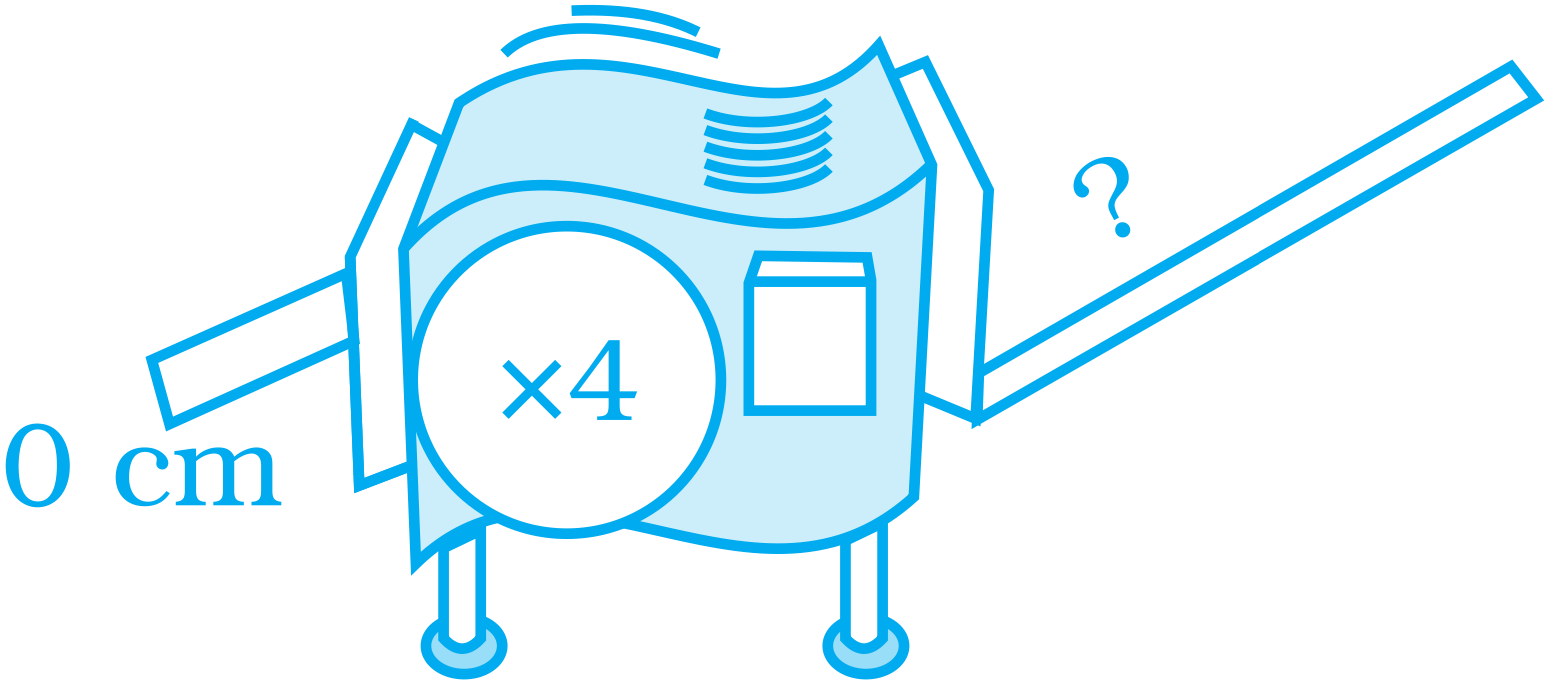
AnswerAccording to the question, if we put a $5m$ stick into a $(\times 4)$ stretching machine, then machine produces $20\ m$ stick. Similarly, if we put $10\ cm$ carrot into a $(\times 4)$ stretching machine, then machine produce $10 \times 4= 40\ cm$ stick.
View full question & answer→Question 192 Marks
Express the following in standard form: Mass of a molecule of hydrogen gas is about $0.00000000000000000000334$ tons.
AnswerMass of a molecule of hydrogen gas is about $0.00000000000000000000334$ tonnes
$ \text { Standard form }=0.334 \times 10^{-20} $
$=3.34 \times 10^{-20} \times 10^{-1} $
$ =3.34 \times 10^{-21}\left[\because a^m \times a^n=(a)^{m+n}\right] $
View full question & answer→Question 202 Marks
Simplify: $\big(\frac{1}{2}\big)^2-\big(\frac{1}{4}\big)^{3^{-1}}\times2^{-3}$
AnswerGiven, $\Big[\big(\frac{1}{2}\big)^2-\big(\frac{1}{4}\big)^3\Big]^{-1}\times2^{-3}$$=\big(\frac{1}{4}-\frac{1}{64}\big)^{-1}\times2^{-3}$$=\big(\frac{16-1}{64}\big)^{-1}\times2^{-3}$
$=\big(\frac{15}{64}\big)^{-1}\times2^{-3}$
$=\frac{64}{15}\times\frac{1}{8}$ $\big[\because\text{a}^{\text{-m}}=\frac{1}{\text{a}^{\text{m}}}\big]$
$=\frac{8}{15}$
View full question & answer→Question 212 Marks
The cells of a bacteria double in every $30$ minutes. A scientist begins with a single cell. How many cells will be there after
$a. 12$ hours
$b. 24$ hours
AnswerThe cell of a bacteria in every $30$ min $= 2 [\because 1 + 1 = 2$ in $30$ min$]$
so, cell of bacteria in $1h = 2^2 [\because 2 + 2 = 1h]$
$a.$ cell of a bacteria in $12 \mathrm{~h}=2^2 \times 2^2 \times 2^2 \times 2^2 \times 2^2 \times 2^2 \times 2^2 \times 2^2 \times 2^2 \times 2^2 \times 2^2 \times 2^2$
$=2^{24}\left[\because a^m \times a^n=a^{m+n}\right]$
$b.$ Similarly, bacteria in $24 \mathrm{~h}=2^{24} \times 2^{24}\left[\because a^{\mathrm{m}} \times a^{\mathrm{n}}=a^{\mathrm{m}+\mathrm{n}}\right]$
$=2^{24+24} $
$ =2^{48}$
View full question & answer→Question 222 Marks
Express $\frac{27}{64}$ and $\frac{-27}{64}$ as powers of a rational number.
Answer$\because$ $27=3\times3\times3=3^3$
$(-27)=(-3)\times(-3)\times(-3)=(-3)^3$ and
$64=4\times4\times4=4^3$
$\therefore \frac{27}{64}=\frac{3^3}{4^3}=\Big(\frac{3}{4}\Big)^3$ and
$\frac{-27}{64}=\frac{(-3)^3}{(4)^3}=\Big(\frac{-3}{4}\Big)^3$
View full question & answer→Question 232 Marks
For hook-up, determine whether there is a single repeater machine that will do the same work. If so, describe or draw it.

AnswerUsing law of exponents, $(a^m× a^n= a^{m+n})$ $[\therefore$ a is non-zero integer$]$
Hook-up machine can do the work $= 7^3× 7^2= 7^5$
So, $(x7^5)$ single machine can do the same work.
Diagram of single $x7^5$ machine
.
View full question & answer→Question 242 Marks
For the following repeater machines, how many times the base machine is applied and how much the total stretch is?

AnswerIn machine $(a)$, $(x100^2) = 10000$ stretch.
Since, it is two times the base machine.
In machine $(b)$,$(x7^5) = 16807$ stretch.
Since, it is fair times the base machine.
In machine $(c)$,$ (x5^7) = 78125 $ stretch.
Since, it is $7$ times the base machine.
View full question & answer→Question 252 Marks
Express following in standard form: Express $5$ tons in g.
AnswerGiven, $5$ tonnes $= 5 \times 100\ kg$ [$\because$ $1$ tonne $= 100\ kg$]
$= 5 \times 100 \times 1000g$ [$\because$ $1\ kg = 1000\ g$]
$= 500000g$
Standard form of $500000 = 5 \times 10 \times 10 \times 10 \times 10 \times 10$
$=5 \times 10^5\left[\because a^m \times a^n=(a)^{m+n}\right]$
View full question & answer→Question 262 Marks
The cells of a bacteria double itself every hour. How many cells will there be after $8$ hours, if initially we start with $1$ cell. Express the answer in powers.
AnswerThe cell of a bacteria double itself every hour $= 1 + 1 = 2 = 2^1$
Since, the process started with $1$ cell.
$\therefore$ The total number of cell in$8h$ $=8 \mathrm{~h}=2^1 \times 2^1 \times 2^1 \times 2^1 \times 2^1 \times 2^1 \times 2^1 \times 2^1$
$=2^{1+1+1+1+1+1+1+1}$
$= 2^8$ [$\because$ $a^m× a^n= (a)^{m+n}]$
View full question & answer→Question 272 Marks
Simplify: $\frac{(9)^{3}\times27\times\text{t}^4}{(3)^{-2}\times(3)^{4}\times\text{t}^{2}}$
Answer$\frac{(9)^{3}\times27\times\text{t}^4}{(3)^{-2}\times(3)^{4}\times\text{t}^{2}}$
$=\frac{(3^2)^{3}\times(3)^3\times\text{t}^4}{(3)^{-2}\times(3)^{4}\times\text{t}^{2}}$
$[\because3\times3=3^2=9]$
$\frac{(3)^{6}\times(3)^3\times\text{t}^4}{(3)^{-2}\times(3)^{4}\times\text{t}^{2}}$
$=(3)^{6}\times(3)^3\times(3)^2\times(3)^{-4}\times\text{t}^4\times\text{t}^{-2}$
$\big[\because\text{a}^{\text{-m}}=\frac{1}{\text{a}^{\text{m}}}\big]$
$=(3)^{11-4}\times\text{t}^{4-2}=(3)^7\times\text{t}^2$
$[\because\text{a}^{\text{m}}\times\text{a}^{\text{n}}=\text{a}^{\text{m}+\text{n}}]$
View full question & answer→Question 282 Marks
For hook-up, determine whether there is a single repeater machine that will do the same work. If so, describe or draw it.

AnswerUsing law of exponents, $\left(a^m \times a^n=a^{m+n}\right)[\because a$ a is non-zero integer$]$
Hook-up machine can do the work $=2^3 \times 3^2=8 \times 9=72$
So, it is not possible for a single machine can do the same work.
Since, $\left(x 8^2\right)=64$ and $\left(x 9^2\right)=81$.
View full question & answer→Question 292 Marks
a$(x 5^{99})$ machine followed by $a(5^{-100})$ machine.
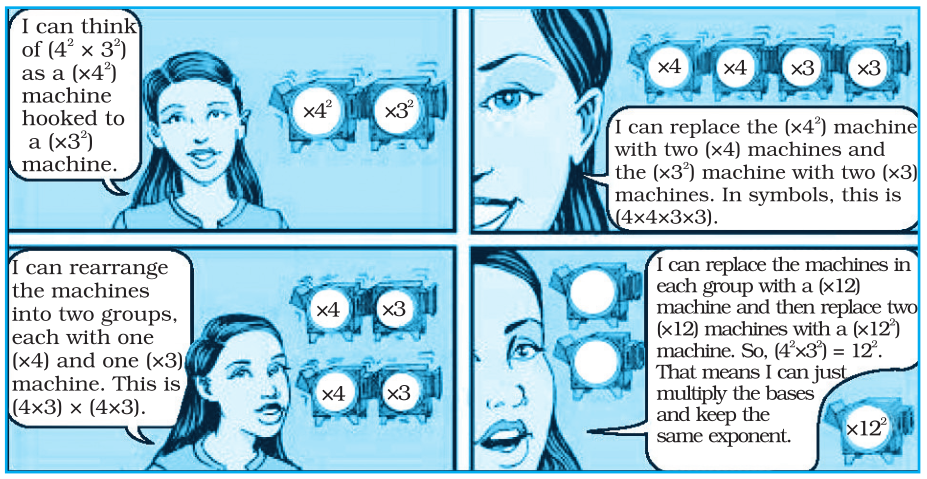
Answera$(x 5^{99})$ machine followed by $a(5^{-100})$ machine.
So, it produces $= 5^{99}\times\frac{1}{5^{100}}=\frac{1}{5}$
Hence, $\Big(\text{x}\frac{1}{5}\Big)$ machine can do the same job as the given hook-up.
View full question & answer→Question 302 Marks
Express the following in exponential form: $\frac{-625}{10000}$
AnswerGiven, $\frac{-625}{10000}$
Since, $5 × 5 × 5 × 5 = 625 = (5)^4$ and $10 × 10 × 10 × 10 = 1000 = (10)^4$
Exponential form of $\frac{-625}{10000}=\frac{-(5)^4}{(10)^4}=-\big(\frac{1}{2}\big)^4$
View full question & answer→Question 312 Marks
Express the following in standard form: Express $56\ km$ in m.
AnswerGiven,
$56km = 56 \times 1000\ m$ [$\because$ $1km= 1000\ m$]
$= 56000\ m$
Standard form of $56000 \mathrm{~m}=56 \times 10^3$
$=5.6 \times 10^3 \times 10^1$
$ =5.6 \times 10^4 \mathrm{~m}\left[\because a^m \times a^n=(a)^{m+n}\right]$
View full question & answer→Question 322 Marks
Repeater Machine:
Similarly, repeater machine is a hypothetical machine which automatically enlarges items several times. For example, sending a piece of wire through a $(x2^4)$ machine is the same as putting it through a $(x2)$ machine four times. So, if you send a $3\ cm$ piece of wire through a $(x2^4)$ machine, its length becomes $3 \times 2 \times 2 \times 2 \times 2 = 48\ cm$. It can also be written that a base $(2)$ machine is being applied $4$ times.
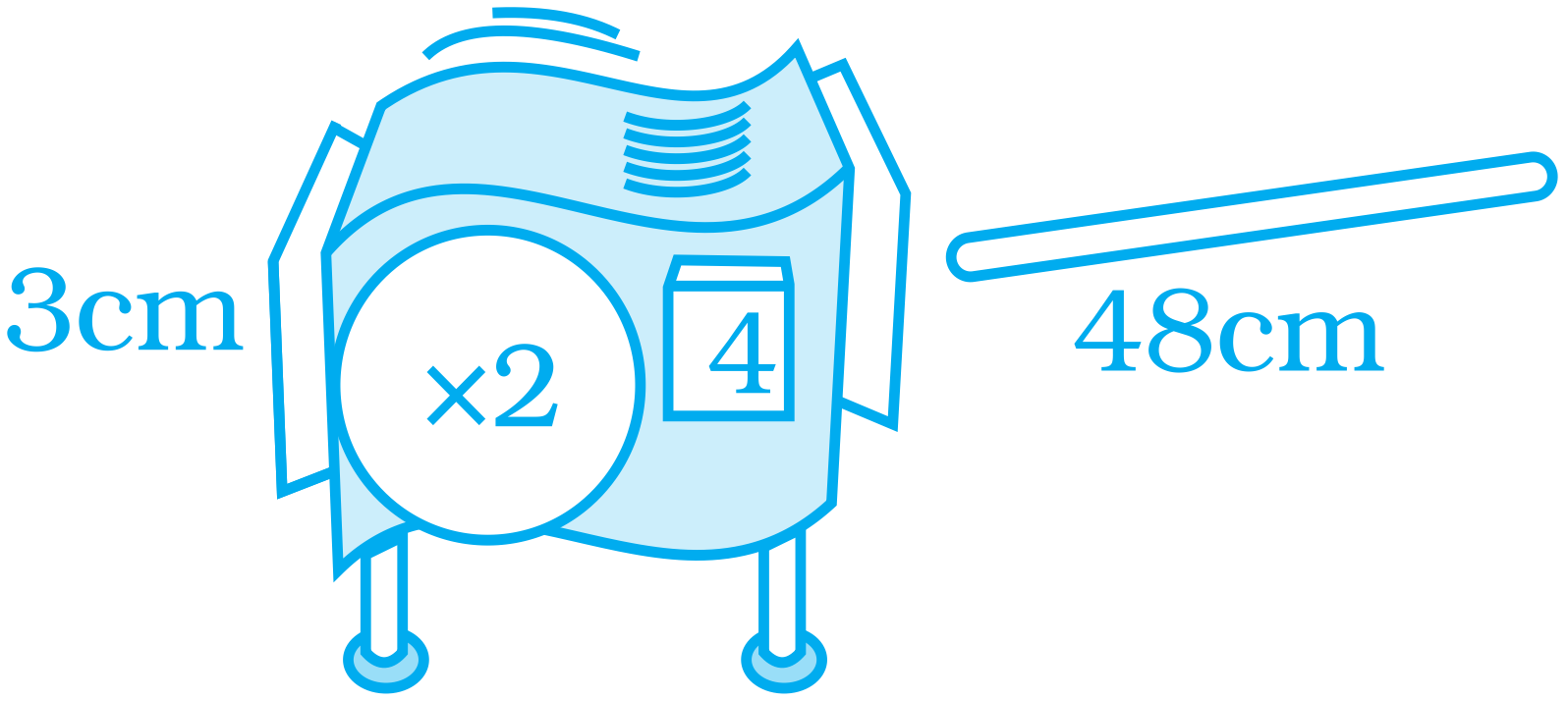
What will be the new length of a 4cm strip inserted in the machine? AnswerAccording to the question, if we put a $3\ cm$ piece of wire through a $(x2^4)$ machine,
its length becomes $3 \times 2 \times 2 \times 2 \times 2 = 48\ cm$.
Similarly, $4\ cm$ long strip becomes $4 \times 2 \times 2 \times 2 \times 2 = 64\ cm$.
View full question & answer→Question 332 Marks
Special balances can weigh something as $0.00000001$ gram. Express this number in the standard form.
AnswerWeight $= 0.00000001\ g$
Standard form of $0.00000001 \mathrm{~g}=0.1 \times 10^{-7} \mathrm{~g}$
$0.1 \times 10^{-7} \times 10^{-1} \mathrm{~g}\left[\because a^{\mathrm{m}} \times a^{\mathrm{n}}=(a)^{\mathrm{m}+\mathrm{n}}\right] $
$=1.0 \times 10^{-8} \mathrm{~g}$
View full question & answer→Question 342 Marks
Divide $293$ by $10,00,000$ and express the result in standard form.
Answer$\because$ $1000000 = 10^6$
$\because$ $\frac{293}{10^6}=293\times10^{-6}$
$\Big[\because\text{a}^{-\text{m}}=\frac{1}{\text{a}^\text{m}}\Big]$
$=2.93\times10^{-6}\times10^2$
$=2.93\times10^{-4}$
View full question & answer→Question 352 Marks
The planet Uranus is approximately $2,896,819,200,000$ metres away from the Sun. What is this distance in standard form?
AnswerDistance between the planet Uranus and the Sun is $2896819200000\ m$.
Standard form of $2896819200000 = 28968192 \times 10 \times 10 \times 10 \times 10 \times 10$
$= 28968192 x 10^5= 2.8968192 x 10^{12}m.$
View full question & answer→Question 362 Marks
One Fermi is equal to $10^{-15}$ metre. The radius of a proton is $1.3b$ Fermis. Write the radius of a proton in metres in standard form.
AnswerThe radius of a proton is $1.3$ fermi.
One fermi is equal to $10^{-15}m$.
So, the radius of the proton is $1.3 \times 10^{-15}m$.
Hence, standard form of radius of the proton is $1.3 \times 10^{-15}m$.
View full question & answer→Question 372 Marks
Express as a power of a rational number with negative exponent.
$\left(2^5 \div 2^8\right) \times 2^{-7}$
AnswerUsing law of exponents, $a^m+a^n=a^{m-n}$and $a^m \times a^n=a^{m+n}[\because$ a is non-zero integer]
$\therefore\left(2^5 \div 2^8\right) \times 2^{-7}=\left(2^{5-8}\right) \times 2^{-7}$
$=2^{-3} \times 2^{-7}=2^{-3-7}$
$=2^{-10}$
View full question & answer→Question 382 Marks
a $(x2^4)$ machine followed by $\Big(\text{x}\big(\frac{1}{2}^{}\big)^2\Big)$ machine.
Answera $(x2^4)$ machine followed by $\Big(\text{x}\big(\frac{1}{2}^{}\big)^2\Big)$ machine.
So, it produces $2\times2\times2\times2\times\frac{1}{2}\times\frac{1}{2}=4$
Hence, $(x2^2)$ single machine can do the same job as the given hook-up
View full question & answer→Question 392 Marks
Consider a quantity of a radioactive substance. The fraction of this quantity that remains after $t$ half$-$lives can be found by using the expression $3^{-t}$.
$a.$ What fraction of substance remains after $7$ half$-$lives?
$b.$ After how many half$-$lives will the fraction be $\frac{1}{243}$ of the original?
AnswerSince, $3^{-t}$ expression is used for fiding the fraction of the quantity that remains after $t$ half$-$lives.
Hence, the fraction of substance remains after $7$ half$-$lives will be equal to $3^{-7},$
$\text{i.e.}\frac{1}{3^7}$.
Given, $t$ half$-$lives $= 3^{-t}$
So, $\frac{1}{243}=3^{\text{-t}}$
$\Rightarrow \ \frac{1}{3^{5}}=\frac{1}{3^\text{t}}$ $\Big[\because3\times3\times3\times3\times3^{5} \ \text{and} \ \text{a}^ \text{-m}=\frac{1}{\text{a}^{\text{m}}}\Big]$
On comparing both sides, we get $t = 5$ half$-$lives.
View full question & answer→Question 402 Marks
What happens when 1cm worms are sent through these hook-ups?
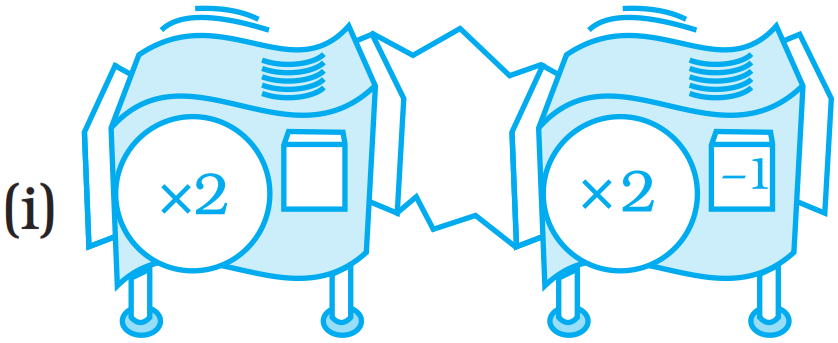
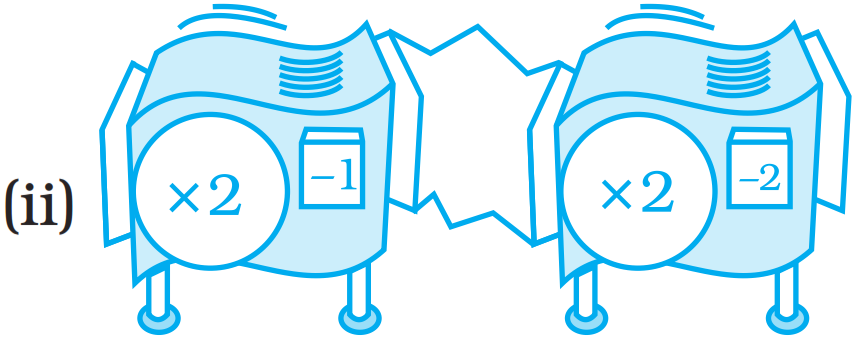
AnswerIf cm worms are sent through $(x261)$ and $(x2^{-1})$ machine, then the result comes with $1\times2\times\frac{1}{2}=1\text{cm}.$
If 1cm worms are sent through $(x2^{-1})$ and $(x2)^{-2}$ hooked machine, the result comes with
$1\times\frac{1}{2}\times\frac{1}{2\times2}=\frac{1}{2\times4}=\frac{1}{8}\text{cm}=0.125\text{cm}.$
View full question & answer→Question 412 Marks
By what number should $(-15)^{-1}$ be divided so that the quotient may be equal to $(-5)^{-1}?$
AnswerLet x be the number divide $(-15)^{-1}$ to get $(-5)^{-1}$ as a quotient.
$(-15)^{-1}+ x = (-5)^{-1}$
$\Rightarrow\frac{1}{-15}\times\frac{1}{\text{x}}=\frac{1}{5}$ $\Big[\because\text{a}^{\text{-m}}=\frac{1}{\text{a}^{\text{m}}}\Big]$
$\Rightarrow \ \frac{1}{\text{x}}=\frac{1}{5}+\frac{1}{-15} \ \Rightarrow\frac{1}{\text{x}}=\frac{1}{5}\times\frac{-15}{1}$
$\Rightarrow \ \text{x}=3$
View full question & answer→Question 422 Marks
At the end of the $20\ th$ century, the world population was approximately $6.1 \times 10^9$ people. Express this population in usual form. How would you say this number in words?
AnswerGiven, at the end of the $20$th century, the world population was $6.1 x 10^9$ (approx).
People population in usual form $= 6.1 x 10^9$ $= 6100000000$.
Hence, population in usual form was six thousand one hundred million.
View full question & answer→Question 432 Marks
Express $\frac{16}{81}$ and $\frac{-16}{81}$ as powers of a rational number.
Answer$\because$ $16=4\times4=4^2$ and $81=9\times9=9^2$
$\therefore$ $\frac{16}{81}=\frac{(4)^2}{(9)^2}=\Big(\frac{4}{9}\Big)^2$ and $\frac{-16}{81}=\frac{(-4)^2}{(9)^2}=-\Big(\frac{4}{9}\Big)^2$
View full question & answer→Question 442 Marks
For hook-up, determine whether there is a single repeater machine that will do the same work. If so, describe or draw it.

AnswerUsing law of exponents, $\left(a^m \times a^n=a^{m+n}\right)[\because a$ is non-zero integer $]$
Hook-up machine work $=(0.5)^2 \times(0.5)^3=(0.5)^5$
So, it $(x 0.5)^5$ machine can for the same work.
Diagram of single $x(0.5)^2$ machine.

View full question & answer→Question 452 Marks
Express each of the following in standard form: Express $5$ hectares in $cm^2$ $(1\ $ hectare $= 10000m^2)$
AnswerGiven, $5 hec = 5 \times 10000m^2$
$= 5 \times 10000 \times 100 \times 100cm^2$
$= 5 \times 10 \times 10 \times 10 \times 10 \times 10 \times 10\times 10 \times 10$
$= 5 \times 10^8cm^2$ [$\because$ $a^m\times a^n= (a)^{m+n}$]
View full question & answer→Question 462 Marks
An electron’s mass is approximately $9.1093826 × 10^{-31}$ kilograms. What is this mass in grams?
AnswerMass of electron $=9.1093826 \times 10^{-31} \mathrm{~kg}$
$ 9.1093826 \times 10^{-31} \times 1000 \mathrm{~g}[\because 1 \mathrm{~kg}=1000 \mathrm{~g}]$
$ 9.1093826 \times 10^{-31} \times 10^3=9.1093826 \times 10^{-26} \mathrm{~g}\left[\because \mathrm{a}^{\mathrm{m}} \times \mathrm{a}^{\mathrm{n}}==(\mathrm{a})^{\mathrm{m}+\mathrm{n}}\right]$
View full question & answer→Question 472 Marks
Find a single machine that will do the same job as the given hook-up. $a(x2^3)$ machine followed by $(x2^{-2})$ machine.
Answer$(x2^3)$ machine vfollowed by $(x2^{-2})$ machine.
So, it produced $2\times2\times2\times\frac{1}{2}\times\frac{1}{2}=2^1$
Hence, $(x2^1)$ single machine can do the same job as the given hook-up.
View full question & answer→Question 482 Marks
Simplify: $\big(\frac{1}{5}\big)^{45}\times\big(\frac{1}{5}\big)^{-60}-\big(\frac{1}{5}\big)^{+28}\times\big(\frac{1}{5}\big)^{-43}$
Answer$\big(\frac{1}{5}\big)^{45}\times\big(\frac{1}{5}\big)^{-60}-\big(\frac{1}{5}\big)^{+28}\times\big(\frac{1}{5}\big)^{-43}$$=\frac{1}{(5)^{45}}\times\frac{1}{(5)^{-60}}-\frac{1}{(5)^{28}}\times\frac{1}{(5)^{-43}}$
$=\frac{1}{(5)^{45-60}}-\frac{1}{(5)^{28-43}}$
$[\because\text{a}^{\text{m}}\times\text{a}^{\text{n}}=\text{a}^{\text{m}+\text{n}}]$
$=\frac{1}{(5)^{-15}}-\frac{1}{(5)^{-15}}=(5)^{15}-(5)^{15}$
$\big[\because\text{a}^{\text{-m}}=\frac{1}{\text{a}^{\text{m}}}\big]$
$=0$
View full question & answer→Question 492 Marks
Planet $A$ is at a distance of $9.35 \times 10^6km$ from Earth and planet $B$ is $6.27 \times 10^7km$ from Earth. Which planet is nearer to Earth?
AnswerDistance between planet $A$ and Earth $= 9.35 \times 10^6km$
Distance between planet $B$ and Earth $= 6.27 \times 10^7km$
For finding difference between above two distances,
we have to change both in same exponent of $10,\ i.e. 9.35 × 10^6$
$= 0.935 \times 10^7$
clearly $6.27 \times 10^7$ is greater.
So, planet $A$ is nearer to Earth.
View full question & answer→Question 502 Marks
Express the product of $3.2 × 10^6$ and $4.1 × 10^{-1}$ in the standard form.
Answerproduct of $3.2 \times 10^6$ and $4.1 \times 10^{-1}$
$ =\left(3.2 \times 10^6\right)\left(4.1 \times 10^{-1}\right) $
$ =(3.2 \times 4.1) \times 10^6 \times 10^{-1} $
$ =13.12 \times 10^5 $
$ =1.312 \times 10^5 \times 10^1\left[\because a^m \times a^n=a^{m+n}\right] $
$ =1.312 \times 10^6$
View full question & answer→Question 512 Marks
Express the following in exponential form: $\frac{-1296}{14641}$
AnswerGiven, $\frac{-1296}{14641}$
Since, $(6) × (6) × (6) × (6) = 1296 = (6)^4$ and $11 × 11 × 11 × 11 = 14641 = (11)^4$
Exponential form of $\frac{-1296}{14641}=-\frac{(6)^4}{(11)^4}=-\big(\frac{6}{11}\big)^4$
View full question & answer→Question 522 Marks
A sugar factory has annual sales of $3$ billion $720$ million kilograms of sugar. Express this number in the standard form.
AnswerAnnual sales of a sugar factory $= 3$ billion $720$ million kilograms $= 3720000\ kg$
Standard form of $3720000 = 372 \times 10 \times 10 \times 10 \times 10$
$ =372 \times 10^4 \mathrm{~kg} $
$ =3.72 \times 10^4 \times 10^2 $
$ =3.72 \times 10^6 \mathrm{~kg}\left[\because a^{\mathrm{m}} \times a^{\mathrm{n}}=(a)^{\mathrm{m}+\mathrm{n}}\right]$
View full question & answer→Question 532 Marks
For hook-up, determine whether there is a single repeater machine that will do the same work. If so, describe or draw it.

AnswerUsing law of exponents, $(a^m× a^n= a^{m+n})$ $[\because$ a is non-zero integer$]$
Hook-up machine work $= 12^2× 12^3= 12^5$
So, $(x12^5)$ machine can do the same work.
Diagram of single $x12^5$ machine.

View full question & answer→Question 542 Marks
The left column of the chart lists the lengths of input chains of gold.Repeater machines are listed across the top. The other entries are the outputs you get when you send the input chain from that row through the repeater machine from that column. Copy and complete the chart.
|
Input Length
|
Repeater Machine |
|
|
$x2^3$
|
|
|
|
|
$40$ |
|
$125$
|
| $2$ |
|
|
|
|
|
|
$162$
|
|
AnswerIn the given table, the left column of the chart lists is the length of input chains of gold. Thus, the output we get when we send the input chain from the row through the repeater machine are detailed in the following table.
|
Input Length
|
Repeater Machine |
|
|
$x3$
|
$x12$
|
$x9$
|
|
$13.3$
|
$40$ |
$160$ |
$125$
|
| $2$ |
$6$
|
$24$
|
$18$ |
|
$13.5$
|
$41$ |
$162$
|
$121$
|
View full question & answer→Question 552 Marks
Express the following in exponential form: $\frac{400}{3969}$
AnswerGiven, $\frac{400}{3969}$
Since, $20 × 20 = 400 = (20)^2$ and $63 × 63 = 3969 = (63)^2$
Exponential form of $\frac{-400}{3969}=\frac{(20)^2}{(63)^2}=-\big(\frac{20}{63}\big)^2$
View full question & answer→Question 562 Marks
Express the following in exponential form: $\frac{-125}{343}$
AnswerGiven, $\frac{-125}{343}$
Since, $(-5) × (-5) × (-5) = -125 = (-5)^3$ and $7 × 7 × 7 =343 = (-7)^3$
Exponential form of $\frac{-125}{343}=\frac{(-5)^3}{(7)^3}=\big(\frac{-5}{7}\big)^3$
View full question & answer→Question 572 Marks
Shrinking Machine: In a shrinking machine, a piece of stick is compressed to reduce its length. If $9\ cm$ long sandwich is put into the shrinking machine below, how many cm long will it be when it emerges?

AnswerAccording to the question, in a shrinking machine, a piece of stick is compressed to reduce its length. If $9\ cm$ long sandwich is put into the shrinking machine, then the length of sandwich will be $9\times\frac{1}{3^{-1}}=9\times3=27\text{cm}.$
View full question & answer→Question 582 Marks
The left column of the chart lists the lengths of input pieces of ribbon. Stretching machines are listed across the top. The other entries are the outputs for sending the input ribbon from that row through the machine from that column. Copy and complete the chart.
|
Input Length
|
Machine
|
|
|
$x2$
|
|
|
|
|
|
$1$
|
$5$
|
|
|
|
$3$
|
|
|
|
$15$
|
|
|
$14$
|
|
$7$
|
|
AnswerIn the given table, the left column of chart list is the length of input piece of ribbon. Thus, the outputs for sending the input ribbon are given in the following table.
|
Input Length
|
Machine
|
|
|
$x2$
|
$x10$
|
$x5$
|
|
$5$
|
$1$
|
$5$
|
$2.5$
|
|
$3$
|
$6$
|
$30$
|
$15$
|
|
$7$
|
$14$
|
$70$
|
$35$
|
View full question & answer→Question 592 Marks
Ajay had a $1\ cm$ piece of gum. He put it through repeater machine given below and it came out $\frac{1}{100,000}$ cm long. What is the missing value? 
AnswerSince, Ajay put a $1\ cm$ pieace of gum and came out $\frac{1}{100000}$. So, it is shrinking machine.
Hence, it is a $\Big(\text{x}\frac{1^1}{10}\Big)^5$ type shrinking machine. Thus, missing value is $5$.
View full question & answer→Question 602 Marks
Find the product of the cube of $(-2)$ and the square of $(+4)$.
Answer$\because$ Cube of $(-2) = (-2)^3$
and square of $(+4) = (+4)^2$
$\therefore$ The product $= (-2)^3\times (4)^2$
$= (-8) \times 16$
$= -128$
View full question & answer→Question 612 Marks
By what number should $(–8)^{-3}$ be multiplied so that that the product may be equal to $(–6)^{-3}?$
AnswerLet $x$ be the number multiplied with $(-8)^{-3}= (-6)^{-3}$
$\Rightarrow \ \text{x}\times(-8)^{-3}=(-6)^{-3}$
$\Rightarrow \ \text{x}=\frac{(-6)^{-3}}{(-8)^{-3}}=\frac{(-8)^{-3}}{(-6)^{-3}}=\frac{512}{216}=\frac{64}{27}$
View full question & answer→Question 622 Marks
Find the multiplicative inverse of $(-7)^{-2}÷ (90)^{-1}$.
Answera is called multiplicative inverse of b, if $a \times b = 1$
We have, $(-7)^{-2}÷ (90)^{-1}$
$=\frac{1}{(7)^2}+\frac{1}{(90)^1}$
$=\frac{1}{49}\div\frac{1}{90}$
$=\frac{1}{49}\times\frac{90}{1}$
$=\frac{90}{49}$
$\Big[\because$ $(-a)^m= a^m$ if $m$ is an even number and $\text{a}^{-\text{m}}=\frac{1}{\text{a}^\text{m}}\Big]$
Put $\text{b}=\frac{90}{49}$
$\therefore$ $\text{a}\times\frac{90}{49}=1$
$\Rightarrow\text{a}\times\frac{90}{49}$
View full question & answer→Question 632 Marks
Express $\frac{1.5\times10^6}{2.5\times10^{-4}}$ in the standard form.
AnswerGiven,
$\frac{1.5\times10^6}{2.5\times10^{-4}}=\frac{15}{25}\times10^{6+4}$ [$\because$ $a^m÷ a^n= (a)^{m-n}$]
$=\frac{3}{5}\times10^{10}$
$=0.6\times10^{10}$
$=0.6\times10^{10}\times10^{-1}$
$=6\times10^9$ [$\because$ $a^m× a^n= (a)^{m-n}$]
View full question & answer→Question 642 Marks
Mass of Mars is $6.42 \times 10^{29} \mathrm{~kg}$ and mass of the Sun is $1.99 \times 10^{30} \mathrm{~kg}$. What is the total mass?
AnswerMass of Mars $=6.42 \times 10^{29} \mathrm{~kg}$
Mass of the Sun $=1.99 \times 10^{30} \mathrm{~kg}$
Total mass of Mars and Sun together $=6.42 \times 10^{29}+1.99 \times 10^{30}$
$=6.42 \times 10^{29}+19.9 \times 10^{29}=26.32 \times 10^{29} \mathrm{~kg}$
View full question & answer→Question 652 Marks
Express the following in standard form: A Helium atom has a diameter of $0.000000022\ cm$.
AnswerA helium atom has a diameter of $0.000000022\ cm$.
Standard form of $0.000000022\ cm$
$ =0.22 \times 10^{-7} $
$ =2.2 \times 10^{-7} \times 10^{-1} $
$ =2.2 \times 10^{-8} \mathrm{~cm}\left[\because a^{\mathrm{m}} \times a^{\mathrm{n}}=(a)^{\mathrm{m}+\mathrm{n}}\right] $
View full question & answer→Question 662 Marks
Fill in the blanks:

Answer$144\times2^{-3}=144\times\frac{1}{8}=18$
$18\times12^{-1}=18\times\frac{1}{12}=\frac{3}{2}$
$\frac{3}{2}\times3^{-2}=\frac{3}{2}\times\frac{1}{3^{2}}=\frac{1}{2\times3}=\frac{1}{6}$
View full question & answer→Question 672 Marks
The diameter of the Sun is $1.4 \times 10^9m$ and the diameter of the Earth is $1.2756 \times 10^7m$. Compare their diameters by division.
AnswerDiameter of the sun $= 1.4 \times 10^9m$
Diameter of the Earth $= 1.2756 \times 10^7m$
For comparison, we have to change both diameter in same powers of $10$ i.e. $1.2756 \times 10^7m = 0.012756 \times 10^9$
Hence, if we divide diameter of sun by diameter of Earth,we get
$\frac{1.4 \times 109\text{m}}{0.012756\times10^9}=110$
So, diameter of sun is $110$ times the diameter of Earth.
View full question & answer→Question 682 Marks

The paper clip below has the indicated length. What is the length in standard form. Length of the paper clip $= 0.05m$.
In standard form, $0.05m$ $=0.5 \times 10^{-1}=5.0 \times 10^{-2} \mathrm{~m}$.
Hence, the length of the paper clip in standard form is $5.0 \times 10^{-2} \mathrm{~m}$.AnswerLength of the paper clip $= 0.05m$.
In standard form, $0.05\ m$ $=0.5 \times 10^{-1}=5.0 \times 10^{-2} \mathrm{~m}$.
Hence, the length of the paper clip in standard form is $5.0 \times 10^{-2} \mathrm{~m}$.
View full question & answer→