MCQ 11 Mark
$x = 2, y = -1$ is a solution of the linear equation:
- ✓
$x + 2y = 0$
- B
$x + 2y = 4$
- C
$2x + y = 0$
- D
$2x + y = 5$
AnswerCorrect option: A. $x + 2y = 0$
Substituting $x = 2$ and $y = -1$ in the following equations:
$L.H.S. = x + 2y = 2 + 2(-1) = 2 - 2 = 0 = R.H.S.$
$L.H.S. = x + 2y = 2 + 2(-1) = 2 - 2 = 0 ≠ 4 ≠ R.H.S.$
$L.H.S. = 2x + y = 2(2) + (-1) = 4 - 1 = 3 ≠ 0 ≠ R.H.S.$
$L.H.S. = 2x + y = 2(2) + (-1) = 4 - 1 = 3 ≠ 5 ≠ R.H.S.$
Hence, correct option is $(a).$
View full question & answer→MCQ 21 Mark
The equation of the $y-$axis is:
- ✓
$x = 0$
- B
$y = 0$
- C
$x + y = 0$
- D
$x = y$
AnswerCorrect option: A. $x = 0$
Since the $x-$coordinate of any point on $y-$axis is always $0.$
So, the equation of the $y-$axis is $x = 0.$
View full question & answer→MCQ 31 Mark
The equation $2x + 5y = 7$ has a unique solution, if $x$ and $y$ are:
AnswerThe equation $2x + 5y = 7$ has a unique solution, if $x$ and $y$ are natural numbers.
If we take $x = 1$ and $y = 1$, the given equation is satisfied.
View full question & answer→MCQ 41 Mark
The graph of the linear equation $2x + 5y = 10$ meets the $x-$axis at the point.
- A
$(0, 5)$
- ✓
$(5, 0)$
- C
$(0, 2)$
- D
$(2, 0)$
AnswerCorrect option: B. $(5, 0)$
If the graph of the linear equation $2x + 5y = 10$ meets the $x-$axis, then $y = 0.$
Substituting the value of $y = 0$ in equation $2x + 5y = 10$, we get
$2x + 5(0) = 10$
$\Rightarrow 2x = 10$
$\Rightarrow\text{x}=\frac{10}{2}$
$\Rightarrow x = 5$
So, the point of meeting is $(5, 0).$
View full question & answer→MCQ 51 Mark
The graph of the linear equation $2x + 3y = 6$ is a line which meets the $x-$axis at the point.
- A
$(0, 2)$
- B
$(0, 3)$
- ✓
$(3, 0)$
- D
$(2, 0)$
AnswerCorrect option: C. $(3, 0)$
$2x + 3y = 6$ meets the $x-$axis.
Put $y = 0,$
$2x + 3(0) = 6$
$x = 3$
Therefore, graph of the given line meets x-axis at $(3, 0).$
View full question & answer→MCQ 61 Mark
All linear equations in two variables have __________.
- A
- ✓
Infinitely many solutions
- C
- D
AnswerCorrect option: B. Infinitely many solutions
Infinitely many solutions
View full question & answer→MCQ 71 Mark
The graph of the equation$ x + y = 4.$
- ✓
Intersects both the axis.
- B
Parallel to the $x-$axis.
- C
Intersects $x-$axis only.
- D
Intersects $y-$axis only.
AnswerCorrect option: A. Intersects both the axis.
The graph of the equation $x + y = 4,$
Put $x = 0$ cut $y$ axis at $y = 4,$
Put $y = 0$ cut $x$ axis at $x = 4.$
View full question & answer→MCQ 81 Mark
A linear equation in two variables $x$ and $y$ is of the form $ax = by + c = 0$, where:
- ✓
$\text{a}\neq0,\ \text{b}\neq0$
- B
$\text{a}\neq0,\ \text{b}=0$
- C
$\text{a}=0,\ \text{b}\neq0$
- D
$\text{a}=0,\ \text{c}=0$
AnswerCorrect option: A. $\text{a}\neq0,\ \text{b}\neq0$
A linear equation in tow variables $x$ and $y$ is of the form $ax + by + c = 0$, where $\text{a}\neq0$ and $\text{b}\neq0,$ since if either a or be is $0$, the degree of the equation would be but it would not be a linear equation in tow variables.If both $a$ and $b$ are $0$, then the equation is not linear.
View full question & answer→MCQ 91 Mark
How many lines pass through two points?
AnswerOnly one because if a line is passing through two points then that two points are solution of a single linear equation so only one line passes over two given points.
View full question & answer→MCQ 101 Mark
Write the correct answer in the following:
Any point on the $X-$axis is of the form,
- A
$(x, y)$
- B
$(0, y)$
- ✓
$(x, 0)$
- D
$(x, x)$
AnswerCorrect option: C. $(x, 0)$
Every point on the $X-$axis has its $y-$coordinate equal to zero. i.e., $y = 0.$
View full question & answer→MCQ 111 Mark
Any point on the $x-$axis is of the form:
- A
$(x, y)$
- B
$(0, y)$
- ✓
$(x, 0)$
- D
$(x, x)$
AnswerCorrect option: C. $(x, 0)$
Any point on x-axis is of the form $(x, 0)$, where $\text{x}\neq0,$
Since its $y-$coordinate will be $0$ always.
View full question & answer→MCQ 121 Mark
The cost of a notebook is twice the cost of a pen. The equation to represent this statement is:
- A
$x = 3y$
- ✓
$x - 2y = 0$
- C
$2x = 3y$
- D
AnswerCorrect option: B. $x - 2y = 0$
Let the cost of the notebook is $₹ x$ and pen is $₹ y$ and we have given that the cost of a notebook is twice the cost of a pen.
So we have
$x = 2y$
Or $x - 2y = 0.$
View full question & answer→MCQ 131 Mark
If $(a, 4)$ lies on the graph of $3x + y = 10$, then the value of a is:
Answer$3x + y = 10$
If $(a, 4)$ lies on its graph, then it must satisfy the equation.
Thus, we have
$3(a) + 4 = 10$
i.e. $3a = 6$
i.e. $a = 2$
Hence, correct option is $(c).$
View full question & answer→MCQ 141 Mark
The graph of $y + 2 = 0$ is a line.
- A
Parallel to the $y-$axis at a distance of $2$ units to the left of $y-$axis.
- B
Parallel to the $x-$axis at a distance of $2$ units below the $x-$axis.
- C
Making an intercept of $-2$ on the $x-$axis.
- ✓
Making an intercept of $-2$ on the $y-$axis.
AnswerCorrect option: D. Making an intercept of $-2$ on the $y-$axis.
As, the graph of $y+2=0$ or $y=-2$ is a line parallel to $x$-axis i.e. $y=0$.
$\Rightarrow$ The line represented by the equation $y=-2$ is parallel to $x$-axis and intersects $y$-axis at $y=-2$.
So, the graph of $y+2=0$ is a line parallel to the $x$-axis at a distance of 2 units below the $x$-axis making an intercept -2 on the $y$-axis.
View full question & answer→MCQ 151 Mark
The linear equation $3x - 5y = 15$ has:
- A
- B
- ✓
Infinitely many solutions.
- D
AnswerCorrect option: C. Infinitely many solutions.
The linear equation $3x - 5y = 15$ has infinitely many solutions since any every point on this line will be a solution of this equation.
For different values of $x$, we will get get the corresponding different values of $y.$
Since $x$ can take infinitely many values, $y$ will also have infinite values.
Hence, the line will have infinitely many solutions.
View full question & answer→MCQ 161 Mark
If $x$ represents the age of father and $y$ represents the present age of the son, then the statement for ‘present age of father is $5$ more than 6 times the age of the son’ in terms of mathematical equation is
- A
$6x + y = 5$
- ✓
$x = 6y + 5$
- C
$x + 6y = 5$
- D
$x - 6 = 5$
AnswerCorrect option: B. $x = 6y + 5$
$x = 6y + 5$
View full question & answer→MCQ 171 Mark
The value of $y$ at $x = -1$ in the equation $5y = 2$ is:
- A
$\frac{5}{2}$
- ✓
$\frac{2}{5}$
- C
$10$
- D
$0$
AnswerCorrect option: B. $\frac{2}{5}$
$\frac{2}{5}$
View full question & answer→MCQ 181 Mark
$x = 0$ is the equation of:
AnswerCorrect option: D. $y-$axis.
$x = 0$ is a line of $y-$axis because $x-$coordinates of all points lie on $y-$axis are zero.
View full question & answer→MCQ 191 Mark
Equation of a line which is $5$ units distance above the $x -$ axis is:
- A
$x = 5$
- B
$x + 5 = y$
- ✓
$y - 5$
- D
$x - y = 0$
AnswerCorrect option: C. $y - 5$
$y - 5$
View full question & answer→MCQ 201 Mark
The equation of a line parallel to $y-$axis and $4$ units to the right of origin is:
- ✓
$x = 4$
- B
$x = -4$
- C
$y = -4$
- D
$y = 4$
AnswerCorrect option: A. $x = 4$
The equation of a line parallel to $y$-axis at a distance of $4$ units from it, to its right from the origin.
$x=4$
Because when a line parallel toy axis in that case equation of line is $x=4$
So required equation is $x=4$
View full question & answer→MCQ 211 Mark
The point which lies on $y-$axis at a distance of $6$ units in the positive direction of $y-$axis is:
- ✓
$(0, 6)$
- B
$(-6, 0)$
- C
$(6, 0)$
- D
$(0, -6)$
AnswerCorrect option: A. $(0, 6)$
At $y-$axis the value of $x$ co-ordinate is $0$ and $y-$axis at a distance of $6$ units in the positive direction so the co-ordinate of the $y-$axis is 6. So the co-ordinate of point is $(0, 6).$
View full question & answer→MCQ 221 Mark
If the line represented by the equation $3x + ky = 9$ passes through the points $(2, 3)$, then the value of $'k'$ is:
AnswerIf the line represented by the equation $3x + ky = 9$ passes through the points $(2, 3)$ then $(2, 3)$ will satisy the equation
$3x + ky = 93(2) + 3k = 9$
$\Rightarrow 6 + 3k = 9$
$\Rightarrow 3k - 9 - 6$
$\Rightarrow 3k = 3$
$\Rightarrow k = 1$
View full question & answer→MCQ 231 Mark
For what value of $‘k’, x = 2$ and $y = -1$ is a solution of $x + 3y - k = 0?$
AnswerFor finding value of $‘k’,$ we put $x = 2$ and $y = -1$ in a equation
$x + 3y - k = 0.$
$x + 3y - k = 0$
$2 + 3(-1) = k$
$2 - 3 = k$
$k = -1.$
View full question & answer→MCQ 241 Mark
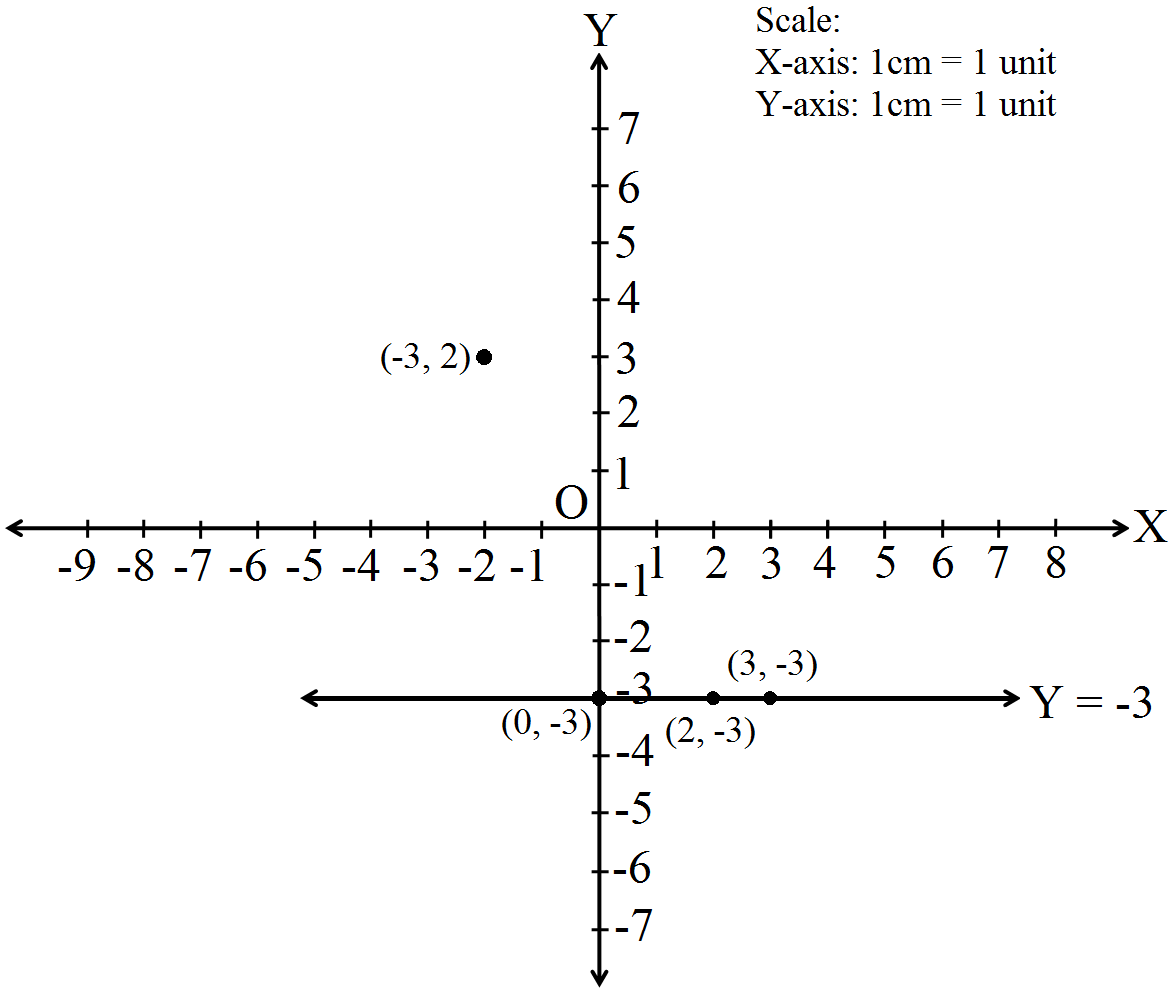
The graph of the line $y = -3$ does not pass through the point:
- A
$(2, -3)$
- B
$(3, -3)$
- C
$(0, -3)$
- ✓
$(-3, 2)$
AnswerCorrect option: D. $(-3, 2)$
The line $y = -3$ does not pass through the point $(-3, 2)$ since $\text{y}\neq2.$
View full question & answer→MCQ 251 Mark
The point of the form $(a, a)$, where a lies on:
- ✓
The line $y = x.$
- B
The line $x + y = 0.$
- C
The $x-$axis.
- D
The $y-$axis.
AnswerCorrect option: A. The line $y = x.$
The point $(a, a)$ lies on line $x=y$ or $x-y=0$
Here, is the verification
Put $x=a$ in equation
$x - y = 0$
$a - y = 0$
$-y = -a$
$y = a$
Hence, it is prove that $(a, a)$ is a solution of $x-y=0$ or $x=y$.
View full question & answer→MCQ 261 Mark
Express $y$ in terms of $x$ in the equation$ 5x - 2y = 7.$
- A
$\text{y}=\frac{5\text{x}+7}{2}$
- B
$\text{y}=\frac{7\text{x}+5}{2}$
- ✓
$\text{y}=\frac{5\text{x}-7}{2}$
- D
$\text{y}=\frac{7-5\text{x}}{2}$
AnswerCorrect option: C. $\text{y}=\frac{5\text{x}-7}{2}$
$5x - 2y = 7$
$-2y = 7 - 5x$
$2y = 5x - $7
$\text{y}=\frac{5\text{x}-7}{2}.$
View full question & answer→MCQ 271 Mark
Write the correct answer in the following: The graph of $y = 6$ is a Line,
- ✓
Parallel to $X-$axis at a distance $6$ units from the origin.
- B
Parallel to $Y-$axis at a distance $6$ units from the origin.
- C
Making an intercept $6$ on the $X-$axis.
- D
Making an intercept $6$ on both axes.
AnswerCorrect option: A. Parallel to $X-$axis at a distance $6$ units from the origin.
The given equation $y = 6$ does not contain $x$. Its graph is a line parallel to $X-$axis.
So, the graph of $y = 6$ is a line parallel to $X-$axis at a distance $6$ units from the origin.
View full question & answer→MCQ 281 Mark
The graph of the linear equation $x - y = 0$ passes through the point:
- A
$(-1,1)$
- ✓
$\Big(\frac{1}{1},\frac{1}{2}\Big)$
- C
$\Big(\frac{1}{1},-\frac{1}{2}\Big)$
- D
$(0,1)$
AnswerCorrect option: B. $\Big(\frac{1}{1},\frac{1}{2}\Big)$
The graph of the linear equation $x - y = 0$ passes through the point $\Big(\frac{1}{1},\frac{1}{2}\Big)$ because the co-ordinate of x and y axis satisfy the given equation $x - y = 0.$
$\frac{1}{1}-\frac{1}{2}=0$
$0 = 0$
So we can say $\Big(\frac{1}{1},\frac{1}{2}\Big)$ is a solution of above equation.
So we can say the value of x co-ordinate must be equal to y co-ordinate.
View full question & answer→MCQ 291 Mark
If $(2, 0)$ is a solution of the linear equation $2x + 3y = k$, then the value of $k$ is:
AnswerSubstitute $x = 2$ and $y = 0$ in the given equation, we get2 $(2) + 3 (0) = k$
$k = 4 + 0$
$k = 4$.
Hence, the value of $k$ is $4$.
Stay tuned with $BYJU’S –$ The Learning App and download the app today to get more class - wise concepts.
View full question & answer→MCQ 301 Mark
The equation $2x + 5y = 7$ has a unique solution, if $x, y$ are:
AnswerThere is only one pair i.e., $(1, 1)$ which satisfies the given equation but in positive real numbers, real numbers and rational numbers there are many pairs to satisfy the given linear equation. Hence, unique solution is possible only in case of Natural numbers.
View full question & answer→MCQ 311 Mark
Which of the following is a linear equation in two variables?
- A
$x + 5 = 8$
- ✓
$2x - 5y = 0$
- C
$x ^2 = 5x + 3$
- D
$5x = y ^2 + 3$
AnswerCorrect option: B. $2x - 5y = 0$
In linear equation power of variable $x$ and $y$ should be $1$ and here, the given linear equation has two variable $x$ and $y.$
View full question & answer→MCQ 321 Mark
Write the correct answer in the following: The equation of $X-$axis is of the form,
- A
$x = 0$
- ✓
$y = 0$
- C
$x + y = 0$
- D
$x = y$
AnswerCorrect option: B. $y = 0$
$y = 0$ is the equation of $x-$axis.
View full question & answer→MCQ 331 Mark
If a linear equation has solutions $(1, 2), (-1, -16)$ and $(0, -7)$, then it is of the form:
- ✓
$y = 9x - 7$
- B
$9x - y + 7 = 0$
- C
$x - 9y = 7$
- D
$x = 9y - 7$
AnswerCorrect option: A. $y = 9x - 7$
Since all the given co- ordinate $(1, 2), (-1, -16)$ and $(0, -7)$ satisfy the given line $y = 9x - 7$
For point $(1, 2)$
$y = 9x - 7$
$2 = 9(1) - 7$
$2 = 9 - 7$
$2 = 2$
Hence $(2, 1)$ is a solution.
For point $(-1, -16)$
$y = 9x - 7$
$-16 = 9(-1) - 7$
$-16 = -9 - 7$
$-16 = -16$
Hence $(-1, -16)$ is a solution.
For point $(0, -7)$
$y = 9x - 7$
$-7 = 9(0) -7$
$-7 = -7$
Hence $(0, -7)$ is a solution.
View full question & answer→MCQ 341 Mark
The maximum number of points that lie on the graph of a linear equation in two variables is:
MCQ 351 Mark
The equation $x = 7$ in two variables can be written as:
- A
$1.x + 1.y = 7$
- ✓
$1.x + 0.y = 7$
- C
$0.x + 1.y = 7$
- D
$0.x + 0.y = 7$
AnswerCorrect option: B. $1.x + 0.y = 7$
The equation $x=7$ in two variables can be written as exactly $1 . x+0 . y=7$ because it contain two variable $x$ and $y$ and coefficient of $y$ is zero as there is no term containing yin equation $x=7$
View full question & answer→MCQ 361 Mark
$x - 4$ is the equation of:
AnswerCorrect option: D. A line parallel to $y-$axis.
We know that the line parallel to $y-$axis is given by $x = a$
$x - 4 = 0$
$x = 4$
So it is a line parallel to $y-$axis, at a distance of $4$ units from it, to the right.
View full question & answer→MCQ 371 Mark
Write the correct answer in the following:
The graph of the linear equation $2x + 3y = 6$ cuts the $Y-$axis at the point,
- A
$(2, 0)$
- B
$(0, 3)$
- C
$(3, 0)$
- ✓
$(0, 2)$
AnswerCorrect option: D. $(0, 2)$
The graph of the linear equation $2x + 3y = 6$ cuts the y-axis at the point where x coordinate is zero.
Putting $x = 0$ in $2x + 3y = 6$, we get
$2(0) + 3y = 6 $
$\Rightarrow 3y = 6 $
$\Rightarrow y = 6 ÷ 3 = 2$
View full question & answer→MCQ 381 Mark
If a linear equation has solutions $(-2, 2), (0, 0)$ and $(2, -2)$, then it is of the form:
- A
$-x + 2y = 0$
- ✓
$x + y = 0$
- C
$x - y = 0$
- D
$-2x + y = 0$
AnswerCorrect option: B. $x + y = 0$
Linear equation has solutions $(-2, 2), (0, 0)$ and $(2, -2)$, then the equation will be $x + y = 0.$
As all the given three points satisfy the given equation.
View full question & answer→MCQ 391 Mark
Express $‘x’$ in terms of $‘y’$ in the equation $2x - 3y - 5 = 0.$
- A
$\text{x}=\frac{5-3\text{y}}{2}$
- B
$\text{x}=\frac{5+3\text{y}}{2}$
- ✓
$\text{x}=\frac{3\text{y}+5}{2}$
- D
$\text{x}=\frac{3\text{y}-5}{2}$
AnswerCorrect option: C. $\text{x}=\frac{3\text{y}+5}{2}$
$2x - 3y -5 = 0$
$2x = 3y + 5$
$\text{x}=\frac{3\text{y}+5}{2}.$
View full question & answer→MCQ 401 Mark
If the point $(3, 4)$ lies on the graph of $3y = ax + 6$, then the value of ‘a’ is:
AnswerThe point $(3, 4)$ lies on the graph of $3y = ax + 6$
So it will satisfy the equation
$3y = ax + 6$
$3(y) = ax + 6$
$12 = 3a + 6$
$12 - 6 = 3a$
$3a = 6$
$\text{a}=\frac{6}{3}$
$a = 2$
View full question & answer→MCQ 411 Mark
The distance between the graph of the equations $x = -3$ and $x = 2$ is:
AnswerDistance between the graph of the equations $x = -3$ and $x = 2$ is $= 2 - (-3) = 5$ units.
View full question & answer→MCQ 421 Mark
Write the correct answer in the following: The graph of the linear equation $2x + 3y = 6 $ is a line which meets the $X-$axis at the point.
- A
$(0, 2)$
- B
$(2, 0)$
- ✓
$(3, 0)$
- D
$(0, 3)$
AnswerCorrect option: C. $(3, 0)$
Since, the graph of linear equation $2x + 3y = 6$ meets the $X-$axis.
So, we put $y = 0$ in $2\text{x} + 3\text{y} = 6 \Rightarrow 2\text{x} + 3(0) = 6$
$\Rightarrow2\text{x}+0=6$
$\Rightarrow\text{x}=\frac{6}{2}\Rightarrow\text{x}=3$
View full question & answer→MCQ 431 Mark
The point of the form $(a, a)$, where a lies on:
- A
The $x-$axis
- ✓
The line $y = x$
- C
The $y-$axis
- D
The line $x + y = 0$
AnswerCorrect option: B. The line $y = x$
The point $(a, a)$ lies on line $x=y$ or $x-y=0$
here is the verification
Put $x=a$ in equation
$x-y=0$
$a-y=0$
$- y =- a$
$y=a$
hence it is prove that $(a, a)$ is a solution of $x-y=0$ or $x=y$
View full question & answer→MCQ 441 Mark
Any point on line $x = y$ is of the form:
- A
$(k, -k)$
- B
$(0, k)$
- C
$(k, 0)$
- ✓
$(k, k)$
AnswerCorrect option: D. $(k, k)$
$(k, k)$
View full question & answer→MCQ 451 Mark
The point of the form $(\text{a},-\text{a}),\ \text{a}\neq0$ lies on:
- A
The $x-$axis
- B
The $y-$axis
- C
The line $y = x$
- ✓
The line $x + y = 0$
AnswerCorrect option: D. The line $x + y = 0$
A point which lies on the $x$-axis has its $y$-coordinate $=0$ While a point which lies on the $y$-axis has its $x$-coordinate $=$ 0 .
So, the points of the form $(a,-a)$ will not lie on either axes.
Also, it does not satisfy the equation on of the line $y=x$.
The point of the form $(a,-a)$ lies on the line $x+y=0$ since it satisifes the equation of the given line.
View full question & answer→MCQ 461 Mark
The graph of the equation $2x + 3y = 6$ cuts the $x -$ axis at the point.
- A
$(0, 3)$
- ✓
$(3, 0)$
- C
$(2, 0)$
- D
$(0, 2)$
AnswerCorrect option: B. $(3, 0)$
$(3, 0)$
View full question & answer→MCQ 471 Mark
If $(4, 19)$ is a solution of the equation $y = ax + 3$, then $a =$
Answer$y = ax + 3$If $(4, 19)$ is its solution, then it must satisfy the equation.
Thus, we have
$19 = a × 4 + 3$
i.e. $4a = 16$
i.e. $a = 4$
Hence, correct option is $(b).$
View full question & answer→MCQ 481 Mark
Any point on the line $y = 3x$ is of the form.
- ✓
$(\text{a}, 3\text{a})$
- B
$(3\text{a}, \text{a})$
- C
$(\text{a}, \frac{\text{a}}{3})$
- D
$(\frac{\text{a}}{3}, \text{-a})$
AnswerCorrect option: A. $(\text{a}, 3\text{a})$
$(\text{a}, 3\text{a})$
View full question & answer→MCQ 491 Mark
The line represented by the equation $x + y = 16$ passes through $(2, 14)$. How many more lines pass through the point $(2, 14).$
AnswerThere are many lines pass through the point $(2, 14)$
$x - y = -12$
$2x + y = 18$
and many more
View full question & answer→MCQ 501 Mark
The graph of $x = 4$ is a line:
- A
Making an intercept $4$ on the $x-$axis.
- B
Making an intercept $4$ on the $y-$axis.
- C
Parallel to the $x-$axis at a distance of $4$ units from the origin.
- ✓
Parallel to the $y-$axis at a distance of $4$ units from the origin.
AnswerCorrect option: D. Parallel to the $y-$axis at a distance of $4$ units from the origin.
The graph of $x = 4$ is a line parallel to the $y-$axis at a distance of $4$ units from the origin.
View full question & answer→MCQ 511 Mark
Find the value of k, if $x = 1, y = 2$ is a solution of the equation $2x + 3y = k.$
View full question & answer→MCQ 521 Mark
The equation $y = 2x - 7$ has:
Answer$y = 2x - 7$Has many solutions because for different value of $x$ we have different value of $y$ for example.
At $x = 1$
$y = 2 (1) - 7$
$y = 2 - 7$
$y = -5$
At $x = 2$
$y = 2(2) - 7$
$y = 4 - 7$
$y = -3$
So we can say for many value of $x$ there is many value of $y.$
View full question & answer→MCQ 531 Mark
The graph of $x + 3 = 0$ is a line.
- A
Making an intercept $-3$ on the $y-$axis.
- B
Parallel to the $x-$axis at a distance of $3$ units below the $x-$axis.
- ✓
Making an intercept $-3$ on the $x-$axis.
- D
Parallel to the $y-$axis at a distance of $3$ units to the left of $y-$axis.
AnswerCorrect option: C. Making an intercept $-3$ on the $x-$axis.
As, the graph of $x+3=0$ or $x=-3$ is a line parallel to $y$-axis i.e. $x=0$.
$\Rightarrow$ The line represented by the equation $x=-3$ is parallel to $y$-axis and intersects $x$-axis at $x=-3$.
So, the graph of $x+3=0$ is a line parallel to the $y$-axis at a distance of 3 units to the left of $y$-axis making an intercept -3 on the $x$-axis.
View full question & answer→MCQ 541 Mark
The equation of a line parallel to $x-$axis and $3$ units above the origin is:
- A
$x = 3$
- ✓
$y = 3$
- C
$x = -3$
- D
$y = -3$
AnswerCorrect option: B. $y = 3$
The equation of a line parallel to $x$-axis and $3$ units above the origin is $y=3$.
Because when a line parallel to $x$ axis in that case equation of line is $y=a$
where $a$ is the co-ordinate of $y$-axis and $3$ units above the origin value $x$-coordinate is $3$ so required equation is $y=3$.
View full question & answer→MCQ 551 Mark
The equation of a line parallel to $y-$axis and $7$ units to the left of origin is:
- ✓
$x = -7$
- B
$y = 7$
- C
$y = -7$
- D
$x = 7$
AnswerCorrect option: A. $x = -7$
The equation of a line parallel to $y$-axis and $7$ units to the left of the origin is $x=-7$. Because when a line parallel to $y$-axis in that case equation of line is $x=a$.
Where $a$ is the co-ordinate of $x$-axis and $7$ units to the left of the origin value $x$-co-ordinate is $-7$ .
So required equation is $x=-7$.
View full question & answer→MCQ 561 Mark
Any solution of the linear equation $2x + 0y + 9 = 0$ in two variables is of the form:
- A
$\Big(0,-\frac{9}{2}\Big)$
- B
$(-9,0)$
- C
$\Big(\text{n},-\frac{9}{2}\Big)$
- ✓
$\Big(-\frac{9}{2},\text{m}\Big)$
AnswerCorrect option: D. $\Big(-\frac{9}{2},\text{m}\Big)$
$2x + 9 = 0 \Rightarrow\text{x}=\frac{-9}{2}$ And $y = m$, where m is any real number,
Hence, $\Big(-\frac{9}{2},\text{m}\Big)$ is the solution of the given equation.
View full question & answer→MCQ 571 Mark
The linear equation $2x - 5y = 7$ has:
- A
- ✓
Infinitely many solutions.
- C
- D
AnswerCorrect option: B. Infinitely many solutions.
Given equation is $2x - 5y = 7$,There is no given value of $x$ and $y$ so we can take any values. For every value of $x$, we get a corresponding value of $y$ and vice-versa.
Therefore, it has infinitely many solutions.
View full question & answer→MCQ 581 Mark
Write the correct answer in the following: The positive solutions of the equation $ax + by + c = 0$ always lie in the,
- ✓
I$^{st}$ quadrant.
- B
II$^{nd}$ quadrant.
- C
III$^{rd}$ quadrant.
- D
IV$^{th}$ quadrant.
AnswerCorrect option: A. I$^{st}$ quadrant.
We know that, if a line passes through the Ist quadrant, then all solution lying on the line in first quadrant must be positive because the coordinate of all points in the Ist quadrant are positive.
View full question & answer→MCQ 591 Mark
The point on the graph of the linear equation $2x + 5y = 19$, whose ordinate is $1^{\frac{1}{2}}$ times its abscissa is:
- A
$(-2, -3)$
- ✓
$(2, 3)$
- C
$(4, 6)$
- D
AnswerCorrect option: B. $(2, 3)$
Ordinate means y-coordinate. It means we need to find a point on the given line where y-coordinte $=\frac{3}{2}$ ex-coordinate).Just put $\text{y}=\Big[\frac{3}{2}\Big].\text{x}$ in the given eqn.
$2\text{x}+5\times\frac{3}{2}\text{x}=19$
$2\text{x}+\frac{15}{2}\text{x}=19$
$\frac{19\text{x}}{2}=19$
$\text{x}=\frac{19\times2}{19}$
$\text{y}=\frac{3}{2}\text{x}$
$\text{y}=\frac{3}{2}\times2$
$\text{y}=3$
So the co-ordinate are $(2, 3)$
View full question & answer→MCQ 601 Mark
How many lines pass through one point?
AnswerBecause one point can be solution of many equations. So many equations can be pass from one point.
View full question & answer→MCQ 611 Mark
For the equation $5x + 8y = 50$, if $y = 10$, then the value of $x$ is:
AnswerFor the equation $5x + 8y = 50$, if $y = 10$
Put $y = 10$ in given equation
$5x + 8 × 10 = 50$
$5x + 80 = 50$
$5x = 50 - 80$
$5x = -30$
$\text{x} = -\frac{30}{5}$
$x = -6$
View full question & answer→MCQ 621 Mark
The graph of the linear equation $y = 3x$ passes through the point.
- A
$(0,-\frac{2}{3})$
- ✓
$(\frac{2}{3},2)$
- C
$(,-\frac{2}{3},0)$
- D
$(0,\frac{2}{3})$
AnswerCorrect option: B. $(\frac{2}{3},2)$
$\text{y}=3\text{x}$
$\frac{\text{y}}{3}=\text{x}$
For $\text{x}=\frac{2}{3},$ the value of $\text{y}=3\times\frac{2}{3}=2$
So $(\frac{2}{3},2).$
View full question & answer→MCQ 631 Mark
Any point on the $y -$ axis is of the form.
- A
$(y, y)$
- ✓
$(0, y)$
- C
$(x, y)$
- D
$(x, 0)$
AnswerCorrect option: B. $(0, y)$
Any point on the $y -$ axis is of the form $(0, y).$
On the $y$ - axis, $y$ can take any values and $x$ should be equal to $0.$
View full question & answer→MCQ 641 Mark
Which of the following is the equation of a line parallel to $y -$ axis?
- A
$y = 0$
- B
$x + y = z$
- C
$y = x$
- ✓
$x = a$
AnswerCorrect option: D. $x = a$
$x = a$
View full question & answer→MCQ 651 Mark
If the graph of the equation $4x + 3y = 12$ cuts the coordinate axes at $A$ and $B$, then hypotenuse of right triangle $AOB$ is of length.
- A
$3$ units.
- B
$4$ units.
- ✓
$5$ units.
- D
AnswerCorrect option: C. $5$ units.
According to the given question, triangle so formed has sides of units $3$ and $4$, using pythagoras theorem, the largest side is of $5$ units.
View full question & answer→MCQ 661 Mark
If $(2k - 1, k)$ is a solution of the equation $10x - 9y = 12$, then $k =$
AnswerIf $(2k - 1, k)$ is solution of equation $10x - 9y = 12$, then it must satisfy this equation.
Thus, we have
$10(2k - 1) - 9k = 12$
$20k - 10 - 9k = 12$
$11k = 22$
$k = 2$
Hence, correct option is $(b).$
View full question & answer→MCQ 671 Mark
$x = 5$ and $y = -2$ is the solution of the linear equation.
- A
$x + 3y = 1$
- B
$2x + y = 9$
- C
$3x + y = 0$
- ✓
$2x - y = 12$
AnswerCorrect option: D. $2x - y = 12$
$x = 5$ and $y = -2$ is the solution of the linear equation $2x - y = 12$
$2x - y = 12$
$LHS = 2x - y$
$2.5 - (-2)$
$10 + 2$
$12$
$RHS = 12$
$LHS = RHS$
It means that $x = 5$ and $y = -2$ is the solution of the linear equation $2x - y = 12.$
View full question & answer→MCQ 681 Mark
The area of the triangle formed by the line $2x + 5y = 10$ and the co-ordinate axis is:
- A
$4$ sq. units.
- B
$10$ sq. units.
- C
$3$ sq. units.
- ✓
$5$ sq. units.
AnswerCorrect option: D. $5$ sq. units.
To find the area of the triangle formed by the line $2 x+5 y=10$ and co-ordinate axis. We put $x=0$ in given equation at $x=0$, we get $y=2$ at $y=0$ we get $x=5$. So the line cut $y$-axis at 2 and $x$-axis at 5 .
So the height of the triangle is 2 units and the base is 5 units.
Area of triangle $=\frac{1}{2}$ base $\times$ heigh,
$=\frac{1}{2}\times2\times5$
$= 5 sq$. units.
View full question & answer→MCQ 691 Mark
The graph of a linear equation $\text{y}=\frac{9}{5}\text{x}+32$ cuts the $y-$axis at the point:
- ✓
$(0, 32)$
- B
$(-32, 0)$
- C
$(0, -32)$
- D
$(32, 0)$
AnswerCorrect option: A. $(0, 32)$
When the graph cut at y axis in that case the value of $x-$ coordinate is $0.$
$\text{y}=\frac{9}{5}\text{x}+32$
$\text{y}=\frac{9}{5}.0+\text{32}$
$\text{y}=32$
So, the co-ordinates are $(32, 0)$
View full question & answer→MCQ 701 Mark
Write the correct answer in the following: The graph of the linear equation $y = x$ passes through the point.
- A
$\Big(\frac{3}{2},\frac{-3}{2}\Big)$
- B
$\Big(0,\frac{3}{2}\Big)$
- ✓
$(1,1)$
- D
$\Big(\frac{-1}{2},\frac{1}{2}\Big)$
AnswerCorrect option: C. $(1,1)$
We know that any point on the line $y = x$ will have $x$ and $y$ coordinates same.So, the graph of the linear equation $y = x$ passes through the point$ (1, 1).$
View full question & answer→MCQ 711 Mark
The graph of the linear equation $2x + 3y = 6$ meets the $y-$axis at the point.
- A
$(0, 3)$
- B
$(2, 0)$
- C
$(3, 0)$
- ✓
$(0, 2)$
AnswerCorrect option: D. $(0, 2)$
If the graph of the linear equation $2x + 3y = 6$ meets the $y-$axis, then $x = 0.$
Substituting the value of $x = 0$ in equation $2x + 3y = 6,$ we get
$2(0) + 3y = 6$
$\Rightarrow 3y = 6$
$\Rightarrow\text{y}=\frac{6}{3}$
$\Rightarrow y = 2$
So, the point of meeting is $(0, 2).$
View full question & answer→MCQ 721 Mark
If $(4, 19)$ is a solution of the equation $y = ax + 3$, then $a =$
AnswerGiven, $(4, 19)$ is a solution of the equation $y = ax + 3= 19 = 4a + 3$
$= a = 4.$
View full question & answer→MCQ 731 Mark
The graph of the linear equation $y = 3x$ passes through the point.
- A
$\Big(0,-\frac{2}{3}\Big)$
- B
$\Big(-\frac{2}{3},0\Big)$
- C
$\Big(0,\frac{2}{3}\Big)$
- ✓
$\Big(\frac{2}{3},2\Big)$
AnswerCorrect option: D. $\Big(\frac{2}{3},2\Big)$
$\text{y}=3\text{x}$
$\frac{\text{y}}{3}=\text{x}$
For, $y = 2$, the value of x will be $\frac{2}{3}$
So, $\Big(\frac{2}{3},2\Big)$
View full question & answer→MCQ 741 Mark
The graph of the line $x - y = 0$ passes through the point:
- A
$\Big(\frac{-1}{2},\frac{1}{2}\Big)$
- B
$\Big(\frac{3}{2},\frac{-3}{2}\Big)$
- C
$(0,-1)$
- ✓
$(1, 1)$
AnswerCorrect option: D. $(1, 1)$
The given linear equation is $x = y = 0.$
We have to check which of the point satisfy the given equation.
consider option (a):
Substituting $\text{x}=-\frac{1}{2}$ and $\text{y}=\frac{1}{2}$ in the $LHS$ if the given linear equation
$\therefore\ \text{x}-\text{y}=-\frac{1}{2}-\frac{1}{2}=-1\neq\text{RHS}$
$\therefore\ \text{x}=-\frac{1}{2}$ and $\text{y}=\frac{1}{2}$ does not satisfy the given linear equation.
Consider option (b):
Substituting $\text{a}=\frac{3}{2}$ and $\text{y}=-\frac{3}{2}$ in the $LHS$ if the given linear equation on
$\therefore\ \text{x}-\text{y}=\frac{3}{2}+\frac{3}{2}=3\neq\text{RHS}$
$\therefore\ \text{x}=-\frac{3}{2}$ and $\text{y}=-\frac{3}{2}$ does not satisfy the given linear eqation on.
Consider option (d):
Substitution $x = 1 $and $y = 1$ in the $LHS$ if the given linear equation
$\therefore\ $$x - y = 1 - 1 = 0 = RHS$
$\therefore\ $$x = 1$ and $y = 1$ satisfies the given linear equation.
View full question & answer→MCQ 751 Mark
The graph of $y = 5$ is a line.
- A
Parallel to the $x-$axis at a distance of $6$ units from the origin.
- B
Making an intercept $5$ on the $x-$axis.
- C
Parallel to the $y-$axis at a distance of $5$ units from the origin.
- ✓
Making an intercept $5$ on the $y-$axis.
AnswerCorrect option: D. Making an intercept $5$ on the $y-$axis.
As, the graph of $y=5$ is a line parallel to $x$-axis i.e. $y=0$.
$\Rightarrow$ The line represented by the equation $y=5$ is parallel to $x$-axis and intersects $y$-axis at $y=5$. So, the graph of $y=5$ is a line parallel to the $x$-axis at a distance of 5 units from the origin making an intercept 5 on the $y$-axis.
View full question & answer→MCQ 761 Mark
The graph of $x = 3$ is a line:
- A
Parallel to $x -$ axis at a distance of $3$ units from the origin.
- ✓
Parallel to $y -$ axis at a distance of $3$ units from the origin.
- C
Makes an intercept $3$ on $x -$ axis.
- D
Makes an intercept $3$ on $y -$ axis.
AnswerCorrect option: B. Parallel to $y -$ axis at a distance of $3$ units from the origin.
Parallel to $y -$ axis at a distance of $3$ units from the origin.
View full question & answer→MCQ 771 Mark
The point which lies on $x-$axis at a distance of $4$ units in the negative direction of $x-$axis is:
- A
$(0, -4)$
- B
$(0, 4)$
- ✓
$(-4, 0)$
- D
$(4, 0)$
AnswerCorrect option: C. $(-4, 0)$
At $x$-axis the value of $y$ co-ordinate is $0 x$-axis at a distance of $4$ units in the negative direction so the co-ordinate of $x$-axis is $-4$ . So the co-ordinate of point is $(-4,0)$.
View full question & answer→MCQ 781 Mark
The line represented by the equation $x + y = 16$ passes through $(2, 14).$ How many more lines pass through the point $(2, 14).$
AnswerThere are many lines pass through the point $(2, 14).$
For example
$x - y = -12$
$2x + y = 18$
And many more.
View full question & answer→MCQ 791 Mark
Which of the following is not a solution of $2x - 3y = 12?$
- A
$(6, 0)$
- B
$(3, -2)$
- C
$(0, -4)$
- ✓
$(2, 3)$
AnswerCorrect option: D. $(2, 3)$
We have to check $(2,3)$ is a solution of $2 x-3 y=12$ if $(2,3)$ satisfy the equation then $(2,3)$ solution of $2 x-3 y=12$.
$LHS = 2x - 3y$
$2 × 2 - 3 × 3$
$4 - 9 = -5$
$RHS = -5$
$LHS ≠ RHS$
So $(2,3)$ is not a solution of $2 x-3 y=12$.
View full question & answer→MCQ 801 Mark
The linear equation $3x - y = x - 1$ has:
- A
- B
- C
- ✓
Infinitely many solutions
AnswerCorrect option: D. Infinitely many solutions
The linear equation $3x - y = x - 1$ has infinitely many solutions.
On simplification, the given equation becomes $2x - y = -1$, which is a single equation with two variables.
Thus, $3x - y = x - 1$ has infinitely many solutions.
View full question & answer→MCQ 811 Mark
The equation of a line parallel to $y-$axis and $4$ units to the right of origin is:
- A
$x = -4$
- B
$y = -4$
- C
$y = 4$
- ✓
$x = 4$
AnswerCorrect option: D. $x = 4$
The equation of a line parallel to $y$-axis at a distance of $4$ units from it, to its right from the origin.
$x=4$
Because when a line parallel to $y$-axis in that case equation of line is $x=4$. So required equation is $x=4$.
View full question & answer→MCQ 821 Mark
Write the correct answer in the following: Any solution of the linear equation $2x + 0y + 9 = 0$ in two variables is of the form,
- ✓
$\Big(-\frac{9}{2},\text{m}\Big)$
- B
$\Big(\text{n},-\frac{9}{2}\Big)$
- C
$\Big(0,-\frac{9}{2}\Big)$
- D
$(-9,0)$
AnswerCorrect option: A. $\Big(-\frac{9}{2},\text{m}\Big)$
The given linear equation is
$2x + 0y + 9 = 0$
$\Rightarrow 2x + 9 = 0$
$\Rightarrow 2x = -9$
$\Rightarrow x = -\frac{9}{2}$ and $y$ can be any real number.
View full question & answer→MCQ 831 Mark
Which of the following is a linear equation in two variables?
- ✓
$2x - 5y = 0$
- B
$x + y = 8$
- C
$x ^2 = 5x + 3$
- D
$5x = y^2 + 3$
AnswerCorrect option: A. $2x - 5y = 0$
In linear equation power of variable $x$ and $y$ should be $1$ and here, the given linear equation has two variable $x$ and $y.$
View full question & answer→MCQ 841 Mark
If we divide both sides of a linear equation with a non-zero number, then the solution of the linear equation.
- A
- ✓
- C
- D
Gets divided by the number.
AnswerIf then for any non-zero c.
We can divide both sides of an equation by a non-zero number c, without changing the equation.
View full question & answer→MCQ 851 Mark
The linear equation $3x - 11y = 10$ has:
- A
- B
- ✓
Infinitely many solutions
- D
AnswerCorrect option: C. Infinitely many solutions
$3\text{x}-11\text{y}=10$$\text{y}=\frac{(3\text{x}-10)}{11}$
Now for infinite values of x, y will also have infinite solutions.
View full question & answer→MCQ 861 Mark
$x = 3$ and $y = -2$ is a solution of the equation $4px - 3y = 12$, then the value of $p$ is:
- A
$0$
- ✓
$\frac{1}{2}$
- C
$2$
- D
$3$
AnswerCorrect option: B. $\frac{1}{2}$
$\frac{1}{2}$
View full question & answer→MCQ 871 Mark
Express $'y'$ in terms of $'x'$ in the equation $5y - 3x - 10 = 0.$
- A
$\text{y}=\frac{3-10\text{x}}{5}$
- B
$\text{y}=\frac{3+10\text{x}}{5}$
- C
$\text{y}=\frac{3\text{x}-10\text{}}{5}$
- ✓
$\text{y}=\frac{3\text{x}+10}{5}$
AnswerCorrect option: D. $\text{y}=\frac{3\text{x}+10}{5}$
$(D) \text{y}=\frac{3\text{x}+10}{5}$
$5y - 3, x - 10 = 0$
$5y - 3, x = 10$
$5y = 10 + 3x$
$\text{y}=\frac{3\text{x}+10}{5}$
View full question & answer→MCQ 881 Mark
The graph of the linear equation $3x - 5y = 15,$ cuts the $y-$axis at the point:
- A
$(2, 0)$
- B
$(-2, 0)$
- C
$(0, 3)$
- ✓
$(0, -3)$
AnswerCorrect option: D. $(0, -3)$
The graph of the linear equation $3x - 5y = 15$, cuts the $y-$axis at the point when line cut $y-$axis the co-ordinate of $x$ becomes zero.
So we put $x = 0$ in given equation to find the co-ordinate.
$3x - 5y = 15$
$3(0) - 5y = 15$
$-5y = 15$
$\text{y} = −\frac{15}{5}$
$y = -3$
So the required cordinate is $(0, -3).$
View full question & answer→MCQ 891 Mark
The graph of $x = 3 $is a line:
- A
Parallel to the $x -$ axis at a distance of $3$ units from the origin.
- ✓
Parallel to the $y -$ axis at a distance of $3$ units from the origin.
- C
Makes an intercept $3$ on the $x -$ axis.
- D
Makes an intercept $3$ on the $y -$ axis.
AnswerCorrect option: B. Parallel to the $y -$ axis at a distance of $3$ units from the origin.
Parallel to the $y -$ axis at a distance of $3$ units from the origin.
View full question & answer→MCQ 901 Mark
If we multiply both sides of a linear equation with a non-zero number, then the solution of the linear equation:
- A
Gets multiplied by the number.
- ✓
- C
- D
AnswerIf for any c. where c is any natural number.
Like addition and subtraction, we can multiply and divide both sides of an equation by a number, c, without changing the equation, where c is any natural number
View full question & answer→MCQ 911 Mark
The linear equation $3x - 5y = 15$ has:
- A
- B
- C
- ✓
Infinitely many solutions.
AnswerCorrect option: D. Infinitely many solutions.
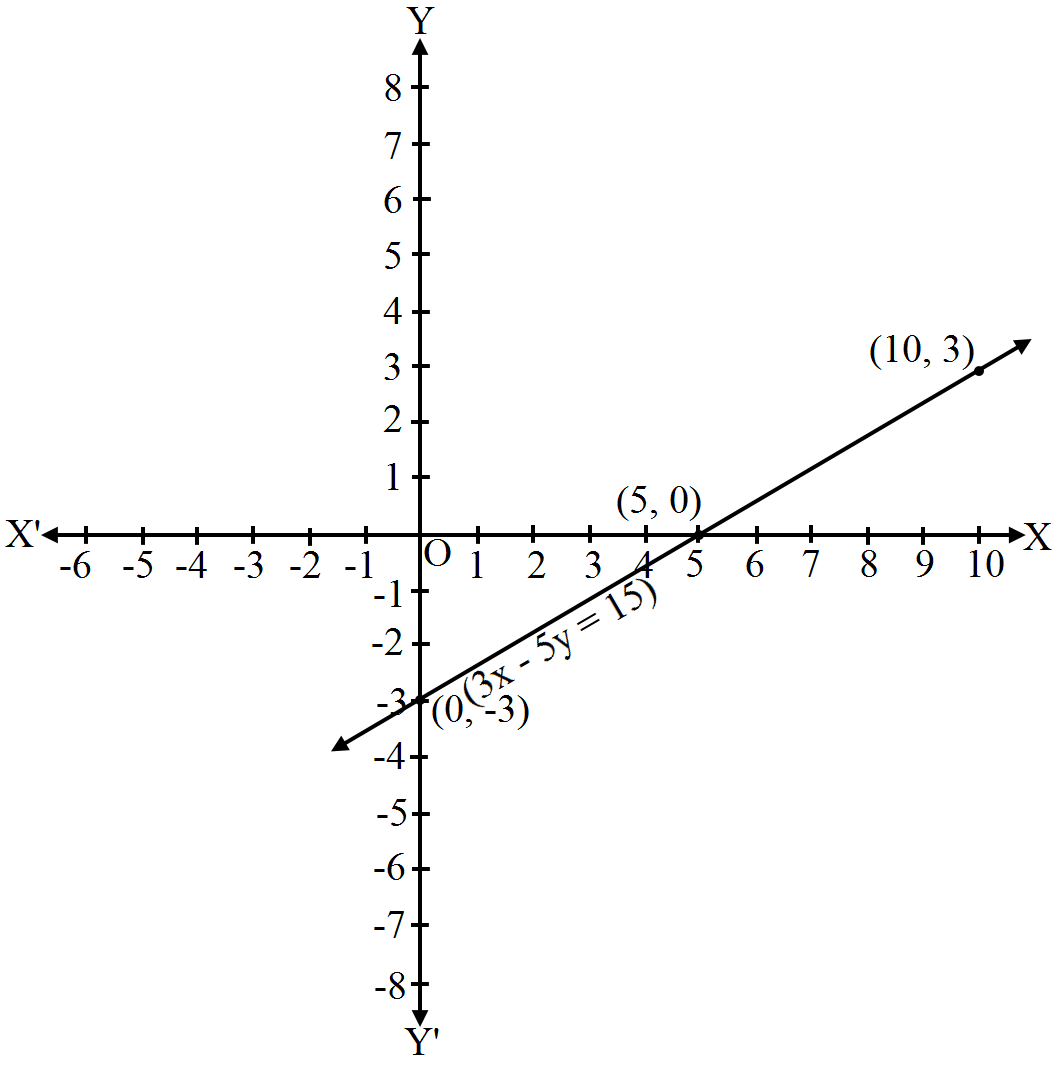
Given linear equation: $3x - 5y = 15$
Or, $\text{x}=5\text{y}+\frac{15}{3}$
When $y = 0, x = 153 = 5$
When $y = 3, x = 303 = 10$
When $y = - 3, x = 03 = 0$
|
$xx$
|
$5$
|
$10$
|
$0$
|
|
$yy$
|
$0$
|
$3$
|
$-3$
|
Plot the points $A(5, 0), B(10, 3)$ and $C(0, -3)$. Join the points and extend them in both the directions.
We get infinite points that satisfy the given equation.
Hence, the linear equation has infinitely many solutions.
View full question & answer→MCQ 921 Mark
$x = 2, y = 5$ is a solution of the linear equation.
- A
$x + 2y = 7$
- ✓
$x + y = 7$
- C
$5x + y = 7$
- D
$5x + 2y = 7$
AnswerCorrect option: B. $x + y = 7$
$x = 2$ and $y = 5$ satisfy the given equation.
View full question & answer→MCQ 931 Mark
Write the correct answer in the following: Any point on the line $y = x$ is of the form,
- ✓
$(a, a)$
- B
$(0, a)$
- C
$(a, 0)$
- D
$(a, -a)$
AnswerCorrect option: A. $(a, a)$
Every point on the line $y = x$ has same value of $x-$and $y-$coordinates i.e., $x = a$ and $y = a.$
View full question & answer→MCQ 941 Mark
The equation $x - 2 = 0$ on number line is represented by:
Answer$x - 2 = 0$
$x = 2$ is a point on the number line.
View full question & answer→MCQ 951 Mark
If the point $(3, 4)$ lies on the graph of $3y = ax + 6$, then the value of $'a'$ is:
AnswerThe point $(3, 4)$ lies on the graph of $3y = ax + 6$So, it will satisfy the equation
$3y = ax + 6$
$3(y) = ax + 6$
$12 = 3a + b$
$12 - 6 = 3a$
$3a = 6$
$\text{a}=\frac{6}{3}$
$\text{a}=2$
View full question & answer→MCQ 961 Mark
The graph of $x = 4$ is a line.
- A
Making an intercept $4$ on the $y-$axis.
- B
Parallel to the $y-$axis at a distance of $5$ units from the origin.
- ✓
Making an intercept $4$ on the $x-$axis.
- D
Parallel to the $x-$axis at a distance of $4$ units from the origin.
AnswerCorrect option: C. Making an intercept $4$ on the $x-$axis.
As, the graph of $x=4$ is a line parallel to $y$-axis i.e. $x=0$.
$\Rightarrow$ The line represented by the equation $x=4$ is parallel to $y$-axis and intersects $x$-axis at $x=4$.
So, the graph of $x=4$ is parallel to $y$-axis at a distance of 4 units from the origin making an intercept 4 on the $x$-axis.
View full question & answer→MCQ 971 Mark
If we multiply or divide both sides of a linear equation with a non-zero number, then the solution of the linear equation:
- A
- ✓
- C
Only changes in case of multiplication.
- D
Only changes in case of division.
AnswerIf we multiply or divide both sides of a linear equation with a non-zero number, then the solution of the linear equation remains the same.
View full question & answer→MCQ 981 Mark
The point of the form $(-a, a)$, where a lies on
- ✓
The line$ x + y = 02$
- B
The $y-$axis
- C
The $x-$axis
- D
The line $y = x$
AnswerCorrect option: A. The line$ x + y = 02$
The point $(a,-a)$ lies on line $x+y=0$
Here is the verification
Put $x=a$ in equation
$x + y = 0$
$a + y = 0$
$y = -a$
Hence it is prove that $(a,-a)$ is a solution of $x+y=0$
View full question & answer→MCQ 991 Mark
If $x$ and $y$ are both positive solutions of equation $ax + by + c = 0$, always lie in the:
View full question & answer→MCQ 1001 Mark
The linear equation $3x - 11y = 10$ has:
- A
- B
- ✓
Infinitely many solutions
- D
AnswerCorrect option: C. Infinitely many solutions
Infinitely many solutions
View full question & answer→MCQ 1011 Mark
The distance between the graphs of the equations $y = -1$ and $y = 3$ is:
AnswerDistance between the graphs of the equations $y = -1$ and $y = 3$ is $= 3 - (-1) = 4$ units.
View full question & answer→MCQ 1021 Mark
The area of the triangle formed by the line $3x + 4y = 12$ and the co-ordinate axis is:
- ✓
$6$ sq. units.
- B
$12$ sq. units.
- C
$4$ sq. units.
- D
$3$ sq. units.
AnswerCorrect option: A. $6$ sq. units.
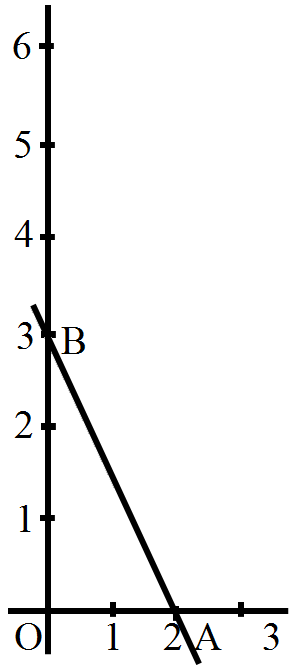
To find the area of the triangle $A O B$ formed by the line $3 x+4 y=12$ and co-ordinate axis we put $x=0$ in given equation to find the point on $y$ axies.
So, at $x=0$
$3(0) + 4y = 12$
$4y = 12$
We get $y = 3$
$At y = 0$
$3x + 4(0) = 12$
$3x = 12$
We get $x=4$
So the line cut $y$ axis at 3 and $x$ axis at $4$
So the hight of triangle $A O B$ is $O B=3$ unit and base $O A=4$ unit
Area ot triangle $A O B=12$ (base $\times$ height)
$= 12 \times 4 \times 3$
$= 6$ unit square. View full question & answer→MCQ 1031 Mark
If $(2, 0)$ is a solution of the linear equation $2x + 3y = k$ then the value of $k$ is:
AnswerSince, $(2, 0)$ is a solution of the linear equation $2x + 3y = k$, substituting $x = 2$ and $y = 0$ in the given equation,We have:
$2(2) + 3(0) = k$
$\Rightarrow 4 + 0 = k$
$\Rightarrow k = 4$
View full question & answer→MCQ 1041 Mark
The distance between the graph of the equations $x = -3$ and $x = 2$ is:
AnswerThe distance between the graph of the equations $x = -3$ and $x = 2= 2 - (-3)$
$= 2 + 3$
$= 5$
Hence, correct option is $(d).$
View full question & answer→MCQ 1051 Mark
Cost of book $(x)$ exceeds twice the cost of pen $(y)$ by Rs $10$. This statement can be expressed as linear equation.
- ✓
$x - 2y - 10 = 0$
- B
$2x - y - 10 = 0$
- C
$2x + y - 10 = 0$
- D
$x - 2y + 10 = 0$
AnswerCorrect option: A. $x - 2y - 10 = 0$
$x - 2y - 10 = 0$
View full question & answer→MCQ 1061 Mark
The graph of the line $y = 3$ passes through the point:
- A
$(3, 0)$
- B
$(3, 2)$
- ✓
$(2, 3)$
- D
AnswerCorrect option: C. $(2, 3)$
Since, the $y$ coordinate is $3$, the graph of the line $y = 3$ passes through the point $(2, 3).$
View full question & answer→MCQ 1071 Mark
Point $(3, 4)$ lies on the graph of the equation $3y = kx + 7$. The value of $k$ is:
- A
$\frac{4}{3}$
- ✓
$\frac{5}{3}$
- C
$3$
- D
$\frac{6}{3}$
AnswerCorrect option: B. $\frac{5}{3}$
$\frac{5}{3}$
View full question & answer→MCQ 1081 Mark
The graph of the linear equation $x + y = 0$ passes through the point.
- ✓
$(1, -1)$
- B
$(1, 1)$
- C
$(1, 0)$
- D
$(0, 1)$
AnswerCorrect option: A. $(1, -1)$
The graph of the linear equation $x+y=0$ passes through the point $(1,-1)$ because the co-ordinate of $x$ and $y$ axis satisfy the given equation. $x+y=0$
$1-1=0$
So we can say $(1,-1)$ is a solution of above equation
View full question & answer→MCQ 1091 Mark
The graph of every linear equation in two variables is a:
AnswerBecause for one value of one variable their is only one and unique value of other variables.
View full question & answer→MCQ 1101 Mark
The equation of the $y-$axis is:
- A
$x = 0$
- ✓
$y = 0$
- C
$x = y$
- D
$x + y = 0$
AnswerCorrect option: B. $y = 0$
The equation of the $y-$axis is $x = 0.$
View full question & answer→MCQ 1111 Mark
How many linear equation in x and $y$ can be satisfied by $x = 1$ and $y = 2?$
View full question & answer→MCQ 1121 Mark
The equation $x = 7$ in two variables can be written as:
- A
$0.x + 0.y = 7$
- ✓
$1.x + 0.y = 7$
- C
$1.x + 1.y = 7$
- D
$0.x + 1.y = 7$
AnswerCorrect option: B. $1.x + 0.y = 7$
The equation $x =7$ in two variables can be written as exactly $1 . x +0 . y =7$ because it contain two variable $x$ and $y$ and coefficient of $y$ is zero as there is no term containing $y$ in equation $x =7$.
View full question & answer→MCQ 1131 Mark
$x = 5, y = 2$ is a solution of the linear equation:
- A
$x + 2y = 7$
- B
$5x + 2y = 7$
- ✓
$x + y = 7$
- D
$5x + y = 7$
AnswerCorrect option: C. $x + y = 7$
Substituting $x = 5$ and $y = 2$ in $L.H.S.$ of equation $x + y = 7,$
We get:
$LHS$
$= 5 + 2$
$7 = RHS$
Hence, $x = 5$ and $y = 2$ is a solution of the linear equation $x + y = 7.$
View full question & answer→MCQ 1141 Mark
$3x + 10 = 0$ will have:
- ✓
- B
- C
Infinitely many solutions
- D
Answer$3\text{x}+10 = 0$
$\text{x}=\frac{-10}{3}.$
Hence, only one solution is possible.
View full question & answer→MCQ 1151 Mark
In equation, $y = mx + c, m$ is:
View full question & answer→MCQ 1161 Mark
How many linear equations can be satisfied by $x = 2$ and $y = 3?$
AnswerThere are infinite many eqution which satisfy the given value $x = 2, y = 3$For example
$x + y = 5$
$x - y = -1$
$3x - 2y = 0$
Etc..
View full question & answer→MCQ 1171 Mark
The graph of a linear equation $x - 5y + 3 = 0$ cuts the $x-$axis at the point.
- A
$(-5, 0)$
- B
$(5, 0)$
- ✓
$(-3, 0)$
- D
$(3, 0)$
AnswerCorrect option: C. $(-3, 0)$
When a line cuts $x-$axis in that case $y$ co-ordinate is $0.$
So to find the co-ordinate of $x$ we put $y = 0$ in given equation,
$x - 5y + 3 = 0$
at $y = 0$
$x - 5.0 + 3 = 0$
$x + 3 = 0$
$x = -3$
So the co-ordinate are $(-3, 0)$
View full question & answer→MCQ 1181 Mark
lf the graph of the equation $4x + 3y = 12$ cuts the coordinate axes at $A$ and $B,$ then hypotenuse of right triangle $AOB$ is of length:
- A
$4$ units.
- B
$3$ units.
- ✓
$5$ units.
- D
AnswerCorrect option: C. $5$ units.
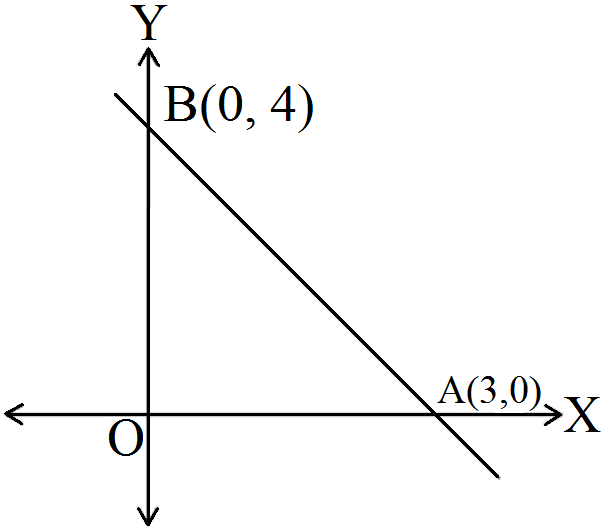
$4x + 3y = 12$
At $x = 0, 3y = 12 $
$\Rightarrow y = 4$ units
At $y = 0, 4x = 12$
$ \Rightarrow x = 3$ units
The triangle formed is $\triangle\text{AOB},$ where
$OB = 4$ units
$OA = 3$ units
Hypotenuse $=\text{AB}=\sqrt{\text{OB}^2+\text{OA}^2}=\sqrt{16+9}=5\text{ units}$
Hence, correct option is $(c).$ View full question & answer→MCQ 1191 Mark
The taxi fare in a city is as follows: For the first kilometer, the fare is $₹ 8$ and for the subsequent distance it is $₹ 5$ per kilometer. Taking the distance covered as $x \ km$ and total fare as $₹ y$, write a linear equation for this information.
- A
$x = 5y - 3$
- ✓
$y = 5x + 3$
- C
$x = 5y + 3$
- D
$y = 5x - 3$
AnswerCorrect option: B. $y = 5x + 3$
Taxi fare for first kilometer $= ₹ 8$
Taxi fare for subsequent distance $= ₹ 5$
Total distance covered $= x$
Total fare $= y$
Since the fare for first kilometer $= ₹ 8$
According to problem, Fare for $(x - 1)$ kilometer $= 5(x - 1)$
So, the total fare $y = 5(x - 1) + 8$
$\Rightarrow y = 5(x - 1) + 8$
$\Rightarrow y = 5x - 5 + 8$
$\Rightarrow y = 5x + 3$
Hence, $y = 5x + 3$ is the required linear equation.
View full question & answer→MCQ 1201 Mark
The graph of $y = 6$ is a line.
- A
Parallel to $y-$axis at a distance $6$ units from the origin.
- B
Making an intercept $6$ on both the axes.
- C
Making an intercept $6$ on the $x-$ axis.
- ✓
Parallel to $x-$axis at a distance $6$ units from the origin.
AnswerCorrect option: D. Parallel to $x-$axis at a distance $6$ units from the origin.
As $y = a$ is an equation of a line parallel to $x-$axis at a distance of a unit from the origin.
View full question & answer→MCQ 1211 Mark
For the equation $5x - 7y = 35$, if $y = 5$, then the value of $‘x’$ is:
AnswerFor the equation $5x - 7y = 35$, if $y = 5,$
$5x - 7y = 35$
$y = 55$
$x - 7.5 = 35$
$5x - 35 = 35$
$5x = 35 + 35$
$5x = 70$
$\text{x}=\frac{70}{5}=14$
$x = 14.$
View full question & answer→MCQ 1221 Mark
If $(a, 4)$ lies on the graph of $3x + y = 10$, then the value of a is:
AnswerGiven, $(a, 4)$ lies on the graph of $3x + y = 10$
Thus it is a solution
$= 3a + 4 = 10$
$= a = 2.$
View full question & answer→MCQ 1231 Mark
The solution of equation $x - 2y = 4$ is:
- A
$(0, 2)$
- B
$(2, 0)$
- ✓
$(4, 0)$
- D
$(1, 1)$
AnswerCorrect option: C. $(4, 0)$
Explanation: Putting $x = 4$ and $y = 0$, on the
$L.H.S$. of the given equation, we get;
$4 - 2 (0) = 4 - 0 = 4$
Which is equal to $R.H.S.$
View full question & answer→MCQ 1241 Mark
The equation of a line parallel to $x -$ axis and $3$ units above the origin is:
- A
$x = -3$
- B
$x = 3$
- C
$y = -3$
- ✓
$y = 3$
AnswerCorrect option: D. $y = 3$
$y = 3$
View full question & answer→MCQ 1251 Mark
Which of the following pair is a solution of the equation $3x - 2y = 7?$
- A
$(-2, 1)$
- B
$(5, 1)$
- ✓
$(1, -2)$
- D
$(1, 5)$
AnswerCorrect option: C. $(1, -2)$
Solution of the equation $3x - 2y = 7$ is $(1, -2)$ as it satisfy the given equation,
$3x - 2y = 7$
$\Rightarrow 3(1) - 2(-2) = 7$
$\Rightarrow 3 + 4 = 7$
$LHS = RHS.$
View full question & answer→MCQ 1261 Mark
If $(k, -3)$ lies on the line $3x - y = 6,$ then the value of $‘k’$ is:
Answer$(k, -3)$ lies on the line $3x - y = 6$, it means that $(k, -3)$ is a solutio of a line $3x - y = 6,$
So,
$3k -(-3) = 6$
$3k + 3 = 6$
$3k = 6 - 3$
$3k = 3$
$\text{k}=\frac{3}{3}=1$
$k = 1.$
View full question & answer→MCQ 1271 Mark
Write the correct answer in the following: The linear equation $2x – 5y = 7$ has,
- A
- B
- ✓
Infinitely many solutions.
- D
AnswerCorrect option: C. Infinitely many solutions.
$2x – 5y = 7$ is a linear equation in two variables. A linear equation in two variables has infinitely many solutions.
View full question & answer→MCQ 1281 Mark
A linear equation in two variables has maximum:
MCQ 1291 Mark
If $(2, 0)$ is a solution of the linear equation $2x + 3y = k$, then the value of $k$ is:
Answer$(2, 0)$ is a solution of the linear equation $2x + 3y = k,$
$\Rightarrow 4 = k.$
View full question & answer→MCQ 1301 Mark
Write the correct answer in the following: The equation $2x + 5y = 7$ has a unique solution, if $x$ and $y$ are,
AnswerThe equation $2x + 5y = 7$ has a unique solution if $x, y$ are natural numbers.
View full question & answer→MCQ 1311 Mark
Equation of a line passing through origin is:
- A
$x + y = 1$
- B
$x = 2y - 4$
- ✓
$x + y = 0$
- D
$y = x - 1$
AnswerCorrect option: C. $x + y = 0$
$x + y = 0$
View full question & answer→MCQ 1321 Mark
If $(2, 0)$ is a solution of the linear equation $2x +3y = k$, then the value of $k$ is:
View full question & answer→MCQ 1331 Mark
The graph of the linear equation $3x - 2y = 6$, cuts the $x-$axis at the point:
- ✓
$(2, 0)$
- B
$(0, 2)$
- C
$(0, -2)$
- D
$(-2, 0)$
AnswerCorrect option: A. $(2, 0)$
The linear equation $3x - 2y = 6$, cuts the $x-$axis when $y$ co-ordinate is $0$.So we put $y = 0$ in given equation $3x - 2y = 6$
$3x - 2.0 = 6$
$3x = 6$
$\text{x}=\frac{6}{3}$
$x = 2$
So the co-ordinates are $(2, 0).$
View full question & answer→MCQ 1341 Mark
The linear equation $2x + 3y = 6$ has:
- ✓
Infinitely many solutions.
- B
- C
- D
AnswerCorrect option: A. Infinitely many solutions.
$2x + 3y = 62x = 6 - 3y$
$\text{x}=\frac{6-3\text{y}}{2}$
|
$x$
|
$0$
|
$3232$
|
$3$
|
|
$y$
|
$2$
|
$1$
|
$0$
|
This table continues for infinite terms for different values of $x$ and $y$. So for infinite value of $y$ we have infinite value of $x.$
Therefore, this equation has Infinitely many solutions. View full question & answer→MCQ 1351 Mark
The graph of the linear equation $2x - 3y = 6$, cuts the $y-$axis at the point:
- A
$(2, 0)$
- B
$(0, 2)$
- ✓
$(0, -2)$
- D
$(-2, 0)$
AnswerCorrect option: C. $(0, -2)$
The linear equation $2x - 3y = 6$, cuts the $y-$axis when $x$ co-ordinate is $0.$
So we put $x = 0$ in given equation $2x - 3y = 6$
$2 × 0 - 3y = 6$
$0 - 3y = 6$
$-y = 63$
$-y = 2$
$y = -2$
So the co-ordinates are $(0, -2).$
View full question & answer→MCQ 1361 Mark
The graph of the line $x = -2$ passes through:
- A
$(0, 4)$
- ✓
$(-2, 3)$
- C
$(-1, 4)$
- D
$(3, -2)$
AnswerCorrect option: B. $(-2, 3)$
Because value of $x$ co-ordinate is $-2.$
View full question & answer→MCQ 1371 Mark
The equation $3x + 4y = 7$ has a unique solution, if $x$ and $y$ are:
Answer$3x + 4y = 7$
$3x = 7 - 4y$
$\text{x} = 7−\frac{4\text{y}}{3}$
The equation will have a unique solution only if $x$ and $y$ are natural numbers with only one value which is,
For $y = 1.$
$\text{x} = 7−\frac{4.1}{3}$
$\text{x} = 7−\frac{4}{3}$
$\text{x} = \frac{3}{3} = 1$
$x = 1$
I.e., $x = 1, y = 1$ will be unique value for this equation.
View full question & answer→MCQ 1381 Mark
Which of the following is not a solution of $3x + 4y = 12?$
- A
$(0, 3)$
- ✓
$(2, 3)$
- C
$(4, 0)$
- D
$(8, -3)$
AnswerCorrect option: B. $(2, 3)$
The given co-ordinate is solution of a eqution if on puting the co-ordiates $L.H.S = R.H.S$
$3x + 4y = 12$
Put co-ordinate $(2, 3)$ in given equation,
$L.H.S$
$3.2 + 4.3$
$6 + 12 = 18$
$L.H.S ≠ R.H.S$
So we can say $(2, 3)$ is a not a solution of $3x + 4y = 12.$
View full question & answer→MCQ 1391 Mark
Write the linear equation such that each point on its graph has an ordinate $5$ times it's abscissa.
- A
$5x + y = 2$
- B
- ✓
$y = 5x$
- D
$x = 5y$
AnswerCorrect option: C. $y = 5x$
$y = 5x$
$At x = 1$
$y = 5.1 = 5$
$y = 5$
$(1, 5)$
$At x = 2$
$y = 5.2 = 10$
$y = 10$
$(2, 10)$
$At x = 3$
$y = 5.3 = 15$
$y = 15$
$(3, 15).$
View full question & answer→MCQ 1401 Mark
The point of the form $(a, -a)$, where a lies on:
- A
The line $x = y.$
- B
The $x-$axis.
- ✓
The line $y + x = 0.$
- D
The $y-$axis.
AnswerCorrect option: C. The line $y + x = 0.$
The point (a, -a) lies on line $x + y = 0$
Here, is the verification
Put $x = a$ in equation
$x + y = 0$
$a + y = 0$
$y = -a$
Hence, it is prove that $(a, -a)$ is a solution of $x + y = 0.$
View full question & answer→MCQ 1411 Mark
The value of k if $x = 2, y = 1$ is a solution of equation $2x - k = -3y$ is:
View full question & answer→MCQ 1421 Mark
The graph of the linear equation $2x - y = 4$ cuts $x-$axis at:
- ✓
$(2, 0)$
- B
$(-2, 0)$
- C
$(0, -4)$
- D
$(0, 4)$
AnswerCorrect option: A. $(2, 0)$
On $x-$axis, the $y-$co-ordinate is always $0.$
So, $2x - y = 4$ will cut the x-axis where $y = 0$
i.e. $2x = 4$
i.e. $x = 2$
Thus, $2x - y = 4$ will cut the $x-$axis at $(2, 0).$
Hence, correct option is $(a).$
View full question & answer→MCQ 1431 Mark
The positive solutions of the equation $ax + by + c = 0$ always lie in the:
- A
$2$nd quadrant.
- ✓
$1$st quadrant.
- C
$3$rd quadrant.
- D
$4$th quadrant.
AnswerCorrect option: B. $1$st quadrant.
The positive solutions of the equation $a x+b y+c=0$ always lie in the $1$ st quadrant. Because in $1$st quadrant both $x$ and $y$ have positive value.
View full question & answer→MCQ 1441 Mark
The distance between the graphs of the equations $y = -1$ and $y = 3$ is:
AnswerThe distance between given two graphs
$= 3 - (-1)$
$= 3 + 1$
$= 4$
Hence, correct option is $(b).$
View full question & answer→MCQ 1451 Mark
The graph of $y = 4x$ will:
- A
Intersect $x-$axis.
- ✓
- C
- D
Intersect $y-$axis.
AnswerThe graph of $y = 4x$ will pass through the origin $(0, 0)$
$y = 4x$
At $x = 0$
$y = 4.0$
$y = 0$
So the graph $y = 4x$ will pass from point $(0, 0).$
View full question & answer→MCQ 1461 Mark
Write the linear equation such that each point on its graph has an ordinates times its abscissa.
- ✓
$y = 5x$
- B
$x = 5y$
- C
$5x + y = 2$
- D
AnswerCorrect option: A. $y = 5x$
At $x = 1$
$y = 5.1 = 5$
$y = 5$
$(1, 5)$
At $x = 2$
$y = 5.2 = 10$
$y = 10$
$(2, 10)$
At $x = 3$
$y = 5.3 = 15$
$y = 15$
$(3, 15)$
View full question & answer→MCQ 1471 Mark
Which of the following ordered pairs is a solution of the equation $x - 2y - 6?$
- A
$(2, 4)$
- B
$(0, 3)$
- C
$(-4, 1)$
- ✓
$(4, -1)$
AnswerCorrect option: D. $(4, -1)$
$(4, -1)$
View full question & answer→MCQ 1481 Mark
The equation $x - 2 = 0$ on number line is represented by:
AnswerThe equation $x - 2 = 0$ is represented by a point on the number line.
Therefore, the correct answer is $(b).$
View full question & answer→MCQ 1491 Mark
Write the correct answer in the following: The equation $x = 7$, in two variables can be written as,
- A
$1 - x + 1.y = 7$
- B
$1 - x + 0.y = 7$
- C
$0 - x + 1.y = 7$
- ✓
$0 - x + 0.y = 7$
AnswerCorrect option: D. $0 - x + 0.y = 7$
The equation $x = 7$ in two variables can be expressed as $1.x + 0.y = 7.$
View full question & answer→MCQ 1501 Mark
Point $(3, 4)$ lies on the graph of the equation $3y = kx + 7$. The value of $k$ is:
- A
$\frac{4}{3}$
- ✓
$\frac{5}{3}$
- C
$3$
- D
$\frac{7}{3}$
AnswerCorrect option: B. $\frac{5}{3}$
$3y = kx + 7$
Here, $x = 3$ and $y = 4$
Hence,
$(3 × 4) = (kx3) + 7$
$12 = 3k + 7$
$3k = 12 - 7$
$3k = 5$
$\text{k}=\frac{5}{3}$
View full question & answer→MCQ 1511 Mark
The force applied on a body is directly proportional to the acceleration produced on it. The equation to represent the above statement is:
- ✓
$y = kx$
- B
$y + x = 0$
- C
- D
$y = x$
AnswerCorrect option: A. $y = kx$
Let force applied be $y$ and acceleration produced be $x$. The force applied on a body is directly proportional to the acceleration produced on it.Yαx
$y = kx$
Where $k$ is proportionality constant.
View full question & answer→MCQ 1521 Mark
A linear equation in two variables is of the form $ax + by + c = 0$, where:
- A
$a = 0, c = 0$
- B
$a \neq 0, b = 0$
- C
$a = 0, b \neq 0$
- ✓
$a \neq 0, b \neq 0$
AnswerCorrect option: D. $a \neq 0, b \neq 0$
A linear equation in two variables is of the form $ax + by + c = 0$, where $a \neq 0, b \neq 0.$
If the values of $“a”$ and $“b”$ are equal to $0$, the equation becomes $c = 0.$
Hence, the values of a and b should not be equal to $0.$
View full question & answer→MCQ 1531 Mark
The cost of $2\ kg$ of apples and $1\ kg$ of grapes on a day was found to be $₹ 160$. A linear equation in two variables to represent the above data is:
- A
$x + y = 160$
- B
$2x - y = 160$
- C
$x - 2y = 160$
- ✓
$2x + y = 160$
AnswerCorrect option: D. $2x + y = 160$
Let the cost of apples be ₹ $x$ per $Kg$ and cost of grapes be $₹ y$ per $Kg$ . The cost of $2 \ kg$ of apples and $1 \ kg$ of grapes on a day was found to be $₹ 160 .$
So the equation will be $2 x + y =160$.
View full question & answer→MCQ 1541 Mark
The linear equation $3x - y = x - 1$ has:
- A
- B
- ✓
Infinitely many solutions.
- D
AnswerCorrect option: C. Infinitely many solutions.
$3x - y = x - 1$
$y = 3x - x + 1$
$y = 2x + 1$
This is linear equation of two variable. If we take any random value of $x$ and solve $y$ corresponding value of $x$. We will get infinite many solutions.
View full question & answer→MCQ 1551 Mark
If the point $(3, 4)$ lies on the graph of $3y = ax + 7$ then the value of a is:
- A
$\frac{2}{7}$
- B
$\frac{2}{5}$
- ✓
$\frac{5}{3}$
- D
$\frac{3}{5}$
AnswerCorrect option: C. $\frac{5}{3}$
Given equation:$ 3y = ax + 7$
Also, $(3, 4)$ lies on the graph of the equation.
Putting $x = 3, y = 4$ in the equation, we get
$3 \times 4 = 3a + 7$
$\Rightarrow 12 = 3a + 7$
$\Rightarrow 3a = 12 - 7 = 5$
$\Rightarrow\text{a}=\frac{5}{3}.$
View full question & answer→MCQ 1561 Mark
Find the value of k, if $x = 1, y = 2$ is a solution of the equation $2x + 3y = k.$
Answer$2x + 3y = k$
$k = 2 (1) + 3 (2)$
$= 2 + 6 = 8$
View full question & answer→MCQ 1571 Mark
If the line represented by the equation $3x + ky = 9$ passes through the points $(2, 3)$, then the value of $k$ is:
AnswerIf the line represented by the equation $3x + ky = 9$ passes through the points $(2, 3)$ then $(2, 3)$ will satisy the equation
$3x + ky = 9$
$3(2) + 3k = 9$
$\Rightarrow 6 + 3k = 9$
$\Rightarrow 3k = 9 - 6$
$\Rightarrow 3k = 3$
$\Rightarrow k = 1$
View full question & answer→MCQ 1581 Mark
The condition that the equation $ax + by + c = 0$ represents a linear equation in two variables is:
- A
$a \neq 0, b = 0$
- B
$b \neq 0, a = 0$
- C
$a = 0, b = 0$
- ✓
$a \neq 0, b \neq 0$
AnswerCorrect option: D. $a \neq 0, b \neq 0$
$a \neq 0, b \neq 0$
View full question & answer→MCQ 1591 Mark
Write the correct answer in the following:
If a linear equation has solutions $(-2, 2), (0, 0)$ and $(2, -2)$, then it is of the form,
- A
$y – x = 0$
- ✓
$x + y = 0$
- C
$-2x + y = 0$
- D
$-x + 2y = 0$
AnswerCorrect option: B. $x + y = 0$
Thinking Process,
$i.$Firstly, consider a linear equation $ax + by + c = 0.$
$ii.$Secondly, substitute all points one by one and get three different equations.
$iii.$Further, simplify the three equations and then substitute the values of $a, b$ and $c$ in the considered equation.
View full question & answer→MCQ 1601 Mark
Each of the points $(-2, 2), (0, 0), (2, 2)$ satisfies the linear equation:
- A
$x - y = 0$
- ✓
$x + y = 0$
- C
$-x + 2y = 0$
- D
$x - 2y = 0$
AnswerCorrect option: B. $x + y = 0$
Since given that each of the three points is a solution of the linear equation, all three points have to satisfy the linear equation.
We need to check for each of the four given equations.
Substituting $x = -2$ and $y = 2$ in option $(b),$
We get:
$LHS$
$= x + y$
$= -2 + 2$
$0 = RHS$
$\therefore\ x = -2$ and $y = 2$
Satisfy the given linear equation.
Substituting $x = 0$ and $y = 0$ in option $(b),$
We get:
$LHS$
$= x + y$
$= 0 + 0$
$0 = RHS$
$\therefore\ x = 0$ and $y = 0$
Satisfy the given linear equation.
Substituting $x = -2$ and $y = 2$ in option $(b),$
We get:
$LHS$
$= x + y$
$= 2 - 2$
$0 = RHS$
$\therefore\ x = 2$ and $y = -2$
Satisfy the given linear equation.
So, clearly all the three points satisfy the equation
$x + y = 0.$
View full question & answer→MCQ 1611 Mark
If $x = 3$ and $y = -2$ satisfies $5x - y = k$, then the value of $k$ is:
AnswerIf $x = 3$ and $y = -2$ satisfies $5x - y = k$
Then
$5x - y = k$
$5 \times 3 - (-2) = k$
$15 + 2 = k$
$k = 17.$
View full question & answer→MCQ 1621 Mark
The graph of the linear equation $2x + 3y = 6$ cuts the $y -$ axis at the point.
- A
$(2, 0)$
- ✓
$(0, 2)$
- C
$(3, 0)$
- D
$(0, 3)$
AnswerCorrect option: B. $(0, 2)$
Given that the graph of the linear equation $2x + 3y = 6$ cuts the $y -$ axis at the point.
Let the point be $“P”.$
Hence, the x - coordinate of point $P$ is $0.$
Now, substitute $x = 0$ in the given equation,
$2 (0) + 3y = 6$
$3y = 6$
$y = 2$
Hence, the cooridnate point is $(0, 2).$
View full question & answer→MCQ 1631 Mark
The graph of $x = - 4$ is a straight line.
- A
Parallel to $x-$axis.
- ✓
Parallel to $y-$axis.
- C
- D
AnswerCorrect option: B. Parallel to $y-$axis.
We know that the general equation of a line parallel to $y-$axis is $x = a.$
So $x = -4$ is a line parallel to $y-$axis.
View full question & answer→MCQ 1641 Mark
Any point on the $x -$ axis is of the form.
- A
$(x, y)$
- B
$(0, y)$
- ✓
$(x, 0)$
- D
$(x, x)$
AnswerCorrect option: C. $(x, 0)$
Any point on the $x -$ axis is of the form $(x, 0).$
On the $x -$ axis, $x$ can take any values, whereas $y$ should be equal to $0.$
View full question & answer→MCQ 1651 Mark
The graph of the linear equation $4x + 2y = 12$, cuts the $x-$axis at the point:
- ✓
$(3, 0)$
- B
$(0, -2)$
- C
$(-2, 0)$
- D
$(0, 3)$
AnswerCorrect option: A. $(3, 0)$
The graph of the linear equation $4 x+2 y=12$, cuts the $x$-axis at the point when line cut $x$-axis the co-ordinate of $y$ becomes zero.
So we put $y=0$ in given equation to find the co-ordinate,
$4x + 2y = 124x + 2(0) = 124x = 12$
$\text{x}=\frac{12}{4}$
$x = 3$
So the required coordinate is $(3,0)$.
View full question & answer→MCQ 1661 Mark
The point of the form $(a, –a)$ always lies on the line:
- A
$x = a$
- B
$y = –a$
- C
$y = x$
- ✓
$x + y = 0$
AnswerCorrect option: D. $x + y = 0$
Taking option $(d), x + y = a + (-a) = a – a = 0$ [since, give point is of the form $(a, -a)$] Hence, the point $(a, – a)$ always lies on the line $x + y = 0.$
View full question & answer→MCQ 1671 Mark
The value of k if $x = 3$ and $y = -2$ is a solution of the equation $2x - 13y = k$ is:
AnswerWe have to find the value of ‘k’ if $x = 3$ and $y = -2$ is a solution of the equation $2x - 13y = k$
$2x - 13y = k$
$2(3) - 13(-2) = k$
$6 + 26 = k$
$k = 32.$
View full question & answer→MCQ 1681 Mark
The graph of the linear equation $y = x$ passes through the point.
- A
$\Big(\frac{3}{2},\frac{-3}{2}\Big)$
- B
$\Big(\frac{-1}{2},\frac{1}{2}\Big)$
- C
$\Big(0,\frac{3}{2}\Big)$
- ✓
$(1,1)$
AnswerCorrect option: D. $(1,1)$
$y = x, \Rightarrow$ Both the coordinates are the same. Hence $(1, 1)$ is correct option.
View full question & answer→MCQ 1691 Mark
If $(-2, 5)$ is a solution of $2x + my = 11$, then the value of $‘m’$ is:
AnswerIf $(-2, 5)$ is a solution of $2x + my = 11$ then it will satisfy the given equation,
$2.(-2) + 5m = 11$
$-4 + 5m = 11$
$5m = 11 + 4$
$5m = 15$
$\text{m}=\frac{15}{5}=3$
$m = 3.$
View full question & answer→MCQ 1701 Mark
Write the correct answer in the following: If $(2, 0)$ is a solution of the linear equation $2x + 3y = k$, then the value of $k$ is:
AnswerSince, $(2, 0)$ is a solution of the given linear equation $2x + 3y = k$, then put $x = 2$ and $y = 0$ in the equation.
$\Rightarrow 2(2) + 3(0) = k$
$\Rightarrow k = 4$
View full question & answer→MCQ 1711 Mark
A linear equation in two variables is of the form $ax + by + c = 0$, where?
AnswerCorrect option: A. $a \neq 0$ and $b \neq 0$
A linear equation in two variables is of the form $a x+b y+c=0$ as $a$ and $b$ are coefficient of $x$ and $y$ so if $a=0$ and $b$ $=0$ or either of one is zero in that case the equation will be one variable or their will be no equation respectively. Therefore when $a \neq 0$ and $b \neq 0$ then only the equation will be in two variable.
View full question & answer→MCQ 1721 Mark
Solutions of the equation $2x + 5y = 0$ is:
- A
$3, 0$
- B
$-3, 2$
- ✓
$0, 0$
- D
$0, 4$
AnswerCorrect option: C. $0, 0$
$0, 0$
View full question & answer→MCQ 1731 Mark
Write the correct answer in the following: $x = 5$ and $y = 2$ is a solution of the linear equation,
- A
$x + 2y = 7$
- B
$5x + 2y = 7$
- ✓
$x + y = 7$
- D
$5x + y = 7$
AnswerCorrect option: C. $x + y = 7$
$x = 5, y = 2$ is a solution of the linear equation $x + y = 7$, as $5 + 2 = 7.$
View full question & answer→MCQ 1741 Mark
If we multiply or divide both sides of a linear equation with the same non - zero number, then the solution of the linear equation:
- ✓
- B
- C
Changes in case of multiplication only
- D
Changes in case of division only
AnswerIf we multiply or divide both sides of a linear equation with the same non - zero number, then the solution of the linear equation remains the same.
View full question & answer→MCQ 1751 Mark
Straight line passing through the points $(-1, 1), (0, 0)$ and $(1, -1)$ has equation.
- A
$y - x$
- ✓
$x + y = 0$
- C
$y = 2x$
- D
$2 + 3y = 7x$
AnswerCorrect option: B. $x + y = 0$
$x + y = 0$
View full question & answer→MCQ 1761 Mark
If $x = 3$ and $y = -2$ satisfies $2x - 3y = k$, then the value of $k$ is:
AnswerIf $x = 3$ and $y = -2$ satisfies $2x - 3y = k.$
It means $x = 3$ and $y = -2$ is a solution of equation $2x - 3y = k$
$2 × 3 - 3(-2) = k$
$6 + 6 = k$
$k = 12$
View full question & answer→MCQ 1771 Mark
Any point of the form $(a, -a)$ always lie on the graph of the equation.
- A
$x = -a$
- B
$y = a$
- C
$y = x$
- ✓
$x + y = 0$
AnswerCorrect option: D. $x + y = 0$
$x + y = 0$
View full question & answer→MCQ 1781 Mark
How many linear equation can be satisfied by $x = 2$ and $y = 3?$
AnswerInfinitely many linear equations can be satisfied by $x = 2$ and $y = 3.$
View full question & answer→MCQ 1791 Mark
The graph of linear equation $x + 2y = 2$, cuts the $y -$ axis at:
- A
$(2, 0)$
- B
$(0, 2)$
- ✓
$(0, 1)$
- D
$(1, 1)$
AnswerCorrect option: C. $(0, 1)$
$x + 2y = 2$
$\text{y}=\frac{(2-\text{x})}{2}$
If $x = 0$, then;
$\text{y}=\frac{(2-0)}{2}=\frac{2}{2}=1$
Hence, $x + 2y = 2$ cuts the $y -$ axis at $(0, 1).$
View full question & answer→MCQ 1801 Mark
The point of the form $(a, a)$ always lies on:
- A
On the line $x + y = 0$
- ✓
On the line $y = x$
- C
$x -$ axis
- D
$y -$ axis
AnswerCorrect option: B. On the line $y = x$
The point of the form $(a, a)$ always lies on the line $y = x.$
If the point has the same $x$ and $y$ values, it should lie on the same line.
View full question & answer→MCQ 1811 Mark
The linear equation $2x - 5y = 7$ has:
- A
- B
- C
- ✓
Infinitely many solutions
AnswerCorrect option: D. Infinitely many solutions
The linear equation $2x - 5y$ has infinitely many solutions.
Because, the equation $2x - 5y = 7$ is a single equation, that involves two variables.
Hence, for different values of $x$, we will get different values of y and vice - versa.
View full question & answer→MCQ 1821 Mark
Any point on line $x = y$ is of the form:
- A
$(k, -k)$
- B
$(0, k)$
- C
$(k, 0)$
- ✓
$(k, k)$
AnswerCorrect option: D. $(k, k)$
$(k, k)$
View full question & answer→MCQ 1831 Mark
The equation of a line parallel to $x-$axis and $5$ units below the origin is:
- ✓
$y = -5$
- B
$x = 5$
- C
$y = 5$
- D
$x = -5$
AnswerCorrect option: A. $y = -5$
The equation of a line parallel to $x$-axis and $5$ units below the origin is $y=-5$ because when a line parallel to $x$ axis in that case equation of line is $y=a$.
Where $a$ is the co-ordinate of $y$-axes and $5$ units below the origin value $x$-coordinate is $-5$ . So required equation is $y$ $=-5$.
View full question & answer→MCQ 1841 Mark
$x = 2, y = - 1$ is a solution of the linear equation:
- A
$x + 2y = 4$
- B
$2x + y = 5$
- C
$2x + y = 0$
- ✓
$x + 2y = 0$
AnswerCorrect option: D. $x + 2y = 0$
$2 + 2(-1) = 2 - 2 = 0.$
View full question & answer→MCQ 1851 Mark
If $(3, 2)$ is the solution $3x - ky = 5$, then $k$ equals of the equation.
- ✓
$2$
- B
$4$
- C
$3$
- D
$\frac{1}{2}$
View full question & answer→MCQ 1861 Mark
If $(-2, 5)$ is a solution of $2x + my = 11$, then the value of $'m'$ is:
AnswerIf $(-2, 5)$ is a solution of $2x + my = 11$
then it will satisfy the given equation
$2.(-2) + 5 m = 11$
$-4 + 5m = 11$
$5m = 11 + 4$
$5m = 15$
$\text{m}=\frac{15}{5}=3$
$\text{m}=3$
View full question & answer→MCQ 1871 Mark
$y = 0$ is the equation of:
AnswerCorrect option: B. A line parallel to $y -$ axis
A line parallel to $y -$ axis
View full question & answer→MCQ 1881 Mark
The equation $2x + 5y = 7$ has a unique solution, if $x, y$ are:
AnswerThe equation $2 x+5 y=7$ has a unique solution, if $x, y$ are natural numbers.
In natural numbers, there exists only one pair $(1,1)$ which satisfies the given equation.
But for rational numbers, real numbers, positive real numbers, there exist many solution pairs to satisfy the equation.
View full question & answer→MCQ 1891 Mark
How many linear equations are satisfied by $x = 2$ and $y = -3?$
AnswerFrom Point $(2, -3)$ there are infinitely many lines passing in every-direction.
So $(2, -3)$ is satisfied with infinite linear equations.
Hence, correct option is $(d).$
View full question & answer→