Questions

Case study (4 Marks)

Take a timed test

7 questions · self-marked practice — reveal the answer and mark yourself.

Question 14 Marks
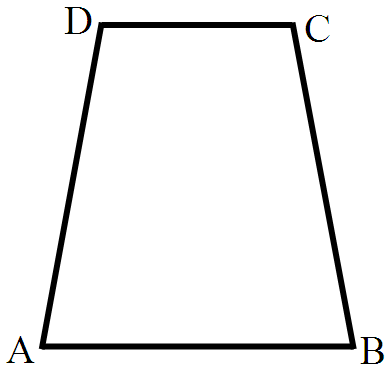
The figure below shows the side view of a shopping trolley. The metal plate is fixed on the side by the store keeper for advertisement.Image
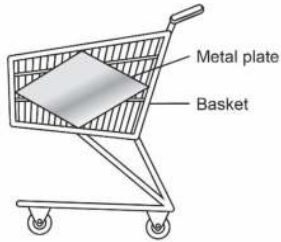
$6.$ Three angles of the basket are obtuse. Which type of angle is the fourth$?$
$A.$ Acute
$B.$ Obtuse
$C.$ Right
$D.$ Relex
$7.$ What is the shape of the metal plate$?$
$A.$ Square
$B.$ ectangle
$C.$ Rhombus
$D.$ Parallelogram
Answer
$6. A.$ Acute
$7. D.$ Parallelogram
View full question & answer
Question 24 Marks
Atul likes to observe the stars with his telescope. He likes to track the movements of stars in the sky.
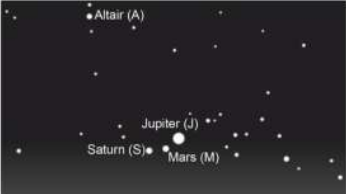
He took a picture of the night sky one day. On that day, Mars was equidistant from Saturn and Jupiter.Image

He draws a circle such that the dots showing the planets Mars $(M),$ Jupiter $(J),$ Saturn $(S)$ and a star Altair $(A)$ lies on the boundary of a circle and $\angle SMJ = 150^\circ .$
$1.$ What is the measure of $\angle SAJ?$
$A. 30^\circ $
$B. 45^\circ $
$C. 150^\circ $
$D. 210^\circ $
$2.$ Atul claims that the quadrilateral $MJAS$ is a kite.
What additional information is required to conirm his claim$?$
$A.$ Distance between Altair and Saturn is equal to the distance between Mars and Jupiter.
$B.$ Distance between Altair and Jupiter is equal to the distance between Mars and Saturn.
$C.$ Distance between Altair and Saturn is equal to the distance between Altair and Mars.
$D.$ Distance between Altair and Saturn is equal to the distance between Altair and Jupiter.
$3.$ The adjacent sides of quadrilateral $A$ are equal to corresponding sides of Quadrilateral $B.$ All angles of Quadrilateral A measure $90^\circ .$ The angles of Quadrilateral $B$ are $120^\circ , 60^\circ , 120^\circ $ and $60^\circ $ respectively.
Which quadrilateral has a greater area? Give reasons.
$4.$ Sanya has a triangular piece of land. She wants to divide it into four equal areas. Suggest a way to do so.
$5.$ Does joining four distinct points always produce a quadrilateral? Justify your answer.
Answer
$1. A. 30^\circ $
$2. D.$ Distance between Altair and Saturn is equal to the distance between Altair and Jupiter.
$3.$ Mention Quadrilateral A along with a valid mathematical reason.
● Quadrilateral A, both the quadrilaterals have an equal base but the altitude of Quadrilateral A is greater.
$4.$ Accept a valid mathematical division.
● Sanya can ind mid-points of the sides of the triangular region and create a smaller triangular region by connecting them. In this way, the triangular region can be divided into four triangles of equal area.
● Sanya can divide one side into four equal parts and connect each point on the base to the vertex (this may be a more practical way if all the land owners need some part touching the road for access).
$5.$ No, with valid justiication.
No, there can be three cases.
● When all the points are collinear, the resulting igure is a line.
● When three points are collinear out of four, the resulting igure is a triangle.
● When no three points out of four are collinear, the resulting igure is a quadrilateral.
View full question & answer
Question 34 Marks
Read the Source Text given below and answer any four questions:

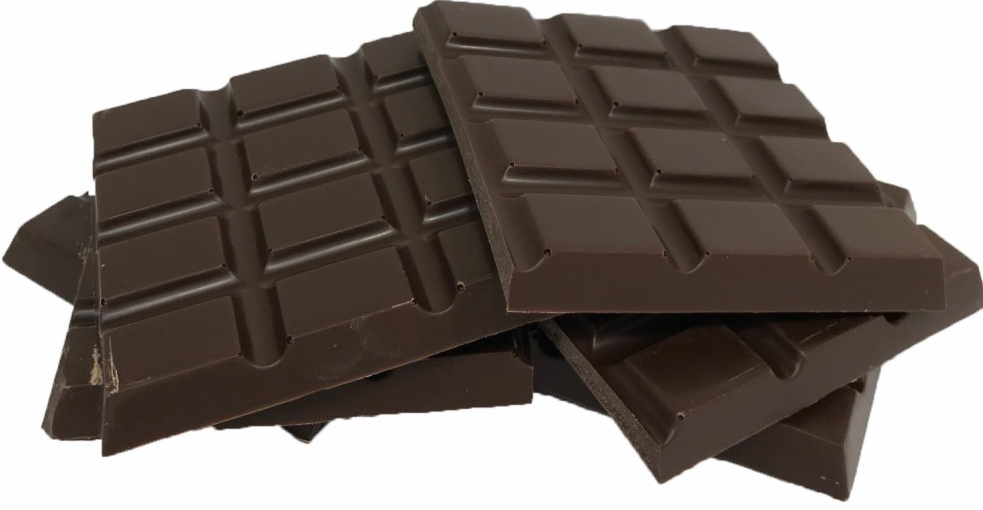
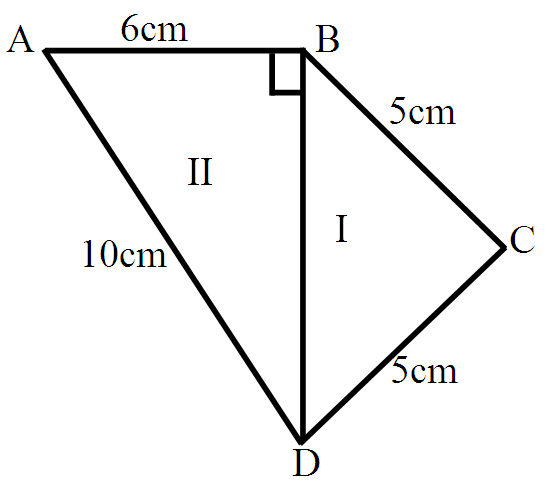
Chocolate is in the form of a quadrilateral with sides $6\ cm$ and $10\ cm, 5\ cm$ and $5\ cm($as shown in the figure$)$ is cut into two parts on one of its diagonal by a lady. Part$-I$ is given to her maid and part $II$ is equally divided among a driver and gardener.

$i.$ Length of $BD:$
$a. 9\ cm$
$b. 8\ cm$
$c. 7\ cm$
$d. 6\ cm$
Area of $\triangle\text{ABC}:$
$a. 24\ cm^2$
$b. 12\ cm^2$
$c. 42\ cm^2$
$d. 21\ cm^2$
The sum of all the angles of a quadrilateral is equal to:
$a. 180^\circ$
$b. 270^\circ$
$c. 360^\circ$
$d. 90^\circ$
A diagonal of a parallelogram divides it into two congruent:
$a.$ Square.
$b.$ Parallelogram.
$c.$ Triangles.
$d.$ Rectangle.
Each angle of the rectangle is:
$a.$ More than $90^\circ$
$b.$ Less than $90^\circ$
$c.$ Equal to $90^\circ$
$d.$ Equal to $45^\circ$
Answer
$(i)$ $(b)$ $8\ cm$
$(ii)$ $(a)$ $24\ cm^2$
$(iii)$ $(c)$ $360^\circ$
$(iv)$ $(c)$ Triangles.
$(v)$ $(c)$ Equal to $90^\circ$
View full question & answer
Question 44 Marks
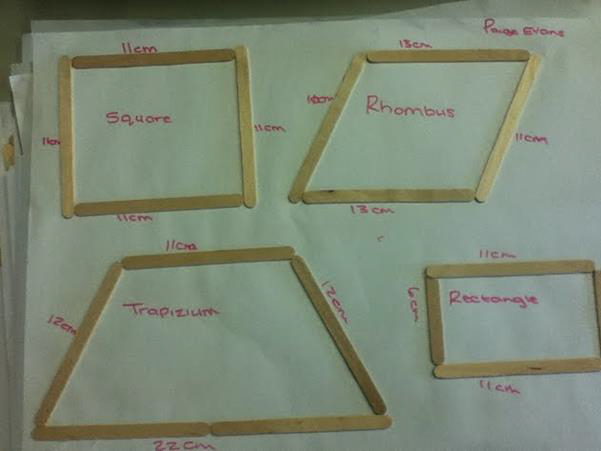
Read the Source/ Text given below and answer any four questions: During Maths Lab Activity each student was given four broomsticks of lengths $8\ cm, 8\ cm, 5\ cm, 5\ cm$ to make different types of quadrilaterals.

Using the above information answer the following questions:
$i.$ How many quadrilaterals can be formed using these sticks?
$a.$ Only One type of quadrilaterals can be formed.
$b.$ Two types of quadrilaterals can be formed.
$c.$ Three types of quadrilaterals can be formed.
$d.$ Four types of quadrilaterals can be formed.
$ii.$ Name the types of quadrilaterals formed:
$a.$Rectangle, parallelogram, kite.
$b.$ Rectangle, parallelogram, Trapizum.
$c.$, parallelogram, Square.
$d.$Rectangle, Square, kite.
$iii.$ In a trapezium $\text{ABCD}, DC \| AB$ and $\angle\text{A}=\angle\text{B}=45^\circ,$ the teacher asked the student to find $\angle\text{D}.$ Naresh answered it is $...........$

$a. 105^\circ $
$b.108^\circ $
$c.135^\circ $
$d. 125^\circ $
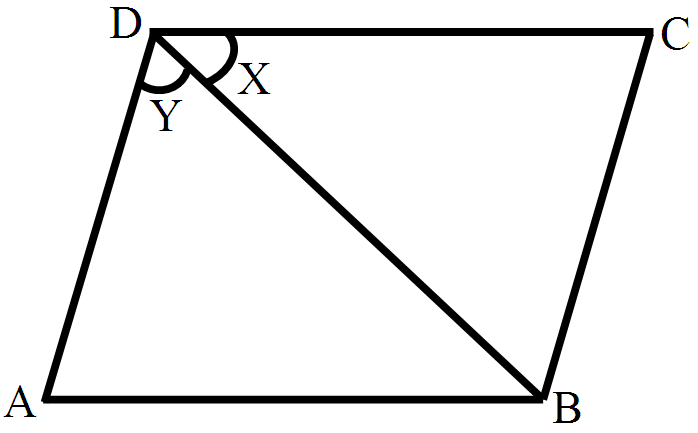
While discussing the properties of a parallelogram teacher asked about the relation between two angles x and y of a parallelogram as shown in fig. The teacher gave them $4$ options as $($if $BC < CD):$

$a.x > y$
$b. x < y$
$c.x = y$
$d.$None of these.
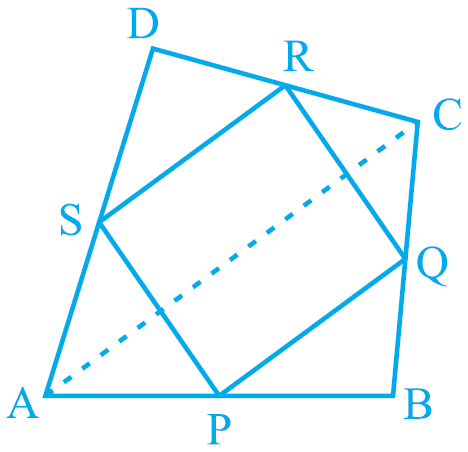
$P, Q, R,$ and $S$ are respectively the mid-points of sides $AB, BC, CD,$ and $DA$ of quadrilateral $ABCD$ in which $AC = BD$ and $\text{AC}\bot\text{BD}, \text{PQRS},$ is a:
$a.$ Square.
$b.$ Rhombus.
$c.$Kite.
$d.$Parallelogram.
Answer
$(i)$ $(c)$ Three types of quadrilaterals can be formed.
$(ii)$ $(a)$ Rectangle, parallelogram, kite.
$(iii)$ $(c)$ $135^\circ $
$(iv)$ $(b)$ $x < y$
$(v)$ $(a)$ Square.
View full question & answer
Question 54 Marks
Read the Source/ Text given below and answer these questions:

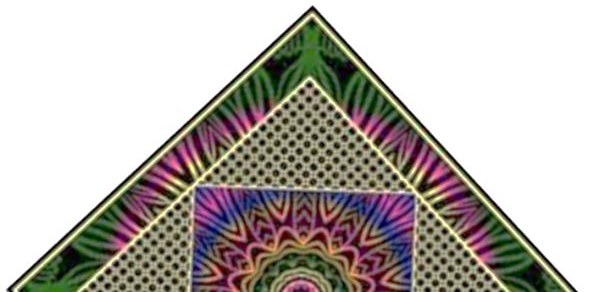
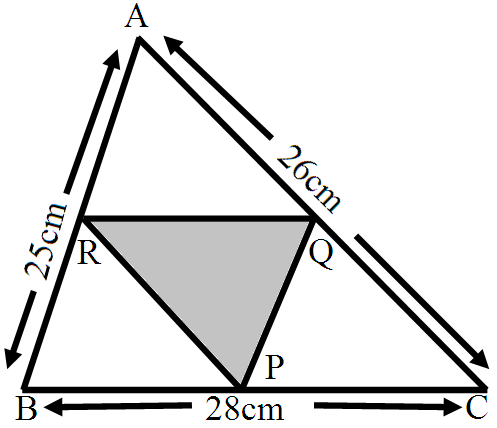
There is a Diwali celebration in the $DPS$ school Janakpuri New Delhi. Girls are asked to prepare Rangoli in a triangular shape. They made a rangoli in the shape of $\triangle ABC.$ Dimensions of $\triangle\text{ABC}$ are $26\ cm, 28\ cm, 25\ cm.$

$i.$ In fig, $R$ is mid$-$point of $AB$ and $RQ \| BC$ then $AQ$ is equal to:
$a. BC$
$b. RB$
$c. QC$
$d. AD$
$ii.$ In fig $R$ and $Q$ are mid-points of $AB$ and $AC$ respectively. The length of $RQ$ is:
$a. 14$
$b. 13$
$c. 12.5$
$d.13.5$
$iii.$ If Garland is to be placed along the side of $\triangle\text{QPR}$ which is formed by joining midpoint, what is the length of garland:
$a. 79\ cm$
$b. 39.5\ cm$
$c. 35\ cm$
$d.79.5\ cm$
$iv.$ In the following figure $R, P$ and $Q$ are the mid-points of $AB, BC,$ and $AC$ respectively. Which of the following is the area of $\triangle\text{PQR}?$
$a. \frac12\text{ar (ABC)}$
$b. \frac{1}{3}\text{ar (ABC)}$
$c. \frac14\text{ar (ABC)}$
$d.\frac16\text{ar (ABC)}$
$v. R, P, Q$ are the mid-points of corresponding sides $AB, BC, CA$ in $\triangle\text{ABC}$ the figure so obtained $BPQR$ will be:
$a.$ Parallelogram.
$b.$ Trapezium.
$c.$ Quadrilateral.
$d.$ None of these.
Answer
$(i)$
$(c)$
$QC$
$(ii)$
$(a)$
$14$
$(iii)$
$(b)$
$39.5\ cm$
$(iv)$
$(c)$
$\frac14\text{ar (ABC)}$
$(v)$
$(a)$
Parallelogram.
View full question & answer
Question 64 Marks
Read the Source/ Text given below and answer these questions:

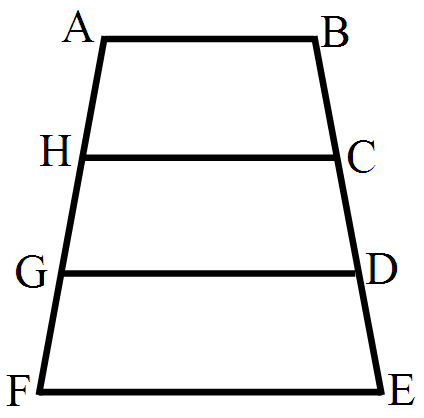
Sohan wants to show gratitude towards his teacher by giving her a card made by him. He has three pieces of trapezium pasted one above the other as shown in fig. These pieces are arranged in a way that $AB \| HC \| GD \| FE.$ Also $BC = CD = DE$ and $AH = HG = GF = 6\ cm.$ He wants to decorate the card by putting up a colored tape on the nonparallel sides of the trapezium.

$i.$ Find the total length of colored tape required if $DE = 4\ cm.$
$a. 20\ cm$
$b. 30\ cm$
$c. 40\ cm$
$d. 50\ cm$
$ii. \text{ABHC}$ is a trapezium in which $AB \| HC$ and $\angle\text{A}=\angle\text{B}=45^\circ.$ Find angles $C$ and $H$ of the trapezium.
$a. 135, 130$
$b. 130, 135$
$c. 135, 135$
$d. 130, 130$
$iii.$ What is the difference between trapezium and parallelogram$?$
$a.$ Trapezium has $2$ sides, and parallelogram has $4$ sides.
$b.$ Trapezium has $4$ sides, and parallelogram has $2$ sides.
$c.$ Trapezium has $1$ pair of parallel sides, and parallelogram has $2$ pairs of parallel sides.
$d.$ Trapezium has $2$ pairs of parallel sides, and parallelogram has $1$ pair of parallel sides.
$iv.$ Diagonals in isosceles trapezoid are $ ...........$
$a.$ parallel.
$b.$ opposite.
$c.$ vertical.
$d.$ equal.
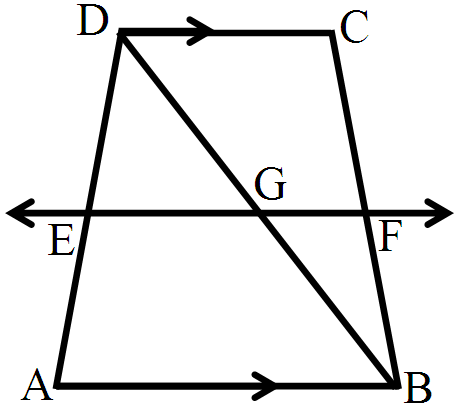
$v. \text{ABCD}$ is a trapezium where $AB \| DC, BD$ is the diagonal and $E$ is the midpoint of $AD. A$ line is drawn through $E$ parallel to $AB$ intersecting $BC$ at $F.$ Which of these is true$?$

$a. BF = FC$
$b. EA = FB$
$c. CF = DE$
$d.$ None of these
Answer
$(i)$ $(b)$ $30\ cm$
$(ii)$ $(c)$ $135, 135$
$(iii)$ $(c)$ Trapezium has $1$ pair of parallel sides, and parallelogram has $2$ pairs of parallel sides.
$(iv)$ $(d)$ equal.
$(v)$ $(a)$ $BF = FC$
View full question & answer
Question 74 Marks
Read the Source/ Text given below and answer these questions: A class teacher gave students coloured paper in the shape of a quadrilateral. She asks him to make a parallelogram from it using paper folding.


$i.$ One angle of a quadrilateral is $108^\circ$ and the remaining three angles are equal, then each of the three equal angles:
$a. 90^\circ $
$b. 74^\circ $
$c. 84^\circ $
$d. 72^\circ $
$ii.$ How can a parallelogram be formed by using paper folding?
$1.$ By finding diagonals of the quadrilateral.
$2.$ By joining mid pts. of sides of a quadrilateral.
$3.$ By finding angle bisectors.
$4.$ None of these.
The quadrilateral formed by joining the mid-points of the sides of a quadrilateral PQRS, taken in order, is a rectangle, if:
$a. \text{PQRS}$ is a rectangle.
$b. \text{PQRS}$ is a parallelogram.
$c.$ diagonals of $\text{PQRS}$ are perpendicular.
$d.$ diagonals of $\text{PQRS}$ are equal.
$iii.$ In the figure, $\text{ABCD}$ and $\text{AEFG}$ are two parallelograms. If $\angle\text{C}=60^\circ,$ then $\angle\text{F}$ is:

$a. 30^\circ $
$b. 60^\circ $
$c. 90^\circ $
$d. 120^\circ $
$iv.$ Which of the following is not true for a parallelogram$?$
$a.$ Opposite sides are equal.
$b.$ Opposite angles are equal.
$c.$ Opposite angles are bisected by the diagonals.
$d.$ Diagonals bisect each other.
$v.$ The angles of the quadrilateral are in the ratio $2 : 5 : 4 : 1?$ Which of the following is true$?$
$a.$ The largest angle in the quadrilateral is $150^\circ .$
$b.$ The smallest angle is $30^\circ .$
$c.$ The second$-$largest angle in the quadrilateral is $80^\circ .$
$d.$ Both the largest angle in the quadrilateral is $150^\circ $ and The smallest angle is $30^\circ .$
Answer
$(i)$ $(c)$ $84^\circ $
$(ii)$ $(b)$ $\text{PQRS}$ is a parallelogram
$(iii)$ $(b)$ $60^\circ $
$(iv)$ $(c)$ Opposite angles are bisected by the diagonals.
$(v)$ $(d)$ Both the largest angle in the quadrilateral is $150^\circ $ and The smallest angle is $30^\circ .$
View full question & answer