Question 13 Marks
Express the kinetic energy of a rotating body in terms of its angular momentum.
AnswerThe kinetic energy of a body of moment of inertia I and rotating with a constant angular velocity $\omega$ is
$
\mathrm{E}=\frac{1}{2} I \omega^2
$
The angular momentum of the body, $L=\mid \omega$.
$
\therefore \mathrm{E}=\frac{1}{2}(I \omega) \omega=\frac{1}{2} L \omega
$
This is the required relation.
View full question & answer→Question 23 Marks
Define the angular momentum of a particle.
Question 33 Marks
A thin rod of uniform cross section is made up of two sections made of wood and steel. The wooden section has length $50 \mathrm{~cm}$ and mass $0.6 \mathrm{~kg}$. The steel section has length $30 \mathrm{~cm}$ and mass $3 \mathrm{~kg}$. Find the moment of inertia of the rod about a transverse axis passing through the junction of the two sections.
View full question & answer→Question 43 Marks
The radius of gyration of a disc about its transverse symmetry axis is $2 \mathrm{~cm}$. Determine its radius of gyration about a diameter.
AnswerData : $\mathrm{k} \mathrm{CM}=2 \mathrm{~cm}$
Let $\mathrm{M}$ and $\mathrm{R}$ be the mass and radius of the disc. Let $\mathrm{I}_{\mathrm{CM}}$ and $\mathrm{K}_{\mathrm{CM}}$ be the $\mathrm{MI}$ and radius of gyration of the disc about its transverse symmetry axis. Let I and $\mathrm{k}$ be the $\mathrm{MI}$ and radius of gyration of the disc about its diameter. Then
$
\begin{aligned}
& I_{\mathrm{CM}}=\frac{M R^2}{2}=M k_{\mathrm{CM}}^2 \text { and } I=\frac{M R^2}{4}=M k^2 \\
& \therefore k_{\mathrm{CM}}^2=\frac{R^2}{2} \text { and } k^2=\frac{R^2}{4} \\
& \therefore \frac{k^2}{k_{\mathrm{CM}}^2}=\frac{R^2}{4} \times \frac{2}{R^2}=\frac{1}{2} \\
& \therefore k^2=\frac{k_{\mathrm{CM}}^2}{2} \quad \therefore k=\frac{k_{\mathrm{CM}}}{\sqrt{2}} \\
& \therefore k=\frac{2}{\sqrt{2}}=\sqrt{2}=1.414 \mathrm{~cm} \\
&
\end{aligned}
$
View full question & answer→Question 53 Marks
The radius of gyration of a body about an axis at $6 \mathrm{~cm}$ from its centre of mass is $10 \mathrm{~cm}$. Find its radius of gyration about a parallel axis through its centre of mass.
AnswerLet $O$ be a point at $6 \mathrm{~cm}$ from the centre of mass of the body.
Let $\mathrm{I}=\mathrm{Ml}$ about an axis through $\mathrm{O}$,
$\mathrm{k}=$ radius of gyration about the axis through $\mathrm{O}$,
$\mathrm{I}_{\mathrm{CM}}=\mathrm{Ml}$ about a parallel axis through the centre of mass of the body,
$\mathrm{k}_{\mathrm{CM}}=$ radius of gyration about a parallel axis through the centre of mass,
$M=$ mass of the body,
$\mathrm{h}=$ distance between the two axes.
Data : $\mathrm{h}=6 \mathrm{~cm}, \mathrm{k}=10 \mathrm{~cm}$
By the theorem of parallel axis,
$
\mathrm{I}=\mathrm{I}_{\mathrm{CM}}+\mathrm{Mh}^2
$
Also, $\mathrm{I}=\mathrm{Mk}^2$ and $\mathrm{I}_{\mathrm{CM}}=M k_{\mathrm{CM}}^2$
$
\begin{aligned}
& \therefore M k^2=M k_{\mathrm{CM}}^2+M h^2 \\
& \therefore k^2=k_{\mathrm{CM}}^2+h^2 \\
& \therefore 100=k_{\mathrm{CM}}^2+36 \quad \therefore k_{\mathrm{CM}}=8 \mathrm{~cm}
\end{aligned}
$
The radius of gyration about a parallel axis through its centre of mass is $8 \mathrm{~cm}$.
View full question & answer→Question 63 Marks
A compound object is formed of a thin rod and a disc attached at the end of the rod. The rod is $0.5 \mathrm{~m}$ long and has mass $2 \mathrm{~kg}$. The disc has mass of $1 \mathrm{~kg}$ and its radius is $20 \mathrm{~cm}$. Find the moment of inertia of the compound object about an axis passing through the free end of the rod and perpendicular to its length.
AnswerData : $L=0.5 \mathrm{~m}, R=0.2 \mathrm{~m}, M_{\text {rod }}=2 \mathrm{~kg}, M_{\text {disk }}=1 \mathrm{~kg}$ About a transverse axis through $C M$,
$
I_{\mathrm{CM}, \text { rod }}=\frac{1}{2} M_{\text {rod }} L^2 \quad \text { and } \quad I_{\mathrm{CM}, \text { disk }}=\frac{1}{2} M_{\text {disk }} R^2
$
The MI of the compound object about the given axis,
$
\begin{aligned}
& I_{\text {total }}=I_{\text {rod }}+I_{\text {disk }} \\
& =\left[I_{\mathrm{CM}, \mathrm{rod}}+M_{\mathrm{rod}}\left(\frac{L}{2}\right)^2\right] \\
& +\left[I_{\mathrm{CM}, \text { disc }}+M_{\text {disk }}(L+R)^2\right] \\
& =\left(\frac{1}{12} M_{\text {rod }} L^2+\frac{1}{4} M_{\text {rod }} L^2\right) \\
& +\left[\frac{1}{2} M_{\text {disc }} R^2+M_{\text {disc }}(L+R)^2\right] \\
& =\frac{1}{3} M_{\text {rod }} L^2+M_{\text {disc }}\left[\frac{1}{2} R^2+M_{\text {disk }}(L+R)^2\right] \\
& =\frac{1}{3}(2)(0.5)^2+(1)\left[\frac{1}{2}(0.2)^2+(0.5+0.2)^2\right] \\
& =\frac{1}{6}+\frac{0.04}{2}+0.49=0.167+0.02+0.49 \\
& =0.677 \mathrm{~kg} \cdot \mathrm{m}^2 \\
&
\end{aligned}
$
View full question & answer→Question 73 Marks
A thin uniform rod $1 \mathrm{~m}$ long has mass $1 \mathrm{~kg}$. Find its moment of inertia and radius of gyration for rotation about a transverse axis through a point midway between its centre and one end.
AnswerData : $M=1 \mathrm{~kg}, \mathrm{~L}=1 \mathrm{~m}$
Let $\mathrm{I}_{\mathrm{CM}}$ and $\mathrm{I}$ be the moments of inertia of the rod about a transverse axis through its centre, and a parallel axis midway between its centre and one end.
Then, $I_{\mathrm{CM}}=\frac{M L^2}{12}$ and $h=\frac{L}{4}$
By the theorem of parallel axis,
$
\begin{aligned}
I & =I_{\mathrm{CM}}+M h^2 \\
& =\frac{M L^2}{12}+\frac{M L^2}{16}=\frac{4 M L^2+3 M L^2}{48} \\
& =\frac{7}{48} M L^2=\frac{7}{48}(1)(1)^2=0.1458 \mathrm{~kg} \cdot \mathrm{m}^2
\end{aligned}
$
If $k$ is the radius of gyration about the parallel axis,
$
\begin{gathered}
I=M k^2 \quad \therefore M k^2=\frac{7}{48} M L^2 \\
\therefore k=\sqrt{\frac{7}{48}} L=\sqrt{\frac{7}{48}} \times 1=0.3818 \mathrm{~m}
\end{gathered}
$
View full question & answer→Question 83 Marks
A solid sphere of radius $R$, rotating with an angular velocity $\omega$ about its diameter, suddenly stops rotating and $75 \%$ of its $\mathrm{KE}$ is converted into heat. If $\mathrm{c}$ is the specific heat capacity of the material in SI units, show that the temperature of $3 \mathrm{R}^2 \mathrm{CO}^2$ the sphere rises by $\frac{3 R^2 \omega^2}{20 c}$.
AnswerThe $\mathrm{Ml}$ of a solid sphere about its diameters, $\mathrm{I}=\frac{2}{5} \mathrm{MR}^2$ where $M$ is its mass.
The rotational KE of the sphere,
$
\begin{aligned}
E=\frac{1}{2} I \omega^2 & =\frac{1}{2}\left(\frac{2}{5} M R^2\right) \omega^2 \\
& =\frac{1}{5} M R^2 \omega^2
\end{aligned}
$
If $\Delta \theta$ is the rise in temperature,
$
\begin{aligned}
& \quad M c \Delta \theta=\frac{3}{4} E=\frac{3}{4}\left(\frac{1}{5} M R^2 \omega^2\right) \\
& \therefore \Delta \theta=\frac{3 R^2 \omega^2}{20 c}
\end{aligned}
$
View full question & answer→Question 93 Marks
The mass and the radius of the Moon are, respectively, about $\frac{1}{81}$ time and about $\frac{1}{3.7}$ time those of the Earth. Given that the rotational period of the Moon is 27.3 days, compare the rotational kinetic energy of the Earth with that of the Moon.
Answer$
\text { Data : } M_M=\frac{1}{81} M_E, R_M=\frac{1}{3.7} R_E, T_M=27.3 \text { days, } T_E=1 \text { day }
$
Let $I_E$ and $I_M$ be the moments of inertia of the Earth and the Moon about their respective axes of rotation, and $\omega_E$ and $\omega_M$ be their respective rotational angular speeds. Assuming the Earth and the Moon to be solid spheres of uniform densities,
$
I_{\mathrm{E}}=\frac{2}{5} M_{\mathrm{E}} R_{\mathrm{E}}^2 \text { and } I_{\mathrm{M}}=\frac{2}{5} M_{\mathrm{M}} R_{\mathrm{M}}^2
$
Kinetic energy of rotation, $E_{\mathrm{rot}}=\frac{1}{2} \mathrm{I} \omega^2$
$
=\frac{1}{2} I\left(\frac{2 \pi}{T}\right)^2=2 \pi^2 \frac{I}{T^2}
$
Therefore, the ratio of the rotational KE of the Earth to that of the Moon is MaharashtraBoardSolutions.Guru
$
\begin{aligned}
\frac{E_{\text {rot (Earth) }}}{E_{\text {rot (Moon) }}} & =\frac{I_{\mathrm{E}}}{I_{\mathrm{M}}} \cdot\left(\frac{T_{\mathrm{M}}}{T_{\mathrm{E}}}\right)^2=\frac{M_{\mathrm{E}}}{M_{\mathrm{M}}} \cdot\left(\frac{R_{\mathrm{E}}}{R_{\mathrm{M}}}\right)^2 \cdot\left(\frac{T_{\mathrm{M}}}{T_{\mathrm{E}}}\right)^2 \\
& =81 \times(3.7)^2 \times(27.3)^2=8.264 \times 10^5
\end{aligned}
$
View full question & answer→Question 103 Marks
Calculate the moment of inertia of a ring of mass $500 \mathrm{~g}$ and radius $0.5 \mathrm{~m}$ about an axis of rotation passing through
(i) its diameter
(ii) a tangent perpendicular to its plane.
AnswerData : $M=500 \mathrm{~g} 0.5 \mathrm{~kg}, \mathrm{R}=0.5 \mathrm{~m}$
(i) The moment of inertia of the ring about its
$
\begin{aligned}
& \text { diameter }=\frac{M R^2}{2}=\frac{0.5 \times(0.5)^2}{2} \\
& =0.0625 \mathrm{~kg} \mathrm{~m}{ }^2=6.25 \times 10^{-2} \mathrm{~kg} \cdot \mathrm{m}^2
\end{aligned}
$
(ii) The moment of inertia of the ring about a tangent perpendicular to its plane $=2 \mathrm{MR}^2=2 \times 0.5 \times(0.5)^2=0.25 \mathrm{~kg} \cdot \mathrm{m}^2$
View full question & answer→Question 113 Marks
State the MI of a thin rectangular plate-of mass M, length l and breadth b about its transverse axis passing through its centre. Hence find its MI about a parallel axis through the midpoint of edge of length b.
Question 123 Marks
State the MI of a thin rectangular plate-of mass M, length l and breadth b- about an axis passing through its centre and parallel to its length. Hence find its MI about a parallel axis along one edge.
Question 133 Marks
Find the ratio of the radius of gyration of a solid sphere about its diameter to the radius of gyration of a hollow sphere about its tangent, given that both the spheres have the same radius.
AnswerThe radius of gyration of a body about a given axis, $\mathrm{k}=\sqrt{I / M}$, where $\mathrm{M}$ and $\mathrm{I}$ are respectively the mass of the body and its moment of inertia (MI) about the axis.
For a solid sphere rotating about its diameter,
$
k_{\mathrm{SS}}=\sqrt{\frac{2}{5}} R
$
For a hollow sphere rotating about its diameter,
$
I_{\mathrm{HS}}=\frac{2}{3} M R^2
$
For a hollow sphere rotating about its tangent,
$
I_{\mathrm{HS}}=\frac{2}{3} M R^2+M R^2=\frac{5}{3} M R^2
$
so that, its radius of gyration for rotation about a tangent is
$
k_{\mathrm{HS}}^{\prime}=\sqrt{\frac{5}{3}} R
$
The required ratio, $\frac{k_{\mathrm{SS}}}{k_{\mathrm{HS}}^{\prime}}=\sqrt{\frac{2}{5}} \times \sqrt{\frac{3}{5}}=\frac{\sqrt{6}}{5}$
View full question & answer→Question 143 Marks
State the expression for the Ml of a thin spherical shell (i.e., a thin-walled hollow sphere) about its diameter. Hence obtain the expression for its $\mathrm{Ml}$ about a tangent.
AnswerConsider a uniform, thin-walled hollow sphere radius $R$ and mass M. An axis along its diameter is an axis of spherical symmetry through its centre of mass. The $\mathrm{Ml}$ of the thin spherical shell about its diameter is
$
\mathrm{I}_{\mathrm{CM}}=\frac{2}{3} M R^2
$
Let I be its $\mathrm{Ml}$ about a tangent parallel to the diameter. Here, $\mathrm{h}=\mathrm{R}=$ distance between the two axes. Then, according to the theorem of parallel axis,
$
\begin{aligned}
I & =I_{\mathrm{CM}}+M h^2 \\
& =\frac{2}{3} M R^2+M R^2=\frac{5}{3} M R^2
\end{aligned}
$
[Note : The corresponding radii of gyration are
$
k_{\mathrm{CM}}=\sqrt{\frac{I_{\mathrm{CM}}}{M}}=\sqrt{\frac{2}{3}} R \simeq 0.8165 R \text { and }
$
$
\left.k=\sqrt{\frac{1}{M}}=\sqrt{\frac{5}{3}} R \simeq 1.291 R\right]
$
View full question & answer→Question 153 Marks
The radius of gyration of a uniform solid sphere of radius $R$ is $\sqrt{\frac{2}{5}} R$ for rotation about its diameter. Show that its radius of gyration for rotation about a tangential axis of rotation is $\sqrt{\frac{7}{5}} R$
AnswerLet the mass of the uniform solid sphere of radius R be $\mathrm{M}$. Let $\mathrm{I}_{\mathrm{CM}}$ and $\mathrm{k}_{\mathrm{d}}$ be its $\mathrm{Ml}$ about any diameter and the corresponding radius of gyration, respectively. Then,
$
I_{\mathrm{CM}}=M k_{\mathrm{d}}^2=\frac{2}{5} M R^2 \quad\left(\because k_{\mathrm{d}}=\sqrt{\frac{2}{5}} R, \text { given }\right)
$
Let $\mathrm{I}$ and $\mathrm{k}_{\mathrm{t}}$ be its $\mathrm{Ml}$ about a parallel tangential axis and the corresponding radius of gyration, respectively. Here, $h=R=$ distance between the two axis.
$
\therefore \mathrm{I}=M k_{\mathrm{t}}^2
$
By the theorem of parallel axis,
$
\begin{aligned}
& I=I_{C M}+M h^2 \\
& \therefore M k_{\mathrm{t}}^2=\frac{2}{5} M R^2+M R^2 \quad \therefore k_{\mathrm{t}}^2=\frac{2}{5} R^2+R^2=\frac{7}{5} R^2 \\
& \therefore k_{\mathrm{t}}=\sqrt{\frac{7}{5}} R
\end{aligned}
$
View full question & answer→Question 163 Marks
Assuming the expression for the MI of a uniform solid sphere about its diameter, obtain the expression for its moment of inertia about a tangent.
Question 173 Marks
State an expression for the moment of inertia of a solid sphere about its diameter. Write the expression for the corresponding radius of gyration.
Question 183 Marks
Assuming the expression for the moment of inertia of a thin uniform disc about its diameter, show that the moment of inertia of the disc about a tangent in its plane is $\mathrm{MR}^2$. Write the expression for the corresponding radius of gyration.
View full question & answer→Question 193 Marks
Given the moment of inertia of a thin uniform disc about its diameter to be $\frac{1}{4} M R^2$, where $M$ and $R$ are respectively the mass and radius of the disc, find its moment of inertia about an axis normal to the disc and passing through a point on its edge.
AnswerConsider a thin uniform disc of mass $\mathrm{M}$ and radius $\mathrm{R}$ in the $\mathrm{xy}$ plane. Let $\mathrm{I} \mathrm{x}$, ly and $\mathrm{Iz}$ be the moments of inertia of the disc about the $x, y$ and $z$ axes respectively.
Now, $I_x=I_y$
since each represents the moment of inertia (MI) of the disc about its diameter and, by symmetry, the $\mathrm{Ml}$ of the disc about any diameter is the same.
$\therefore \mathrm{I}_{\mathrm{x}}=\mathrm{I}_{\mathrm{y}}=\frac{1}{4} \mathrm{MR}^2$ (Given)
According to the theorem of perpendicular axes,
$\mathrm{I}_z=\mathrm{I}_{\mathrm{x}}+\mathrm{I}_{\mathrm{y}}=2\left(\frac{1}{4} M R^2\right)=\frac{1}{2} \mathrm{MR}^2$
Let I be the $\mathrm{Ml}$ of the disc about a tangent normal to the disc and passing through a point on its edge (i.e., a tangent perpendicular to its plane). According to the theorem of parallel axis,
$\mathrm{I}=\mathrm{I}_{\mathrm{CM}}+\mathrm{Mh}^2$
Here, $I_{C M}=I_z=\frac{1}{2} M R^2$ and $h=R$.
$\therefore \mathrm{I}=\frac{1}{2} \mathrm{MR}^2+\mathrm{MR}^2=\frac{3}{2} \mathrm{MR}^2$
which is the required expression.
View full question & answer→Question 203 Marks
State the expression for the Ml of a thin spherical shell (i.e., a thin-walled hollow sphere) about its diameter. Hence obtain the expression for its $\mathrm{Ml}$ about a tangent.
AnswerConsider a uniform, thin-walled hollow sphere radius $\mathrm{R}$ and mass $\mathrm{M}$. An axis along its diameter is an axis of spherical symmetry through its centre of mass. The Ml of the thin spherical shell about its diameter is
$
\mathrm{I}_{\mathrm{CM}}=\frac{2}{3} \mathrm{MR}^2
$
Let $\mathrm{I}$ be its $\mathrm{MI}$ about a tangent parallel to the diameter. Here, $\mathrm{h}=\mathrm{R}=$ distance between the two axes. Then, according to the theorem of parallel axis,
$
\begin{aligned}
& k_{\mathrm{CM}}=\sqrt{\frac{I_{\mathrm{CM}}}{M}}=\sqrt{\frac{2}{3}} R \simeq 0.8165 R \text { and } \\
& \left.k=\sqrt{\frac{I}{M}}=\sqrt{\frac{5}{3}} R \simeq 1.291 R\right]
\end{aligned}
$
View full question & answer→Question 213 Marks
About which axis of rotation is the radius of gyration of a body the least ?
AnswerThe radius of gyration of a body is the least about an axis through the centre of mass (CM) of the body.
From the parallel axis theorem, we know that a given body has the smallest possible moment of inertia about an axis through its $\mathrm{CM}$. The radius of gyration of a body about a given axis is directly proportional to the square root of its moment of inertia about that axis. Hence, the conclusion.
$
\left\{O R I=I_{C M}+M h^2 . \therefore M k^2=\backslash\left([/ \text { latexM k_\{ } \operatorname{mathrm}\{C M\}\}^{\wedge}\{2\}\right]+M^2\right. \text {. }
$
$\therefore \mathrm{k}^2=\left[\right.$ latex] $\mathrm{k}_{-}\{\mathrm{mathrm}\{\mathrm{CM}\}\}^{\wedge}\{2\} \mathrm{N}+\mathrm{h}^2$, which shows that $\mathrm{k}$ is minimum, equal to $\mathrm{k}_{\mathrm{CM}}$ when $\mathrm{h}=0$.
View full question & answer→Question 223 Marks
State an expression for the radius of gyration of
(i) a thin ring
(ii) a thin disc, about respective transverse symmetry axis.
OR
Show that for rotation about respective transverse symmetry axis, the radius of gyration of a thin disc is less than that of a thin ring.
Answer(i) The $\mathrm{Ml}$ of the ring about the transverse symmetry axis is
$\mathrm{I}_{\mathrm{CM}}=\mathrm{MR}^2 \ldots(1)$
Radius of gyration : The radius of gyration of the ring about the transverse symmetry axis is $\mathrm{K}=\sqrt{I_{\mathrm{CM}} / M}=\sqrt{R^2}=\mathrm{R}$
(ii) The Ml of the disc about the transverse symmetry axis is
$\mathrm{I}_{\mathrm{CM}}=\frac{1}{2} \mathrm{MR}<^2$..
Radius of gyration : The radius of gyration of the disc for the given rotation axis is
$
k=\sqrt{\frac{I}{M}}=\sqrt{\frac{R^2}{2}}=\frac{R}{\sqrt{2}}
$
Therefore, $k_{\text {disc }}<k_{\text {ring }}$.
View full question & answer→Question 233 Marks
State an expression for the moment of inertia of a thin ring about its transverse symmetry axis.
Question 243 Marks
Four particles of masses 0.2 kg, 0.3 kg, 0.4 kg and 0.5 kg respectively are kept at comers A, B, C and D of a square ABCD of side 1 m. Find the moment of inertia of the system about an axis passing through point A and perpendicular to the plane of the square.
Question 253 Marks
Find the moment of inertia of a hydrogen molecule about its centre of mass if the mass of each hydrogen atom is $m$ and the distance between them is $R$.
AnswerWe assume the rotation axis to be a transverse axis through the centre of mass of the linear molecule $\mathrm{H}_2$. Then, each of the hydrogen atom is a distance $\frac{1}{2} \mathrm{R}$ from the $\mathrm{CM}$. Therefore, the $\mathrm{Ml}$ of the molecule about this axis,
$
I=2 m\left(\frac{R}{2}\right)^2=\frac{1}{2} m R^2
$
Notes :
1. For a $\mathrm{H}_2$ molecule, $\mathrm{mH}=1.674 \times 10^{-27} \mathrm{~kg}$ and bond length $=7.774 \times 10^{-11} \mathrm{~m}$, so that $\mathrm{I}=5.065 \times 10^{-48} \mathrm{~kg} \cdot \mathrm{m}^2$.
2. As atoms are treated as particles, we do not consider rotation about the line passing through the atoms.
View full question & answer→Question 263 Marks
Three point masses $M_1, M_2$ and $M_3$ are located at the vertices of an equilateral triangle of side a. What is the moment of inertia of the system about an axis along the altitude of the triangle passing through $M_1 ?$
View full question & answer→Question 273 Marks
A stone of mass $100 \mathrm{~g}$ attached to a string of length $50 \mathrm{~cm}$ is whirled in a vertical circle by giving it a velocity of $7 \mathrm{~m} / \mathrm{s}$ at the lowest point. Find the velocity at the highest point.
AnswerData : $m=0.1 \mathrm{~kg}, \mathrm{r}=\mathrm{l}=0.5 \mathrm{~m}, \mathrm{v}_2=7 \mathrm{~m} / \mathrm{s}, \mathrm{g}=10 \mathrm{~m} / \mathrm{s}^2$
The total energy at the bottom, $E_{\text {bot }}$
$
=\mathrm{KE}+\mathrm{PE}=\frac{1}{2} m v_2^2+0=\frac{1}{2}(0.1)(7)^2=2.45 \mathrm{~J}
$
The total energy at the top, $\mathrm{E}_{\text {top }}=\mathrm{KE}+\mathrm{PE}=\frac{1}{2} m v_1^2+\mathrm{mg}(2 \mathrm{r})$
$
\begin{aligned}
& =\frac{1}{2}(0.1) v_1^2+(0.1)(10)(2 \times 0.5) \\
& =0.05 v_1^2+1
\end{aligned}
$
By the principle of conservation of energy,
$
\begin{aligned}
& \quad E_{\text {top }}=E_{\text {bot }} \\
& \therefore 0.05 v_1^2+1=2.45 \\
& \therefore v_1^2=\frac{2.45-1}{0.05}=\frac{145}{5}=29 \\
& \therefore v_1=\sqrt{29}=5.385 \mathrm{~m} / \mathrm{s}
\end{aligned}
$
View full question & answer→Question 283 Marks
A small body of mass $0.3 \mathrm{~kg}$ oscillates in a vertical plane with the help of a string $0.5 \mathrm{~m}$ long with a constant speed of $2 \mathrm{~m} / \mathrm{s}$. It makes an angle of $60^{\circ}$ with the vertical. Calculate the tension in the string.
Answer$
\begin{aligned}
\text { Data }: \mathrm{m} & =0.3 \mathrm{~kg}, \mathrm{r}=0.5 \mathrm{~m}, \mathrm{v}=2 \mathrm{~m} / \mathrm{s}, \theta=60^{\circ}, \mathrm{g}=10 \mathrm{~m} / \mathrm{s}^2 \\
\frac{m v^2}{r} & =T-m g \cos \theta
\end{aligned}
$
Tension in the string, $T=\frac{m v^2}{r}+m g \cos \theta$
$
\begin{aligned}
& =\frac{(0.3)(2)^2}{0.5}+\begin{array}{c} \\
(0.3)(10) \cos 60^{\circ}
\end{array} \\
& =2.4+0.3 \times 10 \times \frac{1}{2}=2.4+0.3 \times 5=3.9 \mathrm{~N}
\end{aligned}
$
View full question & answer→Question 293 Marks
A bucket of water is tied to one end of a rope $8 \mathrm{~m}$ long and rotated about the other end in a vertical circle. Find the number of revolutions per minute such that water does not spill.
Answer[Important note: The circular motion of the bucket in a vertical plane under gravity is not a uniform circular motion. Assuming the critical case of the motion such that the bucket has the minimum speed at the highest point required for the water to stay put in the bucket, we can find the minimum frequency of revolution. ]
Data $: r=8 \mathrm{~m}, \mathrm{~g}=9.8 \mathrm{~m} / \mathrm{s}^2, \pi=3.142$
Assuming the bucket has a minimum speed $v=\sqrt{r g}$ at the highest point, the corresponding angular speed is
$
\omega=2 \pi f=\frac{v}{r}=\frac{\sqrt{r g}}{r}=\sqrt{\frac{g}{r}}
$
The minimum frequency of revolution,
$
\begin{aligned}
f & =\frac{1}{2 \pi} \sqrt{\frac{g}{r}} \\
& =\frac{1}{2 \times 3.142} \sqrt{\frac{9.8}{8}} \\
& =\frac{1}{6.284} \sqrt{1.225}=0.1761 \mathrm{rps} \\
& =0.1761 \times 60 \mathrm{rpm}=10.566 \mathrm{rpm}
\end{aligned}
$
View full question & answer→Question 303 Marks
A small body of mass $m=0.1 \mathrm{~kg}$ at the end of a cord $1 \mathrm{~m}$ long swings in a vertical circle. Its speed is $2 \mathrm{mls}$ when the cord makes an angle $\theta=30^{\circ}$ with the vertical. Find the tension in the cord.
AnswerData: $\mathrm{m}=0.1 \mathrm{~kg}, \mathrm{r}=1 \mathrm{~m}, \mathrm{y}=2 \mathrm{~m} / \mathrm{s}, \theta=30^{\circ}$,
$\mathrm{g}=9.8 \mathrm{~m} / \mathrm{s}^2$
When the cord makes an angle $\theta$ with the vertical, the centripetal force on the body is
$
\frac{m v^2}{r}=T-m g \cos \theta
$
The tension in the cord,
$
\begin{aligned}
T & =\frac{m v^2}{r}+m g \cos \theta \\
& =0.1\left(\frac{2^2}{1}+9.8 \times \cos 30^{\circ}\right) \\
& =0.1\left(4+9.8 \times \frac{\sqrt{3}}{2}\right)=0.1(4+4.9 \times 1.732) \\
& =0.1(4+8.486)=1.2486 \mathrm{~N}
\end{aligned}
$
View full question & answer→Question 313 Marks
A loop-the-loop cart runs down an incline into a vertical circular track of radius 3 m and then describes a complete circle. Find the minimum height above the top of the circular track from which the cart must be released.
Question 323 Marks
What is vertical circular motion? Comment on its two types.
AnswerA body revolving in a vertical circle in the gravitational field of the Earth is said to perform vertical circular motion.
A vertical circular motion controlled only by gravity is a nonuniform circular motion because the linear speed of the body does not remain constant although the motion can be periodic.
In a controlled vertical circular motion, such as that a body attached to a rod, the linear speed of the body can be constant (including zero) so that such a motion can be uniform and periodic.
View full question & answer→Question 333 Marks
A stone of mass $1 \mathrm{~kg}$, attached at the end of a $1 \mathrm{~m}$ long string, is whirled in a horizontal circle. If the string makes an angle of $30^{\circ}$ with the vertical, calculate the centripetal force acting on the stone.
Answer$
\begin{aligned}
& \text { Data : } \mathrm{m}=1 \mathrm{~kg}, \mathrm{~L}=1 \mathrm{~m}, \theta=30^{\circ}, \mathrm{g}=10 \mathrm{~m} / \mathrm{s}^2 \\
& \therefore \theta=\sin ^{-1}\left(\frac{1}{6}\right)=\sin ^{-1} 0.1667=9^{\circ} 36^{\prime} \\
& \therefore \cos \theta=\cos 9^{\circ} 36^{\prime}=0.9860 \\
\end{aligned}
$
The tension in the string,
$
\begin{aligned}
& F=\frac{m g}{\cos \theta}=\frac{0.15 \times 9.8}{0.9860}=1.491 \mathrm{~N} \\
& v=\sqrt{r g \tan \theta}
\end{aligned}
$
The centripetal force $=\frac{m v^2}{r}=\frac{m(r g \tan \theta)}{r}$
$
\begin{aligned}
& =m g \tan \theta \quad \text { MaharashtraBoardSolutions.Guru } \\
& =(1)(10)\left(\tan 30^{\circ}\right) \\
& =10 \times \frac{1}{\sqrt{3}}=\frac{10}{1.732}=\mathbf{5 . 7 7 4} \mathrm{N}
\end{aligned}
$
View full question & answer→Question 343 Marks
A string of length $0.5 \mathrm{~m}$ carries a bob of mass $0.1 \mathrm{~kg}$ at its end. If this is to be used as a conical pendulum of period $0.4 \pi \mathrm{s}$, calculate the angle of inclination of the string with the vertical and the tension in the string.
AnswerData : $L=0.5 \mathrm{~m}, \mathrm{~m}=0.1 \mathrm{~kg}, \mathrm{~T}=0.4 \pi \mathrm{s}, \mathrm{g}=10 \mathrm{~m} / \mathrm{s}^2$
(i) Period, $T=2 \pi \sqrt{\frac{L \cos \theta}{g}}$
$
\begin{aligned}
\therefore \cos \theta & =\frac{g T^2}{4 \pi^2 L} \\
& =\frac{10(0.4 \pi)^2}{4 \pi^2 \times 0.5} \\
& =\frac{10 \times 0.16 \pi^2}{2 \pi^2}=10 \times 0.08=0.8
\end{aligned}
$
The inclination of the string with the vertical,
$
\theta=36^{\circ} 5^{\prime}
$
(ii) The tension in the string,
$
F=\frac{m g}{\cos \theta}=\frac{0.1 \times 10}{0.8}=1.25 \mathrm{~N}
$
View full question & answer→Question 353 Marks
A stone of mass $2 \mathrm{~kg}$ is whirled in a horizontal circle attached at the end of a $1.5 \mathrm{~m}$ long string. If the string makes an angle of $30^{\circ}$ with the vertical, compute its period.
AnswerData : $L=1.5 \mathrm{~m}, \theta=30^{\circ}, \mathrm{g}=10 \mathrm{~m} / \mathrm{s}^2$
The period of the conical pendulum,
$
\begin{aligned}
T & =2 \pi \sqrt{\frac{L \cos \theta}{g}}=2 \times 3.142 \times \sqrt{\frac{1.5 \cos 30^{\circ}}{10}} \\
& =6.284 \times \sqrt{\frac{1.5 \times 0.866}{10}}=6.284 \sqrt{\frac{1.299}{10}} \\
& =2.265 \mathrm{~s} \quad
\end{aligned}
$
View full question & answer→Question 363 Marks
A motorcyclist is describing a circle of radius $25 \mathrm{~m}$ at a speed of $5 \mathrm{~m} / \mathrm{s}$. Find his inclination with the vertical. What is the value of the coefficient of friction between the tyres and ground ?
AnswerData : $v=5 \mathrm{~m} / \mathrm{s}, \mathrm{r}=25 \mathrm{~m}, \mathrm{~g}=10 \mathrm{~m} / \mathrm{s}^2$
(i)
$
\begin{aligned}
& \tan \theta=\frac{v^2}{r g}=\frac{(5)^2}{25 \times 10}=0.10 \\
& \therefore \theta=\tan ^{-1} 0.10=5^{\circ} \mathbf{4}^{\prime}
\end{aligned}
$
(inclination with the vertical)
(ii) $\frac{m v^2}{r}=\mu_s m g$
where $\mu_{\mathrm{s}}$ is the coefficient of friction.
$
\therefore \mu_{\mathrm{s}}=\frac{v^2}{r g}=0.10
$
View full question & answer→Question 373 Marks
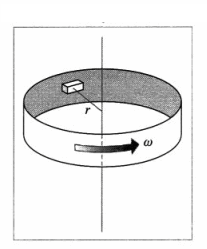
A thin cylindrical shell of inner radius 1.5 m rotates horizontally, about a vertical axis, at an angular speed ω. A wooden block rests against the inner surface and rotates with it. If the coefficient of static friction between block and surface is 0.3, how fast must the shell be rotating if the block is not to slip and fall ?
AnswerData : $\mathrm{r}=1.5 \mathrm{~m}, \mu_{\mathrm{s}}=0.3$
The normal force $\vec{N}$ of the shell on the block is the centripetal force which holds the block in place. $\vec{N}$ determines the friction on the block, which in turn keeps it from sliding downward.
If the block is not to slip, the friction force $\overrightarrow{f_{\mathrm{s}}}$ must balance the weight $m \vec{g}$ of the block.
$
\begin{aligned}
& \therefore N=m \omega^2 r \text { and } f_s=\mu_s N=m g \\
& \therefore \mu_s\left(\omega^2 r\right)=m g \\
& \therefore \omega=\sqrt{\frac{g}{\mu_s r}}=\sqrt{\frac{10}{(0.3)(1.5)}}=\sqrt{\frac{10}{0.45}} \\
& \quad=\sqrt{22.22}=4.714 \mathrm{rad} / \mathrm{s}=\frac{4.714}{2 \pi}=0.75 \mathrm{rev} / \mathrm{s}
\end{aligned}
$
This gives the required angular speed.
View full question & answer→Question 383 Marks
A circular race course track has a radius of $500 \mathrm{~m}$ and is banked at $10^{\circ}$. The coefficient of static friction between the tyres of a vehicle and the road surface is 0.25 . Compute
(i) the maximum speed to avoid slipping
(ii) the optimum speed to avoid wear and tear of the tyres.
Answer$
\text { Data : } r=500 \mathrm{~m}, \theta=10^{\circ}, \mu_{\mathrm{s}}=0.25, \mathrm{~g}=9.8 \mathrm{~m} / \mathrm{s}^2, \tan 10^{\circ}=0.1763
$
(i) On the banked track, the maximum speed of the vehicle without slipping (skidding) is
$
\begin{aligned}
& v_{\max }=\sqrt{\frac{r g\left(\mu_{\mathrm{s}}+\tan \theta\right)}{1-\mu_{\mathrm{s}} \tan \theta}} \\
& =\sqrt{\frac{500 \times 10(0.25+0.1763)}{1-(0.25 \times 0.1763)}} \\
& \text { MaharashtraBoardSolutions. Guru } \\
& =\sqrt{\frac{500 \times 10 \times 0.4263}{0.9559}}=\sqrt{2230} \\
& =47.22 \mathrm{~m} / \mathrm{s} \\
&
\end{aligned}
$
(ii) The optimum speed of the vehicle on the track is
$
\begin{aligned}
v_{\text {opt }} & =\sqrt{r g \tan \theta} \\
& =\sqrt{500 \times 10 \times 0.1763} \\
& =\sqrt{881.5}=29.69 \mathrm{~m} / \mathrm{s}
\end{aligned}
$
View full question & answer→Question 393 Marks
A certain string $500 \mathrm{~cm}$ long breaks under a tension of $45 \mathrm{~kg}$ wt. An object of mass $100 \mathrm{~g}$ is attached to this string and whirled in a horizontal circle. Find the maximum number of revolutions that the object can make per second without breaking the string, $\left[\mathrm{g}=9.8 \mathrm{~m} / \mathrm{s}^2\right.$ ]
AnswerData : $\mathrm{m}=100 \mathrm{~g}=0.1 \mathrm{~kg}, \mathrm{r}=500 \mathrm{~cm}=5 \mathrm{~m}, \mathrm{~g}=9.8 \mathrm{~m} / \mathrm{s}^2, \mathrm{~F}=45 \mathrm{~kg} w \mathrm{t}=45 \times 9.8 \mathrm{~N}$ The breaking tension is equal to the maximum centripetal force that can be applied. $\therefore \mathrm{F}=\mathrm{m} \omega^2 \mathrm{r}$,
But $\omega=2 \pi \mathrm{f}$, where/is the corresponding frequency of revolution.
$
\begin{aligned}
& \therefore F=m(2 \pi f)^2 r=4 \pi^2 m f^2 r \\
& \therefore f=\sqrt{\frac{F}{4 \pi^2 m r}}=\sqrt{\frac{45 \times 9.8}{4 \times(3.142)^2 \times 0.1 \times 5}}
\end{aligned}
$
The maximum number of revolutions per second, $f=4.726 \mathrm{~Hz}$
View full question & answer→Question 403 Marks
A coin is placed on a stationary disc at a distance of $1 \mathrm{~m}$ from the disc's centre. At time $t=0$ $\mathrm{s}$, the disc begins to rotate with a constant angular acceleration of $2 \mathrm{rad} / \mathrm{s}^2$ around a fixed vertical axis through its centre and perpendicular to its plane.
Find the magnitude of the linear acceleration of the coin at $t=1.5 \mathrm{~s}$. Assume the coin does not slip.
AnswerData : $r=1 \mathrm{~m}, \alpha=2 \mathrm{rad} / \mathrm{s}^2, \omega_0=0, t=1.5 \mathrm{~s}$
$
a_{\mathrm{t}}=\alpha r=(2)(1)=2 \mathrm{~m} / \mathrm{s}^2
$
Angular speed at $t=1.5 \mathrm{~s}$,
$
\begin{aligned}
\omega & =\omega_{\mathrm{o}}+\alpha t=0+(2)(1.5)=3 \mathrm{rad} / \mathrm{s} \\
\therefore a_{\mathrm{r}} & =\omega^2 r=(3)^2(1)=9 \mathrm{~m} / \mathrm{s}^2
\end{aligned}
$
The required linear acceleration is,
$
\begin{aligned}
a & =\sqrt{a_{\mathrm{r}}^2+a_{\mathrm{t}}^2}=\sqrt{9^2+2^2}=\sqrt{85} \\
& =9.22 \mathrm{~m} / \mathrm{s}^2
\end{aligned}
$
[OR $v=u+a_1 t=0+(2)(1.5)=3 \mathrm{~m} / \mathrm{s}$
$
\left.\therefore a_{\mathrm{r}}=\frac{v^2}{r}=\frac{3^2}{1}=9 \mathrm{~m} / \mathrm{s}^2\right]
$
View full question & answer→Question 413 Marks
A flywheel slows down uniformly from $1200 \mathrm{rpm}$ to $600 \mathrm{rpm}$ in $5 \mathrm{~s}$. Find the number of revolutions made by the wheel in $5 \mathrm{~s}$.
AnswerData : $\omega_0=1200 \mathrm{rpm}, \omega=600 \mathrm{rpm}, \mathrm{f}=5 \mathrm{~s}$
Since the flywheel slows down uniformly, its angular acceleration is constant. Then, its average angular speed,
$
\begin{aligned}
& \omega_{\mathrm{av}}=\frac{\omega_{\mathrm{o}}+\omega}{2}=\frac{1200+600}{2} \\
& =900 \mathrm{rpm}=\frac{900 \mathrm{rev}}{60 \mathrm{~s}}=15 \mathrm{rps}
\end{aligned}
$
Its angular displacement in time $t$,
$\theta=\omega_{\text {av }} \cdot \mathrm{t}=15 \times 5=75$ revolutions
View full question & answer→Question 423 Marks
The frequency of revolution of a particle performing circular motion changes from $60 \mathrm{rpm}$ to $180 \mathrm{rpm}$ in 20 seconds. Calculate the angular acceleration of the particle.
AnswerData $: \mathrm{f}_1=60 \mathrm{rpm}=\frac{60}{60} \mathrm{rev} / \mathrm{s}=1 \mathrm{rev} / \mathrm{s}, \mathrm{f}_2=180 \mathrm{rpm}=\frac{180}{60} \mathrm{rev} / \mathrm{s}=3 \mathrm{rev} / \mathrm{s}, \mathrm{t}=20 \mathrm{~s}$ The angular acceleration in SI units,
$
\begin{aligned}
\alpha & =\frac{\omega_2-\omega_1}{t}=\frac{2 \pi f_2-2 \pi f_1}{t}=\frac{2 \pi(3)-2 \pi(1)}{20} \\
& =\frac{4 \pi}{20}=\frac{\pi}{5}=\frac{3.14}{5}=0.628 \mathrm{rad} / \mathrm{s}^2
\end{aligned}
$
OR
Using non SI units, the angular frequencies are $\omega_1=60 \mathrm{rpm}=1 \mathrm{rps}$ and $\omega_2=180 \mathrm{rpm}=3$ rps.
$
\therefore \alpha=\frac{\omega_2-\omega_1}{t}=\frac{3-1}{20}=\frac{1}{10}=0.1 \mathrm{rev} / \mathrm{s}^2 .
$
View full question & answer→Question 433 Marks
A body of mass 100 grams is tied to one end of a string and revolved along a circular path in the horizontal plane. The radius of the circle is $50 \mathrm{~cm}$. If the body revolves with a constant angular speed of $20 \mathrm{rad} / \mathrm{s}$, find the
1. period of revolution
2. linear speed
3. centripetal acceleration of the body.
AnswerData : $m=100 \mathrm{~g}=0.1 \mathrm{~kg}, \mathrm{r}=50 \mathrm{~cm}=0.5 \mathrm{~m}, \omega=20 \mathrm{rad} / \mathrm{s}$
1. The period of revolution of the body,
$
T=\frac{2 \pi}{\omega}=\frac{2 \times 3.142}{20}=0.3142 \mathrm{~s}
$
2. Linear speed, $v=\omega r=20 \times 0.5=10 \mathrm{~m} / \mathrm{s}$
3. Centripetal acceleration,
$
a_c=w^2 r=(20)^2 \times 0.5=200 \mathrm{~m} / \mathrm{s}^2
$
View full question & answer→Question 443 Marks
Write the kinematical equations for circular motion in analogy with linear motion.
AnswerFor circular motion of a particle with constant angular acceleration $\alpha$, average angular speed, $\omega_{\mathrm{av}}=\frac{\omega_0+\omega}{2}$
$
\alpha=\frac{\omega-\omega_0}{t} \text { and } \theta-\theta_0=\omega_{\text {av }} \cdot t
$
where $\omega_0$ and $\omega$ are the initial and final angular speeds, $t$ is the time, $\omega_{a v}$ the average angular speed and $\theta_0$ and $\theta$ the initial and final angular positions of the particle.
Then, the angular kinematical equations for the circular motion are (in analogy with linear kinematical equations for constant linear acceleration)
$
\begin{aligned}
& \omega=\omega_0+\alpha t \\
& \theta-\theta_0=\omega_0 t+\frac{1}{2} \alpha t^2 \\
& \omega^2=\omega_0^2+2 \alpha\left(\theta-\theta_0\right)
\end{aligned}
$
View full question & answer→Question 453 Marks
Draw a diagram showing the linear velocity, angular velocity and radial acceleration of a particle performing circular motion with radius r.
Question 463 Marks
A solid sphere of mass $1 \mathrm{~kg}$ rolls on a table with linear speed $2 \mathrm{~m} / \mathrm{s}$, find its total kinetic energy.
AnswerData : $M=1 \mathrm{~kg}, \mathrm{v}=2 \mathrm{~m} / \mathrm{s}$
The total kinetic energy of a rolling body,
$
E=\frac{1}{2} M v^2\left(1+\frac{k^2}{R^2}\right)
$
For a solid sphere, $k^2=\frac{2}{5} R^2$
$
\begin{aligned}
\therefore E & =\frac{1}{2} M v^2\left(1+\frac{2}{5}\right)=\frac{1}{2} \times \frac{7}{5} M v^2 \\
& =\frac{7}{10} M v^2=\frac{7}{10} \times 1 \times 2^2=\frac{7 \times 4}{10}=2.8 \mathrm{~J}
\end{aligned}
$
View full question & answer→Question 473 Marks
A lawn roller of mass $80 \mathrm{~kg}$, radius $0.3 \mathrm{~m}$ and moment of inertia $3.6 \mathrm{~kg} \cdot \mathrm{m}^2$, is drawn along a level surface at a constant speed of $1.8 \mathrm{~m} / \mathrm{s}$. Find
(i) the translational kinetic energy
(ii) the rotational kinetic energy
(iii) the total kinetic energy of the roller.
AnswerData : $M=80 \mathrm{~kg}, \mathrm{R}=0.3 \mathrm{~m}, \mathrm{I}=3.6 \mathrm{~kg} \cdot \mathrm{m}^2, \mathrm{v}=1.8 \mathrm{~m} / \mathrm{s}$
(i) The translational kinetic energy of the centre of mass of the roller,
$
E_{\text {tran }}=\frac{1}{2} M v^2=\frac{1}{2} \times 80 \times(1.8)^2=40 \times 3.24=129.6 \mathrm{~J}
$
(ii) The rotational kinetic energy about the roller's axle,
$
\begin{aligned}
E_{\text {rot }}=\frac{1}{2} I \omega^2=\frac{1}{2} I\left(\frac{v}{R}\right)^2 & =\frac{1}{2} \times 3.6 \times\left(\frac{1.8}{0.3}\right)^2 \\ \\
& =1.8 \times 36=64.8 \mathrm{~J}
\end{aligned}
$
(iii) The total kinetic energy of the roller,
$
E=E_{\operatorname{tran}}+E_{r o t}=129.6+64.8=194.4 \mathrm{~J}
$
View full question & answer→Question 483 Marks
State with reason if the statement is true or false : A wheel moving down a perfectly frictionless inclined plane will undergo slipping (not rolling) motion.
AnswerThe statement is true.
Explanation : Rolling on a surface (horizontal or inclined) without slipping may be viewed as pure rotation about an horizontal axis through the point of contact, when viewed in the inertial frame of reference in which the surface is at rest. The point of contact of the wheel with the surface will be instantaneously at rest, resulting in a rolling motion, provided the wheel is able to 'grip' the surface, i.e., friction is necessary. With little or no friction, the wheel will slip at the point of contact. On an inclined plane, this will result in pure translation along the plane. On a horizontal surface, the wheel will simply rotate about its axis through the centre without translation.
View full question & answer→Question 493 Marks
Define the period and frequency of revolution of a particle performing uniform circular motion (UCM) and state expressions for them. Also state their SI units.
Answer(1) Period of revolution: The time taken by a particle performing UCM to complete one revolution is called the period of revolution or the period $(T)$ of UCM.
$
\mathrm{T}=\frac{2 \pi r}{v}=\frac{2 \pi}{\omega}
$
where $v$ and $w$ are the linear and angular speeds, respectively.
SI unit: the second (s)
Dimensions : $\left[\mathrm{M}^{\circ} \mathrm{L}^{\circ} \mathrm{T}^1\right]$.
(2) Frequency of revolution: The number of revolutions per unit time made by a particle in UCM is called the frequency of revolution ( $f$ ).
The particle completes 1 revolution in periodic time T. Therefore, it completes $1 / T$ revolutions per unit time.
$\therefore$ Frequency $\mathrm{f}=\frac{1}{T}=\frac{v}{2 \pi r}=\frac{\omega}{2 \pi}$
SI unit : the hertz $(\mathrm{Hz}), 1 \mathrm{~Hz}=1 \mathrm{~s}^{-1}$
Dimensions: $\left[\mathrm{M}^{\circ} \mathrm{L}^{\circ} \mathrm{T}^{-1}\right]$
View full question & answer→Question 503 Marks
A torque of $100 \mathrm{~N} . \mathrm{m}$ is applied to a body capable of rotating about a given axis. If the body starts from rest and acquires kinetic energy of $10000 \mathrm{~J}$ in 10 seconds, find
(i) its moment of inertia about the given axis
(ii) its angular momentum at the end of 10 seconds.
AnswerData : $\tau=100 \mathrm{~N} \cdot \mathrm{m}, \omega_i=0, \mathrm{E}_{\mathrm{i}}=0, \mathrm{E}_{\mathrm{f}}=10^4 \mathrm{~J}, \mathrm{t}=10 \mathrm{~s}$
$
\tau=\frac{\Delta L}{\Delta t}=\frac{L_{\mathrm{f}}-L_{\mathrm{i}}}{\Delta t}
$
Since the body starts from rest, its initial angular momentum, $L_i=0$.
The final angular momentum,
$
L_f=\tau \Delta t=(100)(10)=10^3 \mathrm{~kg} \cdot \mathrm{m}^2 / \mathrm{s}
$
The final rotational kinetic energy, $E_f=\frac{1}{2} L_{\mathrm{f}} \omega_{\mathrm{f}}$
$
\begin{aligned}
\therefore \omega_{\mathrm{f}} & =\frac{2 E_{\mathrm{f}}}{L_{\mathrm{f}}} \\
& =\frac{2 \times 10^4}{10^3}=20 \mathrm{rad} / \mathrm{s}
\end{aligned}
$
The moment of inertia of the body,
$
\begin{aligned}
I & =\frac{L_f}{\omega_f} \\
& =\frac{10^3}{20}=50 \mathrm{~kg} \cdot \mathrm{m}^2
\end{aligned}
$
View full question & answer→Question 513 Marks
A ballet dancer spins about a vertical axis at $2.5 \pi \mathrm{rad} / \mathrm{s}$ with his arms outstretched. With the arms folded, the MI about the same axis of rotation changes by $25 \%$. Calculate the new speed of rotation in rpm.
AnswerLet $I_1, w_1$, and $f_1$, be the moment of inertia, angular velocity and frequency of rotation of the ballet dancer with arms outstretched, and $\mathrm{I}_2, \mathrm{w}_2$ and $\mathrm{f}_2$ be the corresponding quantities with arms folded.
Data : $\omega_1=2.5 \pi \mathrm{rad} / \mathrm{s}$
Since moment of inertia with arms folded is less than that with arms outstretched,
$
\begin{aligned}
I_2 & <I_1 \\
\therefore I_2 & =I_1-0.25 I_1=0.75 I_1=\frac{3}{4} I_1 \\
\omega_1 & =2 \pi f_1=2.5 \pi \\
\therefore f_1 & =\frac{2.5 \pi}{2 \pi}=\frac{5}{4} \mathrm{~Hz}
\end{aligned}
$
According to the principle of conservation of angular momentum, $I_1 \omega_1=I_2 \omega_2$
$
\therefore I_1\left(2 \pi f_1\right)=I_2\left(2 \pi f_2\right)
$
The new frequency of rotation is
$
\begin{aligned}
f_2=\frac{I_1 f_1}{I_2}=\frac{4}{3} \times \frac{5}{4}=\frac{5}{3} \mathrm{~Hz} & =\frac{5}{3} \times 60 \mathrm{rpm} \\
& =100 \mathrm{rpm}
\end{aligned}
$
View full question & answer→Question 523 Marks
A horizontal disc is rotating about a transverse axis through its centre at $100 \mathrm{rpm}$. A $20 \mathrm{gram}$ blob of wax falls on the disc and sticks to it at $5 \mathrm{~cm}$ from its axis. The moment of inertia of the disc about its axis passing through its centre is $2 \times 10^{-4} \mathrm{~kg} \cdot \mathrm{m}^2$. Calculate the new frequency of rotation of the disc.
Answer$
\text { Data }: \mathrm{f}_1=100 \mathrm{rpm}, \mathrm{m}=20 \mathrm{~g}=20 \times 10^{-3} \mathrm{~kg}, \mathrm{r}=5 \mathrm{~cm}=5 \times 10^{-2} \mathrm{~m}, \mathrm{l}_1=\mathrm{I}_{\text {disc }}=2 \times 10^{-4}
$
$\mathrm{kg} \cdot \mathrm{m}^2$
The $\mathrm{Ml}$ of the disc and blob of wax is
$
\begin{aligned}
l_2=l_1 & +m r^2 \\
& =\left(2 \times 10^{-4}\right)+\left(20 \times 10^{-3}\right)\left(5 \times 10^{-2}\right)^2 \\
& =\left(2 \times 10^{-4}\right)+\left(20 \times 10^{-3}\right)\left(25 \times 10^{-4}\right) \\
& =(2+0.5) \times 10^{-4}=2.5 \times 10^{-4} \mathrm{~kg} \cdot \mathrm{m}^2
\end{aligned}
$
By the principle of conservation of angular
$
\begin{aligned}
& \text { momentum, } I_1 \omega_1=I_2 \omega_2 \\
& \therefore I_1\left(2 \pi f_1\right)=I_2\left(2 \pi f_2\right) \\
& \therefore f_2=\frac{I_1 f_1}{I_2}=\frac{\left(2 \times 10^{-4}\right)(100)}{2.5 \times 10^{-4}}=\frac{200}{5 / 2}=80 \mathrm{rpm}
\end{aligned}
$
This is the new frequency of rotation.
View full question & answer→Question 533 Marks
A uniform horizontal disc is freely rotating about a vertical axis passing through its centre at the rate of $180 \mathrm{rpm}$. A blob of wax of mass $1.9 \mathrm{~g}$ falls on it and sticks to it at $25 \mathrm{~cm}$ from the axis. If the frequency of rotation is reduced by $60 \mathrm{rpm}$, calculate the moment of inertia of the disc.
AnswerData : $\mathrm{f}_1=180 \mathrm{rpm}=180 / 60 \mathrm{rot} / \mathrm{s}=3 \mathrm{rot} / \mathrm{s}, \mathrm{f}_2=(180-60) \mathrm{rpm}=120 / 60 \mathrm{rot} / \mathrm{s}=2 \mathrm{rot} / \mathrm{s}, \mathrm{m}$ $=1.9 \mathrm{~g}=1.9 \times 10^{-3} \mathrm{~kg}, \mathrm{r}=25 \mathrm{~cm}=0.25 \mathrm{~m}$
Let $I_1$ be the $M l$ of the disc. Let $I_2$ be the Ml of the disc and the blob.
$
\therefore I_2=I_1+m r^2
$
According to the principle of conservation of angular momentum,
$
\begin{aligned}
& I_1 \omega_1=I_2 \omega_2 \quad \\
& \therefore I_1\left(2 \pi f_1\right)=\left(I_1+m r^2\right)\left(2 \pi f_2\right) \\
& \therefore I_1 f_1=\left(I_1+m r^2\right) f_2 \\
& \therefore I_1\left(f_1-f_2\right)=m r^2 f_2 \\
& \therefore I_1=\frac{m r^2 f_2}{f_1-f_2}=\frac{1.9 \times 10^{-3} \times(0.25)^2 \times 2}{3-2} \\
& =3.8 \times 10^{-3} \times 6.25 \times 10^{-2} \\
& =2.375 \times 10^{-4} \mathrm{~kg} \cdot \mathrm{m}^2 \\
&
\end{aligned}
$
View full question & answer→Question 543 Marks
Fly wheels used in automobiles and steam engines producing rotational motion have discs with a large moment of inertia. Explain why?
AnswerA flywheel is used as
(i) a mechanical energy storage, the energy being stored in the form of rotational kinetic energy
(ii) a direction and speed stabilizer. A flywheel rotor is typically in the form of a disc. Rotational kinetic energy, $E_{\text {rot }}=\frac{1}{2} I \omega^2$, where 1 is the moment of inertia and $\omega$ is the angular speed. That is, $E_{\text {rot }} \propto \mathrm{L}$. Therefore, higher the moment of inertia, the higher is the rotational kinetic energy that can be stored or recovered.Also, angular momentum, $\vec{L}=I \vec{\omega}$, i.e, $|\vec{L}| \propto I$. A torque aligned with the symmetry axis of a flywheel can change its angular velocity and thereby its angular momentum. A flywheel with a large angular momentum will require a greater torque to change its angular velocity. Thus, a flywheel can be used to stabilize direction and magnitude of its angular velocity by undesired torques.
View full question & answer→Question 553 Marks
A boy standing at the centre of a turntable with his arms outstretched is set into rotation with angular speed $\omega \mathrm{rev} / \mathrm{min}$. When the boy folds his arms back, his moment of inertia reduces to $\frac{2}{5}$ th its initial value. Find the ratio of his final kinetic energy of rotation to his initial kinetic energy.
AnswerData $: I_2=\frac{2}{5} l_1$
$L=l \omega$
Assuming the angular momentum $\vec{L}$ is conserved, in magnitude,
$
\begin{aligned}
& I_1 \omega_1=I_2 \omega_2 \\
\therefore & \frac{\omega_2}{\omega_1}=\frac{I_1}{I_2}=\frac{5}{2}
\end{aligned}
$
Rotational KE, $E=\frac{1}{2} I \omega^2$
$
\therefore \frac{E_2}{E_1}=\frac{I_2}{I_1}\left(\frac{\omega_2}{\omega_1}\right)^2=\frac{2}{5}\left(\frac{5}{2}\right)^2=\frac{5}{2}
$
This gives the required ratio.
View full question & answer→Question 563 Marks
Two discs of moments of inertia $\mathrm{I}_1$ and $\mathrm{I}_2$ about their transverse symmetry axes, respectively rotating with angular velocities to $\omega_1$ and $\omega_2$, are brought into contact with their rotation axes coincident. Find the angular velocity of the composite disc.
AnswerWe assume that the initial angular momenta $\left(\vec{L}_1\right.$ and $\left.\vec{L}_2\right)$ of the discs are either in the same direction or in opposite directions. Then,
the total initial angular momentum $=\vec{L}_1+\vec{L}_2=I_1 \overrightarrow{\omega_1}+I_2 \overrightarrow{\omega_2}$
After they are coupled, the total moment of inertia, i.e., the moment of inertia of the composite disc is $I=I_1+I_2$ and the common angular velocity is $\vec{\omega}$. Assuming conservation of angular momentum,
$
l \vec{\omega}=\left(I_1+I_2\right) \vec{\omega}=I_1 \vec{\omega}_1+I_2 \vec{\omega}_2
$
$\therefore \vec{\omega}=\frac{I_1 \vec{\omega}_1+I_2 \vec{\omega}_2}{I_1+I_2}$
If $\vec{\omega}_1$ and $\vec{\omega}_2$ are in the same direction, $\omega=\frac{I_1 \omega_1+I_2 \omega_2}{I_1+I_2}$. If $\vec{\omega}_1$ and $\vec{\omega}_2$ are in opposite directions, $\omega=\left|\frac{I_1 \omega_1-I_2 \omega_2}{I_1+I_2}\right|$.
View full question & answer→Question 573 Marks
A torque of $20 \mathrm{~N}$.m sets a stationary circular disc into rotation about a transverse axis through its centre and acts for $2 \pi$ seconds. If the disc has a mass $10 \mathrm{~kg}$ and radius $0.2 \mathrm{~m}$, what is its frequency of rotation after $2 \pi$ seconds ?
AnswerData : $\tau=20 \mathrm{~N} . \mathrm{m}, \mathrm{t}=2 \pi \mathrm{s}, \mathrm{M}=10 \mathrm{~kg}, \mathrm{R}=0.1 \mathrm{~m}$ Let $\mathrm{f}_1$ and $\mathrm{f}_2$ be the initial and final frequencies of rotation of the discr and $\omega_1$ and $\omega_2$ be its initial and final angular speeds.
Since the disc was initially stationary, $f_1=\omega_1,=0$ and $\omega_2=2 \pi f_2$.
The $\mathrm{Ml}$ of the disc about the given axis is
$
I=\frac{M R^2}{2}=\frac{10 \times(0.2)^2}{2}=0.2 \mathrm{~kg} \cdot \mathrm{m}^2
$
Torque, $\tau=I \alpha$
Angular acceleration, $\alpha=\frac{\tau}{I}=\frac{20}{0.2}=100 \mathrm{rad} / \mathrm{s}^2$
Now, $\omega_2=\omega_1+\alpha \mathrm{t}=0+\alpha \mathrm{t}$
$
\begin{aligned}
& \therefore 2 \pi f_2=\alpha t \\
& \therefore \mathrm{f}_2=\frac{\alpha t}{2 \pi}=\frac{100(2 \pi)}{2 \pi}=100 \mathrm{~Hz}
\end{aligned}
$
View full question & answer→Question 583 Marks
A flywheel of mass $4 \mathrm{~kg}$ and radius $10 \mathrm{~cm}$, rotating with a uniform angular velocity of $5 \mathrm{rad} / \mathrm{s}$, is subjected to a torque of $0.01 \mathrm{~N}$.m for 10 seconds.
If the torque increases the speed of rotation, find
(i) the final angular velocity of the flywheel
(ii) the change in its angular velocity
(iii) the change in its angular momentum
(iv) the change in its kinetic energy.
Answer$
\begin{aligned}
& \text { Data : } M=4 \mathrm{~kg}, \mathrm{R}=10 \mathrm{~cm}=0.1 \mathrm{~m}, \omega_1=5 \mathrm{rad} / \mathrm{s}, \tau=0.01 \mathrm{~N} \cdot \mathrm{m}, \mathrm{t}=10 \mathrm{~s} \\
& I=\frac{M R^2}{2}=\frac{4 \times 0.01}{2}=0.02 \mathrm{~kg} \cdot \mathrm{m}^2 \\
& \alpha=\frac{\tau}{l}=\frac{0.01}{0.02}=0.5 \mathrm{rad} / \mathrm{s}
\end{aligned}
$
(i) The final angular velocity of the flywheel,
$
\begin{aligned}
& \omega_2=\omega_1+\alpha \mathrm{t} \\
& =5+0.5 \times 10=10 \mathrm{rad} / \mathrm{s}
\end{aligned}
$
(ii) The change in its angular velocity
$
=\omega_2-\omega_1=5 \mathrm{rad} / \mathrm{s}
$
(iii) The change in its angular momentum
$
\begin{aligned}
& =\left|\omega_2-\right| \omega_1=\mid\left(\omega_2-\omega_1\right) \\
& =0.02 \times 5=0.1 \mathrm{~kg} \cdot \mathrm{m}^2 / \mathrm{s}
\end{aligned}
$
(iv) The change in its kinetic energy
$
\begin{aligned}
& =\frac{1}{2} I \omega_2^2-\frac{1}{2} I \omega_1^2=\frac{1}{2} I\left(\omega_2^2-\omega_1^2\right) \\
& =\frac{1}{2} \times 0.02 \times\left[(10)^2-(5)^2\right]=0.75 \mathrm{~J}
\end{aligned}
$
View full question & answer→Question 593 Marks
Two wheels have the same mass. First wheel is in the form of a solid disc of radius $\mathrm{R}$ while the second is a disc with inner radius $r$ and outer radius $R$. Both are rotating with same angular velocity $\omega_0$ about transverse axes through their centres. If the first wheel comes to rest in time $t_1$ while the second comes to rest in time $t_2$, are $t_1$ and $t_2$ different? Why?
AnswerThe moments of inertia of the two wheels about transverse axes through their centres are
$
I_1=\frac{1}{2} M R^2, \quad I_2=\frac{1}{2} M\left(R^2+r^2\right)
$
( $\because$ they have the same mass)
Assuming the same (frictional) torque, $\tau$, acts on both the wheels,
$
\tau=I_1 \alpha_1=I_2 \alpha_2
$
Since $I_2>I_1, \quad \alpha_1>\alpha_2$.
$
\omega=\omega_0+\alpha t
$
Since the final angular velocity $\omega=0$,
$
\begin{aligned}
& \alpha_1=-\frac{\omega_0}{t_1} \text { and } \alpha_2=-\frac{\omega_0}{t_2} \\
\therefore & \frac{\omega_0}{t_1}>\frac{\omega_0}{t_2} \\
\therefore & t_1<t_2
\end{aligned}
$
View full question & answer→Question 603 Marks
Two identical rings are to be rotated about different axes of rotation as shown by applying torques so as to produce the same angular acceleration in both. How is it possible ?
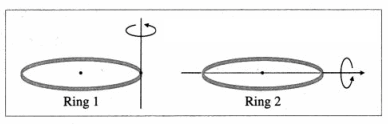
AnswerThe $\mathrm{MI}$ of ring 1 about a transverse tangent is $\mathrm{I}_1=2 \mathrm{MR}^2$
The $\mathrm{MI}$ of ring 2 about its diameter is
$
\mathrm{I}_2=\frac{1}{2} \mathrm{MR}^2
$
Since, torque $\mathrm{T}=\tau=I \alpha$, to produce the same angular acceleration in both,
$
\begin{aligned}
\frac{\tau_1}{I_1} & =\frac{\tau_2}{I_2} \Rightarrow \frac{\tau_1}{\tau_2}=\frac{I_1}{I_2}=4 \\
\text { i.e., } \tau_1 & =4 \tau_2
\end{aligned}
$
$\therefore$ It will be possible to produce the same angular acceleration in both the rings only if
$
\tau_1=4 \tau_2
$
View full question & answer→Question 613 Marks
A wheel of moment of inertia $1 \mathrm{~kg} \cdot \mathrm{m}^2$ is rotating at a speed of $40 \mathrm{rad} / \mathrm{s}$. Due to the friction on the axis, the wheel comes to rest in 10 minutes. Calculate the angular momentum of the wheel, two minutes before it comes to rest.
Answer$
\begin{aligned}
& \text { Data }: \mid=1 \mathrm{~kg} \cdot \mathrm{m}^2, \omega_1=40 \mathrm{rad} / \mathrm{s}, \omega_2=0 \text { at } \\
& \mathrm{t}=10 \text { minutes }=60 \times 10 \mathrm{~s}=600 \mathrm{~s}, \\
& \mathrm{t}^{\prime}=8 \text { minutes }=60 \times 8 \mathrm{~s}=480 \mathrm{~s} \\
& \omega_2=\omega_1+\alpha t \\
& \begin{aligned}
& \therefore=\frac{\omega_2-\omega_1}{t} \\ \\
&=\frac{0-40}{600}=-\frac{1}{15} \mathrm{rad} / \mathrm{s}^2
\end{aligned}
\end{aligned}
$
At time $t^{\prime}$,
$
\begin{aligned}
\omega_3 & =\omega_1+\alpha t^{\prime} \\
& =40-\frac{1}{15} \times 480=40-32=8 \mathrm{rad} / \mathrm{s} \\
\therefore L & =I \omega_3=1 \times 8=8 \mathrm{~kg} \cdot \mathrm{m}^2 / \mathrm{s}
\end{aligned}
$
This is the required anqular momentum of the wheel.
View full question & answer→Question 623 Marks
The angular momentum of a body changes by $80 \mathrm{~kg} \cdot \mathrm{m}^2 / \mathrm{s}$ when its angular velocity changes from $20 \mathrm{rad} / \mathrm{s}$ to $40 \mathrm{rad} / \mathrm{s}$. Find the change in its kinetic energy of rotation.
AnswerData : $\omega_1=20 \mathrm{rad} / \mathrm{s}, \omega_2=40 \mathrm{rad} / \mathrm{s}$
If $\mathrm{I}$ is the $\mathrm{MI}$ of the body, its initial angular momentum is $\mathrm{I} \omega_1$, and final angular momentum is $\mathrm{I}_2$.
Change in angular momentum
$
\begin{aligned}
& =1 \omega_2-1 \omega_1\left(\omega_2-\omega_1\right) \\
& \therefore 80=1(40-20) \\
& \therefore I=4 \mathrm{~kg} \cdot \mathrm{m}^2
\end{aligned}
$
$
\begin{aligned}
\text { Change in KE } & =\frac{1}{2} I \omega_2^2-\frac{1}{2} I \omega_1^2=\frac{1}{2} I\left(\omega_2^2-\omega_1^2\right)^{\prime} \\
& =\frac{1}{2} \times 4 \times(1600-400)=\mathbf{2 4 0 0} \mathrm{J}
\end{aligned}
$
View full question & answer→Question 633 Marks
Why do grinding wheels have large mass and moderate diameter?
AnswerA grinding wheel, used for abrasive machining operations (e.g., sharpening), is typically in the form of a heavy disc of moderate diameter. A grinding machine needs to have a high frequency of revolution but the machining operations exert braking torques on its wheel.
Angular momentum is directly proportional to mass. Hence, heavier the wheel, the greater is its angular momentum and lesser is the decelerating effect of the braking torques. Also, angular acceleration is inversely proportional to the moment of inertia. Since the wheel is made heavy, its diameter is kept moderate so that a large angular acceleration and high angular velocity can be achieved with a motor of given power.
View full question & answer→Question 643 Marks
What is the recommendations on loading a vehicle for not toppling easily?
AnswerOverloading (or improper load distribution) or any load placed on the roof raises a vehicle’s centre of gravity, and increases the vehicle’s likelihood of rolling over. A roof rack should be fitted by considering weight limits.
Road accidents involving rollovers show that vehicles with higher h (such as SUVs, pickup vans and trucks) topple more easily than cars. Untripped rollovers normally occur when a top-heavy vehicle attempts to perform a panic manoeuver that it physically cannot handle.
View full question & answer→Question 653 Marks
What do you do if your vehicle is trapped on a slippery or sandy road? What is the physics involved?
AnswerDriving on a country road should be attempted only with a four-wheel drive. However, if you do get stuck in deep sand or mud, avoid unnecessary panic and temptation to drive your way out of the mud or sand because excessive spinning of your tyres will most likely just dig you into a deeper hole. Momentum is the key to getting unstuck from sand or mud. One method is the rocking method-rocking your car backwards and forwards to gain momentum. Your best option is usually to gain traction and momentum by wedging a car mat (or sticks, leaves, gravel or rocks) in front and under your drive wheels. Once you start moving, keep the momentum going until you are on more solid terrain.
View full question & answer→Question 663 Marks
Using the energy conservation, derive the expressions for the minimum speeds at different locations along a vertical circular motion controlled by gravity. Is zero speed possible at the uppermost point? Under what condition/s? Also prove that the difference between the extreme tensions (or normal forces) depends only upon the weight of the object.
AnswerIn a non uniform vertical circular motion, e.g., those of a small body attached to a string or the loop-the-loop manoeuvers of an aircraft or motorcycle or skateboard, the body must have some minimum speed to reach the top and complete the circle. In this case, the motion is controlled only by gravity and zero speed at the top is not possible.
However, in a controlled vertical circular motion, e.g., those of a small body attached to a rod or the giant wheel (Ferris wheel) ride, the body or the passenger seat can have zero speed at the top, i.e., the motion can be brought to a stop.
View full question & answer→Question 673 Marks
If friction is zero, can a vehicle move on the road? Why are we not considering the friction in deriving the expression for the banking angle?
AnswerFriction is necessary for any form of locomotion. Without friction, a vehicle cannot move. The banking angle for a road at a bend is calculated for optimum speed at which every vehicle can negotiate the bend without depending on friction to provide the necessary lateral centripetal force.
View full question & answer→Question 683 Marks
A uniform disc and a hollow right circular cone have the same formula for their M.I., when rotating about their central axes. Why is it so?
AnswerThe radius of gyration of a thin ring of radius $Rr$ about its transverse symmetry axis is
$
K _{ r }=\sqrt{I_{ CM } / M_{ r }}=\sqrt{R_{ r }^2}= R _{ r }
$
The radius of gyration of a thin disc of radius $R_d$ about its transverse symmetry axis is
$
k_{ d }=\sqrt{I_{ CM } / M_{ d }}=\sqrt{\frac{M_{ d } R_{ d }^2 / 2}{M_{ d }}}=\frac{1}{\sqrt{2}} R_{ d }
$
Given $k_{ r }=k_{ d }$,
$R_{ r }=\frac{1}{\sqrt{2}} R_{ d }$ or, equivalently, $R_{ d }=\sqrt{2} R_{ r }$
View full question & answer→Question 693 Marks
On what factors does the frequency of a conical pendulum depend? Is it independent of some factors?
AnswerThe frequency of a conical pendulum, of string length $L$ and semivertical angle $\theta$, is $n =\frac{1}{2 \pi} \sqrt{\frac{g}{L \cos \theta}}$
where $g$ is the acceleration due to gravity at the place.
From the above expression, we can see that
1. $n \propto \sqrt{g}$
2. $n \propto \frac{1}{\sqrt{L}}$
3. $n \propto \frac{1}{\sqrt{\cos \theta}}$
(if $\theta$ increases, $\cos \theta$ decreases and $n$ increases)
4. The frequency is independent of the mass of the bob.
View full question & answer→Question 703 Marks
Do we need a banked road for a two wheeler? Explain.
AnswerWhen a two-wheeler takes a turn along an unbanked road, the force of friction provides the centripetal force. The two-wheeler leans inward to counteract a torque that tends to topple it outward. Firstly, friction cannot be relied upon to provide the necessary centripetal force on all road conditions. Secondly, the friction results in wear and tear of the tyres. On a banked road at a turn, any vehicle can negotiate the turn without depending on friction and without straining the tyres.
View full question & answer→