MCQ 11 Mark
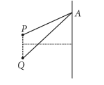
A parallel beam of light travelling in water is incident obliquely on a glass surface. After refraction, its width
MCQ 21 Mark
When a ray of light enters into water from air.
MCQ 31 Mark
Huygens' principle is used to
- ✓
obtain the new position of wavefront geometrically
- B
explain the principle of superposition of waves
- C
explain the phenomenon of interference
- D
explain the phenomenon of polarization.
AnswerCorrect option: A. obtain the new position of wavefront geometrically
obtain the new position of wavefront geometrically
View full question & answer→MCQ 41 Mark
Using a monochromatic light of wavelength 2 in Young's double-slit experiment, the eleventh dark fringe is obtained on the screen for a phase difference of
- A
$\frac{11}{2} \pi rad$
- B
$\frac{21}{2} \pi rad$
- C
$13 \pi rad$
- ✓
$21 rrad$
AnswerCorrect option: D. $21 rrad$
$21 \pi rad$
View full question & answer→MCQ 51 Mark
If $a$ is the aperture of a telescope and 2 is the wavelength of light then the resolving power of the telescope is
- A
$\frac{\lambda}{1.22 a}$
- B
$\frac{1.22 a}{\lambda}$
- C
$\frac{1.22 \lambda}{a}$
- ✓
$\frac{a}{1.22 \lambda}$
AnswerCorrect option: D. $\frac{a}{1.22 \lambda}$
$\frac{a}{1.22 \lambda}$
View full question & answer→MCQ 61 Mark
Wavenormals to spherical wavefronts can be
MCQ 71 Mark
The resolving power of a telescope depends upon the
- A
- B
focal length of the objective
- ✓
diameter of the objective
- D
focal length of the eyepiece.
AnswerCorrect option: C. diameter of the objective
diameter of the objective
View full question & answer→MCQ 81 Mark
The resolving power of a telescope of aperture $100 cm$, for light of wavelength $5.5 \times 10^{-7} m$, is
- ✓
$0.149 \times 10^7$
- B
$1.49 \times 10^7$
- C
$149 \times 10^7$
- D
$149 \times 10^7$
AnswerCorrect option: A. $0.149 \times 10^7$
$0.149 \times 10^7$
View full question & answer→MCQ 91 Mark
The resolving power of a refracting telescope is increased by'
AnswerCorrect option: D. increasing $D$ and using smaller $\lambda$
increasing $D$ and using smaller $\lambda$.
View full question & answer→MCQ 101 Mark
The numerical aperture of the objective of a microscope is 0.12 . The limit of resolution, when light of wavelength $6000 A$ is used to view an object, is
- A
$0.25 \times 10^{-7} m$
- B
$2.5 \times 10^{-7} m$
- ✓
$25 \times 10^{-7} m$
- D
$250 \times 10^{-7} m$
AnswerCorrect option: C. $25 \times 10^{-7} m$
$25 \times 10^{-7} m$
View full question & answer→MCQ 111 Mark
If the numerical aperture of a microscope is increased, then its
- A
resolving power decreases
- ✓
limit of resolution decreases
- C
resolving power remains constant
- D
limit of resolution increases
AnswerCorrect option: B. limit of resolution decreases
limit of resolution decreases
View full question & answer→MCQ 121 Mark
High magnifying power microscopes have oil-immersion objectives
- A
to increase the fringe width
- ✓
to increase the numerical aperture of the objective
- C
to decrease the wavelength of light
- D
because oil does not damage the observed sample.
AnswerCorrect option: B. to increase the numerical aperture of the objective
to increase the numerical aperture of the objective
View full question & answer→MCQ 131 Mark
Two closely-spaced distant stars are just resolved when seen through a telescope with an objective lens of diameter $D$ and focal length $f$. The separation between their images is given by.
- A
$\frac{D}{1.22 \lambda f}$
- B
$\frac{f D }{1.22 \lambda}$
- ✓
$\frac{1.22 \lambda f}{D}$
- D
$\frac{1.22 D \lambda}{f}$
AnswerCorrect option: C. $\frac{1.22 \lambda f}{D}$
$\frac{1.22 \lambda f}{D}$
View full question & answer→MCQ 141 Mark
The objective lens of a telescope has a diameter D. The angular limit of resolution of the telescope for light of wavelength $\lambda$ is
- A
$\frac{D}{1.22 \lambda}$
- ✓
$\frac{1.22 \lambda}{D}$
- C
$\frac{D}{0.61 \lambda}$
- D
$\frac{0.61 \lambda}{D}$
AnswerCorrect option: B. $\frac{1.22 \lambda}{D}$
$\frac{1.22 \lambda}{D}$
View full question & answer→MCQ 151 Mark
A microscope with numerical aperture 0.122 is used with light of wavelength $6000 A$. The limit of resolution is
- A
$3.33 \times 10^6 m$
- B
$3.33 mm$
- ✓
$3 \times 10^{-6} m$
- D
$3 \times 10^{-7} m$.
AnswerCorrect option: C. $3 \times 10^{-6} m$
$3 \times 10^{-6} m$
View full question & answer→MCQ 161 Mark
If NA is the numerical aperture of a microscope objective, then its resolving power with an illumination of wavelength $\lambda$ is
- ✓
$\frac{0.5 \lambda}{ NA }$
- B
$\frac{0.61 \lambda}{ NA }$
- C
$\frac{1.22 NA }{\lambda}$
- D
$\frac{2 NA }{\lambda}$
AnswerCorrect option: A. $\frac{0.5 \lambda}{ NA }$
$\frac{0.5 \lambda}{ NA }$
View full question & answer→MCQ 171 Mark
Two points, equidistant from a point source of light, are situated at diametrically opposite positions in an isotropic medium. The phase difference between the light waves passing through the two points is
- ✓
- B
$\pi / 2 rad$
- C
$\pi rad$
- D
View full question & answer→MCQ 181 Mark
A plane wave of wavelength $5500 A$ is incident normally on a slit of width $2 \times 10^2 cm$. The width of the central maximum on a screen $50 cm$ away is
- A
$2.50 \times 10^{-3} cm$
- B
$2.75 \times 10^{-3} cm$
- C
$2.75 \times 10^{-3} m$
- ✓
$5.50 \times 10^{-3} m$
AnswerCorrect option: D. $5.50 \times 10^{-3} m$
$5.50 \times 10^{-3} m$
View full question & answer→MCQ 191 Mark
A parallel beam of light $(\lambda=5000 A )$ is incident normally on a narrow slit of width $0.2 mm$. The Fraunhofer diffraction pattern is observed on a screen placed at the focal plane of a convex lens $(f=20 cm )$. The first two minima are separated by
- A
$0.005 cm$
- ✓
$0.05 cm$
- C
$2.5 mm$
- D
$5 mm$.
AnswerCorrect option: B. $0.05 cm$
$0.05 cm$
View full question & answer→MCQ 201 Mark
A parallel beam of light $(\lambda=5000 A )$ is incident normally on a narrow slit of width $0.2 mm$. The angular separation between the first two minima is
AnswerCorrect option: B. $2.5 \times 10^{-3} rad$
$2.5 \times 10^{-3} rad$
View full question & answer→MCQ 211 Mark
Fraunhofer diffraction pattern of a parallel beam of light (wavelength $\lambda$ ) passing through a narrow slit (width $a$ ) is observed on a screen using a convex lens (focal length $f$ ). The angular half-width of the central fringe is
- A
$\frac{2 \lambda f}{a}$
- B
$\frac{\lambda f}{a}$
- C
$\frac{2 \lambda}{a}$
- ✓
$\frac{\lambda}{a}$
AnswerCorrect option: D. $\frac{\lambda}{a}$
$\frac{\lambda}{a}$
View full question & answer→MCQ 221 Mark
For a single slit of width a, the first diffraction maximum with light of wavelength $\lambda$ subtends an angle $\theta$ such that $\sin \theta$ is equal to
- A
$\frac{\lambda}{2 a}$
- B
$\frac{\lambda}{a}$
- ✓
$\frac{1.5 \lambda}{a}$
- D
$\frac{2 \lambda}{a}$.
AnswerCorrect option: C. $\frac{1.5 \lambda}{a}$
$\frac{1.5 \lambda}{\pi}$
View full question & answer→MCQ 231 Mark
The fringes produced in a diffraction pattern are of
- A
equal width with the same intensity
- ✓
unequal width with varying intensity
- C
- D
equal width with varying intensity.
AnswerCorrect option: B. unequal width with varying intensity
unequal width with varying intensity
View full question & answer→MCQ 241 Mark
In a diffraction pattern due to a single slit of width a with incident light of wavelength $\lambda$ at an angle of diffraction $\theta$, the condition for the first minimum is
- A
$\lambda \sin \theta=a$
- B
$a \cos \theta=\lambda$
- ✓
$a \sin \theta=\lambda$
- D
$\lambda \cos \theta=a$.
AnswerCorrect option: C. $a \sin \theta=\lambda$
$a \sin \theta=\lambda$
View full question & answer→MCQ 251 Mark
For a single slit of width a, the diffraction pattern minima are located at angles $\theta_m$, where $m$ is a positive, non-zero integer. Which of the following expressions is most correct?
- ✓
$a \sin \theta_m=m \lambda$
- B
$a \sin \theta_m=\frac{m \lambda}{2}$
- C
$a \sin \theta_m=(2 m+1) \frac{\lambda}{2}$
- D
$a \sin \theta_m=(2 m-1) \frac{\lambda}{2}$
AnswerCorrect option: A. $a \sin \theta_m=m \lambda$
$a \sin \theta_m=m \lambda$
View full question & answer→MCQ 261 Mark
In single slit diffraction (at a narrow slit of width a), the intensity of the central maximum is
- A
- B
- C
proportional to $a^2$
- ✓
inversely proportional to a.
AnswerCorrect option: D. inversely proportional to a.
inversely proportional to a.
View full question & answer→MCQ 271 Mark
In single-slit diffraction, which of the following are equal ?
- A
Widths of all bright and dark fringes
- B
Intensities of non-central bright fringes
- ✓
Widths of non-central bright fringes
- D
Both widths and intensities of noncentral bright fringes.
AnswerCorrect option: C. Widths of non-central bright fringes
Widths of non-central bright fringe:
View full question & answer→MCQ 281 Mark
Consider a medium through which light is propagating with a speed v. Given a wavefront, in order to determine the wavefront after a time interval $\Delta t$ the secondary wavelets are drawn with a radius.
- A
- ✓
$v \Delta t$
- C
$\frac{\Delta t}{v}$
- D
$\frac{y}{\Delta t}$
AnswerCorrect option: B. $v \Delta t$
$v \Delta t$
View full question & answer→MCQ 291 Mark
To obtain pronounced diffraction with a single slit illuminated by light of wavelength $\lambda$ the slit width should be
- A
of the same order as $\lambda$
- ✓
considerably larger than $\lambda$
- C
considerably smaller than $\lambda$
- D
exactly equal to $\lambda / 2$.
AnswerCorrect option: B. considerably larger than $\lambda$
considerably larger than $\lambda$
View full question & answer→MCQ 301 Mark
Using a light of wavelength 4800 \& in Fresnel's biprism experiment, 21 fringes are obtained in a given region. If light of wavelength $5600 A$ is used, the number of fringes in the same region will be
View full question & answer→MCQ 311 Mark
In finding the distance between the two coherent sources in Fresnel's biprism experiment by the conjugate foci method, one uses
- A
a long focus convex lens that forms real images of the virtual sources
- B
a short focus concave lens that forms real images of the virtual sources
- C
a short focus convex lens that forms virtual images of the virtual sources
- ✓
a short focus convex lens that forms real images of the virtual sources.
AnswerCorrect option: D. a short focus convex lens that forms real images of the virtual sources.
a short focus convex lens that forms real images of the virtual sources.
View full question & answer→MCQ 321 Mark
In a biprism experiment, keeping the experimental setup unchanged, the fringe width
- ✓
increases with increase in wavelength
- B
decreases with increase in wavelength
- C
increases with decrease in wavelength
- D
remains unchanged with change in wavelength.
AnswerCorrect option: A. increases with increase in wavelength
increases with increase in wavelength
View full question & answer→MCQ 331 Mark
In Fresnel's biprism experiment, with the eyepiece $1 m$ from the two coherent sources, the fringe width obtained is $0.4 mm$. If just the eyepiece is moved towards the biprism by $25 cm$. then the fringe width
- A
decreases by $0.01 mm$
- ✓
decreases by $0.1 mm$
- C
increases by $0.01 mm$
- D
increases by $0.1 mm$
AnswerCorrect option: B. decreases by $0.1 mm$
decreases by $0.1 mm$
View full question & answer→MCQ 341 Mark
In a biprism experiment two interfering waves are produced by division of
- A
- ✓
- C
- D
neither wavefront nor amplitude.
View full question & answer→MCQ 351 Mark
In a two-slit intereference experiment, if a thin transparent sheet of thickness $f$ and refractive index $n_m$ covers both the slits, the optical path difference between the two interfering waves
- A
increases by $\left(n_{m}-1\right)$ t
- B
decreases by $\left(n_m-1\right) t$
- C
changes by $\frac{D}{d}\left(n_m-1\right) t$
- ✓
View full question & answer→MCQ 361 Mark
In Young's double-slit experiment, if a thin mica sheet of thickness $t$ and refractive index $n_m$ covers one of the slits, the optical path of the wave from that slit
- ✓
increases by $\left(n_m-1\right) t$
- B
decreases by $\left(n_m-1\right) t$
- C
changes by $\frac{D}{d}\left(n_m-1\right) t$
- D
AnswerCorrect option: A. increases by $\left(n_m-1\right) t$
increases by $\left(n_m-1\right) t$
View full question & answer→MCQ 371 Mark
In Young's double-slit experiment, if a thin transparent sheet covers one of the slits, the optical path of the wave from that slit
MCQ 381 Mark
A pair of slits $1.5 mm$ apart is illuminated with monochromatic light of wavelength $5500 A$ and the interference pattern is obtained on a screen $1.5 m$ from the slits. The least distance of a point from the central maximum where the intensity is minimum is
- ✓
$0.275 mm$
- B
$0.55 mm$
- C
$2.75 mm$
- D
$5.5 mm$.
AnswerCorrect option: A. $0.275 mm$
$0.275 mm$
View full question & answer→MCQ 391 Mark
In an isotropic medium, the secondary wavelets centred on every point of a given wavefront are all
MCQ 401 Mark
In Young's double-slit experiment, the slit separation is reduced to half while the distance of the screen from the slits is increased by $50 \%$. In terms of the initial fringe width, W, the new fringe width is,
- A
$\frac{1}{4} W$
- B
$\frac{3}{4} W$
- C
$\frac{3}{2} W$
- ✓
$3 W$.
AnswerCorrect option: D. $3 W$.
$3 W$.
View full question & answer→MCQ 411 Mark
In two separate setups of Young's double-slit experiment, the wavelengths of the lights used are in the ratio $1: 2$ while the separation between the slits are in the ratio $2: 1$. If the fringe widths are equal, the ratio of the distances between the slit and the screen is
- A
$1: 4$
- B
$1: 2$
- C
$2: 1$
- ✓
$4: 1$.
AnswerCorrect option: D. $4: 1$.
$4: 1$.
View full question & answer→MCQ 421 Mark
Two slits, $2 mm$ apart, are placed $300 cm$ from a screen. When light of wavelength $6000 A$ is used, the separation (in mm) between the successive bright lines of the interference pattern is
View full question & answer→MCQ 431 Mark
In an interference pattern using two coherent sources of light, the fringe width is
- ✓
directly proportional to the wavelength
- B
inversely proportional to the square of the wavelength
- C
inversely proportional to the wavelength
- D
directly proportional to the square of the wavelength.
AnswerCorrect option: A. directly proportional to the wavelength
directly proportional to the wavelength
View full question & answer→MCQ 441 Mark
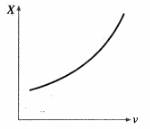
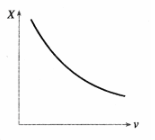
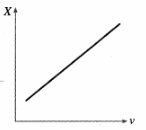
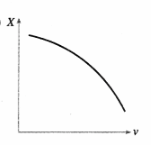
Which of the following graphs shows the variation of the fringe width with the frequency of light in a two-source interference pattern ?
MCQ 451 Mark
The fringe width in an interference pattern is W. The distance between the 6th dark fringe and the 4 th bright fringe on the same side of the central bright fringe is
- ✓
$1.5 W$
- B
$2 W$
- C
$25 W$
- D
$10.5 W$.
AnswerCorrect option: A. $1.5 W$
$1.5 W$
View full question & answer→MCQ 461 Mark
If $\lambda$ is the wavelength of light used in Young's double-slit experiment, the path difference for a phase difference of $11 \pi$ rad is
- A
$23 \lambda$
- B
$11 \lambda$
- ✓
$11 \frac{\lambda}{2}$
- D
$23 \frac{\lambda}{2}$
AnswerCorrect option: C. $11 \frac{\lambda}{2}$
$11 \frac{\lambda}{2}$
View full question & answer→MCQ 471 Mark
For constructive interference, the phase difference (in radian) between the two waves should be
AnswerCorrect option: B. $0,2 \pi, 4 \pi$,
$0,2 \pi, 4 \pi, \ldots$
View full question & answer→MCQ 481 Mark
For destructive interference, the phase difference (in radian) between the two waves should be
- A
$0,2 \pi, \pi$
- B
$0,2 \pi, 4 \pi$
- ✓
$\pi, 3 \pi, 5 \pi, \ldots$
- D
$\frac{\pi}{2}, \frac{3 \pi}{2}, \frac{5 \pi}{2}$
AnswerCorrect option: C. $\pi, 3 \pi, 5 \pi, \ldots$
$\pi, 3 \pi, 5 \pi, \ldots$
View full question & answer→MCQ 491 Mark
In a two-source interference pattern, the phase difference between the waves reaching a dark point in radian is $( m =1,2,3, \ldots)$
- A
- B
$m \pi$
- C
$(2 m-1) \frac{\pi}{2}$
- ✓
$(2 m-1) \pi$
AnswerCorrect option: D. $(2 m-1) \pi$
$(2 m-1) \pi$
View full question & answer→MCQ 501 Mark
The wavefront originating from a point source of light at finite distance is a wavefront.
MCQ 511 Mark
Two sources of light are said to be coherent if light from them have
- A
the same speed and the same phase
- B
the same phase and the same or nearly the same amplitude
- C
constant phase difference and nearly the same frequency
- ✓
zero, or some constant, phase difference.
AnswerCorrect option: D. zero, or some constant, phase difference.
zero, or some constant, phase difference.
View full question & answer→MCQ 521 Mark
At points of constructive interference with maximum intensity of two coherent monochromatic waves (wavelength $\lambda$, the path difference between them is
- ✓
zero or an integral multiple of $\lambda$
- B
zero or an integral multiple of $\lambda / 2$
- C
zero or an even integral multiple of $\lambda / 2$
- D
an odd integral multiple of $\lambda / 2$.
AnswerCorrect option: A. zero or an integral multiple of $\lambda$
zero or an integral multiple of $\lambda$
View full question & answer→MCQ 531 Mark
Light transmitted through a Polaroid $P_1$ has an intensity I and is incident on a crossed Polaroid $P_2$. The intensity of the light transmitted by $P_2$ is
View full question & answer→MCQ 541 Mark
A glass plate of refractive index 1.732 is to be used as a polarizer. Its polarizing angle is
- A
$30^{\circ}$
- B
$45^{\circ}$
- ✓
$60^{\circ}$
- D
$90^{\circ}$.
AnswerCorrect option: C. $60^{\circ}$
$60^{\circ}$
View full question & answer→MCQ 551 Mark
Polarization of light CANNOT be produced by
MCQ 561 Mark
A narrow beam of light in air is incident on glass at an angle of incidence of $58^{\circ}$. If the reflected beam is completely plane polarized, the refractive index of the glass is
View full question & answer→MCQ 571 Mark
If the polarizing angle for a given medium is $60^{\circ}$, then the refractive index of the medium is
- A
$\frac{1}{\sqrt{3}}$
- B
$\frac{\sqrt{3}}{2}$
- C
- ✓
$\sqrt{3}$
AnswerCorrect option: D. $\sqrt{3}$
$\sqrt{3}$
View full question & answer→MCQ 581 Mark
A ray of light passes from vacuum to a medium of refractive index $n$. The angle of incidence is found to be twice the angle of refraction. The angle of incidence is
- A
$\cos ^{-1}\left(\frac{n}{2}\right)$
- B
$\cos ^{-1}(n)$
- ✓
$2 \cos ^{-1}\left(\frac{n}{2}\right)$
- D
$2 \sin ^{-1}\left(\frac{n}{2}\right)$
AnswerCorrect option: C. $2 \cos ^{-1}\left(\frac{n}{2}\right)$
$2 \cos ^{-1}\left(\frac{n}{2}\right)$
View full question & answer→MCQ 591 Mark
A ray of light, in passing from vacuum into a medium of refractive index $n$, suffers a deviation $d$ equal to half the angle of incidence. Then, the refractive index is
- A
$\sin \delta$
- B
$2 \sin \delta$
- C
$\cos \delta$
- ✓
$2 \cos \delta$.
AnswerCorrect option: D. $2 \cos \delta$.
$2 \cos \delta$.
View full question & answer→MCQ 601 Mark
Light of a certain colour has 1800 waves to the milimetre in air. What is its frequency in water? [n $=\frac{4}{3}$ for water]
- A
$1.67 \times 10^6 Hz$
- B
$4.05 \times 10^{14} Hz$
- ✓
$5.4 \times 10^{14} Hz$
- D
$7.2 \times 10^{14} Hz$.
AnswerCorrect option: C. $5.4 \times 10^{14} Hz$
$5.4 \times 10^{14} Hz$
View full question & answer→MCQ 611 Mark
Huygens' wave theory could not explain
MCQ 621 Mark
In Young’s double slit experiment, a thin uniform sheet of glass is kept in front of the two slits, parallel to the screen having the slits. The resulting interference pattern will satisfy
- ✓
The interference pattern will remain unchanged
- B
The fringe width will decrease
- C
The fringe width will increase
- D
AnswerCorrect option: A. The interference pattern will remain unchanged
The interference pattern will remain unchanged
View full question & answer→MCQ 631 Mark
In Young’s double slit experiment, the two coherent sources have different intensities. If the ratio of maximum intensity to the minimum intensity in the interference pattern produced is 25:1. What was the ratio of intensities of the two sources?
MCQ 641 Mark
When unpolarized light is passed through a polarizer, its intensity
- A
- ✓
- C
- D
depends on the orientation of the polarizer
View full question & answer→MCQ 651 Mark
Which property of light does not change when it travels from one medium to another?
MCQ 661 Mark
Which of the following phenomenon proves that light is a transverse wave?
MCQ 671 Mark
In Young's double slit experiment, the wavelength of light used is ' $\lambda$ : The intensity at a point is $I$ where path difference is $\left(\frac{\lambda}{4}\right)$. If $I_0$ denotes the maximum intensity, then the ratio $\left(\frac{1}{I_0}\right)$ is $\left(\sin \frac{\pi}{4}=\cos \frac{\pi}{4}=\frac{1}{\sqrt{2}}\right)$
- A
$\frac{1}{\sqrt{2}}$
- ✓
$\frac{1}{2}$
- C
$\frac{3}{4}$
- D
$\frac{\sqrt{3}}{2}$
AnswerCorrect option: B. $\frac{1}{2}$
(b) : Given, wavelength $=\lambda, \Delta x=\lambda / 4$
$
\begin{aligned}
& I=I_0 \cos ^2\left(\frac{\Delta \phi}{2}\right) ; \Delta \phi=\frac{2 \pi}{\lambda} \cdot \Delta x=\frac{2 \pi}{\lambda} \cdot \frac{\lambda}{4}=\frac{\pi}{2} \\
\therefore & I=I_0 \cos ^2\left(\frac{\pi}{4}\right)=I_0\left(\frac{1}{\sqrt{2}}\right)^2=\frac{I_0}{2}
\end{aligned}
$
View full question & answer→MCQ 681 Mark
Light of wavelength ' $\lambda$ ' is incident on a slit of width ' $d$ ' The resulting diffraction pattern is observed on a screen at a distance ' $D$ '. The linear width of the principal maximum is then equal to the width of the slit if $D$ equals
- A
$\frac{d}{\lambda}$
- ✓
$\frac{d^2}{2 \lambda}$
- C
$\frac{2 \lambda}{d}$
- D
$\frac{2 \lambda^2}{d}$
AnswerCorrect option: B. $\frac{d^2}{2 \lambda}$
(b) : Wavelength $=\lambda$, slit width $=d$, screen distance $=D$
Linear width of central principal maximum
$
=\text { angular width } \times \text { distance }=\frac{2 \lambda}{d} \times D
$
When linear width is equal to the slit width, then Now, $\frac{2 \lambda D}{d}=d \Rightarrow D=\frac{d^2}{2 \lambda}$
View full question & answer→MCQ 691 Mark
In Young's double slit experiment, the fringe wid th is $2 mm$. The separation between the $13^{\text {th }}$ bright fringe and the $4^{\text {th }}$ dark fringe from the centre of the screen on same side will be
- A
$13 mm$
- B
$17 mm$
- ✓
$19 mm$
- D
$23 mm$
AnswerCorrect option: C. $19 mm$
(c) : Given, $\beta=\frac{\lambda D}{d}=2 mm$ $13^{\text {th }}$ bright $\rightarrow 4^{\text {th }}$ dark
For bright, $y_n=\frac{n D \lambda}{d}$; For dark, $y_n^{\prime}=\frac{(2 n-1) \lambda D}{2 d}$
$
\begin{aligned}
\Rightarrow & \Delta x=\left(13-\frac{7}{2}\right) \frac{\lambda D}{d} \\
& =19 mm
\end{aligned}
$
View full question & answer→MCQ 701 Mark
In a diffraction pattern due to single slit of width ' $a$ ', the first minimum is observed at an angle $30^{\circ}$ when the light of wavelength 5400 Å is incident on the slit. The first secondary maximum is observed at an angle of $\left(\sin 30^{\circ}=\frac{1}{2}\right)$
- A
$\sin ^{-1}\left(\frac{3}{4}\right)$
- B
$\sin ^{-1}\left(\frac{2}{3}\right)$
- C
$\sin ^{-1}\left(\frac{1}{2}\right)$
- D
$\sin ^{-1}\left(\frac{1}{4}\right)$
Answer(a) : For first minimum, $a \sin \theta=\lambda$
$
\begin{aligned}
& \theta=30^{\circ}, a \sin 30^{\circ}=\lambda \\
& a=2 \lambda......(i)
\end{aligned}
$
For first secondary maximum, $a \sin \theta^{\prime}=\frac{3}{2} \lambda$
$
2 \lambda \sin \theta^{\prime}=\frac{3}{2} \lambda ; \sin \theta^{\prime}=\frac{3}{4} \Rightarrow \theta^{\prime}=\sin ^{-1}\left(\frac{3}{4}\right)
$
View full question & answer→MCQ 711 Mark
A beam of unpolarized light passes through a tourmaline crystal $A$ and then it passes through a second tourmaline crystal $B$ oriented so that its principal plane is parallel to that of $A$. The intensity of emergent light is $I_0$. Now $B$ is rotated by $45^{\circ}$ about the ray. The emergent light will have intensity $\left(\cos 45^{\circ}=\frac{1}{\sqrt{2}}\right)$
- ✓
$\frac{I_0}{2}$
- B
$\frac{I_0}{\sqrt{2}}$
- C
$\frac{\sqrt{2}}{I_0}$
- D
$\frac{2}{I_0}$
AnswerCorrect option: A. $\frac{I_0}{2}$
(a) : As, the emergent intensity, $I=I_0 \cos ^2 \theta$
$
I=I_0 \times \cos ^2 45^{\circ}=I_0\left(\frac{1}{\sqrt{2}}\right)^2 ; I=\frac{I_0}{2}
$
View full question & answer→MCQ 721 Mark
In a single slit experiment, the width of the slit is doubled. Which one of the following statements is correct?
AnswerCorrect option: D. The intensity increases by a factor 4 and the angular width decreases by a factor of $\frac{1}{2}$.
(d) $: I \propto(\text { slit width })^2$
So, when slit widths doubled, intensity is increased 4 times and $\theta$ (angular width) becomes half as $\theta \propto \frac{1}{\text { slit width }}$
View full question & answer→MCQ 731 Mark
When two light waves each amplitude ' $A$ ' and having a phase difference of $\frac{\pi}{2}$ superimposed then the amplitude of resultant wave is
- A
$\frac{A}{\sqrt{2}}$
- B
$2 A$
- ✓
$\sqrt{2} A$
- D
$\frac{A}{2}$
AnswerCorrect option: C. $\sqrt{2} A$
(c) : $A_n=\sqrt{A^2+A^2+2 A^2 \cos \frac{\pi}{2}}=\sqrt{2} A$
View full question & answer→MCQ 741 Mark
On placing a thin film of mica of thickness $12 \times 10^{-5} cm$ in the path of one of the interfering beams in Young's double slit experiment using monochromticlight, thefringe patternshiftsthrough a distance equal to the width of bright fringe. If $\lambda=6 \times 10^{-5} cm$, the refractive index of mica is
Answer(c) : Given, $t=12 \times 10^{-5} cm , \lambda=6 \times 10^{-5} cm$
$
\begin{aligned}
& \beta=(\mu-1) t=n \lambda ; \quad(\mu-1) 12 \times 10^{-5}=1 \times 6 \times 10^{-5} \\
& \mu-1=\frac{1}{2} ; \quad \mu=\frac{3}{2}=1.5
\end{aligned}
$
View full question & answer→MCQ 751 Mark
Two wavelengths of sodium light $590 nm$ and $596 nm$ are used one after another to study diffraction due to single slit of aperture $2 \times 10^{-6} m$. The distance between the slit and the screen is $1.5 m$. The separation between the position of first maximum of the diffraction pattern obtained in the two cases is
- A
$5.5 mm$
- B
$5.75 mm$
- C
$6.25 mm$
- ✓
$6.75 mm$
AnswerCorrect option: D. $6.75 mm$
(d) : $a=2 \times 10^{-6} m , \lambda_1=590 nm , \lambda_2=596 nm , D=1.5 m$
For maxima, $y=\frac{D(2 n+1)}{2 d} \cdot \lambda$
For $\lambda_1, n=1$
$
\begin{aligned}
& y_1=\frac{1.5(3) \times 590 \times 10^{-9}}{2 \times 2 \times 10^{-6}}=0.66375 m \\
& y_2=\frac{1.5 \times 3 \times 596 \times 10^{-9}}{2 \times 2 \times 10^{-6}}=0.6705 m
\end{aligned}
$
So,
$
\begin{aligned}
y_2-y_1 & =0.6705-0.66375 \\
& =6.75 \times 10^{-3} m =6.75 mm
\end{aligned}
$
View full question & answer→MCQ 761 Mark
If $I_0$ is the intensity of the principal maximum in the single slit diffraction pattern, then what will be the intensity when the slit width is doubled?
- A
$\frac{I_0}{2}$
- B
$I_0$
- ✓
$4 I_0$
- D
$2 I_0$
AnswerCorrect option: C. $4 I_0$
(c) : Intensity does depend on slit width, $I \propto d^2$.
View full question & answer→MCQ 771 Mark
In Young's double slit experiment, $8^{\text {th }}$ maximum with wavelength ' $\lambda_1$ ' is at distance ' $d_1$ ' from the central maximum and $6^{\text {th }}$ maximum with wavelength ' $\lambda_2$ ' is at a distance ' $d_2$. Then $\frac{d_2}{d_1}$ is
- A
$\frac{3 \lambda_1}{4 \lambda_2}$
- ✓
$\frac{3 \lambda_2}{4 \lambda_1}$
- C
$\frac{4 \lambda_1}{3 \lambda_2}$
- D
$\frac{4 \lambda_2}{3 \lambda_1}$
AnswerCorrect option: B. $\frac{3 \lambda_2}{4 \lambda_1}$
(b) : Position of $n^{\text {th }}$ maxima from central maxima is
$
x_n=\frac{n \lambda \cdot D}{d} \Rightarrow d=\frac{n \lambda D}{x_n}
$
As, same slit is used in both cases.
$
\therefore \frac{8 D \lambda_1}{d_1}=\frac{6 D \lambda_2}{d_2} ; \frac{d_2}{d_1}=\frac{6}{8} \frac{\lambda_2}{\lambda_1}=\frac{3}{4} \frac{\lambda_2}{\lambda_1}
$
View full question & answer→MCQ 781 Mark
The diffraction fringes obtained by a single slit are of
- A
- B
equal width and unequal intensity
- C
unequal width but equal intensity
- ✓
unequal width and unequal intensity.
AnswerCorrect option: D. unequal width and unequal intensity.
(d) : In case of diffraction, the fringes are of unequal width and of unequal intensity.
View full question & answer→MCQ 791 Mark
The path difference between two interfering light waves meeting at a point on the screen is $\left(\frac{87}{2}\right) \lambda$. The band obtained at that point is
- A
$87^{\text {th }}$ dark band
- ✓
$44^{\text {th }}$ dark band
- C
$44^{\text {th }}$ bright band
- D
$87^{\text {th }}$ bright band
AnswerCorrect option: B. $44^{\text {th }}$ dark band
(b) : Path difference $=87\left(\frac{\lambda}{2}\right)$
For dark point, $(2 n-1) \frac{\lambda}{2}=87\left(\frac{\lambda}{2}\right)$
$
2 n-1=87 \Rightarrow 2 n=88
$
$n=44^{\text {th }}$ dark band
View full question & answer→MCQ 801 Mark
In Young's double slit experiment, the two slits are ' $d$ ' distance apart. Interference pattern is observed on the screen at a distance ' $D$ ' from the slits. First dark fringe is observed on the screen directly opposite to one of the slits. The wavelength of the light is
- ✓
$\frac{d^2}{D}$
- B
$\frac{D^2}{d}$
- C
$\frac{d^2}{2 D}$
- D
$\frac{D^2}{2 d}$
AnswerCorrect option: A. $\frac{d^2}{D}$
(a) : For $n^{\text {th }}$ dark fringe, $(2 n-1) \frac{\lambda D}{2 d}=\frac{d}{2}$
$
\lambda=\frac{d^2}{(2 n-1) D}=\frac{d^2}{D}
$(For $n=1$)
View full question & answer→MCQ 811 Mark
The optical path difference between two identical light waves arriving at a point is $31.5 \lambda$, where ' $\lambda$ ' is the wavelength of light used. The point is [Two light sources are coherent]
- A
- ✓
- C
- D
alternatively bright and dark.
Answer(b) : As $\Delta x=31.5 \lambda ; \Delta x=63\left(\frac{\lambda}{2}\right)$
The above is an odd multiple of $\frac{\lambda}{2}$ i.e., a minimum will be formed and hence the point will be dark.
View full question & answer→MCQ 821 Mark
If the ratio of the intensities of two waves producing interference is $49: 16$, then the ratio of the resultant maximum intensity to minimum intensity will be
- A
$11: 3$
- B
$49: 16$
- ✓
$121: 9$
- D
$7: 4$
AnswerCorrect option: C. $121: 9$
(c) : Let the intensities of two waves be $I_1$ and $I_2$. $I_1: I_2=49 ; 16$ (Given)
$
\begin{aligned}
& \Rightarrow \frac{I_{\max }}{I_{\min }}=\left(\frac{\sqrt{I_1}+\sqrt{I_2}}{\sqrt{I_1}+\sqrt{I_2}}\right)^2 \Rightarrow \frac{I_{\max }}{I_{\min }}=\left(\frac{\sqrt{\frac{I_1}{I_2}}+1}{\sqrt{\frac{I_1}{T_2}-1}}\right)^2 \\
& \text { or } \frac{I_{\max }}{I_{\min }}=\left(\frac{\sqrt{\frac{49}{16}}+1}{\sqrt{\frac{49}{16}}-1}\right)^2=\frac{\left(\frac{11}{4}\right)^2}{\left(\frac{3}{4}\right)^2}=\left(\frac{11}{3}\right)^2=\frac{121}{9}
\end{aligned}
$
View full question & answer→MCQ 831 Mark
Two sources of light of wavelength 2500 Å and 3500 Å are used in Young's double slit experiment simultaneously. Which orders of fringes of two wavelength patterns coincide?
- A
$3^{\text {rd }}$ order of $1^{\text {st }}$ and $5^{\text {th }}$ order of $2^{\text {nd }}$
- ✓
$7^{\text {th }}$ order of $1^{\text {st }}$ and $5^{\text {th }}$ order of $2^{\text {nd }}$
- C
$5^{\text {th }}$ order of $1^{\text {st }}$ and $3^{\text {rd }}$ order of $2^{\text {bd }}$
- D
$5^{\text {th }}$ order of $1^{\text {st }}$ and $7^{\text {th }}$ order of $2^{\text {nd }}$
AnswerCorrect option: B. $7^{\text {th }}$ order of $1^{\text {st }}$ and $5^{\text {th }}$ order of $2^{\text {nd }}$
(b) : Let $n^{\text {th }}$ fringe of 2500 Å coincide with $(n-2)^{\text {th }}$ fringe of 3500 Å.
$
\therefore \quad 3500(n-2)=2500 \times n \text { or } 1000 n=7000 \text {, or } n=7
$
$\therefore \quad 7^{\text {th }}$ order fringe of $1^{\text {st }}$ source will coincide with $5^{\text {th }}$ order fringe of $2^{\text {nd }}$ source.
View full question & answer→MCQ 841 Mark
A parallel beam of monochromatic light is incident normally on a narrow slit. A diffraction pattern is formed on a screen placed perpendicular to the direction of the incident beam. At the first minimum of the diffraction pattern, the phase difference between the rays coming from the two edges of the slit is
- A
- B
$\frac{\pi}{2}$
- C
$\pi$
- ✓
$2 \pi$
AnswerCorrect option: D. $2 \pi$
(d) : At the first minimum of the diffraction pattern, the rays coming from the two edges of the slit have a path difference $=1$ and phase difference $=2 \pi$.
View full question & answer→MCQ 851 Mark
If the polarizing angle of a piece of glass for green light is $54.74^{\circ}$, then the angle of minimum deviation for an equilateral prism made of same glass is (Given : $\tan 54.74^{\circ}=1.414$ )
- A
$45^{\circ}$
- B
$54.74^{\circ}$
- C
$60^{\circ}$
- ✓
$30^{\circ}$
AnswerCorrect option: D. $30^{\circ}$
(d) : $\mu=\tan i_\rho=\tan 54.74^{\circ}=1.414=\sqrt{2}$
$
\begin{aligned}
& \mu=\frac{\sin \left(\frac{\left(A+\delta_m\right)}{2}\right)}{\sin \frac{A}{2}}=\sqrt{2} \\
& \sin \left(\frac{60^{\circ}+\delta_m}{2}\right)=\sqrt{2} \sin \frac{60^{\circ}}{2}=\sqrt{2} \times \frac{1}{2}=\frac{1}{\sqrt{2}} \\
& \text { or } \sin \left(\frac{60^{\circ}+\delta_m}{2}\right)=\sin 45^{\circ} \text { or } \frac{60^{\circ}+\delta_m}{2}=45^{\circ}
\end{aligned}
$
or $\delta_m=90^{\circ}-60^{\circ}=30^{\circ}$
View full question & answer→MCQ 861 Mark
The luminous border that surrounds the profile of a mountain just before sun rises behind it, is an example of
- A
- B
total internal reflection
- C
- ✓
Answer(d) : The luminous border that surrounds the profile of a mountain just before sun rises behind it, is an example of diffraction.
View full question & answer→MCQ 871 Mark
Light of wavelength $\lambda$ is incident on a single slit of width $a$ and the distance between slit and screen is $D$. In diffraction pattern, if slit width is equal to the width of the central maximum, then $D$ is equal to
- A
$a / 2 \lambda$
- ✓
$a^2 / 2 \lambda$
- C
$a / \lambda$
- D
$a^2 / \lambda$
AnswerCorrect option: B. $a^2 / 2 \lambda$
(b) : Here it is given that slit width is equal to the width of central maximum, i.e., $y_2=a$.
Therefore, $y_2=\frac{2 D \lambda}{a} \Rightarrow a=\frac{2 D \lambda}{a} \Rightarrow D=\frac{a^2}{2 \lambda}$
View full question & answer→MCQ 881 Mark
In biprism experiment, the distance between source and eyepiece is $1.2 m$, the distance between two virtual sources is $0.84 mm$. Then the wavelength of light used if eyepiece is to be moved transversely through a distance of $2.799 cm$ to shift 30 fringes is
AnswerHere, $D=1.2 m , d=0.84 mm$
$=0.84 \times 10^{-3} m$ and fringe width, $\beta=\frac{2.799}{30} cm$
$
=0.0933 \times 10^{-2} m
$
Fringe width, $\beta=\frac{\lambda D}{d}$ or $\lambda=\frac{\beta d}{D}$
$
\begin{aligned}
& \Rightarrow \lambda=\frac{0.0933 \times 10^{-2} \times 0.84 \times 10^{-3}}{1.2 m } \\
& \Rightarrow \lambda=6531 \times 10^{-10} m \Rightarrow \lambda=6531{Å}
\end{aligned}
$
- None of the given options is correct.
View full question & answer→MCQ 891 Mark
A telescope has large diameter of the objective. Then its resolving power is
- A
independent of the diameter of the objective
- B
- C
- ✓
Answer(d) : Resolving power of telescope, $R=\frac{1}{\Delta \theta}=\frac{a}{1.22 \lambda}$, where $a$ is diameter of objective lens of the telescope.
Now, as the resolving power is directly proportional to the diameter of the objective. Thus for large diameter of the objective of the telescope its resolving power will be high.
View full question & answer→MCQ 901 Mark
If a star emitting yellow light is accelerated towards earth, then to an observer on earth it will appear
- A
- B
- ✓
gradually changing to blue
- D
gradually changing to red.
AnswerCorrect option: C. gradually changing to blue
(c) : In case of astronomical Doppler effect, when source and observer move towards each other then change in frequency $(\Delta v)$ becomes positive. Thus apparent frequency as observed by observer increases or apparent wavelength decreases. Therefore, if a star, emitting yellow light, is accelerated towards Earth, then to an observer on Earth it will appear gradually changing to blue. It is known as 'blue shift.
View full question & answer→MCQ 911 Mark
If numerical aperture of a microscope is increased, then its
- A
resolving power remains constant.
- B
resolving power becomes zero.
- ✓
limit of resolution is decreased.
- D
limit of resolution is increased.
AnswerCorrect option: C. limit of resolution is decreased.
(c) : Since limit of resolution of a microscope is given by, $d=\frac{1.22 \lambda}{2 \mu \sin \alpha}=\frac{1.22 \lambda}{2 NA }$
$\therefore$ As numerical aperture increase, the limit of resolution is decreases.
View full question & answer→MCQ 921 Mark
Two light waves of intensities ' $I_1$ ' and ' $I_2$ ' having same frequency pass through same medium at a time in same direction and interfere. The sum of the minimum and maximum intensities is
AnswerCorrect option: B. $2\left(I_1+I_2\right)$
(b) : Let $a_1$ and $a_2$ be the amplitudes of light waves. Therefore, after interference
Maximum Intensity $I_{\max }=\left(a_1+a_2\right)^2$
Minimum Intensity $I_{\min }=\left(a_1-a_2\right)^2$
$
I_{\text {mix }}+I_{\text {min }}=a_1^2+a_2^2+a_1^2+a_2^2=2\left(a_1^2+a_2^2\right)=2\left(I_1+I_2\right)
$
View full question & answer→MCQ 931 Mark
Two identical light waves having phase difference $\phi$ propagate in same direction. When they superpose, the intensity of resultant wave is proportional to
AnswerCorrect option: B. $\cos ^2 \frac{\phi}{2}$
(b) : For two identical light, the intensity of resultant wave is
$
I_R=4 I \cos ^2 \frac{\phi}{2} \text { or } I_R \propto \cos ^2 \frac{\phi}{2}
$
View full question & answer→MCQ 941 Mark
In Young's double slit experiment, in an interference pattern second minimum is observed exactly in front of one slit. The distance between the two coherent sources is $d$ and the distance between source and screen is $D$. The wavelength of light source used is
- A
$\frac{d^2}{D}$
- B
$\frac{d^2}{2 D}$
- ✓
$\frac{d^2}{3 D}$
- D
$\frac{d^2}{4 D}$
AnswerCorrect option: C. $\frac{d^2}{3 D}$
(c) : The position of minimum is
$
x=\frac{(2 n-1)}{2} \frac{D \lambda}{d}
$
or $\frac{d}{2}=\left(\frac{2 \times 2-1}{2}\right) \frac{D \lambda}{d}$
$
(\because n=2)
$
$
\frac{d}{2}=\frac{3}{2} \frac{D \lambda}{d} \text { or } \lambda=\frac{d^2}{3 D}
$
View full question & answer→MCQ 951 Mark
In Fraunhofer diffraction pattern, slit width is $0.2 mm$ and screen is at $2 m$ away from the lens. If wavelength of light used is 5000 Å then the distance between the first minimum on either side the central maximum is ( $\theta$ is small and measured in radian)
- A
$10^{-1} m$
- ✓
$10^{-2} m$
- C
$2 \times 10^{-2} m$
- D
$2 \times 10^{-1} m$
AnswerCorrect option: B. $10^{-2} m$
(b) : Given $d=0.2 mm _3=0.2 \times 10^{-3} m$
$
\begin{gathered}
D=2 m \\
\lambda=5000 Å=5 \times 10^{-7} m
\end{gathered}
$
The distance between the first minimum on either side of the central maximum
$
\begin{aligned}
& x=\frac{2 \lambda D}{d}=\frac{2 \times 5 \times 10^{-7} \times 2 \times 10}{0.2 \times 10^{-3}} \\
& x=10^{-2} m
\end{aligned}
$
View full question & answer→MCQ 961 Mark
The polarising angle for transparent medium is $\theta$, $v$ is the speed of light in that medium. Then the relation between $\theta$ and $v$ is $(c=$ velocity of light in air)
- A
$\theta=\tan ^{-1}\left(\frac{v}{c}\right)$
- ✓
$\theta=\cot ^{-1}\left(\frac{v}{c}\right)$
- C
$\theta=\sin ^{-1}\left(\frac{v}{c}\right)$
- D
$\theta=\cos ^{-1}\left(\frac{v}{c}\right)$
AnswerCorrect option: B. $\theta=\cot ^{-1}\left(\frac{v}{c}\right)$
(b): The polarising angle is given as
$
\tan \theta=\mu...(i)
$
The refractive index is given as
$
\mu=\frac{c}{v}...(ii)
$
From equations (i) and (ii)
$
\tan \theta=\frac{c}{v} \text { or } \cot \theta=\frac{v}{c} \text { or } \theta=\cot ^{-1}\left(\frac{v}{c}\right)
$
View full question & answer→MCQ 971 Mark
When the same monochromatic ray of light travels through glass slab and through water, the number of waves in glass slab of thickness $6 cm$ is same as in water column of height $7 cm$. If refractive index of glass is 1.5 then refractive index of water is
Answer(c) : Number of waves in glass slab
$=$ number of waves in water column
$
\begin{aligned}
& \mu_g h_g=\mu_w h_w \\
& \mu_w=\frac{\mu_g h_g}{h_w}=\frac{1.5 \times 6}{7} \\
& \mu_w=\frac{9}{7}=1.286
\end{aligned}
$
View full question & answer→MCQ 981 Mark
Resolving power of telescope increases when
- ✓
wavelength of light decreases
- B
wavelength of light increases
- C
focal length of eye-piece increases
- D
focal length of eye-piece decreases
AnswerCorrect option: A. wavelength of light decreases
(a) : Resolving power of telescope $=\frac{a}{1.22 \lambda}$
$\therefore \quad$ It increases when the wavelength of light decreases and/or the objective lens of larger diameter is used.
View full question & answer→MCQ 991 Mark
Two coherent sources $P$ and $Q$ produce interference at point $A$ on the screen where there is a dark band which is formed between $4^{\text {th }}$ bright band and $5^{\text {th }}$ bright band. Wavelength of light used is $6000 \hat{A}$. The path difference between $P A$ and $Q A$ is
- A
$1.4 \times 10^{-4} cm$
- B
$2.7 \times 10^{-4} cm$
- C
$4.5 \times 10^{-4} cm$
- D
$6.2 \times 10^{-4} cm$
View full question & answer→MCQ 1001 Mark
Interference fringes are produced on a screen by using two light sources of intensities $I$ and $9 I$. The phase difference between the beams is $\frac{\pi}{2}$ at point $P$ and $\pi$ at point $Q$ on the screen. The difference between the resultant intensities at point $P$ and $Q$ is
Answer(c) : Resultant intensity, $I_t=I_1+I_2+2 \sqrt{I_1 I_2} \cos \phi$
Here, $I_1=I, I_2=9 I, \phi_P=\frac{\pi}{2}, \phi_Q=\pi$
$
\begin{aligned}
\therefore \quad & I_p=I+9 I+2 \sqrt{I \times 9 I} \cos \frac{\pi}{2} \\
& =10 I+2 \times 3 I \times 0=10 I \\
I_Q= & I+9 I+2 \sqrt{I \times 9 I} \cos \pi \\
= & 10 I+2 \times 3 I(-1) \\
= & 10 I-6 I=4 I
\end{aligned}
$
Hence, $I_p-I_Q=10 I-4 I=6 I$
View full question & answer→MCQ 1011 Mark
From Brewster's law, except for polished metallic surfaces, the polarising angle
- ✓
depends on wavelength and is different for different colours
- B
independent of wavelength and is different for different colours
- C
independent of wavelength and is same for different colours
- D
depends on wavelength and is same for different colours
AnswerCorrect option: A. depends on wavelength and is different for different colours
(a) : From Brewster's law $i_p=\tan ^{-1}(\mu)$ i.e., the polarising angle depends on refractive index and hence on wavelength and therefore is different for different colours.
View full question & answer→MCQ 1021 Mark
A ray of light travelling through rarer medium is incident at very small angle $i$ on a glass slab and after refraction its velocity is reduced by $20 \%$. The angle of deviation is
- A
$\frac{i}{8}$
- ✓
$\frac{i}{5}$
- C
$\frac{i}{2}$
- D
$\frac{4 i}{5}$
AnswerCorrect option: B. $\frac{i}{5}$
(b) : Let velocity of light in rarer medium be $v$. Then velocity of light in glass is $\frac{4 v}{5}$.
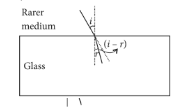
$\therefore \quad$ Refractive index of glass with respect to given rarer medium is $\mu=\frac{v}{4 v / 5}=\frac{5}{4}$
From Snell's law, $\mu=\frac{\sin i}{\sin r} \approx \frac{i}{r}$
( $\because$ for small angles, $\sin \theta=\theta$ )
$\therefore \quad \frac{i}{r}=\frac{5}{4}$
or $r=\frac{4 i}{5}$
$\therefore \quad$ Angle of deviation $=i-r=i-\frac{4 i}{5}=\frac{i}{5}$ View full question & answer→MCQ 1031 Mark
In Young's double slit experiment, the ratio of intensities of bright and dark bands is 16 which means
- A
the ratio of their amplitudes is 5
- ✓
intensities of individual sources are 25 and 9 units respectively
- C
the ratio of their amplitudes is 4
- D
intensities of individual sources are 4 and 3 units respectively.
AnswerCorrect option: B. intensities of individual sources are 25 and 9 units respectively
(b) : Here, $\frac{I_{\max }}{I_{\min }}=16, a_1=$ ?, $a_2=$ ?
$
\text { As } \frac{I_{\max }}{I_{\min }}=\left(\frac{r+1}{r-1}\right)^2 ; r=\frac{a_1}{a_2} ; 16=\left(\frac{r+1}{r-1}\right)^2 \Rightarrow \frac{r+1}{r-1}=4
$
$\begin{aligned} & r+1=4 r-4 \Rightarrow 3 r=5 \\ & r=\frac{5}{3}=\frac{a_1}{a_2} \therefore \frac{I_1}{I_2}=\left(\frac{a_1}{a_2}\right)^2=\frac{25}{9}\end{aligned}$
View full question & answer→MCQ 1041 Mark
Two coherent monochromatic light beams of intensities ' $4 I$ and ' $9 I$ ' are superimposed. The maximum and minimum possible intensities in the resulting beam are
- A
$3 I$ and $2 I$
- B
$9 I$ and $5 I$
- C
$16 I$ and $3 I$
- ✓
$25 I$ and $I$
AnswerCorrect option: D. $25 I$ and $I$
(d) : Here, $I_1=4 I, I_2=9 I$
$
I_{\max }=\text { ?, } I_{\min }=\text { ? }
$
Also, amplitude $\propto \sqrt{\text { Intensity }}$
$
\begin{aligned}
& I_{\max }=\left(A_1+A_2\right)^2=(2 \sqrt{I}+3 \sqrt{I})^2=25 I \\
& I_{\min }=\left(A_1-A_2\right)^2=(2 \sqrt{I}-3 \sqrt{I})^2=I
\end{aligned}
$
View full question & answer→MCQ 1051 Mark
The distance of a point on the screen from two slits in biprism experiment is $1.8 \times 10^{-5} m$ and $1.23 \times 10^{-5} m$. If wavelength of light used is 6000 Å, the fringe formed at that point is
AnswerCorrect option: B. $10^{\text {th }}$ dark
(b) : Fordark fringe, $\Delta x=0.57 \times 10^{-5}=\left(\frac{2 n-1}{2}\right) \lambda$
$
\begin{aligned}
& n=\frac{1}{2}\left(\frac{2 \times 0.57 \times 10^{-5}}{6000 \times 10^{-10}}\right) \\
& n=10^{\text {th }} \text { (dark fringe). }
\end{aligned}
$
View full question & answer→MCQ 1061 Mark
For the same angle of incidence, the angles of refraction of media ' $P$ ', ' $Q$, ' $R$ ' and ' $S$ ' are $50^{\circ}, 40^{\circ}$, $30^{\circ}, 20^{\circ}$ respectively. The speed of light is minimum in medium
Answer(d) : According to Snell's law
$\sin i=\mu \sin r$
[From air to a medium]
$
\mu=\frac{\sin i}{\sin r}
$
Let $v$ be speed of light in the medium.
$
v=\frac{c}{\mu}=\frac{c}{(\sin r) /(\sin r)}=\left(\frac{c}{\sin i}\right) \sin r
$
For a given angle of incidence,
$
\begin{aligned}
& v \propto \sin r \\
& \therefore \quad v_P>v_Q>v_R>v_S
\end{aligned}
$
Hence, the speed of light in medium $S$ is minimum.
View full question & answer→MCQ 1071 Mark
A light is travelling from air into a medium. Velocity of light in a medium is reduced to 0.75 times the velocity in air. Assume that angle of incidence ' $i$ ' is very small, the deviation of the ray is
- A
$i$
- B
$\frac{i}{3}$
- ✓
$\frac{i}{4}$
- D
$\frac{3 i}{4}$
AnswerCorrect option: C. $\frac{i}{4}$
(c) : Given situation is shown in the figure.
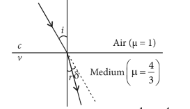
Refractive index of medium, $\mu=\frac{c}{v}=\frac{1}{0.75}=\frac{4}{3}$
Deviation of ray, $\delta=$ ?
Using Snell's law at the interface of media,
$
\begin{aligned}
& \text { (1) } \sin i=\left(\frac{4}{3}\right) \sin r \\
& \frac{\sin i}{\sin r}=\frac{4}{3}
\end{aligned}
$
Since $i$ and $r$ is very small so, $\sin i \approx i$ and $\sin r \approx r$ then
$
\begin{aligned}
& \frac{i}{r}=\frac{4}{3} ; \frac{i}{i-\delta}=\frac{4}{3} \quad(\because r=i-\delta) \\
& 3 i=4 i-4 \delta \therefore \quad \delta=\frac{i}{4}
\end{aligned}
$ View full question & answer→MCQ 1081 Mark
Two coherent sources of intensity ratio $\alpha$ interfere.In interference pattern $\frac{I_{\max }-I_{\min }}{I_{\max }+I_{\min }}=$
- A
$\frac{2 \alpha}{1+\alpha}$
- ✓
$\frac{2 \sqrt{\alpha}}{1+\alpha}$
- C
$\frac{2 \alpha}{1+\sqrt{\alpha}}$
- D
$\frac{1+\alpha}{2 \alpha}$
AnswerCorrect option: B. $\frac{2 \sqrt{\alpha}}{1+\alpha}$
(b) : Let two coherent sources of intensity $I_1$ and $I_2$ interfere. Then
$
\frac{I_{\max }}{I_{\min }}=\frac{\left(\sqrt{I_1}+\sqrt{I_2}\right)^2}{\left(\sqrt{I_1}-\sqrt{I_2}\right)^2}=\frac{\left(\sqrt{\frac{I_1}{I_2}}+1\right)^2}{\left(\sqrt{\frac{I_1}{I_2}}-1\right)^2}
$
As $\frac{I_1}{I_2}=\alpha$ (Given)
$
\therefore \frac{I_{\max }}{I_{\min }}=\frac{(\sqrt{\alpha}+1)^2}{(\sqrt{\alpha}-1)^2}=\left(\frac{\sqrt{\alpha}+1}{\sqrt{\alpha}-1}\right)^2
$
$
\begin{aligned}
& \text { Then, } \frac{I_{\max }-I_{\min }}{I_{\max }+I_{\min }}=\frac{\frac{I_{\max }}{I_{\min }}-1}{\frac{I_{\max }}{I_{\min }}+1} \\
& =\frac{\left(\frac{\sqrt{\alpha}+1}{\sqrt{\alpha}-1}\right)^2-1}{\left(\frac{\sqrt{\alpha}+1}{\sqrt{\alpha}-1}\right)^2+1}=\frac{(\sqrt{\alpha}+1)^2-(\sqrt{\alpha}-1)^2}{(\sqrt{\alpha}+1)^2+(\sqrt{\alpha}-1)^2} \\
& =\frac{\alpha+1+2 \sqrt{\alpha}-\alpha-1+2 \sqrt{\alpha}}{\alpha+1+2 \sqrt{\alpha}+\alpha+1-2 \sqrt{\alpha}} \Rightarrow=\frac{4 \sqrt{\alpha}}{2+2 \alpha}=\frac{4 \sqrt{\alpha}}{2(1+\alpha)}=\frac{2 \sqrt{\alpha}}{1+\alpha}
\end{aligned}
$
View full question & answer→