Questions

5 Mark Question

🎯

Test yourself on this topic

46 questions · timed · auto-graded

Question 15 Marks
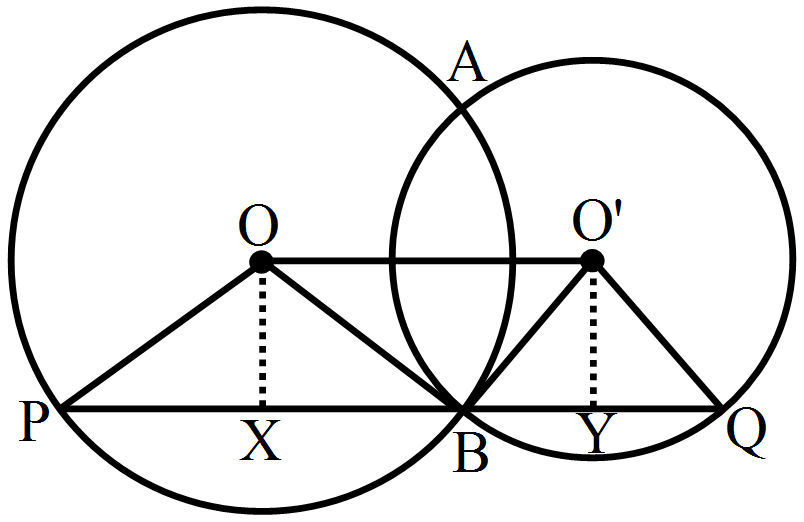
Two circles with centres O and O' intersect at two points A and B. A line PQ is drawn parallel to OO' through A or B, intersecting the circles at P and Q. Prove that PQ = 2OO'.
Answer
Given: Two circles with centres O and O' intersect at two points A and B. Draw a line PQ parallel to OO' through B, OX perpendicular to PQ, O'Y perpendicular to PQ, join all. We know that perpendicular drawn from the centre to the chord, bisects the chord.$\therefore$ PX = XB and YQ = BY
$\therefore$ PX + YQ = XB + BY
On adding XB + BY on both sides, we get PX + YQ + XB + BY = 2(XB + BY) ⇒ PQ = 2(XY) ⇒ PQ = 2(OO') Hence, PQ = 2OO'
View full question & answer
Question 25 Marks
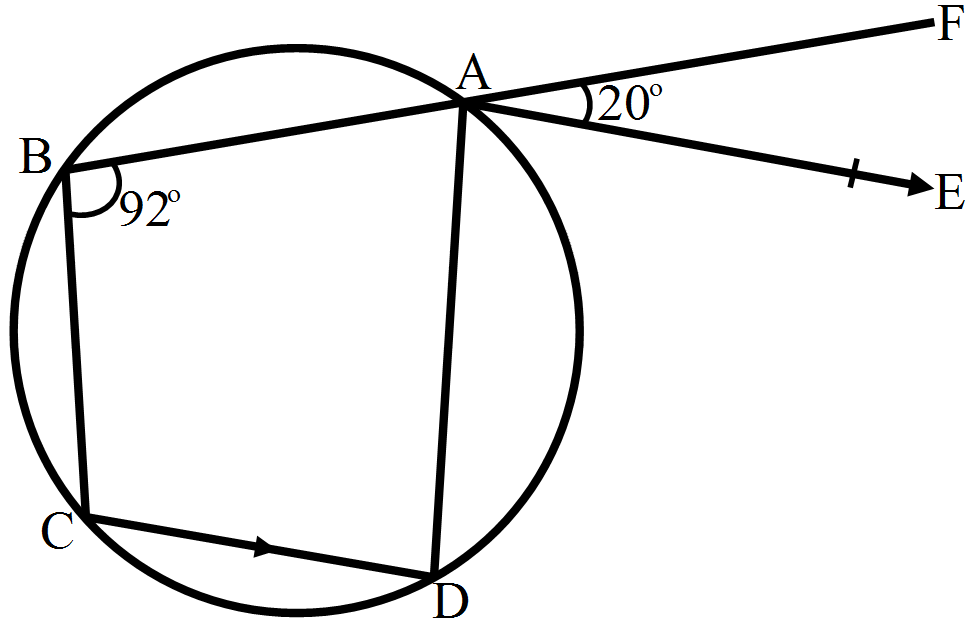
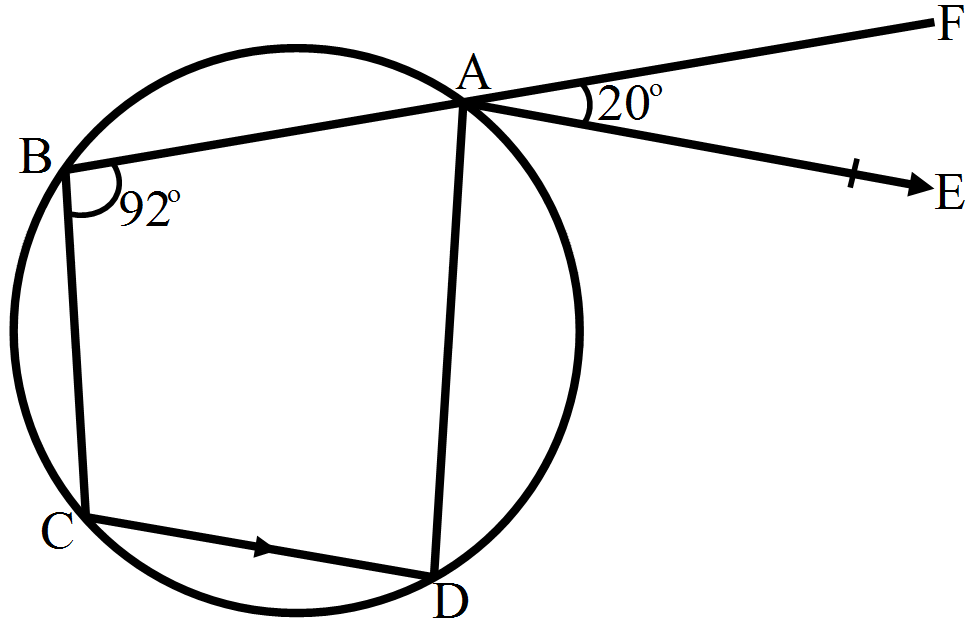
In the given figure, ABCD is a cyclic quadrilateral in which AE is drawn parallel to CD, and BA is produced. If $\angle\text{ABC}=92^\circ$ and $\angle\text{FAE}=20^\circ,$ find $\angle\text{BCD}.$
Answer
Given: ABCD is a cyclic quadrilateral. Then $\angle\text{ABC}+\angle\text{ADC}=180^\circ$$\Rightarrow\ 92^\circ+\angle\text{ADC}=180^\circ$
$\Rightarrow\ \angle\text{ADC}=(180^\circ-92^\circ)=88^\circ$
Again, AE parallel to CD. Thus, $\angle\text{EAD}=\angle\text{ADC}=88^\circ$ [Alternate angles] We know that the exterior angle of a cyclic quadrilateral is equal to the interior opposite angle.$\therefore\ \angle\text{BCD}=\angle\text{DAF}$
$\Rightarrow\ \angle\text{BCD}=\angle\text{EAD}+\angle\text{EAF}$
$=88^\circ+20^\circ=108^\circ$
Hence, $\angle\text{BCD}=108^\circ$
View full question & answer
Question 35 Marks
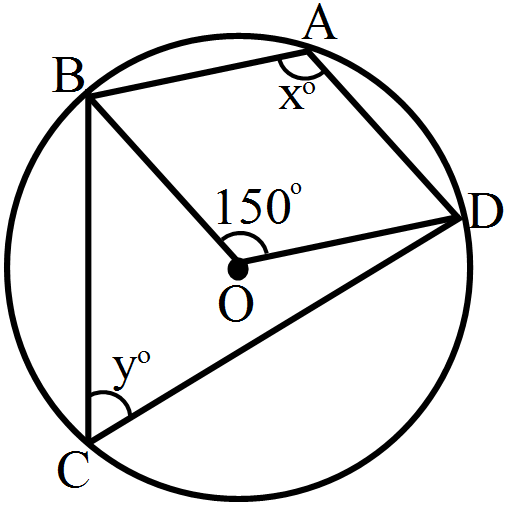
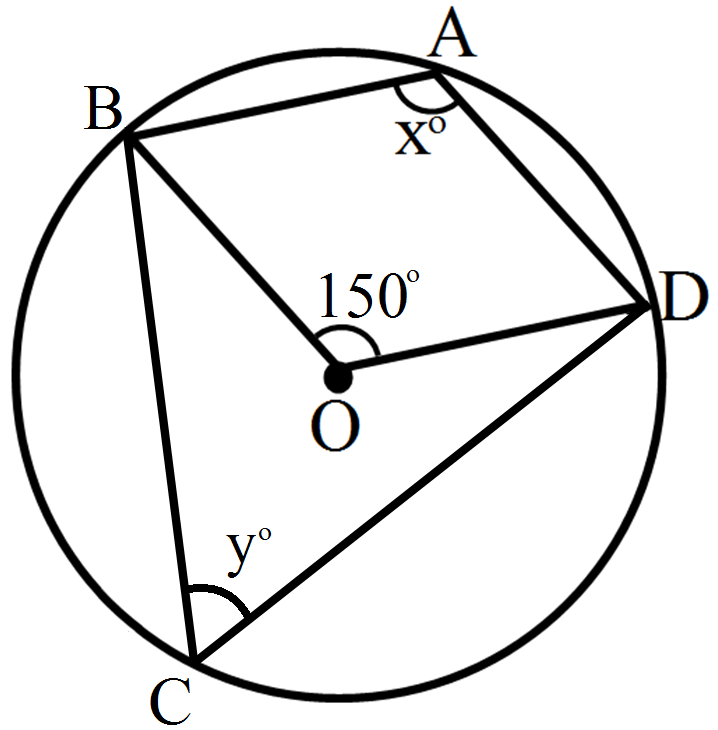
In the given figure, O is the centre of a circle and $\angle\text{BOD}=150^\circ.$ Find the values of x and y.
Answer
O is the centre of the circle and $\angle\text{BOD}=150^\circ$$\therefore$ reflex $\angle\text{BOD}=(360^\circ-\angle\text{BOD})$
$=(360^\circ-150^\circ)=210^\circ$
Now,$\text{x}=\frac{1}{2}(\text{reflex}\angle\text{BOD})$
$=\frac{1}{2}\times210^\circ=105^\circ$
$\therefore\ \text{x}=105^\circ$
Again, x + y = 180° ⇒ 105° + y = 180° ⇒ y = 180° - 105° = 75°$\therefore$ y = 75°
View full question & answer
Question 45 Marks
In the adjoining figure, AB and AC are two equal chords of a circle with centre O. Show that O lies on the bisector of $\angle\text{BAC}.$
Answer
Given: AB and AC are two equal chords of a circle with centre O. To prove: $\angle\text{OAB}=\angle\text{OAC}$ Construction: Join OA, OB and OC. Proof: In $\triangle\text{OAB}$ and $\triangle\text{OAC},$ we have: AB = AC (Given) OA = OA (Common) OB = OC (Radii of a circle)$\therefore\ \triangle\text{OAB}\cong\triangle\text{OAC}$ (By SSS congruency rule)
$\Rightarrow\ \angle\text{OAB}=\angle\text{OAC}$ (C.P.C.T.)
Hence, point O lies on the bisector of $\angle\text{BAC}.$
View full question & answer
Question 55 Marks
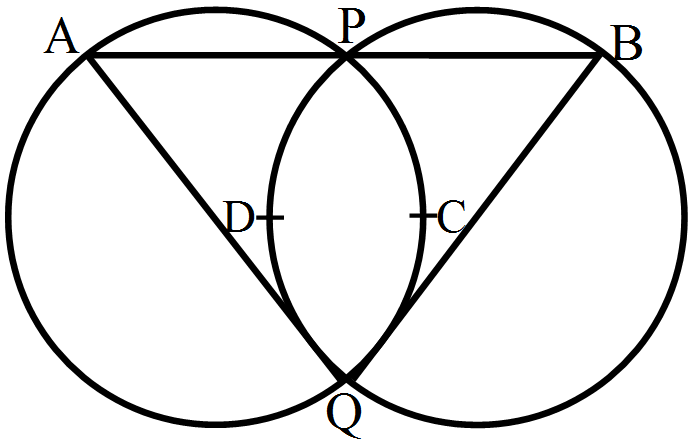
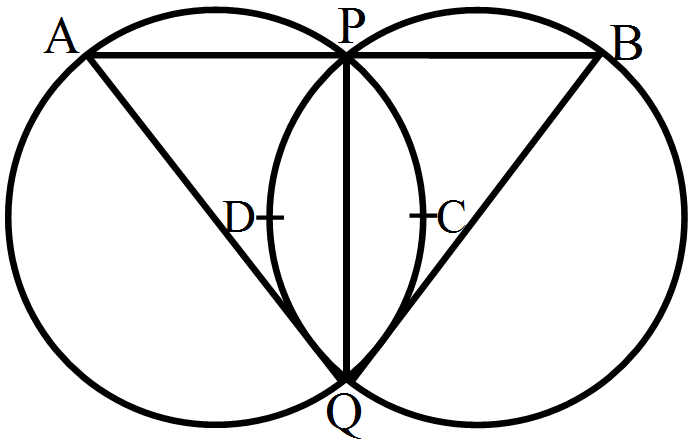
Two equal circles intersect in P and Q. A straight line through P meets the circles in A and B. Prove that QA = QB.
Answer
Given: Two equal circles intersect at point P and Q. A straight line passes through P and meets the circle at points A and B. To prove: QA = QB Construction: Join PQ. Proof: Two circles will be congruent if and only if they have equal radii. Here, PQ is the common chord to both the circles. Thus, their corresponding arcs are equal (if two chords of a circle are equal, then their corresponding arcs are congruent). So, arc PCQ = arc PDQ$\therefore\ \angle\text{QAP}=\angle\text{QBP}$ (Congruent arcs have the same degree in measure)
Hence, QA = QB (In isosceles triangle, base angles are equal)
View full question & answer
Question 65 Marks
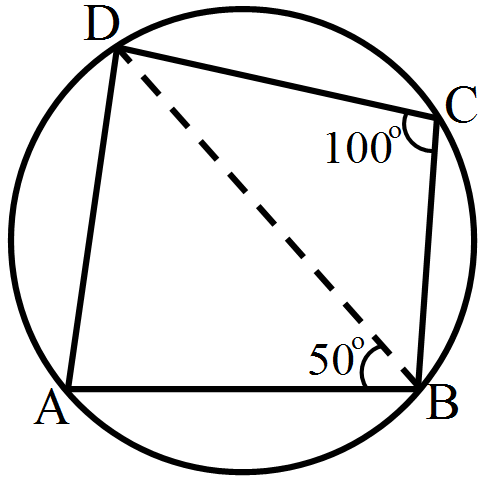
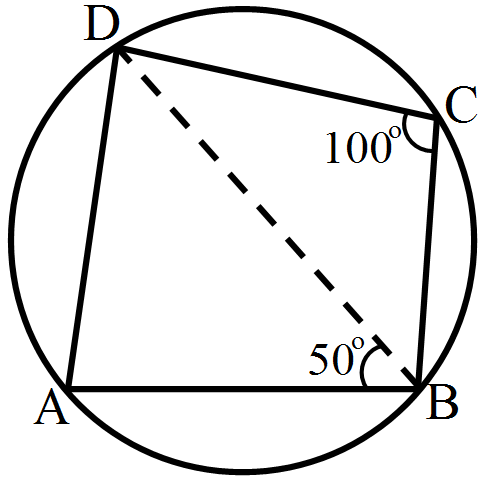
In the adjoining figure, ABCD is a cyclic quadrilateral in which $\angle\text{BCD}=100^\circ$ and $\angle\text{ABD}=50^\circ.$ Find $\angle\text{ADB}.$
Answer
ABCD is a cyclic quadrilateral.$\therefore\ \angle\text{A}+\angle\text{C}=180^\circ$ [Opposite of a cyclic quadrilateral are supplementary]
$\Rightarrow\ \angle\text{A}+100^\circ=180^\circ$
$\Rightarrow\ \angle\text{A}=180^\circ-100^\circ=80^\circ$
Now, in $\triangle\text{ABD},$ we have:$\angle\text{A}+\angle\text{ABD}+\angle\text{ADB}=180^\circ$
$\Rightarrow\ 80^\circ+50^\circ+\angle\text{ADB}=180^\circ$
$\Rightarrow\ \angle\text{ADB}=180^\circ-130^\circ=50^\circ$
$\therefore\ \angle\text{ADB}=50^\circ$
View full question & answer
Question 75 Marks
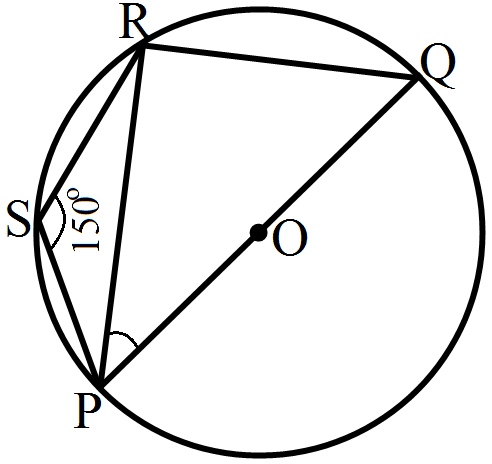
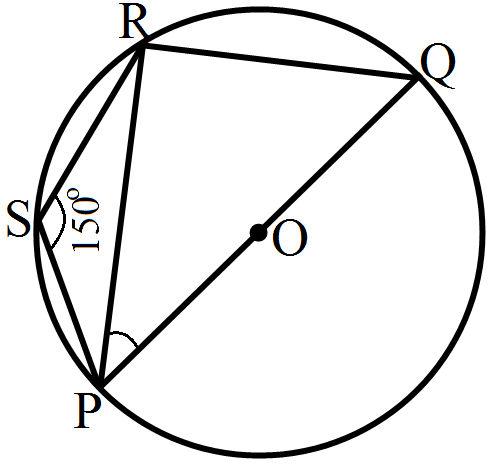
In the given figure, POQ is a diameter and PQRS is a cyclic quadrilateral. If $\angle\text{PSR}=150^\circ,$ find $\angle\text{RPQ}.$
Answer
In cyclic quadrilateral PQRS, we have:$\angle\text{PSR}+\angle\text{PQR}=180^\circ$
$\Rightarrow\ 150^\circ+\angle\text{PQR}=180^\circ$
$\Rightarrow\ \angle\text{PQR}=(180^\circ-150^\circ)=30^\circ$
$\therefore\ \angle\text{PQR}=30^\circ\dots(\text{i})$
Also, $\angle\text{PQR}=90^\circ\dots(\text{ii})$ (Angle in a semicircle) Now, in $\triangle\text{PRQ},$ we have:$\angle\text{PQR}+\angle\text{PRQ}+\angle\text{RPQ}=180^\circ$
$\Rightarrow\ 30^\circ+90^\circ+\angle\text{RPQ}=180^\circ$ [From (i) and (ii)]
$\Rightarrow\ \angle\text{RPQ}=180^\circ-120^\circ=60^\circ$
$\therefore\ \angle\text{RPQ}=60^\circ$
View full question & answer
Question 85 Marks
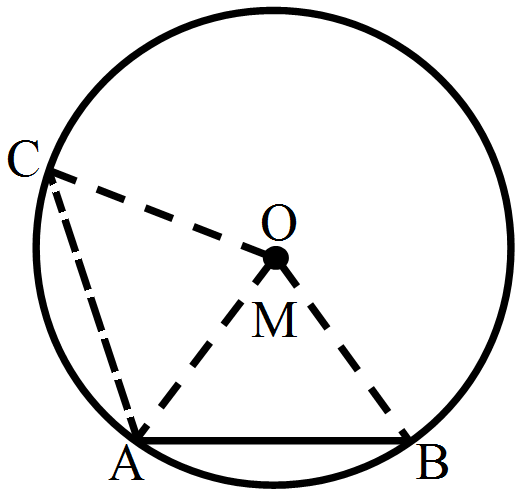
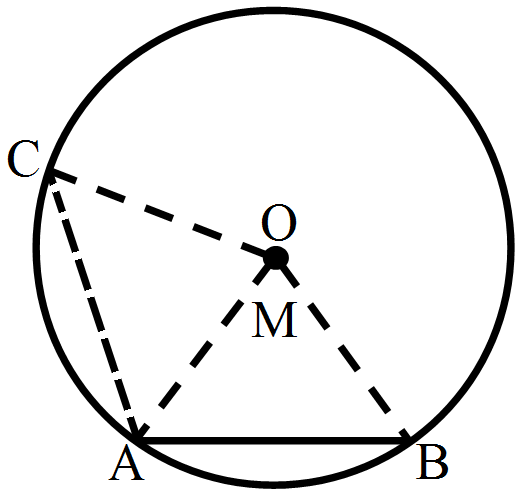
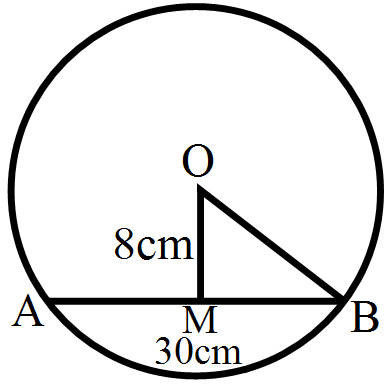
A chord of length $30\ cm$ is drawn at a distance of $8\ cm$ from the centre of a circle.
Find out the radius of the circle.
Answer
Let $AB$ be the chord of the given circle with centre $O$. The perpendicular circle to the chord is $8\ cm$. Join $OB.$
 Then $OM = 8\ cm$ and $AB = 30\ cm.$


We know that the perpendicular from the centre of a circle to a chord.
$\therefore\ \text{MB}=\Big(\frac{\text{AB}}{2}\Big)=\Big(\frac{30}{2}\Big)\text{cm}=15\text{cm}$
From the right $\triangle\text{OMB},$
we have: $OB^2= OM^2 + MB^2 $
$\Rightarrow OB^2 = 8^2 + 15^2 $
$\Rightarrow OB^2 = 64 + 225$
$​​​​​​​ \Rightarrow OB^2 = 289$
$\Rightarrow\ \text{OB}=\sqrt{289}\text{cm}=17\text{cm}$
Hence, the required length of the radius is $17\ cm$.
View full question & answer
Question 95 Marks
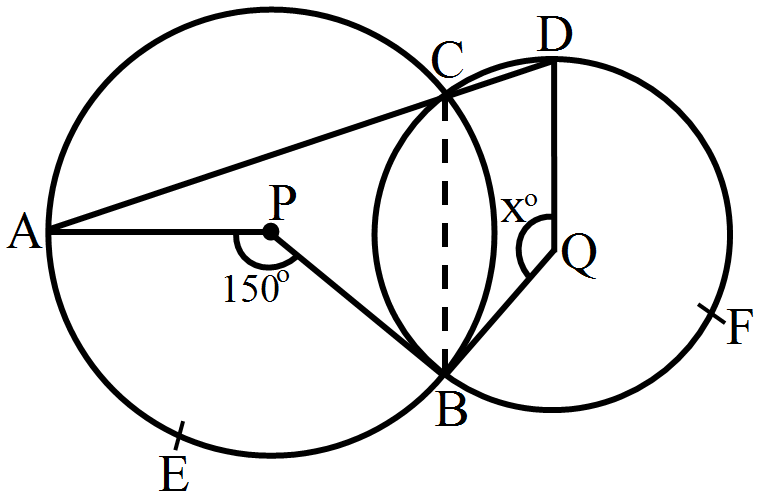
In the figure given below, P and Q are centres of two circles, intersecting at B and C, and ACD is a straight line.

If $\angle\text{APB}=150^\circ$ and $\angle\text{BQD}=\text{x}^\circ,$ find the value of x.
Answer
We know that the angle subtended by an arc of a circle at the centre is double the angle subtended by it on the remaining part of the circle. Here, arc AEB subtends $\angle\text{APB}$ at the centre and $\angle\text{ACB}$ at C on the circle.$\therefore\ \angle\text{APB}=2\angle\text{ACB}$
$\Rightarrow\ \angle\text{ACB}=\frac{150^\circ}{2}=75^\circ\dots(1)$
Since ACD is a straight line, $\angle\text{ACB}=2\angle\text{BCD}=180^\circ$$\Rightarrow\ \angle\text{BCD}=180^\circ-75^\circ$
$\Rightarrow\ \angle\text{BCD}=105^\circ\dots(2)$
Also, arc BFD subtends reflex $\angle\text{BQD}$ at the centre and $\angle\text{BCD}$ at C on the circle.$\therefore$ reflex $\angle\text{BQD}=2\angle\text{BCD}$
⇒ reflex $\angle\text{BQD}=2(105^\circ)=210^\circ\dots(3)$ Now, reflex $\angle\text{BQD}+\angle\text{BQD}=360^\circ$$\Rightarrow\ 210^\circ+\text{x}=360^\circ$
$\Rightarrow\ \text{x}=360^\circ-210^\circ$
$\Rightarrow\ \text{x}=150^\circ$
Hence, $\text{x}=150^\circ.$
View full question & answer
Question 105 Marks
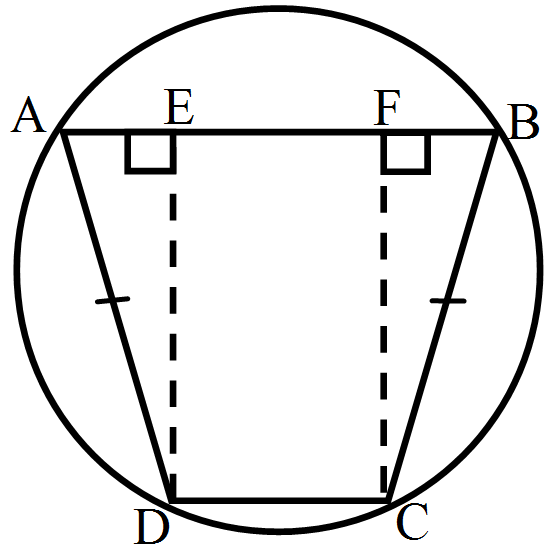
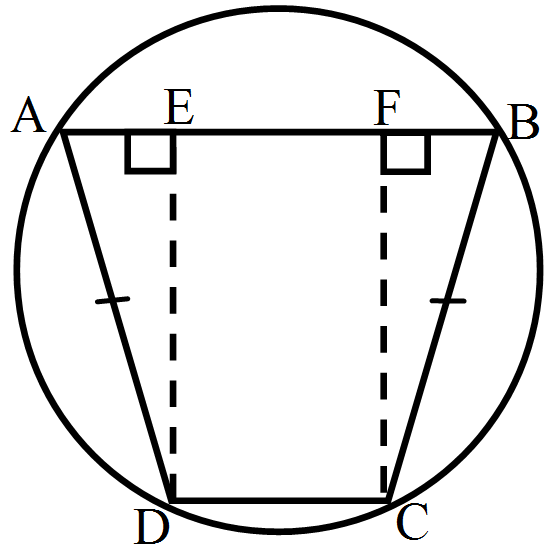
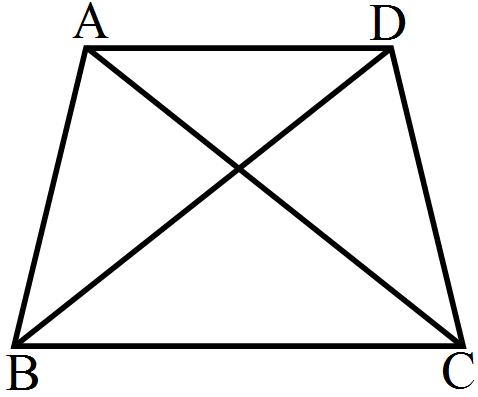
In the given figure, ABCD is a quadrilateral in which AD = BC and $\angle\text{ADC}=\angle\text{BCD}.$ Show that the points A, B, C, D lie on a circle.
Answer
ABCD is a quadrilateral in which AD = BC and $\angle\text{ADC}=\angle\text{BCD}.$ Draw $\text{DE}\perp\text{AB}$ and $\text{CF}\perp\text{AB}.$ In $\triangle\text{ADE}$ and $\triangle\text{BCF},$ we have:$\angle\text{ADE}=\angle\text{ADC}-90^\circ=\angle\text{BCD}-90^\circ=\angle\text{BCF}$ $[$given: $\angle\text{ADC}=\angle\text{BCD}]$
AD = BC [given]$\therefore\ \triangle\text{ADE}\cong\angle\text{BCF}$ [By AAS congruency]
$\Rightarrow\ \angle\text{A}=\angle\text{B}$
Now, $\angle\text{A}+\angle\text{B}+​​\angle\text{C}+\angle\text{D}=360^\circ$$\Rightarrow\ 2\angle\text{B}=2\angle\text{D}=360^\circ$
$\Rightarrow\ \angle\text{B}+\angle\text{D}=180^\circ$
Hence, ABCD is a cyclic quadrilateral.
View full question & answer
Question 115 Marks
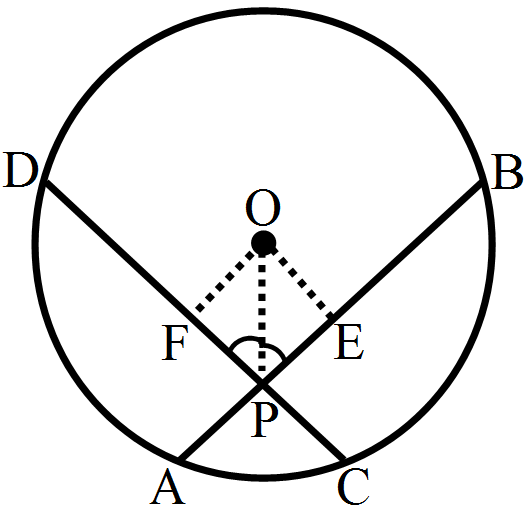
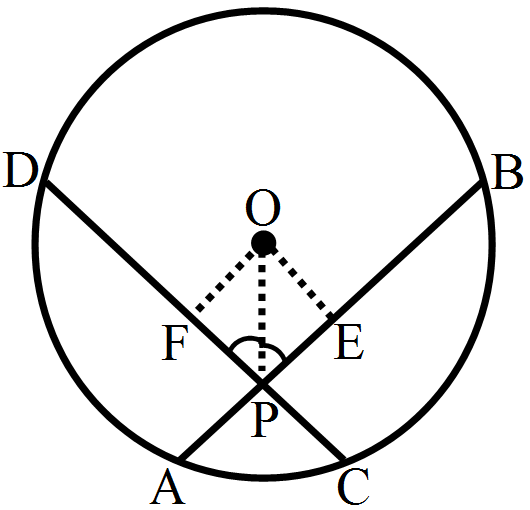
In the given figure, O is the centre of a circle in which chords AB and CD intersect at P such that PO bisects $\angle\text{BPD}.$ Prove that AB = CD.
Answer
Given: O is the centre of a circle in which chords AB and CD intersect. at P such that PO bisects $\angle\text{BPD}.$ To prove: AB = CD Construction: Draw $\text{OE}\perp\text{AB}$ and $\text{OF}\perp\text{CD}.$ Proof: In $\triangle\text{OEP}$ and $\triangle\text{OFP},$ we have:$\angle\text{OEP}=\angle\text{OFP}$ [90° each]
OP = OP [Common]$\angle\text{OPE}=\angle\text{OPF}$ $[\because$ OP bisects $\angle\text{BPD}]$
Thus,$\triangle\text{OEP}\cong\triangle\text{OFP}$ [AAS criterion]
⇒ OE = OF Thus, chords AB and CD are equidistant from the centre O. ⇒ AB = CD $[\because$ Chords equidistant from the centre are equal$]$$\therefore$ AB = CD
View full question & answer
Question 125 Marks
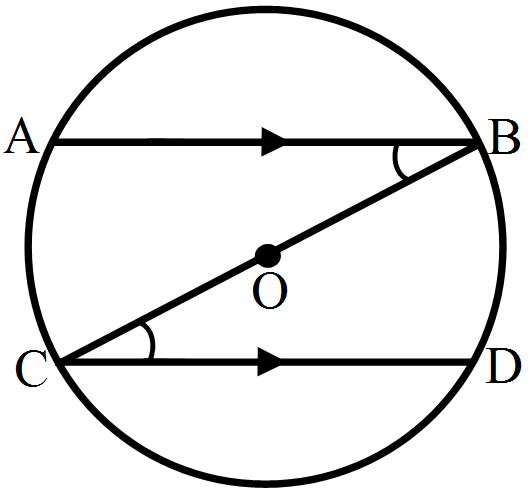
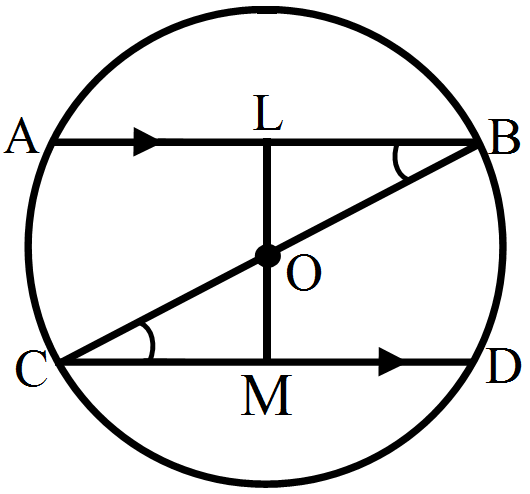
In the adjoining figure, BC is a diameter of a circle with centre O. If AB and CD are two chords such that AB || CD, prove that AB = CD.
Answer
Given: BC is a diameter of a circle with centre O. AB and CD are two chords such that AB || CD. TO prove: AB = CD Construction: Draw $\text{OL}\perp\text{AB}$ and $\text{OM}\perp\text{CD}.$ Proof: In $\triangle\text{OLB}$ and $\triangle\text{OMC},$ we have:$\angle\text{OLB}=\angle\text{OMC}$ [ 90° each]
$\angle\text{OBL}=\angle\text{OCD}$ [Alternate angles as AB || CD]
$\text{OB}=\text{OC}$ [Radii of a circle]
$\therefore\ \triangle\text{OLB}\cong\triangle\text{OMC}$ (AAS criterion)
Thus, OL = OM (C.P.C.T.) We know that chords equidistant from the centre are equal. Hence, AB = CD
View full question & answer
Question 135 Marks
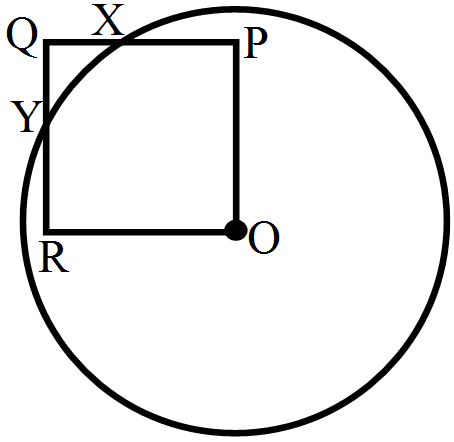
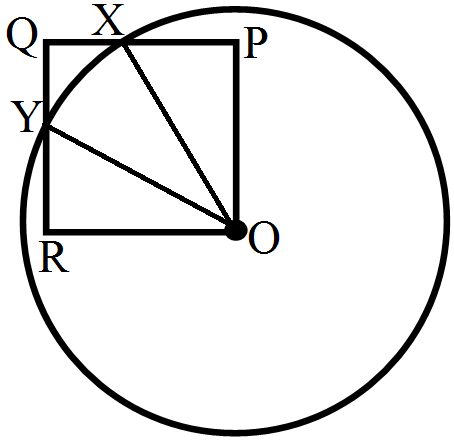
In the adjoining figure, OPQR is a square. A circle drawn with centre O cuts the square at X and Y. Prove that QX = QY.
Answer
Given: OPQR is a square. A circle with centre O cuts the square at X and Y. To prove: QX = QY Construction: Join OX and OY. Proof: In $\triangle\text{OXP}$ and $\triangle\text{OYP},$ we have:$\angle\text{OPX}=\angle\text{ORY}$ (90° each)
OX = OY (Radii of a circle) OP = OR (Sides of a square)$\therefore\ \triangle\text{OXP}\cong\triangle\text{OYP}$ (BY R.H.S. congruency rule)
⇒ PX = RY (By C.P.C.T.) ⇒ PQ - PX = QR - RY (PQ and QR are sides of a square) ⇒ QX = QY Hence, proved.
View full question & answer
Question 145 Marks
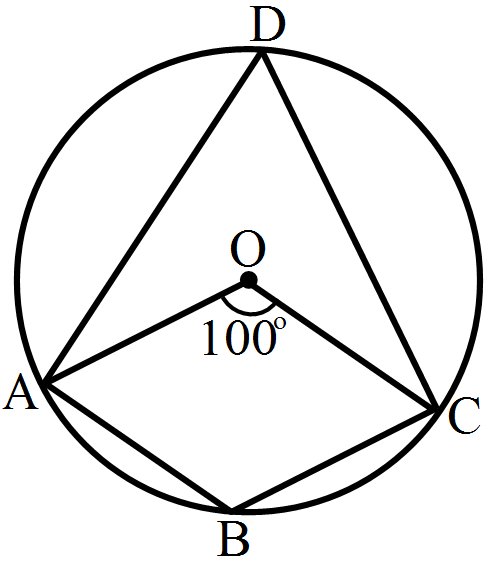
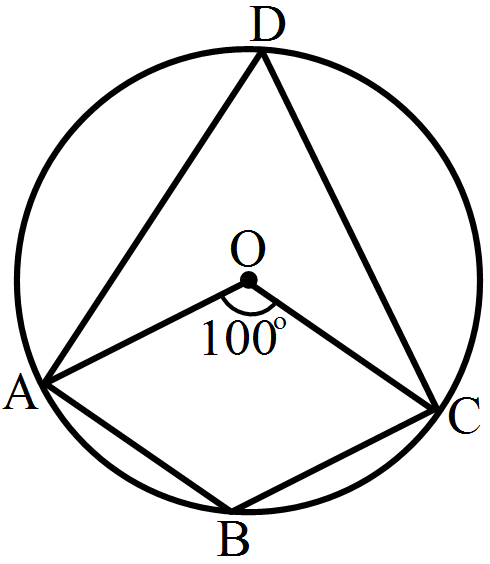
In the given figure, O is the centre of the given circle and measure of arc ABC is 100°. Determine $\angle\text{ADC}$ and $\angle\text{ABC}.$
Answer
We know that the angle subtended by an arc is twice the angle subtended by it on the circumference in the alternate segment. Thus, $\angle\text{AOC}=2\angle\text{ADC}$$\Rightarrow\ 100^\circ=2\angle\text{ADC}$
$\therefore\ \angle\text{ADC}=50^\circ$
The opposite angles of a cyclic quadrilateral are supplementary and ABCD is a cyclic quadrilateral. Thus, $\angle\text{ADC}+\angle\text{ABC}=180^\circ$$\Rightarrow\ 50^\circ+\angle\text{ABC}=180^\circ$
$\Rightarrow\ \angle\text{ABC}=(180^\circ-50^\circ)=130^\circ$
$\therefore\ \angle\text{ADC}=50^\circ$ and $ \angle\text{ABC}=130^\circ$
View full question & answer
Question 155 Marks
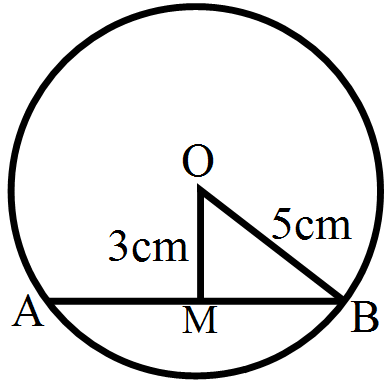
Find the length of a chord which is at a distance of 3cm from the centre of a circle of radius $5\ cm$.
Answer
Let AB be the chord of the given circle with centre $O$ and a radius of $5\ cm$. Then $OM = 3\ cm$ and $OB = 5\ cm$


From the right $\triangle\text{OMB},$
we have: $OB^2 = OM^2 + MB^2$
[Pythagoras theorem]
$\Rightarrow 5^2 = 3^2 + MB^2 $
$\Rightarrow 25 = 9 + MB^2 $
$​​​​​​​\Rightarrow MB^2 = (25 - 9) = 16$
$\Rightarrow\ \text{MB}=\sqrt{16}\text{cm}=4\text{cm}$
Since the perpendicular from the centre of a circle to a chord bisects the chord,
we have: $AB = 2 \times MB = (2 \times 4)\ cm = 8\ cm$
Hence, the required length of the chord is $8\ cm.$
View full question & answer
Question 165 Marks
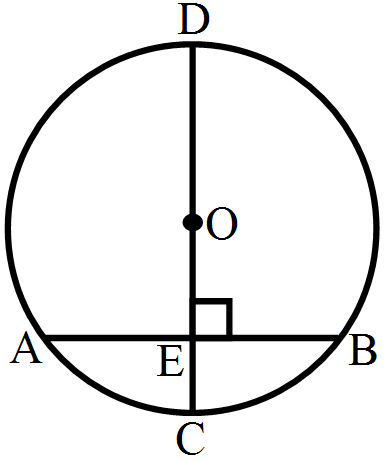
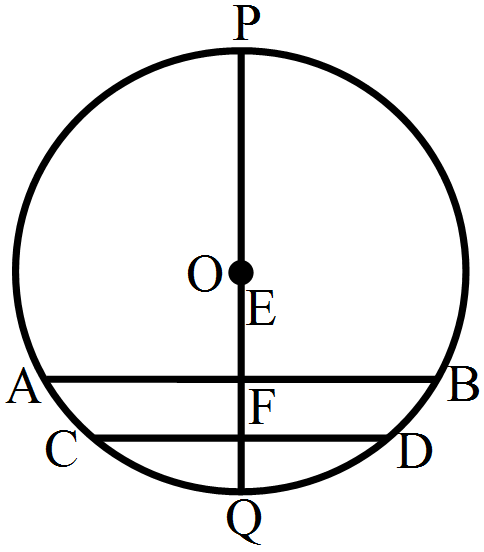
Prove that the diameter of a circle perpendicular to one of the two parallel chords of a circle is perpendicular to the other and bisects it.
Answer
Given: AB and CD are two parallel chords of a circle with centre O. POQ is a diameter which is perpendicular to AB. To prove: $\text{PF}\perp\text{CD}$ and CF = FD Proof: AB || CD and POQ is a diameter.$\angle\text{PEB}=90^\circ$ [Given]
$\angle\text{PFD}=\angle\text{PEB}$ $[\because$ AB || CD, Corresponding angles$]$
Thus, $\text{PF}\perp\text{CD}$$\therefore\ \text{OF}\perp\text{CD}$
We know that the perpendicular from the centre to a chord bisects the chord. i.e., CF = FD Hence, POQ is perpendicular to CD and bisects it.
View full question & answer
Question 175 Marks
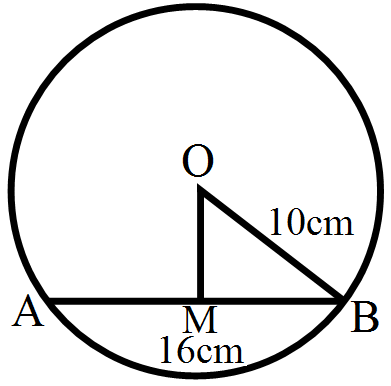
A chord of length $16\ cm$ is drawn in a circle of radius $10\ cm$. Find the distance of the chord from the centre of the circle.
Answer
Let AB be the chord of the given circle with centre $O$ and a radius of $10cm$. Then $AB =16\ cm$ and $OB = 10\ cm$

From O, draw OM perpendicular to AB. We know that the perpendicular from the centre of a circle to a chord bisects the chord.$\therefore\ \text{BM}=\Big(\frac{16}{2}\Big)\text{cm}=8\text{cm}$
In the right $\triangle\text{OMB},$
we have: $OB^2 = OM^2 + MB^2​​​​​​​$​​​​​​​ [Pythagoras theorem]
$\Rightarrow 10^2 = OM^2 + 8^2$​​​​​​​                                                      
$\Rightarrow 100 = OM^2 + 64$
$\Rightarrow OM^2 = (100 - 64) = 36$
$\Rightarrow\ \text{OM}=\sqrt{36}\text{cm}=6\text{cm}$
Hence, the distance of the chord from the centre is $6\ cm.$
View full question & answer
Question 185 Marks
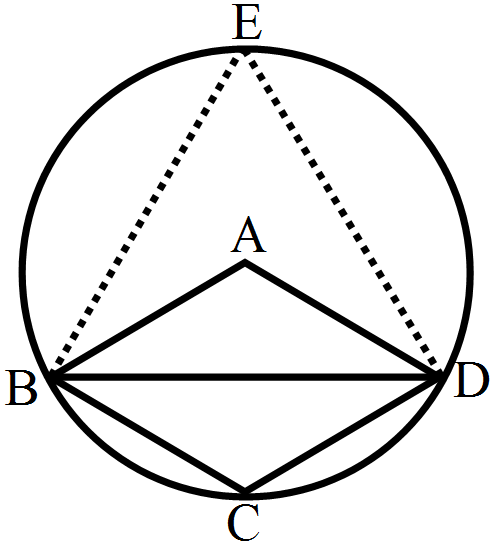
ABCD is a quadrilateral such that A is the centre of the circle passing through B, C and D. Prove that $\angle\text{CBD}+\angle\text{CDB}=\frac{1}{2}\angle\text{BAD}.$
Answer
Construction: Take a point E on the circle. Join BE, DE and BD. We know that the angle subtended by an arc of a circle at its centre is twice the angle subtended by the same arc at a point on the circumference.$\Rightarrow\ \angle\text{BAD}=2\angle\text{BED}$
$\Rightarrow\ \angle\text{BED}=\frac{1}{2}\angle\text{BAD}\dots\text(\text{i})$
Now, EBCD is a cyclic quadrilateral.$\Rightarrow\ \angle\text{BED}+\angle\text{BCD}=180^\circ$
$\Rightarrow\ \angle\text{BCD}=180^\circ-\angle\text{BED}$
$\Rightarrow\ \angle\text{BCD}=\frac{1}{2}\angle\text{BAD}\dots\text(\text{ii})$ [Using (ii)]
In $\triangle\text{BCD},$ by angle sum property$\Rightarrow\ \angle\text{CBD}+\angle\text{CDB}\angle\text{BCD}=180^\circ$
$\Rightarrow\ \angle\text{CBD}+\angle\text{CDB}+180^\circ-\frac{1}{2}\angle\text{BAD}=180^\circ$ [Using (ii)]
$\Rightarrow\ \angle\text{CBD}+\angle\text{CDB}=\frac{1}{2}\angle\text{BAD}$
View full question & answer
Question 195 Marks
Give a geometrical construction for finding the fourth point lying on a circle passing through three given points, without finding the centre of the circle. Justify the construction.
Answer
Let A, B and C be the given points. With B as the centre and a radius equal to AC, draw an arc. With C as the centre and AB as radius, draw another arc, which cuts the previous arcat D. Then D is the required point BD and CD. In $\triangle\text{ABC}$ and $\triangle\text{DCB}$ AB = DC AC = DB BC = CB [Common]$\therefore\ \triangle\text{ABC}\cong\triangle\text{DCB}$ [By SSS]
$\Rightarrow\ \angle\text{BAC}=\angle\text{CDB}$ [C.P.C.T.]
Thus, BC subtends equal angles, $\angle\text{BAC}$ and $\angle\text{CDB}$ on the same side of it.$\therefore$ Points A, B, C, D are concyclic.
View full question & answer
Question 205 Marks
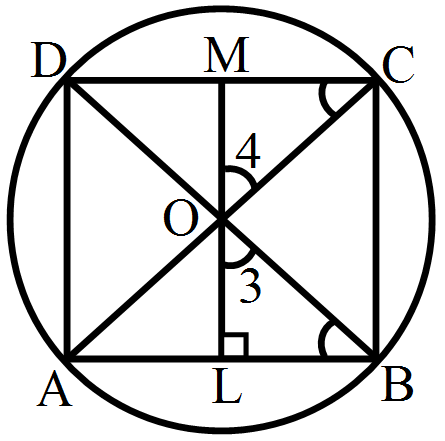
The diagonals of a cyclic quadrilateral are at right angles. Prove that the perpendicular from the point of their intersection on any side when produced backwards, bisects the opposite side.
Answer
Given: Let ABCD be a cyclic quadrilateral whose diagonals AC and BD intersect at O at right angles. Let $\text{OL}\perp\text{AB}$ such that LO produced meets CD at M. To prove: CM = MD Proof:$\angle\text{1}=\angle\text{2}$ [angles in the same segment]
$\angle\text{2}+\angle\text{3}=90^\circ$ $[\angle\text{OLB}=90^\circ]$
$\angle\text{3}+\angle\text{4}=90^\circ$ $[\because$ LOM is a straight line and $\angle\text{BOC}=90^\circ]$
$\therefore\ \angle\text{2}+\angle\text{3}=\angle\text{3}+\angle\text{4}$
$\Rightarrow\ \angle\text{2}=\angle\text{4}$
Thus,$ \angle\text{1}=\angle\text{2}$
And$ \angle\text{2}=\angle\text{4}$
$\Rightarrow\ \angle\text{1}=\angle\text{4}$
$\therefore\ \text{OM}=\text{CM}$
Similarly$\text{OM}=\text{MD}$
Hence,$\text{CM}=\text{MD}$
View full question & answer
Question 215 Marks
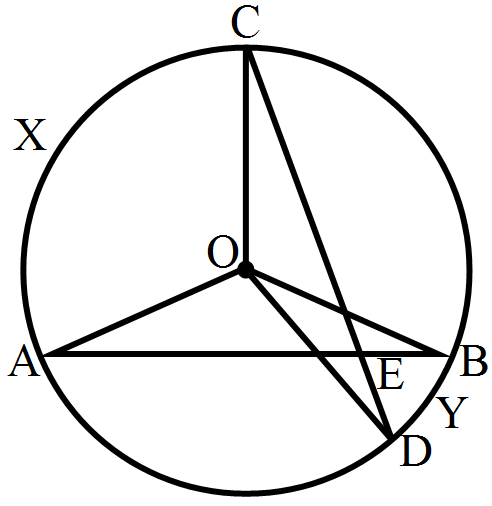
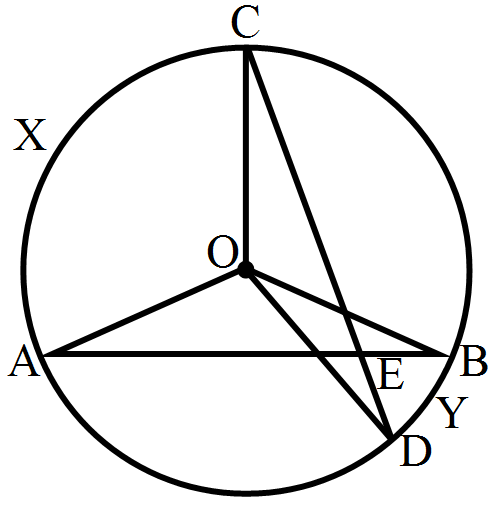
In the given figure, AB and CD are two chords of a circle, intersecting each other at a point E. Prove that $\angle\text{AEC}=\frac{1}{2}$(angle subtended by arc CXA at the centre + angle subtended by arc DYB at the centre).
Answer
We know that the angle subtended by an arc of a circle at the centre is double the angle subtended by it on the remaining part of the circle. Here, arc AXC subtends $\angle\text{AOC}$ at the centre and $\angle\text{ADC}$ at D on the circle.$\therefore\ \angle\text{AOC}=2\angle\text{ADC}$
$\Rightarrow\ \angle\text{ADC}=\frac{1}{2}(\angle\text{AOC})\dots(\text{i})$
Also, arc DYB subtends $\angle\text{DOB}$ at the centre and $\angle\text{DAB}$ at A on the circle.$\therefore\ \angle\text{DOB}=2\angle\text{DAB}$
$\Rightarrow\ \angle\text{DAB}=\frac{1}{2}(\angle\text{DOB})\dots(\text{ii})$
Now, in $\angle\text{ADE},$$\angle\text{AEC}=\angle\text{ADC}+\angle\text{DAB}$ [Exterior angle]
$\Rightarrow\ \angle\text{AEC}=\frac{1}{2}(\angle\text{AOC}+\angle\text{DOB})$ [From (i) and (ii)]
Hence, $\angle\text{AEC}=\frac{1}{2}$(angle subtended by arc CXA at the centre + angle subtended by arc DYB at the centre).
View full question & answer
Question 225 Marks
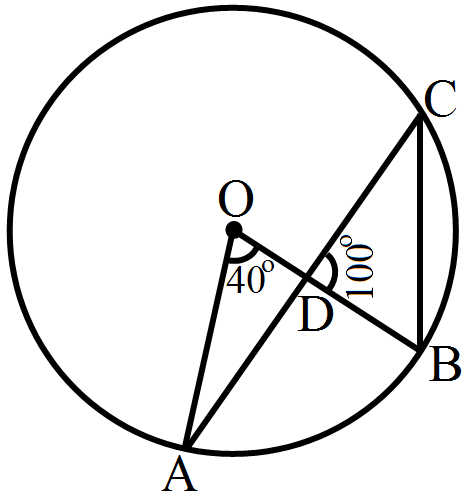
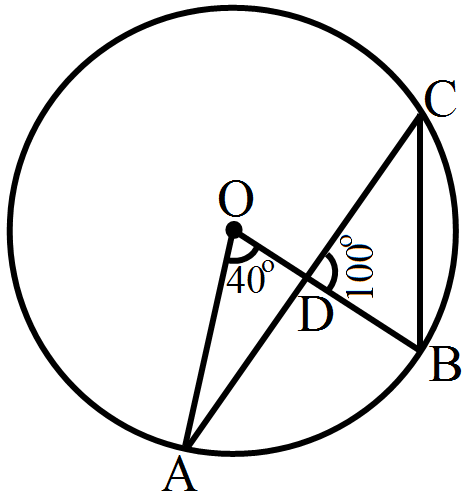
In the given figure, O is the centre of a circle, $\angle\text{AOB}=40^\circ$ and $\angle\text{BDC}=100^\circ,$ find $\angle\text{OBC}.$
Answer
We know that the angle subtended by an arc of a circle at the centre is double the angle subtended by the arc at any point on the circumference.$\angle\text{AOB}=2\angle\text{ACB}$
$=2\angle\text{DCB}$ $[\because\ ​\angle\text{ACB}=\angle\text{DCB}]$
$\therefore\ \angle\text{DCB}=\frac{1}{2}\angle\text{AOB}$
$\Rightarrow\ \angle\text{DCB}=\Big(\frac{1}{2}\times40^\circ\Big)=20^\circ$
Considering $\triangle\text{DBC},$ we have:$\angle\text{BDC}+\angle\text{DCB}+\angle\text{DBC}=180^\circ$
$\Rightarrow\ 100^\circ+20^\circ+\angle\text{DBC}=180^\circ$
$\Rightarrow\ \angle\text{DBC}=(180^\circ-120^\circ)=60^\circ$
$\Rightarrow\ \angle\text{OBC}=\angle\text{DBC}=60^\circ$
Hence, $\angle\text{OBC}=60^\circ$
View full question & answer
Question 235 Marks
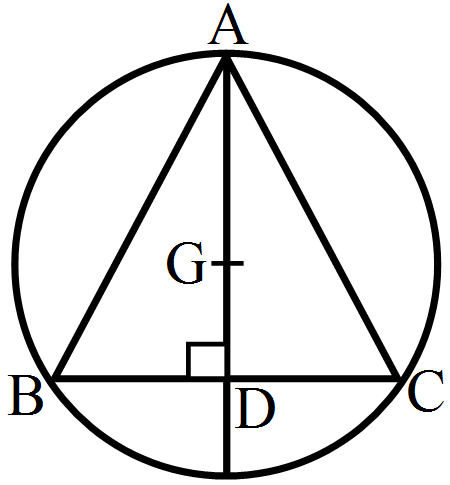
An equilateral triangle of side 9cm is inscribed in a circle. Find the radius of the circle.
Answer
Let $\triangle\text{ABC}$ be an equilateral triangle of side 9cm. Let AD be one of its median. Then, $\text{AD}\perp\text{BC}$ $[\triangle\text{ABC}$ is an equilateral triangle$]$ Also,$\text{BD}=\Big(\frac{\text{BC}}{2}\Big)=\Big(\frac{9}{2}\Big)=4.5\text{cm}$
In right angled $\triangle\text{ADB},$ we have:$\text{AB}^2=\text{AD}^2+\text{BD}^2$
$\Rightarrow\ \text{AD}^2=\text{AB}^2-\text{BD}^2$
$\Rightarrow\ \text{AD}=\sqrt{\text{AB}^2-\text{BD}^2}$
$=\sqrt{(9)^2-\Big(\frac{9}{2}\Big)^2}\text{cm}$
$=\frac{9\sqrt{3}}{2}\text{cm}$
In the equilateral triangle, the centroid and circumcentre coincide and AG : GD = 2 : 1. Now, radius $=\text{AG}=\frac{2}{3}\text{AD}$$\Rightarrow\ \text{AG}=\Big(\frac{2}{3}\times\frac{9\sqrt{3}}{2}\Big)=3\sqrt{3}\text{cm}$
$\therefore$ The radius of the circle is $3\sqrt{3}\text{cm}.$
View full question & answer
Question 245 Marks
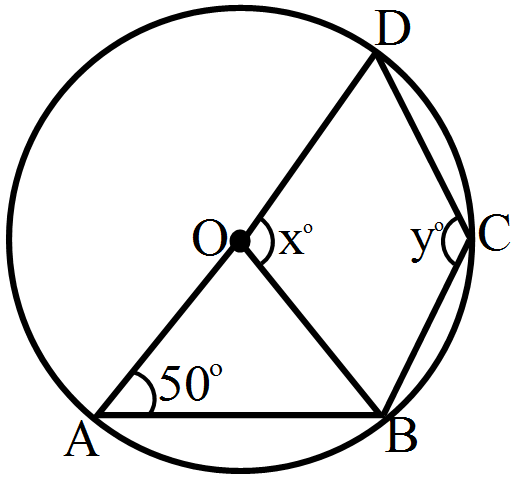
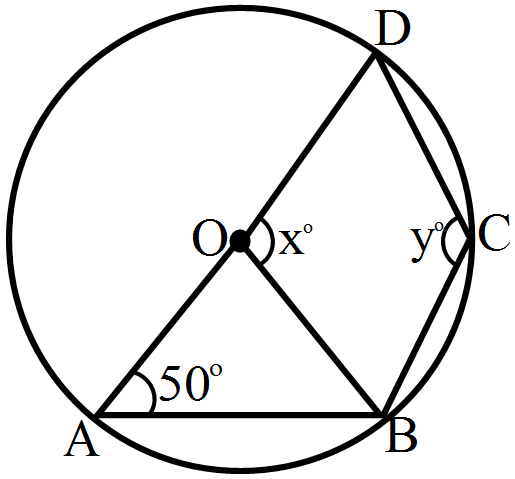
In the given figure, O is the centre of the circle and $\angle\text{DAB}=50^\circ.$Calculate the values of x and y.
Answer
O is the centre of the circle and $\angle\text{DAB}=50^\circ.$ OA = OB [Radii of a circle]$\Rightarrow\ \angle\text{OBA}=\angle\text{OAB}=50^\circ$
In $\triangle\text{OAB},$ we have:$\angle\text{OAB}+\angle\text{OBA}+\angle\text{AOB}=180^\circ$
$\Rightarrow\ 50^\circ+50^\circ+\angle\text{AOB}=180^\circ$
$\Rightarrow\ \angle\text{AOB}=(180^\circ-100^\circ)=80^\circ$
Since AOD is a straight line, we have:$\therefore\ \text{x}=180^\circ-\angle\text{AOB}$
$=(180^\circ-80^\circ)=100^\circ$
$\text{i.e},\text{x}=100^\circ$
The opposite angles of a cyclic quadrilateral are supplementary. ABCD is a cyclic quadrilateral. Thus, $\angle\text{DAB}+\angle\text{BCD}=180^\circ$$\angle\text{BCD}=(180^\circ-50^\circ)=130^\circ$
$\therefore\ \text{y}=130^\circ$
Hence, $\text{x}=100^\circ$ and $\text{y}=130^\circ$
View full question & answer
Question 255 Marks
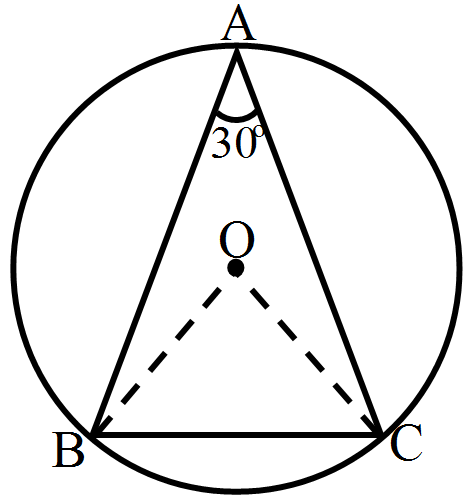
In the given figure, $\angle\text{BAC}=30^\circ.$ Show that BC is equal to the radius of the circumcircle of $\triangle\text{ABC}$ whose centre is O.
Answer
Join OB and OC.$\angle\text{BOC}=2\angle\text{BAC}$ [As angle subtended by an arc of a circle at the centre is double the angle subtended by the arc at any point on the circumference]
$=2\times30^\circ$ $[\because\ \angle\text{BAC}=30^\circ]$
$=60^\circ\dots(\text{i})$
Consider $\triangle\text{BOC},$ we have: OB = OC [Radii of a circle]$\Rightarrow\ \angle\text{OBC}=\angle\text{OCB}\dots(\text{ii})$
In $\triangle\text{BOC},$ we have:$\angle\text{BOC}+\angle\text{OBC}+\angle\text{OCB}=180^\circ$ [Angle sum property of a triangle]
$\Rightarrow\ 60^\circ+\angle\text{OCB}+\angle\text{OCB}=180^\circ$ [From (i) and (ii)]
$\Rightarrow\ 2\angle\text{OCB}=(180^\circ-60^\circ)=120^\circ$
$\Rightarrow\ \angle\text{OCB}=60^\circ\dots(\text{ii})$
Thus we have:$\angle\text{OBC}=\angle\text{OCB}=\angle\text{BOC}=60^\circ$
Hence, $\triangle\text{BOC}$ is an equilateral triangle. i.e., OB = OC = BC$\therefore$ BC is the radius of the circumcircle.
View full question & answer
Question 265 Marks
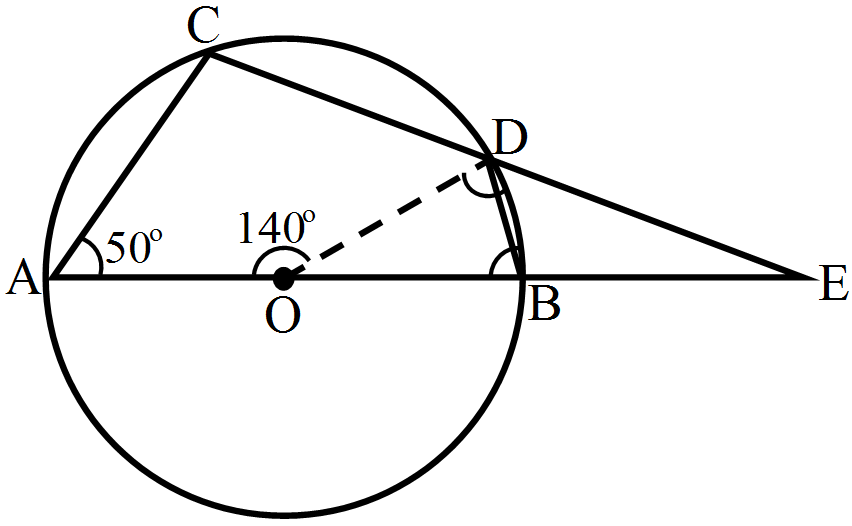
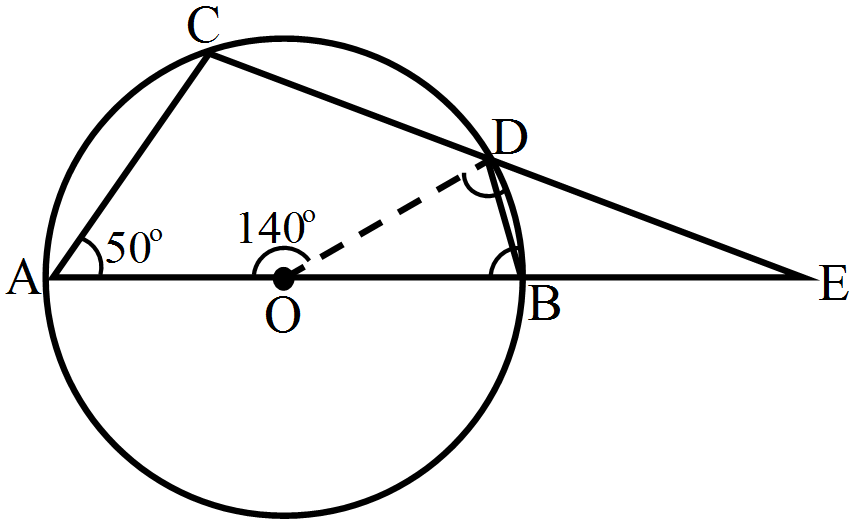
In the given figure, O is the centre of a circle. If $\angle\text{AOC}=140^\circ$ and $\angle\text{CAB}=50^\circ,$ calculate
  1. $\angle\text{EDB}$
  2. $\angle\text{EBD}$
Answer

O is the centre of the circle where $\angle\text{AOC}=140^\circ$ and $\angle\text{CAB}=50^\circ.$
  1. $\angle\text{BOD}=180^\circ-\angle\text{AOD}$
$=(180^\circ-140^\circ)=40^\circ$

We have the following:

OB = OD [Radii of a circle]

$\angle\text{OBD}=\angle\text{ODB}$

In $\triangle\text{OBD},$ we have:

$\angle\text{BOD}+\angle\text{OBD}+\angle\text{ODB}=180^\circ$

$\Rightarrow\ \angle\text{BOD}+\angle\text{OBD}+\angle\text{OBD}=180^\circ$ $[\because\ \angle\text{OBD}=\angle\text{ODB}]$

$\Rightarrow\ 40^\circ+2\angle\text{OBD}=180^\circ$

$\Rightarrow\ 2\angle\text{OBD}=(180^\circ-40^\circ)=140^\circ$

$\Rightarrow\ \angle\text{OBD}=70^\circ$

Since ABCD is a cyclic quadrilateral, we have:

$\angle\text{CAB}+\angle\text{BDC}=180^\circ$

$\Rightarrow\ \angle\text{CAB}+\angle\text{ODB}+\angle\text{ODC}=180^\circ$

$\Rightarrow\ 50^\circ+70^\circ+\angle\text{ODC}=180^\circ$

$\Rightarrow\ \angle\text{ODC}=(180^\circ- 120^\circ)= 60^\circ$

$\therefore\ \angle\text{ODC}= 60^\circ$

$\angle\text{EDB}=180^\circ-(\angle\text{ODC}+\angle\text{ODB})$

$=180^\circ-(60^\circ+70^\circ)$

$=180^\circ-130^\circ=50^\circ$

$\therefore\ \angle\text{EDB}= 50^\circ$
  1. $\angle\text{EDB}=180^\circ-\angle\text{OBD}$
$=180^\circ-70^\circ$

$=\angle\text{110}^\circ$
View full question & answer
Question 275 Marks
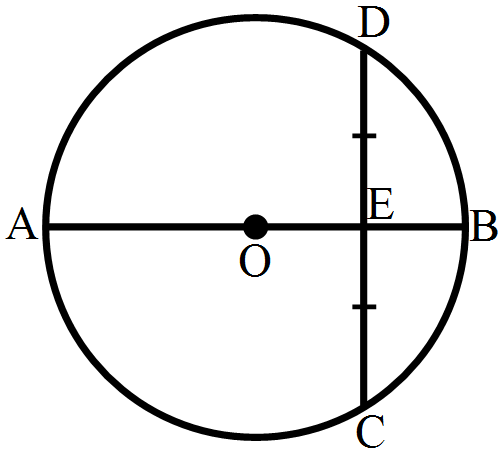
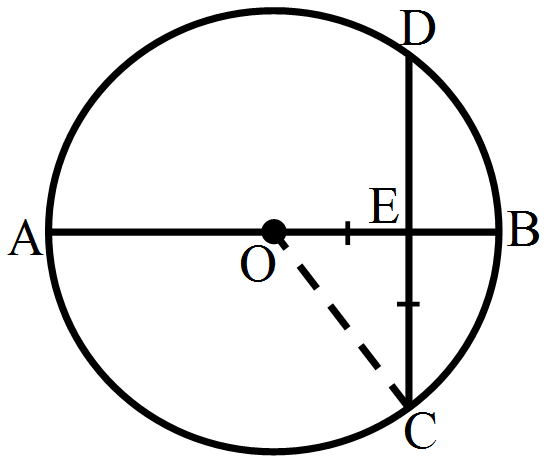
In the given figure, a circle with centre $O$ is given in which a diameter $AB$ bisects the chord $CD$ at a point E such that $CE = ED = 8cm$ and$ EB = 4\ cm$. Find the radius of the circle.
Answer
AB is the diameter of the circle with centre $O$, which bisects the chord $CD$ at point $E$.
Given: $CE = ED = 8\ cm$ and $EB = 4\ cm$ Join $OC$.

Let $OC = OB = rcm$ [Radii of a circle]
Then $OE = (r - 4)\ cm$
Now, in right angled $\triangle\text{OEC},$
we have: $OC^2 = OE^2 + EC^2$[Pythagoras theorem]
$\Rightarrow r^2 = (r - 4)^2 + 8^2 $
$\Rightarrow r^2 = r^2 - 8r + 16 + 64 $
$\Rightarrow r^2 = r^2 + 8r = 80 $
$\Rightarrow 8r = 80$
$\Rightarrow\ \text{r}=\Big(\frac{80}{8}\Big)\text{cm}=10\text{cm}$
$\Rightarrow r = 10\ cm$ Hence, the required radius of the circle is $10\ cm$.
View full question & answer
Question 285 Marks
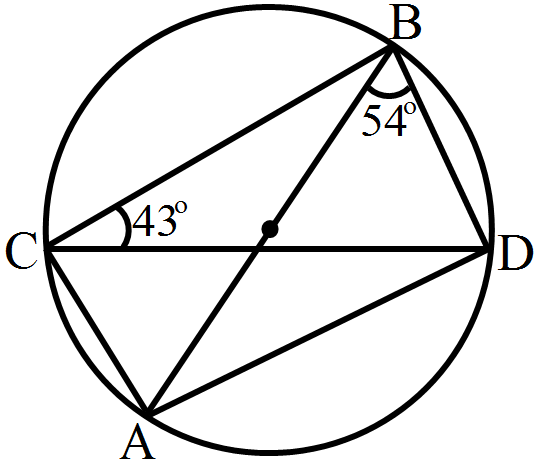
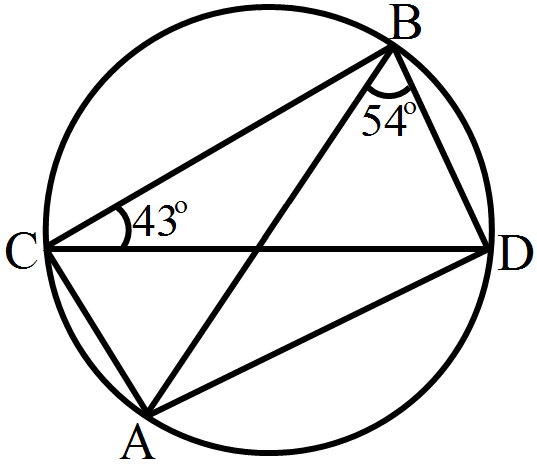
In the given figure, $\angle\text{ABD}=54^\circ$ and $\angle\text{BCD}=43^\circ,$ calculate
  1. $\angle\text{ACD}$
  2. $\angle\text{BAD}$
  3. $\angle\text{BDA}$
Answer
  1. We know that the angles in the same segment of a circle are equal.
$\text{i.e.},\angle\text{ABD}=\angle\text{ACD}=54^\circ$
  1. We know that the angles in the same segment of a circle are equal.
$\text{i.e.},\angle\text{BAD}=\angle\text{BCD}=43^\circ$
  1. In $\triangle\text{ABD},$ we have:
$\angle\text{BAD}+\angle\text{ADB}+\angle\text{DBA}=180^\circ$ [Angle sum property of a triangle]

$\Rightarrow\ 43^\circ+\angle\text{ADB}+54^\circ=180^\circ$

$\Rightarrow\ \angle\text{ADB}=(180^\circ-97^\circ)=83^\circ$

$\Rightarrow\ \angle\text{BDA}=83^\circ$
View full question & answer
Question 295 Marks
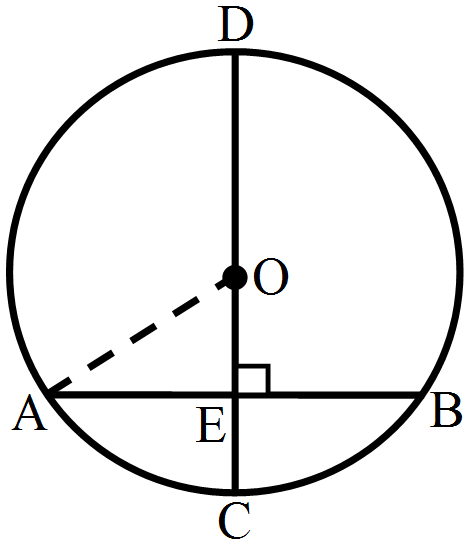
In the given figure, the diameter $CD$ of a circle with centre $O$ is perpendicular to chord $AB$. If $AB = 12\ cm$ and $CE = 3\ cm$, calculate the radius of the circle.

Answer
CD is the diameter of the circle with centre O and is perpendicular to chord AB. Join OA.

Given: $AB = 12\ cm$ and $CE = 3\ cm$  Let $OA = OC = rcm$ [Radii of a circle]
Then OE = (r - 3)cm Since the perpendicular from the centre of the circle to a chord bisects the chord,
we have:$\text{AE}=\Big(\frac{\text{AB}}{2}\Big)=\Big(\frac{12}{2}\Big)\text{cm}=6\text{cm}$
Now, in right angled $\triangle\text{OEA},$ we have:
$\Rightarrow OA^2 = OE^2 + AE^2$
​​​​​​​ $\Rightarrow r^2 = (r - 3)^2 + 6^2 $
$\Rightarrow r^2 = r^2 - 6r + 9 + 36 $
$\Rightarrow r^2 - r^2 + 6r = 45 $
$\Rightarrow 6r = 45$
$\Rightarrow\ \text{r}=\Big(\frac{45}{6}\Big)\text{cm}=7.5\text{cm}$
$\Rightarrow r = 7.5\ cm$
Hence, the required radius of the circle is $7.5\ cm.$
View full question & answer
Question 305 Marks
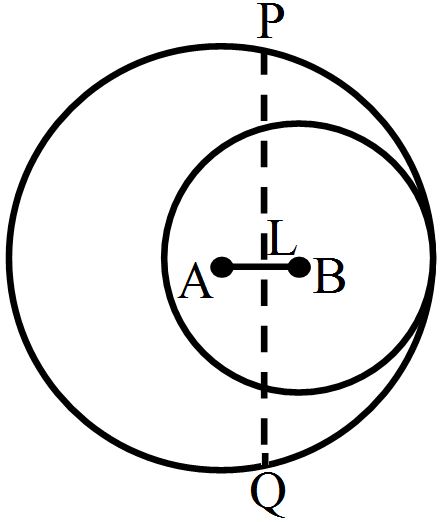
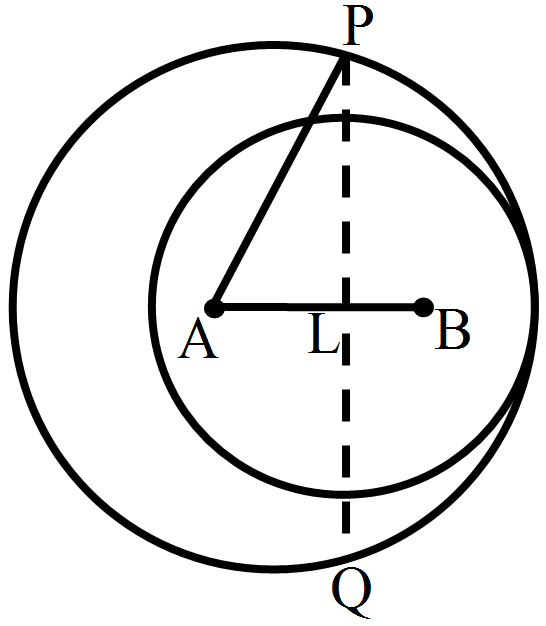
In the adjoining figure, two circles with centres at A and B, and of radii $5\ cm$ and $3\ cm$ touch each other internally.
If the perpendicular bisector of AB meets the bigger circle in P and Q,
find the length of PQ.
Answer
Two circles with centres A and B of respective radii $5\ cm$ and $3\ cm$ touch each other internally.
The perpendicular bisector of AB meets the bigger circle at P and Q. Join AP.

Let PQ intersect AB at point L. Here,$ AP = 5\ cm$
Then $AB = (5 - 3)\ cm = 2\ cm$
Since PQ is the perpendicular bisector of AB,
we have:$\text{AL}=\Big(\frac{\text{AB}}{2}\Big)=\Big(\frac{2}{2}\Big)=1\text{cm}$
Now, in right angled $\triangle\text{PLA},$
we have: $AP^2 = AL^2 + PL^2 $
$\Rightarrow PL^2 = AP^2 - AL^2 = 5^2 - 1^2 = 25 - 1 = 24$
$\Rightarrow\ \text{PL}=\sqrt{24}=2\sqrt{6}\text{cm}$
Thus PQ = 2 × PL$=\big(2\times2\sqrt{6}\big)=4\sqrt{6}\text{cm}$
Hence, the required length of PQ is $4\sqrt{6}\text{cm}.$
View full question & answer
Question 315 Marks
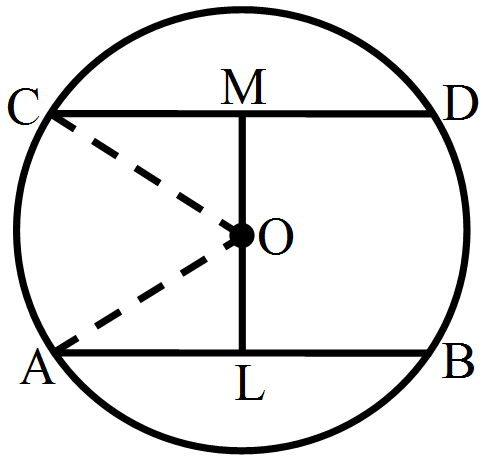
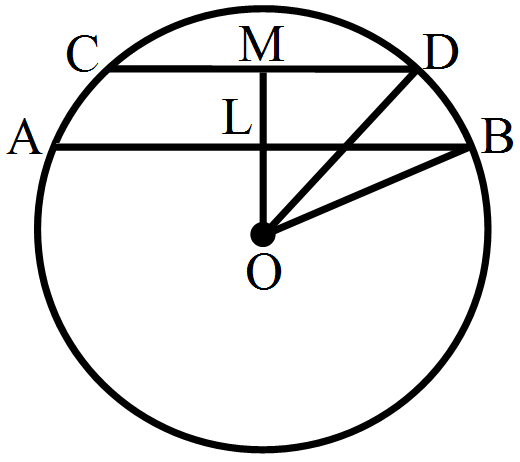
Two parallel chords of lengths $30\ cm$ and $16\ cm$ are drawn on the opposite sides of the centre of a circle of radius $17\ cm$. Find the distance between the chords.
Answer
Let $A B$ and $C D$ be two chords of a circle such that $A B$ is parallel to $C D$ and they are on the opposite sides of the centre.
Given: $AB =30 cm$ and $CD = 1 6 cm$ Draw $OL \perp AB$ and $OM \perp CD$.


Join $O A$ and $O C . O A=O C=17 cm$ [Radii of a circle]
The perpendicular from the centre of a circle to a chord bisects the chord.
$\therefore AL=\left(\frac{AB}{2}\right)=\left(\frac{30}{2}\right)=15 cm$
Now, in right angled $\triangle OLA$,
we have: $O A^2=A L^2+L O^2$
$\Rightarrow L O^2=O A^2-A^2$
$\Rightarrow L O^2=17^2-15^2$
$\Rightarrow L O^2=289-225=64$
$\therefore L O=8 cm$
Similarly, $\therefore CM =\left(\frac{ cD }{2}\right)=\left(\frac{16}{2}\right)=8 cm$ In right angled $\triangle CMO$,
we have:
$\Rightarrow O C^2=C M^2+M O^2$
$\Rightarrow M O^2=O C^2-C M^2$
$\Rightarrow M O^2=17^2-8^2$
$\Rightarrow M O^2=289-64=225$
$\therefore M O=15 cm$
Hence, distance between the chords $=(L O+M O)=(8+15) cm =23 cm$
View full question & answer
Question 325 Marks
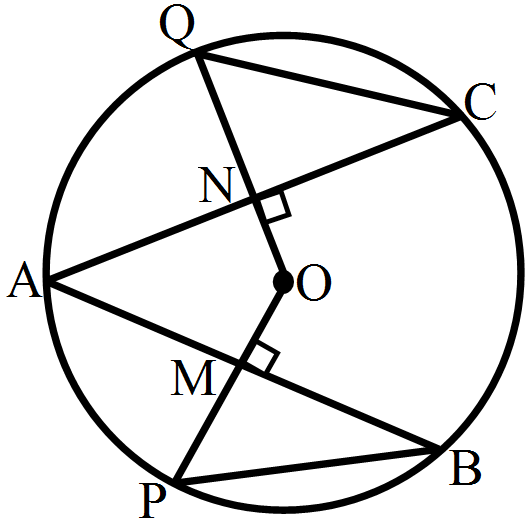
In the adjoining figure, O is the centre of a circle. If AB and AC are chords of the circle such that AB = AC, $\text{OP}\perp\text{AB}$ and $\text{OQ}\perp\text{AC},$
prove that PB = QC.
Answer
Given: AB and AC are chords of the circle with centre O. AB = AC, $\text{OP}\perp\text{AB}$ and $\text{OQ}\perp\text{AC}.$ To prove: PB = QC Proof: AB = AC (Given)$\Rightarrow\ \frac{1}{2}\text{AB}=\frac{1}{2}\text{AC}$
The perpendicular from the centre of a circle to a chord bisects the chord.$\therefore$ MB = NC ...(1)
Also, OM = ON (Equal chords of a circle are equidistant from the centre) and OP = OQ (Radii) ⇒ OP - OM = OQ - ON$\therefore$ PM = QN ...(2)
Now, in $\triangle\text{MPB}$ and $\triangle\text{NQC},$ we have: MB = NC [From (i)]$\angle\text{PMB}=\angle\text{QNC}$ [90° each]
PM = QN [From (ii)] i.e., $\triangle\text{MPB}\cong\triangle\text{NQC}$ (SAS criterion)$\therefore$ PB = QC (C.P.C.T)
View full question & answer
Question 335 Marks
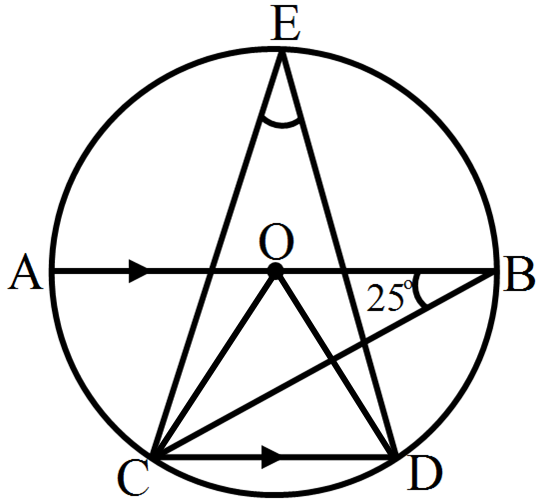
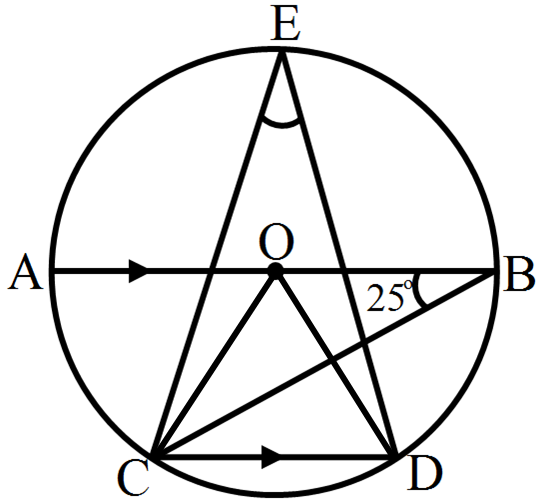
In the adjoining figure, O is the centre of a circle. Chord CD is parallel to diameter AB. If $\angle\text{ABC}=25^\circ,$ calculate $\angle\text{CED}.$
Answer
$\angle\text{BCD}=\angle\text{ABC}=25^\circ$ [Alternate angles]
Join CO and DO. We know that the angle subtended by an arc of a circle at the centre is double the angle subtended by an arc at any point on the circumference. Thus, $\angle\text{BOD}=2\angle\text{BCD}$$\Rightarrow\ \angle\text{BOD}=2\times25^\circ=50^\circ$
Similarly, $\angle\text{AOC}=2\angle\text{ABC}$$\Rightarrow\ \angle\text{AOC}=2\times25^\circ=50^\circ$
AB is a straight line passing through the centre.$\text{i.e.},\angle\text{AOC}+\angle\text{COD}+\angle\text{BOD}=180^\circ$
$\Rightarrow\ 50^\circ+\angle\text{COD}+50^\circ=180^\circ$
$\Rightarrow\ \angle\text{COD}=(180^\circ-100^\circ)=80^\circ$
$\Rightarrow\ \angle\text{CED}=\frac{1}{2}\angle\text{COD}$
$\Rightarrow\ \angle\text{CED}=\Big(\frac{1}{2}\times80^\circ\Big)=40^\circ$
$\therefore\ \angle\text{CED}=40^\circ$
View full question & answer
Question 345 Marks
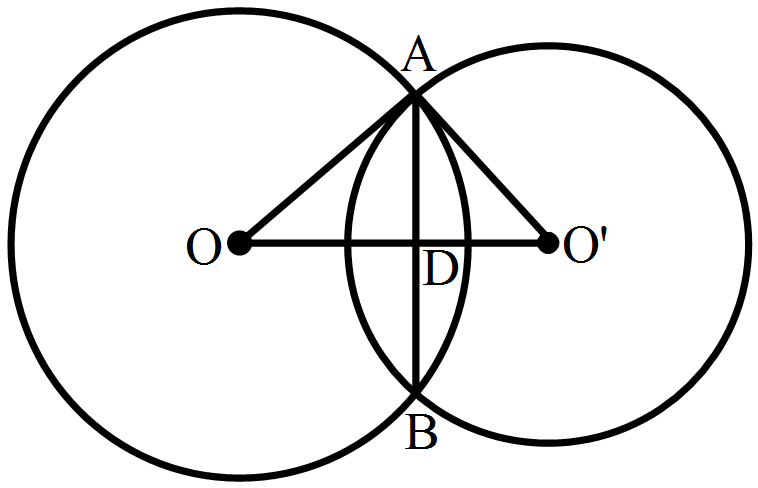
Two circles of radii $10\ cm$ and $8\cm$ intersect each other, and the length of the common chord is $12\ cm$.
Find the distance between their centres.
Answer

Given: $O A=10 cm, O^{\prime} A=8 cm$ and $A B=12 cm$
$AD=\left(\frac{AB}{2}\right)=\left(\frac{12}{2}\right)=6 cm$
Now, in right angled $\triangle ADO$, we have: $O A^2=A D^2+O D^2$
$\Rightarrow O D^2=O A^2-A D^2=10^2-6^2=100-36=64$
$\therefore O D=8 cm$
Similarly, in right angled $\triangle ADO ^{\prime}$, we have: $O^{\prime} A^2=A D^2+O^{\prime} D^2$
$\Rightarrow O^{\prime} D^2=O^{\prime} A^2-A D^2=8^2-6^2=64-36=28$
$\Rightarrow O^{\prime} D=\sqrt{28}=2 \sqrt{7} cm$
Thus, $O O^{\prime}=\left(O D+O^{\prime} D\right)=(8+2 \sqrt{7}) cm$
Hence, the distance between their centres is $(8+2 \sqrt{7}) cm$.
View full question & answer
Question 355 Marks
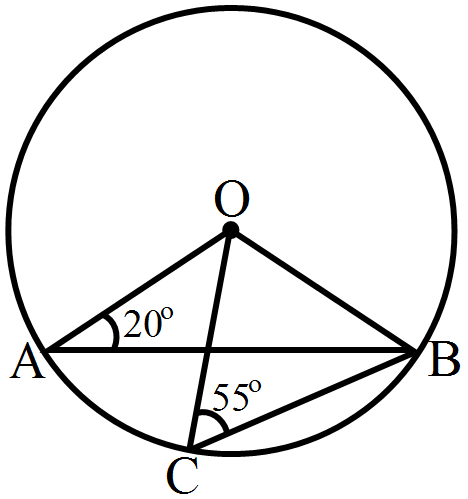
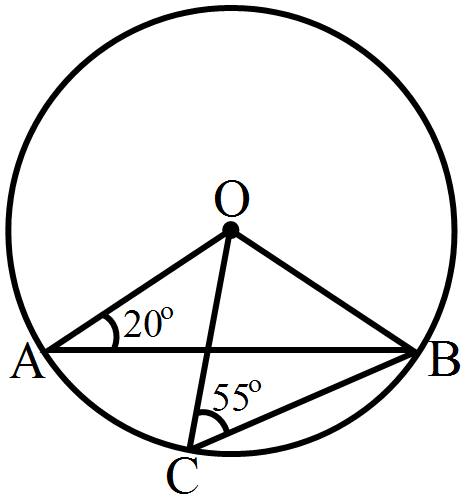
In the given figure, O is the centre of a circle in which $\angle\text{OAB}=20^\circ$and $\angle\text{OCB}=55^\circ.$ Find
  1. $\angle\text{BOC}$
  2. $\angle\text{AOC}$
Answer
  1. OB = OC [Radii of a circle]
$\Rightarrow\ \angle\text{OBC}=\angle\text{OCB}=55^\circ$

Considering $\triangle\text{BOC},$ we have:

$\angle\text{BOC}+\angle\text{OCB}+\angle\text{OBC}=180^\circ$ [Angle sum property of a triangle]

$\Rightarrow\ \angle\text{BOC}+55^\circ+55^\circ=180^\circ$

$\Rightarrow\ \angle\text{BOC}=(180^\circ-110^\circ)=70^\circ$
  1. OA = OB [Radii of a circle]
$\Rightarrow\ \angle\text{OBA}=\angle\text{OAB}=20^\circ$

Considering $\triangle\text{AOB},$ we have:

$\angle\text{AOB}+\angle\text{OAB}+\angle\text{OBA}=180^\circ$ [Angle sum property of a triangle]

$\Rightarrow\ \angle\text{AOB}+20^\circ+20^\circ=180^\circ$

$\Rightarrow\ \angle\text{AOB}=(180^\circ-40^\circ)=140^\circ$

$\therefore\ \angle\text{AOC}=\angle\text{AOB}-\angle\text{BOC}$

$=(140^\circ-70^\circ)$

$=70^\circ$

Hence, $\angle\text{AOC}=70^\circ$
View full question & answer
Question 365 Marks
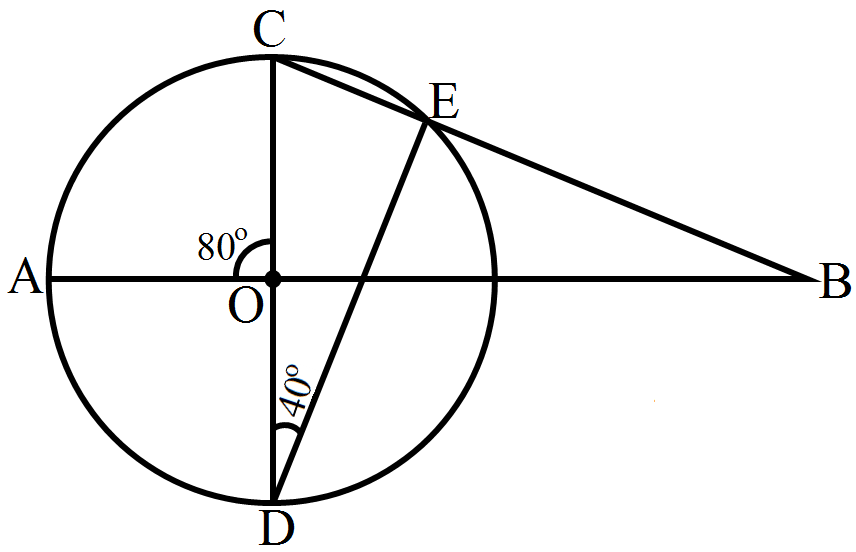
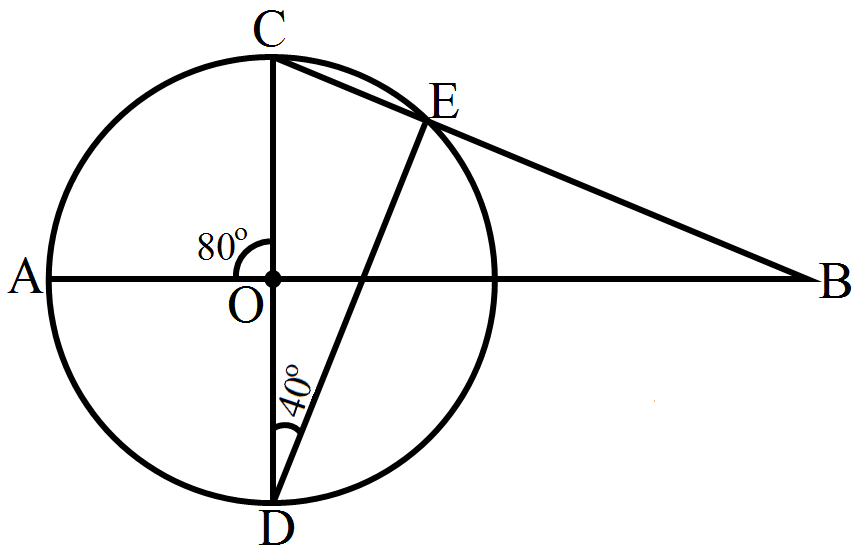
In the given figure, AB and CD are straight lines through the centre O of a circle. If $\angle\text{AOC}=80^\circ$ and $\angle\text{CDE}=40^\circ,$ find
  1. $\angle\text{DCE}$
  2. $\angle\text{ABC}$
Answer
  1. $\angle\text{CED}=90^\circ$ [Angle in a semi circle]
In $\triangle\text{CED},$ we have:

$\angle\text{CED}+\angle\text{EDC}+\angle\text{DCE}=180^\circ$ [Angle sum property of a triangle]

$\Rightarrow\ 90^\circ+40^\circ+\angle\text{DCE}=180^\circ$

$\Rightarrow\ \angle\text{DCE}=(180^\circ-130^\circ)=50^\circ\dots(\text{i})$

$\therefore\ \angle\text{DCE}=50^\circ$
  1. As $\angle\text{AOC}$ and $\angle\text{BOC}$ are linear pair, we have:
$\angle\text{BOC}=(180^\circ-80^\circ)=100^\circ\dots(\text{ii})$

In $\triangle\text{BOC},$ we have:

$\angle\text{ABC}+\angle\text{DCB}+\angle\text{BOC}=180^\circ$ $[\because\ \angle\text{OBC}=\angle\text{ABC}$ and $\angle\text{OCB}=\angle\text{DCE}]$

$\Rightarrow\ \angle\text{ABC}=180^\circ-(\angle\text{BOC}+\angle\text{DCE})$

$\Rightarrow\ \angle\text{ABC}=180^\circ-(100^\circ+50^\circ)$ [From (i) and (ii)]

$\Rightarrow\ \angle\text{ABC}=(180^\circ-150^\circ)=30^\circ$
View full question & answer
Question 375 Marks
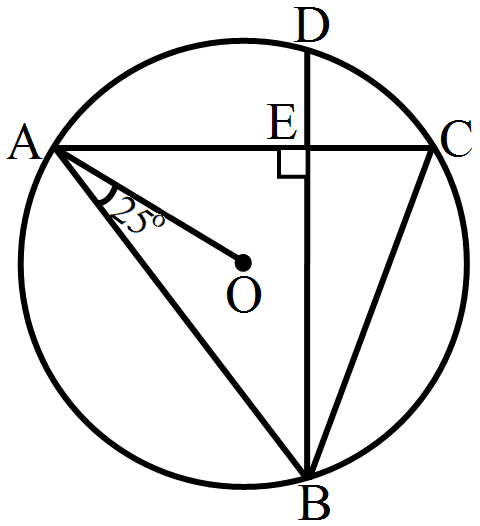
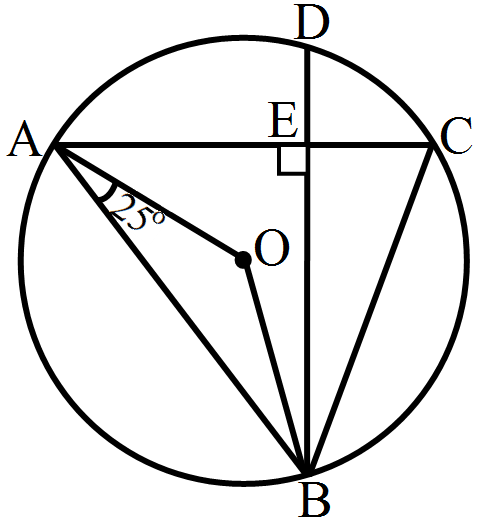
In the adjoining figure, chords AC and BD of a circle with centre O, intersect at right angles at E. If $\angle\text{OAB}=25^\circ,$ calculate $\angle\text{EBC}.$
Answer
OA = OB [Radii of a circle] Thus, $\angle\text{OBA}=\angle\text{OAB}=25^\circ$ Join OB. Now in $\triangle\text{OAB},$ we have:$\angle\text{OAB}+\angle\text{OBA}+\angle\text{AOB}=180^\circ$ [Angle sum property of a triangle]
$\Rightarrow\ 25^\circ+25^\circ+\angle\text{AOB}=180^\circ$
$\Rightarrow\ 50^\circ+\angle\text{AOB}=180^\circ$
$\Rightarrow\ \angle\text{AOB}=(180^\circ-50^\circ)=130^\circ$
We know that the angle subtended by an arc of a circle at the centre is double the angle subtended by the arc at any point on the circumference.$\text{i.e},\angle\text{AOB}=2\angle\text{ACB}$
$\Rightarrow\ \angle\text{ACB}=\frac{1}{2}\angle\text{AOB}=\Big(\frac{1}{2}\times130^\circ\Big)=65^\circ $
Here, $\angle\text{ACB}=2\angle\text{ECB}$$\therefore\ \angle\text{ECB}=65^\circ\dots(\text{i})$
Considering the right angled $\triangle\text{BEC},$ we have:$\angle\text{EBC}+\angle\text{BEC}+\angle\text{ECB}=180^\circ$ [Angle sum property of a triangle]
$\Rightarrow\ \angle\text{EBC}+90^\circ+65^\circ=180^\circ$ [From (i)]
$\Rightarrow\ \angle\text{EBC}=(180^\circ-155^\circ)=25^\circ$
Hence, $ \angle\text{EBC}=25^\circ$
View full question & answer
Question 385 Marks
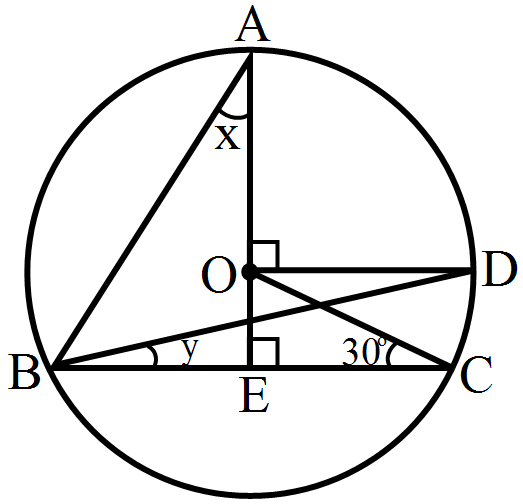
In the given figure, O is the centre of the circle and $\angle\text{BCO}=30^\circ.$ Find x and y.
Answer
In the given figure, OD is parallel to BC.$\therefore\ \angle\text{BCO}=\angle\text{COD}$ [Alternate interior angles]
$\Rightarrow \angle\text{COD}=30^\circ\dots(\text{i})$
We know that the angle subtended by an arc of a circle at the centre is double the angle subtended by it on the remaining part of the circle. Here, arc CD subtends $\angle\text{COD}$ at the centre and $\angle\text{CBD}$ at B on the circle.$\therefore\ \angle\text{COD}=2\angle\text{CBD}$
$\Rightarrow \angle\text{CBD}=\frac{30^\circ}{2}=15^\circ$ [From (i)]
$\therefore\ \text{y}=15^\circ\dots(\text{ii})$
Also, arc AD subtends $\angle\text{AOD}$ at the centre and $\angle\text{ABD}$ at B on the circle.$\therefore\ \angle\text{AOD}=2\angle\text{ABD}$
$\Rightarrow \angle\text{ABD}=\frac{90^\circ}{2}=45^\circ$
In $\triangle\text{ABE},$$\text{x}+\text{y}+\angle\text{ABD}+\angle\text{AEB}=180^\circ$ [Sum of the angles of a triangle]
$\Rightarrow\ \text{x}+15^\circ+45^\circ+90^\circ=180^\circ$ [From (ii) and (iii)]
$\Rightarrow\ \text{x}=180^\circ-(15^\circ+45^\circ+90^\circ)$
$\Rightarrow\ \text{x}=180^\circ-150^\circ$
$\Rightarrow\ \text{x}=30^\circ$
Hence, $\text{x}=30^\circ$ and $\text{y}=15^\circ.$
View full question & answer
Question 395 Marks
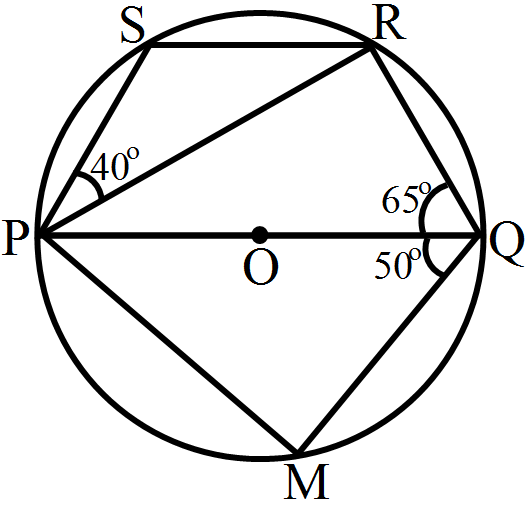
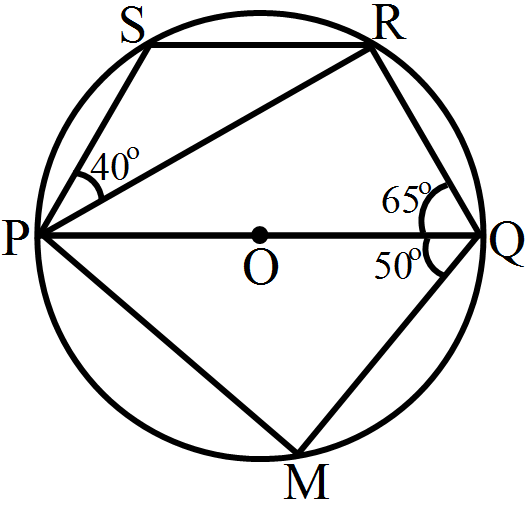
In the given figure, PQ is a diameter of a circle with centre O. If $\angle\text{PQR}=65^\circ,\angle\text{SPR}=40^\circ$ and $\angle\text{PQM}=65^\circ,$ find $\angle\text{QPR},\angle\text{QPM}$ and $\angle\text{PRS}.$
Answer
Here, PQ is the diameter and the angle in a semicircle is a right angle.$\text{i.e},\angle\text{PRQ}=90^\circ$
In $\triangle\text{PRQ},$ we have:$\angle\text{QPR}+\angle\text{PRQ}+\angle\text{PQR}=180^\circ$ [Angle sum property of a triangle]
$\Rightarrow\ \angle\text{QPR}+90^\circ+65^\circ=180^\circ$
$\Rightarrow\ \angle\text{QPR}=(180^\circ-155^\circ)=25^\circ$
In $\triangle\text{PQM}$ PQ is the diameter.$\angle\text{QPM}+\angle\text{PMQ}+\angle\text{PQM}=180^\circ$ [Angle sum property of a triangle]
$\Rightarrow\ \angle\text{QPM}+90^\circ+50^\circ=180^\circ$
$\Rightarrow\ \angle\text{QPM}=(180^\circ-145^\circ)=40^\circ$
Now, in quadrilateral PQRS, we have:$\angle\text{QPS}+\angle\text{SRQ}=180^\circ$ [Opposite angles of a cyclic quadrilateral]
$\Rightarrow\ \angle\text{QPR}+\angle\text{RPS}+\angle\text{PRQ}+\angle\text{PRS}=180^\circ$
$\Rightarrow\ 25^\circ+40^\circ+90^\circ+\angle\text{PRS}=180^\circ$
$\Rightarrow\ \angle\text{PRS}=180^\circ-155^\circ=25^\circ$
$\therefore\ \angle\text{PRS}=25^\circ$
Thus, $ \angle\text{QPR}=25^\circ, \angle\text{QPM}=25^\circ,\angle\text{PRS}=25^\circ$
View full question & answer
Question 405 Marks
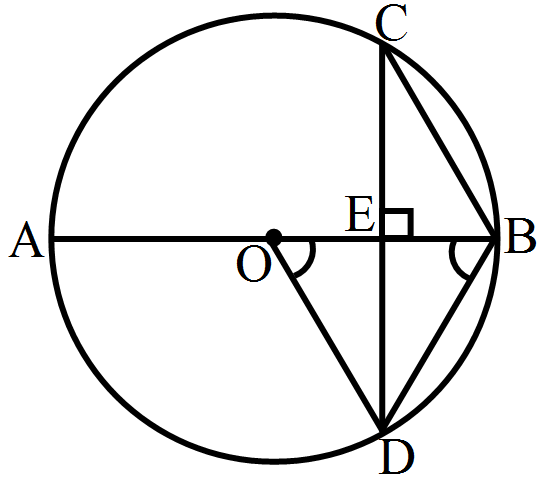
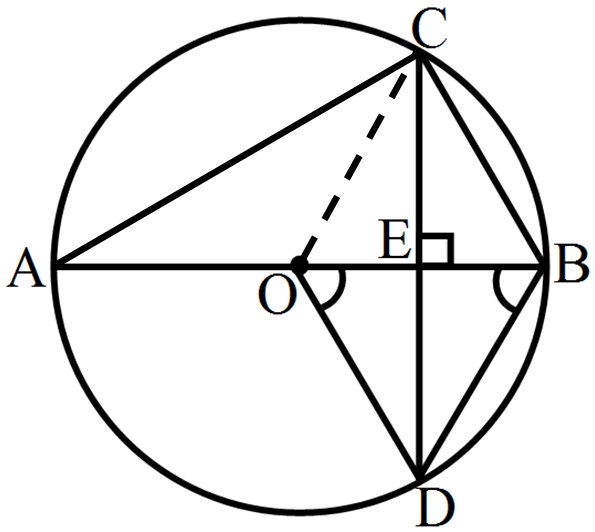
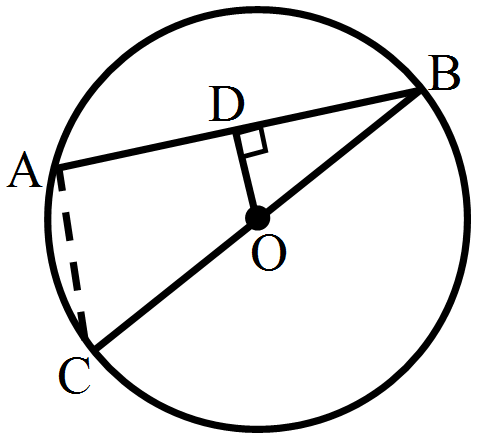
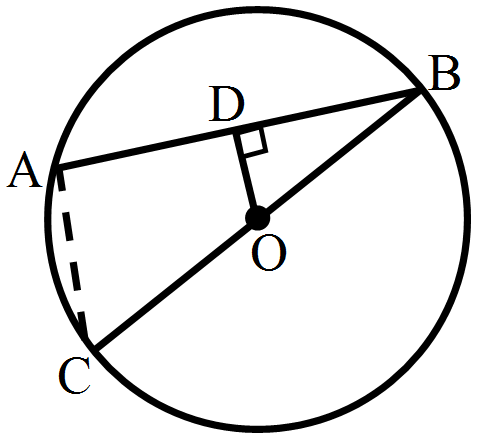
In the adjoining figure, OD is perpendicular to the chord AB of a circle with centre O. If BC is a diameter, show that AC || CD and AC = 2 × OD.
Answer
Given: BC is a diameter of a circle with centre O and $\text{OD}\perp\text{AB}.$ To prove: AC parallel to OD and AC = 2 × OD Construction: Join AC. Proof: We know that the perpendicular from the centre of a circle to a chord bisects the chord. Here, $\text{OD}\perp\text{AB}.$ D is the mid point of AB. i.e., AD = BD Also, O is the midpoint of BC. i.e., OC = OB Now, in $\triangle\text{ABC},$ we have: D is the midpoint of AB and O is the mid point of BC. According to the mid point theorem, the line segment joining the mid points of any two sides of a triangle is parallel to the third side and equal to half of it. i.e., OD || AC and $\text{OD}=\frac{1}{2}\text{AC}$$\therefore$ AC = 2 × OD
Hence, proved.
View full question & answer
Question 415 Marks
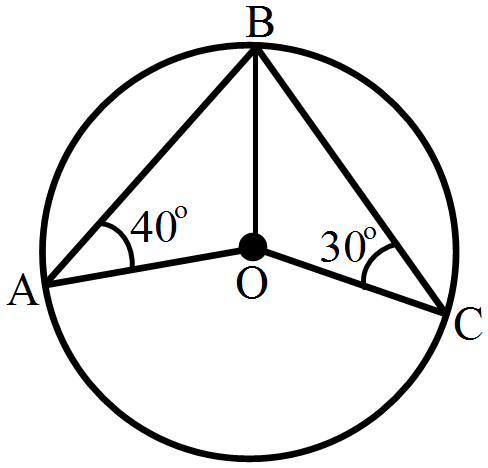
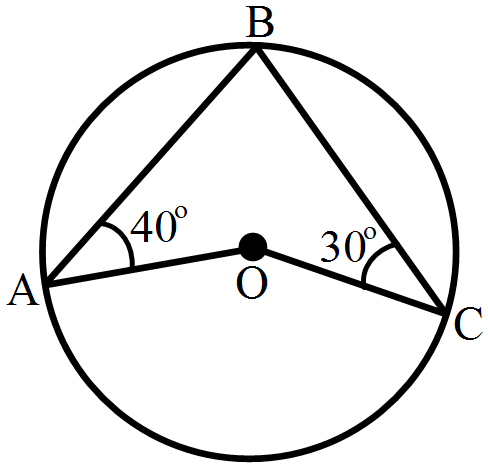
  1. In Figure (1), O is the centre of the circle. If $\angle\text{OAB}=40^\circ$ and $\angle\text{OCB}=30^\circ,$ find $\angle\text{AOC}.$
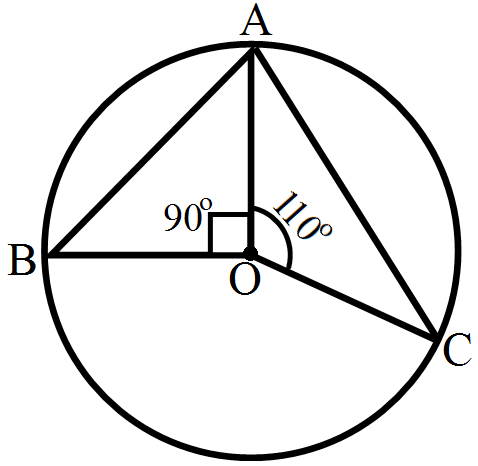
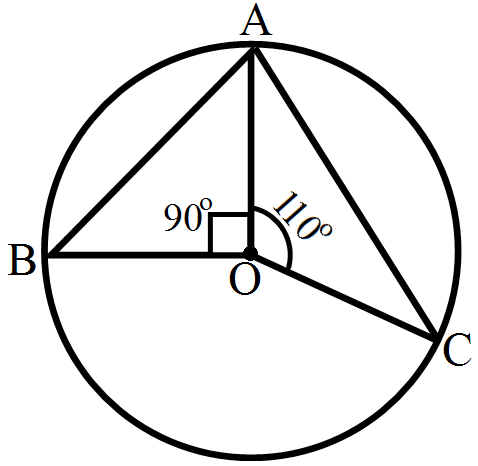
  2. In Figure (2), A, B and C are three points on the circle with centre O such that $\angle\text{AOB}=90^\circ$ and $\angle\text{AOC}=110^\circ.$ Find $\angle\text{BAC}.$


Answer
  1. Join BO.


In $\triangle\text{BOC},$ we have:

OC = OB [Radii of a circle]

$\Rightarrow\ \angle\text{OBC}=\angle\text{OCB}$

$\angle\text{OBC}=30^\circ\dots(\text{i})$

In $\triangle\text{BOA},$ we have:

OB = OA (Radii of a circle)

$\Rightarrow\ \angle\text{OBA}=\angle\text{OAB}$ $[\because\ \angle\text{OAB}=40^\circ]$

$\angle\text{OBA}=40^\circ\dots(\text{ii})$

Now, we have:

$\angle\text{ABC}=\angle\text{OBC}+\angle\text{OBA}$

$=30^\circ+40^\circ$ [From (i) and (ii)]

$\therefore\ \angle\text{ABC}=70^\circ$

The angle subtended by an arc of a circle at the centre is double the angle subtended by the arc at any point on the circumference.

i.e., $\angle\text{AOC}=2\angle\text{ABC}$

$=(2\times70^\circ)=140^\circ$
  1.  


Here, $\angle\text{BOC}=[360^\circ-(90^\circ+110^\circ)]$

$=(360^\circ-200^\circ)=160^\circ$

We know that $\angle\text{BOC}=2\angle\text{BAC}.$

$\Rightarrow\ \angle\text{BAC}=\frac{\angle\text{BOC}}{2}=\Big(\frac{160^\circ}{2}\Big)=80^\circ$

Hence, $\angle\text{BAC}=80^\circ$
View full question & answer
Question 425 Marks
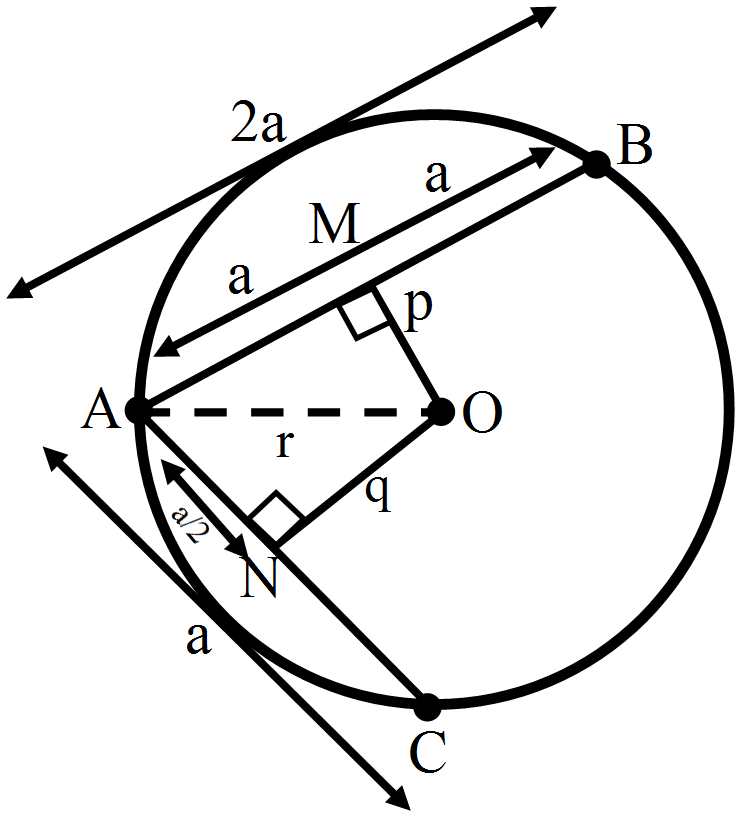
AB and AC are two chords of a circle of radius r such that AB = $2AC.$
If p and q are the distances of AB and AC from the centre then prove that $4q^2 = p^2 + 3r^2.$
Answer
Let AC = a. Since, AB = 2AC, $\therefore$ AB = 2a.

From centre O, perpendicular is drawn to the chords AB and AC at points M and N, respectively.
It is given that OM = p and ON = q.
We know that perpendicular drawn from the centre to the chord, bisects the chord.
$\therefore$ AM = MB = a ...(1)
and $\text{AN}=\text{NC}=\frac{\text{a}}{2}\dots(2)$ In $\triangle\text{OAN},$
$(AN)^2 + (NO)^2 = (OA)^2$​​​​​​​ [Pythagoras theorem]
$\Rightarrow\ \Big(\frac{\text{a}}{2}\Big)^2+(\text{q})^2=(\text{r})^2$
$\Rightarrow\ \frac{\text{a}^2}{4}+\text{q}^2=\text{r}^2$
$\Rightarrow \frac{\text{a}^2+4\text{q}^2}{4}=\text{r}^2$
$\Rightarrow\ \text{a}^2+4\text{q}^2=4\text{r}^2$
$\Rightarrow\ \text{a}^2=4\text{r}^2-4\text{q}^2\dots(3)$
In $\triangle\text{OAM},$$(\text{AM})^2+(\text{MO})^2=(\text{OA})^2$ [Pythagoras theorem]
$\Rightarrow\ (\text{a})^2+\text{p}^2=(\text{r)}^2$
$\Rightarrow\ (\text{a})^2=(\text{r)}^2-\text{p}^2\dots(4)$
From equation (3) and (4),$4\text{r}^2-4\text{q}^2=\text{r}^2-\text{p}^2$
$\Rightarrow\ 4\text{r}^2-\text{r}^2+\text{p}^2=4\text{q}^2$
$\Rightarrow\ 3\text{r}^2+\text{p}^2=4\text{q}^2$
Hence, $4\text{q}^2=\text{p}^2+3\text{r}^2$
View full question & answer
Question 435 Marks
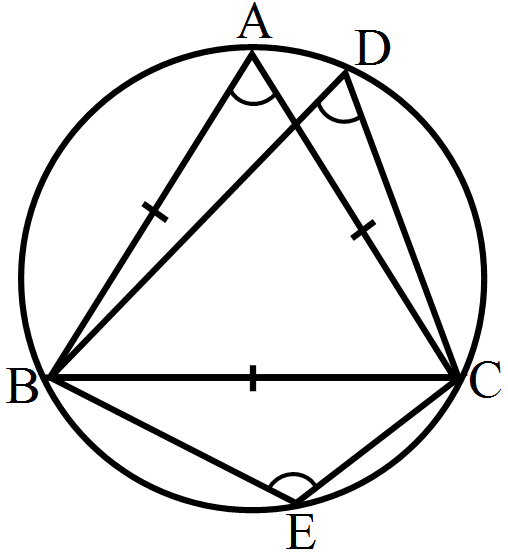
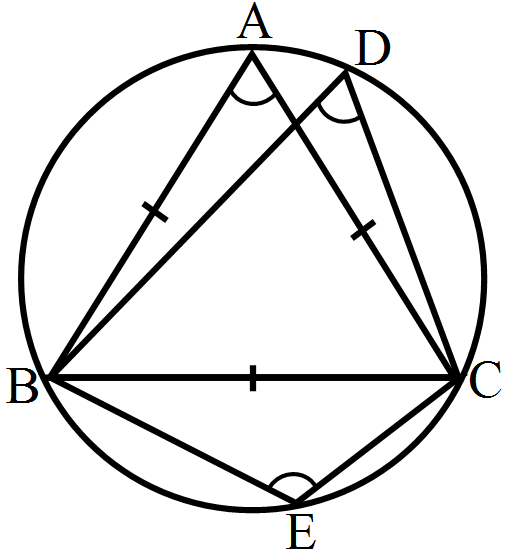
In the given figure, $\triangle\text{ABC}$ is equilateral. Find
  1. $\angle\text{BDC}$
  2. $\angle\text{BEC}$
Answer
  1. Given: $\triangle\text{ABC}$ is an equilateral triangle
i.e., each of its angle = 60°

$\Rightarrow\ \angle\text{BAC}=\angle\text{ABC}=\angle\text{ACB}=60^\circ$

Angles in the same segment of a circle are equal.

$\text{i.e.},\angle\text{BDC}=\angle\text{BAC}=60^\circ$

$\therefore\ \angle\text{BDC}=60^\circ$
  1. The opposite angles of a cyclic quadrilateral are supplementary.
Then in cyclic quadrilateral ABEC, we have:

$\angle\text{BAC}+\angle\text{BEC}=180^\circ$

$\Rightarrow\ 60^\circ+\angle\text{BEC}=180^\circ$

$\Rightarrow\ \angle\text{BEC}=(180^\circ-60^\circ)=120^\circ$

$\therefore\ \angle\text{BDC}=60^\circ$ and $\angle\text{BEC}=120^\circ$
View full question & answer
Question 445 Marks
In the given figure, O is the centre of the circle, BD = OD and $\text{CD}\perp\text{AB}.$ Find $\angle\text{CAB}.$
Answer
In the given figure, BD = OD and $\text{CD}\perp\text{AB}.$ Join AC and OC. In $\triangle\text{ODE}$ and $\triangle\text{DBE},$$\angle\text{DOE}=\angle\text{DBE}$ [given]
$\angle\text{DEO}=\angle\text{DEB}=90^\circ$
OD = DB [given]$\therefore$ By AAS conguence rule, $\triangle\text{ODE}\cong\triangle\text{BDE},$
Thus, OE = EB ...(1) Now, in $\triangle\text{COE}$ and $\triangle\text{CBE},$ CE = CE [common]$\angle\text{CEO}=\angle\text{CEB}=90^\circ$
OE = EB [From (1)]$\therefore$ By AAS conguence rule, $\triangle\text{COE}\cong\triangle\text{CBE},$
Thus, CO = CB ...(2) Also, CO = OB = OA [radius of the circle] ...(3) From (2) and (3), CO = CB = OB$\therefore\ \triangle\text{COB}$ is equilateral triangle.
$\therefore\ \triangle\text{COB}=60^\circ\dots(4)$
We know that the angle subtended by an arc of a circle at the centre is double the angle subtended by it on the remaining part of the circle. Here, arc CB subtends $\angle\text{COB}$ at the centre and $\angle\text{CAB}$ at A on the circle.$\therefore\ \angle\text{COB}=2\angle\text{CAB}$
$\Rightarrow\ \angle\text{CAB}=\frac{60^\circ}{2}=30^\circ$ [From (4)]
Hence, $\angle\text{CAB}=30^\circ.$
View full question & answer
Question 455 Marks
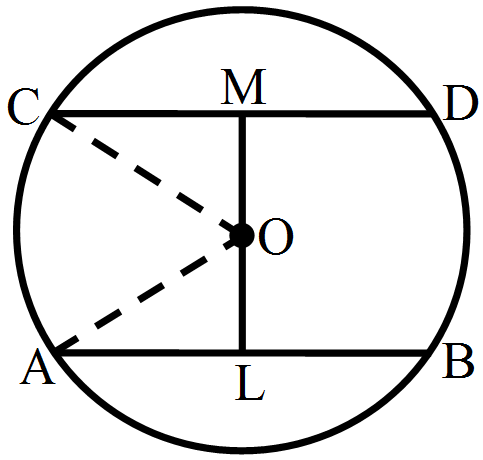
In a circle of radius $5\ cm$, $AB$ and $CD$ are two parallel chords of lengths $8\ cm$ and $6\ cm$ respectively. Calculate the distance between the chords if they are:
  1. On the same side of the centre.
  2. On the opposite sides of the centre.
Answer
We have:
i.Let $AB$ and $CD$ be two chords of a circle such that $AB$ is parallel to $CD$ on the same side of the circle.
Given: $AB = 8\ cm$, $CD = 6\ cm$ and $OB = OD = 5\ cm$
Join $OL$ and $OM$.


The perpendicular from the centre of a circle to a chord bisects the chord.
$\therefore\ \text{LB}=\frac{\text{AB}}{2}=\Big(\frac{8}{2}\Big)=4\text{cm}$
Now, in right angled $\triangle\text{BLO},$ we have:
$OB^2 = LB^2 + LO^2$
$\Rightarrow LO^2= OB^2 - LB^2$
$\Rightarrow LO^2= 5^2 - 4^2$
$\Rightarrow LO^2= 25 - 16 = 9$
Similarly,
$\Rightarrow MO = 4cm$
$\therefore$ Distance between the chords$ = (MO - LO) = (4 - 3)\ cm = 1\ cm.$
ii.Let $AB$ and $CD$ be two chords of a circle such that $AB$ is parallel to $CD$ and they are on the opposite sides of the centre.
Given: $AB = 8\ cm$ and $CD = 6\ cm$
Draw $\text{OL}\perp\text{AB}$ and $\text{OM}\perp\text{CD}.$


Join $OA$ and $OC$.
$OA = OC = 5\ cm$ [Radii of a circle]
The perpendicular from the centre of a circle to a chord bisects the chord.
$\therefore\ \text{AL}=\frac{\text{AB}}{2}=\Big(\frac{8}{2}\Big)=4\text{cm}$
Now, in right angled $\triangle\text{OLA},$ we have:
$OA^2 = AL^2 + LO^2$
$\Rightarrow LO^2= OA^2 - AL^2$
$\Rightarrow LO^2 = 5^2 - 4^2$
$\Rightarrow LO^2 = 25 - 16 = 9$
$\therefore$ $LO = 3\ cm$
Similarly, $\text{CM}=\frac{\text{CD}}{2}=\Big(\frac{6}{2}\Big)=3\text{cm}$
In right angled $\triangle\text{CMO},$ we have:
$OC^2 = CM^2 + MO^2$
$\Rightarrow MO^2 = OC^2 - CM^2$
$\Rightarrow MO^2= 5^2 - 3^2$
$\Rightarrow MO^2= 25 - 9 = 16$
$\therefore$ $MO = 4\ cm$
Hence, distance between the chords $= (MO + LO) = (4 + 3) cm = 7\ cm.$
View full question & answer
Question 465 Marks
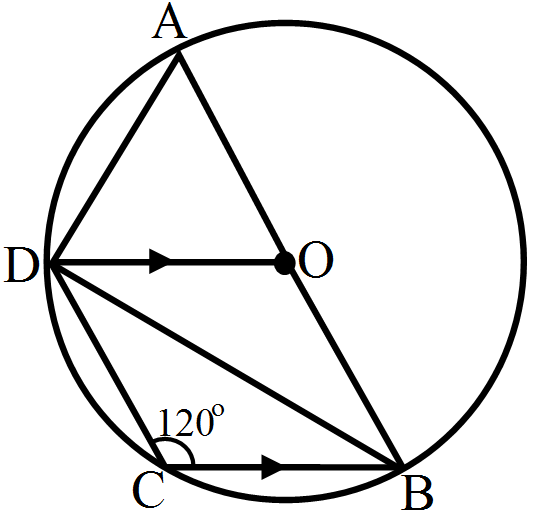
In the given figure, AB is a diameter of a circle with centre O and DO || CB. If $\angle\text{BCD}=120^\circ,$ calculate
  1. $\angle\text{BAD}$
  2. $\angle\text{ABD}$
  3. $\angle\text{CBD}$
  4. $\angle\text{ADC}$
Also, show that $\triangle\text{AOD}$ is an equilateral triangle.
Answer
We have, AB is a diameter of the circle where O is the centre, DO || BC and $\angle\text{BCD}=120^\circ.$ Since ABCD is a cyclic quadrilateral, we have:$\angle\text{BCD}+\angle\text{BAD}=180^\circ$
$\Rightarrow\ 120^\circ+\angle\text{BAD}=180^\circ$
$\Rightarrow\ \angle\text{BAD}=(180^\circ-120^\circ)=60^\circ$
$\therefore\ \angle\text{BAD}=60^\circ$
$ \angle\text{BAD}=90^\circ$ [Angle in a semicircle]
In $\triangle\text{ABD},$ we have:$\angle\text{BDA}+\angle\text{BAD}+\angle\text{ABD}=180^\circ$
$\Rightarrow\ 90^\circ+60^\circ+\angle\text{ABD}=180^\circ$
$\Rightarrow\ \angle\text{ABD}=(180^\circ-150^\circ)=30^\circ$
$\therefore\ \angle\text{ABD}=30^\circ$
OD = OA [Radii of a circle]$\angle\text{ODA}=\angle\text{OAD}$
$=\angle\text{BAD}=60^\circ$
$\angle\text{ODB}=90^\circ-\angle\text{ODA}=(90^\circ-60^\circ)=30^\circ$
Here, DO || BC [Given; alternate angles]$\angle\text{CBD}=\angle\text{ODB}=30^\circ$
$\therefore\ \angle\text{CBD}=30^\circ$
$\angle\text{ADC}=\angle\text{ADB}+\angle\text{CDB}$
$=90^\circ+30^\circ=120^\circ$
In $\triangle\text{AOD},$ we have:$\angle\text{ODA}+\angle\text{OAD}+\angle\text{AOD}=180^\circ$
$\Rightarrow\ 60^\circ+60^\circ+\angle\text{AOD}=180^\circ$
$\Rightarrow\ \angle\text{AOD}=(180^\circ-120^\circ)=60^\circ$
Since all the angles of $\triangle\text{AOD}$ are of 60° each, $\triangle\text{AOD}$ is an equilateral triangle.
View full question & answer
5 Mark Question - Maths STD 9 Questions - Vidyadip