Question 1015 Marks
Find the value of k for which the root are real and equal in the following equations:
$(2k + 1)x^2 + 2(k + 3)x + (k + 5) = 0$
AnswerThe given equation is $(2k + 1)x^2 + 2(k + 3)x + (k + 5) = 0$
This equation is in the form of $ax^2 + bx + c = 0$
Here a = 2k + 1, b = 2(k + 3) and c = k + 5
Given that the nature of the roots for this equation are real and equal i.e.,
$D = b^2 - 4ac$
$\Rightarrow [2(k + 3)]^2 - 4[2k + 1][k + 5] = 0$
$\Rightarrow (k + 3)^2 - (2k + 1)(k + 5) = 0$
$\Rightarrow k^2 + 9 + 6k - [2k^2 + 11k + 5] = 0$
$\Rightarrow -k^2 - 5k + 4 = 0$
$\Rightarrow k^2 + 5k - 4 = 0 ....(i)$
$\Rightarrow k^2 + 4k + k - 4 = 0$
The value of 'k' an be obtained by $\text{k} = {-\text{b} \pm \sqrt{\text{b}^2-4\text{ac}} \over 2\text{a}}$
Where from (i), a = 1, b = 5, c = -4
$\text{k}=\frac{-5\pm\sqrt{25-4\times1\times-4}}{2\times1}$
$=\frac{-5+\sqrt{25+16}}{2}$
$=\frac{-5+\sqrt{41}}{2}$
$\text{k}=\frac{-5-\sqrt{25-4\times1\times-4}}{2\times1}$
$=\frac{-5-\sqrt{25+16}}{2}$
$=\frac{-5-\sqrt{41}}{2}$
$\therefore$ The value of 'k' from the given equation are $\frac{-5\pm\sqrt{41}}{2}$
View full question & answer→Question 1025 Marks
The hypotenuse of a right is $3\sqrt{10}\text{cm}.$ If the smaller leg is tripled and the longer leg doubled, new hypotenuse will be $9\sqrt{5}\text{cm}.$ How long are the legs of the triangle?
AnswerUsing Pythagoras theorem,
$(AB)^2 + (BC)^2 = (AC)^2$
$\Rightarrow (2y)^2cm^2 + (3x)^2cm^2$
$=(9\sqrt{5})^2\text{cm}^2$
$\Rightarrow 4y^2+ 9x^2= 81 \times 5$
$\Rightarrow 4y^2 + 9x^2 = 405$
$\Rightarrow 4(90 - x^2) + 9x^2 = 405$
$\Rightarrow 4 \times 90 - 4x^2 + 9x^2 = 405$
$\Rightarrow 5x^2 = 405 - 360$
$\Rightarrow 5x^2 = 405 - 360$
$\Rightarrow 5x^2 = 45$
$\Rightarrow x^2 = 9$
$\Rightarrow\text{x}=\sqrt{3^2}$
$\Rightarrow\text{x}=\pm3$
Since, x cannot be a negative value. So x = 3cm
We have,
$x^2 + y^2= 90$
$\Rightarrow y^2 = 90 - (3)^2$
$\Rightarrow y^2 = 90 - 9$
$\Rightarrow y^2 = 81$
$\Rightarrow\text{y}=\sqrt{81}$
$\Rightarrow\text{y}=\pm9$
Since, y cannot be a negative value. So y = 9cm
$\therefore$ Hence the length of the smaller side is 3cm and the length of the longer side is 9cm
View full question & answer→Question 1035 Marks
Solve the following quadratic equations by factorization:
$ax^2 + (4a^2 - 3b)x - 12ab = 0$
AnswerWe have,
$ax^2 + (4a^2 - 3b)x - 12ab = 0$
$[a \times 12ab = -12a^2b^2 = 4a^2 \times -3b]$
$\Rightarrow ax^2 + 4a^2x - 3bx + (4a \times (-3b)) = 0$
$\Rightarrow ax(x + 4a) - 3b(x + 4a) = 0$
$\Rightarrow (x + 4a)(ax - 3b) = 0$
$\Rightarrow (x + 4a) = 0 or (ax - 3b) = 0$
$\Rightarrow x = -4a$ or $\text{x}=\frac{3\text{b}}{\text{a}}$
$\therefore\text{x}=\frac{3\text{b}}{\text{a}}$ and x = -4a are the two roots of the given equations.
View full question & answer→Question 1045 Marks
Solve the following quadratic equations by factorization:
$\frac{16}{\text{x}}-1=\frac{15}{\text{x}+1},$ $\text{x}\neq0,-1$
Answer$\frac{16}{\text{x}}-1=\frac{15}{\text{x}+1}$
$\Rightarrow\frac{16-\text{x}}{\text{x}}-\frac{15}{\text{x}+1}$
$\Rightarrow 16x + 16 - x^2 - x = 15x$
$\Rightarrow -x^2 + 16 + 15x = 15x$
$\Rightarrow -x^2 + 16 = 0$
$\Rightarrow x^2 - 16 = 0$
$\Rightarrow (x - 4)(x + 4) = 0$
$\Rightarrow x - 4 = 0 or x + 4 = 0$
$\Rightarrow x = 4 or x = -4$
Hence, the factors are 4 and -4
View full question & answer→Question 1055 Marks
A pole has to be erected at a point on the boundary of a circular park of diameter 13 meters in such a way that the difference of its distance from two diametrically opposite fixed gates A and B on the boundary is 7 meters. Is it the possible to do so? If yes, at what distances from the two gates should the pole be erected?
AnswerLet P be the required location on the boundary of a circular park such that its distance gate B is
= x metres that is BP = x metres
Then, AP = x + 7
In the right triangle ABP we have by using Pythagoras theorem
$\Rightarrow AP^2 + BP^2 = AB^2$
$\Rightarrow (x + 7)^2 + x^2 = (13)^2$
$\Rightarrow x^2 + 14x + 49 + x^2 = 169$
$\Rightarrow 2x^2 + 14x + 49 - 169 = 0$
$\Rightarrow 2x^2 + 14x - 120 = 0$
$\Rightarrow 2(x^2 + 7x - 60) = 0$
$\Rightarrow x^2 + 7x - 60 = 0$
$\Rightarrow x^2 + 12x - 5x - 60 = 0$
$\Rightarrow x(x + 12) - 5(x + 12) = 0$
$\Rightarrow (x + 12)(x - 5) = 0$
$\Rightarrow (x + 12) = 0 or (x - 5) = 0$
$\Rightarrow x = -12 or x = 5$
But, the side of right triangle can never be negative.
Therefore, x = 5
Hence, P is at a distance of 5 meters from the gate B.
View full question & answer→Question 1065 Marks
Solve the following quadratic equation by factorization:
$3\Big(\frac{3\text{x}-1}{2\text{x}+3}\Big)-2\Big(\frac{2\text{x}+3}{3\text{x}-1}\Big)=5,$ $\text{x}\neq\frac{1}{3},-\frac{3}{2}$
Answer$3\Big(\frac{3\text{x}-1}{2\text{x}+3}\Big)-2\Big(\frac{2\text{x}+3}{3\text{x}-1}\Big)=5$
Let $\Big(\frac{3\text{x}-1}{2\text{x}+3}\Big)=\text{y},$ then $\Big(\frac{2\text{x}+3}{3\text{x}-1}\Big)=\frac{1}{\text{y}}$
$\therefore3\text{y}-\frac{2}{\text{y}}=5$
$\Rightarrow3\text{y}^2-2=5\text{y}$
$\Rightarrow3\text{y}^2-5\text{y}-2=0$
$\Rightarrow3\text{y}^2-6\text{y}+\text{y}-2=0$
$\Rightarrow(\text{y}-2)(3\text{y}+1)=0$
Either $\text{y}-2=0,$ then $\text{y}=2$
or $3\text{y}+1=0,$ then $3\text{y}=-1$
$\Rightarrow\text{y}=\frac{-1}{3}$
When $\text{y}=2,$ then
$\frac{3\text{x}-1}{2\text{x}+3}=2$
$\Rightarrow3\text{x}-1=2(2\text{x}+3)$
$\Rightarrow3\text{x}-1=4\text{x}+6$
$\Rightarrow3\text{x}-4\text{x}=6+1$
$\Rightarrow-\text{x}=7$
$\Rightarrow\text{x}=-7$
If $\text{y}=\frac{-1}{3},$ then
$\frac{3\text{x}-1}{2\text{x}+3}=\frac{-1}{3}$
$\Rightarrow9\text{x}-3=-2\text{x}-3$
$\Rightarrow9\text{x}+2\text{x}=-3+3$
$\Rightarrow11\text{x}=0$
$\Rightarrow\text{x}=0$
$\Rightarrow\text{x}=0,7$
View full question & answer→Question 1075 Marks
Find the value of k for which the following equation have real root:
$kx(x - 2) + 6 = 0$
AnswerThe given quadric equation is kx(x - 2) + 6 = 0 and roots are real and equal.
Then find the value of k.
Here, $kx(x - 2) + 6 = 0$
$kx^2 - 2kx + 6 = 0$
$So, a = k, b = -2k$ and $c = 6$
As we knoe that $D = b^2 - 4ac$
Putting the value of a = k, b = -2k and c = 6
$= (-2k)^2 - 4 \times k \times 6$
$= 4k^2 - 24k$
The given equation will have real and equal roots, if D = 0
$4k^2 - 24k = 0$
Now factorizing of the above equation
4k(k - 6) = 0
k(k - 6) = 0
So, either
k = 0 or (k - 6) = 0
(k - 6) = 0
k = 6
Therefore, the value of k = 0, 6
View full question & answer→Question 1085 Marks
In the following, determine the set of values of k for which the given quadratic equation has real root:
$2x^2 - 5x - k = 0$
AnswerThe given equation is $2x^2 - 5x - k = 0$
Given that the equation has real roots i.e.,
$\text{D}=\text{b}^2-4\text{ac}\geq0$
$\Rightarrow25-4\times2\times-\text{k}\geq0$
$\Rightarrow25+8\text{k}\geq0$
$\Rightarrow8\text{k}\geq-25$
The value of k should not excees $\frac{25}{8}$ to have real roots.
View full question & answer→Question 1095 Marks
In the centre of a rectangular lawn of dimensions 50m x 40m, a rectangular pond has to be constructed so that the area of the grass surrounding the pond would be $1184m^2$. Find the length and breadth of the pond.
AnswerGiven that a rectangular pond has to be constructed in the centre of a rectangular lawn of dimensions 50m x 40m.
So, the distance between pond and lawn would be same around the pond. Say x m.
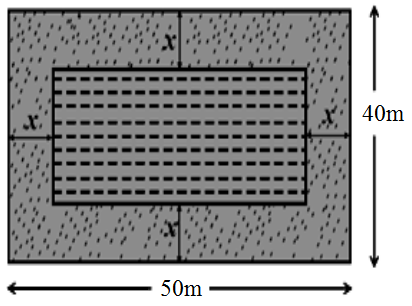
Now, length of rectangular lawn ($l_1$) = 50m
and breadth of rectangular lawn ($b_1$) = 40m
Length of rectangular pond (l2) = 50 - (x + x) = 50 - 2x
Also, area of the grass surrounding the pond$ = 1184m^2$
Area of rectangular lawn - Area of rectangular pond = Area of grass surrounding the pond
$l_1 \times b_1 - l_2 \times b_2 = 1184$ [$\because$ area of rectangle = length x breadth]
$\Rightarrow 50 \times 40 - (50 - 2x)(40 - 2x) = 1184$
$\Rightarrow 2000 - (2000 - 80x - 100x + 4x^2) = 1184$
$\Rightarrow 80x + 100x - 4x^2 = 1184$
$\Rightarrow 4x^2 - 180x + 1184 = 0$
$\Rightarrow x^2 - 45x + 296 = 0$
$\Rightarrow x^2 - 37x - 8x + 296 = 0$ [by splitting the middle term]
$\Rightarrow x(x - 37) - 8(x - 37) = 0$
$\Rightarrow (x - 37)(x - 8) = 0$
$\Rightarrow x = 8$
[At x = 37, length and breadth, of pond are -24 and -34, respectively but length and breadth cannot be negative. So, x = 37 cannot be possible]
Length of pond = 50 - 2x = 50 - 2(8) = 50 - 16 = 34m
and breadth of pond = 40 - 2x = 40 - 2(8) = 50 - 16 = 34m
Hence, required length and .breadth of pond are 34 m and 24 m, respectively.
View full question & answer→Question 1105 Marks
If the list price of a toy is reduced by Rs. 2, a person can buy 2 toys more for Rs. 360. Find the original price of the toy.
AnswerLet the original list price of the toy be Rs. x
Then, the number of toys brought for Rs. 360 $=\frac{360}{\text{x}}$
According to question, reduced list price of the toys = Rs. (x - 2)
Therefore, the number of tpys brought for Rs. 360 $=\frac{360}{\text{x}-2}$
It is given that
$\frac{360}{\text{x}-2}-\frac{360}{\text{x}}=2$
$\frac{360\text{x}-360(\text{x}-2)}{(\text{x}-2)\text{x}}=2$
$\frac{360\text{x}-360\text{x}+720}{(\text{x}-2)\text{x}}=2$
$\frac{720}{(\text{x}-2)\text{x}}=2$
$2(x^2 - 2x) = 720$
$(x^2 - 2x) = 360$
$x^2 - 2x - 360 = 0$
$x^2 + 18x - 20x - 360 = 0$
$x(x + 18) - 20(x + 18) = 0$
$(x + 18)(x - 20) = 0$
$(x + 18) = 0 or (x -20) = 0$
$x = -18 or x = 20$
Because x cannot be negative.
Thus, x = 20 is the require solution.
Therefore, the original list price of the toy be x = Rs. 20
View full question & answer→Question 1115 Marks
A girls is twice as old as her sister. Four years hence, the product of their ages (in years) will be 160. Find their present ages.
AnswerLet the present age of girl be x years then, age of her sister $\Big(\frac{\text{x}}{2}\Big)\text{ years}$
Then, 4 years later, age of girl = (x + 4) years and her sisther's be $\Big(\frac{\text{x}}{2}+4\Big)\text{ years}$
Then according to question,
$(\text{x}+4)\Big(\frac{\text{x}}{2}+4\Big)=160$
$(x + 4)(x + 8) = 160 \times 2$
$x^2 + 8x + 4x + 32 = 320$
$x^2 + 12x + 32 - 320 = 0$
$x^2 + 12x - 288 = 0$
$x^2 - 12x + 24x - 288 = 0$
$x(x - 12) + 24(x - 12) = 0$
$(x - 12)(x + 24) = 0$
So, either
$(x - 12) = 0$
$x = 12$
$Or (x + 24) = 0$
$x = -24$
But the age neaver be negative
therefore, when x = 12 then
$\frac{\text{x}}{12}=\frac{12}{2}$
Hence, the present age of girl be = 12 years and her sisther's age be 6 years.
View full question & answer→Question 1125 Marks
If a, b, c, are real numbers such that $\text{ac}\neq0,$ then show that at least one of the equations $ax^2+ bx + c = 0$ and $-ax^2 + bx + c = 0$ has real roots.
AnswerThe given equation are,
$ax^2+ bx + c = 0 ....(i)$
$-ax^2+ bx + c = 0 .....(ii)$
Roots are simultaneously real
Let $D_1$ and $D_2$ be the discriminants of equation (i) and (ii) respectively,
Then, $D_1 = b^2 - 4ac$
$D_1 = b^2 - 4ac$
$And D_2 = b^2 - 4ac$
$D_2 = b^2 - 4(-a)c$
$D_2 = b^2 + 4ac$
Both the given equation will have real roots, if $\text{D}_1\geq0$ and $\text{D}_2\geq0$
Thus, $\text{b}^2-4\text{ac}\geq0$
$\text{b}^2\geq0\ ....(\text{iii})$
and, $\text{b}^2+4\text{ac}\geq0\ ....(\text{iv})$
Now given that a, b, c, are real number and $\text{ac}\neq0$ as well as from equations (iii) and (iv) we get. At least one of the given equation has real roots,
Hence, proved.
View full question & answer→Question 1135 Marks
Find the value of k for which the following equation have real root:
$\text{kx}(\text{x}-2\sqrt{5})+10=0$
AnswerThe given quadratic equation is $\text{kx}(\text{x}-2\sqrt{5})+10=0,$ and roots are real and equal.
Then find rhe value of k.
$\text{kx}(\text{x}-2\sqrt{5})+10=0$
$\Rightarrow\text{kx}(\text{x}-2\sqrt{5})+10=0$
So, $\text{a}=\text{k},\text{b}=-2\sqrt{5}\text{k}$ and $\text{c}=10$
As we know that $\text{D}=\text{b}^2-4\text{ac}$
Putting the value of $\text{a}=\text{k},\text{b}=-2\sqrt{5}\text{k}$ and $\text{c}=10$
$\text{D}=(-2\sqrt{5}\text{k})^2-4(\text{k})(10)$
$\text{D}=20\text{k}^2-40\text{k}$
The given equation will have real and equal roots, if D = 0
So, $20k^2 - 40k = 0$
Now factorizing the above equation,
$20k^2 - 40k = 0$
$\Rightarrow 20k(k - 2) = 0$
$\Rightarrow 20k = 0 or k - 2 = 0$
$\Rightarrow k = 0 or k = 2$
Therefore, the value of k = 0, 2
View full question & answer→Question 1145 Marks
Show that the equation $2(a^2 + b^2)x^2 + 2(a + b)x + 1 = 0$ has no real roots, when $\text{a}\neq\text{b}.$
AnswerThe quadric equation is $2(a^2 + b^2)x^2 + 2(a + b)x + 1 = 0$
$Here, a = 2(a^2 + b^2), b = 2(a + b)$ and $c = 1$
As we know that $D = b^2 - 4ac$
Putting the value of $a = 2(a^2 + b^2), b = 2(a + b) and c = 1$
$\Rightarrow D = {2(a + b)}^2 - 4 \times 2(a^2 + b^2) \times 1$
$\Rightarrow D = 4(a^2 + 2ab + b^2) - 8(a^2 + b^2) \times 1$
$\Rightarrow D = 4a^2 + 8ab + 4b^2 - 8a^2 - 8b^2$
$\Rightarrow D = 8ab - 4a^2 - 4b^2$
$\Rightarrow D = -4(a^2 - 2ab + b^2)$
$\Rightarrow D = -4(a - b)^2$
We have, $\text{a}\neq\text{b}$
$\Rightarrow\text{a}-\text{b}\neq0$
Thus, the value of D < 0
Therefore, the roots of the given equation are not real.
Hence, proved.
View full question & answer→Question 1155 Marks
Find the value of k for which the root are real and equal in the following equations:
$(4 - k)x^2 + (2k + 4)x + (8k + 1) = 0$
AnswerThe given equation is $(4 - k)x^2 + (2k + 4)x + (8k + 1) = 0$
This equation is in the form of $ax^2 + bx + c = 0$
Here a = 4 - k, b = 2k + 4 and c = 8k + 1
Given that the nature of the roots of this equation are real and equal i.e.,
$D = b^2 - 4ac$
$\Rightarrow (2k + 4)^2 - 4(4 - k)(8k + 1) = 0$
$\Rightarrow 4k^2 + 16 + 16k - 4[-8k^2 + 32k + 4 - k] = 0$
$\Rightarrow 4k^2 + 16 + 16k + (8k^2 \times 4) - (31 \times 4)k - 16 = 0$
$\Rightarrow 36k^2 - 108k = 0$
$\Rightarrow 9k^2 - 27k = 0$
$\Rightarrow k^2 - 3k = 0$
$\Rightarrow k(k - 3) = 0$
Hence k = 0 or k = 3
$\therefore$ The value of 'k' for the given quadratic equation is 0 and 3
View full question & answer→Question 1165 Marks
Solve the following quadratic equations by factorization:
$\frac{1}{\text{x}-2}+\frac{2}{\text{x}-1}=\frac{6}{\text{x}},$ $\text{x}\neq0$
AnswerWe have, $\frac{1}{\text{x}-2}+\frac{2}{\text{x}-1}=\frac{6}{\text{x}},$ $\text{x}\neq0$
$\Rightarrow\frac{(\text{x}-1)+2(\text{x}-2)}{(\text{x}-2)(\text{x}-1)}=\frac{6}{\text{x}}$
$\Rightarrow\frac{\text{x}-1+2\text{x}-4}{\text{x}^2-2\text{x}-\text{x}+2}=\frac{6}{\text{x}}$
$\Rightarrow\frac{3\text{x}-5}{\text{x}^2-3\text{x}+2}=\frac{6}{\text{x}}$
$\Rightarrow x(3x - 5) = 6(x^2 - 3x + 2)$
$\Rightarrow 3x^2 - 5x = 6x^2 - 18x + 12$
$\Rightarrow 3x^2 - 18x + 5x + 12 = 0$
$\Rightarrow 3x^2 - 13x + 12 = 0$
[$\because$ 3 × 18 = 36
⇒ -9x - 4 and $-13 = -9 - 4]$
$\Rightarrow 3x^2 - 9x - 4x + 12 = 0$
$\Rightarrow 3x(x - 3) - 4(x - 3) = 0$
$\Rightarrow (x - 3)(3x - 4) = 0$
$\Rightarrow x = 3$ or $\text{x}=\frac{4}{3}$
$\therefore$ x = 3 and $\text{x}=\frac{4}{3}$ are the two roots of the given equation.
View full question & answer→Question 1175 Marks
The area of a right angled triangle is 165 $m^2$. Determine its base and altitude if the latter exceeds the former by 7m.
AnswerLet the altitude of the right angled triangle be denoted by x meters.
Given that altitude exceeds the base of the triangle by 7m
Base = (x - 7)m
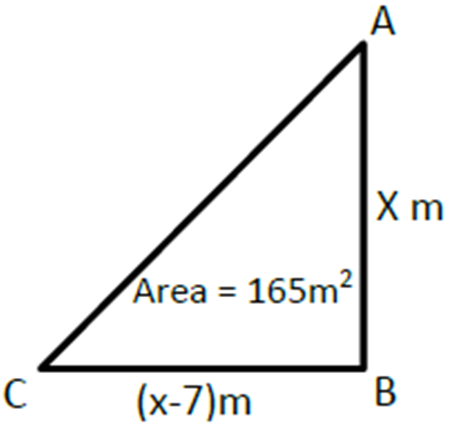
We know that,
Area of a triangle = $\frac{1}{2}$ × base × height
$\Rightarrow 165m^2 =$ $\frac{1}{2}$ × (x - 7)m × x m [$\because$ Area $= 165m^2$ given]
$\Rightarrow 2 \times 165 = x(x - 7)$
$\Rightarrow x^2 - 7x = 330$
$\Rightarrow x^2 - 7x - 330 = 0$
$\Rightarrow (x - 22) + 15(x - 22) = 0$
$\Rightarrow (x - 22) + 15(x - 22) = 0$
$\Rightarrow (x - 22)(x + 15) = 0$
$\Rightarrow x^2 - 22x + 15x - 330 = 0$
$\Rightarrow x = 22 or x = -15$
Since, x cannot be negative. So, x = 22m
$\therefore$ Altitude of the triangle,
⇒ x = 22m
And base of the triangle,
⇒ (x - 7)m = (22 - 7)m = 15m. View full question & answer→Question 1185 Marks
Write the condition to be satisfied for which equations $ax^2 + 2bx + c = 0$ and $\text{bx}^2-2\sqrt{\text{ac}}\text{x}+\text{b}=0$ have equal roots.
AnswerThe given equation are
$\text{ax}^2+2\text{bx}+\text{c}=0\ ....(\text{i})$
And, $\text{bx}^2-2\sqrt{\text{ac}}\text{x}+\text{b}=0\ ...(\text{ii})$
Roots are equal.
Let $D_1$ and $D_2$ be the discriminants of equation (i) and (ii) respectively,
Then,
$\text{D}_1=(2\text{b})^2-4\text{ac}$
$\text{D}_1=4\text{b}^2-4\text{ac}$
And, $\text{D}_2=(-2\sqrt{\text{ac}})^2-4\times\text{b}\times\text{b}$
$\text{D}_2=4\text{ac}-4\text{b}^2$
Both the given equation will have real roots, if $\text{D}_1\geq0$ and $\text{D}_2\geq0$
$4\text{b}^2-4\text{ac}\geq0$
$4\text{b}^2\geq4\text{ac}$
$\text{b}^2\geq\text{ac}\ ....(\text{iii})$
$4\text{ac}-4\text{b}^2\geq0$
$4\text{ac}\geq4\text{b}^2$
$\text{ac}\geq\text{b}\ ....(\text{iv})$
From equation (iii) and (iv) we get
$\text{b}^2=\text{ac}$
Hence, $\text{b}^2=\text{ac}$ is the condition under which the given equations have equal roots.
View full question & answer→Question 1195 Marks
An express train takes 1 hour less than a passenger train to travel 132km between Mysore and Bangalore (without taking into consideration the time they stop at intermediate stations). If the average speed of the express train is 11km/hr more than that of the passenger train, find the average speed of two trains.
AnswerLet the speed of the passenger train be x km/hr
Given that the average speed of the express train is 11km/hr more than that of passenger train.
Average speed of express train = (x + 11) km/hr
Now,
Time taken by passenger train $=\frac{132\text{km}}{\text{x }\text{km/hr}}=\frac{132}{\text{x}}\text{hr}$
And time taken by the espess trian $=\frac{132\text{km}}{\text{(x}+11)\text{ km/hr}}=\frac{132}{\text{x}+11}\text{hr}$
Given that, express trian taken 1 hour less that of passenger train to reach the desiny;
$\Rightarrow\frac{132}{\text{x}}\text{hr}-\frac{132}{\text{x+}+11}\text{hr}=1\text{hr}$
$\Rightarrow132\Big(\frac{1}{\text{x}}-\frac{1}{\text{x}+11}\Big)=1$
$\Rightarrow132\Big(\frac{\text{x}+11-\text{x}}{\text{x}\text{(x}+11)}\Big)=1$
$\Rightarrow 132 \times 11 = x(x + 11) \times 1$
$\Rightarrow x^2 + 11x - 1452 = 0$
$\Rightarrow x^2 + (44x - 33x) +(44 \times - 33) = 0$
$\Rightarrow x^2 + 44x - 33x + (44 \times - 33) = 0$
$\Rightarrow x(x + 44) - 33(x + 44) = 0$
$\Rightarrow (x + 44)(x - 33) = 0$
$\Rightarrow x = -44 or x = 33$
Since speed cannot be in negative values. So, x = 33
$\therefore$ Average speed of the slower trian i.e., passenger trian = 33km/hr
And average speed of express train = (x + 11) km/hr = (33 + 11) km/hr = 44km/hr.
View full question & answer→Question 1205 Marks
Solve the following quadratic equations by factorization:
$4\sqrt{3}\text{x}^2+5\text{x}-2\sqrt{3}=0$
AnswerWe have been given
$4\sqrt{3}\text{x}^2+5\text{x}-2\sqrt{3}=0$
$4\sqrt{3}\text{x}^2+8\text{x}-3\text{x}-2\sqrt{3}=0$
$4\text{x}\big(\sqrt{3}\text{x}+2\big)-\sqrt{3}\big(\sqrt{3}\text{x}+2\big)=0$
$\big(\sqrt{3}\text{x}+2\big)\big(4\text{x}-\sqrt{3}\big)=0$
Therefore,
$\sqrt{3}\text{x}+2=0$
$\sqrt{3}\text{x}=-2$
$\text{x}=\frac{-2}{\sqrt{3}}$
or, $4\text{x}-\sqrt{3}=0$
$4\text{x}=\sqrt{3}$
$\text{x}=\frac{\sqrt{3}}{4}$
Hence, $\text{x}=\frac{-2}{\sqrt{3}}$ or $\text{x}=\frac{\sqrt{3}}{4}$
View full question & answer→Question 1215 Marks
A natural number when increased by 13 equals 160 times its reciprocal. Find the number.
AnswerLet the natural number be x
According to the question,
$\text{x}+12=\frac{160}{\text{x}}$
On multiplying by x on both sides, we get
$\Rightarrow x^2 + 12x - 160 = 0$
$\Rightarrow x^2 + (20x - 8x) - 160 = 0$
$\Rightarrow x^2 + 20x - 8x - 160 = 0$ [by factorisation method]
$\Rightarrow x(x + 20) - 8(x + 20) = 0$
Now, $x + 20 = 0$
⇒ x = -20 which is not possible because natural number is always greater than Zero.
and x - 8 = 0
⇒ x = 8
Hence, the required natural number is 8.
View full question & answer→Question 1225 Marks
Solve the following quadratic equations by factorization:
$\frac{\text{x}+1}{\text{x}-1}-\frac{\text{x}-1}{\text{x}+1}=\frac{5}{6},$ $\text{x}\neq1,-1$
AnswerWe have been given
$\frac{\text{x}+1}{\text{x}-1}-\frac{\text{x}-1}{\text{x}+1}=\frac{5}{6}$
$6(x^2 + 1 + 2x - x^2 - 1 + 2x) = 5(x^2 - 1)$
$5x^2 - 24x - 5 = 0$
$5x^2 - 25x + x - 5 = 0$
$5x(x - 5) + 1(x - 5) = 0$
$(5x + 1)(x - 5) = 0$
Therefore,
5x + 1 = 0
5x = -1
$\text{x}=\frac{-1}{5}$
or,
x - 5 = 0
x = 5
Hence, $\text{x}=\frac{-1}{5}$ or x = 5
View full question & answer→Question 1235 Marks
Solve the following quadratic equations by factorization:
$\frac{\text{x}-1}{2\text{x}+1}+\frac{2\text{x}+1}{\text{x}-1}=\frac{5}{2},$ $\text{x}\neq-\frac{1}{2},1$
Answer$\frac{\text{x}-1}{2\text{x}+1}+\frac{2\text{x}+1}{\text{x}-1}=\frac{5}{2},$ $\text{x}\neq-\frac{1}{2},1$
$\Rightarrow\frac{(\text{x}-1)(\text{x}-1)+(2\text{x}+1)(2\text{x}+1)}{(2\text{x}+1)(\text{x}-1)}=\frac{5}{2}$
$\Rightarrow\frac{(\text{x}-1)^2+(2\text{x}+1)^2}{2\text{x}^2-2\text{x}+\text{x}-1}=\frac{5}{2}$
$\Rightarrow\frac{\text{x}^2-2\text{x}+1+4\text{x}^2+4\text{x}+1}{2\text{x}^2-\text{x}-1}=\frac{5}{2}$
$\Rightarrow\frac{5\text{x}^2+2\text{x}+2}{2\text{x}^2-\text{x}-1}=\frac{5}{2}$
[$\because$ $(a + b)^2 = a^2 + b^2 + 2ab, (a - b)^2 = a^2 + b^2 - 2ab]$
$\Rightarrow 2(5x^2 + 2x + 2) = 5(2x^2 - x - 1)$
$\Rightarrow 10x^2 + 4x + 4 = 10x^2 - 5x - 5$
$\Rightarrow 4x + 5x + 4 +5 = 0$
$\Rightarrow 9x + 9 = 0$
$\Rightarrow 9x = -9$
$\Rightarrow x = -1$
$\therefore$ x = -1 is the only root for the given equation
View full question & answer→Question 1245 Marks
If two pipes function simultaneously, a reservoir will be filled in 12 hours. One pipe fills the reservoir 10 hours faster than the other. How many hours will the second pipe take to fill the reservoir?
AnswerTwo pipes can fill the, reservoir in = 12 hours
Let first pipe can fill the reservoir in = x hrs
Then second pipe will fill it in = (x - 10) hours
Now according to the condition,
$\frac{1}{\text{x}}+\frac{1}{\text{x}-10}=\frac{1}{12}$
$\Rightarrow\frac{\text{x}-10+\text{x}}{\text{x}(\text{x}-10)}=\frac{1}{12}$
$\Rightarrow\frac{2\text{x}-10}{\text{x}^2-10\text{x}}=\frac{1}{12}$
$\Rightarrow x^2 - 10x = 24x - 120$
$\Rightarrow x^2 - 10x - 24x + 120 = 0$
$\Rightarrow x^2 - 34x + 120 = 0$
$\Rightarrow x^2 - 30x - 4x +120 = 0$
$\Rightarrow x(x - 30) - 4(x - 30) = 0$
$\Rightarrow (x - 30)(x - 4) = 0$
Either x - 30 = 0, then x = 30
Or x - 4 = 0 but it is not possible as it is < 10
The second pipe will fill the reservoir in = x - 10 = 30 - 10 = 20 hours.
View full question & answer→Question 1255 Marks
Solve the following quadratic equations by factorization:
$ax^2 + (4a^2 - 3b)x - 12ab = 0$
AnswerWe have,
$ax^2 + (4a^2 - 3b)x - 12ab = 0$
$[a \times 12ab = -12a^2b^2 = 4a^2 \times -3b]$
$\Rightarrow ax^2 + 4a^2x - 3bx + (4a \times (-3b)) = 0$
$\Rightarrow ax(x + 4a) - 3b(x + 4a) = 0$
$\Rightarrow (x + 4a)(ax - 3b) = 0$
$\Rightarrow (x + 4a) = 0 or (ax - 3b) = 0$
⇒ x = -4a or $\text{x}=\frac{3\text{b}}{\text{a}}$
$\therefore\text{x}=\frac{3\text{b}}{\text{a}}$ and x = -4a are the two roots of the given equations.
View full question & answer→Question 1265 Marks
Solve the following quadratic equations by factorization:
$\frac{\text{x}-2}{\text{x}-3}+\frac{\text{x}-4}{\text{x}-5}=\frac{10}{3},$ $\text{x}\neq3,5$
Answer$\frac{\text{x}-2}{\text{x}-3}+\frac{\text{x}-4}{\text{x}-5}=\frac{10}{3}$
$\Rightarrow\frac{\text{x}-2}{\text{x}-3}-\frac{10}{3}=-\frac{\text{x}-4}{\text{x}-5}$
$\Rightarrow\frac{3(\text{x}-2)-10(\text{x}-3)}{3(\text{x}-3)}=-\frac{\text{x}-4}{\text{x}-5}$
$\Rightarrow\frac{3\text{x}-6-10\text{x}+30}{3\text{x}-9}=-\frac{\text{x}-4}{\text{x}-5}$
$\Rightarrow-\frac{7\text{x}-24}{3\text{x}-9}=-\frac{\text{x}-4}{\text{x}-5}$
$\Rightarrow (7x - 24)(x - 5) = (3x - 9)(x - 4)$
$\Rightarrow 7x^2 - 59x + 120 = 3x^2 - 21x + 36$
$\Rightarrow 4x^2 - 38x + 84 = 0$
$\Rightarrow 2x^2 - 19x + 42 = 0$
$\Rightarrow 2x^2 - 12x - 7x + 42 = 0$
$\Rightarrow 2x(x - 6) - 7(x - 6) = 0$
$\Rightarrow (2x - 7)(x - 6) = 0$
$\Rightarrow 2x - 7 = 0 or x - 6 = 0$
$\Rightarrow\text{x}=\frac{7}{2}$ or x = 6
Hence, the factors are 6 and $\frac{7}{2}$
View full question & answer→Question 1275 Marks
Find the value of k for which the following equations have real and equal roots:
$x^2 - 2(k + 1)x + k^2 = 0$
Answer$x^2 - 2(k + 1)x + k^2 = 0$
Here,$ a = 1, b = -2(k + 1), c = k^2$
Discriminant $(D) = b^2 - 4ac$
$= [2(k + 1)]^2 - 4 \times 1 \times k^2$
$= 4(k^2 + 2k + 1) - 4k^2$
$= 4k^2 + 8k + 4 - 4k^2$
$= 8k + 4$
$\because$ Roots are real and equal
$\therefore$ $D = 0$
$\Rightarrow 8k + 4 = 0$
$\Rightarrow 8k = -4$
$\Rightarrow\text{k}=\frac{-4}{8}=\frac{-1}{2}$
Hence, $\text{k}=\frac{-1}{2}$
View full question & answer→Question 1285 Marks
A two-digit number is such that the product of the digits is 16. When 54 is subtracted from the number, the digits are interchanged. Find the number.
AnswerLet the tens digit be x then, the unit digits $=\frac{16}{\text{x}}$Therefore, number $=\Big(10\text{x}+\frac{16}{\text{x}}\Big)$
And number obtained interchanging the digits $=\Big(10\times\frac{16}{\text{x}}+\text{x}\Big)$
Then according to question
$\Big(10\text{x}+\frac{16}{\text{x}}\Big)-\Big(10\times\frac{16}{\text{x}}+\text{x}\Big)=54$
$\Big(10\text{x}+\frac{16}{\text{x}}\Big)-\Big(10\times\frac{16}{\text{x}}+\text{x}\Big)=54$
$\frac{(10\text{x}^2+16)-(160+\text{x}^2)}{\text{x}}=54$
$\frac{10\text{x}^2+16-160-\text{x}^2}{\text{x}}=54$
$\frac{9\text{x}^2-144}{\text{x}}=54$
$9\text{x}^2-144=54\text{x}$
$9\text{x}^2-54\text{x}-144=0$
$9(\text{x}^2-6\text{x}-16)=0$
$\text{x}^2-6\text{x}-16=0$
$\text{x}^2-8\text{x}+2\text{x}-16=0$
$\text{x}(\text{x}-8)+2(\text{x}-8)=0$
$(\text{x}-8)(\text{x}+2)=0$
$(\text{x}-8)=0$
$\text{x}=8$
Or $(\text{x}+2)=0$
$\text{x}=-2$
So, the digit can never be negative.
Therefore,
When x = 8 then unit digits
$=\frac{16}{\text{x}}$
$=\frac{16}{8}$
$=2$
And number
$=\Big(10\text{x}+\frac{16}{\text{x}}\Big)$
$=(10\times8+2)$
$=82$
Thus, the required number be 82.
View full question & answer→Question 1295 Marks
The length of a hall is 5m more than its breadth. If the area of the floor of the hall is $84m^2,$ what are the length and breadth of the hall?
AnswerLet the breadth of the rectangle (hall) be x meter.
Given that,
Length of the hall is 5m more than its breadth i.e., length = (x + 5)m
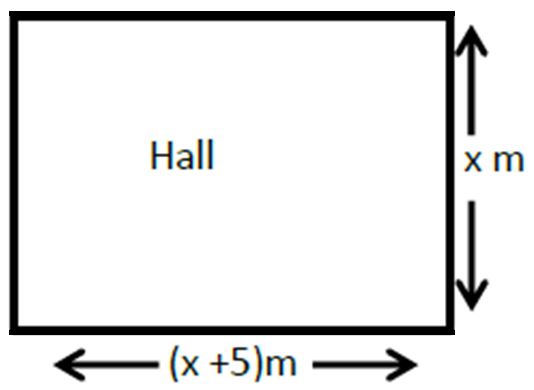
And also given that,
Area of the hall = $84m^2$
Since, hall is in the shape of a rectangle,
Area of the rectangular hall = length × breadth
$\Rightarrow 84m^2 = xm \times (x + 5)m$
$\Rightarrow 84 = x(x + 5)$
$\Rightarrow 84 = x^2 + 5x$
$\Rightarrow x^2 + 5x - 84 = 0$
$\Rightarrow x^2 + 12x - 7x - 84 = 0$
$\Rightarrow x(x + 12) - 7(x + 12) = 0$
$\Rightarrow (x - 7)(x + 12) = 0$
$\Rightarrow x = 7m or x = -12m$
Since, x cannot be negative. So, breadth of the hall = 7m
Hence, length of the hall = (x + 5)m = (7 + 5)m = 12m. View full question & answer→Question 1305 Marks
At present Asha’s age (in years) is 2 more than the square of her daughter Nisha’s age. When Nisha grows to her mother’s present age, Asha’s age would be one year less than 10 times the present age of Nisha. Find the present ages of both Asha and Nisha.
AnswerLet Nisha’s present age be x year
Then, Asha’s present age $= x^2 + 2$ [by given condition]
Now, when Nisha grows to her mother’s present age i.e., after ${(x^2 + 2) - x}$ years
Then, Asha’s age also increased by $[(x^2 + 2) - x]$ years.
Again by given condition,
Age of Asha = One years less than 10 times the present age of Nisha
$(x^2 + 2) + {(x^2 + 2) - x} = 10x - 1$
$\Rightarrow 2x^2 - x + 4 = 10x - 1$
$\Rightarrow 2x^2 - 11x + 5 = 0$
$\Rightarrow 2x^2 - 10x - x + 5 = 0$
$\Rightarrow 2x(x - 5) - 1(x - 5) = 0$
$\Rightarrow (x - 5)(2x - 1) = 0$
$\therefore$ x = 5
$\Big[$Here, $\text{x}=\frac{1}{2}$ cannot be possible, beccause $\text{x}=\frac{1}{2},$ Asha's age is $2\frac{1}{4}$ years which is not possible$\Big]$
Hence, required age of Nisha = 5 years
and required age of Asha $= x^2 + 2 = (5)^2 + 2 = 25 + 2 = 27$ years.
View full question & answer→Question 1315 Marks
Solve the following quadratic equations by factorization:
$\frac{3}{\text{x}+1}-\frac{1}{2}=\frac{2}{3\text{x}-1},$ $\text{x}\neq-1,\frac{1}{3}$
Answer$\frac{3}{\text{x}+1}-\frac{1}{2}=\frac{2}{3\text{x}-1}$
$\Rightarrow\frac{6-(\text{x}+1)}{2(\text{x}+1)}=\frac{2}{3\text{x}-1}$
$\Rightarrow\frac{6-\text{x}-1}{2\text{x}+2}=\frac{2}{3\text{x}-1}$
$\Rightarrow (5 - x)(3x - 1) = 2(2x + 2)$
$\Rightarrow 15x - 5 - 3x^2 + x = 4x + 4$
$\Rightarrow -3x^2 + 16x - 5 - 4x - 4 = 0$
$\Rightarrow -3x^2 + 12x - 9 = 0$
$\Rightarrow 3x^2 - 12x + 9 = 0$
$\Rightarrow x^2 - 4x + 3 = 0$
$\Rightarrow x^2 - 3x - x + 3 = 0$
$\Rightarrow x(x - 3) - 1(x - 3) = 0$
$\Rightarrow (x - 1)(x - 3) = 0$
$\Rightarrow x - 1 = 0 or x - 3 = 0$
$\Rightarrow x = 1 or x = 3$
Hence, the factors are 3 and 1
View full question & answer→Question 1325 Marks
Find the value of p for which quadratic equation $(p + 1)x^2 - 6(p + 1)x + 3(p + 9) = 0$, $\text{p}\neq-1$ has equal roots. Hence, find the roots of the equation.
AnswerThe given quadratic equation $(p + 1)x^2 - 6(p + 1)x + 3(p + 9) = 0$, has equal roots.
Here, a = p + 1, b = -6p - 6 and c = 3p + 27
As know that $D = b^2 - 4ac$
Putting the value of a = p + 1, b = -6p - 6 and $c = 3p + 27$
$\Rightarrow D = [-6(p + 1)]^2 - 4(p + 1)[3(p + 9)]$
$\Rightarrow D = 36(p^2 + 2p + 1) - 12(p^2 + 10p + 9)$
$\Rightarrow D = 36p^2 - 12p^2 + 72p - 120p + 36 - 108$
$\Rightarrow D = 24p^2 - 48p - 72$
The given equation will have real and equal roots, if D = 0
Thus, $24p^2 - 48p - 72 = 0$
The given equation will have real and equal roots, if D = 0
Thus, $24p^2 - 48p - 72 = 0$
$\Rightarrow p^2 - 2p - 3 = 0$
$\Rightarrow p^2 - 3p + p - 3 = 0$
$\Rightarrow p(p - 3) + 1(p - 3) = 0$
$\Rightarrow p + 1 = 0 or p - 3 = 0$
$\Rightarrow p = -1 or p = 3$
Therefore, the value of p is -1, 3
It is given that $\text{p}\neq-1,$ thus p = 3 only.
Now the equation becomes,
$4x^2 - 24x + 36 = 0$
$\Rightarrow x^2 - 6x + 9 = 0$
$\Rightarrow x^2 - 3x - 3x + 9 = 0$
$\Rightarrow x(x - 3) - 3(x - 3) = 0$
$\Rightarrow (x - 3)^2 = 0$
$\Rightarrow x = 3, 3$
Hence, the root of the equation is 3
View full question & answer→Question 1335 Marks
Some students planned a picnic. The budget for food was Rs. 480. But eight of these failed to go and thus the cost of food for each member increased by Rs. 10. How many students attended the picnic?
AnswerLet x students planned a picnic.
Then, the share of each student $=\frac{480}{\text{x}}$
According to question, 8 students fail to go picnic, then remaining students = (x - 8)
Therefore, new share of each student $=\frac{480}{\text{x}-8}$
It is given that
$\frac{480}{\text{x}-8}-\frac{480}{\text{x}}=10$
$\frac{480\text{x}-480(\text{x}-8)}{(\text{x}-8)\text{x}}=10$
$\frac{480\text{x}+3840-480\text{x}}{(\text{x}-8)\text{x}}=10$
$\frac{3840}{(\text{x}-8)\text{x}}=10$
$10(x^2 - 8x) = 3840$
$(x^2 - 8x) = 384$
$x^2 - 8x - 384 = 0$
$x^2 + 16x - 24x - 384 = 0$
$x(x + 16) - 24(x + 16) = 0$
$(x + 16)(x - 24) = 0$
$(x + 16) = 0 or (x - 24) = 0$
$x = -16 x = 24$
Because x cannot be negative.
Thus, the total numbers of students attend a picnic
$= x - 8$
$= 24 - 8$
$= 16$
Therefore, the total numbers of students attend a picnic be x = 16.
View full question & answer→Question 1345 Marks
Solve the following quadratic equations by factorization:
$\frac{2\text{x}}{\text{x}-4}+\frac{2\text{x}-5}{\text{x}-3}=\frac{25}{3}$
Answer$\frac{2\text{x}}{\text{x}-4}+\frac{2\text{x}-5}{\text{x}-3}=\frac{25}{3}$$\Rightarrow\frac{2\text{x}(\text{x}-3)+(2\text{x}-5)(\text{x}-4)}{(\text{x}-4)(\text{x}-3)}=\frac{25}{3}$
$\Rightarrow\frac{2\text{x}^2-6\text{x}+2\text{x}^2-8\text{x}-5\text{x}+20}{\text{x}^2-3\text{x}-4\text{x}+12}=\frac{25}{3}$
$\Rightarrow\frac{4\text{x}^2-19\text{x}+20}{\text{x}^2-7\text{x}+12}=\frac{25}{3}$
$\Rightarrow 25x^2 - 175x + 300 = 12x^2 - 57x + 60$
$\Rightarrow 25x^2 - 175x + 300 - 12x^2 + 57x - 60= 0$
$\Rightarrow 13x^2 - 118x + 240 = 0$
$\Rightarrow 13x^2 - 78x - 40x + 240 = 0$
$\begin{cases}\because40\times13=3120\\\therefore3120=-78\times(-40)\\-118=-78-40\end{cases}$
⇒ 13x(x - 6) - 40(x - 6) = 0
⇒ (x - 6)(13x - 40) = 0
Either x - 6 = 0, then x = 6
or 13x - 40 = 0, then 13x = 40
$\Rightarrow\text{x}=\frac{40}{13}$
$\therefore$ Roots are 6, $\frac{40}{13}$
View full question & answer→Question 1355 Marks
Out of a group of swans, $\frac{7}{2}$ times the square root of the total number are playing on the share of a pond. The two remaining ones are swinging in water. Find the total number of swans.
AnswerLet the total number of swans be x.
Then, total number of swans are playing on the share of a pond $=\frac{7}{2}\sqrt{\text{x}}$
It is given that,
$\frac{7}{2}\sqrt{\text{x}}+2=\text{x}$
Let x = $y^2$, then $\frac{7}{2}{\text{y}}+2=\text{y}^2$
$\frac{7\text{y}+4}{2}={\text{y}^2}$
$2y^2 = 7y + 4$
$2y^2 - 7y - 4 = 0$
$2y^2 + 8y - y - 4 = 0$
$2y(y + 4) - 1(y + 4) = 0$
$(y + 4)(2y - 1) = 0$
$(y + 4) = 0 or (2y - 1) = 0$
y = -4 or $\text{y}=\frac{1}{2}$
Beceuse $\text{y}=\frac{1}{2}$ is not correct.
Thus, y = -4 is correct. Putting the value of y
y = -4
$\sqrt{\text{x}}=-4$
Square root both sides, we get
$(\sqrt{\text{x}})^2=(-4)^2$
x = 16
Therefore, the total number of swans be x = 16
View full question & answer→Question 1365 Marks
Prove that both the roots of the equation (x - a)(x - b) + (x - b)(x - c) + (x - c)(x - a) = 0 are real but they are equal only when a = b = c.
AnswerThe quadric equation is (x - a)(x - b) + (x - b)(x - c) + (x - c)(x - a) = 0
Here, After simplifying the equation,
$x^2 - (a + b)x + ab + x^2 - (b + c)x + bc + x^2 - (c + a)x + ca = 0$
$3x^2 - 2(a + b + c)x + (ab + bc + ca) = 0$
a = 3, b = -2(a + b + c) and c = (ab + bc + ca)
As we know that $D = b^2 - 4ac$
Putting the value of a = 3, b = 2(a + b + c) and c = (ab + bc + ca)
$\Rightarrow D = {2(a + b + c)}^2 - 4 \times 3 \times (ab + bc + ca)$
$\Rightarrow D = 4(a^2 + b^2 + c^2 + 2ab + 2bc + 2ca) - 12(ab + bc + ca)$
$\Rightarrow D = 4a^2 + 4b^2 + 4c^2 + 8ab + 8bc + 8ca - 12ab - 12bc - 12ca$
$\Rightarrow D = 4a^2 + 4b^2+ 4c^2 - 4ab - 4bc - 4ca$
$\Rightarrow D = 4(a^2+ b^2 + c^2 - ab - bc - ca)$
$\Rightarrow D = 2[2a^2 + 2b^2 + 2c^2 - 2ab - 2ac - 2bc]$
$\Rightarrow D = 2[(a - b)^2 + (b - c)^2+ (c - a)^2]$
Since, D > 0. So the solutions are real Let a = b = c
Then, $D = 4(a^2 + b^2 + c^2 - ab - bc - ca)$
$\Rightarrow D = 4(a^2 + b^2 + c^2 - aa - bb - cc)$
$\Rightarrow D = (a^2 + b^2 + c^2 - a^2 - b^2 - c^2)$
$\Rightarrow D = 4 \times 0$
Thus, the value of D = 0
Therefore, the roots of the given equation are and but they are equal only when a = b = c.
Hence proved.
View full question & answer→Question 1375 Marks
In a class test, the sum of Shefali's marks in Mathematics and English is 30. Had she got 2 marks more in mathematics and 3 marks less in English, the product of her marks would have been 210. Find her marks in two subjects.
AnswerLet marks of shefali in Mathematics and English be x and respectively.
Given that sum of these two is 30
⇒ x + y = 30
⇒ x = 30 - y
Given that if x becomes (x + 2) i.e. marks in mathematics is increasedd by 2
and y becomes (y - 3) i.e. marks in English is decreased by 3,
The product at these two becomes 210
i.e. (x + 2)(y - 3) = 210
⇒ (30 - y + 2)(y - 3) = 210 $[\because$ x = 30 - y$]$
$\Rightarrow (32 - y + 2)(y - 3) = 210$
$\Rightarrow (32 - y)(y - 3) = 210$
$\Rightarrow 32y - 32 \times 3 - y \times y + 3 \times y = 210$
$\Rightarrow 35y - 96 - y2 = 210$
$\Rightarrow y^2 - 35y + 210 + 96 = 0$
$\Rightarrow y^2 - 35y + 306 = 0$
$\Rightarrow y^2 - 17y - 18y + (-17 \times -18) = 0$ $[\because$ 306 = 17 × 18 = -17 × -18$]$
$\Rightarrow y(y - 17) - 18(y - 17) = 0$
$\Rightarrow (y - 17)(y - 18) = 0$
$\Rightarrow y - 17 = 0 or y - 18 = 0$
$\Rightarrow y = 17 or y = 18$
We have,
⇒ x + y = 30
if y = 17 ⇒ x = 30 - y = 30 - 17 = 13 and
if y = 18 ⇒ x = 30 - y = 30 - 18 = 18
Marks in Mathematics = 13 and marks in English = 17 or
Marks in Mathematics = 12 and marks in English = 18.
View full question & answer→Question 1385 Marks
Solve the following quadratic equations by factorization:
$\frac{\text{m}}{\text{n}}\text{x}^2+\frac{\text{n}}{\text{m}}=1-2\text{x}$
AnswerWe have been given
$\Rightarrow\frac{\text{m}}{\text{n}}\text{x}^2+\frac{\text{n}}{\text{m}}=1-2\text{x}$
$\Rightarrow\frac{\text{m}^2\text{x}^2+\text{n}^2}{\text{mn}}=1-2\text{x}$
$\Rightarrow\text{m}^2\text{x}^2+2\text{mnx}+(\text{n}^2-\text{mn})=0$
$\Rightarrow\text{m}^2\text{x}^2+\text{mnx}+\text{mnx}+\big[\text{n}^2-(\sqrt{\text{mn}})^2\big]=0$
$\Rightarrow\text{m}^2\text{x}^2+\text{mnx}+\text{mnx}+(\text{n}+\sqrt{\text{mn}})(\text{n}-\sqrt{\text{mn}})\\+(\text{m}\sqrt{\text{mnx}}-\text{m}\sqrt{\text{mnx}})=0$
$\Rightarrow\big[\text{m}^2\text{x}^2+\text{mnx}+\text{m}\sqrt{\text{mnx}}\big]+\big[\text{mnx}-\text{m}\sqrt{\text{mnx}}\\+(\text{n}+\sqrt{\text{mn}})(\text{n}-\sqrt{\text{mn}})\big]=0$
$\Rightarrow\big[\text{m}^2\text{x}^2+\text{mnx}+\text{m}\sqrt{\text{mnx}}\big]+\big[(\text{mx}(\text{n}-\sqrt{\text{mn}})\\+(\text{n}+\sqrt{\text{mn}})(\text{n}-\sqrt{\text{mn}})\big]=0$
$\Rightarrow(\text{mx})\big(\text{mx}+\text{n}+\sqrt{\text{mn}}\big)+\big(\text{n}-\sqrt{\text{mn}}\big)\\\big(\text{mx}+\text{n}+\sqrt{\text{mn}}\big)=0$
$\Rightarrow\big(\text{mx}+\text{n}+\sqrt{\text{mn}})\big(\text{mx}+\text{n}-\sqrt{\text{mn}}\big)=0$
Therefore,
$\Rightarrow\text{mx}+\text{n}+\sqrt{\text{mn}}=0$
$\Rightarrow\text{mx}=-\text{n}-\sqrt{\text{mn}}$
$\Rightarrow\text{x}=\frac{-\text{n}-\sqrt{\text{mn}}}{\text{m}}$
or, $\text{mx}+\text{n}-\sqrt{\text{mn}}=0$
$\Rightarrow\text{mx}=-\text{n}+\sqrt{\text{mn}}$
$\Rightarrow\text{x}=\frac{-\text{n}+\sqrt{\text{mn}}}{\text{m}}$
Hence, $\text{x}=\frac{-\text{n}-\sqrt{\text{mn}}}{\text{m}}$ or $\text{x}=\frac{-\text{n}+\sqrt{\text{mn}}}{\text{m}}$
View full question & answer→Question 1395 Marks
Solve the following quadratic equations by factorization:
$\frac{\text{x}-\text{a}}{\text{x}-\text{b}}+\frac{\text{x}-\text{b}}{\text{x}-\text{a}}=\frac{\text{a}}{\text{b}}+\frac{\text{b}}{\text{a}}$
Answer$\frac{\text{x}-\text{a}}{\text{x}-\text{b}}+\frac{\text{x}-\text{b}}{\text{x}-\text{a}}=\frac{\text{a}}{\text{b}}+\frac{\text{b}}{\text{a}}$
$\Rightarrow\frac{\text{x}-\text{a}}{\text{x}-\text{b}}-\frac{\text{a}}{\text{b}}=\frac{\text{b}}{\text{a}}-\frac{\text{x}-\text{b}}{\text{x}-\text{a}}$
$\Rightarrow\frac{\text{bx}-\text{ab}-\text{ax}+\text{ab}}{\text{b}(\text{x}-\text{b})}=\frac{\text{bx}-\text{ab}-\text{ax}+\text{ab}}{\text{a}(\text{x}-\text{a})}$
$\Rightarrow\frac{\text{bx}-\text{ax}}{\text{b}(\text{x}-\text{b})}=\frac{\text{bx}-\text{ax}}{\text{a}(\text{x}-\text{a})}$
$\Rightarrow\frac{\text{bx}-\text{ax}}{\text{b}(\text{x}-\text{b})}-\frac{\text{bx}-\text{ax}}{\text{a}(\text{x}-\text{a})}=0$
$\Rightarrow(\text{bx}-\text{ax})\bigg(\frac{1}{\text{b}(\text{x}-\text{b})}-\frac{1}{\text{a}(\text{x}-\text{a})}\bigg)=0$
$\Rightarrow(\text{b}\text{x}-\text{ax})\bigg(\frac{\text{a}(\text{x}-\text{a})-\text{b}(\text{x}-\text{b})}{\text{a}\text{b}(\text{x}-\text{a})(\text{x}-\text{b})}\bigg)=0$
$\Rightarrow\frac{\text{x}(\text{b}-\text{a})(\text{ax}-\text{bx}-\text{a}^2+\text{b}^2)}{\text{ab}(\text{x}-\text{a})(\text{x}-\text{b})}=0$
$\because\text{x}\neq\text{a},\text{x}\neq\text{b}$
(Division by Zero is not possible)
$\therefore\text{x}(\text{ax}-\text{bx}-\text{a}^2+\text{b}^2)=0$
Either $\text{x}=0$
or $\text{ax}-\text{bx}=\text{a}^2-\text{b}^2$
$\Rightarrow(\text{a}-\text{b})\text{x}=(\text{a}+\text{b})(\text{a}-\text{b})$
$\Rightarrow\text{x}=\frac{(\text{a}+\text{b})(\text{a}-\text{b})}{\text{a}-\text{b}}=\text{a}+\text{b}$
Hence, $\text{x}=0,\text{a}+\text{b}$
View full question & answer→Question 1405 Marks
Two water taps together can fill a tank in $9\frac{3}{8}$ hours. The of larger diameter takes 10 hours less than the smaller one to fill the tank separately. Find the time in which each tap can separately fill the tank.
AnswerLet the first water tape takes x hours to fill the tank. Then the second water tape will takes = (x + 10)
Since, the faster water tape takes x hours to fill the tank.
Therefore, portion of the tank filled by the faster water tape in hour $=\frac{1}{\text{x}}$
So, portion of the tank filled by the faster water tape in $9\frac{3}{8}$ hours $=\frac{75}{8\text{x}}$
Similarly,
Portion of the tank filled by the slower water tape in $9\frac{3}{8}$ hours $=\frac{75}{8(\text{x}+10)}$
It is given that the tank is filled in $9\frac{3}{8}$ hours.
So, $\frac{75}{8\text{x}}+\frac{75}{8(\text{x}+10)}=1$
$\frac{75(\text{x}+10)+75\text{x}}{8\text{x}(\text{x}+10)}=1$
$75x + 750 + 75x = 8x^2 + 80x$
$8x^2 - 70x - 750 = 0$
$4x^2 - 35x - 375 = 0$
$4x^2 - 60x + 25x - 375 = 0$
$4x(x - 15) + 25(x - 15) = 0$
$(x - 15)(4x + 25) = 0$
$(x - 15) = 0 or (4x + 25) = 0$
x = 15 or $\text{x}=\frac{-25}{4}$
But, x cannot be negative.
Therefore, when x = 15 then
(x + 10) = 5 + 10
(x + 10) = 25
Hence, the first water tape will takes 15 hours to fill the tank, and the second water tape will takes 25 hourse to fill the tank.
View full question & answer→Question 1415 Marks
Find the roots of the following quadratic equation (if they exist) by the method of completing the square.
$\sqrt{3}\text{x}^2+10\text{x}+7\sqrt{3}=0$
AnswerWe have
$\sqrt{3}\text{x}^2+10\text{x}+7\sqrt{3}=0$
$\Rightarrow\text{x}^2+\frac{10}{\sqrt{3}}\text{x}+\frac{7\sqrt{3}}{\sqrt{3}}=0$
$\Rightarrow\text{x}^2+2\times\frac{1}{2}\times\frac{10}{\sqrt{3}}\text{x}+7=0$
$\Rightarrow\text{x}^2+2\times\frac{5}{\sqrt{3}}\times\text{x}+\Big(\frac{5}{\sqrt{3}}\Big)^2-\Big(\frac{5}{\sqrt{3}}\Big)^2+7=0$
$\Rightarrow\Big(\text{x}+\frac{5}{\sqrt{3}}\Big)^2=\frac{25}{3}-7$
$\Rightarrow\Big(\text{x}+\frac{5}{\sqrt{3}}\Big)^2=\frac{25-21}{3}$
$\Rightarrow\Big(\text{x}+\frac{5}{\sqrt{3}}\Big)^2=\frac{4}{3}$
$\Rightarrow\text{x}+\frac{5}{\sqrt{3}}=\pm\sqrt{\frac{4}{3}}$
$\Rightarrow\text{x}+\frac{5}{\sqrt{3}}=\frac{2}{\sqrt{3}}$ or $\text{x}+\frac{5}{\sqrt{3}}=\frac{-2}{\sqrt{3}}$
$\Rightarrow\text{x}=\frac{-3}{\sqrt{3}}$ or $\text{x}=-\frac{7}{\sqrt{3}}$
$\Rightarrow\text{x}=-\sqrt{3}$ or $\text{x}=-\frac{7}{\sqrt{3}}$
$\therefore\text{x}=-\sqrt{3}$ and $\text{x}=-\frac{7}{\sqrt{3}}$ are the roots of the given equation.
View full question & answer→Question 1425 Marks
Find the roots of the following quadratic equation (if they exist) by the method of completing the square.
$\text{x}^2-(\sqrt{2}+1)\text{x}+\sqrt{2}=0$
AnswerWe have
$\text{x}^2-(\sqrt{2}+1)\text{x}+\sqrt{2}=0$
$\Rightarrow\text{x}^2-2\times\frac{1}{2}(\sqrt{2}+1)\text{x}+\sqrt{2}=0$
$\Rightarrow\text{x}^2-2\times\frac{\sqrt{2}+1}{2}\text{x}+\Big(\frac{\sqrt{2}-1}{2}\Big)^2-\Big(\frac{\sqrt{2}+1}{2}\Big)^2+\sqrt{2}=0$
$\Rightarrow\Big(\text{x}-\frac{\sqrt{2}+1}{2}\Big)^2=\Big(\frac{\sqrt{2}+1}{2}\Big)^2-\sqrt{2}$
$\Rightarrow\Big(\text{x}-\frac{\sqrt{2}+1}{2}\Big)^2=\frac{3+2\sqrt{2}-4\sqrt{2}}{4}$
$\Rightarrow\Big(\text{x}-\frac{\sqrt{2}+1}{2}\Big)^2=\frac{3-2\sqrt{2}}{4}$
$\Rightarrow\Big(\text{x}-\frac{\sqrt{2}+1}{2}\Big)^2=\frac{2+1-2\sqrt{2}}{4}$
$\Rightarrow\Big(\text{x}-\frac{\sqrt{2}+1}{2}\Big)^2=\frac{(\sqrt{2})^2-2\sqrt{2}+1}{2^2}$
$\Rightarrow\Big(\text{x}-\frac{\sqrt{2}+1}{2}\Big)^2=\frac{(\sqrt{2}-1)^2}{2^2}$
$\Rightarrow\Big(\text{x}-\frac{\sqrt{2}+1}{2}\Big)^2=\Big(\frac{\sqrt{2}-1}{2}\Big)^2$
$\Rightarrow\text{x}-\frac{\sqrt{2}+1}{2}=\pm\Big(\frac{\sqrt{2}-1}{2}\Big)$
$\Rightarrow\text{x}-\frac{\sqrt{2}+1}{2}=\frac{\sqrt{2}-1}{2}$ or $\text{x}-\frac{\sqrt{2}+1}{2}=-\frac{\sqrt{2}-1}{2}$
$\Rightarrow\text{x}=\frac{\sqrt{2}-1}{2}+\frac{\sqrt{2}+1}{2}$ or $\text{x}=-\frac{\sqrt{2}-1}{2}+\frac{\sqrt{2}+1}{2}$
$\Rightarrow\text{x}=\frac{\sqrt{2}-1+\sqrt{2}+1}{2}$ or $\text{x}=\frac{-\sqrt{2}+1+\sqrt{2}+1}{2}$
$\Rightarrow\text{x}=\frac{2\sqrt{2}}{2}$ or $\text{x}=\frac{2}{2}$
$\Rightarrow\text{x}=\sqrt{2}$ or $\text{x}=1$
$\therefore\text{x}=\sqrt{2}$ and $\text{x}=1$ are the roots of the given equation.
View full question & answer→Question 1435 Marks
Find the value of p for which the quadratic equation $(2p + 1)x^2 - (7p + 2)x + (7p - 3) = 0$ has equal roots. Also, find these roots.
AnswerThe given quadric equation is $(2p + 1)x^2 - (7p + 2)x + (7p - 3) = 0$, and roots real and equal.
Then, find the value of p.
Here, a = 2p + 1, b = -7p - 2 and c = 7p - 3
As we know that $D = b^2 - 4ac$
Putting the value of a = 2p + 1, b = -7p - 2 and c = 7p - 3
$\Rightarrow D = [-(7p + 2)]^2 - 4(2p + 1)(7p - 3)$
$\Rightarrow D = (49p^2 + 28p + 4) - 4(14p^2 - 6p + 7p - 3)$
$\Rightarrow D = 49p^2 + 28p + 4 - 56p^2 - 4p + 12$
$\Rightarrow D = -7p^2 + 24p + 16$
The given equation will have real and equal roots, if D = 0
Thus, $-7p^2+ 24p + 16 = 0$
$\Rightarrow 7p^2 - 24p - 16 = 0$
$\Rightarrow 7p^2 - 28p + 4p - 16 = 0$
$\Rightarrow 7p(p - 4) + 4(p - 4) = 0$
$\Rightarrow (7p + 4)(p - 4) = 0$
$\Rightarrow 7p + 4 = 0 or p - 4 = 0$
$\Rightarrow\text{p}=-\frac{4}{7}$ or p = 4
Therefore, the value of p is 4 or $-\frac{4}{7}$
Now, for p = 4, the equation becomes,
$9x^2 - 30x + 25 = 0$
$\Rightarrow 9x^2 - 15x - 15x + 25 = 0$
$\Rightarrow 3x(3x - 5) - 5(3x - 5) = 0$
$\Rightarrow (3x - 5)^2 = 0$
$\Rightarrow\text{x}=\frac{5}{3},\frac{5}{3}$
For $\text{p}=-\frac{4}{7},$ the equation becomes,
$\Big(-\frac{8}{7}+1\Big)\text{x}^2-(-4+2)\text{x}+(-4-3)=0 $
$\Rightarrow\Big(\frac{-8+7}{7}\Big)\text{x}^2+2\text{x}-7=0$
$\Rightarrow-\frac{1}{7}\text{x}^2+2\text{x}-7=0$
$\Rightarrow -x^2 + 14x - 49 = 0$
$\Rightarrow x^2 - 14x + 49 = 0$
$\Rightarrow x^2 - 7x - 7x + 49 = 0$
$\Rightarrow x(x - 7) - 7(x - 7) = 0$
$\Rightarrow (x - 7)^2 = 0$
$\Rightarrow x = 7, 7$
Hence, the roots the equation are $\frac{5}{3}$ and 7
View full question & answer→Question 1445 Marks
Solve the following quadratic equations by factorization:
$\frac{\text{a}}{\text{x}-\text{a}}+\frac{\text{b}}{\text{x}-\text{b}}=\frac{2\text{c}}{\text{x}-\text{c}}$
AnswerWe have
$\Rightarrow\frac{\text{a}}{\text{x}-\text{a}}+\frac{\text{b}}{\text{x}-\text{b}}=\frac{2\text{c}}{\text{x}-\text{c}}$
$\Rightarrow\frac{\text{a}(\text{x}-\text{b})+\text{b}(\text{x}-\text{a})}{(\text{x}-\text{a})(\text{x}-\text{b})}=\frac{2\text{c}}{\text{x}-\text{c}}$
$\Rightarrow\frac{\text{ax}-\text{ab}+\text{bx}-\text{ab}}{\text{x}^2-\text{ax}-\text{bx}+\text{ab}}=\frac{2\text{c}}{\text{x}-\text{c}}$
$\Rightarrow(\text{x}-\text{c})((\text{a}+\text{b})\text{x}-2\text{ab})\\=2\text{c}(\text{x}^2-(\text{a}+\text{b})\text{x}+\text{ab})$
$\Rightarrow(\text{a}+\text{b})\text{x}^2-2\text{abx}-(\text{a}+\text{b})\text{cx}+2\text{abc}\\=2\text{cx}^2-2\text{c}(\text{a}+\text{b})\text{x}+2\text{abc}$
$\Rightarrow(\text{a}+\text{b}-2\text{c})\text{x}^2-2\text{abx}-(\text{a}+\text{b})\text{xc}+2\text{c}(\text{a}+\text{b})\text{x}=0$
$\Rightarrow(\text{a}+\text{b}-2\text{c})\text{x}^2+\text{x}(-2\text{ab}-\text{ac}-\text{bc}+2\text{ac}+2\text{bc})=0$
$\Rightarrow(\text{a}+\text{b}-2\text{c})\text{x}^2+\text{x}(-2\text{ab}+\text{ac}+\text{bc})=0$
$\Rightarrow\text{x}\big[\text{x}(\text{a}+\text{b}-2\text{c})+(\text{ac}+\text{bc}-2\text{ab})\big]=0$
$\Rightarrow\text{x}=0$ or $\text{x}=-\frac{(\text{ac}+\text{bc}-2\text{ab})}{\text{a}+\text{b}-2\text{c}}$
$\Rightarrow\text{x}=\frac{2\text{ab}-\text{ac}-\text{bc}}{\text{a}+\text{b}-2\text{c}}$
$\therefore\text{x}=0$ and $\text{x}=\frac{2\text{ab}-\text{ac}-\text{bc}}{\text{a}+\text{b}-2\text{c}}$ are the two roots of the given given equation.
$\Rightarrow\frac{\text{a}}{\text{x}-\text{a}}+\frac{\text{b}}{\text{x}-\text{b}}=\frac{2\text{c}}{\text{x}-\text{c}}$
$\Rightarrow\frac{\text{a}(\text{x}-\text{b})+\text{b}(\text{x}-\text{a})}{(\text{x}-\text{a})(\text{x}-\text{b})}=\frac{2\text{c}}{\text{x}-\text{c}}$
$\Rightarrow\frac{\text{ax}-\text{ab}+\text{bx}-\text{ab}}{\text{x}^2-\text{ax}-\text{bx}+\text{ab}}=\frac{2\text{c}}{\text{x}-\text{c}}$
$\Rightarrow(\text{x}-\text{c})((\text{a}+\text{b})\text{x}-2\text{ab})\\=2\text{c}(\text{x}^2-(\text{a}+\text{b})\text{x}+\text{ab})$
$\Rightarrow(\text{a}+\text{b})\text{x}^2-2\text{abx}-(\text{a}+\text{b})\text{cx}+2\text{abc}\\=2\text{cx}^2-2\text{c}(\text{a}+\text{b})\text{x}+2\text{abc}$
View full question & answer→