Questions

5 Marks Questions

🎯

Test yourself on this topic

31 questions · timed · auto-graded

Question 15 Marks
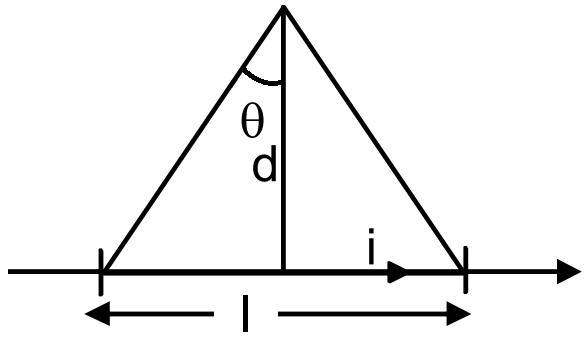
Consider a straight piece of length x of a wire carrying a current i. Let P be a point on the perpendicular bisector of the piece, situated at a distance d from its middle point. Show that for d >> x, the magnetic field at P varies as $\frac{1}{\text{d}^2}$ whereas ford d << x, it varies as $\frac{1}{\text{d}}.$
Answer
$\text{B}=\frac{\pi_0\text{i}}{4\pi\text{d}}2\sin\theta$$=\frac{\pi_0\text{i}}{4\pi\text{d}}\frac{2\times\text{x}}{2\times\sqrt{\text{d}^2+\frac{\text{x}^2}{4}}}=\frac{\mu_0\text{ix}}{4\pi\text{d}+\sqrt{\text{d}^2+\frac{\text{x}^2}{4}}}$
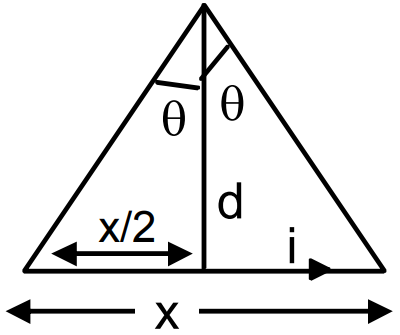
  1. When d >> x
Neglecting x w.r.t.d
$\text{B}=\frac{\pi_0\text{ix}}{\mu\pi\sqrt{\text{d}^2}}=\frac{\mu_0\text{ix}}{\mu\pi\text{d}^2}$
$\therefore\text{B}\propto\frac{1}{\text{d}^2}$
  1. When x >> d, neglecting d w.r.t x
$\text{B}=\frac{\mu_0\text{ix}}{\frac{4\pi\text{dx}}{2}}=\frac{2\mu_0\text{i}}{4\pi\text{d}}$
$\therefore\text{B}\propto\frac{1}{\text{d}}$
View full question & answer
Question 25 Marks
If the outer coil of the previous problem is rotated through 90° about a diameter, what would be the magnitude of the magnetic field B at the centre?
Answer

Outer Circle
$\text{n}=100,\ \text{r}=100\text{m}=0.1\text{m}$
$\text{i}=2\text{A}$
$\overrightarrow{\text{B}}=\frac{\text{n}\mu_0\text{i}}{2\text{a}}=\frac{100\times4\pi\times10^{-7}\times2}{2\times0.1}=4\pi\times10^{-4}$ horizontally towards West.
Inner Circle
$\text{r}=5\text{cm}=0.05\text{m},\ \text{n}=50\text{m},\ \text{i}=2\text{A}$
$\overrightarrow{\text{B}}=\frac{\text{n}\mu_0\text{i}}{2\text{r}}=\frac{4\pi\times10^{-7}\times2\times50}{2\times0.05}=4\pi\times10^{-4}$ downwards
Net $\text{B}=\sqrt{(4\pi\times10^{-4})^2+(4\pi\times10^{-4})^2}$
$=\sqrt{32\pi^2\times10^{-8}}$
$=17.7\times10^{-4}\approx18\times10^{-4}$
$=1.8\times10^{-3}=1.8\text{mT}$
View full question & answer
Question 35 Marks
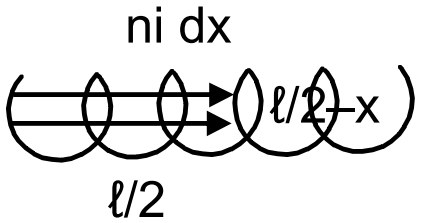
A tightly-wound solenoid of radius a and length l has n turns per unit length. It carries an electric current i. Consider a length dx of the solenoid at a distance x from one end. This contains n(dx) turns and may be approximated as a circular current in (dx).
  1. Write the magnetic field at the centre of the solenoid due to this circular current. Integrate this expression under proper limits to find the magnetic field at the centre of the solenoid.
  2. Verify that if a >> l, the field tends to $\text{B}=\frac{\mu_0\text{nil}}{2\text{a}}.$ Interpret these results.
Answer

Current at ‘0’ due to the circular loop $=\text{dB}=\frac{\mu_0}{4\pi}\times\frac{\text{a}^2\text{in}\ \text{dx}}{\Big[\text{a}^29+\Big(\frac{1}{2}-\text{x}\Big)^2\Big]^\frac{3}{2}}$
$\therefore$ for the whole solenoid $\text{B}=\int\limits_0^\text{B}\text{dB}$
$=\int\limits_0^\ell\frac{\mu_0\text{a}^2\text{in}\ \text{dx}}{4\pi\Big[\text{a}^2+\Big(\frac{\ell}{2}-\text{x}\Big)^2\Big]^\frac{3}{2}}$
$\frac{\mu_0\text{ni}}{4\pi}=\int\limits_0^\ell\frac{\mu_0\text{a}^2\text{in}\ \text{dx}}{\text{a}^3\Big[1+\Big(\ell-\frac{2\text{x}}{2\text{a}}\Big)^2\Big]^\frac{3}{2}}$
$=\frac{\mu_0\text{ni}}{4\pi\text{a}}\int\limits_0^\ell\frac{\text{dx}}{\Big[1+\Big(\ell-\frac{2\text{x}}{2\text{a}}\Big)^\frac{3}{2}\Big]}=1+\Big(\ell-\frac{2\text{x}}{2\text{a}}\Big)^2$
View full question & answer
Question 45 Marks
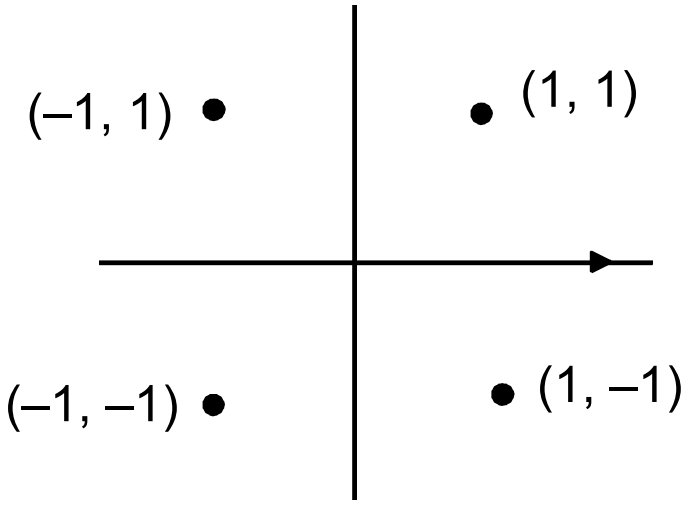
Two long, straight wires, each carrying a current of $5A$, are placed along the X and Y-axes respectively. The currents point along the positive directions of the axes. Find the magnetic fields at the points $(a) (1m, 1m), (b) (-1m, 1m), (c) (-1m,-1m)$ and $(d) (1m, -1m)$,
Answer
  1. $\overrightarrow{\text{B}}\ \text{for}\ \text{X}=\overrightarrow{\text{B}}\ \text{for}\ \text{Y}$
Both are oppositely directed hence net $\overrightarrow{\text{B}}=0$
  1. $\overrightarrow{\text{B}}$ due to $\text{X}=\overrightarrow{\text{B}}$ due to X both directed along Z-axis
Net $\overrightarrow{\text{B}}=\frac{2\times10^{-7}\times2\times5}{1}=2\times10^{-6}\text{T}=2\mu\text{T}$
  1. $\overrightarrow{\text{B}}$ due to $\text{X}=\overrightarrow{\text{B}}$ due to Y both directed opposite to each other.
Hence Net $\overrightarrow{\text{B}}=0$
  1. $\overrightarrow{\text{B}}$ due to $\text{X}=\overrightarrow{\text{B}}$ due to $Y = 1 \times 10^{-6}T$ both directed along (-)ve Z-axis
Hence Net $\overrightarrow{\text{B}}=2\times1.0\times10^{-6}=2\mu\text{T}$
View full question & answer
Question 55 Marks
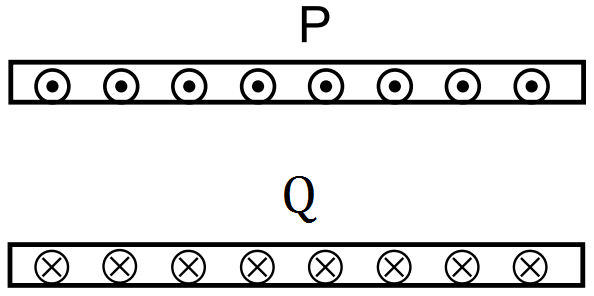
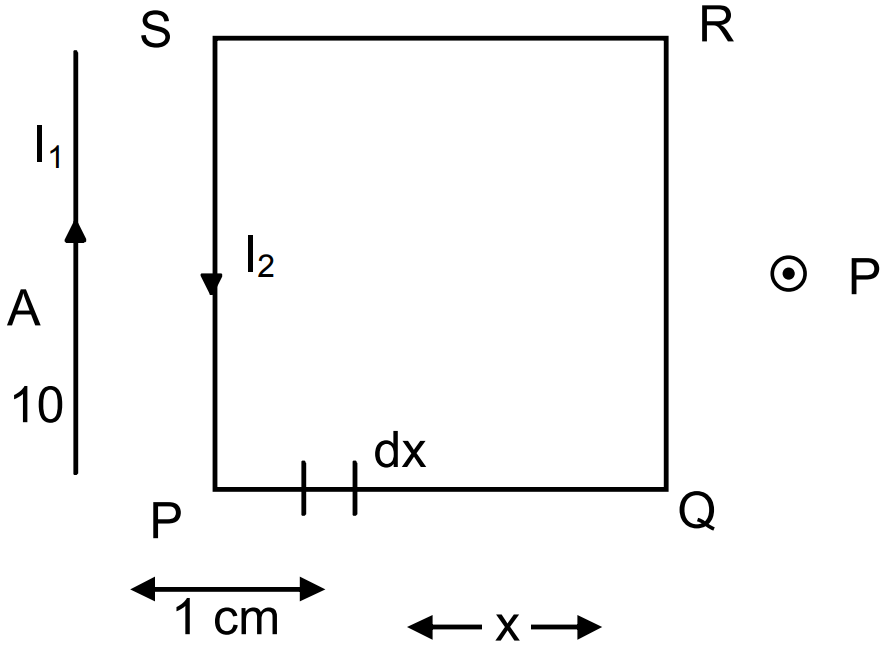
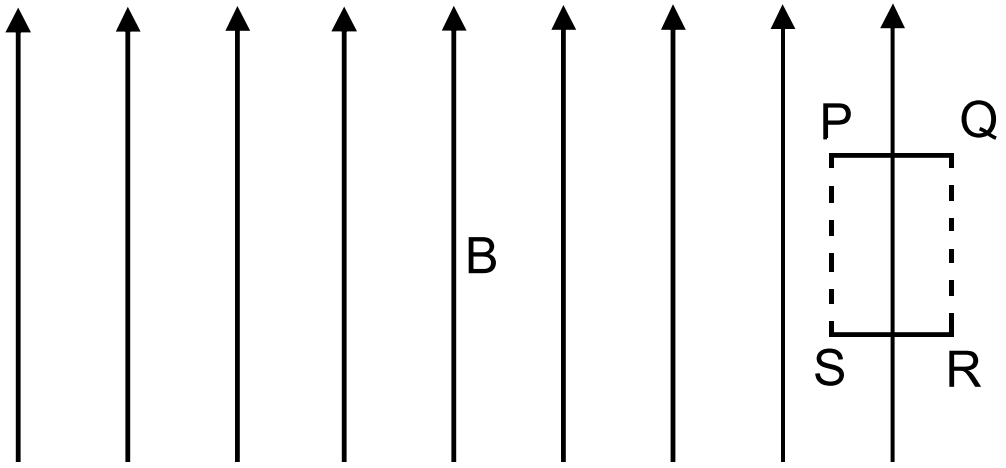
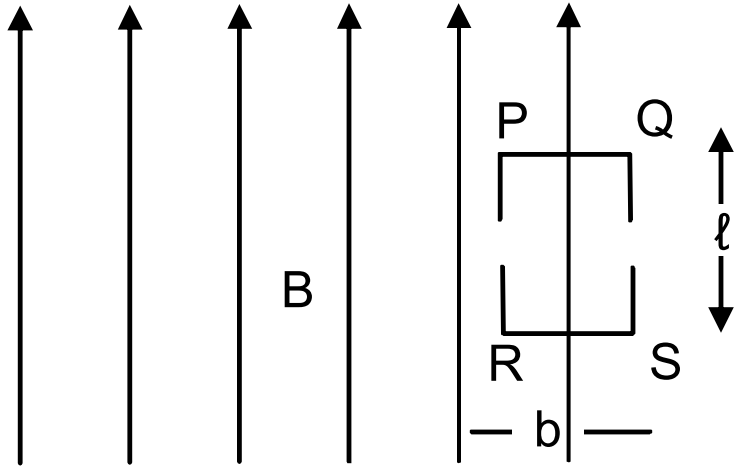
Sometimes we show an idealised magnetic field which is uniform in a given region and falls to zero abruptly. One such field is represented in figure. Using Ampere's law over the path PQRS, show that such a field is not possible.
Answer
We know, $\int\text{B}\times\text{dl}=\mu_0\text{i}.$ Theoritically B = 0 a t A. If, a current is passed through the loop PQRS, then$\text{B}=\frac{\mu_0\text{i}}{2(\ell+\text{b})}$will exist in its vicinity
Now, As the $\overrightarrow{\text{B}}$ at A is zero. So there’ll be no interaction. However practically this is not true. As a current carrying loop, irrespective of its near about position is always affected by an existing magnetic field.
View full question & answer
Question 65 Marks
Two circular coils of radii 5.0cm and 10cm carry equal currents of 21 A. The coils have 50 and 100 turns reepectively and are placed in such a way that their planes as well as the centres coincide. Find the magnitude of the magnetic field B at the common centre of the coils if the currents in the coils are (a) in the same sense (b) in the opposite sense.
Answer
$\text{r}_1 = 5\text{cm},\ \text{r}_2=10\text{cm}$$\text{n}_1=50,\ \text{n}_2=100$
$\text{i}=2\text{A}$
  1. $\text{B}=\frac{\text{n}_1\mu_0\text{i}}{2\text{r}_1}+\frac{\text{n}_2\mu_0\text{i}}{2\text{r}_2}$
$=\frac{50\times4\pi\times10^{-7}\times2}{2\times5\times10^{-2}}+\frac{100\times4\pi\times10^{-7}\times2}{2\times10\times10^{-2}}$
$=4\pi\times10^{-4}+4\pi\times10^{-4}=8\pi\times10^{-4}$
  1. $\text{B}=\frac{\text{n}_1\mu_0\text{i}}{2\text{r}_1}-\frac{\text{n}_2\mu_0\text{i}}{2\text{r}_2}=0$
View full question & answer
Question 75 Marks
Two current-carrying wires may attract each other. In absence of other forces, the wires will move towards each other increasing the kinetic energy. Does it contradict the fact that the magnetic force cannot do any work and hence cannot increase the kinetic energy?
Answer
Magnetic field can not do any work and hence can never speed up or down a particle. Consider 2 wires carrying current in upward direction.
Magnetic field due to current in wire 1 produces a magnetic field out of the plane of paper at the position of wire 2. Due to this magnetic field, a force is exerted on wire 2. Wire 2 electron, moving in downward direction, move in circular paths due to this magnetic force. As these electrons can not come out of the wire so while describing circular path,they hit the edges of the wire and tranfer a momentum to the wire. Due to this change in momentum, wire starts moving and gains kinetic energy.
View full question & answer
Question 85 Marks
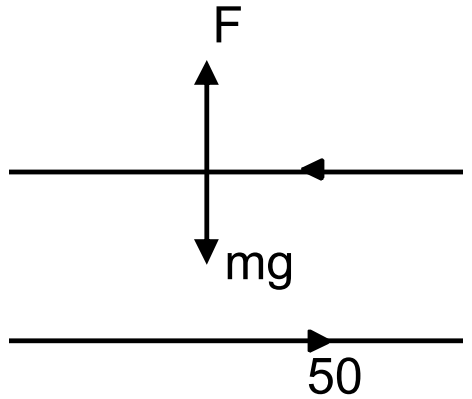
A long, straight wire is fixed horizontally and carries a current of $50.0A$. A second wire having linear mass density $1.0 \times 10^{-4}kg/m$ is placed parallel to and directly above this wire at a separation of $5.0mm$. What current should this second wire carry such that the magnetic repulsion can balance its weight?
Answer
$\frac{\mu_0\text{i}_1\text{i}_2}{2\pi\text{d}}=\text{mg}$ (For a portion of wire of length 1m)

$\Rightarrow\frac{\mu_0\times50\times\text{i}_2}{2\pi\times5\times10^{-3}}=1\times10^{-4}\times9.8$
$\Rightarrow\frac{4\pi\times10^{-7}\times5\times\text{i}_2}{2\pi\times5\times10^{-3}}=9.8\times10^{-4}$
$\Rightarrow3\times\text{i}_2\times10^{-3}=9.3\times10^{-3}\times10^{-1}$
$\Rightarrow\text{i}_2=\frac{9.8}{2}\times10^{-1}=0.49\text{A}$
View full question & answer
Question 95 Marks
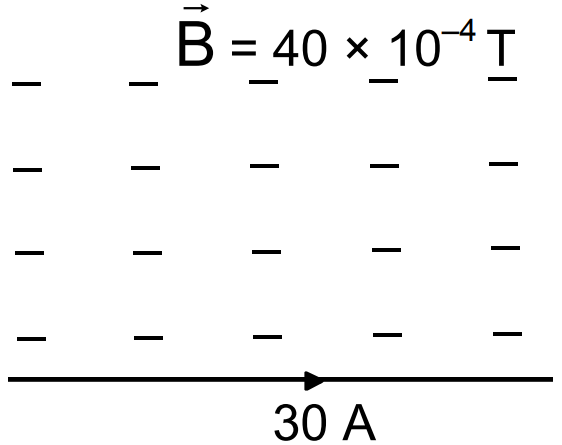
A long, straight wire carrying a current of 30A is placed in an external, uniform magnetic field of $4.0 \times 10^{-4}T$ parallel to the current. Find the magnitude of the resultant magnetic field at a point 2.0cm away from the wire.
Answer


$\mu_0=4\pi\times10^{-7}\text{T-m/A},$
$\text{I}=30\text{A},$
$\text{B}=4.0\times10^{-4}$ Parallel to current.
$\overrightarrow{\text{B}}$ due to wore at pt. 2cm.
$=\frac{\mu_0\text{I}}{2\pi\text{r}}=\frac{4\pi\times10^{-7}\times30}{2\pi\times0.02}=3\times10^{-4}\text{T}$
net field $\sqrt{(3\times10^{-4})^2+(4\times10^{-4})^2}=5\times10^{-4}\text{T}$
View full question & answer
Question 105 Marks
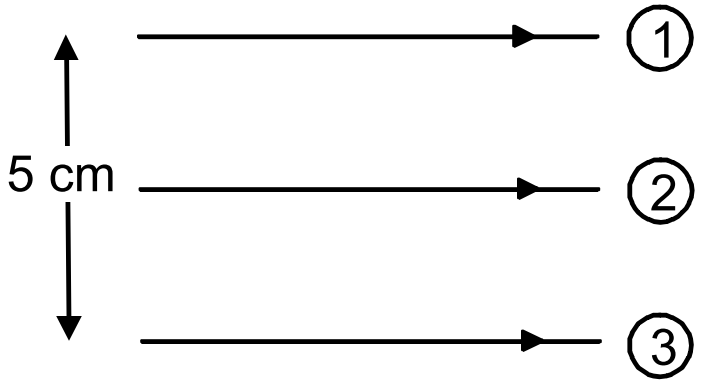
Three coplanar parallel wires, each carrying a current of 10A along the same direction, are placed with a separation 5.0cm between the consecutive ones. Find the matnitude ol the magnetic force per unit lenght acting on the wires.
Answer
i = 10A Magnetic force due to two parallel Current Carrying wires.$\text{F}=\frac{\mu_0\text{I}_1\text{I}_2}{2\pi\text{r}}$
So, $\overrightarrow{\text{F}}\ \text{or}\ 1=\overrightarrow{\text{F}}\ \text{or}\ 2+\overrightarrow{\text{F}}\ \text{by}\ 3$$=\frac{\mu_0\times10\times10}{2\pi\times5\times10^{-2}}+\frac{\mu_0\times10\times10}{2\pi\times10\times10^{-2}}$
$=\frac{4\pi\times10^{-7}\times10\times10}{2\pi\times5\times10^{-2}}+=\frac{4\pi\times10^{-7}\times10\times10}{2\pi\times10\times10^{-2}}$
$=\frac{2\times10^{-3}}{5}+\frac{10^{-3}}{5}=\frac{3\times10^{-3}}{5}=6\times10^{-4}\text{N}$ towards middle wire
View full question & answer
Question 115 Marks
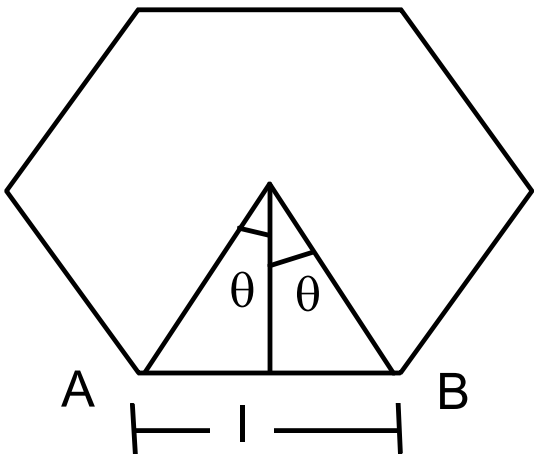
A regular polygon of n sides is formed by bending a wire of total length $27\pi\text{r}$ which carries a current i.
  1. Find the magnetic field B at the centre of the polygon.
  2. By letting $\text{n}\rightarrow\infty,$ deduce the expression for the magnetic field at the centre of a circular current.
Answer

$2\theta=\frac{2\pi}{\text{n}}\Rightarrow\theta=\frac{\pi}{\text{n}},$ $\ell=\frac{2\pi\text{r}}{\text{n}}$
$\tan\theta=\frac{\ell}{2\text{x}}\Rightarrow\text{x}=\frac{\ell}{2\tan\theta}$
$\frac{\ell}{2}=\frac{\pi\text{r}}{\text{n}}$
$\text{B}_\text{AB}=\frac{\mu_0\text{i}}{4\pi(\text{X})}(\sin\theta+\sin\theta)=\frac{\mu_0\text{i}2\tan\theta\times2\sin\theta}{4\pi\ell}$
$=\frac{\mu_0\text{i}2\tan\Big(\frac{\pi}{\text{n}}\Big)2\sin\Big(\frac{\pi}{\text{n}}\Big)\text{n}}{4\pi2\pi\text{r}}=\frac{\mu_0\text{in}\tan\Big(\frac{\pi}{\text{n}}\Big)\sin\Big(\frac{\pi}{\text{n}}\Big)}{2\pi^\text{r}}$
For n sides, $\text{B}_\text{net}=\frac{\mu_0\text{i}2\tan\Big(\frac{\pi}{\text{n}}\Big)\sin\Big(\frac{\pi}{\text{n}}\Big)}{2\pi^2\text{r}}$
View full question & answer
Question 125 Marks
A copper wire having resistance 0.01 ohm in each metre is used to wind a 400-turn solenoid of radius 1.0cm and length 20cm. Find the emf of a battery which when connected the solenoid will eauee a magnetic field of $1.0 \times 10^{-2}T$ near the centre of the solenoid.
Answer
$\frac{\text{R}}{\text{l}}=0.01\Omega\ \text{in}\ 1\text{m},$$\text{r} = 1.0\text{cm},\ \text{Total turns} = 400$
$\ell=20\text{cm},$
$\text{B}=1\times10^{-2}\text{T},$
$\text{n}=\frac{400}{20\times10^{-2}}\text{turns\m}$
$\text{i}=\frac{\text{E}}{\text{R}_0}=\frac{\text{E}}{\frac{\text{R}}{\text{l}}\times(2\pi)\text{r}\times400}$
$=\frac{\text{E}}{0.01\times2\times\pi\times0.01\times400}$
$\Rightarrow10^2=4\pi\times10^{-7}\times\frac{400}{20\times10^{-2}}\times\frac{\text{E}}{400\times2\pi\times0.01\times10^{-2}}$
$\Rightarrow\text{E}=\frac{10^{-2}\times20\times10^{-2}\times400\times2\pi\times10^{-2}\times0.01}{4\pi\times10^{-7}\times400}=1\text{V}$
View full question & answer
Question 135 Marks
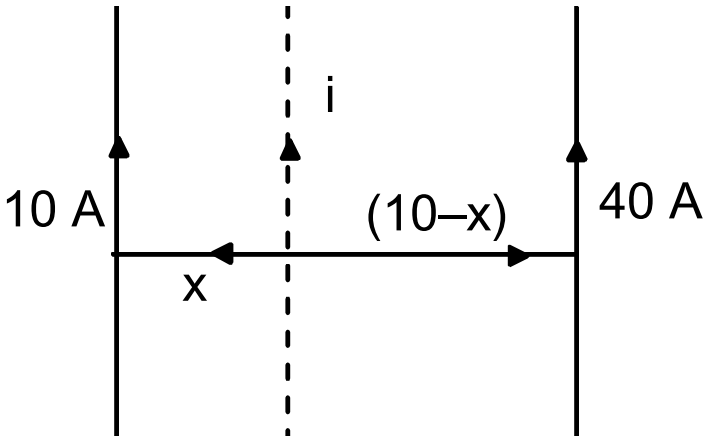
Two parallel wires seprated by a distance of 10cm carry currents of 10A and 40A along-the same direction. Where should a third current be placed so that it experiences no magnetic force?
Answer

$\frac{\mu_010\text{i}}{2\pi\text{x}}=\frac{\mu_0\text{i}40}{2\pi(10-\text{x})}$
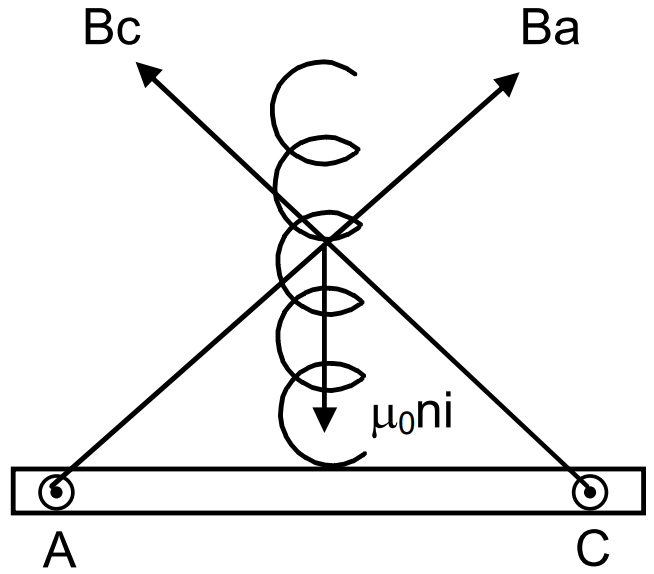
$\Rightarrow\frac{10}{\text{x}}=\frac{40}{10-\text{x}}\Rightarrow\frac{1}{\text{x}}=\frac{4}{10-\text{x}}$
$\Rightarrow10-\text{x} = 4\text{x}$
$\Rightarrow5\text{x} = 10$
$\Rightarrow\text{x} = 2\text{cm}$
The third wire should be placed 2cm from the 10A wire and 8 cm from 40A wire.
View full question & answer
Question 145 Marks
A tightly-wound, long solenoid is kept with its axis parallel to a large metal sheet carrying a surface current. The surface current through a width dl of the sheet is Kdl and the number of turns per unit length of the solenoid is n. The magnetic field near the centre of the solenoid is found to be zero.
  1. Find the current in the solenoid.
  2. If the solenoid is rotated to make its axis perpendicular to the metal sheet, what would be the magnitude of the magnetic field near its centre ?
Answer
No. of turns per unit length $=\ell$
  1. As the net magnetic field = zero
$\therefore\overrightarrow{\text{B}}_\text{plate}=\overrightarrow{\text{B}}_\text{Solenoid}$

$\overrightarrow{\text{B}}_\text{plate}\times2\ell=\mu_0\text{kd}\ell=\mu_0\text{k}\ell$

$\overrightarrow{\text{B}}_\text{plate}=\frac{\mu_0\text{k}}{2}\ ...(1)$

$\overrightarrow{\text{B}}_\text{Solenoid}=\mu_0\text{ni}\ ...(2)$

Equating both $\text{i}=\frac{\mu_0\text{k}}{2}$

  1. $\text{B}_\text{a}\times\ell=\mu\text{k}\ell$
$\Rightarrow\text{B}_\text{a}=\mu_0\text{k}\ \text{BC}=\mu_0\text{K}$

$\text{B}=\sqrt{\text{B}_\text{a}^2+\text{B}_\text{a}^2}=\sqrt{2(\mu_0\text{k})^2}=\sqrt{2}\mu_0\text{k}$

$2\mu_0\text{k}=\mu_0\text{ni}\text{i}=\frac{\sqrt2\text{k}}{\text{n}}$
View full question & answer
Question 155 Marks
An electron makes $3 \times 10^5$ revolutions per second in a circle of radius $0.5$ angstrom. Find the magnetic field B at the centre of the circle.
Answer
$3 \times 10^5$ revolutions in 1sec. 1 revolutions in $\frac{1}{3\times10^5}\text{seci}=\frac{\text{q}}{\text{t}}=\frac{1.6\times10^{-19}}{\Big(\frac{1}{3\times10^{5}}\Big)}\text{A}$
$\text{B}=\frac{\mu_0\text{i}}{2\text{r}}=\frac{4\pi\times10^{-7}\times16\times10^{-19}\times3\times10^5}{2\times0.5\times10^{-10}}$
$=\frac{2\pi\times1.6\times3}{0.5}\times10^{-11}$
$=6.028\times10^{-10}\approx6\times10^{-10}\text{T}$
View full question & answer
Question 165 Marks
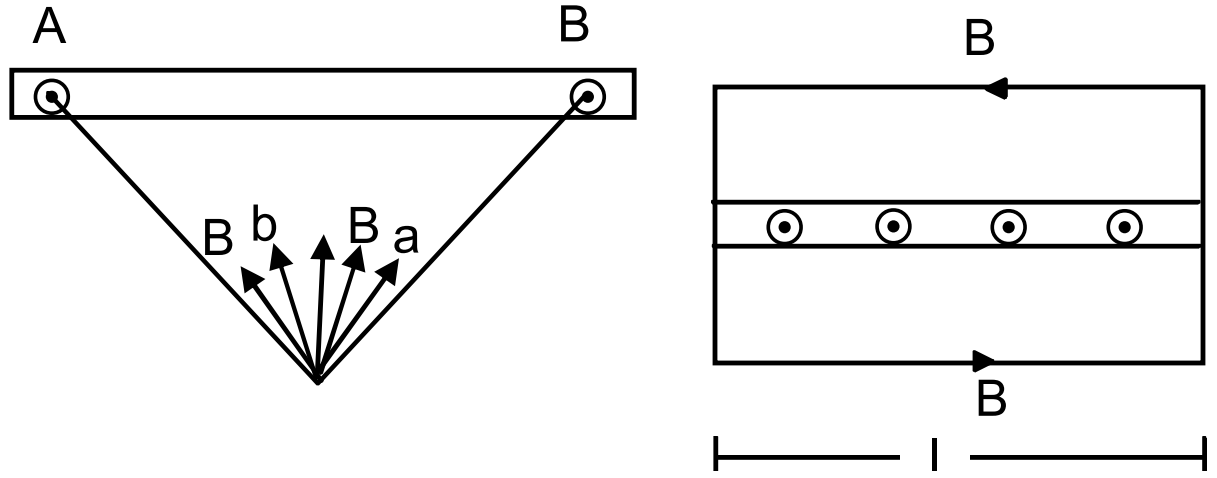
An electric current flows in a wire from north to south. What will be the direction of the magnetic field due to this wire at a point east of the wire? West of the wire? Vertically above the wire? Vertically below the wire?
Answer
According to the right hand thumb rule, if the thumb of our right hand points in the direction of the current flowinig, then the curling of the fingers will show the direction of the magnetic field developed due to it and vice versa. Let us consider the case where an electnc current flows north to south in a wire. According to the right hand thumb rule,
  1. For any point m the east of the wire, the magnetic field will come out of the plane of paper.
  2. For a point m the west of the wire, the magnetic field will enter the plane of paper.
  3. For any point vertically above the wire, the magnetic field will be from right to left.
  4. For any point vertically below the wire, the magnetic field will be from left to right.
View full question & answer
Question 175 Marks
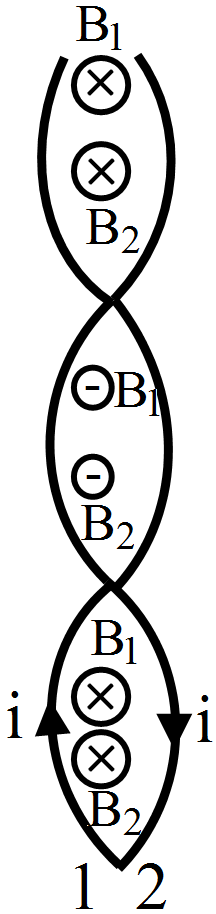
Quite often, connecting wires carrying currents in opposite directions are twisted together in using electrical appliances. Explain how it avoids unwanted magnetic fields.
Answer
Connecting wires carrying currents in opposite directions are twisted together in using electrical appliances. If the wire is twisted, then the resultant fields from consecutive twists are in opposite directions. So the cumulative effect over a long length of wire is roughly zero.
Let at any point in between the two wires, $B_1$ and $B_2$ be the magnetic field due to wire 1 and wire 2 respectively.

From the diagram, we can see that the net magnetic field due to first turn is into the paper and due to second twisted turn is out of the plane of paper so these fields will cancel each other. Hence if the wire is twisted, then the resultant fields from consecutive twists are in opposite directions. So the cumulative effect over a long length of wire is roughly zero.
View full question & answer
Question 185 Marks
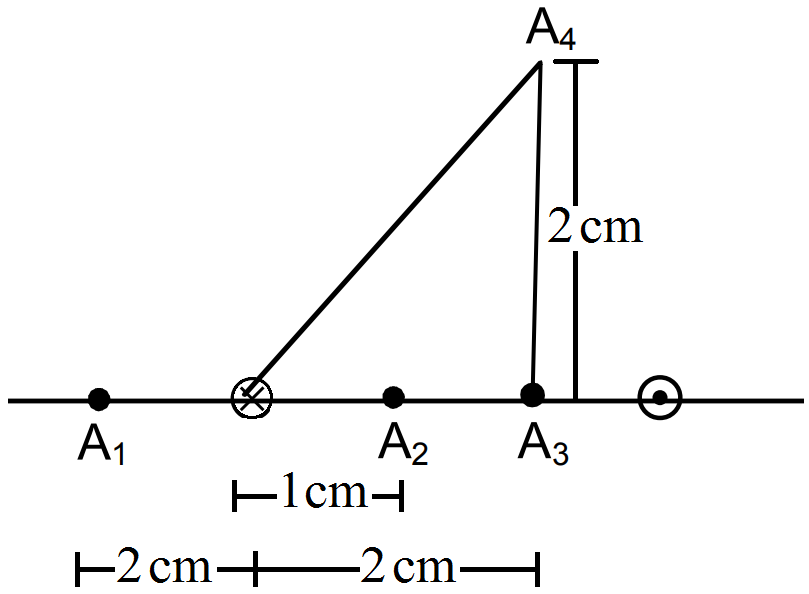
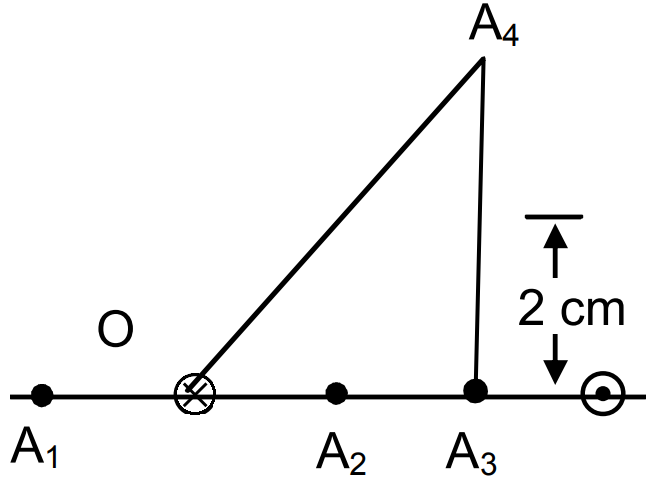
Figure shows two parallel wires separated by a distance of $4.0cm$ and carrying equal currents of 10A along opposite directions. Find the magnitude of the magnetic field B at the points $A_1, A_2, A_3 and A_4$.

​​​​​​​
Answer
Let the tow wires be positioned at O & P$\text{R}=\text{OA},=\sqrt{(0.02)^2+(0.02)^2}$
$=\sqrt{8\times10^{-4}}=2.828\times10^{-2}\text{m}$
  1. $\overrightarrow{\text{B}}$ due to Q, at $\text{A}_1=\frac{4\pi\times10^{-7}\times10}{2\pi\times0.02}=1\times10^{-4}\text{T}$ $\big(\bot\text{r}$ towards up the line$\big)$
$\overrightarrow{\text{B}}$ due to Q, at $\text{A}_1=\frac{4\pi\times10^{-7}\times10}{2\pi\times0.06}=0.33\times10^{-4}\text{T}$ $\big(\bot\text{r}$ towards down the line$\big)$
net $\overrightarrow{\text{B}}=1\times10^{-4}-0.33\times10^{-4}=0.67\times10^{-4}\text{T}$
  1. $\overrightarrow{\text{B}}$ due to O, at $\text{A}_2=\frac{2\times10^{-7}\times10}{0.01}=2\times10^{-4}\text{T}$ $\bot\text{r}$ down the line
$\overrightarrow{\text{B}}$ due to O, at $\text{A}_2=\frac{2\times10^{-7}\times10}{0.03}=0.67\times10^{-4}\text{T}$ $\bot\text{r}$ down the line
net $\overrightarrow{\text{B}}$ at $\text{A}_2=2\times10^{-4}+0.67\times10^{-4}=2.67\times10^{-4}\text{T}$
  1. $\overrightarrow{\text{B}}$ at $A_3$ due to $\text{O}=1\times10^{-4}\text{T}$ $\bot\text{r}$ towards down the line
$\overrightarrow{\text{B}}$ at $A_3$ due to $\text{P}=1\times10^{-4}\text{T}$ $\bot\text{r}$ towards down the line
Net $\overrightarrow{\text{B}}$ at $\text{A}_3=2\times10^{-4}\text{T}$
  1. $\overrightarrow{\text{B}}$ at $A_4$ due to $\text{O}=\frac{2\times10^{-7}\times10}{2.828\times10^{-2}}=0.7\times10^{-4}\text{T}$ towards SE
$\overrightarrow{\text{B}}$ at $A_4$ due to $\text{P}=0.7\times10^{-4}\text{T}$ towards SW
Net $\overrightarrow{\text{B}}=\sqrt{(0.7\times10^{-4})^2+(0.7\times10^{-4})^2}$
$=0.989\times10^{-4}\approx1\times10^{-4}\text{T}$
View full question & answer
Question 195 Marks
Two wires carrying equal currents i each, are placed perpendicular to each other, just avoiding a contact. If one wire is held fixed and the other is free to move under magnetic forces, what kind of motion will result?
Answer
The magnetic force on a wire carrying an electric current i is $\overrightarrow{\text{F}}=\text{i}.\big(\overrightarrow{\text{l}}\times\overrightarrow{\text{B}}\big),$ where l is the length of the wire and B is the magnetic field acting on it. Suppose we have one wire in the horizontal direction (fixed) and other wire in the vertical direction (free to move). If the horizontal wire is carrying current from right to left is held fixed perpendicular to the vertical wire, which is free to move, the upper portion of the free wire will tend to move in the left direction and the lower portion of the wire will tend to move in the right direction, according to Fleming's left hand rule, as the magnetic field acting on the wire due to the fixed wire will point into the plane of paper above the wire and come out of the paper below the horizontal wire and the current will flow in upward direction in the free wire. Thus, the free wire will tend to become parallel to the fixed wire so as to experience maximum attractive force.
View full question & answer
Question 205 Marks
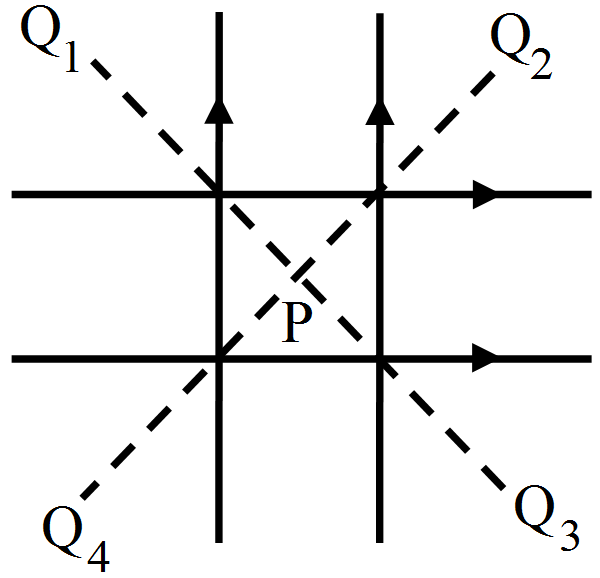
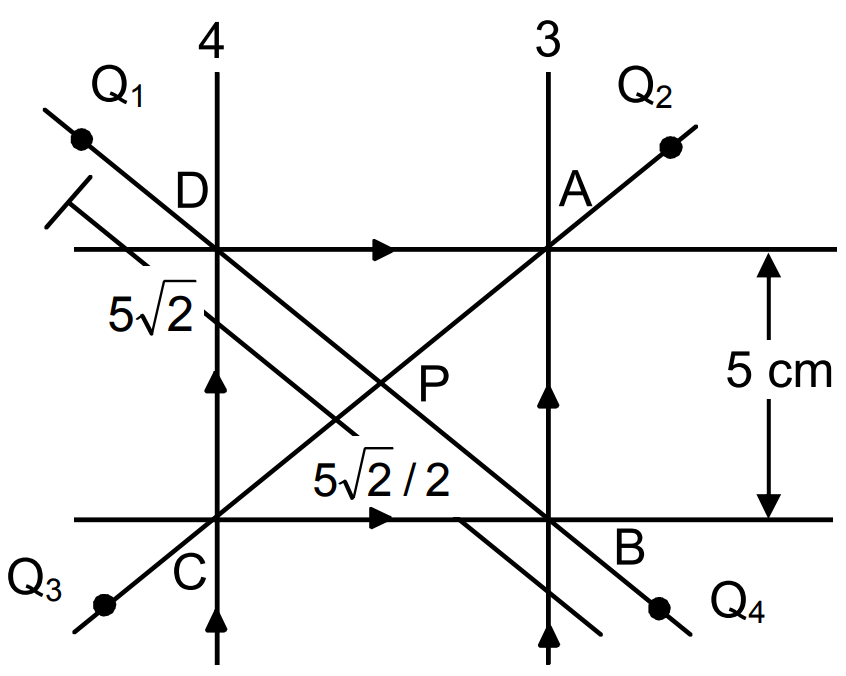
Four long, straight wires, each carrying a current of $5.0A$, are placed in a plane as shown in figure. The points of intersection form a square of side $5.0cm$.
  1. Find the magnetic field at the centre P of the square.
  2. $Q_1, Q_2, Q_3,$ and $Q_4$ are points situated on the diagonals of the liquare and at a distance from P that is equal to the length of the diagonal of the square. Find the magnetic fields at these points.
Answer

  1. For each of the wire
Magnitude of magnetic field
$=\frac{\mu_0\text{i}}{4\pi\text{r}}(\sin45^\circ+\sin45^\circ)=\frac{\mu_0\times5}{4\pi\Big(\frac{5}{2}\Big)}=\frac{2}{\sqrt2}$
For AB $\odot$ for BC $\odot$ for CD $\otimes$ and for DA $\otimes.$
The two $\odot$ and $2\otimes$ fields cancel each other. Thus $B_{net} = 0$
  1.  
At point $Q_1$,
Due to (1) $\text{B}=\frac{\mu_0\text{i}}{2\pi\times2.5\times10^{-2}}=\frac{4\pi\times5\times2\times10^{-7}}{2\pi\times5\times10^{-2}}=4\times10^{-5}\odot$
Due to (2) $\text{B}=\frac{\mu_0\text{i}}{2\pi\times\Big(\frac{15}{2}\Big)\times10^{-2}}=\frac{4\pi\times5\times2\times10^{-7}}{2\pi\times5\times10^{-2}}=\Big(\frac{4}{3}\Big)\times10^{-5}\odot$
Due to (3) $\text{B}=\frac{\mu_0\text{i}}{2\pi\times\Big(5+\frac{5}{2}\Big)\times10^{-2}}=\frac{4\pi\times5\times2\times10^{-7}}{2\pi\times15\times10^{-2}}=\Big(\frac{4}{3}\Big)\times10^{-5}\odot$
Due to (4) $\text{B}=\frac{\mu_0\text{i}}{2\pi\times2.5\times10^{-2}}=\frac{4\pi\times5\times2\times10^{-7}}{2\pi\times5\times10^{-2}}=4\times10^{-5}\odot$
$\text{B}_\text{net}=\Big[4+4+\Big(\frac{4}{3}\Big)+\Big(\frac{4}{3}\Big)\Big]\times10^{-5}$
$=\frac{32}{3}\times10^{-5}=10.6\times10^{-5}\approx1.1\times10^{-4}\text{T}$
At point $Q_2$,
Due to (1) $\frac{\mu_0\text{i}}{2\pi\times(2.5)\times10^{-2}}\odot$
Due to (2) $\frac{\mu_0\text{i}}{2\pi\times\Big(\frac{15}{2}\Big)\times10^{-2}}\odot$
Due to (3) $\text{B}=\frac{\mu_0\text{i}}{2\pi\times(2.5)\times10^{-2}}\otimes$
Due to (4) $\frac{\mu_0\text{i}}{2\pi\times\Big(\frac{15}{2}\Big)\times10^{-2}}\otimes$
At point $Q_3$,
Due to (1) $\frac{4\pi\times10^{-7}\times5}{2\pi\times\Big(\frac{15}{2}\Big)\times10^{-2}}=\frac{4}{3}\times10^{-5}\otimes$
Due to (2) $\frac{4\pi\times10^{-7}\times5}{2\pi\times\Big(\frac{5}{2}\Big)\times10^{-2}}=4\times10^{-5}\otimes$
Due to (3) $\frac{4\pi\times10^{-7}\times5}{2\pi\times\Big(\frac{5}{2}\Big)\times10^{-2}}=4\times10^{-5}\otimes$
Due to (4) $\frac{4\pi\times10^{-7}\times5}{2\pi\times\Big(\frac{15}{2}\Big)\times10^{-2}}=\frac{4}{3}\times10^{-5}\otimes$
$\text{B}_\text{net}=\Big[4+4+\Big(\frac{4}{3}\Big)+\Big(\frac{4}{3}\Big)\Big]\times10^{-5}$
$=\frac{32}{3}\times10^{-5}=10.6\times10^{-5}\approx1.1\times10^{-4}\text{T}$
For $Q_4​​​​​​​$,
Due to (1) $\frac{4}{3}\times10^{-5}\otimes$
Due to (2) $4\times10^{-5}\otimes$
Due to (3) $\frac{4}{3}\times10^{-5}\otimes$
Due to (4) $4\times10^{-5}\otimes$
$\text{B}_\text{net}=0$
View full question & answer
Question 215 Marks
A long, straight wire carries a current i. Let $B_1$, be the magnetic field at a point Pat a distance d from the wire. Consider a section of length l of this wire such that the point P lies on a perpendicular bisector of the section. Let B2 be the magnetic field at this point due to this section only. Find the value of $\frac{\text{d}}{\text{l}}$ so that $B_2$ differs from $B_1$, by $1\%$.
Answer


$\text{B}_1=\frac{\mu_0\text{i}}{2\pi\text{d}},\ \text{B}_2=\frac{\mu_0\text{i}}{4\pi\text{d}}(2\times\sin\theta)$
$=\frac{\mu_0\text{i}}{4\pi\text{d}}\frac{2\ell}{2\sqrt{\text{d}^2+\frac{\ell^2}{4}}}=\frac{\mu_0\text{i}\ell}{4\pi\text{d}\sqrt{\text{d}^2+\frac{\ell^2}{4}}}$
$\text{B}_1-\text{B}_2=\frac{1}{100}\text{B}_2$
$\Rightarrow\frac{\mu_0\text{i}\ell}{4\pi\text{d}\sqrt{\text{d}^2+\frac{\ell^2}{4}}}=\frac{\mu_0}{200\pi\text{d}}$
$\Rightarrow\frac{\mu_0\text{i}\ell}{4\pi\text{d}\sqrt{\text{d}^2+\frac{\ell^2}{4}}}=\frac{\mu_0\text{i}}{\pi\text{d}}\Big(\frac{1}{2}-\frac{1}{200}\Big)$
$\Rightarrow\frac{\ell}{4\sqrt{\text{d}^2+\frac{\ell^2}{4}}}=\frac{99}{200}$
$\Rightarrow\frac{\ell^2}{\text{d}^2+\frac{\ell^2}{4}}=\Big(\frac{99\times4}{200}\Big)^2=\frac{156816}{40000}=3.92$
$\Rightarrow\ell^2=3.92\text{d}^2+\frac{3.92}{4}\ell^2$
$\Big(\frac{1-3.92}{4}\Big)\ell^2=3.92\text{d}^2$
$\Rightarrow0.02\ell^2=3.92\text{d}^2$
$\Rightarrow\frac{\text{d}^2}{\ell^2}=\frac{0.02}{3.92}=\frac{\text{d}}{\ell}=\sqrt{\frac{0.02}{3.92}}=0.07$
View full question & answer
Question 225 Marks
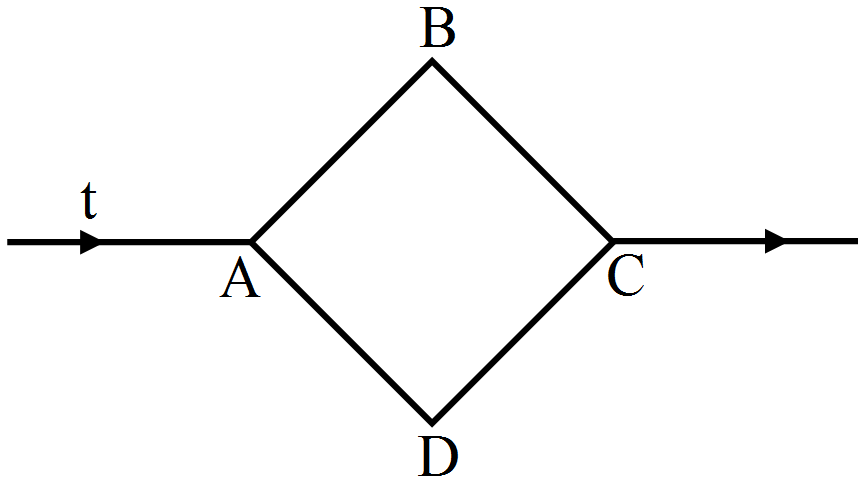
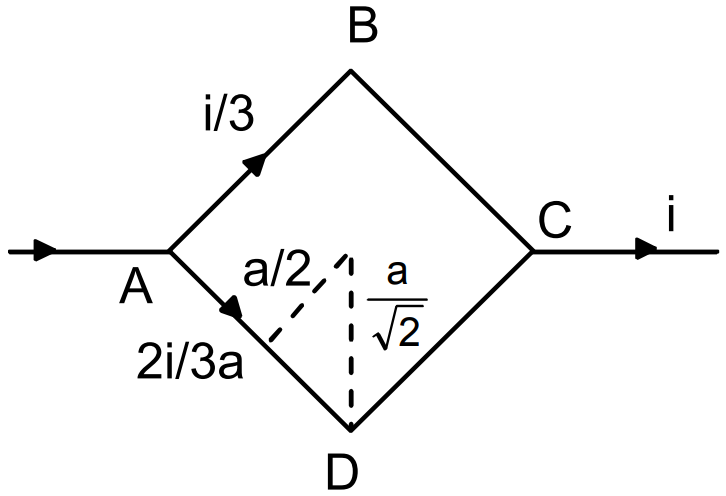
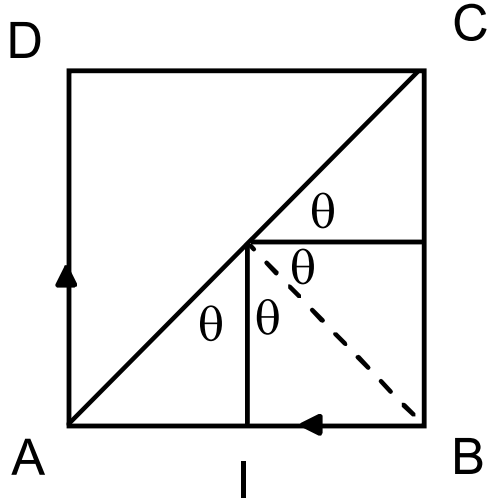
Figure shows a square loop ABCD with edgelength a. The resistance of the wire ABC is r and that of ADC is 2r. Find the magnetic field B at the centre of the loop assuming uniform wires.
Answer
As resistances vary as r & 2r
Hence Current along $\text{ABC}= \frac{\text{i}}{3}$ & along $\text{ADC}= \frac{2}{3\text{i}}$ Now,$\overrightarrow{\text{B}}\ \text{due to}\ \text{ADC}=2\Big[\frac{\mu_0\text{i}\times2\times2\times\sqrt2}{4\pi3\text{a}}\Big]=\frac{2\sqrt2\mu_0\text{i}}{3\pi\text{a}}$
$\overrightarrow{\text{B}}\ \text{due to}\ \text{ABC}=2\Big[\frac{\mu_0\text{i}\times2\times\sqrt2}{4\pi3\text{a}}\Big]=\frac{2\sqrt2\mu_0\text{i}}{6\pi\text{a}}$
Now $\overrightarrow{\text{B}}=\frac{2\sqrt2\mu_0\text{i}}{3\pi\text{a}}-\frac{2\sqrt2\mu_0\text{i}}{6\pi\text{a}}=\frac{\sqrt2\mu_0\text{i}}{3\pi\text{a}}=\otimes$
View full question & answer
Question 235 Marks
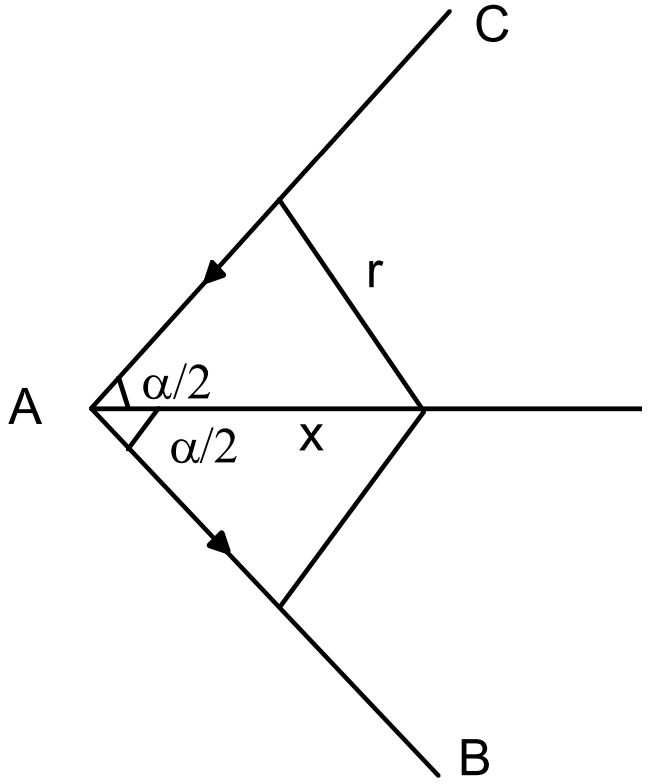
A long wire carrying a current i is bent to form a plane angle $\alpha.$ Find the magnetic field B at a point on the bisector of this angle situated at a distance x from the vertex.
Answer
$\sin\Big(\frac{\alpha}{2}\Big)=\frac{\text{r}}{2}$$\Rightarrow\text{r}=\text{x}\sin\Big(\frac{\alpha}{2}\Big)$

Magnetic field B due to AR
$\frac{\mu_0\text{i}}{4\pi\text{r}}\Big[\sin\Big(180-\Big[90-\Big(\frac{\alpha}{2}\Big)\Big]\Big)+1\Big]$
$=\frac{\mu_0\text{i}\Big[\sin\Big(90-\frac{\alpha}{2}\Big)\Big]+1}{4\pi\times\sin\Big(\frac{\alpha}{2}\Big)}$
$=\frac{\mu_0\text{i}\Big[\cos\Big(\frac{\alpha}{2}\Big)+1\Big]}{4\pi\sin\Big(\frac{\alpha}{2}\Big)}$
$=\frac{\mu_0\text{i}2\cos^4\Big(\frac{\alpha}{4}\Big)}{4\pi\times2\sin\Big(\frac{\alpha}{4}\Big)\cos\Big(\frac{\alpha}{4}\Big)}=\frac{\mu_0\text{i}}{4\pi\text{x}}\cot\Big(\frac{\alpha}{4}\Big)$
The magnetic field due to both the wire
$\frac{2\mu_0\text{i}}{4\pi\text{x}}\cot\Big(\frac{\alpha}{4}\Big)=\frac{\mu_0\text{i}}{2\pi\text{x}}\cot\Big(\frac{\alpha}{4}\Big)$
View full question & answer
Question 245 Marks
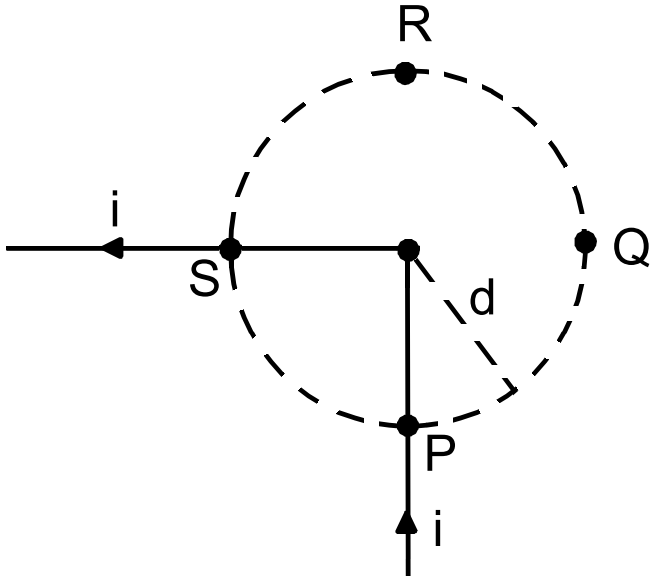
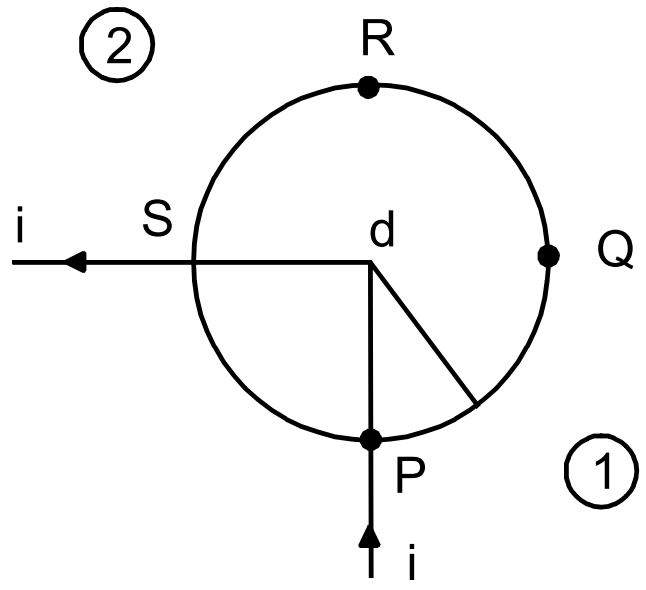
Figure shows a long wire bent at the middle to form a right angle. Show that the magnitudes of the magnetic fields at the points P, Q, R and S are equal and find this magnitude.
Answer
Since all the points lie along a circle with radius = ‘d’
Hence ‘R’ & ‘Q’ both at a distance ‘d’ from the wire.
So, magnetic field B r due to are same in magnitude.
As the wires can be treated as semi infinite straight current carrying
conductors. Hence magnetic field $\overrightarrow{\text{B}}=\frac{\pi_0\text{i}}{4\pi\text{d}}$

At $P$
$B_1$ due to 1 is 0
$\mathrm{B}_2$ due to 2 is $\frac{\pi_0 \mathrm{i}}{4 \pi \mathrm{~d}}$
At Q
$\mathrm{B}_1$ due to 1 is $\frac{\pi_0 \mathrm{i}}{4 \pi \mathrm{~d}}$
$\mathrm{B}_2$ due to 2 is 0
At R
$B_1$ due to 1 is 0
$\mathrm{B}_2$ due to 2 is $\frac{\pi_0 \mathrm{I}}{4 \pi \mathrm{~d}}$
At S
$\mathrm{B}_1$ due to 1 is $\frac{\pi_0 \mathrm{i}}{4 \pi \mathrm{~d}}$
$\mathrm{B}_2$ due to 2 is 0
View full question & answer
Question 255 Marks
Find the magnetic field B at the centre of a rectangular loop of length l and width b, carrying a current i.
Answer

$\overrightarrow{\text{B}}\text{AB}$
$\frac{\mu_0\text{i}\times2}{4\pi\text{b}}\times2\sin\theta=\frac{\mu_0\text{i}\sin\theta}{\pi\text{b}}$
$=\frac{\mu_0\text{i}\ell}{\pi\text{b}\sqrt{\ell^2+\text{b}^2}}=\overrightarrow{\text{B}}\text{DC}$
$\therefore\sin(\ell^2+\text{b})=\frac{\Big(\frac{\ell}{2}\Big)}{\sqrt{\frac{\ell^2}{4}+\frac{\text{b}^2}{4}}}=\frac{\ell}{\sqrt{\ell^2+\text{b}^2}}$
$\overrightarrow{\text{B}}\text{BC}$
$\frac{\mu_0\text{i}\times2}{4\pi\ell}\times2\times2\sin\theta'=\frac{\mu_0\text{i}\sin\theta'}{\pi\ell}$
$\therefore\sin\theta'=\frac{\Big(\frac{\text{b}}{2}\Big)}{\sqrt{\frac{\ell^2}{4}+\frac{\text{b}^2}{4}}}=\frac{\text{b}}{\sqrt{\ell^2+\text{b}^2}}$
$=\frac{\mu_0\text{ib}}{\pi\ell\sqrt{\ell^2+\text{b}^2}}=\overrightarrow{\text{B}}\text{AD}$
Net $\overrightarrow{\text{B}}=\frac{2\mu_0\text{i}\ell}{\pi\text{b}\sqrt{\ell^2+\text{b}^2}}+\frac{2\mu_0\text{ib}}{\pi\sqrt{\ell^2+\text{b}^2}}$
$=\frac{2\mu_0\text{i}(\ell^2+\text{b}^2)}{\pi\ell\text{b}\sqrt{\ell^2+\text{b}^2}}=\frac{2\mu_0\text{i}\sqrt{\ell^2+\text{b}^2}}{\pi\ell\text{b}}$
View full question & answer
Question 265 Marks
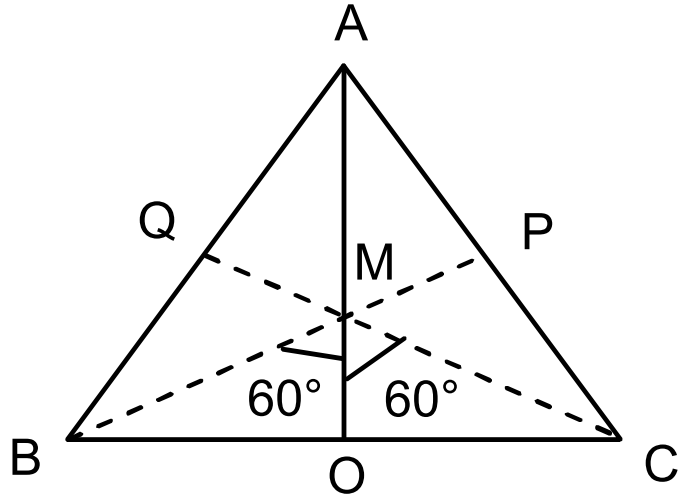
A wire of length l is bent in the form of an equilateral triangle and carries an electric currrent i.
  1. Find the magnetic field B at the centre.
  2. If the wire is bent in the form of a square, what would be the value of B at the centre?
Answer
  1. $\triangle\text{ABC}$ is Equilateral
$\text{AB} = \text{BC} =\text{CA} =\frac{\ell}{3}$
Current = i
$\text{AO}=\frac{\sqrt3}{2}\text{a}=\frac{\sqrt3\times\ell}{2\times3}=\frac{\ell}{2\sqrt3}$
$\phi_1=\phi_2=60^\circ$
So, $\text{MO}=\frac{\ell}{6\sqrt3}$ as AM : MO = 2 : 1
$\overrightarrow{\text{B}}$ due to BC at <.
$=\frac{\mu_0\text{i}}{4\pi\text{r}}(\sin\phi_1+\sin\phi_2)$
$=\frac{\mu_0\text{i}}{4\pi}\times\text{i}\times6\sqrt3\times\sqrt3=\frac{\mu_0\text{i}\times9}{2\pi\ell}$
net $\overrightarrow{\text{B}}=\frac{9\mu_0\text{i}}{2\pi\ell}\times3=\frac{27\mu_0\text{i}}{2\pi\ell}$
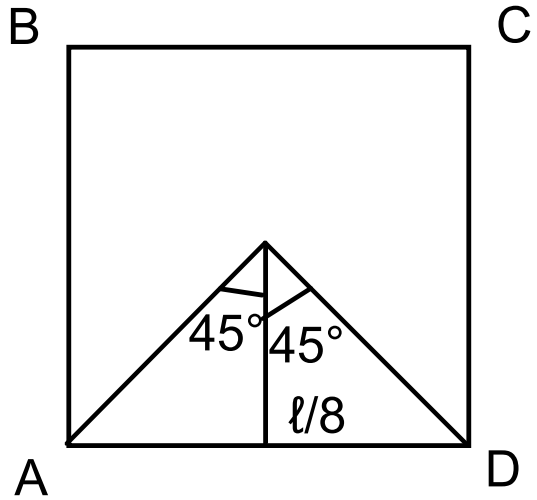
  1. $\overrightarrow{\text{B}}$ due to $\text{AD}=\frac{\mu_0\text{i}\times8}{4\pi\times\ell}\sqrt2=\frac{8\sqrt2\mu_0\text{i}}{4\pi\ell}$
Net $\overrightarrow{\text{B}}=\frac{8\sqrt2\mu_0\text{i}}{4\pi\ell}\times4=\frac{8\sqrt2\mu_0\text{i}}{\pi\ell}$
​​​​​​​
View full question & answer
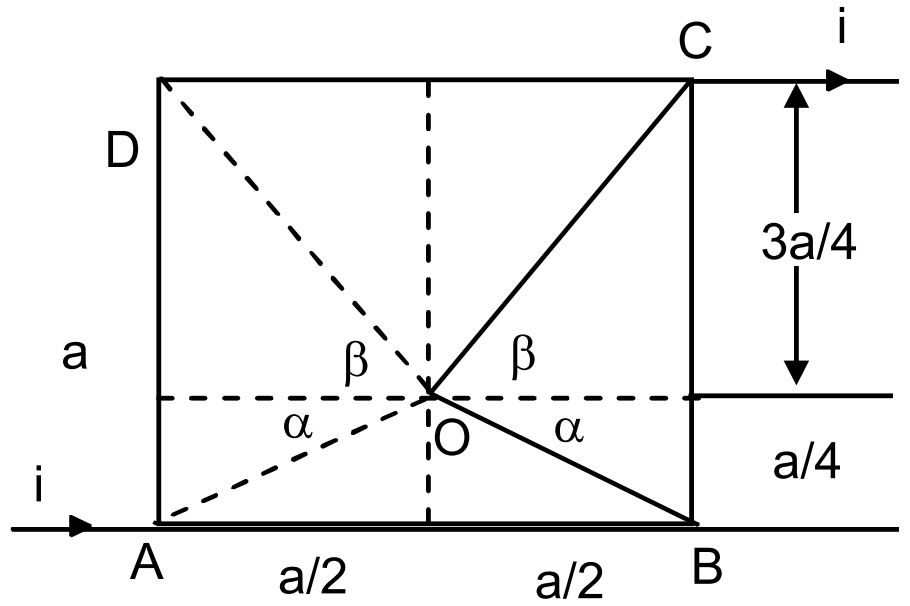
Question 275 Marks
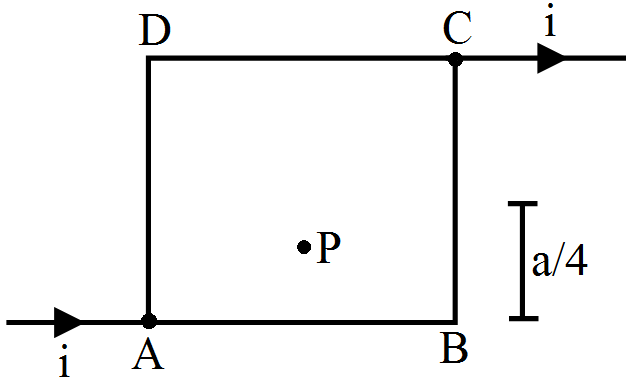
Figure shows a square loop of edge a made of a uniform wire. A current i enters the loop at the point A and leaves it at the point C. Find the magnetic field at the point P which is on the perpendicular bisector of AB at a distance $\frac{\text{a}}{4}$ from it.
Answer
$\text{A}_0=\sqrt{\frac{\text{a}^2}{16}+\frac{\text{a}^2}{4}}=\sqrt{\frac{5\text{a}^2}{16}}=\frac{\text{a}\sqrt5}{4}$$\text{D}_0=\sqrt{\Big(\frac{3\text{a}}{4}\Big)+\Big(\frac{\text{a}}{2}\Big)^2}=\sqrt{\frac{9\text{a}^2}{16}+\frac{\text{a}^2}{4}}$
$=\sqrt{\frac{13\text{a}^2}{16}}=\frac{\text{a}\sqrt{13}}{4}$

Magnetic field due to AB
$\text{B}_\text{AB}=\frac{\mu_0}{4\pi}\times\frac{\text{i}}{2\Big(\frac{\text{a}}{4}\Big)}(\sin(90-\text{i})+\sin(90-\alpha))$
$=\frac{\mu_0\times2\text{i}}{4\pi\text{a}}2\cos\alpha=\frac{\mu_0\times2\text{i}}{4\pi\text{a}}\times2\times\frac{\Big(\frac{\text{a}}{2}\Big)}{\text{a}\Big(\frac{\sqrt5}{4}\Big)}=\frac{2\mu_0\text{i}}{\pi\sqrt5}$
Magnetic field due to DC
$\text{B}_\text{DC}=\frac{\mu_0}{4\pi}\times\frac{\text{i}}{2\Big(\frac{3\text{a}}{4}\Big)}2\sin(90-\text{B})$
$=\frac{\mu_0\text{i}\times4\times2}{4\pi\times3\text{a}}\cos\beta$
$=\frac{\mu_0\text{i}}{\pi\times3\text{a}}\times\frac{\Big(\frac{\text{a}}{2}\Big)}{\Big(\frac{\sqrt{13\text{a}}}{4}\Big)}=\frac{2\mu_0\text{i}}{\pi\text{a}3\sqrt{13}}$
The magnetic field due to AD & BC are equal and appropriate hence cancle each other.
Hence, net magnetic field is $\frac{2\mu_0\text{i}}{\pi\sqrt5}-\frac{2\mu_0\text{i}}{\pi\text{a}3\sqrt{13}}=\frac{2\,u_0\text{i}}{\pi\text{a}}\Big[\frac{1}{\sqrt5}-\frac{1}{3\sqrt{13}}\Big]$
View full question & answer
Question 285 Marks
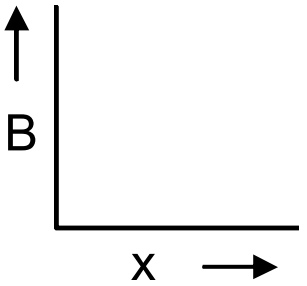
A solid wire of radius $10\ cm$ carries a current $5.0\ A$ distributed uniformly over its cross-section. Find the magnetic field B at a point at a distance (a) $2\ cm$ (b) $10\ cm$ and (c) $20\ cm$ away from the axis. Sketch a graph of $B$ versus $x$ for $0 < x < 20\ cm$.
Answer
  1. $r = 10cm = 10 \times 10^{-2}m$
$x = 2 \times 10^{-2}m,$
$i = 5A$
i in the region of radius 2cm
$\frac{5}{\pi(10\times\times10^{-2})^2}\times\pi(2\times10^{-2})^2=0.2\text{A}$
$\text{B}\times\pi(2\times10^{-2})^2=\mu_0(0-2)$
$\Rightarrow\text{B}=\frac{4\pi\times10^{-7}\times0.2}{\pi\times4\times10^{-4}}=\frac{0.2\times10^{-7}}{10^{-4}}=2\times10^{-4}$
  1. $10\ cm$ radius
$\text{B}\times\pi(10\times10^{-2})^2=\mu_0\times5$
$\Rightarrow\text{B}=\frac{4\pi\times10^{-7}\times5}{\pi\times10^{-2}}=20\times10^{-5}$​​​​​​​
  1. $x = 20\ cm$
$\text{B}\times\pi(20\times10^{-2})^2=\mu_0\times5$
$\Rightarrow\text{B}=\frac{\mu_0\times5}{\pi\times(20\times10^{-2})^2}=\frac{4\pi10^{-7}\times5}{\pi\times400\times10^{-4}}=5\times10^{-5}$​​​​​​​

View full question & answer
Question 295 Marks
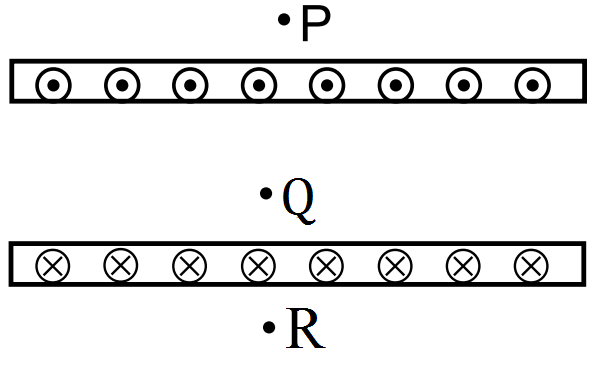
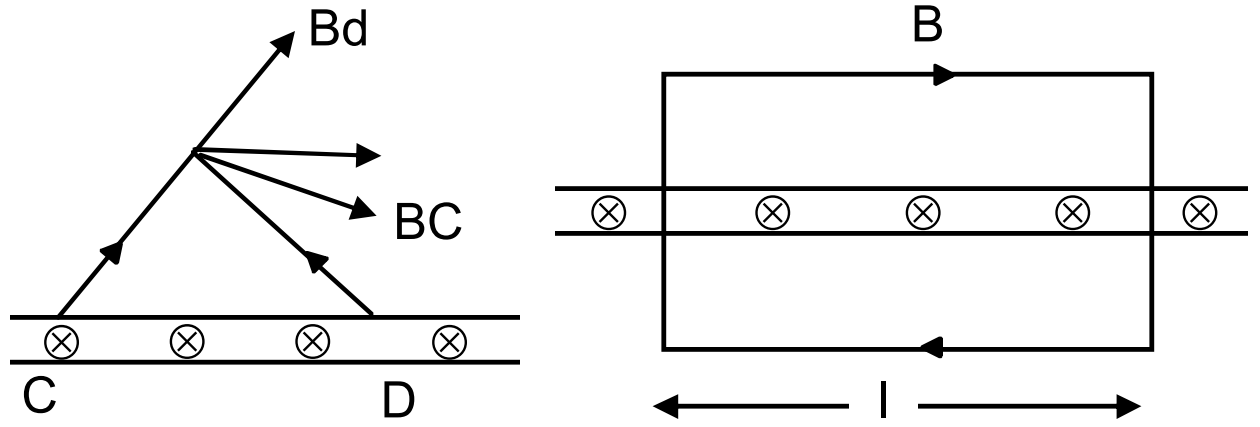
Two large metal sheets carry surface currents as shown in figure. The current through a strip of width dl is Kdl where K is a constant. Find the magnetic field at the points P, Q and R.
Answer

At point P, i = 0, Thus B = 0
At point R, i = 0, B = 0
At point $\theta,$
Applying ampere’s rule to the above rectangle

$\text{B}\times2\text{l}=\mu_0\text{K}_0\int\limits_\text{o}^\text{l}\text{dl}$
$\text{B}\times2\text{l}=\mu_0\text{Kl}\Rightarrow\text{B}=\frac{\mu_0\text{K}}{2}$
$\text{B}\times2\text{l}=\mu_0\text{K}_0\int\limits_\text{o}^\text{l}\text{dl}$
$\text{B}\times2\text{l}=\mu_0\text{Kl}\Rightarrow\text{B}=\frac{\mu_0\text{K}}{2}$
Since the $\overrightarrow{\text{B}}$ due to the 2 stripes are along the same direction, thus.

$\text{B}_\text{net}=\frac{\mu_0\text{K}}{2}+\frac{\mu_0\text{K}}{2}=\mu_0\text{k}$
View full question & answer
Question 305 Marks
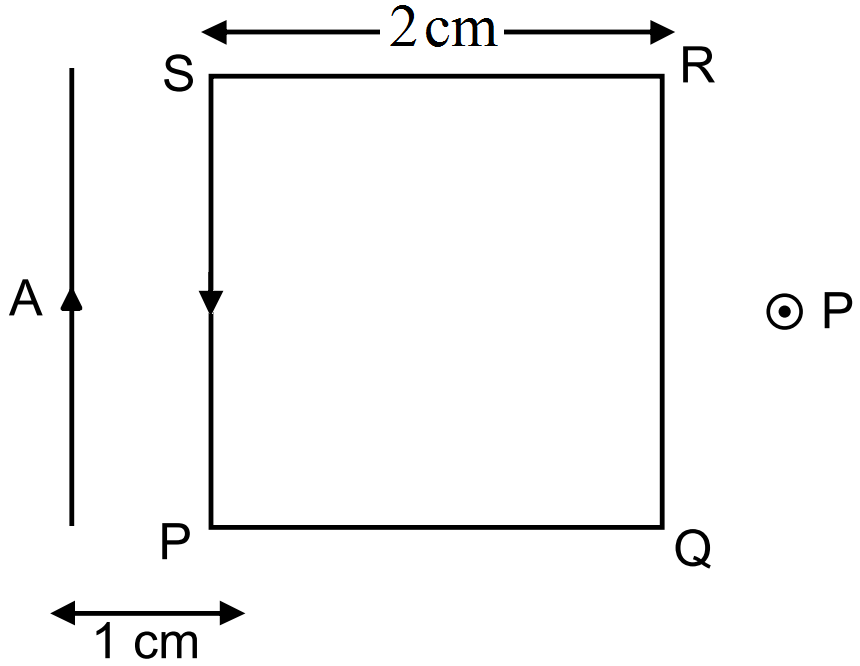
A square loop PQRS carrying a current of 6.0A is placed near a long wire carrying 10A as shown in figure.
  1. Show that the magnetic force acting on the part PQ is equal and opposite to that on the part RS.
  2. Find the magnetic force on the square loop.
Answer

$\text{I}_2=6\text{A},\ \text{I}_1=10\text{A}$
  1. $\text{F}_\text{PQ}$
‘F’ on $=\frac{\mu_0\times30}{\text{x}}\int_1\frac{\text{dx}}{\text{x}}=30\times4\times10^{-7}\times[\log\text{x}]^2_1$
$=120\times10^{-7}[\log3-\log1]$
Similarly force of $\overrightarrow{\text{F}}_\text{RS}=120\times10^{-7}[\log3-\log1]$
  1. So, $\overrightarrow{\text{F}}_\text{PQ}=\overrightarrow{\text{F}}_\text{RS}$
$\overrightarrow{\text{F}}_\text{PS}=\frac{\mu_0\times\text{i}_1\text{i}_2}{2\pi\times1\times10^{-2}}-\frac{\mu_0\times\text{i}_1\text{i}_2}{2\pi\times2\times10^{-32}}$
$=\frac{2\times6\times10\times10^{-7}}{10^{-2}}-\frac{2\times10^{-7}\times6\times6}{2\times10^{-2}}=8.4\times10^{-4}\text{N}$ (Towards right)
$\overrightarrow{\text{F}}_\text{RQ}=\frac{\mu_0\times\text{i}_1\text{i}_2}{2\pi\times3\times10^{-2}}-\frac{\mu_0\times\text{i}_1\text{i}_2}{2\pi\times2\times10^{-32}}$
$=\frac{4\pi\times10^{-7}\times6\times10^{-2}}{2\pi3\times10^{-2}}-\frac{4\pi\times10^{-7}\times6\times6}{2\pi\times2\times10^{-2}}$
$=4\times10^{-4}+36\times10^{-5}=7.6\times10^{-4}\text{N}$
Net force towards down
$= (8.4 + 7.6) × 10^{-4} = 16 × 10^{-4} \text{N}$
View full question & answer
Question 315 Marks
A circular coil of 200 turns has a radius of 10cm and carries a current of 2.0A.
  1. Find the magnitude of the magnetic field. B at the centre of the coil.
  2. At what distance from the centre along the axis of the coil will the field B drop to half its value at the centre? $\big(\sqrt[3]{4}=1.5874\ ...\big)$
Answer
$\text{n} = 200,\ \text{i} = 2\text{A},\ \text{r} = 10\text{cm}= 10 \times10^{-2}\text{n}$
  1. $\text{B}=\frac{\text{n}\mu_0\text{i}}{2\text{r}}=\frac{200\times4\pi\times10^{-7}\times2}{2\times10\times10^{-2}}$
$=2\times4\pi\times10^{-4}$

$=2\times4\times3.14\times10^{-4}$

$=25.12\times10^{-4}\text{T}=2.512\text{mT}$
  1. $\text{B}=\frac{\text{n}\mu_0\text{ia}^2}{2(\text{a}^2+\text{d}^2)^\frac{3}{2}}$
$\Rightarrow\frac{\text{n}\mu_0\text{i}}{4\text{a}}=\frac{\text{n}\mu_0\text{ia}^2}{2(\text{a}^2+\text{d}^2)^\frac{3}{2}}$

$\Rightarrow\frac{1}{2\text{a}}=\frac{\text{a}^2}{2(\text{a}^2+\text{d}^2)^\frac{3}{2}}$

$\Rightarrow(\text{a}^2+\text{d}^2)^\frac{3}{2}\text{2a}^3\Rightarrow\text{a}^2+\text{d}^2=(2\text{a}^3)^\frac{2}{3}$

$\Rightarrow\text{a}^2+\text{d}^2=\big(2^\frac{1}{3}\text{a}\big)^2$

$\text{a}^2+\text{d}^2=2^\frac{2}{3}\text{a}^2\Rightarrow(10^{-1})^2+\text{d}^2=2^\frac{2}{3}(10^{-1})^2$

$\Rightarrow10^{-2}+\text{d}^2(1.5874-1)=\text{d}^2$

$\Rightarrow\text{d}^2=10^{-2}\times0.5874$

$\Rightarrow\text{d}=\sqrt{10^{-2}\times0.5874}=10^{-1}\times0.766\text{m}$

$=7.66\times10^{-2}=7.66\text{cm}.$
View full question & answer
5 Marks Questions - Physics STD 11 Science Questions - Vidyadip