MCQ 11 Mark
Mark the correct options:
- A
A system $X$ is in thermal equilibrium with $Y$ but not with $Z$. System $Y$ and $Z$ may be in thermal equilibrium with each other.
- B
A system $X$ is in thermal equilibrium with $Y$ but not with $Z$. Systems $Y$ and $Z$ are not in thermal equilibrium with each other.
- C
A system $X$ is neither in thermal equilibrium with $Y$ nor with $Z.$ The system $Y$ and $Z$ may be in thermal equilibrium with each other.
- ✓
Both $B$ and $C$
AnswerCorrect option: D. Both $B$ and $C$
Key concept: Two bodies are said to be in thermal equilibrium with each other, when no heat flows from one body to the other. That is when both the bodies are at the same temperature.
According to the problem,
$-$If two systems $X$ and $Y$ are in thermal equilibrium,
i.e., $T_x = T_y$ and $x$ is not in thermal equilibrium with $z,$
i.e., $T_x \neq T_z$ then clearly, $T_y \neq T_z$
Hence, $y$ and $z$ are not in thermal equilibrium.
$-$If $X$ ais not in thermal equilibrium with $Y,$
i.e., $T_x \neq T_y$ and also $X$ is not thermal equilibrium with $Y,$
i.e., $T_x \neq T_z$. Then we cannot say about equilibrium of $Y$ and $Z$, they may or may not be in equilibrium.
View full question & answer→MCQ 21 Mark
The scale on a steel meter rod is calibrated at $20^\circ C.$ What will be the error in the reading of $50\ cm$ at $27^\circ C?$ Take, $\alpha=1.2\times10^{-5}\ ^\circ\text{C}^{-1}.$
- A
$0.042\ cm.$
- ✓
$0.0042\ cm.$
- C
$0.021\ cm.$
- D
$0.0021\ cm.$
AnswerCorrect option: B. $0.0042\ cm.$
View full question & answer→MCQ 31 Mark
At NTP, water boils at 100°C. Deep down the mine, water will boil at a temperature.
Answerb. Deep down the mine, pressure of air increases. This increases the boiling point of water. Hence, water will boil at a temperature > 100°C.
View full question & answer→MCQ 41 Mark
The amount of heat that a body can absorb by radiation:
- ✓
Depends on colour and temperature both of body.
- B
Depends on colour of body only.
- C
Depends on temperature of body only.
- D
Depend on density of body.
AnswerCorrect option: A. Depends on colour and temperature both of body.
The thermal radiation that falls on a body partly reflected and partly absorbed. The amount of heat that a body can absorb, by radiation depends on the colour of the body and temperature of body.
View full question & answer→MCQ 51 Mark
The rates of cooling of two different liquids put in exactly similar calorimeters and kept in identical surroundings are the same if:
- A
The masses of the liquids are equal.
- B
Equal masses of the liquids at the same temperature are taken.
- C
Different volumes of the liquids at the same temperature are taken.
- ✓
Equal volumes of the liquids at the same temperature are taken.
AnswerCorrect option: D. Equal volumes of the liquids at the same temperature are taken.
View full question & answer→MCQ 61 Mark
As the temperature is increased, the time period of a pendulum:
- ✓
Increases as its effective length increases even though its centre of mass still remains at the centre of the bob.
- B
Decreases as its effective length increases even though its centre of mass still remains at the centre of the bob.
- C
Increases as its effective length increases due to shifting of centre of mass below the centre of the bob.
- D
Decreases as its effective length remains same but the centre of mass shifts above the centre of the bob.
AnswerCorrect option: A. Increases as its effective length increases even though its centre of mass still remains at the centre of the bob.
As the temperature increased the length $L$ increase due to expansion $($Linear$)$ and,
$\text{T}=\sqrt{\frac{\text{L}}{\text{g}}}$ or $\text{T }\alpha\ \sqrt{\text{L}}$
So on increasing temperature, its effective length increases hence $T$ also increases.
View full question & answer→MCQ 71 Mark
Temperature of atmosphere in Kashmir falls below $-10^\circ С$ in winter. Due to this water animal and plant life of Dal$-$lake:
- A
- B
Frozen in winter and regenerated in summers.
- ✓
Survives as only top layer of lake in frozen.
- D
AnswerCorrect option: C. Survives as only top layer of lake in frozen.
View full question & answer→MCQ 81 Mark
A spherical body with radius $12\ cm$ radiates $450W$ power at $500K$. If the radius were halved and the temperature doubled, what would be the power radiated?
- A
$2000W$
- B
$1500W$
- ✓
$1800W$
- D
$2500W$
AnswerCorrect option: C. $1800W$
View full question & answer→MCQ 91 Mark
$70$ calories of heat are required to increase the temperature of $2$ moles of an ideal gas from $30^\circ C$ to $35^\circ C$ at constant pressure. The amount of heat required to increase the temperature of the same gas through same temperature range $(30^\circ C$ to $35^\circ C)$ at constant volume will be $\text{(R = 2cal/ mole/ K).}$
- A
$30\ \text{cals.}$
- ✓
$50\ \text{cals.}$
- C
$70\ \text{cals.}$
- D
$90\ \text{cals.}$
AnswerCorrect option: B. $50\ \text{cals.}$
$\text{dQ}=\text{n}\text{C}_\text{P}\Delta\text{T};$
so $70=2\times\text{C}_\text{P}\times5$
$\therefore\text{C}_\text{P}=7\ \text{cal mol}^{-1}{^\circ\text{C}^{-1}}$
$\text{C}_\text{v}=\text{C}_\text{P}-\text{R}=7-2=5\ \text{cal mol}^{-1\circ}\text{C}^{-1}$
$\therefore\text{dQ}=\text{n}\text{C}_\text{v}\Delta\text{T}=2\times5\times5=50\ \text{cal}$
View full question & answer→MCQ 101 Mark
Change of state from solid to vapour state without passing through the liquid state is called:
MCQ 111 Mark
Which of the following circular rods, $($given radius $r$ and length $l)$ each made of the same material and whose ends are maintained at the same temperature difference will conduct most heat?
- A
$r=2 r_0 ; I=2 I_0$
- ✓
$r=2 r_0 ; I=I_0$
- C
$r=r_0 ; I=2 I_0$
- D
$r=r_0 ; I=I_0$
AnswerCorrect option: B. $r=2 r_0 ; I=I_0$
As, $\frac{\text{dQ}}{\text{dt}}=\text{KA}\frac{\Delta\text{T}}{\Delta\text{x}}=\frac{\text{K}\pi\text{r}^2\Delta\text{T}}{\text{l}}$
$\therefore\frac{\text{dQ}}{\text{dt}}\propto\frac{\text{r}^2}{\text{l}} ($as $\Delta\text{T}=$ same for all cases$)$
Since $\frac{\text{r}^2}{\text{l}}$ is maximum for $(b).$
View full question & answer→MCQ 121 Mark
Suppose there is a hole in a copper plate. Upon heating the plate, diameter of hole would:
AnswerA metal expands on heating.
Therefore, diameter of the hole increase always.
View full question & answer→MCQ 131 Mark
The latent heat of vaporisation of a substance is always:
- ✓
Greater than its latent heat of fusion.
- B
Greater than its latent heat of sublimation.
- C
Equals to its latent heat of sublimation.
- D
Less than its latent heat of fusion.
AnswerCorrect option: A. Greater than its latent heat of fusion.
View full question & answer→MCQ 141 Mark
The rate of cooling due to conduction, convection, and radiation combined, is proportional to the difference in temperature, for:
- A
Large temperature differences.
- ✓
Small temperature differences.
- C
Any temperature difference.
- D
None of the above Answers.
AnswerCorrect option: B. Small temperature differences.
View full question & answer→MCQ 151 Mark
A uniform metallic rod rotates about its perpendicular bisector with constant angular speed. If it is heated uniformly to raise its temperature slightly:
- A
Its speed of rotation increases.
- ✓
Its speed of rotation decreases.
- C
Its speed of rotation remains same.
- D
Its speed increases because its moment of inertia increases.
AnswerCorrect option: B. Its speed of rotation decreases.
On heating a uniform metallic rod its length will increase so moment of inertia of rod increased from $I_1$ to
$I_2 ($i.e., $I_1 \text{I}_1\omega_1=\text{I}_2\omega_2)$
$\because\ \text{I}_1<\text{I}_2\Rightarrow\omega_1>\omega_2,$
so angular speed decreases.
View full question & answer→MCQ 161 Mark
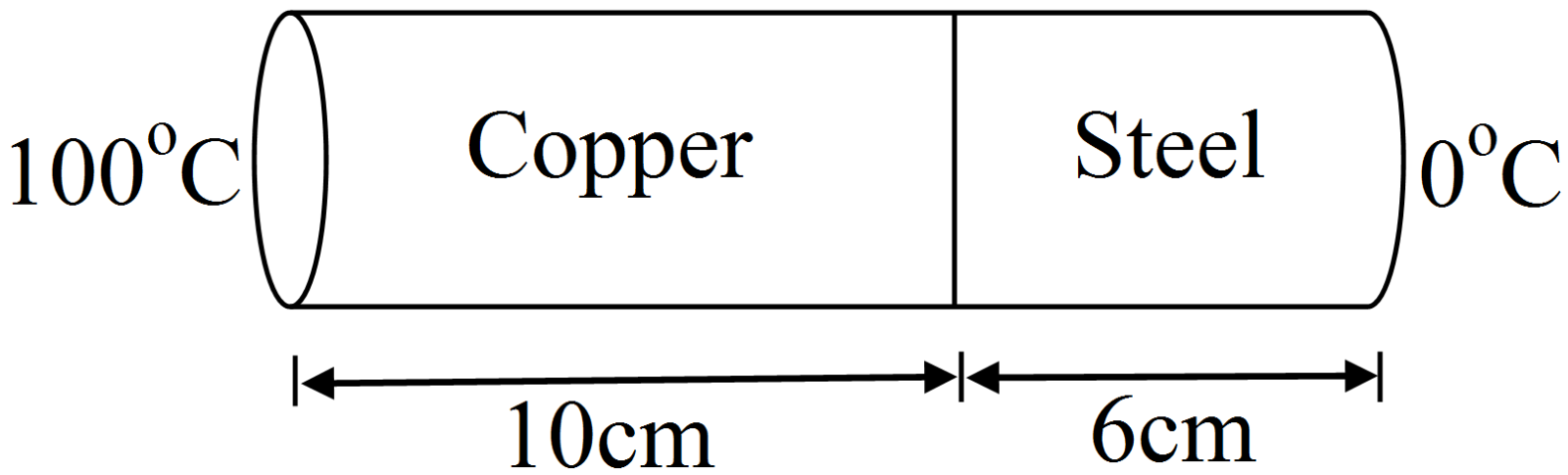
The coefficient of thermal conductivity of copper is nine times that of steel. In the composite cylindrical bar shown in fig. What will be the temperature at the junction of copper and steel?
- ✓
$84.3^\circ C.$
- B
$67^\circ C.$
- C
$33^\circ C.$
- D
$25^\circ C.$
AnswerCorrect option: A. $84.3^\circ C.$
If $T$ is the temperature of the junction of the copper and the steel bar, then
$\frac{\text{dQ}}{\text{dt}}=\frac{9\text{K}\times\text{A}\times(100-\text{T})}{10\times10^{-2}}$
$= \frac {\text{KA}(\text{T}-{0})}{6\times10^{-2}}$
$=84.3^\circ\text{C}$
View full question & answer→MCQ 171 Mark
If there are no heat losses, the heat released by the condensation of $x$ gram of steam at $100^\circ C$ into water at $100^\circ C$ can be used to convert $y$ gram of ice at $0^\circ C$ into water at $100^\circ C.$ Then the ratio $y : x$ is nearly:
- A
$1 : 1$
- B
$2 : 1$
- ✓
$3 : 1$
- D
$2.5 : 1$
AnswerCorrect option: C. $3 : 1$
View full question & answer→MCQ 181 Mark
A cup of tea cools from $65.5^\circ C$ to $62.5^\circ C$ in one minute in a room of $22.5^\circ C.$ How long will the same cup of tea take to cool from $46.5^\circ C$ to $40.5^\circ C$ in the same room. $($Choose the nearest value in min.$)$
AnswerAccording to Newton' law of cooling
$\frac{\text{dT}}{\text{dt}}=-\text{K}(\text{T-T}_0)$
where $\text{T}= \frac{\text{T}_1+\text{T}_2}{2}$
Case I: $\text{dT}= 65.5-62.5=3^\circ\text{C};\text{dt}=1\text{ min};$
$\text{T}= \frac{65.5+62.5}{2}= 64^\circ\text{C}$
$\therefore \frac{3}{1}= \text{K}(64-22.5)=\text{K}\times41.5$
Case II: ${\text{dT}}= 46.5-40.5=6^\circ\text{C};\text{dt}=?$
$\text{T}= \frac{46.5+40.5}{2}= 43.5^\circ\text{C}$
$\therefore \frac{6}{\text{dt}}= - \text{K}(43.5-22.5)=-\text{K}\times21.0$
Dividing $(i)$ by $(ii)$ , we have
$\frac{3\times\text{dt}}{6}= \frac{41.5}{21.0} $
or $\text{dt}=\frac{41.5}{21.0}\times\frac{6}{3}=4 \text{min}.$
View full question & answer→MCQ 191 Mark
The radius of a metal sphere at room temperature $T$ is $R$, and the coefficient of linear expansion of the metal is $\alpha.$ The The sphere is heated a little by a temperature $\Delta\text{T}$ so that its new temperature is $\text{T}+\Delta\text{T}.$ The increase in the volume of the sphere is approximately:
- A
$2\pi\text{R }\alpha\ \Delta\text{T}$
- B
$\pi\text{R}^2\alpha\ \Delta\text{T}$
- C
$\frac{4\pi\text{R}^3\alpha\ \Delta\text{T}}{3}$
- ✓
${4\pi\text{R}^3\alpha\ \Delta\text{T}}$
AnswerCorrect option: D. ${4\pi\text{R}^3\alpha\ \Delta\text{T}}$
Coefficient of linear expansion is $\alpha$
Coefficient of cubical expansion $=3\alpha=\gamma$
$\gamma=\frac{\Delta\text{V}}{\text{V}\Delta\text{t}}\Rightarrow\Delta\text{V}\cdot\Delta\text{t}$
$\Delta\text{V}=3\alpha\cdot\frac{4}{3}\pi\text{R}^3\Delta\text{t}$
$\Delta\text{V}={4\pi\text{R}^3\alpha\ \Delta\text{T}}$
View full question & answer→MCQ 201 Mark
At about $4^\circ C,$ a certain amount of water has maximum:
View full question & answer→MCQ 211 Mark
It is hotter at the some distance over the top of a fire than it is on the side of it mainly because:
- A
Heat is radiated upwards.
- B
Air conducts heat upwards.
- ✓
Convection takes more heat upwards.
- D
Conduction, convection and radiation all contribute significantly in transferring heat up wards.
AnswerCorrect option: C. Convection takes more heat upwards.
View full question & answer→MCQ 221 Mark
The high thermal conductivity of metal is due to free electrons. The relevant electron property is
- A
- B
- ✓
Its high average thermal speed.
- D
AnswerCorrect option: C. Its high average thermal speed.
The average thermal speed of electron is high. This gives high thermal conductivity to metals.
View full question & answer→MCQ 231 Mark
Time taken to heat water upto a temperature of $40^\circ C ($from room temperature$)$ is $t_1$ and time taken to heat mustard oil $($of same mass and at room temperature$)$ upto a temperature of $40^\circ C$ is $t_2$, then $($given mustard oil has smaller heat capacity$).$
AnswerCorrect option: B. $t_1 > t_2$
View full question & answer→MCQ 241 Mark
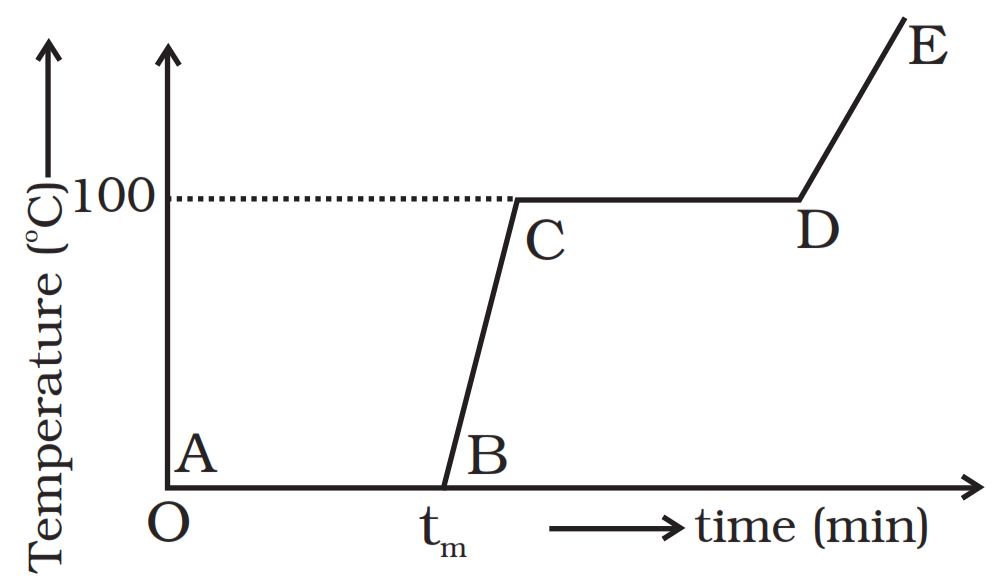
Refer to the plot of temperature versus time showing the changes in the state of ice on heating $($not to scale$)$. Which of the following is correct?
- A
The region $AB$ represents ice and water in thermal equilibrium.
- B
At $B$ water starts boiling.
- C
$C$ to $D$ represents water and steam in equilibrium at boiling point.
- ✓
Both $A$ and $C$
AnswerCorrect option: D. Both $A$ and $C$
In region $AB,$ a phase change takes place, heat is supplied and ice melts but temperature of the system is $0^\circ C.$ it remains constant during process. The heat supplied is used to break bonding between molecules.
In region $CD,$ again a phase change takes place from a liquid to a vapour state during which temperature remains constant. It shows water and steam are in equilibrium at boiling point.
View full question & answer→MCQ 251 Mark
An aluminium sphere is dipped into water. Which of the following is true?
- ✓
Buoyancy will be less in water at $0^\circ C$ than that in water at $4^\circ C.$
- B
Buoyancy will be more in water at $0^\circ C$ than that in water at $4^\circ C.$
- C
Buoyancy in water at $0^\circ C$ will be same as that in water at $4^\circ C.$
- D
Buoyancy may be more or less in water at $4^\circ C$ depending on the radius of the sphere.
AnswerCorrect option: A. Buoyancy will be less in water at $0^\circ C$ than that in water at $4^\circ C.$
Key concept: Liquids generally increase in volume with increasing temperature but in case of water, it expands on heating if its temperature is greater than $4^\circ C.$ The density of water reaches a maximum value of $1.000g/ \ cm^3$ at $4^\circ C.$
This behaviour of water in the range from $0^\circ C$ to $4^\circ C$ is called anomalous expansion.
Let volume of the sphere be $V$ and $\rho$ be its density, then we can write buoyant force at $0^\circ C$
$\text{F}_{0^\circ\text{C}}=\text{V}\rho_{0^{\circ}}\text{g}\ (\rho_{0^{\circ}}=$ density at $0^\circ\text{C})$
Buoyancy at $4^\circ C$
$\text{F}_{{4}^\circ}\text{C}=\text{V}\rho_{{4}^\circ}\text{g}$
$\Rightarrow\frac{\text{F}_{{4}^\circ}\text{C}}{\text{F}_{{0}^\circ}\text{C}}=\frac{\rho_{{4}^\circ\text{C}}}{\rho_{{0}^\circ\text{C}}}>1$
$(\because\rho_{{4}^\circ\text{C}}>\rho_{{0}^\circ\text{C}})$
$\Rightarrow\text{F}_{{4}^\circ}\text{C}>\text{F}_{{0}^\circ}\text{C}$
Hence, buoyancy will be less in water at $0^\circ C$ than that in water at $4^\circ C$
View full question & answer→MCQ 261 Mark
The common physical property which is to be used as the basis for constructing thermometer is:
- A
The variation of the volume of a liquid with temperature.
- B
The variation of the pressure of a gas with temperature.
- C
The variation of the resistance of a wire with temperature.
- ✓
AnswerAny physical property which varies linearly with temperature can be used in constructing thermometers.
View full question & answer→MCQ 271 Mark
Consider a compound slab consisting of two different materials having equal thickness and thermal conductivities $K$ and $2K$ respectively. The equivalent thermal conductivity of the slab is:
AnswerCorrect option: D. $\Big(\frac{4}{3}\Big)\text{K}$
When slabs are connected in series, the equivalent thermal conductivity will be given by,
$\text{K}'=\frac{\sum\text{x}_\text{i}}{\sum\frac{\text{x}_\text{i}}{\text{K}_\text{i}}}$
$=\frac{\text{x}+\text{x}}{\frac{\text{x}}{\text{K}}+\frac{\text{x}}{2\text{K}}}$
$=\frac{\text{2x}}{\frac{\text{3x}}{\text{2K}}}$
$=\frac43\text{K}$
View full question & answer→MCQ 281 Mark
Due to the change in main voltage, the temperature of an electric bulb rises from $3000K$ to $4000K$. What is the percentage rise in electric power consumed?
AnswerElectric power consumed in first case,
$\text{P}_1\sigma\text{T}^4_1=\sigma(3000)^4\ ...(\text{i})$
Electric power consumed in second case,
$\text{P}_2\sigma\text{T}^4_2=\sigma(4000)^4\ ...(\text{ii})$
On dividing Eq. $(ii)$ by Eq. $(i)$, we get
$\frac{\text{P}_2}{\text{P}_1}=\frac{(4000)^4}{(3000)^4}=\frac{256}{81}$
As we know percentage rise in power,
$=\frac{\text{P}_2-\text{P}_1}{\text{P}_1}\times100$
$=\frac{265-81}{81}\times100$
$=\frac{175}{81}\times100$
$=216\%$
View full question & answer→MCQ 291 Mark
A normal diet furnishes $2000 \text{k/ cal}$ to a $60\ kg$ person in a day. If this energy was used to heat the person with no losses to the surroundings, how much would the person's temperature increases? The specific heat of the human body is $0.83 \mathrm{cal} / \mathrm{g}^{-1} |^{\circ} \mathrm{c}^{-1}$
- A
$8.2^\circ C$
- ✓
$4.01^\circ C$
- C
$6.0^\circ C$
- D
$5.03^\circ C$
AnswerCorrect option: B. $4.01^\circ C$
Here, $m = 60\ kg = 60 \times 10^3g, c = 0.83 \mathrm{cal} / \mathrm{g}^{-1} |^{\circ} \mathrm{c}^{-1}$
$Q = 200k/ cal = 2 \times 10^5cal$
Amount of heat required for a person,
$\because\text{Q}=\text{mc}\Delta\text{T}$
$\Rightarrow\Delta\text{T}=\frac{\text{Q}}{\text{mc}}=\frac{2\times10^5}{60\times10^3\times0.83}$
$=4.016^\circ\text{C}.$
View full question & answer→MCQ 301 Mark
A liquid boils when its vapour pressure is equal to:
AnswerWhen vapour pressure is equal to atmospheric pressure, then boiling occurs.
View full question & answer→MCQ 311 Mark
The temperature of two bodies $A$ and $B$ are respectively, $727^\circ C$ and $327^\circ C.$ The ratio $H_A :H_B$ of the rates of heat radiated by them is:
- A
$727 : 327$
- B
$5 : 3$
- C
$25 : 9$
- ✓
$625 : 81$
AnswerCorrect option: D. $625 : 81$
View full question & answer→MCQ 321 Mark
A bar of iron is $10\ cm$ at $20^\circ C.$ At $19^\circ C,$ it will be: $(\alpha$ of iron $=11\times10^{-6}\ ^\circ\text{C})$
- A
$11 \times 10^{-6} \mathrm{~cm}$ longer.
- ✓
$11 \times 10^{-5} \mathrm{~cm}$ shorter.
- C
$11 \times 10^{-6} \mathrm{~cm}$ shorter.
- D
$11 \times 10^{-5} \mathrm{~cm}$ longer.
AnswerCorrect option: B. $11 \times 10^{-5} \mathrm{~cm}$ shorter.
According to linear expansion, we get,
$\text{L}=\text{L}_0(1+\alpha\Delta\theta)$
$\frac{\text{L}_1}{\text{L}_2}=\frac{1+\alpha(\Delta\theta_1)}{1+\alpha(\Delta\theta_2)}$
$\Rightarrow\frac{10}{\text{L}_2}=\frac{1+11\times10^{-6}\times20}{1+11\times20^{-6}\times19}$
$\Rightarrow\text{L}_2=9.99989$
Length is shorter by $= 10 - 9.99989 = 0.00011$
$= 11 \times 10^{-5} \mathrm{~cm}$
View full question & answer→MCQ 331 Mark
A sphere, a cube and a thin circular plate, all of same material and same mass are initially heated to same high temperature.
- A
Plate will cool fastest and cube the slowest.
- B
Sphere will cool fastest and cube the slowest.
- ✓
Plate will cool fastest and sphere the slowest.
- D
Cube will cool fastest and plate the slowest.
AnswerCorrect option: C. Plate will cool fastest and sphere the slowest.
loss of heat on cooling is directly proportional to the following factors:
Temperature difference between body and surrounding.
Surface area exposed to surrounding.
Material of object We know that surface area of sphere is minimum and of circular plate is maximum. So sphere cool slowest and circular plate fastest.
View full question & answer→MCQ 341 Mark
The top of a lake gets frozen at a place where the surrounding air is at a temperature of $-20^\circ C.$ Then:
- ✓
The temperature of the layer of water in contact with the lower surface of the ice block will be at $0^\circ C$ and that at the bottom of the lake will be $4^\circ C.$
- B
The temperature of water below the lower surface of ice will be $4^\circ C$ right up to the bottom of the lake.
- C
The temperature of the water below the lower surface of ice will be $0^\circ C$ right up to the bottom of the lake.
- D
The temperature of the layer of water immediately in contact with the lower surface of ice will be about $-20^\circ C$ and that of water at the bottom will be $0^\circ C.$
AnswerCorrect option: A. The temperature of the layer of water in contact with the lower surface of the ice block will be at $0^\circ C$ and that at the bottom of the lake will be $4^\circ C.$
View full question & answer→MCQ 351 Mark
‘Gulab Jamuns’ $($assumed to be spherical$)$ are to be heated in an oven. They are available in two sizes, one twice bigger $($in radius$)$ than the other. Pizzas $($assumed to be discs$)$ are also to be heated in oven. They are also in two sizes, one twice big $($in radius$)$ than the other. All four are put together to be heated to oven temperature. Choose the correct option from the following:
- A
Both size gulab jamuns will get heated in the same time.
- B
Smaller gulab jamuns are heated before bigger ones.
- C
Smaller pizzas are heated before bigger ones.
- ✓
Both $B$ and $C$
AnswerCorrect option: D. Both $B$ and $C$
Between these four which has the least surface area will be heated first because of less heat radiation.
So, smaller gulab jamuns are having least surface area, hence they will be heated first.
Similarly, smaller pizzas are heated before bigger ones because they are of small surface areas.
View full question & answer→MCQ 361 Mark
A bimetallic strip is made of aluminium and steel $(\alpha_\text{At}>\alpha_{\text{steel}}).$ On heatinh, the strip will:
- A
- B
- C
Will bend with aluminium on concave side.
- ✓
Will bend with steel on concave side.
AnswerCorrect option: D. Will bend with steel on concave side.
Both strips of $Al$ and steel are fixed together initially in bimetallic strip.
When both are heated then expansion in steel will be smaller than aluminium.
$($image$)$
So, $Al$ strip will be convex side and steel on concave side.
View full question & answer→MCQ 371 Mark
On a hilly region, water boils at $95^\circ C.$ The temperature expressed in fahrenheit is:
- A
$100^\circ F.$
- B
$20.3^\circ F.$
- C
$150^\circ F.$
- ✓
$203^\circ F.$
AnswerCorrect option: D. $203^\circ F.$
View full question & answer→MCQ 381 Mark
When temperature of water is raised from $O\ 'C$ to $4^\circ C,$ it:
View full question & answer→MCQ 391 Mark
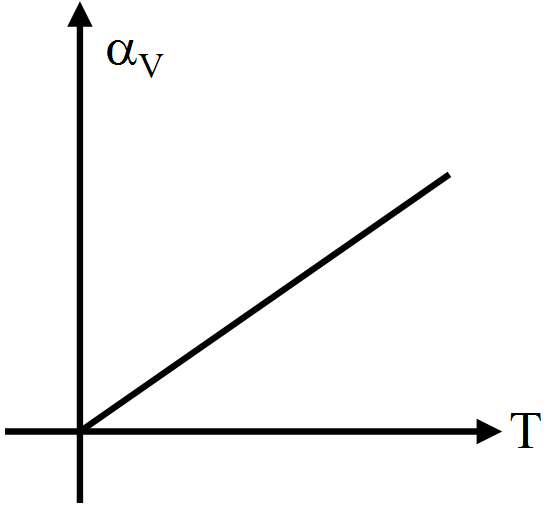
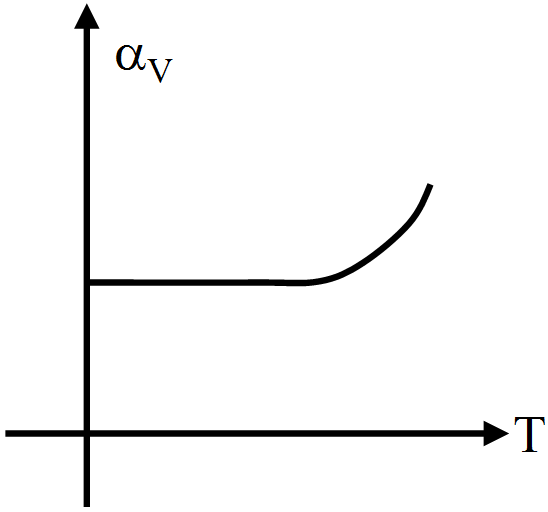
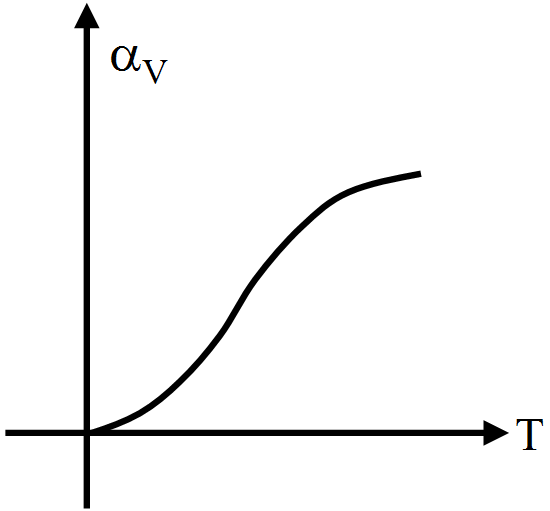
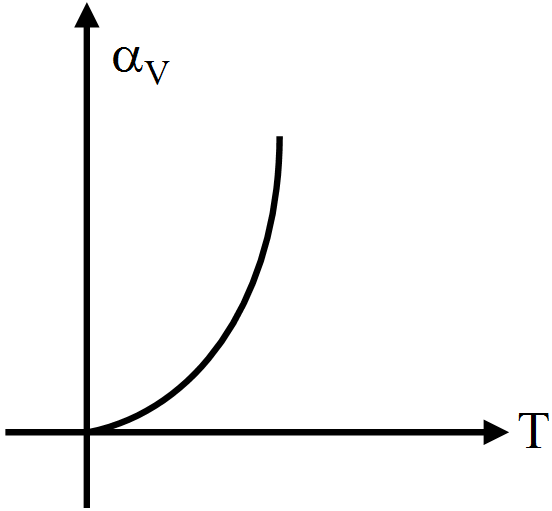
Coefficient of volumetric expansion $\alpha_\text{v}$ is not a constant. It depends on temperature. Variation of $\alpha_\text{v}$ with temperature for metals is:
View full question & answer→MCQ 401 Mark
When water boils or freezes, during these processes its temperature:
- A
- B
- ✓
- D
Sometimes increase and sometimes deceases.
AnswerWhen water boils or freezes, its temperature does not change during these processes. Heat here is absorbed or liberated as latent heat.
View full question & answer→MCQ 411 Mark
Two rods of same length and material transfer a given amount of heat in $12s,$ when they are joined end to end $($ie, in series$)$. But when they are joined in parallel, they will transfer same heat under same temperature difference across thier ends in:
View full question & answer→MCQ 421 Mark
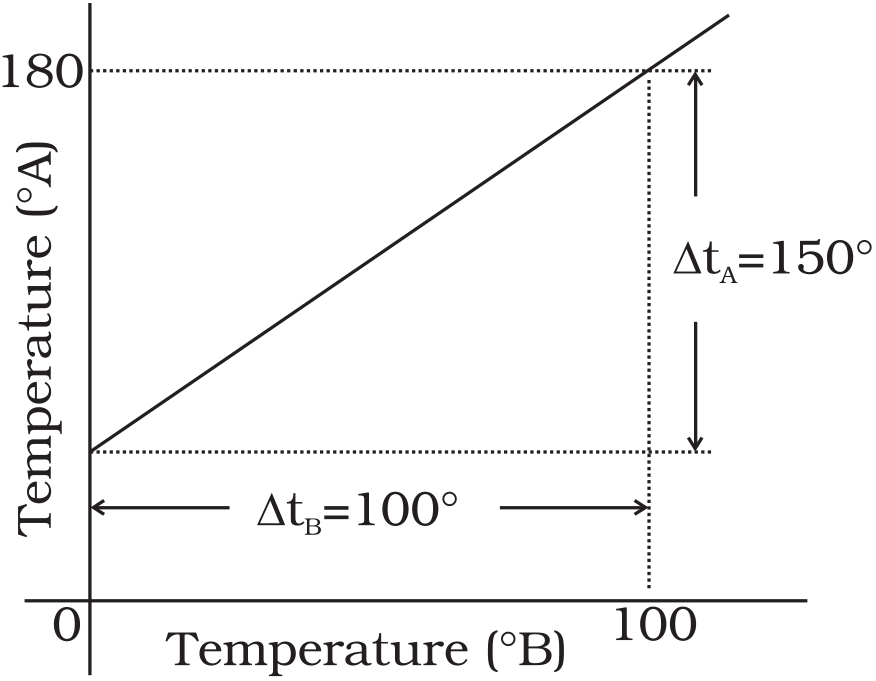
The graph between two temperature scales $A$ and $B$ is shown in between upper fixed point and lower fixed point there are $150$ equal division on scale $A$ and $100$ on scale $B$. The relationship for conversion between the two scales is given by:
- A
$\frac{\text{t}_\text{A}-180}{100}=\frac{\text{t}_\text{B}}{150}$
- ✓
$\frac{\text{t}_\text{A}-30}{150}=\frac{\text{t}_\text{B}}{100}$
- C
$\frac{\text{t}_\text{B}-180}{150}=\frac{\text{t}_\text{A}}{100}$
- D
$\frac{\text{t}_\text{B}-40}{100}=\frac{\text{t}_\text{A}}{180}$
AnswerCorrect option: B. $\frac{\text{t}_\text{A}-30}{150}=\frac{\text{t}_\text{B}}{100}$
Key concept: Temperature on one scale can be converted into other scale by using the following identity.
$($image$)$
Reading on any scale $\frac{\text{LfP}}{\text{UFP}-\text{LFP}}=$ Constant for all scales
where, $\text{LFP} \rightarrow$ Lower fixed point
$\text{UFP} \rightarrow$ Upper fixed point
From the graph it is clear that the lowest point for scale $A$ is $30^\circ$ and highest point for the scale $A$ is $180^\circ$. Lowest point for scale $B$ is $0^\circ$ and highest point for scale $B$ is $100^\circ$ .
Hence, the relation between the two scales $A$ and $B$ is given by
$\frac{\text{T}_\text{A}-(\text{LFP})_\text{A}}{(\text{UFP)}_\text{A}-(\text{LFP})_\text{A}}=\frac{\text{T}_\text{B}-(\text{LFP})_\text{B}}{(\text{UFP)}_\text{B}-(\text{LFP})_\text{B}}$
$\Rightarrow\frac{\text{T}_\text{A}-30}{180-30}=\frac{\text{T}_\text{B}-0}{100-0}$
$\Rightarrow\frac{\text{t}_\text{A}-30}{150}=\frac{\text{t}_\text{B}}{100}$
View full question & answer→MCQ 431 Mark
The bottoms of utensils for cooking food are blackened to:
- A
Absorb minimum heat from fire.
- ✓
Absorb maximum heat from fire.
- C
- D
Reflect heat to surroundings.
AnswerCorrect option: B. Absorb maximum heat from fire.
View full question & answer→MCQ 441 Mark
Water of volume $2$ litre in a container is heated with a coil of $1\ kW$ at $27^\circ C.$ The lid of the container is open and energy dissipates at the rate of $160 Js$ In how much time temperature will rise from $27^\circ C$ to $77^\circ C? [$Given specific heat of water $= \text{4.2kJ/kg]}$
- ✓
$8$ min $20s.$
- B
$6$ in $2s.$
- C
$7$ min.
- D
$14$ min.
AnswerCorrect option: A. $8$ min $20s.$
Explanation: Using law of conservation of total energy, Energy produced by heater $=$ heat gained by water $+$ energy lost.
$\text{Pt }= \text{ms} \Delta + \text{energy lost}$
$\therefore 1000 \text{ t }= 2 \times (4.2\times10^3)\times (77-27)+160\text{t}$
On sollvin $\text{t} = 500_\text{s}= 8\ \text{min}\ 20_\text{s}$
View full question & answer→MCQ 451 Mark
Dimensional formula of specific heat capacity is:
- A
$\left[\mathrm{ML}^2 \mathrm{~T}^{-2} \mathrm{~L}^{-1}\right]$
- B
$\left[\mathrm{MLT}^{-2} \mathrm{~K}^{-1}\right]$
- ✓
$\left[\mathrm{M}^0 \mathrm{~L}^2 \mathrm{~T}^{-2} \mathrm{~K}^{-1}\right]$
- D
$\left[\mathrm{ML}^2 \mathrm{~T}^{-2} \mathrm{~K}\right]$
AnswerCorrect option: C. $\left[\mathrm{M}^0 \mathrm{~L}^2 \mathrm{~T}^{-2} \mathrm{~K}^{-1}\right]$
View full question & answer→MCQ 461 Mark
- ✓
Kinetic energy of random motion of molecules.
- B
Kinetic energy of orderly motion of molecules.
- C
Total kinetic energy of random and orderly motion of molecules.
- D
Kinetic energy of random motion in some cases and kinetic energy of orderly motion in other.
AnswerCorrect option: A. Kinetic energy of random motion of molecules.
We know that as the temperature increases vibration of molecules about their mean position increases. Hence the Kinetic energy associated with random motion of molecule increases.
View full question & answer→MCQ 471 Mark
A glass of ice$-$cold water left on a table on a hot summer day eventually warms up whereas a cup of hot tea on the same table cools down because:
- A
Its surrounding media are different.
- ✓
The direction of heat flow depends on the surrounding temperature with respect to the object.
- C
Heating or cooling does not depend on surrounding temperature.
- D
Both $(a)$ and $(b).$
AnswerCorrect option: B. The direction of heat flow depends on the surrounding temperature with respect to the object.
View full question & answer→MCQ 481 Mark
The density of a substance at $0^\circ C$ is $10g/cc$ and at $100^\circ C,$ its density is $9.7g/cc.$ The coefficient of linear expansion of the substance is:
- ✓
$10^{-4^\circ} C^{-1}$
- B
$10^{-1^\circ} C^{-1}$
- C
$10^{-3^\circ} C^{-1}$
- D
$10^{-2^\circ} C{-1}$
AnswerCorrect option: A. $10^{-4^\circ} C^{-1}$
Here, $\rho_0=10\text{g/cc},\rho_{100}=9.7\text{g/cc}$
As, $\rho_\text{T}=\rho_0(1-\gamma\Delta\text{T})$
$\therefore9.7=10(1-\gamma\times100)$
$\frac{9.7}{10}=1-\gamma\times100$
On solving $\gamma=3\times10^{-4\circ}\text{C}^{-1}$
$\alpha=\frac{\gamma}{3}=\frac{3\times10^{-4}}3=10^{-4\circ}\text{C}^{-1}$
View full question & answer→MCQ 491 Mark
The rate of loss of heat depends on:
- A
The sum of temperature of the body and its surroundings.
- ✓
The difference in temperature of the body and its surroundings.
- C
The product of temperature of the body and its surroundings.
- D
The ratio of temperature of the body and its surroundings.
AnswerCorrect option: B. The difference in temperature of the body and its surroundings.
View full question & answer→MCQ 501 Mark
If $m$ mass of a substance undergoes a phase change, then amount of heat required will be:
- ✓
$\Delta\text{Q}=\text{mL}$
- B
$\Delta\text{Q}=\text{mC}_\text{p}\Delta\text{T}$
- C
$\Delta=\text{ms}\Delta\text{T}$
- D
$\Delta\text{Q}=\text{mC}_\text{v}\Delta\text{T}$
AnswerCorrect option: A. $\Delta\text{Q}=\text{mL}$
View full question & answer→