Questions · Page 2 of 3

3 Marks Question

Question 513 Marks
  1. Two cells of emf $E_1$ and $E_2$ have their internal resistances $r_1$ and $r_2$, respectively. Deduce an expression for the equivalent emf and internal resistance of their parallel combination when connected across an external resistance R. Assume that the two cells are supporting each other.
  2. In case the two cells are identical, each of emf E = 5V and internal resistance $\text{r}=2\Omega,$ calculate the voltage across the external resistance $\text{R}=10\Omega.$
Answer
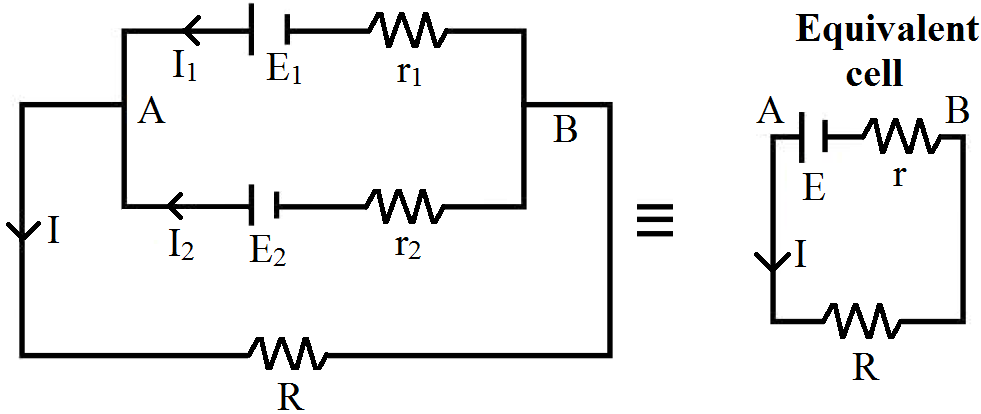
  1.  

Potential difference across A & B,
$\text{V}=\text{V}_\text{A}-\text{V}_\text{B}=\text{E}_1-\text{I}_1\text{r}_1\ ...(1)$
$\text{V}=\text{V}_\text{A}-\text{V}_\text{B}=\text{E}_2-\text{I}_2\text{r}_2\ ...(2)$
$\Rightarrow\text{I}_1=\frac{\text{E}_1}{\text{r}_1}-\frac{\text{V}}{\text{r}_1}\ ...(3)$ (from (1))
$\text{I}_2=\frac{\text{E}_2}{\text{r}_2}-\frac{\text{V}}{\text{r}_2}\ ...(4)$ (from (2))
For Equivalent cell $\text{I}=\frac{\text{E}}{\text{r}}-\frac{\text{V}}{\text{r}}\ ...(5)$
$\because\text{I}=\text{I}_1+\text{I}_2$
$\therefore\frac{\text{E}}{\text{r}}\frac{\text{V}}{\text{r}}=\Big(\frac{\text{E}_1}{\text{r}_1}-\frac{\text{V}}{\text{r}_1}\Big)+\Big(\frac{\text{E}_2}{\text{r}_2}-\frac{\text{V}}{\text{r}_2}\Big)$
$=\Big(\frac{\text{E}_1}{\text{r}_1}+\frac{\text{E}_2}{\text{r}_2}\Big)-\text{V}\Big(\frac{1}{\text{r}_1}+\frac{1}{\text{r}_2}\Big)$
Comparing we get $\frac{1}{\text{r}}=\frac{1}{\text{r}_1}+\frac{1}{\text{r}_2}$
$\therefore$ Equivalent internal resistance is, $\text{r}=\frac{\text{r}_1\text{r}_2}{\text{r}_1+\text{r}_2}$
Also, $\frac{\text{E}}{\text{r}}=\frac{\text{E}_1}{\text{r}_1}+\frac{\text{E}_2}{\text{r}_2}=\frac{\text{E}_1\text{r}_2+\text{E}_2\text{r}_1}{\text{r}_1\text{r}_2}$
$\therefore$ Equivalent emf is, $\text{E}=\frac{\text{E}_1\text{r}_2+\text{E}_2\text{r}_1}{\text{r}_1+\text{r}_2}$
  1. $\text{E}=\frac{5\times2+5\times2}{2+2}=5\text{V}$
$\text{r}=\frac{2\times2}{2+2}=1\text{r}$
$\text{I}=\frac{\text{E}}{\text{R}+\text{r}}=\frac{5}{10+1}=\frac{5}{11}\text{A}$
$\therefore$ Voltage across $\text{R}\Rightarrow\text{V}$
$=\text{IR}=\frac{5}{11}\times10=\frac{50}{11}\text{V}=4.54\text{V}$
View full question & answer
Question 523 Marks
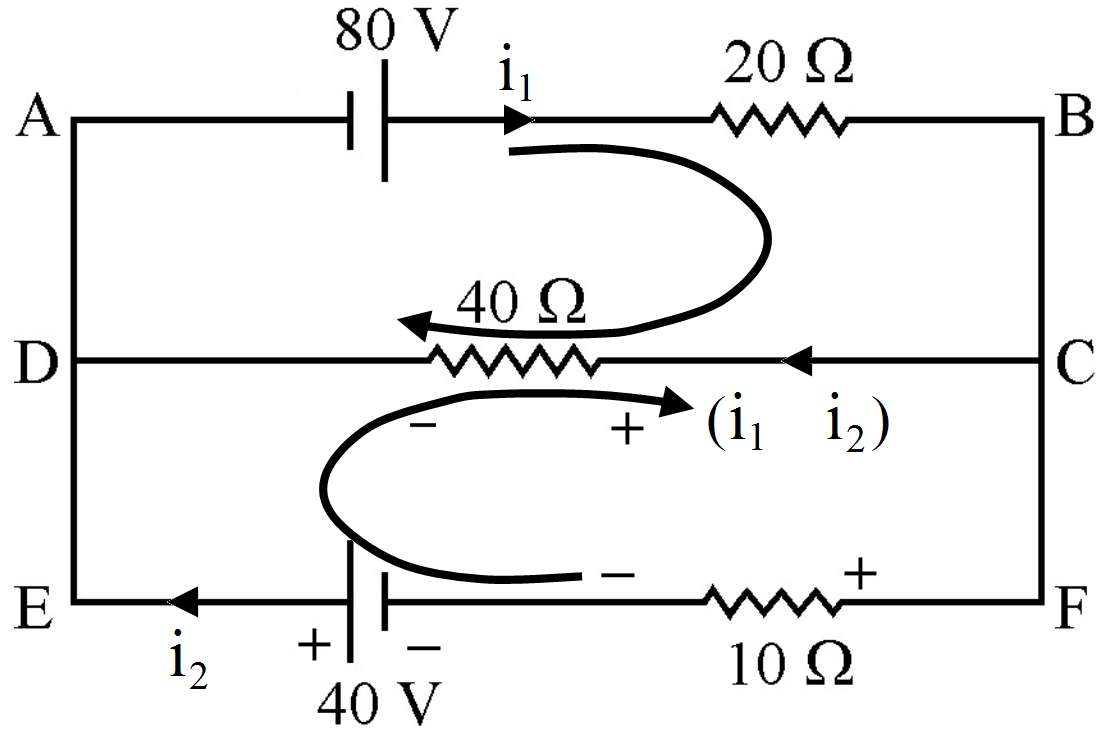
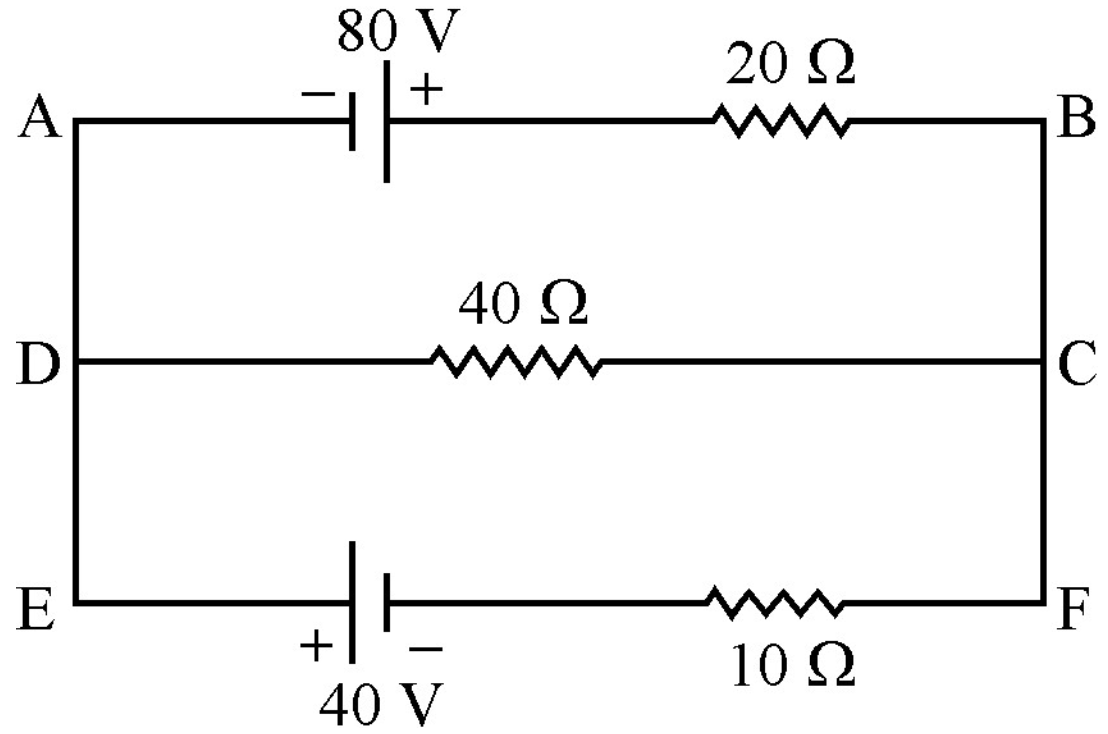
Using Kirchhoff’s rules, calculate the current through the $40\Omega$ and $20\Omega$ resistors in the following circuit:
Answer
Apply KVL through ABCDA:

$80 - 20i_1 - 40(i_1 - i_2) = 0 80 - 60i_1 + 40i_2$
= 0 equation (1) Apply KVL through
FEDCF: $40 + 40(i_1 - i_2) - 10i_2$
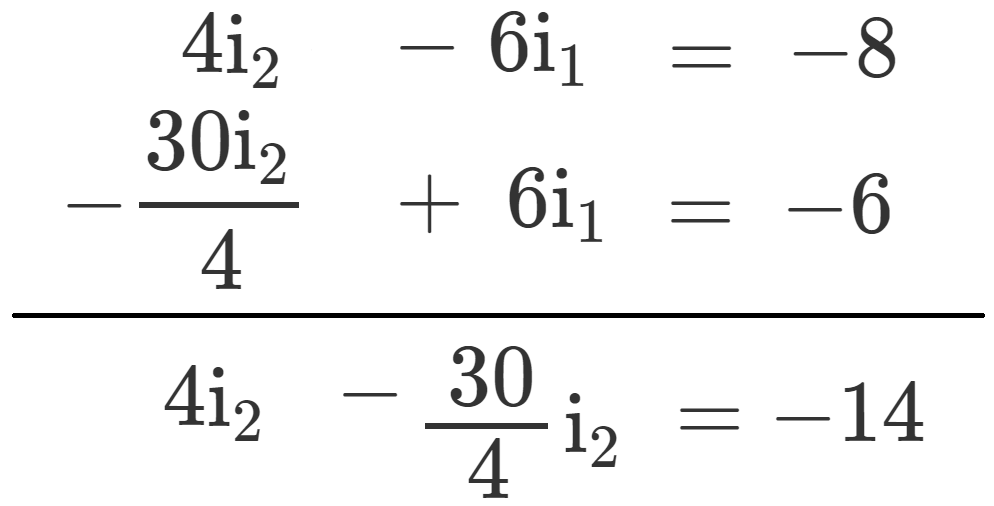
$= 0 40 + 40i_1 - 50i_2= 0$ equation $= 0 4i_2 - 6i_1 = -8$
equation $(1) -5i_2 + 4i_1 = -4$ equation (2) Multiplying equation (2) by $\frac{6}{4}$ and add with equation (1)
$\frac{-14}{4}\text{i}_2=-14,\text{i}_2=\frac{-14}{7}\times2$ $\text{i}_2=4\text{A}$
Put the value of $i_2$ in equation $(1) 4 \times (4) - 6i_1$
$= -8 16 - 6i_1 = -8 6i_1 = 16 + 8 = 24 i_1 = 4A$
So, current through $40\Omega$ resistor $= i_1 - i_2 = 4 - 4 = 0A$
Current through $20\Omega$ resistor $= 4A$
View full question & answer
Question 533 Marks
What is end error in a metre bridge? How is it overcome? The resistances in the two arms of the metre bridge are $\text{R}=5\Omega$ and S respectively. When the resistance S is shunted with an equal resistance, the new balance length found to be 1.5 $l_1$, where $l_1$ is the initial balancing length. Calculate the value of S.
Answer
The shifting of zero of the scale at different points as well as the stray resistance gives rise to the end error in meter bridge wire. This error arises due to the non-uniformity of the meter wire End corrections can be estimated by including known resistances $P_1$ and $Q_1$ in the two ends and finding the null point We have

$\text{R}=5\Omega$ According to the wheat stone Bridge principle: $\frac{\text{R}}{\text{l}_1}=\frac{\text{S}}{100-\text{l}_1}$ $\frac{5}{\text{l}_1}=\frac{\text{S}}{100-\text{l}_1}$ equation (1) After shunting means we are connecting resistance in parallel $\text{S}\rightarrow\frac{\text{S}}{2}$ $\frac{5}{1.5\text{l}_1}=\frac{\text{S}}{2(100-1.5\text{l}_1)}$ equation (2) Equation (1) can be written as: $500 - 5l_1= Sl_1$ equation (3) And, equation (2) can be written as $10(100 - 1.5l_1) = 1.5Sl_1$ equation (4) From equation (3) and (4) $\frac{500-5\text{l}_1}{\text{l}_1}=\frac{1000-15\text{l}_1}{1.5\text{l}_1}$ $750-7.5\text{l}_1=1000-15\text{l}_1$ $ -250=-7.5\text{l}_1$ $\text{l}_1=\frac{100}{3}$ $\text{S}=\frac{500-\frac{5\times100}{3}}{\frac{100}{3}}=\frac{500-\frac{500}{3}}{\frac{100}{3}}=\frac{1000}{3}\times\frac{3}{100}$ $\text{S}=10\Omega$
View full question & answer
Question 543 Marks
How many time constants will elapse before the power delivered by a battery drops to half of its maximum value in an RC circuit?
Answer
Power $=\text{CV}^2=\text{Q}\times\text{V}$
Now, $\frac{\text{QV}}{2}=\text{QV}\times\text{e}^{\frac{-\text{t}}{\text{RC}}}$
$\Rightarrow\frac{1}{2}=\text{e}^{\frac{-\text{t}}{\text{RC}}}$
$\Rightarrow\frac{\text{t}}{\text{RC}}=-\text{In}\ 0.5$
$\Rightarrow-(-0.69)=0.69.$
View full question & answer
Question 553 Marks
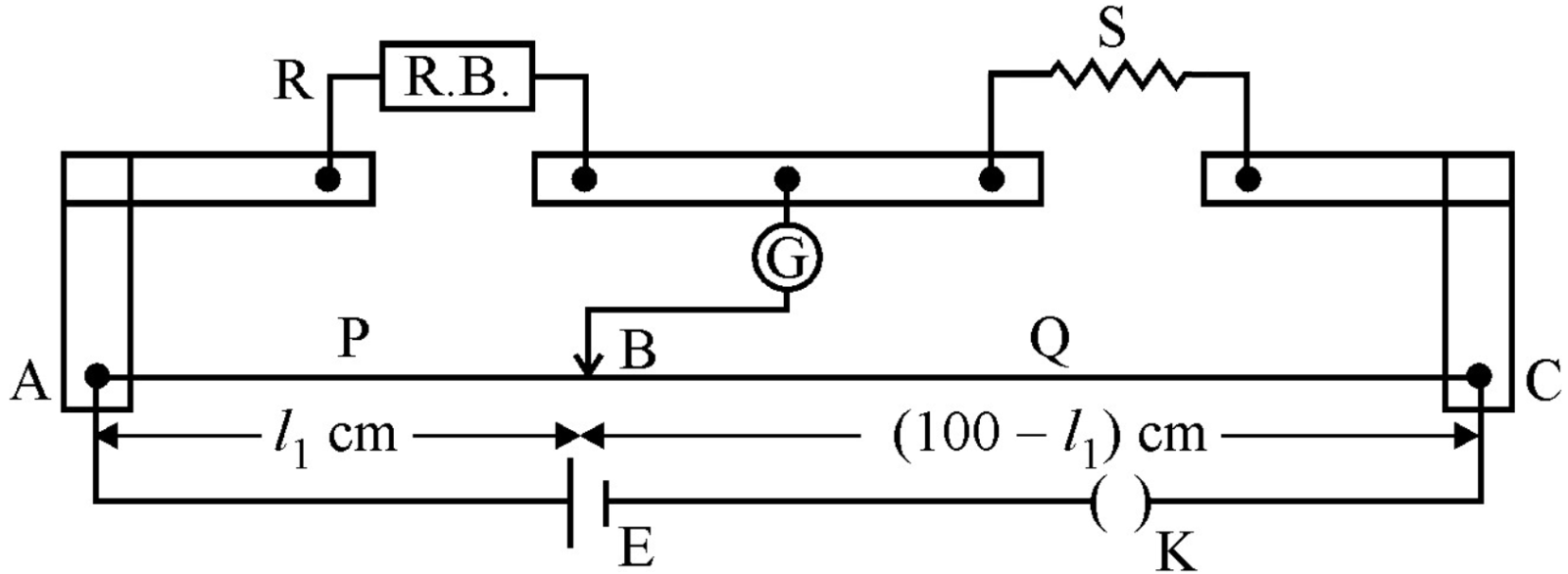
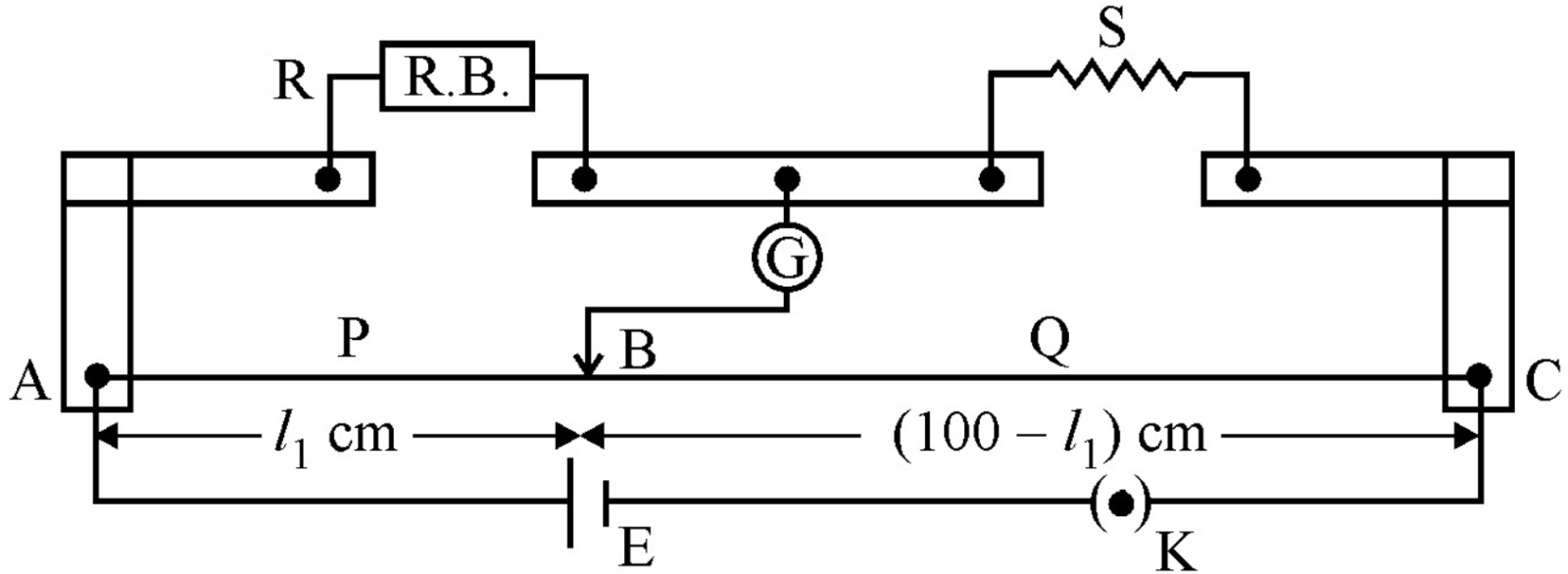
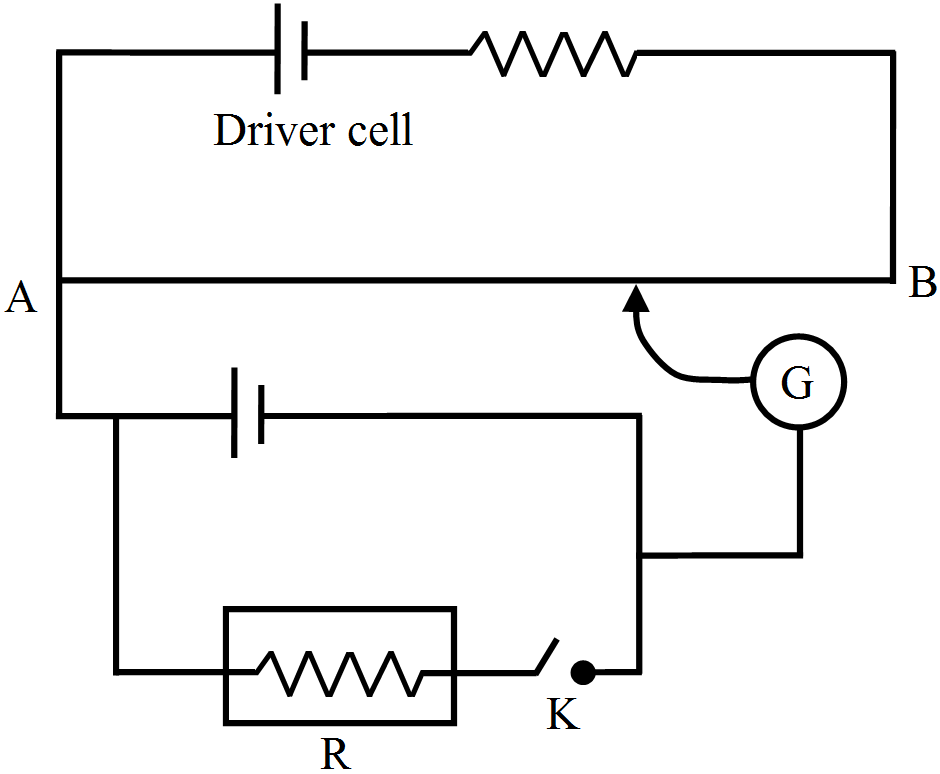
The following circuit shows the use of potentiometer to measure the internal resistance of a cell:
  1. When the key is open, how does the balance point change, if the current from the driver cell decreases?
  2. When the key K is closed, how does the balance point change if R is increased keeping current from the driver cell constant?
Answer
  1. When current through driver cell decreases, the potential gradient across potentiometer wire decreases; so the balancing length $\text{l}=\frac{\text{E}}{\text{k}}$ increases, so balance point is shifted to the right.
  2. With increase of R, the terminal p.d. across cell E increases and hence balancing length $\text{l}=\frac{\text{V}}{\text{k}}\propto\text{V}$ increases. So the balance point is shifted to the right.
View full question & answer
Question 563 Marks
Electrons are continuously in motion within a conductor but there is no current in it unless some source of potential is applied across its ends. Give reason.
Answer
In the absence of any external source the motion of electrons in a conductor is random and electrons collide continuously with the positive ions of metal. This causes a random change in direction of motion. The average velocity of random motion of electrons in any direction is zero, hence current is zero.
View full question & answer
Question 573 Marks
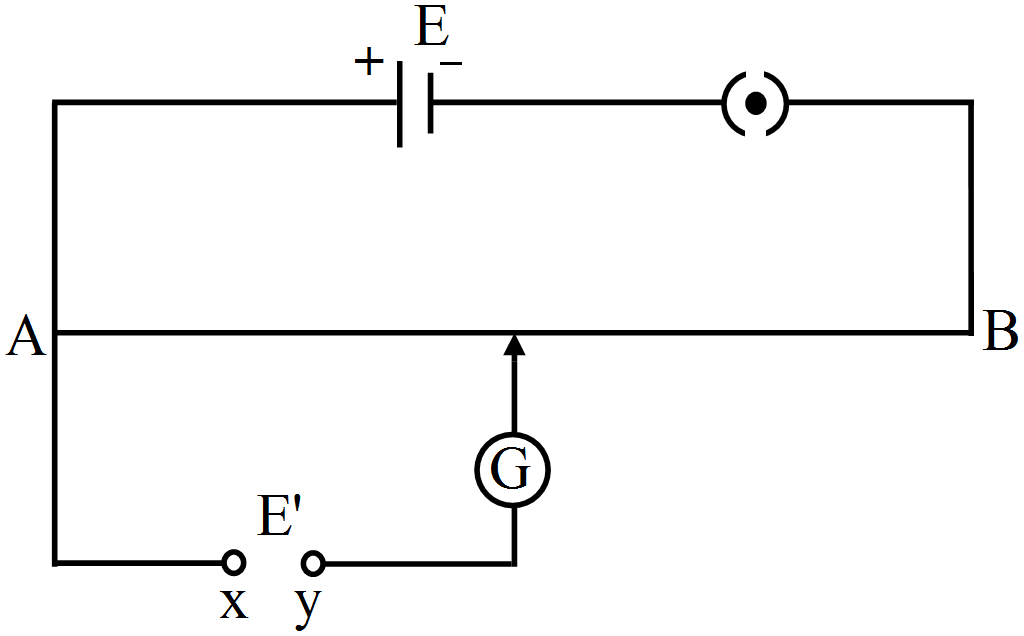
For the potentiometer circuit shown in the given figure, points X and Y represent the two terminals of an unknown emf E'. A student observed that when the jockey is moved from the end A to the end B of the potentiometer wire, the deflection in the galvanometer remains in the same direction.
What may be the two possible faults in the circuit that could result in this observation? If the galvanometer deflection at the end B is (i) more, (ii) less than at the end A, which of the two faults, listed above, would be there in the circuit? Give reason in support of your answer in each case.
Answer
The two possible faults in the circuit may be (i) emf E′ is greater than emf E.
(ii) Terminal X of unknown emf is negative (while it should be positive).
If galvanometer deflection at end B is more than that at end A, then terminal X is negative, because in this case net current in galvanometer along AB due to both cells is additive.
If galvanometer deflection at end B is less than that at end A, then E′ > E, because net current in galvanometer due to both cells’ emfs E and E′ is subtractive.
View full question & answer
Question 583 Marks
What is the advantage of using thick metallic strips to join wires in a potentiometer?
Answer
Metallic strips have negligible resistance and need not to be counted in the length $l_1,$ of the null point of potentiometer. That's why the thick metallic strips are used in potentiometer. It is for the convenience of experimenter as he measures only their lengths along the straight segments each of lengths 1m.This measurements is done with the help of a centimetre scale or metre scale and leads to the accurate measurements.
View full question & answer
Question 593 Marks
A capacitance C charged to a potential difference V is discharged by connecting its plates through a resistance R. Find the heat dissipated in one time constant after the connections are made. Do this by calculating $\int\text{i}^2\text{R}$ dt and also by finding the decrease in the energy stored in the capacitor.
Answer
Energy stored at a part time in discharging $=\frac{1}{2}\text{CV}^2\Big(\text{e}^{\frac{-\text{t}}{\text{RC}}}\Big)^2$
Heat dissipated at any time = (Energy stored at t = 0) - (Energy stored at time t)
$=\frac{1}{2}\text{CV}^2-\frac{1}{2}\text{CV}^2\big(-\text{e}^{-1}\big)^2$ $=\frac{1}{2}\text{CV}^2\big(1-\text{e}^2\big)$
View full question & answer
Question 603 Marks
How many time constants will elapse before the current in a charging RC circuit drops to half of its initial value? Answer the same question for a discharging RC circuit.
Answer
$\frac{\text{Q}}{2}=\text{Q}\Big(1-\text{e}^{\frac{-\text{t}}{\text{CR}}}\Big)$
$\Rightarrow\frac{1}{2}=\Big(1-\text{e}^{\frac{-\text{t}}{\text{CR}}}\Big)$
$\Rightarrow\text{e}^{\frac{-\text{t}}{\text{CR}}}=\frac{1}{2}$
$\Rightarrow\frac{\text{t}}{\text{RC}}=\log2\Rightarrow\text{n}=0.69.$
View full question & answer
Question 613 Marks
A (i) series (ii) parallel combination of two given resistors is connected, one by one, across a cell. In which case will the terminal potential difference, across the cell have a higher value?
Answer
Terminal potential difference across a cell,
$\text{V}=\varepsilon-\text{lr}$
  1. In series arrangement, current, $\text{I}_\text{S}=\frac{\text{E}}{\text{R}_1+\text{R}_2+\text{r}}$
  2. In parallel arrangement, current, $\text{I}_\text{P}=\frac{\text{E}}{\frac{\text{R}_1\text{R}_2}{\text{R}_1+\text{R}_2}+1}$
Obviously, IP > IS, so VP < VS.
That is series arrangement will have higher terminal potential difference.
View full question & answer
Question 623 Marks
A capacitor of capacitance $10\mu\text{F}$ is connected across a battery of emf 6.0V through a resistance of $20\text{k}\Omega$ for 4.0s. The battery is then replaced by a thick wire. What will be the charge on the capacitor 4.0s after the battery is disconnected?
Answer
$\text{C} = 100\mu\text{F, emf} = 6\text{V}, \text{ R} = 20 \text{K}\Omega, \text{t} = 4 \text{S}.$
Charging: $\text{Q}=\text{CV}\Big(1-\text{e}^{\frac{-\text{t}}{\text{RC}}}\Big)\ \bigg[\frac{-\text{t}}{\text{RC}}=\frac{4}{2\times10^4\times10^{-4}}\bigg]$
$=6\times10^{-4}\big(1-\text{e}^{-2}\big)=5.187\times10^{-4}\text{C}=\text{Q}$
Discharging: $\text{q}=\text{Q}\Big(\text{e}^{\frac{-\text{t}}{\text{RC}}}\Big)=5.184\times10^{-4}\times\text{e}^{-2}$
$=0.7\times10^{-4}\text{C}=70\mu\text{c}.$
View full question & answer
Question 633 Marks
Two heated wires of the same dimensions are first connected in series and then in parallel to a source of supply. What will be the ratio of heat produced in the two cases?
Answer
$\text{Q}=\frac{\text{V}^2}{\text{R}}\text{t}\propto\frac{1}{\text{R}}$
For same voltage,
$\frac{\text{Q series}}{\text{Q parallel}}=\frac{\text{R parallel}}{\text{R series}}=\frac{\frac{(\text{R.R})}{\text{(R}+\text{R})}}{\text{R}+\text{R}}=\frac{\frac{\text{R}}{2}}{2\text{R}}=\frac14$
View full question & answer
Question 643 Marks
What length of a copper wire of cross-sectional area $0.01mm^2$ will be needed to prepare a resistance of $1\text{k}\Omega?$ Resistivity of copper $=1.7\times10^{-8}\Omega\text{-m}.$
Answer
$\text{f}_\text{cu}=1.7\times10^{-8}\Omega\text{-m}$
$\text{A}=0.01\text{mm}^2=0.01\times10^{-6}\text{m}^2$
$\text{R}=1\text{K}\Omega=10^3\Omega$
$\text{R}=\frac{\text{f}\ell}{\text{a}}$
$\Rightarrow10^3=\frac{1.7\times10^{-8}\times\ell}{10^{-6}}$
$\Rightarrow\ell=\frac{10^3}{1.7}=0.58\times10^3\text{m}=0.6\text{km}.$
View full question & answer
Question 653 Marks
An ideal battery sends a current of 5A in a resistor. When another resistor of value $10\Omega$ is connected in parallel, the current through the battery is increased to 6A. Find the resistance of the first resistor.
Answer
$\text{R}_1=\text{R},\text{i}_1=5\text{A}$
$\text{R}_2=\frac{10\text{R}}{10+\text{R}},\text{i}_2=6\text{A}$
Since potential constant,
$\text{i}_1\text{R}_1=\text{i}_2\text{R}_2$
$\Rightarrow5\times\text{R}=\frac{6\times10^\text{R}}{10+\text{R}}$
$\Rightarrow(10+\text{R})5=60$
$\Rightarrow5\text{R}=10\Rightarrow\text{R}=2\Omega.$
View full question & answer
Question 663 Marks
A parallel-plate capacitor with plate area $20cm^2$ and plate separation 1.0mm is connected to a battery. The resistance of the circuit is $10\text{k}\Omega.$ Find the time constant of the circuit.
Answer
$\text{A}=20\text{cm}^2=20\times10^{-4}\text{m}^2$
$\text{d}=1\text{mm}=1\times10^{-3}\text{m};\text{R}=10\text{K}\Omega$
$\text{C}=\frac{\text{E}_0\text{A}}{\text{d}}=\frac{8.85\times10^{-12}\times20\times10^{-4}}{1\times10^{-3}}$
$=\frac{8.85\times10^{-12}\times2\times10^{-3}}{10^{-3}}=17.7\times10^{-2}\text{Farad}.$
Time constant $=\text{CR}=17.7\times10^{-2}\times10\times10^3$
$=17.7\times10^{-8}=0.177\times10^{-6}\text{s}=0.18\mu\text{s}.$
View full question & answer
Question 673 Marks
Why are alloys used for making standard resistance coils?
Answer
Alloys are used for making standard resistance coil because they have low temperature coefficient of resistance with less temperature sensitivity.

This keeps the resistance of the wire almost constant even in small temperature change. The alloys also have high resistivity and hence high resistance, because for given length and cross-section area of conductor (L and A are constant).
$\text{R}\hat{\text{I}}\pm\text{p}$
View full question & answer
Question 683 Marks
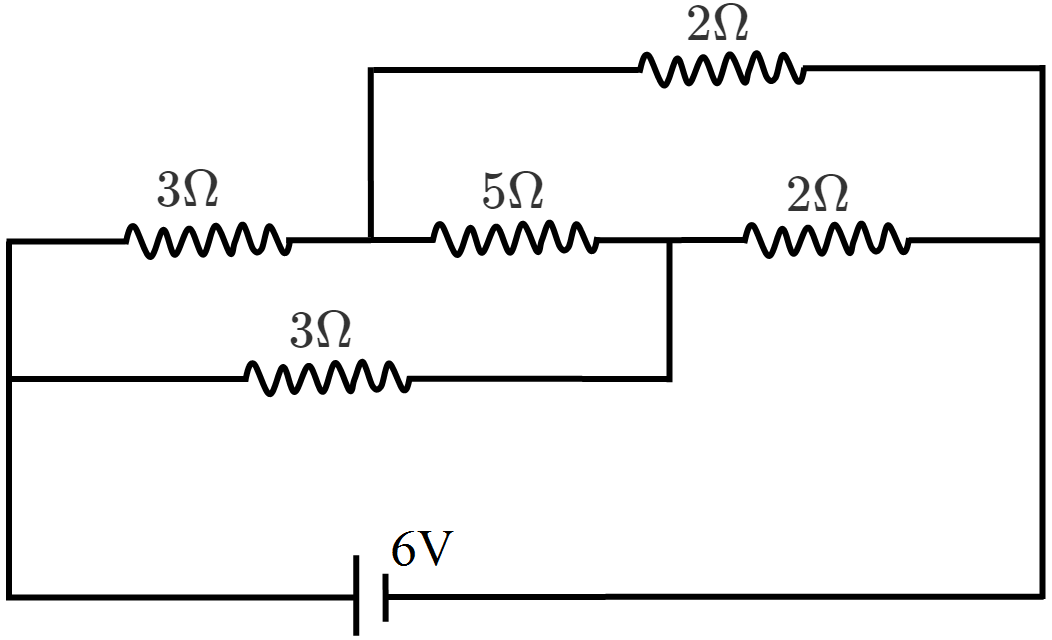
Calculate the current drawn from the battery in the given network shown here. State Kirchhoff’s loop law and name the law on which it is based.
Answer
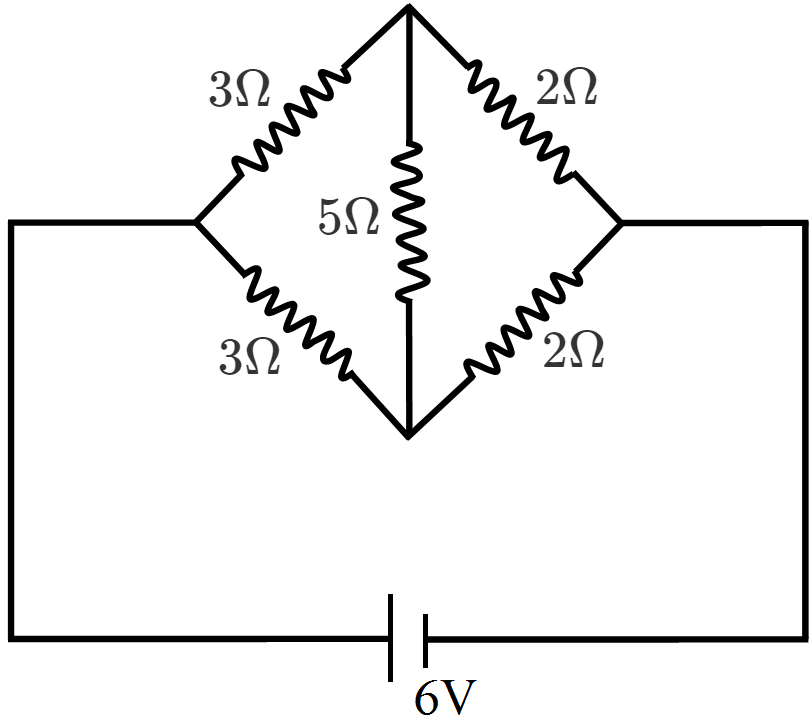
The equivalent circuit is as shown in figure alongside. [$\therefore$ Bridge is in balanced condition, no current flows through $5\Omega$ resistance] $\frac{1}{\text{R}}=\frac{1}{5}+\frac15\text{R}=5\Omega$
Current in the circuit $=\frac{6}{2.5}\text{A}=2.4\text{A}$ Kirchhoff’s Loop Law: The algebraic sum of potential differences of different circuit elements of a closed circuit (or mesh) is zero. This law is based on law of conservation of energy.
View full question & answer
Question 693 Marks
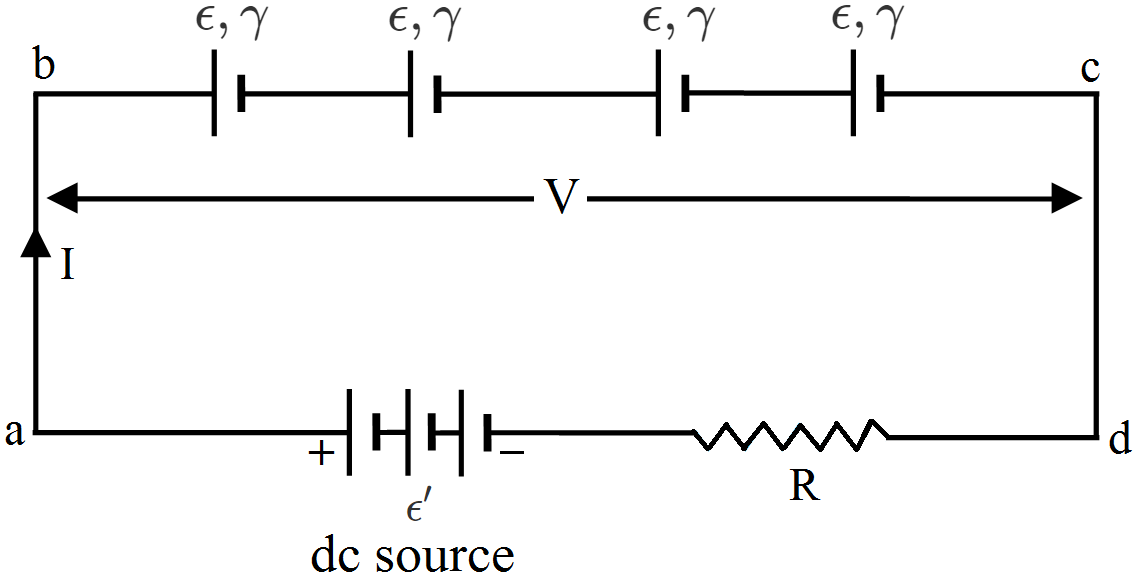
n-identical cells, each of emf $\varepsilon,$ internal resistance r connected in series are charged by a dc source of emf $\varepsilon'$ using a resistance R.
  1. Draw the circuit arrangement.
  2. Deduce expressions for (a) the charging current and (b) the potential difference across the combination of cells.
Answer
  1. The circuit arrangement is shown in figure.


Applying Kirchhoff’s second law to the circuit abcda

$-\text{n}\varepsilon-\text{I}(\text{nr)}-\text{IR}+\varepsilon' = 0$

$\Rightarrow\text{I}=\frac{\varepsilon'-\text{n}\in}{\text{R}+\text{nr}}$
  1.  
  1. Charging current, $\text{I}=\frac{\in'-\text{n}\varepsilon}{\text{R}+\text{nr}}$
  2. Potentail difference across the combination V is given by
$-\text{V}-\text{IR}+\text{}\varepsilon'=0$

$\Rightarrow\text{V}=\varepsilon'-\text{IR}$

$\Rightarrow\text{V}=\varepsilon'=\frac{(\varepsilon'-\text{n}\varepsilon)}{\text{R}+\text{nr}}$

$\Rightarrow\text{V}=\frac{\varepsilon'(\text{R}+\text{nr)}-\varepsilon'+\text{n}\varepsilon}{\text{R}+\text{nr}}$

$\Rightarrow\text{V}=\frac{\varepsilon'(\text{R}+\text{nr}-1)+\text{n}\varepsilon}{\text{R}+\text{nr}}$
View full question & answer
Question 703 Marks
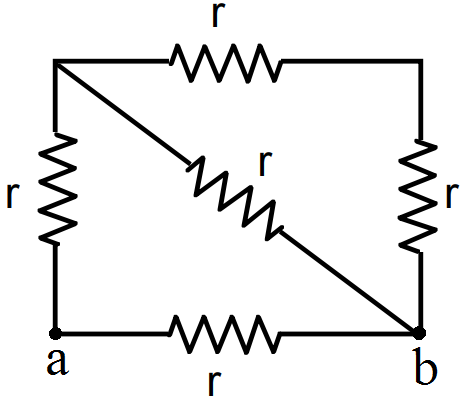
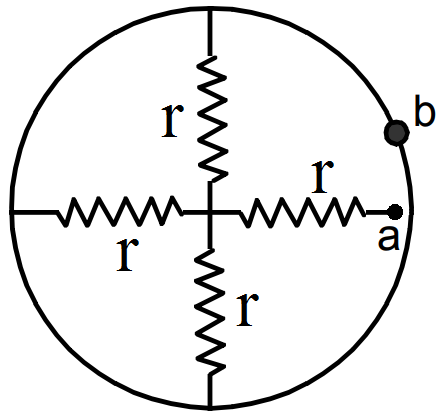
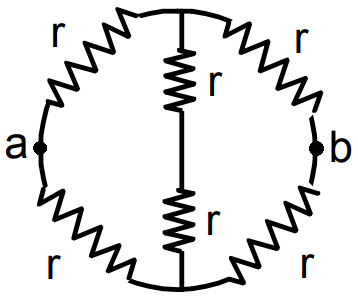
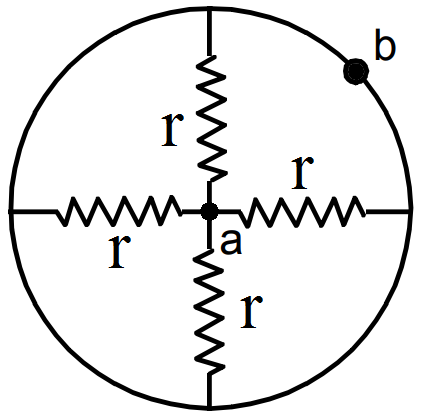
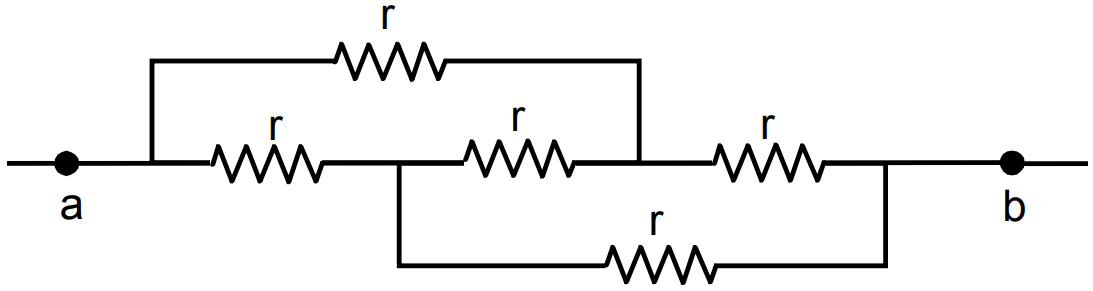
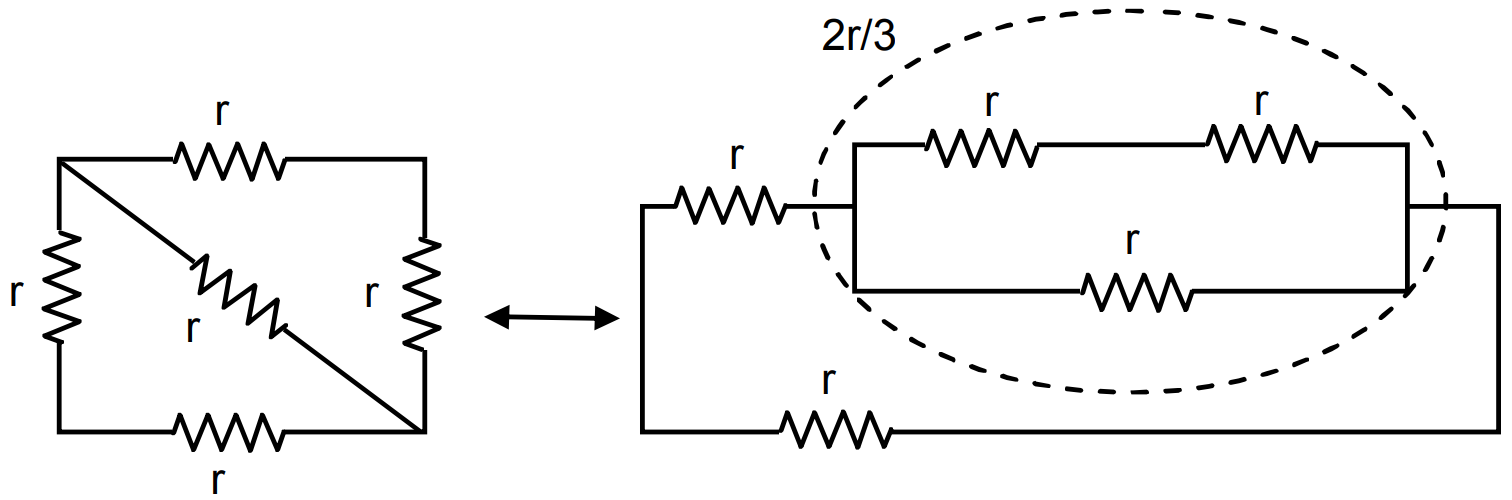
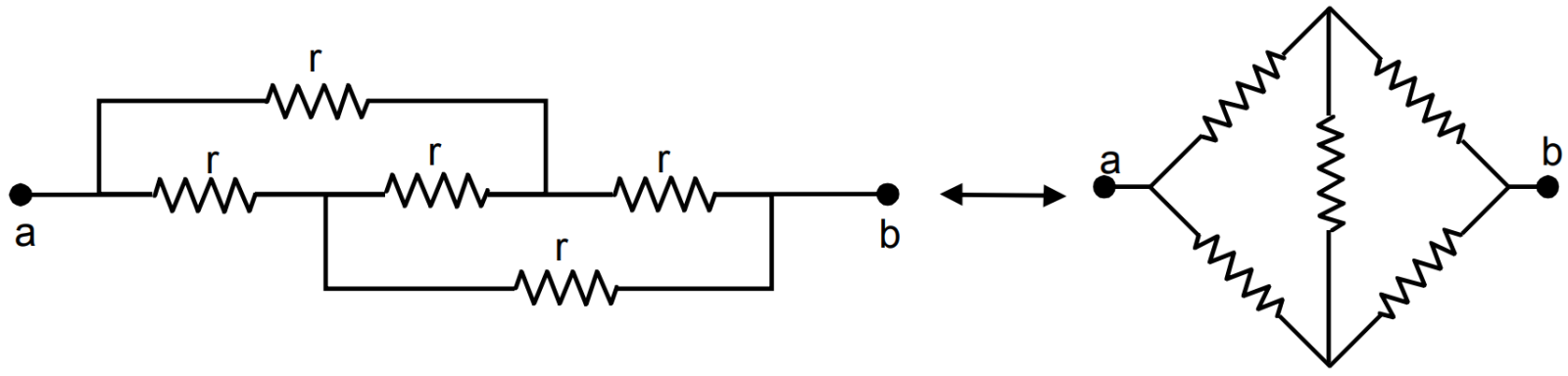
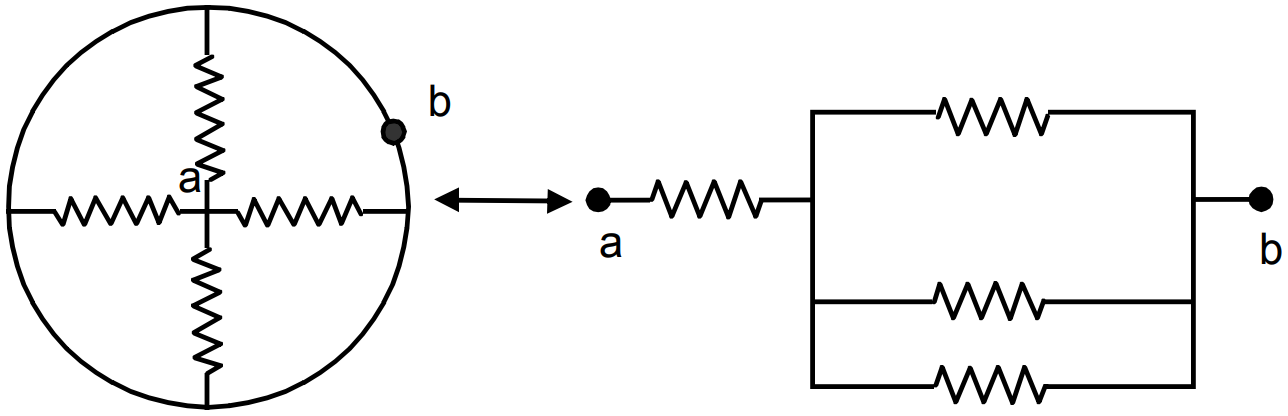
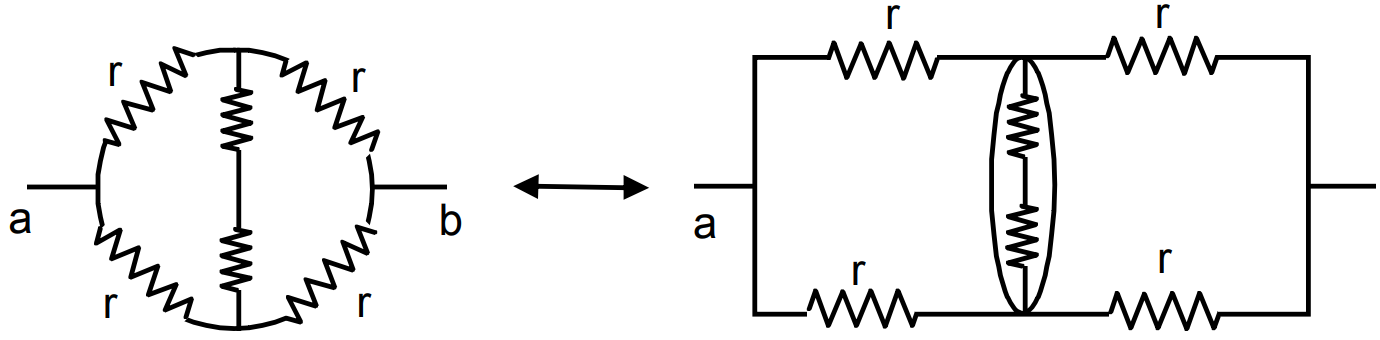
Find the equivalent resistances of the networks shown in the figure. between the points a and b.
  1.  
  1.  
  1.  
  1.  
  1.  
Answer
$\text{R}_\text{eff}=\frac{\Big(\frac{2\text{r}}{3}+\text{r}\Big)\text{r}}{\Big(\frac{2\text{r}}{3}+\text{r}+\text{r}\Big)}=\frac{5\text{r}}{8}$ $\text{R}_\text{eff}=\frac{\text{r}}{3}+\text{r}=\frac{4\text{r}}{3}$ $\text{R}_\text{eff}=\frac{2\text{r}}{2}=\text{r}$ $\text{R}_\text{eff}=\frac{\text{r}}{4}$ $\text{R}_\text{eff}=\text{r}$
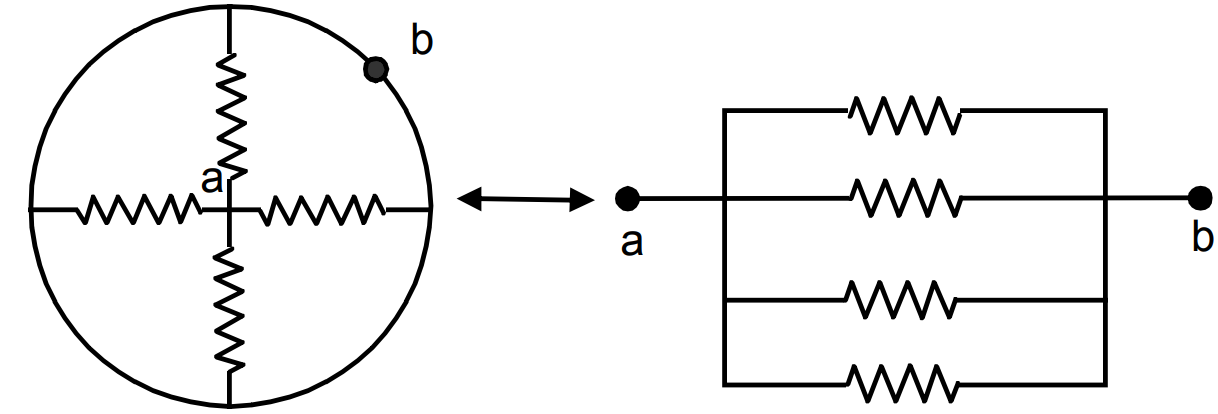
View full question & answer
Question 713 Marks
Two heater coils made of same material are connected in parallel across the mains. The length and diameter of the wire of one of coils are double that of the other. Which one of them will produce more heat?
Answer
We have resistance of one wire,
$\text{R}_1=\frac{\rho\text{l}}{\text{A}}=\frac{\rho\text{l}}{\pi\text{r}^2}=\frac{4\rho\text{l}}{\pi\text{D}^2}$
Where l is length and D is diameter of the wire. The resistance of second wire of double the length and double the diameter is,
$\text{R}_2=\frac{4\rho(2\text{l})}{\pi(2\text{D})^2}=\frac{4\rho\text{l}}{\pi\text{D}^2}.\frac12,\text{ i.e.,}\text{ R}_2=\frac{\text{R}_1}{2}$
Heat produced per second,
$\text{H}=\frac{\text{V}^2}{\text{R}}\propto\frac{1}{\text{R}}$
As second coil has resistance equal to half of first coil, therefore heat produced in second coil is double than that in first coil.
View full question & answer
Question 723 Marks
The specification on a heater coil is 250V, 500W. Calculate the resistance of the coil. What will be the resistance of a coil of 1000W to operate at the same voltage?
Answer
  1. The power consumed by a coil of resistance R when connected across a supply v is $\text{P}=\frac{\text{v}^2}{\text{R}}$
The resistance of the heater coil is, therefore $\text{R}=\frac{\text{v}^2}{\text{P}}=\frac{(250)^2}{500}=125\Omega$
  1. If, $\text{P}=1000\text{w}$
then, $\text{R}=\frac{\text{v}^2}{\text{P}}=\frac{(250)^2}{1000}=62.5\Omega$
View full question & answer
Question 733 Marks
Name the charge carriers of electric current in:
  1. Silver foil.
  2. Hydrogen discharge tube.
  3. Germanium semiconductor.
  4. Wire made of alloy nichrome.
  5. Superconductor.
Answer
  1. Charge carriers in silver foil are free electrons.
  2. Charge carriers in hydrogen discharge tube are electrons $(e^–) $ and positive hydrogen ions $(H^+).$
  3. Charge carriers in germanium semiconductor are electrons $(e^–)$ and holes $(o^+).$
  4. Charge carriers in nichrome wire are electrons.
  5. Charge carriers in superconductor are electrons.
View full question & answer
Question 743 Marks
A wire of length 1m and radius 0.1mm has a resistance of $100\Omega.$ Find the resistivity of the material.
Answer
$\ell=1\text{m},\text{r}=0.1\text{mm}=0.1\times10^{-3}\text{m}$
$\text{R}=100\Omega,\text{f}=?$
$\Rightarrow\text{R}=\frac{\text{f}\ell}{\text{a}}$
$\Rightarrow\text{f}=\frac{\text{Ra}}{\ell}=\frac{100\times3.14\times0.1\times0.1\times10^{-6}}{1}$
$=3.14\times10^{-6}=\pi\times10^{-6}\Omega\text{-m}.$
View full question & answer
Question 753 Marks
Do all the thermocouples have a neutral temperature?
Answer
As neutral temperature is The temperature of the hot junction of a thermocouple at which the electromotive force of the thermocouple attains its maximum value, when the cold junction is maintained at a constant temperature of 0°C.
So, answer is yes.
View full question & answer
Question 763 Marks
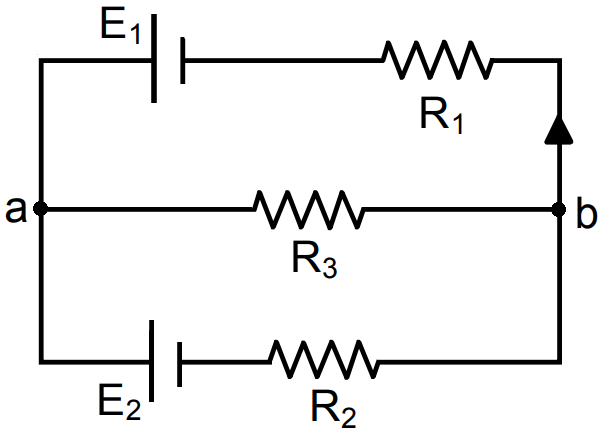
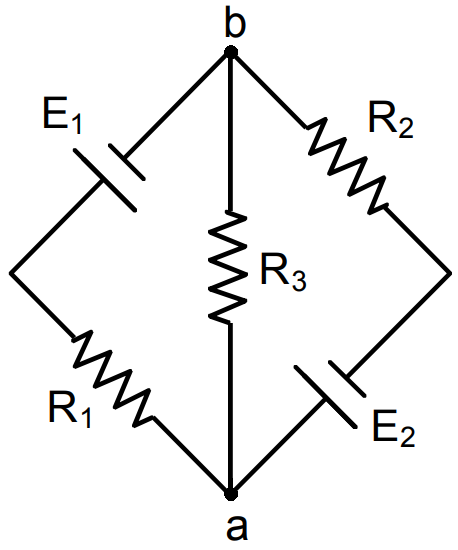
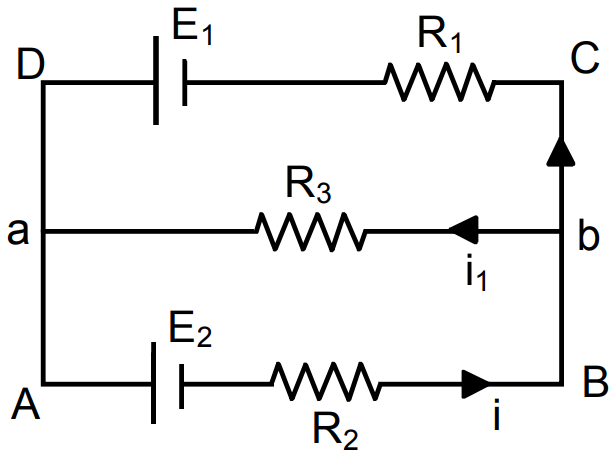
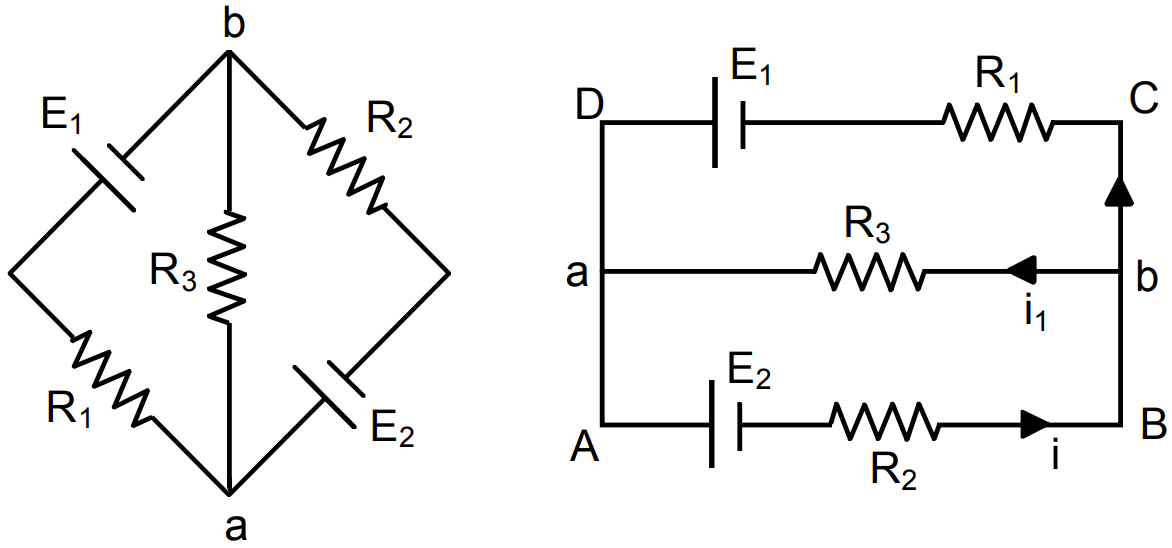
Find the potential difference $V_a - V_b $ in the circuits shown in figure.

Answer
  1. In circuit, AB ba A


$\text{E}_2+\text{iR}_2+\text{i}_1\text{R}_3=0$

In circuit, $\text{i}_1\text{R}_3+\text{E}_1-(\text{i}-\text{i}_1)\text{R}_1=0$

$\Rightarrow\text{i}_1\text{R}_3+\text{E}_1-\text{iR}_1+\text{i}_1\text{R}_1=0$

$[\text{iR}_2+\text{i}_1\text{R}_3\ \ \ \ \ \ \ \ \ \ \ \ \ \ \ \ \ \ \ \ \ \ =-\text{E}_2]\text{R}_1\\ [\text{iR}_2-\text{i}_1(\text{R}_1+\text{R}_3)\ \ \ \ \ \ \ \ \ =\text{E}_1]\text{R}_2\\\underline{\ \ \ \ \ \ \ \ \ \ \ \ \ \ \ \ \ \ \ \ \ \ \ \ \ \ \ \ \ \ \ \ \ \ \ \ \ \ \ \ \ \ \ \ \ \ \ \ \ \ \ \ \ \ \ \ \ }\\\text{iR}_2\text{R}_1+\text{i}_1\text{R}_3\text{R}_1\ \ \ \ \ \ \ \ \ \ \ \ \ =-\text{E}_2\text{R}_1\\\text{iR}_2\text{R}_1-\text{i}_1\text{R}_2(\text{R}_1+\text{R}_3)=\ \ \ \text{E}_1\text{R}_2\\\underline{ \ \ \ \ \ \ \ \ \ \ \ \ \ \ \ \ \ \ \ \ \ \ \ \ \ \ \ \ \ \ \ \ \ \ \ \ \ \ \ \ \ \ \ \ \ \ \ \ \ \ \ \ \ \ \ \ \ }$

$\text{iR}_3\text{R}_1+\text{i}_1\text{R}_2\text{R}_1+\text{i}_1\text{R}_2\text{R}_3=\text{E}_1\text{R}_2-\text{E}_1\text{R}_1$

$\Rightarrow\text{i}_1(\text{R}_3\text{R}_1+\text{R}_2\text{R}_1+\text{R}_2\text{R}_3)=\text{E}_1\text{R}_2-\text{E}_2\text{R}_1$

$\Rightarrow\text{i}_1=\frac{\text{E}_1\text{R}_2-\text{E}_2\text{R}_1}{\text{R}_3\text{R}_1+\text{R}_2\text{R}_1+\text{R}_2\text{R}_3}$

$\Rightarrow\frac{\text{E}_1\text{R}_2\text{R}_3-\text{E}_2\text{R}_1\text{R}_3}{\text{R}_3\text{R}_1+\text{R}_2\text{R}_1+\text{R}_2\text{R}_3}=\Bigg(\frac{\frac{\text{E}_1}{\text{R}_1}-\frac{\text{E}_2}{\text{R}_2}}{\frac{1}{\text{R}_2}+\frac{1}{\text{R}_1}+\frac{1}{\text{R}_3}}\Bigg)$
  1. $\therefore$ Same as a
View full question & answer
Question 773 Marks
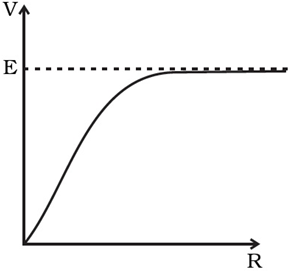
A cell of emf E and internal resistance r is connected across an external resistance R. Plot a graph showing the variation of P.D. across R, verses R.
Answer
When the cell of emf E and internal resistance r is connected across an external resistance R, the relationship between the voltage across R is given by
$\text{V}=\frac{\text{E}}{\big[1+\big(\frac{\text{r}}{\text{R}}\big)\big]}$
From the above relation,
Now, as $\text{R}=0\Rightarrow\ \text{V}=0\ \&\ \text{R}=\infty\Rightarrow\ \text{V}=\text{E}.$ So, this variation is shown in the figure given below.
View full question & answer
Question 783 Marks
Two electric bulbs have the following specifications.
  1. 100W at 220V.
  2. 1000W at 220V.
Which bulb has higher resistance? What is the ratio of their resistances?
Answer
The resistance of filament,
$\text{R}=\frac{\text{V}}{\text{I}}=\frac{\text{V}^2}{\text{P}}$
At constant voltage V, the resistance,
$\text{R}\propto\frac{1}{\text{p}}$
That is the resistance of filament of 100W bulb is greater than that of 1000W bulb.
The ratio of resistances $=\frac{\text{R}_1}{\text{R}_2}=\frac{\text{P}_2}{\text{P}_1}$
$=\frac{1000}{100} $
$=\frac{10}{1}=10:1$
View full question & answer
Question 793 Marks
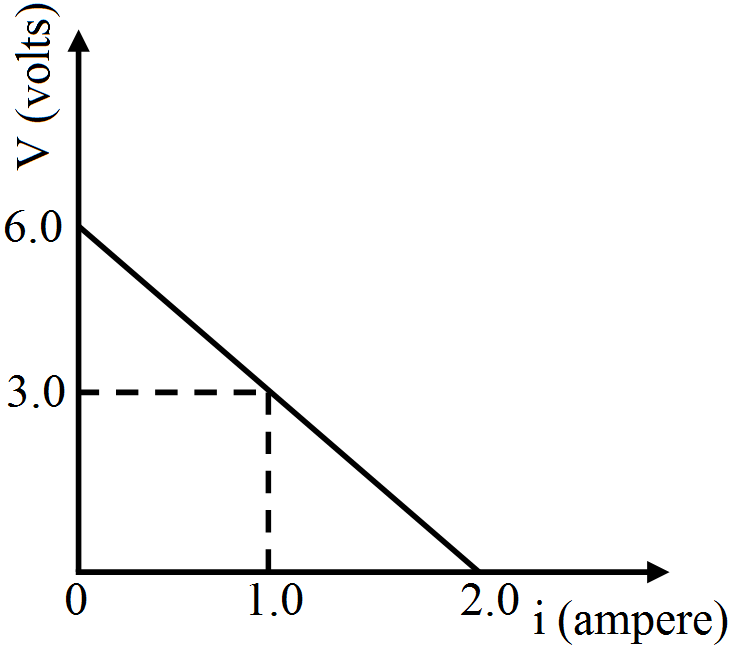
The graph shown here shows the variation of terminal potential difference V, across a combination of three cells in series to a resistor, versus current i:
  1. Calculate the emf of each cell.
  2. For what current i, will the power dissipation of the circuit be maximum?
Answer
Let $\varepsilon$ be emf and r the internal resistance of each cell. The equation of terminal potential difference.
V = $\varepsilon$ eff - i rint becomes,
V = $3\varepsilon$ -i rint …(i)
Where rint is effective (total) internal resistance.
From fig., when i = 0, V = 6.0V
$\therefore$ From (i), $6=3\varepsilon-0\Rightarrow\varepsilon=\frac63=2\text{V}$
i.e., emf of each cell, $\varepsilon=2\text{V}$
Thus, emf of each cell, $\varepsilon=\text{2V}.$
View full question & answer
Question 803 Marks
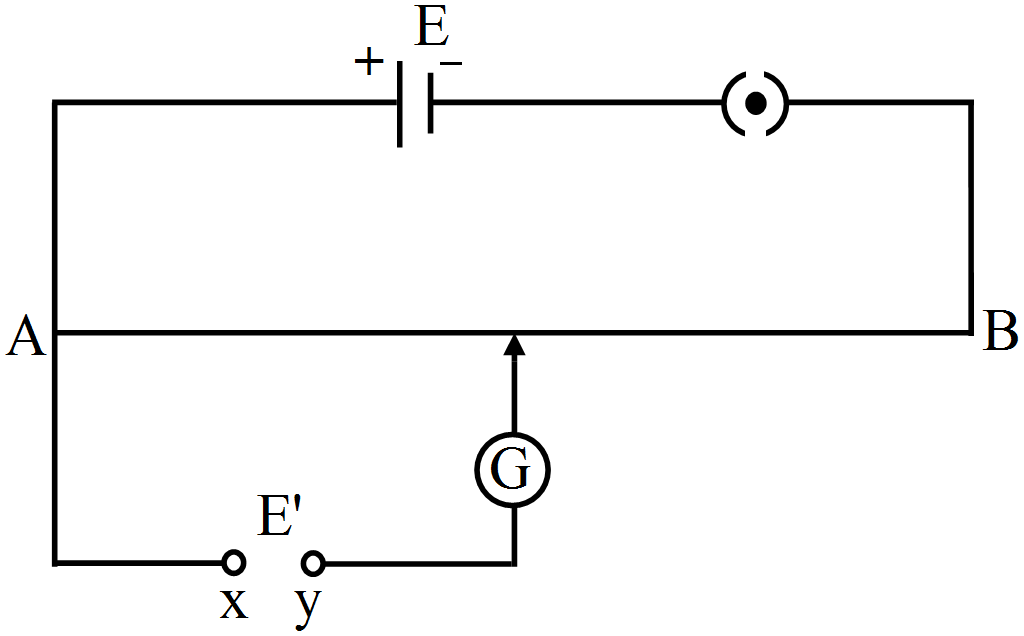
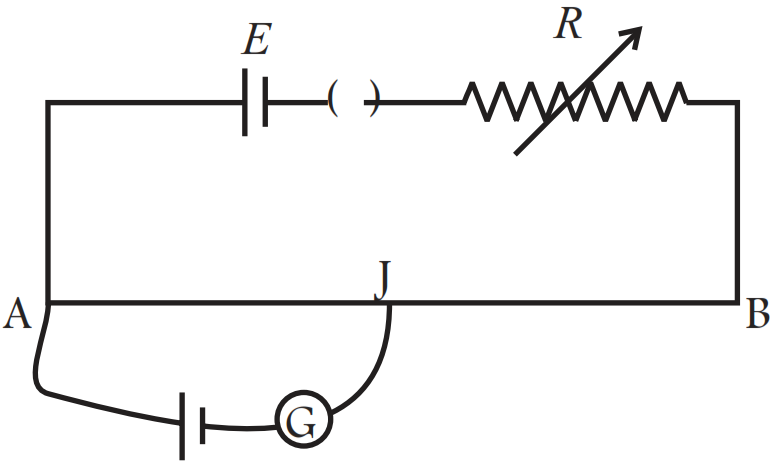
AB is a potentiometer wire (Fig). If the value of R is increased, in which direction will the balance point J shift?
Answer
If the value of R is increased, the current through the wire will decrease which in turn decreases the potential difference across AB, and hence potential gradient (k) across AB decreases.
Since, at neutral point, for given emf of cell, l increases as potential gradient (k) across AB has decreased because E' = kI
Thus, with the increase of l, which will result in increase in balance length. So, jockey J will shift towards B.
View full question & answer
Question 813 Marks
An electric bulb, when connected across a power supply of 220V, consumes a power of 60W. If the supply drops to 180V, what will be the power consumed? If the supply is suddenly increased to 240V, what will be the power consumed?
Answer
$\text{E}=220\text{v}$
$\text{P}=60\text{w}$
$\text{R}=\frac{\text{V}^2}{\text{P}}=\frac{220\times220}{60}$
$=\frac{220\times11}{3}\Omega$
  1. $\text{E}=180\text{v}$
$\text{P}=\frac{\text{V}^2}{\text{R}}$

$=\frac{180\times180\times3}{220\times11}=40.16\approx40\text{w}$
  1. $\text{E}=240\text{v}$
$\text{P}=\frac{\text{V}^2}{\text{R}}$

$=\frac{240\times240\times3}{220\times11}=71.4\approx71\text{w}$
View full question & answer
Question 823 Marks
Calculate the temperature at which the resistance of a conductor becomes 20% more than its resistance at 27°C. The value of the temperature coefficient of resistance of the conductor is $2.0 \times 10\frac{-4}{\text{K}}.$
Answer
Given, $\text{R}_{27}=\text{R}(\text{say}),\text{R}_\text{T}=\text{R}+\frac{20}{100}\text{R}=1.2\text{R},\text{T}_1=27+273=300\text{K}$
From relation,
$\text{R}\text{T}=\text{R}_{27}[1+\alpha(\text{T}_2-300)]$
$\Rightarrow1.2\text{R}=\text{R}[1+2.0\times10^{-4}(\text{T}_2-300)]$
$\Rightarrow1+2.0\times10^{-4}(\text{T}_2-300)=1.2$
$\Rightarrow2.0\times10^{-4}(\text{T}_2-300)=0.2$
$\text{T}_2-300=\frac{0.2}{2.0\times10^{-4}}$
$\text{T}_2=1000+300=1300\text{K}$
View full question & answer
Question 833 Marks
Two wires A and B of the same material and having same length, have their cross sectional areas in the ratio 1 : 6. What would be the ratio of heat produced in these wires when same voltage is applied across each?
Answer
$\text{A}_\text{A}:\text{A}_\text{B}=1:6$
$\text{H}-\text{V}^2\frac{\text{t}}{\text{R}}$ and $\text{R}=\frac{\rho\text{l}}{\text{A}}$
$\text{H}_\text{A}=\frac{\text{V}^2\text{t}}{\frac{\rho\text{l}}{\text{A}_\text{A}}};\text{H}_\text{B}=\frac{\text{V}^2\text{t}}{\frac{\rho\text{l}}{\text{A}_\text{B}}}$
$=\frac{\text{H}_\text{A}}{\text{H}_\text{B}}=\frac{\text{V}^2\text{t}\times\text{A}_\text{A}}{\rho\text{l}}\times\frac{\rho\text{l}}{\text{V}^2\text{tA}_\text{H}}$
$\Rightarrow\frac{\text{H}_\text{A}}{\text{H}_\text{B}}=\frac{\text{A}_\text{A}}{\text{A}_\text{B}}=1:6$
View full question & answer
Question 843 Marks
You are given n resistors each of resistance r. They are first connected to get the minimum possible resistance. In the second case, these are again connected differently to get the maximum possible resistance. Calculate the ratio between minimum and maximum values of resistance so obtained.
Answer
For minimum possible resistance, the resistors should be connected in parallel
$\frac{1}{\text{r}_\text{p}}=\frac{1}{\text{r}}+\frac{1}{\text{r}}+\dots\text{n}\text{ times}$
$\frac{1}{\text{r}_\text{p}}=\frac{\text{n}}{\text{r}}$
$\text{r}_\text{p}=\frac{\text{r}}{\text{n}}$
For maximum possible resistance, the resistors should be connected in series,
$\text{r}_\text{s}=\text{r}+\text{r}+\dots\text{n times}$
$\text{r}_\text{s}=\text{nr}$
$\text{Ratio}\frac{\text{r}_\text{p}}{\text{r}_\text{s}}=\frac{\text{r}}{\text{n}}\times\frac{1}{\text{nr}}=\frac{1}{\text{n}^2}$
View full question & answer
Question 853 Marks
A heater coil is cut in two parts and only one of them is used in the heater. What is the ratio of the heat produced by this half coil to that by the original coil if the voltage applied is the same?
Answer
For same p.d. the heat produced per second,
$\text{H}=\frac{\text{V}^2}{\text{R}}\propto\frac{1}{\text{R}}.$
As the one part of heater coil has resistance $\text{R}_2=\frac{\text{R}}{2}$ being the resistance of original coil; therefore the ratio of heat produced,
$\frac{\text{H}_2}{\text{H}_1}=\frac{\text{R}_1}{\text{R}_2}=\frac{\text{R}}{\frac{\text{R}}{2}}=2:1$
View full question & answer
Question 863 Marks
The current through a wire depends on time as $\text{i}=\text{i}_0+\alpha\text{t},$
Where $\text{i}_0=10\text{A}$ and $\alpha=4\text{A/ s}.$ Find the charge that crosses through a section of the wire in 10 seconds.
Answer
$\text{i}=\text{i}_0+\alpha\text{t},\ \text{t}=10\text{sec},$ $\text{i}_0=10\text{A},\alpha=4\text{A}/\text{ sec}$
$\text{q}=\int\limits^\text{t}_0\text{idt}=\int\limits^\text{t}_0(\text{i}_0+\alpha\text{t})\text{dt}=\int\limits^\text{t}_0\text{i}_0\text{dt}+\int\limits^\text{t}_0\alpha\text{tdt}$
$=\text{i}_0\text{t}+\alpha\frac{\text{t}^2}{2}=10\times10+4\times\frac{10\times10}{2}$
$=100+200=300\text{C}.$
View full question & answer
Question 873 Marks
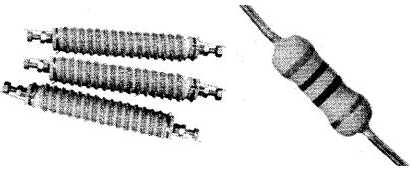
A voltage of 30V is applied across a carbon resistor with first, second and third rings of blue, black and yellow colours respectively. Calculate the value of current in mA, through the resistor.
Answer
Value of first digit (blue ring) = 6
Value of second digit (black ring) = 0
Multiplier (yellow ring) = 104
$\therefore$ Resistance, $\text{R} = 60 \times104\Omega, $ Voltage, V = 30V
Current $\text{I}=\frac{\text{V}}{\text{R}}=\frac{30}{60\times10^4}=0.5\times10^{-4}\text{A}=0.05\text{mA.}$
View full question & answer
Question 883 Marks
Is the motion of a charge across junction momentum conserving? Why or why not?
Answer
In the circuit when an electron approaches a junction, in addition to the uniform E that faces it normally (which keep the drift velocity fixed), as drift velocity $(v_d)$ is directly proportional to Electric field (E). That’s why there are accumulation of charges on the surface of wires at the junction.
These produce additional electric fields. These fields alter the direction of momentum. Thus, the motion of a charge across junction is not momentum conserving.
View full question & answer
Question 893 Marks
What are the advantages of the null-point method in a Wheatstone bridge? What additional measurements would be required to calculate $R_{unknown}$ by any other method?
Answer
The advantage of null point method in a Wheatstone bridge is that the resistance of galvanometer does not affect the balance point and there is no need to determine current in resistances and galvanometer and the internal resistance of ab galvanometer.
$R_{unknown}$ can be calculated applying Kirchhoff’s rules to the circuit.
We would need additional accurate measurement of all the currents in resistances and galvanometer and internal resistance of the galvanometer.
View full question & answer
Question 903 Marks
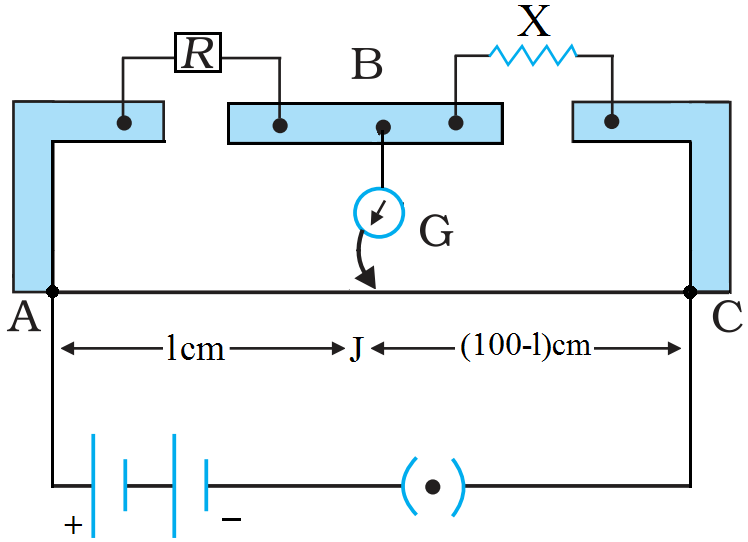
A resistance $\text{R}=4\Omega$ is connected to one of the gaps in a meter bridge, which uses a wire of length 1m. An unknown resistance $\text{x}>4\Omega$ is connected in the other gap as shown in the figure. The balance point is noticed at ‘l’ cm from the positive end of the battery. On interchanging R and X, it is found that the balance point further shifts by 20cm (away from the end A). Neglecting the end correction calculate the value of unknown resistance ‘X’ used.
Answer
From 'meter bridge' formula,
$\frac{\text{R}}{\text{X}}=\frac{\text{l}}{100-\text{l}}$
$\Rightarrow\text{X}=\frac{100-\text{l}}{\text{l}}\text{R}$
Given, $\text{R}=4\Omega$
$\therefore\text{X}=\frac{(100-\text{l})}{\text{l}}\times4\Omega\ \dots\text{(i)}$
On interchanging R and X, the balance point is obtained at a distance (l + 20)cm from end A, so
$\frac{\text{X}}{\text{R}}=\frac{\text{l}+20}{100-(\text{l}+20)}$
$\Rightarrow\text{X}=\frac{\text{l}+20}{80-\text{l}}\times4\Omega\ \dots\text{(ii)}$
Equating (i) and (ii)
$\frac{(100-\text{l})}{\text{l}}\times4=\frac{\text{l}+20}{80-\text{l}}\times4$
Solving we get l = 40cm
$\therefore$ Unknown resistance, $\text{X}=\frac{100-\text{l}}{\text{l}}\times\text{4}\Omega=\frac{100-40}{40}\times4\Omega$
$\Rightarrow\text{X}=6\Omega$
View full question & answer
Question 913 Marks
How many time constants will elapse before the charge on a capacitors falls to 0.1% of its maximum value in a discharging RC circuit?
Answer
$\text{q}=\text{Qe}^{\frac{-\text{t}}{\text{RC}}}$
$\text{q}=0.1\%\text{ Q}$
$\text{RC}\Rightarrow\text{Time constant}$
$=1\times10^{-3}\text{Q}$
So, $1\times10^{-3}\text{Q}=\text{Q}\times\text{e}^{\frac{-\text{t}}{\text{RC}}}$
$\Rightarrow\text{e}^{\frac{-\text{t}}{\text{RC}}}=\text{In}\ 10^{-3}$
$\Rightarrow\frac{\text{t}}{\text{RC}}=-(-6.9)=6.9$
View full question & answer
Question 923 Marks
A plate of area $10cm^2$​​​​​​​ is to be electroplated with copper (density $9000kg/m^3$) to a thickness of 10 micrometres on both sides, using a cell of 12V. Calculate the energy spent by the cell in the process of deposition. If this energy is used to heat 100g of water, calculate the rise in the temperature of the water. ECE of copper $= 3 \times 10^{-7}kg C^{-1}$ and specific heat capacity of water $= 4200Jkg^{-1}.$
Answer
Surface area of the plate, $A=10 \mathrm{~cm}^2=10 \times 10^{-4} \mathrm{~m}^2$
Thickness of copper deposited, $\mathrm{t}=10 \mu \mathrm{~m}=10^{-5} \mathrm{~m}$
Density of copper $=9000 \mathrm{~kg} / \mathrm{m}^3$
Volume of copper deposited, $\mathrm{V}=\mathrm{A}(2 \mathrm{t}) \mathrm{V}=10 \times 10^{-4} \times 2 \times 10 \times 10^{-6}$
$=2 \times 10^2 \times 10^{-10}$
$=2 \times10^{-8} \mathrm{~m}^3$ Mass of copper deposited, $\mathrm{m}=$ Volume $\times$
Density $=2 \times 10^{-8} \times 9000$
$ \Rightarrow \mathrm{~m}=18 \times 10^{-5} \mathrm{~kg}$
Using the formula, $\mathrm{m}=\mathrm{ZQ}$,
We get, $18 \times 10^{-5} \mathrm{~kg}=3 \times 10^{-7} \times \mathrm{Q} $
$\Rightarrow \mathrm{Q}=6 \times 10^2 \mathrm{C}$
Energy spent by the cell $=$ Work done by the cell
$ \Rightarrow W=V Q $
$ =2 \times 6 \times 10^2 $
$=72 \times 10^2=7.2 \mathrm{~kJ}$
Let $\Delta\theta$ be the rise in temperature of water. When this energy is used to heat 100g of water,
We have,
$72 \times 10^3$
$= 100 × 10^{-3 }\times4200\times\Delta\theta$
$\Rightarrow\Delta\theta=17\text{K}$
View full question & answer
Question 933 Marks
A cylindrical metallic wire is stretched to increase its length by 10%. Calculate the percentage increase in its resistance.
Answer
When the same wire is stretched, it's length increases but cross-sectional area decreases. The change in resistance is due to both increase in length and decrease in cross-sectional area.
Valume V = lA = Costans, $\text{A}=\frac{\text{V}}{\text{l}}=$ constant
$\therefore\text{R}=\frac{\rho\text{l}}{\text{A}}=\frac{\rho\text{l}^2}{\text{V}}\propto\text{l}^2$
$\therefore\frac{\text{R}'}{\text{R}}=\Big(\frac{\text{l}'}{\text{l}}\Big)^2$
Given, $\text{l}'=\text{l}+\frac{10}{100}\text{l}=1.1\text{l}$
$\Rightarrow\frac{\text{l}'}{\text{l}}=1.1$
$\frac{\text{R}'}{\text{R}}=(1.1)^2=1.21$
% increase in resistance,
$\frac{\text{R}'-\text{R}}{\text{R}}\times100\%=\Big(\frac{\text{R}'}{\text{R}}-1\Big)\times100\%=(1.21-1\times100\%=21\%$
View full question & answer
Question 943 Marks
The potential difference between the terminals of a battery of emf 6.0V and internal resistance $1\Omega$ drops to 5.8V when connected across an external resistor. Find the resistance of the external resistor.
Answer
$\text{E}=6\text{V},\text{r}=1\Omega,\text{V}=5.8\text{V},\text{R}=?$
$\text{l}=\frac{\text{E}}{\text{R}+\text{r}}=\frac{6}{\text{R}+1},\text{V}=\text{E}-\text{lr}$
$\Rightarrow5.8=6-\frac{6}{\text{R}+1}\times1\Rightarrow\frac{6}{\text{R}+1}=0.2$
$\Rightarrow\text{R}+1=30\Rightarrow\text{R}=29\Omega.$
View full question & answer
Question 953 Marks
The potential difference across a resistor ‘r’ carrying current ‘I’ is Ir.
  1. Now if the potential difference across ‘r’ is measured using a voltmeter of resistance ‘RV’, show that the reading of voltmeter is less than the true value
  2. Find the percentage error in measuring the potential difference by a voltmeter.
  3. At what value of RV, does the voltmeter measures the true potential difference?
Answer
  1. V = lr (without voltmeter $R_V$)
$\text{V}'=\frac{\text{lrR}_\text{V}}{\text{r}+\text{R}_\text{V}}=\frac{\text{Ir}}{1+\frac{\text{r}}{\text{R}_\text{V}}}$

$\text{V}'<\text{V}$
  1. Percentage error,
$\Big(\frac{\text{V}-\text{V}'}{\text{V}}\Big)\times100=\Big(\frac{\text{r}}{\text{r}+\text{R}_\text{V}}\Big)\times100$
  1. $\text{R}_\text{V}\xrightarrow{\ \ \ \ \ \ }\infty,\text{V}'=\text{lr}=\text{V}$
View full question & answer
Question 963 Marks
A uniform wire of resistance $100\Omega$ is melted and recast as a wire of length is double that of the original. What would be the resistance of the wire?
Answer
$\ell'=2\ell$
Volume of the wire remains constant.
$\text{A}\ell=\text{A}'\ell'$
$\Rightarrow\text{A}\ell=\text{A}'\times2\ell$
$\Rightarrow\text{A}'=\frac{\text{A}}{2}$
f = Specific resistance
$\text{R}=\frac{\text{f}\ell}{\text{A}};\text{R}'=\frac{\text{f}\ell'}{\text{A}'}$
$100\Omega=\frac{\text{f}2\ell}{\text{A}/2}=\frac{4\text{f}\ell}{\text{A}}=4\text{R}$
$\Rightarrow4\times100\Omega=400\Omega$
View full question & answer
Question 973 Marks
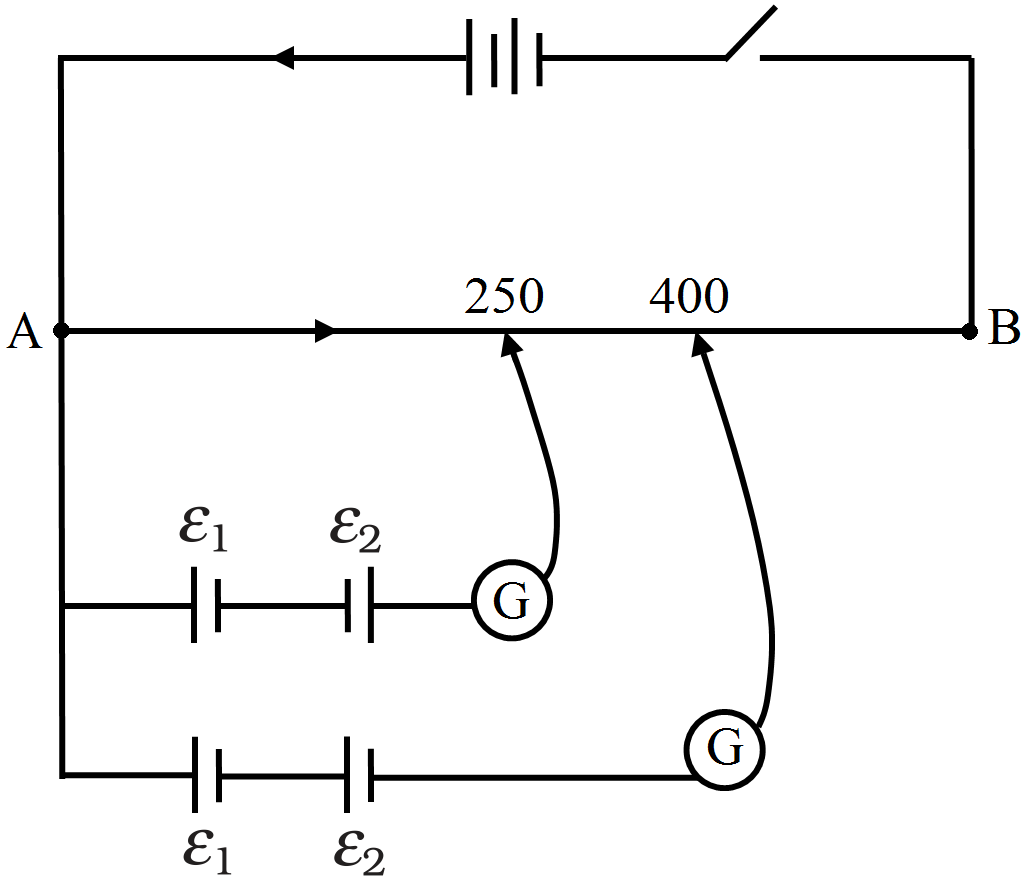
Two primary cells of emfs wire $\varepsilon_1$ and $\varepsilon_2(\varepsilon_1>\varepsilon_2)$ are connected to a potentiometer wire AB as shown in fig. If the balancing lengths for the two combinations of the cells are 250cm and 400cm, find the ratio of $\varepsilon_1$ and $\varepsilon_2.$
Answer
In first combination $\varepsilon_1$ and $\varepsilon_2$ are opposing each other while in second combination $\varepsilon_1$ and $\varepsilon_2$ are adding each other,
So,
$\varepsilon_1-\varepsilon_2=\text{Kl}_1$
$\varepsilon_1+\varepsilon_2=\text{kl}_2$
$\frac{\varepsilon_1-\varepsilon_2}{\varepsilon_1+\varepsilon_2}=\frac{\text{l}_1}{\text{l}_1}$
$\Rightarrow\frac{\varepsilon_1-\varepsilon_2}{\varepsilon_1+\varepsilon_2}=\frac{250}{400}$
$\Rightarrow\frac{\varepsilon_1-\varepsilon_2}{\varepsilon_1+\varepsilon_2}=\frac{5}{8}$
$\Rightarrow8\varepsilon_1-8\varepsilon_2=5\varepsilon_1+5\varepsilon_2$
$\Rightarrow3\varepsilon_1=13\varepsilon_2$
$\therefore\frac{\varepsilon_1}{\varepsilon_2}=\frac{13}{3}$
$\therefore\varepsilon_1:\varepsilon_2=13:32$
View full question & answer
Question 983 Marks
A coil of resistance $100\Omega$ is connected across a battery of emf 6.0V. Assume that the heat developed in the coil is used to raise its temperature. If the heat capacity of the coil is 4.0J/K, how long will it take to raise the temperature of the coil by 15^^\circC?
Answer
$\text{R}=100\Omega,$
$\text{E}=6\text{v}$
Heat capacity of the coil $=4\text{J/k}$
$\Delta\text{T}=15^\circ$
Heat liberate $\Rightarrow\frac{\text{E}^2}{\text{Rt}}=4\text{J/K}\times15$
$\Rightarrow\frac{6\times6}{100}\times\text{t}=60$
$\Rightarrow\text{t}=166.67\text{sec}=2.8\text{min}$
View full question & answer
Question 993 Marks
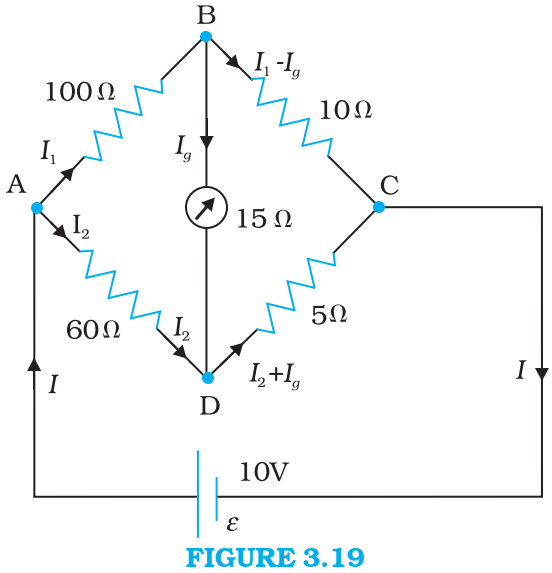
The four arms of a Wheatstone bridge $($Fig. $3.19)$ have the following resistances:
$AB =100 \Omega, BC =10 \Omega, CD =5 \Omega \text {, and } DA =60 \Omega \text {. }$
Image
A galvanometer of $15 \Omega$ resistance is connected across $BD$.
Calculate the current through the galvanometer when a potential difference of $10 V$ is maintained across $AC$.
Answer
Considering the mesh $\text{BADB},$ we have
$100 I_1+15 I_g-60 I_2=0$
$\text { or } 20 I_1+3 I_g-12 I_2=0\quad\quad\quad \text{[3.65(a)]}$
Considering the mesh $\text{BCDB}$, we have
$10\left(I_1-I_g\right)-15 I_g-5\left(I_2+I_g\right)=0$
$10 I_1-30 I_g-5 I_2=0$
$2 I_1-6 I_g-I_2=0 \quad\quad\quad\text{[3.65(b)]}$
Considering the mesh $\text{ADCEA},$
$60 I_2+5\left(I_2+I_g\right)=10$
$65 I_2+5 I_g=10$
$13 I_2+I_g=2 \quad\quad\quad\text{[3.65(c)]}$
Multiplying Eq. $(3.65b)$ 
by $10 \ \ 20 I_1-60 I_g-10 I_2=0 \quad\quad\quad\text{[3.65(d)]}$
From Eqs. $(3.65d)$ and $(3.65a)$ we have
$63 I_g-2 I_2=0$
$I_2=31.5 I_g \quad\quad\quad\text{[3.65(e)]}$
Substituting the value of $I_2$ into Eq. $[3.65(c)]$, we get
$13\left(31.5 I_g\right)+I_g=2$
$410.5 I_g=2$
$I_g=4.87 mA .$
View full question & answer
Question 1003 Marks
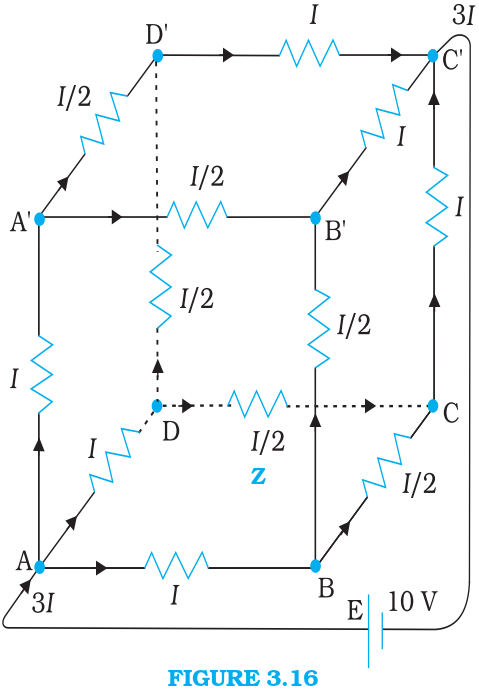
A battery of $10 V$ and negligible internal resistance is connected across the diagonally opposite corners of a cubical network consisting of 12 resistors each of resistance $1 \Omega$ (Fig. 3.16). Determine the equivalent resistance of the network and the current along each edge of the cube.
Image
Answer
The network is not reducible to a simple series and parallel combinations of resistors. There is, however, a clear symmetry in the problem which we can exploit to obtain the equivalent resistance of the network.
The paths $AA ^{\prime}, AD$ and $AB$ are obviously symmetrically placed in the network. Thus, the current in each must be the same, say, $I$. Further, at the corners $A ^{\prime}, B$ and $D$, the incoming current $I$ must split equally into the two outgoing branches. In this manner, the current in all the 12 edges of the cube are easily written down in terms of $I$, using Kirchhoff's first rule and the symmetry in the problem.
Next take a closed loop, say, ABCC'EA, and apply Kirchhoff's second rule:
$
-I R-(1 / 2) I R-I R+\varepsilon=0
$
where $R$ is the resistance of each edge and $\varepsilon$ the emf of battery. Thus,
$
\varepsilon=\frac{5}{2} I R
$

The equivalent resistance $R_{e q}$ of the network is
$
R_{e q}=\frac{\varepsilon}{3 I}=\frac{5}{6} R
$

For $R=1 \Omega, R_{e q}=(5 / 6) \Omega$ and for $\varepsilon=10 V$, the total current ( $=3 I$ ) in the network is
$
3 I=10 V /(5 / 6) \Omega=12 \text { A, i.e., } I=4 A
$
The current flowing in each edge can now be read off from the Fig. 3.16.
View full question & answer
3 Marks Question - Page 2 - Physics STD 12 Science Questions - Vidyadip