Questions · Page 4 of 7

M.C.Q (1 Marks)

MCQ 1511 Mark
When we wear nylon dresses during winter then there is $........$ current which gets produced due to contact with out body. Fill in the Blank.
  • A
    Magnetic
  • Electrostatic
  • C
    Potential
  • D
    kinetic
Answer
Correct option: B.
Electrostatic

When we wear nylon dresses during winter then there is electrostatic current which gets produced due to contact with out body.
View full question & answer
MCQ 1521 Mark
Unlike charges $........$ each other.
  • Attacks.
  • B
    Repels.
  • C
    Both a and b.
  • D
    None.
Answer
Correct option: A.
Attacks.
View full question & answer
MCQ 1531 Mark
An electron and a proton are both released from rest $1$ meter from a large stationary negative charge, considering only the force from the large stationary negative charge on the proton and electron. Which of the following is true?
  • A
    The magnitude of force is greater on the electron.
  • B
    The magnitude of force is greater on the proton.
  • The magnitude of force is the same on both the electron and proton.
  • D
    The direction of the force, but not the magnitude, is the same on both the electron.
Answer
Correct option: C.
The magnitude of force is the same on both the electron and proton.

The electron has negative charge ,$−e$ and proton has positive charge ,$+e.$
Thus, the force on electron due to the large stationary charge will be repulsive and force on proton due to the large stationary charge will be attractive.
Since both electron and proton released from same distance and they have equal magnitude of charge so the magnitude of force on both the electron and proton will be same.

View full question & answer
MCQ 1541 Mark
A region surrounding a stationary electric dipoles has:
  • A
    Magnetic field only.
  • Electric field only.
  • C
    Both electric and magnetic fields.
  • D
    No electric and magnetic fields.
Answer
Correct option: B.
Electric field only.
View full question & answer
MCQ 1551 Mark
Sometimes you get a mild spark when you touch the metal surface of a car. What might be the reason?
  • A
    Due to magnetic attraction, a spark is created.
  • Due to electrostatic charge residing on the metal as well as on skin, mild spark is observed.
  • C
    Car tries to become neutral by donating electrons.
  • D
    Its the only path to ground.
Answer
Correct option: B.
Due to electrostatic charge residing on the metal as well as on skin, mild spark is observed.
Negative electric charge often resides on the surface of metal of car. When you touch the car, electrostatic discharge occurs via your body and you get a mild spark.
View full question & answer
MCQ 1561 Mark
The filament of an electric bulb is made of:
  • A
    Carbon
  • B
    Aluminium
  • Tungsten
  • D
    Nickel
Answer
Correct option: C.
Tungsten

The electric bulbs convert electrical energy to heat and light energy and thus the filaments of the bulbs are expected to withstand high temperatures.
While at the same time ensure that their structure does not get affected via heating effects from the current passing through.
As a metal, Tungsten is a good electrical conductor. It is also a good thermal conductor. In pure form, tungsten has the highest known melting point among all metals and lowest vapour pressure and greatest tensile strength out of all the metals.
This means that tungsten is able to maintain its form irrespective of the large heating effects from electrical current. Because of this, It can reach a high temperature before melting.

View full question & answer
MCQ 1571 Mark
Number of electrons in $1$ Coulomb charge is _________?
  • $6.25 \times 10^{21}$
  • B
    $6.25 \times 10^{20}$
  • C
    $6.25 \times 10^{25}$
  • D
    $6.25 \times 10^{23}$
Answer
Correct option: A.
$6.25 \times 10^{21}$
a. $6.25 \times 10^{21}$
Explanation:
Electron has the charge of $1.602 \times 10^{-19}$ Coulomb. So, the number of electrons in $1$ Coulomb of charge is
$\frac{1}{1.602 \times 10^{-19}}=6.25 \times 10^{21}$
This huge number of electrons can be accumulated to form 1C of charge.
Thus, we can conclude that we need Avogadro's number of electrons (approximately) to get $100C$ charges.
View full question & answer
MCQ 1581 Mark
An electroscope is used:
  • A
    To detect presence of charge on a body.
  • B
    To determine the nature of charge on a body.
  • C
    To measure the exact amount of charge on a body.
  • For both $A$ and $B.$
Answer
Correct option: D.
For both $A$ and $B.$

Electroscope is a device which is use to detect whether a body is carrying charge and also to detect the nature of charge on the body.

View full question & answer
MCQ 1591 Mark
Quantisation of charge was experimentally demonstrated by:
  • A
    Einstein’s photoelectric effect.
  • B
    Frank-Hertz experiment.
  • C
    Davisson and Germer experiment.
  • Millikan’s oil drop experiment.
Answer
Correct option: D.
Millikan’s oil drop experiment.
View full question & answer
MCQ 1601 Mark
The dimensions of electric flux are:
  • A
    $[M L-3 T-3 A-1].$
  • B
    $[M L-3 T-3 A-1].$
  • $[M L3 T-3 A-1].$
  • D
    None.
Answer
Correct option: C.
$[M L3 T-3 A-1].$
View full question & answer
MCQ 1611 Mark
The force of attraction or repulsion between two charges is given by $........$
  • A
    Gauss's law
  • B
    Kepler's law
  • Coulomb's law
  • D
    Gravitational law
Answer
Correct option: C.
Coulomb's law

Coulomb's law: The force exerted by one point charge is proportional to the product of the charge and varies inversely as the sure of the distance separating the charges.

View full question & answer
MCQ 1621 Mark
A charge is being induced to a sphere with the help of another charged sphere. The extent of induction increase if $........$?
  • A
    The distance between the sphere increases.
  • B
    The distance between the sphere decreases.
  • C
    The two spheres are kept in contact with each other.
  • Remains same irrespective of the distance between the spheres.
Answer
Correct option: D.
Remains same irrespective of the distance between the spheres.
The extent of induction increases if both the spheres are kept close to each other because the more electrons in the uncharged sphere are attracted or repelled by the charged sphere, so the extent of induction increases.
View full question & answer
MCQ 1631 Mark
Two point charges of the same polarities are hung with the help of two threads and kept close. The angle between the threads will be $........$ if the system is taken to space.
  • $180$ degree
  • B
    $90$ degree
  • C
    $45$ degree
  • D
    $60$ degree
Answer
Correct option: A.
$180$ degree

There is gravitational field on earth, so if we hang the two same charges there will be an interaction of vertical gravitational field and horizontal electric field. The system will achieve equilibrium by creating a certain angle between the threads and hence the vertical and horizontal components of forces will balance. But in space, there is no gravity. So the charges will be at $180-$degree separation.

View full question & answer
MCQ 1641 Mark
What happens when some charge is placed on a soap bubble?
  • A
    Its radius decreases
  • Its radius increases
  • C
    The bubble collapses
  • D
    None of these
Answer
Correct option: B.
Its radius increases

The radius of soap bublle increases because of outward force acting on the bubble due to charging.

View full question & answer
MCQ 1651 Mark
What do you understand by the static or frictional electricity?
  • A
    Discarging of two bodies on rubbing them together is called static or frictional electricity.
  • Charging of two bodies on rubbing them together is called static or frictional electricity.
  • C
    Electricity which is static is called static or frictional electricity.
  • D
    Electricity on high friction bodies is called static or frictional electricity.
Answer
Correct option: B.
Charging of two bodies on rubbing them together is called static or frictional electricity.

Static electricity is produced when a suitable combination of substances $($e.g., glass rod and silk, ebonite rod and cat's skin, sealing wax and wool$)$ are rubbed together and get electrified due to friction.

View full question & answer
MCQ 1661 Mark
Which among the following is false?
  • A
    Coulomb force is a central force.
  • B
    The force between two charges depend on the medium between them.
  • Coulomb force is a weak force.
  • D
    The net force on a charge is the vector sum of the forces acting on it due to several other charges.
Answer
Correct option: C.
Coulomb force is a weak force.

Coulomb force is a strong force. It can be shown that the Coulomb force between two electrons is $10^{43}$ times than gravitational force. All the other options are basic properties of Coulomb’s Law.

View full question & answer
MCQ 1671 Mark
If there were only one type of charge in the universe, then
  • A
    $\oint_\text{s}\text{E.dS}\neq0$ on any surface.
  • B
    $\oint_\text{s}\text{E.dS}=0$ if the charge is outside the surface.
  • C
    $\oint_\text{s}\text{E.dS}=\frac{\text{q}}{\in_0}$ if charges of magnitude q were inside the surface.
  • B and C both
Answer
Correct option: D.
B and C both
According to the Gauss' law
$\int_\text{s}\text{E.dS}=\frac{\text{q}}{\in_0}$
Where q is the charge enclosed by the surface. If the charge is outside the surface, then charge.
If the charge is outside the surface, then charge enclosed by the surface is q = 0, therefore,
$\int_\text{s}\text{E.dS}=0$
Electric flux doesn't depend on the nature or type of charge.
View full question & answer
MCQ 1681 Mark
A body is positively charged, it implies that:
  • A
    There is only positive charge in the body.
  • There is positive as well as negative charge in the body, but the positive charge is more than negative charge.
  • C
    There is equal positive and negative charge in the body, but the positive charge lies in the outer regions.
  • D
    Negative charge is displaced from its position.
Answer
Correct option: B.
There is positive as well as negative charge in the body, but the positive charge is more than negative charge.
View full question & answer
MCQ 1691 Mark
The device, which can be used to detect whether an object is charged, is:
  • A
    Telescope
  • B
    Microscope
  • Electroscope
  • D
    None of the above
Answer
Correct option: C.
Electroscope
Electroscope is a device that is used for detection and identification of charge on objects.
View full question & answer
MCQ 1701 Mark
The force that a unit positive charge would experiences if placed at that point is called as $........$ due to charge at a point in space.
  • A
    Electric charge.
  • Electric field.
  • C
    Both a and b.
  • D
    None.
Answer
Correct option: B.
Electric field.
View full question & answer
MCQ 1711 Mark
Current carrier in conductors is $........$?
  • Electron
  • B
    Proton
  • C
    Neutron
  • D
    Positron
Answer
Correct option: A.
Electron

Conductors have lots of free electrons that can carry electricity if the potential difference is applied across them. Protons are positively charged particle and Neutron are electrically neutral. They don’t carry electricity in conductors.

View full question & answer
MCQ 1721 Mark
The safety fuse should have:
  • A
    high resistance and high melting point.
  • high resistance and low melting point.
  • C
    low resistance and high melting point.
  • D
    low resistance and low melting point.
Answer
Correct option: B.
high resistance and low melting point.
The safety fuse should have high resistance and low melting point.
View full question & answer
MCQ 1731 Mark
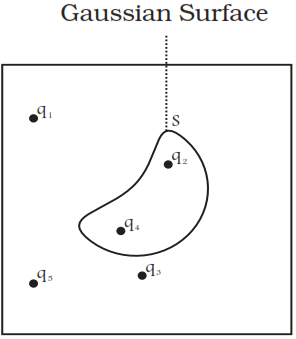
Five charges $q_1, q_2, q_3, q_4$, and $q_5$ are fixed at their positions as shown in. $S$ is a Gaussian surface. The Gauss’s law is given by$\oint\limits_\text{S}\text{E.ds}=\frac{\text{q}}{\in_0}$
Which of the following statements is correct?
  • A
    E on the $L H S$ of the above equation will have a contribution from $q _1, q _5$ and $q _3$ while q on the $R H S$ will have a contribution from $q _2$ and $q _4$ only.
  • E on the LHS of the above equation will have a contribution from all charges while $q$ on the $RHS$ will have a contribution from $q _2$ and $q _4$ only.
  • C
    E on the $LHS$ of the above equation will have a contribution from all charges while $q$ on the $RHS$ will have a contribution from $q _1, q _3$ and $q _5$ only.
  • D
    Both $E$ on the $LHS$ and q on the $RHS$ will have contributions from $q _2$ and $q _4$ only.
Answer
Correct option: B.
E on the LHS of the above equation will have a contribution from all charges while $q$ on the $RHS$ will have a contribution from $q _2$ and $q _4$ only.
b. E on the $LHS$ of the above equation will have a contribution from all charges while $q$ on the RHS will have a contribution from $q _2$ and $q _4$ only.
Key concept: According to Gauss' law, the term qenclosed on the right side of the equation $\oint E . ds =$ qenclosed/II $\mu 0$ includes the sum of all charges enclosed by the surface called (Gaussian surface).
In left side equation, the electric field is due to all the charges present both inside as well as outside the Gaussian surface.
Hence in given question, $E$ on $LHS$ of the above equation will have a contribution from all charges while $q$ on the RHS will have a contribution from $q _2$ and $q _4$ only. Hence option (b) is correct.
View full question & answer
MCQ 1741 Mark
Mark the correct options:
  • A
    Gauss's law is valid only for symmetrical charge distributions.
  • B
    Gauss's law is valid only for charges placed in vacuum.
  • C
    The electric field calculated by Gauss's law is the field due to the charges inside the Gaussian surface.
  • The flux of the electric field through a closed surface due to all the charges is equal to the flux due to the charges enclosed by the surface.
Answer
Correct option: D.
The flux of the electric field through a closed surface due to all the charges is equal to the flux due to the charges enclosed by the surface.

The flux of the electric field through a closed surface due to all the charges is equal to the flux due to the charges enclosed by the surface.

View full question & answer
MCQ 1751 Mark
Opening up of strips of an electroscope is an indication of:
  • A
    Proximity of a conductor.
  • Proximity of a charged body.
  • C
    Proximity of an uncharged body.
  • D
    Earth connection.
Answer
Correct option: B.
Proximity of a charged body.
When a charged body comes close to an electroscope, charges are induced to the electroscope. These charges flow down to the metal strips which open up due to repulsion for having similar charges.
View full question & answer
MCQ 1761 Mark
A point charge is kept at the centre of metallic insulated spherical shell. Then:
  • A
    Electric field out side the sphere is zero.
  • B
    Electric field inside the sphere is zero.
  • Net induced charge on the sphere is zero.
  • D
    Electric potential inside the sphere is zero.
Answer
Correct option: C.
Net induced charge on the sphere is zero.
View full question & answer
MCQ 1771 Mark
The property which differentiate the two kinds of charges is called as:
  • A
    Magnitude of charge.
  • B
    Direction of charge.
  • Polarity of charge.
  • D
    None.
Answer
Correct option: C.
Polarity of charge.
View full question & answer
MCQ 1781 Mark
The property which differentiates two kinds of charges is called $........$?
  • A
    Equality of charge
  • Polarity of charge
  • C
    Fraction of charge
  • D
    None of the option
Answer
Correct option: B.
Polarity of charge

The property which differentiates two kinds of charges is called polarity of charge.

View full question & answer
MCQ 1791 Mark
The electrostatic force between two point charges $q _1$ and $q _2$ at separation ' r ' is given by $F =\frac{ K _{ q q^2}}{ r ^2}$. The constant $K$ :
  • A
    Depends on the system of units only.
  • B
    Depends on the medium between the charges only.
  • Depends on both the system of units and the medium between the charges.
  • D
    Is independent of both the system of units and the medium between the charges.
Answer
Correct option: C.
Depends on both the system of units and the medium between the charges.
c. Depends on both the system of units and the medium between the charges.
Explanation:
$K =\frac{1}{4 \pi \epsilon_{ o } k }$ and its units is $N - m ^2 / C ^2$
It depend on system of unit and dielectric constant (k), that's medium between charges
View full question & answer
MCQ 1801 Mark
If a positively charged sphere is taken close to another uncharged sphere then which of the following statements is true?
  • A
    Induction and attraction occur simultaneously.
  • Induction occurs before the attraction.
  • C
    Attraction occurs before induction.
  • D
    Attraction or repulsion may occur.
Answer
Correct option: B.
Induction occurs before the attraction.

If two bodies are taken close to each other, a positively charged body induces a negative charge on another body and then they attract each other. So, induction occurs before attraction. This phenomenon is also true for magnetic induction. 

View full question & answer
MCQ 1811 Mark
Insulation breakdown may occur at $........$?
  • High temperature
  • B
    Low temperature
  • C
    At any temperature
  • D
    Depends on pressure
Answer
Correct option: A.
High temperature

At high temperatures, electrons of insulators get excited and then the electrons can overcome the large energy band gaps between valence and conduction bands. So a large number of electrons travel to the conduction band and they act as conductor i.e. insulation breakdown occurs.

View full question & answer
MCQ 1821 Mark
Water molecule is the example of:
  • Polar molecule.
  • B
    Non polar molecule.
  • C
    Both $a$ and $b.$
  • D
    None.
Answer
Correct option: A.
Polar molecule.
View full question & answer
MCQ 1831 Mark
The charge is negative, then the electric lines of forces are:
  • Straight lines converging towards the charge.
  • B
    Concentric circle with charge at the centre.
  • C
    Straight lines radiating away from the charge.
  • D
    Non of these.
Answer
Correct option: A.
Straight lines converging towards the charge.

Lines of force originate from a positive charge and terminate to a negative charge. Hence, when the charge is negative, then the electric lines of force are straight lines converging towards the charge.

View full question & answer
MCQ 1841 Mark
Force between two charges at rest is $........$?
  • electrostatic force.
  • B
    elector magnetic force.
  • C
    real force.
  • D
    dynamic force.
Answer
Correct option: A.
electrostatic force.

Force between two charges at rest is electrostatic force of coulomb's law.

View full question & answer
MCQ 1851 Mark
Electrostatic field lines $........$
  • A
    Forms any closed loops.
  • Do not form any closed loops.
  • C
    Both $a$ and $b.$
  • D
    None.
Answer
Correct option: B.
Do not form any closed loops.
View full question & answer
MCQ 1861 Mark
Let there be a spherically symmetric charge distribution with charge density varying as $\text{p}(\text{r})=\text{p}_0\bigg(\frac{5}{4}-\frac{\text{r}}{\text{R}}\bigg)$ upto $r = R$ and $p(r) = 0$ for $r > R$ where $r$ is the distance from the origin the electric field at a distance $r(r < R)$ from the origin is given by.
  • $\text{p}{_0}^\text{r}\Big(\frac{5}{3}-\frac{\text{r}}{\text{R}}\Big)$
  • B
    $\frac{4\pi\text{p}{_0}^\text{r}}{3\in_0}\Big(\frac{5}{3}-\frac{\text{r}}{\text{R}}\Big)$
  • C
    $\frac{4\text{p}{_0}^\text{r}}{4\in_0}\Big(\frac{5}{4}-\frac{\text{r}}{\text{R}}\Big)$
  • D
    $\frac{\text{p}{_0}^\text{r}}{3\in_0}\Big(\frac{5}{4}-\frac{\text{r}}{\text{R}}\Big)$
Answer
Correct option: A.
$\text{p}{_0}^\text{r}\Big(\frac{5}{3}-\frac{\text{r}}{\text{R}}\Big)$
View full question & answer
MCQ 1871 Mark
The electric field inside a spherical shell of uniform surface charge density is:
  • Zero.
  • B
    Constant different from zero.
  • C
    Proportional to the distance from the curve.
  • D
    None of the above.
Answer
Correct option: A.
Zero.
View full question & answer
MCQ 1881 Mark
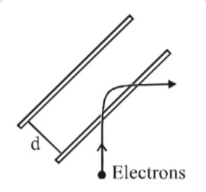
A problem of practical interest is to make a beam of electrons turn at $90^{\circ}$ corner. This can be done with the parallel plates shown in figure. An electron with kinetic energy $8.0 \times 10^{-17} J$ enters through a small hole in the bottom plate. The strength of electric field that is needed if the electron is to emerge from an exit hole 1.0 cm away from the entrance hole, traveling at right angles to its original direction is........... $\times 10^5 N / C$.
  • $3$
  • B
    $1$
  • C
    $6$
  • D
    $2.5$
Answer
Correct option: A.
$3$
a.$3$
View full question & answer
MCQ 1891 Mark
hoose the correct statement from the following:
  • A
    Electric lines of force never cross each other.
  • B
    Electric lines of force end at a positive.
  • C
    The electric field charge inside a conductor are infinity.
  • Lines of electric field point towards regions of lower potential.
Answer
Correct option: D.
Lines of electric field point towards regions of lower potential.

If the lines cross each other at a given location, then there must be two distinctly different values of electric field with their own individual direction at that given location. This could never be the case. Therefore the lines representing the field cannot cross each other at any given location.
Electric field end at a negative charge.
Along the electric field line potential drops.

View full question & answer
MCQ 1901 Mark
In winter season, a mild spark is often seen when a man touches somebody else's skin. Why?
  • Due to lack of humidity and rubbing with clothes, charge accumulate on human body which is discharged via sparking.
  • B
    Due to cold, electrostatic charge on body finds a lower resistance path to the skin of other's body.
  • C
    The static charge on sweaters worn by the two persons is different, hence discharge through sparking occurs.
  • D
    Similar to the lightning, extremely high potential exists on both the bodies and hence they discharge through sparking.
Answer
Correct option: A.
Due to lack of humidity and rubbing with clothes, charge accumulate on human body which is discharged via sparking.

Due to friction between clothes and skin, electrostatic charge is built up on skin. Hence, electrical discharge may occur when a man touches somebody else. This phenomenon is more significant in winters because due to low humidity, charge has a tendency to stay longer on the body.

View full question & answer
MCQ 1911 Mark
If the potential at each point on a conductor is same to each other, then:
  • A
    Electric lines of force may begin or end on the same conductor.
  • No electric lines of force may begin or end on the same conductor.
  • C
    The electric field inside the conductor may be non-zero.
  • D
    None of the above.
Answer
Correct option: B.
No electric lines of force may begin or end on the same conductor.

Electric field lines explain the orientation of the electric field in the region and it points tangential to the point at which it is drawn. Thus at any point, the tangent to the electric field line matches the direction of the electric field.
The density of the field lines at a point determines the strength of the electric field at that point.
Therefore, if the potential at each point of the conductor is the same, then it means that there are no electric lines that may begin or end on the conductor.

View full question & answer
MCQ 1921 Mark
Mark out the correct options.
  • The total charge of the universe is constant.
  • B
    The total positive charge of the universe is constant.
  • C
    The total negative charge of the universe is constant.
  • D
    The total number of charged particles in the universe is constant.
Answer
Correct option: A.
The total charge of the universe is constant.

The total charge $($Positive $+$ negative$)$ oif the universe is constant.

View full question & answer
MCQ 1931 Mark
Two nucleons are at a separation of $1 \ fm$ . The net force between them is $F_1$ if both are neutrons, $F_2$ if both are protons, and $F_3$ if one is a proton and the other is a neutron then:
  • A
    $F_1 > F_2 > F_3$
  • $F_3=F_1 > F_2$
  • C
    $F_1=F_3 > F_2$
  • D
    $F_1=F_2 > F_3$
Answer
Correct option: B.
$F_3=F_1 > F_2$
b. $F_3=F_1 > F_2$
Explanation:
Two nucleons are at separation $=1 fm$. The net force between them $=F_1$ are neutrons $F_2$ is both are protons and $F_3$ if one is a proton and the other is a neutron then, nuclear forces are the strong forces of attraction which hold together the nucleons (neutrons and protons) in the tiny nucleus of an atom, in spite of strong electrostatic forces of repulsion between protons.
Nuclear forces act between a pair of neutrons, a pair of protons and also between a neutron, proton pair with the same strength.
This shows that nuclear forces are independent of charges. The attraction nuclear force is the same force any pair of nucleons.
Thus, $F_1=F_3$
When there are no electrostatic forces, but $F_2=$ Nuclear force - repulsive electrostatic force.
View full question & answer
MCQ 1941 Mark
On charging by conduction, mass of a body may:
  • A
    Increase.
  • B
    Decreases.
  • Increase or decrease.
  • D
    None of these.
Answer
Correct option: C.
Increase or decrease.
View full question & answer
MCQ 1961 Mark
Coulomb’s law is true for:
  • A
    Atomic distances $\left(=10^{-11} m\right)$
  • B
    Nuclear distances $\left(=10^{-15} m\right)$
  • C
    Charged as well as uncharged particles.
  • All the distances.
Answer
Correct option: D.
All the distances.
View full question & answer
MCQ 1971 Mark
Like coulomb force, $........$ also satisfies superposition principle.
  • A
    Electric charge.
  • Electric field.
  • C
    Both $a$ and $b.$
  • D
    None.
Answer
Correct option: B.
Electric field.
View full question & answer
MCQ 1981 Mark
Charge is:
  • A
    Transferable.
  • B
    Associated with mass.
  • C
    Conserved.
  • All of these.
Answer
Correct option: D.
All of these.
View full question & answer
MCQ 1991 Mark
Force on any charge due to a number of other charges is the $........$ of all the forces on that charge taken one at a time.
  • A
    Vector difference.
  • Vector sum.
  • C
    Both $a$ and $b.$
  • D
    None.
Answer
Correct option: B.
Vector sum.
View full question & answer
MCQ 2001 Mark
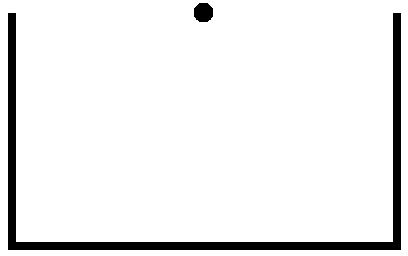
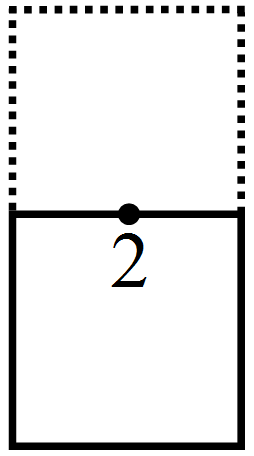
A charge q is placed at the centre of the open end of a cylindrical vessel $($figure$)$. The flux of the electric field through the surface of the vessel is:
  • A
    $\text{Zero}$
  • B
    $\frac{\text{q}}{\in_0}$
  • $\frac{\text{q}}{2\in_0}$
  • D
    $\frac{2\text{q}}{\in_0}$
Answer
Correct option: C.
$\frac{\text{q}}{2\in_0}$


In the charge $'q'$ in side closed cylinder, due to charge the flux of the electric field through the surface of the vessel is $\frac{\text{q}}{\in_0}.$ Here A charge q is placed at the centre of the open end of a cylindrical, By symmetricily Half line of flux goes outside & half flux line goes inside. So we can say that the flux of the electric field through the surface of the vessel is $\frac{\text{q}}{2\in_0}.$

View full question & answer
M.C.Q (1 Marks) - Page 4 - Physics STD 12 Science Questions - Vidyadip