MCQ 11 Mark
A point charge is situated at an axial point of a small electric dipole at a large distance from it. The charge experiences a force F. If the distance of the charge is doubled, the force acting on the charge will become:
- A
$2\text{F}$
- B
$\frac{\text{F}}{2}$
- C
$\frac{\text{F}}{4}$
- ✓
$\frac{\text{F}}{8}$
AnswerCorrect option: D. $\frac{\text{F}}{8}$
The electric field due to dipole at distance $r$ is $\text{E}\propto\frac{1}{\text{r}^3}.$
Thus force on charge is $\text{F}=\text{qE}$
$\Rightarrow\text{F}\propto\frac{1}{(2\text{r})^3}=\frac{\text{F}}{8}.$
View full question & answer→MCQ 21 Mark
An electric dipole consisting of charges $+q$ and $-q$ separated by a distance $L$ is in stable equilibrium in a uniform electric field $\vec{\text{E}}.$ The electrostatic potential energy of the dipole is:
AnswerCorrect option: C. $–qLE$
The electrostatic potential energy of the dipole is $-qLE.$
Given:
An electric dipole consisting of charges $+q$ and $-q.$
Separation between these two charges is $L.$
We need to find the electrostatic potential energy of the dipole.
We know electrostatic potential energy of the dipole is given by:
$P = -pE .....(1)$
Here, p is electric dipole defined by product of charge and distance between them.
$p = qL.$
Putting value of $p$ in equation $1,$
We get, $P = -qLE.$
View full question & answer→MCQ 31 Mark
$...X...$ is a machine that can build up high voltages of the order of a few million volts. Here, A refers to:
- A
- ✓
- C
$DC$ generator.
- D
$AC$ generator.
View full question & answer→MCQ 41 Mark
An electric dipole is kept in non-uniform elecric field. it experiences?
- ✓
- B
A force but not a torque.
- C
A torque but not a force.
- D
Neither a force nor a torque.
View full question & answer→MCQ 51 Mark
What is the net electrostatic field in the interior of a conductor?
- A
- B
- ✓
- D
Depends on the nature of the conductor
AnswerNet electrostatic field is zero in the interior of a conductor. When a conductor is placed in an electric field, its free electrons begin to move in the opposite direction. Negative charges are induced on the left end and positive charges on the right end of the conductor. The process continues until the electric field set up by induced charges becomes equal and opposite the external field.
View full question & answer→MCQ 61 Mark
Identify the simplest and the most widely used capacitor among the following.
- A
- B
- ✓
Parallel plate capacitor.
- D
AnswerCorrect option: C. Parallel plate capacitor.
The simplest and the most widely used capacitor is the parallel plate capacitor. It consists of two large plane parallel conducting plates, separated by a small distance.
View full question & answer→MCQ 71 Mark
Earth’s potential is $......$?
- ✓
- B
- C
- D
Varies from place to place.
AnswerWe consider earth as the storage of infinite positive as well as a negative charge. Therefore, the potential of the earth is always considered to be zero and the potential of every body is measured with respect to earth. That’s why if we connect any charged body to the earth, its potential instantaneously becomes zero.
View full question & answer→MCQ 81 Mark
The molecules in which centres of positive and negative charges are separated are called as:
MCQ 91 Mark
In a parallel plate capacitor, the capacity increases if:
- A
Area of the plate is decreased.
- B
Distance between the plates is increases.
- ✓
Area of the plate is increased.
- D
Dielectric constant decreases.
AnswerCorrect option: C. Area of the plate is increased.
Hint:- Check the dependence of capacitance on certain quantities.
In a parallel plate capacitor, the capacitance is $\text{C}=\frac{\text{k}\in_0\text{A}}{\text{d}};$
Where, $k$ is the dielectric constant, $\in_0$ is the permittivity constant, A is the area of the conduction and $d$ is the distance between plates.
From here we can see $C$ is directly proportional to k, $\in_0$,A and inversely proportional to d.
View full question & answer→MCQ 101 Mark
Identify the factor on which the capacitance of a parallel plate capacitor does not depend.
- ✓
Permeability of the medium between the plates.
- B
- C
Distance between the plates.
- D
The permittivity of the medium between the plates.
AnswerCorrect option: A. Permeability of the medium between the plates.
The capacitance of a parallel plate capacitor is directly proportional to the area of the plates and permittivity of the medium between the plates. It is indirectly proportional to the distance between the plates.
View full question & answer→MCQ 111 Mark
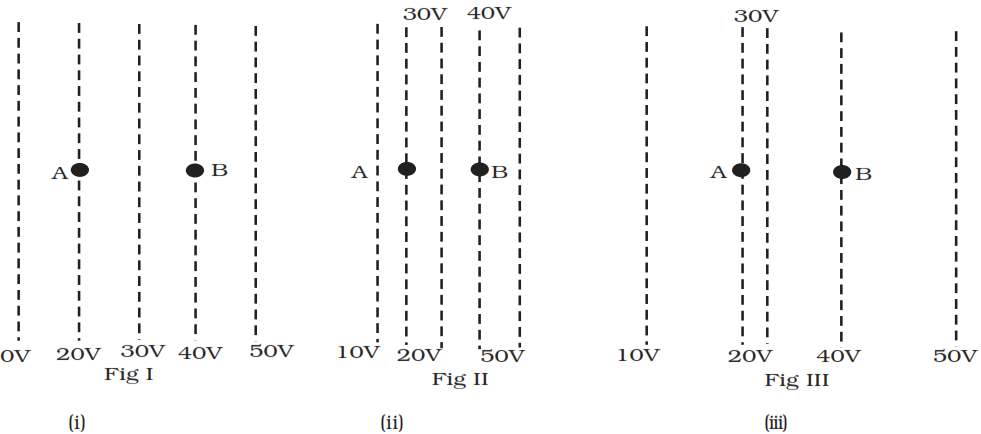
Figure shows some equipotential lines distributed in space. A charged object is moved from point $A$ to point $B.$
- A
The work done in Fig. $(i)$ is the greatest.
- B
The work done in Fig. $(ii)$ is least.
- ✓
The work done is the same in Fig. $(i)$ Fig. $(ii)$ and Fig. $(iii).$
- D
The work done in Fig. $(iii)$ is greater than Fig. $(ii)$ but equal to that in Fig. $(i).$
AnswerCorrect option: C. The work done is the same in Fig. $(i)$ Fig. $(ii)$ and Fig. $(iii).$
Key concept: For a given charge distribution, locus of all points or regions for which the electric potential has a constant value are called equipotential regions. Such equipotential can be surfaces, volumes or lines. Regarding equipotential surface the following points should be kept in mind:
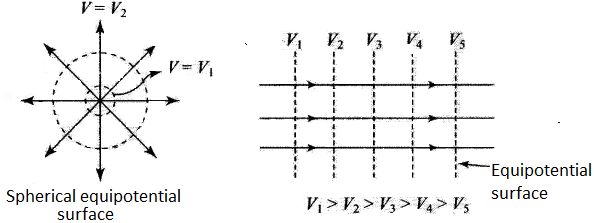
- The density of the equipotential lines gives an idea about the magnitude of electric field. Higher the density, larger the field strength.
- The direction of electric field is perpendicular to the equipotential surfaces or lines.
- The equipotential surfaces produced by a point charge or a spherically charge distribution are a family of concentric spheres.
- For a uniform electric field, the equipotential surfaces are a family of plane perpendicular to the field lines.
- A metallic surface ofany shape is an equipotential surface.
- Equipotential surfaces can never cross each other.
- The work done in moving a charge along an equipotential surface is always zero.
As the direction of electric field is always perpendicular to one equipotential surface maintained at high electrostatic potential than other equipotential surface maintained at low electrostatic potential. Hence direction of electric field is from $B$ to $A$ in all three cases.
The positively charged particle experiences electrostatic force along the direction of electric field, hence moves in the direction opposite to electric field. Thus, the work done by the electric field on the charge will be negative. We know
$\text{W}_\text{electrical}=-\Delta\text{U}=-\text{q}\Delta\text{V}=\text{q}(\text{V}_\text{Intial}-\text{V}_\text{final})$
Here initial and final potentials are same in all three cases and same charge is moved, so work done is same in all three cases. View full question & answer→MCQ 121 Mark
$1$ Volt $= .......$ style$-$type: lower$-$ alpha;$”>$
- A
$1$ Coulomb
- B
$1$ Newton/ $1$ Coulomb
- ✓
$1$ Joule/ $1$ Coulomb
- D
$1$ Newton/ $1$ meter
AnswerCorrect option: C. $1$ Joule/ $1$ Coulomb
View full question & answer→MCQ 131 Mark
In a charged capacitor, the energy is stored in:
- A
- B
- ✓
The field between the plates.
- D
Both $(a)$ and $(b).$
AnswerCorrect option: C. The field between the plates.
View full question & answer→MCQ 141 Mark
A conductor carries a certain charge. When it is connected to another uncharged conductor of finite capacity, then the energy of the combined system is.
- A
More than that of the first conductor.
- ✓
Less than that of the first conductor.
- C
Equal to that of the first conductor.
- D
AnswerCorrect option: B. Less than that of the first conductor.
View full question & answer→MCQ 151 Mark
What is the order of potential difference built up by the Van de Graff generator?
- A
Potential difference of the order of hundreds.
- ✓
Potential difference of the order of several million volts.
- C
Potential difference of the order of thousands.
- D
Potential difference of the order of tens.
AnswerCorrect option: B. Potential difference of the order of several million volts.
A Van de Graff generator, by means of a moving belt and suitable brushes, transfers charge continuously to a large spherical conducting shell. As a result, a potential difference of the order of several million volts is built up and this can be used for accelerating charged particles.
View full question & answer→MCQ 161 Mark
Consider the following statements and select the correct option:
- In an external electric field, the positive and negative charges of a non$–$polar molecule are displaced in opposite directions.
- In non $–$polar molecules displacement stops when the external force on the constituent charges of the molecule is balanced by the restoring force.
- The non$–$polar molecule develops an induced dipole moment.
- A
$I$ and $II.$
- B
$II$ and $III.$
- C
$I$ and $III.$
- ✓
$I, II$ and $III.$
AnswerCorrect option: D. $I, II$ and $III.$
View full question & answer→MCQ 171 Mark
Two metal pieces having a potential difference of $800 \ V$ are $0.02 \ m$ apart horizontally. A particle of mass $1.96 \times 10^{-}$ ${ }^{15} kg$ is suspended in equilibrium between the plates. If e is the elementary charge, then charge on the particle is:
View full question & answer→MCQ 181 Mark
Three capacitors, $ 3\mu \text{F}, 6\mu \text{F}$ and $6\mu F$ are connected in series to a source of $120V$. The potential difference, in volts, across the $3\mu \text{F}$ capacitor will be:
AnswerThe equivalent capacitance of the two $6μ\text{F} $ and $6μ\text{F} $ capacitors in series is $3μ\text{F} $.
Hence the potential across the two capacitors, original $3μ\text{F} $ capacitor and the equivalent $3μ\text{F} $ capacitor is divided equally.
View full question & answer→MCQ 191 Mark
Two metal spheres of capacitances $C_1$ and $C_2$ carry some charges. They are put in contact and then separated. The final charges $Q_1$ and $Q_2$ on them will satisfy:
- A
$\frac{\text{Q}_1}{\text{Q}_2}<\frac{\text{C}_1}{\text{C}_2}$
- ✓
$\frac{\text{Q}_1}{\text{Q}_2}=\frac{\text{C}_1}{\text{C}_2}$
- C
$\frac{\text{Q}_1}{\text{Q}_2}>\frac{\text{C}_1}{\text{C}_2}$
- D
$\frac{\text{Q}_1}{\text{Q}_2}=\frac{\text{C}_2}{\text{C}_1}$
AnswerCorrect option: B. $\frac{\text{Q}_1}{\text{Q}_2}=\frac{\text{C}_1}{\text{C}_2}$
When the spheres are connected, charges flow between them until they both acquire the same common potential $V.$
The final charges on the spheres are given by:
$Q _1= C _1 V \text { and } Q _2= C _2 V$
$\therefore \frac{ Q _1}{ Q _2}=\frac{ C _1 V}{ C _2 V}=\frac{ C _1}{ C _2}$
View full question & answer→MCQ 201 Mark
In which type of molecule positive and negative charges does not coincide with each other?
AnswerA molecule in which the centre of mass of positive and negative charges does not collide with each other is called a polar molecule. They have a permanent dipole moment. They have unsymmetrical shapes.
View full question & answer→MCQ 211 Mark
A foil of aluminium of negligible thickness is inserted in between the space of a parallel plate condenser. If the foil is electrically insulated, the capacity of the condenser will:
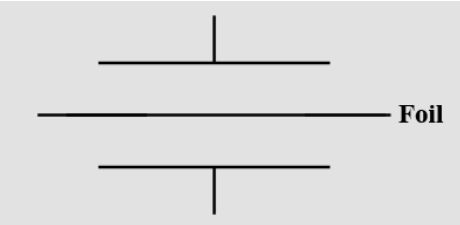
AnswerThe capacity of condenser before inserting foil is $\text{C}=\frac{\text{A}\in0}{\text{d}}$ where A be the area of plate and d be the separation between plates.
After inserting foil the there will be two capacitors in series with capacitance $2C$ as distance is halved and the series combination of the two will give equivalent capacitance of $C,$ hence, capacity will remain same.
View full question & answer→MCQ 221 Mark
A capacitor is charged by a battery. The battery is removed, and another identical uncharged capacitor is connected in parallel. The total electrostatic energy of resulting system.
- A
Decreases by a factor of 2.
- B
- ✓
Increases by a factor of 2.
- D
Increases by a factor of 4.
AnswerCorrect option: C. Increases by a factor of 2.
View full question & answer→MCQ 231 Mark
To obtain $3\ \mu\text{F}$ capacity from three capacitors of $2\ \mu\text{F}$ each, they will be arranged.
- A
- B
All the three in parallel.
- ✓
Two capacitors in series and the third in parallel with the combinatioin of first two.
- D
Two capacitors in parallel and the third in series with the combinatioin of first two.
AnswerCorrect option: C. Two capacitors in series and the third in parallel with the combinatioin of first two.
View full question & answer→MCQ 241 Mark
On moving a charge of $Q$ coulomb by $X \ cm, W J$ of work is done, then the potential difference between the points is:
- ✓
$W/Q *V.$
- B
$QW V.$
- C
$Q/W V.$
- D
$Q2 /W V.$
AnswerCorrect option: A. $W/Q *V.$
View full question & answer→MCQ 251 Mark
The electrostatic force between the metal plates of an isolated parallel plate capacitor $C$ having a charge $Q$ and area $A$, is:
- ✓
Independent of the distance between the plates.
- B
Linearly proportional to the distance between the plates.
- C
Inversely proportional to the distance between theplates.
- D
Proportional to the square root of the distance betweenthe plates.
AnswerCorrect option: A. Independent of the distance between the plates.
View full question & answer→MCQ 261 Mark
Which material sheet should be placed between the plates of a parallel plate condenser in order to increase its capacitance ?
AnswerHere copper, tin, iron all are conductor so they will decrease the capacitance. The mica sheet is a dielectric or insulator so it will increase the capacitance $k$ times. Where $k$ is the dielectric constant.
View full question & answer→MCQ 271 Mark
If the capacitors in the previous question are joined in parallel, the capacitance and the breakdown voltage of the combination will be:
- A
$2C$ and $2V$
- B
$C$ and $2V$
- ✓
$2C$ and $V$
- D
$C$ and $V$
AnswerCorrect option: C. $2C$ and $V$
In a parallel combination of capacitors, the potential difference across the capacitors remain the same, as the righthand-side plates and the left$-$hand$-$side plates of both the capacitors are connected to the same terminals of the battery. Therefore, the potential remains the same, that is, $V.$
For the parallel combination of capacitors, the capacitance is given by
$C_{\text {eq }}=C_1+C_2$
Here,
$C_1=C_2=C$
$\therefore C_{e q}=2 C$
View full question & answer→MCQ 281 Mark
The direction of electric field is from:
- A
Negative to positive plate.
- ✓
Positive to negative plate.
- C
Both $a$ and $b.$
- D
AnswerCorrect option: B. Positive to negative plate.
View full question & answer→MCQ 291 Mark
Each capacitor in the circuit shown is a $1F$ capacitor. What would be the equivalent capacitance between $A$ and $B?$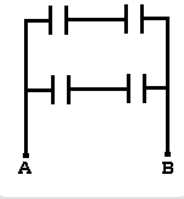
AnswerEquivalent capacitance of each pair of capacitance in series$=\frac{1\times1}{1+1}\text{F}=0.5\text{F}$
The two series combination are connected in parallel. Hence the net capacitance becomes $0.5F + 0.5F = 1F$
View full question & answer→MCQ 301 Mark
A parallel plate capacitor is charged to a certain voltage. Now, if the dielectric material $($with dielectric constant $k)$ is removed then the
- A
Capacitance increases by $a$ factor of $k$
- B
Electric field reduces by $a$ factor $k$
- C
Voltage across the capacitor decreases by $a$ factor $k$
- ✓
AnswerAs the capacitor is charged by using cell so potential as well as filed between the plates become constant.
For removing dielectric the capacitance becomes $C/ k$. Thus capacitance decreases by $a$ factor of $k.$
View full question & answer→MCQ 311 Mark
What is not true of equipotential surface?
AnswerCorrect option: C. Equipotential surfaces are always spherical.
Equipotential surface
$\rightarrow P.D$ difference between two points on the surface is zero always since potential is same everywhere in equipotential surface.
$\rightarrow $ The $EF$ is always perpendicular to the surface because there is no potential gradient along any direction parallel to the surface $P$ so no $EF$ parallel to the surface
$\rightarrow $ Equipotential surface can have any shape not just sphere.
$\rightarrow $ No work is done in moving a charge along the surface, because potential difference is zero.
View full question & answer→MCQ 321 Mark
How is the potential within and on the surface of a conductor?
AnswerElectric field at any point is equal to the negative of the potential gradient. But inside a conductor, the electric field is zero. Hence, the electric potential is constant throughout the volume of a conductor and has the same value on its surface.
View full question & answer→MCQ 331 Mark
. A surface that has the same electrostatic potential at every point on it is known as $......$
AnswerEquipotential surface is a surface formed by the locus of all the points which are at the same potential. Equipotential surfaces do not intersect with each other and are closely spaced in the region of strong electric fields and vice$-$versa.
View full question & answer→MCQ 341 Mark
A smaller sphere has potential $50V$ and a larger sphere has potential $100V$. How should they be placed so that if they are connected with the help of a wire, the charge will flow from the smaller sphere to the larger sphere? Both the spheres are conducting and hollow.
- ✓
- B
- C
- D
The smaller sphere should be grounded
AnswerWe know that for a conducting sphere, the charge is always distributed on its outer surface. We also know that charge flows from higher potential to lower potential. But if we put the smaller sphere inside the larger sphere and connect them with a conductor, they will act as a single conductor and charge will be distributed to its outer surface, i.e. charge will flow to the larger sphere.
View full question & answer→MCQ 351 Mark
What is the dimension of the dipole moment?
AnswerCorrect option: A. {$[I L T]$}
a. [$I L T$]
Explanation:
Dipole moment $=$ charge $\times$ length of the dipole. The electric charge has dimensions $[I T]$ and length has dimensions $[L]$. Therefore, the dipole moment has the dimension $[IT L]$ and has unit $C \times m$ of $C \times m$.
View full question & answer→MCQ 361 Mark
Which one of the following gives the resultant capacitor when capacitors are joined in series?
- A
The sum of the individual capacitors.
- ✓
The reciprocal of the sum of the reciprocals of the individual capacitors.
- C
The reciprocal of the sum of the capacitors.
- D
The sum of the reciprocals of the individual capacitors.
AnswerCorrect option: B. The reciprocal of the sum of the reciprocals of the individual capacitors.
The resultant capacitor when capacitors are joined in series is the reciprocal of the sum of the reciprocals of the indivisual capacitors.
View full question & answer→MCQ 371 Mark
A parallel-plate capacitor has plates of unequal area. The larger plate is connected to the positive terminal of the battery and the smaller plate to its negative terminal. Let Q$_{+}$and Q$_{-}$be the charges appearing on the positive and negative plates respectively:
AnswerCorrect option: B. $Q_{+}=Q_{-}$
b. $Q_{+}=Q_{-}$
Explanation:
The charge induced on the plates of a capacitor is independent of the area of the plates.
$\therefore Q_{+}=Q_{-}$
View full question & answer→MCQ 381 Mark
The potential energy of a system of two charges is negative when:
- A
Both the charges are positive.
- B
Both the charges are negative.
- ✓
One charge is positive and other is negative.
- D
Both the charges are separated by infinite distance.
AnswerCorrect option: C. One charge is positive and other is negative.
View full question & answer→MCQ 391 Mark
When a dielectric is introduced between the plates of a condenser, the capacity of condenser:
AnswerIf the empty Condensor has capacity $C$, then its capacity with dielectric is given by $C′ = kC$, where $k$ is the dielectric constant of the dielectric material. $k$ can never be less than $1.$
View full question & answer→MCQ 401 Mark
A diode, a resistor and a $50Hz \ AC$ source are connected in series. The number of current pulses per second through the resistor is:
AnswerThe number of current pulses is equal to the frequency of the $AC$ source because one current pulse passes through the diode for one oscillation of the $AC$ source.
View full question & answer→MCQ 411 Mark
How many $6μ\text{F}, 200V$ condensers are needed to make a condenser of $18μ\text{F}, 600V?$
AnswerPlace three $200V, 6\mu \text{F},$ capacitors in series to get $1$ equivalent $600V, 2\mu \text{F},$ capacitor. Now place $9$ of these equivalent $600V, 2\mu \text{F},$capacitors in parallel to obtain an equivalence of $18\mu F$ at $600$ Volts. All this requires a total of $27 6\mu \text{F},$ capacitors. Nine rows connected in parallel with $3$ capacitors connected in series in each row.
View full question & answer→MCQ 421 Mark
is equal to the work done by an external agent in carrying a unit of positive charge from the arbitrarily chosen reference point $($usually infinity$)$ to that point without any acceleration.
- A
Electric potential energy.
- B
- ✓
- D
Electric potential difference.
AnswerElectric potential is equal to work done by an external agent in carrying a unit positive charge from the arbitrary chosen reference point to that point without any acceleration.
View full question & answer→MCQ 431 Mark
The polarisation is measured in:
- A
$Cm$
- B
$Cm ^2$
- ✓
$C / m ^2$
- D
AnswerCorrect option: C. $C / m ^2$
c. $C / m ^2$
View full question & answer→MCQ 441 Mark
An electric dipole is placed at the centre of a sphere, choose the correct options:
- A
Electric field is zero at every point on the surface.
- ✓
Flux is zero across the surface.
- C
No circle is present in the sphere which is equipotential.
- D
AnswerCorrect option: B. Flux is zero across the surface.
A dipole contains two equal and opposite charge. So total charge inside the sphere will be zero.
By Gauss's law, the flux across a surface is depends on the charge inside the surface. As total charge is zero inside the sphere so the flux through the sphere will be zero.
As the electric field is resultant effect due to all charges so there will be field exists on the surface.
As the sphere contains two equal and opposite charges so there may be exists equipotential surface in the sphere.
View full question & answer→MCQ 451 Mark
The dimensions of capacitance are:
- A
$[M L-2 T4 A-2]$
- B
$[M L-2 T-4 A2]$
- ✓
$[M-1 L-2 T-4 A2]$
- D
AnswerCorrect option: C. $[M-1 L-2 T-4 A2]$
View full question & answer→MCQ 461 Mark
It becomes possible to define potential at a point in an electric field because electric field:
MCQ 471 Mark
$(1):$ The dielectric medium between the plates of a parallel plate capacitor lowers the potential difference between the plates without a battery.
$(2):$ The maximum electric field that a dielectric can withstand without causing it to break down is dielectric strength.
- ✓
Both $1$ and $2$ are true, $2$ is not correct explanation of $1$
- B
Both $1$ and $2$ are true, $2$ is correct explanation of $1.$
- C
$1$ is false, $2$ is true
- D
$1$ is true, $2$ is false
AnswerCorrect option: A. Both $1$ and $2$ are true, $2$ is not correct explanation of $1$
Consider a capacitor with charge density $σ.$
The potential between its two plates is given by $\frac{\sigma\text{d}}{\in_0}$
When a dielectric is inserted, the electric field inside the capacitor decrease decreasing the potential between the two plates of capacitor.
However, this is nothing to the dielectric strength of the dielectric.
View full question & answer→MCQ 481 Mark
The electrostatic potential on the perpendicular bisector due to an electric dipole is $......$
AnswerThe electrostatic potential on the perpendicular bisector due to an electric dipole is zero.
View full question & answer→MCQ 491 Mark
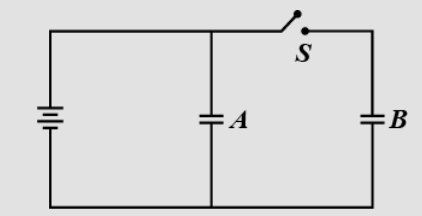
Two identical air filled parallel plate capacitors are charged to the same potential in the manner shown by closing the switch $S$. If now the switch $S$ is opened and the space between the plates is filled with a dielectric of relative permittivity $\varepsilon_r$ then:
- A
The potential difference as well as charge on each capacitor goes up by a factor $\varepsilon_r.$
- B
The potential difference as well as charge on each capacitor goes down by a factor $\varepsilon_r.$
- ✓
The potential difference across $A$ remains constant and the charge on $B$ remains unchanged.
- D
The potential difference across $B$ remains constant while the charge on $A$ remains unchanged.
AnswerCorrect option: C. The potential difference across $A$ remains constant and the charge on $B$ remains unchanged.
After switch $S$ is opened, as the Capacitor $A$ is connected across the battery, its potential difference is fixed at steady state $($i.e., when capacitor is fully charged$).$
Capacitor $B$ is isolated, so its charge gets fixed. But as we insert the dielectric, its capacitance changes, thus its potential difference also changes.
View full question & answer→MCQ 501 Mark
Which of the following are non polar molecules:
- A
$O ^2$
- B
$H ^2$.
- ✓
Both $a$ and $b.$
- D
AnswerCorrect option: C. Both $a$ and $b.$
View full question & answer→