Questions · Page 1 of 3

3 Marks Question

🎯

Test yourself on this topic

50 questions · timed · auto-graded

Question 13 Marks
  1. A ray of light incident on face AB of an equilateral glass prism, shows minimum deviation of 30°. Calculate the speed of light through the prism.
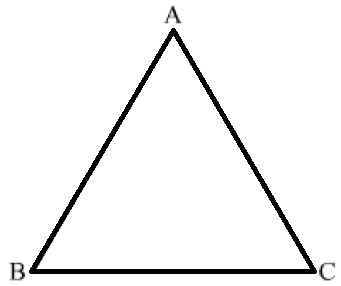
  1. Find the angle of incidence at face AB so that the emergent ray grazes along the face AC.
Answer
  1. $\mu=\frac{\sin\big(\frac{A+\delta_m}{2}\big)}{\sin\big(\frac{A}{2}\big)}$
$=\frac{\sin\big(\frac{60+30}{2}\big)}{\sin\big(\frac{60^\circ}{2}\big)}=\sqrt{2}$
Also $\mu=\frac{c}{v}\Rightarrow v=\frac{3\times10^8}{\sqrt{2}}\text{m/s}$
$=2.122\times10^8\text{m/s}$
  1.  

At face AC, let the angle of incidence be $r_2$. For grazing ray, $e = 90^\circ$
$\Longrightarrow\mu=\frac{1}{sin r_2}\Longrightarrow r_2=\sin^{-1}\big(\frac{1}{\sqrt{2}}\big)=45^\circ$
Let angle of refraction at face AB be $r_1$. Now $r_1+r_2=A$
$\therefore r_1=A-r_2=60^\circ-45^\circ=15^\circ$
Let angle of incidence at this face be $i$
$\mu=\frac{\sin i}{\sin r_1}$
$\Longrightarrow\sqrt{2}=\frac{\sin i}{\sin 15^\circ}$
$\therefore i=\sin^{-1}(\sqrt{2}.\sin 15^\circ)$
View full question & answer
Question 23 Marks
If this telescope is used to view a 100 m tall tower 3 km away, what is the height of the image of the tower formed by the objective lens?
Answer
Focal length of the objective lens, $f_0 = 140\ cm$
Focal length of the eyepiece, $f_e = 5\ cm$
Height of the tower,$ h_1= 100\ m$
Distance of the tower (object) from the telescope, u= 3 km = 3000 m
The angle subtended by the tower at the telescope is given as:
$\theta=\frac{\text{h}_1}{\text{u}}$
$=\frac{100}{3000}=\frac{1}{30} \ \text{rad}$
The angle subtended by the image produced by the objective lens is given as:
$\theta=\frac{\text{h}_2}{\text{f}_\text{o}}=\frac{\text{h}_2}{140}$ rad
Where,
$h_2=$ Height of the image of the tower formed by the objective lens
$\frac{1}{30}=\frac{\text{h}_2}{140}$
$\therefore \ \text{h}_2=\frac{140}{30}=4.7 \ \text{cm}$
Therefore, the objective lens forms a 4.7 cm tall image of the tower.
View full question & answer
Question 33 Marks
What should be the distance between the object in Exercise 9.30 and the magnifying glass if the virtual image of each square in the figure is to have an area of $6.25\ mm^2$. Would you be able to see the squares distinctly with your eyes very close to the magnifier?
Answer
Area of the virtual image of each square, $A= 6.25\ mm^2$
Area of each square, $A_0= 1\ mm^2$​​​​​​​
Hence, the linear magnification of the object can be calculated as:
$\text{m}=\sqrt{\frac{\text{A}}{\text{A}_0}}$
$\text{m}=\sqrt{\frac{6.25}{1}}=2.5$
But, $\text{m}=\frac{\text{imagr dis tan ce(v)}}{\text{Object dis tan ce(u)}}$
$\therefore \ \text{v}=\text{mu}$
$= 2.5\ u ...(1)$
Focal length of the magnifying glass, f= 10 cm
According to the lens formula, we have the relation:
$\frac{1}{\text{f}}=\frac{1}{\text{v}}-\frac{1}{\text{u}}$
$\frac{1}{10}=\frac{1}{2.5\text{u}}-\frac{1}{\text{u}}=\frac{1}{\text{u}}\Big(\frac{1}{2.5}-\frac{1}{1}\Big)=\frac{1}{\text{u}}\Big(\frac{1-2.5}{2.5}\Big)$
$\therefore \ \text{u}=\frac{1.5\times10}{2.5}=-6 \ \text{cm}$
and v = 2.5 u
= 2.5 × 6 = -15 cm
The virtual image is formed at a distance of 15 cm, which is less than the near point (i.e., 25 cm) of a normal eye. Hence, it cannot be seen by the eyes distinctly.
View full question & answer
Question 43 Marks
  1. At what distance should the lens be held from the figure in Exercise 9.29 in order to view the squares distinctly with the maximum possible magnifying power?
  2. What is the magnification in this case?What is the magnification in this case?
  3. Is the magnification equal to the magnifying power in this case? Explain.
Answer
Maximum magnifying power is obtained when the image is at the near point (25 cm).
Thus, Image distance, v = -25 cm
Focal length, f = +10 cm
Object distance, u = ?
Using the formula,
$\frac{1}{\text{v}}-\frac{1}{\text{u}}=\frac{1}{\text{f}}$
$\therefore \ \frac{1}{\text{u}}=\frac{1}{\text{v}}-\frac{1}{\text{f}}$
$=\frac{1}{-25}-\frac{1}{10}$
$=\frac{-2-5}{50}$
$=\frac{-7}{50}$
i.e., $\text{u}=-\frac{50}{7}=-7.14 \ \text{cm}$.
So the lens should be held at a distance of 7.14 cm away so as to have a maximum possible magnifying power.
View full question & answer
Question 53 Marks
A small telescope has an objective lens of focal length 140 cm and an eyepiece of focal length 5.0 cm. What is the magnifying power of the telescope for viewing distant objects when,
  1. the telescope is in normal adjustment (i.e., when the final image is at infinity)?
  2. the final image is formed at the least distance of distinct vision (25 cm)?
Answer
Focal length of the objective lens, $f_0 = 140\ cm$
Focal length of the eyepiece, $f_e = 5\ cm$
Least distance of distinct vision, $d = 25\ cm$
  1. When the telescope is in normal adjustment, its magnifying power is given as:
When the final image is formed at d, the

$\text{m}=\frac{\text{f}_0}{\text{f}_\text{e}}$

$=\frac{140}{5}=28$
  1. magnifying power of the telescope is given as:
$\frac{\text{f}_0}{\text{f}_\text{e}}\Big[1+\frac{\text{f}_\text{e}}{\text{d}}\Big]$

$=\frac{140}{5}\Big[1+\frac{5}{25}\Big]$

$= 28[1 + 0.2]$

$= 28 × 1.2 = 33.6$
View full question & answer
Question 63 Marks
For a normal eye, the far point is at infinity and the near point of distinct vision is about 25 cm in front of the eye. The cornea of the eye provides a converging power of about 40 dioptres, and the least converging power of the eye-lens behind the cornea is about 20 dioptres. From this rough data estimate the range of accommodation (i.e., the range of converging power of the eye-lens) of a normal eye.
Answer
For a normal eye, near point of distinct vision = 25 cm.
i.e., u = -25 cm
Converging power = +40 D
To see objects at infinity, the eye uses its least converging power = 40 + 20 = 60 dioptres. This gives the rough idea of the distance between the retina and cornea eye-lens.
$\therefore$ to focus an object at near point,
Focal length of eye - lenc $=\frac{100}{\text{P}}=\frac{100}{60}=\frac{10}{6}=\frac{5}{3} \ \text{cm}$
$\text{v}=-\frac{5}{3} \ \text{cm}$
Now, using the formula,
$\frac{1}{\text{f}}=\frac{1}{\text{v}}-\frac{1}{\text{u}}$
$=\frac{3}{5}+\frac{1}{25}=\frac{16}{25}$
i.e., $\text{f}=\frac{25}{16}$, corresponding to a converging power given by,
$\text{P}=\frac{\frac{100}{25}}{16}=64$ dipotre.
Hence, we can say that the range of accommodation of the eye-lens is roughly 20 to 24 dioptre.
View full question & answer
Question 73 Marks
An object of size 3.0 cm is placed 14 cm in front of a concave lens of focal length 21 cm. Describe the image produced by the lens. What happens if the object is moved further away from the lens?
Answer
Size of the object, $h_1 = 3\ cm$
Object distance, u = -14 cm
Focal length of the concave lens, f = -21 cm
Image distance = v
According to the lens formula, we have the relation:
$\frac{1}{\text{v}}-\frac{1}{\text{u}}=\frac{1}{\text{f}}$
$\frac{1}{\text{v}}=-\frac{1}{21}-\frac{1}{14}=\frac{-2-3}{42}=\frac{-5}{42}$
$\therefore \ \text{v}=-\frac{42}{5}=-8.4 \ \text{cm}$
Hence, the image is formed on the other side of the lens, 8.4 cm away from it. The negative sign shows that the image is erect and virtual.
The magnification of the image is given as:
$\text{m}=\frac{\text{Im age height(h_2)}}{\text{Object height(h_1)}}=\frac{\text{v}}{\text{u}}$
$\therefore \ \text{h}_2=\frac{-8.4}{-14}\times3=0.6\times3=1.8 \ \text{cm}$
Hence, the height of the image is 1.8 cm.
If the object is moved further away from the lens, then the virtual image will move toward the focus of the lens, but not beyond it. The size of the image will decrease with the increase in the object distance.
View full question & answer
Question 83 Marks
You are given prisms made of crown glass and flint glass with a wide variety of angles. Suggest a combination of prisms which will
  1. deviate a pencil of white light without much dispersion.
  2. disperse (and displace) a pencil of white light without much deviation.
Answer
  1. Angular dispersion produced by two prisms should be zero so that, no dispersion take place.
The sum of angular dispersion by crown glass prism and angular dispersion by flint glass prism is equal to zero.

i.e., $(\mu_\text{b}-\mu_\text{r})\text{A}+(\mu_\text{b}'-\mu\text{r}')\text{A}'=0.$

Since $(\mu_\text{b}'-\mu_\text{r}')$ for flint glass is more than that for crown glass, therefore,

A' < A

Hence, the combination of prism is such that the, flint glass prism of smaller angle has to be suitably combined with crown glass prism of larger angle.
  1. For almost no deviation,
$(\mu_\text{y}-1)\text{A}'+(\mu_\text{y}'-1)\text{A}'=0.$

To disperse without deviation, we need flint glass prism of greater so that the deviation due to two prisms are equal and opposite. In the final combination however, angle of flint glass prism will be smaller than the angle of crown glass prism because the refractive index is more for flint glass as compared to the refractive index of crown glass.
View full question & answer
Question 93 Marks
A small candle, 2.5 cm in size is placed at 27 cm in front of a concave mirror of radius of curvature 36 cm. At what distance from the mirror should a screen be placed in order to obtain a sharp image? Describe the nature and size of the image. If the candle is moved closer to the mirror, how would the screen have to be moved?
Answer
Size of the candle, h= 2.5 cm
Image size = h'
Object distance, u= - 27 cm
Radius of curvature of the concave mirror, R= - 36 cm
$\therefore \ \text{h}'=-\frac{\text{v}}{\text{u}}\times\text{h}$
Focal length of the concave mirror, $=-\Big(\frac{-54}{27}\Big)\times2.5=-5 \ \text{cm}$
Image distance = v
The image distance can be obtained using the mirror formula:
$\frac{1}{\text{u}}+\frac{1}{\text{v}}=\frac{1}{\text{f}}$
$\frac{1}{\text{v}}=\frac{1}{\text{f}}-\frac{1}{\text{u}}$
$-\frac{1}{-18}-\frac{1}{-27}=\frac{-3+2}{54}=-\frac{1}{54}$
$\therefore \ \text{v}=-54 \ \text{cm}$
Therefore, the screen should be placed 54 cm away from the mirror to obtain a sharp image. The magnification of the image is given as:
$\text{m}=\frac{\text{h}'}{\text{h}}=-\frac{\text{v}}{\text{u}}$
$\therefore \ \text{h}'=-\frac{\text{v}}{\text{u}}\times\text{h}$
$=-\Big(\frac{-54}{27}\Big)\times2.5=-5 \ \text{cm}$
The height of the candle's image is 5 cm. The negative sign indicates that the image is inverted and real.
If the candle is moved closer to the mirror, then the screen will have to be moved away from the mirror in order to obtain the image.
View full question & answer
Question 103 Marks
  1. A giant refracting telescope at an observatory has an objective lens of focal length 15 m. If an eyepiece of focal length 1.0 cm is used, what is the angular magnification of the telescope?
  2. If this telescope is used to view the moon, what is the diameter of the image of the moon formed by the objective lens? The diameter of the moon is $3.48 \times 10^6m,$ and the radius of lunar orbit is $3.8 \times 10^8m.$
Answer
Focal length of the objective lens,$ f_0 = 15 m = 15 \times 10^2cm$
Focal length of the eyepiece, $f_e = 1.0 cm$
  1. The angular magnification of a telescope is given as:
$\alpha=\frac{\text{f}_0}{\text{f}_\text{e}}$

$=\frac{15\times10^2}{1.0}=1500$

Hence, the angular magnification of the given refracting telescope is 1500.
  1. Diameter of the moon, $d = 3.48 \times 10^6m$
Radius of the lunar orbit, $r_0 = 3.8 \times 10^8 m$

Let d' be the diameter of the image of the moon formed by the objective lens.

The angle subtended by the diameter of the moon is equal to the angle subtended by the image.

$\frac{\text{d}}{\text{r}_0}=\frac{\text{d}'}{\text{d}_0}$

$\frac{3.48\times10^6}{3.8\times10^8}=\frac{\text{d}'}{15}$

$\therefore \ \text{d}'=\frac{3.48}{3.8}\times10^{-2}\times15$

$= 13.74 \times 10^{-2} m = 13.74 cm$
Hence, the diameter of the moon's image formed by the objective lens is 13.74 cm.
View full question & answer
Question 113 Marks
  1. A giant refracting telescope at an observatory has an objective lens of focal length 15 m. If an eyepiece of focal length 1.0 cm is used, what is the angular magnification of the telescope?
  2. If this telescope is used to view the moon, what is the diameter of the image of the moon formed by the objective lens? The diameter of the moon is $3.48 \times 10^6 \mathrm{~m}$, and the radius of lunar orbit is $3.8 \times 10^8 \mathrm{~m}$.
Answer
Focal length of the objective lens, $\mathrm{f}_0=15 \mathrm{~m}=15 \times 10^2 \mathrm{~cm}$
Focal length of the eyepiece, $\mathrm{f}_{\mathrm{e}}=1.0 \mathrm{~cm}$
  1. The angular magnification of a telescope is given as:
$\alpha=\frac{\text{f}_0}{\text{f}_\text{e}}$
$=\frac{15\times10^2}{1.0}=1500$
Hence, the angular magnification of the given refracting telescope is 1500.
  1. Diameter of the moon, $d = 3.48 \times 10^6m$
Radius of the lunar orbit, $r_0 = 3.8 \times 10^8 m$
Let d' be the diameter of the image of the moon formed by the objective lens.
The angle subtended by the diameter of the moon is equal to the angle subtended by the image.
$\frac{\text{d}}{\text{r}_0}=\frac{\text{d}'}{\text{d}_0}$
$\frac{3.48\times10^6}{3.8\times10^8}=\frac{\text{d}'}{15}$
$\therefore \ \text{d}'=\frac{3.48}{3.8}\times10^{-2}\times15$
$= 13.74 \times 10^{-2} m = 13.74 cm$
Hence, the diameter of the moon's image formed by the objective lens is 13.74 cm.
View full question & answer
Question 123 Marks
A myopic person has been using spectacles of power –1.0 dioptre for distant vision. During old age he also needs to use separate reading glass of power + 2.0 dioptres. Explain what may have happened.
Answer
Power of spectacles, P = -1 D
$\therefore$ Focal length, f = -100 cm
That is, the far point of the person is at 100 cm.
Near point of the eye might have been normal (i.e., 25 cm).
The objects at infinity produce virtual images at 100 cm (using spectacles).
To see objects between 25 cm to 100 cm, the person uses the ability of accommodation of his eye-lens. This ability is partially lost in old age.
The near point of the eye may recede to 50 cm. He has, therefore, to use glasses of suitable power for reading.
Here,
Object distance, u = -25 cm
Image distance, v = -50 cm
Since, $\frac{1}{\text{v}}-\frac{1}{\text{u}}=\frac{1}{\text{f}}=-\frac{1}{50}+\frac{1}{25}$
i.e., focal length, f = 50 cm
power $\text{P}=\frac{100}{\text{f}}=\frac{100}{50}=+2$ dipotre.
View full question & answer
Question 133 Marks
Answer the following question:
Why must both the objective and the eyepiece of a compound microscope have short focal lengths?
Answer
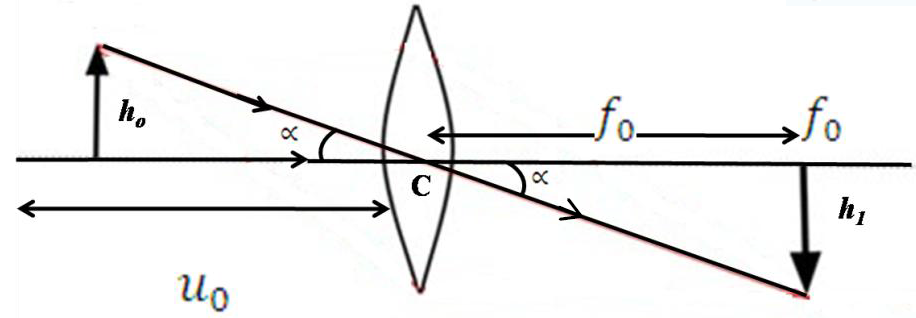
The angular magnification produced by the eyepiece of a compound microscope is
$\Bigg[\Big(\frac{25}{\text{f}_0}\Big)+1\Bigg]$
Where, $f_e =$ Focal length of the eyepiece
It can be inferred that if $f_e$ is small, then angular magnification of the eyepiece will be large.
The angular magnification of the objective lens of a compound microscope is given as
$\frac{1}{(|\text{u}_0|\text{f}_0)}$
Where, $u_0 =$ Object distance for the objective lens
$f_0 =$ Focal length of the objective
The magnification is large when $u_0 > f_0$. In the case of a microscope, the object is kept close to the objective lens. Hence, the object distance is very little. Since $u_0$ is small, $f_0$ will be even smaller. Therefore, $f_0$ and $f_0$ are both small in the given condition.
View full question & answer
Question 143 Marks
Double - convex lenses are to be manufactured from a glass of refractive index 1.55, with both faces of the same radius of curvature. What is the radius of curvature required if the focal length is to be 20cm?
Answer
Refractive index of glass, µ = 1.55
Focal length of the double-convex lens, f = 20 cm
Radius of curvature of one face of the lens $= R_1$
Radius of curvature of the other face of the lens $= R_2$​​​​​​​
Radius of curvature of the double-convex lens = R
$\therefore \ \text{R}_1=\text{R} \ \text{and} \ \text{R}_2=-\text{R}$
The value of R can be calculated as:
$\frac{1}{\text{f}}=(\mu-1)\Big[\frac{1}{\text{R}_1}-\frac{1}{\text{R}_2}\Big]$
$\frac{1}{20}=(1.55-1)\Big[\frac{1}{\text{R}}+\frac{1}{\text{R}}\Big]$
$\frac{1}{20}=0.55\times\frac{2}{\text{R}}$
$\therefore \ \text{R}=0.55\times2\times20=22 \ \text{cm}$
Hence, the radius of curvature of the double-convex lens is 22 cm.
View full question & answer
Question 153 Marks
Double - convex lenses are to be manufactured from a glass of refractive index 1.55, with both faces of the same radius of curvature. What is the radius of curvature required if the focal length is to be 20cm?
Answer
Refractive index of glass, $µ = 1.55$
Focal length of the double-convex lens, $f = 20\ cm$
Radius of curvature of one face of the lens $= R_1$
Radius of curvature of the other face of the lens $= R_2$​​​​​​​
Radius of curvature of the double-convex lens = R
$\therefore \ \text{R}_1=\text{R} \ \text{and} \ \text{R}_2=-\text{R}$
The value of R can be calculated as:
$\frac{1}{\text{f}}=(\mu-1)\Big[\frac{1}{\text{R}_1}-\frac{1}{\text{R}_2}\Big]$
$\frac{1}{20}=(1.55-1)\Big[\frac{1}{\text{R}}+\frac{1}{\text{R}}\Big]$
$\frac{1}{20}=0.55\times\frac{2}{\text{R}}$
$\therefore \ \text{R}=0.55\times2\times20=22 \ \text{cm}$
Hence, the radius of curvature of the double-convex lens is 22 cm.
View full question & answer
Question 163 Marks
A tank is filled with water to a height of 12.5 cm. The apparent depth of a needle lying at the bottom of the tank is measured by a microscope to be 9.4 cm. What is the refractive index of water? If water is replaced by a liquid of refractive index 1.63 up to the same height, by what distance would the microscope have to be moved to focus on the needle again?
Answer
Actual depth of the needle in water, $h_1 = 12.5\ cm$
Apparent depth of the needle in water, $h_2 = 9.4\ cm$
Refractive index of water = µ
The value of µ can be obtained as follows:
$\mu=\frac{\text{h}_1}{\text{h}_2}$
$=\frac{12.5}{9.4}=1.33$
Hence, the refractive index of water is about 1.33.
Water is replaced by a liquid of refractive index, µ' = 1.63
The actual depth of the needle remains the same, but its apparent depth changes. Let y be the new apparent depth of the needle. Hence, we can write the relation:
$\mu'=\frac{\text{h}_1}{\text{y}}$
$\therefore \ \text{y}'=\frac{\text{h}_1}{\mu'}$
$=\frac{12.5}{1.63}=7.67 \ \text{cm}$
Hence, the new apparent depth of the needle is 7.67 cm. It is less than $h_2$. Therefore, to focus the needle again, the microscope should be moved up.
$\therefore$ Distance by which the microscope should be moved up = 9.4 - 7.67
= 1.73 cm
View full question & answer
Question 173 Marks
A small telescope has an objective lens of focal length 144 cm and an eyepiece of focal length 6.0 cm. What is the magnifying power of the telescope? What is the separation between the objective and the eyepiece?
Answer
Focal length of the objective lens, $f_0 = 144\ cm$
Focal length of the eyepiece, $f_e = 6.0\ cm$
The magnifying power of the telescope is given as:
$\text{m}=\frac{\text{f}_0}{\text{f}_\text{e}}$
$=\frac{144}{6}=24$
The separation between the objective lens and the eyepiece is calculated as:
$f_0 + f_e$​​​​​​​
$= 144 + 6 = 150\ cm$
Hence, the magnifying power of the telescope is 24 and the separation between the objective lens and the eyepiece is 150 cm.
View full question & answer
Question 183 Marks
A small telescope has an objective lens of focal length 144 cm and an eyepiece of focal length 6.0 cm. What is the magnifying power of the telescope? What is the separation between the objective and the eyepiece?
Answer
Focal length of the objective lens, $f_0 = 144\ cm$
Focal length of the eyepiece, $f_e = 6.0\ cm$
The magnifying power of the telescope is given as:
$\text{m}=\frac{\text{f}_0}{\text{f}_\text{e}}$
$=\frac{144}{6}=24$
The separation between the objective lens and the eyepiece is calculated as:
$f_0 + f_e$​​​​​​​
$= 144 + 6 = 150\ cm$
Hence, the magnifying power of the telescope is 24 and the separation between the objective lens and the eyepiece is 150 cm.
View full question & answer
Question 193 Marks
A beam of light converges at a point P. Now a lens is placed in the path of the convergent beam 12cm from P. At what point does the beam converge if the lens is (a) a convex lens of focal length 20cm, and (b) a concave lens of focal length 16cm?
Answer
In the given situation, the object is virtual and the image formed is real.
Object distance, u = +12 cm
  1. Focal length of the convex lens, f = 20 cm
Image distance = v

According to the lens formula, we have the relation:

$\frac{1}{\text{v}}-\frac{1}{\text{u}}=\frac{1}{\text{f}}$

$\frac{1}{\text{v}}-\frac{1}{12}=\frac{1}{20}$

$\frac{1}{\text{v}}=\frac{1}{20}+\frac{1}{12}=\frac{3+5}{60}=\frac{8}{60}$

$\therefore \ \text{v}=\frac{60}{8}=7.5 \ \text{cm}$

Hence, the image is formed 7.5 cm away from the lens, toward its right.
  1. Focal length of the concave lens, f = –16 cm
Image distance = v

According to the lens formula, we have the relation:

$\frac{1}{\text{v}}-\frac{1}{\text{u}}=\frac{1}{\text{f}}$

$\frac{1}{\text{v}}=-\frac{1}{16}+\frac{1}{12}=\frac{-3+4}{48}=\frac{1}{48}$

$\therefore \ \text{v}=48\ \text{cm}$

Hence, the image is formed 48 cm away from the lens, toward its right.
View full question & answer
Question 203 Marks
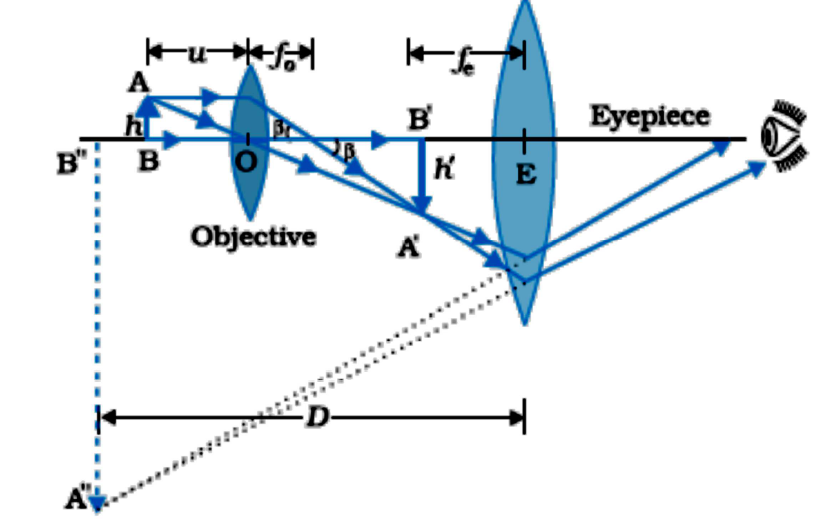
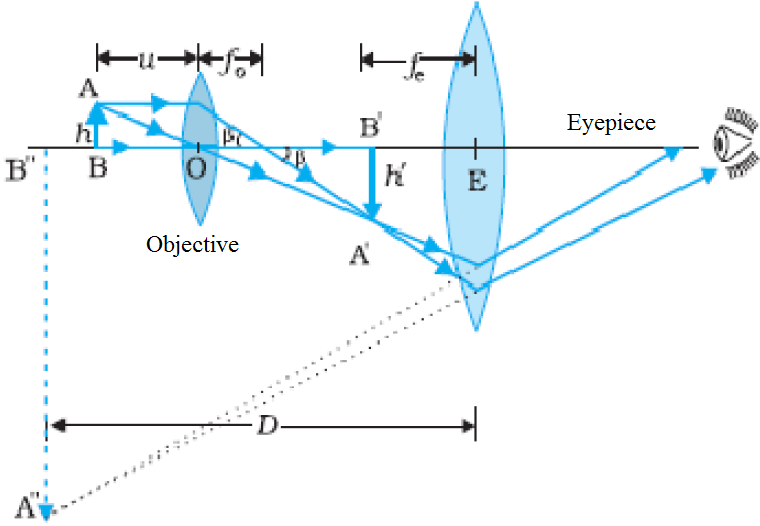
  1. Draw a ray diagram for the formation of image by a compound microscope.
  2. You are given the following three lenses. Which two lenses will you use as an eyepiece and as an objective to construct a compound microscope?
Lenses Power (D) Aperture (cm)
$L_1$ 3 8
$L_2$ 6 1
$L_3​​​​​​​$ 10 1
  1. Define resolving power of a microscope and write one factor on which it depends.
Answer
  1. Ray Diagram for compound microscope:
  1.  
  • Objective: Lens $L_3$
  • Eye Piece: Lens $L_2$
  1. $\text{R}_\text{p}=\frac{2{\mu}\sin \beta}{1.22\lambda}$
View full question & answer
Question 213 Marks
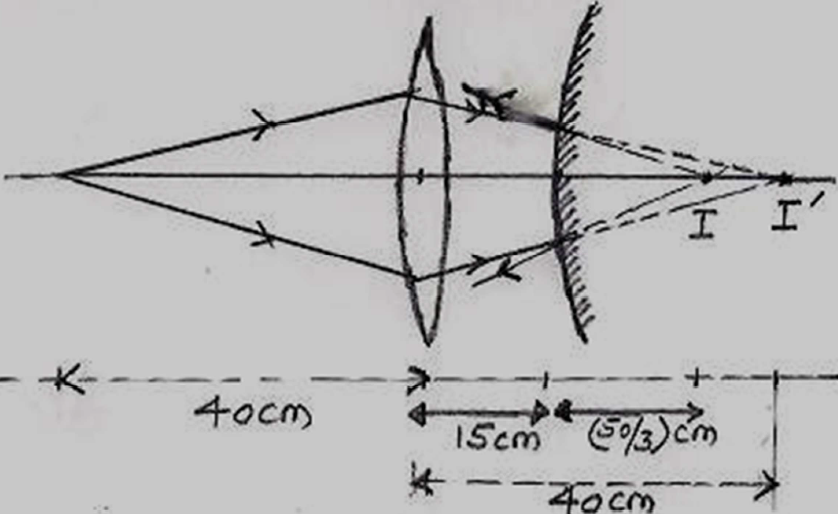
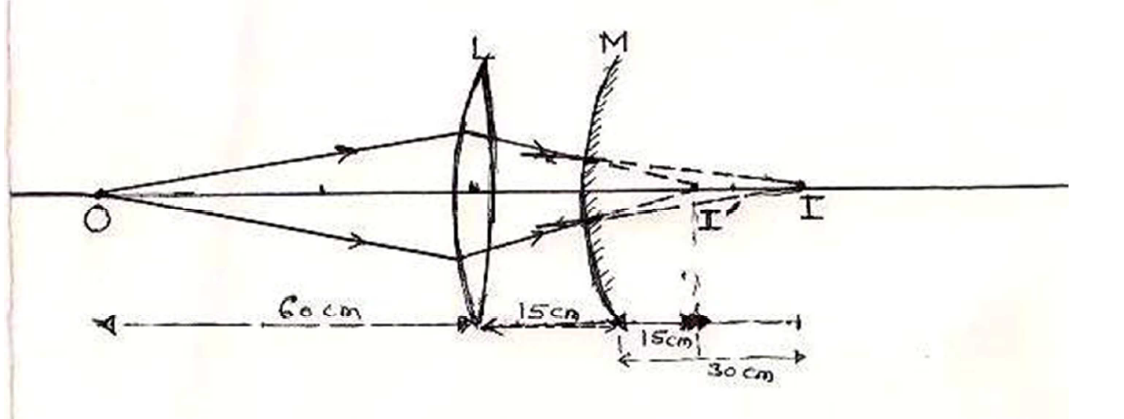
A convex lens of focal length 20 cm is placed coaxially with a convex mirror of radius of curvature 20 cm. The two are kept 15 cm apart. A point object is placed 40 cm in front of the convex lens. Find the position of the image formed by this combination. Draw the ray diagram showing the image formation.
Answer
For the lens:
$\frac{1}{f}=\frac{1}{v}-\frac{1}{u}$
U= - 40 cm, f= +20 cm This gives v= + 40 cm.
This image acts as a (virtual) object for the convex mirror
$\therefore u= (+40-15)\text{cm}=25\text{ cm}$
$ \text{Also f} =+\frac{20}{2}\text{cm}=+10\text{ cm}$
From
$\frac{1}{f}=\frac{1}{v}+\frac{1}{u}$
We get
$v=\frac{50}{3}\text{cm}-\cong16.67\text{cm}$
The final image is, therefore formed at a distance of 16.67 cm $ (\frac{50}{3}\text{cm})$ to the right of the convex mirror.
(at a distance of 31.67 cm $(\frac{95}{3}\text{cm})$ to the right of the convex lens.)
View full question & answer
Question 223 Marks
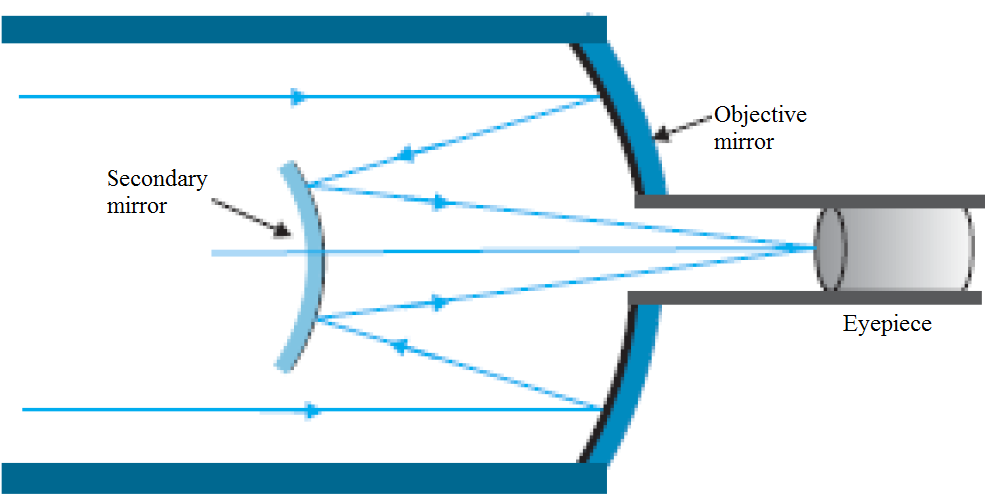
  1. Draw a ray diagram showing the formation of image by a reflecting telescope.
  2. Write two advantages of a reflecting telescope over a refracting telescope.
Answer
  1.  
Ray Diagram.
Arrow marking.
Labelling.
  1. Advantages:
  1. Spherical aberration is absent.
  2. Chromatic aberration is absent.
  3. Mounting is easier.
  4. Polishing is done on only one side.
  5. Light gathering power is more.
View full question & answer
Question 233 Marks
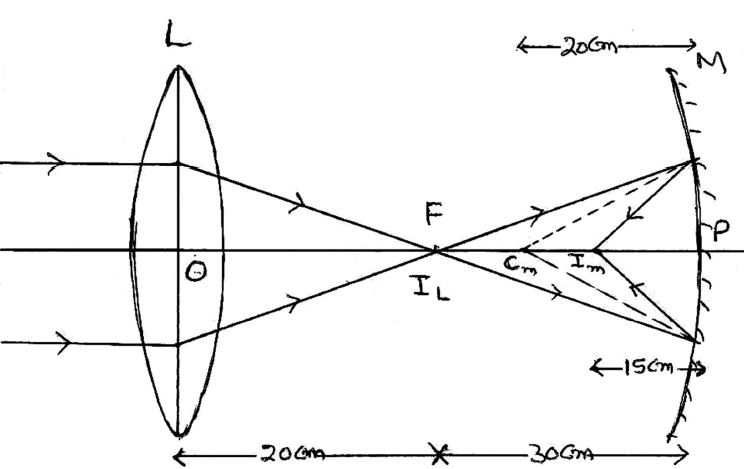
A convex lens of focal length 20 cm is placed coaxially with a concave mirror of focal length 10 cm at a distance of 50 cm apart from each other. A beam of light coming parallel to the principal axis is incident on the convex lens. Find the position of the final image formed by this combination. Draw the ray diagram showing the formation of the image.
Answer
For the lens $\frac{1}{\text{f}} = \frac{1}{\text{v}} - \frac{1}{\text{u}}$ As u is infinity, v = 20cm
For the concave mirror, the image, formed by the lens, acts as the object.
Hence, u = - (50 – 20)cm = -30cm
Also, f = -10cm $\frac{1}{\text{f}} = \frac{1}{\text{v}} + \frac{1}{\text{u}}$ $-\frac{1}{\text{10}} = \frac{1}{\text{v}} - \frac{1}{\text{30}}$$\therefore$ v = -15cm
The final image is, therefore, at a distance of 15cm to the left of the concave mirror.
View full question & answer
Question 243 Marks
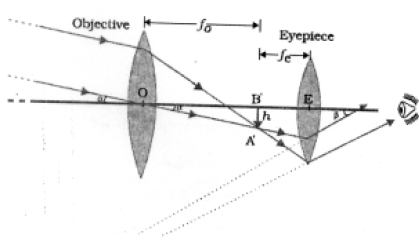
  1. Draw a ray diagram depicting the formation of the image by an astronomical telescope in normal adjustment.
  2. You are given the following three lenses. Which two lenses will you use as an eyepiece and as an objective to construct an astronomical telescope? Give reason.
Lenses Power (D) Aperture (cm)
$L_1$ 3 8
$L_2$ 6 1
$L_3​​​​​​​$ 10 1
Answer
  1. Ray diagram of astronomical telescope.
  1. Objective Lens: Lens $L_{1}$​​​​​​​.
Eyepiece Lens: Lens $L_2.​​​​​​​$
Reason: The objective should have large aperture and large focal length while the eyepiece should have small aperture and small focal length.
View full question & answer
Question 253 Marks
  1. Monochromatic light of wavelength 589 nm is incident from air on a water surface. If $\mu$ for water is 1.33, find the wavelength, frequency and speed of the refracted light.
  2. A double convex lens is made of a glass of refractive index 1.55, with both faces of the same radius of curvature. Find the radius of curvature required, if the focal length is 20 cm.
Answer
  1. $\lambda=\frac{589\text{ }\text{nm}}{1.33}=442.8\text{ }\text{nm}$
Frequency $\nu=\frac{3\times10^8\text{ }\text{ms}^{-1}}{589\text{ }\text{nm}}=5.09\times10^{12}\text{Hz}$

Speed $\nu=\frac{3\times10^8}{1.33}\text{m/s}=2.25\times10^{8}\text{m/s}$
  1. $\frac{1}{f}=\bigg[\frac{\mu_2}{\mu_1}-1\bigg]\bigg[\frac{1}{\text{R}_1}+\frac{1}{\text{R}_2}\bigg]$
$\therefore\text{ }\frac{1}{20}=\bigg[\frac{1.55}{1}-1\bigg]\frac{2}{\text{R}}$

$\therefore\text{ }\text{R}=(20\times1.10)\text{cm}=22\text{ }\text{cm}$
View full question & answer
Question 263 Marks
A convex lens of focal length 20 cm is placed coaxially with a convex mirror of radius of curvature 20 cm. The two are kept at 15 cm from each other. A point object lies 60 cm in front of the convex lens. Draw a ray diagram to show the formation of the image by the combination. Determine the nature and position of the image formed.
Answer

For the convex lens
u = - 60 cm, f = + 20 cm
$\frac{1}{\text{v}} - \frac{1}{\text{u}} = \frac{1}{\text{f}} \text{ gives } \text{v} = + 30 \text{ cm }$
For the convex mirror
u= + (30 – 15) cm = 15 cm,
$\text{F} = + \frac{20}{2}\text{cm} = 10 \text{ cm}$
$\frac{1}{\text{v}} + \frac{1}{\text{u}} = \frac{1}{\text{f}} \text{ gives }\text{v} = + 30 \text{ cm}$
Final image is formed at the distance of 30 cm from the convex mirror (or 45 cm from the convex lens ) to the right of the convex mirror. The final image formed is a virtual image.
View full question & answer
Question 273 Marks
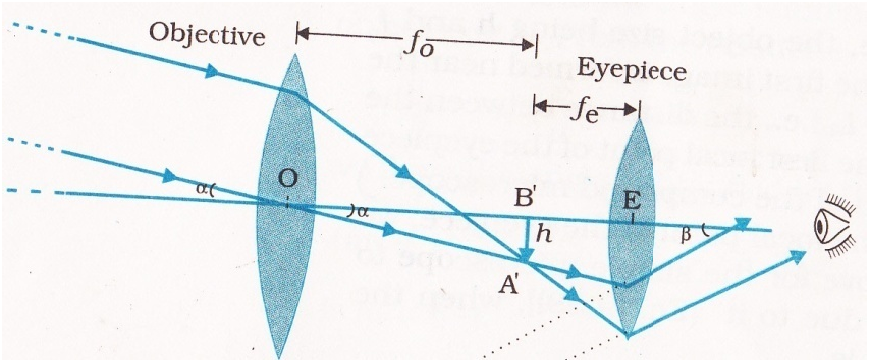
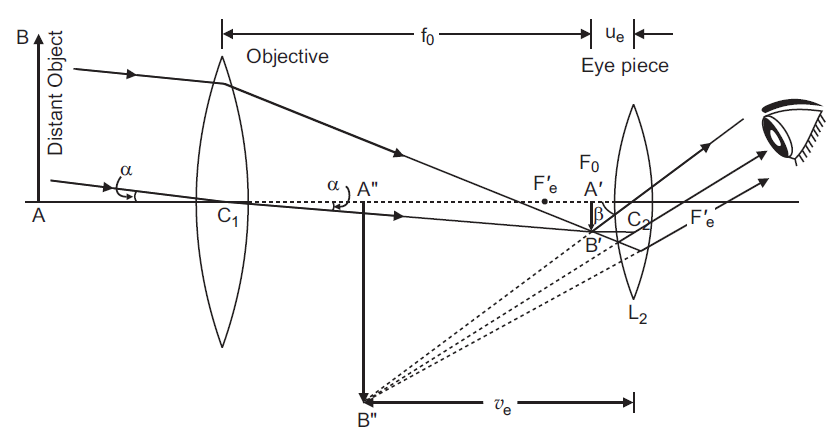
Draw a labelled ray diagram of a refracting telescope. Define its magnifying power and write the expression for it.
Write two important limitations of a refracting telescope over a reflecting type telescope.
Answer

It is defined as the ratio of the angle ($\beta$) subtended by the final image on the eye to the angle($\alpha$) subtended by the object on eye.
$\text{M} = \frac{\tan\beta}{\tan\alpha} = \bigg(\frac{\beta}{\alpha}\bigg)$
Magnifying power $\text{M} = \frac{-\text{f}_{0}}{\text{f}_{e}}$ (for comfortable view)
$ = \frac{-\text{f}_{0}}{\text{f}_{e}}\bigg(1+\frac{\text{f}_{e}}{\text{D}}\bigg)$ (for strained eye)
Limitations:
  1. Image is not free from chromatic aberration and spherical aberration.
  2. Aperture of the objective lens should be large for high resolving power.
View full question & answer
Question 283 Marks
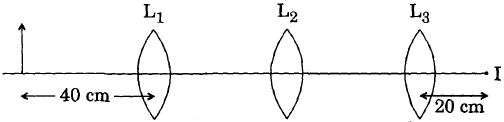
You are given three lenses $L_1, L_2$ and $L_3$ each of focal length 20 cm . An object is kept at 40 cm in front of $L_1$, as shown. The final real image is formed at the focus I of $L_3$. Find the separations between $L_1, L_2$ and $L_3$.
Answer
For lens $L_1$
$\frac{1}{\text{f}_{1}} = \frac{1}{\text{v}_{1}} - \frac{1}{\text{u}_{1}}$
$\frac{1}{20} = \frac{1}{\text{v}_{1}} -\frac{1}{-40}=>\text{v}_{1} = 40 \text{ cm}$
For $L_3​​​​​​​$
$\frac{1}{\text{f}_{3}} = \frac{1}{\text{v}_{3}} - \frac{1}{\text{u}_{3}}$
$u_3 = ?, f_3 = + 20 cm, v_3 = 20 cm$
$\frac{1}{20} = \frac{1}{20} + \frac{1}{\text{u}_{3}}$
$\text{u}_{3} = \infty$
It shows that $L_2$ must render the rays parallel to the common axis. It means that the image $\left(I_1\right)$, formed by $L_1$, must be at a distance of 20 cm from $L_2$ (at the focus of $L_2$ )
Therefore, distance between $L_1$ and $L_2(=40+20)=60 \mathrm{~cm}$ and distance between $L_2$ and $L_3$ can have any value.
View full question & answer
Question 293 Marks
Use the mirror equation to show that.
  1. An object placed between f and 2f of a concave mirror produces a real image beyond 2f.
  2. A convex mirror always produces a virtual image independent of the location of the object.
  3. An object placed between the pole and focus of a concave mirror produces a virtual and enlarged image.
Answer
$\frac{1}{\text{v}} + \frac{1}{\text{u}} = \frac{1}{\text{f}}$
for concave mirror, f < 0 or f = - ve
for convexmirror, f > 0 or f = + ve
Concave Mirror
Let f = - c
Also, Let u = nf = - nc
$\frac{1}{\text{v}} = \frac{1}{\text{f}} - \frac{1}{\text{u}} = -\frac{1}{\text{c}} + \frac{1}{\text{nc}} = \frac{-\text{n} + 1 }{\text{nc}}$
$\therefore\text{v} = \frac{\text{nc}}{(1 - \text{n})}$
  1. When object is between f and 2f, we have 1 < n < 2
$\therefore\text{v} \text{ is -ve real image }$

(For n =1 and n =2), magnitude of v becomes $ \infty$ and 2c, respectively

$\therefore$ Real image is formed beyond 2F.
  1. Obiect between pole and F we have 0 < 0 < 1
v is + ve $\Rightarrow$(virtual image) and | v | > c

$\therefore$ We get a virtual, enlarged image
  1. Convex Mirror
f = + d Let u = - pd (p can have any value)

1/v = 1/d + 1/pd = (1+p)/pd

$\text{v} = \frac{\text{pd}}{(\text{p} + 1) }$

$\therefore$ v is always +ve and always less than d

$\therefore$ Convex mirror always produces a virtua1 image between pole and focus.
View full question & answer
Question 303 Marks
A compound microscope uses an objective lens of focal length 4 cm and eyepiece lens of focal length 10 cm. An object is placed at 6 cm from the objective lens. Calculate the magnifying power of the compound microscope. Also calculate the length of the microscope.
Answer
$\frac{1}{\text{v}_{0}} - \frac{1}{\text{u}_{0}} = \frac{1}{\text{f}_{0}}$
$\text{f}_{0} = 4 \text{cm};\text{u}_{e} = - 6 \text{cm}$
$\frac{1}{\text{v}_{0}} = \frac{1}{4}- \frac{1}{6} = \frac{1}{12} \therefore\text{v}_{0} = 12 \text{ cm}$
magnification by objective, $\text{m}_{0} = \frac{\text{v}_{0}}{|\text{u}_{0}|}$
$ = \frac{12}{6} = 2 $
Magnification by eyepiece
$\text{m}_{e} = \bigg(1 + \frac{\text{D}}{\text{f}_{e}}\bigg) \text{ or }\frac{\text{D}}{\text{f}_{e}}$
$ = \bigg(1 + \frac{25}{10}\bigg)\text{ or } \frac{25}{10}$
$ = 3.5 \text{ or } 2.5$
magnification power of the microscope
$m = m_0 \times m_e$​​​​​​​
$= 2 × 3.5$ or $2 × 2.5$
$= 7$ or $5$
Length of the microscope,
$L = |V_0| + |u_0| or L = |V_0| + f_e$
$u_e = ? v_e = D = – 25 cm, f_e = 10 cm$
$\frac{1}{\text{u}_{e}} = \frac{1}{\text{v}_{e}} - \frac{1}{\text{f}_{e}} = - \frac{1}{25} - \frac{1}{10} = - \frac{7}{50}$
$\text{u}_{e} = - \frac{50}{7}\text{ cm}$
$\therefore\text{L} = 12 \text{ cm} + \frac{50}{7}\text{ cm}$
$ = 19.1 \text{ cm}$
Alternate Answer
$L = |V_0| + |f_0|$
$= 12 + 10 = 22\ cm.$
View full question & answer
Question 313 Marks
A convex lens made up of glass of refractive index 1.5 is dipped, in turn, in (i) a medium of refractive index 1.65, (ii) a medium of refractive index 1.33.
  1. Will it behave as a converging or a diverging lens in the two cases?
  2. How will its focal length change in the two media?
Answer
$\frac{1}{\text{f}} = (\mu - 1)\bigg(\frac{1}{\text{R}_{1}} - \frac{1}{\text{R}_{2}}\bigg)$
    1. Diverging lens or concave lens.
    2. Converging lens or convex lens.
    1. Focal length will become negative and its magnitude would increase.
    2. Focal length increases.
View full question & answer
Question 323 Marks
A giant refracting telescope at an observatory has an objective lens of focal length 15 m. If an eyepiece lens of focal length 1.0 cm is used, find the angular magnification of the telescope.
If this telescope is used to view the moon, what is the diameter of the image of the moon formed by the objective lens? The diameter of the moon is $3.42 \times 10^6\ m$ and the radius of the lunar orbit is $3.8 \times 10^6\ m.$
Answer
Angular magnification, $\text{m} = \frac{\text{f}_{0}}{\text{f}_{e}}$
$ = \frac{1500\text{ cm}}{1\text{ cm}}$
= 1500
$\frac{\text{Diameter of image of moon (d)}}{\text{Focal length of objective}\text{(f}_{0})} = \frac{\text{Diameter of the moon}}{\text{Radius of Lunar orbit}}$
$\text{d} = 1500\times\frac{3.42\times10^{6}}{3.80\times10^{6}}$
= 13.5 cm.
View full question & answer
Question 333 Marks
An illuminated object and a screen are placed 90 cm apart. Determine the focal length and nature of the lens required to produce a clear image on the screen, twice the size of the object.
Answer
for real image m $ = - 2 = \frac{\text{v}}{\text{u}}\Rightarrow\text{v} = - 2\text{u}$
given | u | + | v | = 90 cm
$\Rightarrow3 |\text{u}| = 90 \text{cm}$
$\Rightarrow|\text{u}| = 30 \text{cm}$
We have for a lens
$\frac{1}{\text{f}} = \frac{1}{\text{v}} - \frac{1}{\text{u}}$
$\therefore\frac{1}{\text{f}} = \frac{1}{60} - \frac{1}{-30}$
$\frac{1}{\text{f}} = \frac{1}{20}$
$\Rightarrow\text{f} = 20 \text{ cm }$
Nature of lens: Convex/Converging.
View full question & answer
Question 343 Marks
  1. Draw a neat labelled ray diagram of an astronomical telescope in normal adjustment. Explain briefly its working.
  2. An astronomical telescope uses two lenses of powers 10 D and 1 D. What is its magnifying power in normal adjustment?
Answer

Light from a distant object enters the objective and a real image is formed in the tube at its second focal point. The eyepiece magnifies this image producing a final inverted image at infinity.
Calculation of magnifying power:
Given: Power of eyepiece = 10 D
Power of objective = 1 D
Magnifying power in normal adjustment: $\text{m} = \frac{\text{f}_{o}}{\text{f}_{e}} = \frac{\text{p}_{e}}{\text{p}_{o}} = \frac{10}{1} = 10 $
View full question & answer
Question 353 Marks
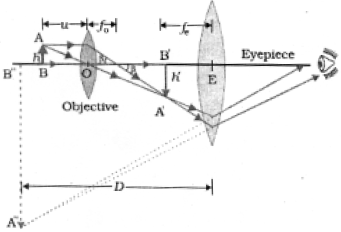
  1. Draw a neat labelled ray diagram of a compound microscope. Explain briefly its working.
  2. Why must both the objective and the eye-piece of a compound microscope have short focal lengths?
Answer

The objective forms a real, inverted, magnified image of the object. This serves as the object for the second lens, the eyepiece, which functions essentially like a simple microscope or magnifier, produces the final image, which is enlarged and virtual.
To achieve a large magnification of a small object; both the objective and eyepiece should have small focal lengths.
View full question & answer
Question 363 Marks
A double convex lens of glass of refractive index 1.6 has its both surfaces of equal radii of curvature of 30 cm each. An object of height 5cm is placed at a distance of 12.5 cm from the lens. Calculate the size of the image formed.
Answer
$\frac{1}{\text{f}} = (\mu -1)\bigg(\frac{1}{\text{R}_{1}} -\frac{1}{\text{R}_{2}}\bigg) $
Alternate Answer
$\text{f} = \frac{\text{R}}{2(\mu -1)}$
f = 25 cm
$\frac{1}{\text{f}} =\frac{1}{\text{v}} -\frac{1}{\text{u}}$
v = - 25 cm
$\frac{\text{I}}{0} =\frac{\text{v}}{\text{u}} = 2 $

Alternate Answer
$\frac{\text{I}}{0} = \frac{\text{f}}{\text{f+ u}}$
$\therefore \text{I} = + 10 \text{cm}$.
View full question & answer
Question 373 Marks
A beam of light converges to a point P. A lens is placed in the path of the convergent beam12 cm from P. At what point does the beam converge if the lens is.
  1. a convex lens of focal length 20 cm,
  2. a concave lens of focal length 16 cm?
Do the required calculations.
Answer
$\frac{1}{\text{f}} = \frac{1}{\text{v}} - \frac{1}{\text{u}}$
For convex lens u = 12cm.
Calculation $\text{f} = + 20\text{cm}$ $\text{v} =7.5 \text{cm}$
For the concave lens u = +12cm
f = -16cm then v = 48cm.
View full question & answer
Question 383 Marks
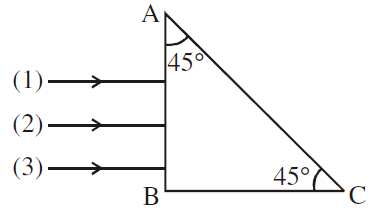
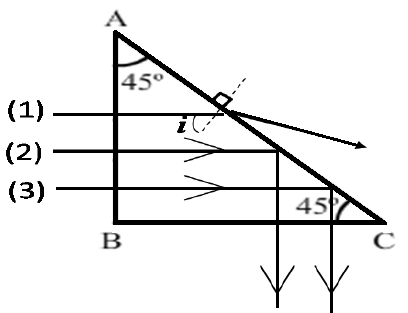
Three rays (1, 2, 3) of different colours fall normally on one of the sides of an isosceles right angled prism as shown. The refractive index of prism for these rays is 1.39, 1.47 and 1.52 respectively. Find which of these rays get internally reflected and which get only refracted from AC. Trace the paths of rays. Justify your answer with the help of necessary calculations.
Answer
$\text{i}=45^\circ$ (on face AC)
For TIR
$i>i_c$
$\Rightarrow\sin i>\sin i_c$
$\Rightarrow\frac{1}{\sin i}<\frac{1}{\sin i_c}$
$\Rightarrow\mu>\frac{1}{\sin i}\text{ }\text{ }\text{ }\text{ }\text{ }\text{ }\text{ }\because\mu=\frac{1}{\sin i_c}$
$\mu>\sqrt{2}=1.414$ for TIR
$\therefore$ Ray (1) is refracted from AC And rays (2) and (3) are internally reflected.
View full question & answer
Question 393 Marks
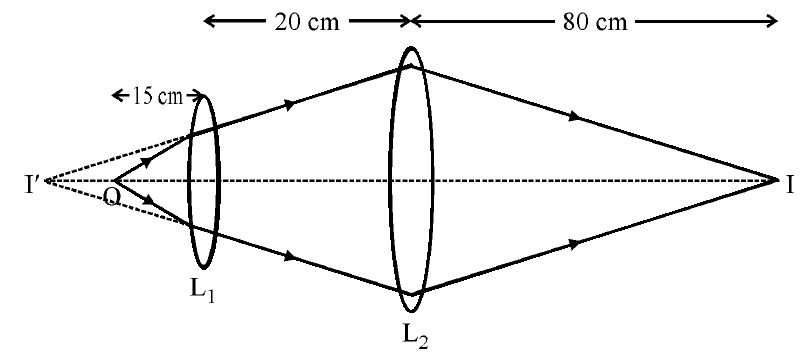
In the following diagram, an object ‘O’ is placed 15 cm in front of a convex lens $L_1$ of focal length 20 cm and the final image is formed at ‘I’ at a distance of 80 cm from the second lens $L_2.$ Find the focal length of the lens $L_2.$​​​​​​​
Answer
For $L_1$​​​​​​​
$\frac{1}{v_1}-\frac{1}{u_1}=\frac{1}{f_1 }$
$\Rightarrow \frac{1}{v_1}=\frac{1}{20}-\frac{1}{15}=-\frac{1}{60}$
$\Rightarrow v_1=-60\text{ }cm$
For lens $L_2$​​​​​​​
$u = (-20 – 60) cm = -80 cm$
$v = 80 cm$
$\therefore\text{ }|u|=|v|=2\text{f}_2$
$\Rightarrow f_2=\frac{80}{2}=40\text{ }cm$
View full question & answer
Question 403 Marks
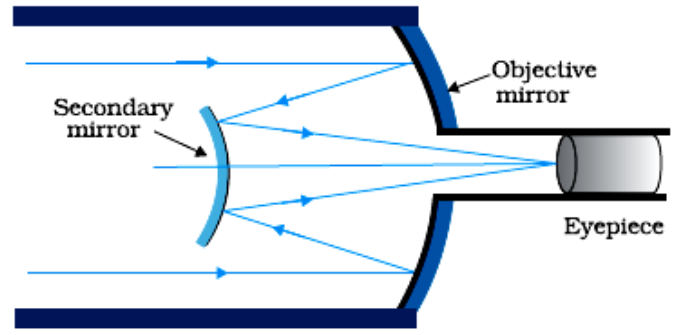
Draw a schematic ray diagram of reflecting telescope showing how rays coming from a distant object are received at the eye-piece. Write its two important advantages over a refracting telescope.
Answer
  1. Large gathering power.
  2. Large magnifying power.
  3. No chromatic aberration.
  4. Spherical aberration is also removed.
  5. Easy mechanical support.
  6. Large resolving power.
View full question & answer
Question 413 Marks
  1. Calculate the distance of an object of height h from a concave mirror of radius of curvature 20 cm, so as to obtain a real image of magnification 2. Find the location of image also.
  2. Using mirror formula, explain why does a convex mirror always produce a virtual image.
Answer
  1. Given R = -20 cm, and magnification m= -2
Focal length of the mirror $\text{f} = \frac{\text{R}}{2} = - 10\text{cm}$

Magnification $(\text{m}) = -\frac{\text{v}}{\text{u}}$

$ - 2 = - \frac{\text{v}}{\text{u}}$

$ = > {v} = 2\text{u}$

Using mirror formula

$\frac{1}{\text{f}} = \frac{1}{\text{v}} + \frac{1}{\text{u}}$

$\Rightarrow - \frac{1}{10} = \frac{1}{2\text{u}} + \frac{1}{\text{u}}$

$\Rightarrow\text{u} = - 15 \text{cm}$

$\therefore\text{v} = 2 \times -15 \text{cm} = - 30 \text{cm}$
  1. $\frac{1}{\text{f}} =\frac{1}{\text{v}} + \frac{1}{\text{u}}$
Using sign convention, for convex mirror, we have

$\text{f} > 0 , \text{u} < 0$

From the formula

$\frac{1}{\text{v}} =\frac{1}{\text{f}} - \frac{1}{\text{u}}$

$\because \text{f}$ is positive and $\text{u}$ is negative,

$\Rightarrow\text{v}$ is always positive, hence image is always virtual.
View full question & answer
Question 423 Marks
  1. A giant refracting telescope has an objective lens of focal length 15 m. If an eye piece of focal length 1.0 cm is used, what is the angular magnification of the telescope?
  2. If this telescope is used to view the moon, what is the diameter of the image of the moon formed by the objective lens? The diameter of the moon is 3.48 × 10⁶ m and the radius of lunar orbit is 3.8 x 10⁸ m.
Answer
Angular Magnification $\text{m} =\frac{\text{f}_{\circ}}{\text{f}_{e}}$ $ = \frac{15}{10^{-2}} = 1500$
Angular size of the moon $ =\bigg(\frac{3.48\times10^{6}}{3.8\times10^{8}}\bigg) = \frac{3.48}{3.8}\times10^{-2} \text{radian}$ $\therefore$ Angular size of the image $ =\bigg(\frac{3.48}{3.8}\times10^{-2}\times1500\bigg) =\text{radian}$ Diameter of the image $ =\frac{3.48}{3.8}\times15\times$ focal length of eye piece $ =\frac{3.48}{3.8}\times15\times1 \text{cm}$ = 13.7 cm.
View full question & answer
Question 433 Marks
  1. Draw a labelled ray diagram showing the formation of a final image by a compound microscope at least distance of distinct vision.
  2. The total magnification produced by a compound microscope is 20. The magnification produced by the eye piece is 5. The microscope is focussed on a-certain object. The distance between the objective and eyepiece is observed to be 14 cm. If least distance of distinct vision is 20 cm, calculate the focal length of the objective and the eye piece.
Answer

For eyepiece $\text{m}_{e} = \frac{\text{v}_{e}}{\text{u}_{e}}$
$\text{u}_{e} = \frac{\text{v}_{e}}{\text{m}_{e}} = \frac{-20}{5}\text{cm} = - 4 \text{cm}$
Also, $\frac{1}{\text{f}_{e}}= \frac{1}{\text{v}_{e}} - \frac{1}{\text{u}_{e}}$
$\frac{1}{\text{f}_{e}} = \frac{-1}{20} + \frac{1}{4}$
$\text{f}_{e} = 5 \text{cm}$
$\text{m} = \text{m}_{e}\times \text{m}_{o}$
$-20 = 5 \times \text{m}_{o} = > \text{m}_{0} = -4$
Also, $|\text{v}_{o}| + |\text{u}_{e}| = 14$
$= > \text{v}_{o}= (14 – 4) \text{ cm} = 10\text{ cm}$
$\text{m}_{0} = 1-\frac{\text{v}_{o}}{\text{f}_{0}} = > -4= 1-\frac{10}{\text{f}_{o}}$
$= > \text{f}_{o} = 2\text{ cm}$
where subscripts e and o are used for eyepiece and objective respectively.
View full question & answer
Question 443 Marks
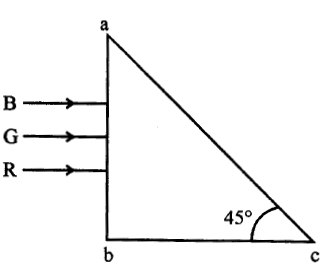
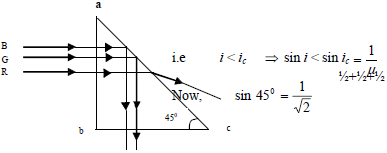
Three light rays red (R), green (G) and blue (B) are incident on a right-angled prism ‘abc’ at face ‘ab’. The refractive indices of the material of the prism for red, green and blue wavelengths are 1.39, 1.44 and 1.47 respectively. Out of the three which colour ray will emerge out of face ‘ac’? Justify your answer. Trace the path of these rays after passing through face ‘ab’.
Answer
Angle of incidence at face ac for all three colours = 45°A ray will get transmitted if the angle of incidence, for it, is less than thecritical angle for it.
$\therefore 45^{\circ}$ is the critical angle for $\mu = 1.414.$
Hence only the red colour $($with angle more than $45^\circ)$ ray will get transmitted $\big(\mu = 1.39\big)$. The green $\big(\mu = 1.44\big)$ and blue colour $\big(\mu = 1.47\big)$ rays will undergo total internal reflection.
View full question & answer
Question 453 Marks
Define the term 'resolving power' of an astronomical telescope. How does it get affected on?
  1. Increasing the aperture of the objective lens?
  2. Increasing the wavelength of the light used?
Justify your answer in each case.
Answer
Resolving power (R.P) is the reciprocal of limit of angular resolution OR any other suitable definition.
  1. Increases:
Resolving power $ = \frac{\text{d}}{1.22\lambda}$

$\therefore$ R.P is directly proportional to ‘d’ (For a given $\lambda$)
  1. Decreases:
$\therefore$ R.P is inversely proportional to $'\lambda'$ (For a given d).
View full question & answer
Question 463 Marks
A convex lens made up of glass of refractive index 1.5 is dipped, in turn, in:
  1. Medium A of refractive index 1.65
  2. Medium B of refractive index 1.33
Explain, giving reasons, whether it will behave as a converging lens or a diverging lens in each of these two media.
Answer
$\frac{1}{\text{f}}_{\text{m}}=\bigg(\frac{_{a}\mu_{g}}{_{a}\mu_{m}}-1\bigg)\bigg(\frac{1}{\text{R}_{1}} - \frac{1}{\text{R}_{2}}\bigg )$
  1. $\text{For } _{a}{\mu}_{g} = 1.5 \text { and } _{a}{\mu}_{m}= 1.6\text{f}_{m} \text{will be negative}$
hence it will be a converging lens.
  1. $\text{For} _{a}\mu_{g}= 1.5 \text {and}_{a}\mu_{m}=1.33\text{f}_{m}\text{will be positive}$
hence it will be a converging lens.
View full question & answer
Question 473 Marks
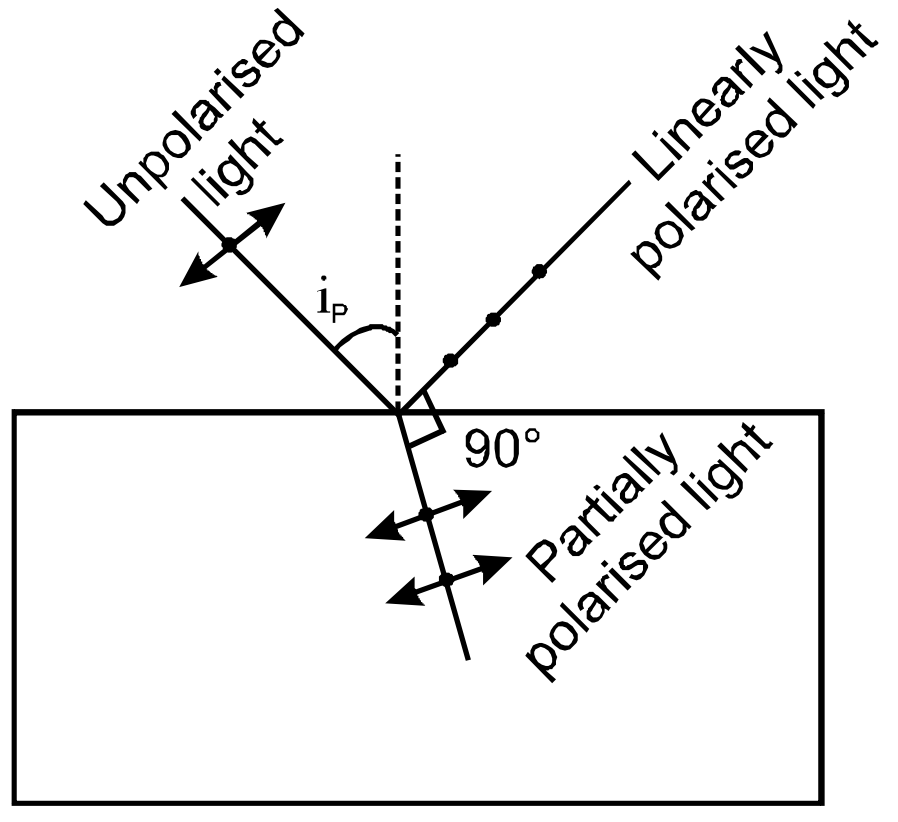
  1. Show using a proper diagram how unpolarised light can be linearly polarised by reflection from a transparent glass surface.
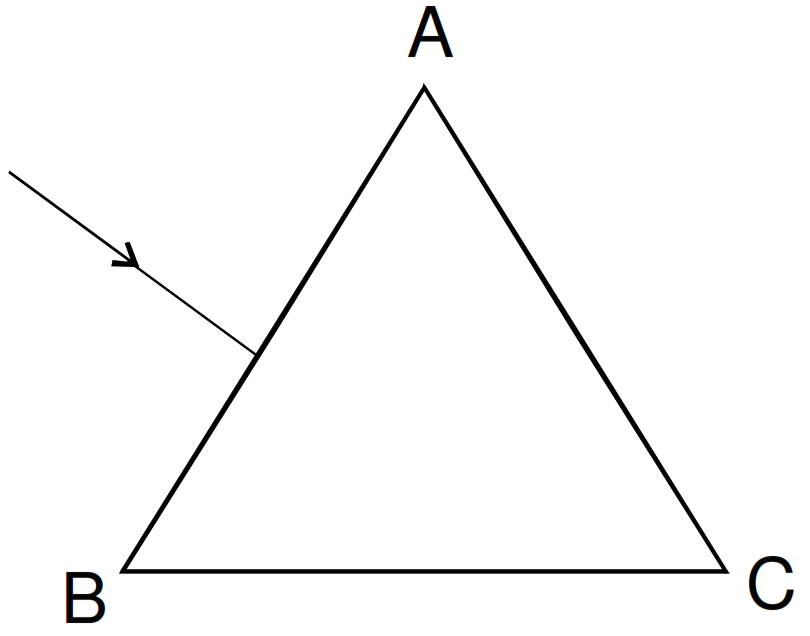
  2. The figure shows a ray of light falling normally on the face AB of an equilateral glass prism having refractive index $\frac{3}{2},$ placed in water of refractive index $\frac{4}{3}.$ Will this ray suffer total internal reflection on striking the face AC? Justify your answer.
Answer
  1.  


When unpolarised light ray is incident at an angle such that the angle between reflected of refracted rays is 90°, then reflected ray is linearly polarised. In that case incident angle is called polarising angle or Brewster angle$(i_P$ or $i_B).$​​​​​​​
  1. For Total internal reflection $\Big(\frac{1}{\sin\text{i}_{\text{c}}}=\mu_{\text{DR}}\Big)$
$\sin\text{i}_{\text{c}}=\Big(\frac{1}{\sin\text{i}_{\text{c}}}=\mu_{\text{DR}}\Big)$

$\sin\text{i}_{\text{c}}=\mu_{\text{wg}}$

$\sin\text{i}_{\text{c}}=\frac{4}{3}\div\frac{3}{2}$

$=\frac{4}{3}\times\frac{2}{3}$

$\sin\text{i}_{\text{c}}=\frac{8}{9}=0.88$

Now, in this case

$\sin\text{i}=\sin60^\circ=\frac{\sqrt{3}}{2}=0.867$

$\because\ \sin\text{i}<\sin\text{i}_{\text{c}}$

$\text{So,}\ \text{i}<\text{i}_{\text{c}}$

So, ray will not suffer Total internal reflection.
View full question & answer
Question 483 Marks
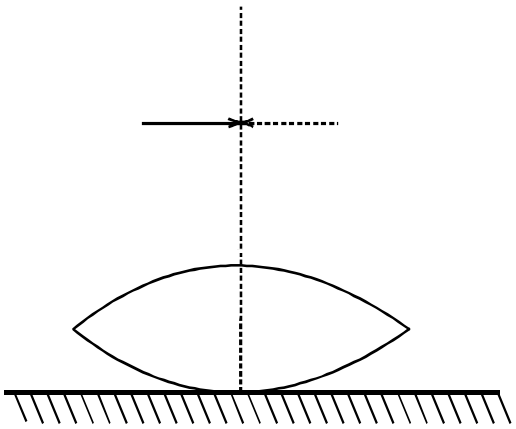
A symmetric biconvex lens of radius of curvature R and made of glass of refractive index 1·5, is placed on a layer of liquid placed on top of a plane mirror as shown in the figure. An optical needle with its tip on the principal axis of the lens is moved along the axis until its real, inverted image coincides with the needle itself. The distance of the needle from the lens is measured to be x. On removing the liquid layer and repeating the experiment, the distance is found to be y. Obtain the expression for the refractive index of the liquid in terms of x and y.
Answer
Let $f_1 =$ focal length of biconvex lens.
$f_2 =$ focal length of plano concave liquid.
$f =$ focal length of combination of above two lenses.
$f = x f_1 = y .........(i)$ From combination of thin lenses,
$\frac{1}{\text{f}_1}+\frac{1}{\text{f}_2}=\frac{1}{\text{f}}$ $\frac{1}{\text{f}_2}=\frac{1}{\text{f}}-\frac{1}{\text{f}_1}$ $=\frac{1}{\text{x}}-\frac{1}{\text{y}}$ $\frac{1}{\text{f}_2}=\frac{\text{y}-\text{x}}{\text{xy}}\ ....(\text{ii})$
For bicovex lens, $\frac{1}{\text{f}_1}=(\mu-1)\Big(\frac{1}{\text{R}}+\frac{1}{\text{R}}\Big)$$\frac{1}{\text{f}_1}$
$=(1.5-1)\Big(\frac{2}{\text{R}}\Big)$
$f_1 = R = y .......(iii)$
For planoconcave liquid, $\frac{1}{\text{f}_2}=(\mu_1-1)\Big(-\frac{1}{\text{R}}-\frac{1}{\infty}\Big)$
From equation (ii) & (iii), $\Rightarrow\ \frac{\text{y}-\text{x}}{\text{xy}}=(\mu_1-1)\Big(-\frac{1}{\text{y}}\Big)$
$\Rightarrow\ \frac{\text{y}-\text{x}}{\text{x}}=1-\mu_1$
$\mu_1=1-\frac{\text{y}-\text{x}}{\text{x}}$
$\mu_1=1-\frac{\text{x}-\text{y}+\text{x}}{\text{x}}$
$\mu_1=\frac{2\text{x}-\text{y}}{\text{x}}$
View full question & answer
Question 493 Marks
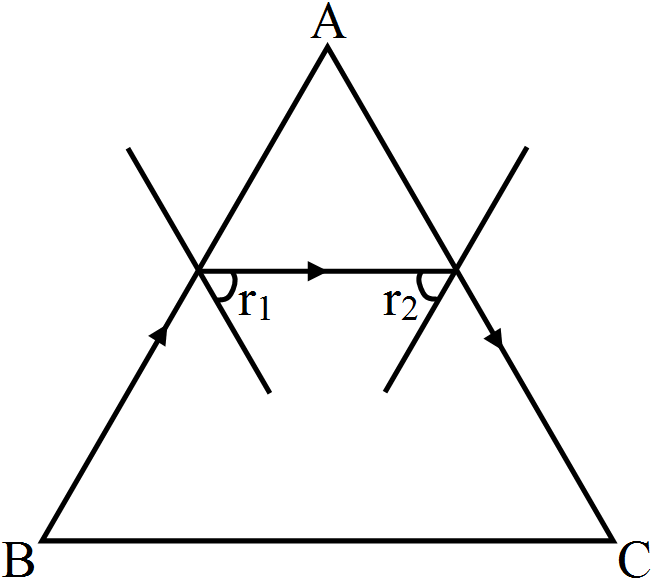
A light ray incident at grazing angle on the face AB of a prism ABC, follows the path shown in the figure. Obtain the relation between the angle of prism A and the refractive index $\mu$ of its material.
Answer
For grazing incidence at the first face.
$\mu=\frac{\frac{\sin}{\pi^2}}{\text{r}_1}=\frac{1}{\sin\text{r}_1}$
$\Rightarrow\text{r}_1=\sin^{-1}\Big(\frac{1}{\mu}\Big)\dots(1)$
At the second face, $\frac{1}{\mu}=\frac{\sin\text{r}_2}{\frac{\sin}{\pi^2}}=\frac{\sin\text{r}_2}{1}$
$\Rightarrow\text{r}_2=\sin^{-1}\Big(\frac{1}{\mu}\Big)\dots(2)$
Also $\text{A}=\text{r}_1+\text{r}_2=2\sin^{-1}\Big(\frac{1}{\mu}\Big)$
View full question & answer
Question 503 Marks
Why are the magnification properties of microscopes and telescopes defined in terms of the ratio of angles and not in terms of the ratio of sizes of objects and images?
Answer
Instruments like telescopes and microscopes deal with objects placed at different distances. Due to some physical factors, there is a relative change in heights not in the angle which the light emerging from them subtends on the lens. So, the magnification properties of instruments are defined in terms of the ratio of angles.
View full question & answer