Questions · Page 4 of 6

M.C.Q (1 Marks)

Question 1511 Mark
Identify the simplest and the most widely used capacitor among the following.
Answer
  1. Parallel plate capacitor.
Explanation:
The simplest and the most widely used capacitor is the parallel plate capacitor. It consists of two large plane parallel conducting plates, separated by a small distance.
View full question & answer
Question 1521 Mark
Earth’s potential is _______?
Answer
  1. Zero.
Explanation:
We consider earth as the storage of infinite positive as well as a negative charge. Therefore, the potential of the earth is always considered to be zero and the potential of every body is measured with respect to earth. That’s why if we connect any charged body to the earth, its potential instantaneously becomes zero.
View full question & answer
Question 1531 Mark
The molecules in which centres of positive and negative charges are separated are called as:
Answer
  1. Polar molecules.
View full question & answer
Question 1541 Mark
Identify the factor on which the capacitance of a parallel plate capacitor does not depend.
Answer
  1. Permeability of the medium between the plates.
Explanation:
The capacitance of a parallel plate capacitor is directly proportional to the area of the plates and permittivity of the medium between the plates. It is indirectly proportional to the distance between the plates.
View full question & answer
Question 1551 Mark
...X... is a machine that can build up high voltages of the order of a few million volts. Here, A refers to:
Answer
  1. Van De Graaff generator.
View full question & answer
Question 1561 Mark
A conductor carries a certain charge. When it is connected to another uncharged conductor of finite capacity, then the energy of the combined system is.
Answer
  1. Less than that of the first conductor.
View full question & answer
Question 1571 Mark
What is the order of potential difference built up by the Van de Graff generator?
Answer
  1. Potential difference of the order of several million volts.
Explanation:
A Van de Graff generator, by means of a moving belt and suitable brushes, transfers charge continuously to a large spherical conducting shell. As a result, a potential difference of the order of several million volts is built up and this can be used for accelerating charged particles.
View full question & answer
Question 1581 Mark
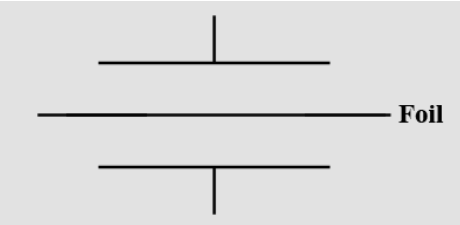
A foil of aluminium of negligible thickness is inserted in between the space of a parallel plate condenser. If the foil is electrically insulated, the capacity of the condenser will:
Answer
  1. remain unchanged
Explanation:
The capacity of condenser before inserting foil is $\text{C}=\frac{\text{A}\epsilon0}{\text{d}}$​​ where A be the area of plate and d be the separation between plates.
After inserting foil the there will be two capacitors in series with capacitance 2C as distance is halved and the series combination of the two will give equivalent capacitance of C, hence, capacity will remain same.
View full question & answer
Question 1591 Mark
Two metal pieces having a potential difference of $800V$ are $0.02m$ apart horizontally. $A$ particle of mass $1.96 \times 10^{-15}\ kg$ is suspended in equilibrium between the plates. If e is the elementary charge, then charge on the particle is:
Answer
SELF
View full question & answer
Question 1611 Mark
A capacitor is charged by a battery. The battery is removed, and another identical uncharged capacitor is connected in parallel. The total electrostatic energy of resulting system.
Answer
  1. Decreases by a factor of 2.
View full question & answer
Question 1621 Mark
On moving a charge of Q coulomb by X cm, W J of work is done, then the potential difference between the points is:
Answer
  1. W/Q *V.
View full question & answer
Question 1631 Mark
The electrostatic force between the metal plates of an isolated parallel plate capacitor C having a charge Q and area A, is:
Answer
  1. Independent of the distance between the plates.
View full question & answer
Question 1641 Mark
Which material sheet should be placed between the plates of a parallel plate condenser in order to increase its capacitance ?
Answer
  1. Mica
Explanation:
Here copper, tin, iron all are conductor so they will decrease the capacitance. The mica sheet is a dielectric or insulator so it will increase the capacitance k times. Where k is the dielectric constant.
View full question & answer
Question 1651 Mark
To obtain $3\ \mu\text{F}$ capacity from three capacitors of $2\ \mu\text{F}$ each, they will be arranged.
Answer
  1. Two capacitors in series and the third in parallel with the combinatioin of first two.
View full question & answer
Question 1661 Mark
A parallel plate capacitor is charged to a certain voltage. Now, if the dielectric material (with dielectric constant k) is removed then the
Answer
  1. None of these
Explanation:
As the capacitor is charged by using cell so potential as well as filed between the plates become constant.
For removing dielectric the capacitance becomes C/ k. Thus capacitance decreases by a factor of k.
View full question & answer
Question 1671 Mark
What is not true of equipotential surface?
Answer
  1. Equipotential surfaces are always spherical.
Explanation:
Equipotential surface
→ P.D difference between two points on the surface is zero always since potential is same everywhere in equipotential surface.
→ The EF is always perpendicular to the surface because there is no potential gradient along any direction parallel to the surface P so no EF parallel to the surface
→ Equipotential surface can have any shape not just sphere.
→ No work is done in moving a charge along the surface, because potential difference is zero.
View full question & answer
Question 1681 Mark
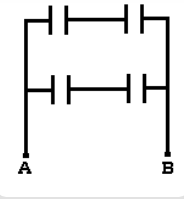
Each capacitor in the circuit shown is a 1F capacitor. What would be the equivalent capacitance between A and B?
Answer
  1. F
Explanation:
Equivalent capacitance of each pair of capacitance in series$=\frac{1\times1}{1+1}\text{F}=0.5\text{F}$
The two series combination are connected in parallel. Hence the net capacitance becomes 0.5F + 0.5F = 1F
View full question & answer
Question 1691 Mark
How is the potential within and on the surface of a conductor?
Answer
  1. Constant
Explanation:
Electric field at any point is equal to the negative of the potential gradient. But inside a conductor, the electric field is zero. Hence, the electric potential is constant throughout the volume of a conductor and has the same value on its surface.
View full question & answer
Question 1701 Mark
An electric dipole is kept in non-uniform elecric field. it experiences?
Answer
  1. A force and a torque.
View full question & answer
Question 1711 Mark
A smaller sphere has potential 50V and a larger sphere has potential 100V. How should they be placed so that if they are connected with the help of a wire, the charge will flow from the smaller sphere to the larger sphere? Both the spheres are conducting and hollow.
Answer
  1. Concentrically
Explanation:
We know that for a conducting sphere, the charge is always distributed on its outer surface. We also know that charge flows from higher potential to lower potential. But if we put the smaller sphere inside the larger sphere and connect them with a conductor, they will act as a single conductor and charge will be distributed to its outer surface, i.e. charge will flow to the larger sphere.
View full question & answer
Question 1721 Mark
What is the dimension of the dipole moment?
Answer
  1. [I L T]
Explanation:
Dipole moment = charge × length of the dipole. The electric charge has dimensions [I T] and length has dimensions [L]. Therefore, the dipole moment has the dimension [I T L] and has unit C × m of C × m.
View full question & answer
Question 1731 Mark
Which one of the following gives the resultant capacitor when capacitors are joined in series?
Answer
  1. The reciprocal of the sum of the reciprocals of the individual capacitors.
Explanation:
The resultant capacitor when capacitors are joined in series is the reciprocal of the sum of the reciprocals of the indivisual capacitors.
View full question & answer
Question 1741 Mark
In which type of molecule positive and negative charges does not coincide with each other?
Answer
  1. Polar
Explanation:
A molecule in which the centre of mass of positive and negative charges does not collide with each other is called a polar molecule. They have a permanent dipole moment. They have unsymmetrical shapes.
View full question & answer
Question 1751 Mark
. A surface that has the same electrostatic potential at every point on it is known as _____________.
Answer
  1. Equipotential surface
Explanation:
Equipotential surface is a surface formed by the locus of all the points which are at the same potential. Equipotential surfaces do not intersect with each other and are closely spaced in the region of strong electric fields and vice-versa.
View full question & answer
Question 1771 Mark
Each plate of a parallel plate capacitor has a charge q on it. The capacitor is now connected to a batter. Now:
Answer
  1. The facing surfaces of the capacitor have equal and opposite charges.
  2. The two plates of the capacitor have equal and opposite charges.
  1. The outer surfaces of the plates have equal charges.
Explanation:
In H.C Verma the answer is (a), (c), (d). But according to us the answer should be (a), (b), (d) all these options are the properties of a capacitor and the option (c) is incorrect because the battery is a source of energy not charge. Moreover if a capacitor plates have equal charge on outside and equal charge on inside then one can think that the charge on the plates must be also equal so option (b) cant be incorrect.
View full question & answer
Question 1781 Mark
The potential energy of a system of two charges is negative when:
Answer
  1. One charge is positive and other is negative.
View full question & answer
Question 1791 Mark
When a dielectric is introduced between the plates of a condenser, the capacity of condenser:
Answer
  1. increases
Explanation:
If the empty Condensor has capacity C, then its capacity with dielectric is given by C′ = kC, where k is the dielectric constant of the dielectric material. k can never be less than 1.
View full question & answer
Question 1801 Mark
A diode, a resistor and a 50Hz AC source are connected in series. The number of current pulses per second through the resistor is:
Answer
  1. 50
Explanation:
The number of current pulses is equal to the frequency of the AC source because one current pulse passes through the diode for one oscillation of the AC source.
View full question & answer
Question 1811 Mark
is equal to the work done by an external agent in carrying a unit of positive charge from the arbitrarily chosen reference point (usually infinity) to that point without any acceleration.
Answer
  1. Electric potential.
Explanation:
Electric potential is equal to work done by an external agent in carrying a unit positive charge from the arbitrary chosen reference point to that point without any acceleration.
View full question & answer
Question 1831 Mark
An electric dipole is placed at the centre of a sphere, choose the correct options:
Answer
  1. Flux is zero across the surface.
Explanation:
A dipole contains two equal and opposite charge. So total charge inside the sphere will be zero.
By Gauss's law, the flux across a surface is depends on the charge inside the surface. As total charge is zero inside the sphere so the flux through the sphere will be zero.
As the electric field is resultant effect due to all charges so there will be field exists on the surface.
As the sphere contains two equal and opposite charges so there may be exists equipotential surface in the sphere.
View full question & answer
Question 1841 Mark
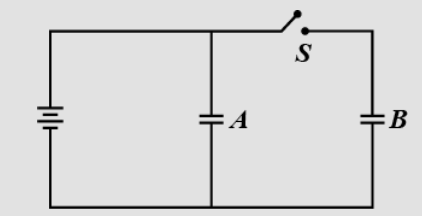
Two identical air filled parallel plate capacitors are charged to the same potential in the manner shown by closing the switch $S.$ If now the switch $S$ is opened and the space between the plates is filled with a dielectric of relative permittivity $ε_{r​},$ then:
Answer
After switch $S$ is opened, as the Capacitor $A$ is connected across the battery, its potential difference is fixed at steady state $($i.e., when capacitor is fully charged$).$
Capacitor $B$ is isolated, so its charge gets fixed. But as we insert the dielectric, its capacitance changes, thus its potential difference also changes.
View full question & answer
Question 1871 Mark
A parallel plate capacitor is charged. If the plates are pulled apart:
Answer
  1. The potential difference increases.
Explanation:
Capacitance of a parallel plate capacitor.
$\text{C}=ε0\text{AdC}=ε0\text{Ad}$
A parallel plate capacitor is charged (battery is disconnected) then the plates are pulled apart, the capacitance decreases while the charge remains the same.
$\because$ Potentialdifference = ChargeCapacitance∵Potentialdifference = ChargeCapacitance.
$\therefore$ potential difference increases.
View full question & answer
Question 1881 Mark
A pendulum ( positively charged and hinged at some length above the plate) is swinging above a parallel plate (infinitely large and having negative charge), now consider the following statements, (consider gravity):
Answer
  1. Angular momentum about the hinge point of the ball will be max at lowest point.
Explanation:
Angular momentum about the hinge point of the ball will be max at point. mV will be max at closer point because law of conservation says that the swinging energy will be gathered when it will be at lowest point. The potential energy is maximum.
View full question & answer
Question 1891 Mark
A positively charged particle is released from rest in an uniform electric field. The electric potential energy of the charge:
Answer
  1. Decreases because the charge moves along the electric field.
The positive charge will experience an electrostatic force whose direction will be along the direction of electric field.
In other words, positive charge will move from high electrostatic potential to low electrostatic potential.
Work will be done by electric filed on the charge and the electric potential energy of the charge will decrease.
View full question & answer
Question 1901 Mark
When air in a capacitor is replaced by a medium of dielectric constant K, the capacity:
Answer
  1. Increases K times.
View full question & answer
Question 1921 Mark
 The electrostatic potential on the perpendicular bisector due to an electric dipole is _____________.
Answer
  1. Zero
Explanation:
The electrostatic potential on the perpendicular bisector due to an electric dipole is zero.
View full question & answer
Question 1931 Mark
When moving electron comes closer to other stationary electron, then its kinetic energy and potential energy respectively _____ and _____.
Answer
  1. Decreases, increases
Explanation:
When electron comes closer to the other stationary electron, its kinetic energy decreases because of repulsion between them. As per conservation of energy, the potential energy increases.
View full question & answer
Question 1941 Mark
If the capacitors having capacitance $C_1$ and $C_2$ are connected in series then their resultant capacitance is given by:
Answer
$1/C = 1/C_1^+ 1/C_2$
View full question & answer
Question 1951 Mark
Work done by an external force in bringing a unit positive charge from infinity to a point is called as:
Answer
  1. Electric potential at that point.
View full question & answer
Question 1961 Mark
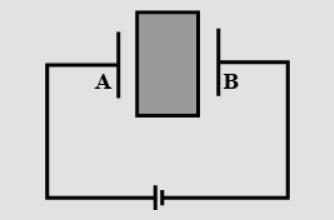
An insulator plate is passed between the plates of a capacitor. Then, current:
Answer
  1. First flows from B to A and then from A to B
View full question & answer
Question 1971 Mark
The plate current in a diode is zero. It is possible that:
Answer
  1. The plate voltage is zero.
  2. The plate voltage is slightly negative.
  3. The plate voltage is slightly positive.
  4. The temperature of the filament is low.
Explanation:
The plate current varies directly with the plate voltage. Therefore, if the plate voltage is zero, the plate current is also zero. Due to the same reason, if the plate voltage is negative, the plate current will be zero. Now, if the plate is slightly positive, then it may be the reason that the plate voltage is not able to reduce the effect of space charge. Hence, the current may be zero. Now, as the temperature of the filament is low, it will not be able to emit electrons and the resulting plate current will be zero. Hence, all the options are possible.
View full question & answer
Question 1991 Mark
Two point charges 10C and -10C are placed at a certain distance. What is the electric potential of their midpoint?
Answer
  1. Zero.
Explanation:
Electric potential is a scalar quantity and its value is solely dependent on the charge near it and the distance from that charge. In this case, the point is equidistant from the two point charges and the point charges have the same value but opposite nature. Therefore equal but opposite potentials are generated due to the charges and hence the net potential at midpoint becomes zero.
View full question & answer
Question 2001 Mark
Equipotential surfaces:
Answer
  1. Are closer in regions of large electric fields compared to regions of lower electric fields.
  2. Will be more crowded near sharp edges of a conductor.
  3. Will be more crowded near regions of large charge densities.
Equipotential surfaces are closer in regions of large electric fields because electric field intensity is inversely proportional to the separation between equipotential surfaces. 
As the electric field intensities is large near sharp edges of a charged conductor or near the regions of large charge densities. Therefore, numbers of equipotential surfaces are closer to such places or in other words they are more crowded.
View full question & answer
M.C.Q (1 Marks) - Page 4 - Physics STD 12 Science Questions - Vidyadip