Questions · Page 3 of 6

M.C.Q (1 Marks)

Question 1011 Mark
Electric potential can be calculated in a:
Answer
  1. Both static and dynamic electric field.
Explanation:
An electric potential can be calculated in either a static (or time invariant) or a dynamic (varying with time) electric field at a specific time in units of Joules per Coulomb or Volts.
View full question & answer
Question 1021 Mark
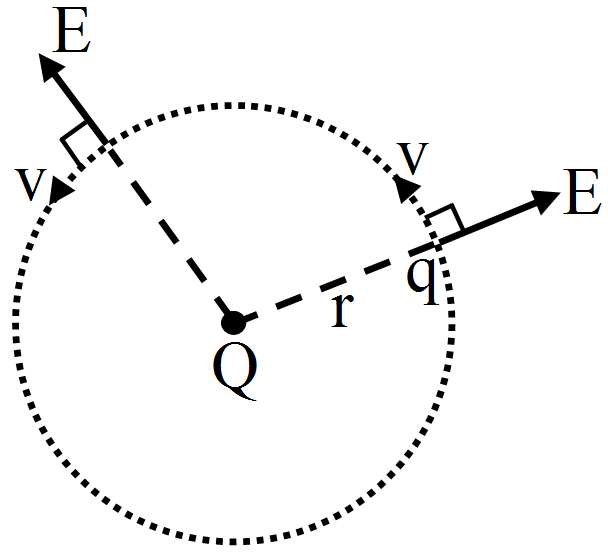
A point charge q is rotated along a circle in the electric field generated by another point charge Q. The work done by the electric field on the roatating charge in one complete revolution is:
Answer
  1. Zero.
Explanation:

In a circle Electric field due tot 'Q' is always perpendicular to the displacement oifthe charge 'q'.
Workdone $=\vec{\text{F}}.\vec{\text{d}}$
$=\big(\text{q}\vec{\text{E}}\big).\vec{\text{d}}=\text{q}\big(\vec{\text{E}}.\vec{\text{d}}\big)=0$
$\therefore\vec{\text{E}}\ \bot\ \vec{\text{d}}$
Workdoen by the Electric field on the rotating charge in one complete revolution is zero.
View full question & answer
Question 1031 Mark
‘X’ is a substance which does not allow the flow of charges through it but permits them to exert electrostatic forces on one another through it. Identify X.
Answer
  1. Dielectric
Explanation:
A dielectric is a substance which does not allow the flow of charges through it but permits them to exert electrostatic forces on one another through it. A dielectric is essentially an insulator which can be polarized through small localized displacements of its charges.
View full question & answer
Question 1041 Mark
What is the use of a Van de Graff generator?
Answer
  1. Van de Graff generator is used to create a large amount of static electricity.
Explanation:
Van de Graff generator is used to create a large amount of static electricity. A Van de Graff generator uses static electricity and a moving belt to charge a large metal sphere to a very high voltage. As the belt moves, electrons move from the rubber belt to the silicon roller, causing the belt to become positively charged and the roller to become negatively charged. As a result, it builds up positive charge.
View full question & answer
Question 1051 Mark
Statement(A): Negative charges always move from a higher potential to lower potential point
Statement (B): Electric potential is vector.
Answer
  1. Both A and B false.
Explanation:
Positive charges move from higher to lower potential whereas negative charges move from lower to higher potential. Hence, A is false. Electric potential does not have direction and is a scalar quantity.
View full question & answer
Question 1061 Mark
A sheet of aluminium foil of negligible thickness is introduced between the plates of a capacitor. The capacitance of the capacitor:
Answer
  1. Remains unchanged.
View full question & answer
Question 1081 Mark
On decreasing the distance between the plates of a parallel plate capacitor, its capacitance:
Answer
  1. Increases.
View full question & answer
Question 1091 Mark
How is the electric field between the two plates of a parallel plate capacitor?
Answer
  1. Uniform
Explanation:
The direction of the electric field is from the positive to the negative plate. In the inner region, between the two capacitor plates, the electric fields due to the two charged plates add up. Hence, the field is uniform throughout.
View full question & answer
Question 1111 Mark
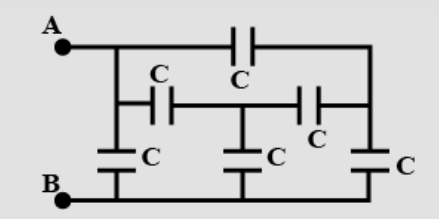
The equivalent capacitance between A and B is:
Answer
  1. 2C
Explanation:
For IMAGE 01 AND 02:
[Loops AXBY forms wheat stone bridge ]
So, effective capacitance will be for the bridge C
In IMAGE 03 the parallel combination 
C′ = C + C = 2C
View full question & answer
Question 1131 Mark
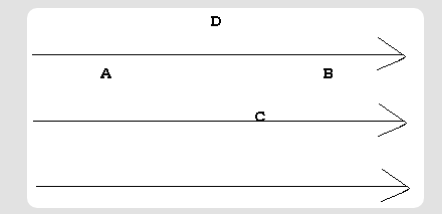
A negative charge is located in the uniform electric field between two plates (not shown).
Where in the diagram will the electron have the greatest change in potential energy before hitting the one of the plates?
Answer
  1. B
Explanation:
A charged species tends to move from place of higher potential energy to that of lower potential energy.
The direction of electric field is from left to right. This means that there is a positively charged plate on the left side, closest to A and farthest from B.
An electron being negatively charged plate always moves towards left here.
View full question & answer
Question 1141 Mark
What happens to the capacitance when a dielectric material is inserted between the plates of a parallel plate capacitor?
Answer
When a dielectric material is inserted between the plates of the parallel plate capacitor, the capacitance of the capacitor increases with a factor of $K.$ That is $C = KC_0.$
View full question & answer
Question 1151 Mark
Which of the following quantities do not depend on the choice of zero potential or zero potential energy?
Answer
  1. Potential difference between two points.
View full question & answer
Question 1161 Mark
The capacitance of a capacitor does not depend on:
Answer
  1. The charges on the plates.
Explanation:
The capacitance of a capacitor is given by:
$\text{C}=\frac{\epsilon_0\text{A}}{\text{d}}$
Here, A is the area of the plates of the capacitor and d is the distance between the plates.
So, we can clearly see that the capacitance of a capacitor does depend on the size and shape of the plates and the separation between the plates; it does not depend on the charges on the plates.
View full question & answer
Question 1171 Mark
A hollow metal sphere of radius 5cm is charged such that the potential on its surface is 10V. The potential at a distance of 2cm from the centre of the sphere is:
Answer
  1. 10V.
View full question & answer
Question 1181 Mark
What is the net electric field in the outer regions above the upper plate and below the lower plate in a parallel plate capacitor?
Answer
  1. Zero
Explanation:
In the outer regions above the upper plate and below the lower plate, the electric fields due to the two charged plates cancel out. Hence, the net electric field in the outer regions above the plate and below the lower plate is zero.
View full question & answer
Question 1191 Mark
In order to increase the capacity of a parallel plate condenser, one should introduce a sheet of between the plates (assume that the space is completely filled).
Answer
  1. Mica
Explanation:
Dielectric constant is the factor by which the capacitance increases from its value in air when a dielectric is introduced between the plates.
Mica, among the materials mentioned above, is a dielectric material and hence to be used to increase the capacity.
View full question & answer
Question 1201 Mark
Which of the following statement is true about the relation between electric field and potential?
Answer
  1. Both the statements (a) and (b) are correct.
Explanation:
The magnitude of electric field is given as the change in magnitude of potential per unit displacement as
View full question & answer
Question 1211 Mark
The surface with a constant value of potential at all points on the surface is called as:
Answer
  1. Equipotential surface.
View full question & answer
Question 1221 Mark
What is the total work done on moving a test charge on an equipotential surface?
Answer
  1. Zero
Explanation:
The potential difference between any two points on an equipotential surface is zero.
Work done = Test charge x potential difference(0)
View full question & answer
Question 1231 Mark
Among identical spheres A and B having charges −15C and −16C:
Answer
  1. −15C is at higher potential.
Explanation:
Potential at surface of a sphere of radius r is V = kQ/ r
As identical sphere so r is same for both, Thus V will depend on charge Q.
So when Q is more, potential will be more.
Since −15 C is more than −16 C, so −15 C sphere will have higher potential.
View full question & answer
Question 1241 Mark
 The formula for electrostatic potential is _____________.
Answer
  1. Electrostatic potential = Work done/ charge
Explanation:
The formula for electrostatic potential is Electrostatic potential = Work done/ charge.
View full question & answer
Question 1251 Mark
An electric dipole is kept in the origin with charges along the x axis, now choose the correct option,
Answer
  1. Equipotential surface is on yz plane.
Explanation:
Electric potential of every point  lying on the YZ  plane is zero as every point is at equal distance from negative and positive charge of dipole. So, the plane will be equipotential.
View full question & answer
Question 1261 Mark
What is the ratio of the polarization to $ε_o$ times the electric field called?
Answer
The ratio of the polarization to $ε_o$ times the electric field is called the electric susceptibility of the dielectric. It describes the electrical behaviour of a dielectric.
View full question & answer
Question 1281 Mark
When is the effective capacitance of a capacitor increased?
Answer
The effective capacitance of a capacitor is increased when the capacitors are connected in parallel. When the capacitors are connected in parallel, the equivalent capacitance is given by: $C_p = C_1 + C_2 + C_3 +…….$
When the capacitors are connected in parallel, the potential difference across each capacitor is the same.
View full question & answer
Question 1311 Mark
Consider the following statements regarding series grouping of capacitors and select the correct statements.
  1. Charge on each capacitor remains same and equals to the main charge supplied by the battery.
  2. Potential difference and energy distributes in the reverse ratio of capacitance.
  3. Effective capacitance is even less than the least of teh individual capacitances.
Answer
  1. I, II and III.
View full question & answer
Question 1331 Mark
Which of the following is an example of a molecule whose centre of mass of positive and negative charges coincide each other?
Answer
$CO_2$ is a molecule in which the centre of mass of positive and negative charges collide with each other and is called a non$-$polar molecule. They normally have zero dipole moment. They have symmetrical shapes.
View full question & answer
Question 1341 Mark
Which of the following statements is correct?
Answer
  1. The surface of a charged conductor is equipotential.
Explanation:
In conductors, charges are equally distributed over the surface of the conductor. Therefore the potential throughout the surface is the same, i.e. equipotential. The electric field is a vector quantity and the field lines cut the equipotential surfaces at 90 degrees. The field lines due to a point charge are radial.
View full question & answer
Question 1361 Mark
‘X’ is the phenomenon of making a region free from any electric field. Identify X.
Answer
  1. Electrostatic shielding
Explanation:
The phenomenon of making a region free from any electric field is called electrostatic shielding. It is based on the fact that the electric field vanishes inside the cavity of a hollow conductor.
View full question & answer
Question 1371 Mark
In which type of molecule positive and negative charges coincide with each other?
Answer
  1. Non-polar
Explanation:
A molecule in which the centre of mass of positive and negative charges collide with each other is called a non-polar molecule. They normally have zero dipole moment. They have symmetrical shapes.
View full question & answer
Question 1381 Mark
Find the true statement.
Answer
  1. A Van de Graff generator produces large voltage and less current.
Explanation:
A Van de Graff generators produces large voltage and less current. A Van de Graff generator is an electrostatic generator which creates very high electric potentials. It produces very high voltage direct current electricity at low current levels.
View full question & answer
Question 1391 Mark
The maximum electric field that a dielectric medium can withstand without break-down is called its:
Answer
  1. Dielectric strength.
View full question & answer
Question 1401 Mark
The potential gradient at which the dielectric of a condenser just gets punctured is called:
Answer
  1. Dielectric strength.
View full question & answer
Question 1421 Mark
A cube of a metal is given a positive charge Question: For this system, which of the following statements is true?
Answer
  1. Electric field varies within the cube.
View full question & answer
Question 1441 Mark
The work done against electrostatic force gets stored in which form of energy?
Answer
  1. Potential energy
Explanation:
The work done against electrostatic force gets stored in the form of potential energy.
View full question & answer
Question 1451 Mark
What is the unit of electric potential difference?
Answer
  1. Volt
Explanation:
Unit of electric potential difference is volt(V).
View full question & answer
Question 1461 Mark
In an electrical circuit, which of the following quantities is analogous to temperature?
Answer
  1. Potential
Explanation:
When there is a temperature difference, heat flows from high temperature to low temperature. Similarly, when there is a potential difference electric current flows from high potential to low potential. Hence, potential is analogous to temperature.
View full question & answer
Question 1471 Mark
The electrostatic potential on the surface of a charged conducting sphere is $100V$. Two statments are made in this regard:
$S_1$ : At any point inside the sphere, electric intensity is zero.
$S_2$ : At any point inside the sphere, the electrostatic potential is $100V$.
Which of the following is a correct statement?
Answer
  1. $S_1$ is true $, S_2$ is also true and $S_1$ is the cause of $S_2$.
  1. We know, the electric field intensity E and electric potential V are related $\text{E}=\frac{\text{dV}}{\text{dr}}$.
    If electric field intensity $E= 0,$ then $\frac{\text{dV}}{\text{dr}}=0$. It means, $E = 0$ inside the charged conducting sphere causes uniform potential inside the sphere. Hence uniform electrostatic potential $100 V$ will be at any point inside the sphere.
    Important points:
  2. The electric field zero does not necessary imply that electric potential is zero. $E.g$., the electric field intensity at any point inside the charged spherical shell is zero but there may exist non $-$ zero electric potential.
  3. If two charged particles of same magnitude but opposite sign are placed, the electric potential at the midpoint will be zero but electric field is not equal to zero.
View full question & answer
Question 1491 Mark
If a unit positive charge is taken from one point to another over an equipotential surface, then:
Answer
  1. No work is done.
View full question & answer
Question 1501 Mark
What is the net electrostatic field in the interior of a conductor?
Answer
  1. Zero
Explanation:
Net electrostatic field is zero in the interior of a conductor. When a conductor is placed in an electric field, its free electrons begin to move in the opposite direction. Negative charges are induced on the left end and positive charges on the right end of the conductor. The process continues until the electric field set up by induced charges becomes equal and opposite the external field.
View full question & answer
M.C.Q (1 Marks) - Page 3 - Physics STD 12 Science Questions - Vidyadip