Questions

Case study (4 Marks)

Take a timed test

28 questions · self-marked practice — reveal the answer and mark yourself.

Question 14 Marks
Deduce the expression for the torque $\overrightarrow{\tau}$ acting on a planar loop of area $\overrightarrow{\text{A}}$ and carrying current I placed in a uniform magnetic field $\overrightarrow{\text{B}}.$ If the loop is free to rotate, what would be its orientation in stable equilibrium?
Answer
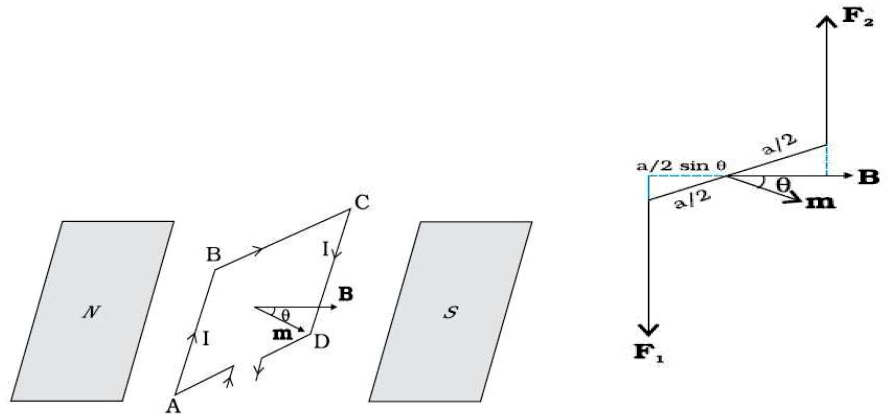

Force on each perpendicular arm:
$?_1 = ?_2 = ?\ ?\ ?$
Moment of couple = ? ? ?. ? sin ?
$? = ?\ ??\ ?\ ????$
? = I ?? ???? $\overrightarrow{\tau} =\overrightarrow{\text{IA}}\times\overrightarrow{\text{B}}$
When the plane of the loop is perpendicular to the magnetic field, the loop will be in stable equilibrium.$(\overrightarrow{\text{A}}||\overrightarrow{\text{B}}) , \Rightarrow\theta = 0^{\circ}$
$\overrightarrow{\text{M}} = $ Equivalent magnetic moment of the planer loop $ = \overrightarrow{\text{IA}}$
$\therefore \text{Torque} =\overrightarrow{\text{M}}\times\overrightarrow{\text{B}} = \overrightarrow{\text{IA}}\times\overrightarrow{\text{B}}$
$\text{|??????|} = \text{IAB}\sin\theta$.

View full question & answer
Question 24 Marks
Out of the two magnetic materials, 'A' has relative permeability slightly greater than unity while oB' has less than unity. Identify the nature of the materials 'A' and 'B'. Will their susceptibilities be positive or negative?
Answer
A: Paramagnetic
B: Diamagnetic
Susceptibility:
For A: positive
For B: negative.
View full question & answer
Question 34 Marks
Out of the two magnetic materials, 'A' has relative permeability slightly greater than unity while 'B' has less than unity. Identify the nature of the materials 'A' and 'B'. Will their susceptibilities be positive or negative?
Answer
A: Paramagnetic
B: Diamagnetic
Susceptibility:
For A: positive
For B: negative.
View full question & answer
Question 44 Marks
Out of the two magnetic materials, 'A' has relative permeability slightly greater than unity while 'B' has less than unity. Identify the nature of the materials 'A' and 'B'. Will their susceptibilities be positive or negative?
Answer
A: Paramagnetic
B: Diamagnetic
Susceptibility:
For A: positive
For B: negative.
View full question & answer
Question 54 Marks
The magnetic field due to the earth has a horizontal component of $26\mu\text{T}$ at a place where the dip is 60°. Find the vertical component and the magnitude of the field.
Answer
$\delta(\text{dip}) =60^\circ$$\text{B}_\text{H}=\text{B}\cos60^\circ$
$\Rightarrow\text{B}=52\times10^{-6}=52\mu\text{T}$
$\text{B}_\text{v}=\text{B}\sin\delta=52\times10^{-6}\frac{\sqrt{3}}{2}$
$=44.98\mu\text{T} \approx45\mu\text{T}$
View full question & answer
Question 64 Marks
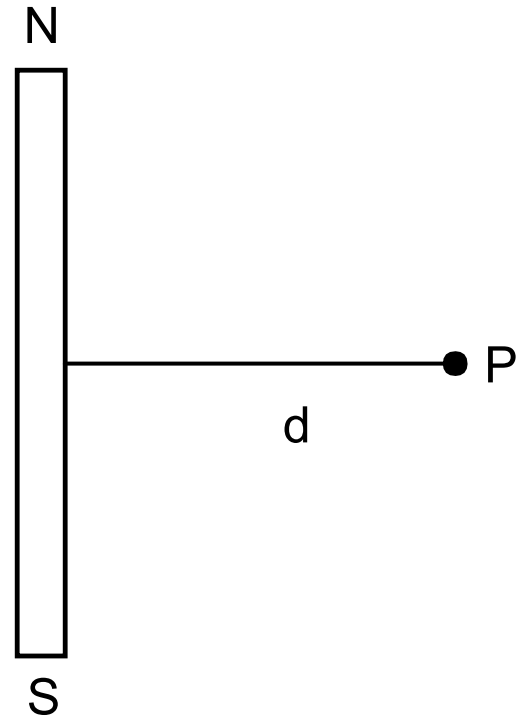
A long bar magnet has a pole strength of 10A-m. Find the magnetic field at a point on the axis of the magnet at a distance of 5cm from the north pole of the magnet.
Answer
$\text{m}=10\text{A-m,}$ $\text{d}=5\text{cm}=0.05\text{m}$ $\text{B}=\frac{\mu_0\text{m}}{4\pi\text{r}^2}=\frac{10^{-7}\times10}{(5\times10^{-2})^2}=\frac{10^{-2}}{25}=4\times10^{-4}\text{ Tesla}$
View full question & answer
Question 74 Marks
The needle of a dip circle shows an apparent dip of 45° in a particular position and 53° when the circle is rotated through 90°. Find the true dip.
Answer
We know:
$\text{B}_\text{H}=\frac{\mu_0\text{in}}{2\text{r}}$
Give: $\text{B}_\text{H}=3.6\times10^{-5}\times\text{T}$
$\text{i}=10\text{mA}=10^{-2}\text{A}$
$\text{n}=?$
$\theta=45^\circ$
$\tan\theta=1$
$\text{r}=10\text{cm}=0.1\text{m}$
$\text{n}=\frac{\text{B}_\text{H}\tan\theta\times2\text{r}}{\mu_0\text{i}}$
$=\frac{3.6\times10^{-5}\times2\times1\times10^{-1}}{4\pi\times10^{-7}\times10^{-2}}$
$=0.5732\times10^{3} \approx573\text{ turns}$
View full question & answer
Question 84 Marks
Two long bar magnets are placed with their axes coinciding in such a way that the north pole of the first magnet is 2·0cm from the south pole of the second. If both the magnets have a pole strength of 10A-m, find the force exerted by one magnet on the other.
Answer
$\text{m}_1=\text{m}_2=10\text{A-m}$
$\text{r}=2\text{cm}=0.02\text{m}$
we know
Force exerted by tow magnetic poles on each other $=\frac{\mu_0\text{m}_1\text{m}_2}{4\pi\text{ r}^2}=\frac{4\pi\times10^{-7}\times10^{2}}{4\pi\times4\times10^{-4}}=2.5\times10^{-2}\text{N}$
View full question & answer
Question 94 Marks
A moving-coil galvanometer has a 50-turn coil of size 2cm × 2cm. It is suspended between the magnetic poles producing a magnetic field of 0.5T. Find the torque on the coil due to the magnetic field when a current of 20mA passes through it.
Answer
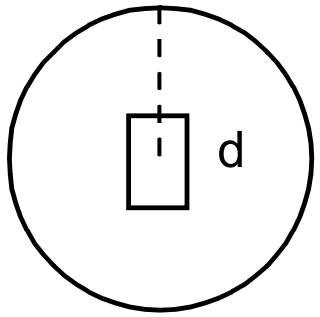
Given $\theta=37^\circ$$\text{d}=10\text{cm}=0.1\text{m}$
We know
$\frac{\text{M}}{\text{B}}=\frac{4\pi}{\mu_0}\frac{(\text{d-}^2\ell^2)^2}{2\text{d}}\tan\theta$
$=\frac{4\pi}{\mu_0}\times\frac{\text{d}^4}{2\text{d}}\tan\theta$ [As the magnet is short]
$=\frac{4\pi}{4\pi\times10^{-7}}\times\frac{(0.1)^3}{2}\times\tan37^\circ$
$=0.5\times0.75\times1\times10^{-3}\times10^7$
$=3.75\times10^3\text{A-m}^2\text{T}^{-1}$
View full question & answer
Question 104 Marks

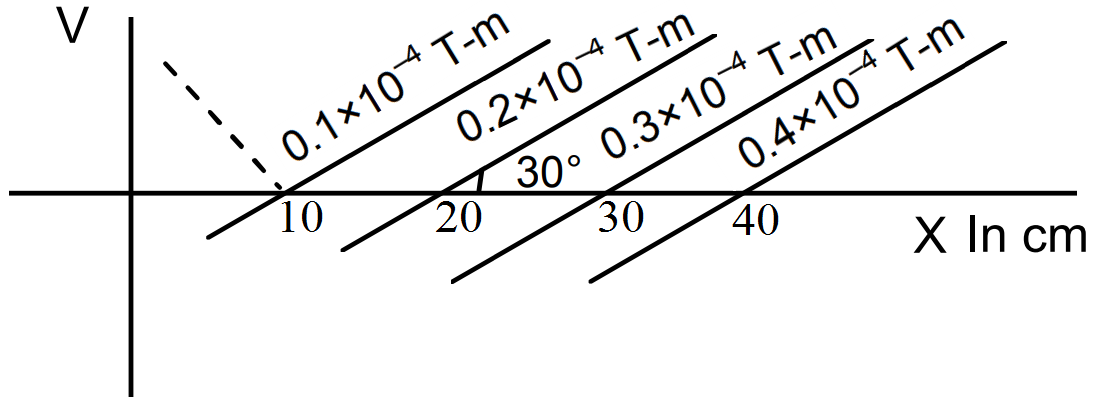
Figure shows some of the quipotential surfaces of the magnetic scalar potential. Fmd the magnetic field B at a point in the region.
Answer
Here$\text{dx}=10\sin30^\circ\text{cm}=5\text{cm}$
$\frac{\text{dV}}{\text{dx}}=\text{B}=\frac{0.1\times10^{-4}\text{T-m}}{5\times10^{-2}\text{m}}$
Since B is perpendicular to equipotential surface.
Here it is at angle 120° with (+ve) x-axis and $B = 2 \times 10^{-4}T$
View full question & answer
Question 114 Marks
A magnetic needle is free to rotate in a vertical plane which makes an angle of 60° with the magnetic meridian. If the needle stays in a direction making an angle of $\tan^{-1}\Big(\frac{2}{\sqrt{3}}\Big)$ with the horizontal, what would be the dip at that place?
Answer
Given:
Angle made by the ma by the magnetic meridian with the plane of rotation of the needle, $\theta=60^\circ$ Angle made by the needle With the horizontal, $\delta_1=\tan^{-1}\Big(\frac{2}{\sqrt{3}}\Big)$ If $\delta$ is the angle of dip, then.
$\tan\delta_1=\frac{\tan\delta}{\cos\theta}$
$\Rightarrow\tan\delta=\tan\delta\cos\theta$
$\Rightarrow\tan\delta=\tan\Big(\tan^{-1}\frac{2}{\sqrt{3}}\Big)\cos60^\circ$
$\Rightarrow\tan\delta=\frac{2}{\sqrt{3}}\times\frac{1}{2}=\frac{1}{\sqrt{3}}$
$\Rightarrow\delta=30^\circ$
View full question & answer
Question 124 Marks
A uniform magnetic field of $0.20 \times 10^{-3} T$ exists in the space. Find the change in the magnetic scalar potential as one moves through 50cm along the field.
Answer
$\text{B}=-\frac{\text{dv}}{\text{dt}}\Rightarrow\text{dv}=-\text{B dt}$$=-0.2\times10^{-3}\times0.5=-0.1\times10^{-3}\text{T-m}$
Since the sigh is-ve therefore potential decreases.
View full question & answer
Question 134 Marks
A tangent galvanometer shows a deflection of 45° when 10mA of current is passed through it. If the horizontal component of the earth's magnetic field is $B_H = 3.6\times 10^{-5} T$ and radius of the coil is 10cm, find the number of turns in the coil.
Answer
$\text{n}=50$
$\text{i}=20\times10^{-3}\text{A}$
$\text{A}=2\text{cm}\times2\text{cm}=2\times2\times10^{-4}\text{m}^{2}$
$\text{B}=0.5\text{T}$
$\tau =\text{ni}(\vec{\text{A}}\times\vec{\text{B}})=\text{ni}\text{AB}\sin90^\circ$
$=50\times20\times10^{-3}\times4\times10^{-4}\times0.5$
$=2\times10^{-4}\text{N-M}$
View full question & answer
Question 144 Marks
The magnetic moment of the assumed dipole at the earth's centre is $8.0 \times 10^{22}A-m^2$. Calculate the magnetic field B at the geomagnetic poles of the earth. Radius of the earth is 6400km.
Answer

The geomagnetic pole is at the end on position of the earth.
$\text{B}=\frac{\mu_0}{4\pi}\frac{2\text{M}}{\text{d}^3}=\frac{10^{-7}\times2\times8\times10^{22}}{(6400\times10^{3})^{3}}\approx60\times10^{-6}\text{t}=60\mu\text{T}$
View full question & answer
Question 154 Marks
If the earth's magnetic field has a magnitude $3.4 \times 10^{-5} T$ at the magnetic equator of the earth what would be its value at the earth's geomagnetic poles?
Answer
$\vec{\text{B}}=3.4\times10^{-5}\text{T}$
Given: $\frac{\mu_0}{4\pi}\frac{\text{M}}{\text{R}^{3}}=3.4\times10^{-5}$
$\Rightarrow\text{M}=\frac{3.4\times10^{-5}\times\text{R}^3\times4\pi}{4\pi\times10^{-7}}=3.4\times10^2\text{R}^3$
$\vec{\text{B}}\text{ at}\text{ poles}=\frac{\mu_0}{4\pi}\frac{2\text{M}}{\text{R}^3}=6.8\times10^{-5}\text{T}$
View full question & answer
Question 164 Marks
To keep valuable instruments away from the earth's magnetic field, they are enclosed in iron boxes. Explain.
Answer
As we know that iron have high permeability, therefore it will provide easy path for the magnetic field lines to pass. As a result of this, all the magnetic field lines of earth's magnetic field will prefer to pass through the wall of the box making magnetic field inside the box zero. Hence, it will keep the valuable instruments away from the earth's magnetic field.
View full question & answer
Question 174 Marks
When a ferromagnetic material goes through a hysteresis loop, its thermal energy is increased. Where does this energy come from?
Answer
When a ferromagnetic material is taken through the cycle of magnetisation, magnet dipoles of the material orient and reorient with time. This molecular motion within the material results in the production of heat, which increses thermal energy of material.
View full question & answer
Question 184 Marks
A magnetic dipole of magnetic moment $0.72A-m^2$ is placed horizontally with the north pole pointing towards bsouth. Find the position of the neutral point if the horizontal component of the earth's magnetic field is $18\mu\text{T.}$
Answer

When the magnet is such that its North faces the geographic south of earth. The neutral point lies along the axial line of the magnet.
$\frac{\mu_0}{4\pi}\frac{2\text{M}}{\text{d}^3}=18\times10^{-6}$
$\Rightarrow\frac{10^{-7}\times2\times0.72}{\text{d}^3}=18\times10^{-6}$
$\Rightarrow\text{d}^3=\frac{2\times0.7\times10^{-7}}{18\times10^{-6}}$
$\Rightarrow\text{d}=\Big(\frac{8\times10^{-9}}{10{-6}}\Big)^\frac{1}{3}$
$=2\times10^{-1}\text{m}=20\text{cm}$
View full question & answer
Question 194 Marks
A magnetic dipole of magnetic moment $1.44A-m^2$ is placed horizontally with the north pole pointing towards north. Find the position of the neutral point if the horizontal component of the earth's magnetic field is $18 \mu\text{T}.$
Answer

We know for a magnetic dipole with its north pointing the north, the neutral point in the broadside on position

Again $\vec{\text{B}}$ in this case $=\frac{\mu_0\text{M}}{4\pi\text{d}^3}$
$\therefore\frac{\mu_0\text{M}}{4\pi\text{d}^3}=\overrightarrow{\text{B}_\text{H}}$ due to earth
$\Rightarrow\frac{10^{-7}\times1.44}{\text{d}^3}=18\mu\text{T}$
$\Rightarrow\frac{10^{-7}\times1.44}{\text{d}^3}=18\times10^{-6}$
$\Rightarrow\text{d}^3=8\times10^{-3}$
$\Rightarrow \text{d}=2\times10^{-1}\text{m}=20\text{cm}$
In the plane bisecting the dipole.
View full question & answer
Question 204 Marks
A magnetic dipole of magnetic moment $0.72\sqrt{2}\text{ A-m}^2$ -is placed horizontally with the north pole pointing towards east. Find the position of the neutral point if the horizontal component of the earth's magnetic field is $18\mu\text{T.}$
Answer

Magnetic moment $=0.72\sqrt{2}\text{ A-m}^2=\text{m}$
$\text{B}=\frac{\mu_0\text{M}}{4\pi\text{d}^3}$
$\text{B}_\text{H}=18 \mu\text{T}$
$\Rightarrow\frac{4\pi\times10^{-7}\times0.72\sqrt{2}}{4\pi\times\text{d}^3}=18\times10^{-6}$
$\Rightarrow\text{d}^3=\frac{0.72\times1.414\times10^{-7}}{18\times10^{-6}}=0.005656$
$\Rightarrow\text{d}\approx0.2\text{m}=20\text{cm}$
View full question & answer
Question 214 Marks
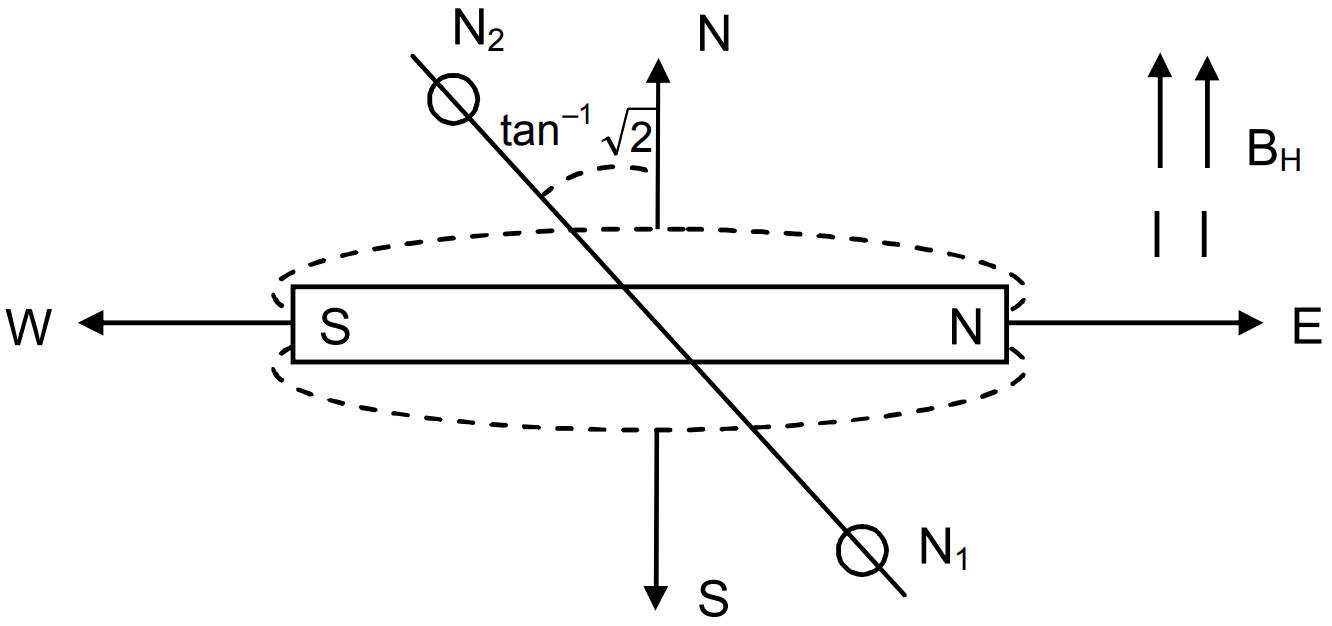
Show that the magnetic field at a point due to a magnetic dipole is perpendicular to the magnetic axis if the line joining the point with the centre of the dipole makes an angle of $\tan^{-1}(\sqrt{2})$ with the magnetic axis.
Answer
Given:$\theta=\tan^{-1}\sqrt{2}\Rightarrow\tan\theta=\sqrt{2}\Rightarrow2=\tan^2\theta$
$\Rightarrow\tan\theta=2\cot\theta\Rightarrow\frac{\tan\theta}{2}=\cot\theta$
We know $\frac{\tan\theta}{2}=\tan\propto$
Comparing we get, $\tan\propto=\cot\theta$
$\tan\propto=(90-\theta)$
$\propto=90-\theta$
$\theta +\propto=90$
Hence magnetic field due to the dipole is $\perp\text{r}$ to the magnetic axis.
View full question & answer
Question 224 Marks
The magnetic field at a point, 10cm away from a magnetic dipole, is found to be $2.0 \times 10^{-4}T$. find the magnetic moment of the dipole if the point is.
  1. In end-on position of the dipole.
  2. In broadside-onposition of the dipole.
Answer
$\text{B}=2\times10^{-4}\text{ T}$
$\text{d}=10\text{cm}=0.1\text{m}$
  1. If the point at end-on postion.
$\text{B} =\frac{\mu_02\text{M}}{4\pi\text{ d}^3}\Rightarrow2\times10^{-4}=\frac{10^{-7}\times2\text{M}}{(10^ {-1})^3}$

$\Rightarrow\frac{2\times10^{-4}\times10^{-3}}{10^{-7}\times2}=\text{M}\Rightarrow\text{M}=1\text{Am}^2$
  1. If the point is at broad-on position.
$\frac{\mu_0\text{ M }}{4\pi\text{ d}^3}\Rightarrow2\times10^{-4}=\frac{10^{-7}\times\text{M}}{(10^{-1})^3}\Rightarrow\text{m}=2\text{Am}^2$
View full question & answer
Question 234 Marks
A bar magnet has a length of 8cm. The magnetic field at a point at a distance 3cm from the centre in the broadside-on position is found to be $4 \times 10^{-6} T.$ Find the pole strength of the magnet.
Answer
Magnetic field at the broad side on position :
$\text{B}=\frac{\mu_0}{4\pi}\frac{\text{M}}{(\text{d}^2+\ell^3)\frac{3}{2}}$
$2\text{t}=8\text{cm}$
$\text{d}=3\text{cm}$
$\Rightarrow4\times10^{-6}=\frac{10^{-7}\times\text{m}\times8\times10^{-2}}{(9\times10^{-4}+16\times10)\frac{3}{2}}$
$\Rightarrow4\times10^{-6}=\frac{10^{-9}\times\text{m}\times8}{(10^{-4})\frac{3}{2}+(25)\frac{3}{2}}$
$\Rightarrow\text{m}=\frac{4\times10^{-6}\times125\times10^{-8}}{8\times10^{-9}}=62.5\times10^{-5}\text{A-m}$
View full question & answer
Question 244 Marks

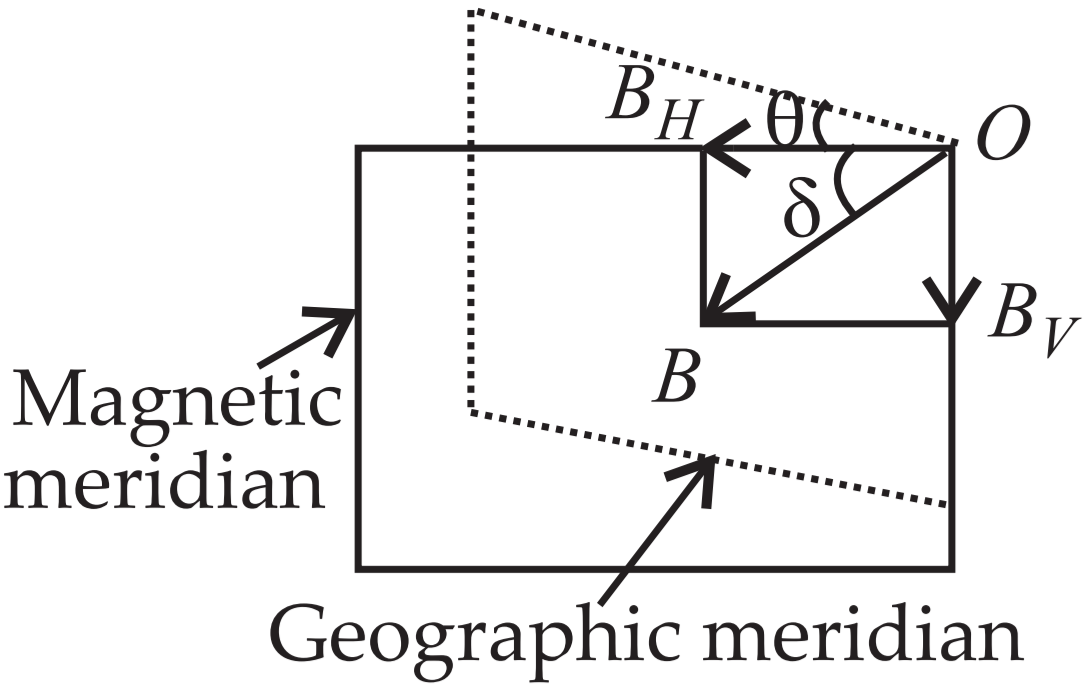
'Tile earth's magnetic field at a point on its surface is usually characterised by three quantities: (a) declination (bl inclination or dip and (cl horizontal component of the field. These are known as the elements of the earth's magnetic field. At a place, angle between geographic meridian and magnetic meridian is defined as magnetic declination, whereas angle made by the earth's magnetic field with the horizontal in magnetic meridian is known as magnetic dip.
  1. In a certain place, the horizontal component of magnetic field is $\frac{1}{\sqrt{3}}$ times the vertical component. 'Tile angle of dip at this place is:
  1. $\text{Zero}$
  2. $\frac{\pi}{3}$
  3. $\frac{\pi}{2}$
  4. $\frac{\pi}{6}$
  1. The angle between the true geographic north and the north shown by a compass needle is called as:
  1. Inclination.
  2. Magnetic declination.
  3. Angle of meridian.
  4. Magnetic pole.
  1. Tile angles of dip at the poles and the equator respectively are
  1. 30º, 30º
  2. 0º, 90º
  3. 45º, 90º
  4. 90º, 0º
  1. A compass needle which is allowed to move in a horizontal plane is taken to a geomagnetic pole. It
  1. Will become rigid showing no movement.
  2. Will stay in any position.
  3. Will stay in north-south direction only.
  4. Will stay in east-west direction only.
  1. Select the correct statement from the following.
  1. The magnetic dip is zero at the centre of the earth.
  2. Magnetic dip decreases as we move away from the equator towards the magnetic pole.
  3. Magnetic dip increases as we move away from the equator towards the magnetic pole.
  4. Magnetic dip does not vary from place to place.
Answer
  1. (b) $\frac{\pi}{3}$
Explanation:
$\tan\theta=\frac{\text{B}_\text{V}}{\text{B}_\text{H}}$ and $\text{B}_\text{H}=\frac{\text{B}_\text{V}}{\sqrt{3}}$
$\therefore\tan\theta=\sqrt{3}\text{ i.e. }\theta=\frac{\pi}{3}$
  1. (b) Magnetic declination.
Explanation:
The angle between the true geographic north and the north shown by a compass needle is called as magnetic declination or simply declination.
  1. (d) 90º, 0º
Explanation:
Since angle of dip at a place is defined as the angle $\delta,$ which is the direction of total intensity of earth's magnetic field B makes with a horizontal tine in magnetic meridian,
At poles $\text{B}=\text{B}_\text{V}$ and $\text{B}_\text{V}=\text{B}\sin\delta\therefore\sin\delta=1\Rightarrow\delta=90^\circ$
At equator $\text{B}=\text{B}_\text{H}$ and $\text{B}_\text{H}=\text{B}\cos\delta$
$\therefore\cos\delta=1\Rightarrow\delta=-0^\circ.$
  1. (a) Will become rigid showing no movement.
Explanation:
A compass needle which is allowed to move in a horizontal plane is taken to a geomagnetic pole. It will stay in any position as the horizontal component of earth's magnetic field becomes zero at the geomagnetic pole.
  1. (c) Magnetic dip increases as we move away from the equator towards the magnetic pole.
Explanation:
At equator, $\delta=0^\circ$
At poles, $\delta=90^\circ$
$\therefore\delta$ increases as we move from equator towards poles.
View full question & answer
Question 254 Marks
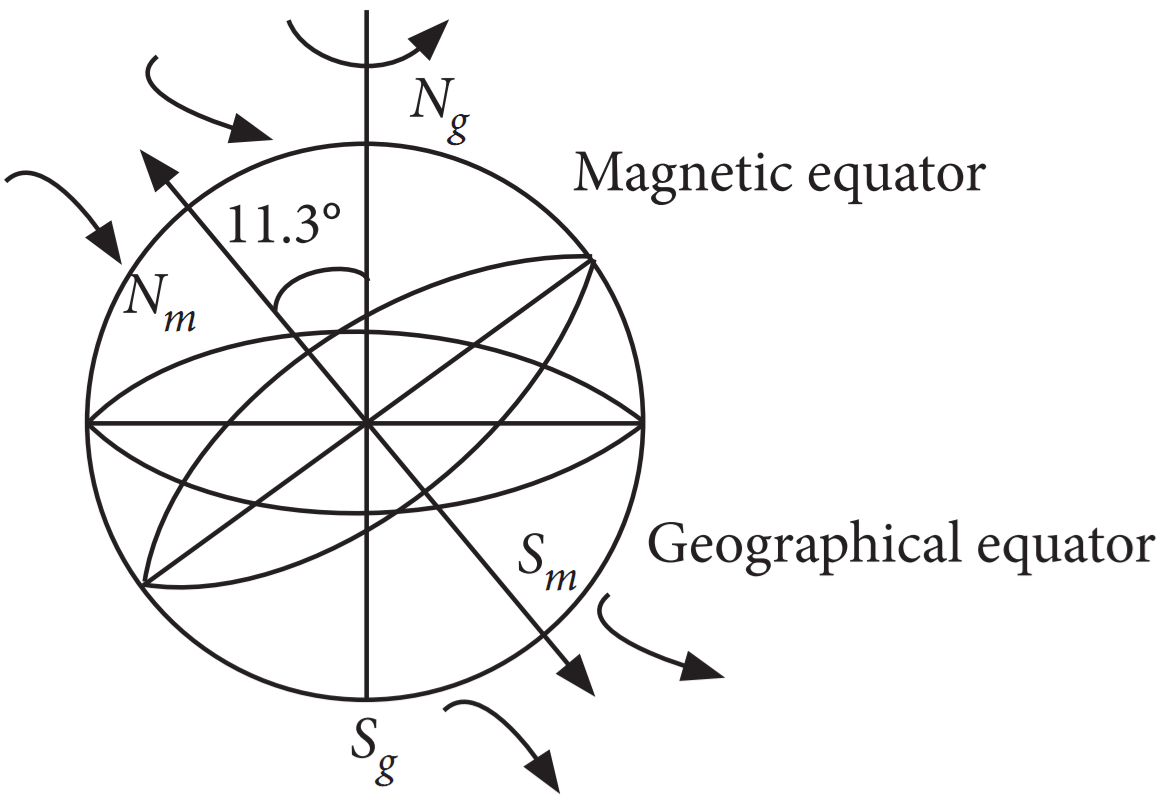
The magnetic field lines of the earth resemble that of a hypothetical magnetic dipole located at the centre of the earth. The axis of the dipole is presently tilted by approximately 11.3° with respect to the axis of rotation of the earth.

The pole near the geographic North pole of the earth is called the North magnetic pole and the pole near the geographic South pole is called South magnetic pole.
  1. Magnetization of a sample is:
  1. $10^5T$
  2. $10^{-6}T$
  3. $10^{-5}T$
  4. $10^8T$
  1. A bar magnet is placed North-South with its North-pole due North. The points of zero magnetic field will be in which direction from centre of magnet?
  1. North-South
  2. East- West
  3. North-East and South-West
  4. None of these.
  1. The value of angle of dip is zero at the magnetic equator because on it:
  1. V and Hare equal.
  2. The values of V and H zero.
  3. The value of V is zero.
  4. The value of His zero.
  1. The angle of dip at a certain place, where the horizontal and vertical components of the earth's magnetic field are equal, is:
  1. $30^\circ$
  2. $90^\circ$
  3. $60^\circ$
  4. $45^\circ$
  1. At a place, angle of dip is 300. lf horizontal component of earth's magnetic field is H, then the total intensity of magnetic field will be.
  1. $\frac{\text{H}}{2}$
  2. $\frac{2\text{H}}{\sqrt{3}}$
  3. $\text{H}\sqrt{\frac{3}{2}}$
  4. $2\text{H}$
Answer
  1. (c) $10^{-5}T$
  1. (b) East- West
  1. (c) The value of V is zero.
Explanation:
At equator vertical component of magnetic fields is zero.
  1. (d) $45^\circ$
Explanation:
Given, $\text{V}=\text{H}$
$\therefore\tan\delta=\frac{\text{V}}{\text{H}}=1$ or $\delta=45^\circ$
  1. (b) $\frac{2\text{H}}{\sqrt{3}}$
Explanation:
Given: Biot-Savart law can be expressed alternatively as Ampere circuital law.
View full question & answer
Question 264 Marks
When the atomic dipoles are aligned partially or fully, there is a net magnetic moment in the direction of the field in any small volume of the material. The actual magnetic field inside material placed in magnetic field is the sum of the applied magnetic field and the magnetic field due to magnetisation. This field is called magnetic intensity (H).
$\text{H}=\frac{\text{B}}{\mu_0}-\text{M}$
where Mis the magnetisation of the material, flo is the permittivity of vacuum and B is the total magnetic field. The measure that tells us how a magnetic material responds to an external field is given by a dimensionless quantity is appropriately called the magnetic susceptibility: for a certain class of magnetic materials, intensity of magnetisation is directly proportional to the magnetic intensity.
  1. Magnetization of a sample is:
  1. Volume of sample per unit magnetic moment.
  2. Net magnetic moment per unit volume.
  3. Ratio of magnetic moment and pole strength.
  4. Ratio of pole strength to magnetic moment.
  1. Identify the wrongly matched quantity and unit pair.
  1. Pole strength - Am
  2. Magnetic susceptibility - dimensionless number
  3. Intensity of magnetisation $ - Am^{-1}$
  4. Magnetic permeability - Henry m
  1. A closed surface S encloses a magnetic dipole of magnetic moment 2ml. The magnetic flux emerging from the surface is:
  1. $2 \times 10^5A/ m$
  2. $3 \times 10^5A/ m$
  3. $4 \times 10^5A/ m$
  4. $5 \times 10^5A/ m$
  1. A solenoid has core of a material with relative permeability 500 and its windings carry a current of 1A. The number of turns of the solenoid is 500 per metre. The magnetization of the material is nearly,
  1. $2.5 \times 10^3Am^{-1}$
  2. $2.5 \times 10^5Am^{-1}$
  3. $2.0 \times 10^3Am^{-1}$
  4. $2.0 \times 10^5Am^{-1}$
  1. The relative penneability of iron is 6000. Its magnetic susceptibility is:
  1. $5999$
  2. $6001$
  3. $6000 \times 10^{-7}$
  4. $6000 \times 10^7$
Answer
  1. (b) Net magnetic moment per unit volume.
  1. (d) Magnetic permeability - Henry m
Explanation:
Magnetic penneability- Henry $m^{-1}.$
  1. (d) $5 \times 10^5A/ m$
Explanation:

Given, $l = 3cm,\ A= 2cm ^2,\ M = 3A\ m^2$ intensity of magneusanon $=\frac{\text{M}}{\text{lA}}=\frac{3}{3\times10^{-2}\times2\times10^{-4}}$
  1. (b) $2.5 \times 10^5Am^{-1}$
Explanation:
Here, n = 500 turns/ m
$\text{I}=\text{lA},\ \mu^{\text{r}}=500$
Magnetic intensity, $\text{H}=\text{nl}=500\text{m}^{-1}\times1\text{A}=500\text{Am}^{-1}$
As $\mu^{\text{r}}=1+\chi$ or $\chi=(\mu_\text{r}-1)$
Magnetisation, $\text{M}=\chi\text{H}$
$=(\mu_\text{r}-1)\text{H}=(500-1)\times500\text{Am}^{-1}$
$=\text{2.495}\times106{5}\text{Am}^{-1}\approx2.5\times10^{5}\text{Am}^{-1}$
  1. (a) 5999
Explanation:
Relative permeability of iron, $\mu_{\text{r}}=6000$
Magnetic susceptibility $\chi_{\text{m}}=\mu_{\text{r}}-1=5999.$
View full question & answer
Question 274 Marks
By analogy to Gauss's law of electrostatics, we can write Gauss's law of magnetism as $\oint\vec{\text{B}}.\text{d}\vec{\text{v}}=\mu_0\text{m}_{\text{inside}}$ where $\oint\vec{\text{B}}.\text{d}\vec{\text{s}}$ is the magnetic flux and $\text{m}_{\text{inside}}$ is the net pole strength inside the closed surface. We do not have an isolated magnetic pole in nature. At least none has been found to exist till date. The smallest unit of the source of magnetic field is a magnetic dipole where the net magnetic pole is zero. Hence, the net magnetic pole enclosed by any closed surface is always zero. Correspondingly, the flux of the magnetic field through any closed surface is zero.
  1. Consider the two idealised systems
  1. a parallel plate capacitor with large plates and small separation and
  2. a long solenoid of length L >> R, radius of cross-section.
(In) (i) $\vec{\text{E}}$ is ideally treated as a constant between plates and zero outside. In (ii) Magnetic field is constant inside the solenoid and zero outside. These idealised assumptions, however, contradict fundamental laws as below
  1. Case (i) contradicts Gauss's law for electrostatic fields.
  2. Case (ii) contradicts Gauss's law for magnetic fields.
  3. Case (i) agrees with $\oint\vec{\text{E}}.\text{d}\vec{\text{l}}=0$
  4. Case (ii) contradicts $\oint\vec{\text{H}}.\text{d}\vec{\text{l}}=\text{l}_{\text{en}}.$
  1. The angle between the true geographic north and the north shown by a compass needle is called as:
  1. $\text{Zero}$
  2. $\frac{\mu_0}{4\pi}$
  3. $4\pi\mu_0$
  4. $\frac{4\mu_0}{\pi}$
  1. A closed surface S encloses a magnetic dipole of magnetic moment 2ml. The magnetic flux emerging from the surface is:
  1. $\mu_0\text{m}$
  2. $\text{Zero}$
  3. $2\mu_0\text{m}$
  4. $\frac{2\text{m}}{\mu _0}$
  1. Which of the following is not a consequence of Gauss's law?
  1. The magnetic poles always exist as unlike pairs of equal strength.
  2. If several magnetic lines of force enter in a closed surface, then an equal number of lines of force must leave that surface.
  3. There are abundant sources or sinks of the magnetic field inside a closed surface.
  4. Isolated magnetic poles do not exist.
  1. The surface integral of a magnetic field over a surface:
  1. Is proportional to mass enclosed.
  2. Is proportional to charge enclosed.
  3. S zero.
  4. Equal to its magnetic flux through that surface.
Answer
  1. (b) Case (ii) contradicts Gauss's law for magnetic fields.
Explanation:

According to Gauss's law in magnetism $\oint\vec{\text{B}}.\text{d}\vec{\text{s}}=0,$ which implies that number of magnetic field tines entering the Gaussian surface is equal to the number of magnetic field lines leaving it. Therefore, case (ii) is not possible.
  1. (a) $\text{Zero}$
Explanation:

The net magnetic flux through a closed surface will be zero, $\oint\vec{\text{B}}.\text{d}\vec{\text{s}}=0,$ because there are no magnetic monopoles.
  1. (b) $\text{Zero}$
  1. (c) There are abundant sources or sinks of the magnetic field inside a closed surface.
Explanation:

Gauss's law indicates that there are no sources or sinks of the magnetic field inside a closed surface. ln other words, there are no free magnetic charges.
  1. (d) Equal to its magnetic flux through that surface.
Explanation:

The surface integral of a magnetic field over a surface gives magnetic flux through that surface.
View full question & answer
Question 284 Marks

The field of a hollow wire with constant current is homageneous.
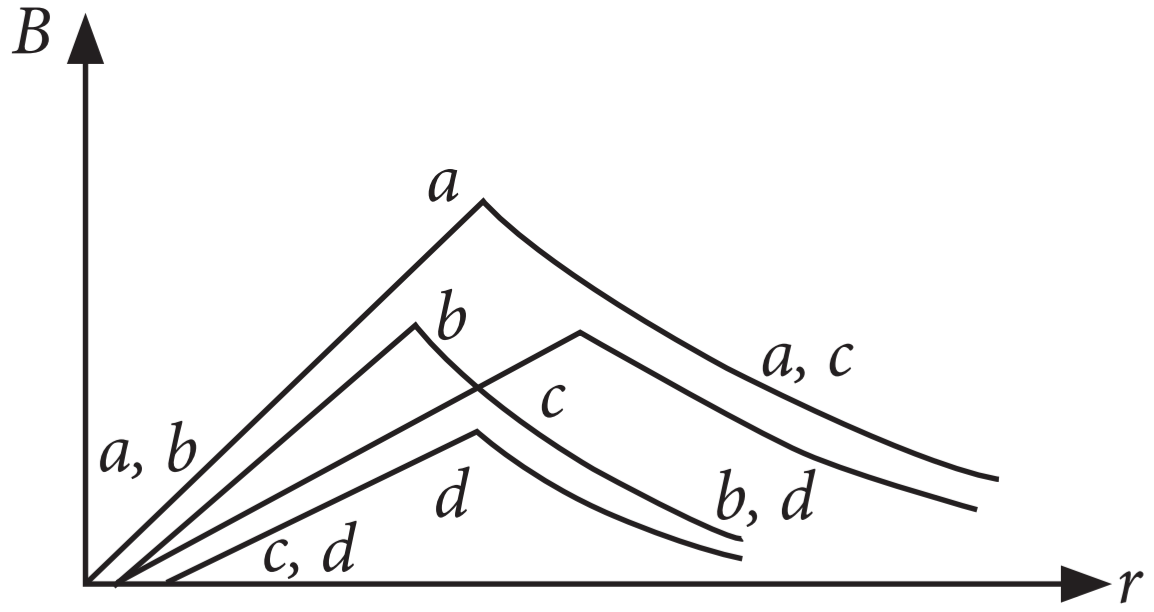
Curves in the graph shown give, as functions of radius distance r, the magnitude B of the magnetic field inside and outside four long wires a, b, c and d, carrying currents that are uniformly distributed across the cross sections of the wires. Overlapping portions of the plots are indicated by double labels.
  1. Which wire has the greatest magnitude of the magnetic field on the surface?
  1. a
  2. b
  3. c
  4. d
  1. The current density in a wire a is:
  1. Greater than in wire c.
  2. Less than in wire c.
  3. Equal to that in wire c.
  4. Not comparable to that of in wire c due to lack of information.
  1. Which wire has the greatest radius?
  1. a
  2. b
  3. c
  4. d
  1. A direct current I flows along the length of an infinitely long straight thin walled pipe, then the magnetic field is:
  1. Uniform throughout the pipe but not zero.
  2. Zero only along the axis of the pipe.
  3. Zero at any point inside the pipe.
  4. Maximum at the centre and minimum at the edges.
  1. In a coaxial, straight cable, the central conductor and the outer conductor carry equal currents in opposite direction. The magnetic field is zero.
  1. Outside the cable.
  2. Inside the inner conductor.
  3. Inside the outer conductor.
  4. In between the two conductor.
Answer
  1. (a) a
Explanation:
It can be seen that slop of curve for wire a is greater th an wire c.
  1. (b) Less than in wire c.
Explanation:
Inside the wire
$\text{B(r)}=\frac{\mu_0}{2\pi}\frac{\text{I}}{\text{R}^2}\text{r}\Rightarrow\frac{\text{dB}}{\text{dr}}=\frac{\mu_0}{\text{dr}}=\frac{\text{I}}{\text{R}^2}\text{r}$
$\text{i.e. slope}\propto\frac{\text{I}}{\pi\text{R}^2}\propto\text{Current density}$
  1. (c) c
Explanation:
Wire c has the greatest radius.
  1. (c) Zero at any point inside the pipe.
  1. (a) Outside the cable.
View full question & answer