Question 12 Marks
A magnetic field of $100 \mathrm{G}\left(1 \mathrm{G}=10^{-4} \mathrm{~T}\right)$ is required which is uniform in a region of linear dimension about 10 cm and area of cross-section about $10^{-3} \mathrm{~m}^2$. The maximum current-carrying capacity of a given coil of wire is 15 A and the number of turns per unit length that can be wound round a core is at most 1000 turns $\mathrm{m}^{-1}$. Suggest some appropriate design particulars of a solenoid for the required purpose. Assume the core is not ferromagnetic.
AnswerMagnetic field strength, $B = 100\ G = 100 × 10^{-4}\ T$
Number of turns per unit length, n = 1000 turns $m^{-1}$
Current flowing in the coil, I = 15 A
Permeability of free space, $\mu_\circ=4\pi\times10^{-7}\text{T m A}^{-1}$
Magnetic field is given by the relation, $\text{B}=\mu_{0}\text{nl}$
$\therefore\text{nl}=\frac{\text{B}}{\mu_{0}}$
$=\frac{100\times10^{-4}}{4\pi\times10^{-7}}=7957.74$
≈ 8000 A\m
If the length of the coil is taken as 50 cm, radius 4 cm, number of turns 400, and current 10 A, then these values are not unique for the given purpose. There is always a possibility of some adjustments with limits.
View full question & answer→Question 22 Marks
A circular coil of N turns and radius R carries a current I. It is unwound and rewound to make another coil of radius R/2, current I remaining the same. Calculate the ratio of the magnetic moments of the new coil and the original coil.
AnswerWe have:
$\text{N}_{1}.2\pi\text{R} = \text{N}_{2}.2\pi(\text{R}/2)$
$\therefore\text{N}_{2} = 2 \text{N}_{1}$
Magnetic Moment of a coil M = NAI
For the coil of radius ‘R’
$\text{M}_{1} = \text{N}_{1}\text{I}\text{A}_{1} = \text{N}_{1}\text{I}\pi\text{R}^{2}$
For the coil of radius R/2
$\text{M}_{2} = \text{N}_{2}\text{I}\text{A}_{2} = 2 \text{N}_{1}\text{I}\pi\text{R}^{2}/4 = \text{N}_{1}.\pi\text{R}^{2}/2$
$=>\text{M}_{2}:\text{M}_{1} = 1:2$
Alternate Answer
$\text{M}_{1}:\text{M}_{2} = 2:1.$
View full question & answer→Question 32 Marks
A steady current $\left(I_1\right)$ flows through a long straight wire. Another wire carrying steady current $\left(I_2\right)$ in the same direction is kept close and parallel to the first wire. Show with the help of a diagram how the magnetic field due to the current $\mathrm{I}_1$ exerts a magnetic force on the second wire. Write the expression for this force.
Answer
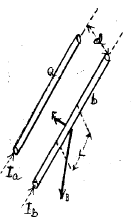 $\text{F}_{12} = \text{I}_{2}\text{IB}_{1}$
$\text{F}_{12} = \frac{\mu_{o}\text{I}_{1}\text{I}_{2}}{2\pi\text{d}}\text{l}$. View full question & answer→Question 42 Marks
Write the expression for Lorentz magnetic force on a particle of charge 'q' moving with velocity$\overrightarrow{\text{v}}$ in a magnetic field $\overrightarrow{\text{B}}.$ Show that no work is done by this force on the charged particle.
Answer$\overrightarrow{\text{F}} = \text{q}(\overrightarrow{\text{v}}\times\overrightarrow{\text{B}})$
Alternate Answer
$\overrightarrow{\text{F}} =\text{qv B} \sin\theta\hat{\text{n}}$
Work done $ = \overrightarrow{\text{F}}.\overrightarrow{\text{S}}$
as $\overrightarrow{\text{F}}$ is perpendicular to $\overrightarrow{\text{S}}$, W= 0.
View full question & answer→Question 52 Marks
Deduce the expression for the magnetic dipole moment of an electron orbiting around the central nucleus.
AnswerCurrent due to revolution of electron $\text{I}=\frac{\text{e}}{\text{T}}\text{ and }\text{T} = \frac{2\pi\text{r}}{\text{v}}$
$\therefore\text{I} = \text{ev}/2\pi\text{r}$
$\text{ Magnetic moment }\mu_{1} = \text{I}\pi\text{r}^{2} = \text{evr}/2.$
View full question & answer→Question 62 Marks
Define current sensitivity and voltage sensitivity of a galvanometer.
Increasing the current sensitivity may not necessarily increase the voltage sensitivity of a galvanometer. Justify.
AnswerThe current sensitivity of the galvanometer equals the deflection per unit current.
Alternate Answer
Voltage sensitivity is the deflection per unit voltage.
Alternate Answer
$\frac{\phi}{\text{V}} = \bigg(\frac{\text{NBA}}{\text{k}}\bigg) \frac{\text{I}}{\text{V}} = \bigg(\frac{\text{NAB}}{\text{k}}\bigg)\frac{1}{\text{R}}$
Justification: Increasing the current sensitivity may not necessarily increase the voltage sensitivity. If N→2N, i.e., we double the number of turns, then
$\frac{\phi}{\text{I}}\rightarrow2\frac{\phi}{\text{I}}$
Thus, the current sensitivity doubles. However, the resistance of the galvanometer is also likely to double, since it is proportional to the length of the wire. N→2N, and R→2R, thus the voltage sensitivity, remains unchanged.
$\frac{\phi}{\text{V}}\rightarrow\frac{\phi}{\text{V}}.$
View full question & answer→Question 72 Marks
Using Ampere’s circuital law, obtain an expression for the magnetic field along the axis of a current carrying solenoid of length l and having N number of turns.
AnswerDiagram:
$\Delta\text{m} = \text{m}\bigg({^{235}_{92}\text{U}}\bigg) -\text{m}\bigg({^{234}_{90}\text{Th}}\bigg) - \text{m}\bigg({^{4}_{2}\text{He}}\bigg)$
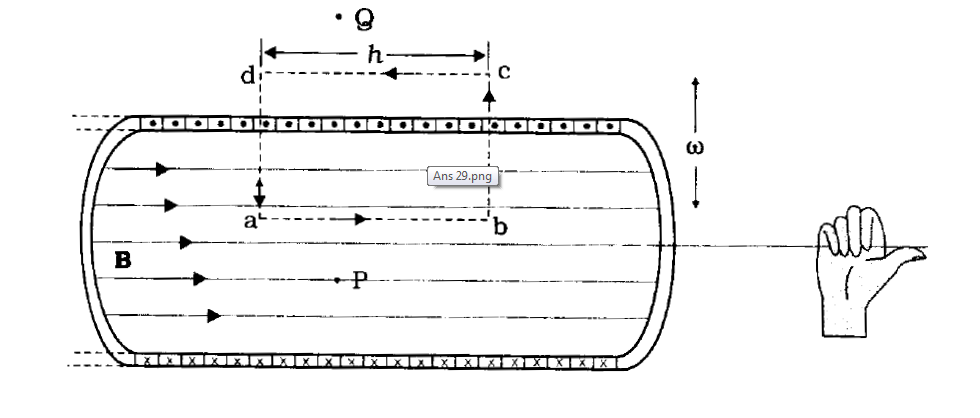
$\text{Law:}\oint\overline{\text{B}}.\overline{\text{d}l} = \mu_{0}\sum\text{l}\text{ or }\text{I}_{c}$
$\text{Derivation:}\text{ B} = \mu_{0}\text{nl}\text{ or }\mu_{0}\frac{\text{N}}{\text{l}}\text{l}.$ View full question & answer→Question 82 Marks
A galvanometer has a resistance of 30Ω. It gives full scale deflection with a current of 2 mA. Calculate the value of the resistance needed to convert it into an ammeter of range 0-0.3 A.
AnswerFormula $\text{S}= \text{G} \cdot \frac{\text{I}_{g}}{\text{I} - \text{I}_\text{g}}$
Substitution $\text{S} = \frac{30\times2\times10^{-3}}{0.3-2\times10^{-3}}$
Calculation & Result
$\text{S}\approx0.20\Omega$.
View full question & answer→Question 92 Marks
Which one of the two, an ammeter or a milliammeter, has a higher resistance and why?
AnswerMilliammeter has a higher resistance. It has higher value of shunt resistance comparable to ammeter.
View full question & answer→Question 102 Marks
State the underlying principle of a cyclotron. Write briefly how this machine is used to accelerate charged particles to high energies.
AnswerIt makes use of the principle that the energy of the charged particles/ions can be made to increase in presence of crossed Electric and magnetic fields. A normal Magnetic field acts on the charged particle and makes them move in a circular path. While moving from one dee to another; Particle is acted upon by the alternating electric field, and is accelerated by this field, which increases the energy of the particle.
View full question & answer→Question 112 Marks
An ammeter of resistance 0.80 $\Omega$ can measure current up to 1.0 A.
- What must be the value of shunt resistane to enable the ammeter to measure current upto 5.0 A?
- What is the combined resistance of the ammeter and the shunt?
Answer
- Shunt
$\text{S} = \frac{\text{R}_{A}\text{i}_{g}}{\text{i} - \text{i}_{g}}$
$ = \frac{0.8\times1.0}{5.0 - 1.0} = 0.2\Omega$
- Combined resistance of ammeter and shunt
$\frac{1}{\text{R}_{total}} = \frac{1}{\text{R}_{A}} + \frac{1}{\text{S}}$
$ = \frac{1}{0.8} + \frac{1}{0.2}$
$\text{R}_{total} = \frac{0.8}{5}$
$\Rightarrow\text{R}_{total} = 0.16\Omega.$ View full question & answer→Question 122 Marks
Two identical circular wires P and Q each of radius R and carrying current 'I' are kept in perpendicular planes such that they have a common centre as shown in the figure. Find the magnitude and direction of the net magnetic field at the common centre of the two coils.
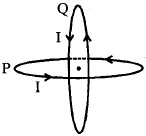
AnswerWe have: $B_P= B_Q= \frac{\mu\text{o}\text{I}}{2\text{R}}$
$B_p$ is directed in the vertically upward direction while $B_Q$ is directed along the horizontal direction.
$\therefore\text{B} = \sqrt{\text{B}_{p}^{2} + \text{B}_{Q}^{2}}$
$ = \sqrt{2}\text{B}_{p}$
$ =>\text{B} = \sqrt{2}\frac{\mu_{o}\text{I}}{2\text{R}} = \bigg(\frac{\mu_{o}\text{I}}{\sqrt{2\text{R}}}\bigg)$
The net magnetic field is directed at an angle of $45^\circ$ with either of the fields.
View full question & answer→Question 132 Marks
A magnetic needle free to rotate in a vertical plane parallel to the magnetic meridian has its north tip down at 60° with the horizontal. The horizontal component of the earth's magnetic field at the place is known to be 0.4 G. Determine the magnitude of the earth's magnetic field at the place.
Answer$\text{B}_{H} = \text{B}\cos\theta$
$\text{B} = \frac{\text{B}_{H}}{\cos60^{o}} = 0.8\text{ G}.$
View full question & answer→Question 142 Marks
State Biot-Savart law.A current I flows in a conductor placed perpendicular to the plane of the paper.Indicate the direction of the magnetic field due to a small element d $\overrightarrow{l}$at point P situated at a distance $ \overrightarrow{r}$ from the element as shown in the figure.

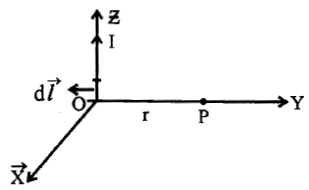
AnswerStatement of Biot - Sarvat Law:$\text{d}\overrightarrow{\text{B}}$ varies as $\frac{\text{I}\big(\text{d}\overrightarrow{l}\times\overrightarrow{r}\big)}{\text{r}^{3}}$
Direction of Magnetic field at point P is along negative x-axis.
Alternate Answer
Directed in the plane of page along the negative X direction.
View full question & answer→Question 152 Marks
A charge ‘q’ moving along the X-axis with a velocity v is subjected to a uniform magnetic field B acting along the Z-axis as it crosses the origin O.
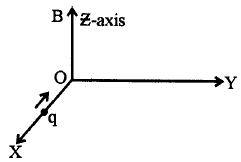
- Trace its trajectory.
- Does the charge gain kinetic energy as it enters the magnetic field? Justify your answer.
Answer
-
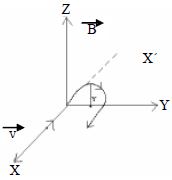
- No
Work done by a magnetic force on a charge is always zero.
Alternate Answer
$\overrightarrow{\text{F}} = \text{q}\big(\overrightarrow{\text{v}}\times\overrightarrow{\text{B}}\big)$
$\therefore \overrightarrow{\text{F}} \perp\overrightarrow{\text{v}}$
Alternate Answer
A magnetic force only changes the direction of motion but does not change the speed of the charge. View full question & answer→Question 162 Marks
Write the relation for the forces $\overrightarrow{F}$ acting on a charge carrier q moving with a velocity $\overrightarrow{V}$ through a magnetic field $\overrightarrow{B}$ in vector notation. Using this relation, deduce the conditions under which this force will be (1) maximum (2) minimum.
Answer$\stackrel\rightharpoonup{\text{F}} = \text{q}\big(\stackrel\rightharpoonup{V}\times\stackrel\rightharpoonup{B}\big)$ $\therefore |\stackrel\rightharpoonup{\text{F}}| = \text{qVB}sin\theta$
- Maximum when
$\stackrel\rightharpoonup{\text{V}}\bot\stackrel\rightharpoonup{\text{B}}$ Or $\theta = \pi/2$
- Minimum when
$\stackrel\rightharpoonup{\text{V}}||\stackrel\rightharpoonup{\text{B}} $ Or $\theta = 0 $ Or $180^{\circ}$ View full question & answer→Question 172 Marks
State the principle of working of a cyclotron. Write two uses of this machine.
AnswerPrinciple of working:A charged particle experiences a force in an electric field and gets accelerated. It then enters in uniform magnetic field acting at right angles to its direction of motion and follows a circular path with constant speed.
Uses:
- For accelerating charged particles.
- For implanting ions into solids and for studying their properties and synthesising new materials.
- For producing radioactive substances used in diagnosis and treatment.
View full question & answer→Question 182 Marks
An iron ring of relative permeability $\mu_{\text{r}}$ has windings of insulated copper wire of n turns per metre. When the current in the windings is I, find the expression for the magnetic field in the ring.
AnswerRelative permeability $=\mu_{\text{r}}$
Number of turns/ metre = n
Current = I
By Amperes Circuital law
$\oint\vec{\text{B}}.\vec{\text{dl}}=\mu_0\times\text{total current}$
$\text{B}\oint\text{dl}=\mu_0\times\text{NI}$
Here N = Total number of atoms
$\text{B}=\mu_0\frac{\text{NI}}{2\pi\text{r}}$
$\therefore\ \text{B}=\mu_0\text{nI}\ \Big(\because\ \frac{\text{N}}{2\pi\text{r}}=\text{n}\Big)$
For ring $\mu=\mu_0\mu_\text{r}$
$\therefore\ \text{B}=\mu_0\mu_\text{r}\text{nI}$
View full question & answer→Question 192 Marks
Two long straight parallel wires A and B separated by a distance d, carry equal current I flowing in same direction as shown in the figure.
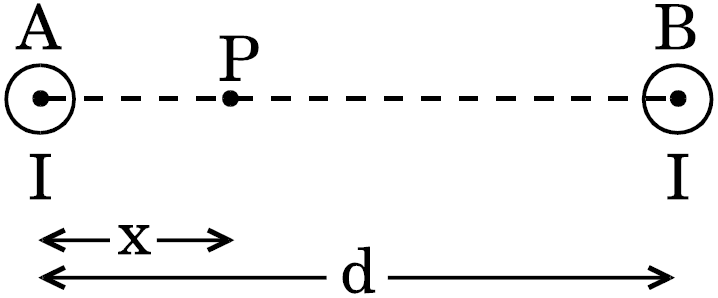
- Find the magnetic field at a point P situated between them at a distance x from one wire.
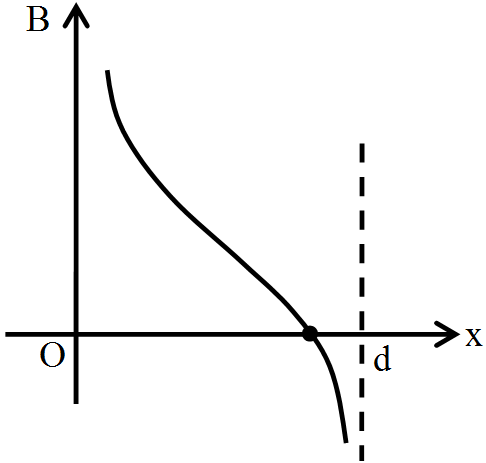
- Show graphically the variation of the magnetic field with distance x for 0 < x < d.
Answer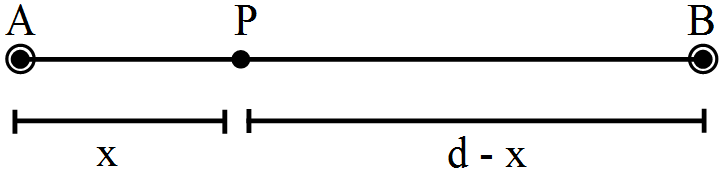
- $\text{B}_\text{P}=\text{B}_\text{A}+\text{B}_\text{B}=\frac{\mu_0\text{I}}{2\pi\text{x}}(\text{upwards})+\frac{\mu_0\text{I}}{2\pi(\text{fx)}}(\text{down)}$
$=\frac{\mu_0\text{I}}{2\pi}\Big[\frac{1}{\text{x}}-\frac{1}{\text{d}-\text{x}}\Big]$
$=\frac{\mu_0\text{I}}{2\pi}\Big[\frac{\text{d}-\text{x}-\text{x}}{\text{x}(\text{d}-\text{x)}}\Big]$
$=\frac{\mu_0\text{I}}{2\pi}\Big(\frac{\text{d}-2\text{x}}{\text{x}(\text{d}-\text{x)}}\Big)\text{upwards}+\frac{\mu_0\text{I}}{2\pi(\text{d}-\text{x})}(\text{down})$
$(1)\div(2)$
$\Rightarrow\frac{\text{mv}^2_\text{n}\text{r}_\text{n}}{\text{mv}_\text{n}\text{r}_\text{n}}=\Big(\frac{\text{ze}^2}{4\pi\varepsilon_0}\Big)\Big(\frac{2\pi}{\text{nh}}\Big)$
$\Rightarrow\text{speed of }\text{e}^-,$
As $\text{B}_\text{A}>\text{B}_\text{B}$
-
View full question & answer→Question 202 Marks
An $\alpha-\text{particle}$ and a proton of the same kinetic energy are in turn allowed to pass through a magnetic field $\overrightarrow{\text{B}},$acting normal to the direction of motion of the particles. Calculate the ratio of radii of the circular paths described by them.
AnswerMass of alpha particle $=\text{m}_\alpha$
Charge on alpha particle $=\text{q}_\alpha$
Velocity of alpha particle $=\text{V}_\alpha$
Mass of a proton $=m_p$
Charge on a proton $=q_p$
Velocity of proton $=v_p$
Since the KE of alpha particle and proton are equal.
$\therefore\frac{1}{2}\text{m}_\alpha\text{v}^2_\alpha=\frac{1}{2}\text{m}_\text{p}.\text{v}^2_\text{p}$
$\Rightarrow\frac{(\text{m}_\alpha\text{v}_\alpha)^2}{\text{m}_\alpha}=\frac{(\text{m}_\text{p}.\text{v}_\text{p})^2}{\text{m}_\text{p}}\Rightarrow\frac{\text{m}_\alpha\text{v}_\alpha}{\text{m}_\text{p}.\text{v}_\text{p}}=\Big(\frac{\text{m}_\alpha}{\text{m}_\text{p}}\Big)^\frac{1}{2}$
Radius of circular $=\text{R}=\frac{\text{mv}}{\text{qB}}$
Ratio of radii of alpha particle to proton
$=\frac{\text{R}_\alpha}{\text{R}_\text{p}}=\frac{\text{m}_\alpha.\text{v}_\alpha}{\text{q}_\alpha\text{B}}.\frac{\text{q}_\text{p}\text{B}}{\text{m}_\text{p}.\text{v}_\text{p}}=\Big(\frac{\text{m}_\alpha}{\text{m}_\text{p}}\Big)^\frac{1}{2}.\frac{\text{q}_\text{p}}{\text{q}_\alpha}$
Using $\frac{\text{m}_\alpha}{\text{m}_\text{p}}=4$ and $\frac{\text{q}_\text{p}}{\text{q}_\alpha}=\frac{1}{2}$
$\therefore\frac{\text{R}_\alpha}{\text{R}_\text{p}}=(4)^\frac{1}{2}\Big(\frac{1}{2}\Big)=1$
View full question & answer→Question 212 Marks
A transmission wire carries a current of 100A. What would be the magnetic field B at a point on the road if the wire is 8m above the road?
Answer
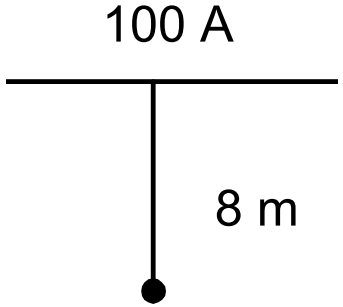 $\text{i} = 100\text{A},\text{d} = 8\text{m}$
$\text{B}=\frac{\mu_0\text{i}}{2\pi\text{r}}$
$=\frac{4\pi\times10^{-7}\times100}{2\times\pi\times8}=2.5\mu\text{T}$ View full question & answer→Question 222 Marks
A circular coil of radius 2.0cm has 500 turns and carries a current of 1.0A. Its axis makes an angle of 30° with the uniform magnetic field of magnitude 0.40 T that exists in the space. Find the torque acting on the coil.
Answer$\text{n}=500$
$\text{r}=0.02\text{m}$
$\theta=30^\circ$
$\text{i}=2\text{A}$
$\text{B}=4\times10^{-1}\text{T}$
$=500\times1\times3.14\times4\times10^{-4}\times4\times10^{-1}\times\Big(\frac{1}{2}\Big)$
$12.56\times10^{-2}=0.1256\approx0.13\text{N-M}$
View full question & answer→Question 232 Marks
A current of 10A is established in a long wire along the positive z-axis. Find the magnetic field $\overrightarrow{\text{B}}$ at the point (1m, 0, 0).
Answer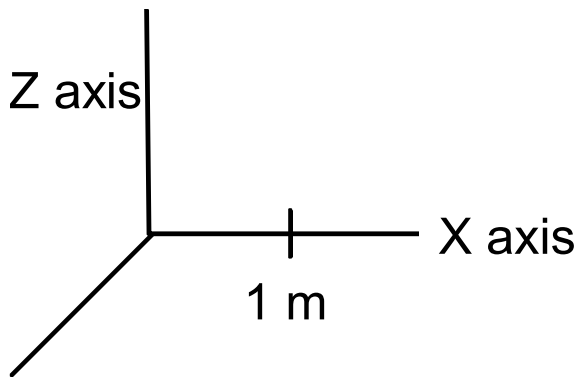
$\text{i} = 10\text{A},\text{d} = 1\text{m}$
$\text{B}=\frac{\mu_0\text{i}}{2\pi\text{r}}=\frac{10^{-7}\times4\pi\times10}{2\pi\times1}$
$=20\times10^{-6}\text{T}=2\mu\text{T}$
Along +ve Y direction. View full question & answer→Question 242 Marks
Verify that the units weber and volt-second are the same.
Answer$\text{v}=\frac{\text{d}\phi}{\text{dt}}$
$\Rightarrow\text{d}\phi=\text{dt}$
Charge in flux has unit weber and potential difference as volt.
View full question & answer→Question 252 Marks
You are facing a circular wire carrying an electric current. The current is clockwise as seen by you. Is the field at the centre coming towards you or going away from you?
AnswerAccording to the right-hand thumb rule, if we curl the fingers of our right hand in the direction of the current flowing, then the thumb will point in the direction of the magnetic field developed due to it and vice versa. Therefore, in this case, the field at the centre is going away from us.
View full question & answer→Question 262 Marks
A wire, carrying a current i, is kept in the x−y plane along the curve $\text{y}=\text{A}\sin\Big(\frac{2\pi}{\lambda}\text{x}\Big).$ A magnetic field B exists in the z direction. Find the magnitude of the magnetic force on the portion of the wire between $\text{x}=0$ and $\text{x}=\lambda.$
AnswerHere the displacement vector $\overrightarrow{\text{dl}}=\lambda$
So magnetic for $\text{i}\rightarrow\text{t}\overrightarrow{\text{dl}}\times\vec{\text{B}}=\text{i}\times\lambda\text{B}$
View full question & answer→Question 272 Marks
In order to have a current in a long wire, it should be connected to a battery or some such device. Can we obtain the magnetic due to a straight, long wire by using Ampere's law without mentioning this other part of the circuit?
AnswerWe can obtain a magnetic field due to a straight, long wire using Ampere's law by mentioning the current flowing in the wire, without emphasising on the source of the current in the wire. To apply Ampere's circuital law, we need to have a constant current flowing in the wire, irrespective of its source.
View full question & answer→Question 282 Marks
A semicircular wire of radius 5.0cm carries a current of 5.0A. A magnetic field B of magnitude 0.50T exists along the perpendicular to the plane of the wire. Find the magnitude of the magnetic force acting on the wire.
Answer
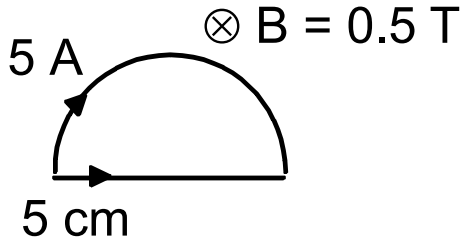
Force on a semicircular wire
= 2iRB
= 2 × 5 × 0.05 × 0.5
= 0.25N
View full question & answer→Question 292 Marks
Verify that the cyclotron frequency ω = eB/m has the correct dimensions of $[T]^{-1}$.
AnswerFor a charge particle moving perpendicular to the magnetic field:
$\frac{(\text{mv}^2)}{\text{R}}=\text{qvB}$
$\Rightarrow\ \frac{\text{qB}}{\text{m}}=\frac{\text{v}}{\text{R}}=\omega$
$\Rightarrow\ =\omega=\frac{\text{qB}}{\text{m}}=\frac{\text{v}}{\text{R}}=[\text{T}]^{-1}$
View full question & answer→Question 302 Marks
The torque on a current loop is zero if the angle between the positive normal and the magnetic field is either $\theta=0^\circ$ or $\theta=180^\circ$ In which of the two orientations, the equilibrium is stable?
AnswerAs we know the potential energy.
$\text{U}=-\vec{\text{m}}.\vec{\text{B}}$
In the case of stable equilibrium potential energy is minimum.
So, far $\theta=0^\circ$ Potential Energy is -ve and minimum.
View full question & answer→Question 312 Marks
A rectangular coil of 100 turns has length 5cm and width 4cm. It is placed with its plane parallel to a uniform magnetic field and a current of 2A is sent through the coil. Find the magnitude of the magnetic field B if the torque acting on the coil is $0.2N\ m^{-1}$.
Answer$\tau=\text{ni}\overrightarrow{\text{A}}\times\overrightarrow{\text{B}}$
$\Rightarrow\tau=\text{ni}\text{ AB}\sin90^\circ$
$\Rightarrow0.2=100\times2\times5\times4\times10^{-4}\times\text{B}$
$\Rightarrow\text{B}=\frac{0.2}{100\times2\times5\times4\times10^{-4}}=0.5$ Tesla
View full question & answer→Question 322 Marks
The coil of a moving-coil galvanometer keeps on oscillating for a long time if it is deflected and released. If the ends of the coil are connected together, the oscillation stops at once. Explain
AnswerWhen the ends are not connected the coil acts as inductor thus it undergoes inductance and keeps varying the current and keeps oscillating. But when ends are connected the coil is close loop thus there is no inductance.
View full question & answer→Question 332 Marks
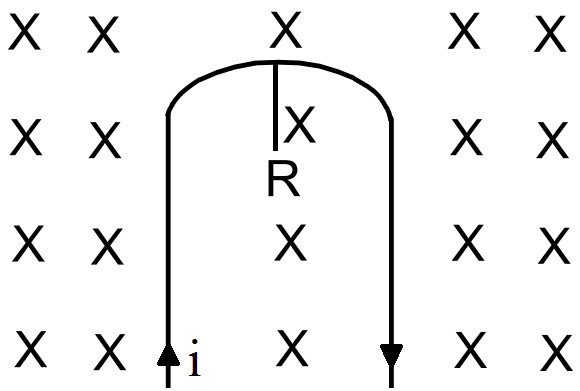
A rigid wire consists of a semi-circular portion of radius R and two straight sections The wire is partially immersed in a perpendicular magnetic field B, as shown in the figure. Find the magnetic force on the wire if it carries a current i.
Answer
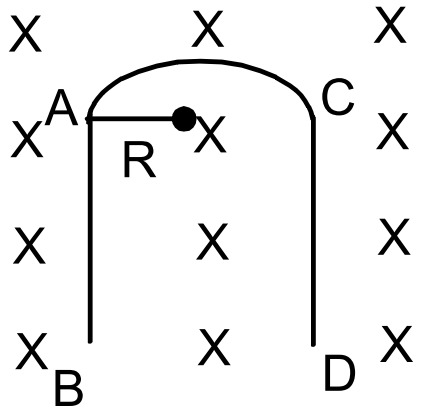
Force due to the wire AB and force due to wire CD are equal and opposite to each other.
Thus they cancel each other.
Net force is the force due to the semicircular loop = 2iRB
View full question & answer→Question 342 Marks
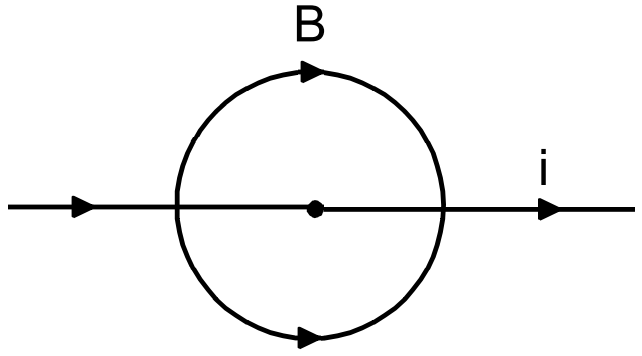
A conducting circular loop of radius a is connected to two Iong, straight wires. The straight wires carry current I as shown in figure. Find the magnetic field B at the centre of the loop.
Answer
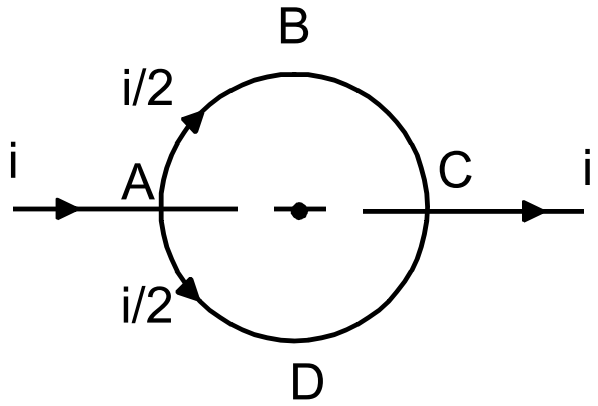 $\text{l}=\frac{\text{i}}{2}$ in each semicircle
$\text{ABC}=\overrightarrow{\text{B}}=\frac{1}{2}\times\frac{\mu_0\Big(\frac{\text{i}}{2}\Big)}{2\text{a}}$ downwards
$\text{ADC}=\overrightarrow{\text{B}}=\frac{1}{2}\times\frac{\mu_0\Big(\frac{\text{i}}{2}\Big)}{2\text{a}}$ upwards
Net $\overrightarrow{\text{B}}=0$ View full question & answer→Question 352 Marks
In Ampere's $\oint\overrightarrow{\text{B}}.\text{d}\overrightarrow{\text{l}}=\mu_0\text{i},$ the current outside the curve is not included on the right hand side. Does it mean that the magnetic field B calculated by using Ampere's law, gives the contribution of only the currents crossing the area bounded by the curve?
AnswerIn Ampere's law $\oint\overrightarrow{\text{B}}.\text{d}\overrightarrow{\text{l}}=\mu_0\text{i},$ is the total current crossing the area bounded by the closed curve. The magnetic field B on the left-hand side is the resultant field due to all existing currents.
View full question & answer→Question 362 Marks
Two metal strips, each of length l, are clamped parallel to each other on a horizontal floor with a separation b between them. A wire of mass m lies on them perpendicularly, as shown in A vertically-upward magnetic field of strength B exists in the space. The metal strips are smooth but the coefficient of friction between the wire and the floor is $\mu.$ A current i is established when the switch S is closed at the instant t = 0. Discuss the motion of the wire after the switch is closed. How far away from the strips will the wire reach?
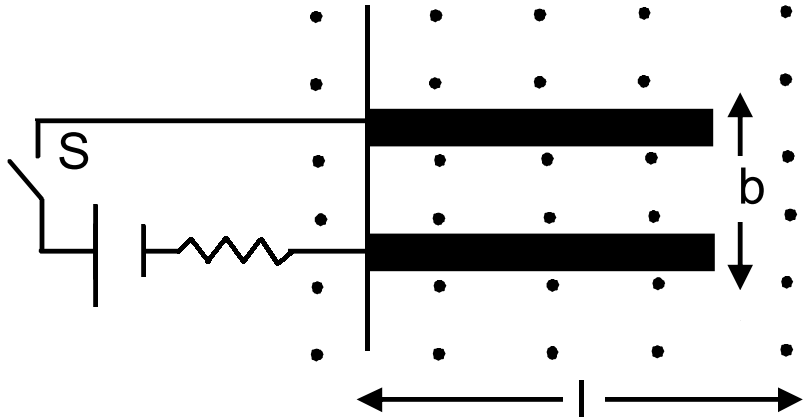
Answer
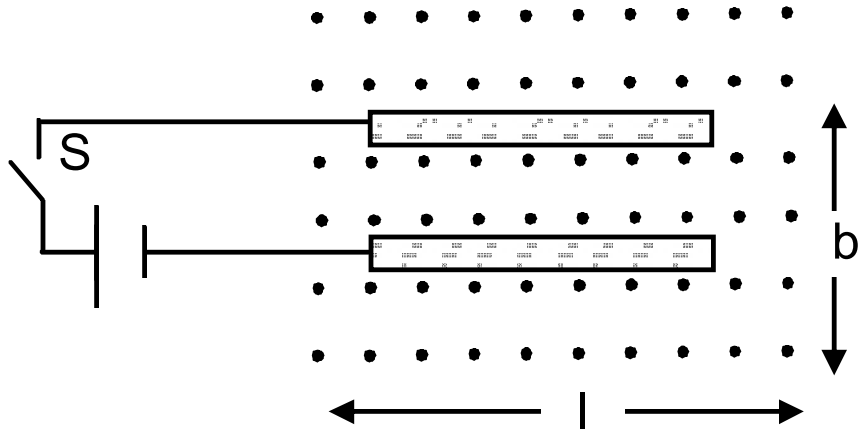 Let ‘F’ be the force applied due to magnetic field on the wire and ‘x’ be the dist covered.
So, $\text{F}\times\text{l}=\mu\text{mg}\times\text{x}$
$\Rightarrow\text{ibBl}=\mu\text{mgx}$
$\Rightarrow\text{x}\frac{\text{ibBl}}{\mu\text{mg}}$ View full question & answer→Question 372 Marks
An alpha particle is projected vertically upward with a speed of $3.0 × 10^4km\ s^{-1}$ in a region where a magnetic field of magnitude 1.0T exists in the direction south to north. Find the magnetic force that acts on the α-particle.
Answer$\text{q}=2\times1.6\times10^{-19}\text{C},$
$\text{v}=3\times10^4\text{km/s}$
$\text{B}=1\text{T},\ \text{F}=\text{qBv}$
$=2\times1.6\times10^{19}\times3\times10^7\times1$
$=9.610^{12}\text{N}.$
View full question & answer→Question 382 Marks
The velocities of two $\alpha-$particles A and B entering a uniform magnetic field are in the ratio 4 : 1. On entering the field they move in different circular paths. Give the ratio of the radii of curvature of the paths of the particles.
AnswerRadius of circular path $\text{r}=\frac{\text{mv}}{\text{qB}}$ i.e. $\text{r}\ \alpha\ \upsilon$
$\therefore\frac{\text{r}_\text{A}}{\text{r}_\text{B}}=\frac{\upsilon_\text{A}}{\upsilon_\text{B}}=\frac{4}{1}$
View full question & answer→Question 392 Marks
A copper wire of diameter 1.6 mm carries 20A. Find the maximum magnitude of the magnetic field $\overrightarrow{\text{B}}$ due to this current.
Answer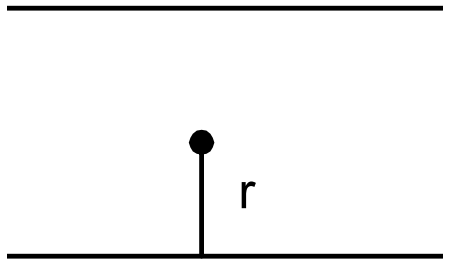
$\text{d}= 1.6 \text{mm}$
$\text{So},\ \text{r} = 0.8\text{mm}= 0.0008\text{m}$
$\text{i} = 20 \text{A}$
$\overrightarrow{\text{B}}=\frac{\mu_0\text{i}}{2\pi\text{r}}=\frac{4\pi\times10^{-7}\times20}{2\times\pi\times8\times10^{-4}}$
$=5\times10^{-3}\text{T}=5\text{mT}$ View full question & answer→Question 402 Marks
The magnetic force depends on v which depends on the inertial frame of reference. Does then the magnetic force differ from inertial frame to frame? Is it reasonable that the net acceleration has a different value in different frames of reference?
AnswerAs F = q(v × B),velocity depends on frame of reference. Hence The magnetic force is frame dependent. So, yes the magnetic force differ from inertial frame to frame.
The net acceleration which a rising from this is however, frame independent for inertial frames (non-relativistic physics).
View full question & answer→Question 412 Marks
An electron beam projected along the positive X-axis deflects along the positive Y-axis. If this deflection is caused by a magnetic field, what is the direction of the field? Can we conclude that the field is parallel to the Z-axis?
AnswerThere must exist a component of magnetic field in +Z direction. There can be magnetic field in +X direction also because of which there will be no initial deflection.
View full question & answer→Question 422 Marks
Protons with kinetic energy K emerge from an accelerator as a narrow beam. The beam is bent by a perpendicular magnetic field, so that it just misses a plane target kept at a distance l in front of the accelerator. Find the magnetic field.
Answer
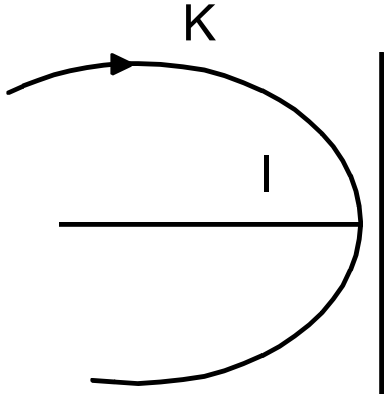 Radius = l, K.E = K
$\text{L}=\frac{\text{Mv}}{\text{qB}}$
$\Rightarrow\text{l}=\frac{\sqrt{2\text{mk}}}{\text{ql}}$
$\Rightarrow\text{B}=\sqrt{\frac{2\text{mk}}{\text{ql}}}$ View full question & answer→Question 432 Marks
The net charge in a current-carrying wire is zero. Then, why does a magnetic field exert a force on it?
AnswerThe positive charge at nucleus do not actually move while the negative charges in the conductor moves. So, force is on moving electron and not on proton as they are at rest.
View full question & answer→Question 442 Marks
The magnetic field inside a tightly wound, long solenoid is $\text{B}=\mu_0\text{ni}.$ It suggests that the field does not depend on the total length of the solenoid, and hence if we add more loops at the ends of a solenoid the field should not increase. Explain qualitatively why the extra-added loops do not have a considerable effect on the field inside the solenoid.
AnswerThe magnetic field due to a long solenoid is given as $\text{B}=\mu_0\text{ni},$ where n is the number of loops per unit length. So, if we add more loops at the ends of the solenoid, there will be an increase in the number of loops and an increase in the length, due to which the ratio n will remain unvaried, thereby leading to not a considerable effect on the field inside the solenoid.
View full question & answer→Question 452 Marks
An electron enters with a velocity $v = v_0i$ into a cubical region (faces parallel to coordinate planes) in which there are uniform electric and magnetic fields. The orbit of the electron is found to spiral down inside the cube in plane parallel to the x-y plane. Suggest a configuration of fields E and B that can lead to it.
AnswerIn the given question, orbit of electron is spiral down inside the cube in a plane parallel to x-y plane, so, direction of magnetic field is along +z direction. Therefore, $\text{B}=\text{B}_0\hat{\text{k}}$. Also, electric field will be along positive x-axis, i.e., $\text{E}=\text{E}_0\hat{\text{i}}$, where $E_0 > 0.$
View full question & answer→Question 462 Marks
A current carrying loop consists of 3 identical quarter circles of radius R, lying in the positive quadrants of the x-y, y-z and z-x planes with their centres at the origin, joined together. Find the direction and magnitude of B at the origin.
Answer$\vec{\text{B}}=\vec{\text{B}}_\text{xy}+\vec{\text{B}}_\text{yz}+\vec{\text{B}}_\text{zx}$
$\Rightarrow\ \vec{\text{B}}=\bigg(\frac{\mu_0}{4\pi}\frac{\text{I}}{\text{R}}\frac{\pi}{2}\bigg)\hat{\text{k}}+\bigg(\frac{\mu_0}{4\pi}\frac{\text{I}}{\text{R}}\frac{\pi}{2}\bigg)\hat{\text{i}}+\bigg(\frac{\mu_0}{4\pi}\frac{\text{I}}{\text{R}}\frac{\pi}{2}\bigg)\hat{\text{j}}$
$\Rightarrow\ \vec{\text{B}}=\bigg(\frac{\mu_0}{8}\frac{\text{I}}{\text{R}}\bigg)(\hat{\text{i}}+\hat{\text{j}}+\hat{\text{k}}).$
View full question & answer→Question 472 Marks
If a particle of charge q is moving with velocity v along X-axis and the magnetic field B is acting along Y-axis, use the expression $\vec{\text{F}}=\text{q}(\vec{\upsilon}\times\vec{\text{B}})$ to find the direction of force $\vec{\text{F}}$ acting on it.
Answer$\vec{\text{F}}=\text{q}\vec{\upsilon}\times\vec{\text{B}}$
Given $\vec{\upsilon}=\upsilon \text{i},\vec{\text{B}}=\text{B}\hat{\text{j}}$
$\therefore\ \ \ \ \vec{\text{F}}=\text{q}(\upsilon\hat{\text{i}}\times(\text{B}\hat{\text{j}})=\text{qvB}\ \hat{\text{k}}$
That is, force is acting along Z-axis.
View full question & answer→Question 482 Marks
An $\alpha$–particle and a proton are moving in the plane of paper in a region where there is a uniform magnetic field directed normal to the plane of the paper. If the particles have equal linear momenta, what would be the ratio of the radii of their trajectories in the field?
AnswerRadius of circularpath of a charged particle, $\text{r}=\frac{\text{mv}}{\text{qB}}=\frac{\text {P}}{\text{qB}}$.
For same linear momentum andmagnetic field B,
$\text{r}\ \alpha\frac{1}{\text{q}}$
$\therefore\ \ \frac{\text{r}_\text{a}}{\text{r}_\text{p}}=\frac{\text{q}_\text{p}}{\text{q}_\text{a}}=\frac{+\text{e}}{+2\text{e}}=\frac{1}{2}$
View full question & answer→Question 492 Marks
Consider a 10cm long portion of a straight wire carrying a current of 10A placed in a magnetic field of 0.1T making an angle of 53° with the wire. What magnetic force does the wire experience?
Answer$\text{l}=10\text{cm}=10\times10^{-3}\text{m}=10^{-1}\text{m}$
$\text{i}=10\text{A},\ \text{B}=0.1\text{T},\ \theta=53^\circ$
$|\text{F}|=\text{iL B}\sin\theta=10\times10^{-1}\times0.1\times0.79$
$=0.0798\approx0.08$
direction of F is along a direction $\perp\text{r}$ to both l and B.
View full question & answer→Question 502 Marks
Using the formula $\overrightarrow{\text{F}}=\text{q}\overrightarrow{\text{v}}\times\overrightarrow{\text{B}}$ and $\text{B}=\frac{\mu_0\text{i}}{2\pi\text{r}},$ show that the SI units of the magnetic field B and the permeability constant $\mu_0$ may be written as N/A-m and $NA^2$ respectively.
Answer$\overrightarrow{\text{F}}=\text{q}\overrightarrow{\text{v}}\times\overrightarrow{\text{B}}$
$\text{B}=\frac{\text{F}}{\text{qv}}=\frac{\text{F}}{\text{ITv}}=\frac{\text{N}}{\text{A.sec}/\text{sec}.}=\frac{\text{N}}{\text{A-m}}$
$\text{B}=\frac{\mu_0\text{I}}{2\pi\text{r}}$
$\mu_0=\frac{2\pi\text{rB}}{\text{I}}=\frac{\text{m}\times\text{N}}{\text{A-m}\times\text{A}}=\frac{\text{N}}{\text{A}^2}$
View full question & answer→Question 512 Marks
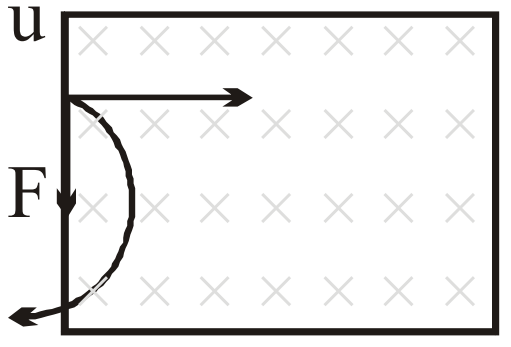
Assume that the magnetic field is uniform in a cubical region and is zero outside. Can you project a charged particle from outside into the field so that the particle describes a complete circle in the field?
AnswerNo,
View full question & answer→Question 522 Marks
Each of the batteries shown in figure has an emf equal to 5V. Show that the magnetic field B at the point P is zero for any set of values of the resistances.
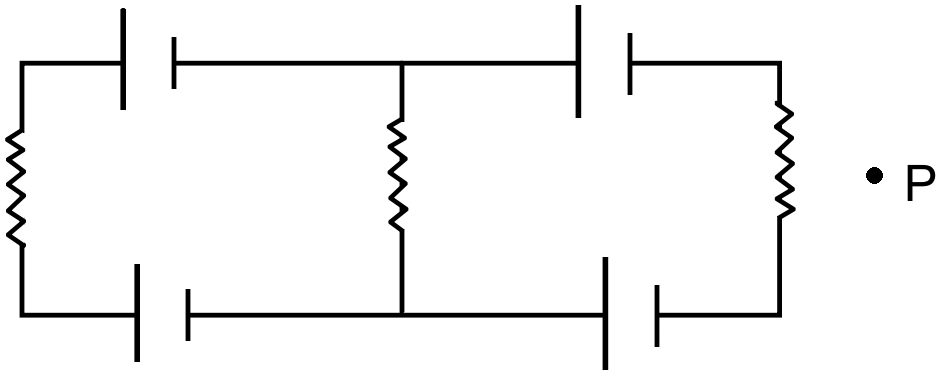
Answer
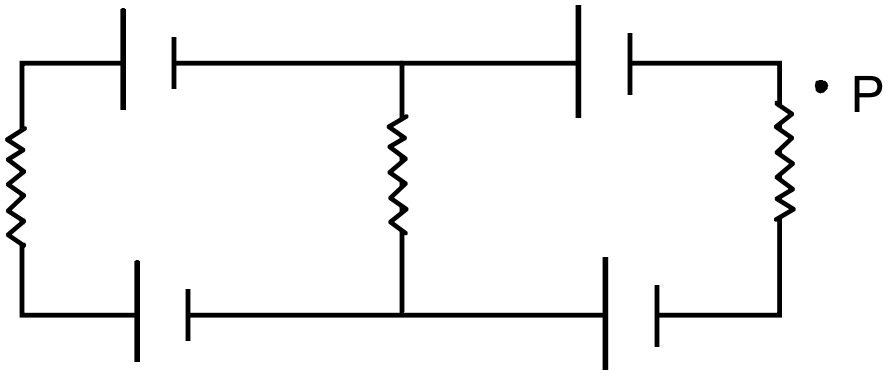
Net current in circuit = 0
Hence the magnetic field at point P = 0
[Owing to wheat stone bridge principle]
View full question & answer→Question 532 Marks
A circular loop of one turn carries a current of 5.00A. If the magnetic field B at the centre is 0.200mT find the radius of the loop.
Answer$\text{B} = 0.2\text{mT},$
$\text{i} = 5\text{A},$
$\text{n} = 1,$
$\text{r} = ?$
$\text{B}=\frac{\text{n}\mu_0\text{i}}{2\text{r}}$
$\Rightarrow\text{r}=\frac{\text{n}\times\mu_0\text{i}}{2\text{B}}=\frac{1\times4\pi\times10^{-7}\times5}{2\times0.2\times10^{-3}}$
$=3.14\times5\times10^{-3}\text{m}$
$= 15.7\times10^{-3}\text{m}$
$ = 15.7 × 10^{-1}\text{cm} = 1.57\text{cm}$
View full question & answer→Question 542 Marks
An electron beam passes through a region of crossed electric and magnetic fields of strength E and B respectively. For what value of electron-speed the beam will remain undeflected?
AnswerThe electron beam will pass undeflected if electric force and magnetic force on electron is equal and opposite i.e., eE = evor $\upsilon=\frac{\text{E}}{\text{B}}$
View full question & answer→Question 552 Marks
A solenoid of length $0.5 m$ has a radius of $1 cm$ and is made up of 500 turns. It carries a current of $5 A$. What is the magnitude of the magnetic field inside the solenoid?
AnswerThe number of turns per unit length is,
$
n=\frac{500}{0.5}=1000 \text { turns } / m
$
The length $l=0.5 m$ and radius $r=0.01 m$. Thus, $l / a=50$ i.e., $l>>a$. Hence, we can use the long solenoid formula, namely, Eq. (4.20)
$
\begin{aligned}
B & =\mu_0 n I \\
& =4 \pi \times 10^{-7} \times 10^3 \times 5 \\
& =6.28 \times 10^{-3} T
\end{aligned}
$
View full question & answer→Question 562 Marks
A straight wire carrying a current of $12 A$ is bent into a semi-circular arc of radius $2.0 cm$ as shown in Fig. 4.11 (a). Consider the magnetic field $B$ at the centre of the arc. (a) What is the magnetic field due to the straight segments? (b) In what way the contribution to $B$ from the semicircle differs from that of a circular loop and in what way does it resemble? (c) Would your answer be different if the wire were bent into a semi-circular arc of the same radius but in the opposite way as shown in Fig. 4.11(b)?
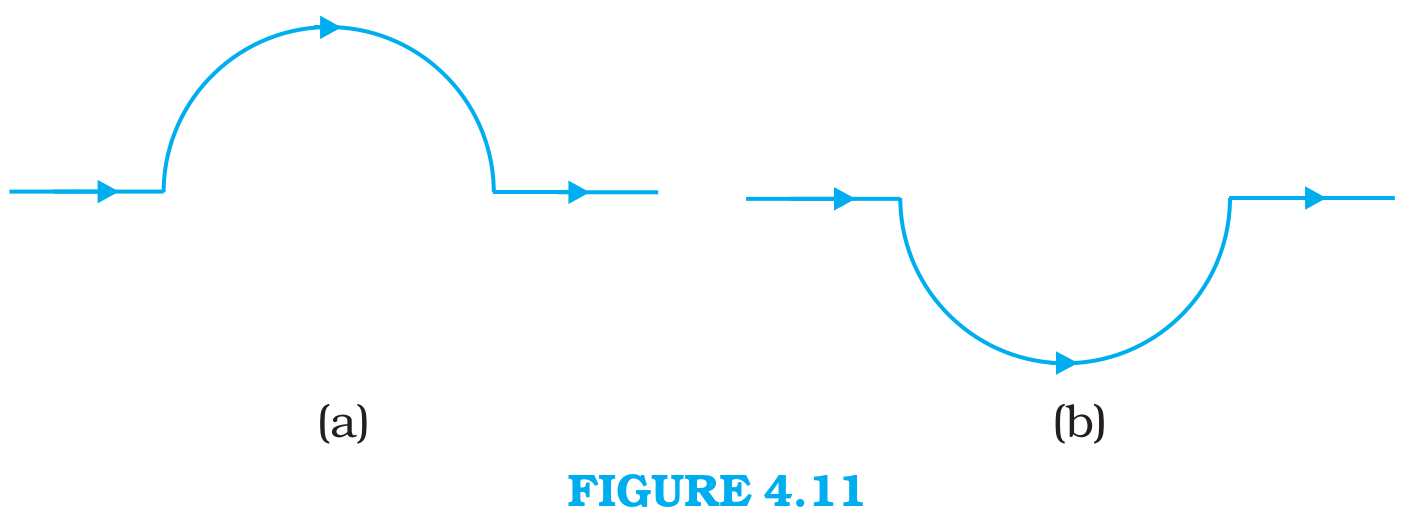
Answer(a) $d l$ and $r$ for each element of the straight segments are parallel. Therefore, $d l \times r =0$. Straight segments do not contribute to $|B|$.
(b) For all segments of the semicircular arc, $d l \times r$ are all parallel to each other (into the plane of the paper). All such contributions add up in magnitude. Hence direction of $B$ for a semicircular arc is given by the right-hand rule and magnitude is half that of a circular loop. Thus B is $1.9 \times 10^{-4} T$ normal to the plane of the paper going into it.
(c) Same magnitude of $B$ but opposite in direction to that in (b).
View full question & answer→Question 572 Marks
What is the radius of the path of an electron $($mass $9 \times 10^{-31} kg$ and charge $1.6 \times 10^{-19} C$ ) moving at a speed of $3 \times 10^7 m / s$ in a magnetic field of $6 \times 10^{-4} T$ perpendicular to it? What is its frequency? Calculate its energy in $keV .\left(1 eV =1.6 \times 10^{-19} J \right)$.
AnswerUsing Eq. $(4.5)$ we find
$r=m v /(q B)=9 \times 10^{-31} \ kg \times 3 \times 10^7 m s ^{-1} /\left(1.6 \times 10^{-19} C \times 6 \times 10^{-4} T \right)$
$=28 \times 10^{-2} m =28 \ cm$
$v=v /(2 \pi r)=17 \times 10^6 s ^{-1}=17 \times 10^6 Hz =17 MHz \text {. }$
$E=(1 / 2) m v^2=(1 / 2) 9 \times 10^{-31} \ kg \times 9 \times 10^{14} m ^2 / s ^2=40.5 \times 10^{-17} J$
$\approx 4 \times 10^{-16} J =2.5 keV \text {. }$
View full question & answer→Question 582 Marks
In the circuit (Fig. 4.23) the current is to be measured. What is the value of the current if the ammeter shown (a) is a galvanometer with a resistance $R_G=60.00 \Omega$; (b) is a galvanometer described in (a) but converted to an ammeter by a shunt resistance $r_s=0.02 \Omega$; (c) is an ideal ammeter with zero resistance?
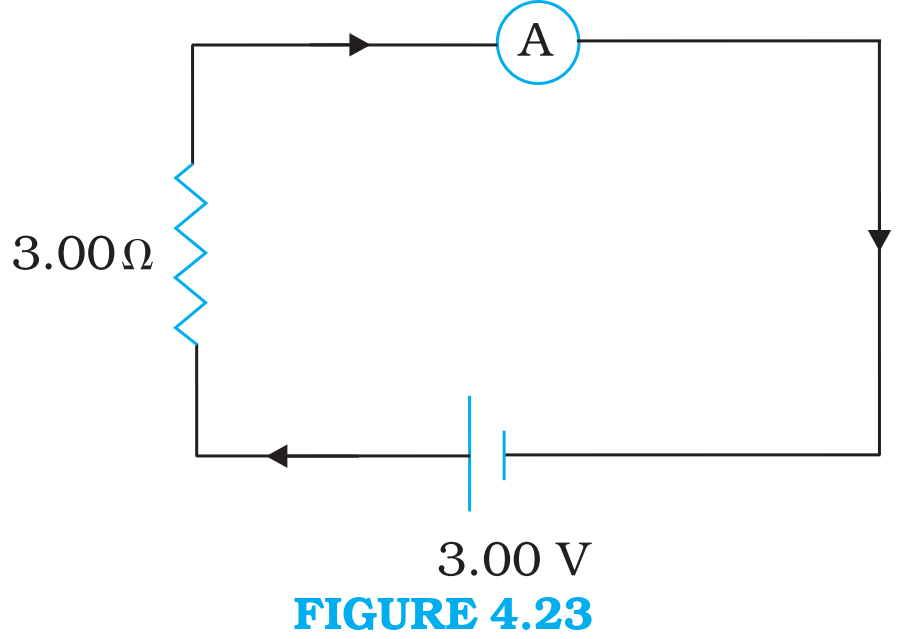
Answer(a) Total resistance in the circuit is, $R_G+3=63 \Omega$. Hence, $I=3 / 63=0.048 A$.
(b) Resistance of the galvanometer converted to an ammeter is,
$
\frac{R_G r_s}{R_G+r_s}=\frac{60 \Omega \times 0.02 \Omega}{(60+0.02) \Omega} \simeq 0.02 \Omega
$
Total resistance in the circuit is, $0.02 \Omega+3 \Omega=3.02 \Omega$. Hence, $I=3 / 3.02=0.99 A$.
(c) For the ideal ammeter with zero resistance, $I=3 / 3=1.00 A$
View full question & answer→