Questions · Page 2 of 4

M.C.Q (1 Marks)

MCQ 511 Mark
Antinodal curves correspond to $........$ interference.
  • Constructive
  • B
    Destructive
  • C
    Where intensity is less than maximum but not completely zero.
  • D
    None of these
Answer
Correct option: A.
Constructive

Antinodal curves correspond to constructive interference.
View full question & answer
MCQ 521 Mark
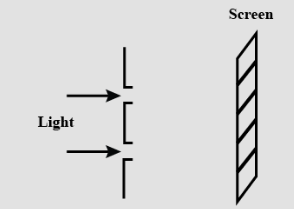
If light is passed through a double$-$slit opening and falls onto a screen, Identify the pattern produced on the screen.
  • A bright central band of light with slightly diminished, alternating bright and dark bands.
  • B
    A bright central band of light with tiny lines toward the edges of the screen.
  • C
    A large circle of light with tiny circles around it
  • D
    one antinode and no nodes.
Answer
Correct option: A.
A bright central band of light with slightly diminished, alternating bright and dark bands.

When light is passed through a double slit opening, light from the two slits interfere at different points in the screen, forming alternating bright and dark fringes due to constructive and destructive interference respectively. However the intensities of higher order bands is slightly diminished.
Such an arrangement was first studied by Young, and has been since called Young's Double Slit Setup.

View full question & answer
MCQ 531 Mark
Which of the following properties show that light is a transverse wave?
  • A
    Reflection.
  • B
    Interference.
  • C
    Diffraction.
  • Polarization.
Answer
Correct option: D.
Polarization.

Reflection, interference and diffraction are the phenomena shown by both transverse waves and longitudinal waves. Polarization is the phenomenon shown only by transverse waves.

View full question & answer
MCQ 541 Mark
If Young's double slit experiment is performed in water:
  • The fringe width will decrease.
  • B
    The fringe width will increase.
  • C
    The fringe width will remain unchanged.
  • D
    There will be no fringe.
Answer
Correct option: A.
The fringe width will decrease.

As fringe width is proportional to the wavelength and wavelength of light is inversely proportional to the refractive index of the medium,
Here,
$\lambda_\text{M}=\frac{\lambda}{\eta}$
$\lambda_\text{M}$ = wavelength in medium
$\lambda$ = wavelength in vacuum
$\eta$ = refractive index of medium
Hence, fringe width decreases when Young's double slit experiment is performed under water.

View full question & answer
MCQ 551 Mark
During the $19^{th}$ century, light was considered to be a stream of particles called:
  • A
    Atoms
  • B
    Electrons
  • Corpuscles
  • D
    Quantas
Answer
Correct option: C.
Corpuscles

The corpuscular theory of light is proposed by newton in $1704$. It is referred as particle theory or newton’s theory of light.
According to this theory,
Light is made up of tiny particles called corpuscles having negligible mass. These particles $($corpuscles$)$ are perfectly elastic.
These tiny particles always travel in straight line in all directions.
These corpuscles ravel at very high velocity.
These corpuscles are of different sizes. The different color of light is due to different sizes.

View full question & answer
MCQ 561 Mark
The transverse nature of light is shown by:
  • A
    Interference of light
  • B
    Refraction of light
  • Polarization of light
  • D
    Dispersion of light
Answer
Correct option: C.
Polarization of light

Polarisation of light establishes that light are transverse in nature, otherwise it was believed that they are longitudinal waves, like the sound waves.

View full question & answer
MCQ 571 Mark
Light is:
  • A
    Wave phenomenon.
  • B
    Particle phenomenon
  • Both particle and wave phenomenon.
Answer
Correct option: C.
Both particle and wave phenomenon.

Light shows photoelectric effect and Compton effect, which depicts its particle nature. It also shows interference and diffraction, which depicts the wave nature of light.

View full question & answer
MCQ 581 Mark
The angular resolution of a telescope of $10\ cm$ diameter at a wavelength of $5000 \mathring{\text{A}}$ is of the order of:
  • A
    $10^6 \mathrm{rad}$
  • B
    $10^{-2} \mathrm{rad}$
  • C
    $10^{-4} \mathrm{rad}$
  • $10^{-5} \mathrm{rad}$
Answer
Correct option: D.
$10^{-5} \mathrm{rad}$
$\text{R}=\frac{1}{\Delta\theta}$
$=\frac{\text{a}}{1.22\lambda}$
$\frac{1}{\Delta\theta}=\frac{0.10}{1.22\times5000\times10^{-10}}$
$\Delta\theta=6.1\times10^{-6}\text{rad}$
View full question & answer
MCQ 591 Mark
If the source of light used in a Young's double slit experiment is changed from red to violet:
  • A
    The fringes will become brighter.
  • Consecutive fringes will come closer.
  • C
    The intensity of minima will increase.
  • D
    The central bright fringe will become a dark fringe.
Answer
Correct option: B.
Consecutive fringes will come closer.

Fringe width, $\beta=\frac{\lambda\text{D}}{\text{d}}$
Wavelength of red light is greater than wavelength of violet light; so, the fringe width will reduce.

View full question & answer
MCQ 601 Mark
Consider sunlight incident on a slit of width $10^4A$. The image seen through the slit shall.
  • Be a fine sharp slit white in colour at the center.
  • B
    A bright slit white at the center diffusing to zero intensities at the edges.
  • C
    A bright slit white at the center diffusing to regions of different colours.
  • D
    Only be a diffused slit white in colour.
Answer
Correct option: A.
Be a fine sharp slit white in colour at the center.

Key concept:
Diffraction of Light is the phenomenon of bending of light around the comers of an obstacle/aperture of the size of the wavelength of light.

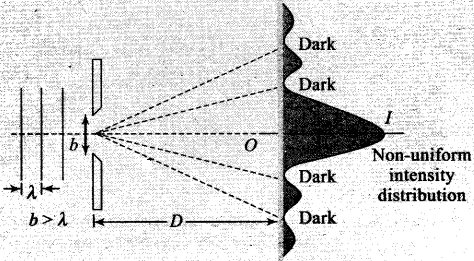
Size of the slit is very large compared to wavelength

Size of the slit is comparable to wavelenght
In figure $(A)$, no diffraction phenomenon is observed as the size of slit is weary large compared to wavelength. But in figure$(B),$ there will be diffraction of light as size of slit is compared to the wavelength of light incident.
Here in the question it is given, width of the slit
$\text{b}=10^4\mathring{\text{A}}=10^4\times10^{-10}\text{m}$
$=10^{-6}\text{m}=1\text{pm}$
Wavelength of $($visible$)$ sunlight varies from $4000\mathring{\text{A}}\text{ to }8000\mathring{\text{A}}$.
Hence the width of slit is comparable to that of wavelength, hence diffraction occurs with maxima at centre. So, at the centre all colours appear, i.e., mixing of colours form white patch at the centre.

View full question & answer
MCQ 611 Mark
Why do polarized sun glasses block out some reflected light $($glare$)$, but do not block out light that has not been reflected?
  • Some reflected light is at least partially polarized.
  • B
    Some reflected light changes frequency.
  • C
    Some reflected light is at least partially diffracted.
  • D
    Some reflected light splits into multiple photons.
Answer
Correct option: A.
Some reflected light is at least partially polarized.

When ordinary $($unpolarised$)$ light is reflected from a surface, it gets partial polarisation, it means some of the electric vectors in some planes are cut$-$off. When this partially polarized light is incident on polarized glasses, glass acts as an analyser and therefore block out some reflected light.

View full question & answer
MCQ 621 Mark
The wave theory of light, in its original form, was first postulated by.
  • A
    Isaac Newton
  • Christian Huygens
  • C
    Thomas Young
  • D
    Augustin Jean Fresnel
Answer
Correct option: B.
Christian Huygens

In $1678$, Dutch physicist, Christian Huygens, believed that the light was made up of waves vibrating up and down perpendicular to the direction of the light travels and therefore formulated away of visualising wave propagation.
This becomes know as Huygens principle. Huygens theory was the successful theory of light in three dimensions. Huygens suggested that the light wave peaks form from surfaces like the layers of onion. In a vacuum or other uniform mediums the light waves are spherical and these wave surfaces advance or spread out as they travel at the speed if light.
This theory explains why light shining through a pinhole or slitwall spread out rather than going in straight lines.

View full question & answer
MCQ 631 Mark
What type of diffraction takes place in case of Young's double slit experiment?
  • A
    Fresnal type
  • Fraunhofer type
  • C
    neigher Fresnel type nor Fraunhofer type
  • D
    sometimes Fresnel type sometimes Frunhofer types
Answer
Correct option: B.
Fraunhofer type
View full question & answer
MCQ 641 Mark
In which of the following the final image is erect?
  • A
    Compound microscope
  • B
    Astronomical telescope
  • Simple microscope
  • D
    All of the above
Answer
Correct option: C.
Simple microscope

The image formed by the Compound microscope and Astronomical telescope is inverted,but in case of Simple microscope it form erect image.

View full question & answer
MCQ 651 Mark
In an astronomical microscope, the focal length of the objective is made:
  • A
    Shorter than that of the eye piece
  • Greater than that of the eye piece
  • C
    Half of the eye piece
  • D
    Equal to that of the eye piece
Answer
Correct option: B.
Greater than that of the eye piece
In an Astronomical telescope, the objective lens has a greater radius than the eyepiece.
Thus the objective lens has a greater focal length than the eyepiece.
View full question & answer
MCQ 661 Mark
The wavefronts of a light wave travelling in vacuum are given by $x + y + z = c$. The angle made by the direction of propagation of light with the $X-$axis is:
  • A
    $0^\circ$
  • B
    $45^\circ$
  • C
    $90^\circ$
  • $\cos^{-1}\Big(\frac{1}{\sqrt{3}}\Big)$
Answer
Correct option: D.
$\cos^{-1}\Big(\frac{1}{\sqrt{3}}\Big)$

On writing the given equation in the plane equation form $lx + my + nz = p,$
Where $l^2+m^2+n^2$ and $p>0$, we get:
$\frac{1}{\sqrt{3}}\text{x}+\frac{1}{\sqrt{3}}\text{y}+\frac{1}{\sqrt{3}}\text{z}=\frac{\text{c}}{\sqrt{3}}$
If $\theta$ is the angle between the normal and $+x$ axis, then
$\cos\theta=\frac{1}{\sqrt{3}}$
$\Rightarrow\theta=\cos^{-1}\Big(\frac{1}{\sqrt{3}}\Big) $

View full question & answer
MCQ 671 Mark
When light is refracted, which of the following does not change?
  • A
    Wavelepgth.
  • Frequency.
  • C
    Velocity.
  • D
    Amplitude.
Answer
Correct option: B.
Frequency.

Frequency of a light wave doesnt change on changing the medium of propagation of light.

View full question & answer
MCQ 681 Mark
The phenomenon of rotation of plane polarized light is called:
  • A
    Kerr effect
  • B
    Double refraction
  • Optical activity
  • D
    Dichroism
Answer
Correct option: C.
Optical activity

The phenomenon of rotation of plane polarized light is called optical activity.

View full question & answer
MCQ 691 Mark
An observer on earth observes that wave length of spectral line in spectrum of a milky way shifts towards red end of spectrum. According to the observer, the milky-way is:
  • A
    Approaching the earth
  • Receding away from the earth
  • C
    Stationary
  • D
    Rotating about its own axis
Answer
Correct option: B.
Receding away from the earth

When an object moves away from us, its light waves are stretched into lower frequencies or longer wavelengths, and we say that the light is redshifted.
It also explain the expanding nature of universe. Shifting towards red end means wavelength is increasing. There, milkyway is receding away from earth.

View full question & answer
MCQ 701 Mark
When a drop of oil is spread on a water surface, it displays beautiful colours in daylight because of:
  • A
    Disperson of light.
  • B
    Reflection of light.
  • C
    Polarization of light.
  • Interference of light.
Answer
Correct option: D.
Interference of light.

Interference effect is produced by a thin film $($coating of a thin layer of a translucent material on a medium of different refractive index which allows light to pass through it$)$. ln the present case, oil floating on water forms a thin film on the surface of water, leading to the display of beautiful colours in daylight because of the interference of sunlight.

View full question & answer
MCQ 711 Mark
According to Newton, different colors of light are due to the difference in $........$ of the corpuscles.
  • A
    mass
  • B
    nature
  • C
    shape
  • size
Answer
Correct option: D.
size

Corpuscles are single, infinitesimally small, particles which have shape, size, color, and other physical properties.

View full question & answer
MCQ 721 Mark
Which of the following sources gives best monochromatic light?
  • A
    A candle.
  • B
    A bulb.
  • C
    A mercury tube.
  • A laser.
Answer
Correct option: D.
A laser.

Among the given sources, laser is the best coherent source providing monochromatic light with constant phase difference.

View full question & answer
MCQ 731 Mark
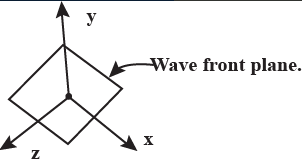
Light waves travel in vaccum along the $y-$axis. Then the wave front is:
  • $y =$ constant
  • B
    $x =$ constant
  • C
    $z =$ constant
  • D
    $x+y+z =$ constant
Answer
Correct option: A.
$y =$ constant

waves front are plane perpendicular to the direction of rays.
so, as light is traveling along $y -$ axis, plane perpendicular to $y -$ axis is the $x-z$ plane with any constant value of $y.$
so, $y =$ constant is the wave front plane

View full question & answer
MCQ 741 Mark
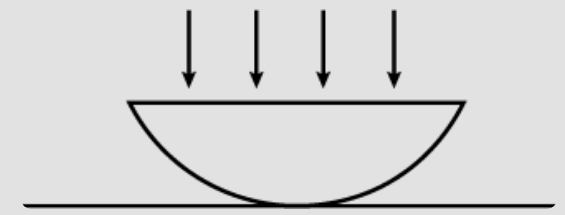
A thin slice is cut out of a glass cylinder along a plane parallel to its axis. The slice is placed on a flat glass plae as shown in figure. The observed interference fringes from this combination shall be:
  • Straight
  • B
    Circular
  • C
    Equally spaced
  • D
    Having fringe spacing which increases as we go outward.
Answer
Correct option: A.
Straight

The locus of the equal path difference consists in lines going parallel to the axis of cylinder.
Therefore, interference fringes will be straight.

View full question & answer
MCQ 751 Mark
Two identical lights sources $S_1$​ and $S_2$ emit the light of same wavelength $\lambda$. These light rays will exhibit interference if:
  • Their phase difference remain constant.
  • B
    Their phase difference is distributed randomly.
  • C
    Their light intensities remain constant.
  • D
    Their light intensities change continuously.
Answer
Correct option: A.
Their phase difference remain constant.

For interference to take place the light sources need to be either in phase or have a constant phase difference. In case the phase difference keeps changing the interference pattern will keep on changing, as a result of interference pattern will be observed.

View full question & answer
MCQ 761 Mark
When a drop of oil is spread on a water surface, it displays beautiful colors in daylight because of:
  • A
    Dispersion of light
  • B
    Reflection of light
  • C
    Polarization of light
  • Interference of light
Answer
Correct option: D.
Interference of light

When a drop of oil is spread on a water surface, it displays beautiful colors in daylight because the oil film is only a few nano-meters thick. Some of the light is reflected off the top surface and some the bottom surface. Because the thickness of the oil film is about the same as the wavelength of the light the two reflected rays interfere with each other.

View full question & answer
MCQ 771 Mark
If the apertature of a telescope is decreased the resolving power will:
  • A
    Increases
  • Decreases
  • C
    Remain same
  • D
    Zero
Answer
Correct option: B.
Decreases

Resolving power of a telescope $=\frac{\text{a}}{1.22\lambda}$
where a is the aperture of the telescope.
Thus resolving power∝ aperture.
Hence, if the aperture of telescope decreases, the resolving power decreases.

View full question & answer
MCQ 781 Mark
In a Young's double slit experiment, the source is white light. One of the holes is covered by a red filter and another by a blue filter. In this case:
  • A
    There shall be alternate interference patterns of red and blue.
  • B
    There shall be an interference pattern for red distinct from that for blue.
  • There shall be no interference fringes.
  • D
    There shall be an interference pattern for red mixing with one for blue.
Answer
Correct option: C.
There shall be no interference fringes.

We know that, for the interference pattern to be formed on the screen, the sources should be coherent and emits lights of same frequency and wavelength.
In a Young's double$-$slit experiment, if one of the holes is covered by a red filter and another by a blue filter, then only red and blue lights are present due to alteration. In Young's double$-$slit experiment, a monochromatic light is used for the formation of fringes on the screen.
Therefore, there shall be no interference fringes.

View full question & answer
MCQ 791 Mark
The magnitude of magnifying power of an astronomical telescope is $5$, the focal power of its eyepiece is $10$ diopters. The focal power of its objective $($in diopters$)$ is:
  • A
    $1$
  • $2$
  • C
    $3$
  • D
    $4$
Answer
Correct option: B.
$2$
$M = 5$
$P_e = 10$
$\frac{1}{\text{f}_\text{e}}=10$
$f_e$​ = $\frac{1}{10} m = 10\ cm$
M = $\frac{\text{f}_\text{0}}{\text{f}_\text{e}}​​ =5$
$f_0= 50\ cm$
$P = 2D$
View full question & answer
MCQ 801 Mark
The shape of wave front at a very large distance from source is $........$
  • A
    Circular
  • B
    Spherical
  • C
    Cylindrical
  • Plane
Answer
Correct option: D.
Plane

Due to the large distance, the radius of the wavefront can be considered as large $($infinity$)$ and hence, a wavefront is almost plane.

View full question & answer
MCQ 811 Mark
If one of the two slits of Young's double$-$slit experiment is painted so that it transmits half the light intensity as the second slit, then:
  • A
    Fringe system will altogether disappear.
  • B
    Bright fringes will become brighter and the dark fringes will become darker.
  • C
    Both dark and bright fringes will become darker.
  • Dark fringes will become less dark and bright fringes will become less bright.
Answer
Correct option: D.
Dark fringes will become less dark and bright fringes will become less bright.

As the intensity from second slit decreases the bright fringe becomes darker due to constructive interference and dark fringe becomes bright due to destructive interference.

View full question & answer
MCQ 821 Mark
Light waves can be polarised because they:
  • A
    Have high frequencies
  • B
    Have short wavelength
  • Are transverse
  • D
    Can be reflected
Answer
Correct option: C.
Are transverse
Polarisation of light waves is possible only because they can oscillate in more than one orientation i.e., they are transverse in nature. It has no dependence on its wavelength and frequencies.
View full question & answer
MCQ 831 Mark
Wave front means:
  • All particles in it have same phase.
  • B
    Few particles are in same phase, rest are in opposite phase.
  • C
    All particles have opposite phase of vibrations.
  • D
    All particles have random vibrations.
Answer
Correct option: A.
All particles in it have same phase.

It is the imaginary surface representing corresponding points pf a wave that vibrate in unison. When identical waves having a common origin travel through a homogeneous medium, the corresponding crests and troughs at any instant phase.

View full question & answer
MCQ 841 Mark
Huygen's wave theory allows us to know:
  • A
    The wavelength of the wave.
  • B
    The velocity of the wave.
  • C
    The amplitude of the wave.
  • The propagation of the wave front.
Answer
Correct option: D.
The propagation of the wave front.

Huygen's wave theory explain the propagation of the wave front.

View full question & answer
MCQ 851 Mark
In Young's interference experiment, if the slits are of unequal width, then:
  • A
    No fringes will be formed
  • The positions of minimum intensity will not be completely dark.
  • C
    Bright fringe as displaced from the original central position.
  • D
    Distance between two consecutive dark fringes will not be equal to the distance between two consecutive right fringes.
Answer
Correct option: B.
The positions of minimum intensity will not be completely dark.

Unequal width of slits will cause unequal intensity of lights entering from both slits.
As a result, during interference complete cancelling of light intensity will not take place at regions of otherwise dark fringe.
As the value of $\beta$ does not depend on intensity of light, there will be no shifting of fringes as well as no change in fringe width.

View full question & answer
MCQ 861 Mark
When light is refracted into a medium:
  • A
    Its wavelength and frequency both increase
  • B
    Its wavelength increases but frequency remains unchanged
  • Its wavelength decreases but frequency remains unchanged.
  • D
    Its wavelength and frequency both decrease.
Answer
Correct option: C.
Its wavelength decreases but frequency remains unchanged.

Frequency of a light wave, as it travels from one medium to another, always remains unchanged, while wavelength decreases.
Decrease in the wavelength of light entering a medium of refractive index $\mu$, is given by,
$\lambda_\text{M}=\frac{\lambda}{\mu},$
Where $\lambda_\text{M}$ = wavelength in medium
$\lambda =$ wavelength in vacuum
$\mu =$ refractive index

View full question & answer
MCQ 871 Mark
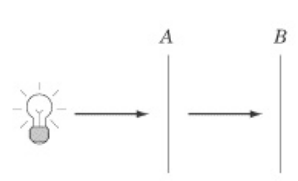
A person shines a coherent light of a bulb through an object, A, which produces a pattern of concentric rings on a screen, B. A is most likely:
  • A
    A polarization filter
  • B
    A single-slit
  • C
    A prism
  • A sheet with a pinhole
Answer
Correct option: D.
A sheet with a pinhole
Explanation: d. A sheet with a pinhole
A polarization filter will limit the light vectors in a single plane i.e. polarization.
A prism will split the light i.e. dispersion .
A slit system will make a diffraction pattern on screen B, but in this pattern, fringes are straight.
Due to its circular size, a pinhole will produce diffraction pattern on screen B in the forms of concentric rings.
View full question & answer
MCQ 881 Mark
Light waves exhibit polarization but sound waves do not exhibit polarization because they are not:
  • A
    Longitudinal
  • B
    Coherent
  • C
    Dispersive
  • Transverse
Answer
Correct option: D.
Transverse

Only transverse waves can exhibit polarization.
Light waves are transverse waves whereas sound waves are longitudinal waves, hence sound waves can not be polarized.

View full question & answer
MCQ 891 Mark
A white light is passed through the two narrow slits and produced a pattern of alternating bright and dark lines on the screen as shown above. What will effects on the central bright band , if the distance between screen and slits are increased?
  • Become wider
  • B
    Become narrower
  • C
    Remain unchanged
  • D
    Disappear completely
Answer
Correct option: A.
Become wider

The setup shown is that of Young's Double Slit Experiment.
The fringe width in the experiment is given as $\beta=\frac{\text{D}\lambda}{\text{d}}​$
where d is the distance between the slits, $D$ is the distance between screen and slits.
Hence the central fringe also widens when distance between screen and slits increases.

View full question & answer
MCQ 901 Mark
A microscope is used with sodium light and its resolving power is not sufficiently large. Higher resolution will be obtained by using wavelength of:
  • A
    $20$ micron
  • B
    $2$ micron
  • C
    $1$ micron
  • $400 \mathring{\text{A}}$
Answer
Correct option: D.
$400 \mathring{\text{A}}$

Since power of resolution is more for violet than for red, we conclude that resolving power is greater for light with lower wavelengths.
Wavelength of sodium light is around 589nm.
Hence resolving power increases for light with lower wavelength.

View full question & answer
MCQ 911 Mark
Two nearby objects are just resolved, if the principle maximum in the diffraction pattern of one coincides with:
  • A
    Principal maxima of other
  • B
    First minimum of the other
  • C
    Half$-$way between principal maximum and first minimum.
  • Second maximum of the other
Answer
Correct option: D.
Second maximum of the other

The Rayleigh criterion is the generally accepted criterion for the minimum resolvable detail $-$ the imaging process is said to be diffraction$-$limited when the first diffraction minimum of the image of one source point coincides with the maximum of another.

View full question & answer
MCQ 921 Mark
A thin transparent sheet is placed in front of a Young's double slit. The fringe$-$width will:
  • A
    Increase.
  • B
    Decrease.
  • Remain same.
  • D
    Become nonuniform.
Answer
Correct option: C.
Remain same.

On the introduction of a transparent sheet in front of one of the slits, the fringe pattern will shift slightly but the width will remain the same.

View full question & answer
MCQ 931 Mark
Which of the following is correct for light diverging from a point source?
  • The intensity decreases in proportion for the distance squared.
  • B
    The wavefront is parabolic.
  • C
    The intensity at the wavelength does not depend on the distance.
  • D
    None of these.
Answer
Correct option: A.
The intensity decreases in proportion for the distance squared.

A point source produces a spherical wavefront that moves in all the directions from the point.
Whereas the intensity at the wavelength is dependent on the distance and it follows the inverse square law. So, the intensity decreases with an increase in the distance from the source.

View full question & answer
MCQ 941 Mark
In $\text{YDSE}$, the slit widths are in the ratio of $1:9$. The ratio of intensity of the maxima to that of the minima is:
  • A
    $81:1$
  • B
    $9:1$
  • $4:1$
  • D
    $3:1$
Answer
Correct option: C.
$4:1$

Intensity is proportional to the area of the slit.
As slit widths are in the ratio of $1:9$
The areas are also in the ratio $1:9$
Thus Intensities are in the ratio $1:9$
amplitudes are square root of Intensities
Thus amplitudes are in ratio $1:3$
Let amplitudes be x and $3x$
At maxima the amplitudes get added up $x + 3x = 4x$
At minima they become $x − 3x = −2x$
Intensity of maxima to minima is $\frac{16\text{x}^2}{4\text{x}^2}=\frac{4}{1}$

View full question & answer
MCQ 951 Mark
In optical instruments, the lenses are used to form images by:
  • A
    Reflection
  • Refraction
  • C
    Dispersion
  • D
    Scattering
Answer
Correct option: B.
Refraction

In optical instruments, the lenses are used to form images by Refraction.

View full question & answer
MCQ 961 Mark
The interfering fringes formed by a thin oil film on water are seen in yellow light of sodium lamp. We find the fringes:
  • A
    Coloured
  • B
    Black and white
  • Yellow and black
  • D
    Coloured white yellow
Answer
Correct option: C.
Yellow and black

When the yellow light of sodium lamp interferes constructively we get yellow bright band, and when they interfere destructively we get black bark band.

View full question & answer
MCQ 971 Mark
The speed at which the current travels in a conductor, is nearly.
  • A
    $ 3 \times 10^4 \mathrm{~ms}^{-1} $
  • B
    $ 3 \times 10^5 \mathrm{~ms}^{-1} $
  • C
    $ 4 \times 10^6 \mathrm{~ms}^{-1} $
  • $3 \times 10^8 \mathrm{~ms}^{-1} $
Answer
Correct option: D.
$3 \times 10^8 \mathrm{~ms}^{-1} $

The speed of the current in the conductor is the same as the speed of light in the vacuum which is $3\times 10^8$
$\frac{\text{m}}{\text{s}}$

View full question & answer
MCQ 981 Mark
Anti-nodal curves represent the points joining:
  • A
    Destructive interference
  • Constructive interference
  • C
    Equal pressure curves
  • D
    Zero pressure curves
Answer
Correct option: B.
Constructive interference

Conceptual, anti node represents joining of all points in constructive interface as the amplitude is high.

View full question & answer
MCQ 991 Mark
If a star emitting yellow light is accelerated towards earth, then to an observer on earth it will appear?
  • A
    Becoming orange
  • B
    Shining yellow
  • Gradually changing to blue
  • D
    Gradually changing to red
Answer
Correct option: C.
Gradually changing to blue

As the star coming closer to the earth, the frequency of the light increase and the wavelength decrease due to doppler effect. So the colour should gradually change to blue.

View full question & answer
MCQ 1001 Mark
Making a light wave vibrate in only one plane is known as:
  • A
    Refraction.
  • B
    Interference
  • C
    Diffraction
  • Polarization.
Answer
Correct option: D.
Polarization.
Explanation: d. Polarization.
Light in the form of a plane wave in space is said to be linearly polarized. Light is a transverse electromagnetic wave, but natural light is generally unpolarized, all planes of propagation being equally probable.
The process of making the light wave vibrated in a single plane is known as polarization.
View full question & answer