Questions

5 Marks Questions

Take a timed test

22 questions · self-marked practice — reveal the answer and mark yourself.

Question 15 Marks
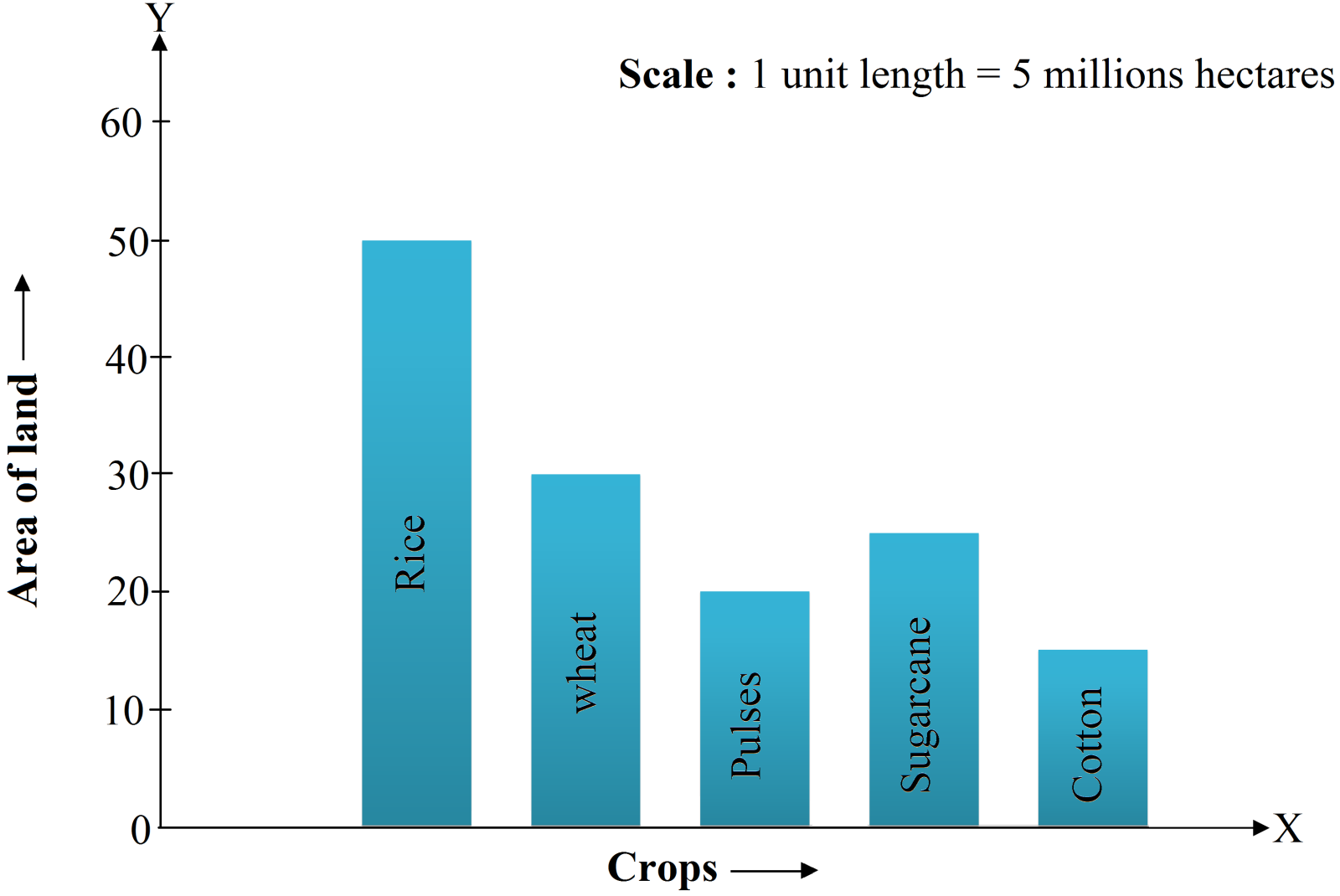
Refer to question $54.$ Prepare a bar graph of the data.
Answer
In order to construct a bar graph representing above data, we follow the following steps:
Step I: Take a graph paper and draw two mutually perpendicular lines $OX$ and $OY.$ Let $OX$ as the horizontal axis and $OY$ as the vertical axis.
Step II: Along $OX,$ mark crop and along $OY,$ mark area of the land.
Step III: Along $OX,$ choose the uniform (equal) width of the bars and the uniform gap between them, according to the space available for the graph.
Step IV: Choose a suitable scale to determine the heights of the bars, according to the availability of space. Flere, we choose $1$ unit length to represents $5$ million hectares.
Step V: Calculate the heights of various bars as follows:
Crop Height of bars
Rice $\frac{50}{5}=10\text{ units}$
Wheat $\frac{30}{5}=6\text{ units}$
Pulses $\frac{20}{5}=4\text{ units}$
Sugarcane $\frac{25}{5}=5\text{ units}$
Cotton $\frac{15}{2}=3\text{ units}$
Hence, the required bar graph of the given data is shown below:
View full question & answer
Question 25 Marks
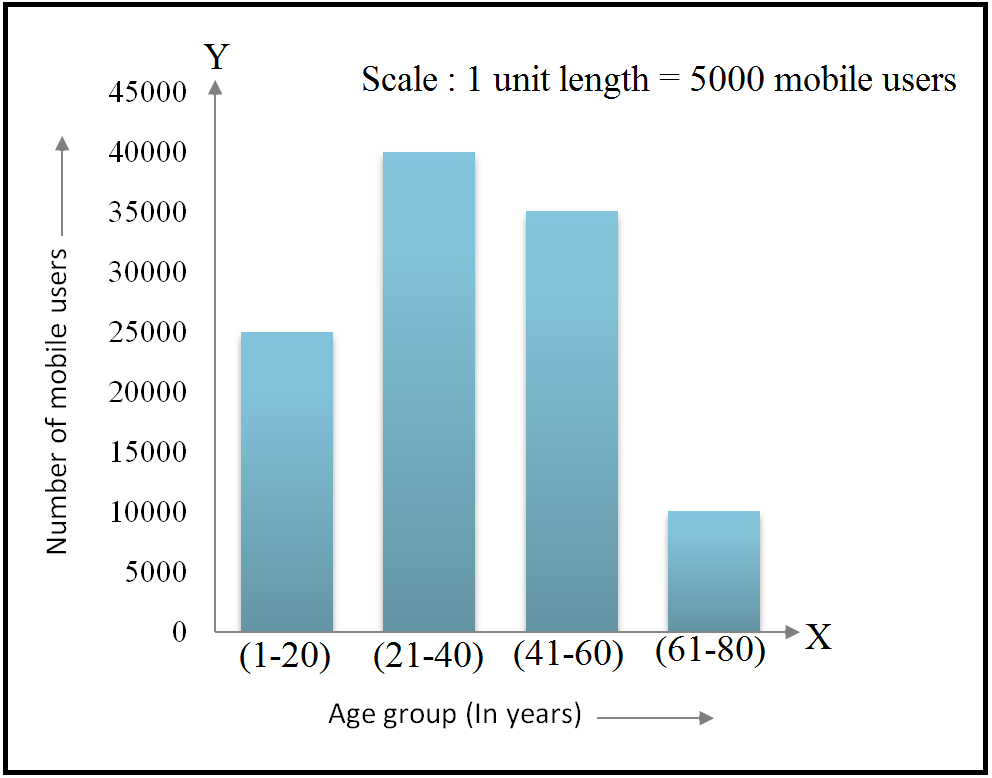
Number of mobile phone users in various age groups in a city is listed below:
Age group (in years) Number of mobile users
$1-20$ $25000$
$21-40$ $40000$
$41-50$ $35000$
$61-80$ $10000$
Draw a bar graph to represent the above information.
Answer
In order to construct a bar graph representing the above data, we follow the following steps:
Step I: Take a graph paper and draw two mutually perpendicular lines $OX$ and $OY.$ Let $OX$ as the horizontal axis and $OY$ as the vertical axis.
Step II: Along $OX,$ mark age groups and along $OY,$ mark number of mobile users.
Step III: Choose a suitable scale to determine the heights of the bars, according to the availability of space. Here, we choose $1$ unit length represents $5000$ mobile users.
Step IV: Calculate the height of various bars as follows.
Age group Height of bars
$(1-20)$ years $\frac{25000}{5000}=5\text{ units}$
$(21-40)$ years $\frac{40000}{5000}=8\text{ units}$
$(41-50)$ years $\frac{35000}{5000}=7\text{ units}$
$(61-80)$ years $\frac{10000}{5000}=2\text{ units}$
Hence, the required bar graph of given data is shown below:
View full question & answer
Question 35 Marks
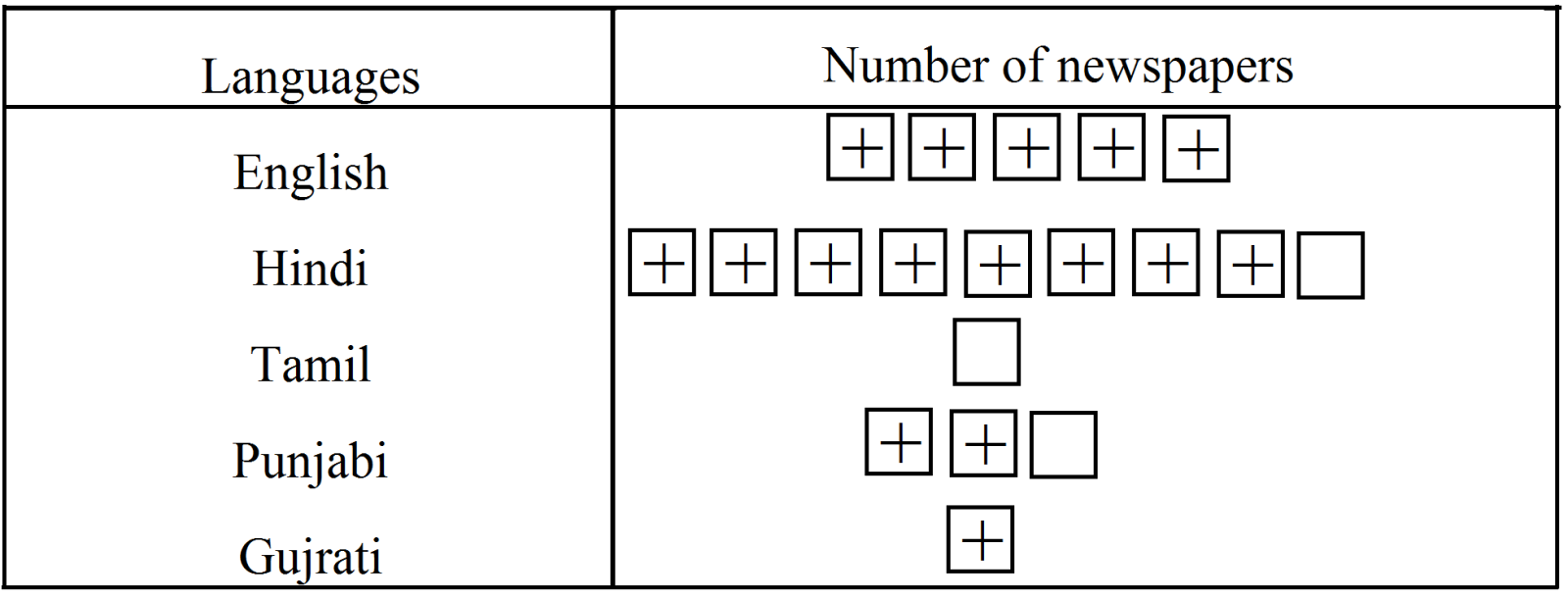
The following table gives information about the circulation of newspapers (dailies) in a town in five languages.
Language: English Hindi Tamil Punjabi Gujarati
Number of newspapers: $5000$ $8500$ $500$ $2500$ $1000$
Prepare a pictograph of the above data, using a symbol of your choice, each representing $1000$ newspapers.
Answer
$1000$ newspapers can be represented by

and $500$ newspapers can be represented by

For English language,
$5000$ newspapers can be represented by $5$ complete symbols.
For Hindi language,
$8500$ newspapers can be represented by $8$ complete and $1$ incomplete symbol.
For Tamil language,
$500$ newspapers can be represented by $1$ incomplete symbol.
Take

$1000$ newspapers and

$ 500$ newspapers
View full question & answer
Question 45 Marks
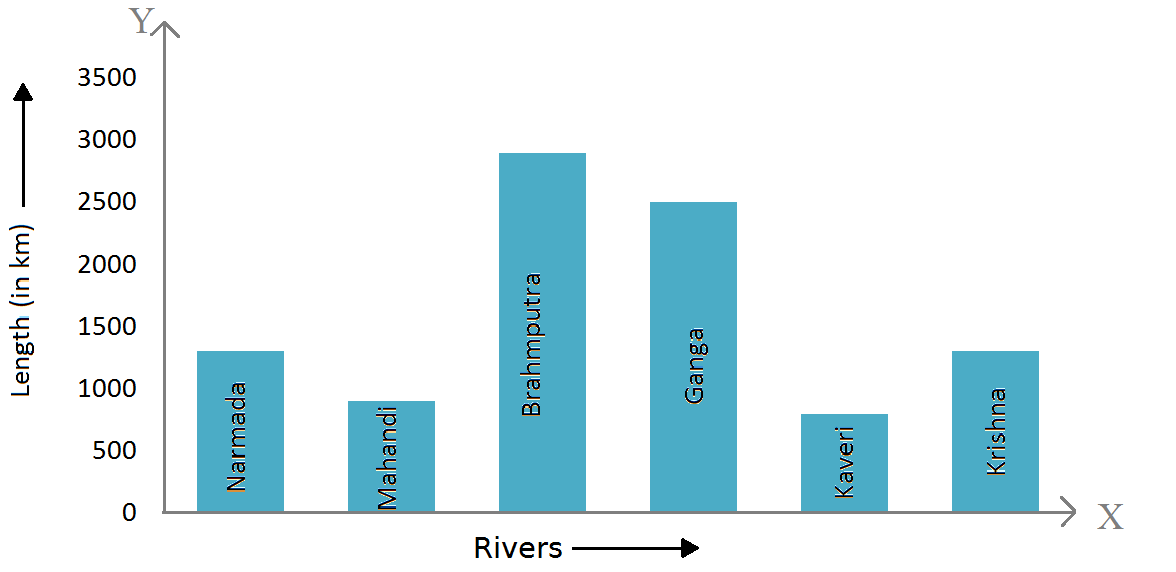
The lengths in km (rounded to nearest hundred) of some major rivers of India is given below:
River Length (in km)
Narmada $1300$
Mahanadi $900$
Brahmputra $2900$
Ganga $2500$
Kaveri $800$
Krishna $1300$
Draw a bar graph to represent the above information.
Answer
In order to construct a bar graph representing the above data, we follow the following steps:
Step I: Take a graph paper and draw two mutually perpendicular lines $OX$ and $OY.$ Let $OX$ as the horizontal axis and $OY$ as the vertical axis.
Step II: Along $OX,$ mark river’s name and along $OY,$ mark length in kilometres.
Step III: Along $OX,$ choose the uniform (equal) width of the bars and the uniform gap between them, according to the space available for the graph.
Step IV: Choose a suitable scale to determine the heights of the bars, according to the availability of space. Here, we choose $1$ unit length represents $200 \ km.$ Hence, the required bar graph of given data is shown below
Name of the river Height of bars
Narmada $\frac{1300}{200}=6.5\text{ units}$
Mahanadi $\frac{900}{200}=4.5\text{ units}$
Brahmputra $\frac{2900}{200}=14.5\text{ units}$
Ganga $\frac{2500}{200}=12.5\text{ units}$
Kaveri $\frac{800}{200}=4\text{ units}$
Krishna $\frac{1300}{200}=6.5\text{ units}$
View full question & answer
Question 55 Marks
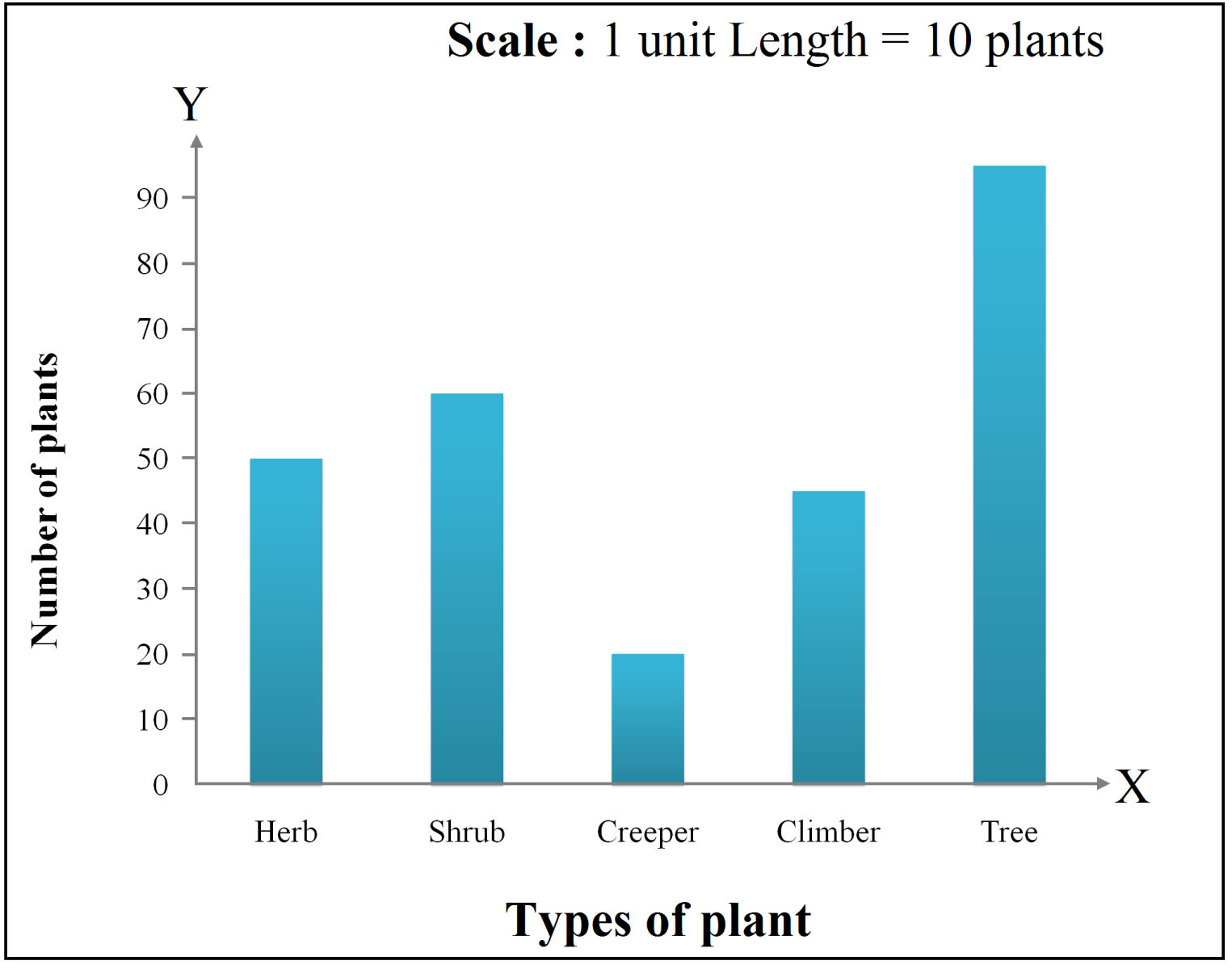
In a botanical garden, the number of different types of plants are found as follows:
Type of the plant Number of home appliances
Herb $50$
Shrub $60$
Creeper $20$
Climber $45$
Tree $95$
Draw a bar graph to represent the above information and answer the following questions:
$a.\ $Which type of plant is maximum in number in the garden?
$b.\ $Which type of plant is minimum in number in the garden?
Answer
In order to construct a bar graph representing the above data, we follow the following steps:
Step $I:$ Take a graph paper and draw two mutually perpendicular lines $OX$ and $Oy. $ Let $O X$ as the horizontal axis and $OY$ as the vertical axis.
Step $II:$ Along $OX,$ mark type of the plant and along $OY,$ mark number of plants.
Step $III:$ Choose a suitable scale to determine the heights of the bars, according to the availability of space. Here, we choose $1$ unit length represents $10$ plants.
Step $IV:$ Calculate the height of various bars as follows.
Type of the plant Number of home appliances
Herb $\frac{50}{10}=5\text{ units}$
Shrub $\frac{60}{10}=6\text{ units}$
Creeper $\frac{20}{10}=2\text{ units}$
Climber $\frac{45}{10}=4.5\text{ units}$
Tree $\frac{9.5}{10}=9.5\text{ units}$
Hence, the required bar graph for the given data is shown below:
$a.\ $On studying bar graph, tree is maximum in number in the garden.
$b.\ $On studying bar graph, creeper plants is minimum in number in the garden.
View full question & answer
Question 65 Marks
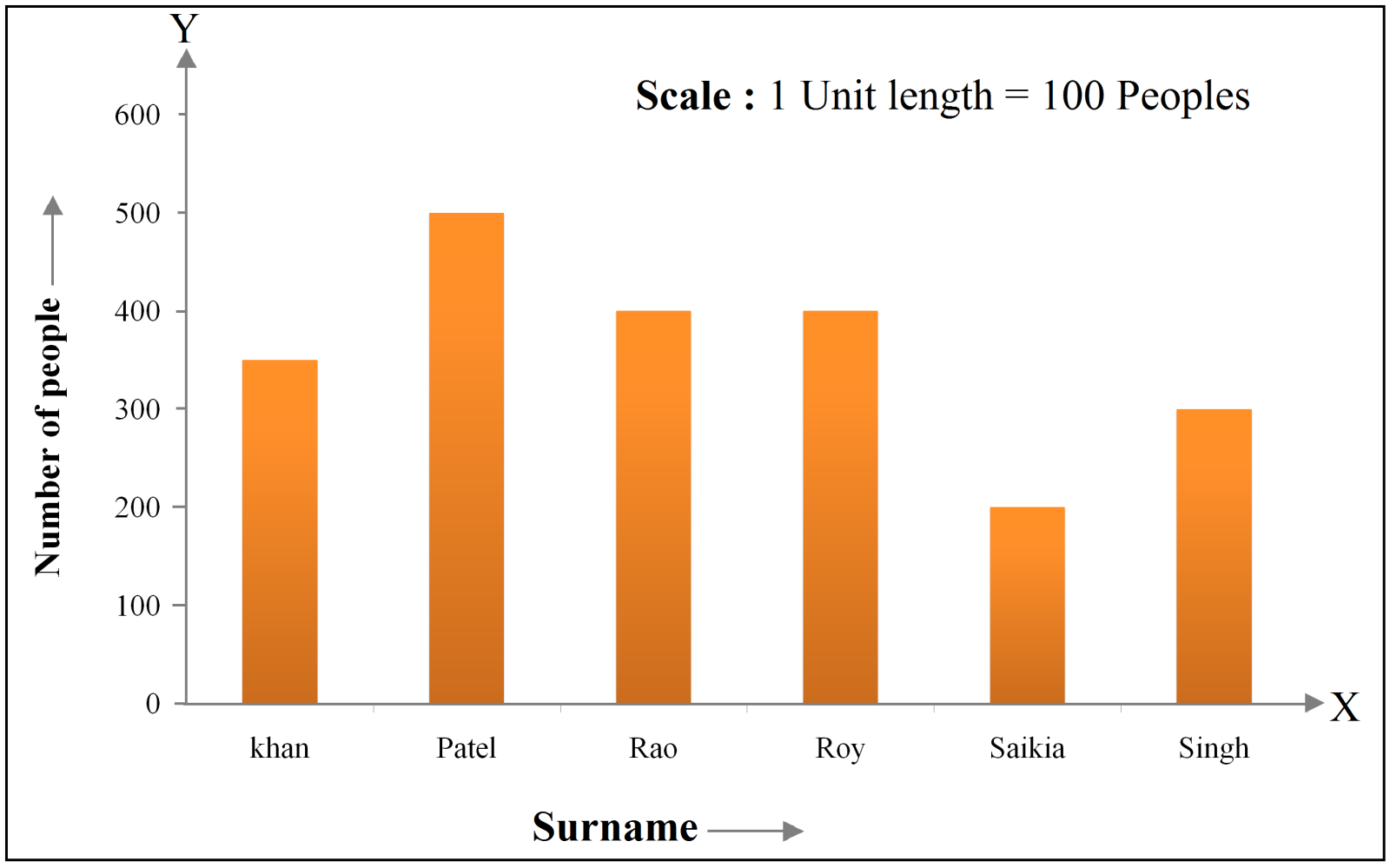
Prepare a bar graph of the data given in question $28.$
Answer
In order to construct a bar graph, first we have to make a table representing the pictograph in tabular form of question $28.$
Surname Number of people
Khan $350$
Patel $500$
Rao $400$
Roy $400$
Saikia $200$
Singh $300$
In order to construct a bar graph representing the above data, we follow the following steps:
Step I: Take a graph paper and draw two mutually perpendicular lines $OX$ and $OY.$ Let $OX$ as the horizontal axis and $OY$ as the vertical axis.
Step II: Along $OX,$ mark surname and along $OY,$ mark number of people.
Step III: Along $OX,$ choose the uniform (equal) width of the bars and the uniform gap between them, according to the space available for the graph.
Step IV: Choose a suitable scale to determine the heights of the bars, according to the availability of space. Here, we choose $1$ unit length represents $100$ people.
Step V: Calculate the height of various bars as follows:
Surname Height of bars
Khan $\frac{350}{100}=3.5\text{ units}$
Patel $\frac{500}{100}=5\text{ units}$
Rao $\frac{400}{100}=4\text{ units}$
Roy $\frac{400}{100}=4\text{ units}$
Saikia $\frac{200}{100}=2\text{ units}$
Singh $\frac{300}{100}=3\text{ units}$
Hence, the required bar graph for the given data is shown below:
View full question & answer
Question 75 Marks
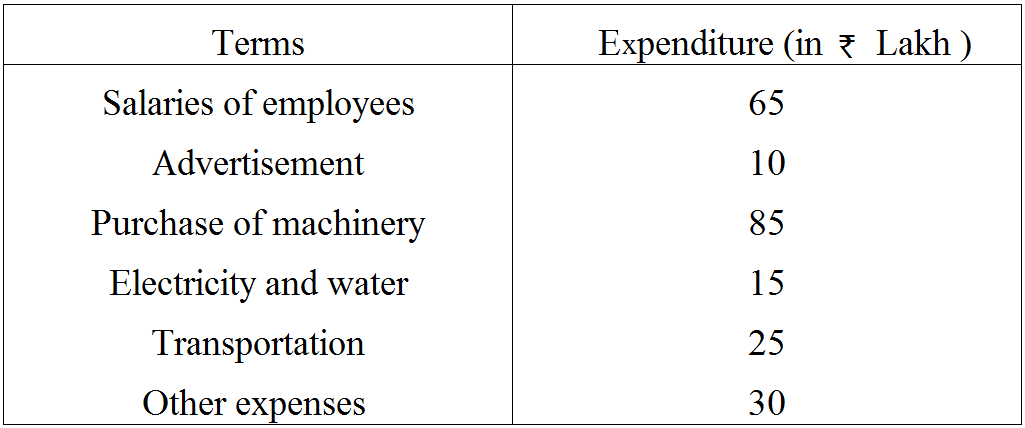
Annual expenditure of a company in the year $2007-2008$ is given below:

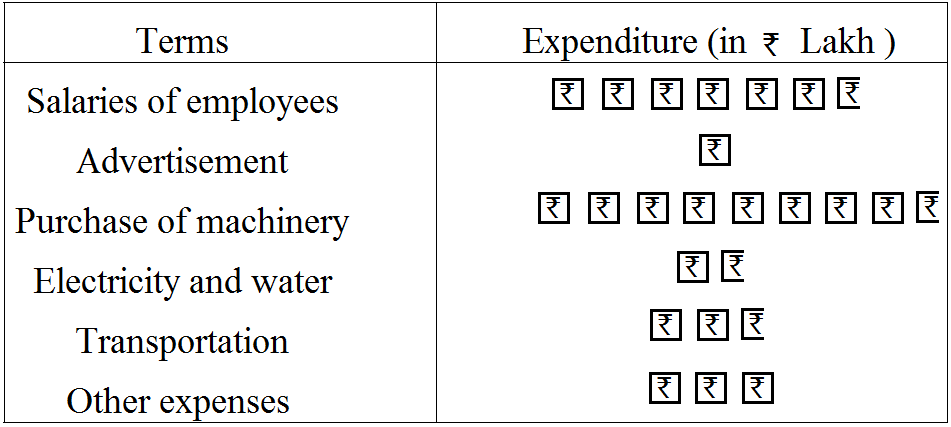
Prepare a pictograph of the above data using an appropriate symbol to represent $Rs.10$ lakh.
Answer
$Rs. 10$ lakh can be represented by $[T]$ and $Rs. 5$ lakh can be represented by For salaries of employees,
$Rs. 65$ lakh can be represented by $6$ complete and $1$ incomplete symbol.
For advertisement, $110$ lakh can be represented by $1$ complete symbol.
For purchase of machinery, $Rs. 85$ lakh can be represented by $8$ complete and $1$ incomplete symbol.
For electricity and water, $Rs. 15$ lakh can be represented by $1$ complete and $1$ incomplete symbol.
For transportation, $Rs. 25$ lakh can be represented by $2$ complete and $1$ incomplete symbol.
For other expenses, $Rs. 30$ lakh can be represented by $3$ complete symbol.
Hence, the required pictograph of given data is shown below,
Take $[T] = 10$ lakh and $[f = 5$ lakh$]$
Take $₹ = 10$ lake and $₹ = 5$ lake
View full question & answer
Question 85 Marks
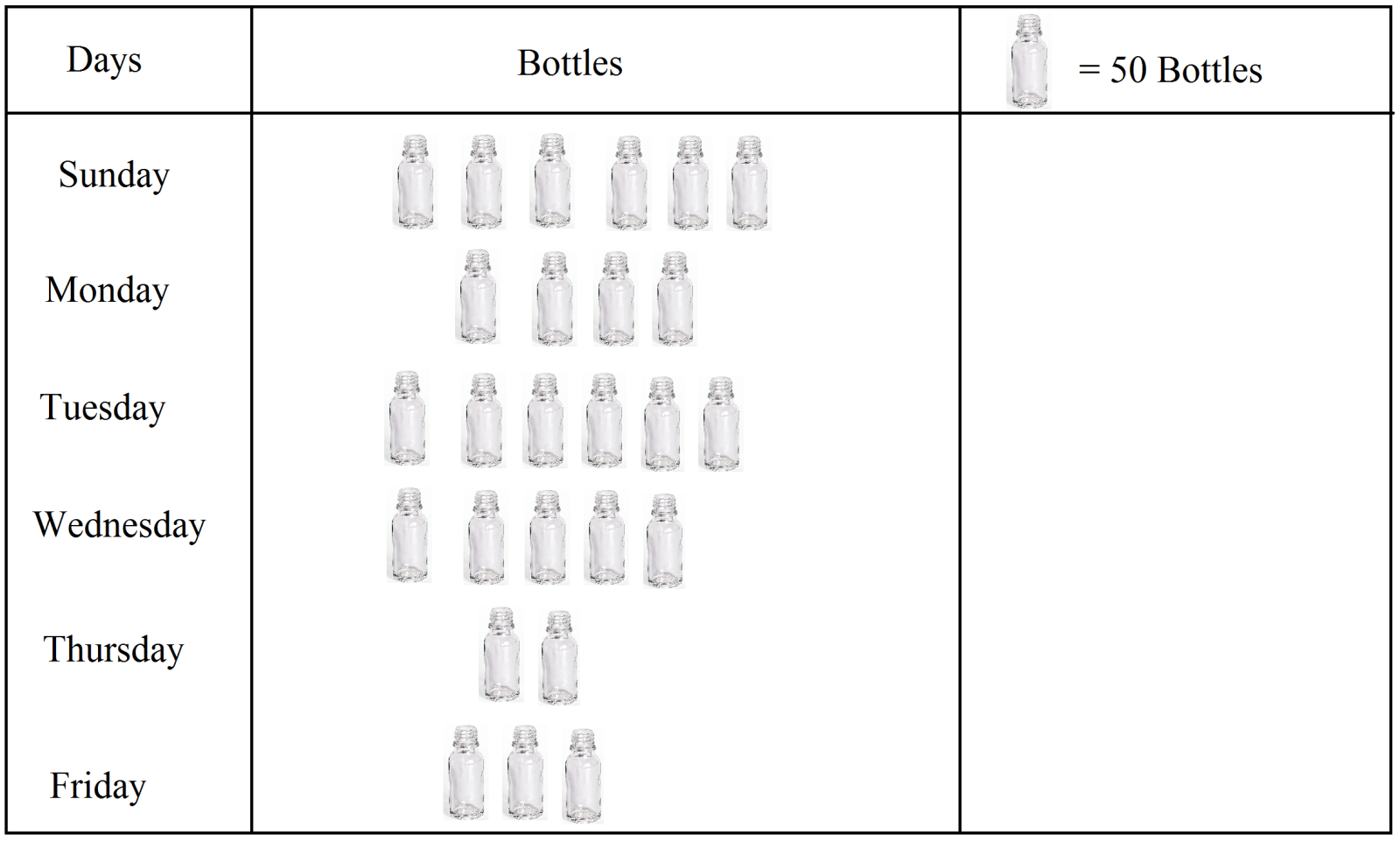
The number of bottles of cold drinks sold by a shopkeeper on six consecutive days is as follows:
Day: Sunday Monday Tuesday Wednesday Thursday Friday
Number of bottle: $350$ $200$ $300$ $250$ $100$ $150$
Prepare a pictograph of the data using one symbol to represent $50$ bottles.
Answer
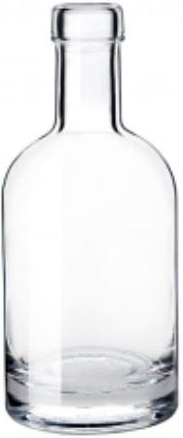
Let $50$ bottles of cold drink can be represented by
 
For Monday,
$200$ cold drink bottles can be represented by $4$ complete symbols. For Tuesday,
$300$ cold drink bottles can be represented by $6$ complete symbols. For Wednesday,
$250$ cold drink bottles can be represented by $5$ complete symbols. For Thursday,
$100$ cold drink bottles can be represented by $2$ complete symbols. For Friday,
$150$ cold drink bottles can be represented by $3$ complete symbols.
Hence, the required pictograph of given data is shown below:
View full question & answer
Question 95 Marks
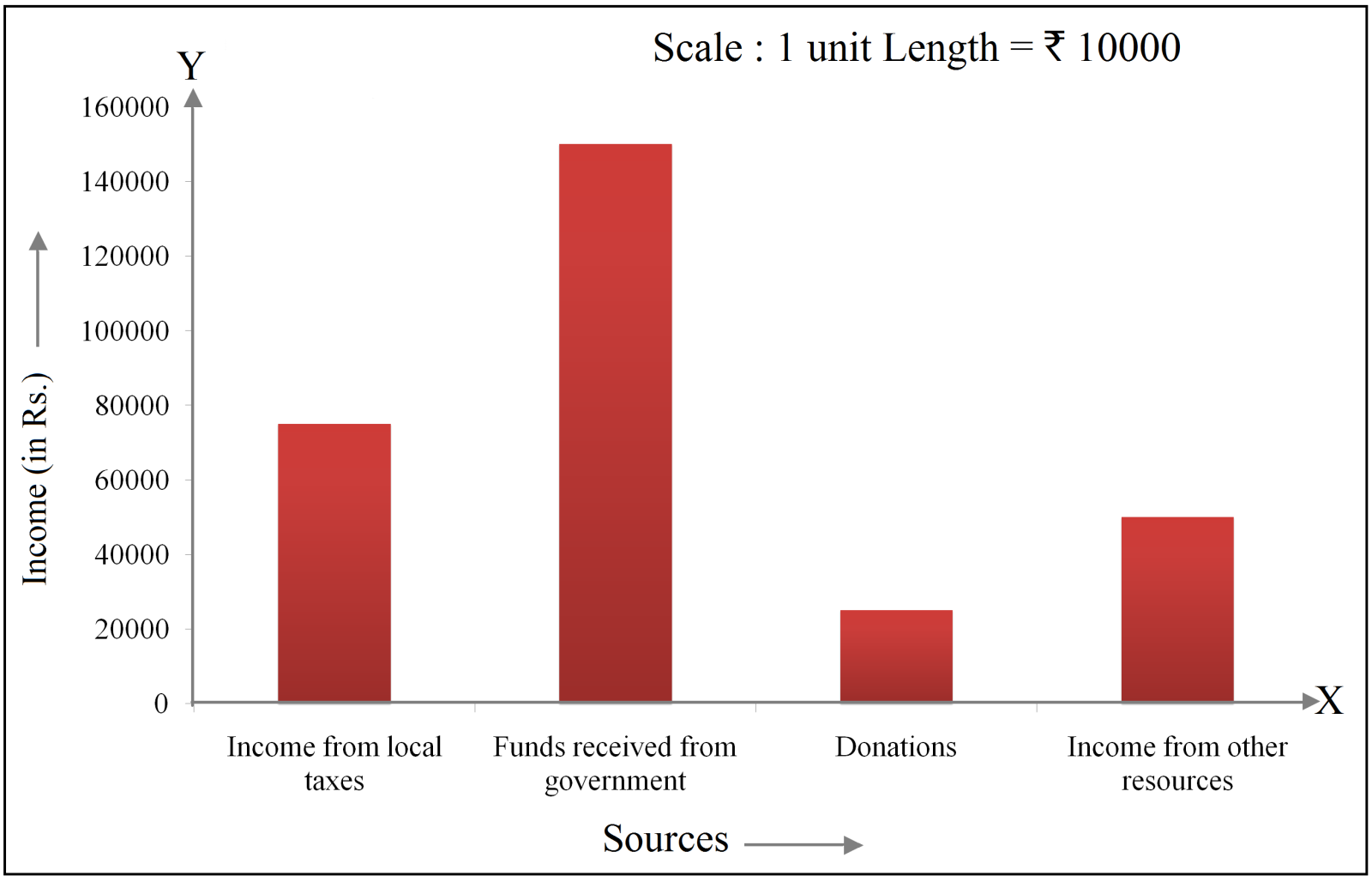
The following table represents income of a Gram Panchayat from
different sources in a particular year:
Sources
Height of bars
Income from local taxes
$75000$
Funds receved from goverment
$150000$
Donations
$25000$
Incomes from other resources
$50000$
Draw a bar graph to represent the above information.
Answer
In order to construct a bar graph representing the above data, we follow the following steps:
Step I: Take a graph paper and draw two mutually perpendicular lines $OX$ and $OY.$ Let $OX$ as the horizontal axis and $OY$ as the vertical axis.
Step II: Along $OX,$ mark sources and along $OY,$ mark income.
Step III: Along $OX,$ choose the uniform (equal) width of the bars and the uniform gap between them, according to the space available for the graph.
Step IV: Choose a suitable scale to determine the heights of the bars, according to the availability of spate. Here, we choose $1$ unit length to represents $Rs. 10000.$
Step V: Calculate the various bars as follows:
Sources Height of bars
Income from local taxes $\frac{75000}{10000}=7.5\text{ units}$
Funds receved from goverment $\frac{150000}{10000}=15\text{ units}$
Donations $\frac{25000}{10000}=2.5\text{ units}$
Incomes from other resources $\frac{50000}{10000}=5\text{ units}$
Hence, the required bar graph for the given data is shown below:
View full question & answer
Question 105 Marks
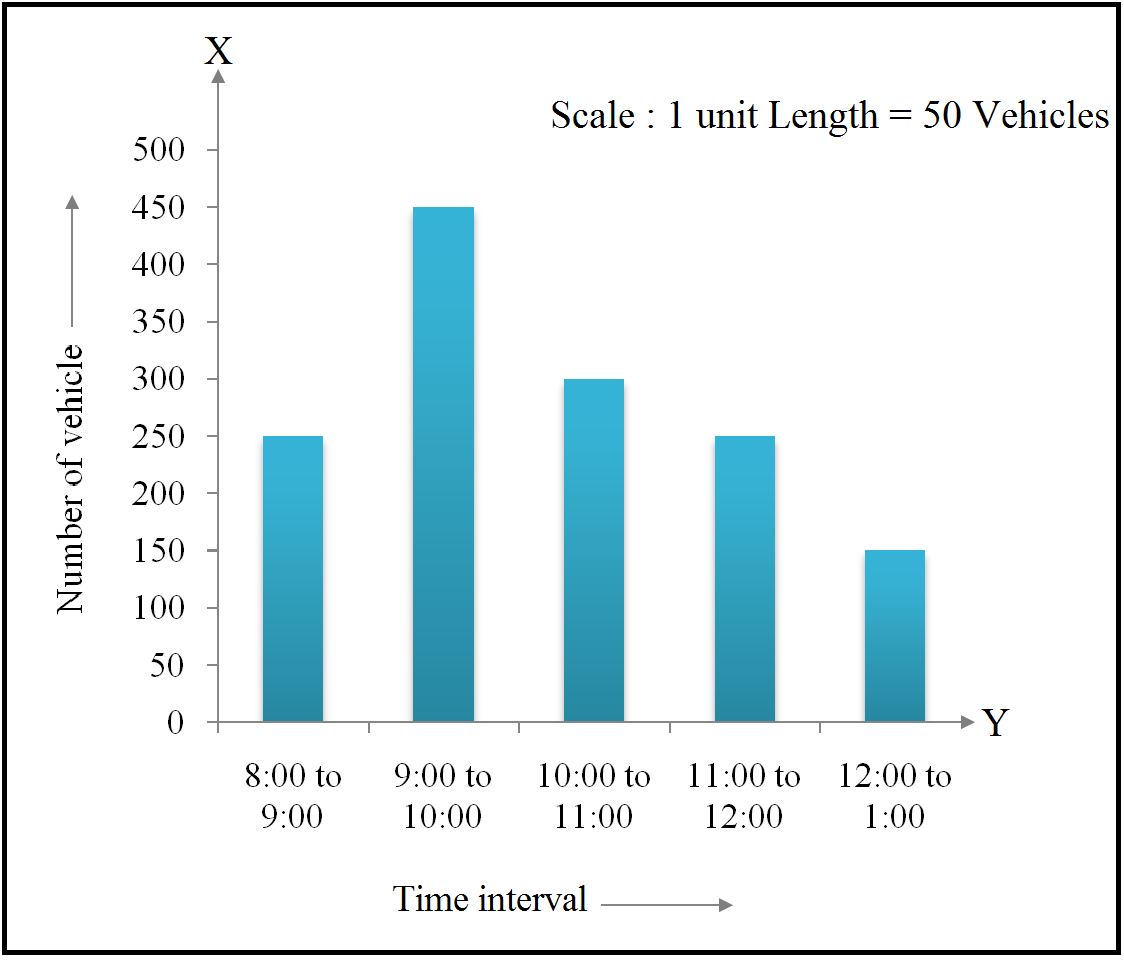
The following table gives the number of vehicles passing through a toll gate, every hour from $8.00\ am.$ to $1.00\ pm:$
Time Interval: $8.00 $ to $9.00$ $9.00$ to $10.00$ $10.00$ to $11.00$ $11.00$ to $12.00$ $12.00$ to $1.00$
Number of vehicles: $250$ $450$ $300$ $250$ $150$
Draw a bar graph representing the above data.
Answer
In order to construct a bar graph representing the above data, we follow the following steps:
Step I: Take a graph paper and draw two mutually perpendicular lines $OX$ and $Oy.$ Let $OX$ as the horizontal axis and $OY$ as the vertical axis.
Step II: Along $OX,$ mark time interval and along $OY,$ mark number of vehicles.
Step III: Along $OX,$ choose the uniform (equal) width of the bars and the uniform gap between them, according to the space available for the graph.
Step IV: Choose a suitable scale to determine the heights of the bars, according to the availability of space. Here, we choose $1$ unit length represents $50$ vehicles.
Time interval Height of bars
$8.00$ to $9.00$ $\frac{250}{50}=5\text{ units}$
$9.00$ to $10.00$ $\frac{450}{50}=9\text{ units}$
$10.00$ to $11.00$ $\frac{300}{50}=6\text{ units}$
$11.00$ to $12.00$ $\frac{250}{50}=5\text{ units}$
$12.00$ to $1.00$ $\frac{150}{50}=3\text{ units}$
Hence, the required bar graph for the given data is shown below:
View full question & answer
Question 115 Marks
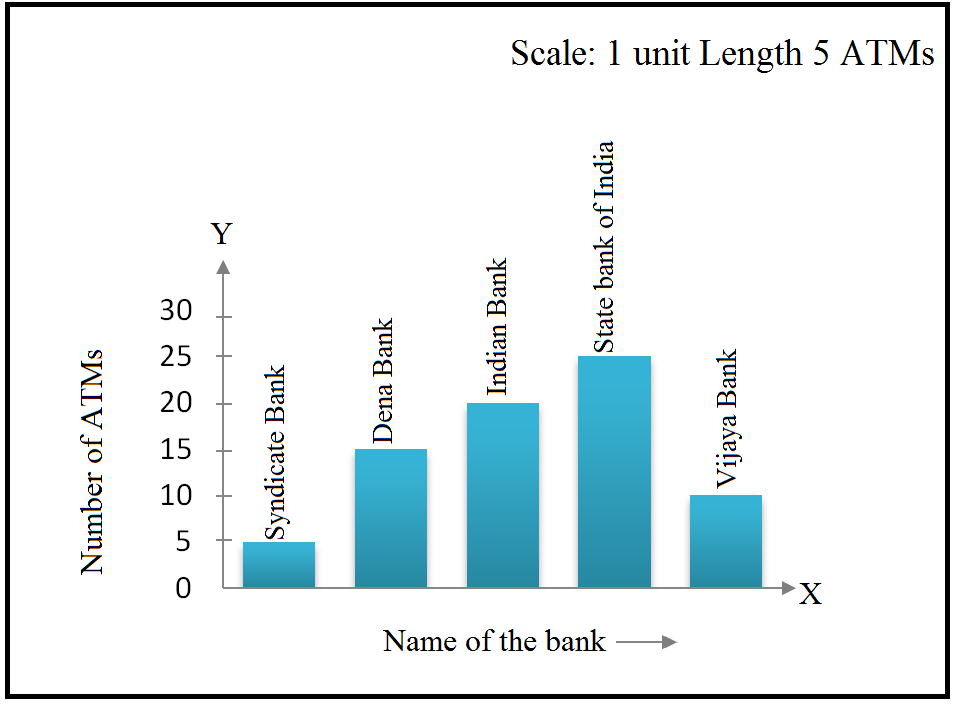
The number of $ATMs$ of different banks in a city is shown below:
Bank Number of ATMs
Syndicate Bank $5$
Dena Bank $15$
Indian Bank $20$
State Bank of India $25$
Vijaya Bank $10$
Draw a bar graph to represent the above information by choosing the scale of your choice.
Answer
In order to construct a bar graph representing the above data, we follow the following steps:
Step I: Take a graph paper and draw two mutually perpendicular lines $OX$ and $OY.$ Let $OX$ as the horizontal axis and $OY$ as the vertical axis.
Step II: Along $OX,$ mark bank names and along $OY,$ mark number of $ATMs.$
Step III: Along $OX,$ choose the uniform (equal) width of the bars and the uniform gap between them, according to the space available for the graph.
Step IV: Choose a suitable scale to determine the heights of the bars, according to the availability of space. Here, we choose $1$ unit length represents $5$ $ATMs.$​​​​​​​
Step V: Calculate the height of various bars as follows:
Bank Number of ATMs
Syndicate Bank $\frac{5}{5}=1\text{ unit}$
Dena Bank $\frac{15}{5}=3\text{ units}$
Indian Bank $\frac{20}{5}=4\text{ units}$
State Bank of India $\frac{25}{5}=5\text{ units}$
Vijaya Bank $\frac{10}{5}=2\text{ units}$
Hence, the required bar graph of given data is shown below:
View full question & answer
Question 125 Marks
The following table shows the area of the land on which different crops were grown.
Crop Area of land (in million hectares)
Rice $50$
Wheat $30$
Pulses $20$
Sugarcane $25$
Cotton $15$
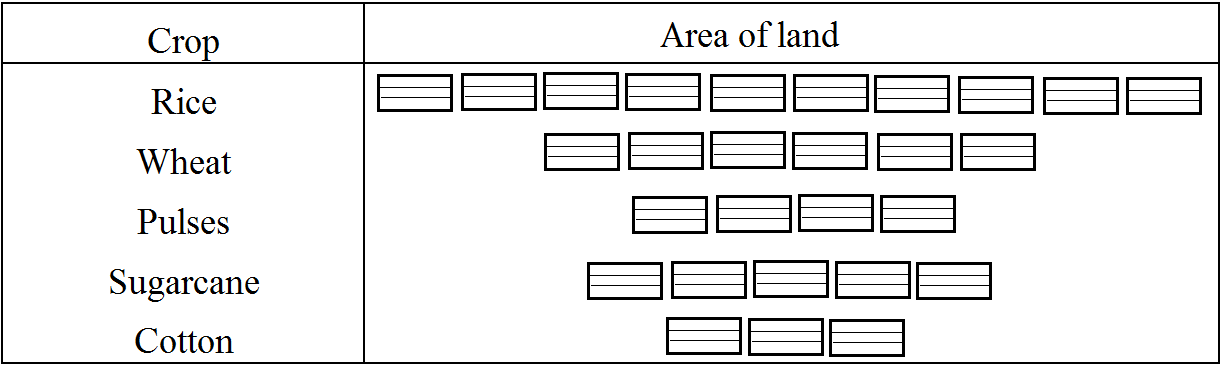
Prepare a pictograph by choosing a suitable symbol to represent $10$ million hectares.
Answer
$5$ million hectares can be represented by ill symbol.
For rice, $50$ million hectares can be represented by $10$ symbols.
For wheat, $30$ million hectares can be represented by $6$ symbols.
For pulses, $20$ million hectares can be represented by $4$ symbols.
For sugarcane, $25$ million hectares can be represented by $5$ symbols.
For cotton, $15$ million hectares can be represented by $3$ symbols.
Hence, the required pictograph of the given data is shown below Take, $= 5$ million hectares
View full question & answer
Question 135 Marks
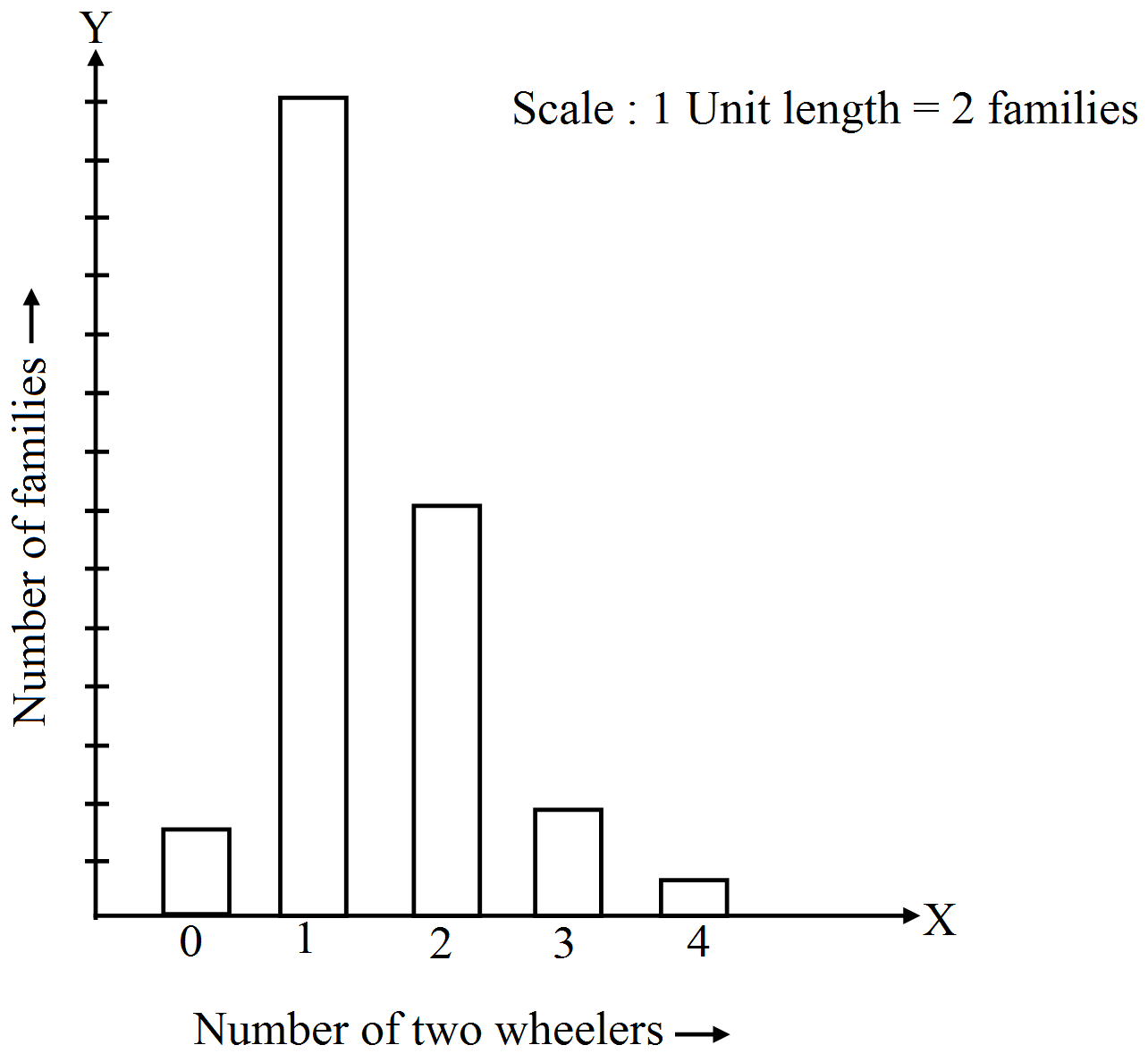
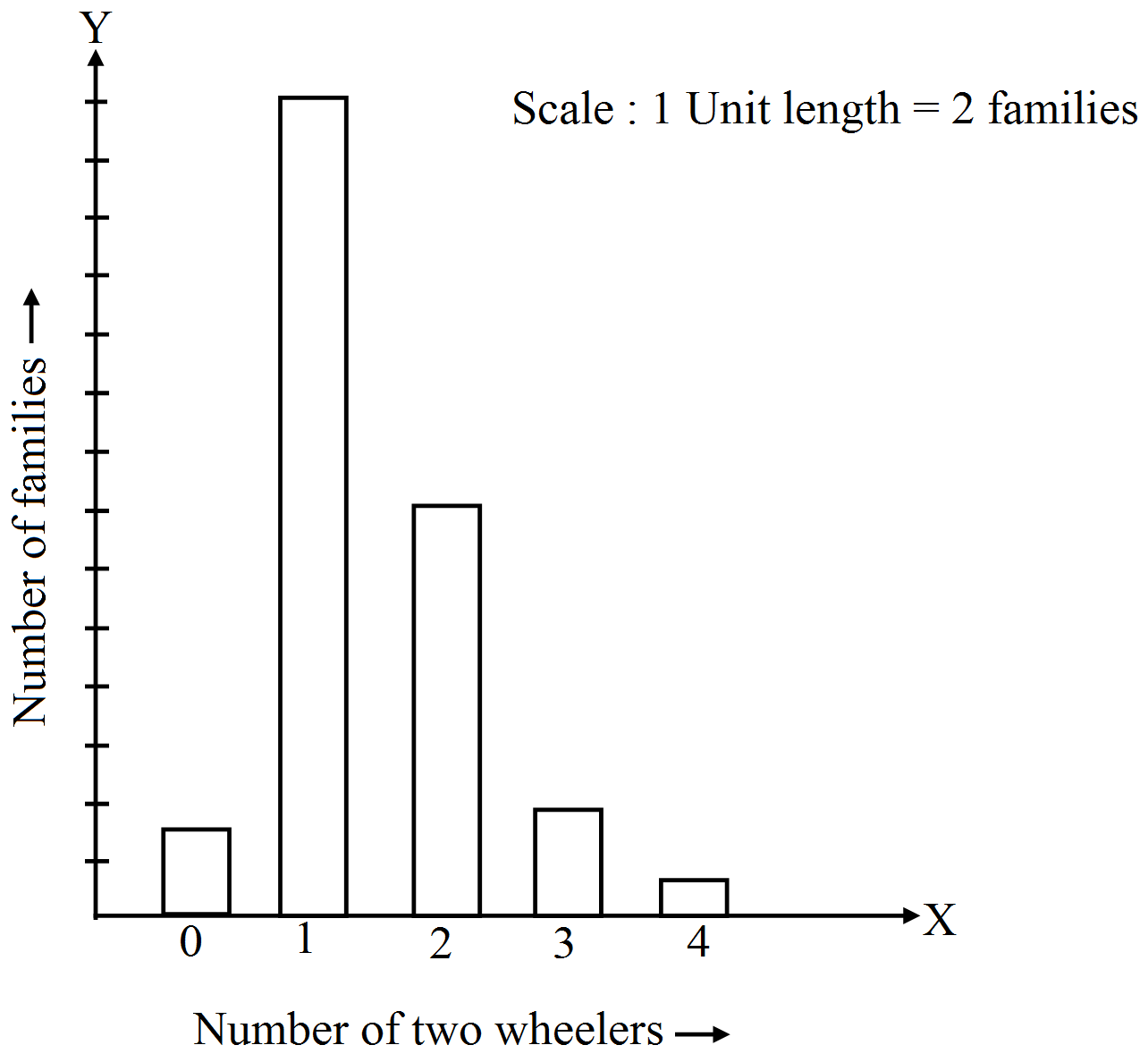
Refer to question $23.$ Prepare a bar graph of the data.
Answer
In order to construct a bar graph representing the above data, we follow the following steps:
Step I: Take a graph paper and draw two mutually perpendicular lines $OX$ and $OY.$ Let $OX$ as the horizontal axis and $OY$ as the vertical axis.
Step II: Along $OX,$ mark number of two wheelers and along $OY,$ mark number of families.
Step III: Along $OX,$ choose the uniform (equal) width of the bars and the uniform gap between them, according to the space available for the graph.
Step IV: Calculate the height of various bars as follows:
Number of two wheelers Height of bars
$0$ $\frac{3}{1}=1.5\text{ units}$
$1$ $\frac{28}{2}=14\text{ units}$
$2$ $\frac{14}{2}=7\text{ units}$
$3$ $\frac{4}{2}=2\text{ units}$
$4$ $\frac{1}{2}=0.5\text{ units}$
Hence, the required bar graph for the given data is shown below:
View full question & answer
Question 145 Marks
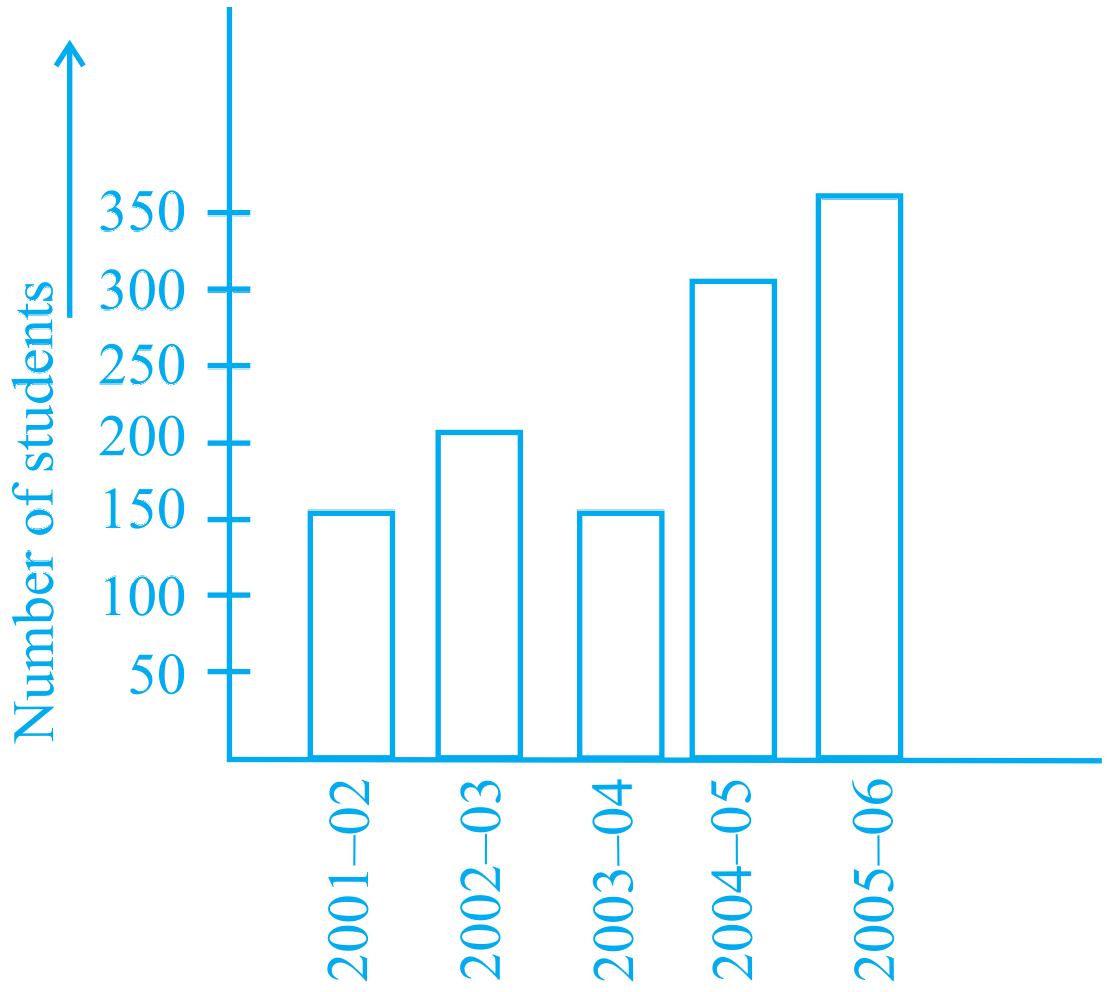
Read the bar graph given below and answer the following questions: Scale: $1$ unit $=\ 50$ students
$a.\ $ What information is given by the bar graph$?$
$b.\ $ In which year is the number of students maximum$?$
$c.\ $ In which year is the number of students twice as that of $2001-02?$
$d.\ $ In which year did the number of students decrease as compared to previous year$?$
$e.\ $ In which year is the increase in number of students maximum as compared to the previous year$?$
Answer
$a.\ $The bar graph shows the information about the number of students in each academic year from $2001$ to $2006.$
$b.\ $Given, number of students in $2001-02 = 150$ Number of students in $2002-03 = 200$ Number of students in $2003-04 = 150$ Number of students in $2004-05 = 300$ Number of students in $2005-06 = 350$ The number of students was maximum in the academic year $2005-06.$
$c.\ $Clearly, the number of students in academic year $2004-05$ is twice as that of $2001-02.$
$d.\ $From the graph, we can observe that, the number of students decreased to $150$ in $2003-04$ from $200$ of previous year $2002-03.$
$e.\ $In the year $2004-05,$ the increase in number of students is maximum as compared to the previous year.
View full question & answer
Question 155 Marks
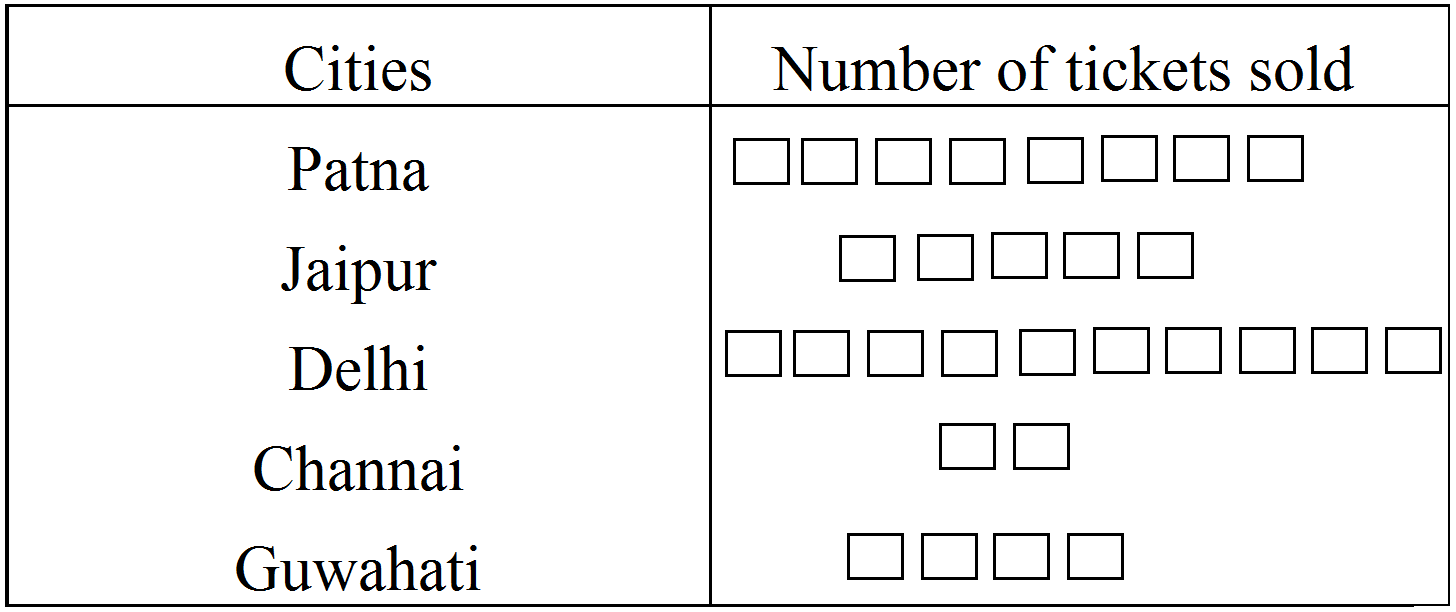
Prepare a pictograph of the information given in question $38.$
Answer
$10$ tickets can be represented by $\Box.$
For Patna, $80$ tickets can be represented by $8$ symbols.
For Jaipur, $50$ tickets can be represented by $5$ symbols.
For Delhi, $100$ tickets can be represented by $10$ symbols.
For Chennai, $20$ tickets can be represented by $2$ symbols.
For Guwahati, $40$ tickets can be represented by $4$ symbols.
Hence, the required pictograph of given data is shown below Take, $\Box = 10$ tickets
View full question & answer
Question 165 Marks
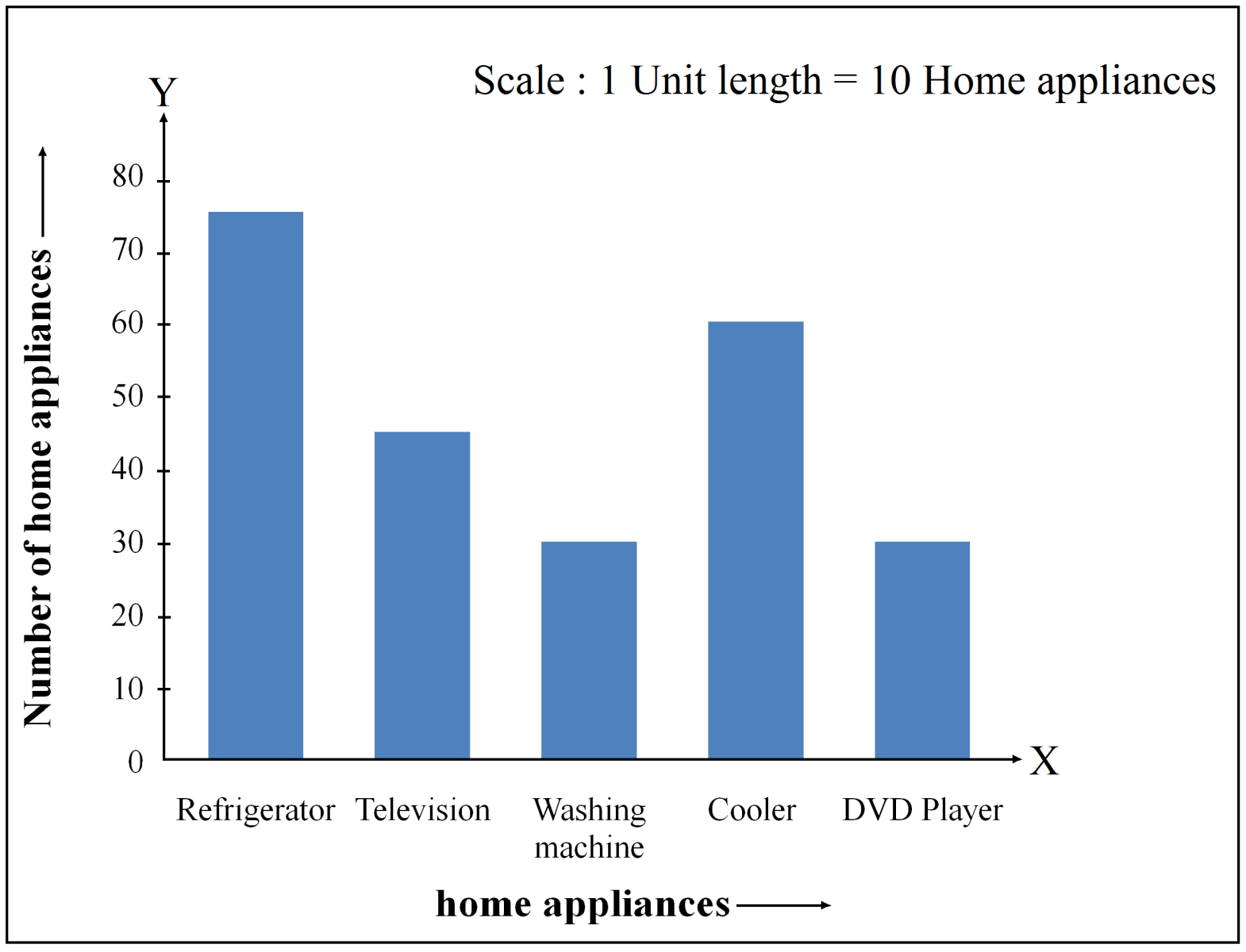
Home appliances sold by a shop in one month are given as below:
Home appliance Number of home appliances
Refrigerator $75$
Television $45$
Washing Machine $30$
Cooler $60$
$DVD$ Player $30$
Draw a bar graph to represent the above information.
Answer
In order to draw a bar graph representing the above data, we follow the following steps:
Step I: Take a graph paper and draw two mutually perpendicular lines $OX$ and $OY$. Let $OX$ as the horizontal axis and $OY$ as the vertical axis.
Step II: Along $OX,$ mark of home appliances and along $OY,$ mark number of appliances.
Step III: Choose a suitable scale to determine the heights of the bars, according to the availability of space. Here, we choose $1$ unit length represents $10$ home appliances.
Step IV: Calculate the height of various bars as follows:
Home appliance Number of home appliances
Refrigerator $\frac{75}{10}=7.5\text{ units}$
Television $\frac{45}{10}=4.5\text{ units}$
Washing Machine $\frac{30}{10}=3\text{ units}$
Cooler $\frac{60}{10}=6\text{ units}$
$DVD$ Player $\frac{30}{10}=3\text{ units}$
Hence, the required bar graph for the given data is shown below:
View full question & answer
Question 175 Marks
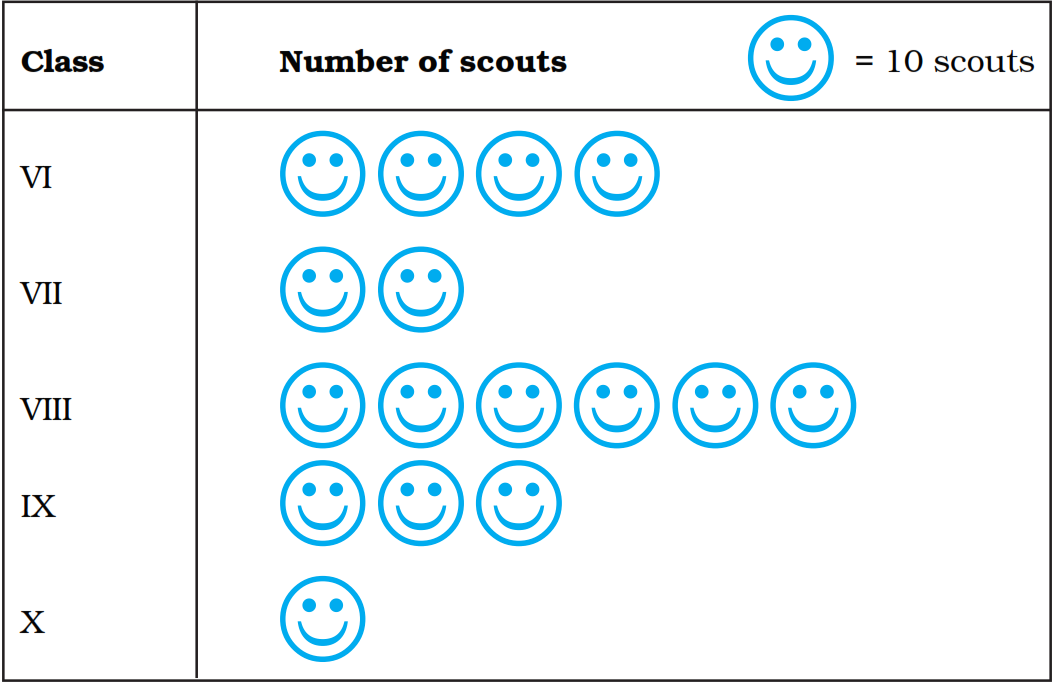
The number of scouts in a school is depicted by the following pictograph:

Observe the pictograph and answer the following questions:
$a.\ $Which class has the minimum number of scouts$?$
$b.\ $Which class has the maximum number of scouts$?$
$c.\ $How many scouts are there in Class $VI?$
$d.\ $Which class has exactly four times the scouts as that of Class $X?$
$e.\ $What is the total number of scouts in the Classes $VI$ to $X?$
Answer
$a.\ $Class $X$ has minimum number of scouts, i.e. $10.$
$b.\ $Class $VIII$ has maximum number of scouts i.e. $60.$
$c.\ $Number of scouts in Class $VI = 40$
$d.\ $Number of scouts in Class $X = 10$ Number of scouts in Class $VI = 4 \times 10 = 40$
Hence, class $VI$ has exactly four times the scouts as that of Class $X.$
$e.\ $Total number of scouts in Classes $VI$ to $X = 40 + 20 + 60 + 30 + 10 = 160.$
View full question & answer
Question 185 Marks
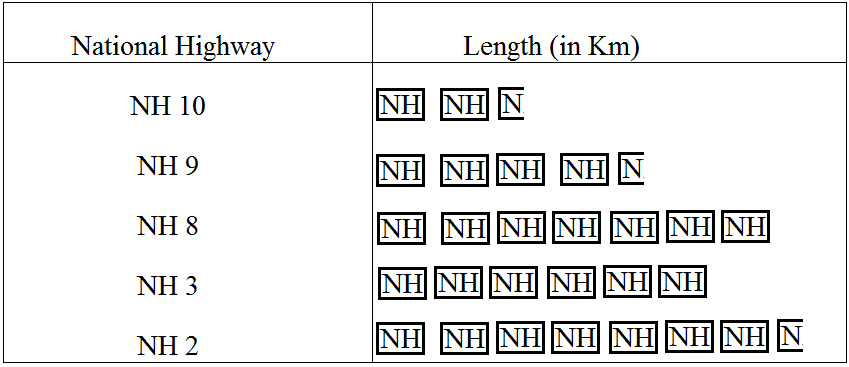
Refer to question $39.$ Prepare a pictograph of the data by taking a suitable symbol to represent $200$ kilometers.
Answer
Let $200\ km$ can be represented by $NH$ and $100\ km$ represented by $N.$
For $NH\ 10, 500\ km$ can be represented by $2$ complete symbols and $1$ incomplete symbol.
For $NH\ 9, 900\ km$ can be represented by $4$ complete symbols and $1$ incomplete symbol.
For $NH\ 8, 1400\ km$ can be represented by $7$ complete symbols.
For $NH\ 3, 1200\ km$ can be represented by $6$ complete symbols.
For $NH\ 2, 1500\ km$ can be represented by $7$ complete symbols and $1$ incomplete symbol.
Hence, the required pictograph of given data is shown below:
Take, $NH = 200\ km$ and $N = 100\ km$​​​​​​​
View full question & answer
Question 195 Marks
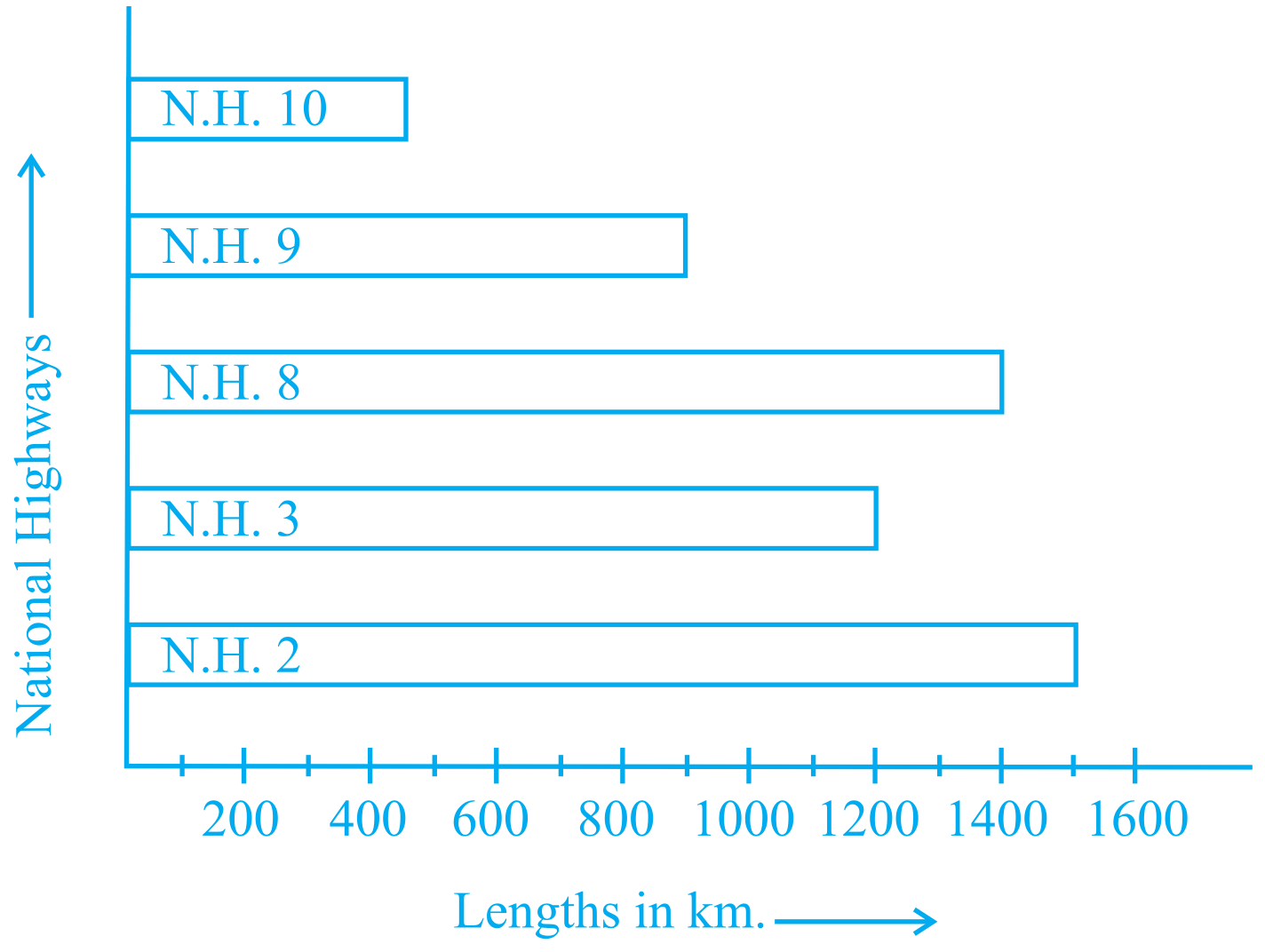
The bar graph given below represents approximate length $($in kilometres$)$ of some National Highways in India. Study the bar graph and answer the following questions: Scale: $1$ unit length $= 200\ km$ 

$a.\ $Which National Highway $(N.H.)$ is the longest among the above$?$
$b.\ $Which National Highway is the shortest among the above$?$
$c.\ $What is the length of National Highway $9?$
$d.\ $Length of which National Highway is about three times the National Highway$10?$
Answer
$a.\ $National Highway $2$ is the longest among the above shown highways. It is $1500\ km$ long.
$b.\ $National Highway $10$ is the shortest among the above shown highways. It is $500\ km$ long.
$c.\ $The length of National Highway $9$ is $900\ km.$
$d.\ $Length of $NH\ 10 = 500\ km$
Length of $NH\ 9 = 900\ km$ ‘
Length of $NH\ 8 = 1400\ km$
Length of $NH\ 3 = 1200\ km$ and length of $NH\ 2 = 1500\ km$
Clearly, the length of $NH\ 2$ is about three times the length of $NH\ 10.$
View full question & answer
Question 205 Marks
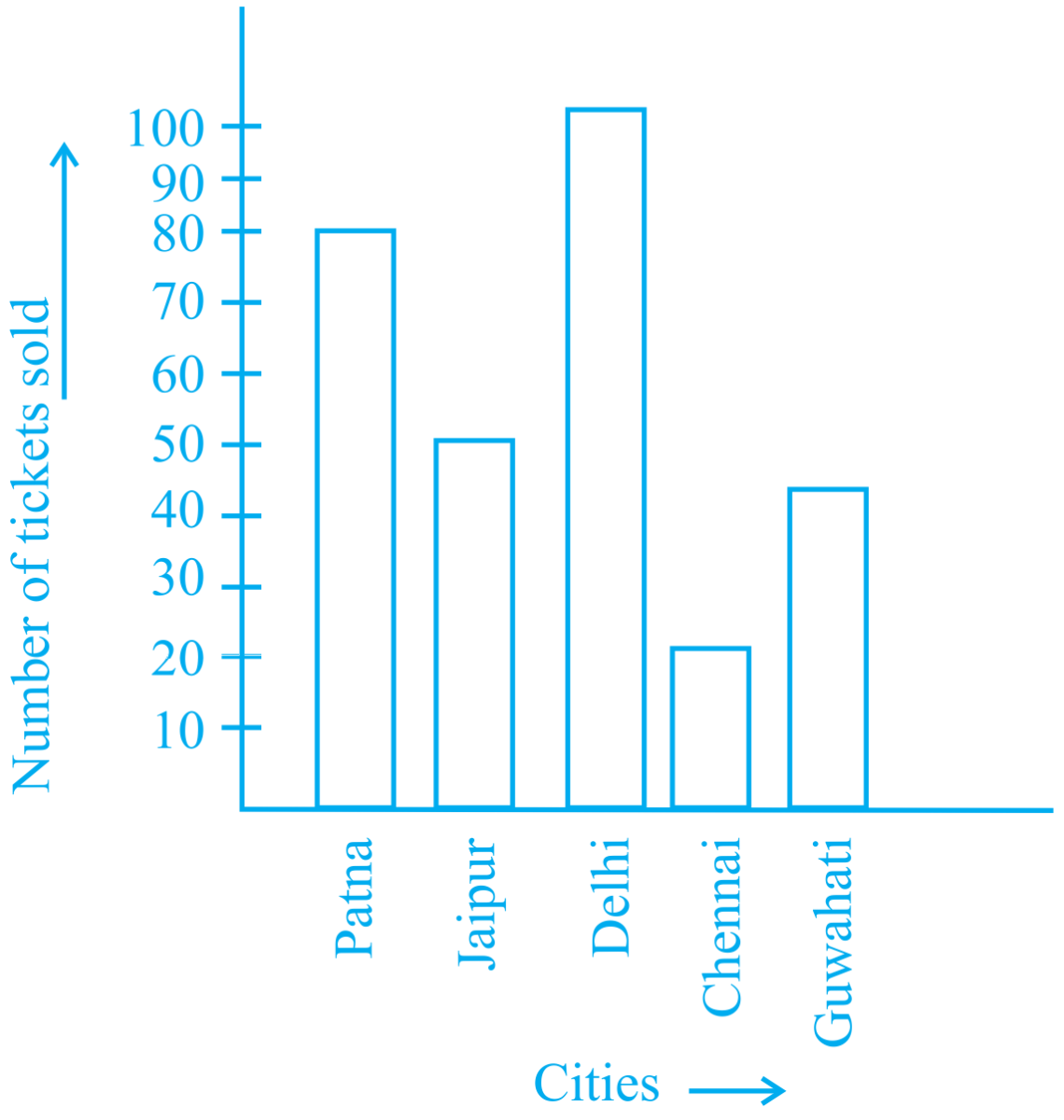
The following graph gives the information about the number of railway tickets sold for different cities on a railway ticket counter between $6.00\ am$ to $10.00\ am.$ Read the bar graph and answer the following questions.

$a.\ $How many tickets were sold in all$?$
$b.\ $For which city were the maximum number of tickets sold$?$
$c.\ $For which city were the minimum number of tickets sold$?$
$d.\ $Name the cities for which the number of tickets sold is more than $20.$
$e.\ $Fill in the blanks:
Number of tickets sold for Delhi and Jaipur together exceeds the total number of tickets sold for Patna and Chennai by $....$
 
Answer
$a.\ $Total tickets sold $= 80 + 50 + 100 + 20 + 40 = 290$
$b.\ $Maximum number of tickets were sold for Delhi, i.e. $100$ tickets.
$c.\ $Minimum number of tickets were sold for Chennai, i.e. $20$ tickets.
$d.\ $ The cities for which the number of tickets sold is more than $20$ are Patna, Jaipur, Delhi and Guwahati.
$e.\ $ Number of tickets sold for Delhi and Jaipur together $= 100 + 50 = 150$ and number of tickets sold for Patna and Chennai together $= 80 + 20 = 100$ Required difference $= 150 - 100 = 50$
View full question & answer
Question 215 Marks
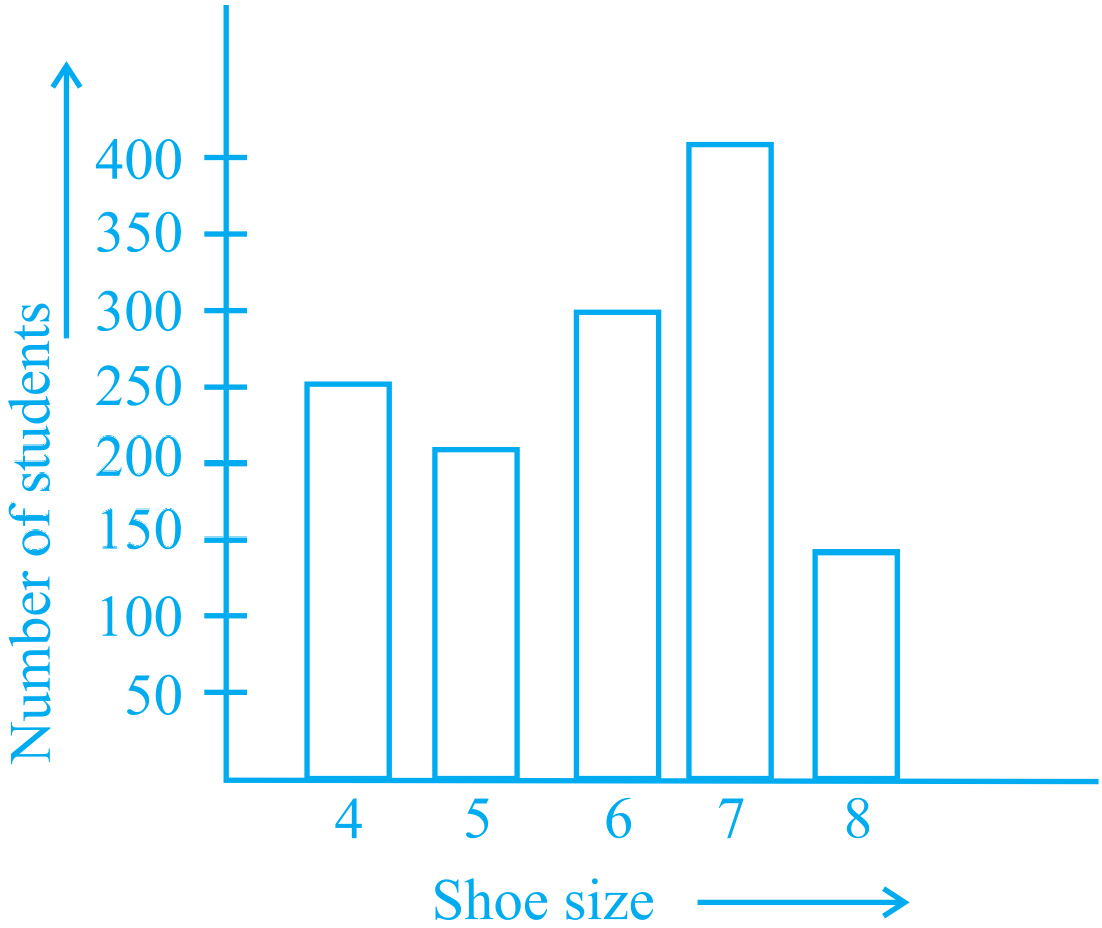
The following bar graph represents the data for different sizes of shoes worn by the students in a school. Read the graph and answer the following questions. Scale: $1$ unit length $= 50$ students
 
$a.\ $Find the number of students whose shoe sizes have been collected.
$b.\ $What is the number of students wearing shoe size $6?$
$c.\ $What are the different sizes of the shoes worn by the students$?$
$d.\ $Which shoe size is worn by the maximum number of students$?$
$e.\ $Which shoe size is worn by minimum number of students$?$
$f.\ $State whether true or false:
The total number of students wearing shoe sizes $5$ and $ 8$ is the same as the number of students wearing shoe size $6.$
Answer
$a.\ $Total number of students whose shoes sizes have been collected $= 250 + 200 + 300 + 400 + 150 = 1300$
$b.\ $Shoe size $6$ is worn by $300$ students.
$c.\ $Different number of shoes worn by the students are $4, 5, 6, 7$ and $8.$
$d.\ $Shoe number $7$ is worn by maximum number of students.
$e.\ $Shoe number $8$ is worn by minimum number of students.
$f.\ $False, since total $350$ students wore shoe numbers $5$ and $8,$ whereas only $300$ students worn shoe number $6.$
What information is given by the bar graph$?$
View full question & answer
Question 225 Marks
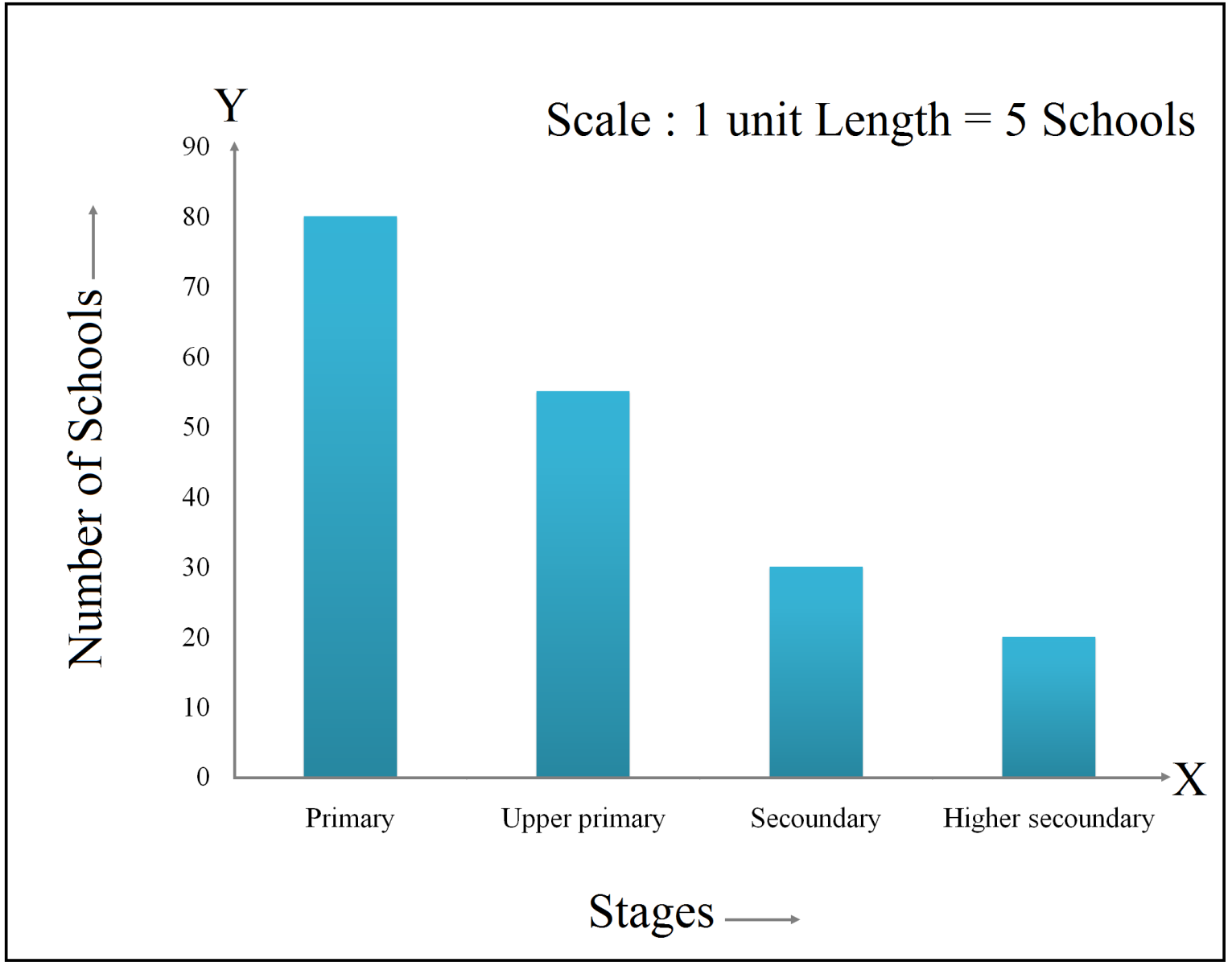
The following table gives the data of number of schools (stage-wise) of a country in the year $2002.$
Stage Number of schools (in thousands)
Primary $80$
Upper Primary $55$
Secondary $30$
Higher Secondary $20$
Draw a bar graph to represent the above data.
Answer
In order to construct a bar graph representing the above data, we follow the following steps:
Step I: Take a graph paper and draw two mutually perpendicular lines $OX$ and $OXX.$ Let $OX$ as the horizontal axis and $OY$ as the vertical axis.
Step II: Along $OX,$ mark stages and along $OY,$ mark number of schools.
Step III: Choose a suitable scale to determine the heights of the bars, according to the availability of space. Here, we choose $1$ unit length represents $5$ schools.
Step IV: Calculate the height of various bars as follows:
Stage Height of bars
Primary $\frac{80}{5}=16\text{ units}$
Upper Primary $\frac{55}{5}=11\text{ units}$
Secondary $\frac{30}{5}=6\text{ units}$
Higher Secondary $\frac{20}{5}=4\text{ units}$
Hence, the required bar graph for the given data is shown below:
View full question & answer