Question 12 Marks
Find the square root of $289 x^4-612 x^3+970 x^2-684 x+361$
View full question & answer→Question 22 Marks
Reduce the given Rational expression to its lowest form
$
\frac{x^{3 a }-8}{x^{2 a }+2 x^{ a }+4}
$
Answer$\begin{aligned} & x^{3 a}-8=\left(x^a\right)^3-2^3 \ldots\left(\text { using the formula } a^3-b^3=(a-b)\left(a^2+a b+b^2\right)\right. \\ & =\left(x^a-2\right)\left[\left(x^a\right)^2+x^a \times 2+2^2\right] \\ & =\left(x^a-2\right)\left(x^{2 a}+2 x^a+4\right) \\ & \frac{x^{3 a}-8}{x^{2 a}+2 x^a+4}=\frac{\left(x^a-2\right)\left(x^{2 a}+2 x^a+4\right)}{\left(x^{2 a}+2 x^a+4\right)} \\ & =x^a-2\end{aligned}$
View full question & answer→Question 32 Marks
Reduce the given Rational expression to its lowest form
$
\frac{10 x^3-25 x^2+4 x-10}{-4-10 x^2}
$
Answer$\begin{aligned} & 10 x^3-25 x^2+4 x-10=5 x^2(2 x-5)+2(2 x-5) \\ & =(2 x-5)\left(5 x^2+2\right) \\ & -4-10 x^2=-2\left(2+5 x^2\right) \\ & =-2\left(5 x^2+2\right) \\ & \frac{10 x^3-25 x^2+4 x-10}{-4-10 x^2}=\frac{(2 x-5)\left(5 x^2+2\right)}{-2\left(5 x^2+2\right)} \\ & =\frac{2 x-5}{-2} \text { or } \frac{2 x}{-2}-\frac{5}{-2} \\ & =-x+\frac{5}{2}\end{aligned}$
View full question & answer→Question 42 Marks
Find the least common multiple of $x y\left(k^2+1\right)+k\left(x^2+y^2\right)$ and $x y\left(k^2-1\right)+k\left(x^2-y^2\right)$
Answer$x y\left(k^2+1\right)+k\left(x^2+y^2\right)$.
$x y\left(k^2-1\right)+k\left(x^2-y^2\right) \ldots(2)$
(1) $\Rightarrow x y k^2+x y+k x^2+k y^2$
(2) $\Rightarrow x y k^2-x y+k x^2-k y^2$
(1) $\Rightarrow y k(x k+y)+x(x k+y)$
$=(x k+y)(x+y k)$
(2) $\Rightarrow y k(x k-y)+x(x k-y)$
$=(x+y k)(x k-y)$
$\therefore$ L.C.M. : $(x+y k)(x k+y)(x k-y)$
$=(x+y k)\left(x^2 k^2-y^2\right)$
View full question & answer→Question 52 Marks
Find the sum and product of the roots for the following quadratic equation
$3y^2 – y – 4 = 0$
Answer$\begin{aligned} & 3 y^2-y-4=0 \div 3 \\ & y^2-\frac{y}{3}-\frac{4}{3}=0 \\ & y^2-\left(\frac{1}{3}\right) y+\left(\frac{-4}{3}\right)=0 \\ & \therefore \alpha+\beta=\frac{1}{3} \\ & \alpha \beta=\frac{-4}{3}\end{aligned}$
View full question & answer→Question 62 Marks
Find the sum and product of the roots for the following quadratic equation
$x^2+3 x-28=0$
Answer$x^2-(-3) x+(-28)=0$.
Comparing this with $x^2-(\alpha+\beta) x+\alpha \beta=0$.
$(\alpha+\beta)=$ Sum of the roots $=-3$
$\alpha \beta=$ product of the roots $=-28$
View full question & answer→Question 72 Marks
Find the sum and product of the roots for the following quadratic equation
$x^2 + 3x = 0$
Answer$x^2+3 x=0=x^2-(-3) x+0=0$
$x^2-(\alpha+\beta) x+\alpha \beta=0$
Sum of the roots $\alpha+\beta=-3$
Products of the roots $\alpha \beta=0$
View full question & answer→Question 82 Marks
Find the sum and product of the roots for the following quadratic equation $3+\frac{1}{ a }=\frac{10}{ a ^2}$
Answer$\begin{aligned} & 3 a^2+a=10 \\ & 3 a^2+a-10=0 \text { comparing this with } x^2-(\alpha+\beta) \\ & x+\alpha \beta=0 \\ & a^2-\left(-\frac{1}{3}\right) a+\left(\frac{-10}{3}\right)=0 \\ & \alpha+\beta=\frac{-1}{3} \\ & \alpha \beta=\frac{-10}{3}\end{aligned}$
View full question & answer→Question 92 Marks
Determine the quadratic equation, whose sum and product of roots are $-(2-a)^2,(a+5)^2$
AnswerSum of the roots $=-(2-a)^2$; Product of the roots $=(a+5)^2$ $x^2-$ (sum of the roots) $x+$ product of the roots $=0$
$x^2-\left[-(2-a)^2\right] x+(a+5)^2=0$
$x^2+(2-a)^2 x+(a+5)^2=0$
View full question & answer→Question 102 Marks
Determine the quadratic equation, whose sum and product of roots are - 9,20
AnswerSum of the roots $=-9$ and Product of the roots $=20$
The Quadratic equation is $x^2-$ (sum of the roots)
$x+$ product of the roots $=0$
$x^2-(-9) x+20=0$
$\Rightarrow x^2+9 x+20=0$
View full question & answer→Question 112 Marks
Determine the quadratic equation, whose sum and product of roots are $\frac{5}{3}, 4$
AnswerSum of the roots $=\frac{5}{3} ;$ Product of the roots $=4$
The Quadratic equation is
$
\begin{aligned}
& x^2-(\text { sum of the roots }) x+\text { product of the roots }=0 \\
& x^2-\left(\frac{5}{3}\right) x+4=0 \\
& \Rightarrow x^2-\frac{5}{3} x+4=0 \\
& 3 x^2-5 x+12=0
\end{aligned}
$
View full question & answer→Question 122 Marks
Determine the quadratic equation, whose sum and product of roots are $\frac{-3}{2},-1$
AnswerSum of the roots $=\frac{-3}{2} ;$ Product of the roots $=-1$
The Quadratic equation is
$
\begin{aligned}
& x ^2-(\text { sum of the roots }) x +\text { product of the roots }=0 \\
& x^2-\left(\frac{-3}{2}\right) x+(-1)=0 \\
& \Rightarrow x^2+\frac{3}{2} x-1=0 \\
& 2 x^2+3 x-2=0
\end{aligned}
$
View full question & answer→Question 132 Marks
Find the square root of the following
$4 x^2+20 x+25$
Answer$\begin{aligned} & \sqrt{4 x^2+20 x+25}=\sqrt{(2 x)^2+2 \times 2 x \times 5+5^2} \\ & =\sqrt{(2 x+5)^2} \\ & =|2 x+5|\end{aligned}$
View full question & answer→Question 142 Marks
Find the square root of the following
$9 x^2-24 x y+30 x z-40 y z+25 z^2+16 y^2$
Answer$\begin{aligned} & \sqrt{9 x^2-24 x y+30 x z-40 y z+25 z^2+16 y^2} \\ & =\sqrt{(3 x)^2+(4 y)^2+(5 z)^2-2(3 x)(4 y)-2(4 y)(5 z)+2(3 x)(5 z)} \\ & =\sqrt{(3 x-4 y+5 z)^2} \quad \ldots\left[\text { using }(a-b+c)^2=a^2+b^2+c^2-2 a b-2 b c+2 a c\right] \\ & =|3 x-4 y+5 z|\end{aligned}$
View full question & answer→Question 152 Marks
Find the square root of the following
$
1+\frac{1}{x^6}+\frac{2}{x^3}
$
Answer$\begin{aligned} & 1+\frac{1}{x^6}+\frac{2}{x^3}=\sqrt{1^2+\left(\frac{1}{x^3}\right)^2+\frac{2}{x^3}} \\ & =\sqrt{\left(1+\frac{1}{x^3}\right)^2} \\ & =\left|1+\frac{1}{x^3}\right|\end{aligned}$
View full question & answer→Question 162 Marks
Find the square root of the following rational expression
$
\frac{400 x^4 y^{12} z^{16}}{100 x^8 y^4 z^4}
$
Answer$\begin{aligned} & \frac{400 x^4 y^{12} z^{16}}{100 x^8 y^4 z^4} \\ & =\frac{20}{10}\left|\frac{x^2 y^6 z^8}{x^4 y^2 z^2}\right| \\ & =2\left|\frac{y^4 z^6}{x^2}\right|\end{aligned}$
View full question & answer→Question 172 Marks
Find the square root of the following rational expression
$
\frac{7 x^2+2 \sqrt{14} x+2}{x^2-\frac{1}{2} x+\frac{1}{16}}
$
Answer$\begin{aligned} & \sqrt{\frac{7 x^2+2 \sqrt{14} x+2}{x^2-\frac{1}{2} x+\frac{1}{16}}} \\ & =\sqrt{\frac{(\sqrt{7} x)^2+2 \times \sqrt{7} x \times \sqrt{2}+(\sqrt{2})^2}{x^2-2 \times x \times \frac{1}{4}+\left(\frac{1}{4}\right)^2}} \\ & =\sqrt{\frac{(\sqrt{7} x+\sqrt{2})^2}{\left(x-\frac{1}{4}\right)^2}} \\ & =\left|\frac{\sqrt{7} x+\sqrt{2}}{x-\frac{1}{4}}\right| \\ & \text { or } \\ & =4\left|\frac{\sqrt{7} x+\sqrt{2}}{4 x-1}\right|\end{aligned}$
View full question & answer→Question 182 Marks
Find the square root of the following rational expression
$
\frac{121(a+b)^8(x+y)^8(b-c)^8}{81(b-c)^4(a-b)^{12}(b-c)^4}
$
Answer$\begin{aligned} & \sqrt{\frac{121( a + b )^8(x+y)^8( b - c )^8}{81( b - c )^4( a - b )^{12}( b - c )^4}} \\ & =\frac{11}{9}\left|\frac{( a + b )^4(x+y)^4( b - c )^4}{( b - c )^2( a - b )^6( b - c )^2}\right| \\ & =\frac{11}{9}\left|\frac{( a + b )^4(x+y)^4}{( a - b )^6}\right|\end{aligned}$
View full question & answer→Question 192 Marks
Subtract $\frac{1}{x^2+2}$ from $\frac{2 x^3+x^2+3}{\left(x^2+2\right)^2}$
Answer$\begin{aligned} & \frac{2 x^3+x^2+3}{\left(x^2+2\right)^2}-\frac{1}{x^2+2}=\frac{2 x^3+x^2+3-\left(x^2+2\right)}{\left(x^2+2\right)^2} \\ & =\frac{2 x^3+x^2+3-x^2-2}{\left(x^2+2\right)^2} \\ & =\frac{2 x^3+1}{\left(x^2+2\right)^2}\end{aligned}$
View full question & answer→Question 202 Marks
Simplify $\frac{x(x+1)}{x-2}+\frac{x(1-x)}{x-2}$
Answer$\begin{aligned} & \frac{x(x+1)}{x-2}+\frac{x(1-x)}{x-2}=\frac{x(x+1)+x(1-x)}{x-2} \\ & =\frac{x^2+x+x-x^2}{x-2} \\ & =\frac{2 x}{x-2}\end{aligned}$
View full question & answer→Question 212 Marks
Simplify $\frac{x+2}{x+3}+\frac{x-1}{x-2}$
Answer$\begin{aligned} & \frac{x+2}{x+3}+\frac{x-1}{x-2}=\frac{(x+2)(x-2)+(x-1)(x+3)}{(x+3)(x-2)} \\ & =\frac{x^2+2 x-2 x-4+x^2+3 x-x-3}{(x+3)(x-2)} \\ & =\frac{2 x^2+2 x-7}{(x+3)(x-2)}\end{aligned}$
View full question & answer→Question 222 Marks
Simplify $\frac{x^3}{x-y}+\frac{y^3}{y-x}$
Answer$\begin{aligned} & =\frac{x^3}{x-y}-\frac{y^3}{x-y} \\ & =\frac{x^3-y^3}{x-y} \ldots\left(\text { using } a ^3- b ^3=( a - b )\left( a ^2+ ab + b ^2\right)\right) \\ & =\frac{(x-y)\left(x^2+x y+y^2\right)}{x-y} \\ & = x ^2+ xy + y ^2\end{aligned}$
View full question & answer→Question 232 Marks
Simplify $\frac{x+2}{4 y} \div \frac{x^2-x-6}{12 y^2}$
Answer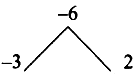
$\begin{aligned} & x ^2- x -6=( x -3)( x +2) \\ & \frac{x+2}{4 y } \div \frac{x^2-x-6}{12 y^2}=\frac{x+2}{4 y} \div \frac{(x-3)(x+2)}{12 y^2} \\ & =\frac{(x+2)}{4 y} \times \frac{12 y^2}{(x-3)(x+2)} \\ & =\frac{3 y}{x-3}\end{aligned}$ View full question & answer→Question 242 Marks
Simplify $\frac{x+4}{3 x+4 y} \times \frac{9 x^2-16 y^2}{2 x^2+3 x-20}$
Answer$\begin{aligned} & 9 x^2-16 y^2=(3 x)^2-(4 y)^2 \\ & =(3 x+4 y)(3 x-4 y) \\ & 2 x^2+3 x-20=2 x^2+8 x-5 x-20 \\ & =2 x(x+4)-5(x+4) \\ & =(x+4)(2 x-5) \\ & \frac{x+4}{3 x+4 y} \times \frac{9 x^2-16 y^2}{2 x^2+3 x-20}=\frac{(x+4) \times(3 x+4 y)(3 x-4 y)}{(3 x+4 y)(x+4)(2 x-5)} \\ & =\frac{3 x-4 y}{2 x-5}\end{aligned}$
View full question & answer→Question 252 Marks
Simplify $\frac{4 x^2 y}{2 z^2} \times \frac{6 x z^3}{20 y^4}$
Answer$\begin{aligned} & \frac{4 x^2 y}{2 z^2} \times \frac{6 x z^3}{20 y^4}=\frac{4 \times 6 \times x^3 \times y \times z^3}{2 \times 20 \times z^2 \times y^4} \\ & =\frac{3 x^3 z}{5 y^3} \\ & =\frac{3 x^3 z}{5 y^3}\end{aligned}$
View full question & answer→Question 262 Marks
Simplify $\frac{5 t^3}{4 t-8} \times \frac{6 t-12}{10 t}$
Answer$\begin{aligned} & \frac{5 t ^3}{4 t -8} \times \frac{6 t -12}{10 t }=\frac{5 t ^3 \times 6( t -2)}{4( t -2) \times 10 t } \\ & =\frac{5 t ^3 \times 6}{4 \times 10 t } \\ & =\frac{3}{4} t ^2\end{aligned}$
View full question & answer→Question 272 Marks
Find the excluded values, of the following expression
$
\frac{x^3-27}{x^3+x^2-6 x}
$
Answer$\begin{aligned} & \frac{x^3-27}{x^3+x^2-6 x} \\ & x^3-27=x^3-3^3 \\ & =(x-3)\left(x^2+x+3\right) \\ & x^3+x^2-6 x=x\left(x^2+x-6\right)=x(x+3)(x-2)\end{aligned}$
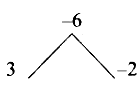
$
\frac{x^3-27}{x^3+x^2-6 x}=\frac{(x-3)\left(x^2+x+3\right)}{x(x+3)(x-2)}
$
The expression $\frac{(x-3)\left(x^2+x+3\right)}{x(x+3)(x-2)}$ is undefined
when $x(x+3)(x-2)=0$
$
\begin{aligned}
& x=0 \text { or } x+3=0 \text { or } x-2=0 \\
& x=0 \text { or } x=-3 \text { or } x=2
\end{aligned}
$
The excluded values are $0,-3$ and 2 View full question & answer→Question 282 Marks
Find the excluded values, of the following expression
$
\frac{y}{y^2-25}
$
AnswerThe expression $\frac{y}{y^2-25}$ is undefined
when $y ^2-25=0$
$
\begin{aligned}
& y^2-5^2=0 \\
& (y+5)(y-5)=0 \\
& y+5=0 \text { or } y-5=0 \\
& \because y=-5 \text { or } y=5
\end{aligned}
$
The excluded values are -5 and 5
View full question & answer→Question 292 Marks
Find the excluded values, of the following expression
$\frac{t}{t^2-5 t+6}$
AnswerThe expression $\frac{t}{t^2-5 t+6}$ is undefined
when $t^2-5 t+6=0$
$(t-3)(t-2)=0$
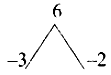
$t -3=0$ or $t -2=0$
$t=3$ or $t=2$
The excluded values are 2 and 3 View full question & answer→Question 302 Marks
Find the excluded values, of the following expression
$
\frac{x^2+6 x+8}{x^2+x-2}
$
Answer$\begin{aligned} & x ^2+6 x +8=( x +4)( x +2) \\ & x ^2+ x -2=( x +2)( x -1) \\ & \frac{x^2+6 x+8}{x^2+x-2}=\frac{(x+4)(x+2)}{(x+2)(x-1)} \\ & =\frac{x+4}{x-1}\end{aligned}$
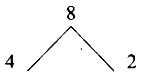
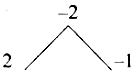
The expression $\frac{x+4}{x-1}$ is undefined when $x-1=0$
$
\because x=1
$
The excluded value is 1 View full question & answer→Question 312 Marks
Reduce the following rational expression to its lowest form
$
\frac{p^2-3 p-40}{2 p^3-24 p^2+64 p}
$
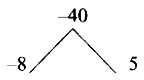
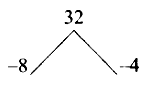
Answer$\begin{aligned} & \frac{p^2-3 p-40}{2 p^3-24 p^2+64 p} \\ & p^2-3 p-40=(p-8)(p+5) \\ & 2 p^3-24 p^2+64 p=2 p\left(p^2-12 p+32\right) \\ & =2 p(p-8)(p-4) \\ & \frac{p^2-3 p-40}{2 p^3-24 p^2+64 p}=\frac{(p-8)(p+5)}{2 p(p-8)(p-4)} \\ & =\frac{p+5}{2 p(p-4)}\end{aligned}$
View full question & answer→Question 322 Marks
Reduce the following rational expression to its lowest form
$
\frac{x^2-1}{x^2+x}
$
Answer$\begin{aligned} & \frac{x^2-1}{x^2+x} \\ & =\frac{(x+1)(x-1)}{x(x+1)} \\ & =\frac{x-1}{x}\end{aligned}$
View full question & answer→Question 332 Marks
Reduce the following rational expression to its lowest form
$
\frac{x^2-11 x+18}{x^2-4 x+4}
$
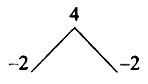
Answer$\frac{x^2-11 x+18}{x^2-4 x+4}$
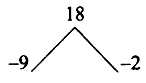
$\begin{aligned} & x ^2-11 x +18=( x -9)( x -2) \\ & x ^2-4 x +4=( x -2)( x -2) \\ & \frac{x^2-11 x+18}{x^2-4 x+4}=\frac{(x-9)(x-2)}{(x-2)(x-2)} \\ & =\frac{x-9}{x-2}\end{aligned}$
View full question & answer→Question 342 Marks
Reduce the following rational expression to its lowest form
$
\frac{9 x^2+81 x}{x^3+8 x^2-9 x}
$
Answer$\begin{aligned} & \frac{9 x^2+81 x}{x^3+8 x^2-9 x} \\ & 9 x^2+81 x =9 x ( x +9) \\ & x ^3+8 x ^2-9 x = x \left( x ^2+8 x -9\right) \\ & = x ( x +9)( x -1) \\ & \frac{9 x^2+81 x}{x^3+8 x^2-9 x}=\frac{9 x(x+9)}{x(x+9)(x-1)} \\ & =\frac{9}{x-1}\end{aligned}$
View full question & answer→Question 352 Marks
Find the LCM pair of the following polynomials
$x^4-27 a^3 x,(x-3 a)^2$ whose GCD is $(x-3 a)$
Answer$\begin{aligned} & p ( x )= x ^4-27 a ^3 x = x \left[ x ^3-27 a ^3\right] \\ & = x \left[ x ^3-(3 a)^3\right] \\ & = x ( x -3 a )\left( x ^2+3 ax +9 a ^2\right) \\ & g( x )=( x -3 a )^2 \\ & \text { G.C.D. }= x -3 a \\ & \text { L.C.M. }=\frac{ p (x) \times g (x)}{ G \cdot C \cdot D \cdot} \\ & =\frac{x(x-3 a )\left(x^2+3 a x+9 a ^2\right) \times(x-3 a)^2}{(x-3 a)} \\ & \text { L.C.M. }= x ( x -3 a )^2\left( x ^2+3 ax +9 a ^2\right)\end{aligned}$
View full question & answer→Question 362 Marks
Find the L.C.M. of the given expressions
$2 x^2-5 x-3,4 x^2-36$
Answer$2 x^2-5 x-3=2 x^2-6 x+x-3$
$=2 x(x-3)+1(x-3)$
$=(x-3)(2 x+1)$
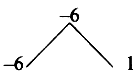
$=4 x^2-36=4\left[x^2-9\right]$
$=4\left[x^2-3^2\right]$
$=4(x+3)(x-3)$
L.C.M. $=4(x-3)(x+3)(2 x+1)$ View full question & answer→Question 372 Marks
Find the L.C.M. of the given expressions
$\left(2 x^2-3 x y\right)^2,(4 x-6 y)^3,\left(8 x^3-27 y^3\right)$
Answer$\left(2 x^2-3 x y\right)^2=x^2(2 x-3 y)^2$
$(4 x-6 y)^3=2^3(2 x-3 y)^3$
$=8(2 x-3 y)^3$
$\left(8 x^3-27 y^3\right)=(2 x)^3-(3 y)^3$
$=(2 x-3 y)\left[(2 x)^2+2 x \times 3 y+\left(3 y^2\right)\right] \ldots\left[\text { using } a^3-b^3=(a-b)\left(a^2+a b+b^2\right)\right]$
$(2 x-3 y)\left(4 x^2+6 x y+9 y^2\right)$
$\text { L.C.M. }=8 x^2(2 x-3 y)^3\left(4 x^2+6 x y+9 y\right)^2$
View full question & answer→Question 382 Marks
Find the L.C.M. of the given expressions
$p^2-3 p+2, p^2-4$
Answer$p^2-3 p+2=p^2-2 p-p+2$
$=p(p-2)-1(p-2)$
$=(p-2)(p-1)$
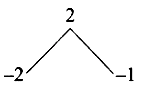
$p^2-4=p^2-2^2 \ldots$ (using $\left.a^2-b^2=(a+b)(a-b)\right]$
$=(p+2)(p-2)$
L.C.M. $=(p-2)(p+2)(p-1)$ View full question & answer→Question 392 Marks
Find the L.C.M. of the given expressions
$4 x^2 y, 8 x^3 y^2$
Answer$4 x^2 y=2 \times 2 \times x^2 \times y$
$8 x^3 y^2=2 \times 2 \times 2 \times x^3 \times y^2$
$\text { L.C.M. }=2^3 \times x^3 \times y^2$
$=8 x^3 y^2$
Aliter:
L.C.M. of 4 and $8=8$
L.C.M. of $x^2 y$ and $x^3 y^2=x^3 y^2$
$\therefore$ L.C.M. $=8 x^3 y^2$
View full question & answer→Question 402 Marks
Find the L.C.M. of the given expressions
$-9 a^3 b^2, 12 a^2 b^2 c$
Answer$-9 a^3 b^2=-\left(3^2 \times a^3 \times b^2\right)$
$12 a^2 b^2 c=2^2 \times 3 \times a^2 \times b^2 \times c$
$\text { L.C.M. }=-\left(2^2 \times 3^2 \times a^3 \times b^2 \times c\right)$
$=-36 a^3 b^2 c$
View full question & answer→Question 412 Marks
Find the L.C.M. of the given expressions
$16 m,-12 m^2 n^2, 8 n^2$
Answer$16 m=24 \times m$
$-12 m^2 n^2=-\left(2^2 \times 3 \times m^2 \times n^2\right)$
$8 n^2=2^3 \times n^2$
$\text { L.C.M. }=-\left(2^4 \times 3 \times m^2 \times n^2\right)$
$=-48 m^2 n^2$
View full question & answer→Question 422 Marks
A has ‘a’ rows and ‘a + 3’ columns. B has ‘b’ rows and ‘17 − b’ columns, and if both products AB and BA exist, find a, b?
AnswerOrder of $A=a \times(a+3)$
Order of $B=b \times(17-b)$
Given: Product of $A B$ exist
$
\begin{aligned}
& a+3=b \\
& a-b=-3
\end{aligned}
$
Product of BA exist
$
\begin{aligned}
& 17-b=a \\
& -a-b=-17 \\
& a+b=17 \ldots \ldots . .(2) \\
& (1)+(2) \Rightarrow 2 a=14 \\
& a=\frac{14}{2}=7
\end{aligned}
$
Substitute the value of $a =7$ in (1)
$
7-b=-3 \Rightarrow-b=-3-7
$
– b = – 10 ⇒ b = 10
The value of a = 7 and b = 10
View full question & answer→Question 432 Marks
If A is of order p × q and B is of order q × r what is the order of AB and BA?
AnswerIf A is of order p × q .....[∵ p × q q × r = p × r]
the order of AB = p × r .......[∵ q × r p × q = r ≠ p]
Product of BA cannot be defined/found as the number of columns in B ≠. The number of rows in A.
View full question & answer→Question 442 Marks
Find the order of the product matrix AB if
| | (i) | (ii) | (iii) | (iv) | (v) |
| Order of A | 3 × 3 | 4 × 3 | 4 × 2 | 4 × 5 | 1 × 1 |
| Order of B | 3 × 3 | 3 × 2 | 2 × 2 | 5 × 1 | 1 × 3 |
Answer(i) Order of matrix AB = 3 × 3
(ii) Order of matrix AB = 4 × 2
(iii) Order of matrix AB = 4 × 2
(iv) Order of matrix AB = 4 × 1
(v) Order of matrix AB = 1 × 3
View full question & answer→Question 452 Marks
Find the values of $x , y , z$ if $\left[\begin{array}{cc}x-3 & 3 x-z \\ x+y+7 & x+y+z\end{array}\right]=\left[\begin{array}{ll}1 & 0 \\ 1 & 6\end{array}\right]$
Answerx – 3 = 1 ⇒ x = 1 + 3 ⇒ x = 4
3x – z = 0 ...(substitute the value of x)
3(4) – z = 0
12 – z = 0
∴ z = 12
x + y + z = 6
4 + y + 12 = 0
y + 16 = 6
y = 6 – 16
∴ y = – 10
The value of x = 4, y = – 10 and z = 12
View full question & answer→Question 462 Marks
Find the values of $x , y , z$ if $\left[\begin{array}{c}x \\ y-z \\ z+3\end{array}\right]+\left[\begin{array}{l}y \\ 4 \\ 3\end{array}\right]=\left[\begin{array}{c}4 \\ 8 \\ 16\end{array}\right]$
Answer$ \begin{aligned} & {\left[\begin{array}{c} x \\ y-z \\ z+3 \end{array}\right]+\left[\begin{array}{l} y \\ 4 \\ 3 \end{array}\right]=\left[\begin{array}{c} 4 \\ 8 \\ 16 \end{array}\right]} \\\end{aligned} $
$x+y=4 \ldots(1)$
$ y-z+4=8 \ldots(2)$
Substitute the value of $z$ in $(2)$
$(2) \Rightarrow y-10=4$
Substitute the value of $y$ in $(1)$
$ z+3+3=16$
$ z+6=16$
$ z=16-16=10$
$ y=14$
$ (1) \Rightarrow x+14=4$
$x-4-14=-10$
The value of $x = – 10, y = 14$ and $z = 10$
View full question & answer→Question 472 Marks
If $A=\left[\begin{array}{lll}0 & 4 & 9 \\ 8 & 3 & 7\end{array}\right], B=\left[\begin{array}{lll}7 & 3 & 8 \\ 1 & 4 & 9\end{array}\right]$ find the value of $B-5 A$
Answer$\begin{aligned} & B-5 A=\left[\begin{array}{lll}7 & 3 & 8 \\ 1 & 4 & 9\end{array}\right]-5\left[\begin{array}{lll}0 & 4 & 9 \\ 8 & 3 & 7\end{array}\right] \\ & =\left[\begin{array}{lll}7 & 3 & 8 \\ 1 & 4 & 9\end{array}\right]-\left[\begin{array}{ccc}0 & 20 & 45 \\ 40 & 15 & 35\end{array}\right] \\ & =\left[\begin{array}{ccc}7 & -17 & -37 \\ -39 & -11 & -26\end{array}\right]\end{aligned}$
View full question & answer→Question 482 Marks
If $A=\left[\begin{array}{lll}0 & 4 & 9 \\ 8 & 3 & 7\end{array}\right], B=\left[\begin{array}{lll}7 & 3 & 8 \\ 1 & 4 & 9\end{array}\right]$ find the value of $3 A-9 B$
Answer$\begin{aligned} & 3 A-9 B=3\left[\begin{array}{lll}0 & 4 & 9 \\ 8 & 3 & 7\end{array}\right]-9\left[\begin{array}{lll}7 & 3 & 8 \\ 1 & 4 & 9\end{array}\right] \\ & =\left[\begin{array}{ccc}0 & 12 & 27 \\ 24 & 9 & 21\end{array}\right]-\left[\begin{array}{ccc}63 & 27 & 72 \\ 9 & 36 & 81\end{array}\right] \\ & =\left[\begin{array}{ccc}-63 & -5 & -45 \\ 15 & -27 & -60\end{array}\right]\end{aligned}$
View full question & answer→Question 492 Marks
Find the values of $x, y$ and $z$ from the following equation
$
\left[\begin{array}{cc}
12 & 3 \\
x & \frac{3}{2}
\end{array}\right]=\left[\begin{array}{ll}
y & z \\
3 & 5
\end{array}\right]
$
AnswerSince the given matrices are equal then all the corresponding elements are equal.
y = 12, z = 3, x = 3
The value of x = 3, y = 12 and z = 3
View full question & answer→Question 502 Marks
If $A=\left[\begin{array}{ccc}5 & 2 & 2 \\ -\sqrt{17} & 0.7 & \frac{5}{2} \\ 8 & 3 & 1\end{array}\right]$ then verify $\left(A^{\top}\right)^{\top}=A$
Answer$
\begin{aligned}
& A=\left[\begin{array}{ccc}
5 & 2 & 2 \\
-\sqrt{17} & 0.7 & \frac{5}{2} \\
8 & 3 & 1
\end{array}\right] \\
& A^{\top}=\left[\begin{array}{ccc}
5 & -\sqrt{17} & 8 \\
2 & 0.7 & 3 \\
2 & \frac{5}{2} & 1
\end{array}\right] \\
& \left(A^{\top}\right)^{\top}=\left[\begin{array}{ccc}
5 & 2 & 2 \\
-\sqrt{17} & 0.7 & \frac{5}{2} \\
8 & 3 & 1
\end{array}\right] \\
& \left(A^{\top}\right)^{\top}=A
\end{aligned}
$
Hence it is verified
View full question & answer→