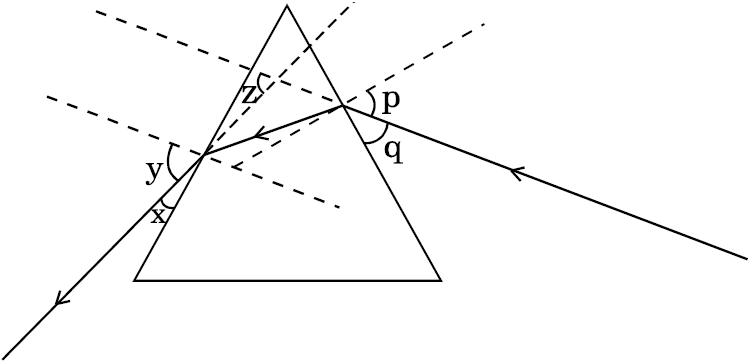
- Areflection of light
- Batmospheric refraction
- ✓scattering of light
- Ddispersion of light
Answer: C.
View full solution →971 questions across 9 question groups — pick any mix to generate a Science paper with step-by-step answer keys.
M.C.Q
239 Q→02Assertion - Reasoning (1 Marks)
15 Q→03Fill in the blank
20 Q→04True-False
9 Q→05[1 Mark Questions]
171 Q→06[2 Mark Questions]
215 Q→07[3 Mark Questions]
208 Q→08[5 marks Questions]
82 Q→09case /data -based (4 Marks)
12 Q→One sample from each question group in this chapter. Select any group above to see the full set with answer keys.
Answer: C.
View full solution →Answer: D.
View full solution →
Answer: D.
View full solution →
Answer: C.
View full solution →Answer: B.
View full solution →Answer: A.
View full solution →
Answer: D.
View full solution →Answer: A.
View full solution →Answer: C.
View full solution →
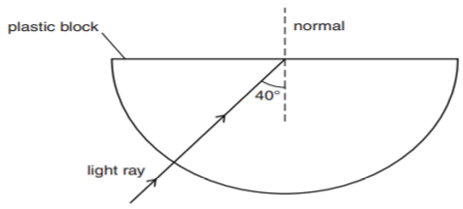
| Medium | Refractive Index |
| A | 1.6 |
| B | 1.8 |
| C | 1.5 |


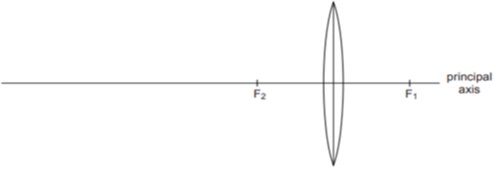
The above image shows a thin lens of focal length $5 m$.
(i) What is the kind of lens shown in the above figure?
(ii) If a real inverted image is to be formed by this lens at a distance of $7 m$ from the pole, then show with calculation where should the object be placed?
(iii) Draw a neatly labelled diagram of the image formation mentioned in (ii)
| Position of object | Position of image | Relative size of image |
| At infinity | At focus F_(2) | Highly diminished point sized |
| Beyond 2F_(1) | Between F_(2) and 2F_(2) | Diminished |
| At 2F_(1) | At 2F_(2) | Same size |
| Between F_(1) and 2F_(1) | Beyond 2F_(2) | Enlarged |
| At focus F_(1) | At infinity | Infinitely large or highly enlarged |
| Between focus F_(1) and optical centre O | On the same side of the lens as the object | Enlarged |
(i) What is the nature of the image, if an object is placed at infinity ?
(ii) Identify the nature of the image for which the object is between focus and optical centre.
(iii) What is position of image, when object is place at focus $\left(f_1\right)$ ?
or
(iv) What is the focal length of a lens for an object placed $50 cm$ from the lens producing virtual image at a distance of $10 cm$ in front of the lens?
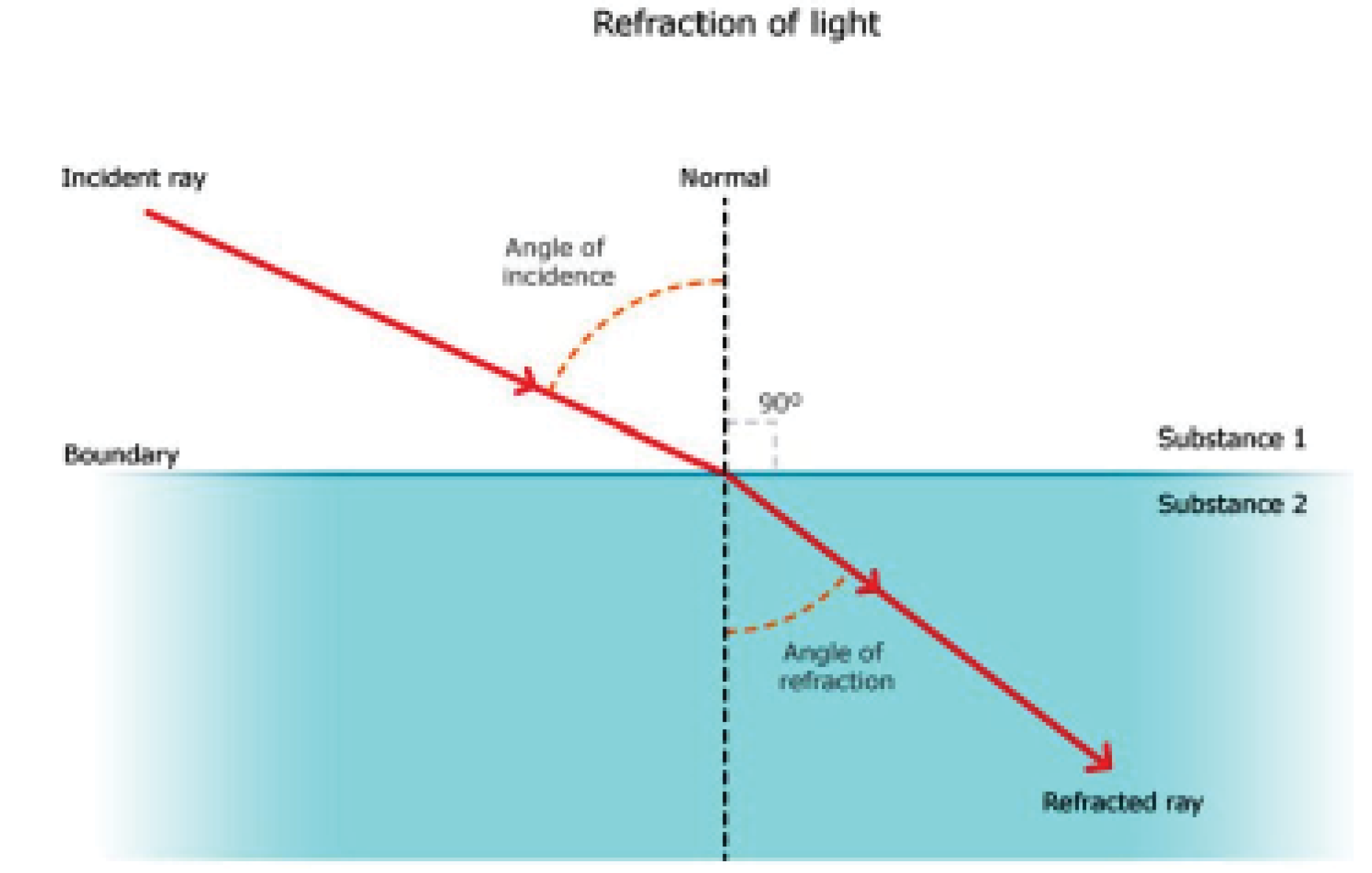
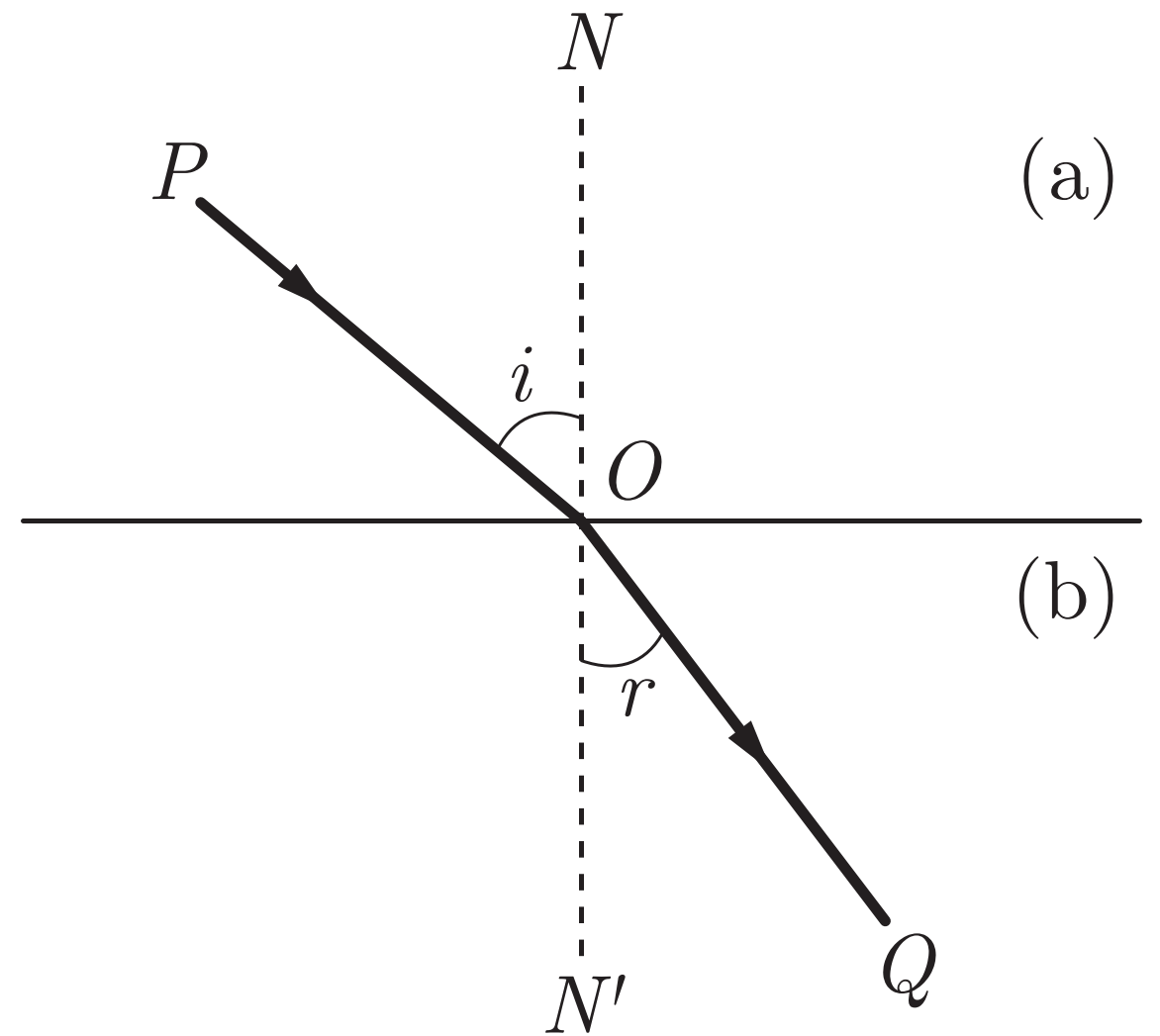
When light travels from a rarer medium to a denser one, it bends towards the normal $(i>r)$ and when travels from a denser medium to a rarer one. it bends away from the normal $(i<r)$.
Where, $\quad i=$ Angle of incidence
and $\quad r=$ Angle of refraction
We can see refraction in our daily life, some of the examples are given below :
The bottom of a tank or pond containing water appears to be raised due to refraction of light which takes place when light rays pass from the pool of water into the air. The letters appear to be raised when viewed through a glass slab placed over the document because of refraction of light.
When a light ray enters in a glass slab, then the emergent ray is parallel to the incident ray but it is shifted sideward slightly.
In this case, refraction takes place twice, first when ray enters glass slab from air and second when exits from glass slab to air.
(i) What do you mean by optically rarer and denser medium ?
(ii) What is the cause of refraction?
(iii) Draw a ray diagram shotving refraction through a glass slab.
or
(iv) Give one example of refraction from our daily life experience other than the two examples given above.
<
(i) A ray of light enters into the glass from air. Does it bend towards normal ?
(ii) What is the unit of refractive index?
(iii) Light enters from air to glass having refractive index 1.50. What is the speed of light in the glass? The speed of light in vacuum is $3 \times 10^3 ms ^{-1}$.
or
(iii) When light goes from one medium to another, which of the three parameters, frequency, wavelength, velocity change?
Pick question groups from the list above, set marks and difficulty, and export a branded PDF with step-by-step answer keys. First 3 chapters free — no signup.