Questions

3 Marks Question

Take a timed test

46 questions · self-marked practice — reveal the answer and mark yourself.

Question 13 Marks
How would you react to the statement that the electronegativity of N on Pauling scale is 3.0 in all the nitrogen compounds?
Answer
On Pauling scale, the electronegativity of nitrogen, (3.0) indicates that it is sufficiently electronegative. But it is not correct to say that the electronegativity of nitrogen in all the compounds is 3 . It depends upon its state of hybridization in a particular compound, greater the percentage of s-character, more will be the electronegativity of the element. Thus, the electronegativity of nitrogen increases in moving from $\mathrm{SP}^3$ hybridized orbital's to SP hybridized orbital's i.e., as $\mathrm{SP}^3<\mathrm{SP}^3<\mathrm{SP}$.
View full question & answer
Question 23 Marks
The increasing order of reactivity among group 1 elements is Li < Na < K < Rb CI > Br > I. Explain.
Answer
The trend Li < Na < K < Rb < Cs is observed for chemical reactivity because upon descending the group the ionization energy of alkali metals decreases i.e., it is easy for them to lose an electron from their valence shell and attain the nearest stable noble gas configuration. The trend F > Cl > Br > I is observed for chemical reactivity in halogens because the standard reduction potential decreases as we descend the group. F being the most electronegative readily accepts an e~ to complete its octet and hence the trend.
View full question & answer
Question 33 Marks
Predict the formulas of the stable binary compounds that would be formed by the combination of the following pairs of elements.
  1. Lithium and oxygen.
  2. Magnesium and nitrogen.
  3. Aluminium and iodine.
  4. Silicon and oxygen.
  5. Phosphorus and fluorine.
  6. Element 71 and fluorine.
Answer
a. $\mathrm{Li}_2 \mathrm{O}$
b. $\mathrm{Mg}_3 \mathrm{~N}_2$
c. $\mathrm{All}_3$
d. $\mathrm{SiO}_2$
e. $\mathrm{PF}_3$ or $\mathrm{PF}_5$
f. The element with the atomic number 71 is Lutetium (Lu). It has valency 3 . Hence, the formula of the compound is $\mathrm{LuF}_3$.
View full question & answer
Question 43 Marks
How would you react to the statement that the electronegativity of N on Pauling scale is 3.0 in all the nitrogen compounds?
Answer
On Pauling scale, the electronegativity of nitrogen, (3.0) indicates that it is sufficiently electronegative. But it is not correct to say that the electronegativity of nitrogen in all the compounds is 3 . It depends upon its state of hybridization in a particular compound, greater the percentage of s-character, more will be the electronegativity of the element. Thus, the electronegativity of nitrogen increases in moving from $\mathrm{SP}^3$ hybridized orbital's to SP hybridized orbital's i.e., as $\mathrm{SP}^3<\mathrm{SP}^3<\mathrm{SP}$.
View full question & answer
Question 53 Marks
Write the atomic number of the element present in the third period and seventeenth group of the periodic table.
Answer
There are two elements in the $1^{\text {st }}$ period and eight elements in the $2^{\text {nd }}$ period., The third period starts with the element with $Z=11$. Now, there are eight elements in the third period. Thus, the $3^{\text {rd }}$ period ends with the element with $Z=18$ i.e., the element in the $18^{\text {th }}$ group of the third period has $Z=18$. Hence, the element in the $17^{\text {th }}$ group of the third period has atomic number $Z=17$.
View full question & answer
Question 63 Marks
Would you expect the second electron gain enthalpy of O as positive, more negative or less negative than the first? Justify your answer.
Answer
For oxygen atom:
$\text{O}(\text{e}) + \text{e}^{-} \rightarrow \text{O}^{-}(\text{g}) (\Delta\text{eg} \text{H} = -141 \ \text{kj}\ \text{mol}^{-})$
$\text{O} (\text{g}) + \text{e}^{-} \rightarrow \text{O} ^{2-} (\text{g}) (\Delta\text{eg}\text{H} = + 780\ \text{KJ}\ \text{mol}^{-1})$
The first electron gain enthalpy of oxygen is negative because energy is released when a gaseous atom accepts an electron to form monovalent anion. The second electron gain enthalpy is positive because energy is needed to overcome the force of repulsion between monovalent anion and second incoming electron.
View full question & answer
Question 73 Marks
Energy of an electron in the ground state of the hydrogen atom is –2.18×10⁻¹⁸J. Calculate the ionization enthalpy of atomic hydrogen in terms of J mol–1.
Hint: Apply the idea of mole concept to derive the answer.
Answer
Energy of the electron in the ground state of H-atom,
$\text{E}_{1} = -2.18\ \text{x} \ 10-18 \text{J}$
Ionisation energy $=\text{E}_{\propto}-\text{E}_{1}$
Ionisation enthalpy per mole of atomic hydrogen $= (\text{E}_{{\propto}} – \text{E}_1)\text{NA}$
$= \big[0 – (- 2.18\ \text{x} \ 10-18)\big] \text{x}\ 6.023 \text{x}1023$
$= 2.18\ \text{x}\ 6.023\ \text{x} \ 105 \ \text{j}/\text{mol} = 13.13 \ \text{x} \ 105\ \text{j}/\text{mol}$
$= 1.313\ \text{x} \ 106\text{j}/\text{mol}$
View full question & answer
Question 83 Marks
Which of the following pairs of elements would have a more negative electron gain enthalpy?
F or Cl
Answer
F and Cl are the elements of the same group in periodic table. On moving down the group the electron affinity becomes less negative. Here, the value of electron affinity of F is less negative than that of Cl. It is because atomic size of Cl is larger than that of F. In Cl, the electron will be added to n = 3 quantum level, whereas in F, the electron will be added to n = 2 quantum level. Thus, as the electron-electron repulsion is reduced in Cl so an extra electron can easily be accommodated. So, electron affinity of Cl is more negative compared to that of F.
View full question & answer
Question 93 Marks
Which of the following pairs of elements would have a more negative electron gain enthalpy?
O or F
Answer
O and F are the elements of the same period in periodic table. An F-atom is having 1 electron and 1 proton more than that of O-atom as electron is added in the same shell, Thus the atomic size of O-atom is larger than F-atom. As O-atom is having 1 proton less than F-atom. So, the nucleus of O-atom cannot attract an incoming electron that strongly as that of an F-atom. Also F-atom requires only 1 electron to achieve stable inert gas configuration. So, the electron affinity of F(Fluorine) is more negative than that of O(oxygen).
View full question & answer
Question 103 Marks
Arrange the following as stated.
  1. Increasing order of bond dissociation energy of $N_2, O_2, F_2, Cl_2.$
  2. Decreasing order of electropositive character of $Cu$, Fe, Mg.
  3. Increasing order of valency of nitrogen in $HNO_3, HNO_2, NO_2.$
Answer
  1. In general, as the size of atom or multiplicity of bond increases, bond dissociation energy increases but bond dissociation energy of $F_2$​​​​​​​ is less than that of $Cl_2​​​​​​​$​​​​​​​because of the small size of F. Thus, the correct order is
$F_2$
<
$Cl_2$
<
$O_2$
<
$N_2$
155
 
242
 
494
 
941kJ/ mol
  1. Electropositive character means tendency to give an electron to form cation. It varies directly with atomic radii. Thus, the correct order is Mg > Fe > Cu.
  2. In $HNO_3​​​​​​​$​​​​​​​, N is in contact with three electronegative O atoms each of which share two electrons and hence acquire -2 charge.
    Therefore, N acquire +6 charge but one charge of one O is used to make bond with H. So in actual, the charge or valency of N in $HNO_3​​​​​​​$​​​​​​​ is +5.
    Similarly, its valency in $HNO_2​​​​​​​$​​​​​​​ is +3 and $NO_2​​​​​​​$​​​​​​​ is +4.
    The order of valency of N is $HNO_2 < NO_2 3.$
View full question & answer
Question 113 Marks
Among the elements B, Al, C and Si:
  1. Which element has the highest first ionisation enthalpy?
  2. Which element has the most metallic character? Justify your answer in each case.
Answer
Arranging the elements into different groups and periods:
Group
13
14
Period 2
B
C
Period 3
Al
Si
  • Ionization enthalpy increases along a period and decreases down a group. Therefore, C has the highest first ionization enthalpy.
  • Metallic character decreases along a period and increases down a group. Therefore, Al has the most metallic character.
View full question & answer
Question 123 Marks
Among the elements B, Al, C and Si:
  1. Which has the highest first ionization enthalpy?
  2. Which has the most negative electron gain enthalpy?
  3. Which has the largest atomic radius?
Give reasons.
Answer
  1. Ionization energy increases along a period but decreases going down in the group. Hence, carbon has highest first ionization enthalpy since it has the smallest size among all.
  2. Electron gain enthalpy becomes more negative along a period and less negative down a group, thus, carbon has the most negative electron gain enthalpy due to smallest size.
  3. Atomic radii decrease along a period but increase down the group, thus, Al has the largest atomic radius.
View full question & answer
Question 133 Marks
Give two similarities and one difference between Boron and Aluminium.
Answer
Similarities:
  • Both show valency equal to 3.
  • Both form oxides with similar formula $\mathrm{B}_2 \mathrm{O}_3$, $\mathrm{Al}_2 \mathrm{O}_3$.
Difference:
$\mathrm{B}_2 \mathrm{O}_3$, is acidic oxide whereas $\mathrm{Al}_2 \mathrm{O}_3$ is amphoteric oxide.
View full question & answer
Question 143 Marks
Answer the following questions:
  1. B, Al, Ga arrange in decreasing order of atomic radii.
  2. C, F, O first electron gain enthalpy in increasing order.
  3. Al forms amphoteric oxide, why?
Answer
  1. Al > Ga > B is decreasing order of atomic radii. In 'Ga', effective nuclear charge is more than Al due to poor shielding effect of 3d-electrons.
  2. C < O < F is increasing order of electron gain enthalpy due to decrease in atomic size.
  3. ‘Al’ is less electropositive metal, therefore forms amphoteric, i.e. acidic as well as basic oxide.
View full question & answer
Question 153 Marks
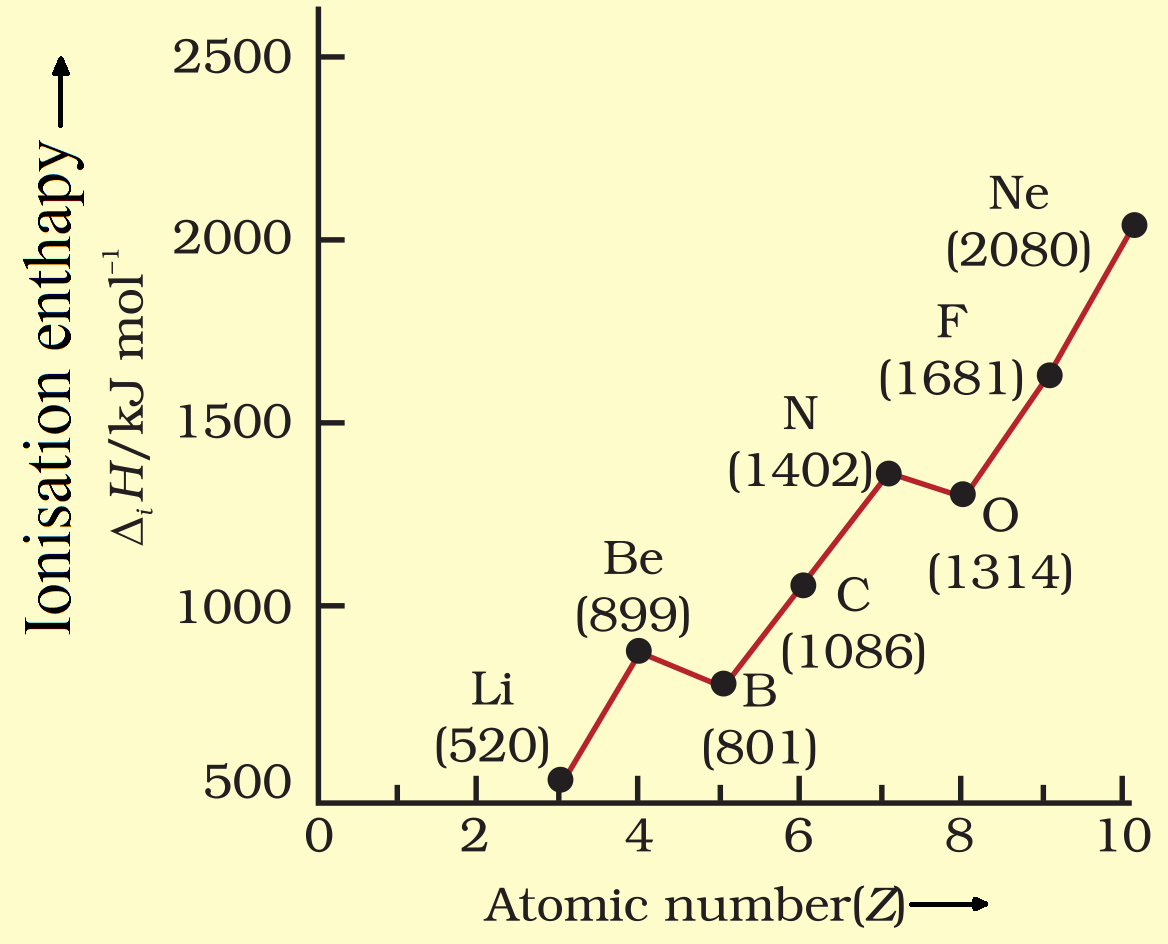
Explain the deviation in ionisation enthalpy of some elements from the general trend by using.
Answer
Ionisation enthalpy increases in a period with increase in atomic number. The graph shows few exceptions and not the linear relationship. Ionisation enthalpy of Be is greater than that of B due to filled s-orbital in Be $\left(\mathrm{Be}-\mathrm{I} . \mathrm{s}^2 1 \mathrm{~s}^2, \mathrm{~B}-1 \mathrm{~s}^2 2 \mathrm{~s}^2 2 \mathrm{p}^1\right)$
Ionisation enthalpy of N is greater than that of O due to half-filled p-orbitals in nitrogen. $\left(N-1 s^2 2 s^2 2 p^3, O-1 s^2 2 s^2 2 p^4\right)$.
View full question & answer
Question 163 Marks
What do you understand by exothermic reaction and endothermic reaction? Give one example of each type.
Answer
Exothermic reaction: The reaction which is accompanied with evolution of heat is known as exothermic reaction.
$\text{CaO}\ +\ \text{CO}_2\ \xrightarrow{\ \ \ \ \ \ \ \ \ \ \ \ }\text{ CaCO}_3,\ \Delta\text{H}=-178.3\text{kJ mol}^{-1}$
Endothermic reaction: The reaction which is accompanied with absorption of energy is known as endothermic reaction, e.g.,
$\text{2NH}_3\ \xrightarrow{\ \ \ \ \ \ \ \ \ \ \ \ }\text{ N}_2,\ +\ 3\text{H}_2,\ \Delta\text{H}=+91.8\text{kJ mol}^{-1}$
View full question & answer
Question 173 Marks
Can an element with atomic number 126, if discovered, be accommodated in the present Un set up of the long form of periodic table?
Answer
No, the maximum number of elements which can be accommodated in the present set up of the long form of the periodic table is 118. Thereafter, filling of 8s-orbital shell begin which will accommodate only two electrons. After 8s-orbitals, the filling of 5g-orbitals will begin. Since we do not have any provision for g-block elements in the present set up of the long form of periodic table, therefore, an element with atomic number 126, if discovered, cannot be accommodated in the present set up of the long form of periodic table.
View full question & answer
Question 183 Marks
Account for the following:
i. Which is smaller $\mathrm{Fe}^{2+}$ or $\mathrm{Fe}^{3+}$, why?
ii. Chlorine (Cl) have more negative electron gain enthalpy than Fluorine (F).
[Atomic no.: $\mathrm{F}=9, \mathrm{Cl}=17]$
iii. Anions are bigger in size than their parent atom.
Answer
i. $\mathrm{Fe}^{3+}$ ion is smaller than $\mathrm{Fe}^{2+}$ due to greater effective nuclear charge. In $\mathrm{Fe}^{3+}, 26$ protons attract 23 electrons more strongly than $\mathrm{Fe}^{2+}$ in which 26 protons attract 24 electrons.
ii. It is due to less inter electronic repulsion in 'Cl' than F as ' F ' is smaller in size than Cl .
iii. Anions are formed when a neutral atom gains one or more electrons. Since, the number of electrons increases and the number of protons remains same, the effective nuclear charge decreases which results in decrease in ionic radii.
View full question & answer
Question 193 Marks
From each set, choose the atom which has largest ionisation enthalpy and explain your answer:
  1. F, O, N
  2. Mg, P, Ar
  3. B, Al, Ga
Answer
  1. F has highest ionisation enthalpy due to smallest atomic size, therefore, highest effective nuclear charge because it has 9 protons, O has 8 protons and N has 7 protons.
  2. Ar has highest ionisation enthalpy due to stable electronic configuration.
$1 s^2 2 s^2 2 p^6 3 s^2 3 p^6$
  1. B has highest ionisation enthalpy due to smallest atomic size and, therefore, highest effective nuclear charge, has two shells only. Al has 3 shells, Ga has 4 shells.
View full question & answer
Question 203 Marks
Give reasons for the following:
  1. Elements in the same group have similar physical and chemical properties.
  2. O has lower ionization enthalpy than N.
  3. Noble gases have high positive values of electron gain enthalpies.
Answer
  1. It is due to the presence of same number of valence electrons and same valency.
  2. It is because $N(7): 1 s^2 2 s^2 2 p^3$ has half filled $p$-orbitals which are more stable than $O(8): 1 s^2 2 s^2 2 p^4$. This, it is difficult remove electron from $2 p^3$ orbital, therefore more energy is required to remove an electron as compared to $2 p^4$.
  3. Noble gases have stable electronic configuration, i.e. have their octet complete. Therefore, energy is absorbed when electron is added to these, i.e. electron gain enthalpies have positive values.
View full question & answer
Question 213 Marks
Arrange the species in each group in order of increasing ionisation energy and give reason:
i. $\mathrm{K}^{+}, \mathrm{Cl}^{-}, \mathrm{Ar}$
ii. $\mathrm{Na}, \mathrm{Mg}, \mathrm{Al}$
iii. C, N, O
Answer
i. $\mathrm{Cl}^{-}<\mathrm{Ar}<\mathrm{K}^{+}$because nuclear charge goes on increasing because Cl has 17 protons, 'Ar' has 18 protons, K has 19 protons.
ii. $\mathrm{Na}<\mathrm{Al}<\mathrm{Mg}$ because Mg has stable electronic configuration and Na has large atomic size due to which it has lowest ionisation energy.
iii. $\mathrm{C}<\mathrm{O}<\mathrm{N}$ because N has half filled p-orbital which is more stable, whereas carbon is larger in size due to less effective nuclear charge ( 6 protons)
View full question & answer
Question 223 Marks
The radius of $\mathrm{Na}^{+}$ cation is less than that of Na atom. Give reason.
Answer
$\mathrm{Na}^{+}$is formed by losing one electron from Na atom. This means $\mathrm{Na}^{+}$contain 1 electron less than the Na atom. The nuclear charge is same on both, therefore electrons in $\mathrm{Na}^{+}$experience more nuclear force of attraction as compared to Na as it is less of 1 electron. More nuclear force of attraction means smaller size, hence $\mathrm{Na}^{+}$is smaller than Na .
View full question & answer
Question 233 Marks
The amount of energy released when $1 \times 10^{10}$ atoms of chlorine in vapour state are converted to $Cl ^{-}$ions according to the equation,
$Cl(g)+e^{-} \rightarrow Cl^{-}(g) \text { is } 57.86 \times 10^{-10} J$
Calculate the electron gain enthalpy of chlorine atom in terms of $kJ mol ^{-1}$ and eV per atom.
Answer
The amount of energy released when $1 \times 10^{10}$ atoms of chlorine in vapour state are converted to $Cl ^{-}$ions, according to the equation.
$Cl(g)+e^{-} \rightarrow Cl^{-}(g) \text { is } 57.86 \times 10^{-10} J$
$\therefore$ The electron gain enthalpy of chlorine, i.e. the amount of energy released when 1 mole $\left(6.023 \times 10^{23}\right)$ atoms of chlorine are converted into $Cl ^{-}$ions according to the above equation will be
$=-\frac{57.86 \times 10^{-10}}{1 \times 10^{10}} \times 6.023 \times 10^{23}$
$=-348.49 \times 10^3 J mol^{-1}$
$=-348.49 kJ mol^{-1}$
Now $1 eV /$ atom $=96.49 kJ mol ^{-1}$
$\therefore$ Electron gain enthalpy of chlorine $=-\frac{348.49}{96.49}=-3.61 eV /$ atom
View full question & answer
Question 243 Marks
a. Name the group of the elements in which electrons are progressively filled in 4 f -orbital and 5 f orbitals.
b. Which of the following is the correct order of size of the given species: $I, I^{+}, I^{-}$?
c. Which of the following elements can show covalency greater than 4 ?
Be, P, S, B
Answer
a. In lanthanoids, 4 f orbital is progressively filled.
b. $I^{-}>I>I^{+}$, cations are smaller and anions are bigger than neutral atom. Cations have greater effective nuclear charge as protons are more than electrons anions have less effective nuclear charge as electrons are more than protons.
c. 'P' and 'S' show co-valency greater than 4 due to presence of d-orbitals, in which electrons can be exited e.g. $\mathrm{PCl}_5, \mathrm{SF}_6$.
View full question & answer
Question 253 Marks
  1. Which orbitals are filled with electrons in third period?
  2. Which of the lanthanoids is man-made element?
  3. To which series do man-made elements belong?
Answer
  1. In third period, 3s and 3p orbitals are filled.
  2. Promethium (Pm) with atomic number 61 is a man-made lanthanoid.
  3. Actinoid series (f-block elements).
View full question & answer
Question 263 Marks
Identify the group and valency of the element having atomic number 119. Also predict the outermost electronic configuration and write the general formula of its oxide.
Answer
The present long form of periodic table has seven periods and the last element of this period is the element with atomic number 118 . Thus, the element with atomic number 119 is the first member of $8^{\text {th }}$ period and a member of alkali group with outer electronic configuration, $8 s^1$. It belongs to first group and therefore, its valency is one. The formula of its oxide is $\mathrm{M}_2 \mathrm{O}$.
View full question & answer
Question 273 Marks
Arrange the elements N, P, O and S in the order of:
  1. Increasing first ionisation enthalpy.
  2. Increasing non metallic character. Give reason for the arrangement assigned.
Answer
  1. S < P < O < N
Ionisation enthalpy increases from left to right in a period and decreases down the group. N has higher ionisation enthalpy than O due to extra stability of half-filled orbitals. Similarly, P has higher ionisation enthalpy than S due to half-filled orbitals.
  1. P < S < N < O
Non-metallic character decreases down the group and increases from left to right in a period.
View full question & answer
Question 283 Marks
Select from each group of species which has the smallest radius stating the appropriate reason:
$\text { i. } \mathrm{O}, \mathrm{O}^{-}, \mathrm{O}^{2-}$
$\text { ii. } \mathrm{K}^{+}, \mathrm{Sr}^{2+}, \mathrm{Ar}$
$\text { iii. } \mathrm{Si}, \mathrm{P}, \mathrm{Cl}$
Answer
i. O has smallest radius because it has highest effective nuclear charge because 8 protons attract 8 electrons.
In $O^{-}, 8$ protons attract 9 electrons less strongly.
In $\mathrm{O}^{2-}, 8$ protons attract 10 electrons with least force of atraction among these.
ii. $\mathrm{K}^{+}$has smallest radius due to greater effective nuclear charge because it has 19 protons which attract 18 electrons with strong force of attraction. In Argon, 18 protons attract 18 electrons less strongly.
$\mathrm{Sr}^{2+}$ has more number of shells, therefore effective nuclear charge is less.
iii. Cl has smallest radius due to greater effective nuclear charge. 17 protons attract 17 electrons. In $\mathrm{P}, 15$ protons attract 15 electrons. In Si, 14 protons attract 14 electrons.
View full question & answer
Question 293 Marks
Which one (atom/ ion) in the following pairs has higher electron gain enthalpy?
i. $\mathrm{O}^{-}, \mathrm{S}$
ii. $\mathrm{O}, \mathrm{S}^{-}$
iii. $\mathrm{O}^{-}, \mathrm{S}^{-}$
iv. $N^{-}, \mathrm{P}$
Answer
i. Due to repulsions between the electrons on $\mathrm{O}^{-}$and the additional incoming electron, the electron gain enthalpy of $\mathrm{O}^{-}$is positive while that of S is negative.
ii. On similar grounds, the electron gain enthalpy of $S^{-}$is positive while that of $O$ is negative.
iii. Due to small size, repulsions between $\mathrm{O}^{-}$and the incoming electron is much more than in $\mathrm{S}^{-}$. Therefore, electron gain enthalpy of $\mathrm{O}^{-}$is more positive than that of $\mathrm{S}^{-}$.
iv. Due to repulsions between $\mathrm{N}^{-}$and the incoming electron, electron gain enthalpy of $\mathrm{N}^{-}$is positive while that of $P$ is negative.
View full question & answer
Question 303 Marks
i. Arrange $\mathrm{Fe}^2 \mathrm{Fe}^{2+}, \mathrm{Fe}^{3+}$ in increasing order of radii.
ii. Explain why Be has higher ionization enthalpy than B .
iii. Predict the formula of compound which might be formed by silicon and bromine.
Answer
i. $\mathrm{Fe}^{3+}<\mathrm{Fe}^{2+}<\mathrm{Fe}$ is an increasing order of ionic radii.
ii. Be (4) has electronic configuration $1 s^2 2 s^2$ whereas $B(5)$ has $1 s^2 2 s^2 2 p^1$.
The energy required to remove electron from completely filled 2 s orbital is higher than the energy required to remove electron from $2 p$ orbital.
iii. $\mathrm{SiBr}_4$ is a formula of compound which might be formed by Si and $\mathrm{Br}_2$.
View full question & answer
Question 313 Marks
Among the elements of second period Li to Ne, pick out element:
  1. With the highest first ionisation energy.
  2. With highest electronegativity.
  3. With largest atomic radius.
  4. That is most reactive non-metal.
  5. That is most reactive metal.
  6. With valency equal to 4.
Answer
  1. Ne
  2. F
  3. Li (Covalent radii)
  4. F
  5. Li
  6. C
View full question & answer
Question 323 Marks
  1. Out of N and O which have high first ionisation enthalpy?
  2. Write general electronic configuration off-block elements.
  3. Define hydrogen bonds.
Answer
i. ' $N$ ' has higher ionisation enthalpy because it has half filled p-orbitals $\left(2 p^3\right)$ which is more stable.
ii. $(n-2) f^{1 to 14} (n-1) d^{0-1} n s^2$
iii. Hydrogen bond is the force of attraction between hydrogen and most electronegative atom like F, N, O.
View full question & answer
Question 333 Marks
Write down the outermost electronic configuration of alkali metals. How will you justify their placement in group 1 of the periodic table?
Answer
$\text{Li}- 1\text{s}^22\text{s}^1\text{ or }\big[\text{He}\big]2\text{s}^1$
$_{11}\text{Na}-1\text{s}^2\ 2\text{s}^2\ 2\text{p}^6\ 3\text{s}^1\ \text{or }\big[\text{Ne}\big]3\text{s}^1$
$_{19}\text{K}-1\text{s}^2\ 2\text{s}^2\ 2\text{p}^6\ 3\text{s}^2\ 3\text{p}^6\ 4\text{s}^1\ \text{or } \big[\text{Ar}\big]4\text{s}^1$
$_{37}\text{Rb}-1\text{s}^2\ 2\text{s}^2\ 2\text{p}^6\ 3\text{s}^1\ 3\text{p}^6\ 3\text{d}^{10}\ 4\text{s}^2\ 4\text{p}^6\ 5\text{s}^1\ \text{or }\big[\text{Kr}\big]5\text{s}^1$
$_{55}\text{Cs}-1\text{s}^2\ 2\text{s}^2\ 2\text{p}^6\ 3\text{s}^1\ 3\text{p}^6\ 3\text{d}^{10}\ 4\text{s}^2\ 4\text{p}^6\ 4\text{d}^{10}\ 5\text{s}^2\ 5\text{s}^2\ 5\text{p}^6\ 6\text{s}^1\text{ or }\big[\text{Xe}\big]6\text{s}^1$
$_{87}\text{Fr}-\big[\text{Rn}\big]7\text{s}^1$
Since all the elements have one electron in their valence shell, hence, they are placed in first group of the periodic table.
View full question & answer
Question 343 Marks
  1. Write the general electronic configuration of Group $17$ elements.
  2. What is the oxidation state and covalency of Al in $[AlCl(H_2O)_5]^{2+}?$
  3. Which out of the following will have the most negative electron gain enthalpy and which have the least negative?
$P, S, Cl$ and $F.$
Answer
  1. $ns^2 np^5$​​​​​​​ is the general electronic configuration of Group $17.$
  2. The oxidation state of Al in is $+3,$
$x - 1 + 0 = +2$

$x = +3$

The covalency of 'Al' is $6.$​​​​​​​
  1. Across a period, electron gain enthalpy becomes more negative as we move from left to right. In case of Cl, n = 3, added electron occupies a larger region of space and electron-electron repulsion is much less. So, it has higher negative value. Therefore, 'Cl' has highest negative electron gain enthalpy and 'P' has least negative electron gain enthalpy.
View full question & answer
Question 353 Marks
Give the name and atomic number of the inert gas atom in which the total number of d-electrons is equal to the difference in numbers of total p and s electrons.
Answer
The first inert gas which contains d electrons is krypton. Its atomic number is 36 and its electronic configuration is $1 s^2, 2 s^2, 2 p^6, 3 s^2, 3 p^6, 3 d^{10}, 4 s^2, 4 p^6$
Total number of $d$-electrons $=10$
Total number of p-electrons $=6+6+6=18$
Total number of s-electrons $=2+2+2+2=8$
$\therefore$ Difference in total number of p and s electrons $=18-8=10$
Thus, the inert gas is krypton.
View full question & answer
Question 363 Marks
Match the correct ionisation enthalpies and electron gain enthalpies of the following elements.
 
Elements
 
$\Delta\text{H}_1$
$\Delta\text{H}_2$
$\Delta_\text{eg}\text{H}$
(i)
Most reactive non-metal
A.
419
3051
-48
(ii)
Most reactive metal
B.
1681
3374
-328
(iii)
Least reactive element
C.
738
1451
-40
(iv)
Metal forming binary halide
D.
2372
5251
+48
Answer
  1. Most reactive non-metal has high $\Delta_\text{i}\text{H}_1$ and $\Delta_\text{i}\text{H}_2$ and most negative $\Delta_\text{eg}\text{H}.$ Therefore, the element is B.
  2. Most reactive metal has low $\Delta_\text{i}\text{H}_1$ and high $\Delta_\text{i}\text{H}_2$ (because the second electron has to be lost from noble gas configuration) and has small negative $\Delta_\text{eg}\text{H}.$
Therefore, the element is A.
  1. Noble gases are the least reactive elements. They have very high $\Delta_\text{i}\text{H}_1$ and $\Delta_\text{i}\text{H}_2$ and have positive $\Delta_\text{eg}\text{H}$ values. Thus, the element is D.
  2. Metal forming binary halides are alkaline earth metals. They have $\Delta_\text{i}\text{H}_1$ and $\Delta_\text{i}\text{H}_2$ values little higher than those of most reactive metals (such as A) and have comparatively slightly less negative $\Delta_\text{eg}\text{H}$ values. Thus, the element is C.
View full question & answer
Question 373 Marks
a. Consider the isoelectronic species, $\mathrm{Na}^{+}, \mathrm{Mg}^{2+}, \mathrm{F}^{-}$and $\mathrm{O}^{2-}$. What is the correct order of increasing length of their radii and why?
b. Si is semiconductor whereas ' C ' is non-metal, why?
Answer
a. $\mathrm{Mg}^2<\mathrm{Na}^{+}<\mathrm{F}^{-}<\mathrm{O}^{2-}$ is increasing order of ionic radii because effective nuclear charge decreases due to decrease in number of protons, therefore force of attraction decreases, ionic size increases.
b. Si is metalloid, i.e. shows properties of metals as well as non-metals that in why it is semiconductor. It is larger in size than ' $C$ '.

'C' is non-metal therefore, it is smaller in size, it has more tendency to gain electron than 'Si'.
View full question & answer
Question 383 Marks
Consider the element N, P, O and S and arrange them in order of:
  1. Increasing first ionisation enthalpy.
  2. Increasing negative electron gain enthalpy.
  3. Increasing non-metallic character.
Answer
  1. S < P < O < N is increasing order of first ionisation energy.
  2. N < P < O < S is increasing order of negative electron gain enthalpy.
  3. P < S < N < O is increasing order of non-metallic character.
View full question & answer
Question 393 Marks
Give reason for the following:
  1. Halogens act as good oxidising agent.
  2. Electron gain enthalpy of noble gas is almost zero.
  3. Na and $\mathrm{Mg}^{+}$ have same number of electrons but removal of electron from $\mathrm{Mg}^{+}$​​​​​​​ requires more energy.
Answer
  1. Due to highly negative electron gain enthalpy they act as good oxidising agent as they can gain electrons easily.
  2. Electronic configuration of noble gases is such that all sub-shells are completely filled. Hence their electron gain enthalpy is almost zero.
  3. Sodium has eleven electrons and eleven protons but number of protons in $\mathrm{Mg}^{+}$ are twelve, though it has eleven electrons. Due to higher effective nuclear charge in case of $\mathrm{Mg}^{+}$​​​​​​​, removal of electron from it requires more energy.
View full question & answer
Question 403 Marks
Give reason for the following:
  1. Electron gain enthalpy of fluorine is less negative than that of chlorine.
  2. Anionic radius is always more than that of neutral atom.
  3. Ionization enthalpy of nitrogen is more than that of oxygen.
Answer
  1. This is due to the smaller size of F than Cl. The electron-electron repulsion in 2p subshell of Fis large and incoming electron is not accommodated with the ease as is accommodated in a larger 3p subshell of Cl.
  2. Anion is formed when a neutral gaseous atom gains electrons. This increases the number of electrons in the anion while its nuclear charge remains the same. Since the same nuclear charge now attracts the greater number of electrons, therefore, the force of attraction of electrons by the nucleus decreases leading to increase in the size of an anion.
  3. $N, Z = 7 : 1s^2, 2s^2, 2p^3$​​​​​​​
$O, Z = 8 : 1s^2, 2s^2, 2p^4​​​​​​​$​​​​​​​

In case of N, electron is to be removed from half filled p-orbitals; hence more energy is required leading to the higher value of ionization enthalpy of nitrogen.
View full question & answer
Question 413 Marks
The first $\left(\mathrm{IE}_1\right)$ and second $\left(\mathrm{IE}_2\right)$ ionisation enthalpies $\left(\mathrm{kJ} \mathrm{~mol}^{-1}\right)$ of three elements $\mathrm{I}, \mathrm{II}$ and III are given below:
Element
$\mathrm{IE}_1$
$\mathrm{IE}_2$
I
403
2640
II
549
1060
III
1142
2080
Identify the element which is likely to be:
  1. Non-metal.
  2. An alkali metal.
  3. An alkaline earth metal.
Answer
  1. III is non-metal because it has very high first and second ionisation enthalpy. It cannot lose electron. It can gain electron easily.
  2. I is an alkali metal because it has lowest first ionisation enthalpy, it can lose one electron easily.
  3. II is alkaline earth metal because it has lowest second ionisation enthalpy. It can lose two electrons easily to form dipositive ions.
View full question & answer
Question 423 Marks
  1. Which pair of element show similar properties with following atomic number?
$[13, 31], [11, 21]$
  1. Which of the following elements has most positive electron gain enthalpy?
$F, N and Ne$​​​​​​​
  1. Lithium shows diagonal relationship with which element and why?
Answer
  1. 13, 31 will show similar chemical properties due to similar electronic configuration i.e. same valence electrons.
$Al(13) 1s^2 2s^2 2p^6 3s^2 3p^1$​​​​​​​

$Ga(31) 1s^2 2s^2 2p^6 3s^2 3p^6 4^{s2} 3d^{10} 4p^1​​​​​​​$​​​​​​​
  1. Ne has most positive electron gain enthalpy due to interelectronic repulsion.
  2. Lithium shows diagonal relationship with Mg. It is due to similar charge/ radius ratio i.e. similar polarising power.
View full question & answer
Question 433 Marks
Write four characteristic properties of p-block elements.
Answer
General characteristics of p-block elements:
  1. The general electronic configuration of p-block elements is $\mathrm{ns}^2 \mathrm{~np}^{1-6}$.
  2. These elements include metals and non-metals with a few semi metals (Metalloids)
  3. Most of them form covalent compounds.
  4. These elements possess relatively higher ionisation energy and the value tends to increase along the period but decrease down the group.
  5. Most of the elements show negative (except some metals) as well as positive oxidation states (except Fluorine).
  6. One of the familiar characteristic of p-block elements is to show inert pair effect i.e. the tendency of being less availability for ns electron in bonding. The inert pair effect increases down the group with the increase in atomic number.
View full question & answer
Question 443 Marks
Explain why the electron gain enthalpy of fluorine is less negative than that of chlorine.
Answer
In fluorine, the new electron to be added goes to 2p-subshell while in chlorine, the added electron goes to 3p subshell. Since the 2p-subshell is relatively small as compared to 3p-subshell, the added electron in small 2p subshell experiences strong interelectronic repulsions in comparison to that in 3p-subshell in Cl. As a result, the incoming electron does not feel much attraction from the nucleus and therefore, the electron gain enthalpy of F is less negative than that of Cl.
View full question & answer
Question 453 Marks
  1. How does Ionic radii vary with effective nuclear charge? Give example.
  2. An element belongs to 3rd period and group-13 of the periodic table. Identify the element and write two properties of element.
Answer
a. Ionic radii decreases as effective nuclear charge increases e.g. $\mathrm{Mg}^{2+}$ is smaller than $\mathrm{Na}^{+}$because $\mathrm{Mg}^{2+}$ has 12 protons which attract 10 electrons more strongly than 1 electrons attract 10 electrons in $\mathrm{Na}^{+}$.
- Inverse proportion to the effective nuclear charge.
- Direct proportion to the screening effect.
b. It is aluminum, good conductor of electricity, solid and metallic.
View full question & answer
Question 463 Marks
Out of elements of Group 17, 18, 1 in the sequence placed in modern periodic table.
  1. Which elements have negative electron gain enthalpy.
  2. Which elements have more metallic behaviour?
  3. Which elements have zero electronic behavior (zero valent)?
Answer
  1. Group 17 elements ($n s^2 ~np^5$) because they can gain electron easily.
  2. Group 1 element ($n s^1$) because they can lose electron easily.
  3. Group 18 elements have stable electronic configuration. They cannot lose or gain electron.
View full question & answer