Questions

5 Marks Questions

Take a timed test

41 questions · self-marked practice — reveal the answer and mark yourself.

Question 15 Marks
What is meant by ‘demineralised’ water and how can it be obtained?
Answer
Demineralised water is free from all soluble mineral salts which is obtained by passing water successively through a cation exchange (in the form of $\mathrm{H}^{+}$) and an anion exchange in the form of $\mathrm{OH}^{-}$resins.
$2 \mathrm{RH}(\mathrm{~s})+\mathrm{M}^{2+}(\mathrm{aq}) \rightleftharpoons \mathrm{MR}_2(\mathrm{~s})+2 \mathrm{H}^{+}(\mathrm{aq})$
$\mathrm{H}^{+}$exchanges for $\mathrm{Na}^{+}, \mathrm{Ca}^{2+}, \mathrm{Mg}^{2+}$ and other cations present in water. This process results in release of proton which makes the water acidic.
$\mathrm{OH}^{-}$exchanges, for anions like $\mathrm{Cl}^{-}, \mathrm{HCO}_3-\mathrm{SO}_4{ }^{2-}$ etc.
$\mathrm{OH}^{-}$ions thus liberated neutralize the $\mathrm{H}^{+}$ions set free in the cation exchange process.
$\mathrm{H}^{+}(\mathrm{aq})+\mathrm{OH}^{-}(\mathrm{aq}) \longrightarrow \mathrm{H}_2 \mathrm{O}(\mathrm{l})$
View full question & answer
Question 25 Marks
What characteristics do you expect from an electron-deficient hydride with respect to its structure and chemical reactions?
Answer
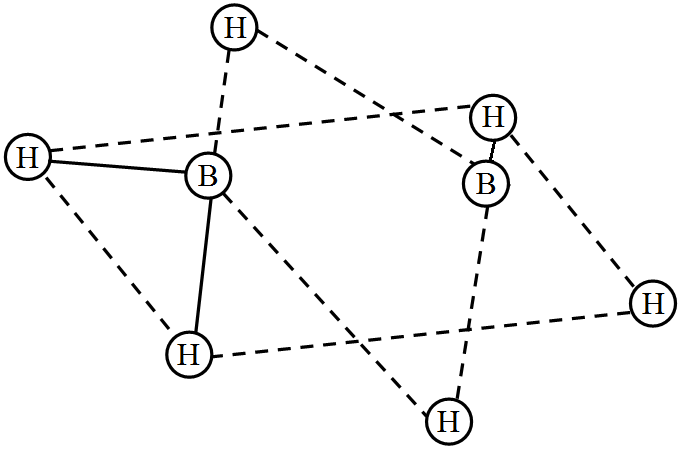
An electron-deficient hydride does not have sufficient electrons to form a regular bond in which two electrons are shared by two atoms e.g., $\mathrm{B}_2 \mathrm{H}_6, \mathrm{Al}_2 \mathrm{H}_6$ etc.
These hydrides cannot be represented by conventional Lewis structures. $\mathrm{B}_2 \mathrm{H}_6$, for example, contains four regular bonds and two three centered-two electron bond. Its structure can be represented as,

Since these hydrides are electron-deficient, they have a tendency to accept electrons. Hence, they act as Lewis acids.
$\text{B}_2\text{H}_6+2\text{NM}_3\xrightarrow{\ \ \ \ \ \ \ \ \ }2\text{B}\text{H}_3\cdot\text{NMe}_3$
View full question & answer
Question 35 Marks
Write chemical reactions to justify that hydrogen peroxide can function as an oxidising as well as reducing agent.
Answer
Hydrogen peroxide, $\text{H}_2\text{O}_2$ acts as an oxidizing as well as a reducing agent in both acidic and alkaline media.
Reactions involving oxidizing actions are:
  1. $2\text{Fe}^{2+}+2\text{H}^{+}+\text{H}_2\text{O}_2\xrightarrow{\ \ \ \ \ \ \ \ \ \ \ \ \ \ }2\text{Fe}^{3+}+2\text{H}_2\text{FO}$
  2. $\text{Mn}^{2+}+\text{H}_2\text{O}_2\xrightarrow{\ \ \ \ \ \ \ \ \ \ \ \ \ \ }\text{Mn}^{4+}+2\text{OH}^-$
  3. $\text{PdS}+4\text{H}_2\text{O}_2\xrightarrow{\ \ \ \ \ \ \ \ \ \ \ \ \ \ }\text{PdSO}_4+4\text{H}_2\text{O}$
  4. $2\text{Fe}^{2+}+\text{H}_2\text{O}_2\xrightarrow{\ \ \ \ \ \ \ \ \ \ \ \ \ \ }2\text{Fe}^{3+}+2\text{OH}^-$
Reactions involving reduction actions are:
  1. $2\text{MnO}_4^-+6\text{H}^{+}+5\text{H}_2\text{O}_2\xrightarrow{\ \ \ \ \ \ \ \ \ \ \ \ \ \ }2\text{Mn}^{2+}+8\text{H}_2\text{O}+5\text{O}_2$
  2. $\text{I}+\text{H}_2\text{O}_2+2\text{OH}^-\xrightarrow{\ \ \ \ \ \ \ \ \ \ \ \ \ \ }2\text{I}^-+2\text{H}_2\text{O}+\text{O}_2$
  3. $\text{HOCl}+\text{H}_2\text{O}_2\xrightarrow{\ \ \ \ \ \ \ \ \ \ \ \ \ \ }\text{H}_3\text{O}^{+}+\text{Cl}^-+\text{O}_2$
  4. $2\text{MnO}_4^-+3\text{H}_2\text{O}_2\xrightarrow{\ \ \ \ \ \ \ \ \ \ \ \ \ \ }2\text{MnO}_2+3\text{O}_2+2\text{H}_2\text{O}+2\text{OH}^-$
View full question & answer
Question 45 Marks
Compare the structures of $\text{H}_2\text{O}$ and $\text{H}_2\text{O}_2$.
Answer
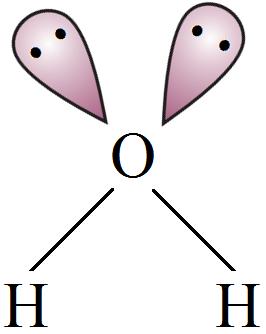
In water, O is $\text{sp}^3$ hybridized. Due to stronger lone pair-lone pair repulsions than bond pair-bond pair repulsions, the HOH bond angle decreases from 109.5° to 104.5°. Thus water molecule has a bent structure.

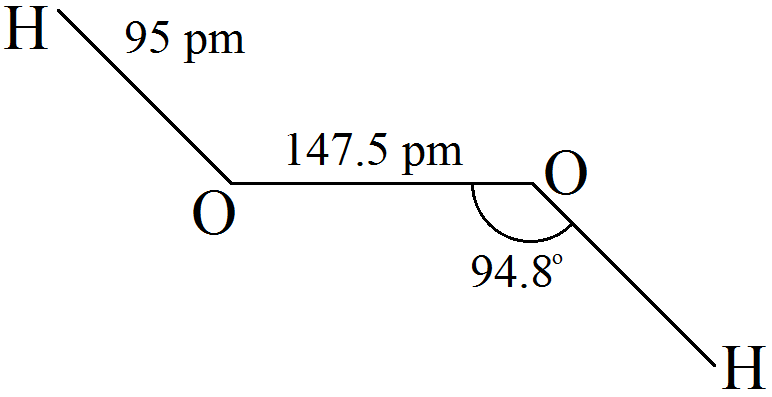
$\text{H}_2\text{O}_2$ has a non-planar structure. The O—H bonds are in different planes. Thus, the structure of $\text{H}_2\text{O}_2$ is like an open book.
View full question & answer
Question 55 Marks
Describe the bulk preparation of dihydrogen by electrolytic method. What is the role of an electrolyte in this process?
Answer
Dihydrogen is prepared by the electrolysis of acidified or alkaline water using platinum electrodes. Generally, $15-20 \%$ of an acid $\left(\mathrm{H}_2 \mathrm{SO}_4\right)$ or a base $(\mathrm{NaOH})$ is used.
Reduction of water occurs at the cathode as,
$2 \mathrm{H}_2 \mathrm{O}+2 \mathrm{e}^{-} \longrightarrow 2 \mathrm{H}_2+2 \mathrm{OH}^{-}$
At the anode, oxidation of $\mathrm{OH}^{-}$ions takes place as,
$2 \mathrm{OH}^{-} \longrightarrow \mathrm{H}_2 \mathrm{O}+\frac{1}{2} \mathrm{O}_2+2 \mathrm{e}^{-}$
$\therefore$ Net reaction can be represented as,
$\mathrm{H}_2 \mathrm{O}_{\mathrm{I}} \longrightarrow \mathrm{H}_{2(\mathrm{~g})}+\frac{1}{2} \mathrm{O}_{2(\mathrm{~g})}$
Electrical conductivity of pure water is very low owing to the absence of ions in it. Therefore, electrolysis of pure water also takes place at a low rate. If an electrolyte such as an acid or a base is added to the process, the rate of electrolysis increases. The addition of the electrolyte makes the ions available in the process for the conduction of electricity and for electrolysis to take place.
View full question & answer
Question 65 Marks
Consider the reaction of water with $F_2$ and suggest, in terms of oxidation and reduction, which species are oxidised/ reduced.
Answer
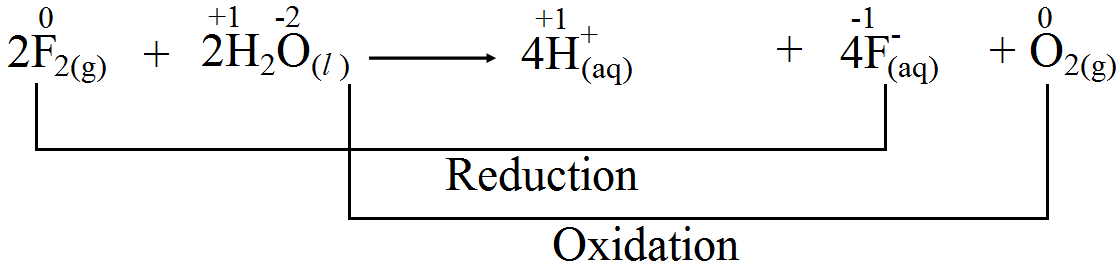
The reaction between fluorine and water can be represented as,
$2\text{F}_2(\text{g})+2\text{H}_2\text{O}_{(\text{l})}\xrightarrow{\ \ \ \ \ \ \ \ \ }4\text{H}^+_{\text{(aq)}}+4\text{F}^-_{\text{(aq)}}+\text{O}_{2(\text{g})}$
This is an example of a redox reaction as water is getting oxidized to oxygen, while fluorine is being reduced to fluoride ion.
The oxidation numbers of various species can be represented as,

Fluorine is reduced from zero to (-1) oxidation state. A decrease in oxidation state indicates the reduction of fluorine.
Water is oxidized from (-2) to zero oxidation state. An increase in oxidation state indicates oxidation of water.
View full question & answer
Question 75 Marks
Do you expect the carbon hydrides of the type $(C_nH_{2n + 2})$ to act as ‘Lewis’ acid or base? Justify your answer.
Answer
For carbon hydrides of type $C_nH_{2n + 2}$, the following hydrides are possible for,
$n = 1 \Rightarrow CH_4$
$n = 2 \Rightarrow C_2H_6$
$n = 3 \Rightarrow C_3H_{8}$
: ............. :
For a hydride to act as a Lewis acid i.e., electron accepting, it should be electron-deficient. Also, for it to act as a Lewis base i.e., electron donating, it should be electron-rich.
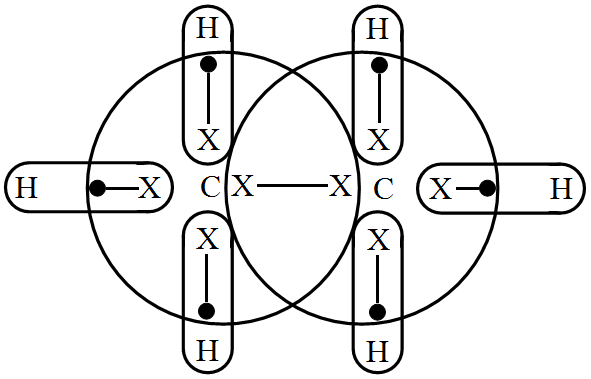
Taking $C_2H_6$ as an example, the total number of electrons are 14 and the total covalent bonds are seven.
Hence, the bonds are regular $2e^--2$ centered bonds.

Hence, hydride $C_2H_6$ has sufficient electrons to be represented by a conventional Lewis structure. Therefore, it is an electron-precise hydride, having all atoms with complete octets. Thus, it can neither donate nor accept electrons to act as a Lewis acid or Lewis base.
View full question & answer
Question 85 Marks
Saline hydrides are known to react with water violently producing fire. $\mathrm{Can} \mathrm{~CO}_2$, a well known fire extinguisher, be used in this case? Explain.
Answer
Saline hydrides (i.e., NaH, LiH, etc.) react with water to form a base and hydrogen gas. The chemical equation used to represent the reaction can be written as,
$\mathrm{MH}_{\mathrm{s}}+\mathrm{H}_2 \mathrm{O}_{\mathrm{eq}} \longrightarrow \mathrm{MOH}_{\mathrm{eq}}+\mathrm{H}_{2(\mathrm{~g})}$
The reaction is violent and produces fire. $\mathrm{CO}_2$ is heavier than dioxygen. It is used as a fire extinguisher because it covers the fire as a blanket and inhibits the supply of dioxygen, thereby dousing the fire. $\mathrm{CO}_2$ can be used in the present case as well. It is heavier than dihydrogen and will be effective in isolating the burning surface from dihydrogen and dioxygen.
View full question & answer
Question 95 Marks
What do you understand by the term “non-stoichiometric hydrides”? Do you expect this type of the hydrides to be formed by alkali metals? Justify your answer.
Answer
Hydrides of d-block (Group No. 3, 4, 5 and 6) and f-block are metallic or interstitial hydrides because in these hydrides, hydrogen occupies some interstitial sites in the metal lattice producing distortion. These hydrides are also called non-stoichiometric hydrides as, the law of constant composition does not hold good for them, e.g., $\mathrm{LaH}_{2.87} , \mathrm{YbH}_{2.55}, \mathrm{TiH}_{1.5-1.8}, \mathrm{ZrH}_{1.3-1.75}, \mathrm{vH}_{0.56}, \mathrm{NiH}_{0.6-0.7}, \mathrm{PdH}_{0.6-0.8}$ etc. Alkali metals do not form these types of hydrides transfer of electrons so, alkali metal and H atom are in fixed stoichiometric ratio.
View full question & answer
Question 105 Marks
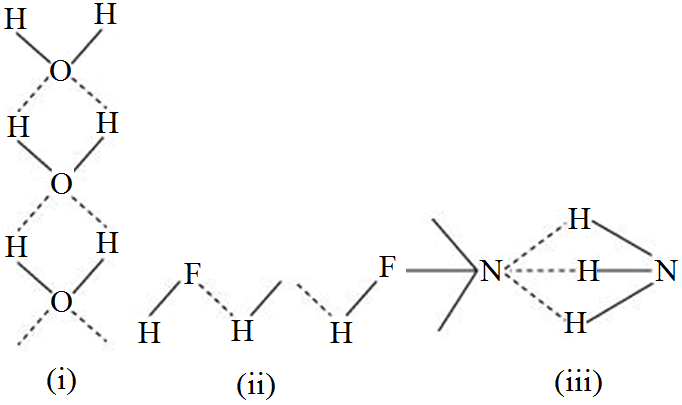
Among $\mathrm{NH}_3, \mathrm{H}_2 \mathrm{O}$ and HF , which would you expect to have highest magnitude of hydrogen bonding and why?
Answer
The extent of hydrogen bonding depends upon electronegativity and the number of hydrogen atoms available for bonding. Among nitrogen, fluorine, and oxygen, the increasing order of their electronegativities are $\mathrm{N}<\mathrm{O}<\mathrm{F}$.
Hence, the expected order of the extent of hydrogen bonding is $\mathrm{HF}>\mathrm{H}_2 \mathrm{O}>\mathrm{NH}_3$.
But, the actual order is $\mathrm{H}_2 \mathrm{O}>\mathrm{HF}>\mathrm{NH}_3$.
Although fluorine is more electronegative than oxygen, the extent of hydrogen bonding is higher in water. There is a shortage of hydrogens in HF, whereas there are exactly the right numbers of hydrogens in water. As a result, only straight chain bonding takes place. On the other hand, oxygen forms a huge ring-like structure through its high ability of hydrogen bonding.
In case of ammonia, the extent of hydrogen bonding is limited because nitrogen has only one lone pair. Therefore, it cannot satisfy all hydrogens.
View full question & answer
Question 115 Marks
Write chemical reactions to show the amphoteric nature of water.
Answer
The amphoteric nature of water can be described on the basis of the following reactions,
  1. Reaction with $H_2S$:
The reaction takes place as,

$\text{H}_2(\text{O})_{\text{(l)}}\ \ \ + \ \ \ \text{H}_2\text{S}_{\text{(aq)}}\ \ \ \ \rightleftharpoons\ \ \ \ \ \ \text{H}_3\text{O}^+_{\text{aq}}\ \ \ \ \ \ \ \ \ \ \ +\ \ \ \ \ \ \ \ \ \text{HS}^-_{\text{(aq)}}\\ \ \text{Base}\ \ \ \ \ \ \ \ \ \ \ \ \ \ \ \ \ \text{Acid}\ \ \ \ \ \ \ \ \ \ \ \ \ \ \text{conjugate acid}\ \ \ \ \ \ \ \ \ \ \ \ \text{conjugate base}$

In the forward reaction $H_2O_{(l)}$ denotes its proton to $NH_{3(aq)}$. Hence, it acts as a Lewis base.
  1. Reaction with $NH_3$:
The reaction takes place as,


In the forward reaction, $H_2O_{(l)}$ denotes its proton to $NH_{3(aq)}$. Hence, it acts as a Lewis acid.
  1. Self-ionization of water:
In the reaction, two water molecules react as,

View full question & answer
Question 125 Marks
Do you expect different products in solution when aluminium (III) chloride and potassium chloride treated separately with:
  1. Normal water.
  2. Acidified water, and
  3. Alkaline water? Write equations wherever necessary.
Answer
  1. In normal water,
$\text{AlCl}_3+3\text{H}_2\text{O}\xrightarrow{\ \ \ \ \ \ \ \ \ \ \ \ \ \ \ }\text{Al(OH)}_3+3\text{HCl}$

KCl will dissolve in water and ions will get hydrated.
  1. KCl will be unaffected in acidified water. While in acidic water $\mathrm{H}^{+}$ion react with $\mathrm{Al}(\mathrm{OH})_3$ to form $\mathrm{Al}^{3+}(\mathrm{aq})$ ions and $\mathrm{H}_2 \mathrm{O}$. Thus in acidic water $\mathrm{AlCl}_3$ existes as $\mathrm{Al}^{3+}(\mathrm{aq})$ and $\mathrm{Cl}^{-}(\mathrm{aq})$ ions,
$\text{AlCl}_3(\text{s})\xrightarrow{\ \ \ \ \ \ {\text{Acidified}} \ \ \ \ \ \ \ \ }\text{Al}^{3+}(\text{aq})+3\text{Cl}^-(\text{aq})$
  1. In alkaline water since the aqueous solution of $KCl$ is neutral therefore, it is unaffected.
$Al(OH)_3$ reacts to form soluble tetrahydroxoaluminate complex or meta-aluminate.

$\text{AlCl}_3(\text{s})\xrightarrow{\ \ \ \ \ \ {\text{Alkaline}\\ \text{ water}} \ \ \ \ \ \ \ \ }\text{Al}^+\big[(\text{OH})_4\big]^-+3\text{Cl}^-\text{OH}^-\\ \ \ \ \ \ \ \ \ \ \ \ \ \ \ \ \ \ \ \ \ \ \ \ \ \ \ \ \ \ \ \ \ \ \ \ \ \ \ \ \ \ \ \ \ \ \ \ \ \ \ \downarrow\\ \ \ \ \ \ \ \ \ \ \ \ \ \ \ \ \ \ \ \ \ \ \ \ \ \ \ \ \ \ \ \ \ \ \ \ \ \ \ \ \text{AlO}_2 ^-(\text{aq) }2\text{H}_2\text{O(l)}+3\text{Cl}^-(\text{aq})$
View full question & answer
Question 135 Marks
Justify the position of hydrogen in the periodic table on the basis of its electronic configuration.
Answer
Hydrogen is the first element of the periodic table. Its electronic configuration is $[1s^1]$. Due to the presence of only one electron in its $1s$ shell, hydrogen exhibits a dual behavior, i.e., it resembles both alkali metals and halogens.
Resemblance with alkali metals:
  1. Like alkali metals, hydrogen contains one valence electron in its valency shell.
$H : 1s^1$
$Li : [He] 2s^1$
$^{Na : [Ne]3s1}$

:

:

Hence, it can lose one electron to form a unipositive ion.
  1. Like alkali metals, hydrogen combines with electronegative elements to form oxides, halides, and sulphides.
Resemblance with halogens:
Both hydrogen and halogens require one electron to complete their octets.
$H : 1s^1$
$F : 1s^2 2s^2 2p^5$
$Cl : 1s^2 2s^2 2p^6 3s^2 3p^5$
Hence, hydrogen can gain one electron to form a uninegative ion.
Like halogens, it forms a diatomic molecule and several covalent compounds.
Though hydrogen shows some similarity with both alkali metals and halogens, it differs from them on some grounds. Unlike alkali metals, hydrogen does not possess metallic characteristics. On the other hand, it possesses a high ionization enthalpy. Also, it is less reactive than halogens.
Owing to these reasons, hydrogen cannot be placed with alkali metals (group I) or with halogens (group VII). In addition, it was also established that $H^+$ ions cannot exist freely as they are extremely small. $H^+​​​​​​​$​​​​​​​ ions are always associated with other atoms or molecules. Hence, hydrogen is best placed separately in the periodic table.
View full question & answer
Question 145 Marks
Discuss the principle and method of softening of hard water by synthetic ionexchange resins.
Answer
The process of treating permanent hardness of water using synthetic resins is based on the exchange of cations (e.g., $Na^+, Ca^{2+}, Mg^{2+}$ etc) and anions (e.g., $Cl^-, SO_4^{2-}, HCO_3^-$ etc) present in water by $H^+$ and $OH^-$ ions respectively.
Synthetic resins are of two types:
Cation exchange resins.
Anion exchange resins.
Cation exchange resins are large organic molecules that contain the $-SO_3H$ group. The resin is firstly changed to RNa (from $RSO_3H$) by treating it with NaCl. This resin then exchanges $Na^+$ ions with $Ca^{2+}$ and $Mg^{2+}$ ions, thereby making the water soft.
$2\text{RNa}+\text{M}^{2+}_\text{(aq)}\xrightarrow{\ \ \ \ \ \ \ \ \ \ \ \ \ }\text{R}_2\text{M}_{(\text{s})}+2\text{Na}^+_{(\text{aq})}$
There are cation exchange resins in $H^+$ form. The resins exchange $H^+$ ions for $Na^+, Ca^{2+}$, and $Mg^{2+}$ ions.
$2\text{RH}+\text{M}^{+2}_{(\text{aq})}\leftrightarrows\text{ MR}_{2(\text{s})}+2\text{H}^+_{(\text{aq})}$
Anion exchange resins exchange $OH^-$ ions for anions like $Cl^-$,
$\text{RNH}_{2(\text{s})}+\text{H}_2\text{O}_{(\text{l})}\leftrightarrows\text{RNH}_3^+\cdot\text{OH}^-_{(\text{s})}\\\ \ \ \ \ \ \ \ \ \ \ \ \ \ \ \ \ \ \ \ \ \ \ \ \ \ \ \ \ \ \ \ \ \ \ \ \downarrow\ _+\text{X}^-_{\text{aq}}\\ \ \ \ \ \ \ \ \ \ \ \ \ \ \ \ \ \ \ \ \ \ \ \ \ \ \ \ \ \ \ \ \ \ \ \text{RNH} _3^+\cdot\text{X}^-_{\text{(s)}}+\text{OH}^-_{(\text{aq})}$
During the complete process, water first passes through the cation exchange process. The water obtained after this process is free from mineral cations and is acidic in nature. This acidic water is then passed through the anion exchange process where $OH^–$​​​​​​​ ions neutralize the $H^+$​​​​​​​ ions and de-ionize the water obtained.
View full question & answer
Question 155 Marks
What do you expect the nature of hydrides is, if formed by elements of atomic numbers $15, 19, 23$ and $44$ with dihydrogen? Compare their behaviour towards water.
Answer
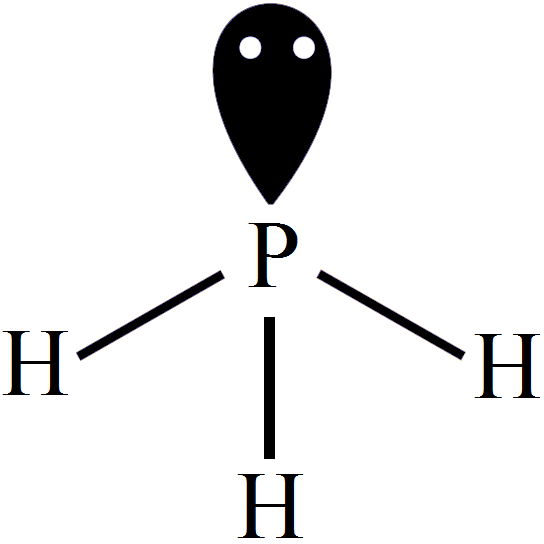
  1. Hydride of phosphorus: Hydride of nitrogen ($PH_3$) is a covalent molecule. It is an electron-rich hydride owing to the presence of excess electrons as a lone pair on phosphorus.
  1. Hydride of potassium: Dihydrogen forms an ionic hydride with potassium owing to the high electropositive nature of potassium. It is crystalline and non-volatile in nature.
  2. Hydrides of Vanadium and Ruthenium: Both vanadium and ruthenium belong to the d–block of the periodic table. The metals of d–block form metallic or non–stoichiometric hydrides. Hydrides of vanadium and ruthenium are therefore, metallic in nature having a deficiency of hydrogen.
  3. Behaviour of hydrides towards water: Potassium hydride reacts violently with water as:
$\text{KH}_{(\text{s})}+\text{H}_2\text{O}_{(\text{aq})}\xrightarrow{\ \ \ \ \ \ \ \ \ \ \ \ \ \ }\text{KOH}_{(\text{aq})}+\text{H}_{2\text{(g})}$
Phosphorus ($PH_3​​​​​​​$) is covalent hydride and slightly soluble in water. Hydrides of vanadium and Ruthenium do not react with water. Hence, the increasing order of reactivity of the hydrides is $(V, Ru) H < NH_3< KH$.
View full question & answer
Question 165 Marks
What do you understand by the term “non-stoichiometric hydrides”? Do you expect this type of the hydrides to be formed by alkali metals? Justify your answer.
Answer
Hydrides of d-block (Group No. 3, 4, 5 and 6) and f-block are metallic or interstitial hydrides because in these hydrides, hydrogen occupies some interstitial sites in the metal lattice producing distortion. These hydrides are also called non-stoichiometric hydrides as, the law of constant composition does not hold good for them, e.g., $\mathrm{LaH}_{2.87}, \mathrm{YbH}_{2.55}, \mathrm{TiH}_{1.5-1.8}, \mathrm{ZrH}_{1.3-1.75}, \mathrm{vH}_{0.56}, \mathrm{NiH}_{0.6-0.7}, \mathrm{PdH}_{0.6-0.8}$ etc. Alkali metals do not form these types of hydrides because alkali metals donate lone pair of electrons to hydrogen which forms $\mathrm{H}^{-}$ion. As $\mathrm{H}^{-}$ion is formed by complete transfer of electrons so, alkali metal and H atom are in fixed stoichiometric ratio.
View full question & answer
Question 175 Marks
How can $\text{D}_2\text{O}$ be prepared from water? Mention the physical properties in which $\text{D}_2\text{O}$ differs from $\text{H}_2\text{O}$. Give at least three reactions of $\text{D}_2\text{O}$ showing the exchange of hydrogen with deuterium.
Answer
For preparation of heavy water, there is exhaustive distillation of ordinary water. It is a multistep distillation process. Physical properties
 
 
$\text{H}_2\text{O}$
$\text{D}_2\text{O}$
1.
Boiling point
373k
374.42k
2.
Melting point
273k
276.82k
3.
Mol. mass
18.016
20.03
Exchange reactions.
$\text{NaOH}+\text{D}_2\text{O}\leftrightharpoons\text{NaOD}+\text{HDO}$
$\text{HCl}+\text{D}_2\text{O}\leftrightharpoons\text{DCl}+\text{HDO}$
$\text{NH}_4\text{Cl}+4\text{D}_2\text{O}\leftrightharpoons\text{ND}_4\text{Cl}+4\text{HDO}$
View full question & answer
Question 185 Marks
How is dihydrogen obtained from:
  1. dilute sulphuric acid.
  2. sodium hydroxide and.
  3. water.
Explain by giving equations.
Answer
  1. When metal reacts with dilute sulphuric acid, hydrogen is obtained along with metal salts.
$\text{Mg}(\text{s})+\text{H}_2\text{SO}_4(\text{aq})\xrightarrow{\ \ \ \ \ \ \ \ \ \ }\text{MgSO}_4(\text{aq})+\text{H}_2(\text{g})$
  1. When zinc reacts with sodium hydroxide, sodium zincate is formed and hydrogen gas is evolved.
$\text{Zn}(\text{s})+2\text{NaOH}(\text{aq})\xrightarrow{\ \ \ \ \ \ \ \ \ }\text{Na}_2\text{OH}_2(\text{aq})+(\text{g)}$
  1. When acidified water is electrolysed using platinum electrodes, hydrogen gas is evolved at cathode.
$\text{H}_2\text{O}\xrightarrow{\ \ \ \ \ \ }\text{H}^+(\text{aq})+\text{OH}^-(\text{aq})$
At cathode $2\text{H}^++2\text{e}^-\xrightarrow{\ \ \ \ \ \ \ \ }2\text{H}\xrightarrow{\ \ \ \ \ \ \ }\text{H}_2$
At anode $4\text{OH}^-\xrightarrow{\ \ \ \ \ \ \ }4\text{OH}+4\text{e}^-\xrightarrow{\ \ \ \ \ }2\text{H}_2\text{O}+\text{O}_2$
View full question & answer
Question 195 Marks
Rohan heard that instructions were given to the laboratory attendant to store a particular chemical, i.e., keep it in the dark room, add some urea in it, and keep it away from dust. This chemical acts as an oxidizing as well as a reducing agent in both acidic and alkaline media. This chemical is important for use in the pollution control treatment of domestic and industrial effluents.
  1. Write the name of this compound.
  2. Explain why such precautions are taken for storing this chemical.
Answer
1. The name of the compound is $\mathrm{H}_2 \mathrm{O}_2$. It acts as an oxidizing as well as reducing agent in both acidic and basic media.
2. $\mathrm{H}_2 \mathrm{O}_2$ is decomposed by light and dust particles. Urea is added as a negative catalyst, i.e., to check its decomposition.
$2 \mathrm{H}_2 \mathrm{O}_2(1) \rightarrow 2 \mathrm{H}_2 \mathrm{O}(1)+\mathrm{O}_2(\mathrm{~g})$
Because of the oxidizing properties, $\mathrm{H}_2 \mathrm{O}_2$ is widely used to control pollution by oxidation of harmful cyanides and obnoxious smelling sulphides present in domestic and industrial effluents.
It also helps in sewage disposal by supplying $\mathrm{O}_2$ for oxidation of organic matter present - in sewage waters.
View full question & answer
Question 205 Marks
How can production of hydrogen from water gas be increased by using water gas shift reaction?
Answer
Water gas is produced when super heated steam is passed over red hot coke or coal at 1270K in the presence of nickel as catalyst.
$\text{C(s)}+\text{H}_2\text{O(g)}\xrightarrow{\ \ \ \ \ \ \ \ \ \ }\underbrace{\text{CO(g)}+\text{H}_2\text{(g)}}-121.3\text{kj}\\\ \ \ \ \ \ \ \ \ \ \ \ \ \ \text{Steam}\ \ \ \ \ \ \ \ \ \ \ \ \ \ \ \ \ \text{Water gas}\ \ \ \ \ \ \ \ \ \ \ \ $
Pure $H_2$ from water gas cannot be obtained easily because it is difficult to remove CO. Therefore, to increase the production of $H_2$ from water gas, $CO$ is oxidized to $CO_2$ by mixing it with more steam and passing the mixture over heated $FeCrO_4$ catalyst at 673 K.
$\underbrace{\text{H}_2+\text{CO}}+\text{H}_2\text{O}\xrightarrow[\text{FeCrO}_4]{673\text{k}}\text{CO}_2+2\text{H}_2\\\text{Water gas}\ \ \ \ \ \ \ \ \ \ \ \ \ \ \ \ \ \ \ \ \ \ \ \ \ \ \ \ \ \ \ \ \ \ \ \ \ \ \ \ \ \ \ \ $
The $CO_2$ produced is removed by scrubbing with sodium arsenite solution.
View full question & answer
Question 215 Marks
Give reasons why hydrogen resembles alkali metals?
Answer
Hydrogen resembles alkali metals, like Na, because of their similarity in electronic configuration. Both of them have 1 valence electron.
One more interesting fact that Hydrogen also resembles the elements of Group 17, that are halogens, because they can gain 1 electron and achieve noble gas configuration.
That is why position of Hydrogen is always a controversial point.
In modern periodic table the hydrogen is placed in group 1 but it is not attached to the other elements of that group.
See the periodic table in our NCERT book.
Hydrogen is not attached to other group 1 elements.
View full question & answer
Question 225 Marks
What do you understand by the term ‘auto-protolysis of water? What is its significance?
Answer
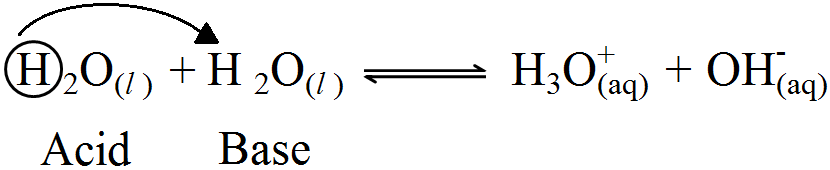
Auto-protolysis of water. Auto-protolysis of water means its self-ionisation. Self-ionisation of water can be represented as:
$\text{H}_2\text{O(l)}\ \ \ +\ \ \ \ \text{H}_2\text{O(1)}\ \ {\leftrightharpoons}\ \ \ \text{H}_3\text{O}^+\ +\ \text{OH}^-\text{(aq)}\\\ \ \text{Acid}_1\ \ \ \ \ \ \ \ \ \ \ \ \text{Base}_2\ \ \ \ \ \ \ \ \ \ \ \ \ \text{Asid}_2\ \ \ \ \ \ \ \ \text{Base}_1$
The significance of auto-protolysis. Water shows its amphoteric nature due to autoprotolysis i.e. water reacts with both acids and bases.
Water acting as an acid:
$\text{H}_2\text{O(l)}\ \ \ +\ \ \ \text{NH}_3\text{(aq)}\xrightarrow{\ \ \ \ \ \ }\text{N}^+\text{H}_4\text{(aq)}\ \ \ +\ \ \ \text{OH}^-\text{(aq)}\\\text{Acid}_1\ \ \ \ \ \ \ \ \ \ \ \ \ \ \text{Base}_2\ \ \ \ \ \ \ \ \ \ \ \ \ \text{Acid}_1\ \ \ \ \ \ \ \ \ \ \ \ \ \ \ \ \ \ \ \text{Base}_2$
Water acting as a base:
$\text{H}_2\text{(l)}\ \ \ +\ \ \ \text{CH}_3\text{COOH(aq)}\xrightarrow{\ \ \ \ \ \ \ \ \ }\text{H}_3\text{O}^+\text{(l)}\ \ \ +\ \ \ \text{CH}_3\text{COO}^-\text{(aq)}\\\text{Base}_1\ \ \ \ \ \ \ \ \ \ \ \ \ \ \text{Acid}_2\ \ \ \ \ \ \ \ \ \ \ \ \ \ \ \ \ \ \ \ \ \ \ \text{Acid}_1\ \ \ \ \ \ \ \ \ \ \ \ \ \ \ \ \ \ \ \text{Base}_2$
View full question & answer
Question 235 Marks
Give reasons:
Lakes freeze from top towards bottom.
Answer
During severe winter, the temperature of water in the lake keeps on decreasing. Since cold water is heavier, it keeps on going into the interior of the lake while warm water keeps on coming to the surface of the lake. This process continues till the temperature of entire water of lakes becomes 4°C. Since density of water is maximum at 277K, any further decrease in the temperature will decrease its density. As a result, the temperature of the surface water keeps on decreasing and it ultimately freezes. Now, any further decrease in the temperature will decrease the temperature of water below 4°C. This process continues and as a result, the lakes keep on freezing from top to bottom.
View full question & answer
Question 245 Marks
Calculate the strength of $5$ volume $H_2O_2$.
Answer
5 volume $H_2O_2$ solution means that 1 L of 5 volume $H_2O_2$ on decomposition gives $5L$ of $O_2$ at NTP.
$\text{H}_2\text{O}_2\ \ \ \xrightarrow{\ \ \ \ \ \ \ \ }\ \ \ 2\text{H}_2\text{O}\ \ +\ \ \text{O}_2\\68\text{g}\ \ \ \ \ \ \ \ \ \ \ \ \ \ \ \ \ \ \ \ 22.4\text{L at NTP}$
22.4 L of $\mathrm{O}_2$ at NTP is produced from $\mathrm{H}_2 \mathrm{O}_2=68 \mathrm{~g}$
5 L of $\mathrm{O}_2$ at NTP is produced from $\mathrm{H}_2 \mathrm{O}_2=\frac{68}{22.4} \times 5=15.18 \mathrm{~g}$
But 5 L of $\mathrm{O}_2$ at NTP is produced from 1 L of 5 volume $\mathrm{H}_2 \mathrm{O}_2$
Strength of $\mathrm{H}_2 \mathrm{O}_2$ in 5 volume $\mathrm{H}_2 \mathrm{O}_2=15.18 \mathrm{~g} / \mathrm{L}$
Percentage strength of H2O2 solution $=\frac{15.18}{1000} \times 100=1.518 \%$
View full question & answer
Question 255 Marks
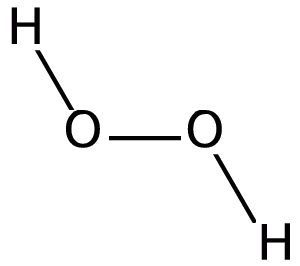
A colourless liquid ‘A’ contains H and O elements only. It decomposes slowly on exposure to light. It is stabilised by mixing urea to store in the presence of light.
  1. Suggest possible structure of A.
  2. Write chemical equations for its decomposition reaction in light.
Answer
  1. The compound is $H_2O_2$ Its structure is
  1. Decomposition by light
$2H_2O_2→ 2H_2O + O_2$​​​​​​​
View full question & answer
Question 265 Marks
Why does water show high boiling point as compared to hydrogen sulphide? Give reasons for your answer.
Answer
In water $\mathrm{H}_2 \mathrm{O}$ there is electrostatic attraction between partially positive hydrogen of one atom with partial negative oxygen (highly electronegative) of another atom which produces dipole-dipole interactions resulting hydrogen bonding. As these hydrogen bonds are strong in water, it requires high energy to break the bonds with high boiling point of 373 K .
While in hydrogen sulphide $\mathrm{H}_2 \mathrm{S}$, even though there are intermolecular forces of attraction between atoms, hydrogen bonding is not present. Hence the $\mathrm{H}_2 \mathrm{S}$ requires less energy to break the bonds with low boiling point of 213 K .
View full question & answer
Question 275 Marks
  1. Why is hydrated barium peroxide used in the preparation of hydrogen peroxide instead of anhydrous barium peroxide?
  2. Phosphoric acid is preferred over sulphuric acid in preparing hydrogen peroxide from peroxides. Why?
  3. Hydrogen peroxide acts both as an oxidising agent as well as a reducing agent in alkaline solution towards certain first row transition metal ions. Illustrate both these properties of $H_2O_2$ using chemical equations.
Answer
  1. Anhydrous $BaO_2$ is not used because the $BaSO_4$ formed during the reaction forms a protective layer around unreacted $BaO_2$ and the reaction stops after sometime.
  2. $H_2SO_4$ acts as a catalyst for decomposition of $H_2O_2$. Therefore, some weaker acids such as $H_3PO_4$, $H_2CO_3$ are preferred over $H_2SO_4$ for preparing $H_2O_2$ from peroxides.
  3. Oxidising agent,
$2\text{Cr}(\text{OH})_3+4\text{NaOH}+3\text{H}_2\text{O}_2\xrightarrow{\ \ \ \ \ \ \ \ \ }\\2\text{Na}_2\text{CrO}_4+8\text{H}_2\text{O}$

Here, $Cr^{3+}$ gets oxidised to $Cr^{6+}$.

Reducing agent,

$2\text{K}_3[\text{Fe(CN)}_6]+2\text{KOH}+\text{H}_2\text{O}_2\xrightarrow{\ \ \ \ \ \ \ \ \ }\\2\text{K}_4[\text{Fe(CN)}_6]+2\text{H}_2\text{O}+\text{O}_2$

Here, $Fe^{3+}$ gets reduced to $Fe^{2+}$​​​​​​​.
View full question & answer
Question 285 Marks
An acidic solution of hydrogen peroxide behaves as an oxidising as well as reducing agent. Illustrate it with the help of a chemical equation.
Answer
Hydrogen peroxide, $H_2O_2$ acts as an oxidizing as well as a reducing agent in both acidic and alkaline media. Reactions involving oxidizing actions are:
  1. $\text{Fe}^{2+}+2\text{H}^++\text{H}_2\text{O}_2\xrightarrow{\ \ \ \ \ \ }2\text{Fe}^{3+}+2\text{H}_2\text{O}$
  2. $\text{Mn}^{2+}+\text{H}_2\text{O}_2\xrightarrow{\ \ \ \ \ \ }\text{Mn}^{4+}+2\text{OH}^-$
  3. $\text{pbS}+4\text{H}_2\text{O}_2\xrightarrow{\ \ \ \ \ \ \ \ }\text{pbSO}_4+4\text{H}_2\text{O}$
  4. $2\text{Fe}^{2+}+\text{H}_2\text{O}_2\xrightarrow{\ \ \ \ \ }2\text{Fe}^{3+}+2\text{OH}^-$
Reactions involving reduction actions are:
  1. $2\text{MnO}^-_4+6\text{H}^++5\text{H}_2\text{O}_2\xrightarrow{\ \ \ \ \ \ \ }2\text{Mn}^{2+}+8\text{H}_2\text{O}+5\text{O}_2$
  2. $\text{I}_2+\text{H}_2\text{O}_2+2\text{OH}^-\xrightarrow{\ \ \ \ \ \ \ \ }2\text{I}^-+2\text{H}_2\text{O}+\text{O}_2$
  3. $\text{HOCl}+ \text{H}_2\text{O}_2\xrightarrow{\ \ \ \ \ \ }\text{H}_3\text{O}^++\text{Cl}^-+\text{O}_2$
  4. $2\text{MnO}^-_4+3\text{H}_2\text{O}_2\xrightarrow{\ \ \ \ \ \ \ \ }2\text{MnO}_{2}+3\text{O}_2+2\text{H}_2\text{O}+2\text{OH}^-$
View full question & answer
Question 295 Marks
Molecular hydrides are classified as electron deficient, electron precise and electron rich compounds. Explain each type with two examples.
Answer
Covalent or molecular hydrides are classified into three categories: Electron deficient hydrides: These hydrides do not have sufficient number of electrons to form normal covalent bonds. Examples are the hydrides of group 13 such as $B_2H_6, (AlH_3)_n$ etc. Electron precise hydrides: These have exact number of electrons to form normal covalent bonds. Examples are the hydrides of group 14 such as $CH_4, SiH_4$, etc. Electron rich hydrides: These have more number of electrons than normal covalent bonds. The excess electrons are present in the form of lone pairs. Examples are the hydrides of group 15, 16 and 17 such as,
View full question & answer
Question 305 Marks
Calculate the volume strength of a $3\%$ solution of $H_2O_2$.
Answer
100mL of $H_2O_2$ solution contains $H_2O_2 = 3 g$
$\therefore$ 1000mL of $H_2O_2$ solution will contains
$\text{H}_2\text{O}_2=\frac{3}{100}\times1000=30\text{g}$
Consider the chemical equation,
$2\text{H}_2\text{O}_2\xrightarrow{\ \ \ \ \ \ \ \ \ \ \ \ \ \ \ \ \ \ }2\text{H}_2\text{O}+\text{O}_2\\2\times34=68\text{g} \ \ \ 22.7\text{L}\text{ at }\text{NTP}$
Now 68 g of $\mathrm{H}_2 \mathrm{O}_2$ gives $\mathrm{O}_2$ at NTP $=22.7 \mathrm{~L}$
$\therefore 30 \mathrm{~g}$ of $\mathrm{H}_2 \mathrm{O}_2$ will give $\mathrm{O}_2$ at $\mathrm{NTP}=\frac{22.7}{68} \times 30=10.014$
But 30 g of H 2 O , are present in 1000 mL of $\mathrm{H}_2 \mathrm{O}_2$.
Hence, 1000 mL of $\mathrm{H}_2 \mathrm{O}_2$ solution gives $\mathrm{O}_2$ at NTP $=1.0014 \mathrm{ml}$
$\therefore 1 \mathrm{ml}$ of $\mathrm{H}_2 \mathrm{O}_2$ solution will give $\mathrm{O}_2$ at NTP
$=\frac{10014}{1000}=10.01 \mathrm{~mL}$
Hence, the volume strength of $3 \% ~\mathrm{H}_2 \mathrm{O}_2$ solution= $=10.01$
View full question & answer
Question 315 Marks
  1. Name the element which forms maximum number of compound.
  2. How is nascent hydrogen prepared?
  3. What is ratio of $\frac{\text{C}_\text{P}}{\text{C}_\text{V}}$ for hydrogen andwhy?
  4. What is half life of tritium? How is it obtained?
  5. If we electrolyse 2000 litres of $H_2O_2$ how much heavy water will be formed?
Answer
  1. Hydrogen forms maximum number of compounds.
  2. It is produced by reaction of Zn-Cu with $H_2O$ or Na and ethyl alcohol.
$2\text{Zn}+\text{H}_2\text{O}\xrightarrow{\ \ \ \ \ \ \ \ \ \ }\text{ZnO}+2[\text{H}]$

$2\text{C}_2\text{H}_5\text{Oh}+2\text{Na}\xrightarrow{\ \ \ \ \ \ \ \ \ \ }2\text{C}_2\text{H}_5\text{ONa}+2[\text{H}]$
  1. $\frac{\text{C}_\text{P}}{\text{C}_\text{V}}=1.40$ brcause $H_2$ is diatomic.
  2. It is 12.33 year
$^6_3\text{Li}+\ ^1_0\text{n}\xrightarrow{\ \ \ \ \ \ \ \ \ \ }\ ^4_2\text{He}+\ ^1_1\text{H}$

It is formed by bombarding $^6_3\text{Li}$ with neutron.
  1. 70ml of 99% heavy water is formed by electrolysis of 2000 litres of water because $H_2O$ contains 0.016% deuterium.
View full question & answer
Question 325 Marks
  1. Balance and complete the following reactions:
  1. $\text{Fe(s)}+\text{H}_2\text{O}\xrightarrow{\ \ \ \ \ \ \ \ }$
  2. $\text{Zn(s)}+\text{NaOH}(\text{aq})\xrightarrow{\ \ \ \ \ \ \ \ \ \ }$
  3. $\text{Mg(s)}+\text{HNO}_3(\text{aq})\xrightarrow{\ \ \ \ \ \ \ \ \ }$
(b) Write chemical equations for the following:
(1) $H_2O_2$, as an oxidising agent in acidic medium.
(ii) $H_2O_2$ as an reducing agent in basic medium.
(iii) $H_2O_2$ as an reducing agent in basic medium.
(iv) $H_2O_2$ as an reducing agent in acidic medium.
Answer
  1.  
  1. $3\text{Fe}(\text{s})+4\text{H}_2\text{O}_2(\text{g})\rightleftarrows\text{Fe}_3\text{O}_4(\text{s})+4\text{H}_2\text{O}(\text{s})$
  2. $\text{Zn}(\text{s})+2\text{NaOH}(\text{aq})\\\xrightarrow{\ \ \ \ \ \ \ \ \ \ }\text{Na}_2\text{ZnO}_2(\text{aq})+\text{H}_2(\text{g})$
  3. $\text{Mg}(\text{s})+2\text{HNO}_3\\\xrightarrow{\ \ \ \ \ \ \ \ \ }\text{Mg}^{2+}(\text{aq})+2\text{NO}^-_3(\text{aq})+\text{H}_2(\text{g})$
  1.  

  1. $2\text{Kl}(\text{aq})+\text{H}_2\text{SO}_4(\text{aq})+\text{H}_2\text{O}_2(\text{aq})\\\xrightarrow{\ \ \ \ \ \ \ \ \ \ } \text{K}_2\text{SO}_4(\text{aq})+2\text{H}_2\text{O}(\text{s)}+\text{l}_2(\text{g})$
  2. $2\text{FeCl}_3(\text{aq})+\text{H}_2\text{O}_2(\text{aq})+2\text{NaOH}(\text{aq})\\\xrightarrow{\ \ \ \ \ \ \ \ \ \ }2\text{FeCl}_2(\text{aq})+2\text{H}_2\text{O}(\text{l})+\text{O}_2(\text{g})+2\text{NaCl}(\text{aq})$
  3. $\text{Mn}^{2+}(\text{aq})+\text{H}_2\text{O}_2(\text{aq})\\\xrightarrow{\ \ \ \ \ \ \ \ \ \ }\text{Mn}^{4+}(\text{aq})+2\text{OH}^-(\text{aq})$
  4. $2\text{KMnO}_4(\text{aq})+3\text{H}_2\text{SO}_4(\text{aq})+5\text{H}_2\text{O}_2(\text{aq})\\\\\xrightarrow{\ \ \ \ \ \ \ \ \ }\text{K}_2\text{SO}_4(\text{aq})+2\text{MnSO}_4(\text{aq})+8\text{H}_2\text{O}(\text{l})+5\text{O}_2(\text{g})$
View full question & answer
Question 335 Marks
  1. How would you prepare dihydrogen from water by using a reducing agent?
  2. How would you prepare dihydrogen from a substance other than water?
  3. How would you prepare very pure dihydrogen in the laboratory?
Answer
  1. Sodium metal is a good reducing agent. It reduces water to hydrogen (or dihydrogen).
$2\text{H}_2\text{O}+2\text{Na}\xrightarrow{\ \ \ \ \ \\ \ \ }2\text{NaOH}+\text{H}_2(\text{g)}$
  1. Dihydrogen can be obtained by treating zinc with dilute.
$\text{HCl}\text{ Zn}(\text{s})+2\text{HCl}(\text{aq})\rightarrow\text{ZnCl}_2(\text{aq})+\text{H}_2(\text{g})$
  1. Highly pure dihydrogen (hydrogen gas) can be prepared by the following methods.
  1. Fairly pure hydrogen can be obtained by treating pure magnesium or pure aluminium with chemically pure $H_2SO_4$ or HCl diluted with distilled water. The gas is passed over $P_2O_5$ and is collected by the displacement of mercury.
$\text{Mg}(\text{g})+\text{H}_2\text{SO}_4(\text{aq})\xrightarrow{\ \ \ \ \ \ \ \ \ }\text{MgSO}_4(\text{aq})+\text{H}_4(\text{g})$
  1. Highly pure hydrogen gas can be obtained by electrolysing a warm solution of $Ba(OH)_2​​​​​​​$​​​​​​​ in a U-tube using nickel electrodes. The gas is purified by passing it over heated platinum gauze when traces of oxygen combine with hydrogen forming water.
The gas is then dried by passing it over caustic potash sticks and phophorus pentoxide. Hydrogen is finally adsorbed in palladium and the impurities remain unadsorbed. On heating palladium under reduced pressure, pure hydrogen is liberated.
View full question & answer
Question 345 Marks
What are metallic/ interstitial hydrides? How do they differ from molecular hydrides?
Answer
Metallic hydrides are formed by d- and f-block elements.
Their hydrides conduct heat and electricity.
They are non-stoichiometric, being deficient in hydrogen.
For example, $\mathrm{LaH}_{2.87}, \mathrm{ybH}_{2.55}$ etc.
Metallic hydrides
Molecular hydrides
(1)
These are formed by el­and f-block elements.
(1)
These are formed by p-block elements and some s-block elements (Be and Mg).
(2)
They conduct electricity.
(2)
They do not conduct electricity.
(3)
They are hard and have metallic luster.
(3)
They are volatile compounds having low melting and boiling points.
View full question & answer
Question 355 Marks
  1. Arrange the following in decreasing order of stability.
$\text{PH}_3,\text{NH}_3,\text{AlH}_3,\text{SbH}_3,\text{BiH_3}$

$\text{CH}_4,\text{H}_2\text{O},\text{NH}_3,\text{HF}$
  1. Which negative catalyst prevent decomposition of $H_2O^2$?
  2. What happens when.
  1. $H_2O_2$ is added to acidified $K_2Cr_2O_7$?
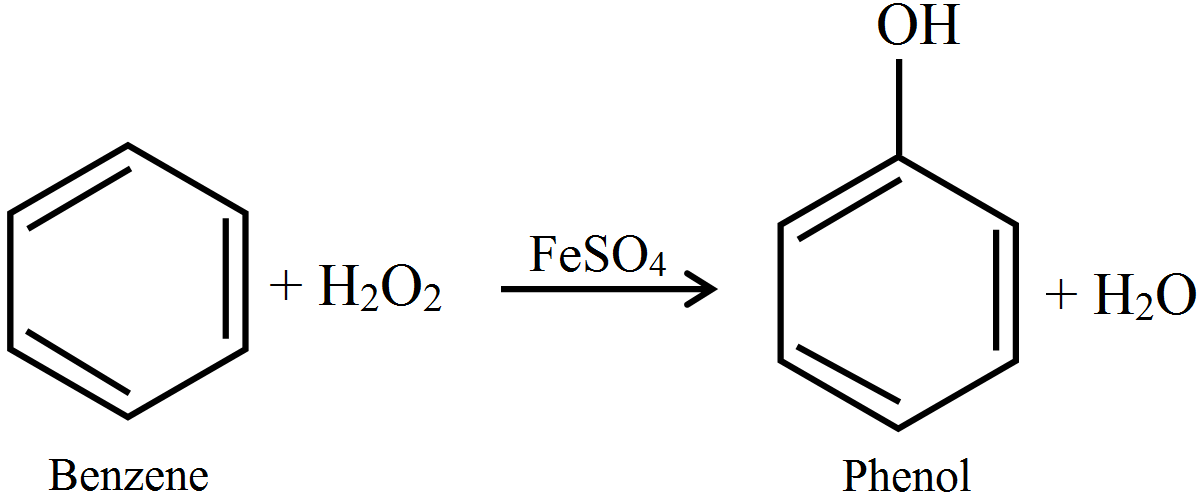
  2. Benzene reacts with $H_2O_2$ in presence of $FeSO_4$ as catalyst.
Write chemical reactions involved.
Answer
  1.  
  1. $NH_3 > PH_3 > AsH_3 > SbH_3 > BiH_3$
As atomic size of central atom increases, stability of hydrides decreases.
  1. $CH_3 NH_3< H_2O < HF$
As atomic size of central atom decreases electronegative increases, stability increase
  1. Acetanilide or phosphoric acid or glycerol prevent decomposition of $H_2O_2$.
  2. Blue coloured chromium peroxide, $CrO_5$ is formed.
  1. $\text{K}_2\text{Cr}_2\text{O}_7+\text{H}_2\text{SO}_4+4\text{H}_2\text{O}\\\xrightarrow{\ \ \ \ \ \ \ \ }2\text{CrO}_5+\text{K}_2\text{SO}_4+5\text{H}_2\text{O}$
  2. Phenol is formed.
View full question & answer
Question 365 Marks
  1. What is the increasing order of the acidity of the compounds, $H_2O, H_2S$ and $H$, Se? Give reason for your answer.
  2. Complete and balance the following chemical equations:
    1. $\text{Na}+\text{D}_2\text{O}\xrightarrow{\ \ \ \ \ \ \ \ \ \ }$
    2. $\text{SO}_3+\text{D}_2\text{O}\xrightarrow{\ \ \ \ \ \ \ \ \ \ \ }$
    3. $\text{Na}_2\text{O}+\text{D}_2\text{O}\xrightarrow{\ \ \ \ \ \ \ \ \ \ }$
Answer
  1. The order of increasing acidity is $H_2O < H_2S < H_2Se$.
Electronegativity of the elements oxygen, sulphur and selenium is in the order O > S > Se and so the X-H bond enthalpy is in the order O - H > SH > Se- H. Lower is the bond enthalpy, smaller would be the proton enthalpy.
  1.  
  1. $2\text{Na}+2\text{D}_2\text{O}\xrightarrow{\ \ \ \ \ \ \ \ \ \ \ \ }2\text{NaOD}+\text{D}_2$
  2. $\text{SO}_3+\text{D}_2\text{O}\xrightarrow{\ \ \ \ \ \ \ }\text{D}_2\text{SO}_4$
  3. $\text{Na}_2\text{O}+\text{D}_2\text{O}\xrightarrow{\ \ \ \ \ \ \ \ }2\text{NaOD}$
View full question & answer
Question 375 Marks
How is heavy water prepared? Compare its physical properties with those of ordinary water.
Answer
  Property $H_2O$ $D_2O$
(1) Molecular mass $(g mol^{-1})$ 18.015 20.027
(ii) Melting point (k) 273.0 276.8
(iii) Boilling point (k) 373.0 374.4
(iv) Density (298k) $g\ cm^{-3}$ 1.0000 1.1059
(v) Enthalpy of vapourisation $(kJ mol^{-1})$ 40.66 41.61
View full question & answer
Question 385 Marks
Discuss briefly de-mineralisation of water by ion exchange resin.
Answer
The distilled water free from all soluble minerals is termed demineralised water.
Demineralisation is done by ion exchange resins which are synthetic substances.
These are of two types:
  1. Cation exchange resins.
  2. Anion exchange resins.
The cation exchange resins are granular insoluble organic acid.
Resins have giant molecules with $-\mathrm{SO}_3 \mathrm{H}$ or COOH groups, while anion exchange resins contain giant organic molecules with basic groups derived from amines.
The hard water is first passed through a bed of cation exchanger which removes the cations like $\mathrm{Na}^{+}, \mathrm{Mg}^{2+}, \mathrm{Ca}^{2+}$ etc., by exchanging with $\mathrm{H}^{+}$ions.
$2 \mathrm{RCOOH}+\mathrm{Ca}^{2+} \rightarrow(\mathrm{RCOO})_2 \mathrm{Ca}+2 \mathrm{H}^{+}$
Resin,
The water coming from cation exchanger is acidic.
This water is then passed through anion exchanger which removes anions like $\mathrm{Cl}^{-}, \mathrm{SO}^{2-}{ }_4, \mathrm{NO}^{-}{ }_3$, etc., by exchanging with $\mathrm{OH}^{-}$ions.
$\mathrm{R}-\mathrm{NH}_3 \mathrm{OH}+\mathrm{Cl}^{-} \rightarrow \mathrm{R}-\mathrm{NH}_3 \mathrm{Cl}+\mathrm{OH}^{-}$
The $\mathrm{OH}^{-}$ions combine with $\mathrm{H}^{+}$ions to form water. $\mathrm{H}^{+}+\mathrm{OH}^{-} \rightarrow \mathrm{H}_2 \mathrm{O}$ this process gives demineralised water.
View full question & answer
Question 395 Marks
Arrange the following:
  1. During Clark's method, name the compound in which 'Mg' is precipated out?
  2. Give the formula of Zeolite used in ion exchange method to remove permanent hardness of water.
  3. Complete the following reaction:
$\text{BaO}_2.8\text{H}_2\text{O}(\text{s})+\text{H}_2\text{SO}_4(\text{aq})\xrightarrow{\ \ \ \ \ \ \ \ \ \ \ \ }$
  1. $H_2O_2$ is miscible with water. Assign reason.
  2. Name the compound which can be used as a hair bleach, mild antiseptic in form of perhydrol, as a rocket propellant in concentrated solution.
Answer
  1. $\text{Mg}(\text{OH})_2$
  2. $\text{NaAlSiO}_4$ (Sodium aluminium silicate)
  3. $\text{BaO}_2.8\text{H}_2\text{O}(\text{s})+\text{H}_2\text{SO}_4(\text{aq})\\\xrightarrow{\ \ \ \ \ \ \ \ \ \ \ \ \ }\text{BaSO}_4(\text{S})+\text{H}_2\text{O}_2(\text{l})+8\text{H}_2\text{O}(\text{l})$
  4. $H_2O_2$ can from H-bonds with water.
$\therefore$ It is miscible with water.
  1. $H_2O_2$​​​​​​​ (Hydrogen peroxide) is used in hair bleach. Its dilute solution acts as antiseptic.
Its concentrated solution acts as rocket propellant.
View full question & answer
Question 405 Marks
i. Name the most abundant isotope of hydrogen.
ii. Name the particles emitted by tritium.
iii. Mixture of CO and $\mathrm{H}_2$ is used for preparation of which compound?
iv. Name the catalyst used in Haber's process for manufacture of $\mathrm{NH}_3(\mathrm{~g})$.
v. Name two electron rich hydrides.
Answer
i. ${ }_1^1 \mathrm{H}$ (Protium)
ii. $\beta$ - paricles
iii. Methanol
iv. Iron
v. $\mathrm{H}_2 \mathrm{O}$ and $\mathrm{PH}_3$.
View full question & answer
Question 415 Marks
Give ion electron equations for the following reactions.
  1. Oxidation of ferrous ions to ferric ions by hydrogen peroxide both in acidic and basic media.
  2. Oxidation of iodide ion to iodine by hydrogen peroxide in acidic medium.
  3. Reduction of acidified potassium dichromate solution.
  4. Oxidation of sulphurous acid to sulphuric acid.
  5. Oxidation of ferrocyanide ions to ferricyanide ions in acidic medium.
Answer
  1.  
  1. In acidic medium
$2\text{Fe}^{2+}(\text{aq})+2\text{H}^+(\text{aq})+\text{H}_2\text{O}_2(\text{aq})\xrightarrow{\ \ \ \ \ \ \ \ \ }\\2\text{Fe}^{3+}(\text{aq})+2\text{H}_2\text{O}(\text{l})$
  1. In basic medium
$2\text{Fe}^{2+}(\text{aq})+\text{H}_2\text{O}_2(\text{aq})\xrightarrow{\ \ \ \ \ }2\text{Fe}^{3+}(\text{aq})+2\text{OH}^-(\text{aq})$
  1. $2\text{I}^-+\text{H}_2\text{O}_2+2\text{H}^+\xrightarrow{\ \ \ \ \ }\text{I}_2+2\text{H}_2\text{O}$
  2. $\text{K}_2\text{Cr}_2\text{O}_7+4\text{H}_2\text{SO}_4\xrightarrow{\ \ \ \ \ }\text{K}_2\text{SO}_4\\+\text{Cr}_2(\text{SO}_4)_3+4\text{H}_2\text{O}+3(\text{O})$
$\frac{[\text{H}_2\text{O+}\text{O}\xrightarrow{\ \ \ \ \ \ \ }\text{H}_2\text{O}+\text{O}_2]\times3}{\text{K}_2\text{Cr}_2\text{O}_7+4\text{H}_2\text{SO}_4+3\text{H}_2\text{O}_2\xrightarrow{\ \ \ \ \ }\text{K}_2\text{SO}_4}\\+\text{Cr}_2(\text{SO}_4)_3+7\text{H}_2\text{O}+3\text{O}_2$
or $\text{Cr}_2\text{O}_7^{2-}+8\text{H}^+3\text{H}_2\text{O}_2\xrightarrow{\ \ \ \ \\ \ \ \ }2\text{Cr}^{3+}+7\text{H}_2\text{O}+3\text{O}_2$
  1. $\text{H}_2\text{O}_2\xrightarrow{\ \ \ \ \ \ \ \ \ }\text{H}_2\text{O}+\text{O}$
$\frac{\text{H}_2\text{SO}_3+\text{O }\xrightarrow{\ \ \ \ \ \ \ \ \ \ \ \ \ \ }\text{ H}_4\text{SO}_4}{\text{H}_2\text{SO}_3+\text{H}_2\text{O}_2\xrightarrow{\ \ \ \ \ \ \ \ \ }\text{H}_2\text{SO}_4+\text{H}_4\text{O}}$
or $\text{SO}^{2-}_3+\text{H}_2\text{O}_2\xrightarrow{\ \ \ \ \ \ \ }\text{SO}_4^{2-}+\text{H}_2\text{O}$
  1. $2\text{K}_4[\text{Fe(CN)}_6]+\text{K}_2\text{SO}_4+2\text{H}_2\text{O}\xrightarrow{\ \ \ \ \ \ \ \ \ \ }\\2\text{K}_3[\text{Fe(CN)}_6]+\text{K}_2\text{SO}_4+2\text{H}_2\text{O}$
View full question & answer