Question 12 Marks
Pick out the only vector quantity in the following list: Temperature, pressure, impulse, time, power, total path length, energy, gravitational potential, coefficient of friction, charge.
AnswerSince, Impulse = change in momentum = force × time. As momentum and force are vector quantities, hence impulse is a vector quantity.
View full question & answer→Question 22 Marks
Prove that the horizontal range is same when angle of projection is:
- Greater than $45^\circ$ by certain value.
- Less than $45^\circ$ by the same value.
AnswerThe horizontal range of the projectile is given by $\text{R}=\frac{\text{u}^2\sin2\theta}{\text{g}}$
- If angle of projection $\theta=45^\circ+\alpha$ and $R = R_1$
then, $\text{R}_1=\frac{\text{u}^2\sin2(45^\circ+\alpha)}{\text{g}}=\frac{\text{u}^2}{\text{g}}\cos2\alpha\dots(\text{i})$
- If angle of projection $\theta=45^\circ-\alpha$ and $R = R_2$
$\therefore\ \text{R}_2=\frac{\text{u}^2\sin2(45^\circ-\alpha)}{\text{g}}=\frac{\text{u}^2}{\text{g}}\cos2\alpha\dots(\text{ii})$
Comparing eq. $(i)$ and $(ii),$ we have $R_1$ = $R_2$ View full question & answer→Question 32 Marks
Galileo, in his book Two New Sciences, stated the “for elevations which exceed or fall short of 45° by equal amounts, the ranges are equal.” Prove this statement.
AnswerCase I: When angle of projection.$\theta=45^\circ+\alpha.$
Range, $\text{R}_1=\frac{\text{u}^2\sin2(45^\circ+\alpha)}{\text{g}}$
$=\frac{\text{u}^2\cos2\alpha}{\text{g}}$
Case II: When angle of projection.
$\theta=45^\circ-\alpha.$
Range, $\text{R}_2=\frac{\text{u}^2\sin2(45^\circ-\alpha)}{\text{g}}$
$=\frac{\text{u}^2}{\text{g}}\sin(90^\circ-2\alpha)$
$=\frac{\text{u}^2}{\text{g}}\cos^2\alpha=\text{R}_1$
View full question & answer→Question 42 Marks
Prove the following statement, “For Elevation which exceed or fall short of 45° by equal amount, the range is equal.”
AnswerAt 45°, the projectile has maximum range. At $(45^\circ-\theta)$ the range is, $\text{R}_1=\frac{\text{u}^2\sin[2(45^\circ-\theta)]}{\text{g}}$ $=\frac{\text{u}^2\sin(90^\circ-2\theta)}{\text{g}}=\frac{\text{u}^2\cos2\theta}{\text{g}}$ At $(45^\circ+\theta)$ the range is, $\text{R}_2=\frac{\text{u}^2\sin[2(45^\circ+\theta)]}{\text{g}}$ $=\frac{\text{u}^2\sin(90^\circ+2\theta)}{\text{g}}=\frac{\text{u}^2\cos2\theta}{\text{g}}$ $\text{R}_1=\text{R}_2$
View full question & answer→Question 52 Marks
Why are the passengers of a car rounding a curve thrown outward?
AnswerWhen the car turns round a curve, the passengers sitting in the car experience an outward force, i.e. centrifugal force due to the absence of the necessary centripetal force.
View full question & answer→Question 62 Marks
Give the geometrical meaning of $(i)$ scalar product $(ii)$ cross product of two vectors.
AnswerGeometrically,
- $\vec{\text{A}}.\vec{\text{B}}$ refers to the product of magnitude of $\vec{\text{A}}$ and projection of $\vec{\text{B}}$ on $\vec{\text{A}}.$
- $\vec{\text{A}}\times\vec{\text{B}}$ refers to the area of the parallelogram formed by the vectors.
View full question & answer→Question 72 Marks
Pick out the only vector quantity in the following list: Temperature, pressure, impulse, time, power, total path length, energy, gravitational potential, coefficient of friction, charge.
AnswerSince, Impulse = change in momentum = force × time. As momentum and force are vector quantities, hence impulse is a vector quantity.
View full question & answer→Question 82 Marks
The dot product of two vectors vanishes when vectors are orthogonal and has maximum value when vectors are parallel to each other. Explain.
AnswerWe know that $\text{A}.\text{B}=\text{AB}\cos\theta,$ when vectors are or thogonal, $\theta=90^\circ.$ So, $\text{A}.\text{B}=\text{AB}\cos90^\circ=0,$ when vectors are parallel, then, $\theta=0^\circ.$ So, $\text{A}.\text{B}=\text{AB}\cos0^\circ=\text{AB}$ (maximum)
View full question & answer→Question 92 Marks
What is meant by resolving a force into rectangular components? Resolve a force of 10N into two components, if it acts at an angle 30° with the horizontal.
AnswerLet F be the force at 30° to horizontal. The horizontal component is, $\text{F}\cos30^\circ=\frac{\sqrt{3}\text{F}}{2}$ The vertical component is, $\text{F}\sin30^\circ=\frac{\text{F}}{2}$
View full question & answer→Question 102 Marks
Prove the following statement "For Elevations which exceed or fall short of 45° by equal amounts, the ranges are equal”.
AnswerCase I: When angle of projection $\theta=45^\circ+\alpha$ Range, $\text{R}_1=\frac{\text{u}^2\sin2(45^\circ+\alpha)}{\text{g}}$ $=\frac{\text{u}^2\cos2\alpha}{\text{g}}$ Case II: When angle of projection $\theta=45^\circ-\alpha$ Range, $\text{R}_2=\frac{\text{u}^2\sin2(45^\circ-\alpha)}{\text{g}}$ $=\frac{\text{u}^2}{\text{g}}\sin(90^\circ-2\alpha)$ $=\frac{\text{u}^2\cos2\alpha}{\text{g}}=\text{R}_1$
View full question & answer→Question 112 Marks
Prove that the maximum horizontal range is four times the maximum height attained by a projectile which is fired along the required oblique direction.
AnswerThe required angle of projection for max. horizontal range is 45°. $\text{R}_\text{max}=\frac{\text{u}^2}{\text{g}}$ Max. height, $\text{H}=\frac{\text{u}^2\sin^2\theta}{2\text{g}}$ $=\frac{\text{u}^2\sin^245^\circ}{2\text{g}}=\frac{\text{u}^2}{4\text{g}}$ $\frac{\text{R}_\text{max}}{\text{H}}=\frac{\frac{\text{u}^2}{\text{g}}}{\frac{\text{u}^2}{4\text{g}}}=4$ or $\text{R}_\text{max}=4\text{H}$
View full question & answer→Question 122 Marks
A person sitting in a running train throws a ball vertically upwards. What is the nature of the path described by the ball to a person?
- Sitting inside the train.
- Standing on the ground outside the train.
Answer
- The nature of the path will be vertical straight line because the ball has only one velocity acting vertically. The horizontal component of velocity of ball will not be visible to the passenger inside the train because he himself is in motion.
- The nature of the path will be a parabolic path because the ball has the vertical as well as horizontal component of velocities.
View full question & answer→Question 132 Marks
Prove that the vectors $(\hat{\text{i}}+2\hat{\text{j}}+3\hat{\text{k}})$ and $(2\hat{\text{i}}-\hat{\text{j}})$ are perpendicular to each other.
Answer$\vec{\text{A}}=\hat{\text{i}}+2\hat{\text{j}}+3\hat{\text{k}}$ $\vec{\text{B}}=2\hat{\text{i}}-\hat{\text{j}}$ $\vec{\text{A}}$ is perpendicular to $\vec{\text{B}},$ if $\vec{\text{A}}.\vec{\text{B}}=0$ $\therefore\ (\hat{\text{i}}+2\hat{\text{j}}+3\hat{\text{k}}).(2\hat{\text{i}}-\hat{\text{j}})=2-2=0$ Thus, $\vec{\text{A}}$ is perpendicular to $\vec{\text{B}}.$
View full question & answer→Question 142 Marks
How does the knowledge of projectile help, a player in the baseball game?
AnswerIn the baseball game, a player has to throw a ball so that it goes a certain distance in the minimum time. The time would depend on velocity of ball and angle of throw with the horizontal. Thus, while playing a baseball game, the speed and angle of projection have to be adjusted suitably so that the ball covers the desired distance in minimum time. So, a player has to see the distance and air resistance while playing with a baseball game.
View full question & answer→Question 152 Marks
Find the angle of projection at which horizontal range and maximum height are equal.
AnswerHorizontal range = Maximum height (given) $\therefore\ \frac{\text{u}^2}{\text{g}}\sin2\theta=\frac{\text{u}^2\sin^2\theta}{2\text{g}}$ $\Rightarrow\ 2\sin\theta\cos\theta=\frac{\sin^2\theta}{2}$ $[\therefore\ \sin2\theta=2\cos\theta\sin\theta]$$\tan\theta=4$
$\Rightarrow\ \theta=75^\circ58'$
View full question & answer→Question 162 Marks
Determine that vector which when added to the resultant of $\text{A}=3\hat{\text{i}}-5\hat{\text{j}}+7\hat{\text{k}}$ and $\text{B}=2\hat{\text{i}}+4\hat{\text{j}}-3\hat{\text{k}}$ gives unit vector along y-direction.
AnswerWe are given, $\text{A}=3\hat{\text{i}}-5\hat{\text{j}}+7\hat{\text{k}}$ and $\text{B}=2\hat{\text{i}}+4\hat{\text{j}}-3\hat{\text{k}}$ Thus, the resultant vector is given by, $\text{R}=\text{A}+\text{B}=(3\hat{\text{i}}-5\hat{\text{j}}+7\hat{\text{k}})+(2\hat{\text{i}}+4\hat{\text{j}}-3\hat{\text{k}})$ $=5\hat{\text{i}}-\hat{\text{j}}+4\hat{\text{k}}$ But the unit vector along y-direction $=\hat{\text{j}}$ $\therefore$ Required vector $=\hat{\text{j}}-(5\hat{\text{i}}-\hat{\text{j}}+4\hat{\text{k}})$ $=-5\hat{\text{i}}+2\hat{\text{j}}-4\hat{\text{k}}$
View full question & answer→Question 172 Marks
Two bombs of 20kg and 30kg are thrown from a cannon with the same velocity in the same direction. Which bomb will reach the ground first?
AnswerTime of flight $\text{T}=\frac{2\text{u}\sin\theta}{\text{g}}.$ Since time of flight does not depend upon mass, both will reach simultaneously.
View full question & answer→Question 182 Marks
We can order events in time and there is no sense of time, distinguishing past, present and future. Is time a vector?
AnswerWe know that time always flows on and on i.e. from past to present and then to future. Therefore, a direction can be assigned to time. Since, the direction of time is unique and it is unspecified or unstated. That is why, time cannot be a vector though it has a direction.
View full question & answer→Question 192 Marks
What is the projection of $\hat{\text{i}}+\hat{\text{j}}$ on $(\hat{\text{i}}-\hat{\text{j}})?$
AnswerLet $\vec{\text{A}}=\hat{\text{i}}+\hat{\text{j}}$ and $\vec{\text{B}}=\hat{\text{i}}-\hat{\text{j}}$ Projection of $\vec{\text{A}}$ on $\vec{\text{B}}=|\vec{\text{A}}||\vec{\text{B}}|\cos\theta$ $\cos\theta=\frac{\vec{\text{A}}.\vec{\text{B}}}{|\vec{\text{A}}||\vec{\text{B}}|}=0$ $(\theta=90^\circ)$ $\theta=90^\circ,$ $\therefore$ Projection = 0.
View full question & answer→Question 202 Marks
A lady walking towards east on a road with velocity of 10m/ s encounters rain falling vertically with a velocity of 30m/ s. At what angle she should hold her umbrella to protect herself from the rain?
Answer
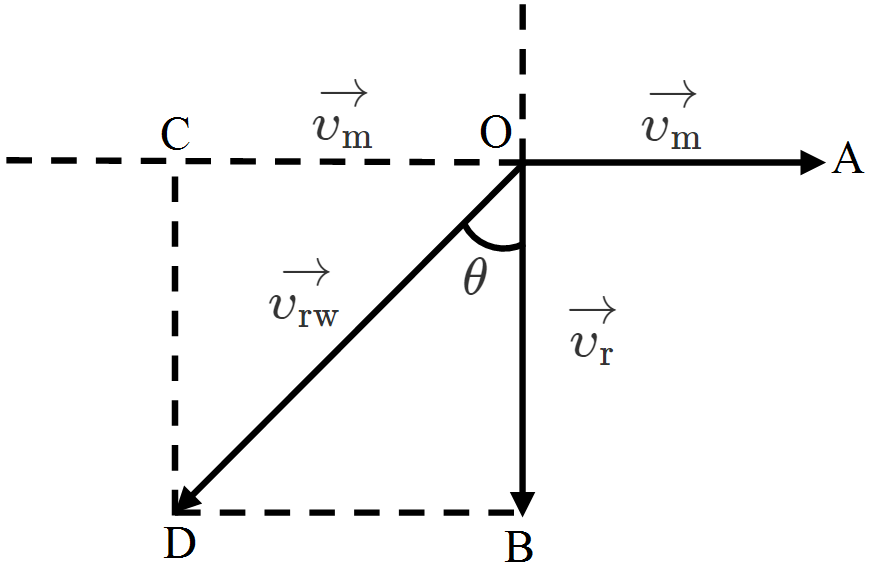 $\vec{\text{v}_\text{w}}=10\text{ m/s}=\vec{\text{OA}}$
$\vec{\text{v}_\text{r}}=30\text{ m/s}=\vec{\text{OB}}$
$\therefore\ \vec{\text{v}_\text{rw}}=\sqrt{\text{v}_\text{r}^2+\text{v}_\text{w}^2}$
$=\sqrt{(10)^2+(30)^2}=31.6\text{ m/s}$
$\tan\theta=\frac{\text{BD}}{\text{OB}}=\frac{10}{30}=0.33\ (\text{BD}=\text{OA})$
$\theta=18^\circ16'$ with vertical direction. View full question & answer→Question 212 Marks
Water from a sprinkler comes out with a constant velocity u in all the directions. What is the maximum area of the grass-land that can be watered at any time?
AnswerWater can go to a maximum distance equal to maximum range (i.e.), $\frac{\text{u}^2}{\text{g}}.$ $\therefore$ Area that can be watered $=\pi\text{r}^2$ $=\pi\Big(\frac{\text{u}^2}{\text{g}}\Big)^2=\frac{\pi\text{u}^4}{\text{g}^2}$
View full question & answer→Question 222 Marks
Two forces 5kg-wt. and 10kg-wt. are acting with an inclination of 120° between them. Find the angle when the resultant makes with 10kg-wt.
AnswerGiven, A = 5kg-wt, B = 10kg-wt, $\theta=120^\circ$ then $\beta=?$ $\tan\beta=\frac{\text{B}\sin\theta}{\text{A}+\text{B}\cos\theta}=\frac{10\sin120^\circ}{5+10\cos120^\circ}$ $=\frac{5\sin60^\circ}{10-5\cos60^\circ}=\frac{5\times\frac{\sqrt{3}}{2}}{10-\frac{5}{2}}=\frac{1}{\sqrt{3}}=\tan30^\circ$ $\therefore\ \beta=30^\circ$
View full question & answer→Question 232 Marks
A body is projected with a speed v at an angle $\theta$ with horizontal to have maximum range. What is the velocity at the highest point?
AnswerFor maximum range $\theta=45^\circ,$ velocity at the highest point $=\text{v}\cos45^\circ=\frac{\text{v}}{\sqrt{2}}.$
View full question & answer→Question 242 Marks
What is the speed of an aircraft if the pilot remains in contact with the seat, even while looping in vertical plane?
AnswerFor the pilot to stay at rest, centripetal force should be provided by his weight, i.e., $\frac{\text{mv}^2}{\text{r}}=\text{mg}$ $\therefore\ \text{v}=\sqrt{\text{rg}}$
View full question & answer→Question 252 Marks
- At what point of projectile path the speed is minimum?
- At which point, the speed is maximum?
Answer
- At the highest point.
- At the projection point.
View full question & answer→Question 262 Marks
If two vectors of equal magnitude add to either of them by magnitude, what is the angle between them?
Answer$|\text{R}|=|\text{p}|$ and $|\text{P}|=|\text{Q}|=|\text{p}|$$\therefore$ using $\text{R}^2=\text{P}^2+\text{Q}^2+2\text{PQ}\cos\theta$
we get,
$\text{p}^2=\text{p}^2+\text{p}^2+2\text{p}^2\cos\theta$
$\cos\theta=-\frac{1}{2};\ \theta=120^\circ$
View full question & answer→Question 272 Marks
What is the distance travelled by a point during the time, if it moves in x - y plane, according to the relation $\text{x}=\text{a}\sin\omega\text{t}$ and $\text{y}=\text{a}(1-\cos\omega\text{t})?$
AnswerThe motion will be Simple Harmonic with amplitude of $\sqrt{\text{a}^2+\text{a}^2}=\text{a}\sqrt{2}$ if in the same direction.Because directions are perpendicular to X and Y, it may be interpreted for a circular motion with radius a.
View full question & answer→Question 282 Marks
Two equal forces have their resultant equal to either. What is the inclination between them?
AnswerHere, A = F; B = F, R = F$\text{R}=\sqrt{\text{A}^2+\text{B}^2+2\text{AB}\cos\theta}$
$\text{F}=\sqrt{\text{F}^2+\text{F}^2+2\text{F}.\text{F}\cos\theta}$
$\text{F}=\text{F}\sqrt{2(1+\cos\theta)}$
$1=2(1+\cos\theta)$
$\cos\theta=-\frac{1}{2}=\cos120^\circ$
$\theta=120^\circ$
View full question & answer→Question 292 Marks
The angle between vector $\vec{\text{A}}$ and $\vec{\text{B}}$ is 60°. What is the ratio of $\vec{\text{A}}.\vec{\text{B}}$ and $|\vec{\text{A}}\times\vec{\text{B}}|.$
Answer$\vec{\text{A}}.\vec{\text{B}}=\text{AB}\cos\theta$ $|\vec{\text{A}}\times\vec{\text{B}}|=\text{AB}\sin\theta$ $\therefore\ \frac{\vec{\text{A}}.\vec{\text{B}}}{|\vec{\text{A}}\times\vec{\text{B}}|}=\cot\theta$ $=\cot60^\circ=\frac{1}{\sqrt{3}}$
View full question & answer→Question 302 Marks
Can there be a two dimensional motion even though acceleration is present in only one direction?
AnswerYes, the motion of projectile is an example for the same.
View full question & answer→Question 312 Marks
A swimmer can swim with velocity of 10 km/ h. w.r.t. the water flowing in a river with velocity of 5 km/ h. In what direction should he swim to reach the point on the other bank just opposite to his starting point?
Answer
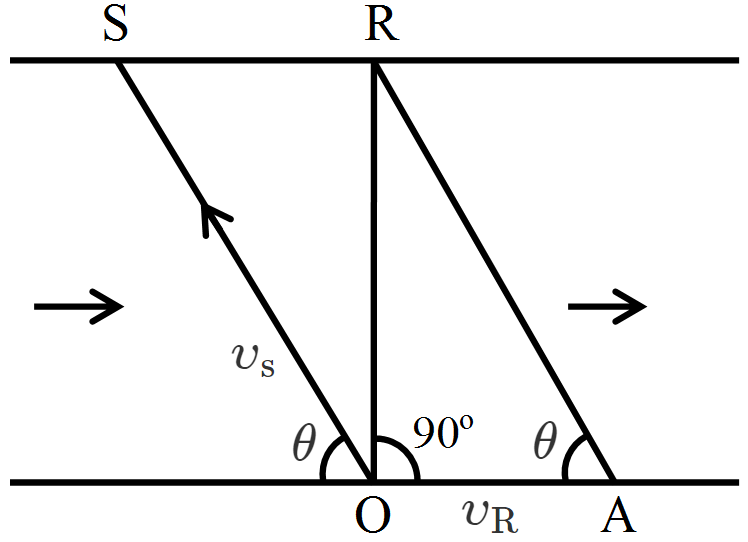
$\mathrm{v}_{\mathrm{R}}=5 \mathrm{~km} / \mathrm{h}$
$\mathrm{v}_{\mathrm{S}}=10 \mathrm{~km} / \mathrm{h}$
$\cos\theta=\frac{5}{10}=\frac{1}{2}$
$\theta=60^\circ$
⇒ with the direction of river, the angle would be 120° to reach the opposite point. View full question & answer→Question 322 Marks
Instantaneous velocity and tangential acceleration of two particles moving in circular paths of radius r are shown in figure I and II. Which of the particles is speeding up and which one is slowing down?
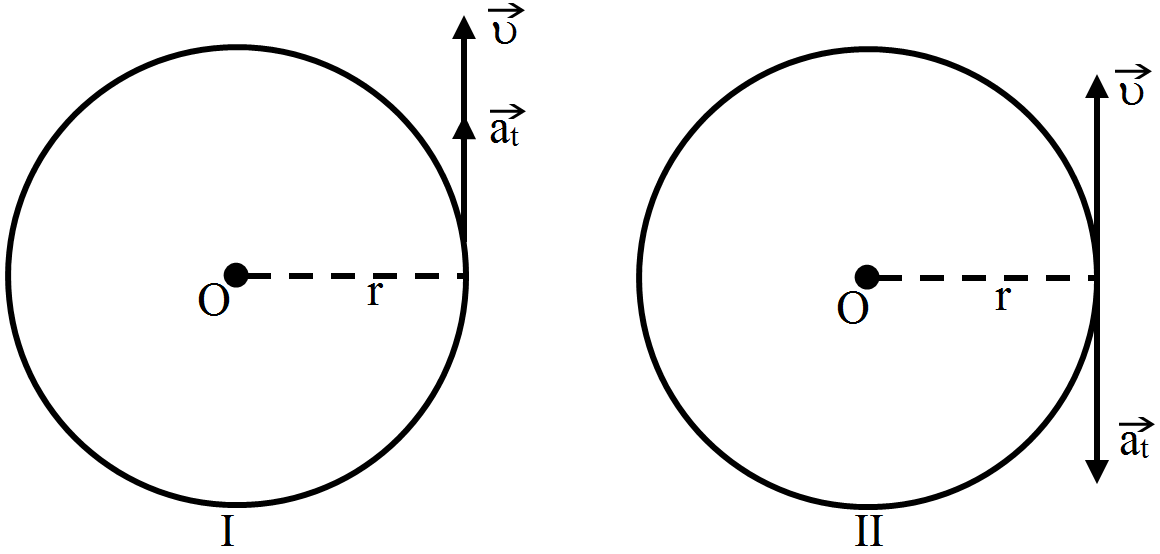
AnswerParticle moving in a circular path I is speeding up because the direction of both $\vec{\text{v}}$ and $\vec{\text{a}}_\text{t}$ are same. Particle moving in a circtrlar path II is slowing down because the directions of both $\vec{\text{v}}$ and $\vec{\text{a}}_\text{t}$ are opposite to each other.
View full question & answer→Question 332 Marks
Derive $\text{x}_2=\text{x}_1+\text{v}_1(\text{t}_2-\text{t}_1)+\frac{1}{2}\text{a}(\text{t}_2-\text{t}_1)^2.$
AnswerConsider a body starting from $x_1$ and reaching $x_2$ at time $t_2$. Starting with a velocity $v_1$ at time $t_1$ with a uniform acceleration ‘a'. The motion can be described by the v-t graph as shown. Area below v-t graph is PMWYNP $=\text{WM}\times\text{WY}\times\frac{1}{2}\text{WY}\times\text{NP}$ $=\text{v}_1(\text{t}_2-\text{t}_1)+\frac{1}{2}(\text{t}_2-\text{t}_1)\times(\text{v}_2-\text{v}_1)$ Since area below v-t graph is displacement and $v_2-v_1=a\left(t_2-t_1\right)$, we get $\text{x}_2-\text{x}_1=\text{v}_1(\text{t}_2-\text{t}_1)+\frac{1}{2}(\text{t}_2-\text{t}_1)\times\text{a}(\text{t}_2-\text{t}_1)$
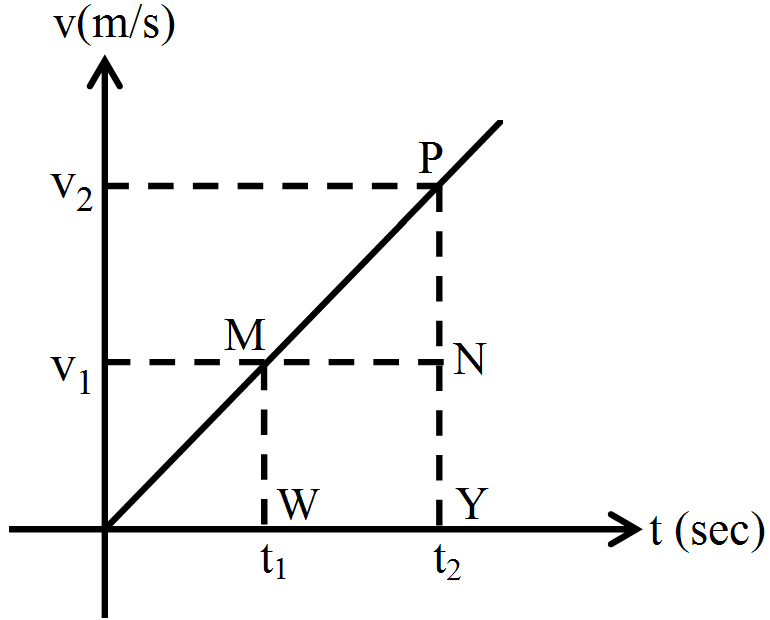
$\therefore\ \text{x}_2=\text{x}_1+\text{v}_1(\text{t}_2-\text{t}_1)+\frac{1}{2}\text{a}(\text{t}_2-\text{t}_1)^2$ View full question & answer→Question 342 Marks
What are co-initial and collinear vectors?
AnswerTwo vectors having the same initial point are called co-initial vectors. Two vectors which either act along the same line or along parallel lines are called collinear vectors.
View full question & answer→Question 352 Marks
If $\vec{\text{A}}=(-2\hat{\text{i}}+3\hat{\text{j}}-4\hat{\text{k}})$ and $\vec{\text{B}}=(3\hat{\text{i}}-4\hat{\text{j}}+5\hat{\text{k}})$ find $\vec{\text{A}}\times\vec{\text{B}}$ and $\vec{\text{A}}.\vec{\text{B}}$
Answer
- $\vec{\text{A}}\times\vec{\text{B}}=\begin{vmatrix}\hat{\text{i}} & \hat{\text{j}}&\hat{\text{k}} \\-2 & 3&-4\\3&-4&5 \end{vmatrix}$
$=\hat{\text{i}}\begin{vmatrix}3&-4\\-4&5\end{vmatrix}-\hat{\text{j}}\begin{vmatrix}-2&-4\\3&5\end{vmatrix}+\hat{\text{k}}\begin{vmatrix}-2&3\\3&-4\end{vmatrix}$
$=\hat{\text{i}}(15-16)-\hat{\text{j}}(-10+12)+\hat{\text{k}}(8-9)$
$=-\hat{\text{i}}-2\hat{\text{j}}-\hat{\text{k}}$
- $\vec{\text{A}}.\vec{\text{B}}=(-2\hat{\text{i}}+3\hat{\text{j}}-4\hat{\text{k}}).(3\hat{\text{i}}-4\hat{\text{j}}+5\hat{\text{k}})$
$=-6-12-20=-38$ View full question & answer→Question 362 Marks
A cyclist starts from centre O of a circular park of radius 1km and moves along the path OPRQO as shown Fig. If he maintains constant speed of $10 \mathrm{~ms}^{-1}$, what is his acceleration at point R in magnitude and direction?
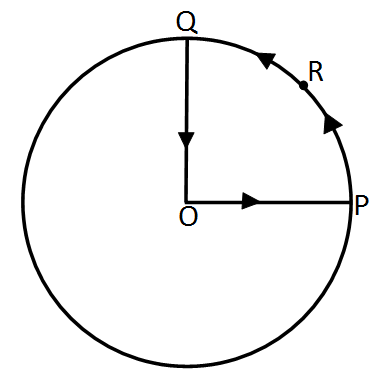
AnswerThe path of the cyclist at R is circular of constant radius 1km with centre O and he is moving with constant speed 10m/ s. So his motion is uniform circular motion at R.
Hence, the R = 1000m, v =10m/ s
$\therefore\ \text{a}_\text{c}=\frac{\text{v}^2}{\text{R}}=\frac{10\times10}{1000}=\frac{1}{10}=0.1\text{m/ s}^2$ along RO.
View full question & answer→Question 372 Marks
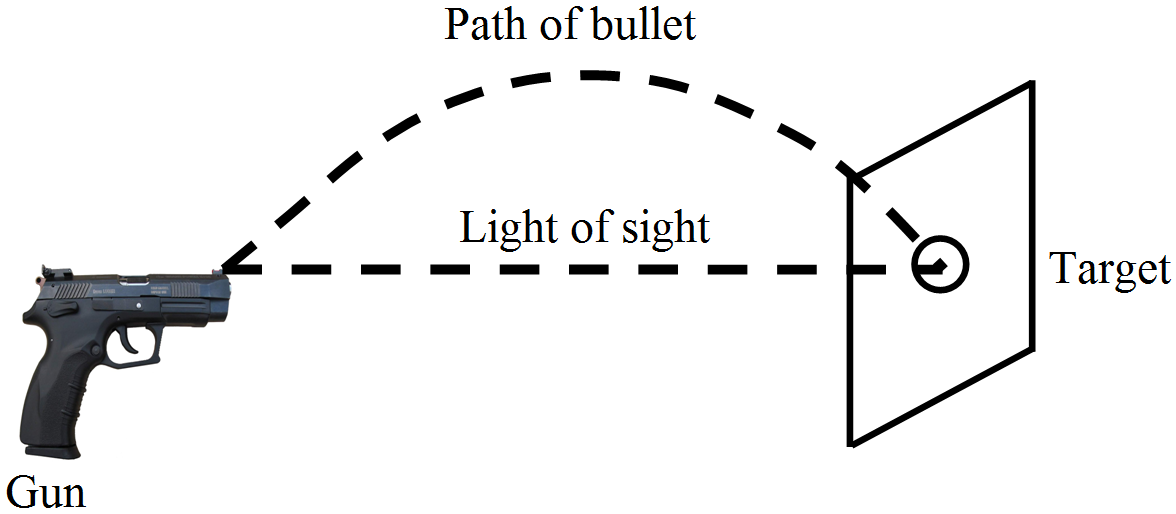
A skilled gun man always keeps his gun slightly tilted above the line of sight while shooting. Why?
AnswerWhen a bullet is fired from a gun with its barrel directed towards the target, it starts falling downwards on account of acceleration due to gravity. Due to which the bullet hits below the target. Just to avoid it, the barrel of the gun is lined up little above the target, so that the bullet after travelling in parabolic path hits the distant target.
View full question & answer→Question 382 Marks
Keeping the angle of projection same, what is the effect on horizontal range of a particle when its velocity is doubled?
Answer$\text{R}=\frac{\text{v}_0^2\sin2\theta}{\text{g}},\text{R }\alpha\text{ v}_0^2$ On doubling $\text{v}_0$, R becomes 4 times.
View full question & answer→Question 392 Marks
Suppose you have two forces $F$ and $F.$ How would you combine them in order to have resultant force of magnitudes?
- Zero
- $F$
Answer
- If they act at opposite direction, resultant is zero.
- For the resultant to be $F,$
$\text{F}^2=\text{F}^2+\text{F}^2+2\text{F}^2\cos\theta$
$\Rightarrow\ \cos\theta=\frac{-1}{2}$
$\Rightarrow\ \theta=120^\circ$ View full question & answer→Question 402 Marks
Two bodies are thrown with same velocities at angles $\alpha$ and $(90^\circ-\alpha)$ with the horizontal. What will be the ratio of $(i)$ maximum heights attained by them $(ii)$ their horizontal ranges?
Answer
- $\frac{\text{h}_1}{\text{h}_2}=\frac{\frac{\text{v}^2_0\sin^2\alpha}{2\text{g}}}{\frac{\text{v}^2_0\sin^2(90-\alpha)}{2\text{g}}}$
$=\frac{\sin^2\alpha}{\cos^2\alpha}=\tan^2\alpha$
- Horizontal ranges in both the cases are same, i.e.,
$\text{R}_1=\text{R}_2,\ \frac{\text{R}_1}{\text{R}_2}=1$ View full question & answer→Question 412 Marks
Two cars are going in two concentric circular orbits of radius $\text{r}_1$ and $\text{r}_2$ with angular velocities $\omega_1$ and $\omega_2.$ What is the ratio of their linear velocities?
AnswerWe know, $\text{v}=\text{r}\omega,\ \therefore\ \frac{\text{v}_1}{\text{v}_2}=\frac{\text{r}_1\omega_1}{\text{r}_2\omega_2}.$
View full question & answer→Question 422 Marks
Can there be two vectors where the resultant is equal to either of them?
AnswerYes, when two vectors of same magnitude inclined at an angle of 120°, then resultant is equal to either of them. Let x be the magnitude of each of two vectors which make an angle of 120°, then resultant is equal to either of them. Now, $\text{R}=\sqrt{\text{x}^2+\text{x}^2+2\text{x.x}\cos120^\circ}$ $\Rightarrow\ \text{R}=\sqrt{2\text{x}^2-\text{x}^2}=\sqrt{\text{x}^2}=\text{x}$ $\Big[\because\ \cos120^\circ=-\frac{1}{2}\Big]$
View full question & answer→Question 432 Marks
The angle between vectors A and B is 60°. What is the ratio of A.B and |A × B|?
AnswerThe dot product, $\text{A}.\text{B}=\text{AB}\cos\theta$ cross product $|\text{A}\times\text{B}|=\text{AB}\sin\theta.$ $\therefore$ Ratio is $\frac{\text{A.B}}{|\text{A}\times\text{B}|}=\frac{\text{AB}\cos\theta}{\text{AB}\sin\theta}=\cot\theta$$=\cot60^\circ=\frac{1}{\sqrt{3}}$
As, $\theta=60^\circ,\ \cot60^\circ=\frac{1}{\sqrt{3}}$
View full question & answer→Question 442 Marks
A, B and C are three non-collinear, non co-planar vectors. What can you say about direction of A × (B × C)?
AnswerThe direction of the vector $(\vec{\text{B}}\times\vec{\text{C}})$ will be perpendicular to the plane containing by vectors $\vec{\text{B}}$ and $\vec{\text{C}}$ by Right-hand thumb or Right-hand grip rule (RHGR).
The direction of the vector $\vec{\text{A}}\times(\vec{\text{B}}\times\vec{\text{C}})$ will be perpendicular to $\vec{\text{A}}$ and in a plane containing $\vec{\text{B}}$ and $\vec{\text{C}}$ by Right-hand grip rule.
View full question & answer→Question 452 Marks
A cyclist has to bend a little inwards from his vertical position while turning. Why?
AnswerBy bending, a component of normal reaction of the ground is spared to provide him the necessary centripetal force for turning.
View full question & answer→Question 462 Marks
Two forces whose magnitudes are in the ratio 3 : 5 give a resultant of 28N. If the angle of their inclination is $60^o$. Find the magnitude of each force.
AnswerLet A and B be the two forces. Then, A = 3x, B = 5x, R = 28N and $\theta=60^\circ$ Thus, $\frac{\text{A}}{\text{B}}=\frac{3}{5}$ Now, $\text{R}=\sqrt{\text{A}^2+\text{B}^2+2\text{AB}\cos\theta}$ $\Rightarrow\ 28=\sqrt{9\text{x}^2+25\text{x}^2+30\text{x}^2\cos60^\circ}=7\text{x}$ $\Rightarrow\ \text{x}=4$ $\therefore$ Forces are A = 12N and B = 20N.
View full question & answer→Question 472 Marks
What is the angular acceleration of a particle moving in a circle of radius 'r' with a angular speed $'\omega'?$
AnswerSince $\omega$ is constant, angular acceleration will be zero.
View full question & answer→Question 482 Marks
Calculate the area of a parallelogram whose adjacent sides are given by the vectors. $\vec{\text{A}}=\hat{\text{i}}+2\hat{\text{j}}+3\hat{\text{k}};\ \vec{\text{B}}=2\hat{\text{i}}-3\hat{\text{j}}+\hat{\text{k}}.$
AnswerArea of the parallelogram $=|\vec{\text{A}}\times\vec{\text{B}}|$ $\vec{\text{A}}\times\vec{\text{B}}=\begin{vmatrix} \hat{\text{i}}& \hat{\text{j}}&\hat{\text{k}}\\1 & 2&3\\2&-3&1 \end{vmatrix}$ $=11\hat{\text{i}}+5\hat{\text{j}}-7\hat{\text{k}}$ $\therefore\ |\vec{\text{A}}\times\vec{\text{B}}|=\sqrt{121+25+49}$ $=\sqrt{195}\text{ sq. units}$
View full question & answer→Question 492 Marks
Explain the property of two vectors A and B if |A + B| = |A - B|.
AnswerAs we know that, $|\text{A}+\text{B}|=\sqrt{\text{A}^2+\text{B}^2+2\text{AB}\cos\theta}$ and $|\text{A}-\text{B}|=\sqrt{\text{A}^2+\text{B}^2-2\text{AB}\cos\theta}$ But as per question, we have $\sqrt{\text{A}^2+\text{B}^2+2\text{AB}\cos\theta}=\sqrt{\text{A}^2+\text{B}^2-2\text{AB}\cos\theta}$ Squaring both sides, we have $(4\text{ AB}\cos\theta)=0$ $\Rightarrow\ \cos\theta=0\ \text{or }\theta=90^\circ$ Hence, the two vectors A and B are perpendicular to each other.
View full question & answer→Question 502 Marks
An aeroplane travelling at a speed of 5000km/ hr tilts at an angle of 30° as it makes a turn. What is the radius of the curve?
Answer$\tan\theta=\frac{\text{v}^2}{\text{rg}}=\Big(\frac{1250}{9}\Big)^2\times\frac{1}{\text{r}}\times\frac{1}{9.8}$or $\text{r}=\Big(\frac{1250}{9}\Big)^2\frac{\sqrt{3}}{1}\times\frac{1}{9.8}$
$\Big[\because5000\text{ km/hr}=\frac{1250}{9}\text{ m/s}\Big]$
or, $\text{r}=3.41\times10^3\text{m}\Big[\because\tan30^\circ=\frac{1}{\sqrt{3}}\Big]$
View full question & answer→Question 512 Marks
A football is kicked 20m/ s at a projection angle of 45°. A receiver on the goal line 25m away in the direction of the kick runs the same instant to meet the ball. What must be his speed, if he has to catch the ball before it hits the ground?
AnswerGiven, u = 20m/ s, $\theta=45^\circ,$ d = 25m Horizontal range is given by $\text{R}=\frac{\text{u}^2}{\text{g}}\sin2\theta=\frac{(20)^2}{9.8}\sin2(45^\circ)$ $=\frac{400}{9.8}\times1=40.82\text{m}$ Time of flight, $\text{T}=\frac{2\text{u}\sin\theta}{\text{g}}=\frac{2\times20}{9.8}\sin45^\circ$ $=2.886\text{s}$The goal man is 25m away in the direction of the ball, so to catch the ball, he is to cover a distance
= 40.82 - 25 = 15.82m in time 2.886s.
$\therefore$ Velocity of the goal man to catch the ball
$\text{v}=\frac{15.82}{2.886}=5.48\text{m/ s}$
View full question & answer→Question 522 Marks
Find the angle of projection for a projectile motion whose range R is n times the maximum height H.
AnswerGiven R = nH $\Rightarrow\ \frac{\text{u}^2\sin2\theta}{\text{g}}=\text{n}\times\frac{\text{u}^2\sin^2\theta}{2\text{g}}$ $\Rightarrow\ \theta=\tan^{-1}\Big(\frac{4}{\text{n}}\Big)$
View full question & answer→Question 532 Marks
Suppose you have two forces $\vec{\text{F}}$ and $\vec{\text{F}}.$ How would you combine them in order to have resultant force of magnitudes $(a)$ zero, $(b) 2\vec{\text{F}}$ and $(c) \vec{\text{F}}?$
Answer
- If they act at opposite direction, resultant is zero.
- If they act in same direction, $R = 2F.$
- For the resultant to be $F,$
$\text{F}^2=\text{F}^2+\text{F}^2+2\text{F}^2\cos\theta$
$\cos\theta=-\frac{1}{2}$ or $\theta=120^\circ.$ View full question & answer→Question 542 Marks
Find the scalar product of two vectors $\vec{\text{a}}=(3\hat{\text{i}}-4\hat{\text{j}}+5\hat{\text{k}})$ and $\vec{\text{b}}=(-2\hat{\text{i}}+\hat{\text{j}}-3\hat{\text{k}}).$
Answer$\vec{\text{a}}=(3\hat{\text{i}}-4\hat{\text{j}}+5\hat{\text{k}})$ $\vec{\text{b}}=(-2\hat{\text{i}}+\hat{\text{j}}-3\hat{\text{k}})$ $\vec{\text{a}}.\vec{\text{b}}=3(-2)-4(1)+5(-3)$ $=-6-4-15=-25$
View full question & answer→Question 552 Marks
The sum and difference of two vectors are perpendicular to each other. Prove that the ectors are equal in magnitude.
AnswerAs the vectors A + B and A - B are perpendicular to each other, therefore$(\text{A}+\text{B}).(\text{A}-\text{B})=0$
$\text{A}.\text{A}-\text{A}.\text{B}+\text{B}.\text{A}-\text{B}.\text{B}=0$
$\text{A}-\text{B}=0\ \ [\because\ \text{A}.\text{B}=\text{B}.\text{A}]$
$\Rightarrow\ \text{A}=\text{B}$
View full question & answer→Question 562 Marks
Show that $\vec{\text{a}}.(\vec{\text{b}}\times\vec{\text{c}})$ is equal in magnitude to the volume of a parallelopiped formed by the three vectors $\vec{\text{a}},\vec{\text{b}}$ and $\vec{\text{c}}.$
Answer
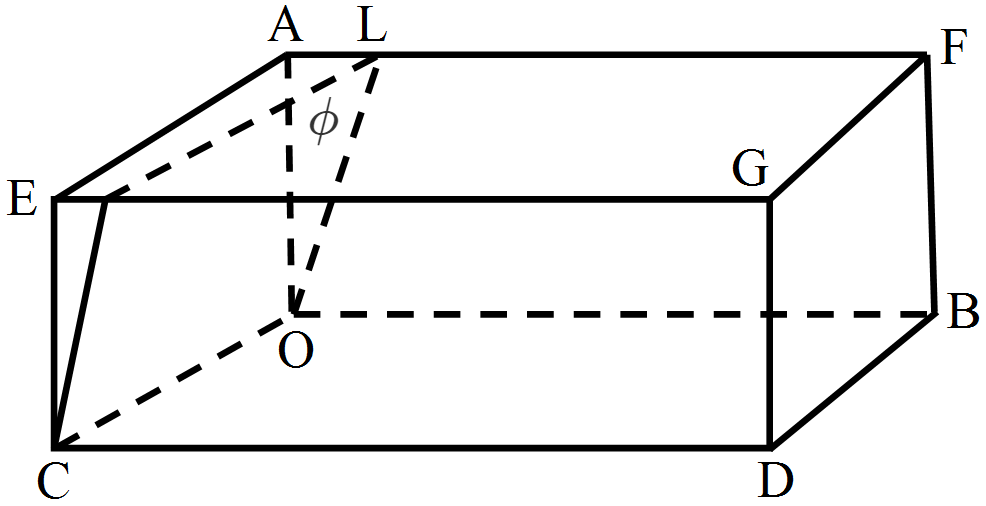 Consider $\vec{\text{OA}}=\vec{\text{a}}$
$\vec{\text{OB}}=\vec{\text{b}}$
$\vec{\text{OC}}=\vec{\text{c}}$
Then $\vec{\text{b}}\times\vec{\text{c}}$ is a vector perpendicular to the plane of $\vec{\text{b}}$ and $\vec{\text{c}}.$
Let $\phi$ be the angle between $\vec{\text{a}}$ and $\vec{\text{b}}\times\vec{\text{c}}$ and $\hat{\text{n}}$ unit vector along $\vec{\text{b}}\times\vec{\text{c}}.$
$\vec{\text{a}}.(\vec{\text{b}}\times\vec{\text{c}})=$ (area of parallelogram OBDC)
= area of parallelogram OBDC $(\hat{\text{n}}.\vec{\text{a}})$
= area of parallelogram OBDC $|\vec{\text{a}}|\cos\phi$
$(\because\ |\hat{\text{n}}|=1)$
= (area of parallelogram OBDC) (OL)
$[\because\ \text{OA}\cos\phi=\text{OL}]$
= (area of parallelogram OBDC) × (height)
= volume of parallelopiped with edges $\vec{\text{a}},\vec{\text{b}},\vec{\text{c}}$ View full question & answer→Question 572 Marks
If two vectors of equal magnitude add to either of them by magnitude, what is the angle between them?
Answer$\sqrt{\text{p}^2+\text{p}^2+2\text{p}^2\cos\theta}=\text{p}$ Squaring, $2\text{p}^2(1+\cos\theta)=\text{p}^2$ $1+\cos\theta=\frac{1}{2}\cos\theta=\frac{-1}{2},$ $\theta=120^\circ$
View full question & answer→Question 582 Marks
Determine $\lambda$ such that: $\vec{\text{A}}=2\hat{\text{i}}+\lambda\hat{\text{j}}+\hat{\text{k}};\ \vec{\text{B}}=4\hat{\text{i}}-2\hat{\text{j}}-2\hat{\text{k}}$ are perpendicular to each other.
Answer$\vec{\text{A}}=2\hat{\text{i}}+\lambda\hat{\text{j}}+\hat{\text{k}}$ $\vec{\text{B}}=4\hat{\text{i}}-2\hat{\text{j}}-2\hat{\text{k}}$ $\vec{\text{A}}.\vec{\text{B}}=(2\hat{\text{i}}+\lambda\hat{\text{j}}+\hat{\text{k}}).(4\hat{\text{i}}-2\hat{\text{j}}-2\hat{\text{k}})$ $=8-2\lambda-2$ $0=6-2\lambda$ or $\lambda=3$
View full question & answer→Question 592 Marks
Can a flight of a bird, an example of composition of vectors. Why?
AnswerYes, the flight of a bird is an example of composition of vectors. As the bird flies, it strikes the air with its wings W, W along WO. According to Newton's third law of motion, air strikes the wings in opposite directions with the same force in reaction. The reactions are OA and OB. From law of parallelogram vectors, OC is the resultant of OA and OB. This resultant upwards force OC is responsible for the flight of the bird.
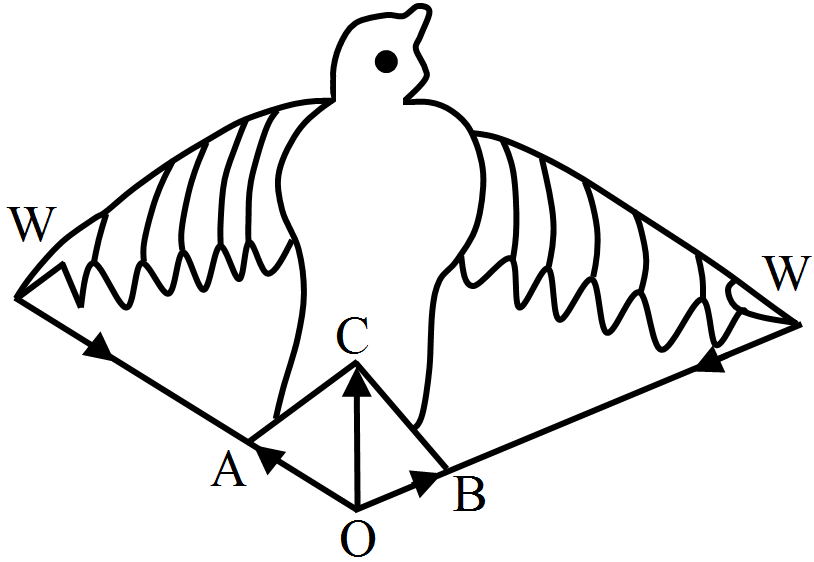
View full question & answer→Question 602 Marks
A string can withstand a tension of 25N. What is the greatest speed at which a body of mass 1kg can be whirled in a horizontal circle using a 1m length of the string?
AnswerAs the body is whirled in a horizontal circle, the force of gravity, acting vertically downwards, has no effect on its motion. If v is the greatest speed with which the body can be whirled, the centripetal forces in the string must balance the maximum tension that the string can withstand. $\therefore\ \text{Tension, T}=\frac{\text{mv}^2}{\text{r}}$ or $25=\frac{1\times\text{v}^2}{1}$ or, $\text{v}=5\text{ ms}^{-1}$
View full question & answer→Question 612 Marks
An insect trapped in a circular groove of radius $12 \ cm$ moves along the groove steadily and completes $7$ revolutions in $100 s$. $(a)$ What is the angular speed, and the linear speed of the motion? $(b)$ Is the acceleration vector a constant vector? What is its magnitude?
AnswerThis is an example of uniform circular motion. Here $R=12 \ cm$. The angular speed $\omega$ is given by
$\omega=2 \pi / T=2 \pi 7 / 100=0.44 rad / s$
The linear speed $v$ is :
$v=\omega R=0.44 s ^{-1} 12 \ cm =5.3 \ cm s ^{-1}$
The direction of velocity $v$ is along the tangent to the circle at every point. The acceleration is directed towards the centre of the circle. Since this direction changes continuously, acceleration here is not a constant vector. However, the magnitude of acceleration is constant:
$a=\omega^2 R=\left(0.44 s ^{-1}\right)^2(12 \ cm )$
$=2.3 \ cm s ^{-2}$
View full question & answer→Question 622 Marks
A cricket ball is thrown at a speed of $28\ m s ^{-1}$ in a direction $30$ above the horizontal. Calculate $(a)$ the maximum height, $(b)$ the time taken by the ball to return to the same level, and $(c)$ the distance from the thrower to the point where the ball returns to the same level.
Answer$(a)$ The maximum height is given by
$h_m =\frac{\left(v_o \sin \theta_o\right)^2}{2 g}$
$=\frac{\left(28 \sin 30^{\circ}\right)^2}{2(9.8)} m$
$ =\frac{14 \times 14}{2 \times 9.8}$
$=10.0 m$
$(b)$ The time taken to return to the same level is
$T_f=(2 v_0 \sin \theta_0) / g$
$=(2 28 \sin 30) / 9.8$
$=28 / 9.8 s$
$=2.9 s$
$(c)$ The distance from the thrower to the point where the ball returns to the same level is
$R=\frac{\left(v_{ o }^2 \sin 2 \theta_{ o }\right)}{a}$
$=\frac{28 \times 28 \times \sin 60^{\circ}}{98}$
$=69 m$
View full question & answer→Question 632 Marks
The position of a particle is given by
$
r =3.0 t \hat{ i }+2.0 t^2 \hat{ j }+5.0 \hat{ k }
$
where $t$ is in seconds and the coefficients have the proper units for $r$ to be in metres. (a) Find $v (t)$ and $a(t)$ of the particle. (b) Find the magnitude and direction of $v (t)$ at $t=1.0 s$.
Answer$
\begin{aligned}
v (t) & =\frac{ d r }{ d t}=\frac{ d }{ d t}\left(3.0 t \hat{ i }+2.0 t^2 \hat{ j }+5.0 \hat{ k }\right) \\
& =3.0 \hat{ i }+4.0 t \hat{ j } \\
a (t) & =\frac{ d v }{ d t}=+4.0 \hat{ j } \\
a & =4.0 m s ^{-2} \text { along } y \text { - direction }
\end{aligned}
$
At $t=1.0 s , \quad v =3.0 \hat{ i }+4.0 \hat{ j }$
It's magnitude is $v=\sqrt{3^2+4^2}=5.0 m s ^{-1}$ and direction is
$\theta=\tan ^{-1}\left(\frac{v_y}{v_x}\right)=\tan ^{-1}\left(\frac{4}{3}\right) \cong 53^{\circ}$ with $x$-axis.
View full question & answer→Question 642 Marks
View full question & answer→