Question 11 Mark
Which of the following examples represent periodic motion? An arrow released from a bow.
AnswerThere is no repetition, hence not periodic.
View full question & answer→Question 21 Mark
Which of the following functions of time represent (a) simple harmonic, (b) periodic but not simple harmonic, and (c) non-periodic motion? Give period for each case of periodic motion ($\omega$ is any positive constant): $\text{exp}(-\omega^2\text{t}^2)$
AnswerNon-periodic motion The given function $\text{exp}(-\omega^2\text{t}^2)$ is an exponential function. Exponential functions do not repeat themselves. Therefore, it is a non-periodic motion.
View full question & answer→Question 31 Mark
Which of the following examples represent periodic motion? A swimmer completing one (return) trip from one bank of a river to the other and back.
AnswerThere is no repetition of the motion as the swimmer just completes one trip hence not periodic.
View full question & answer→Question 41 Mark
Which of the following examples represent (nearly) simple harmonic motion and which represent periodic but not simple harmonic motion?General vibrations of a polyatomic molecule about its equilibrium position.
AnswerA polyatomic molecule has many natural frequencies of oscillation. Its vibration is the superposition of individual simple harmonic motions of a number of different molecules. Hence, it is not simple harmonic, but periodic.
View full question & answer→Question 51 Mark
Fig. depicts four x-t plots for linear motion of a particle. Which of the plots represent periodic motion? What is the period of motion (in case of periodic motion)?
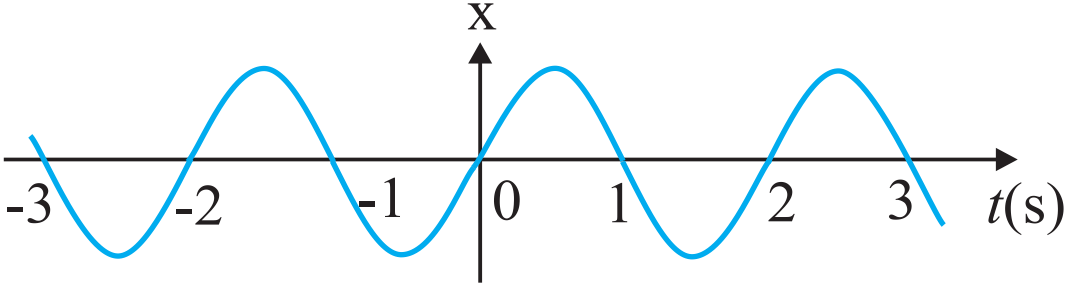
AnswerIn this case, the motion of the particle repeats itself after 2s. Hence, it is a periodic motion, having a period of 2s.
View full question & answer→Question 61 Mark
A particle is in linear simple harmonic motion between two points, A and B, 10cm apart. Take the direction from A to B as the positive direction and give the signs of velocity, acceleration and force on the particle when it is: At the end A.
Answer
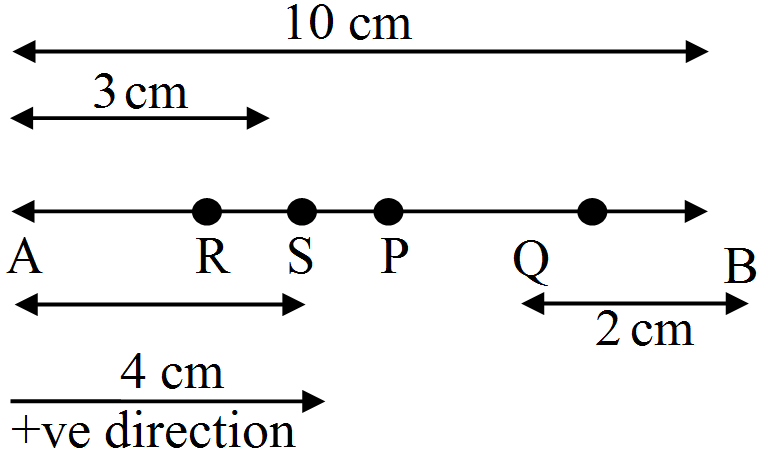
From above figure, where A and B represent the two extreme positions of a SHM. For velocity, the direction from A to B is taken to b positive. The acceleration and the force, along AP are taken as positive and along Bp are taken as negative.
At the end A, the particle executing SHM is momentarily at rest being its extreme position of motion. Therefore, its velocity is zero. Acceleration is positive because it is directed along AP, Force is also Positive since the force is directed along AP.
View full question & answer→Question 71 Mark
Which of the following functions of time represent (a) simple harmonic, (b) periodic but not simple harmonic, and (c) non-periodic motion? Give period for each case of periodic motion ($\omega$ is any positive constant): $1+\omega\text{t}+\omega^2\text{t}^2$
AnswerThe given function $1+\omega\text{t}+\omega^2\text{t}^2$ is non-periodic.
View full question & answer→Question 81 Mark
Which of the following examples represent periodic motion? A freely suspended bar magnet displaced from its N-S direction and released.
Answer The motion is repeated after a certain interval of time, hence periodic. In fact, the bar magnet oscillates about its mean position with a definite period of time.
View full question & answer→Question 91 Mark
A particle is in linear simple harmonic motion between two points, A and B, 10cm apart. Take the direction from A to B as the positive direction and give the signs of velocity, acceleration and force on the particle when it is:At the mid-point of AB going towards A.
Answer
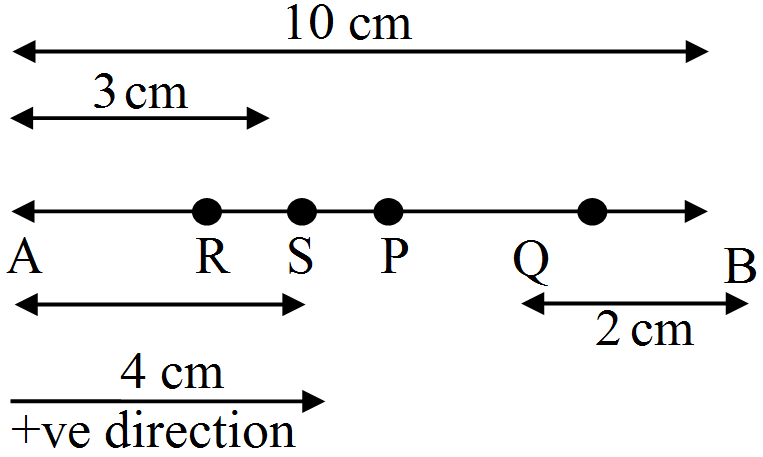
From above figure, where A and B represent the two extreme positions of a SHM. For velocity, the direction from A to B is taken to b positive. The acceleration and the force, along AP are taken as positive and along Bp are taken as negative.
At the mid-point of AB going towards A, the particle is at its mean position P, with a tendency to move along PA. Hence, velocity is positive. Both acceleration and force are zero.
View full question & answer→Question 101 Mark
Fig. depicts four x-t plots for linear motion of a particle. Which of the plots represent periodic motion? What is the period of motion (in case of periodic motion)?
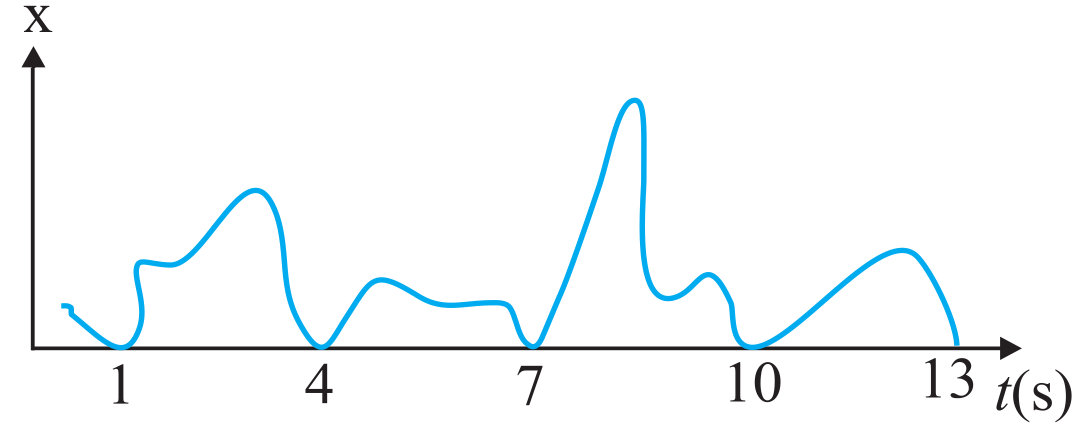
Answer It is not a periodic motion. This is because the particle repeats the motion in one position only. For a periodic motion, the entire motion of the particle must be repeated in equal intervals of time.
View full question & answer→Question 111 Mark
Which of the following examples represent (nearly) simple harmonic motion and which represent periodic but not simple harmonic motion? The rotation of earth about its axis.
AnswerIt is periodic but not simple harmonic motion because it is not to and fro about a fixed point.
View full question & answer→Question 121 Mark
A particle is in linear simple harmonic motion between two points, A and B, 10cm apart. Take the direction from A to B as the positive direction and give the signs of velocity, acceleration and force on the particle when it is: At the end B.
Answer
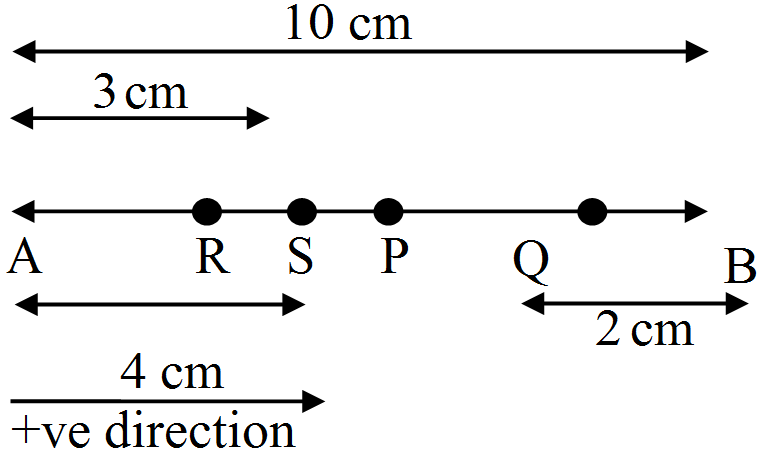
From above figure, where A and B represent the two extreme positions of a SHM. For velocity, the direction from A to B is taken to b positive. The acceleration and the force, along AP are taken as positive and along Bp are taken as negative.
At the end B, velocity is zero. Here, acceleration and force are negative as they are directed along BP.
View full question & answer→Question 131 Mark
A particle is in linear simple harmonic motion between two points, A and B, 10cm apart. Take the direction from A to B as the positive direction and give the signs of velocity, acceleration and force on the particle when it is:At 3cm away from A going towards B.
Answer
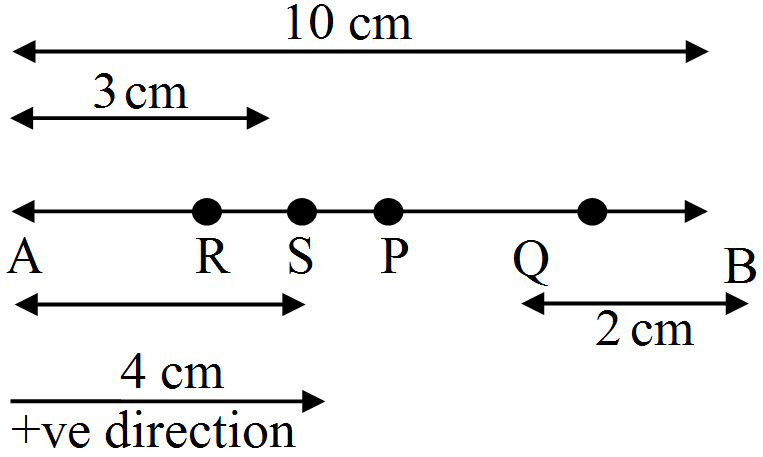
From above figure, where A and B represent the two extreme positions of a SHM. For velocity, the direction from A to B is taken to b positive. The acceleration and the force, along AP are taken as positive and along Bp are taken as negative.
At 3cm away from A going towards B, the particle is at R, with a tendency to move along RP, which is positive direction. Here, velocity, acceleration all are positive.
View full question & answer→MCQ 141 Mark
Which of the following relationships between the acceleration a and the displacement $x$ of a particle involve simple harmonic motion?
- A
$a=0.7 x$
- B
$a=-200 x^2$
- ✓
$a=-10 x$
- D
$a=100 x^3$
AnswerCorrect option: C. $a=-10 x$
In $\text{SHM}$, acceleration a is related to displacement by the relation of the form $a = -kx$, which is for relation $(c)$.
View full question & answer→Question 151 Mark
Which of the following examples represent (nearly) simple harmonic motion and which represent periodic but not simple harmonic motion? Motion of a ball bearing inside a smooth curved bowl, when released from a point slightly above the lower most point.
AnswerIt is simple harmonic motion because the ball moves to and fro about the lowermost point of the bowl when released. Also, the ball comes back to its initial position in the same period of time, again and again.
View full question & answer→Question 161 Mark
Which of the following examples represent periodic motion?A hydrogen molecule rotating about its centre of mass.
Answer Rotatary motion is periodic as repeating after fixed time-interval.
View full question & answer→Question 171 Mark
A particle is in linear simple harmonic motion between two points, A and B, 10cm apart. Take the direction from A to B as the positive direction and give the signs of velocity, acceleration and force on the particle when it is:At 2cm away from B going towards A.
Answer
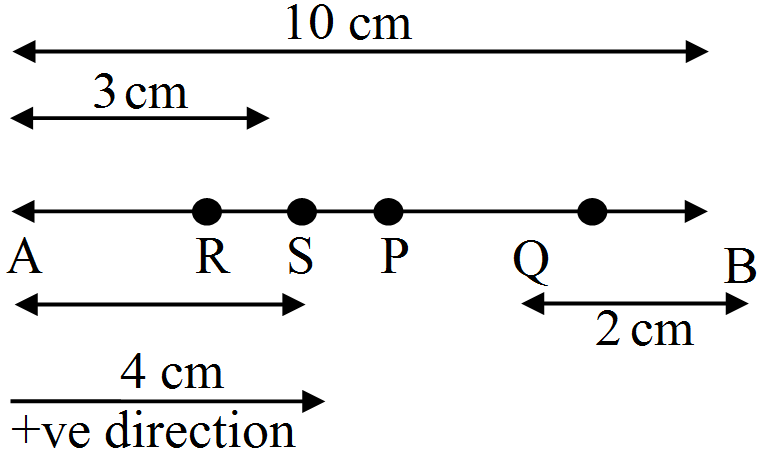
From above figure, where A and B represent the two extreme positions of a SHM. For velocity, the direction from A to B is taken to b positive. The acceleration and the force, along AP are taken as positive and along Bp are taken as negative.
At 2cm away from B going towards A, the particle is at Q, with a tendency to move along QP, which is negative direction. Therefore, velocity, acceleration and force all are positive.
View full question & answer→Question 181 Mark
A particle is in linear simple harmonic motion between two points, A and B, 10cm apart. Take the direction from A to B as the positive direction and give the signs of velocity, acceleration and force on the particle when it is:At 4cm away from B going towards A.
Answer
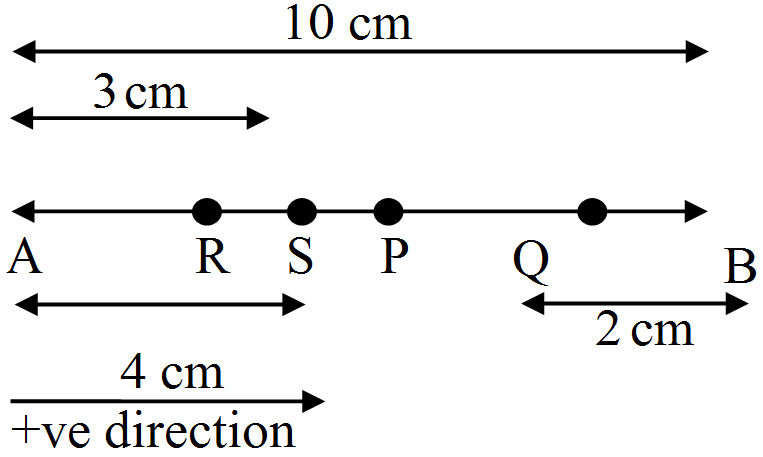
From above figure, where A and B represent the two extreme positions of a SHM. For velocity, the direction from A to B is taken to b positive. The acceleration and the force, along AP are taken as positive and along Bp are taken as negative.
At 4cm away from A going towards A, the particles is at S, with a tendency to move along SA, which is negative direction. Therefore, velocity is negative but acceleration is directed towards mean position, along SP. Hence it is positive and also force is positive similarly.
View full question & answer→Question 191 Mark
Which of the following examples represent (nearly) simple harmonic motion and which represent periodic but not simple harmonic motion? Motion of an oscillating mercury column in a U-tube.
AnswerIt is a simple harmonic motion because the mercury moves to and fro on the same path, about the fixed position, with a certain period of time.
View full question & answer→Question 201 Mark
Figure (a) shows a spring of force constant k clamped rigidly at one end and a mass m attached to its free end. A force F applied at the free end stretches the spring. Figure (b) shows the same spring with both ends free and attached to a mass m at either end. Each end of the spring in Fig. (b) is stretched by the same force F.
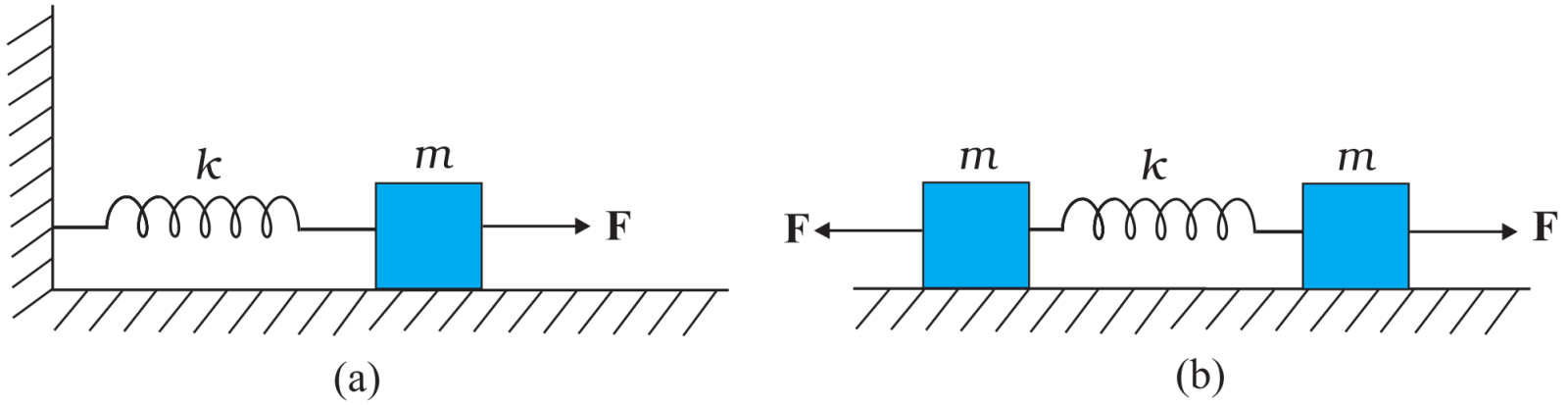
What is the maximum extension of the spring in the two cases?
AnswerThe maximum extension of the spring in both cases will = Flk, where k is the spring constant of the springs used.
View full question & answer→Question 211 Mark
Fig. depicts four x-t plots for linear motion of a particle. Which of the plots represent periodic motion? What is the period of motion (in case of periodic motion)?
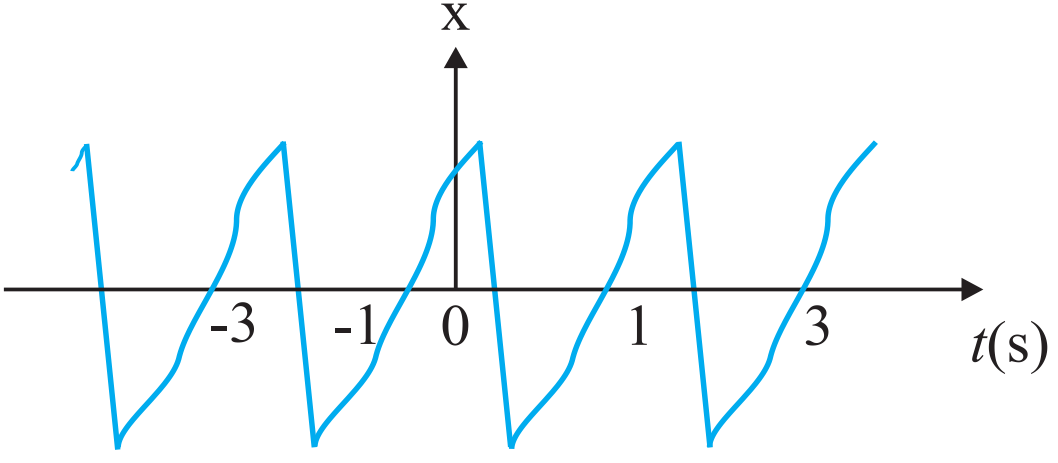
Answer In this case, the motion of the particle repeats itself after 2s. Hence, it is a periodic motion, having a period of 2s.
View full question & answer→Question 221 Mark
Fig. depicts four x-t plots for linear motion of a particle. Which of the plots represent periodic motion? What is the period of motion (in case of periodic motion)?
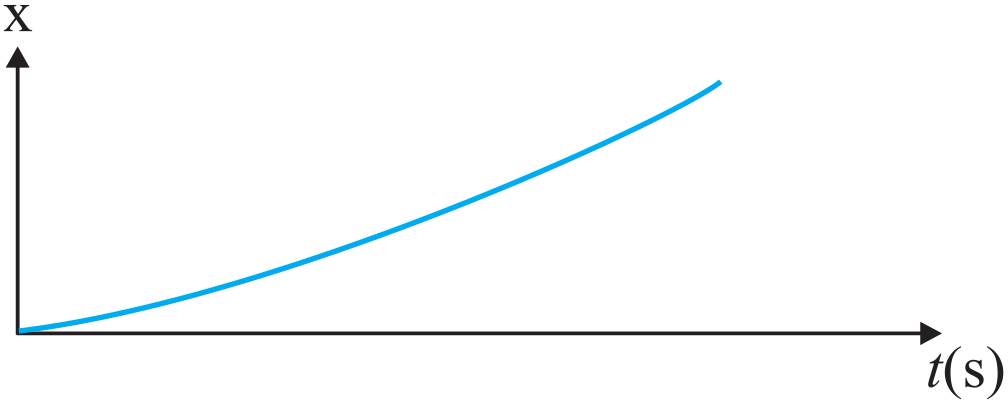
AnswerIt is not a periodic motion. This represents a unidirectional, linear uniform motion. There is no repetition of motion in this case.
View full question & answer→Question 231 Mark
Answer the following questions:What is the frequency of oscillation of a simple pendulum mounted in a cabin that is freely falling under gravity?
Answer When a simple pendulum mounted in a cabin falls freely under gravity, its acceleration is zero. Hence the frequency of oscillation of this simple pendulum is zero.
View full question & answer→Question 241 Mark
Which of the following examples represent periodic motion? An arrow released from a bow.
AnswerThere is no repetition, hence not periodic.
View full question & answer→Question 251 Mark
How is the path difference related to phase difference?
Answer Path difference $=\frac{\lambda}{2\pi}\times\text{phase difference}$
View full question & answer→Question 261 Mark
Which of the following functions of time represent (a) simple harmonic, (b) periodic but not simple harmonic, and (c) non-periodic motion? Give period for each case of periodic motion ($\omega$ is any positive constant):$\text{exp}(-\omega^2\text{t}^2)$
AnswerNon-periodic motion The given function $\text{exp}(-\omega^2\text{t}^2)$ is an exponential function. Exponential functions do not repeat themselves. Therefore, it is a non-periodic motion.
View full question & answer→Question 271 Mark
What is an epoch? Name the unit in which it is measured.
Answer The initial difference in position from mean position expressed in radians is called epoch.
View full question & answer→Question 281 Mark
What is the force equation of a SHM?
AnswerAccording to force equation of SHM, F = -kx, where, k is a constant known as force constant.
View full question & answer→Question 291 Mark
A body of mass m is situated in a potential field $\text{U}(\text{x})=\text{U}_0(1-\cos\text{ax}),$ Where $U_0$ and a are constant. find the time period of small oscillation.
Answer$\because\text{dW}=\text{F}.\text{dx}$ if W = U, then$\text{dU}=\text{F}.\text{dx}\ \text{or}\ \text{F}=\frac{-\text{dU}}{\text{dx}}$ (here restoring force is opposite to displacement)
$\text{F}=\frac{-\text{d}}{\text{dx}}[\text{U}_0(1-\cos\text{ax})=\frac{-\text{d}}{\text{dx}}[\text{U}_0+\text{U}_0\cos\text{a}_\text{x}]$
$\text{F}=-[0-\text{U}_0(-\sin\text{ax}).\text{a}]$
$\text{F}=-\text{aU}_0\sin\text{a}\text{x}$
For SHM. ax is small
So sin ax becomes ax ...(i)
$\therefore\text{F}=-\alpha.\text{U}_0\text{ax}=-\text{a}^2\text{U}_0\text{x}\ ...(\text{ii})$
$\alpha_2\text{U}_0$ are constants.
$\therefore\text{F}\propto-\text{x}.$ so motion is SHM.
Here from (ii) $k = a^2U_0$
$\text{m}\omega^2=\text{a}^2\text{U}_0\Rightarrow\omega^2=\text{a}^2\frac{\text{U}_0}{\text{m}}$
$\Big(\frac{2\pi}{\text{T}}\Big)^2=\text{a}^2\frac{\text{U}_0}{\text{m}}\Rightarrow\text{T}^2=4\pi\frac{\text{m}}{\text{U}_0\text{a}^2}\ \text{or}$
$\text{T}=\frac{2\pi}{\text{a}}\sqrt{\frac{\text{m}}{\text{U}_0}}.$
From (i) this time period is valid for small angle ax.
View full question & answer→Question 301 Mark
What happens to the time period of a simple pendulum if its length is doubled?
Answer The time period is increased by a factor of $\sqrt{2}$.
View full question & answer→Question 311 Mark
What forces keep the simple pendulum in simple harmonic motion?
Answer Restoring force $\text{mg}\sin\theta$ and proper tension maintain simple harmonic motion in simple pendulum.
View full question & answer→Question 321 Mark
Is the damping force constant on a system executing S.H.M?
Answer No. It is directly proportional to velocity which is a variable with time.
View full question & answer→Question 331 Mark
Why a point on a rotating wheel cannot be considered as executing S.H.M.?
AnswerIt is only periodic and not oscillatory.
View full question & answer→Question 341 Mark
Which of the following examples represent periodic motion? A swimmer completing one (return) trip from one bank of a river to the other and back.
AnswerThere is no repetition of the motion as the swimmer just completes one trip hence not periodic.
View full question & answer→Question 351 Mark
Which of the following examples represent (nearly) simple harmonic motion and which represent periodic but not simple harmonic motion?General vibrations of a polyatomic molecule about its equilibrium position.
AnswerA polyatomic molecule has many natural frequencies of oscillation. Its vibration is the superposition of individual simple harmonic motions of a number of different molecules. Hence, it is not simple harmonic, but periodic.
View full question & answer→Question 361 Mark
A pendulum is making one oscillation in every two seconds. What is the frequency of oscillation?
Question 371 Mark
Why does the time period of a swing not change when two persons sit on it instead of one?
Answer $\text{T}=2\pi\frac{\text{l}}{\text{g}},$ so it does not depend upon the mass.
View full question & answer→Question 381 Mark
What will be the time period of oscillation, if the length of a second pendulum is one third?
Answer$\frac{\text{T}_2^2}{\text{T}_1^2}=\frac{\text{l}_2}{\text{l}_1}\frac{\Big(\frac{\text{l}}{3}\Big)}{\text{l}}\frac{1}{3}$$\frac{\text{T}_2^2}{\text{T}_1^2}=\frac{(2)^2}{3}$
$\text{T}_2=\frac{2}{\sqrt{3}}\text{s}$
View full question & answer→Question 391 Mark
What are the basic properties required by a system to oscillate?
AnswerInertia and elasticity are the properties which are required by a system to oscillate.
View full question & answer→Question 401 Mark
Is it correct to say the “linear combinations of S.H.M. is a S.H.M."?
AnswerYes, e.g., $\text{a}\sin\omega\text{t + b}\cos\omega\text{t}$ is a linear combination which is also S.H.M. with amplitude $\sqrt{\text{a}^2+\text{b}^2}.$
View full question & answer→Question 411 Mark
What is the main difference between forced oscillations and resonance?
AnswerIn forced oscillations, a body oscillates with the help of external periodic force with a frequency different from natural frequency of body but in resonance a body oscillates with its own natural frequency with the help of an external periodic force whose frequency is equal to natural frequency of body.
View full question & answer→Question 421 Mark
Two exactly similar simple pendula are vibrating with amplitudes 1cm and 3cm. What is the ratio of their energies of vibration?
Answer$\frac{\text{E}_1}{\text{E}_2}=\frac{\text{a}_1^2}{\text{a}_2^2}=\Big(\frac{1}{3}\Big)^2=\frac{1}{9}$.
View full question & answer→Question 431 Mark
Can the motion of an artificial satellite around earth be taken as S.H.M?
Answer No, it is a circular and periodic motion but not to and fro about a mean position which is essential for SHM.
View full question & answer→Question 441 Mark
What is the phase difference between particle velocity and particle acceleration in SHM?
AnswerParticle acceleration in SHM is ahead in phase by $\frac{\pi}{2}$ as compared to the particle velocity.
View full question & answer→Question 451 Mark
Which of the following functions of time represent (a) simple harmonic, (b) periodic but not simple harmonic, and (c) non-periodic motion? Give period for each case of periodic motion ($\omega$ is any positive constant):$1+\omega\text{t}+\omega^2\text{t}^2$
AnswerThe given function $1+\omega\text{t}+\omega^2\text{t}^2$ is non-periodic.
View full question & answer→Question 461 Mark
Two springs of force constants $\text{k}_1$ and $\text{k}_2$ are joined in series. What is the force constant of the combination?
AnswerThe force constant k of series combination is given by $\frac{1}{\text{k}}=\frac{1}{\text{k}_1}+\frac{1}{\text{k}_2}$$\text{k}=\frac{\text{k}_1\text{k}_2}{\text{k}_1+\text{k}_2}$.
View full question & answer→Question 471 Mark
Which of the following examples represent periodic motion? A freely suspended bar magnet displaced from its N-S direction and released.
AnswerThe motion is repeated after a certain interval of time, hence periodic. In fact, the bar magnet oscillates about its mean position with a definite period of time.
View full question & answer→Question 481 Mark
How would the period of spring mass system change, when it is made to oscillate horizontally and then vertically?
AnswerThe time period remains same in both the cases.
View full question & answer→Question 491 Mark
A particle is in linear simple harmonic motion between two points, A and B, 10cm apart. Take the direction from A to B as the positive direction and give the signs of velocity, acceleration and force on the particle when it is:At the mid-point of AB going towards A.
Answer
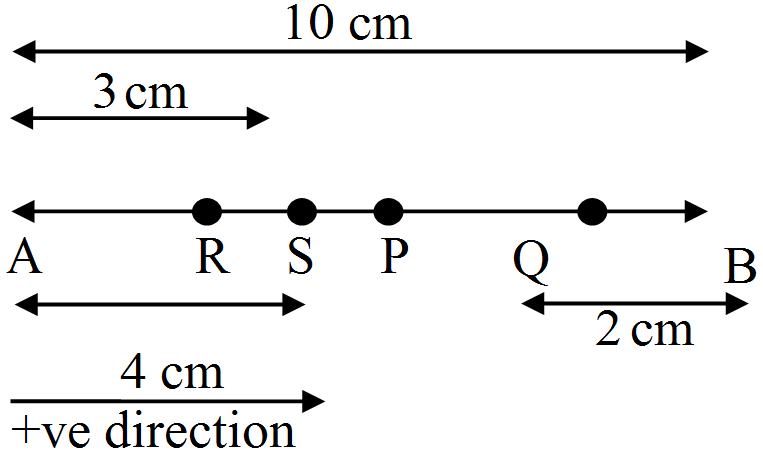
From above figure, where A and B represent the two extreme positions of a SHM. For velocity, the direction from A to B is taken to b positive. The acceleration and the force, along AP are taken as positive and along Bp are taken as negative.
At the mid-point of AB going towards A, the particle is at its mean position P, with a tendency to move along PA. Hence, velocity is positive. Both acceleration and force are zero.
View full question & answer→Question 501 Mark
When a pendulum clock gains time, what adjustment should be made?
AnswerWhen a pendulum clock gains time, it means it has gone fast i.e., it makes more vibrations per day than required. This shows that the time period of oscillation has decreased. Therefore, to correct it, the length of pendulum should be properly increased.
View full question & answer→Question 511 Mark
How will the time period of a simple pendulum change when its length is doubled?
AnswerIt becomes $\sqrt{2}$ times the original time period.
View full question & answer→Question 521 Mark
Sometimes, when an automobile picks up speed, its body begins to rattle. Why?
Answer This is because of resonant vibrations.
View full question & answer→Question 531 Mark
If the displacement is represented by $\text{x}=3\sin\omega\text{t}+4\cos\omega\text{t},$ what is the amplitude?
Answer Phase difference between $3\sin\omega\text{t}$ and $4\cos\omega\text{t}$ is $\frac{\pi}{2}.$$\therefore$ The amplitude is $\sqrt{3^2+4^2},$ i.e., 5 units.
View full question & answer→Question 541 Mark
Is the damping force constant on a system executing SHM?
AnswerNo, because damping force depends upon velocity and is more when the system moves fast and is less when the system moves slow.
View full question & answer→Question 551 Mark
Show that for a particle executing S.H.M, velocity and displacement have a phase difference of $\frac{\pi}{2}.$
Answer Let the displacement equation of SHM$\text{x}=\text{a}\cos\omega\text{t}$
Velocity $\text{v}=\frac{\text{dx}}{\text{dt}}=\text{a}\omega(-\sin\omega\text{t})=-\text{a}\omega\sin\omega\text{t}$$\Rightarrow\text{v}=\text{a}\omega\cos\Big(\frac{\pi}{2}+\omega\text{t}\Big)$
Now, phase of displacement $\phi_1=\omega\text{t}$ Phase of velocity $\phi_2=\frac{\pi}{2}+\omega\text{t}$$\therefore$ Difference in phase of velocity to that of phase of displacement
$\triangle\phi=\phi_2-\phi_1=\Big(\frac{\pi}{2}+\omega\text{t}\Big)-(\omega\text{t})=\frac{\pi}{2}$
View full question & answer→Question 561 Mark
AnswerForce constant is defined as the restoring force developed in a body per unit displacement.
View full question & answer→Question 571 Mark
On what factors does the energy of a harmonic oscillator depend?
AnswerEnergy of a harmonic oscillator depends on the mass, frequency and amplitude of oscillation.
View full question & answer→Question 581 Mark
What is the maximum value of the kinetic energy/ in the case of S.H.M.?
AnswerMaximum value of K.E. is total energy, i.e. $\frac{1}{2}\text{m}\omega^2\text{A}^2.$
View full question & answer→Question 591 Mark
Give the name of three important characteristics of a SHM.
AnswerThree important characteristics of an SHM are amplitude, time period (or frequency) and phase.
View full question & answer→Question 601 Mark
What provides restoring force in the following cases?
- A spring compressed and then left free to vibrate.
- Water disturbed in $U-$tube.
- Pendulum disturbed from its mean position.
Answer
- Elasticity of the material of the spring.
- Weight of water.
- Weight of pendulum.
View full question & answer→Question 611 Mark
When is the tension maximum in the string of a simple pendulum?
AnswerAt the lower-most point or mean position.
View full question & answer→Question 621 Mark
What will be the time period of oscillation, if the length of a second pendulum is one third?
Answer$\frac{\text{T}_2^2}{\text{T}_2^1}=\frac{\text{l}_2}{\text{l}_1}=\frac{\text{l}}{\frac{3}{1}}=\frac{1}{3}$$\text{T}^2_2=\frac{(2)^2}{3}$
$\text{T}_2=\frac{2}{\sqrt{3}}\text{ sec}$
View full question & answer→Question 631 Mark
Can a motion be periodic but not oscillatory? If your answer is yes, give an example and if not explain why?
AnswerYes, e.g., circular motion is periodic but not oscillatory.
View full question & answer→Question 641 Mark
The amplitude of a harmonic oscillator is doubled. How does its energy change?
AnswerAs $\text{E}\propto\text{A}^2$ the energy of harmonic oscillator will became 4 times, its original value when its amplitude is doubled.
View full question & answer→Question 651 Mark
Which of the following examples represent (nearly) simple harmonic motion and which represent periodic but not simple harmonic motion? The rotation of earth about its axis.
AnswerIt is periodic but not simple harmonic motion because it is not to and fro about a fixed point.
View full question & answer→Question 661 Mark
A simple harmonic motion is described by a = -16x where a → acceleration, x → displacement in m. What is the time period?
Answer For S.H.M., $\text{a}=-\omega^2\text{x}$ Comparing with $\text{a}=-16\text{x}$$\because\omega^2=16\Rightarrow\omega=\frac{2\pi}{\text{T}}=\sqrt{16}=4$
$\therefore\text{T}=\frac{\pi}{2}\text{ second}$
View full question & answer→Question 671 Mark
State force law for a simple harmonic motion.
Answer Force $\text{F}\propto-\text{x}$$\Rightarrow\text{F = kx}$
$\Rightarrow\text{F}=-\text{m}\omega^2\text{x}.$
View full question & answer→Question 681 Mark
Is oscillation of a mass suspended by a spring simple harmonic in nature?
AnswerYes, it is if the spring is perfectly elastic.
View full question & answer→Question 691 Mark
All oscillatory motions are periodic and vice-versa. Is it true?
AnswerNo, There are other types of periodic motions also. Circular motion and rotatory motion are periodic but non-oscillatory.
View full question & answer→Question 701 Mark
What provides the restoring force for simple harmonic oscillations in the following cases?
- Simple pendulum.
- Spring.
- Column of mercury in $U-$tube.
Answer
- Part of the force of gravity.
- Elastic restoring force.
- Force due to difference in column of mercury or pressure difference between the levels on the two limbs.
View full question & answer→Question 711 Mark
What is the maximum velocity of the oscillating body?
AnswerMaximum velocity is $\omega\text{A}.$
View full question & answer→Question 721 Mark
A simple pendulum of length l suspended from a roof of a trolley which moves in a horizontal direction with an acceleration a. Find its time period of oscillation.
AnswerThe trolley is accelerated horizontally by a. So, there will be two accelerations, g vertically down and horizontal acceleration a. The net acceleration is $\sqrt{\text{g}^2+\text{a}^2}.$ The time period.$\text{T}=2\pi\sqrt{\frac{\text{l}}{\sqrt{\text{g}^2+\text{a}^2}}}.$
View full question & answer→Question 731 Mark
What will be the change in the time period of a loaded spring when taken to moon?
Answer No change, since $\text{T}=2\pi\sqrt{\frac{\text{m}}{\text{k}}}$
View full question & answer→Question 741 Mark
A cylindrical wooden block of cross-section $15.0 \mathrm{~cm}^2$ and mass 230 gm is floated over water with an extra weight 50 gm attached to its bottom. The cylinder floats vertically. From the state of equilibrium, it is slightly depressed and released. If the specific gravity of wood is 0.30 and $\mathrm{g}=9.8 \mathrm{~m}$ per $\mathrm{sec}^2$, find the frequency of oscillation of the block.
AnswerArea of cross-section of the block $=\pi \mathrm{r}^2=15 \mathrm{~cm}^2=15 \times 10^{-4} \mathrm{~m}^2$ Total weight of the block $=(230+50)=280 \mathrm{gm}=$ 0.28 kg Density of wood $=0.30 \mathrm{gm} / \mathrm{c} . \mathrm{c}=300 \mathrm{~kg} / \mathrm{m}^3$ Density of water $=10^3 \mathrm{~kg}$
When the cylinder is depressed in water through a distance $y$ the restoring force $=$ weight of water displaced $\mathrm{F}=$ Aydg $=\left(15 \times 10^{-4}\right) \times 10^3 \times 9.8$ newton/metre $=1.5 \times 9.8 \mathrm{~N} / \mathrm{m}$ Hence the frequenry of orillation is given by
$=\frac{1}{2\pi}\sqrt{\Big(\frac{\text{k}}{\text{m}}\Big)}$
$=\frac{1}{2\pi}\sqrt{\frac{1.5\times9.8}{0.28}}$
$=1.15\text{Hz}$
View full question & answer→Question 751 Mark
A particle is in linear simple harmonic motion between two points, A and B, 10cm apart. Take the direction from A to B as the positive direction and give the signs of velocity, acceleration and force on the particle when it is: At the end B.
Answer
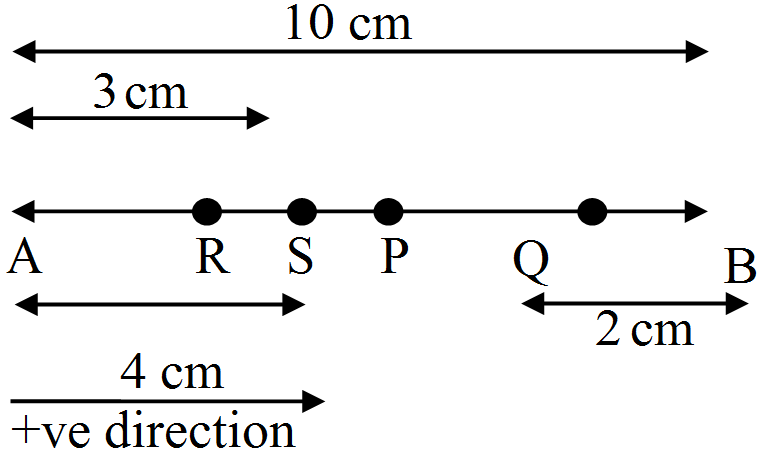
From above figure, where A and B represent the two extreme positions of a SHM. For velocity, the direction from A to B is taken to b positive. The acceleration and the force, along AP are taken as positive and along Bp are taken as negative.
At the end B, velocity is zero. Here, acceleration and force are negative as they are directed along BP.
View full question & answer→Question 761 Mark
The maximum acceleration is a and the maximum velocity is v. What is the amplitude?
Answer $\text{a}_{\text{max}}=-\omega^2\text{A = a, v}_{\text{max}}=\omega\text{A = v}$$\frac{\text{a}_{\text{max}}}{\text{v}_{\text{max}}}=\frac{\text{a}}{\text{v}}=-\omega,$
Also $\text{v}=\omega\text{A}=\frac{\text{a}}{\text{v}}\text{A}$
$\therefore\text{A}=\frac{\text{v}^2}{\text{a}}$
View full question & answer→Question 771 Mark
What is the time period of oscillation of a pendulum in a satellite?
Question 781 Mark
If the total energy with an oscillating system is E, what is the kinetic energy at $\text{x}=\frac{\text{A}}{3}?$
AnswerK.E. $=\frac{1}{2}\text{m}\omega^2(\text{A}^2-\text{x}^2)$ Total energy, $\text{E}=\frac{1}{2}\text{m}\omega^2\text{A}^2$ At, $\text{x}=\frac{\text{A}}{3},$ K.E. $=\frac{1}{2}\text{m}\omega^2\Big(\text{A}^2-\frac{\text{A}^2}{9}\Big)$$=\frac{8}{9}\frac{1}{2}\text{m}\omega^2\text{A}^2=\frac{8}{9}\text{E}$
View full question & answer→Question 791 Mark
What is I second's pendulum? What is the length of a second's pendulum?
AnswerA pendulum having a time period of 2 seconds is called second's pendulum. Since $\text{T}=2\pi\sqrt{\frac{\text{l}}{\text{g}}},$$\text{l}=\frac{\text{T}^2\text{g}}{4\pi^2}=\frac{4\text{g}}{4\pi^2}=1\text{m}$
View full question & answer→Question 801 Mark
Two simple pendulum of equal length cross each other at mean position. What is their phase difference?
Question 811 Mark
What is the frequency of oscillation of a simple pendulum mounted in a cabin that is freely falling under gravity?
Question 821 Mark
What is the frequency of variation of potential or kinetic energy when the frequency of the oscillation is f?
AnswerSince K.E. or P.E. $\propto\cos^2\omega\text{t}$ or $\sin^2\omega\text{t},$ the frequency of variation is 2f.
View full question & answer→Question 831 Mark
Two clocks, one working with oscillating pendulum and the other with spring are given. Which one will you use in satellite?
AnswerThe clock with spring is preferred, since it is not influenced by variation in g.
View full question & answer→Question 841 Mark
Why the amplitude of the vibrating pendulum should be small?
Answer For S.H.M., restoring force should always be pointing towards the mean position which is not possible at large angles.
View full question & answer→Question 851 Mark
Which of the following conditions is not sufficient for $\text{S.H.M}$. and why?
- Acceleration displacement.
- Restoring force o displacement.
AnswerAcceleration $\propto$ displacement is not sufficient since it does not refer the direction of these quantities. As you know acceleration is always against displacement.
View full question & answer→Question 861 Mark
What determines the natural frequency of a body?
AnswerNatural frequency of a body depends upon:
- Elastic properties of the material of the body and.
- Dimensions of the body.
View full question & answer→Question 871 Mark
State the conditions when motion of a particle can be an SHM.
AnswerFor SHM, the restoring force on the particle must be proportional to its displacement and directed towards mean position.
View full question & answer→Question 881 Mark
A particle is in linear simple harmonic motion between two points, A and B, 10cm apart. Take the direction from A to B as the positive direction and give the signs of velocity, acceleration and force on the particle when it is:At 3cm away from A going towards B.
Answer
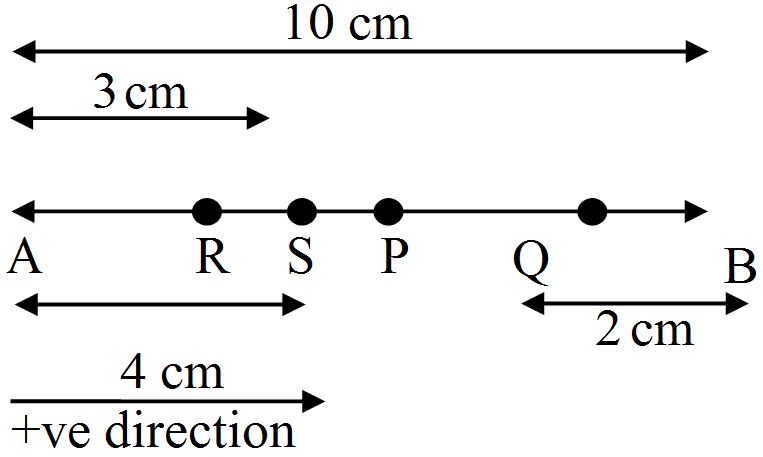
From above figure, where A and B represent the two extreme positions of a SHM. For velocity, the direction from A to B is taken to b positive. The acceleration and the force, along AP are taken as positive and along Bp are taken as negative.
At 3cm away from A going towards B, the particle is at R, with a tendency to move along RP, which is positive direction. Here, velocity, acceleration all are positive.
View full question & answer→Question 891 Mark
Can a simple pendulum vibrate at the centre of Earth?
AnswerNo. This is because of zero value of g at the centre of Earth.
View full question & answer→Question 901 Mark
A simple pendulum is inside a space craft. What should be its time period of vibration?
AnswerInfinity or it does not oscillate.
View full question & answer→Question 911 Mark
A driver wearing an electronic digital watch goes down into sea water with terminal velocity v. How will the time in the water proof watch be affected?
Answer It will not be affected as its action is independent of gravity and buoyant force.
View full question & answer→Question 921 Mark
What is the total energy of a simple harmonic oscillator?
Answer$\frac{1}{2}\text{m}\omega^2\text{r}^2$ where r = amplitude, $\omega$ = angular frequency, m = mass of the oscillator.
View full question & answer→Question 931 Mark
A simple pendulum is mounted inside a space craft. What should be its time period of oscillation?
Answer A simple pendulum is mounted inside a space craft. its time period of oscillation is given by$\text{T}=2\pi\sqrt{\frac{\text{l}}{\text{g}}}$
Here, I = 0, so T becomes infinity.
View full question & answer→Question 941 Mark
Two springs of force constant $\mathrm{k}_1$ and $\mathrm{k}_2$ are joined in parallel. What is the force constant of the combination?
AnswerForce constant $k$ of parallel combination is given by $k=k_1+k_2$. Thus, force constant of the parallel combination is equal to the sum of individual force constants of two springs.
View full question & answer→Question 951 Mark
Are all periodic motions oscillatory by nature?
AnswerAll periodic motions need not be oscillatory.
View full question & answer→Question 961 Mark
Will a pendulum gain or lose time when taken to the top of a mountain?
AnswerAt height as we move up 'g' decreases. Since $\text{T}\propto\frac{1}{\sqrt{\text{g}}}$ time period increases.
View full question & answer→Question 971 Mark
How many times in one vibration, K.E. and P.E. become maximum?
Question 981 Mark
A particle is executing $\text{S.H.M.}$ Identify the positions of the particle where:
- $\text{K.E}$. of the particle is zero.
- $\text{P.E}$. is zero.
- $\text{P.E}$. is one fourth of the total energy.
- $\text{P.E}$. and $\text{K.E}$. are equal.
Answer
- At extreme position $(x = A)$
- At mean position $(x = 0)$
- $\frac{1}{2}\text{m}\omega^2(\text{A}^2-\text{x}^2)=\frac{1}{4}\times\frac{1}{2}\text{m}\omega^2\text{A}^2$
$\Rightarrow\text{x}=\frac{\sqrt{3}\text{A}}{2}$
- $\frac{1}{2}\text{m}\omega^2(\text{A}^2-\text{x}^2)=\frac{1}{2}\text{m}\omega^2\text{A}^2$
$\Rightarrow\text{x}=\frac{\text{A}}{\sqrt{2}}$ View full question & answer→Question 991 Mark
At what points is the energy entirely kinetic and potential in SHM?
Answer At mean position, the energy is entirely K.E. At extreme positions, the energy is entirely P.E.
View full question & answer→Question 1001 Mark
A mass of 2 kg is attached to the spring of spring constant $50 \mathrm{Nm}^{-1}$. The block is pulled to a distance of 5 cm from its equilibrium position at $\mathrm{x}=0$ on a horizontal frictionless surface from rest at $\mathrm{t}=0$. Write the expression for its displacement at anytime $t$.
View full question & answer→Question 1011 Mark
If the body is given a small displacement from the mean position, a force comes in to play which tends to bring the body back to the mean point, this give rise to vibrations. Define phase of a vibrating particle.
AnswerThe phase of a vibrating particle at any instant of time is the state of particle as regards to its position and state of motion.
View full question & answer→Question 1021 Mark
Is simple harmonic motion always linear?
Answer No, it is not essential. Simple harmonic motion may be either a linear simple harmonic motion or an angular SHM.
View full question & answer→Question 1031 Mark
What is the phase difference between the displacement and velocity in a S.H.M.?
Answer$\frac{\pi}{2}\text{ radians}.$
View full question & answer→Question 1041 Mark
At what point the velocity and acceleration are zero in S.H.M?
AnswerThe velocity is zero at the extreme point of motion and acceleration is zero at the mean position of motion.
View full question & answer→Question 1051 Mark
A girl swinging suddenly stands up on the swing. What is the influence on the time period and frequency?
AnswerGirl can be considered as an extended body. As the girl stands up on the swing so, the separation ‘d’ between the point of suspension and the centre of gravity decreases. Since time period is inversely proportional to $\sqrt{\text{d}},$ time period increases and frequency decreases.
View full question & answer→Question 1061 Mark
Which of the following examples represent (nearly) simple harmonic motion and which represent periodic but not simple harmonic motion? Motion of a ball bearing inside a smooth curved bowl, when released from a point slightly above the lower most point.
AnswerIt is simple harmonic motion because the ball moves to and fro about the lowermost point of the bowl when released. Also, the ball comes back to its initial position in the same period of time, again and again.
View full question & answer→Question 1071 Mark
Which of the following examples represent periodic motion?A hydrogen molecule rotating about its centre of mass.
Answer Rotatary motion is periodic as repeating after fixed time-interval.
View full question & answer→Question 1081 Mark
In the arrangement shown in the figure, the block of mass m is displaced, what is the frequency of oscillation?
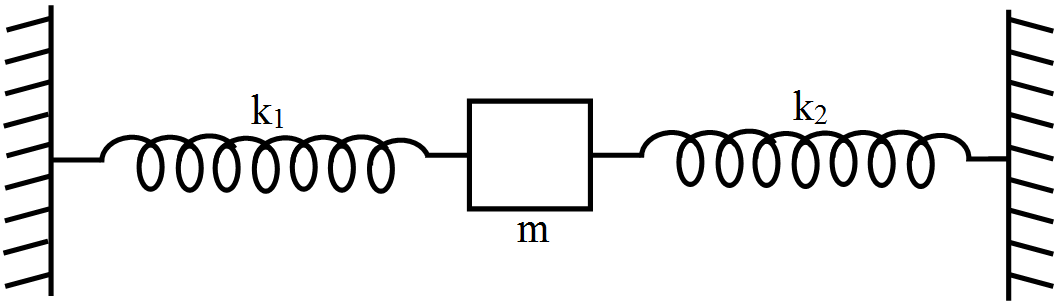
AnswerSince extension is ofequal amount acting in the springs, the frequeocy is$\text{f}=\frac{1}{2\pi}\sqrt{\frac{\text{k}_1+\text{k}_2}{}\text{m}}$
View full question & answer→Question 1091 Mark
Why should the amplitude of the vibrating pendulum be small?
AnswerWhen amplitude of the vibrating pendulum is small, then angular displacement of the bob used in simple pendulum is small. Here the restoring force$\text{F}=\text{mg}\sin\theta=\text{mg}\theta=\frac{\text{mgx}}{\text{l}}$
Where x is the displacement of the bob and I is the length of pendulum . Hence $\text{F}\propto\text{x}$ Since F is directed towards mean position, therefore the motion of the bob of simple pendulum will be S. H. M.if $\theta$ is small.
View full question & answer→Question 1101 Mark
A simple harmonic motion is described by a = -16x where a → acceleration and x is displacement in meter. What is the time period?
AnswerAcceleration in simple harmonic motion, $a=w^2 x a=-16 x=-w^2 x \Rightarrow w=4$, Time Period, T $=\frac{2\pi}{\text{w}}=\frac{2\pi}{4}=\frac{\pi}{2}$
View full question & answer→Question 1111 Mark
What is a second's pendulum?
AnswerA pendulum, whose time period is 2 seconds is called a second's pendulum.
View full question & answer→Question 1121 Mark
A spring of constant k is cut into two equal parts. What is the spring constant of each part?
Answer Each part carries a constant 2k.
View full question & answer→Question 1131 Mark
A particle is in linear simple harmonic motion between two points, A and B, 10cm apart. Take the direction from A to B as the positive direction and give the signs of velocity, acceleration and force on the particle when it is:At 2cm away from B going towards A.
Question 1141 Mark
A particle is in linear simple harmonic motion between two points, A and B, 10cm apart. Take the direction from A to B as the positive direction and give the signs of velocity, acceleration and force on the particle when it is:At 4cm away from B going towards A.
Answer
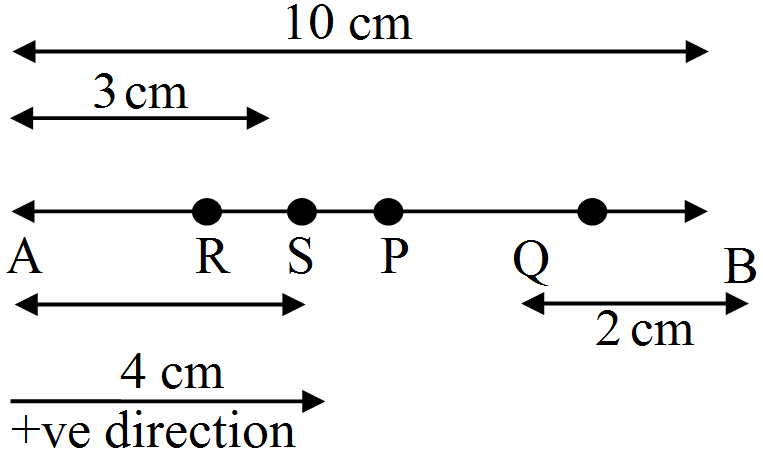
From above figure, where A and B represent the two extreme positions of a SHM. For velocity, the direction from A to B is taken to b positive. The acceleration and the force, along AP are taken as positive and along Bp are taken as negative.
At 4cm away from A going towards A, the particles is at S, with a tendency to move along SA, which is negative direction. Therefore, velocity is negative but acceleration is directed towards mean position, along SP. Hence it is positive and also force is positive similarly.
View full question & answer→Question 1151 Mark
During the oscillation of the bob of a simple pendulum, what is the quantity that remains constant?
AnswerTotal mechanical energy associated always remains constant.
View full question & answer→Question 1161 Mark
How would the period of spring mess system change when it is med€ to oscillatc horizontally and then vertically?
AnswerTime period is independent of g. So no change.
View full question & answer→Question 1171 Mark
Why does a simple pendulum eventually stop?
Answer Due to damping forces like air resistance.
View full question & answer→Question 1181 Mark
Which of the following examples represent (nearly) simple harmonic motion and which represent periodic but not simple harmonic motion? Motion of an oscillating mercury column in a U-tube.
Answer It is a simple harmonic motion because the mercury moves to and fro on the same path, about the fixed position, with a certain period of time.
View full question & answer→Question 1191 Mark
Give the geometrical meaning of S.H.M.
AnswerGeometrically S.H.M. refers to the projection of a uniform circular motion along any diameter.
View full question & answer→Question 1201 Mark
Figure (a) shows a spring of force constant k clamped rigidly at one end and a mass m attached to its free end. A force F applied at the free end stretches the spring. Figure (b) shows the same spring with both ends free and attached to a mass m at either end. Each end of the spring in Fig. (b) is stretched by the same force F.
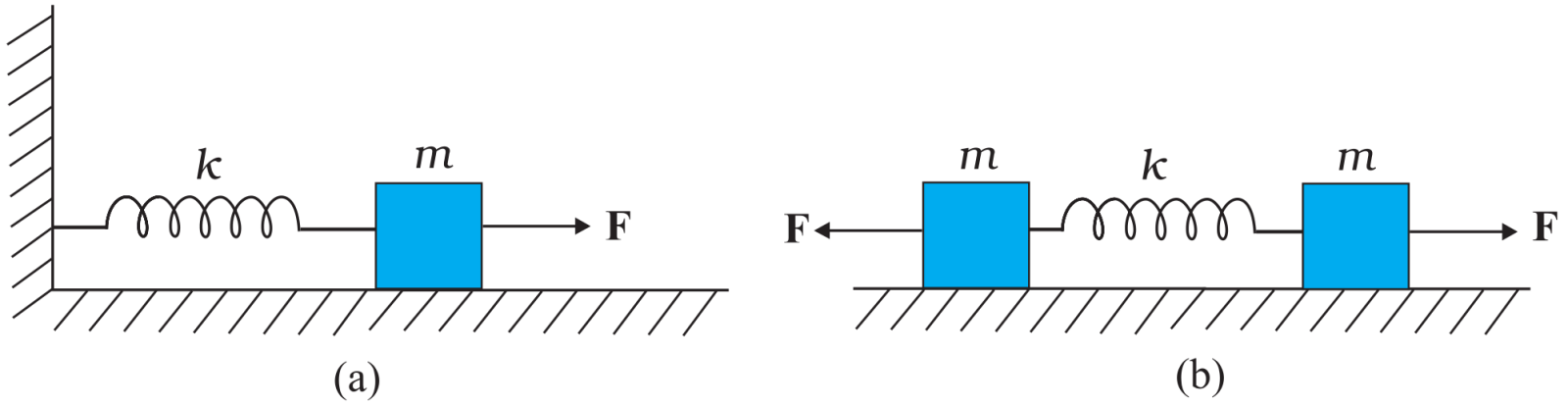
What is the maximum extension of the spring in the two cases?
AnswerThe maximum extension of the spring in both cases will = Flk, where k is the spring constant of the springs used.
View full question & answer→Question 1211 Mark
A simple pendulum is transferred from earth to the surface of moon. How will its time period be affected?
Answer As value of g on moon is less than that on earth, in accordance with the relation $\text{T}=2\pi\sqrt{\frac{\text{l}}{\text{g}}}$the time period of oscillations of a simple pendulum on moon will be greater.
View full question & answer→Question 1221 Mark
A simple harmonic motion is described by a = -16x where a is acceleration and x is displacement in meter. What is the time-period?
Answer For simple harmonic motion, $\text{a}=\omega^2\text{x}$ comparing with $\text{a}=-16\text{x}$$\because\omega^2=16$
$\Rightarrow\omega=\frac{2\pi}{\text{T}}=\sqrt{16}=4$
$\text{T}=\frac{\pi}{2}\text{ sec}.$
View full question & answer→Question 1231 Mark
Every SHM is periodic motion, but every periodic motion need not to be a simple harmonic motion. Do you agree? Give an example to justify your statement.
AnswerYes, every periodic motion need not to be SHM. e.g. the motion of the earth round the sun is a periodic motion, but not simple harmonic motion as the back and forth motion is not taking place.
View full question & answer→Question 1241 Mark
A spring of force constant k is broken into n equal parts (n > 0). What will be the spring factor of each part?
Answer The spring factor of each equal part is nk.
View full question & answer→Question 1251 Mark
Write the condition necessary for a motion to be S.H.M.
Answer Restoring force or acceleration is proportional to negative of displacement.
View full question & answer→Question 1261 Mark
Fig. depicts four x-t plots for linear motion of a particle. Which of the plots represent periodic motion? What is the period of motion (in case of periodic motion)?
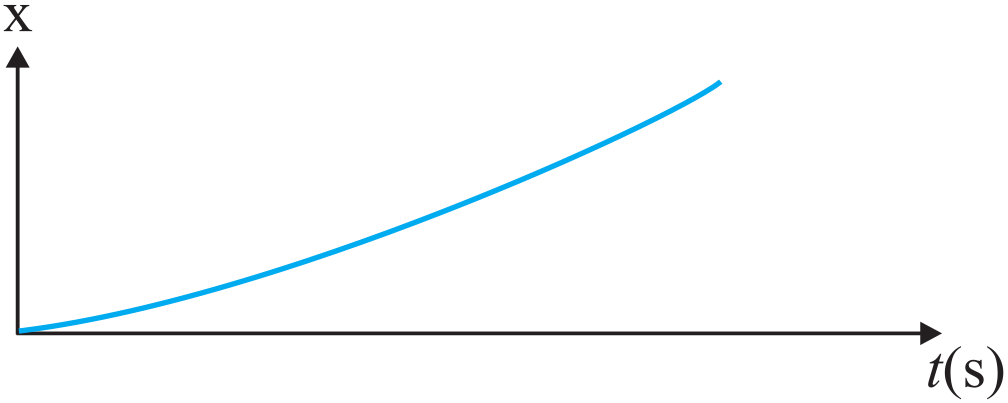
Answer It is not a periodic motion. This represents a unidirectional, linear uniform motion. There is no repetition of motion in this case.
View full question & answer→Question 1271 Mark
What are simple harmonic (or sinusoidal functions)?
Answer Bounded trigonometric functions (Sinusoidal-sine and cosine) having their second derivative proportional to them are called simple harmonic functions.
View full question & answer→Question 1281 Mark
What do you mean by resonance in oscillation?
Answer When the natural frequency of oscillation and the frequency of the force oscillating it are same then there is said to be resonance in oscillation.
View full question & answer→Question 1291 Mark
Answer the following questions:What is the frequency of oscillation of a simple pendulum mounted in a cabin that is freely falling under gravity?
Answer When a simple pendulum mounted in a cabin falls freely under gravity, its acceleration is zero. Hence the frequency of oscillation of this simple pendulum is zero.
View full question & answer→Question 1301 Mark
Can a motion be periodic but not oscillatory? If your answer is yes, give an example and if not explain why?
AnswerYes, uniform circular motion is the example of it.
View full question & answer→Question 1311 Mark
What fraction of the total energy is kinetic energy when the displacement is one-half of amplitude?
Answer$\frac{\text{K.E.}}{\text{Total energy}}=\frac{\frac{1}{2}\text{m}\omega^2\Big(\text{a}^2-\frac{\text{a}^2}{4}\Big)}{\frac{1}{2}\text{m}\omega^2\text{a}^2}$$=\frac{3}{4}$
View full question & answer→Question 1321 Mark
Two identical springs of spring constant K are attached to a block of mass m and to fixed supports as shown in Fig. When the mass is displaced from equilllibrium position by a distance x towards right, find the restoring force.
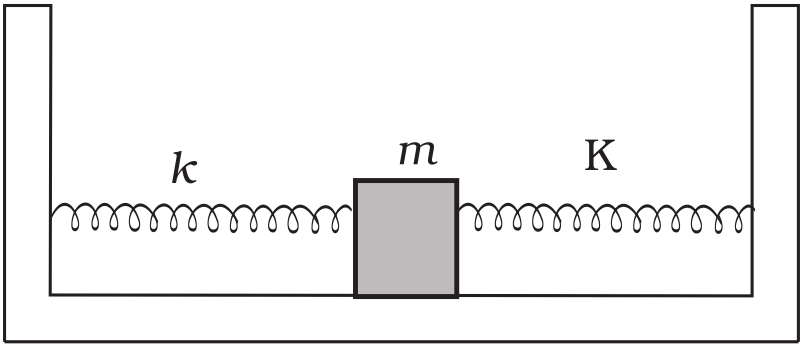
AnswerWhen mass is displaced from equilibrium position by a distance x towards right, the right spring gets compressed by x developing a restoring force kx towards left on the block. The left spring is stretched by an amount x developing a restoring force kx left on the block.
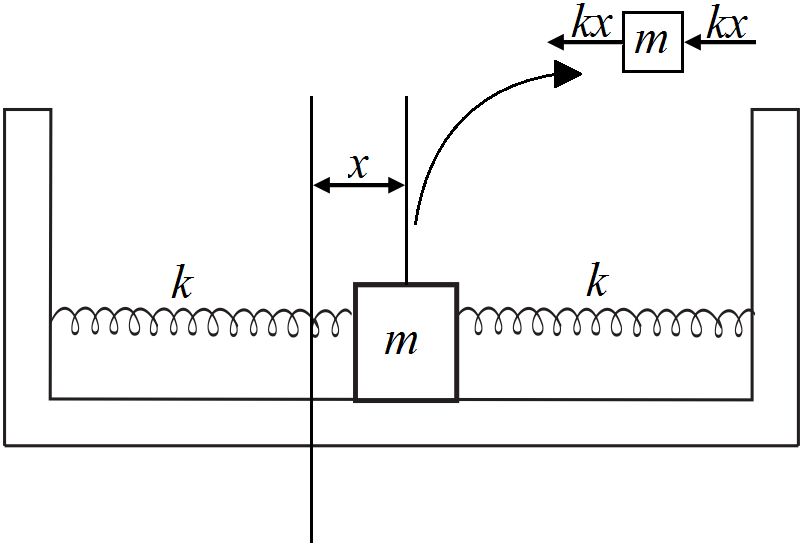
Developing a restoring force $K x$ towards Left on the block. $F_1=-K x$ (for left spring) and $F_2=-K x$ (for right spring) Restoring force, $F=F_1+F_2=-2 K x: . F=2 K x$ towards left. View full question & answer→Question 1331 Mark
Plot a graph between the time period (T) for a simple pendulum and its length (l).
Answer$\text{T}\propto\sqrt{\text{l}}$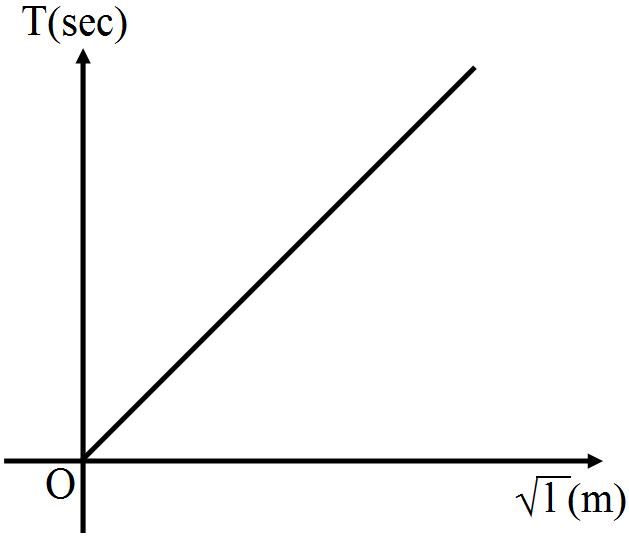
View full question & answer→Question 1341 Mark
A particle is vibrating in SHM when the displacements of the particle from its equilibrium position are $x_1$ and $x_2$, it has velocities $v_1$ and $v_2$ respectively. Show that its time period is given by $\text{T}=2\pi\sqrt{\frac{\text{x}_1^2-\text{x}_2^2}{\text{v}_2^2-\text{v}_1^2}}$.
AnswerThe particle velocity in SHM is given by: $\text{v}=\omega\sqrt{\text{A}^2-\text{x}^2}$ where A is the amplitude of oscillation. For displacement $\text{x}=\text{x}_1$$\text{v}_1=\omega\sqrt{\text{A}^2-\text{x}_1^2}$
$\text{v}_1^2=\omega^2(\text{A}^2-\text{x}_1^2)\cdots\text{(i)}$
For displacement $\text{x}=\text{x}_2$$\text{v}_2=\omega\sqrt{\text{A}^2-\text{x}_2^2}$
$\text{v}_2^2=\omega^2(\text{A}^2-\text{x}_2^2)\cdots\text{(ii)}$
Subtracting (i) from (ii), we have$\text{v}_2^2=\text{v}_2\omega^2(\text{x}_1^2-\text{x}_2^2)$
$\Rightarrow\omega=\sqrt{\frac{(\text{v}_2^2-\text{v}_1^2)}{(\text{x}_1^2-\text{x}_2^2)}}$
$\therefore$ Period of oscillation $\text{T}=\frac{2\pi}{\omega}$
$=2\pi\sqrt{\frac{(\text{x}_2^2-\text{x}_2^2)}{(\text{v}_1^2-\text{v}_2^2)}}$
View full question & answer→Question 1351 Mark
Plot a graph between the square of the time period ($\text{T}^2$) and length (l) for a simple pendulum.
Answer$\text{T}^2\propto\text{l}$
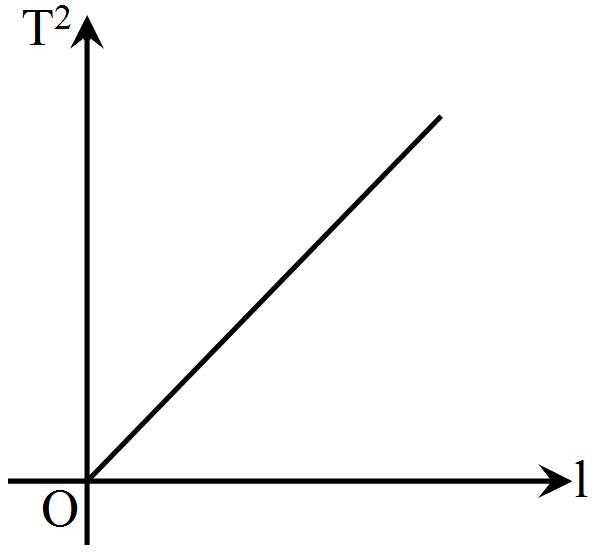
View full question & answer→Question 1361 Mark
On an average, a human heart is found to beat 75 times in a minute. Calculate its frequency and period.
Answer$\begin{aligned} \text {The beat frequency of heart } & =75 /(1 min ) \\ & =75 /(60 s ) \\ & =1.25 s ^{-1} \\ & =1.25 Hz ^{-1} \\ & =1 /\left(1.25 s ^{-1}\right) \\ & =0.8 s \end{aligned}$
View full question & answer→