Question 15 Marks
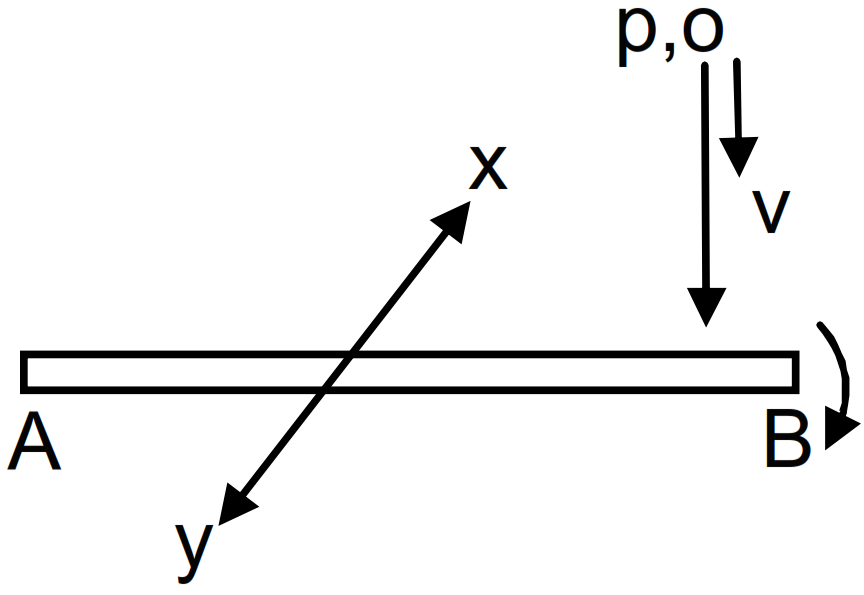
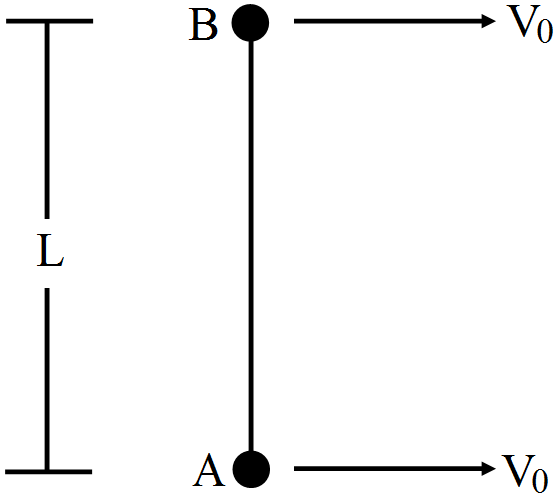
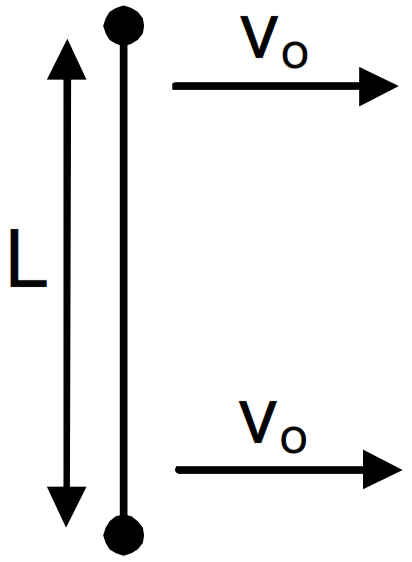
A metre stick weighing 240g is pivoted at its upper end in such a way that it can freely rotate in a vertical plane through this end (figure). A particle of mass 100g is attached to the upper end of the stick through a light string of length 1m. Initially, the rod is kept vertical and the string horizontal when the system is released from rest. The particle collides with the lower end of the stick and sticks there. Find the maximum angle through which the stick will rise.
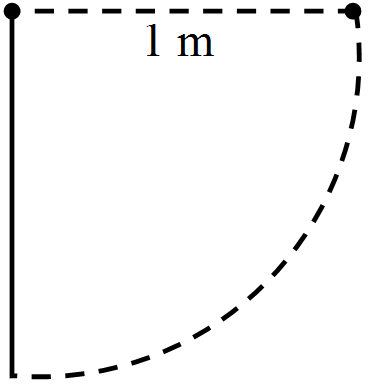
Answer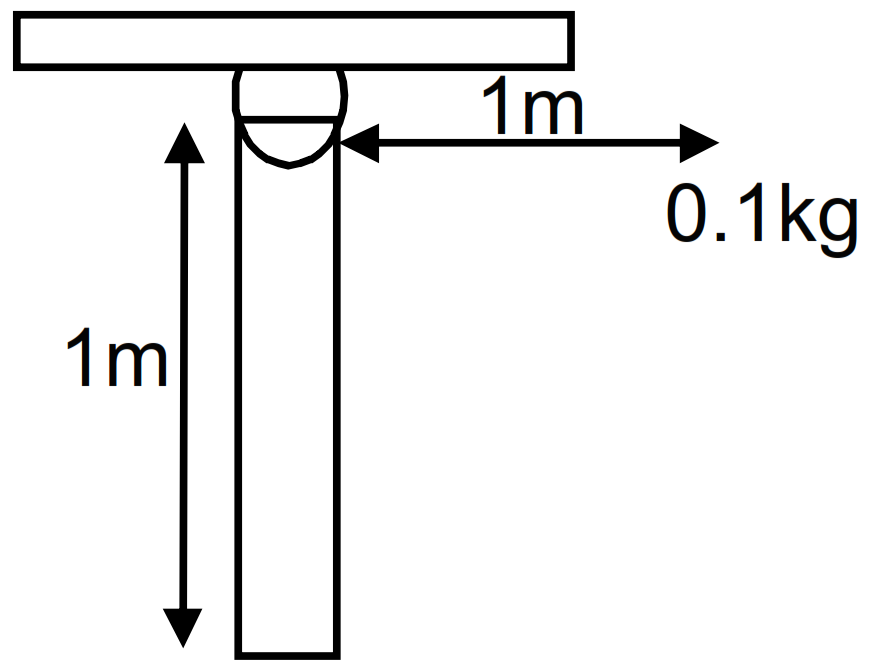 $\frac{1}{2}\text{l}\omega^2-0=0.1\times10\times1$
$\Rightarrow\omega=\sqrt{20}$
For collision
$0.1\times1^2\times\sqrt{20}+0=\Big[\Big(\frac{0.24}{3}\Big)\times1^2+(0.1)^21^2\Big]\omega'$
$\Rightarrow\omega'=\frac{\sqrt{20}}{10.(0.18)}$
$\Rightarrow0-\frac{1}{2}\omega'^2=-\text{m}_1\text{gl}(1-\cos\theta)-\text{m}_2\text{g}\frac{\text{l}}2{}(1-\cos\theta)$
$=0.1\times10(1-\cos\theta)=0.24\times10\times0.5(1-\cos\theta)$
$\Rightarrow\frac{1}{2}\times0.18\times\Big(\frac{20}{3.24}\Big)=2.2(1-\cos\theta)$
$\Rightarrow(1-\cos\theta)=\frac{1}{(2.2\times1.8)}$
$\Rightarrow1-\cos\theta=0.252$
$\Rightarrow\cos\theta=1-0.252=0.748$
$\Rightarrow\omega=\cos^{-1}(0.748)=41^\circ$
View full question & answer→$\frac{1}{2}\text{l}\omega^2-0=0.1\times10\times1$$\Rightarrow\omega=\sqrt{20}$
For collision
$0.1\times1^2\times\sqrt{20}+0=\Big[\Big(\frac{0.24}{3}\Big)\times1^2+(0.1)^21^2\Big]\omega'$
$\Rightarrow\omega'=\frac{\sqrt{20}}{10.(0.18)}$
$\Rightarrow0-\frac{1}{2}\omega'^2=-\text{m}_1\text{gl}(1-\cos\theta)-\text{m}_2\text{g}\frac{\text{l}}2{}(1-\cos\theta)$
$=0.1\times10(1-\cos\theta)=0.24\times10\times0.5(1-\cos\theta)$
$\Rightarrow\frac{1}{2}\times0.18\times\Big(\frac{20}{3.24}\Big)=2.2(1-\cos\theta)$
$\Rightarrow(1-\cos\theta)=\frac{1}{(2.2\times1.8)}$
$\Rightarrow1-\cos\theta=0.252$
$\Rightarrow\cos\theta=1-0.252=0.748$
$\Rightarrow\omega=\cos^{-1}(0.748)=41^\circ$
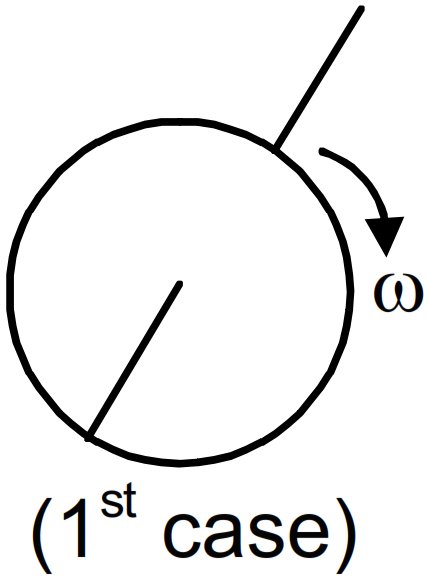
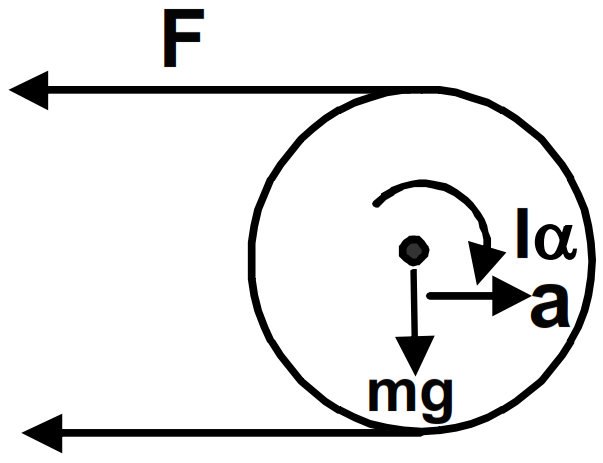
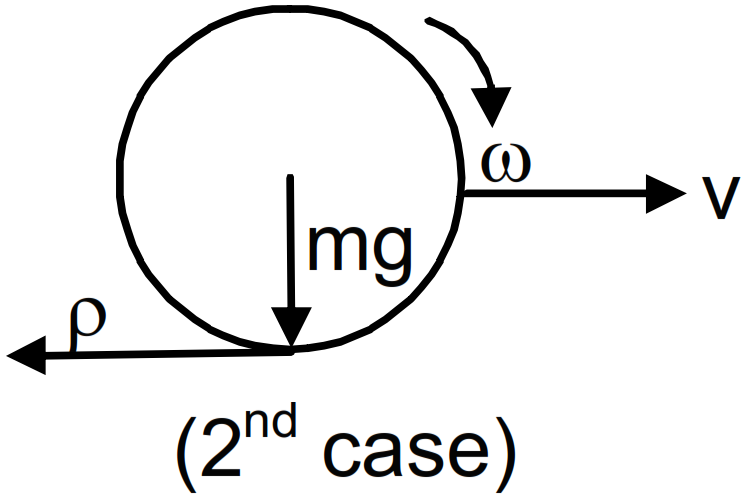 If we consider the net moment at A then it is zero. Therefore the net angular momentum before pure rolling & after pure rolling remains constant Before rolling the wheel was only rotating around its axis. Therefore Angular momentum $=\ell\omega=\Big(\frac{1}{2}\Big)\text{MR}^2\omega\ \dots(1)$ After pure rolling the velocity of the wheel let v Therefore angular momentum $=\ell_{\text{cm}}\omega+\text{m}(\text{v}\times\text{R})$$=\Big(\frac{1}{2}\Big)\text{m}\text{R}^2\Big(\frac{\text{v}}{\text{R}}\Big)+\text{mvR}=\frac{3}{2}\text{mvR}\ \dots(2)$
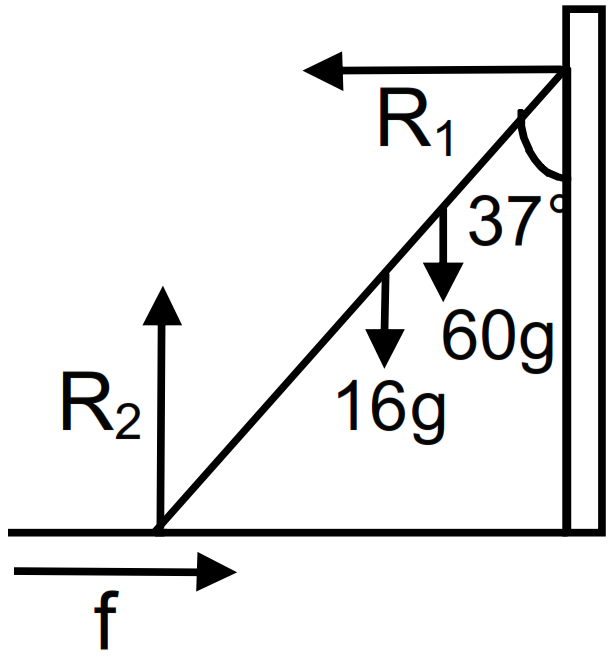 $\mu=0.54,\ \text{R}_2=16\text{g}+\text{mg};\ \text{R}_1=\mu\text{R}_2$
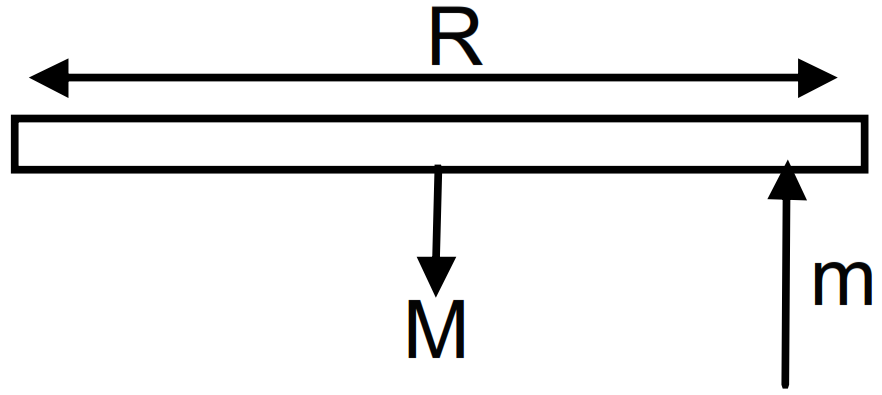 Let the mass of the particle = m & the mass of the rod = M.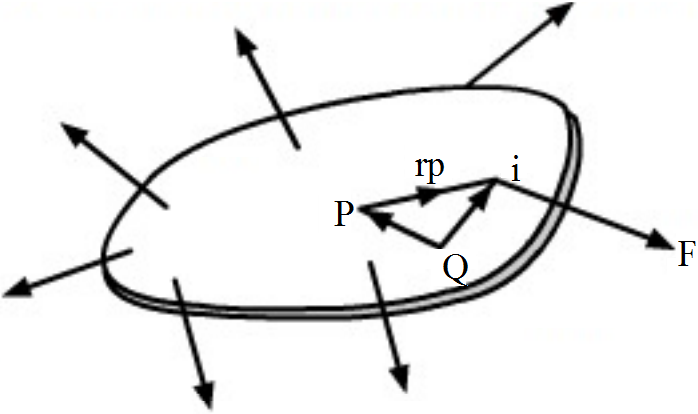
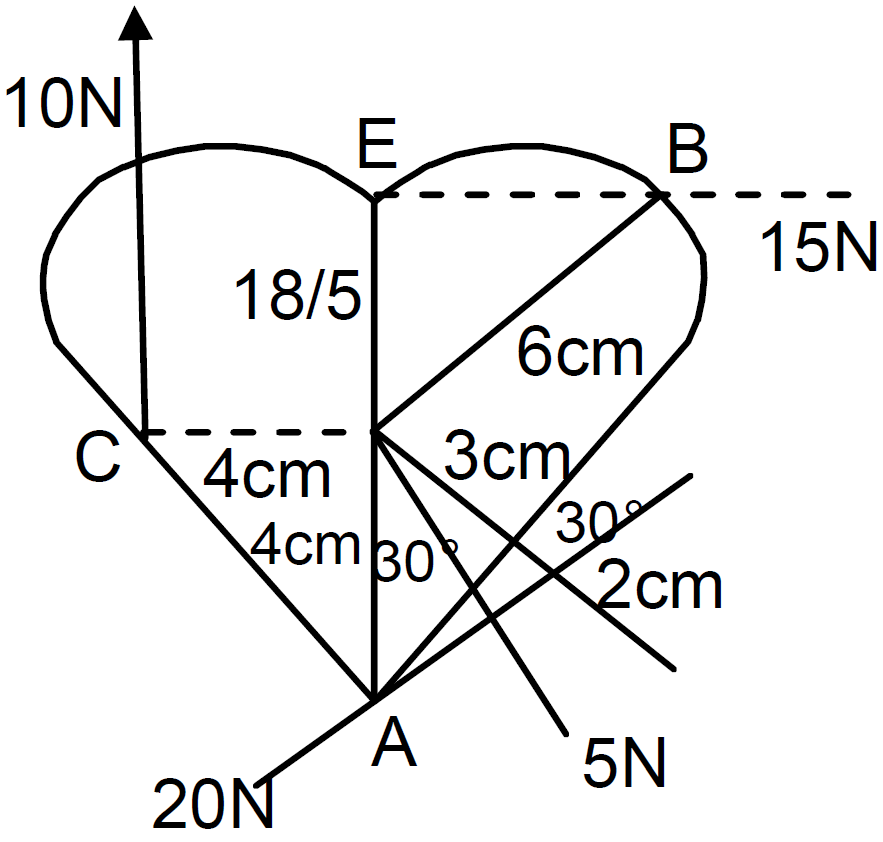
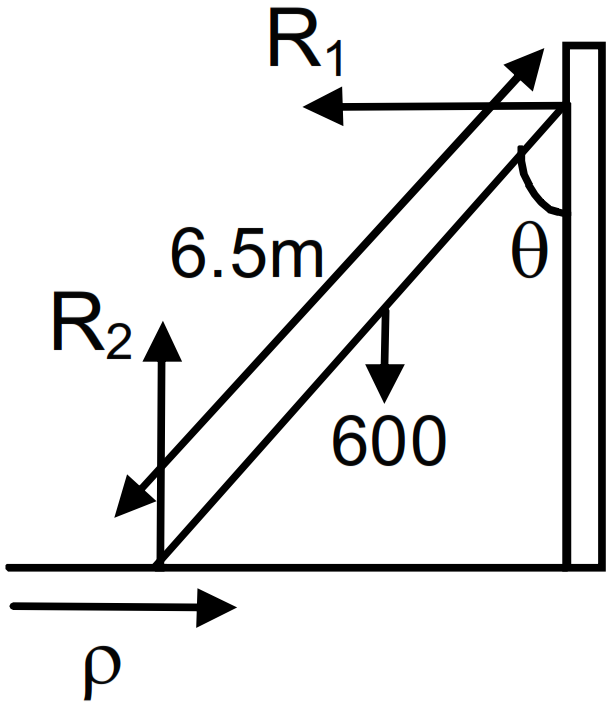 m = 60kg, ladder length = 6.5m, height of the wall = 6m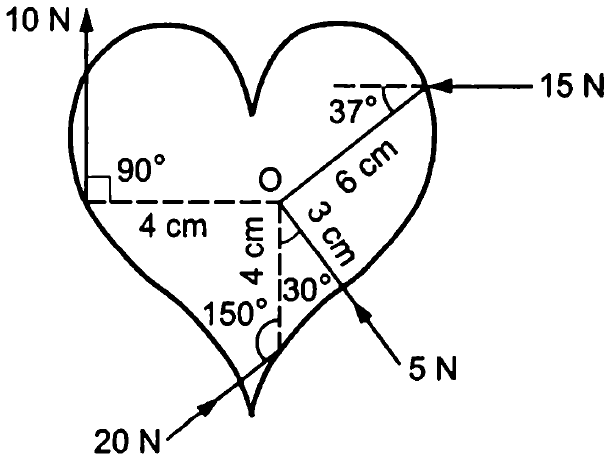
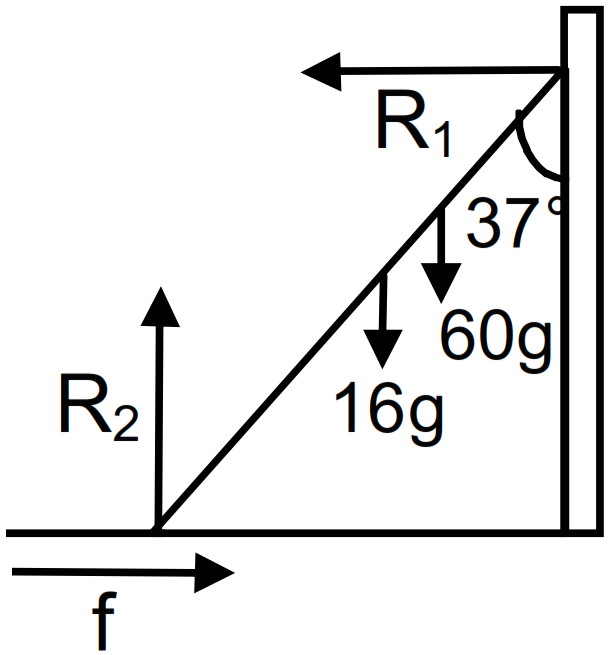 $\text{R}_1=\mu\text{R}_2,\ \text{R}_2=16\text{g}+60\text{g}=745\text{N}$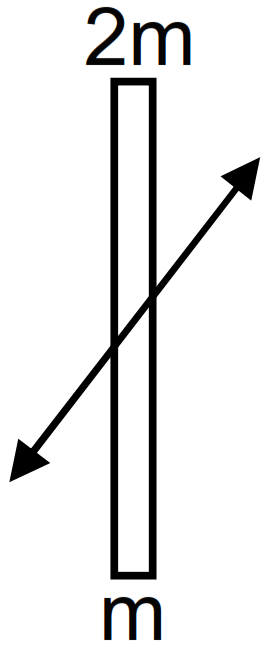
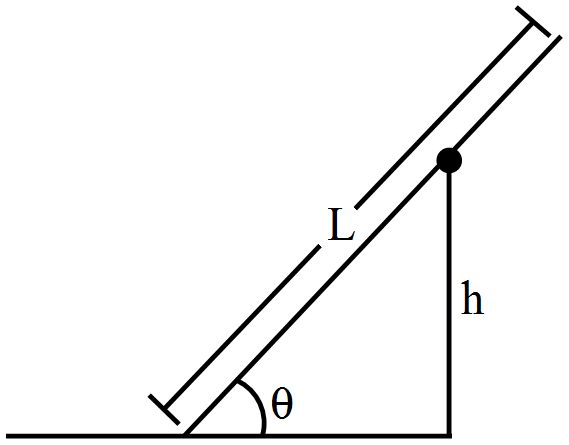
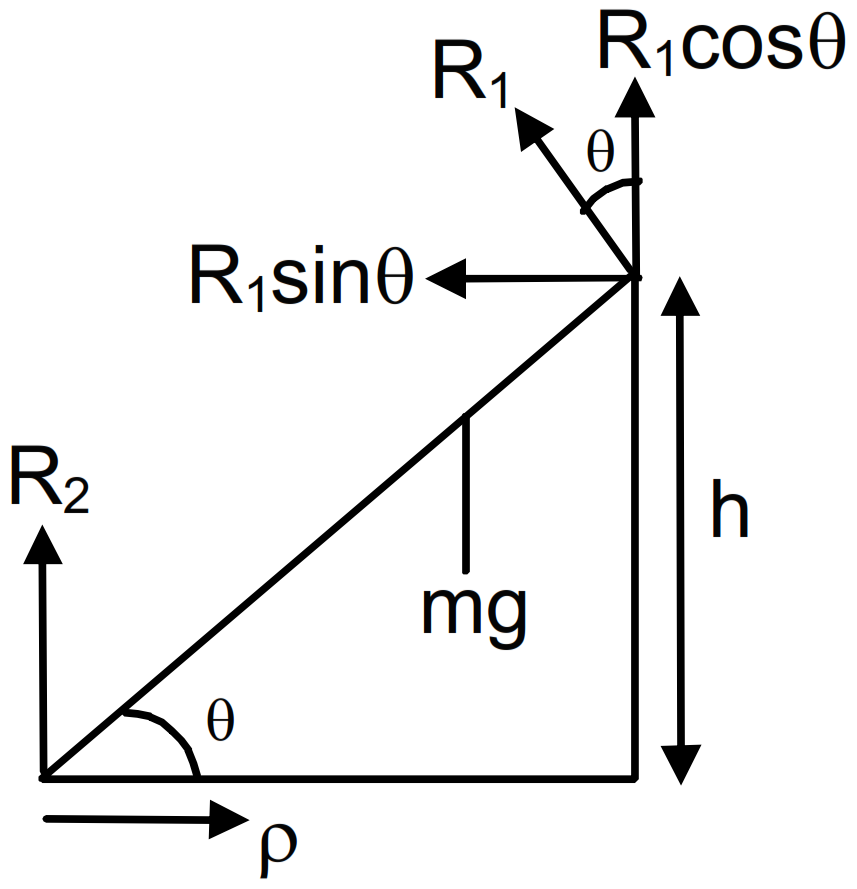 Rod has a length = L