Question 13 Marks
What is the pressure inside the drop of mercury of radius $3.00mm$ at room temperature? Surface tension of mercury at that temperature $(20^\circ C) is 4.65 \times 10^{–1}N m^{–1}$. The atmospheric pressure is $1.01 × 10⁵Pa$. Also give the excess pressure inside the drop.
AnswerRadius of the mercury drop, $\mathrm{r}=3.00 \mathrm{~mm}=3 \times 10^{-3} \mathrm{~m}$ Surface tension of mercury, $\mathrm{S}=4.65 \times 10^{-1} \mathrm{~N} \mathrm{~m}^{-1}$ Atmospheric pressure, $\mathrm{P}_0=1.01 \times 10^5 \mathrm{~Pa}$ Total pressure inside the mercury drop. $=$ Excess pressure inside mercury + Atmospheric pressure $=2 \mathrm{~S} / \mathrm{r}+\mathrm{P}_0=\left[\frac{2 \times 4.65 \times 10^{-1}}{\left(3 \times 10^{-3}\right)}\right]+1.01 \times 10^5=1.0131 \times 10^5=1.01 \times 10^5 \mathrm{~Pa}$ Excess pressure $=2 \mathrm{~S} / \mathrm{r}$ $=\left[\frac{2 \times 4.65 \times 10^{-1}}{\left(3 \times 10^{-3}\right)}\right] 310 \mathrm{pa}$
View full question & answer→Question 23 Marks
In a test experiment on a model aeroplane in a wind tunnel, the flow speeds on the upper and lower surfaces of the wing are $70m s^{–1}$ and $63m s^{-1}$ respectively. What is the lift on the wing if its area is $2.5m^2$? Take the density of air to be $1.3kg m^{–3}$.
AnswerSpeed of wind on the upper surface of the wing, $\mathrm{V}_1=70 \mathrm{~m} / \mathrm{s}$ Speed of wind on the lower surface of the wing, $\mathrm{V}_2=$ $63 \mathrm{~m} / \mathrm{s}$ Area of the wing, $\mathrm{A}=2.5 \mathrm{~m}^2$ Density of air, $\rho=1.3 \mathrm{~kg} \mathrm{~m}^{-3}$ According to Bernoulli's theorem, we have the relation: $\mathrm{p}_1+\frac{1}{2} \rho \mathrm{~V}_1^2=\mathrm{P}_2+\frac{1}{2} \rho \mathrm{~V}_2^2 \mathrm{P}_2-\mathrm{P}_1=\frac{1}{2} \rho\left(\mathrm{~V}_1^2-\mathrm{V}_2^2\right)$ Where, $\mathrm{P}_1=$ Pressure on the upper surface of the wing. $P_2=$ Pressure on the lower surface of the wing. The pressure difference between the upper and lower surfaces of the wing provides lift to the aeroplane.
View full question & answer→Question 33 Marks
A U-tube contains water and methylated spirit separated by mercury. The mercury columns in the two arms are in level with $10.0cm$ of water in one arm and $12.5cm$ of spirit in the other. What is the specific gravity of spirit?
AnswerHeight of the spirit column, $h_1 = 12.5cm = 0.125m$ Height of the water column, $h_2 = 10cm = 0.1m \rho_0$ = Atmospheric pressure $\rho_1$ = Density of spirit $\rho_2$ = Density of water Pressure at point $\text{B}=\rho_0+\rho_1\text{h}_1\text{g}$ Pressure at point $\text{D}=\rho_0+\rho_2\text{h}_2\text{g}$ Pressure at points B and D is the same. $\rho+\rho_1\text{h}_1\text{g}=\rho_0+\rho_2\text{h}_2\text{g}$ $\frac{\rho_1}{\rho_2}=\frac{\text{h}_2}{\text{h}_1}$ $= \frac{10}{12.5} = 0.8$ Therefore, the specific gravity of spirit is 0.8.
View full question & answer→Question 43 Marks
A vertical off-shore structure is built to withstand a maximum stress of $109 Pa$. Is the structure suitable for putting up on top of an oil well in the ocean? Take the depth of the ocean to be roughly $3km$, and ignore ocean currents.
AnswerYes The maximum allowable stress for the structure, $P=109$ Pa Depth of the ocean, $d=3 \mathrm{~km}=3 \times 10^3 \mathrm{~m}$ Density of water, $p=10^3 \mathrm{~kg} / \mathrm{m}^3$ Acceleration due to gravity, $g=9.8 \mathrm{~m} / \mathrm{s}^2$ The pressure exerted because of the sea water at depth, $d=p d g=3 \times 10^3 \times 10^3 \times 9.8=2.94 \times 10^7 \mathrm{~Pa}$ The maximum allowable stress for the structure $\left(10^9 \mathrm{~Pa}\right)$ is greater than the pressure of the sea water ( $2.94 \times 10^7 \mathrm{~Pa}$ ). The pressure exerted by the ocean is less than the pressure that the structure can withstand. Hence, the structure is suitable for putting up on top of an oil well in the ocean.
View full question & answer→Question 53 Marks
A hydraulic automobile lift is designed to lift cars with a maximum mass of $3000kg$. The area of cross-section of the piston carrying the load is $425cm^2$. What maximum pressure would the smaller piston have to bear?
AnswerThe maximum mass of a car that can be lifted, $m=3000 \mathrm{~kg}$. Area of cross-section of the load-carrying piston, $\mathrm{A}=$ $425 \mathrm{~cm}^2=425 \times 10^4 \mathrm{~m}^2$ The maximum force exerted by the load, $\mathrm{F}=\mathrm{mg}=3000 \times 9.8=29400 \mathrm{~N}$ The maximum pressure exerted on the load-carrying piston, $\mathrm{P}=\mathrm{F} / \mathrm{A} \frac{29400}{(425 \times 10-4)}=6.917 \times 10^5 \mathrm{~Pa}$ Pressure is transmitted equally in all directions in a liquid. Therefore, the maximum pressure that the smaller piston would have to bear is $6.917 \times$ $10^5 \mathrm{~Pa}$.
View full question & answer→Question 63 Marks
Two vessels have the same base area but different shapes. The first vessel takes twice the volume of water that the second vessel requires to fill upto a particular common height. Is the force exerted by the water on the base of the vessel the same in the two cases ? If so, why do the vessels filled with water to that same height give different readings on a weighing scale?
AnswerTwo vessels having the same base area have identical force and equal pressure acting on their common base area. Since the shapes of the two vessels are different, the force exerted on the sides of the vessels has non-zero vertical components. When these vertical components are added, the total force on one vessel comes out to be greater than that on the other vessel. Hence, when these vessels are filled with water to the same height, they give different readings on a weighing scale.
View full question & answer→Question 73 Marks
A U-shaped wire is dipped in a soap solution, and removed. The thin soap film formed between the wire and the light slider supports a weight of $1.5 × 10⁻²N$ (which includes the small weight of the slider). The length of the slider is $30cm$. What is the surface tension of the film?
AnswerThe weight that the soap film supports, $\mathrm{W}=1.5 \times 10^{-2} \mathrm{~N}$ Length of the slider, $\mathrm{I}=30 \mathrm{~cm}=0.3 \mathrm{~m} \mathrm{~A}$ soap film has two free surfaces.
$\therefore$ Total length $=2 \mathrm{I}=2 \times 0.3=0.6 \mathrm{~m}$ Surface tension, $S=\frac{\text { Force of Weight }}{21}$
$=1.5 \times \frac{10^{-2}}{0.6}=2.5 \times 10-2 \mathrm{~N} / \mathrm{m}$ Therefore, the surface tension of the film is $2.5 \times 10-2 \mathrm{~N} \mathrm{~m}^{-1}$.
View full question & answer→Question 83 Marks
Explain why The angle of contact of mercury with glass is obtuse, while that of water with glass is acute.
AnswerThe angle between the tangent to the liquid surface at the point of contact and the surface inside the liquid is called the angle of contact $(\theta)$, as shown in the given figure.
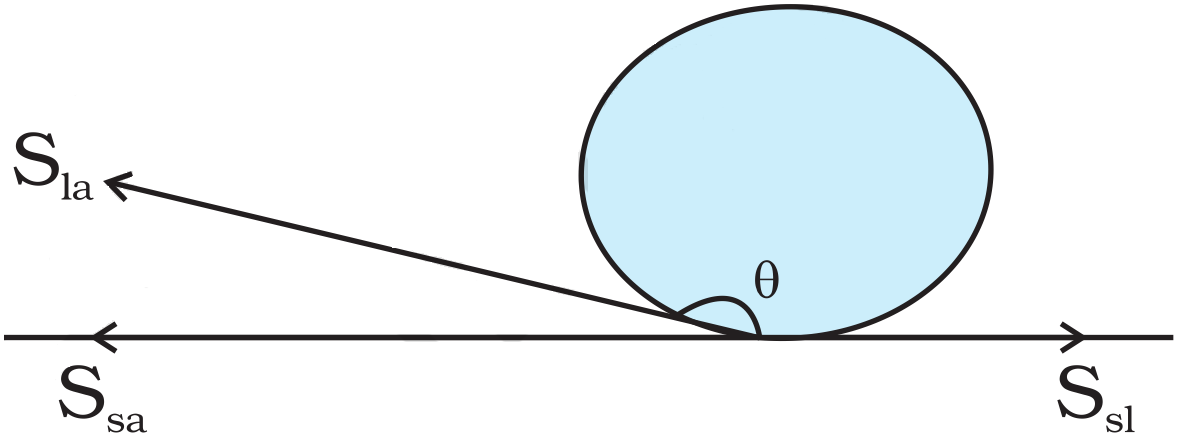
$S_{la}, S_{sa}$, and $S_{sl}$ are the respective interfacial tensions between the liquid-air, solid-air, and solid-liquid interfaces. At the line of contact, the surface forces between the three media must be in equilibrium, i.e., $\cos\theta=\text{(Ssa}–\text{Sla})/\text{Sla}$ The angle of contact $\theta$ , is obtuse if $S_{sa}< S_{la}$ (as in the case of mercury on glass). This angle is acute if $S_{sl} < S_{la}$ (as in the case of water on glass). View full question & answer→Question 93 Marks
Iceberg floats in water with part of it submerged. What is the fraction of the volume of iceberg submerged if the density of ice is $\rho_\text{i}=0.917\text{g cm}^{-3}?$
AnswerAccording to the problem, density of ice $(\rho_\text{ice})=0.917\text{g/ cm}^3,$ Density of water $(\rho_\text{w})=1\text{g/ cm}^3$ Let $V_i$_= Volume of iceberg, $V_w$ = Volume of water displaced by iceberg, Weight of iceberg, $\text{W}=\rho_\text{i}\text{V}_\text{i}\text{g}$ Upthrust, $\text{F}_\text{B}=\rho_\text{w}\text{V}_\text{w}\text{g}$ At equilibrium, Weight of the iceberg = Weight of the water displaced by the submerged part by ice$\Rightarrow\rho_\text{w}\text{V}_\text{w}\text{g}=\rho_\text{i}\text{V}_\text{i}\text{g}$
$\Rightarrow\frac{\text{V}_\text{w}}{\text{V}_\text{i}}=\frac{\rho_\text{i}}{\rho_\text{w}}=\frac{0.917}{1}=0.917$
View full question & answer→Question 103 Marks
Two capillaries of same length and radius in the ratio of $1 : 2$ are connected in series and a liquid flows through this system under streamline conditions. If the pressure across the two extreme ends of combination is $1m$ of water, what is the pressure difference across the:
- First capillary.
- Second capillary?
Answer$\nu=\frac{\pi\text{p}_1\text{r}^4}{8\eta\text{l}}=\frac{\pi\text{p}_2(2\text{r})^2}{8\eta\text{l}}$ Or $\text{p}_1=16\text{p}_2$
But $\text{p}_1+\text{p}_2=1$ So $\frac{16\text{p}_1+\text{p}_1}{16}=1$
Or $\text{p}_1=\frac{16}{17}\text{m}$ and $\text{p}_2=1-\text{p}_1=1-\frac{16}{17}=\frac{1}{17}\text{m}$
View full question & answer→Question 113 Marks
What is the pressure inside the drop of mercury of radius $3.00mm$ at room temperature? Surface tension of mercury at that temperature ($20°C$) is $4.65 \times 10^{–1}N m^{–1}$. The atmospheric pressure is $1.01 × 10⁵Pa$. Also give the excess pressure inside the drop.
AnswerRadius of the mercury drop, $\mathrm{r}=3.00 \mathrm{~mm}=3 \times 10^{-3} \mathrm{~m}$ Surface tension of mercury, $\mathrm{S}=4.65 \times 10^{-1} \mathrm{~N} \mathrm{~m}^{-1}$ Atmospheric pressure, $\mathrm{P}_0=1.01 \times 10^5 \mathrm{~Pa}$ Total pressure inside the mercury drop. $=$ Excess pressure inside mercury + Atmospheric pressure $=2 \mathrm{~S} / \mathrm{r}+\mathrm{P}_0=\left[\frac{2 \times 4.65 \times 10^{-1}}{\left(3 \times 10^{-3}\right)}\right]+1.01 \times 10^5$
$=1.0131 \times 10^5=1.01 \times 10^5 \mathrm{~Pa}$ Excess pressure $=2 \mathrm{~S} / \mathrm{r}=\left[\frac{2 \times 4.65 \times 10^{-1}}{\left(3 \times 10^{-3}\right)}\right] 310 \mathrm{pa}$
View full question & answer→Question 123 Marks
In a test experiment on a model aeroplane in a wind tunnel, the flow speeds on the upper and lower surfaces of the wing are $70 \mathrm{~m} \mathrm{~s}^{-1}$ and $63 \mathrm{~m} \mathrm{~s}^{-1}$ respectively. What is the lift on the wing if its area is $2.5 \mathrm{~m}^2$ ? Take the density of air to be $1.3 \mathrm{~kg} \mathrm{~m}^{-3}$.
AnswerSpeed of wind on the upper surface of the wing, $V_1 = 70m/ s$ Speed of wind on the lower surface of the wing, $V_2 = 63m/ s$ Area of the wing, $A = 2.5m^2$ Density of air, $\rho=1.3\text{kg m}^{-3}$ According to Bernoulli’s theorem, we have the relation:$\text{p}_1+\frac{1}{2}\rho\text{V}_1^2=\text{P}_2+\frac{1}{2}\rho\text{V}_2^2$
$\text{P}_2-\text{P}_1=\frac{1}{2}\rho(\text{V}_1^2-\text{V}_2^2)$
Where, $P_1$ = Pressure on the upper surface of the wing. $P_2$ = Pressure on the lower surface of the wing. The pressure difference between the upper and lower surfaces of the wing provides lift to the aeroplane.
View full question & answer→Question 133 Marks
A cube of wood floating in water supports a $200g$ mass resting at the centre of its top face. When the mass is removed, the cube rises $2cm$. Find the volume of the cube.
AnswerLet A be the surface area of cube and I be the side length. When 200 g mass is taken away, the cube comes out by 2 cm . Therefore, the weight of 200 g should be balance by the upthrust due to 2 cm volume of cube. (i.e.) $200 \times 10^{-3} \times$ $\mathrm{g}=\mathrm{A} \times 2 \times 10^{-2} \times \mathrm{r}_{\mathrm{wg}} \mathrm{A}=\frac{200 \times 10^{-3}}{2 \times 10^{-2} \times 1000}=\frac{1}{100}$
$\therefore$ side length,
$\mathrm{l}=\sqrt{\mathrm{A}}=\sqrt{\frac{1}{100}}$
$=\frac{1}{10} \mathrm{~m} \text { or } 10 \mathrm{~cm}$
Volume $=P^3=(10)^3=1000 \mathrm{~cm}^3$
View full question & answer→Question 143 Marks
The sap in trees, which consists mainly of water in summer, rises in a system of capillaries of radius $\mathrm{r}=2.5 \times 10^{-5} \mathrm{~m}$. The surface tension of sap is $\mathrm{T}=7.28 \times 10^{-2} \mathrm{~N} \mathrm{~m}^{-1}$ and the angle of contact is $0^{\circ}$. Does surface tension alone account for the supply of water to the top of all trees?
AnswerRadius of capillarity $\text{r}=2.5\times10^{-5}\text{m}$$\text{S}=\text{T}=7.8\times10^{-2}\text{Nm}^{-1}\ \text{g}=9.8\text{m/ s}^2$
$\theta=0^{\circ},\text{ p}=10^3\text{kg m}^3$
$\text{h}=\frac{2\text{s}\cos\theta}{\text{rpg}}=\frac{2\times7.28\times10^{-2}\cos0^\circ}{2.5\times10^{-5}\times10^3\times9.8}=\frac{2\times728\times10^{-2+5}}{25\times98\times10^3}$
$\text{h}=\frac{104}{175}\times\frac{10^{-3}}{10^3}=\frac{104}{175}=0.594\text{m}\cong6\text{m}$
Most of trees are of more than 0.6m height. So, capillary action alone connot account for the rise of water in all other tress.
View full question & answer→Question 153 Marks
A 20N metal block is suspended by a spring balance and beaker containing some water is placed on the weighing machine which reads 36N. The spring balance is now lowered so that the block gets immersed in the water. The spring balance now reads 16N. What will be reading of the weighing machine?
AnswerWeight of beaker with water = 36N Weight of metal block in spring balance = 20N Due to immersion of block, upthrust will act on the block. So the spring balance should indicate less than 20N. But as the block is put in water, the weight in the weighing machine will be more by an amount equal to the weight put inside, i.e., 36 + 20 = 56N
View full question & answer→Question 163 Marks
Two exactly similar rain drops falling with terminal velocity of $(2)^{\frac13}\text{ms}^{-1}$ coalesce to form a bigger drop. Find the terminal velocity of the bigger drop.
AnswerGiven, Terminal valocity of two exactly similar rain drop $=(2)^{\frac13}\text{ms}^{-1}$ According to the question, we have Volume of bigger rain drop = 2 × Volume of a smaller rain drop$\Rightarrow\frac43\pi\text{R}^3=2\times\frac43\pi\text{R}^3$
I.e., $\frac{\text{R}^3}{\text{r}^3}=2$$\Rightarrow\frac{\text{R}}{\text{r}}=(2)^{\frac13},$
Where R = Radius of bigger drop; r = Radius of smaller drop Terminal valocity of smaller drop, $\text{v}_1=\frac29\frac{\text{r}^2}{\eta}(\text{e}-\text{e}')\text{g}$ Terminal velocity of bigger drop, $\text{v}_2=\frac29\frac{\text{R}^2}{\eta}(\text{e}-\text{e}')\text{g}$$\therefore\frac{\text{v}_2}{\text{v}_1}=\frac{\text{R}^2}{\text{r}^2}=(2^{\frac{1}{3}})^2=2^\frac{2}{3}$
$\Rightarrow\text{v}_2=2^\frac23\times\text{v}_1[\because\text{v}_1=2^{\frac13}\text{ms}^{-1}]$
$=2^\frac23\times2^\frac13=2\text{ms}^{-1}$
Hence, the terminal velocity of the bigger drop is $2ms^{-1}$.
View full question & answer→Question 173 Marks
A solid floats with $\frac{1}{4}\text{th}$ of its volume above the surface of water. Calculate the density of the solid.
AnswerLet V and p be the volume and density of solid respectively and $\rho'$ be the density of water, i.e.,$\rho'=10^3\text{kg m}^{-3}$
Weight of body $=\text{V}\rho\text{g}$ Volume of solid body outside water,$=\frac{\text{V}}{4}$
$\therefore$ Volume of solid body inside water,
$=\text{V}-\frac{\text{V}}{4}=\frac{3\text{V}}{4}$
Weight of water displaced by solid,$=\frac{3\text{V}}{4}\times10^3\times\text{g}$
As solid body is floating, then Weight of body = Weight of water displaced by the body$\text{V}\rho\text{g}=\frac{3\text{V}}{4}\times10^3\times\text{g}$
$\rho=\frac34\times1000=750\text{kg m}^{-3}$
View full question & answer→Question 183 Marks
Two soap bubbles of different diameters are in contact with a certain portion common to both the bubbles. What will be the shape of the common boundary as seen from inside the smaller bubble? Support your answer with a neat diagram. Give reason for your answer.
AnswerAs seen from inside the smaller bubble, the shape of the common boundary will be concave.
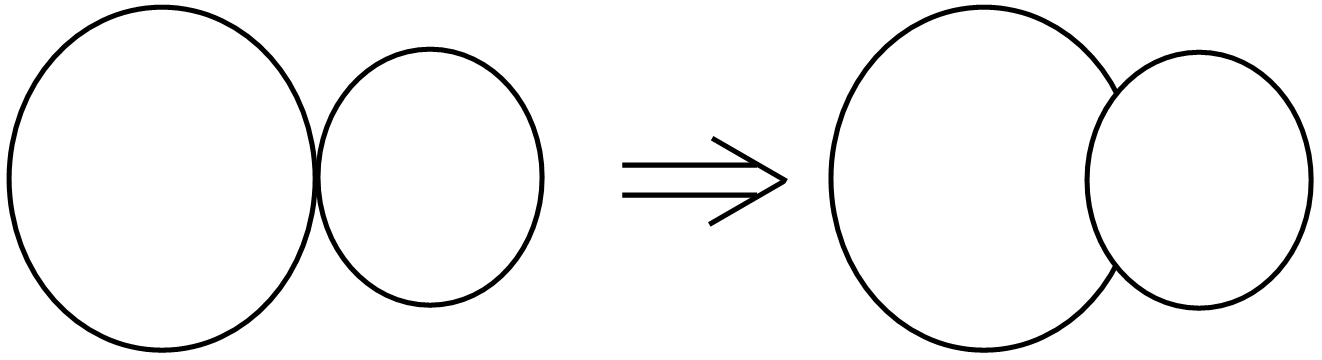
Reasons:
- Pressure inside the smaller bubble is more as compared to that inside the larger bubble.
- For a liquid film, the pressure on concave side is higher.
View full question & answer→Question 193 Marks
Derive an expression for the excess of pressure inside a liquid drop.
AnswerConsider a liquid drop of radius R and $\sigma$ the surface tension of liquid.
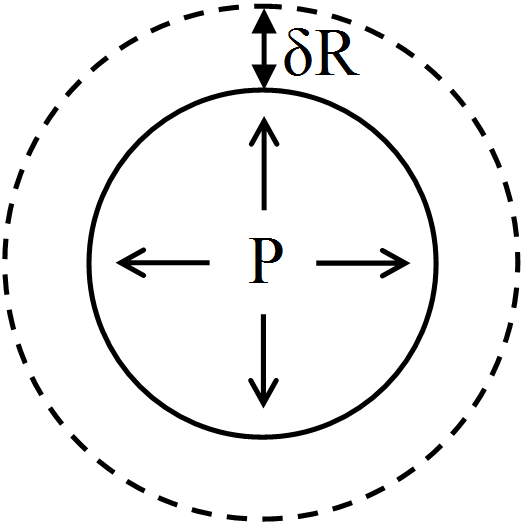
Excess pressure inside the liquid drop, $P = P_i - P_0$ ($\therefore$ liquid drop has only one free surface)$\delta\text{R}=$ Small increase in radius of liquid drop due to excess pressure
$\therefore$ W = Force × Displacement.
W = (Excess pressure × Area) × Increase in radius$\text{W}=\text{P}\times4\pi\text{R}^2\times\delta\text{R}$
Increase in surface area of liquid drop = Final surface area - Initail surface area$=4\pi(\text{R}+\delta\text{R})^2-4\pi\text{R}^2$
$=8\pi\text{R}(\delta\text{R})(\text{Neglecting }\delta\text{R}^2)$
Increase P.E. = Increase in surface area × Surface tension$=8\pi\text{R}(\delta\text{R})\times\sigma$
Since the drop is in equilibrium.$\therefore\text{P}\times4\pi\text{R}^2\times\delta\text{R}=8\pi\text{R}(\delta\text{R})\times\sigma$
$\Rightarrow\text{P}=\frac{2\sigma}{\text{R}}$
$\Rightarrow\text{P}_\text{i}-\text{P}_\text{o}=\frac{2\sigma}{\text{R}}[\because\text{P}=\text{P}_\text{i}-\text{P}_\text{o}]$ View full question & answer→Question 203 Marks
A U-tube contains water and methylated spirit separated by mercury. The mercury columns in the two arms are in level with $10.0cm$ of water in one arm and $12.5cm$ of spirit in the other. What is the specific gravity of spirit?
AnswerHeight of the spirit column, $h_1 = 12.5cm = 0.125m$ Height of the water column, $h_2 = 10cm = 0.1m \rho_0$ = Atmospheric pressure
$\rho_1$ = Density of spirit
$\rho_2$ = Density of water
Pressure at point $\text{B}=\rho_0+\rho_1\text{h}_1\text{g}$ Pressure at point $\text{D}=\rho_0+\rho_2\text{h}_2\text{g}$ Pressure at points B and D is the same.$\rho+\rho_1\text{h}_1\text{g}=\rho_0+\rho_2\text{h}_2\text{g}$
$\frac{\rho_1}{\rho_2}=\frac{\text{h}_2}{\text{h}_1}$
$= \frac{10}{12.5} = 0.8$
Therefore, the specific gravity of spirit is 0.8.
View full question & answer→Question 213 Marks
What is the pressure inside a drop of mercury of radius 3.0 mm at room temperature? Surface tension of mercury at that temperature $\left(20^{\circ} \mathrm{C}\right)$ is $4.65 \times 10^{-1} \mathrm{Nm}^{-1}$. The atmospheric pressure is $1.01 \times 10^5 \mathrm{~Pa}$. Also give the excess pressure inside the drop.
AnswerHere, $\text{r}=3.0\text{mm}=3\times10^{-3}\text{m};$
$\text{S}=4.65\times10^{-1}\text{N m}^{-1};\text{P}=1.01\times10^5\text{Pa}$
Excess of pressure inside the drop of mecury is given by,$\text{P}'=\frac{2\text{S}}{\text{r}}=\frac{2\times4.65\times10^{-1}}{3\times10^{-3}}=310\text{Pa}$
Total pressure inside the drop,$=\text{P}'+\text{P}=1 .01\times10^5+310$
$=1.0131\times10^5\text{Pa}$
View full question & answer→Question 223 Marks
A cylindrical vessel of uniform cross-section contains liquid upto a height 'H'. At a depth $'\text{h}'=\frac{\text{H}}{2}$ below the free surface of the liquid there is an orifice. Using Bernoulli's theorem, find the velocity of efflux of liquid.
AnswerApplying Bernoulli's theorem between two points just on either side of the hole, we get,$\frac{\text{P}_0+\frac{\text{H}}{2}\rho\text{g}}{\rho\text{g}}+\frac{0}{2\text{g}}+\frac{\text{H}}{2}$
$=\frac{\text{H}}{2}+\frac{\text{v}^2}{2\text{g}}+\frac{\text{P}_0}{\rho\text{g}}$
$\Rightarrow\text{v}^2=\frac{\text{H}}{2}\times2\text{g}$
$\Rightarrow\text{v}=\sqrt{\text{gH}}$
View full question & answer→Question 233 Marks
A liquid drop of diameter 4mm breaks into 1000 droplets of equal size. Calculate the resultant change in surface energy, the surface tension of the liquid is 0.07Nm".
Answer$\sigma=0.17\text{Nm}^{-1},\text{R}=\frac{\text{D}}{2}=2\times10^{-3}\text{m}$$\text{N}=1000$
Change in surface energy, $\text{W}=\sigma[\text{N}4\pi\text{r}^2-4\pi\text{R}^2]$
Where $\text{r}=\text{RN}^{-\frac13}$
$\therefore\text{W}=\sigma\Big[\text{N}^{1-\frac23}.4\ne\text{R}^2-4\ne\text{R}^2\Big]$
$=\sigma4\pi\text{R}^2\Big[\text{N}^{\frac13}-1\Big]$
$\text{W}=0.07\times4\times\frac{22}{7}\times(2\times10^{-3})^2\times\Big[(10000)^{\frac13}-1\Big]$
$=0.07\times4\times\frac{22}{7}\times4\times10^{-6}\times9$
$\text{W}=31.68\times10^{-6}\text{J}$
View full question & answer→Question 243 Marks
The sufrace tension and vapour pressure of water at $20^{\circ} \mathrm{C}$ is $7.28 \times 10^{-2} \mathrm{~N} \mathrm{~m}^{-1}$ and $2.33 \times 10^3 \mathrm{~Pa}$, respectively. What is the radius of the smallest spherical water droplet which can form without evaporating at $20^{\circ} \mathrm{C}$ ?
AnswerThe drop will evaporate if the water pressure on liquid, is greater than vapour pressure above the surface of liquid. Let a water droplet of radius R be formed without evaporation then. Vapour pressure = Excess pressure in a drop$\rho=\frac{2\sigma}{\text{R}}$ (onlt one surface in drop)
$\text{R}=\frac{2\times7.28\times10^{-2}}{\text{Vapour preessure}}$
$=\frac{2\times7.28\times10^{-2}}{2.33\times10^{3}}=\frac{1456\times10}{233\times10^5}$
$\text{R}=6.25\times10^{-5}\text{m}$
View full question & answer→Question 253 Marks
A liquid drop of diameter $4mm$ breaks into $1000$ droplets of equal size. Calculate the resultant change in surface energy. The surface tension of the liquid is $0.07Nm^{-1}$
AnswerGiven: $\sigma=0.07\text{Nm}^{-1},\text{ R}=\frac{\text{D}}{2}=2\times10^{-3}\text{m},\text{N}=1000$ Change in surface energy, $\text{W}=\sigma[\text{N}4\pi\text{r}^2-4\pi\text{R}^2]$
$\because$ Volume of 1 drop = N × Volume of a doplet
$\frac43\pi\text{R}^3=\text{N}\times\frac43\pi\text{r}^3$
$\text{R}=\text{N}^{\frac13}\text{r}$
$2\times^{-3}=(1000)^{\frac13}\text{r}$
$\text{r}=2\times10^{-4}\text{m}$
$\therefore\text{W}=\sigma\times4\pi[\text{N}\text{r}^2-\text{R}^2]$
$\text{W}=0.07\times4\times\frac{22}{7}$
$[10^3\times(2\times10^{-4})^2-(2\times10^{-3})^2]$
$\text{W}=0.07\times4\times\frac{22}{7}\times4\times10^{-6}\times9$
$\text{W}=31.68\times10^{-6}\text{J}$
View full question & answer→Question 263 Marks
Establish a relation for the excess pressure on a drop of liquid of surface tension o, giving reason for its presence.
AnswerConsider a liquid drop of radius r. If one tries to enhance the radius by a small amount 'dr', work has to be done to overcome the excess pressure (p). Work done $=\text{dW}=\text{p}\times4\pi\text{r}^2\times\text{r}$ 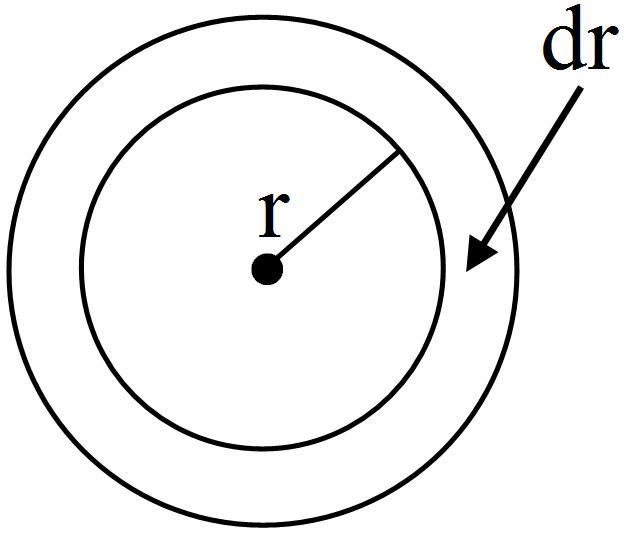 Due to surface tension $'\sigma'$ the excess pressure exists. The work done to change the area is also written as,$\text{dW}=\sigma\times\text{change in area}$
$=\sigma4\pi\{(\text{r}+\text{dr})^2-\text{r}^2)\}=\sigma8\pi\text{r}\text{ dr}$
$\therefore\text{p}4\pi\text{r}^2\text{dr}=\sigma8\pi\text{r dr}$
$\therefore\text{P}=\frac{2\sigma}{\text{r}}$ View full question & answer→Question 273 Marks
State Pascal's law. Explain the working of hydraulic lift.
AnswerPascal's law-It states that the pressure in a liquid at rest is the same at all points if they are at the same level. 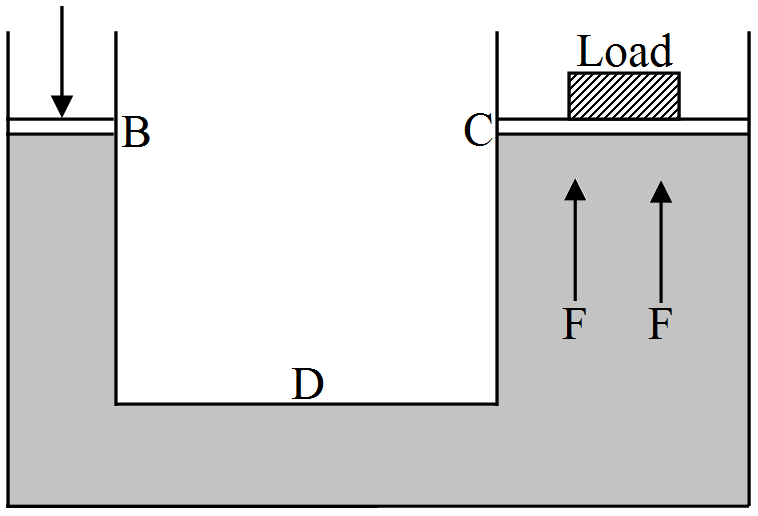 Hydraulic lift: Let, a = area of cross-section of piston in cylinder B A = area of cross section of position in C also a << A. Fill the cylinders with an incompressible fluid. Let f= downward force applied on piston B. Then pressure exerted on liquid is$\text{P}=\text{fla}$
This pressure is equally transmitted to piston in cylinder C (according to Pascal's law)$\therefore$ Upward force acting on the piston of cylinder C is as Therefore a small force applied on piston B appears as a larger force on piston C.
$\text{F}=\text{PA}=\frac{\text{f}}{\text{a}}\text{A}$
As A >> a, F >> f Therefore a small force applied on piston B appears as a larger force on piston C. View full question & answer→Question 283 Marks
Pressure decreases as one ascends the atmosphere. If the density of air is $\rho,$ what is the change in pressure dp over a differential height dh?
Answerconsider a part (packet) of atmosphere of thickeness dh. As the pressure at a point in fluid is equal in all directions. so the pressure on upper layer is p acting downward and on lower layer is (p + dp) acting upward. Force due to pressure is balanced by Buoyant force by air, (p + dp)A - pA = -Vpg PA + dpA - pA = -Adhpg dpA = -ppgdhA dpp = -pgdh ....(i) (image) Negative sign shows that pressure decreases as height increases.
View full question & answer→Question 293 Marks
The figure adjoining shows a hydraulic press with the larger piston of diameter $35cm$ at a height of $1.5m$ relative to the smaller piston of diameter $10cm$. The mass on the smaller piston is $20kg$. What is the force exerted on the load by the larger piston? The density of oil in the press is $750kg m^{-3}$.
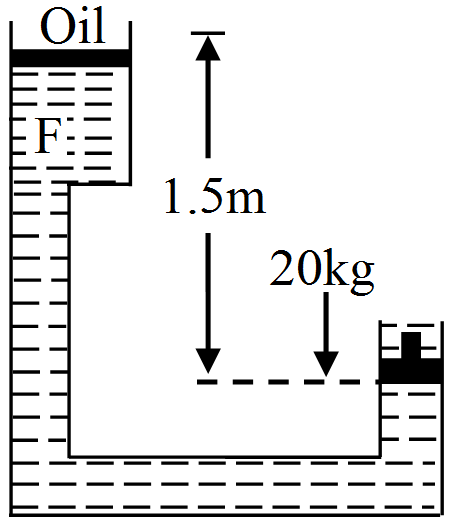
AnswerPressure on the smaller piston,$=\frac{20\times9.8}{\pi\times(5\times10^{-2})^2}\text{N m}^{-2}$
Pressure on the larger piston,$=\frac{\text{F}}{\pi\times(17.5\times10^{-2})^2}\text{N m}^{-2}$
The difference between these two pressures is equal to $\text{h}\rho\text{g}$ where$\text{h}=1.5\text{m};\rho=750\text{kg/m}^3;$
And $\text{g}=9.8\text{ms}^{-2}$
$\therefore\frac{20\times9.8}{\pi\times(5\times10^{-2})^2}-\frac{\text{F}}{\pi\times(17.5\times10^{-2})^2}$
$\Rightarrow1.5\times750\times9.8$
Simplyfying, we get$\text{F}=1.3\times10^3\text{N}$
View full question & answer→Question 303 Marks
What would be pressure inside a small air bubble of 0.1 mm radius situated just below the surface of water? Surface tension of water $72 \times 10^{-3} \mathrm{~N} / \mathrm{m}$ and atmospheric pressure is $1.1 \times 10 \% \mathrm{~N} / \mathrm{m}^2$.
AnswerExcess pressure $=\frac{2\sigma}{\text{r}}=\frac{2\times72\times10^{-3}}{0.1\times10^{-3}}$$=1440\text{N/m}^2$
$=0.01440\times10^5\text{N/m}^2$
So, net pressure $=(1.1-0.0144)\times10^5$$=1.0856\times10^5\text{N/m}^2$
View full question & answer→Question 313 Marks
A vertical off-shore structure is built to withstand a maximum stress of $109$ Pa. Is the structure suitable for putting up on top of an oil well in the ocean? Take the depth of the ocean to be roughly $3km$, and ignore ocean currents.
AnswerYes The maximum allowable stress for the structure, $P=109 \mathrm{~Pa}$ Depth of the ocean, $\mathrm{d}=3 \mathrm{~km}=3 \times 10^3 \mathrm{~m}$ Density of water, $\mathrm{p}=10^3 \mathrm{~kg} / \mathrm{m}^3$ Acceleration due to gravity, $\mathrm{g}=9.8 \mathrm{~m} / \mathrm{s}^2$ The pressure exerted because of the sea water at depth, $d=p d g=3 \times 10^3 \times 10^3 \times 9.8=2.94 \times 10^7 \mathrm{~Pa}$ The maximum allowable stress for the structure $\left(10^9 \mathrm{~Pa}\right)$ is greater than the pressure of the sea water ( $2.94 \times 10^7 \mathrm{~Pa}$ ). The pressure exerted by the ocean is less than the pressure that the structure can withstand. Hence, the structure is suitable for putting up on top of an oil well in the ocean.
View full question & answer→Question 323 Marks
According to Stoke, the viscous force experienced by a sphere of radius r depends on the terminal velocity and viscosity of the liquid besides radius. Derive the formula.
Answer$\text{F}\propto\text{v}^\text{a}\gamma^\text{b}\eta^\text{n}\Rightarrow\text{F}=\text{K}\text{v}^\text{a}\gamma^\text{b}\eta^{\text{c}},$Equating the dimensions, we have,
$\text{MLT}^{-3}=\text{K}(\text{LT}^{-1})^\text{a}(\text{L})^\text{b}(\text{ML}^{-1}\text{T}^{-1})^{\text{c}}$
Equating the powers of:
$\text{M}:1=\text{c},\text{L}:1=\text{a}+\text{b}-\text{c},$
$\text{T}:2=-\text{a}-\text{c}$
$\text{c}=1,\text{a}=-\text{c}+2=1,\text{b}=1-\text{a}+\text{c}=1$
$\therefore\text{F}=\text{K}\text{v}\text{r}\eta=6\pi\eta\text{r}\text{v},$
$\text{K}=6\pi$ was found experimentally by stoke.
View full question & answer→Question 333 Marks
Derive an expression for the height to which the liquid rises in a capillary tube of radius r.
AnswerLet R = Radius of curvature of liquid meniscus P = Atmospheric pressure S = Surface tension of the liquid.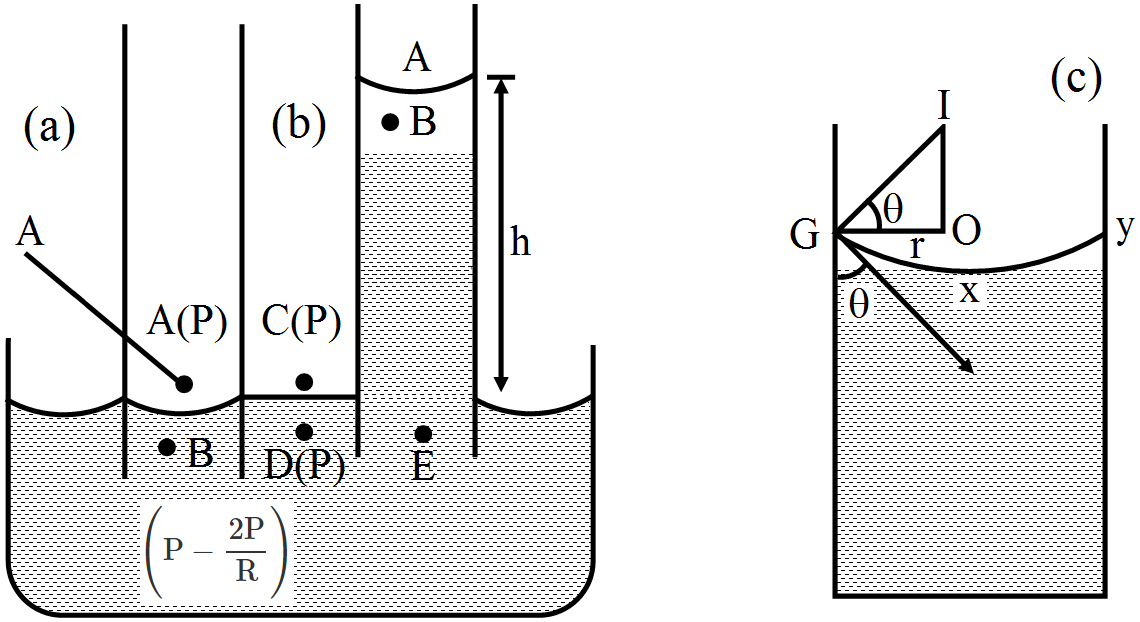
The pressure at point A just above the liquid meniscus in the capillary tube is atmospheric pressure P. The pressure at point B, just below the liquid meniscus (on convex side) $=\text{P}-\frac{2S}{\text{R}}$ Pressure at point and D, just above and below the plane surface of the liquid in the vessel is also P (i.e. atmospheric pressure). The points B and D are in the same horizontal plane in liquid but the pressure at these points is different. Hence, there will be no equilibrium. In order to maintain an equilibrium, the liquid rises in the capillary tube up to a height ‘h' so that the pressures at points D and E which are in the same level in the liquid may become equal figure (b). Now, pressure at E = Pressure at B + Pressure due to height ‘h’ = (BE) of the liquid column $=\Big(\text{P}-\frac{2\text{S}}{\text{R}}\Big)+\text{h}\rho\text{g}$ As there is an equilibrium, therefore pressure at E = Pressure at D i.e. $\text{P}-\frac{2\text{S}}{\text{R}}+\text{h}\rho\text{g}=\text{P}$$\Rightarrow\text{h}\rho\text{g}=\frac{2\text{S}}{\text{R}}$
$\Rightarrow\text{h}=\frac{2\text{S}}{\text{R}\rho\text{g}}\dots\text{(i)}$
Let I be the centre of curvature of liquid meniscus GXY in the tube and GS be the tangent to the liquid surface at point G, figure (c), GI = R; GO = r$\angle\text{IGO}=\theta=\text{angle of contact}$
In $\triangle\text{IGO},\cos\theta=\frac{\text{GO}}{\text{GI}}=\frac{\text{r}}{\text{R}}$$\Rightarrow\text{R}=\frac{\text{r}}{\cos\theta}$
Putting this value in (i), we get$\text{h}=\frac{2\text{S}\cos\theta}{\text{r}\rho\text{g}}$ View full question & answer→Question 343 Marks
Water flows through a horizontal pipe of which the cross-section is not constant. The pressure is 1cm of mercury where the velocity is 0.35m/s. Find the pressure at a point where the velocity is 0.65m/s.
AnswerFor streamlined flow, the sum of the pressure head, velocity head and gravitational head is a constant, i.e.,$\frac{\text{P}}{\rho\text{g}}+\frac{\text{v}^2}{2\text{g}}+\text{h}=\text{Constant}$
Taking h the same, we have,$\frac{\text{P}_1}{\rho\text{g}}+\frac{\text{v}^2_1}{2\text{g}}=\frac{\text{P}_2}{\rho\text{g}}+\frac{\text{v}^2_2}{2\text{g}}$
$1+\frac{(0.35)^2}{2\text{g}}=\frac{\text{P}_2}{\rho\text{g}}+\frac{(0.65)^2}{2\text{g}}$
$\text{P}_2=\frac{(0.35)^2-(0.65)^2}{2\text{g}}+1$
$=1-\frac{0.3}{2\text{g}}$
$=1-0.015=0.985$
$\therefore$ Pressure = 0.985cm
View full question & answer→Question 353 Marks
An ice floats in water with about nine$-$tenths of its volume submerged. What is the fractional volume submerged for an iceberg floating on a freshwater lake of a $($hypothetical$)$ planet whose gravity is ten times that of the earth?
Answer
- The fractional volume submerged is independent of the value of $g$, so it is nine$-$tenths on the new planet also.
- For free fall, $g = 0$
The ice cube has no weight and no thrust.
Therefore, the ice cube can float with any value for the fractional volume submerged. View full question & answer→Question 363 Marks
Water rises to a height of 10cm in a certain capillary tube. The level of mercury in the same tube is depressed by 3.42cm. Compare the surface tensions of water and mercury. Specific gravity of mercury is 13.6g/cc and angle of contact for water and mercury are zero and 135° respectively.
AnswerUsing the capillarity relation,$\sigma=\frac{\text{rh}\rho\text{g}}{2\cos\theta}$
$\sigma_1$ (for water)
$\sigma_1=\frac{\text{r}\times1\times\text{g}\times10}{2\cos0^\circ}=5\text{rg}$
$\sigma_2$ (for mercury)
$\sigma_2=\frac{\text{r}\times13.6\times\text{g}\times(-3.42)}{2\cos135^\circ}$ [-ve refers to dip in level]
$\sigma_2=\frac{\text{r}\times13.6\times\text{g}\times(-3.42)}{2\times\Big(\frac{1}{\sqrt{2}}\Big)}=32.9\text{rg}$
$\frac{\sigma_1}{\sigma_2}=\frac{5\text{rg}}{32.9\text{rg}}=\frac{1}{6.5}=0.15$
View full question & answer→Question 373 Marks
Show that terminal velocity V of a spherical object of radius r, density $\rho$ falling vertically through a viscous fluid of density $\sigma$ and coefficient of viscosity n is given by:$\text{V}=\frac29\frac{(\rho-\sigma)\text{r}^2\text{g}}{\eta}$
AnswerLet $\rho$ be the density of the material of the spherical body of radius r and $\sigma$ be the density of the medium. 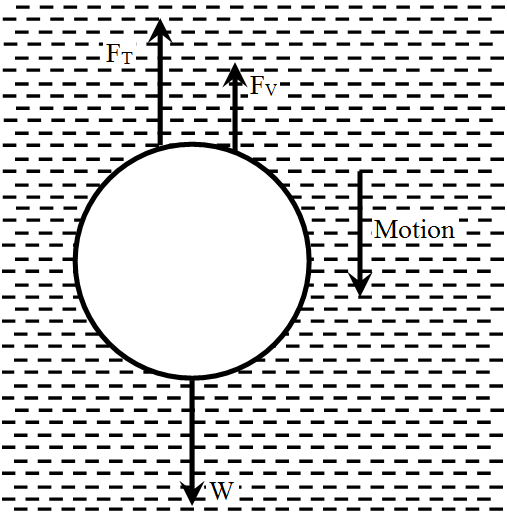
$\therefore$ True weight of the body,
$\text{W}=\text{Volume}\times\text{Density}\times\text{g}=\frac43\pi\text{r}^3\rho\text{g}$
Upward thrust due to buoyancy, $F_T$ = Weight of the medium desplaced
$\therefore F_T$ = Volume of the medium desplaced × Density × g
$=\frac43\pi\text{r}^3\sigma\text{g}$
If V is the terminal velocity of the body, then according to stoke's law, upward viscous drag,$\text{F}_\text{v}=6\pi\eta\text{rv}$
When body attains terminal velocity, then$\text{F}_\text{T}+\text{F}_\text{v}=\text{W}$
$\therefore\frac43\pi\text{r}^3\sigma\text{g}+6\pi\eta\text{rV}=\frac43\pi\text{r}^3\rho\text{g}$
$6\pi\eta\text{rV}=\frac43\pi\text{r}^3(\rho-\sigma)\text{g}$
$\text{V}=\frac{2\text{r}^2(\rho-\sigma)\text{g}}{9\eta}$
$\sigma=$ Density of viscous fluid,
$\eta=$ Coefficient of viscosity. View full question & answer→Question 383 Marks
Two vessels of the same size are at the same temperature. One of them holds $1kg$ of $H_2$ gas and the other holds $1\ kg$ of $N_2$ gas.
- Which of the vessels contains more molecules?
- Which of the vessels is under greater pressure and why?
- In which vessel is the average molecular speed greater? How many times greater?
Answer
- Hydrogen. As $2g$ of hydrogen contains $N$ molecules, $1\ kg$ of hydrogen contain $\frac{\text{N}}{2}\times1000=500\text{N}$ molecules, where $\text{N}=6.023\times10^{23}.$
In the case of the $N_2, 28g$ of nitrogen contains $N$ molecules.
Therefore, $1\ kg$ of nitrogen contains $=\frac{\text{N}}{28}\times1000$
$= 36N$
- Hydrogen, As $\text{P}=\frac{1}{3}\frac{\text{MC}^2}{\text{V}},\text{P}\propto\text{C}^2$
Since, $M$ and $V$ are the same in both the cases, $\text{C}_{\text{H}_2}>\text{C}_{\text{N}_{2}}.$
Therefore, the that by the nitrogen.
- $\frac{\text{C}_{\text{H}_2}}{\text{C}_{\text{N}_2}}=\sqrt {\frac{\text{P}_{\text{N}_2}}{\text{P}_{\text{H}_2}}}=\sqrt{\frac{14}{1}}=3.74,$
$\therefore\text{C}_{\text{H}_2}=3.74\text{C}_{\text{N}_2}$
View full question & answer→Question 393 Marks
An air bubble of volume $1.0cm$ rises from the bottom of a lake $40m$ deep at a temperature of $12°C$. To what volume does it grow when it reaches the surface which is at a temperature of $35°C$?
AnswerWhen the air bubble is at 40m depth, then$\text{V}_1=1\text{cm}^3=1\times10^{-6}\text{m}^3$
$\text{T}_1=12^\circ\text{C}=12+273=285\text{K}$
Bubble rises to a height, h = 40m Temperature at the surface of the lake, $T_2 = 35^\circ C = 308K$ The pressure on the surface of the lake: $P_2 = 1atm = 1.01 \times 10^5Pa$ The pressure at the depth of 40m$\text{P}_1=1\text{atm}+\text{h}\rho\text{g}$
$=1.01\times10^5+40\times10^3\times9.8$
$=493000\text{Pa}$
When the air bubble reaches at the surface of lake, then $V_2$ = ? We have, $\frac{\text{P}_1\text{V}_1}{\text{T}_1}=\frac{\text{P}_2\text{V}_2}{\text{T}_2}$
$\Rightarrow\text{V}_2=\frac{\text{P}_1\text{V}_1\text{T}_2}{\text{T}_1\text{P}_2}$
$=\frac{493000\times1\times10^{-6}\times308}{258\times1.01\times10^5}$
$5.263\times10^{-6}\text{m}^3\text{or }5.263\text{cm}^3$
View full question & answer→Question 403 Marks
A hydraulic automobile lift is designed to lift cars with a maximum mass of $3000kg$. The area of cross-section of the piston carrying the load is $425cm^2$. What maximum pressure would the smaller piston have to bear?
AnswerThe maximum mass of a car that can be lifted, $m=3000 \mathrm{~kg}$. Area of cross-section of the load-carrying piston, $\mathrm{A}=$
$425 \mathrm{~cm}^2=425 \times 10^4 \mathrm{~m}^2$ The maximum force exerted by the load, $\mathrm{F}=\mathrm{mg}=3000 \times 9.8=29400 \mathrm{~N}$ The maximum pressure exerted on the load-carrying piston, $P=F / A \frac{29400}{(425 \times 10-4)}$
$=6.917 \times 10^5 \mathrm{~Pa}$ Pressure is transmitted equally in all directions in a liquid.
Therefore, the maximum pressure that the smaller piston would have to bear is $6.917 \times 10^5 \mathrm{~Pa}$.
View full question & answer→Question 413 Marks
A liquid is in streamlined flow through a tube of non uniform cross-section. Prove that sum of its kinetic energy, pressure energy and potential energy per unit volume remain constant.
AnswerConsider an incompressible non-viscous liquid entering the cross-section $a_1$ at A with a velocity $v_1$ and coming out at a height $h_2$ at B with velocity $v_2$. The P.E. and K.E. would increase since $h_2$ and $v_2$ are more than $h_1$ and $v_1$ respectively. This is done by the conversion of pressure energy into work done on the liquid. If $P_1$ and $P_2$ are the pressure at A and B, for a small displacement at A and B. The work done on the liquid at A,$\text{w}_1=\text{P}_1\text{A}_1\text{v}_1\Delta\text{t}$
The work done by the liquid at B,$\text{w}_2=-\text{P}_2\text{A}_2\text{v}_2\Delta\text{t}$
Net work done by pressure on the liquid,$\text{w}_1-\text{w}_2=(\text{P}_1-\text{P}_2)\text{av}\Delta\text{t}$
Since $\text{A}_1\text{v}_1=\text{A}_2\text{v}_2=\text{v}=$ Constant [equation of continuity]
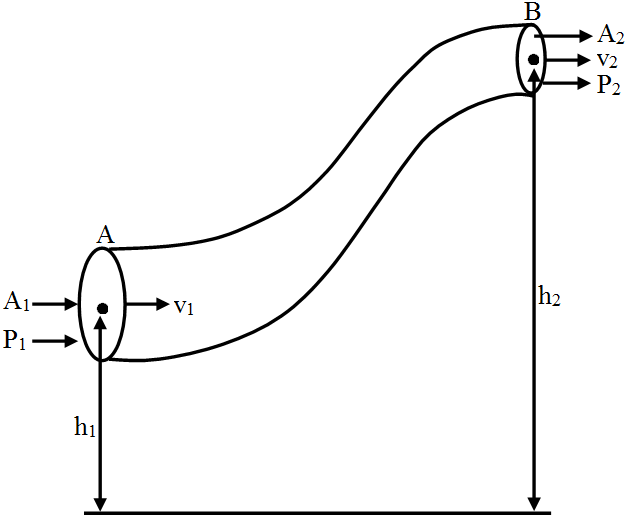
From conservation of energy.$(\text{P}_1-\text{P}_2)\text{Av}\Delta\text{t}=\text{increase in }(\text{K.E.}+\text{P.E.)}$
Increase in $P.E. = mgh_2 - mgh_1 [\text{M}=\text{Av}\rho\Delta\text{t}]$ Increase in $\text{K.E.}=\frac{1}{2}\text{mv}^2_2-\frac{1}{2}\text{mv}^2_1$$(\text{P}_1-\text{P}_2)\text{Av}\Delta\text{t}=\text{Av}\rho\Delta\text{tg}(\text{h}_2-\text{h}_1)+\frac12\text{Av}\Delta\text{t}\rho(\text{v}^2_2-\text{v}^2_1)$
$\therefore\text{P}_1-\text{P}_2=\rho\text{g}(\text{h}_2-\text{h}_1)+\frac{\rho}{2}(\text{v}^2_2-\text{v}^2_1)$
i.e. $\text{P}_1+\rho\text{gh}_1+\frac{\rho}{2}\text{v}^2_1=\text{P}_2\rho\text{h}_2+\frac{\rho}{2}\text{v}^2_2$$\therefore\frac{\text{P}}{\rho\text{g}}+\text{h}+\frac{\text{v}^2}{2\text{g}}=\text{Constant}$
Thus, sum of its K.E. pressure energy and potentail energy per unit volume ramain constant. View full question & answer→Question 423 Marks
Air is streaming past a horizontal air plane wing such that its speed is $120 \mathrm{~ms}^{-1}$ over the upper surface and $90 \mathrm{~ms}^{-1}$ at the lower surface. If the density of air is $1.3 \mathrm{~kg} \mathrm{~m}^{-3}$, find the difference in pressure between the top and bottom of the wing. If wing is 10 m long and has an average width of 2 m , calculate the gross lift of the wing.
AnswerAccording to Bernoulli's theorem,$\frac{\text{P}_1}{\rho}+\text{gh}_1+\frac12\upsilon^2_1$
$=\frac{\text{P}_2}{\rho}+\text{gh}_2+\frac12\upsilon^2_2$
For the horizontal flow, $h_1 = h_2 \therefore\frac{\text{P}_1}{\rho}+\frac12\upsilon^2_1=\frac{\text{P}_2}{\text{P}}+\frac12\upsilon^2_2\dots\text{(i)}$
Here, $\upsilon_1=90\text{ms}^{-1};\upsilon_2=120\text{ms}^{-1};$$\rho=1.3\text{kg m}^{-3}$
$\therefore\frac{\text{P}_1-\text{P}_2}{\rho}=\frac12\big(\upsilon^2_2-\upsilon^2_1\big)$
$(\text{P}_1-\text{P}_2)=\frac{\rho\big(\upsilon^2_2-\upsilon^2_1\big)}{2}$
$=\frac{1.3(14400-8100)}2=\frac{1.3\times63}{2}$
$\text{P}_1-\text{P}_2=4.095\times10^3\text{Nm}^{-2}$
Which is the pressure difference between the top and the bottom of the wing. Now, Gross lift of the wing (i.e. force) = $(P_1 - P_2) \times$ Area of the wing = $4.095 \times 10^3 \times 10 \times 2 = 8.190 \times 10^4N$.
View full question & answer→Question 433 Marks
What should be the average velocity of water in a tube of diameter $2.0cm$ so that the flow is laminar? The viscosity of water is $0.001N m^{-2}s$.
AnswerHere, D = 2cm = 0.02m,$\eta=0.001\text{N m}^{-2}\text{s},$
$\rho=10^3\text{kg m}^{-3};\text{v}_\text{c}=?$
Maximum value of Reynold's number for flow to be linear, $N_R = 2000$ Now, $\text{v}_\text{c}=\frac{\text{N}_\text{R}\eta}{\rho\text{D}}=\frac{2000\times0.001}{10^3\times0.02}$$=0.1\text{ms}^{-1}$
View full question & answer→Question 443 Marks
A boat is floating in a small pond and it carries a large number of big sized stones. If stones are unloaded into water in the pond, will there be an observable change in level of water in the pond?
AnswerWhen the stones are in the boat Let M = Mass of boat m = Mass of stones$\rho'=$ Density of stone
$\rho=$ Density of water
Volume of water displaced by boat and stones together$\text{V}_1=\frac{\text{M}+\text{m}}{\rho}$
Let V' = Valume of water displaced by boat alone$=\frac{\text{M}}{\rho}$
Let V" = Volume of water displaced by stone alone$=\frac{\text{m}}{\rho'}$
Total valume displaced$\text{V}_2=\frac{\text{M}}{\rho}+\frac{\text{M}}{\rho'}$
$\rho'>\rho$
$\text{V}_2<\text{V}_1$
The level of water in the pond falls down.
View full question & answer→Question 453 Marks
Two vessels have the same base area but different shapes. The first vessel takes twice the volume of water that the second vessel requires to fill upto a particular common height. Is the force exerted by the water on the base of the vessel the same in the two cases ? If so, why do the vessels filled with water to that same height give different readings on a weighing scale?
AnswerTwo vessels having the same base area have identical force and equal pressure acting on their common base area. Since the shapes of the two vessels are different, the force exerted on the sides of the vessels has non-zero vertical components. When these vertical components are added, the total force on one vessel comes out to be greater than that on the other vessel. Hence, when these vessels are filled with water to the same height, they give different readings on a weighing scale.
View full question & answer→Question 463 Marks
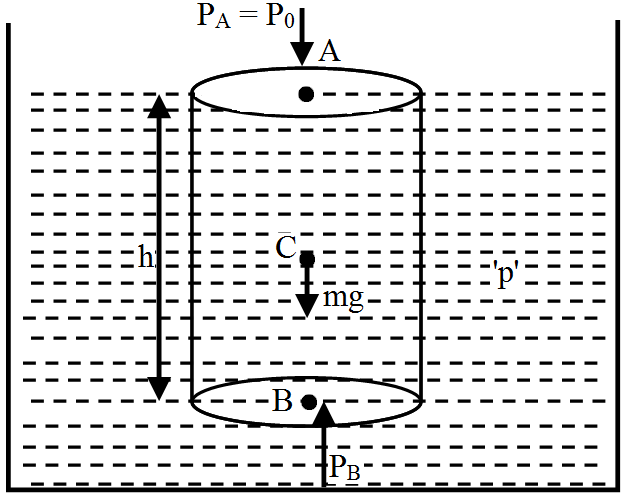
Prove that the pressure at a depth h from the free surface of a liquid (P) in a container is $\text{P}=\text{P}_2+\text{h}\rho\text{g},$ where P, is the atmospheric pressure.
AnswerConsider two points A and B at two levels separated by h column of a liquid of density p surrounding the points A and B. Consider an area 'a' forming a cylinder of liquid of length h. The pressure at, $A = P_A$ = Atmospheric pressure = P. Weight of the liquid at centre of gravity$\text{W}=\text{Mg}=\text{ha}\rho\text{g}$
For equilibrium, pressure/ force at B should nullify the forces acting down.
$\therefore\text{P}_\text{A}.\text{a}+\text{ha}\rho\text{g}=\text{P}_\text{B}.\text{a}$
$\therefore\text{P}_\text{B}=\text{P}_\text{A}+\text{h}\rho\text{g}=\text{P}_0+\text{h}\rho\text{g}$
View full question & answer→Question 473 Marks
A tank 5m high is half-filled with water and then filled to the top with oil of density 0.85g/cc. What is the pressure at the bottom of the tank due to these liquids?
AnswerHere, h = 5m; $\rho_0=0.85\text{g/cc}=0.85\times10^3\text{kg/m}^3$ Mean density, $\rho=\frac{\rho_\text{w}+\rho_0}{2}$$=\frac{10^3+0.85\times10^3}{2}$
$=0.925\times10^3\text{kg/m}^3$
Therefore, pressure at the bottom,$\text{P}=\text{h}\rho\text{g}$
$=5\times0.925\times10^3\times9.8$
$=4.5325\times10^4\text{N/m}^2$
View full question & answer→Question 483 Marks
A piece of brass (an alloy of copper and zinc) weighs $12.9 g$ in air. When completely immersed in water it weighs $11.3 g$ . What is the volume of copper contained in the alloy? RD of copper and zinc are $8: 9$ and $7.1$ respectively. Solving this equation, we get $\mathrm{m}=7.61 \mathrm{~g}$.
AnswerLet m be the mass of copper in the alloy. Then the mass of zinc in the alloy = $(12.9 - m)g$ Volume of copper in the alloy $=\frac{\text{m}}{8.9}\text{cm}^3$ Volume of zinc in the alloy $=\frac{(12.9-\text{m})}{7.1}\text{cm}^3$ Apparent loss of weight of brass = 12.9 - 11.3 = 16g Volume of the alloy $= 1.6cm^3$ (density of water = $1g cm^{-3})$
Hence, $\frac{\text{m}}{8.9}+\frac{12.9-\text{m}}{7.1}=1.6$ Solving this equation, we get m = 7.61g.
View full question & answer→Question 493 Marks
The area of cross-section of wider tube is $800cm^2$ in the figure. If a mass of $16kg$ is placed as the massless piston, find the difference in the level of water in the two tubes.
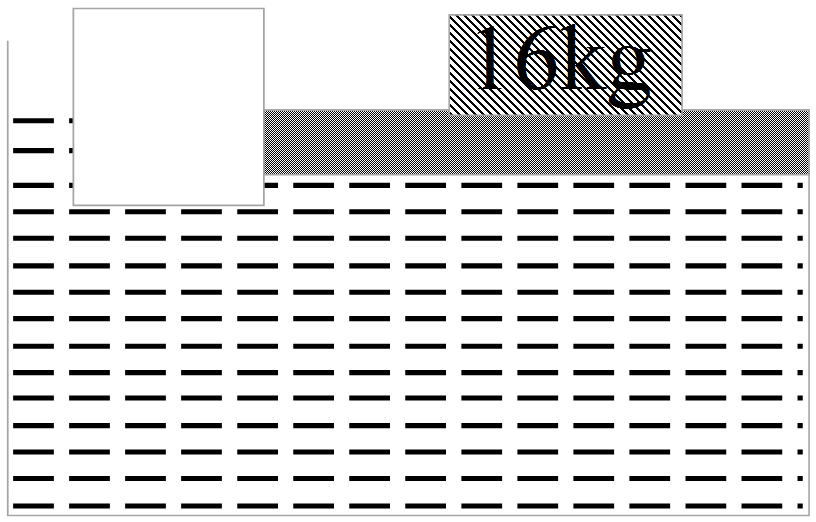
AnswerHere, $\text{a}=800\text{cm}^2$$\text{F}=\text{mg}=16000\times980\text{dyne}$
Increase in pressure on the liquid in the wider tube,$\Delta\text{P}=\frac{16000\times980}{800}$
If h 9 is the difference in level of water in the two tubes, then$\text{h}\rho\text{g}=\frac{16000\times980}{800}$
$\text{h}=\frac{16000\times980}{800\times\rho\text{g}}$
$\text{h}=\frac{16000\times980}{800\times1\times980}=20\text{cm}$
View full question & answer→Question 503 Marks
A big size balloon of mass M is held stationary in air with the help of a small block of mass M/2 tied to it by a light string such that both float in mid air. Describe the motion of the balloon and the block when the string is cut. Support your answer with calculations.
AnswerForces acting on balloon when held stationary are:$\text{U}\rightarrow$ the upthrust,
U = Mg + T ...(i) Forces acting on small block when held stationary.$\text{T}=\Big[\frac{\text{M}}{2}\Big]\text{g}\dots\text{(ii)}$
From (i) and (ii), $\text{U}=\frac{3}{2}\text{Mg}$ When string is cut, T = 0 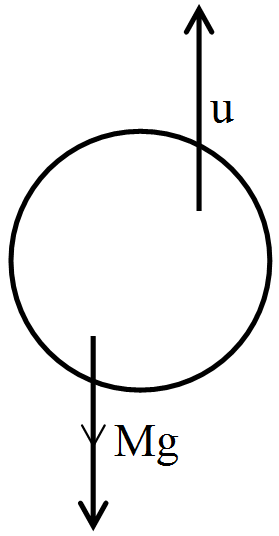 Small block will have free fall. Ballon will have acceleration 'a' such that, U - Mg = Ma$\frac32\text{Mg}-\text{Mg}=\text{Ma}$
$\Rightarrow\text{a}=\frac{\text{g}}{2}\text{ upwards}$ View full question & answer→Question 513 Marks
A capillary tube is attached horizontally to a constant head arrangement. If the radius of the capillary tube is increased by 10% then by what percentage the rate of flow of liquid will change.
AnswerSince, $\text{V}=\frac{\pi\text{p}\text{r}^4}{8\eta\text{l}}$$\text{r}'=\text{r}+\frac{10}{100}\text{r}=\frac{110}{100}\text{r}=1.1\text{r}$
$\therefore\text{V}'=\frac{\pi\text{p}(1.1\text{r})^4}{8\eta\text{l}}=\frac{1.464\pi\text{pr}^4}{8\eta\text{l}}=1.464\text{V}$
$\therefore$ % increase in rate of flow of liquid $=\frac{\text{V}'-\text{V}}{\text{V}}\times100=\Big(\frac{1.464\text{V}-\text{V}}{\text{V}}\Big)\times100=46.4\%$
View full question & answer→Question 523 Marks
A U-shaped wire is dipped in a soap solution, and removed. The thin soap film formed between the wire and the light slider supports a weight of $1.5 × 10⁻²N$ (which includes the small weight of the slider). The length of the slider is $30cm$. What is the surface tension of the film?
AnswerThe weight that the soap film supports, $\mathrm{W}=1.5 \times 10^{-2} \mathrm{~N}$ Length of the slider, $\mathrm{I}=30 \mathrm{~cm}=0.3 \mathrm{~mA}$ soap film has two free surfaces.
$\therefore$ Total length $=2 \mathrm{l}=2 \times 0.3=0.6 \mathrm{~m}$
Surface tension, $S=\frac{\text { Force of Weight }}{21}=1.5 \times \frac{10^{-2}}{0.6}=2.5 \times 10-2 \mathrm{~N} / \mathrm{m}$
Therefore, the surface tension of the film is $2.5 \times 10-2 \mathrm{~N} \mathrm{~m}^{-1}$.
View full question & answer→Question 533 Marks
Explain why The angle of contact of mercury with glass is obtuse, while that of water with glass is acute.
AnswerThe angle between the tangent to the liquid surface at the point of contact and the surface inside the liquid is called the angle of contact $(\theta)$, as shown in the given figure.
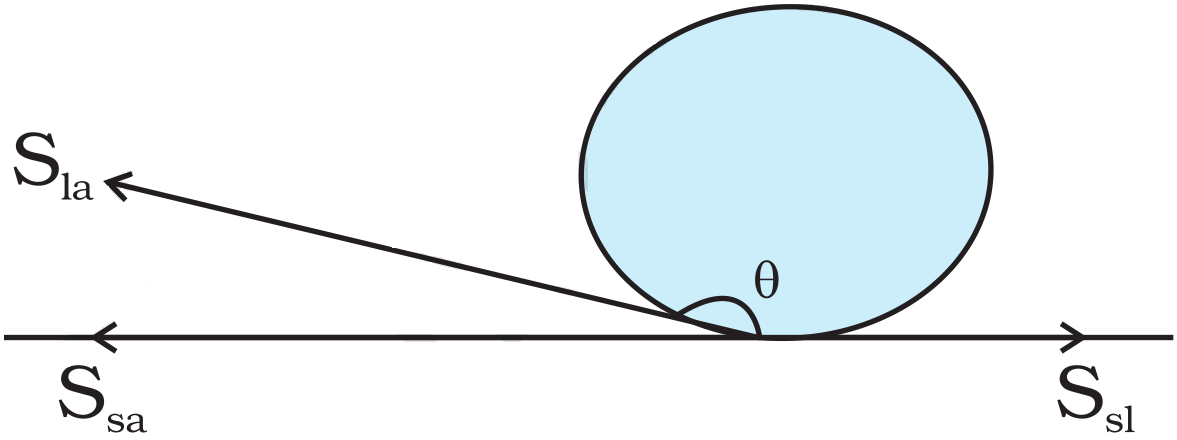
$ S_{la}, S_{sa}$, and $S_{sl}$ are the respective interfacial tensions between the liquid-air, solid-air, and solid-liquid interfaces. At the line of contact, the surface forces between the three media must be in equilibrium, i.e.,$\cos\theta=\text{(Ssa}–\text{Sla})/\text{Sla}$
The angle of contact $\theta$ , is obtuse if $S_{sa}< S_{la}$ (as in the case of mercury on glass). This angle is acute if $S_{sl} < S_{la}$ (as in the case of water on glass). View full question & answer→Question 543 Marks
A fully loaded Boeing aircraft has a mass of $3.3 \times 10^5 \ kg$. Its total wing area is $500 m ^2$. It is in level flight with a speed of $960 \ km / h. (a)$ Estimate the pressure difference between the lower and upper surfaces of the wings (b) Estimate the fractional increase in the speed of the air on the upper surface of the wing relative to the lower surface. [The density of air is $p =1.2 \ kg m ^3 J$
Answer$(a)$ The weight of the Boeing aircraft is balanced by the upward force due to the pressure difference
$\Delta P A=3.3 \times 10^5 \ kg \times 9.8$
$\Delta P =\left(3.3 \times 10^5 \ kg \times 9.8 m s ^{-2}\right) / 500 m ^2$
$ =6.5 \times 10^3 Nm ^2$
$(b)$ We ignore the small height difference between the top and bottom sides in Eq. $(9.12)$.
The pressure difference between them is then
$\Delta P=\frac{\rho}{2}\left(v_2^2-v_1^2\right) $
where $V_2$ is the speed of air over the upper surface and $V_1$ is the speed under the bottom surface.
$\left(v_2-v_1\right)=\frac{2 \Delta P}{\rho\left(v_2+v_1\right)}$
Taking the average speed
$V_{ aw }=\left(V_2+V_1\right) / 2=960 \ km / h =267 m s ^{-1} \text {, }$
we have
$\left(v_2-v_1\right) / v_{ av }=\frac{\Delta P}{\rho v_{ av }^2} \approx 0.08$
The speed above the wing needs to be only $8 \%$ higher than that below.
View full question & answer→Question 553 Marks
At a depth of $\text{1000 m}$ in an ocean $(a)$ what is the absolute pressure? $(b)$ What is the gauge pressure? $(c)$ Find the force acting on the window of area $\text{20 cm} \times \text{20 cm}$ of a submarine at this depth. the interior of which is maintained at sealevel atmospheric pressure. $($ The density of sea water is $1.03 \times 10^3 kg m ^{-3}$, $g=10 m s ^{-2}.)$
AnswerHere $h=1000 m$ and $\rho=1.03 \times 10^3 \ kg m ^3$.
$(a)$ From Eq. $(9.6),$ absolute pressure
$P= P+\rho g h$
$= 1.01 \times 10^5 Pa$
$ +1.03 \times 10^3 \ kg m ^{-3} \times 10 m s ^{-2} \times 1000 m$
$= 104.01 \times 10^5 Pa$
$\approx 104 atm$
$(b)$ Gauge pressure is $P-P_{ a }=\rho g h=P$
$P_{ g }=1.03 \times 10^3 \ kg m ^{-3} \times 10 ms ^2 \times 1000 m$
$=103 \times 10^5 Pa$
$\approx 103 atm$
$(c)$ The pressure outside the submarine is $P=P_{ a }+\rho g h$ and the pressure inside it is $P_{ a }$.
Hence, the net pressure acting on the window is gauge pressure, $P_{ tg }=\rho g h$.
Since the area of the window is $A=0.04 m ^2$, the force acting on it is
$F=P_{ g } A=103 \times 10^5 Pa \times 0.04 m ^2=4.12 \times 10^5 N$
View full question & answer→Question 563 Marks
The lower end of a capillary tube of diameter $2.00 mm$ is dipped 8.00 $cm$ below the surface of water in a beaker. What is the pressure required in the tube in order to blow a hemispherical bubble at Its end in water? The surface tension of water at temperature of the experiments is $7.30 \times 10^{-2} Nm ^{-1} .1$ atmospheric pressure $=$ $1.01 \times 10^5 Pa$, density of water $=1000 kg / m ^3$. $g =9.80 m s ^2$. Also calculate the excess pressure.
AnswerThe excess pressure in a bubble of gas in a liquid is given by $2 S / r$, where $S$ is the surface tension of the liquid-gas interface. You should note there is only one liquid surface in this case. (For a bubble of liquid in a gas, there are two liquid surfaces, so the formula for excess pressure in that case is $4 S / r$.) The radius of the bubble is $r$. Now the pressure outside the bubble $P_o$ equals atmospheric pressure plus the pressure due to $8.00 cm$ of water column. That is
$
\begin{aligned}
P_o & =\left(1.01 \times 10^5 Pa +0.08 m \times 1000 kg m ^{-3} \times\text{9.80 m s}^{-2} \right) \\
& =1.01784 \times 10^5 Pa
\end{aligned}
$
Therefore, the pressure inside the bubble is
$
\begin{aligned}
P_1 & =P_{ o }+2 S / r \\
& =1.01784 \times 10^5 Pa +\left(2 \times 7.3 \times 10^2 Pam / 10^3 m \right) \\
& =(1.01784+0.00146) \times 10^5 Pa \\
& =1.02 \times 10^5 Pa
\end{aligned}
$
where the radius of the bubble is taken to be equal to the radius of the capillary tube, since the bubble is hemispherical! (The answer has been rounded off to three significant figures.) The excess pressure in the bubble is $146 Pa$.
View full question & answer→