Question 13 Marks
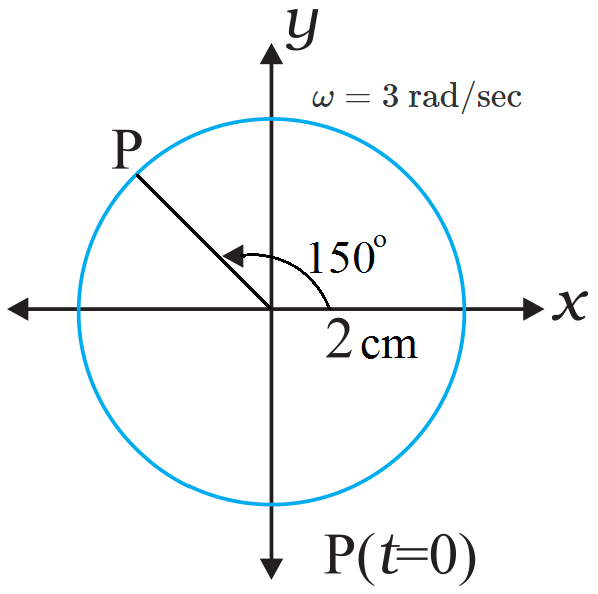
Plot the corresponding reference circle for each of the following simple harmonic motions. Indicate the initial (t = 0) position of the particle, the radius of the circle, and the angular speed of the rotating particle. For simplicity, the sense of rotation may be fixed to be anticlockwise in every case: (x is in cm and t is in s).$\text{x}=-2\sin\Big(3\text{t}+\frac{\pi}{3}\Big)$
Answer$\text{x}=-2\sin\Big(3\text{t}+\frac{\pi}{3}\Big)=+2\cos\Big(3\text{t}+\frac{\pi}{3}+\frac{\pi}{2}\Big)$$=2\cos\Big(3\text{t}+\frac{5\pi}{6}\Big)$
If this equation is compared with the standard SHM equation $\text{x}=\text{A}\cos\bigg(\Big(\frac{2\pi}{\text{T}}\Big)\text{t}+\phi\bigg),$ then we get:
Amplitude, A = 2cm
Phase angle, $\phi=\frac{5\pi}{6}=150^\circ$
Angular velocity, $\omega=\frac{2\pi}{\text{T}}=3\text{rad/sec.}$
The motion of the particle can be plotted as shown in the following figure.
View full question & answer→Question 23 Marks
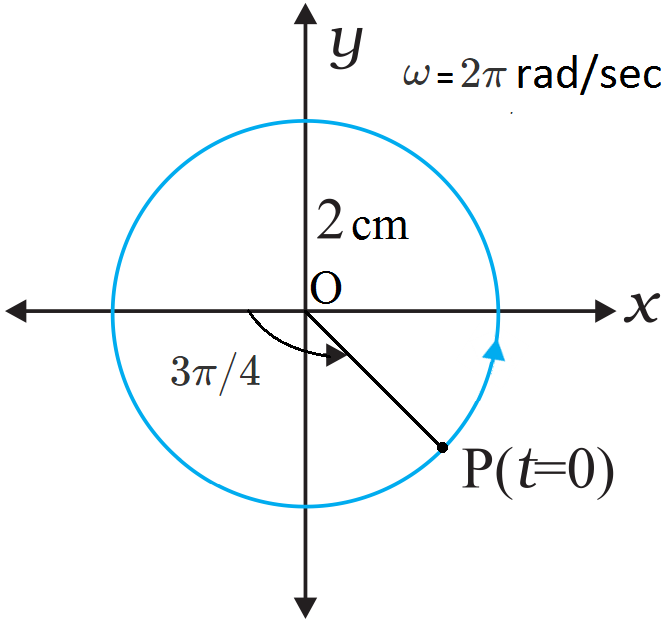
Plot the corresponding reference circle for each of the following simple harmonic motions. Indicate the initial (t = 0) position of the particle, the radius of the circle, and the angular speed of the rotating particle. For simplicity, the sense of rotation may be fixed to be anticlockwise in every case: (x is in cm and t is in s).$\text{x}=3\sin\Big(2\pi\text{t}+\frac{\pi}{4}\Big)$
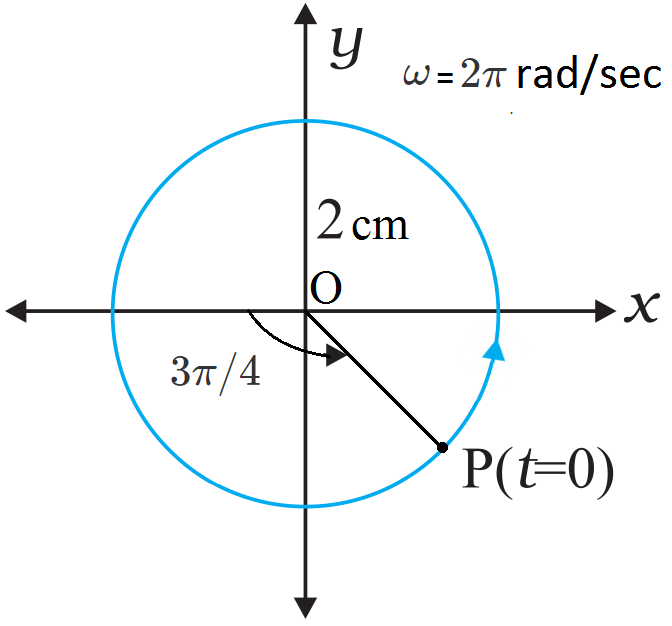
Answer$\text{x}=3\sin\Big(2\pi\text{t}+\frac{\pi}{4}\Big)$$=-3\cos\bigg[\Big(2\pi\text{t}+\frac{\pi}{4}\Big)+\frac{\pi}{2}\bigg]=-3\cos\Big(2\pi\text{t}+\frac{3\pi}{4}\Big)$
If this equation is compared with the standard SHM equation $\text{x}=\text{A}\cos\bigg(\Big(\frac{2\pi}{\text{T}}\Big)\text{t}+\phi\bigg),$ then we get:
Amplitude, A = 3cm
Phase angle, $\phi=\frac{3\pi}{4}=135^\circ$
Angular velocity, $\omega=\frac{2\pi}{\text{T}}=2\pi\text{ rad/s}$
The motion of the particle can be plotted as shown in the following figure.
View full question & answer→Question 33 Marks
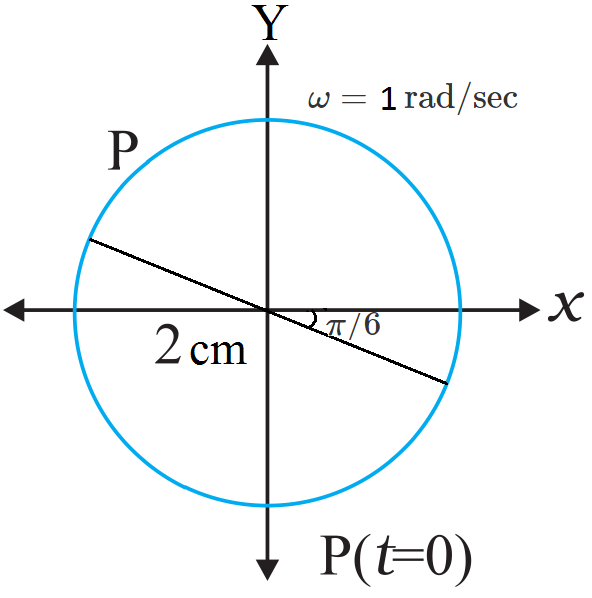
Plot the corresponding reference circle for each of the following simple harmonic motions. Indicate the initial (t = 0) position of the particle, the radius of the circle, and the angular speed of the rotating particle. For simplicity, the sense of rotation may be fixed to be anticlockwise in every case: (x is in cm and t is in s).$\text{x}=\cos\Big(\frac{\pi}{6}-\text{t}\Big)$
Answer$\text{x}=\cos\Big(\frac{\pi}{6}-\text{t}\Big)=\cos\Big(\text{t}-\frac{\pi}{6}\Big)$If this equation is compared with the standard SHM equation $\text{x}=\text{A}\cos\bigg(\Big(\frac{2\pi}{\text{T}}\Big)\text{t}+\phi\bigg),$ then we get:
Amplitude, A = 1
Phase angle, $\phi=-\frac{\pi}{6}=-30^\circ$
Angular velocity, $\omega=\frac{2\pi}{\text{T}}=1\text{rad/s}$
The motion of the particle can be plotted as shown in the following figure.
View full question & answer→Question 43 Marks
Answer the following questions:The motion of a simple pendulum is approximately simple harmonic for small angle oscillations. For larger angles of oscillation, a more involved analysis shows that T is greater than $2\pi\sqrt{\frac{\text{l}}{\text{g}}}.$ Think of a qualitative argument to appreciate this result.
AnswerIn the case of a simple pendulum, the restoring force acting on the bob of the pendulum is given as:
$\text{F}=-\text{mg}\sin\theta$
Where,
F = Restoring force
m = Mass of the bob
g = Acceleration due to gravity
$\theta=$ Angle of displacement
For small $\theta,\ \sin\theta\simeq\theta$
For large $\theta,\ \sin\theta$ is greater than $\theta.$
This decreases the effective value of g.
Hence, the time period increases as:
$\text{T}=2\pi\sqrt{\frac{\text{l}}{\text{g}}}$
Where, l is the length of the simple pendulum.
View full question & answer→Question 53 Marks
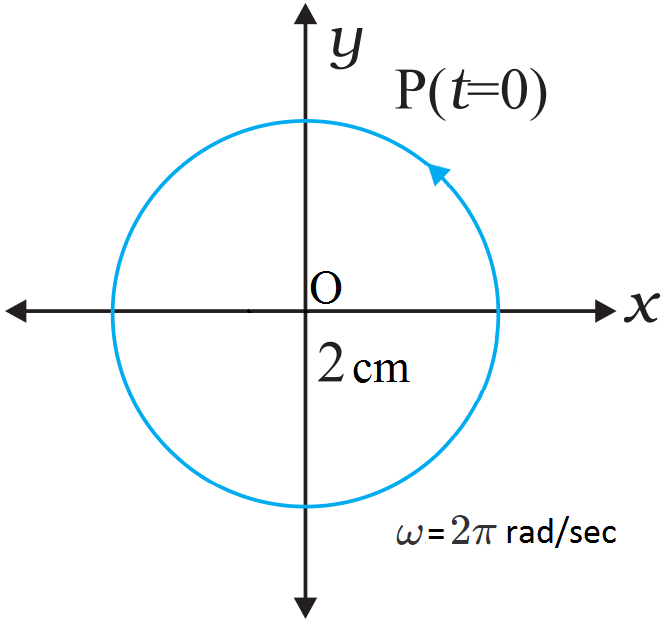
Plot the corresponding reference circle for each of the following simple harmonic motions. Indicate the initial (t = 0) position of the particle, the radius of the circle, and the angular speed of the rotating particle. For simplicity, the sense of rotation may be fixed to be anticlockwise in every case: (x is in cm and t is in s).
$\text{x}=2\cos\pi\text{t}$
Answer$\text{x}=2\cos\pi\text{t}$If this equation is compared with the standard SHM equation $\text{x}=\text{A}\cos\bigg(\Big(\frac{2\pi}{\text{T}}\Big)\text{t}+\phi\bigg),$ then we get:
Amplitude, A = 2cm Phase angle, $\phi=0$ Angular velocity, $\omega=\pi\text{ rad/s}$The motion of the particle can be plotted as shown in the following figure.
View full question & answer→Question 63 Marks
A simple pendulum of length $l$ and having a bob of mass $M$ is suspended in a car. The car is moving on a circular track of radius $R$ with a uniform speed $v$. If the pendulum makes small oscillations in a radial direction about its equilibrium position, what will be its time period?
AnswerThe bob of the simple pendulum will experience the acceleration due to gravity and the centripetal acceleration provided by the circular motion of the car.
Acceleration due to gravity = $g$
Centripetal acceleration = $v^2/R$
where,
v is the uniform speed of the car
R is the radius of the track
Effective acceleration (g') is given as:
$\text{g}'=\sqrt{\text{g}^2+\frac{\upsilon^4}{\text{R}^2}}$
$\therefore$ Time period, $\text{T}=2\pi\sqrt{\frac{\text{l}}{\text{g}'}}$
$=2\pi\frac{\text{l}}{\text{g}^2+\frac{\upsilon^4}{\text{R}^2}}$
View full question & answer→Question 73 Marks
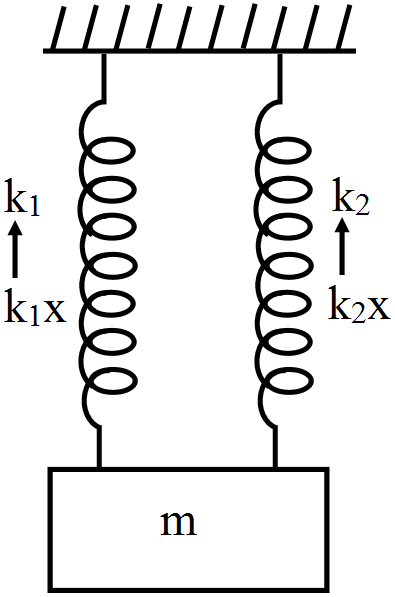
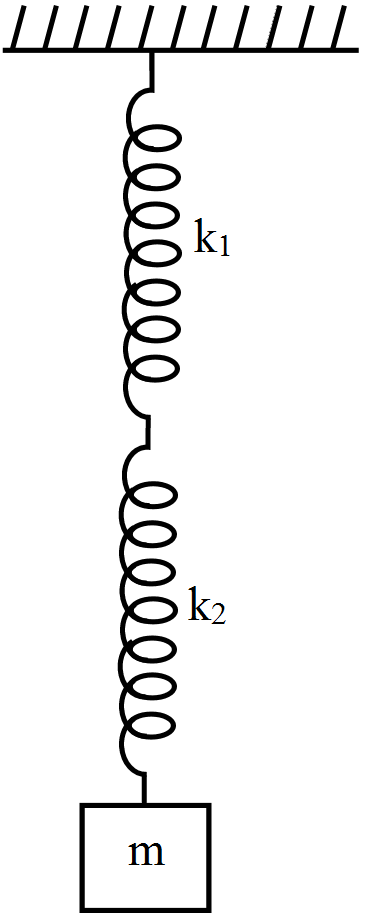
Derive the expression for resultant spring constant when two springs having constants $k_1$ and $k_2$ are connected
- In parallel.
- In series.
Answer
- When the springs are connected in parallel, the extension in them will be same and the total restoring force is the sum of their restoring forces.
$\therefore\text{F = F}_1+\text{F}_2$
$-\text{k}_{\text{eq}}\text{x}=-\text{k}_1\text{x}-\text{k}_2\text{x}$
$\text{k}_{\text{eq}}=\text{k}_1+\text{k}_2$
- When the springs are connected in series, the restoring force is same in both the springs and the extensions will be different so the not extension
i.e., $\text{x = x}_1+\text{x}_2$
$=\frac{\text{F}}{-\text{k}_{\text{eq}}}=\frac{-\text{F}}{\text{k}_1}-\frac{\text{F}}{\text{k}_2}$
$\therefore\frac{1}{\text{k}_{\text{eq}}}=\frac{1}{\text{k}_1}+\frac{1}{\text{k}_2}$
when connected in series.
View full question & answer→Question 83 Marks
The displacement of a particle having $\text{S.H.M}$. is $x = 10\sin\Big[10\pi\text{t}+\frac{\pi}{4}\Big]\text{m}.$
- Amplitude.
- Angular frequency.
- Epoch.
- Time period.
- Frequency.
- Maximum velocity.
AnswerGiven equation is, $\text{x}=10\sin\Big(10\pi\text{t}+\frac{\pi}{4}\Big)\text{m},$ comparing with $\text{x = A}\sin(\omega\text{t}+\phi)$ we have
- Amplitude, $\text{A = 10m.}$
- Angular frequency, $\omega=10\pi.$
- Epoch $=$ initial phase, $\frac{\pi}{4}.$
- Time period, $\text{T}=\frac{1}{5}\text{sec}.$
- Frequency, $\text{f = 5Hz.}$
- Maximum velocity $\omega\text{A}=100\pi\text{ms}^{-1}.$
View full question & answer→Question 93 Marks
What is Simple Harmonic Motion? Show that in $\text{S.H.M}$., acceleration is directly proportional to its displacement at a given instant.
AnswerSimple Harmonic Motion :
- Motion is always directed towards a fixed point or equilibrium point.
- Motion being represented by bounded trigonometric functions.
- Acceleration is directly proportional to negative of displacement, i.e., $\text{a}\propto-\text{x}$
Equation for $\text{S.H.M.}$
Acceleration $=-\omega^2\text{x}$
$\Rightarrow\frac{\text{d}^2\text{x}}{\text{dt}^2}+\omega^2\text{x}=0,\omega=2\pi\text{f}$
$\omega$ is angular frequency $($radian$/$ sec$), f$ is linear fiequency $(s^{-1}) $or $($hertz$)$ View full question & answer→Question 103 Marks
Find the expression for the total energy of a particle executing S.H.M.
AnswerP.E. with a S.H.M.$=\frac{1}2{}\text{Kx}^2=\frac{1}{2}\text{m}\omega^2\text{x}^2$
K.E. with a S.H.M.$=\frac{1}2{}\text{mv}^2=\frac{1}2{}\text{m}\big[\omega\sqrt{\text{A}^2-\text{x}^2}\big]^2$
$=\frac{1}{2}\text{m}\omega^2(\text{A}^2-\text{x}^2)$
Where m is mass, A is amplitude, x is any position and $\omega$ is the angular fiequency,$\therefore$ Total energy $=\frac{1}{2}\text{m}\omega^2\text{x}^2+\frac{1}{2}\text{m}\omega^2(\text{A}^2-\text{x}^2)$
$=\frac{1}{2}\text{m}\omega^2\text{A}^2$
View full question & answer→Question 113 Marks
A particle starts S.H.M. from the mean position. Its amplitude is A and its time period is T. At one time its speed is half that of the maximum speed. What is this displacement?
AnswerLet the particle be at R when its velocity $\text{v}=\frac{\text{v}_{\text{max}}}{2}=\frac{\text{A}\omega}{2}$ and its displacement from the mean position O be y.
As $\text{v}=\omega\sqrt{\text{A}^2-\text{y}^2},$
So $\text{y}=\sqrt{\text{A}^2-\frac{\text{v}^2}{\omega^2}}$
Given $\text{v}=\frac{\text{A}\omega}{2},$
then $\text{y}=\sqrt{\text{A}^2-\frac{\text{A}^2\omega^2}{4\omega^2}}=\frac{\sqrt{3}}{2}\text{A}$
View full question & answer→Question 123 Marks
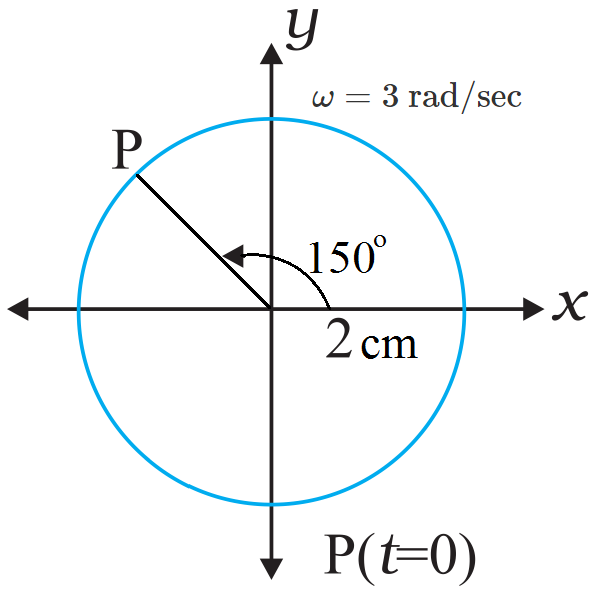
Plot the corresponding reference circle for each of the following simple harmonic motions. Indicate the initial (t = 0) position of the particle, the radius of the circle, and the angular speed of the rotating particle. For simplicity, the sense of rotation may be fixed to be anticlockwise in every case: (x is in cm and t is in s).$\text{x}=-2\sin\Big(3\text{t}+\frac{\pi}{3}\Big)$
Answer$\text{x}=-2\sin\Big(3\text{t}+\frac{\pi}{3}\Big)=+2\cos\Big(3\text{t}+\frac{\pi}{3}+\frac{\pi}{2}\Big)$$=2\cos\Big(3\text{t}+\frac{5\pi}{6}\Big)$
If this equation is compared with the standard SHM equation $\text{x}=\text{A}\cos\bigg(\Big(\frac{2\pi}{\text{T}}\Big)\text{t}+\phi\bigg),$ then we get:
Amplitude, A = 2cm
Phase angle, $\phi=\frac{5\pi}{6}=150^\circ$
Angular velocity, $\omega=\frac{2\pi}{\text{T}}=3\text{rad/sec.}$
The motion of the particle can be plotted as shown in the following figure.
View full question & answer→Question 133 Marks
In a HCl molecule, we may treat Cl to be of infinite mass and H alone be oscillating. If the oscillation of HCl molecule shows a frequency of $9 \times 10^{13}s^{-1}$, deduce the force constant. [Given: Avogadro's number = $6 \times 10^{26}$ per kg mole.)
Answer$1kg$ of $H$ has $6 \times 10^{26}$ atoms.
$\therefore\text{m}=\frac{1}{6\times10^{26}},\text{v}=9\times10^{13}\text{s}^{-1}$
$\text{v}=\frac{1}{2\pi}\sqrt{\frac{\text{k}}{\text{m}}}$
$\text{v}^2=\frac{1}{4\pi^2}\times\frac{\text{k}}{\text{m}}$
$\text{k}=4\pi^2\text{v}^2\text{m}$
$=4(3.14)^2(9\times10^{13})\times\frac{1}{6\times10^{26}}\text{Nm}^{-1}$
$=5.32\times10^2\text{Nm}^{-1}$
View full question & answer→Question 143 Marks
A harmonic oscillation is represented by $\text{y}=0.34\cos(3000\text{t}+0.74),$ where $y$ and $t$ are in $m$ and $s$ respectively. Deduce: $(i)$ the amplitude, $(ii)$ the frequency and angular frequency, $(iii)$ the period, and $(iv)$ the initial phase.
AnswerGiven that, $\text{y}=0.34\cos(3000\text{t}+0.74)$
While the general expression for displacement is, $\text{y = a}\cos(\omega\text{t}+\phi_0)$
Comparing these two expressions,
- Amplitude,$ a = 0.34m.$
- Angular frequency
$\omega=3000\text{ radian/ sec}^{-1}$
Frequency $\text{v}=\frac{\omega}{2\pi}=\frac{3000}2\pi{}=\frac{1500}{\pi}\text{Hz.}$
- Period $\text{T}=\frac{1}{\text{v}}=\frac{1}{\frac{1500}{\pi}}=\frac{\pi}{1500}\text{s}.$
- lnitial phase $\phi_0=0.74\text{ rad.}$
View full question & answer→Question 153 Marks
A body of mass $5kg$ executes $\text{S.H.M}$. of amplitude of $0.5m$. If the force constant is $100Nm^{-1}$, calculate
- Its time period.
- Its maximum kinetic energy, maximum potential energy and total energy.
AnswerGiven: $m = 5\ kg, k = 100N/m; A = 0.5m$
- Time period is given by
$\text{T}=2\pi\sqrt{\frac{\text{m}}{\text{k}}}=2\pi\sqrt{\frac{5}{100}}=0.41\text{s}$
- Angular velocity,
$\omega=\frac{2\pi}{\text{T}}=\frac{2\pi}{0.41}=4.5\text{ rad/ s}$
Maximum $\text{K.E.}=\text{E}_{\text{Kmax}}=\frac{1}{2}\text{mv}^2_0$
$=\frac{1}2{}\text{m}(\omega\text{A})^2=12.50\text{J}$
Maximum $\text{P.E. = E}_{\text{Pmax}}$
$=\frac{1}{2}\text{k}\text{A}^2=12.50\text{J}$
Total energy $\text{E = E}_{\text{Kmax}}$
$=\text{E}_{\text{Pmax}}=12.50\text{J}$ View full question & answer→Question 163 Marks
A particle is subjected to two simple harmonic motions in the same direction having equal amplitude and equal frequency. If the resultant amplitude is equal to the amplitude of individual motions, what is the phase difference between the motions?
AnswerHere, $\text{a}_1=\text{r};\text{a}_2=\text{r}$ and $\text{R = r},\theta=?$ As $\text{R}^2=\text{a}^2_1+\text{a}^2_2+2\text{a}_1\text{a}_2\cos\theta$$\therefore\text{r}^2=\text{r}^2+\text{r}^2+2\text{r.r}\cos\theta$
$=2\text{r}^2(1+\cos\theta)$
$1+\cos\theta=\frac{1}{2}$
$\cos\theta=-\frac{1}{2},$
$=\cos120^{\circ}$
$\theta=120^{\circ}$
$=\frac{2\pi}{3}\text{radian}$
View full question & answer→Question 173 Marks
A body oscillates with $\text{S.H.M}$. according to the equation:$\text{x(t)}=5\cos\Big(2\pi\text{t}+\frac{\pi}{4}\Big)$
where $x$ is in meters and $t$ is in seconds. Calculate the following:
- Displacement at $t = 0$
- Angular frequency
- Magnitude of velocity $($Maximum$)$.
Answer$\text{x(t)}=5\cos\Big(2\pi\text{t}+\frac{\pi}{4}\Big)\text{m}$
- $\text{x}(0)=5\cos\Big(0+\frac{\pi}{4}\Big)=5\times\frac{1}{\sqrt{2}}\text{m}=\frac{5}{\sqrt{2}}\text{m}$
- Angular frequency $=\omega=2\pi\text{v}\text{ rad/sec}.$
- Maximum velocity $=\omega\text{A}=2\pi\times5=10\pi\text{ ms}^{-1}$
View full question & answer→Question 183 Marks
A cylindrical piece of cork of density of base area A and height h floats in a liquid of density $\rho_{\text{l}}.$ The cork is depressed slightly and then released. Show that the cork oscillates up and down simple harmonically with a period.$\text{T}=2\pi\sqrt{\frac{\text{h}\rho}{\rho_{\text{l}}\text{g}}}$
where $\rho$ is the density of cork. (Ignore damping due to viscosity of the liquid).
AnswerGiven, Area of cross-section of cork = A, Height of cork = h Density of liquid $=\rho_{\text{l}}$ In equilibrium position of the weight of liquid displacement by cork = weight of cork. When cork is further depressed by $\xi,$ than it further displaces liquid, an extra upthrust acts upwards, which provides restoring force to the cork. Restoring force = extra upthrust = weight of extra displaced water.$\text{F}=-(\text{volume}\times\text{density}\times\text{g})$
$\text{F}=-\text{A}\times\text{y}\times\rho_{\text{l}}\times\text{g} \ ...(\text{i})$
$\text{k}=\frac{\text{F}}{\text{y}}=-\text{A}\rho_{\text{l}}\text{g}$
The period of oscillation of cork is given by$\text{T}=2\pi\sqrt{\frac{\text{m}}{\text{k}}}$
where m = mass of cork = volume of cork × density of cork$=\text{A}\times\text{h}\times\rho$
$\text{T}=2\pi\sqrt{\frac{\text{A}\times\text{h}\times\rho}{\text{A}\rho_{\text{l}}\text{g}}}=2\pi\sqrt{\frac{\text{h}\rho}{\rho_{\text{l}}\text{g}}}$
thus, $\text{T}=2\pi\sqrt{\frac{\text{h}\rho}{\rho_{\text{l}}\text{g}}}$
View full question & answer→Question 193 Marks
A particle is in linear simple harmonic motion between two points $A$ and $B, 10\ cm$ apart. Take the direction from $A$ to $B$ as positive direction and give the signs of velocity and acceleration on the particle when it is :
- At the end $B$.
- At $3\ cm$ away from $A$ going towards $B$.
Answer
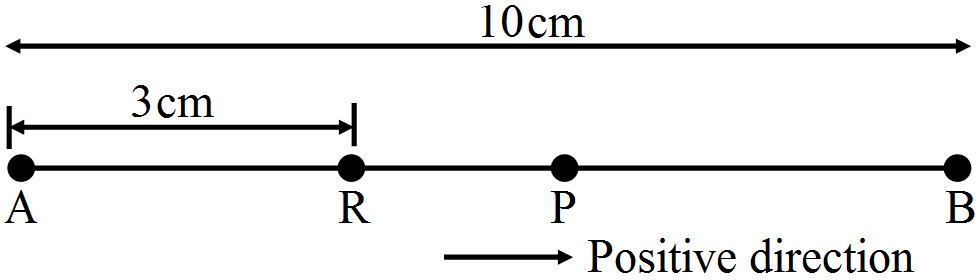
- At the end $B$ velocity is zero. Here acceleration and force are negative as they are directed along $BR$ i.e., along negative direction.
- At $3\ cm$ away from $A$ going towards $B$, the particle is at $R$, with a tendency to move along $RP$ which is positive direction, here velocity, acceleration are all positive.
View full question & answer→Question 203 Marks
A body of mass $12kg$ is suspended by a coil spring of natural length $50cm$ and force constant $2.0 \times 10Nm^3$. What is the stretched length of the spring? If the body is pulled down further stretching the spring to a length of $5.9cm$ and then released, what is the frequency of oscillation of the suspended mass?
(Neglect the mass of the spring.)
Answer$m = 12 kg$; Original length $l = 50 cm; k = 2.0 \times 10^3Nm^{-1}$, As $\text{F = mg}$$\therefore\frac{\text{F}}{\text{k}}=\frac{\text{mg}}{\text{k}}=\frac{12\times9.8}{2\times10^3}$
$=5.9\times10^{-2}\text{m}=5.9\text{cm}$
$\therefore$ Stretched length of the spring
$=\text{l + y}=50+5.9=55.9\text{cm}$
$\text{v}=\frac{1}{\text{T}}=\frac{1}{2\pi}\sqrt{\frac{\text{k}}{\text{m}}}$
$=\frac{1}{2\times3.14}\sqrt{\frac{2\times10^3}{12}}$
$=2.06\text{s}^{-1}$
View full question & answer→Question 213 Marks
Define the restoring force and it characteristic in case of an oscillating body.
AnswerA force which takes the body back towards the mean position in oscillation is called restoring force.
Characteristic of restoring force: The restoring force is always directed towards the mean position and its magnitude of any instant is directly proportional to the displacement of the particle from its mean position of that instance.
View full question & answer→Question 223 Marks
The potential energy of a particle of mass 1kg in motion along the x-axis is given by $\text{U}=4(1-\cos2\text{x})$ Here x is in metres. Find the period of small oscillations.
Answer$\text{F}=-\frac{\text{dU}}{\text{dx}}$$=-\frac{\text{d}}{\text{dx}}[4(1-\cos2\text{x})]-8\sin2\text{x}$
$\text{F}=-8\times2\text{x}$
[When x is small, $\sin2\text{x}=2\text{x}$]
$\text{F}=-16\text{x}$
As $\text{F}\propto\text{x}$ and -ve sign shows that x is directed towards equilibrium position hence the particle will execute SHM.
Here spring factor, k = 16N/ m
Inertia factor m = 1kg
$\therefore$ Time period $\text{T}=32\pi\sqrt{\frac{\text{m}}{\text{k}}}$
$=2\pi\sqrt{\frac{1}{16}}=\frac{\pi}{2}\text{s}$
View full question & answer→Question 233 Marks
Plot the corresponding reference circle for each of the following simple harmonic motions. Indicate the initial (t = 0) position of the particle, the radius of the circle, and the angular speed of the rotating particle. For simplicity, the sense of rotation may be fixed to be anticlockwise in every case: (x is in cm and t is in s).$\text{x}=3\sin\Big(2\pi\text{t}+\frac{\pi}{4}\Big)$
Answer$\text{x}=3\sin\Big(2\pi\text{t}+\frac{\pi}{4}\Big)$$=-3\cos\bigg[\Big(2\pi\text{t}+\frac{\pi}{4}\Big)+\frac{\pi}{2}\bigg]=-3\cos\Big(2\pi\text{t}+\frac{3\pi}{4}\Big)$
If this equation is compared with the standard SHM equation $\text{x}=\text{A}\cos\bigg(\Big(\frac{2\pi}{\text{T}}\Big)\text{t}+\phi\bigg),$ then we get:
Amplitude, A = 3cm
Phase angle, $\phi=\frac{3\pi}{4}=135^\circ$
Angular velocity, $\omega=\frac{2\pi}{\text{T}}=2\pi\text{ rad/s}$
The motion of the particle can be plotted as shown in the following figure.
View full question & answer→Question 243 Marks
If the acceleration due to gravity on moon is one sixth that on the earth what will be the length and time period of a second's pendulum there? (g = 9.8 ms?)
AnswerOn moon $\text{g}_{\text{m}}=\frac{\text{g}}{6}=\frac{9.8}{6};\text{T}=2\text{s}$$\text{T}=2\pi\sqrt{\frac{\text{l}}{\text{g}_{\text{m}}}}$
$\text{l}=\frac{\text{T}^2\text{g}_{\text{m}}}{4\pi^2}=\frac{2^2\times\big(\frac{9.8}{6}\big)}{4\times\big(\frac{22}{7}\big)^2}$
$=0.165\text{m}=16.5\text{cm}$
View full question & answer→Question 253 Marks
Find the displacement of a simple harmonic oscillator at which its PE is half of the maximum energy of the oscillator.
AnswerLet us assume that the required displacement where PE is half of the maximum energy of the oscillator be x. The potential energy of the oscillator at this position,$\text{PE}=\frac{1}{2}\text{kx}^2=\frac{1}{2}\text{m}\omega^2\text{x}^2$
maximum energy of the oscillator = maximum potential energy = Total energy$\text{TE}=\frac{1}{2}\text{m}\omega^2\text{A}^2$
Where, A = amplitude of motion. We are given, $\text{PE}=\frac{1}{2}\text{TE}$$\Rightarrow\frac{1}{2}\text{m}\omega^2\text{x}^2=\frac{1}{2}\Big[\frac{1}{2}\text{m}\omega^2\text{A}^2\Big]$
$\Rightarrow\text{x}^2=\frac{\text{A}^2}{2}\ \text{or}\ \text{x}=\sqrt{\frac{\text{A}^2}{2}}=\pm\frac{\text{A}}{\sqrt{2}}$
View full question & answer→Question 263 Marks
Two simple harmonic motions are represented by:$\text{x}_1=10\sin\Big(4\pi\text{t}+\frac{\pi}{4}\Big)$
$\text{x}_2=5(\sin4\pi\text{t}+\sqrt{3}\cos4\pi\text{t})$
What is the ratio of the amplitudes?
Answer$\text{x}_2=5\sin4\pi\text{t}+5\sqrt{3}\cos4\pi\text{t}$Amplitude of $\text{x}_2=\sqrt{5^2+(5\sqrt{3})^2}=10$
Since the $\sin\pi\text{t}$ and $\cos4\pi\text{t}$ functions are out ofphase by $\frac{\pi}{2}.$
Amplitude of $x_2 = 10$
$\therefore$ Ratio of amplitudes is $1 : 1$
View full question & answer→Question 273 Marks
A man stands on a weighing machine placed on a horizontal platform. The machine reads $50kg$. By means of a suitable mechanism the platform is made to execute harmonic vibrations up and down with a frequency of $2$ vibrations per second. What will be the effect on the reading of the weighing machine? The amplitude of vibrations of platform is 5cm. Take $g = 10ms^{-2}$?
AnswerHere, $m = 50kg, v = 2s^{-1} a = 5cm = 0.05m$ Max. acceleration$\text{a}_{\text{max}}=\omega^2\text{A}=(2\pi\text{v})^2\text{A}=4\pi^2\text{v}^2\text{A}$
$=4\times\Big(\frac{2}{7}\Big)^2\times(2)^2\times0.05$
$=7.9\text{ms}^{-2}$
$\therefore$ Maximum force felt by the man $= m(g + a_{max}) = 50(10 + 7.9) = 895.0N = 89.5kg f$
Minimum force felt by the man = $m(g - a_{max}) = 50(10 - 7.9) = 105.0 = 10.5kg\ f$
Hence, the reading of the weighing machine varies between 10.5kg f and 89.5kg f.
View full question & answer→Question 283 Marks
- What is meant by Simple Harmonic Motion $\text{(S.H.M)}$?
- At what points is the energy entirely kinetic and potential in $\text{S.H.M}$?
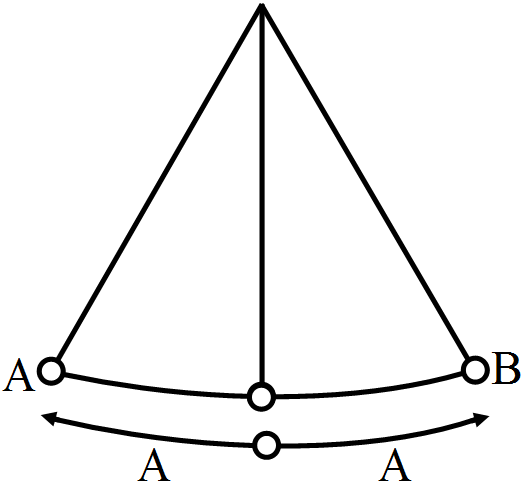
- What is the total distance travelled by a body executing $\text{S.H.M}$ in a time equal to its time period, if its amplitude is $A$?
Answer
- Simple harmonic motion is the projection of uniform circular motion on a diameter of a circle of reference.
- At mean position $- \text{K.E.}$
At extreme position $\text{- P.E.}$
- $4A$ because in completing one oscillation it crosses mean position $2$ times so total dist. is $4A.$
View full question & answer→Question 293 Marks
A spring of constant k is attached with a mass m and is made to oscillate. What is its time period?
AnswerThe mass when displaced will stretch or compress the spring. If x is the displacement, the restoring force will be F = -kx. This makes the mass to oscillate. 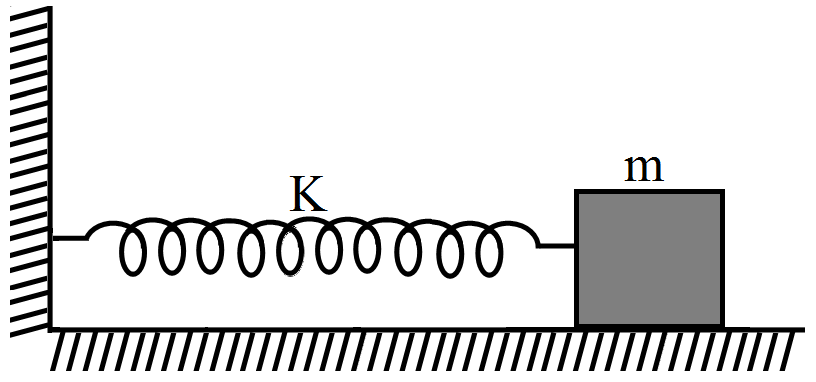 $\therefore\text{ma}=-\text{kx,a}=\frac{-\text{k}}{\text{m}}\text{x}$
We know, $\text{T}=2\pi\sqrt{\frac{\text{Displacement}}{\text{Acceleration}}}$$2\pi\sqrt{\frac{\text{Inertial factor}}{\text{Spring factor}}}$
$\text{T}=2\pi\sqrt{-\frac{\text{x}}{\text{a}}}$
$2\pi\sqrt{\frac{\text{m}}{\text{k}}}$ View full question & answer→Question 303 Marks
What is the ratio of maxmimum acceleration to the maximum velocity of a simple harmonic oscillator?
AnswerConsider a SHM. $\text{x}=\text{A}\sin\omega\text{t}$$\text{v}=\frac{\text{dx}}{\text{dt}}=\text{A}\omega\cos\omega\text{t}$
For $\text{v}_\text{max}\cos\omega\text{t}=-1$$\therefore\text{v}_\text{max}=\text{A}\omega$
$\text{a}=\frac{\text{dv}}{\text{dt}}=-\text{A}\omega^2\sin\omega\text{t}$
For $\text{a}_\text{max}\sin\omega\text{t}=-1 $$\text{a}_\text{max}=\text{A}\omega^2$
$\therefore\frac{\text{a}_\text{max}}{\text{v}_\text{max}}=\frac{\text{A}\omega^2}{\text{A}\omega}=\frac{\omega}{1}$
View full question & answer→Question 313 Marks
Two identical springs of spring constant k each are attached to a block of mass m as shown in figure:

Show that when the mass is displaced from its equilibrium position on either side, it executes a simple harmonic motion. Find the period of oscillations.
Answer
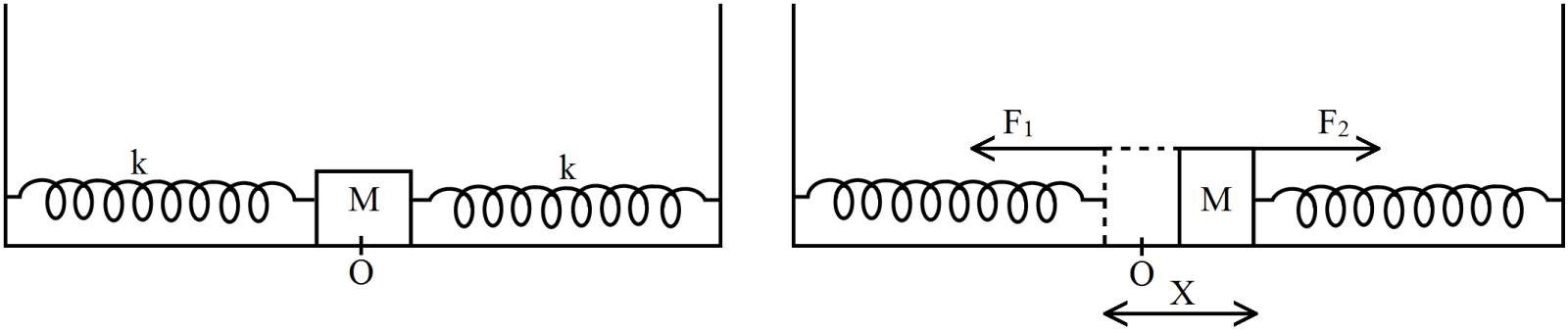
Let the mass be displaced by a small distance x to the right of equilibrium position. Due to this, spring on left gets elongated by length equal to x and that on the right side gets compressed by same length. Then force acting on masses are
$F_1 = -kx$ (force acting on left side and trying to pull the mass towards the mean position.)
$F_2 = -kx$ (force exerted by spring on right side trying to push the mass towards mean position.)
Net force F, acting on the mass
$F = -2kx$
$\therefore$ Force acting on mass is directly propotional to displacement and it directed towards mean position.
$\therefore$ Motion is simple harmonic and time period of oscillation is
$\text{T}=2\pi\sqrt{\frac{\text{m}}{2\text{k}}}$ View full question & answer→Question 323 Marks
A pendulum of length $l$ is attached with a bob and placed in a lift. What will be time period when the lift is :
- Having uniform motion upwards.
- Accelerated upwards by a.
- Accelerated downward by a?
Answer
- When there is uniform motion there is no change in acceleration.
$\therefore\text{T}=\pi\sqrt{\frac{\text{l}}{\text{g}}}$
- When there is an upward acceleration, $g \rightarrow g + a.$
$\therefore\text{T}=2\pi\sqrt{\frac{\text{l}}{\text{g + a}}}$
- When there is a downward acceleration $g \rightarrow g - a.$
$\therefore\text{T}=2\pi\sqrt{\frac{\text{l}}{\text{g}-\text{a}}}$ View full question & answer→Question 333 Marks
A body oscillates with SHM according to the equation (in SI unit)$\text{x}=5\cos\Big[2\pi\text{t}+\frac{\pi}{4}\Big]$
At t = 1.5 second, calculate (i) displecement, (ii) speed.
Answer$\text{x}=5\cos\Big[2\pi\text{t}+\frac{\pi}{4}\Big]\text{at t}=1.5\text{ sec}$Displacement, $\text{x}=5\cos\Big[2\pi(1.5)+\frac{\pi}{4}\Big]$
$=5\cos\Big[3\pi+\frac{\pi}{4}\Big]$
Velocity of oscillation,
$\text{u}=\frac{\text{dx}}{\text{dt}}=-5\times2\pi\times\sin\Big(2\pi\text{t}+\frac{\pi}{4}\Big)$
$=-10\pi\sin\Big(2\pi\text{t}+\frac{\pi}{4}\Big)$
at $\text{t}=1.5\text{ sec}, \text{u}=-10\pi\sin\Big(2\pi(1.5)+\frac{\pi}{4}\Big)$
$=-10\pi\sin\Big(3\pi+\frac{\pi}{4}\Big)$
View full question & answer→Question 343 Marks
Two simple harmonic motions are represented by the following equations:$\text{y}_1=10\sin\frac{\pi}{4}(12\text{t}+1)$
and $\text{y}_2=5(\sin3\pi\text{t}+\sqrt{3}\cos\pi\text{t}).$ What is the ratio of their amplitudes?
AnswerHere, $\text{y}_1=10\sin\frac{\pi}{4}(12\text{t}+1)$$=10\sin(3\pi\text{t}+\frac{\pi}{4}) \ ...(\text{i})$
and $\text{y}_2=5[\sin3\pi\text{t}+\sqrt{3}\cos3\pi\text{t}]$$=10\Big[\frac{1}{2}\sin3\pi\text{t}+\frac{\sqrt{3}}{2}\cos3\pi\text{t}\Big]$
$=10\Big[\cos\frac{\pi}{3}\sin3\pi\text{t}+\sin\frac{\pi}{3}\cos3\pi\text{t}\Big]$
$=10\sin\big(3\pi\text{t}+\frac{\pi}{3}\big) \ ...(\text{ii})$
Thus, from (i) and (ii), the amplitude ratio of motion $=\frac{10}{10}=\frac{1}{1}=1:1$
View full question & answer→Question 353 Marks
The angular velocity and amplitude of a simple pendulum is $\omega$ and r respectively. At a displacement x from the mean position, if its kinetic energy is T and potential energy is V, find the ratio of T to V.
AnswerKinetic energy at. x is$\text{T}=\frac{1}{2}\text{m}\omega^2(\text{A}^2-\text{x}^2)$
Potential energy at x is$\text{V}=\frac{1}{2}\text{m}\omega^2\text{x}^2$
$\frac{\text{T}}{\text{V}}=\frac{\text{A}^2-\text{x}^2}{\text{x}^2}=\Big(\frac{\text{A}^2}{\text{x}^2}-1\Big)$
View full question & answer→Question 363 Marks
A force of 6.4N stretches a vertical spring by 0.1m. Find the mass that must be suspended from the spring so that it oscillates with the period of $\Big(\frac{\pi}{4}\Big)$ second.
Answerspring factor, $\text{k}=\frac{\text{f}}{\text{m}}=\frac{6.4}{0.1}=64\text{Nm}^{-1};\text{T}=\frac{\pi}{4}\text{s};$ Inertial factor = mass suspended = m. ln S.H.M the time period is given by$\text{T}=2\pi\sqrt{\frac{\text{Inertial factor}}{\text{Spring factor}}}$
$\therefore\frac{\pi}{4}=2\pi\sqrt{\frac{\text{m}}{64}}$ or $\text{m}=1\text{kg}$
View full question & answer→Question 373 Marks
A body of mass ‘m' suspended from a spring executes S.H.M. Calculate the ratio of the kinetic energy and potential energy of the body when it is at half the amplitude far from the mean position.
Answer$\text{y}=\frac{\text{a}}{2}$$\text{K.E.}=\frac{1}2{}\text{m}\omega^2(\text{a}^2-\text{y}^2)$
$\text{P.E.}=\frac{1}2{}\text{m}\omega^2\text{y}^2$
$\frac{\text{K.E.}}{\text{P.E.}}=\frac{\frac{\text{a}^2-\text{a}^2}{4}}{\frac{\text{a}^2}{4}}=\frac{3\text{a}^2}{4}\times\frac{4}{\text{a}^2}$
$\frac{\text{K.E.}}{\text{P.E.}}=\frac{3}{1}$
View full question & answer→Question 383 Marks
Show that the motion of a particle represented by $\text{y}=\sin\text{ax}-\cos\cot$ is simple harmonic with a period of $\frac{2\pi}{\omega}.$
AnswerA function will represent S.H.M. if it can be written uniquely in the form of a or a sin$\Big(\frac{2\pi}{\text{T}}\text{t}+\phi\Big)$
Now $\text{y}=\sin\omega\text{t}-\cos\omega\text{t}$$\text{y}=\sqrt{2}\Big[\sin\omega\text{t}\frac{1}{\sqrt{2}}-\cos\omega\text{t}\sin\frac{\pi}{4}\Big]$
$\text{y}=\sqrt{2}\sin\Big(\omega\text{t}-\frac{\pi}{4}\Big)$
Comparing with standard SHM $\text{y}=\text{a}\sin\Big(\frac{2\pi}{\text{T}}\text{t}+\phi\Big)$$\text{w}=\frac{2\pi}{\text{T}}\ \text{or}\ \text{T}=\frac{2\pi}{\omega}.$
View full question & answer→Question 393 Marks
A cylindrical wooden block of cross-section $15.0cm$? and $230$ grams is floated over water with an extra weight $50$ grams attached to its bottom. The cylinder floats vertically. From the state of equilibrium, it is slightly depressed and released. If the specific gravity of wood is $0.3$ and $g = 9.8ms^{-2}$, deduce the frequency of oscillation of the block.
Answer$\text{mg = V}\rho\text{g}$$(230+50)\times980=15.0\times\text{l}\times1.0\times980$
$\text{l}=\frac{280}{15\times1.0}=18.66\text{cm}$
$\text{T}=2\pi\sqrt{\frac{18.66}{980}}=0.8\text{sec}$
View full question & answer→Question 403 Marks
Displacement versus time curve for a particle executing $\text{S.H.M}$. is shown in Fig. Identify the points marked at which,
- Velocity of the oscillator is zero,
- Speed of the oscillator is maximum.
Answer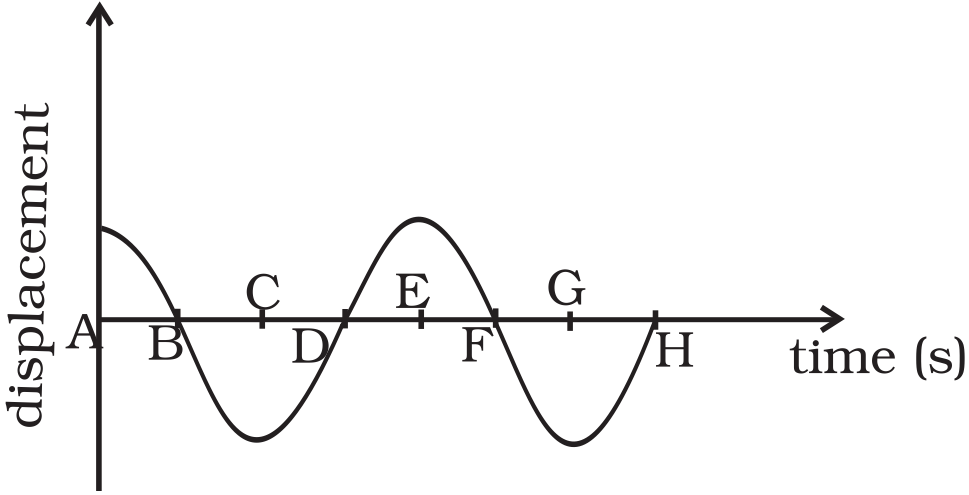
Key concept: In displacement$-$time graph of $\text{SHM}$, zero displacement values correspond to mean position; where velocity of the oscillator is maximum. Whereas the crest and troughs represent amplitude positions, where displacement is maximum and velocity of the oscillator is zero.
- The points $\text{A, C, E, G}$ lie at extreme positions $($maximum displacement, $y = A).$ Hence the velocity of the oscillator is zero.
- The points $\text{B, D, F, H}$ lie at mean position $($zero displacement, $y = 0)$. We know the speed is maximum at mean position.
View full question & answer→Question 413 Marks
A uniform U-tube has a liquid of density $\rho$ and a length L. The cross-sectional area is A. If it is made to oscillate, show that it will be S.H.M. and find its frequency.
AnswerLet L be the length of the liquid column in the U-tube of uniform cross section A. The liquid density be $\rho.$ If by tilting, the level of liquid in the limbs differ by 2x, the excess pressure on the higher level side from the same height as the other equalling $2\text{x}\rho\text{g}$ provides restoring force. The entire liquid oscillates as a result.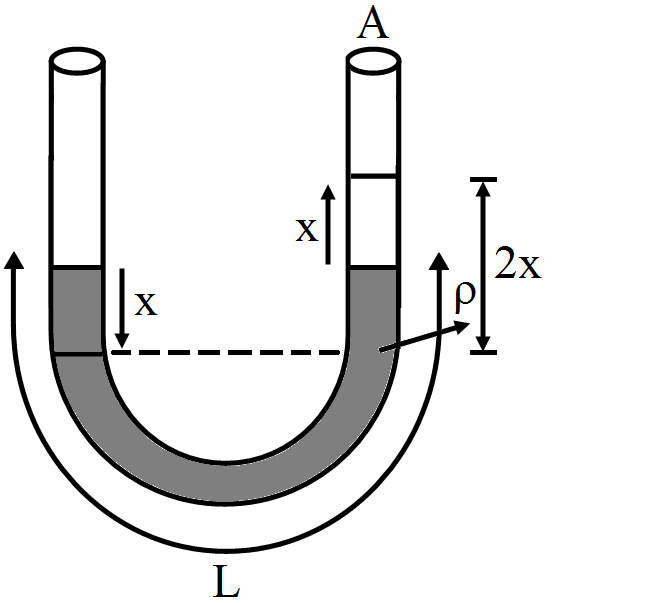
Since, restoring force = mass × acceleration.$=-2\text{x}\rho\text{gA = AL}\rho\text{a,a}=-\frac{2\text{gx}}{\text{L}}$
The frequency $=\text{f}=\frac{1}{2\pi}\sqrt{\frac{\text{acceleration}}{\text{displacement}}}$$=\frac{1}{2\pi}\sqrt{\frac{2\text{g}}{\text{L}}}$ View full question & answer→Question 423 Marks
A horizontal platform with an object placed on it is executing SHM in the vertical direction. The amplitude of oscillation is $2.5cm$. What must be the least period of these oscillations so that the object is not detached from the platform? Take $g = 10ms^{-2}$?
AnswerThe object will not detach from the platform, if the angular frequency $\omega$is such that, during the downward motion, the maximum acceleration equals the acceleration due to gravity, i.e.,$\omega^2_\text{max}\text{A}=\text{g}$
$\omega_\text{max}=\sqrt{\frac{\text{g}}{\text{A}}}$
$\text{T}_\text{min}=\frac{2\pi}{\omega_\text{max}}$
$=2\pi\sqrt{\frac{\text{A}}{\text{g}}}$
Now $\text{A}=2.5\text{cm}$$=2.5\times10^{-2}\text{m}$
$\text{g}=10\text{ms}^{-2}$
Substituting thesa values we get $\text{T}_\text{min}=\frac{\pi}{10}$
View full question & answer→Question 433 Marks
A trolley of mass $3.0\ kg$, as shown in Figure, is connected to two springs, each of spring constant $600Nm^{-1}$. If the trolley is displaced from its equilibrium position by $5.0\ cm$ and released, what is $(a)$ the period of ensuing oscillations, and $(b)$ the maximum speed of the trolley? How much energy is dissipated as heat by the time trolley comes to rest due damping forces?
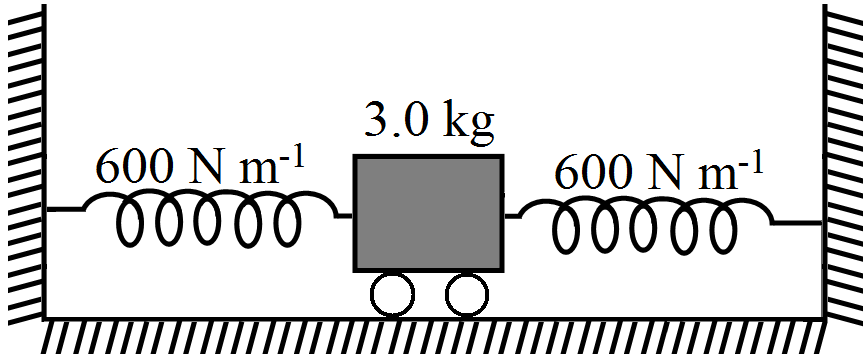
AnswerEquivalent spring constant: $k\ ' = 2k$
$= 1200Nm^{-1}, m = 3kg$
- $\text{T}=2\pi\sqrt{\frac{\text{m}}{\text{k}}}=2\pi\sqrt{\frac{3}{120}}$
$=\frac{2\pi}{20}=\frac{\pi}{10}\text{sec}.$
- Maximum speed
$\text{v}=\omega\text{A}=20\times5\times10^{-2}=1\text{ms}^{-1}$
- Energy dissipated $=$ Maximum energy
$=\frac{1}{2}\text{m}\omega^2\text{A}^2$
$=\frac{1}{2}\times3\times20^2\times25\times10^{-4}$
$=600\times25\times10^{-4}$
$=150\times10^{-2}\text{Joule}$
$=1.5\text{ Jule}$ View full question & answer→Question 443 Marks
A particle of mass $10g$ is placed in a potential field given by $U = 50x^2 + 100 erg/gm$. Calculate the frequency of oscillation.
AnswerP.E. of 10 gram particle is $U = 10(50x^2 + 100) erg$. The force acting on the particle is given by$\text{F}=\frac{-\text{dU}}{\text{dx}}=\frac{-\text{d}}{\text{dx}}(500\text{x}^2+1000)$
$=-1000\text{x}$
But $\text{F = m}\frac{\text{d}^2\text{x}}{\text{dt}^2}$$\therefore\text{m}\frac{\text{d}^2\text{x}}{\text{dt}^2}=-1000\text{x}$
$\frac{\text{d}^2\text{x}}{\text{dt}^2}=\frac{-1000\text{x}}{\text{m}}=\frac{-1000\text{x}}{10}$
$=-100\text{x}$
As $\frac{\text{d}^2\text{x}}{\text{dt}^2}=\omega^2\text{x};$ so $\omega^2=100$$\omega=\sqrt{100}=10$
Frequency of oscillation,$\text{v}=\frac{\omega}{2\pi}=\frac{\sqrt{100}}{2\pi}=1.58\text{s}^{-1}$
View full question & answer→Question 453 Marks
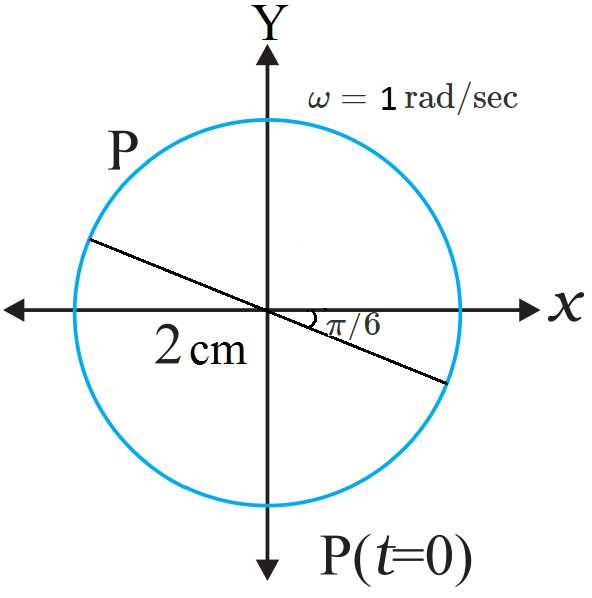
Plot the corresponding reference circle for each of the following simple harmonic motions. Indicate the initial (t = 0) position of the particle, the radius of the circle, and the angular speed of the rotating particle. For simplicity, the sense of rotation may be fixed to be anticlockwise in every case: (x is in cm and t is in s).$\text{x}=\cos\Big(\frac{\pi}{6}-\text{t}\Big)$
Answer$\text{x}=\cos\Big(\frac{\pi}{6}-\text{t}\Big)=\cos\Big(\text{t}-\frac{\pi}{6}\Big)$If this equation is compared with the standard SHM equation $\text{x}=\text{A}\cos\bigg(\Big(\frac{2\pi}{\text{T}}\Big)\text{t}+\phi\bigg),$ then we get:
Amplitude, A = 1
Phase angle, $\phi=-\frac{\pi}{6}=-30^\circ$
Angular velocity, $\omega=\frac{2\pi}{\text{T}}=1\text{rad/s}$
The motion of the particle can be plotted as shown in the following figure.
View full question & answer→Question 463 Marks
The bottom of a dip on a road has a radius of curvature R. A rickshaw of mass M left a little away from the bottom oscillates about this dip. Deduce an expression for the period of oscillation.
AnswerLet R be the radius of the dip, and O be its centre. Let the rickshaw of mass M be at P at any instant. This case is similar to that of a simple pendulum. The force that produces oscillations in the rickshaw is $\text{F}=\text{Mg}\sin\theta.$ If $\theta$ is small and is measured in radian then, $\sin\theta=\theta,$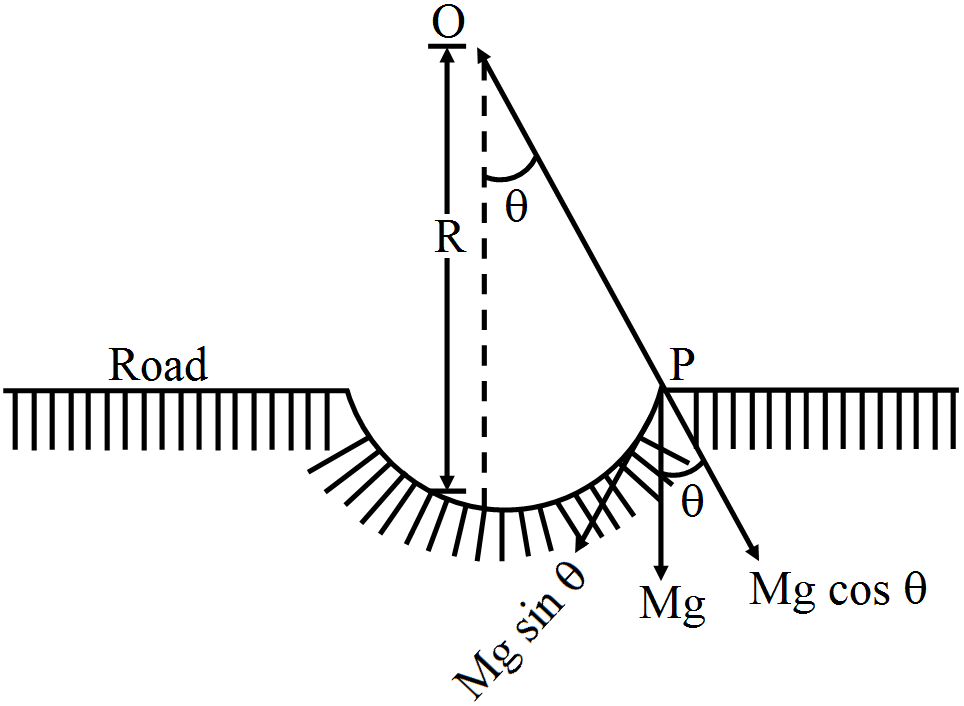
$\therefore\text{F}=-\text{Mg}\theta$ ($\because$ force acts to reduce $\theta$)
Displacement of the rickshaw OP $=\text{y}=\text{R}\theta$$\therefore$ Force constant,
$\text{k}=\frac{-\text{Force}}{\text{Displacement}}$
$=-\Big(\frac{-\text{Mg}\theta}{\text{R}\theta}\Big)=\frac{\text{Mg}}{\text{R}}$
$\therefore$ Time period, $\text{T}=2\pi\sqrt{\frac{\text{Inertial factor}}{\text{Spring factor}}}$
$=2\pi\sqrt{\frac{\text{MR}}{\text{Mg}}}=2\pi\sqrt{\frac{\text{R}}{\text{g}}}$
$\therefore\text{T}=2\pi\sqrt{\frac{\text{R}}{\text{g}}}$ View full question & answer→Question 473 Marks
A cylinder of length l, cross-sectional area A is floating on a liquid of density $\sigma.$ If the cylinder (material density $\rho$) is depressed by a length x further by an external force acting for a short while, estimate the time period of S.H.M.
AnswerLet y be the length immersed in the liquid as it floats. The weight was balanced by upthrust $(\text{Ay}\sigma\text{g})$ while floating. If further displacement x is brought, the upthrust increases and so the oscillation is made possible, i.e., 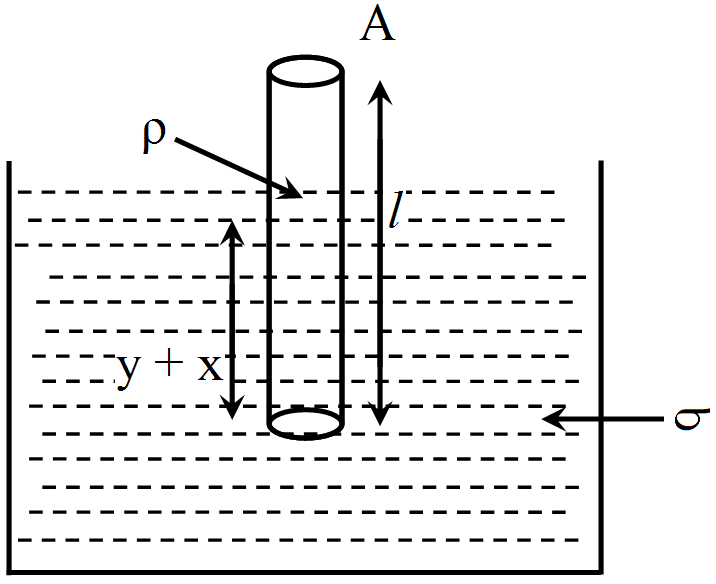 Restoring force $=\text{excess upthrust}=-\text{x}\text{A}\sigma\text{g}.$ Also, $\text{ma = Al}\rho\text{a}$$\therefore\text{Al}\rho\text{a}=-\text{A}\sigma\text{gx}$
$\text{a}=\frac{-\sigma\text{g}}{\rho\text{l}}\text{x}$
$\text{T}=2\pi\sqrt{\frac{\rho\text{l}}{\sigma\text{l}}}$ View full question & answer→Question 483 Marks
A body of mass $1.0kg$ is suspended from a weightless spring having force constant $600Nm^{-1}$. Another body of mass $0.5kg$ moving vertically upwards hits the suspended body with a velocity of $3.0ms^{-1}$ and gets embedded in it. Find the frequency of oscillations and amplitude of motion.
AnswerHere, inertia factor = Oscillating mass $= (m + m_1) = 1 + 0.5 = 1.5kg$ Spring factor = Force conslant $= K = 600Nm^{-1}$ Frequency of oscillation,$\text{v}=\frac{1}{2\pi}\sqrt{\frac{\text{Spring factor}}{\text{Inertial factor}}}$
$=\frac{10}{\pi}\text{Hz}$
Let $v_1$ be the velocity ofthe mass $(m + m_1)$ after collision. According to law of conservation of linear momentum, we have$\text{m}_1\text{v}=(\text{m + m}_1)\text{v}_1$
$\text{v}_1=\frac{\text{m}_1\text{v}}{\text{m + m}_1}$
$\frac{\text{m}_1\text{v}}{\text{m + m}_1}=\frac{0.5\times3}{1+0.5}=1\text{ms}^{-1}$
Here the collision is inelastic. According to the law of conservation of mechanical energy, we have$(\text{K.E}.)_{\text{max}}=(\text{P.E.})_{\text{max}}$
i.e., $\frac{1}{2}(\text{m + m}_1)\text{v}^2_1=\frac{1}{2}\text{kA}^2$$\text{A}=\text{v}_1\sqrt{\frac{\text{m + m}_1}{\text{k}}}$
$=\sqrt{\frac{1.5}{600}}=\frac{1}{20}=5\text{cm}$
View full question & answer→Question 493 Marks
Answer the following questions:The motion of a simple pendulum is approximately simple harmonic for small angle oscillations. For larger angles of oscillation, a more involved analysis shows that T is greater than $2\pi\sqrt{\frac{\text{l}}{\text{g}}}.$ Think of a qualitative argument to appreciate this result.
AnswerIn the case of a simple pendulum, the restoring force acting on the bob of the pendulum is given as:$\text{F}=-\text{mg}\sin\theta$
Where, F = Restoring force m = Mass of the bob g = Acceleration due to gravity$\theta=$ Angle of displacement
For small $\theta,\ \sin\theta\simeq\theta$ For large $\theta,\ \sin\theta$ is greater than $\theta.$ This decreases the effective value of g. Hence, the time period increases as: $\text{T}=2\pi\sqrt{\frac{\text{l}}{\text{g}}}$ Where, l is the length of the simple pendulum.
View full question & answer→Question 503 Marks
The displacement of a particle executing periodic motion is given by:$\text{y}=4\cos^2\Big(\frac{\text{t}}{2}\Big)\sin(1000\text{t}).$ Find independent constituent simple harmonic motion.
Answer$\text{y}=4\cos^2\Big(\frac{\text{t}}{2}\Big)\sin(1000\text{t})$$=2(1+\cos\text{t})\sin(1000\text{t})$ $[\because2\cos^2\theta=1+\cos2\theta]$
$=2\sin1000\text{t}+2\sin1000\text{t}\times\cos\text{t}$
$=2\sin1000\text{t}+\sin(1000+1)\text{t}+\sin(1000-1)\text{t}$ $[\because2\sin\text{A}\cos\text{B}=\sin(\text{A + B})+\sin(\text{A}-\text{B})]$
$=2\sin1000\text{t}+\sin1001\text{t}+\sin999\text{t}$
$=\sin1000\text{t}+\sin1000\text{t}+\sin1001\text{t}+\sin999\text{t}$
View full question & answer→