Questions

3 Marks Question

Take a timed test

44 questions · self-marked practice — reveal the answer and mark yourself.

Question 13 Marks
  1. Which one of the following is a disaccharide: starch, maltose, fructose, glucose
  2. What is the difference between acidic amino acid and basic amino acid?
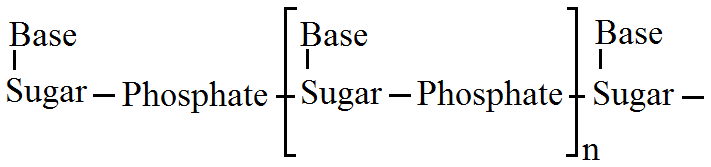
  3. Write the name of the linkage joining two nucleotides.
Answer
  1. Maltose.
  2. In acidic amino acid more carboxyl groups as compared to amino groups are present & In basic amino acid more number of amino than carboxyl groups are present.
  3. Phosphodiester linkage.
View full question & answer
Question 23 Marks
Define the following terms:
  1. Nucleotide.
  2. Anomers.
  3. Essential amino acids.
Answer
  1. A unit formed by the combination of a nitrogen containing heterocyclic base,5-carbon atom sugar and phosphoric acid.
  2. Anomers are the isomers formed due to the change in configuration of –OH group at C-1 of glucose/ ∝ and $\beta$ forms of glucose are known as anomers.
  3. Essential amino acids are the amino acids required in our diet for the growth of the body/which are not synthesized by our body and obtained through diet.
View full question & answer
Question 33 Marks
Define the following terms:
  1. Glycosidic linkage.
  2. Invert sugar.
  3. Oligosaccharides.
Answer
  1. A linkage between two monosaccharide units through oxygen atom is called glycosidic linkage.
  2. Hydrolysis of sucrose brings about a change in the sign of rotation, from dextro (+) to laevo (–) and the product is named as invert sugar.
  3. Carbohydrates that yield two to ten monosaccharide units on hydrolysis, are called oligosaccharides.
View full question & answer
Question 43 Marks
  1. Write the structural difference between starch and cellulose.
  2. What type of linkage is present in Nucleic acids?
  3. Give one example each for fibrous protein and globular protein.
Answer
  1. Starch - Polymer of$\alpha - \text{D} - $ glucose units/Polymer of $\alpha -\text{ glucose}$ units.
Cellulose–polymer of $\beta - \text{D} - $glucose units/polymer of $\beta-\text{glucose}$ units.
  1. Phosphodiester linkage.
  2. Fibrous protein–Keratin/myosin/collagen.
Globular protein-haemoglobin/insulin.
View full question & answer
Question 53 Marks
Define the following terms as related to proteins:
  1. Peptide linkage.
  2. Primary structure.
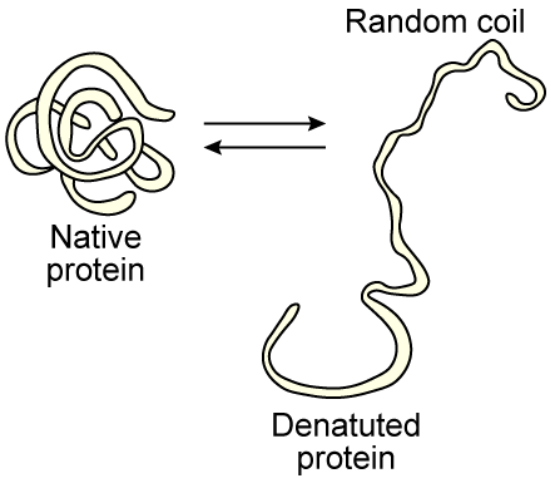
  3. Denaturation.
Answer
  1. Peptide linkage is an amide formed between $–COOH$ group and $–NH_2$ group $(-CO-NH-)$.
  2. Specific sequence of amino acids in a polypeptide chain is said to be the primary structure of the protein.
  3. When a protein in its native form, is subjected to change in temperature or change in pH, protein loses its biological activity. This is called denaturation of protein.
View full question & answer
Question 63 Marks
Shanti, a domestic helper of Mrs. Anuradha, fainted while mopping the floor. Mrs. Anuradha immediately took her to the nearby hospital where she was diagnosed to be severely ‘anaemic’, The doctor prescribed an iron rich diet and multivitamins supplement to her. Mrs. Anuradha supported her financially to get the medicines. After a month, Shanti was diagnosed to be normal.
After reading the above passage, answer the following questions:
  1. What values are displayed by Mrs. Anuradha?
  2. Name the vitamin whose deficiency causes ‘pernicious anaemia’.
  3. Give an example of a water soluble vitamin.
Answer
  1. Mrs. Anuradha has shown generosity/caring/helping/kindness attitude towards poor.
  2. Vit. B12.
  3. Vitamin B/C.
View full question & answer
Question 73 Marks
What is essentially the difference between $\alpha$-glucose and $\beta$-glucose? What is meant by pyranose structure of glucose?
Answer
$\alpha$-glucose $\& \beta$ glucose differ only in the orientation of the hydroxyl group at $\mathrm{C}_1$ position. In $\alpha$-glucose the OH group is on right-hand side at $\mathrm{C}_1$ position whereas in $\beta$-glucose the OH group is on left-hand side at $\mathrm{C}_1$ position. The six-membered hetero cyclic structure of glucose is called pyranose structure.
View full question & answer
Question 83 Marks
State reasons for the following:
  1. $pK_b$ value for aniline is more than that for methylamine.
  2. Ethylamine is soluble in water whereas aniline is not soluble in water.
  3. Primary amines have higher boiling points than tertiary amines.
Answer
  1. Due to resonance in aniline, N acquires + charge which increases its $pK_b$ whereas due to electron donating methyl group electron density increases on N which decreases its $pK_b$.
  2. Due to formation of hydrogen bond with water ethyl amine is soluble in water whereas due to bulky phenyl group aniline does not form H-bond and thus is insoluble.
  3. Due to hydrogen bonding in primary amines, they have higher boiling points whereas there is no hydrogen bonding in tertiary amines.
View full question & answer
Question 93 Marks
Amino acids may be acidic, alkaline or neutral. How does this happen? What are essential and non-essential amino acids? Name one of each type.
Answer
Acidic amino acids contain more number of carboxyl groups than amino groups. Basic amino acids contain more number of amino groups than carboxyl groups. Neutral amino acids contain equal number of amino acids and carboxyl groups.
View full question & answer
Question 103 Marks
What happens when D-glucose is treated with the following reagents?
  1. HI.
  2. Bromine water.
  3. $HNO_3$.
Answer
  1. With HI, n-hexane is formed.
  2. With Bromine water, gluconic acid is formed.
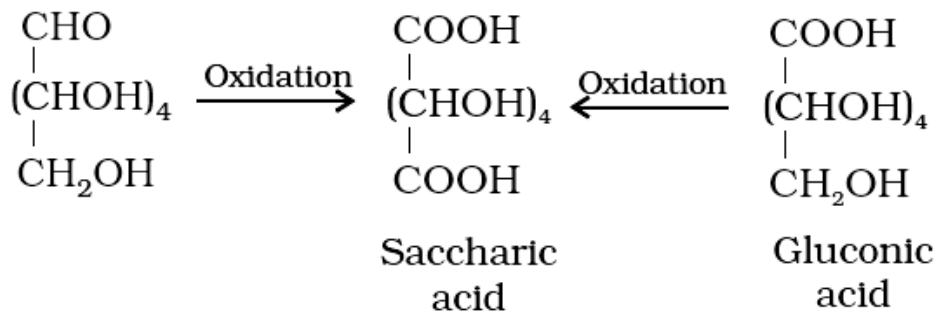
  3. With $HNO_3$, Saccharic acid is formed.
View full question & answer
Question 113 Marks
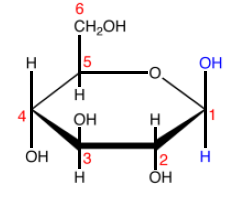
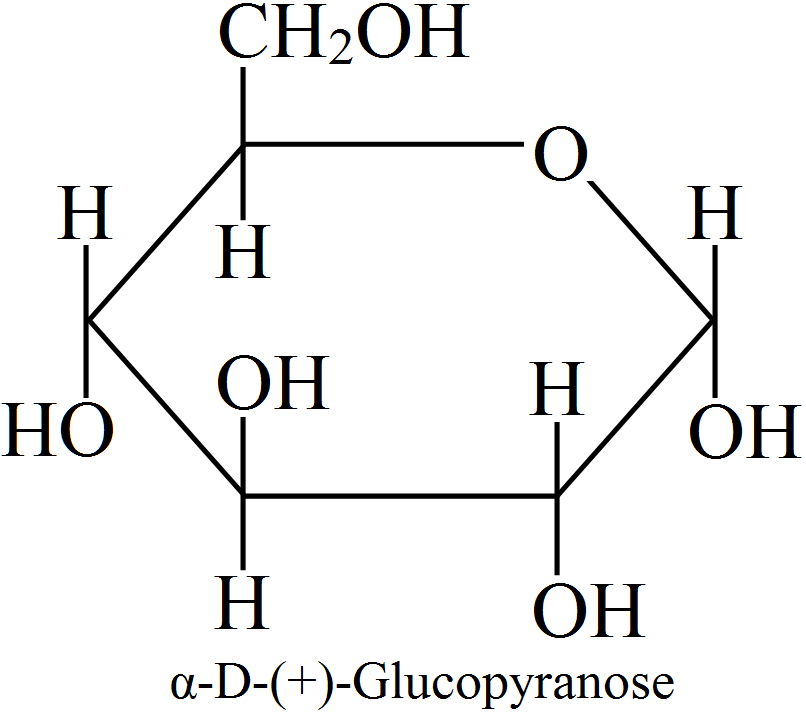
  1. Draw the pyranose structure of glucose.
  2. What type of linkage is present in proteins?
  3. Give one example each for water-soluble vitamins and fat-soluble vitamins.
Answer
  1.  
  1. Peptide linkage/ -CO-NH- linkage
  2.  
Water soluble- Vitamin B/C
Fat soluble- Vitamin A/D/E/K
View full question & answer
Question 123 Marks
  1. Deficiency of which vitamin causes scurvy?
  2. What type of linkage is responsible for the formation of proteins?
  3. Write the product formed when glucose is treated with HI.
Answer
  1. Vitamin C.
  2. Peptide linkage.
  3. n-hexane or its structure.
View full question & answer
Question 133 Marks
  1. Deficiency of which vitamin causes rickets?
  2. Give an example for each of fibrous protein and globular protein.
  3. write the product formed on reaction of D-glucose with Br, water.
Answer
  1. Vitamin D.
  2. Fibrous protein: Keratin, myosin, Globular protein: insulin, albumins.
  3. Gluconic acid or
$COOH$
l
$(CHOH)_4$
l
$CH_2OH$
View full question & answer
Question 143 Marks
  1. Write the name of two monosaccharides obtained on hydrolysis of lactose sugar.
  2. Why Vitamin C cannot be stored in our body?
  3. What is the difference between a nucleoside and nucleotide?
Answer
  1. $\beta$ -D glucose and $\beta$-D-galactose/glucose and galactose.
  2. water soluble,excreted out of the body.
  3. In nucleotide, phosphoric acid/phosphate group attached to the nucleoside/structures of both nucleotide and nucleoside/nucleotide= base +sugar+phosphate group, nucleoside= base+sugar.
View full question & answer
Question 153 Marks
  1. Which one of the following is a disaccharide: Starch, Maltose, Fructose, Glucose?
  2. What is the difference between fibrous protein and globular protein?
  3. Write the name of vitamin whose deficiency causes bone deformities in children.
Answer
  1. Maltose.
  2. Fibrous proteins: parallel polypeptide chain, insoluble in water, Globular proteins: spherical shape, soluble in water.
  3. Vitamin D.
View full question & answer
Question 163 Marks
  1. Deficiency of which vitamin causes night-blindness?
  2. Name the base that is found in nucleotide of RNA only.
  3. Glucose on reaction with HI gives n-hexane. What does it suggest about the structure of glucose?
Answer
  1. Vitamin A.
  2. Uracil.
  3. It suggests that six carbon atoms are in straight chain/$CHO–(CHOH)_4–CH_2OH$.
View full question & answer
Question 173 Marks
After watching a programee on TV about the adverse effects of junk food and soft drink on the health of school children, Sonali, a student of class XII, discussed the issue with the school principal. Principal immediately instructed the canteen contractor to replace the fast food with the fibre and vitamins rich food like sprouts, salad, fruits etc. This decision was welcomed by the parents and the students.
After reading the above passage, answer the following questions:
  1. What values are expressed by Sonali and the principal of the school?
  2. Give two examples of water-soluble vitamins.
Answer
  1. Sonali: Concerned for the society, socially active and helpful to others. Principal: Caring, commanding and serious about the welfare of students.
  2. Vitamins B and C.
View full question & answer
Question 183 Marks
In the following cases rearrange the compounds as directed:
  1. In an increasing order of basic strength:
$C_6H_5NH_2, C_6H_5N(CH_3)_2, (C_2H_5)_6NH$ and $CH_3NH_2$.
  1. In a decreasing order of basic strength:
Aniline, p-nitroaniline and p-toluidine.
  1. In an increasing order of $pK_b$ values:
$C_2H_5NH_2, C_6H_5 NHCH_3, (C_2H_5)_2NH and C_6H_5NH_2$.
Answer
  1. $C_6H_5NH_2 < C_6H_5N(CH_3)_2 < CH_3NH_2 < (C_2H_5)_2NH$.
  2. p-toluidine > Aniline > p-nitroaniline.
  3. $(C_2H_5)_2NH < C_2H_5NH_2 < C_6H_5NHCH_3 < C_6H_5NH_2$.
View full question & answer
Question 193 Marks
Define the following with an example of each:
  1. Polysaccharides.
  2. Denatured protein.
  3. Essential amino acids.
Answer
  1. Carbohydrates which yield a large number of monosaccharide units on hydrolysis are called polysaccharides. Starch, cellulose, glycogen and gums are most common examples.
  2. When native protein is subjected to physical change such as change in temperature or a chemical change such as change in pH, its H-bonds are disturbed. This disturbance unfolds the globules and uncoils the helix. As a result, the protein loses its biological activity.
Loss of biological activity by the protein is called denaturation.

  1. Amino acids which cannot be synthesised inside our body and must be obtained through the diet are called essential amino acids. Examples: Valine, leucine, isoleucine.
View full question & answer
Question 203 Marks
Define the following with an example of each:
  1. Write the product when D-glucose reacts with conc. $HNO_3$.
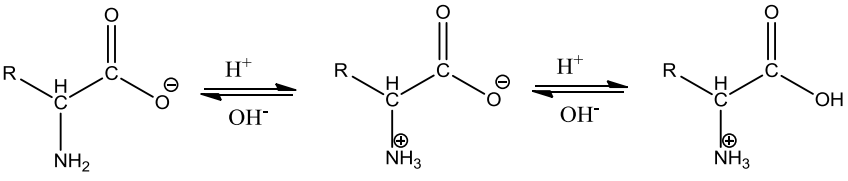
  2. Amino acids show amphoteric behaviour. Why?
  3. Write one difference between $\alpha$-helix and $\beta$-pleated structures of proteins.
Answer
  1. Glucose on oxidation with nitric acid. This indicates the presence of a primary alcoholic (–OH) group in glucose.
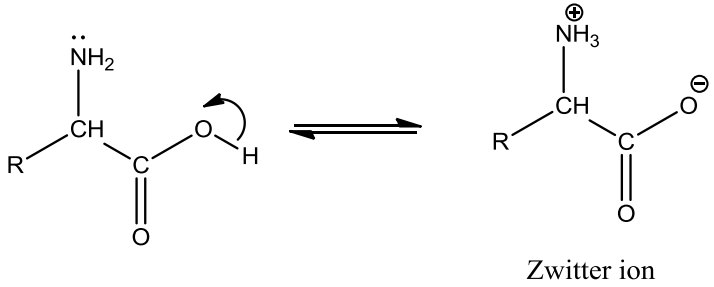
  1. Amino acids have both carboxyl and amino groups; hence, in aqueous solution, the carboxyl group of an amino acid can lose a proton and the amino group can accept a proton.

So, the amino acid can act as both acid and base.
  1.  
$\alpha$-helix $\beta$-pleated sheet
The $\alpha$-helix results from coiling of the protein chain such that the peptide bonds making up the backbone are able to form hydrogen bonds between each other. The $\beta$-pleated sheet is a layering of protein chains one on the top of the other.
View full question & answer
Question 213 Marks
Give the structures of A and B in the following sequence of reactions:
  1. $\text{CH}_3\text{COOH}\xrightarrow[\Delta]{\text{NH}_3\ \ \ }\text{A}\ \ \ \xrightarrow{\text{NaOBr}}\text{B}$
  2. $\text{C}_6\text{H}_5\text{No}_2\xrightarrow{\text{Fe}/ \text{ HCl}}\text{A}\ \ \ \ \ \xrightarrow[0^\circ-5^\circ\text{C}]{\text{NaNo}_2+\text{HCl}}\text{B}$
  3. $\text{C}_6\text{H}_5\text{N}_2^+\text{Cl}^{-}\xrightarrow[\Delta]{\text{CuCN}}\text{A}\ \ \ \ \xrightarrow{\text{H}_2\text{O}/\text{ H}^+}\text{B}$
Answer
a. $(A) \rightarrow \mathrm{CH}_3 \mathrm{CONH}_2(\mathrm{~B}) \rightarrow \mathrm{CH}_3 \mathrm{NH}_2$.
b. $(A) \rightarrow \mathrm{C}_6 \mathrm{H}_5 \mathrm{NH}_2(B) \rightarrow \mathrm{C}_6 \mathrm{H}_5 \mathrm{~N}_2 \mathrm{Cl}$.
c. $(A) \rightarrow \mathrm{C}_6 \mathrm{H}_5 \mathrm{CN}(B) \rightarrow \mathrm{C}_6 \mathrm{H}_5 \mathrm{COOH}$.
View full question & answer
Question 223 Marks
Write the reactions involved when D-glucose is treated with the following reagents:
i. $\mathrm{Br}_2$ water
ii. $\mathrm{H}_2 \mathrm{N}-\mathrm{OH}$
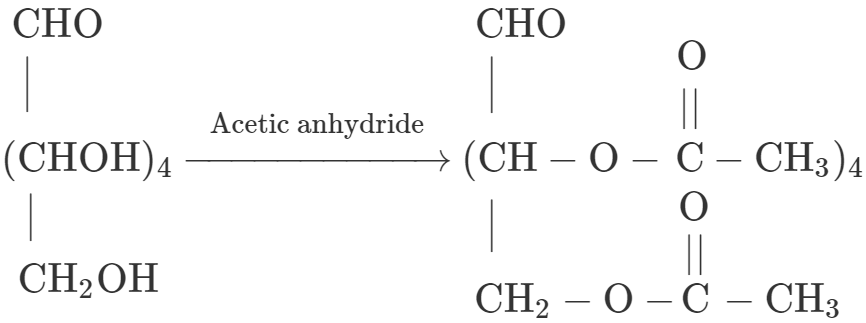
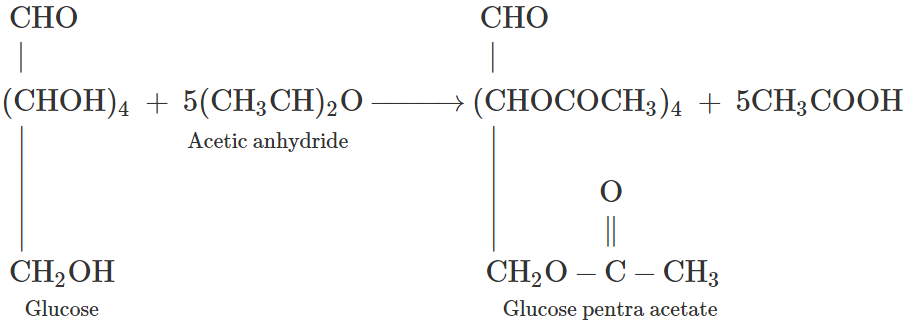
iii. $\left(\mathrm{CH}_3 \mathrm{CO}\right)_2 \mathrm{O}$
Answer
  1. $\ \text{CHO}\ \ \ \ \ \ \ \ \ \ \ \ \ \ \ \ \ \ \ \ \ \ \ \ \ \ \text{COOH}\\\ \ | \ \ \ \ \ \ \ \ \ \ \ \ \ \ \ \ \ \ \ \ \ \ \ \ \ \ \ \ \ \ \ \ \ \ | \$\text{CHOH})_4\xrightarrow{\ \ {\text{Br}_2 \text{water}}\ \ }(\text{CHOH})_4\\ \ \ \ |\ \ \ \ \ \ \ \ \ \ \ \ \ \ \ \ \ \ \ \ \ \ \ \ \ \ \ \ \ \ \ \ \ \ |\\ \ \ \text{CH}_2\text{OH}\ \ \ \ \ \ \ \ \ \ \ \ \ \ \ \ \ \ \ \ \ \text{CH}_2\text{OH}$
  2. $\ \text{CHO}\ \ \ \ \ \ \ \ \ \ \ \ \ \ \ \ \ \ \ \ \ \ \ \ \ \text{CH}=\text{N}-\text{OH}\\\ \ | \ \ \ \ \ \ \ \ \ \ \ \ \ \ \ \ \ \ \ \ \ \ \ \ \ \ \ \ \ \ \ \ \ | \$\text{CHOH})_4\xrightarrow{\ \ {\text{NH}_2 \text{OH}}\ \ }(\text{CHOH})_4\\ \ \ \ |\ \ \ \ \ \ \ \ \ \ \ \ \ \ \ \ \ \ \ \ \ \ \ \ \ \ \ \ \ \ \ \ |\\ \ \ \text{CH}_2\text{OH}\ \ \ \ \ \ \ \ \ \ \ \ \ \ \ \ \ \ \ \ \text{CH}_2\text{OH}$
  3.  
View full question & answer
Question 233 Marks
Define the following with a suitable example in each:
  1. Oligosaccharides
  2. Denaturation of protein
  3. Vitamins
Answer
  1. Carbohydrates that yield two to ten monosaccharide units, on hydrolysis, are called oligosaccharides.
Example: Sucrose or any other.
  1. When a protein in its native form, is subjected to physical change like change in temperature or chemical change like change in pH, the hydrogen bonds are disturbed. Due to this, globules unfold and helix get uncoiled and protein loses its biological activity.
Example: Boiling of egg.
  1. Organic compounds required in the diet in small amounts to perform specific biological functions for normal maintenance of optimum growth and health of the organism.
Example: Vitamin A.
View full question & answer
Question 243 Marks
Give the plausible explanation for the following:
  1. Glucose doesn't give 2, 4-DNP test.
  2. The two strands in DNA are not identical but are complementary.
  3. Starch and cellulose both contain glucose unit as monomer, yet they are structurally different.
Answer
  1. Because the – CHO group in glucose is involved in hemiacetal formation and thus is not free/ due to cyclic structure of glucose-CHO group is not free.
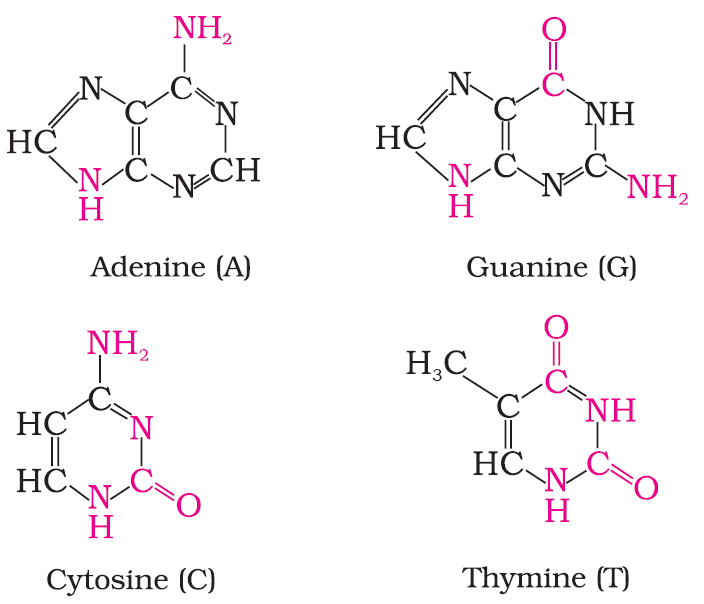
  2. Because the hydrogen bonds are formed between specific pairs of bases.
  3. Starch is a polymer of $\alpha-$ glucose while cellulose is a polymer of $\beta-$ glucose.
View full question & answer
Question 253 Marks
Differentiate between the following:
  1. Amylose and Amylopectin.
  2. Peptide linkage and Glycosidic linkage.
  3. Fibrous proteins and Globular proteins.
Answer
  1. The differences between amylose and amylopectin are as follows:
 
Amylose
Amylopectin
1.
It constitutes about 15-20% of starch.
It constitutes about 80-85% of starch.
2.
It is a water-soluble component of starch .
It is is water soluble component of starch.
3.
Amylose is a long unbranched chain with 200-1000 $\alpha-\text{D}-(+)-$ glucose units held by $C_1–C_4$ glycosidic linkage.
Amylopectin is a branched chain polymer of $\alpha-\text{D}$ glucose units in which chain is formed by $C_1–C_4$ glycosidic linkage whereas branching occurs by $C_1–C_6$ glycosidic linkage.
  1. The differences between peptide linkage and glycosidic linkage are as follows:
 
Peptide linkage
Glycosidic linkage
1.
Peptide linkage is an amide formed between –COOH group and $–NH_2$ group.
A linkage between two monosaccharide units through oxygen atom is called glycosidic linkage.
2.
Present in proteins.
Present in carbohydrate/ sugars.
3.
Represented as -C-O-C-
Represented as $-CONH^-$
  1. The differences between fibrous protein and globular protein are as follows:
 
Fibrous protein
Globular protein
1.
When the polypeptide chains run parallel and are held together by hydrogen and disulphide bonds, then fibrous protein is formed.
When the chains of polypeptides coil around to give a spherical shape, then globular protein is formed.
2.
Generally insoluble in water.
These are usually soluble in water.
3.
Examples are keratin (present in hair, wool, silk) and myosin (present in muscles).
Examples are insulin and albumins.
View full question & answer
Question 263 Marks
Write chemical reactions to show that open structure of D-glucose contains the following:
  1. Straight chain.
  2. Five alcohol groups.
  3. Aldehyde as carbonyl group.
Answer
  1. On prolonged heating with HI, glucose forms n-hexane, suggesting that all the six carbon atoms are linked in a straight chain.
  2. Acetylation of glucose with acetic anhydride gives glucose pentaacetate which confirms the presence of five –OH groups. Since it exists as a stable compound, five –OH groups should be attached to different carbon atoms.
  1. Glucose gets oxidised to six carbon carboxylic acid (gluconic acid) on reaction with a mild oxidising agent like bromine water. This indicates that the carbonyl group is present as an aldehydic group.
$\ \ \text{CHO}\ \ \ \ \ \ \ \ \ \ \ \ \ \ \ \ \ \ \ \ \ \ \ \ \ \ \ \text{COOH}\ \ \ \\\ \ \ |\ \ \ \ \ \ \ \ \ \ \ \ \ \ \ \ \ \ \ \ \ \ \ \ \ \ \ \ \ \ \ \ \ \ \ |\$\text{CHOH})_4\xrightarrow[\text{[O]}]{\ \ \ {\text{Br}_2/\text{H}_2\text{O}} \ \ \ \ }(\text{CHOH})_4\\\ \ |\ \ \ \ \ \ \ \ \ \ \ \ \ \ \ \ \ \ \ \ \ \ \ \ \ \ \ \ \ \ \ \ \ \ \ \ \ |\\\ \text{CH}_2\text{OH}\ \ \ \ \ \ \ \ \ \ \ \ \ \ \ \ \ \ \ \ \ \ \ \ \text{CH}_2\text{OH}\\\ \ \ ^\text{Glucose}\ \ \ \ \ \ \ \ \ \ \ \ \ \ \ \ \ \ \ \ \ \ \ \ \ ^\text{Gluconic acid}$
View full question & answer
Question 273 Marks
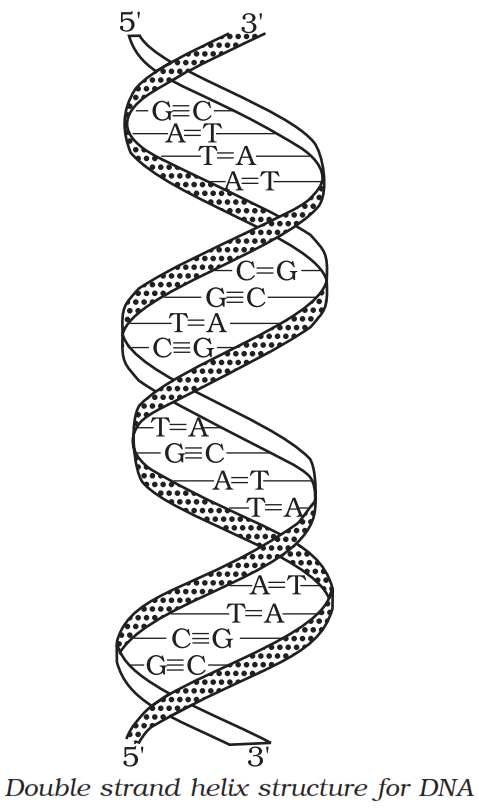
Write the structures of fragments produced on complete hydrolysis of DNA. How are they linked in DNA molecule? Draw a diagram to show pairing of nucleotide bases in double helix of DNA.
Answer

Complete hydrolysis of DNA yields a pentose sugar, phosphoric acid and nitrogen containing heterocyclic compounds called bases.

A unit formed by the attachment of a base to I ‘-position of sugar is called nucleoside. When nucleoside links to phosphoric acid at 5′-position of sugar moiety, a nucleotide is formed. Nucleotides are joined together by phosphodiester linkage between 5’-and 3’carbon atoms of the pentose sugar.

In DNA, two chains of nucleic acid coil about each other and held together by H-bonds between bases of two chains.
View full question & answer
Question 283 Marks
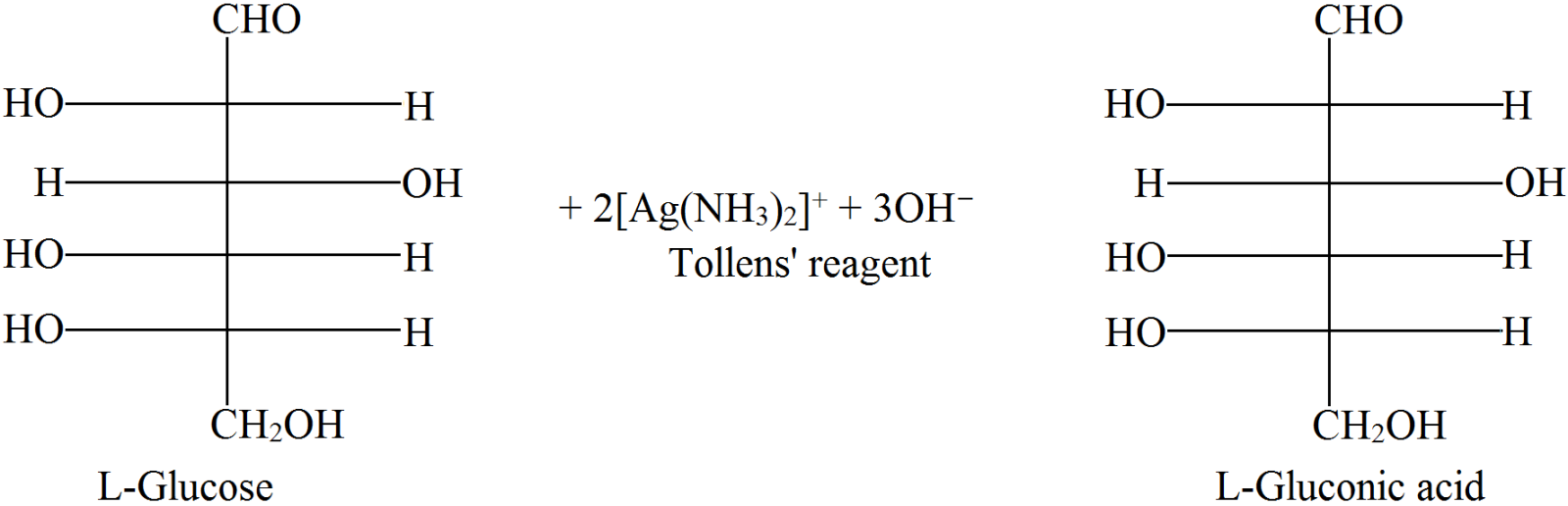
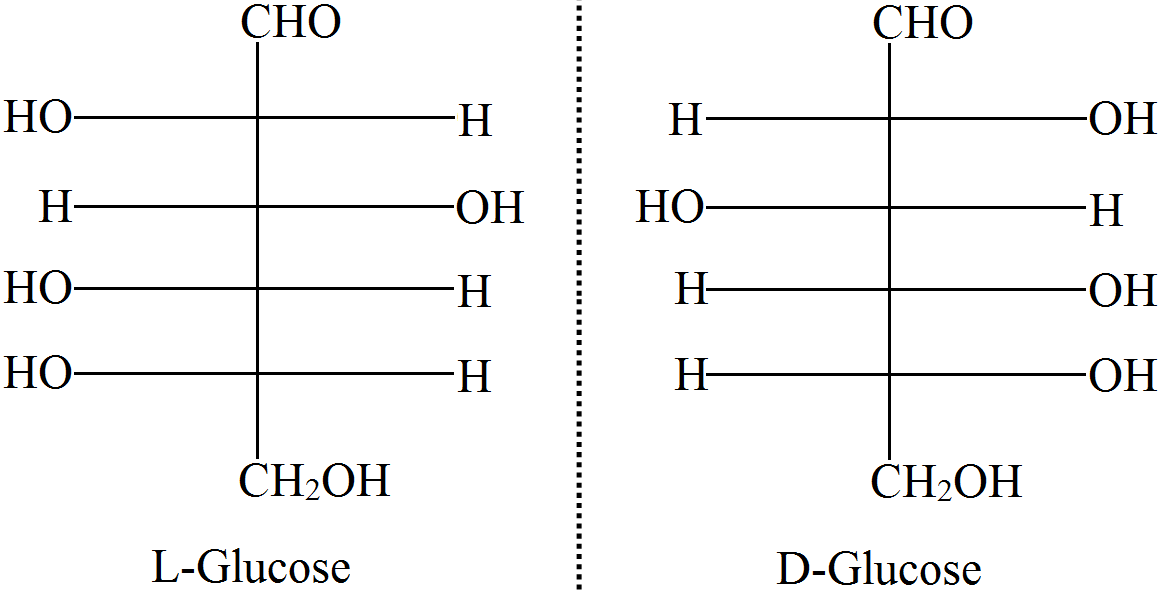
The Fischer projection of D-Glucose is given alongside. What happens when L-Glucose is treated with Tollens’ reagent?
Answer

L-Glucose reduces Tollens’ reagent to metallic silver.
View full question & answer
Question 293 Marks
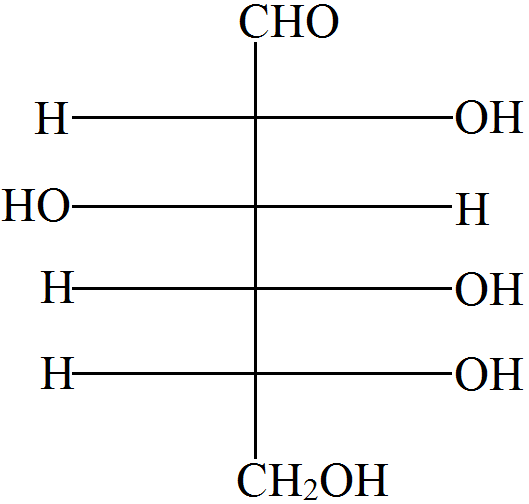
The Fischer projection of D-Glucose is given alongside.
Give the Fischer projection of L-Glucose.
Answer
The Fischer projection of L-Glucose is the mirror image of D-Glucose.
View full question & answer
Question 303 Marks
Answer the following questions.
Write about the following on protein synthesis:
  1. Name the location where protein synthesis occurs.
  2. How do 64 codons code for only 20 amino acids?
  3. Which of the two bases of the codon are more important for coding?
Answer
  1. Protein synthesis occurs at the ribosome in the cytoplasm.
  2. More than one codon (a combination of three nucleotide, i.e., triplet) can code for the same amino acids, e.g., proline is encoded by CCU, CCA, CCG and CCC.
  3. First two bases of a codon are more important for coding, the third being less specific.
View full question & answer
Question 313 Marks
Carbohydrates are essential for life in both plants and animals. Name the carbohydrates that are used as storage molecules in plants and animals, also name the carbohydrate which is present in wood or in the fibre of cotton cloth.
Answer
Starch is the main storage polysaccharide of plants. It is the most important dietary source for human beings. High content of starch is found in cereals. Cellulose occurs exclusively in plants and it is the most abundant organic substance in plant kingdom. Cell wall of bacteria and plants is made up of cellulose. We build furniture, etc. from cellulose in the form of wood and clothe ourselves with cellulose in the form of cotton fibre.
View full question & answer
Question 323 Marks
Explain the following items:
Biocatalysts.
Answer
Biocatalysts: A number of reactions that occur in the bodies of animals and plants to maintain the life process are catalysed by enzymes. The enzymes are thus termed as biocatalysts. Almost all the enzymes are globular proteins. An enzyme catalyses a biochemical reaction by providing alternate lower activation path thereby increasing the rate of the biochemical reaction. For example, activation energy for acid hydrolysis of sucrose is $6.22kJ\ mol^{-1}$ while the activation energy is only $2.15kJ\ mol^{-1}$ when hydrolysed in the presence of enzyme sucrase.
View full question & answer
Question 333 Marks
Answer the following questions.
A non-reducing disaccharide ‘A’ on hydrolysis with dilute acid gives an equimolar mixture of D-(+)-glucose and D-(-)-fructose.
$\text{A}+\text{H}_2\text{O}\xrightarrow{\text{HCl}\ \ \ \ }\ \ \ \ \ \ \text{C}_6\text{H}_{12}\text{O}_6+\ \ \ \ \ \ \text{C}_6\text{H}_{12}\text{O}_6\\ [\alpha]_{\text{D}}=+66.5\hat{\text{O}}\phi\Omega\ \ \ \ \ +52.5\hat{\text{O}}\phi\Omega\ \ \ \ \ -92.4\hat{\text{O}}\phi\Omega$
Identify A. What is the mixture of D-(+)-glucose and D-(-)-fructose known as? Name the linkage that holds the two units in the disaccharide.
Answer
  1. $A = C_{12}H_{22}O_{11}$ (sucrose).
  2. Invert sugar.
  3. Glycosidic linkage.
View full question & answer
Question 343 Marks
  1. Despite having an aldehyde group, glucose does not give 2,4-DNP test. What does this indicate?
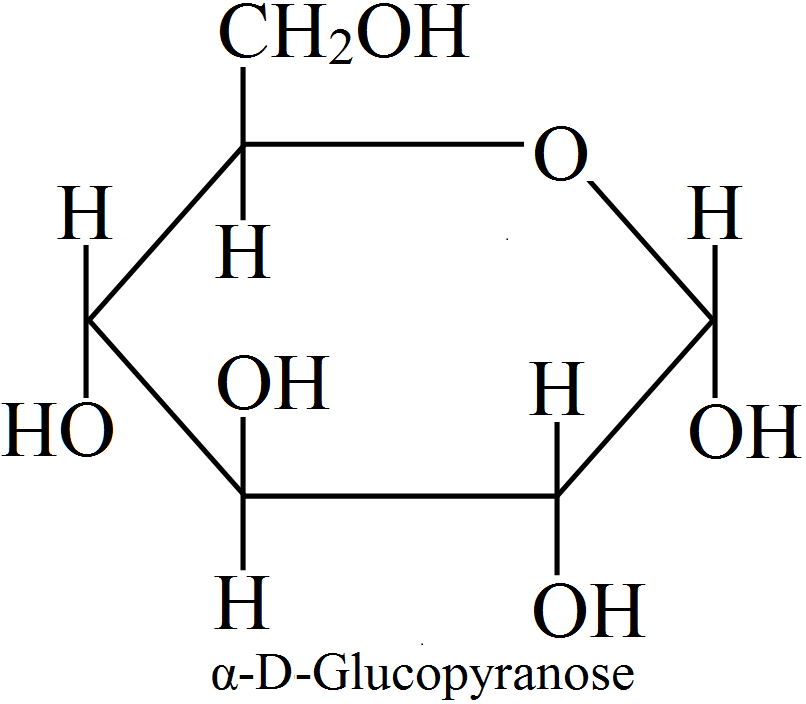
  2. Draw the Haworth structure of a-D-(+)-Glucopyranose.
  3. What is the significance of D and (+) here?
Answer
  1. This indicates that the aldehyde group in glucose is not free.
  2.  
  1. ‘D’ gives the configuration, i.e., the -OH group at C-5 is on the right hand side. (+) sign indicates that the isomer is dextrorotatory.
View full question & answer
Question 353 Marks
On the basis of which evidences D-glucose was assigned the following structure?
$\text{CHO}\\ \ \ |\\ (\text{CH}\text{OH})_{4}\\\ \ |\\\text{CH}_{2}\text{OH}$
Answer
This structure was assigned on the basis of the following evidences:
  1. Molecular formula: The molecular formula of glucose has been found to be $C_6H_{12}O_6$. Straight chain structure:
When aqeous solution of glcouse is treated with sodium amalgam or sodium borohdride, it is reduced to sorbitol.

$\ \text{CHO} \ \ \ \ \ \ \ \ \ \ \ \ \ \ \ \ \ \ \ \ \ \ \ \ \ \ \ \ \ \ \ \ \text{COOH} \\ \ \ {|} \ \ \ \ \ \ \ \ \ \ \ \ \ \ \ \ \ \ \ \ \ \ \ \ \ \ \ \ \ \ \ \ \ \ \ \ \ \ \ \ {|} \\ \text{(CHOH)}_4+2[\text{H}] \xrightarrow{\text{Br}_2/\text{H}_2\text{O}}(\text{CHOH})_4\\ \ \ {|} \ \ \ \ \ \ \ \ \ \ \ \ \ \ \ \ \ \ \ \ \ \ \ \ \ \ \ \ \ \ \ \ \ \ \ \ \ \ \ \ \ \ {|} \\ \ \text{CH}_2\text{OH} \ \ \ \ \ \ \ \ \ \ \ \ \ \ \ \ \ \ \ \ \ \ \ \ \ \ \ \ \ \text{CH}_2\text{OH} \\ \text{Glucose} \ \ \ \ \ \ \ \ \ \ \ \ \ \ \ \ \ \ \ \ \ \ \ \ \ \ \ $
  1. Presence of five hydroxyl (-OH) groups: On acetylation with acetic anhydride, glucose gives a pentaacetate. This confirms that glucose contains five -OH groups. We know that the presence of two or more -OH groups on the same carbon atom makes the molecules unstable.
Now since glucose is a stable compound, therefore, the five -OH groups must present on different carbon atoms.
  1. Presence of one primary alcoholic group: On oxidation with cone, nitric acid, both glucose and gluconic acid give the same dicarboxylic acid, saccharic acid or glucaric acid. The primary alcoholic group $(CH_2OH)$ is always present at the end of the carbon chain.
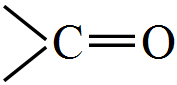
  2. Presence of an aldehyde (-CHO) group: Glucose reacts with hydroxylamine, $NH_2OH$ to form glucose CHO oxime. Which suggest that glucose contains a carbonyl $(CHOH)_4 (>C = O)$ groups.
On the basis of above observations, the following open $CH_2OH$ chain structure for glucose can be written as follows:

$\text{CHO}\\ \ \ |\\ (\text{CH}_{2}\text{OH})_{4}\\\ \ |\\\text{CH}_{2}\text{OH}$
View full question & answer
Question 363 Marks
Answer the following questions.
Draw the Haworth structure for $\alpha-\text{D}-\text{Glucopyranose}.$
View full question & answer
Question 373 Marks
If one strand of a DNA has the sequence -ATGCTTCA-, what is the sequence of the bases in the complementary strand?
Answer
As we know that in DNA molecule, adenine (A) always pairs with thymine (T) and cytosine (C) always pairs with guanine (G). Thus,
Sequence of bases in one strand: A T G C T T C A
Sequence of bases in the complementary strand: T A C G A A G T.
View full question & answer
Question 383 Marks
Give reasons for the following: Amino acids are amphoteric in nature.
Answer

Since amino acids have both acidic $(-^+NH_3)$ as well as basic $(-COO-)$ groups, therefore, they are amphoteric in nature.
View full question & answer
Question 393 Marks
An optically active compound having molecular formula C6H12O6 is found in two isomeric forms (A) and (B) in nature. When (A) and (B) are dissolved in water, they show the following equilibrium.
$(\text{A})\ \ \ \ \rightleftharpoons\ \ \ \ \text{Equilibrium mixture}\ \ \ \ \rightleftharpoons\ \ \ \ \text{(B)}\\ [\alpha]_{\text{D}}=111^\circ\ \ \ \ \ \ \ \ \ \ \ \ \ \ 52.2^\circ\ \ \ \ \ \ \ \ \ \ \ \ \ \ \ \ \ \ \ \ \ \ \ \ \ \ 19.2^\circ$
  1. What are such isomers called?
  2. Can they be called enantiomers? Justify your answer.
  3. Draw the cyclic structure of isomer (A).
Answer
  1. Anomers.
  2. Since these anomers are not mirror images of each other so they cannot be called as enantiomers.
  3.  
View full question & answer
Question 403 Marks
The monoamino monocarboxylic acids have two $pK_a$ values.
Answer
In aqueous solution, monoamino monocarboxylic acid behave like salt at isoelectric point. At a pH lower than isoelectric point (i.e., in acidic medium) it showsone pKa value which corresponds to structure $\text{R}-\text{CH}-\text{COOH}\\ \ \ \ \ \ \ \ \ \ \text{|}\\\ \ \ \ \ ^+\text{NH}_3$ and at a pH higher than isoelectric point (i.e., basic medium), it shows another $pK_a$ value which corresponds to structure $\text{R}-\text{CH}-\text{COO}^-\\ \ \ \ \ \ \ \ \ \ \text{|}\\\ \ \ \ \ \text{NH}_2$
View full question & answer
Question 413 Marks
Answer the following questions.
What deficiency diseases are caused due to lack of vitamins $A, B_1, B_6$ and K in human diet?
Answer
S. No
Name of Vitamins
Sources
Deficiency Diseases
1.
Vitamin A
Fish liver oil, carrots, butter and milk.
Xerophthalmia (hardening of cornea of eye), night blindness.
2.
Vitamin $B_1$ (Thiamine)
Yeast, milk, green vegetables and cereals.
Beri-beri (loss of appetite, retarded growth).
3.
Vitamin $B_6$ (Pyridoxine)
Yeast, milk, egg yolk, cereals and grams.
Convulsions.
View full question & answer
Question 423 Marks
Answer the following the questions.
Name the three major classes of carbohydrates and give an example of each of these classes.
Answer
  1. Monosaccharides: The simple carbohydrates that cannot be broken further into smaller units on hydrolysis, e.g., glucose and fructose, ribose, etc.
  2. Oligosaccharides: These are the carbohydrates which on hydrolysis give two to ten units of monosaccharides, e.g., sucrose, maltose, raffinose, stachyose, etc.
  3. Polysaccharides: These are the carbohydrates which produce a large number of monosaccharide units on hydrolysis, e.g., starch, cellulose, etc.
View full question & answer
Question 433 Marks
An optically active amino acid (A) can exist in three forms depending on the pH of the medium. The molecular formula of (A) is $C_3H_7NO_2$.
  1. Write the structure of compound (A) in aqueous medium. What are such ions called?
  2. In which medium will the cationic form of compound (A) exist?
  3. In alkaline medium, towards which electrode will the compound (A) migrate in electric field?
Answer
  1. A = Alanine In aqueous medium alanine exists as Zwitter ion.
$\ \ \ \ \ \ \ \ \ \ \ \ \text{CH}_3\\ \ \ \ \ \ _{+}\ \ \ \ \ |\\\text{H}_3\text{N}-\text{CH}-\text{COO}\\ \ \ \ \ \ \ \ \ \ \ \text{Alanine }$
  1. In acidic medium.
  2. In alkaline medium, it will exist in the anionic form and will migrate towards anode in electric field.
View full question & answer
Question 443 Marks
What is the secondary structure of proteins?
Answer
The secondary structure of proteins arises due to the regular folding of the backbone of the polypeptide chain due to hydrogen bonding between and -NH group of the peptide bond.
View full question & answer