MCQ 11 Mark
Silicon doped with electron-rich impurity forms ________.
AnswerExplanation: (B) n-type semiconductor.
When silicon is doped with electron rich impurity like P or As, the increase in conductivity is due to the negatively charged Electron. Hence, silicon doped with electron rich impurity is termed as 'n-type semiconductor'.
View full question & answer→MCQ 21 Mark
How many types of crystalline solids are found?
MCQ 31 Mark
Which of the following arrangements correctly represents hexagonal and cubic close packed structure respectively?
- ✓
$\text{ABAB}.....$ and $\text{ABCABCABC}.....$
- B
$\text{ABCABC}.....$ and $\text{ABAB}....$
- C
Both have $\text{ABCABC}......$ arrangement
- D
Both have $\text{ABAB}...$ arrangement
AnswerCorrect option: A. $\text{ABAB}.....$ and $\text{ABCABCABC}.....$
$\text{ABAB}....$ and $\text{ACBACB}.....$ arrangements correctly represents hexagonal and cubic close$-$packed structure respectively.
Note$:\ \text{AAAA}$ type arrangement represents simple cubic structure.
$\text{ACBACB}.....$ arrangement can also be represented as $\text{ABCABC}......$ arrangement.
View full question & answer→MCQ 41 Mark
When a viscous liquid is cooled rapidly $.......$ solid is formed.
View full question & answer→MCQ 51 Mark
A solid can be irreversibly deformed. The stamping of sheets of steel into 'fins' of motor cars is a case of :
AnswerPlastic Deformation is the permanent distortion which occurs when the material is subjected to stress, tensile or compression that exceeds its yield strength.
View full question & answer→MCQ 61 Mark
In which of the following type of lattices, the coordination number is $4\ ?$
- A
$\text{BCC}$
- B
- C
$\text{HCP}$
- ✓
$\text{FCC}$
AnswerCorrect option: D. $\text{FCC}$
In Face centered cubic structure octahedral voids are located at:
View full question & answer→MCQ 71 Mark
The pink colour of lithium chloride crystal is due to:
Answer$\text{iCl}$ has non$-$stochiometric metal excess defect due to anion vacancies. The negative ions $(Cl^-)$ are missing from their lattice sites leaving the holes in which electrons are entrapped so that electrical neutrality is maintained.
When $\text{LiCl}$ is heated$, Li$ atoms gets deposited on the surface of the crystal. The $Cl^-$ ions diffuse into the surface and combine with $Li$ atoms to give $\text{LiCl}.$ This is so because of loss of electrons by $Li$ atoms to form $Li^+$. The released electrons diffuse excess into crystal and occupy anionic sites. As a result, there is an excess of $Li.$ The anionic sites occupied by unpaired electrons are $F-$centers which imparts a pink color to $\text{LiCl}$ crystals. The color is observed as a result of excitation of these electrons when they absorb energy from visible light falling on crystals.
View full question & answer→MCQ 81 Mark
Which metal crystallises in a simple cubic structure?
AnswerPolonium crystallises in a simple cubic structure.
Copper and Nickel crystallises in a face centred cubic structure.
Iron crystallises in a body centred cubic structure.
View full question & answer→MCQ 91 Mark
$P-$type semi$-$conductors are made by mixing silicon with impurities of:
AnswerSince boron has $3$ electrons in its valence shell, it offers $3$ of the four electrons that a silicon atom needs.
As a result, each silicon center is left with a hole. Semiconductors made in this manner are called $p-$type.
View full question & answer→MCQ 101 Mark
Which one of the following is not a close packing?
- A
$\text{HCP}$
- B
$\text{CCP}$
- ✓
$\text{BCC}$
- D
$\text{FCC}$
AnswerCorrect option: C. $\text{BCC}$
The space occupied in $\text{hcp, ccp, bcc}$ and $\text{fcc}$ structures are $74\%, 74\%, 68\%$ and $74\%$ respectively. Thus$, \text{bcc}$ is not a close packing.
View full question & answer→MCQ 111 Mark
Amorphous solid can also be called $............$
AnswerAmorphous solid has short range order which has a tendency to flow very slowly. Hence, it is also known as pseudo solids or super cooled liquids. Glass panes fixed to windows or doors of old buildings are invariably observed to be thicker at bottom than at the top. These are examples of amorphous solids.
View full question & answer→MCQ 121 Mark
Which metal among the following has the highest packing efficiency?
AnswerThe packing efficiency is is the fraction of volume in a crystal structure that is occupied by constituent particles $($volume of space occupied by the spheres/ total volume$).$ The majority of metals take on either the $\text{hcp}$ or $\text{bcc}$ structure. Among the given metals Al occupies hexagonal close$-$packed $(\text{hcp})$ is having $0.74$ packing efficiency and other metals form body$-$centered cubic $(\text{bcc})$ which has $0.68$ packing efficiency.
View full question & answer→MCQ 131 Mark
In which pair most efficient packing in present?
- A
$\text{Hcp}$ and $\text{bcc}$
- ✓
$\text{Hcp}$ and $\text{ccp}$
- C
$\text{Bcc}$ and $\text{ccp}$
- D
$\text{Bcc}$ and simple cubic cell
AnswerCorrect option: B. $\text{Hcp}$ and $\text{ccp}$
The packing efficiency of the lattices are given below.
$\text{hcp} = 74\%$
$\text{ccp} = 74\%$
$\text{bcc} = 68\%$
Simple cubic $= 54\%.$
So, the pair with most efficient packing is $\text{hcp}$ and $\text{ccp}.$
View full question & answer→MCQ 141 Mark
Which of the following statements are true about semiconductors?
- Silicon doped with electron rich impurity is a $p-$type semiconductor.
- Silicon doped with an electron rich impurity is an $n-$type semiconductor.
- Delocalised electrons increase the conductivity of doped silicon.
- An electron vacancy increases the conductivity of $n-$type semiconductor.
- ✓
$2$ and $3$
- B
$1$ and $2$
- C
$3$ and $4$
- D
$1$ and $4$
AnswerCorrect option: A. $2$ and $3$
Silicon $($valence electron $- 4)$ doped with electron rich impurity is an $n-$type semiconductor due to extra electron and the delocalised electrons increase the conductivity of doped silicon.
View full question & answer→MCQ 151 Mark
In which of the following structures coordination number for cations and anions in the packed structure will be same?
- ✓
$Cl ^{-}$ ion form fcc lattice and Na$^{+}$ ions occupy all octahedral voids of the unit cell.
- B
Ca$^{2+}$ ions form fcc lattice and F$^{-}$ ions occupy all the eight tetrahedral voids of the unit cell.
- C
$O ^{2-}$ ions form fcc lattice and $Na ^{+}$ions occupy all the eight tetrahedral voids of the unit cell.
- D
$S ^{2-}$ ions form fcc lattice and $Zn ^{2+}$ ions go into alternate tetrahedral voids of the unit cell.
AnswerCorrect option: A. $Cl ^{-}$ ion form fcc lattice and Na$^{+}$ ions occupy all octahedral voids of the unit cell.
a. $Cl ^{-}$ion form fcc lattice and $Na ^{+}$ions occupy all octahedral voids of the unit cell.
Explanation:
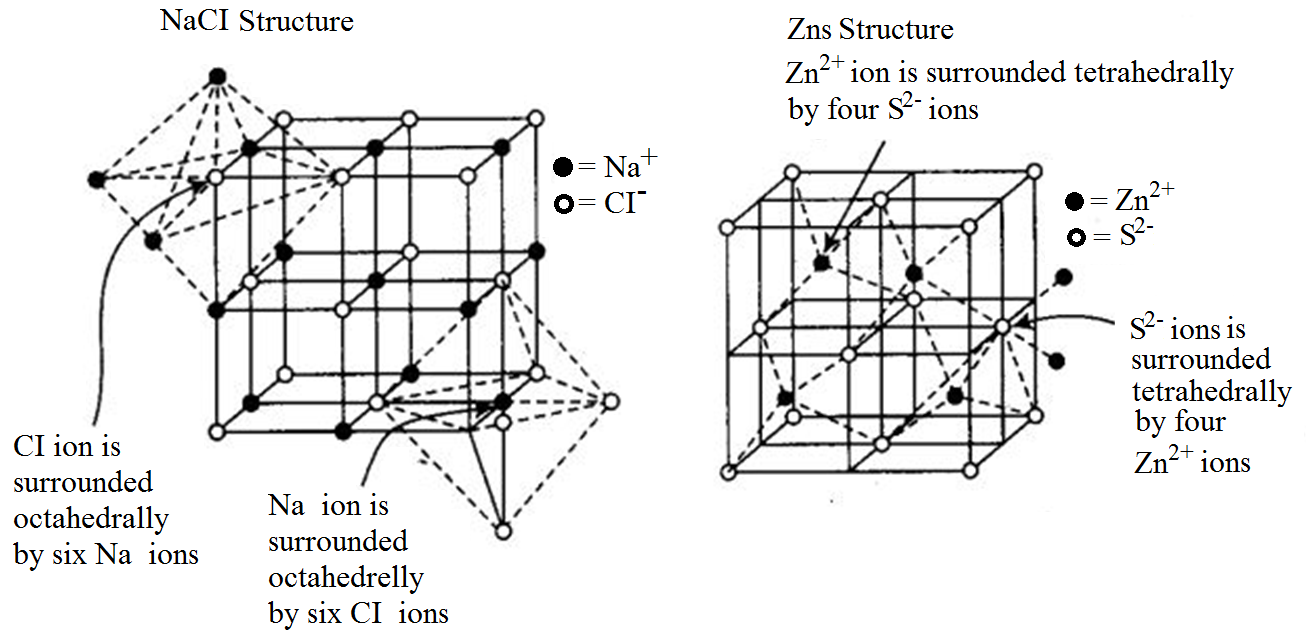
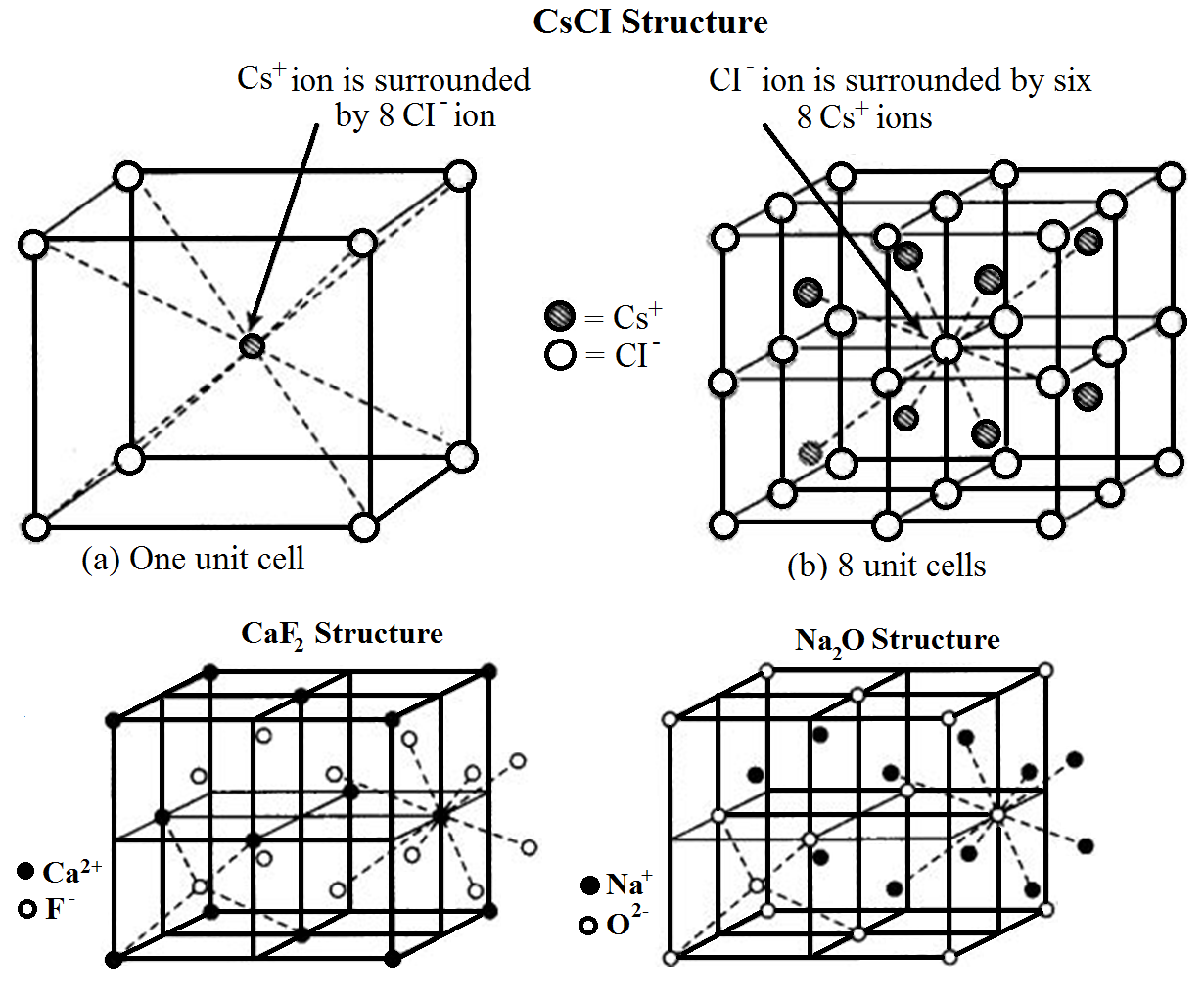
NaCl crystals have rock salt structure having fee lattice in which $Cl ^{-}$ions are present at fee lattice points and face centre and $Na ^{+}$occupies all the octahedral voids of given unit cell.
Where, coordination number of $Na ^{+}=6$
Coordination number of $Cl ^{-}=6$
View full question & answer→MCQ 161 Mark
The sharp melting point of crystalline solids is due to $.......$
- A
a regular arrangement of constituent particles observed over a short distance in crystal lattice.
- ✓
a regular arrangement of constituent particles observed over a long distance in crystal lattice.
- C
same arrangement of constituent particles in different direction
- D
different arrangement of constituent particles in different directions
AnswerCorrect option: B. a regular arrangement of constituent particles observed over a long distance in crystal lattice.
Crystals tend to have relatively sharp, well$-$defined melting points because all the component atoms, molecules, or ions are the same distance from the same number and type of neighbors; that is, the regularity of the crystalline lattice creates local environments that are the same.
View full question & answer→MCQ 171 Mark
Which of the following solids is not an electrical conductor?
$A. \mathrm{Mg}(\mathrm{s}).$
$B. \mathrm{TiO}(\mathrm{s}).$
$C. \mathrm{I}_2(\mathrm{~s}).$
$D. \mathrm{H}_2 \mathrm{O}(\mathrm{s}).$
- A
$(A)$ only.
- B
$(B)$ Only.
- ✓
$(C)$ and $(D).$
- D
$(B), (C)$ and $(D).$
AnswerCorrect option: C. $(C)$ and $(D).$
Iodine is a non$-$ polar molecular solid iodine moleculas are held together by london force or dispersion force , this is soft and non$-$conductor fo electricity.
Water is a hydrogen bonded molecular solid in which $H$ and $O$ are held together by to non$-$ionic nature, they are not electrical conductor.
View full question & answer→MCQ 181 Mark
Schottky defect is observed in crystals when $.......$
- A
Some cations move from their lattice site to interstitial sites.
- ✓
Equal number of cations and anions are missing from the lattice.
- C
Some lattice sites are occupied by electrons.
- D
Some impurity is present in the lattice.
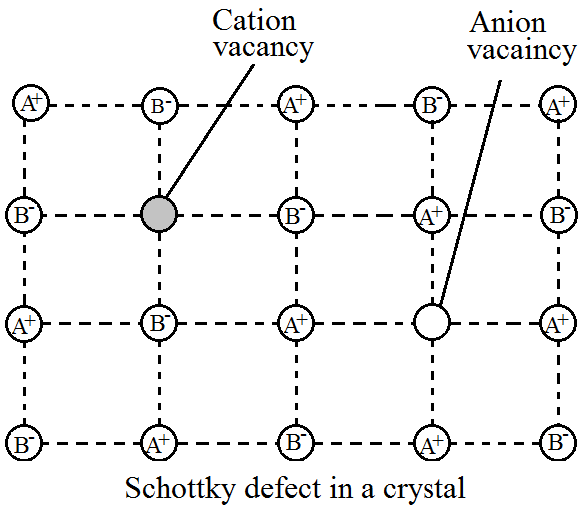
AnswerCorrect option: B. Equal number of cations and anions are missing from the lattice.
|
Defect
|
Definition
|
Type of solid
|
Effect of defect on density of substance
|
Structure fo crystal $($with defect$)$
|
| Schottky defect |
A crystal is said to have Schottky defect if equal number of cations and anions are missing from their normal lattice site there by creating vacancies or holes. |
Ionic solid
|
Decreases |
 |
View full question & answer→MCQ 191 Mark
The lattice site in a pure crystal cannot be occupied by $.......$
AnswerPure crystals have constituents i.e., atoms or molecules or ions as lattice points which are arranged in fixed stoichiometric ratio. Electron can occupy the lattice site only when there is imperfection in solid and not in a pure crystal.
Hence, existence of free electrons are not possible, it is possible on in case of imperfection in solid.
View full question & answer→MCQ 201 Mark
The edge lengths of the unit cells in terms of the radius of spheres constituting $\text{fcc, bcc}$ and simple cubic unit cell are respectively $.......$
- ✓
$2\sqrt{2\text{r}},\frac{4\text{r}}{\sqrt{3}},2\text{r}$
- B
$\frac{4\text{r}}{\sqrt{3}},2\sqrt{2\text{r}},2\text{r}$
- C
$2\text{r},2\sqrt{2\text{r}},\frac{4\text{r}}{\sqrt{3}},$
- D
$2\text{r},\frac{4\text{r}}{\sqrt{3}},2\sqrt{2\text{r}}$
AnswerCorrect option: A. $2\sqrt{2\text{r}},\frac{4\text{r}}{\sqrt{3}},2\text{r}$
Note: Distance between two atoms is always measured from their centres.
- If the crystal lattice consists of $\text{SCC},$ the atom which is present at the comers touch each other.
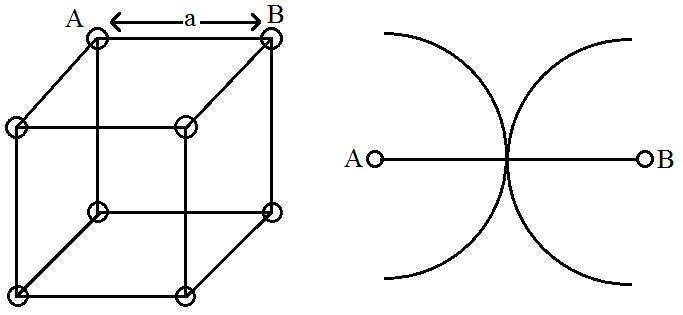
- In case of $\text{FCC},$ atom present at the comer and the centre of the face touch each other.
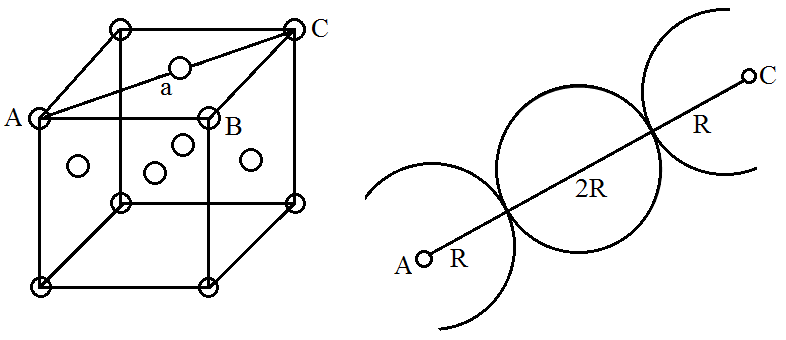
- In case of $\text{BCC}$ atom present at the corner and center of the body touch each other.
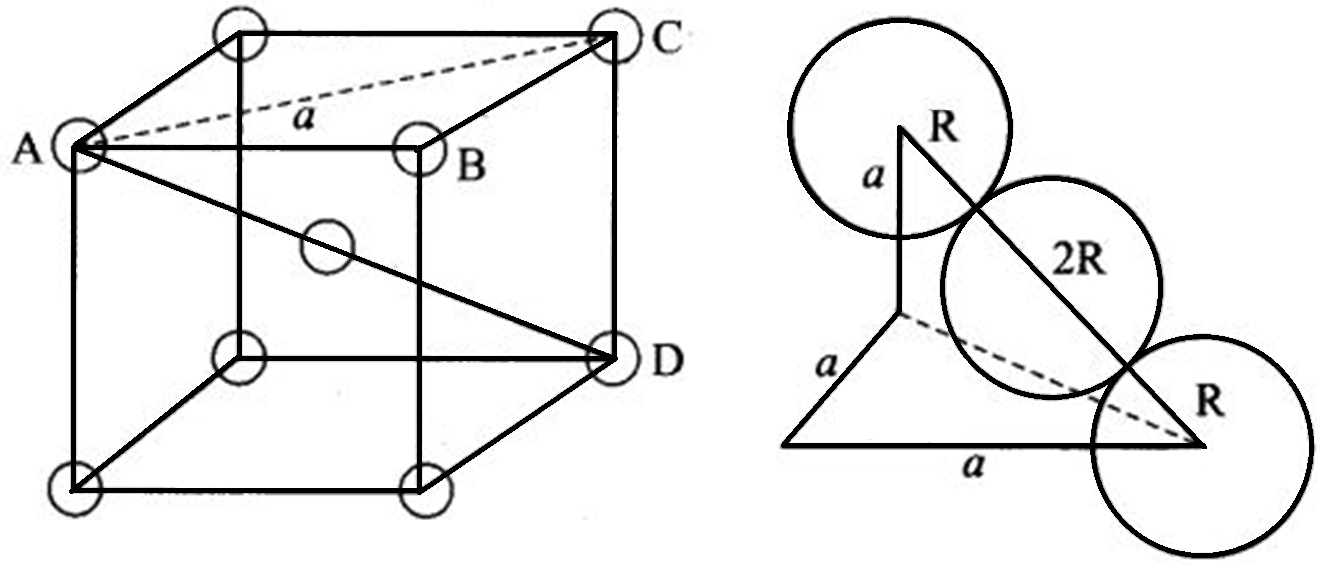
Edge lenght for different types of unit cells can be tabulated as
|
Type of unit cell
|
Edge LEnght
|
| $\text{fcc}$ |
$2\sqrt{2\text{r}}$
|
| $\text{bcc}$ |
$\frac{4}{\sqrt{3}}\text{r}$
|
| $\text{scc}$ |
$2r$
|
View full question & answer→MCQ 211 Mark
Which of the following molecule has higher lattice energy?
AnswerCorrect option: B. $\mathrm{Mg}_1 \mathrm{N}_3$
Lattice energy of a crystal is defined as the energy required to break an ionic crystal into its constituent ions in an isolated gaseous state. More ionic the compound is stronger will be its ionic bond and higher will be its lattice energy. In $\mathrm{MgN}_3$ the charge on the ionic species is greater than $\text{NaCl} .$ So, ionic interactions in $\mathrm{MgN}_3$ will be stronger.
So, lattice energy of $\mathrm{MgN}_3$ is greater than $\text{NaCl}$
View full question & answer→MCQ 221 Mark
$\text{ZnS}$ can be existing in the $......$ structure other than zing blende structure.
AnswerWurtzite is a zinc iron sulfide mineral frequently encountered mineral form of sphalerite.
View full question & answer→MCQ 231 Mark
Crystal of sodium chloride belong to the $......$ system:
AnswerIn sodium chloride $(\text{NaCl}),$ the chloride ions are arranged in a cubic structure $($called as face centered cubic$)$ and sodium ions occupy octahedral voids between them. Each sodium ion is surrounded by $6$ chloride ions.
View full question & answer→MCQ 241 Mark
Packing efficiency of hcp structure is $.....:$
- A
$68\%$
- B
$52.4\%$
- ✓
$74\%$
- D
$82\%$
AnswerCorrect option: C. $74\%$
Both $\text{ccp}$ and $\text{hcp}$ are highly efficient lattice; in terms of packing. The packing efficiency of both types of close packed structure is $74\%,$ i.e. $74\%$ of the space in $\text{hcp}$ and $\text{ccp}$ is filled. The $\text{hcp}$ and $\text{ccp}$ structure are equally efficient; in terms of packing.
The packing efficiency of simple cubic lattice is $52.4\%.$ And the packing efficiency of body centered cubic lattice $(\text{bcc})$ is $68\%.$
View full question & answer→MCQ 251 Mark
Which of the following is not a crystalline solid?
AnswerCommon salt, sugar and iron are crystalline solids whereas rubber is an amorphous solid as it does not have well developed perfectly ordered crystalline structure. Other amorphous solids include tar, glass, plastic, butter etc.
View full question & answer→MCQ 261 Mark
Diamond shows $.......$ lusture:
AnswerLustre or luster is the way light interacts with the surface of a crystal, rock, or mineral. Adamantine minerals possess a superlative lustre, which is most notably seen in diamond. Such minerals are transparent or translucent, and have a high refractive index $($of $1.9$ or more$).$ Minerals with a true adamantine lustre are uncommon.
View full question & answer→MCQ 271 Mark
The close$-$packing sequence $\text{ABAB} ......$ represents:
- A
$SC$ packing
- B
$\text{FCC}$ packing
- ✓
- D
$\text{BCC}$ packing
View full question & answer→MCQ 281 Mark
The co$-$ordination number of hexagonal close packing:
View full question & answer→MCQ 291 Mark
Packing efficiency in a unit cell is never $100\%$ because constituent particles are assumed to be:
View full question & answer→MCQ 301 Mark
In a crystal, atoms are located at the position of:
- A
- ✓
- C
- D
Infinite potential energy
Answera crystal, atoms are located at the position of minimum potential energy.
As two atoms approach each other, the potential energy gradually decreases, reaches a minimum value and then sharply increases.
View full question & answer→MCQ 311 Mark
Absorption of photons by crystal:
- A
Has no effect on imperfection
- ✓
Produce atomic displacement leading to imperfections
- C
Decreases number of defects
- D
AnswerCorrect option: B. Produce atomic displacement leading to imperfections
Absorption of photons by crystal produce atomic displacement leading to imperfections.
These imperfections are also called defects.
These are deviations from perfectly ordered arrangement.
View full question & answer→MCQ 321 Mark
Which one of the following is a pseudo solid?
AnswerPseudo solid is a solid which possesses the property of liquids. Glass is a pseudo solid and in a very slowprocess, it flows like a liquid due to which the base of glass gets thicker than top.
View full question & answer→MCQ 331 Mark
Which of the following is a network solid?
AnswerCorrect option: A. $\mathrm{SO}_2 ($Solid$).$
Diamond is a three$-$dimensional network solid in which each carbon atom is tetrahedral bonded with four carbon atoms.
View full question & answer→MCQ 341 Mark
The incorrect statement among the following is:
- ✓
The fraction of total volume occupied by the atoms in a primitive cell is $0.48.$
- B
Molecular solids are generally volatile.
- C
The number of carbon atoms in an unit cell of diamond is $8.$
- D
The number of Bravais lattices in which a crystal can be categorized is $14.$
AnswerCorrect option: A. The fraction of total volume occupied by the atoms in a primitive cell is $0.48.$
View full question & answer→MCQ 351 Mark
Which of the following is an interstitial compound?
- A
$\mathrm{PdCl}_2$
- B
$\mathrm{NH}_3$
- C
$\mathrm{ZnO}$
- ✓
$\mathrm{TiH}$
AnswerCorrect option: D. $\mathrm{TiH}$
An interstitial compound is a compound that is formed when an atom with a small enough radius sits in an interstitial hole in a metal lattice. Examples of small atoms are boron, carbon and nitrogen. These compounds play an important role in industries.
Examples$:\ \mathrm{TiH}, \mathrm{Fe}_3 \mathrm{H}$ and $\mathrm{Mn}_4 \mathrm{N}$
View full question & answer→MCQ 361 Mark
Crystal structure of $\text{NaCl}:$
Answer$\text{NaCl}$ has a face$-$centred cubic unit cell. Chloride ions $($being larger in size$)$ form cubic close packing. They are present at the corners and at the centre of each face of the cube. Smaller sodium ions are present in all the octahedral holes.
View full question & answer→MCQ 371 Mark
Graphite is a good conductor of electricity due to the presence of $......$
AnswerIn graphite one carbon atom is attached to three other carbon atoms. One electron of carbon remains free. Due to this free valence electron graphite is an electrical conductor.
View full question & answer→MCQ 381 Mark
Beautiful crystals arise from various chemical substances. A single chemical can, sometimes, give rise to different crystals because of different:
- A
- ✓
Arrangement of atoms in space
- C
- D
AnswerCorrect option: B. Arrangement of atoms in space
Different types of crystal system arised due to difference in the arrangement of atoms in the space.
View full question & answer→MCQ 391 Mark
Silver halides generally show:
- A
- B
- ✓
both Frenkel and Schottky defects
- D
AnswerCorrect option: C. both Frenkel and Schottky defects
Silver halides show both Frenkel and Schotkky defects. For Frenkel defect the reason is that there is size difference between the sizes of silver and halide.
Schottky defect is possible because silver halides are highly ionic.
View full question & answer→MCQ 401 Mark
The percentage of empty space in a body centred cubic arrangement is $.......$
AnswerPacking efficiency for $\text{bcc}$ arrangement is $68\%$ which represents total filled space in the unit cell. Hence, empty space in a body centered arrangement is $100 - 68 = 32\%.$
View full question & answer→MCQ 411 Mark
Graphite cannot be classified as $........$
AnswerGraphite is a covalent or Network solid, therefore it cannot be grouped as an ionic solid.
View full question & answer→MCQ 421 Mark
In which pair most efficient packing is present?
- A
$\text{hcp}$ and $\text{bcc}.$
- ✓
$\text{hcp}$ and $\text{ccp}.$
- C
$\text{bcc}$ and $\text{ccp}.$
- D
$\text{bcc}$ and simple cubic cell.
AnswerCorrect option: B. $\text{hcp}$ and $\text{ccp}.$
In $\text{hcp}$ and $\text{ccp}$ the packing efficiency is maximum $($i.e. $74\%),$ hence this pair of packing is considered as "most efficient packing".
View full question & answer→MCQ 431 Mark
$\mathrm{Na}_2 \mathrm{O}$ has:
- A
$\text{NaCl}$ structure
- B
$\text{ZnS}$ structure
- C
- ✓
Answer$\mathrm{Na}_2 \mathrm{O}$ structure is antifluorite type structure in which $\mathrm{O}^{2-}$ ions forms $\text{ccp}\ ($cubic close packing$)$ and $\mathrm{Na}^{+}$ occupy all tetrahedral voids.
View full question & answer→MCQ 441 Mark
Which of the following statements is not true?
- A
Paramagnetic substances are weakly attracted by magnetic field.
- ✓
Ferromagnetic substances cannot be magnetised permanently.
- C
The domains in antiferromagnetic substances are oppositely oriented with respect to each other.
- D
Pairing of electrons cancels their magnetic moment in the diamagnetic substances.
AnswerCorrect option: B. Ferromagnetic substances cannot be magnetised permanently.
Ferromagnetic species are strongly attracted in the magnetic field and can be permanently magnetised. Hence, choice $(b)$ is the correct answer while other three choices are correct.
View full question & answer→MCQ 451 Mark
Which one is an amorphous solid?
AnswerGlass is an amorphous solid. It is called psuedo solid. Diamond, graphite and common salt are crystalline solids.
View full question & answer→MCQ 461 Mark
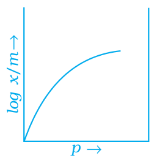
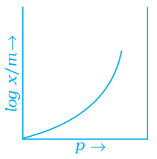
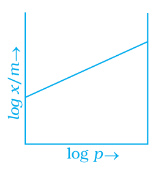
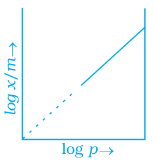
Which of the following curves is in accordance with Freundlich adsorption isotherm?
Answer$\frac{\text{x}}{\text{m}}=\text{kp}^\frac{1}{\text{n}}$
$\log\frac{\text{x}}{\text{m}}=\log\text{k}+\frac{1}{\text{n}}\log\text{p}$
Hence$, \log \Big(\frac{\text{x}}{\text{m}}\Big)$ versus $\log p$ is a straight line with a positive intercept.
View full question & answer→MCQ 471 Mark
Which of the following is not an amorphous substance?
AnswerThe amorphous substance is defined as any noncrystalline solid in which the atoms and molecules are not organized in a definite lattice pattern. As Rubber, Glass and Polymers of high molecular mass are examples of amorphous solids and Copper is not an amorphous substance.
Copper is an example of a crystalline solid.
View full question & answer→MCQ 481 Mark
Crystalline allotrope of silicon has:
MCQ 491 Mark
The correct order of the packing efficiency in different types of unit cells is $......$
- ✓
$\text{fcc < bcc <}$ simple cubic.
- B
$\text{fcc > bcc >}$ simple cubic.
- C
$\text{fcc < bcc >}$ simple cubic.
- D
$\text{bcc < fcc >}$ simple cubic.
AnswerCorrect option: A. $\text{fcc < bcc <}$ simple cubic.
|
Unit Cell
|
Packing Efficiancy
|
| $\text{fcc}$ |
$74\%$ |
| $\text{bcc}$ |
$68\%$ |
|
Simple Cubic
|
$52.4$ |
This follows the order$:\ \text{fcc > bcc >}$ simple cubic. View full question & answer→MCQ 501 Mark
A metallic crystal crystallizes into a lattice containing a sequence of layers $\text{ABABAB}....$ Any packing of spheres leaves out voids in the lattice. What percentage by volume of this lattice is empty space ?
AnswerCorrect option: B. $26\%$
View full question & answer→MCQ 511 Mark
Sodium chloride crystal has a $.....$ shape:
AnswerIn $\text{NaCl}$ crystal, there exists strong ionic bonding between $\mathrm{Na}^{+}$ and $\mathrm{Cl}^{-}$ions. Because of stronger forces of attraction between $\mathrm{Na}^{+}$ and $\mathrm{Cl}^{-}$, they remain fixed at their positions, thus, arranging in a definite pattern to give a definite shape.
View full question & answer→MCQ 521 Mark
- A
Solid substances in real sense
- B
- ✓
- D
Substances with definite melting point
AnswerAmorphous solids are supercooled liquids and they are irregularly arranged in nature of their structure. They never possess a definite melting point.
View full question & answer→MCQ 531 Mark
To get a $n-$type semiconductor from silicon, it should be doped with a substance with valence $......$
AnswerImpurity of higher group is doped to get $n-$type semiconductor. Thus, silicon $($valency $= 4)$ should be doped with the element with valency equal to $5.$
View full question & answer→MCQ 541 Mark
Which of the following crystal lattice has the minimum empty space ?
MCQ 551 Mark
Which of the following has a regular repeated molecular pattern in three dimensional space?
AnswerSolids have a regular repeated molecular pattern in three dimensional space and this is due to their property of high intermolecular forces. But in liquids and gases the arrangement of molecular pattern it is irregular.
View full question & answer→MCQ 561 Mark
Percentage of free space in a body centre cubic unit cell is:
- A
$30\%$
- ✓
$32\%$
- C
$34\%$
- D
$28\%$
AnswerCorrect option: B. $32\%$
Percentage of free space in a body centered cubic unit cell is $32\%.$
Percentage of occupied space in a body centered cubic unit cell is $68\%.$
Note: Percentage of free space in a simple cubic unit cell is $47.6\%.$
Percentage of free space in a face centered cubic unit cell is $26\%.$
View full question & answer→MCQ 571 Mark
In $\text{fcc},$ a tetrahedral void is formed by atoms at:
- A
$3$ corners and $1$ face centre
- ✓
$3$ face centres and $1$ corner
- C
$2$ face centres and $2$ corners
- D
$2$ face centres$, 1$ corner and $1$ body centre
AnswerCorrect option: B. $3$ face centres and $1$ corner
$1$ from corner and $3$ adjacent face centres form tetrahedral void.
View full question & answer→MCQ 581 Mark
What is not a type of crystal?
AnswerExplanation: (D) Amorphous
Crystals tend to have relatively sharp, well-defined melting points because all the component atoms, molecules, or ions are the same distance from the same number and type of neighbours; that is, the regularity of the crystalline lattice creates local environments that are the same.
Thus the intermolecular forces holding the solid together are uniform, and the same amount of thermal energy is needed to break every interaction simultaneously.
Amorphous has different property to crystal.
View full question & answer→MCQ 591 Mark
Stacking $($a pile$)$ of square close packed layer gives rise to:
- A
$\text{BCC}$ structure
- B
$\text{FCC}$ strncture
- ✓
$SC$ structure
- D
AnswerCorrect option: C. $SC$ structure
View full question & answer→MCQ 601 Mark
In $\text{AgBr}$ crystal, the ion size lies in the order $Ag^+<−:\ $The $\text{AgBr}$ crystal should have:
Answer$\text{AgBr}$ exhibits Frenkel defect due to large difference in the size of $Ag^+$ and $Br^-$ ions.
View full question & answer→MCQ 611 Mark
Rhe rank of atoms in the hexagonal until cell is:
AnswerRank of atom is another term for effective number of atoms for a unit cell, i.e., $Z_\ce{effective}$.
Therefore, For $\text{HCP}$ structure rank is $6.$
View full question & answer→MCQ 621 Mark
Which of the following is an amorphous substance?
AnswerAmorphous solids are a type of solids that lacks definition in shape, pattern and long range order as well as do not have a well defined melting point.
View full question & answer→MCQ 631 Mark
In a cube$, X$ atoms are present at corners and $Y$ atoms are at face centres of a cube. The number of $X$ and $Y$ are:
- A
$8, 8$
- B
$6, 8$
- ✓
$8, 6$
- D
$6, 6$
AnswerCorrect option: C. $8, 6$
No. of corner position in a cube $= 8$
No. of face centres present in a cube $= 6$
$X = 8, Y = 6$
View full question & answer→MCQ 641 Mark
Potassium crystallizes in a:
AnswerCorrect option: B. Body$-$centred cubic lattice
Potassium $($alkali metal$)$ and iron are examples of metals that arrange themselves in $\text{bcc}\ ($body$-$centered cubic lattice$).$
View full question & answer→MCQ 651 Mark
If the ratio of the coordination number of $A$ to that of $B$ is $x:y,$ then the ratio of number of atoms of $A$ to that of $B$ in the unit cell is:
- A
$x : y$
- ✓
$y : x$
- C
$x^2 : y$
- D
$y : x^2$
AnswerCorrect option: B. $y : x$
Coordination number of $A =$ Number of atoms of $B$
Coordination number of $B =$ Number of atoms of $A$
So, The Formula is $A_yB_x$ and the ratio of number of atoms is $y : x$
View full question & answer→MCQ 661 Mark
Which of the following oxides shows electrical properties like metals?
- A
$\text{SiO}_2$.
- B
$\text{MgO}.$
- C
$SO_2(s)$.
- ✓
$\text{CrO}_2$.
AnswerCorrect option: D. $\text{CrO}_2$.
$\text{CrO}_2, \text{TiO}$ and $\text{ReO}_3$ are some typical metal oxides which show electrical conductivity similar to metal. While $SO_2, \text{MgO}$ and $SO_2$ are oxides of metal, semimetal and non$-$metal which do not show electrical properties.
View full question & answer→MCQ 671 Mark
Which of the following is a non$-$crystalline solid?
- A
$\text{CsCl}$
- B
$\text{NaCl}$
- C
$\text{CaF}_2$
- ✓
Answer$\text{CsCl, NaCl}$ and $\text{CaF}_2$ are crystalline solids whereas glass is an amorphous solid as it does not has well developed perfectly ordered crystalline structure.
Other amorphous solids include tar, rubber, plastic, butter etc.
View full question & answer→MCQ 681 Mark
AnswerAmorphous solids neither have ordered arrangement $($i.e. no definite shape$)$ nor have sharp melting point like crystals, but when heated, they become pliable until they assume the properties usually related to liquids. It is therefore they are regarded as super$-$cooled liquids.
View full question & answer→MCQ 691 Mark
A tetrahedral void in a crystal implies that:
- A
The shape of the void is tetrahedral
- B
Molecules forming the void are tetrahedral in shape
- ✓
The void is surrounded tetrahedrally by four spheres
- D
The void is surrounded by six spheres
AnswerCorrect option: C. The void is surrounded tetrahedrally by four spheres
A tetrahedral void in a crystal implies that the void is surrounded tetrahedrally by four spheres. The four spheres are located at the four corners of the tetrahedron.
View full question & answer→MCQ 701 Mark
The lattice site in a pure crystal cannot be occupied by $.......:$
AnswerA pure crystal consists of either atoms, molecules or ions at lattice sites. Electrons can only occupy the lattice sites when there is any vacancy at that site which means it is not a pure crystal.
View full question & answer→MCQ 711 Mark
The flame colours of metal ions are due to:
AnswerThe flame colours of metal ions are due to metal excess defect.
The free electrons can be excited to higher energy levels giving absorption spectra and as a consequence their compounds are coloured.
View full question & answer→MCQ 721 Mark
The physical dimension of unit cells in a crystal lattice:
- ✓
- B
- C
- D
number of constituent particles
AnswerLattice parameter which refers to the physical dimension of unit cells in a crystal lattice. Lattices in three dimensions generally have three lattice constants, referred to as $a, b$ and $c.$
View full question & answer→MCQ 731 Mark
The process of converting alkyl halides into alcohols involves $......$
- A
- ✓
- C
Dehydrohalogenation reaction.
- D
AnswerThe reaction is a type of nucleophilic substitution reaction in which $-Cl$ group is replaced by $-OH.$
View full question & answer→MCQ 741 Mark
Frenkel defect is noticed in:
- A
$\text{AgBr}$
- B
$\text{ZnS}$
- C
$\text{AgI}$
- ✓
View full question & answer→MCQ 751 Mark
- ✓
possess sharp melting points.
- B
undergo clean cleavage when cut with a knife.
- C
do not undergo clean cleavage when cut with a knife.
- D
possess orderly arrangement over long distances.
AnswerCorrect option: A. possess sharp melting points.
Amorphous solids do not have a regular pattern of arrangement and hence, cannot be cut with knife for a clean cleavage.
View full question & answer→MCQ 761 Mark
Which one of the following schemes of ordering closed packed sheets of equal sized spheres do not generate close packed lattice?
- A
$\text{ABCABC}$
- B
$\text{ABACABAC}$
- ✓
$\text{ABBAABBA}$
- D
$\text{ABCBCACBC}$
AnswerCorrect option: C. $\text{ABBAABBA}$
In option $C,$ the scheme $\text{ABBAABBA}$ of ordering closed packed sheets of equal$-$sized spheres do not generate close$-$packed lattice as $BB, AA$ and $BB$ represent same layers of sheets placed together.
View full question & answer→MCQ 771 Mark
In a multi layered close$-$packed structure:
- ✓
there are twice as many tetrahedral holes as many close-packed atoms
- B
there are as many tetrahedral holes as many closed packed atoms
- C
there are twice as many octahedral holes as many close-packed atoms
- D
there are as many tetrahedral holes as many octahedral holes
AnswerCorrect option: A. there are twice as many tetrahedral holes as many close-packed atoms
No. of octahedral holes $=$ No. of close packed atoms.
No. of Tetrahedral holes $= 2\times $ No. of close packed atoms.
Hence, in a multi$-$layered close$-$packed structure, there are twice as many tetrahedral holes as many close$-$packed atoms.
View full question & answer→MCQ 781 Mark
Which of the following is an amorphous solid?
AnswerCorrect option: B. Quartz glass $(\text{SiO}_2).$
Quartz glass $(\text{SiO}_2)$ is an amorphous solid because their is no long range ordered arrangement of the constituent particles present in it.
View full question & answer→MCQ 791 Mark
Crystals can be classified into $.......$ basic crystal habits:
AnswerThe structures of all crystals can be classified according to the symmetry of the unit cells. There are in total $7$ groups, collectively called Crystal Systems: Tricinic, Monoclinic, Orthorhombic, Tetragonal, Trigonal, Hexagonal, and Cubic.
View full question & answer→MCQ 801 Mark
Certain crystals produce electric signals on application of pressure. This phenomenon is called:
AnswerWhen a polar crystal is subjected to a mechanical stress, electricity is produced a case of piezoelectricity. Reversely, if an electric field is applied, then a mechanical stress is developed. Piezoelectric crystal acts as a mechanical$-$electrical transductor.
View full question & answer→MCQ 811 Mark
The ratio of a number of rectangular planes and diagonal plane in a cubic unit cell is $.....:$
- ✓
$1 : 2$
- B
$3 : 1$
- C
$2 : 3$
- D
$3 : 4$
AnswerCorrect option: A. $1 : 2$
The ratio of rectangular plane and diagonal plane in cubic unit cell is $3 : 6$ i.e$, 1 : 2$
There are $3$ planes that lie parallel to the side of the cube,that these are rectangular planes.while $6$ planes goes through opposite edges. And also there are diagonal planes.
And Hence, the ratio of rectangular plane and diagonal plane in cubic unit cell is $3 : 6$ i.e$, 1 : 2.$
View full question & answer→MCQ 821 Mark
Which one of the following is purely a crystalline compound?
MCQ 831 Mark
Which of the following conditions favours the existence of a substance in the solid state?
AnswerAt sufficiently low temperature the thermal energy is low and the intermolecular forces bring the molecules of a substance so close that they cling to one another and occupy fixed positions. They can, however, have oscillating motion about their fixed positions. Under such condition the substance exists in solid state.
View full question & answer→MCQ 841 Mark
Empty space in $\text{ccp}$ lattice is:
- ✓
$26\%$
- B
$45\%$
- C
$90\%$
- D
$30\%$
AnswerCorrect option: A. $26\%$
In $\text{ccp}$ lattice $74\%$ of the space is occupied by spheres and $26\%$ is empty.
View full question & answer→MCQ 851 Mark
In the cubic close packing, this unit cell has:
- A
$4$ tetrahedral voids each of which is shared by four adjacent unit cells.
- B
$4$ tetrahedral voids within the unit cell.
- C
$8$ tetrahedral voids each of which is shared by four adjacent unit cell.
- ✓
$8$ tetrahedral voids within the unit cells.
AnswerCorrect option: D. $8$ tetrahedral voids within the unit cells.
Since, cube close packing is analogous to face$-$centered cubic $(\text{fcc})$ structure and number of atoms in a $\text{fcc}$ crystal is $4$ per unit cell.
So, number of tetrahedral voids $= 2\times$ Number of atoms in unit cell
$= 2 \times 4 = 8$
View full question & answer→MCQ 861 Mark
Which of the following is an example of metallic crystal solid?
- A
$C$
- B
$Si$
- ✓
$W$
- D
$\text{AgCl}$
AnswerMetalic crystals consists of metal cations surrounded by large number of mobile valence electrons, these electrons are also known as delocalised electrons, which do not belong to any one atom, but are capable of moving through the crystal. As a result metallic crystals are good conductors of electricity.
Example: gold$-Au,$ tungsten$-W$
View full question & answer→MCQ 871 Mark
The interstital hole is called tetrahedral because ?
- A
it is formed by four spheres
- B
partly same and partly different
- ✓
it is formed by four spheres, the centres of which form a regular tetrahedron
- D
AnswerCorrect option: C. it is formed by four spheres, the centres of which form a regular tetrahedron
A tetrahedral site is surrounded by four spheres and hence an interstitial hole is called tetrahedral.
View full question & answer→MCQ 881 Mark
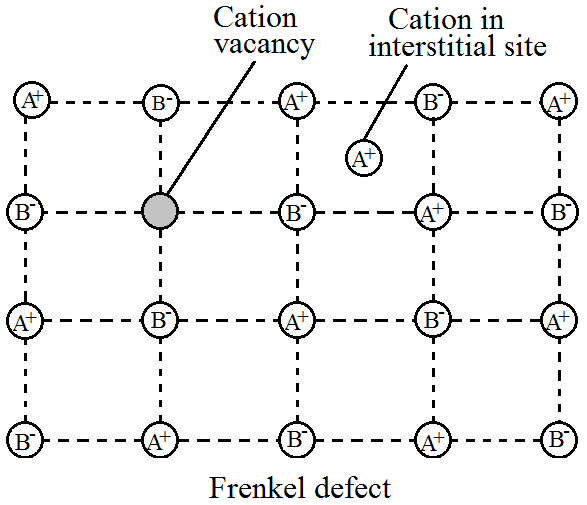
Cations are present in the interstitial sites in $......$
Answer
|
Defect
|
Definition
|
Type of solid
|
Effect of defect on density of substance
|
Structure fo crystal $($with defect$)$
|
|
Frenkel Defect or dis$-$location defect
|
A crystal is said to have Frenkel defect if cation is missing from the normal lattice position and is occupying interstitial site.
|
Ionic solid
|
Remain same
|
|
View full question & answer→MCQ 891 Mark
Hydrogen occupies the $......$ holes, while carbon and nitrogen occupy $......$ holes:
- ✓
Tetrahedral and octahedral
- B
Octahedral and tetrahedral
- C
Octahedral and octahedral
- D
Tetrahedral and tetrahedral
AnswerCorrect option: A. Tetrahedral and octahedral
The size of the hole in tetrahedral voids is smaller than the size of the hole in octahedral voids. The size of the $H$ atom is smaller than the size of $C$ and $N$ atoms. Hence, hydrogen occupies tetrahedral voids and carbon and nitrogen occupy octahedral voids.
View full question & answer→MCQ 901 Mark
The space occupied in $\text{bcc}$ arrangement is $.....:$
- A
$74\%$
- B
$70\%$
- ✓
$68\%$
- D
$60\%$
AnswerCorrect option: C. $68\%$
The space occupied in $\text{sc, bcc}$ and $\text{fcc}$ structures are $52\%, 68\%$ and $74\%$ respectively.
View full question & answer→MCQ 911 Mark
Which among the following metals crystallise as a simple cube?
AnswerPolonium crystallizes as simple cube. Iron crystallizes as $\text{BCC}$ unit cell. Copper and gold crystallizes as $\text{FCC}$ unit cell.
View full question & answer→MCQ 921 Mark
Identify the crystalline solid among the following:
AnswerThe solid which have fixed composition and three dimensional structure is called as crystalline solid.
Silver is a crystalline solid because it have fixed composition and structure.
View full question & answer→MCQ 931 Mark
Pick out the crystalline substance from the following:
AnswerIn sugar, the constituent particles are arranged in a specific manner. Hence, it is a crystalline solid.
In coal, wax, and clay the constituent particles are arranged in a random manner. Hence, it is an amorphous solid.
View full question & answer→MCQ 941 Mark
Hexagonal close packing is found in crystal lattice of:
AnswerCo$-$ordination number in $\text{HCP} = 12$
Co$-$ordination number in $Mg = 12.$
View full question & answer→MCQ 951 Mark
In a solid lattice, the cation has left a lattice site and is located at interstitial position, the lattice defect is $.....:$
View full question & answer→MCQ 961 Mark
The total number of tetrahedral voids in the face centred unit cell is $......$
AnswerIn face centred unit cell the number of atoms per unit cell $= 4$ atoms therefore, the number of tetrahedral voids in fcc unit cell $= 8.$
View full question & answer→MCQ 971 Mark
Which of the following is not the characteristic of ionic solids?
- ✓
Very low value of electrical conductivity in the molten state.
- B
- C
Very strong forces of interactions.
- D
AnswerCorrect option: A. Very low value of electrical conductivity in the molten state.
|
Type of solid
|
Con$-$stituent particles
|
Bonding/ attractive forces
|
Exam$-$ples
|
Physical nature
|
Electrical conductivity
|
Melting Point
|
|
Ionic Solids
|
Ions
|
Coulom but or electrostatic
|
$\text{NaCl, MgO, ZnS, CaF2}$
|
Hard but brittle
|
Insulators in solid state but conductors in molten state and in aqueous solutions
|
High
|
View full question & answer→MCQ 981 Mark
Which of the following is true about the charge acquired by $p-$type semiconductors?
- A
- ✓
- C
- D
Depends on concentration of p impurity.
Answer$P-$type semiconductor by itself has mainly positively charged carriers $($holes$)$ which are able to move freely. It is, however, still neutral because the fixed acceptor atoms having accepted electrons are negative.
View full question & answer→MCQ 991 Mark
What is the coordination number in a square close packed structure in two dimensions?
AnswerIn square closed structure in two dimensions each sphere is in contact with four of its neighbours. Thus the two dimensional coordination number is $4.$
View full question & answer→MCQ 1001 Mark
The sharp melting point of crystalline solids is due to $.......$
- A
A regular arrangement of constituent particles observed over a short distance in the crystal lattice.
- ✓
A regular arrangement of constituent particles observed over a long distance in the crystal lattice.
- C
Same arrangement of constituent particles in different directions.
- D
Different arrangement of constituent particles in different directions.
AnswerCorrect option: B. A regular arrangement of constituent particles observed over a long distance in the crystal lattice.
A solid is said to be crystalline if the various constituent structural units $($atoms, ions or molecules$)$ of which the solid is made, are arranged in a definite geometrical pattern within the solid. The type of forces in crystalline solids are of long range order due to which they have sharp melting point.
View full question & answer→MCQ 1011 Mark
Which one of the following has a different crystal lattice from those of the rest?
AnswerVanadium crystallizes in $\text{bcc}$ structures while $\text{Ag, Cu, Pt}$ and $Au$ crystallize in $\text{ccp}$ structures.
View full question & answer→MCQ 1021 Mark
The efficiency of packing is $68\%$ in:
- A
$\text{Hcp}$ structure
- B
$\text{Ccp}$ structure
- C
$\text{Fcc}$ structure
- ✓
$\text{Bcc}$ structure
AnswerCorrect option: D. $\text{Bcc}$ structure
$\text{FCC}$ or $\text{CCP}$ packing efficiency $= 74\%$
$\text{HCP}$ Packing Efficiency $= 74\%$
$\text{BCC}$ Packing Efficiency $= 68\%$
View full question & answer→MCQ 1031 Mark
Maximum possible numbers of two dimensional and three dimensional lattices are respectively $.......:$
- ✓
$5$ and $14$
- B
$7$ and $14$
- C
$14$ and $4$
- D
$5$ and $13$
AnswerCorrect option: A. $5$ and $14$
View full question & answer→MCQ 1041 Mark
AnswerPseudo solids $($such as glass $\ \&\ $ pitch$)$ lack a regular three$-$dimensional arrangement of atoms.
Pitch is a viscoelastic polymer which can be natural or manufactured, derived from petroleum.
Solids are most stable in crystalline form. However, if a solid is formed rapidly $($for example, when a liquid is cooled suddenly$),$ its atoms or molecules do not have time to align themselves and may become locked in positions other than those of a regular crystal. Such resulting solids are called Pseudo solids.
View full question & answer→MCQ 1051 Mark
The more efficient mode of packing of identical atoms in one layer is:
- A
Square close packing pattern
- B
Hexagonal close packing pattern
- ✓
- D
AnswerThe more efficient mode of packing of identical atoms in one layer is hexagonal close packing pattern.
This is because the empty space in hexagonal closed packing is much less than that in square close packing.
View full question & answer→MCQ 1061 Mark
How many tetrahedral voids are occupied in diamond?
- A
$25\%$
- ✓
$50\%$
- C
$75\%$
- D
$100\%$
AnswerCorrect option: B. $50\%$
One half or $50\%$ tetrahedral voids are occupied in diamond. Its unit cell is similar to face centered cubic unit cell.
View full question & answer→MCQ 1071 Mark
Which of the following cannot be regarded as molecular solid?
- A
$\text{SiC}$
- B
$\text{AlN}$
- C
- ✓
AnswerSilicon carbide $(\text{SiC}),$ Aluminium nitride $(\text{AlN}),$ and diamond are examples of network atomic solids as they have three$-$dimensional structure.
View full question & answer→MCQ 1081 Mark
A ferromagnetic substance becomes a permanent magnet when it is placed in a magnetic field becuase $......$
- ✓
All the domains get oriented in the direction of magnetic field.
- B
All the domains get oriented in the direction opposite to the direction of magnetic field.
- C
Domains get oriented randomly.
- D
Domains are not affected by magnetic field.
AnswerCorrect option: A. All the domains get oriented in the direction of magnetic field.
Ferromagnetic solids can be permanently magnetised and then all the domains get oriented in the direction of applied magnetic field.
View full question & answer→MCQ 1091 Mark
To prepare $n-$type semiconductor the impurity to be added to silicon should have the following number of valence electrons:
AnswerTo prepare $n-$type semiconductor the impurity to be added to silicon should have $5$ valence electrons.
In $n-$type semiconductors, electrons are the majority carriers and holes are the minority carriers. $N-$type semiconductors are created by doping an intrinsic semiconductor with donor impurities.
View full question & answer→MCQ 1101 Mark
An element crystallises in a $\text{bcc}$ lattice. Nearest neighbours and percentage of volume occupied by spheres in the unit cell are:
- A
$8, 74\%$
- ✓
$8, 68\%$
- C
$6, 74\%$
- D
$6, 68\%$
AnswerCorrect option: B. $8, 68\%$
There are $8$ nearest neighbours in $\text{BCC}.$ Percentage of volume occupied by spheres in the unit cell of $\text{BCC}$ is $68\%.$
View full question & answer→MCQ 1111 Mark
In $\text{FCC}$ unit cell, the percentage of unit cell not occupied by atoms is:
- A
$33\%$
- B
$29\%$
- ✓
$26\%$
- D
$74\%$
AnswerCorrect option: C. $26\%$
In $\text{FCC}, 26\%$ of the total volume is not be recovered by atoms.
View full question & answer→MCQ 1121 Mark
$\text{AAA}$ type packing in $3D$ has a unit cell as:
- ✓
- B
$\text{FCC}$
- C
$\text{BCC}$
- D
$\text{CCP}$
View full question & answer→MCQ 1131 Mark
Crystals have 'vacant sites' or 'defects' in them. When light strikes a photographic silver bromide paper, silver atoms move in through these defects to:
- A
- B
Form tiny clumps of silver atoms
- ✓
- D
AnswerWhen light strikes a photographer $(\text{AgBr})$ paper, it gives energy to the electrons present in the film. These energetic electrons when strike silver ions turn them to silver atoms. So eventually, ions leave their lattice site and occupy interstitial sites. Since silver atoms are black in color so whenever light strikes a silver ion the photographic film will turn black.
View full question & answer→MCQ 1141 Mark
Which of the following is not related to amorphous solids?
- A
They do not have sharp melting points
- B
- C
They are not bound by plane surfaces
- ✓
They give diffraction bands
AnswerCorrect option: D. They give diffraction bands
Strength, photovoltaic optical properties, no sharp melting points, not bound by plane surfaces, hard etc. are the features of amorphous solids. However, they do not give diffraction bands.
View full question & answer→MCQ 1151 Mark
An element exists as hexagonal close packed structure as well as cubic closed packed structure. In which case the element would have higher density?
- A
$\text{CCP}$
- B
$\text{HCP}$
- ✓
- D
AnswerThe packing efficiencies of both hcp and $\text{ccp}$ is approximately same that is $74\%$ density of the element will be same in both the cases as two structures will have the same coordination number and hence, the same packing fraction and density.
View full question & answer→MCQ 1161 Mark
Which of the following is correct regarding defect in solid?
AnswerCorrect option: C. Frenkel defect is a dislocation defect
The Schottky defect has some effect on the physical properties of solids such as lower density, lower lattice energy or stability etc.
Frenkel defect is usually favoured by a large difference in the sizes of cations and anions. Cations are small in size than anions.
Frenkel defect is a dislocation defect. A cation moves to another position between two layers.
Trapping of electrons in the lattice leads to the formation of $F-$centers.
View full question & answer→MCQ 1171 Mark
Which type of crystals contains more than one Bravais lattice?
AnswerIn the given options, Hexagonal, Triclinic and Rhombohedral crystals have only one Bravais lattice. Only Monoclinic Crystal has two Bravais lattice.
View full question & answer→MCQ 1181 Mark
Which of the following statement is not true about amorphous solids?
- A
On heating they may become crystalline at certain temperature.
- B
They may become crystalline on keeping for long time.
- C
Amorphous solids can be moulded by heating.
- ✓
They are anisotropic in nature.
AnswerCorrect option: D. They are anisotropic in nature.
Amorphous solids are isotropic because they show thermal and optical properties, same in all directions.
View full question & answer→MCQ 1191 Mark
The compound with the largest lattice energy would be:
- ✓
$\text{NaF}$
- B
$\text{KBr}$
- C
$\text{MgF}_2$
- D
AnswerCorrect option: A. $\text{NaF}$
The lattice energy depends on the attraction between the oppositely charged ions.,
$\text{NaF}$ has largest lattice energy.
View full question & answer→MCQ 1201 Mark
Which of the following solid substance$(s)$ will have the same refractive index when measured in different directions?
AnswerCorrect option: B. $\text{NaCl}$
Isotropic solids have same refractive index in all the directions. As amorphous solids are isotropic in nature.
Hence, amorphous solids like $\text{NaCl}$ will show same refractive index when measured in different directions.
View full question & answer→MCQ 1211 Mark
The compound $\text{MX}_4$ is tetrahedral . The number of $\text{X−M−X}$ angles in the compound is:
Answer$\text{MX}_2$ is tetrahedral, therefore total number of angles $\text{XMX}$ is six.
View full question & answer→MCQ 1221 Mark
Which of the following is a primitive unit cell?
AnswerCorrect option: D. Both body$-$centred and face$-$centred cubic
View full question & answer→MCQ 1231 Mark
How many kinds of space lattices are possible in a crystal?
AnswerThere are $14$ kinds of space lattices are possible for crystals these are called as Bravais lattice.
View full question & answer→MCQ 1241 Mark
In the cubic close packing, the unit cell has $.......$
- A
$4$ Tetrahedral voids each of which is shared by four adjacent unit cells.
- B
$4$ Tetrahedral voids within the unit cell.
- C
$8$ Tetrahedral voids each of the which is shared by four adjacent unit cells.
- ✓
$8$ Tetrahedral voids within the unit cells.
AnswerCorrect option: D. $8$ Tetrahedral voids within the unit cells.
We know that in $\text{ccp}$ structure there are $4$ atoms per unit cell. The number of tetrahedral voids is twice the number of atoms $($i.e. eight tetrahedral voids per unit cell of cubic closed packing$.)$
View full question & answer→MCQ 1251 Mark
Which kind of defects are introduced by doping?
AnswerWhen electron rich or electron deficient impurity is added to a perfect crystal, it introduces electronic defect in them.
View full question & answer→MCQ 1261 Mark
The maximum percentage of available volume that can be filled in a face centred cubic system by an atom is:
- ✓
$74\%$
- B
$68\%$
- C
$34\%$
- D
$26\%$
AnswerCorrect option: A. $74\%$
Face$-$centered cubic cells have $74\%$ packaging efficiency for spheres or ions of equal diameter.
Some examples of $\text{FCC}$ arrangements are aluminum, copper and buckminsterfullerenes$-C-60\ ($buckyballs$)$ etc.
View full question & answer→MCQ 1271 Mark
Which of the following statements are true for glasses?
AnswerCorrect option: D. Both $A$ and $B$ are correct.
Glasses are amorphous solids. Amorphous solids do not have a specific arrangement pattern.
All amorphous solids have a tendency to flow though very slowly. Hence, glass is considered as a super cooled liquid. That is why, glass windows and doors become slightly thicker at the bottom than at the topwith time.
Amorphous solids do not exhibit long order arrangement.
View full question & answer→MCQ 1281 Mark
Which of the following statement is not true about the hexagonal close packing?
AnswerCorrect option: C. Tetrahedral voids of the second layer are covered by the spheres of the third layer.
In hexagonal close packed structure there is $\text{ABAB} ......$ type pattern. This means that in this case spheres of third layer are exactly aligned with those of the first layer. Thus the pattern of spheres is repeated in alternate layers. Thus the statement at $(iv)$ is not true about hexagonal closed packing.
View full question & answer→MCQ 1291 Mark
Which type of 'defect' has the presence of cations in the interstitial sites ?
MCQ 1301 Mark
Which of the following is amorphous?
AnswerAmorphous is defined as a substance laking clear structure or shape.
In quartz glass, elements are not organized in a periodic array, so they don't have a proper shape or structure.
View full question & answer→MCQ 1311 Mark
Which of the following is an example for interstitial solid solution?
- A
$\text{SiC}$
- ✓
$\text{TiC}$
- C
$Li_2C_2$
- D
$Al_4C_3$
AnswerCorrect option: B. $\text{TiC}$
Interstitial solid solution $-$ Interstitial solid solution forms when the solute atom is small enough to fit at interstitial sites between the solvent atoms.
example$-\text{TiC}.$
View full question & answer→MCQ 1321 Mark
What type of bonding results in compounds which are crystalline solids?
AnswerIonic bonding results in compounds which are crystalline solids.
As they are held by strong electrostatic forces, thus they have more organised structure, a definite melting point and are known as crystals.
View full question & answer→MCQ 1331 Mark
Which of the following oxides behaves as conductor or insulator depending upon temperature?
- A
$\text{TiO}.$
- B
$\text{SiO}_2$.
- ✓
$\text{TiO}_3$.
- D
$\text{MgO}.$
AnswerCorrect option: C. $\text{TiO}_3$.
Certain metal oxides like $\text{VO, VO}_2, VO_3$ and $\text{TiO}_3$ show either metallic or insulating properties depending upon temperature.
View full question & answer→MCQ 1341 Mark
Most crystals that show good cleavage because their atoms, ions or molecules are:
AnswerMost crystals show good cleavage as their atoms, ions or molecule are arranged in planes which is due to flat crystal face.
View full question & answer→MCQ 1351 Mark
Iodine molecules are held in the crystals lattice by $......$
AnswerIodine molecule is a nonpolar covalent molecule. These molecules are electrically symmetical and have no dipole moment. The molecules are in a crystal lattice of iodine are, therefore, attracted together by weak 'London forces'.
View full question & answer→MCQ 1361 Mark
In case of cubic system, the number of types of space lattices?
AnswerThere are $14$ space lattices are possible in a crystal.
View full question & answer→MCQ 1371 Mark
Which of the following point defects are shown by $\text{AgBr(s)}$ crystals?
$A.$ Schottky defect.
$B.$ Frenkel defect.
$C.$ Metal excess defect.
$D.$ Metal deficiency defect.
- ✓
$(A)$ and $(B).$
- B
$(C)$ and $(D).$
- C
$(A)$ and $(C).$
- D
$(B)$ and $(D).$
AnswerCorrect option: A. $(A)$ and $(B).$
$\text{AgBr}$ shows both Schottky and Frenkel defects. In $\text{AgBr},$ both $Ag^+$ and $Br$ ions are absent from the lattice causing Schottky defect. However$, Ag^+$ ions are mobile so they have a tendency to move aside the lattice and trapped in interstitial site, hence cause Frenkel defect.
View full question & answer→MCQ 1381 Mark
The three dimensional graph of lattice points which sets the pattern for the whole lattice is called:
AnswerThe three dimensional graph of lattice points which sets the pattern for the whole lattice is called unit cell.
View full question & answer→MCQ 1391 Mark
The smallest repeating unit in space lattice which when repeated over and again results in the crystal of the given substance is called:
AnswerThe smallest repeating unit in space lattice which when repeated over and again results in the crystal of the given substance is called unit cell.
The collection of all points in the crystal having similar environment is called space lattice.
The lattice points can be arranged in maximum of fourteen types. This arrangement is called Bravais lattice.
Two or more substances having the same crystal structure are said to be isomorphous.
View full question & answer→MCQ 1401 Mark
Which of the following represents correct order of conductivity in solids?
- ✓
$\kappa_\text{metals} >> \kappa_\text{insulators} < \kappa_\text{semiconductors}.$
- B
$\kappa_\text{metals} << \kappa_\text{insulators} < \kappa_\text{semiconductors}.$
- C
$\kappa_\text{metals} < \kappa_\text{semiconductors}> \kappa_\text{insulators}=\text{zero}.$
- D
$\kappa_\text{metals} < \kappa_\text{semiconductors}> \kappa_\text{insulators} \neq \text{zero}.$
AnswerCorrect option: A. $\kappa_\text{metals} >> \kappa_\text{insulators} < \kappa_\text{semiconductors}.$
Conductivity of metal, insulator and semiconductors can be represented in the term of $k\ ($Kappa$)$ which depends upon energy gap between valence band and conduction band.
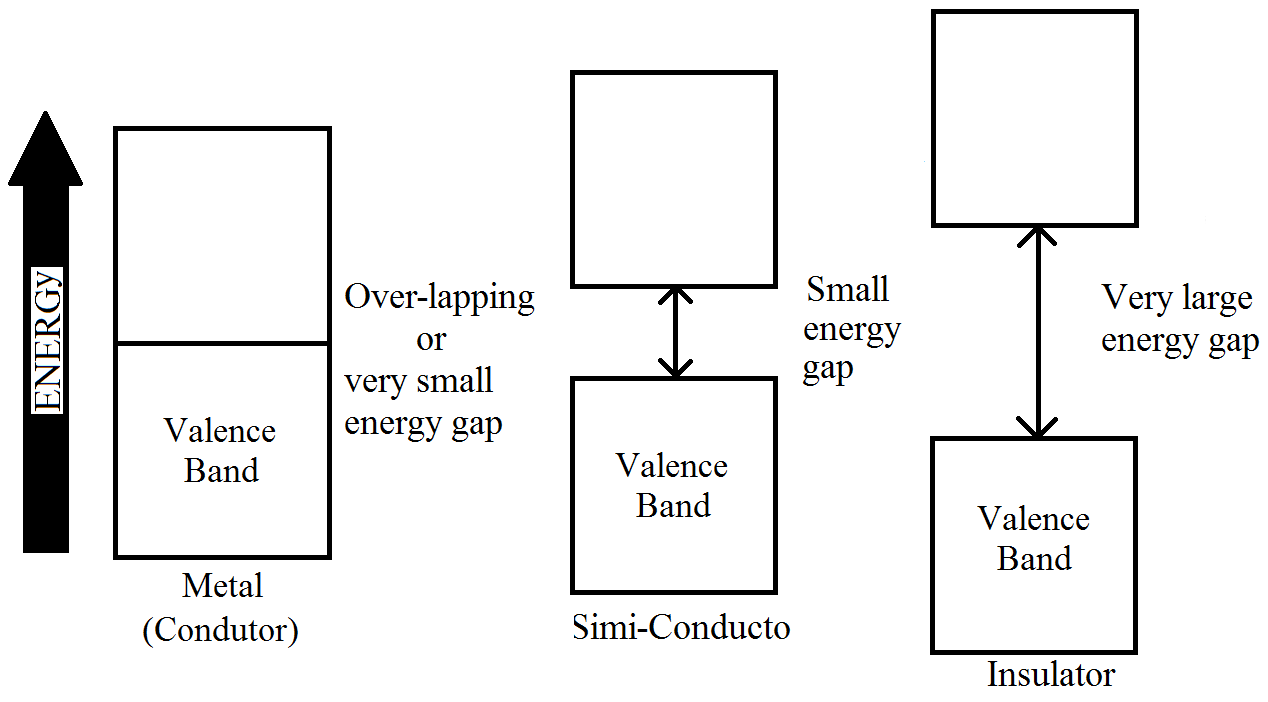
Valence and conductance bands in metals, semiconductors and insulatots.
| |
Valued $\kappa\big(\Omega^{-1}\text{m}^{-1}\big)$
|
|
Metal
|
$ 10^4 \text { to } 10^7 $ |
|
Insulator
|
$ 10^{-20} \text { to } 10^{-10} $ |
|
Semiconductor
|
$ 10^{-6} \text { to } 10^4 $ |
View full question & answer→MCQ 1411 Mark
At zero kelvin, most of the ionic crystals possess:
AnswerAt zero kelvin, most of the ionic crystals posses no defect. This is due to presence of highly ordered arrangement.
View full question & answer→MCQ 1421 Mark
The vacant space in a $\text{bcc}$ unit cell is:
- A
$23\%$
- ✓
$32\%$
- C
$26\%$
- D
$48\%$
AnswerCorrect option: B. $32\%$
Packing fraction of $\text{BCC}$ unit cell is $68\%.$ Therefore, the vacant space in $\text{BCC}$ unit cell is $32\%.$
View full question & answer→MCQ 1431 Mark
Under the influence of electric field, which of the following statements is true about the movement of electrons and holes in a $p-$type semi conductor?
$a.$ Electron will move towards the positvely charged plate through electron holes.
$b.$ Holes will appear to be moving towards the negatively charged plate.
$c.$ Both electrons and holes appear to move towards the positively charged plate.
$d.$ Movement of electrons is not related to the movement of holes.
- ✓
$a$ and $b$
- B
$a$ and $c$
- C
$b$ and $c$
- D
$a$ and $d$
AnswerCorrect option: A. $a$ and $b$
In $p-$type semiconductor, the conductivity is due to existence of hole. When electric field is applied to $p-$type semiconductor hole starts moving towards negatively charged plate and electron towards positively charged plate. Flow of holes in $p-$type semiconductors Hole.
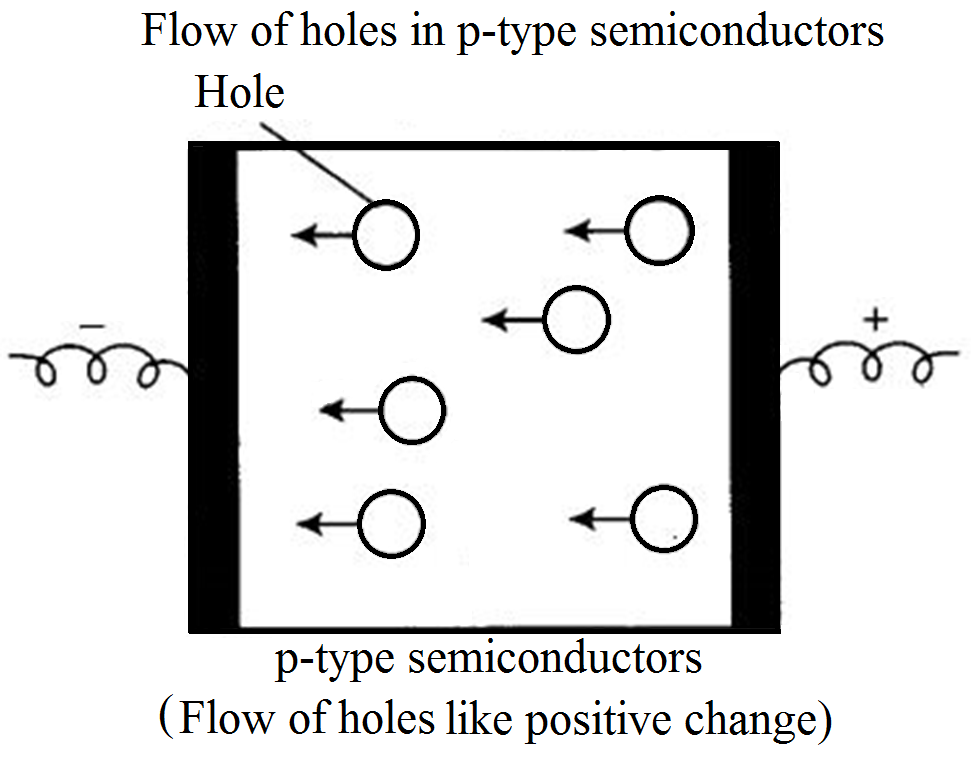
View full question & answer→MCQ 1441 Mark
The crystal structure of pure silicon is like:
AnswerSilicon crystallizes in the same pattern as diamond, in a structure which Ashcroft and Mermin call "two interpenetrating face$-$centered cubic" primitive lattices.
View full question & answer→MCQ 1451 Mark
Which of the following is not true about the voids formed in $3$ dimensional hexagonal close packed structure?
$a.$ A tetrahedral void is formed when a sphere of the second layer is present above triangular void in the first layer.
$b.$ All the triangular voids are not covered by the spheres of the second layer.
$c.$ Tetrahedral voids are formed when the triangular voids in the second layer lie above the triangular voids in the first layer and the triangular shapes of these voids do not overlap.
$d.$ Octahedral voids are formed when the triangular voids in the second layer exactly overlap with similar voids in the first layer.
- A
$a$ and $b$
- B
$a$ and $c$
- C
$b$ and $c$
- ✓
$c$ and $d$
AnswerCorrect option: D. $c$ and $d$
Tetrahedral voids are formed when the triangular void in the second layer lie exactly above the triangular voids in the first layer and the triangular shape of these voids oppositely overlap.
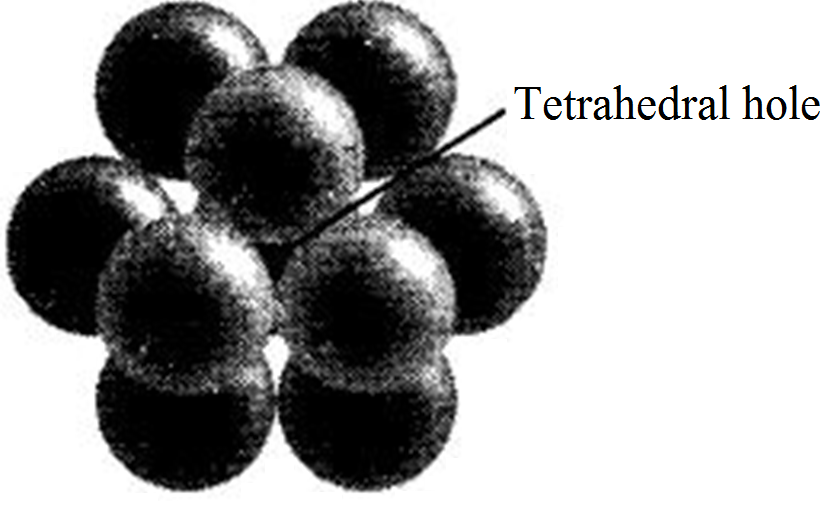
Octahedral voids are formed when triangular void of second layer is not exactly overlap with similar void in first layer.
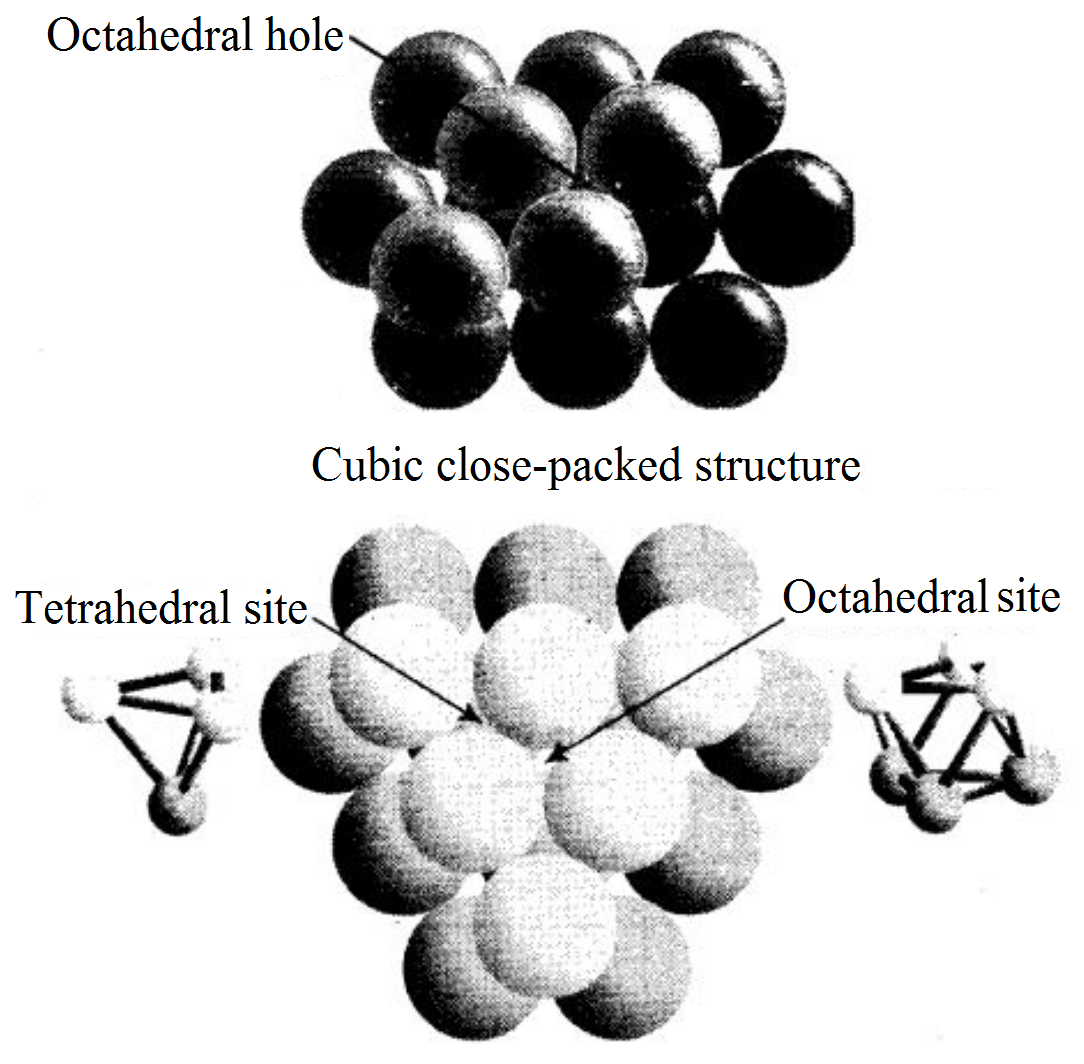
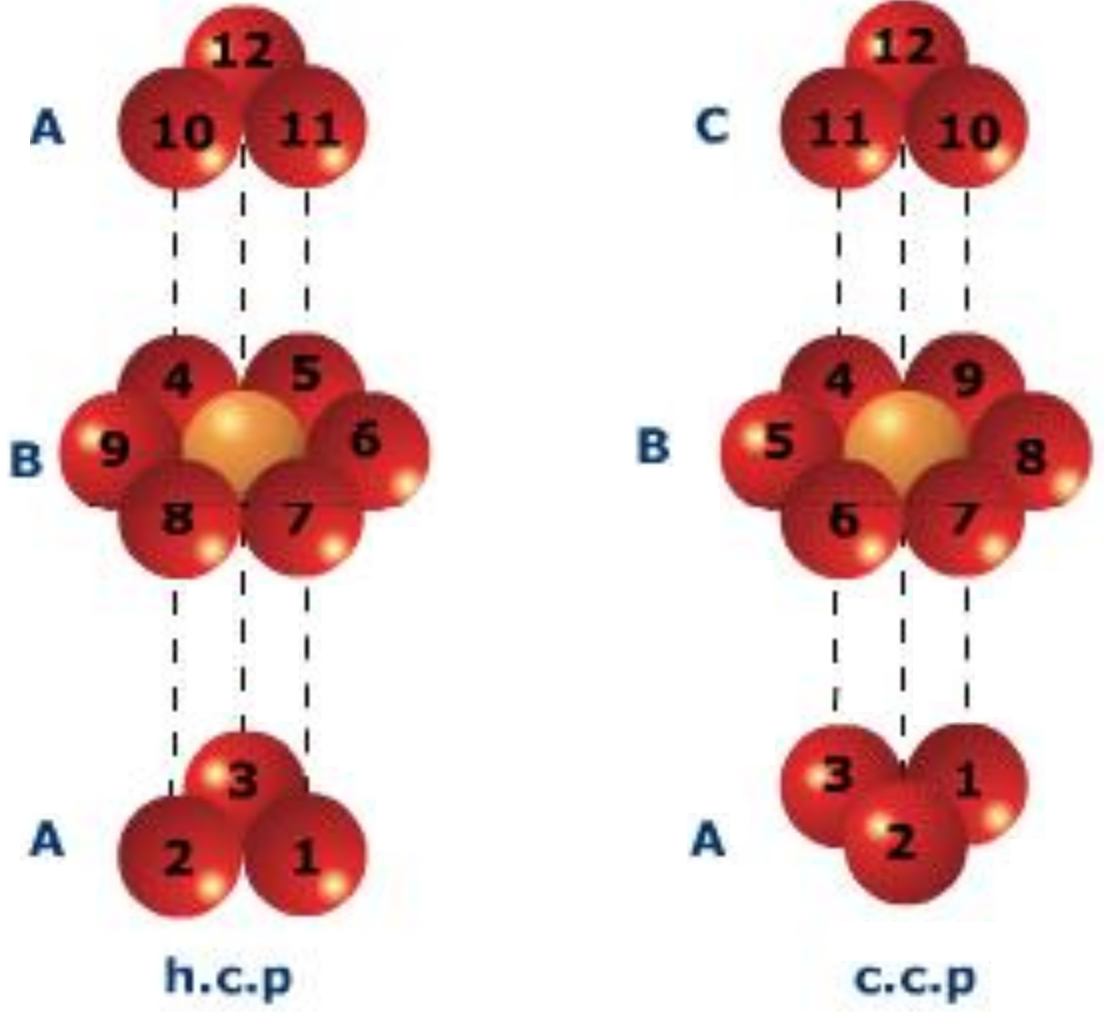
View full question & answer→MCQ 1461 Mark
The crystal system possess by $\mathrm{K}_2 \mathrm{Cr}_2 \mathrm{O}_7$ is:
AnswerThe crystal system possessed by $\mathrm{K}_2 \mathrm{Cr}_2 \mathrm{O}_7$ is Triclinic. It has been determined by single$-$crystal $X−$ray diffraction.
View full question & answer→MCQ 1471 Mark
Which of the following is not true about the ionic solids?
- A
Bigger ions form the close packed structure.
- B
Smaller ions occupy either the tetrahedral or the octahedral voids depending upon their size.
- C
Occupation of all the voids is not necessary.
- ✓
The fraction of octahedral or tetrahedral voids occupied depends upon the radii of the ions occupying the voids.
AnswerCorrect option: D. The fraction of octahedral or tetrahedral voids occupied depends upon the radii of the ions occupying the voids.
The fraction of octahedral or tetrahedral voids occupied depends upon the radii of the ions present at the lattice points. As we know the radii of octahedral or tetrahedral void is related to radii of atoms $(r)$ as Radius of octahedral void $(R_0) = 0.414r.$
Radius of tetrahedral void $(R_1) = 0.225r$ Where$, r =$ radius of bigger atom involved.
View full question & answer→MCQ 1481 Mark
Which is correct statement?
- A
Schottky defect occurs when radius of cation is smaller
- ✓
When temperature increases then number of defects decreases
- C
Frenkel defect occurs when radius of cation is smaller
- D
AnswerCorrect option: B. When temperature increases then number of defects decreases
As temperature and number of defects are inversely propotional, with increase in temperature number of defects decreases.
In schottky effect, size of ions are almost same while in frenkel defect, size of cation is small.
View full question & answer→MCQ 1491 Mark
Crystal system in which maximum number of Bravais lattices are possible is:
AnswerOrthorhombic crystal system has all four lattices i.e. primitive, body$-$centered, face$-$centered and end$-$centered.
View full question & answer→MCQ 1501 Mark
Which of the following defects is also known as dislocation defect?
AnswerIn Frenkel defect, some cations occupy interstitial site and hence it is also called dislocation defect.
View full question & answer→MCQ 1511 Mark
What is the $C.N.$ of a sphere in square packing in $2-D?$
View full question & answer→MCQ 1521 Mark
Schottky defect is observed in the crystal of:
- A
$\text{AgCl}$
- ✓
$\text{NaCl}$
- C
$\text{MgCl}_2$
- D
$\text{TiCl}$
AnswerCorrect option: B. $\text{NaCl}$
Schottky defect is a type of point defect in crystal lattice named after walter $H$ scottky. In non$-$iodic crystals, it means a lattice vacany defect. In ionic$-$crystals, the defect forms when oppositely charged ions leave their lattice sites, creating vacancies.
Eg$. \text{AgBr, NaCl}.$
$\Rightarrow$ Schottky defect abserved in $\text{NaCl}$ crystal.
View full question & answer→MCQ 1531 Mark
The empty space in $\text{hcp}$ and $\text{ccp}$ is about:
- ✓
$26\%$
- B
$30\%$
- C
$35\%$
- D
$40\%$
AnswerCorrect option: A. $26\%$
The space occupied by spheres of equal size in three dimensions in both $\text{hcp}$ and $\text{ccp}$ arrangements is $74\%.$
The vacant space is $100 − 74 = 26\%.$
View full question & answer→MCQ 1541 Mark
The space lattice of graphite is:
AnswerThe structure of graphite consists of many flat layers of hexagons. The layers are called graphene sheets. Each carbon atom in the layer is joined by strong covalent bonds to only three other carbon atoms. Compare this with the structure of diamond. Each graphene sheet is itself a giant molecule.
View full question & answer→MCQ 1551 Mark
Which of the following is true about the value of refractive index of quartz glass?
- ✓
- B
Different in different directions.
- C
- D
Answer Since quartz glass is an amorphous solid having short range order of constitutents. Hence, value of refractive index is same in all directions, can be measured and not be equal to zero always.
View full question & answer→MCQ 1561 Mark
The crystal lattice of ice is mostly formed by:
AnswerCorrect option: D. Covalent as well as $H-$bonds
Ice has hydrogen bonding and covalent bond, and intermolecular hydrogen bonds are weaker than Covalent bonds.
$H-O$ are covalent bonds$. H-O$ are intermolecular hydrogen bonding also with other neighbouring atoms.
View full question & answer→