Question 15 Marks
- Two insulated charged copper spheres A and B have their centres separated by a distance of 50 cm. What is the mutual force of electrostatic repulsion if the charge on each is $6.5 \times 10^{-7}$ C? The radii of A and B are negligible compared to the distance of separation.
- What is the force of repulsion if each sphere is charged double the above amount, and the distance between them is halved?
Answer
- Charge on sphere A, $q_A =$ Charge on sphere $B, q_B = 6.5 \times 10^{-7} C$
Distance between the spheres, r = 50 cm = 0.5 m
Force of repulsion between the two spheres,
$\text{F}=\frac{\text{q}_\text{A}\text{q}_\text{B}}{4\pi\in_0\text{r}^2}$
Where,
$\in_0$ = Free space perrnittivity
$\frac{1}{4\pi\in_0}=9\times10^9\text{Nm}^2\text{C}^{-2}$
$\therefore\text{F}=\frac{9\times10^9\times(6.5\times10^{-7})^2}{(0.5)^2}$
$= 1.52 \times 10^{-2}N$
Therefore, the force between the two spheres is $1.52\times10^{-2} N.$
- After doubling the charge, charge on sphere $A, q_A=$ Charge on sphere $B, q_B = 2 \times 6.5 \times 10^{-7} C = 1.3 \times 10^{-6} C$
The distance between the spheres is halved.
$\therefore\text{r}=\frac{0.5}{2}=0.25 \text{m}$
Force of repulsion between the two spheres,
$\text{F}=\frac{\text{q}_\text{A}\text{q}_\text{B}}{4\pi\in_0\text{r}^2}$
$=\frac{9\times10^9\times1.3\times10^{-6}\times1.3\times10^{-6}}{(0.25)^2}$
$= 16 \times 1.52 \times 10^{-2}$
$= 0.243 N$
Therefore, the force between the two spheres is 0.243 N. View full question & answer→Question 25 Marks
It is now believed that protons and neutrons (which constitute nuclei of ordinary matter) are themselves built out of more elementary units called quarks. A proton and a neutron consist of three quarks each. Two types of quarks, the so called ‘up’ quark (denoted by u) of charge + (2/3) e, and the ‘down’ quark (denoted by d) of charge (–1/3) e, together with electrons build up ordinary matter. (Quarks of other types have also been found which give rise to different unusual varieties of matter.) Suggest a possible quark composition of a proton and neutron.
AnswerA proton has three quarks. Let there be n up quarks in a proton, each having a charge of $+\frac{2}{3}\text{e}.$
Charge due to n up quarks $=\bigg(\frac{2}{3}\text{e}\bigg)\text{n}$
Number of down quarks in a proton = 3 - n
Each down quark has a charge of $-\frac{1}{3}\text{e}.$
Charge due to (3 - n) down quarks $=\bigg(-\frac{1}{3}\text{e}\bigg)(3-\text{n})$
Total charge on a proton = + e
$\therefore\text{e}=\bigg(\frac{2}{3}\text{e}\bigg)\text{n}+\bigg(-\frac{1}{3}\text{e}\bigg)(3-\text{n})$
$\text{e}=\bigg(\frac{2\text{ne}}{3}\bigg)-\text{e}+\frac{\text{ne}}{3}$
2e = ne
n = 2
Number of up quarks in a proton, n = 2
Number of down quarks in a proton = 3 - n = 3 - 2 = 1
Therefore, a proton can be represented as 'uud'.
View full question & answer→Question 35 Marks
In a certain region of space, electric field is along the z-direction throughout. The magnitude of electric field is, however, not constant but increases uniformly along the positive z-direction, at the rate of $10^5$ $NC^{-1}$ per metre. What are the force and torque experienced by a system having a total dipole moment equal to $10^{-7}$ Cm in the negative z-direction?
AnswerForce is acting on an electric dipole in the positive z-direction which is placed in a non-uniform electric field.
$\text{F}=\text{Px}\frac{\partial\text{E}}{\partial\text{x}}+\text{Py}\frac{\partial\text{E}}{\partial\text{y}}+\text{Pz}\frac{\partial\text{E}}{\partial\text{z}}$
As, the electric field changes uniformly in the positive z-dtrection only.
Thus,
$\frac{\partial\text{E}}{\partial\text{z}}=+10^5\text{NC}^{-1}\text{m}^{-1}$
$\frac{\partial\text{E}}{\partial\text{y}}=0\ \text{and}\ \frac{\partial\text{E}}{\partial\text{x}}=0$
As, the system has the total dipole moment equal to $10^{-7}$Cm in the negative z-direction, Thus,
$\therefore P_x = 0, P_y = 0, P_z = -10^{-7}\ cm$
$F = 0 + 0 - 10^{-7} \times 10^5 = -10^{-2}\ N$
It is indicated by the negative sign that the force $10^{-2}\ N$ acts in the negative z-direction.
In an electric field $\vec{\text{E}}$, the torque on dipole moment $\vec{\text{P}}$ is given by
$\vec{\tau}=\vec{\text{p}}\times\vec{\text{E}}$
$|\vec{\tau}|=\text{pE}\ \sin\theta$
As $\vec{\text{P}}$ and $\vec{\text{E}}$ are acting in opposite direction,
$\theta=180^\circ,$
$\therefore\ |\vec{\text{t}}|=\text{pE}\ \sin180^\circ=0$
Hence, the torque experienced by the system is 0.
View full question & answer→Question 45 Marks
A point charge causes an electric flux of $–1.0 \times 10^3\ Nm^2 /C$ to pass through a spherical Gaussian surface of 10.0 cm radius centred on the charge.
- If the radius of the Gaussian surface were doubled, how much flux would pass through the surface?
- What is the value of the point charge?
Answer
- Electric flux, $\phi = -1.0 \times 10^3 Nm^2/C$
Radius of the Gaussian surface,
$r = 10.0 cm$
Electric flux piercing out through a surface depends on the net charge enclosed inside a body. It does not depend on the size of the body. If the radius of the Gaussian surface is doubled, then the flux passing through the surface remains the same i.e., $-10^3 N m^2/C.$
- Electric flux is given by the relation,
$\phi=\frac{\text{q}}{\in_0}$
Where,
q = Net charge enclosed by the spherical surface
$\in_0$ = Permittivity of free space =$ 8.854 \times 10^{-12} N^{-1}C^2m^{-2}$
$\therefore\text{q}=\phi\in_0$
$= -1.0 \times 10^3 \times 8.854 \times 10^{-12}$
$= -8.854 \times 10^{-9} C$
$= -8.854\ nC$
Therefore, the value of the point charge is -8.854 nC. View full question & answer→Question 55 Marks
A system has two charges $\mathrm{q}_{\mathrm{A}}=2.5 \times 10^{-7} \mathrm{C}$ and $\mathrm{q}_{\mathrm{B}}=-2.5 \times 10^{-7} \mathrm{C}$ located at points $\mathrm{A}:(0,0,-15 \mathrm{~cm})$ and $\mathrm{B}:(0,0,+15 \mathrm{~cm})$, respectively. What are the total charge and electric dipole moment of the system?
AnswerBoth the charges can be located in a coordinate frame of reference as shown in the given figure.
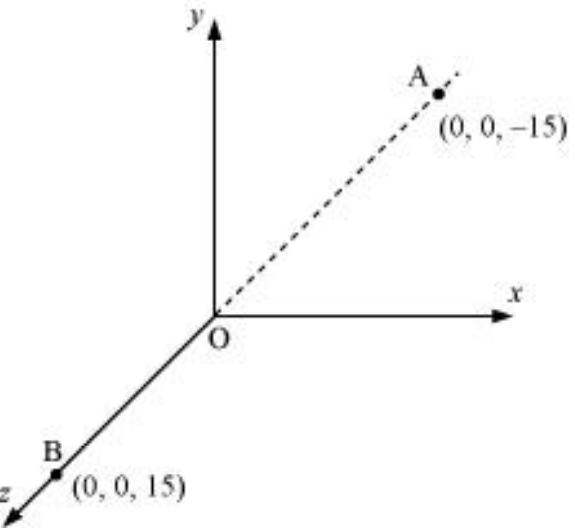
At A , amount of charge, $\mathrm{q}_{\mathrm{A}}=2.5 \times 10^{-7} \mathrm{C}$
At B , amount of charge, $\mathrm{q}_{\mathrm{B}}=-2.5 \times 10^{-7} \mathrm{C}$
Total charge of the system,
$ q=q_A+q_B$
$ q=2.5 \times 10^{-7} C-2.5 \times 10^{-7} C $
$ =0$
Distance between two charges at points A and B ,
$\mathrm{d}=15+15=30 \mathrm{~cm}=0.3 \mathrm{~m}$
Electric dipole moment of the system is given by,
$ p=q_A \times d=q_B \times d $
$ =2.5 \times 10^{-7} \times 0.3 $
$ =7.5 \times 10^{-8} \mathrm{Cm} \text { along positive } z \text {-axis }$
Therefore, the electric dipole moment of the system is $7.510^{-8} \mathrm{Cm}$ along positive z -axis. View full question & answer→Question 65 Marks
Check that the ratio ke$^2$/G $m_em_p$ is dimensionless. Look up a Table of Physical Constants and determine the value of this ratio. What does the ratio signify?
AnswerThe given ratio is $\frac{\text{ke}^2}{\text{G}\text{m}_e\text{m}_p}.$
Where,
G = Gravitational constant
Its unit is $Nm^2kg^{-2}$
$m_e $ and $m_p= $Masses of electron and proton.
Their unit is kg.
e = Electric charge.
Its unit is C.
$\in_0$ = Permittivity of free space
Its unit is $Nm^2\ C^{-2}$
Therefore unit of the given ratio $\frac{\text{ke}^2}{\text{Gm}_e\text{m}_p}$
$=\frac{\Big[\text{Nm}^2\text{C}^{+2}\Big]\Big[\text{C}^{+2}\Big]}{\Big[\text{Nm}^2\text{kg}^{-2}\Big]\Big[\text{kg}\Big]\Big[\text{kg}\Big]}$
$= MºLºTº$
Hence, the given ratio is dimensionless.
$e = 1.6 \times 10^{-19} C$
$G = 6.67 \times 10^{-11} Nkg^{-2}$
$me = 9.1 \times 10^{-31} kg$
$mp = 1.66 \times 10^{-27} kg$
Hence, the numerical value of the given ratio is
$\frac{\text{ke}^2}{\text{Gm}_e\text{m}_p}=\frac{9\times10^{9}\times(1.6\times10^{-19})^2}{6.67\times10^{-11}\times9.1\times10^{-3}\times1.67\times10^{-22}}\approx2.3\times10^{39}$
This is the ratio of electric force to the gravitational force between a proton and an electron, keeping distance between them constant.
View full question & answer→Question 75 Marks
A particle of mass m and charge (–q) enters the region between the two charged plates initially moving along x-axis with speed vx (like particle 1 in Fig. 1.33). The length of plate is L and an uniform electric field E is maintained between the plates. Show that the vertical deflection of the particle at the far edge of the plate is $\mathrm{qEL^2/(2m v^2 x)}.$
Compare this motion with motion of a projectile in gravitational field discussed in Section 4.10 of Class XI Textbook of Physics.
AnswerCharge on a particle of mass $m = -q$
Velocity of the particle $= V_x$
Length of the plates $= L$
Magnitude of the uniform electric field between the plates $= E$
Mechanical force, F = Mass (m) x Acceleration (a)
$\text{a}=\frac{\text{F}}{\text{m}}$
However, electric force, F = qE
Therefore, acceleration, $\text{a}=\frac{\text{qE}}{\text{m}} \dots\dots(1)$
Time taken by the particle to cross the field of length L is given by,
$\text{t}=\frac{\text{Length of the plate}}{\text{Velocity of the particle}}=\frac{\text{L}}{\text{v}_\text{x}} \dots\dots(2)$
In the vertical direction, initial velocity, u = 0
According to the second equation of motion. vertical deflection s of the particle can be obtained as,
$\text{s}=\text{ut}+\frac{1}{2}\text{at}^2$
$\text{s}=0+\frac{1}{2}\bigg(\frac{\text{qE}}{\text{m}}\bigg)\bigg(\frac{\text{L}}{\text{v}_\text{x}}\bigg)^2$
$\text{s}=\frac{\text{qEL}^2}{2\text{mV}^2\text{x}} \dots\dots(3)$
Hence, vertical deflection of the particle at the far edge of the plate is $\mathrm{qEL^2/(2mv^2x)}$. This is similar to the motion of horizontal projectiles under gravity.
View full question & answer→Question 85 Marks
Two point charges $q_A = 3 \mu\ C$ and $q_B = –3$ μC are located 20 cm apart in vaccum.
- What is the electric field at the midpoint O of the line AB joining the two charges?
- If a negative test charge of magnitude $1.5 \times 10^{-9}$ C is placed at this point, what is the force experienced by the test charge?
Answer
- The situation is represented in the given figure. O is the mid-point of line AB. Distance between the two charges, AB cm

$\therefore AO = OB = 10 cm$
Net electric field at point $O = E$
Electric field at point O caused by +3µC charge,
$\text{E}1=\frac{3\times10^{-6}}{4\pi\in_0(\text{AO})^2}=\frac{3\times10^{-6}}{4\pi\in_0(10\times10^{-2})^2}\text{N/C}\ \text{along OB}$
Where,
$\in_0\ =$ Permittivity of free space
$\frac{1}{4\pi\in_0}=9\times10^9\text{ Nm}^2\text{C}^{-2}$
Magnitude of electric field at point O caused by - 3µC charge,
$\text{E}2=\frac{-3\times10^{-6}}{4\pi\in_0(\text{OB})^2}=\frac{3\times10^{-6}}{4\pi\in_0(10\times10)^{-2}}\text{ N/C along OB}$
$\therefore = E_1 + E_2$
$=2\times\bigg[(9\times10^9)\times\frac{3\times10^{-6}}{(10\times10^{-2})^2}\bigg]$ [Since the values of $E_1$ and $E_2$ are same, the value is multiplied with 2]
$= 5.4 \times 10^6$ N/C along OB
Therefore, the electric field at mid-point O is $5.4 \times 10^6 NC^{-1}$ along $OB$
- A test charge of amount $1.5 \times 10^{-9} C$ is placed at mid-point $O.$
$q = 1.5 \times 10^{-9}C$
Force experienced by the test charge $= F$
$\therefore F = qE$
$= 1.5 \times 10^{-9} \times 5.4 \times 10^6$
$= 8.1 \times 10^{-3} N$
The force is directed along line OA. This is because the negative test charge is repelled by the charge placed at point B but attracted towards point A.
Therefore, the force experienced by the test charge is $8.1 \times 10^{-3} N − \times$ along OA. View full question & answer→Question 95 Marks
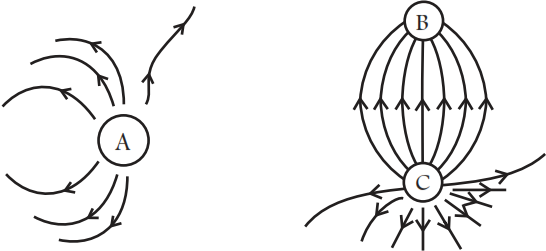
Fig. shows the electric field lines around three point charges A, B and C.
- Which charges are positive?
- Which charge has the largest magnitude? Why?
- In which region or regions of the picture could the electric field be zero? Justify your answer.
- Near A,
- Near B,
- Near C,
- Nowhere.
Answer
- Charges A and C are positive since lines of force emanate from them.
- Charge C has the largest magnitude since maximum numbers of field lines are associated with it.
-
- Near A. There is no neutral point between a positive and a negative charge. A neutral point may exist between two like charges. From the figure we see that a neutral point exists between charges A and C. Also between two like charges the neutral point is closer to the charge with smaller magnitude. Thus, electric field is zero near charge A.
View full question & answer→Question 105 Marks
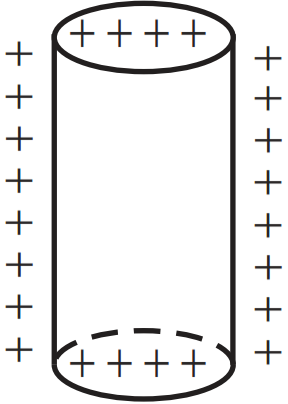
Sketch the electric field lines for a uniformly charged hollow cylinder shown in Fig.
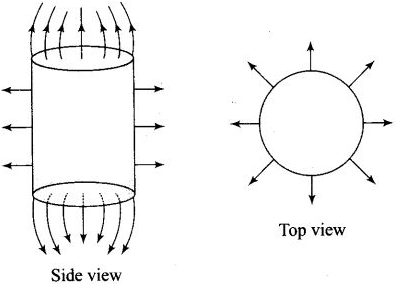
AnswerThe electric field lines starts from positive charges and move towards infinity and meet plane surface normally as shown in the figure below:
 Important point:
 No electric field lines will be present inside the cylinder because of electrostatic shielding. Electrostatic shielding/screening is the phenomenon of protecting a certain region of space from external electric field. Sensitive instruments and appliances are affected seriously with strong external electrostatic fields. Their working suffers and they may start misbehaving under the effect of unwanted fields.
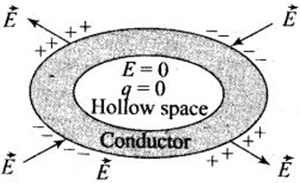
The electrostatic shielding can be achieved by protecting and enclosing the sensitive instruments inside a hollow conductor because inside hollow conductors, electric fields is zero.
View full question & answer→Question 115 Marks
- Using Gauss Theorem show mathematically that for any point outside the shell, the field due to a uniformly charged spherical shell is same as the entire charge on the shell, is concentrated at the centre.
- Why do you expect the electric field inside the shell to be zero according to this theorem?
OR
A thin conducting spherical shell of radius R has charge Q spread uniformly over its surface. Using Gauss’s theorem, derive an expression for the electric field at a point outside the shell.
Draw a graph of electric field E(r) with distance r from the centre of the shell for $0\leq\text{r}\le\infty.$
OR
Find the electric field intensity due to a uniformly charged spherical shell at a point (i) outside the shell and (ii) inside the shell. Plot the graph of electric field with distance from the centre of the shell.
OR
Using Gauss’s law obtain the expression for the electric field due to a uniformly charged thin spherical shell of radius R at a point outside the shell. Draw a graph showing the variation of electric field with r, for r > R and r < R.AnswerImage
- Electric field intensity at a point outside a uniformly charged thin spherical shell: Consider a uniformly charged thin spherical shell of radius R carrying charge Q. To find the electric field outside the shell, we consider a spherical Gaussian surface of radius r (>R), concentric with given shell. If $\vec{\text{E}}$ is electric field outside the shell, then by symmetry electric field strength has same magnitude $E_0$ on the Gaussian surface and is directed radially outward. Also the directions of normal at each point is radially outward, so angle between $\vec{\text{E}}_\text{i}$ and $\vec{\text{dS}}$ is zero at each point. Hence, electric flux through Gaussian surface.
$\oint\text{S}=\vec{\text{E}}_0.\vec{\text{dS}}$
$\oint=\text{E}_0\text{dS}\cos0=\text{E}_0.4\pi\text{r}^2$
Now, Gaussian surface is outside the given charged shell, so charge enclosed by Gaussian surface is Q.
Hence, by Gauss’s theorem,
$\oint\text{S}=\vec{\text{E}}_0.\vec{\text{dS}}=\frac{1}{\in_0}\times\text{charged enclosed}$
$\Rightarrow\ \text{E}_0.4\pi\text{r}^2=\frac{1}{\in_0}\times\text{Q}$
$\Rightarrow\ \text{E}_0=\frac{1}{4\pi\in_0}\frac{\text{Q}}{\text{r}^2}$
Thus, electric field outside a charged thin spherical shell is the same as if the whole charge Q is concentrated at the centre.
If $\sigma$ is the surface charge density of the spherical shell, then
$\text{Q}=4\pi\text{R}^2\sigma$ coulomb
$\therefore\ \text{E}_0=\frac{1}{4\pi\in_0}\frac{4\pi\text{R}^2\sigma}{\text{r}^2}=\frac{\text{R}^2\sigma}{\in_0\text{r}^2}$
Image
- Electric field inside the shell (hollow charged conducting sphere): The charge resides on the surface of a conductor. Thus a hollow charged conductor is equivalent to a charged spherical shell. To find the electric field inside the shell, we consider a spherical Gaussian surface of radius r (< R) concentric with the given shell. If $\vec{\text{E}}$ is the electric field inside the shell, then by symmetry electric field strength has the same magnitude $E_i$ on the Gaussian surface and is directed radially outward. Also the directions of normal at each point is radially outward, so angle between $\vec{\text{E}}_\text{i}$ and $\vec{\text{dS}}$ is zero at each point.
Hence, electric flux through Gaussian surface,
$=\int\limits_\text{S}\vec{\text{E}}_{\text{i}}.\vec{\text{dS}}=\int\text{E}_\text{i}.\text{dS}\cos0=\text{E}_\text{i}.4\pi\text{r}^2$
Now, Gaussian surface is inside the given charged shell, so charge enclosed by Gaussian surface is zero.
Hence, by Gauss’s theorem,
$\int\limits_\text{S}\vec{\text{E}}_\text{i}.\vec{\text{dS}}=\frac{1}{\in_0}\times\text{charged enclosed}$
$\Rightarrow\ \text{E}_\text{i}4\pi\text{r}^2=\frac{1}{\in_0}\times0\Rightarrow\ \text{E}_\text{i}=0$
Image
Thus, electric field at each point inside a charged thin spherical shell is zero. The graph is shown in fig. View full question & answer→Question 125 Marks
Fig. represents a crystal unit of cesium chloride, CsCl. The cesium atoms, represented by open circles are situated at the corners of a cube of side 0.40nm, whereas a Cl atom is situated at the centre of the cube. The Cs atoms are deficient in one electron while the Cl atom carries an excess electron.
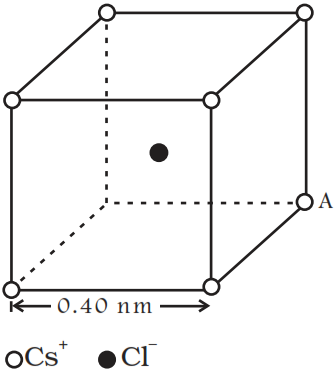
- What is the net electric field on the Cl atom due to eight Cs atoms?
- Suppose that the Cs atom at the corner A is missing. What is the net force now on the Cl atom due to seven remaining Cs atoms?
Answer
- From the given figure, we can observe that $Cl^‒$ atom is at the centre whereas $Cs^+$ atoms are at eight corners at equal distance. So, by symmetry net force on $Cl^‒$ atom due to other $Cs^+$ atoms is zero. Due to which, net electric field due to other $Cs^+$ atoms is also zero $\Big(\text{as},|\text{E}|=\frac{\text{F}}{\text{q}}\Big)$.
- In the given question, removing Cs atom at the corner A is equivalent to adding a singly charged negative Cs ion at point A.
So,
$\text{Net force}=\frac{\text{q}^2}{4\pi\in_0\text{r}^2}$
Here, q = charge on electron, r = distance between Cl and Cs atoms
Applying Pythagoras theorem, we have
$\text{r}=\sqrt{(0.02)^2+(0.20)^2+(0.20)^2}\times10^{-9}\text{m}=0.346\times10^{-9}\text{m}$
Now,
$\text{Not force}=\frac{\text{q}^2}{4\pi\in_0\text{r}^2}=\frac{9\times10^9(1.6\times10^{-19})^2}{(0.346\times10^{-9})^2}=1.92\times10^{-9}\text{N}$
The direction of force is from A to $Cl^‒$. View full question & answer→Question 135 Marks
State Gauss theorem in electrostatics. Apply this theorem to obtain the expression for the electric field at a point due to an infinitely long, thin, uniformly charged straight wire of linear charge density $\lambda\text{Cm}^{-1}.$
AnswerGauss Theorem: It states that total electric flux over the closed surface S is $\frac{1}{\in_0}$ times the total charge (q) contained in side S.$\therefore\ \Phi_\text{E}=\oint\limits_{\text{S}}\vec{\text{E}}.\vec{\text{dS}}=\frac{\text{q}}{\in_0}$
Electric field due to infinitely long, thin and uniformly charged straight wire: Consider an infinitely long line charge having linear charge density $\lambda$ coulomb metre$^{-1}$ (linear charge density means charge per unit length). To find the electric field strength at a distance r, we consider a cylindrical Gaussian surface of radius r and length l coaxial with line charge. The cylindrical Gaussian surface may be divided into three parts:
- Curved surface $S_1.$
- Flat surface $S_2.$
- Flat surface $S_3.$
By symmetry, the electric field has the same magnitude E at each point of curved surface $S_1$ and is directed radially outward.
We consider small elements of surfaces $S_1, S_2$ and $S_3$ The surface element vector $\vec{\text{dS}}_1$ is directed along the direction of electric field (i.e., angle between $\vec{\text{E}}$ and $\vec{\text{dS}}_1$ is zero); the elements $\vec{\text{dS}}_2$ and $\vec{\text{dS}}_3$ are directed perpendicular to field vector $\vec{\text{E}}$ (i.e., angle between $\vec{\text{dS}}_2$ and $\vec{\text{E}}$ is 90° and so also angle between $\vec{\text{dS}}_3$ and $\vec{\text{E}}).$
Electric Flux through the cylindrical surface,
Image
$\oint\limits_{\text{S}}\vec{\text{E}}.\vec{\text{dS}}=\oint\limits_{\text{S}_1}\vec{\text{E}}.\vec{\text{dS}_1}+\oint\limits_{\text{S}_2}\vec{\text{E}}.\vec{\text{dS}_2}+\oint\limits_{\text{S}_3}\vec{\text{E}}.\vec{\text{dS}_3}$
$=\oint\limits_{\text{S}_1}{\text{E}}.{\text{dS}_1}\cos0^\circ+\oint\limits_{\text{S}_2}{\text{E}}.{\text{dS}_2}\cos90^\circ+\oint\limits_{\text{S}_3}{\text{E}}.{\text{dS}_3}\cos90^\circ$
$=\oint\text{E dS}_1+0+0$
$=\text{E}\oint\text{dS}_1$ (since electric field E is the same at each point of curved surface)
$=\text{E}2\pi\text{rl}$ (since area of curved surface $=2\pi\text{rl})$
As $\lambda$ is charge per unit length and length of cylinder is l therefore, charge enclosed by assumed surface $=(\lambda\text{l})$
$\therefore$ By Gauss's theorem
$\int\vec{\text{E}}.\vec{\text{dS}}=\frac{1}{\in_0}\times\text{charge enclosed}$
$\Rightarrow\ \text{E}.2\pi\text{rl}=\frac{1}{\in_0}(\lambda\text{l})$
$\Rightarrow\ \text{E}=\frac{\lambda}{2\pi\in_0\text{r}}$
Thus, the electric field strength due to a line charge is inversely proportional to r. View full question & answer→Question 145 Marks
Two charges $2.0 \times 10^{-6}C$ and $1.0 \times 10^{-6}C$ are placed at a separation of 10cm. Where should a third charge be placed such that it experiences no net force due to these charges?
AnswerGiven:
$\text{q}_1=2.0\times10^{-6}\text{C}$
$\text{q}_2=1.0\times10^{-6}\text{C}$
Let the third charge, q, be placed at a distance of x cm from charge$q_1,$ as shown in the figure.
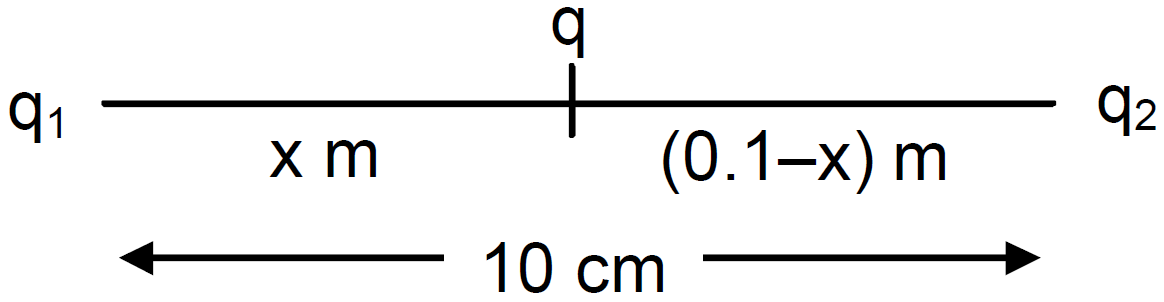
By Coulomb's Law, force,
$\text{F}=\frac{1}{4\pi\in_0}\frac{\text{Q}_1\text{Q}_2}{\text{r}^2}$
Force on charge q due to $q_1,$
$\text{F}=\frac{9\times10^9\times2.0\times10^{-6}\times\text{q}}{\text{x}^2}$
Force on charge q due to $q_2,$
$\text{F}'=\frac{9\times10^9\times10^{-6}\times\text{q}}{(10-\text{x})^2}$
According to the question,
$\text{F}-\text{F}'=0$
$\Rightarrow\text{F}=\text{F}'$
$\Rightarrow\frac{9\times10^9\times2\times10^{-6}\times\text{q}}{\text{x}^2}=\frac{9\times10^9\times10^{-6}\times\text{q}}{(10-\text{x})^2}$
$\Rightarrow\text{x}^2=2(10-\text{x})^2$
$\Rightarrow\text{x}^2-40\text{x}+200=0$
$\Rightarrow\text{x}=20\pm10\sqrt{2}$
$\Rightarrow\text{x}=5.9\text{cm}$ $\Big(\because\text{x}\neq20+10\sqrt{2}\Big)$
So, the third charge should be placed at a distance of 5.9cm from $q_1.$ View full question & answer→Question 155 Marks
An electric dipole of dipole moment $\vec{\text{P}}$ is placed in a uniform electric field $\vec{\text{E}}.$ Write the expression for the torque $\vec\tau$ experienced by the dipole. Identify two pairs of perpendicular vectors in the expression. Show diagrammatically the orientation of the dipole in the field for which the torque is (i) Maximum (ii) Half the maximum value (iii) Zero.
AnswerTorque experienced by an electric dipole,
$\vec{\tau}=\vec{\text{p}}\times\vec{\text{E}}$
Pairs of perpendicular vectors,
- $(\vec{\tau},\vec{\text{p}})$
- $(\vec{\tau},\vec{\text{E}})$
- Magnitude of torque $\tau=\text{pE}\sin\theta$
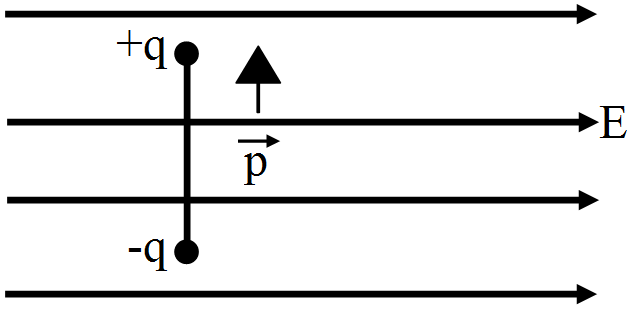
For maximum torque $(\sin\theta)\max=1\Rightarrow\theta=90^\circ$
Orientation is shown in figure (i).
- For $\tau=\frac{1}{2}\tau_\max$
$\text{pE}\sin\theta=\frac{1}{2}\text{pE}$
$\Rightarrow\ \sin\theta=\frac{1}{2}\ \text{or }\theta=30^\circ$
Orientation is shown in figure (ii).
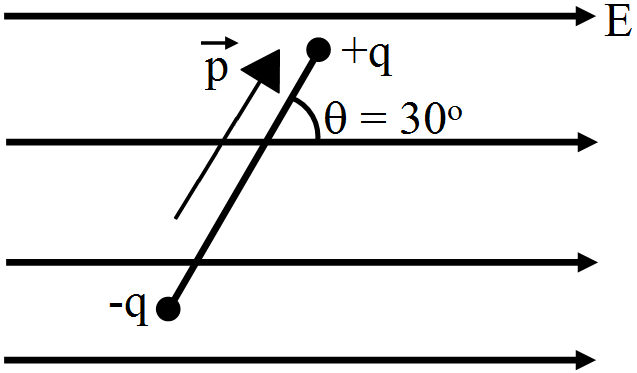
- For zero torque, $\sin\theta=0\Rightarrow\theta=0$
The orientations is shown in the figure (iii).
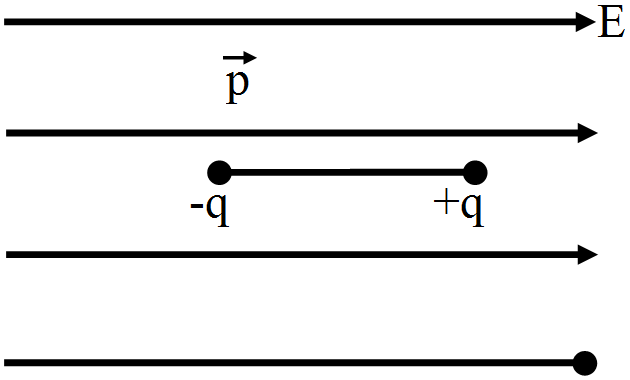
View full question & answer→Question 165 Marks
Consider the situation of the previous problem:
- Find the tension in the string in equilibrium.
- Suppose the ball is slightly pushed aside and released. Find the time period of the small oscillations.
Answer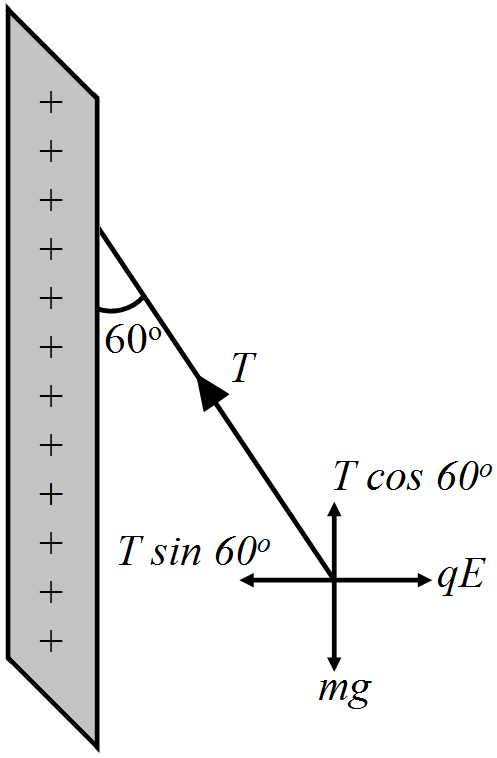
In equilibrium state, the thread makes an angle of 60° with the vertical.
The tension in the thread is resolved into horizontal and vertical components.
Then, tension in the string in equilibrium,
$\text{T}\cos60^\circ=\text{mg}$
$\text{T}\times\frac{1}{2}=\big(10\times10^{-3}\big)\times10$
$\text{T}=\big(10\times10^{-3}\big)\times10\times2=0.20\text{N}$
(b) As it is displaced from equilibrium, net force on the ball,
$\text{F}=\sqrt{(\text{mg})^2+\Big(\frac{\text{q}\sigma}{2\in_0}\Big)^2}$
As F = ma
$\Rightarrow\text{a}=\sqrt{(\text{g})^2+\Big(\frac{\text{q}\sigma}{m2\in_0}\Big)^2}$
The surface charge density of the plate (as calculated in the previous question), $\sigma=7.5\times10^{-7}\text{C/m}^2$
Charge on the ball, $q = 4 \times 10^{-6}C$
Mass of the ball, m = The time period of oscillation of the given simple pendulum,
$\text{T}=2\pi\sqrt{\frac{\text{l}}{\text{g}}}$
$=2\pi\sqrt{\frac{10\times10^{-2}}{9.8}}$
$=0.45\text{sec}$ View full question & answer→Question 175 Marks
Answer the following questions:
- Define electric flux. Write its SI unit.
- Using Gauss’s law, prove that the electric field at a point due to a uniformly charged infinite plane sheet is independent of the distance from it.
- How is the field directed if:
- The sheet is positively charged.
- Negatively charged?
Answer
- Electric flux: It is defined as the total number of electric field lines passing through an area normal to its surface.
$\Phi=\oint\vec{\text{E}}.\vec{\text{dS}}$
The SI unit is $Nm^2/ C$ or volt-metre.
- Image
Let electric charge be uniformly distributed over the surface of a thin, non-conducting infinite sheet. Let the surface charge density (i.e., charge per unit surface area) be σ. We need to calculate the electric field strength at any point distant r from the sheet of charge.
To calculate the electric field strength near the sheet, we now consider a cylindrical Gaussian surface bounded by two plane faces A and B lying on the opposite sides and parallel to the charged sheet and the cylindrical surface perpendicular to the sheet (fig). By symmetry the electric field strength at every point on the flat surface is the same and its direction is normal outwards at the points on the two plane surfaces and parallel to the curved surface.
Total electric flux,
or $\oint\limits_\text{S}\vec{\text{E}}.\vec{\text{dS}}=\oint\limits_{\text{S}_1}\vec{\text{E}}.\vec{\text{dS}_1}+\oint\limits_{\text{S}_2}\vec{\text{E}}.\vec{\text{dS}_2}+\oint\limits_{\text{S}_3}\vec{\text{E}}.\vec{\text{dS}_3}$
$\oint\limits_\text{S}\vec{\text{E}}.\vec{\text{dS}}=\oint\limits_{\text{S}_1}\text{E dS}_1\cos0^\circ+\oint\limits_{\text{S}_2}\text{E dS}_2\cos0^\circ+\oint\limits_{\text{S}_3}\text{E dS}_3\cos90^\circ$
$=\text{E}\oint\text{dS}_1+\text{E}\oint\text{dS}_2=\text{Ea}+\text{Ea}=2\text{Ea}$
$\therefore$ Total electric flux = 2Ea
As $\sigma$ is charge per unit area of sheet and a is the intersecting area, the charge enclosed by Gaussian surface $=\sigma\text{a}$
Total electric flux $=\frac{1}{\in_0}\times$ (total charge enclosed by the surface)
i.e., $2\text{Ea}=\frac{1}{\in_0}(\sigma\text{a})$
$\therefore\ \text{E}=\frac{\text{p}}{2\in_0}.$
Thus electric field strength due to an infinite flat sheet of charge is independent of the distance of the point.
-
- If $\sigma$ is positive, $\vec{\text{E}}$ points normally outwards/ away from the sheet.
- If $\sigma$ is negative, $\vec{\text{E}}$ points normally inwards/ towards the sheet.
View full question & answer→Question 185 Marks
Two large conducting plates are placed parallel to each other with a separation of 2.00cm between them. An electron starting from rest near one of the plates reaches the other plate in 2.00 microseconds. Find the surface charge density on the inner surfaces.
AnswerDistance travelled by the electron, $d = 2cm$
Time taken to cross the region, $t = 2 \times 10^{-6}s$
Let the surface charge density at the conducting plates be $\sigma.$
Let the acceleration of the electron be a.
Applying the 2nd equation of motion, we get:
$\text{d}=\frac{1}{2}\text{at}^2$
$\Rightarrow\text{a}=\frac{2\text{d}}{\text{t}^2}$
This acceleration is provided by the Coulombic force. So,
$\text{a}=\frac{\text{qE}}{\text{m}}=\frac{2\text{d}}{\text{t}^2}$
$\Rightarrow\text{E}=\frac{2\text{md}}{\text{qt}^2}$
$\Rightarrow\text{E}=\frac{2\times\big(9.1\times10^{-31}\big)\times\big(2\times10^{-2}\big)}{\big(1.6\times10^{-19}\big)\times\big(4\times10^{-12}\big)}$
$\Rightarrow\text{E}=5.6875\times10^{-2}\text{N/C}$
Also, we know that electric field due to a plate,
$\text{E}=\frac{\sigma}{\in_0}$
$\Rightarrow\sigma=\in_ 0\text{E}$
$\Rightarrow\sigma=\big(8.85\times10^{-12}\big)\times\big(5.68\times10^{-2}\big)\text{C/m}^2$
$\Rightarrow\sigma=50.33\times10^{-14}\text{C/m}^2$
$\Rightarrow\sigma=0.503\times10^{-12}\text{C/m}^2$
View full question & answer→Question 195 Marks
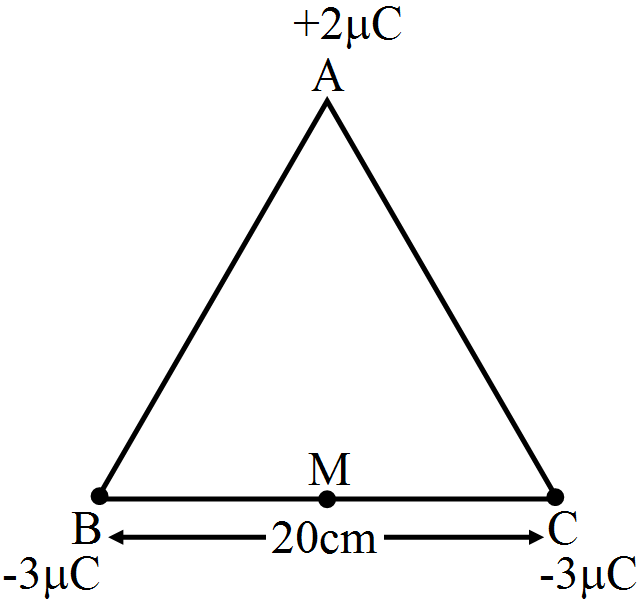
Three point charges of $+2\mu\text{C}, -3\mu\text{C}$ and $-3\mu\text{C}$ are kept at the vertices A, B and C respectively of an equilateral triangle of side 20cm as shown in figure. What should be the sign and magnitude of charge to be placed at the midpoint M of side BC so that charge at A remains in equilibrium?
Answer
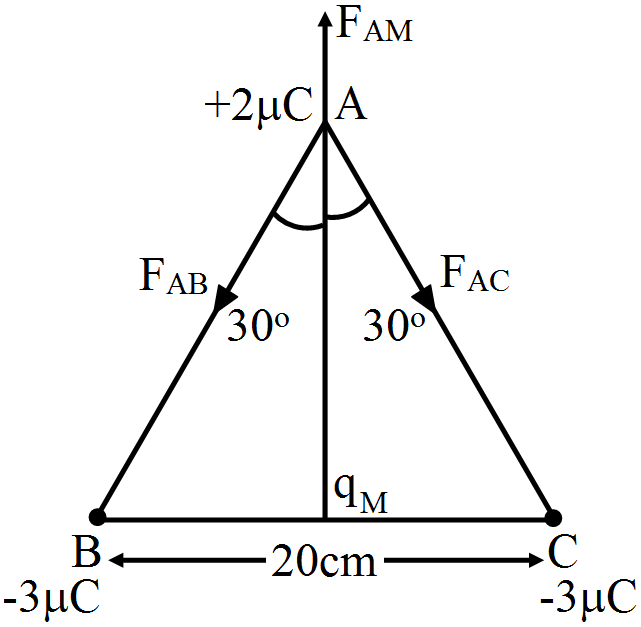
Let charge placed at M be qM. The forces acting on charge $(\text{qA}=+2\mu\text{C})$ are $F_{AB}, F_{AC}$ and $F_{AM}$ as shown in figure.
$\vec{\text{F}}_\text{AB}=\frac{1}{4\pi\in_0}\frac{\text{q}_\text{A}\text{q}_\text{B}}{\text{r}^2_\text{AB}}\text{along }\vec{\text{AB}}$
$=9\times10^9\times\frac{(2\times10^{-6})(3\times10^{-6})}{(0.20)^2}\ \text{along}\ \vec{\text{AB}}=1.35\text{ N}\text{ along }\vec{\text{AB}}$
$\vec{\text{F}}_\text{AC}=\frac{1}{4\pi\in_0}\frac{\text{q}_\text{A}\text{q}_\text{C}}{\text{r}^2_\text{AC}}$
$=9\times10^9\times\frac{(2\times10^{-6})(3\times10^{-6})}{(0.20)^2}=1.35\text{ N}\text{ along }\vec{\text{AC}}$
$\vec{\text{F}}_\text{AM}=\frac{1}{4\pi\in_0}\frac{\text{q}_\text{A}\text{q}_\text{M}}{(\text{r}_\text{AM})^2}=9\times10^9\frac{(2\times10^{-6})(\text{q}_\text{M})}{(\sqrt{3}\times10^{-1})^2}$
$=6\times10^5_\text{qM}\text{ N along }\vec{\text{MA}}$
For equilibrium of charge $q_A$; the resultant of $\vec{\text{F}}_\text{AB}$ and $\vec{\text{F}}_\text{AC}$ must be equal and opposite to $\vec{\text{F}}_\text{AM}.$
i.e., $\text{F}_\text{AB}\cos30^\circ+\text{F}_\text{AC}\cos30^\circ=\text{F}_\text{AM}$
$\Rightarrow\ 1.35\times\frac{\sqrt{3}}{2}+1.35\frac{\sqrt{3}}{2}=6\times10^5\text{qM}$
$\Rightarrow\ \text{qM}=\frac{1.35\sqrt{3}}{6\times10^5}=0.225\sqrt{3}\times10^{-5}\text{C}=2.25\sqrt{3}\mu\text{C}$ View full question & answer→Question 205 Marks
Four equal charges $2.0 \times 10^{-6}C$ each are fixed at the four corners of a square of side 5cm. Find the Coulomb force experienced by one of the charges due to the rest three.
Answer
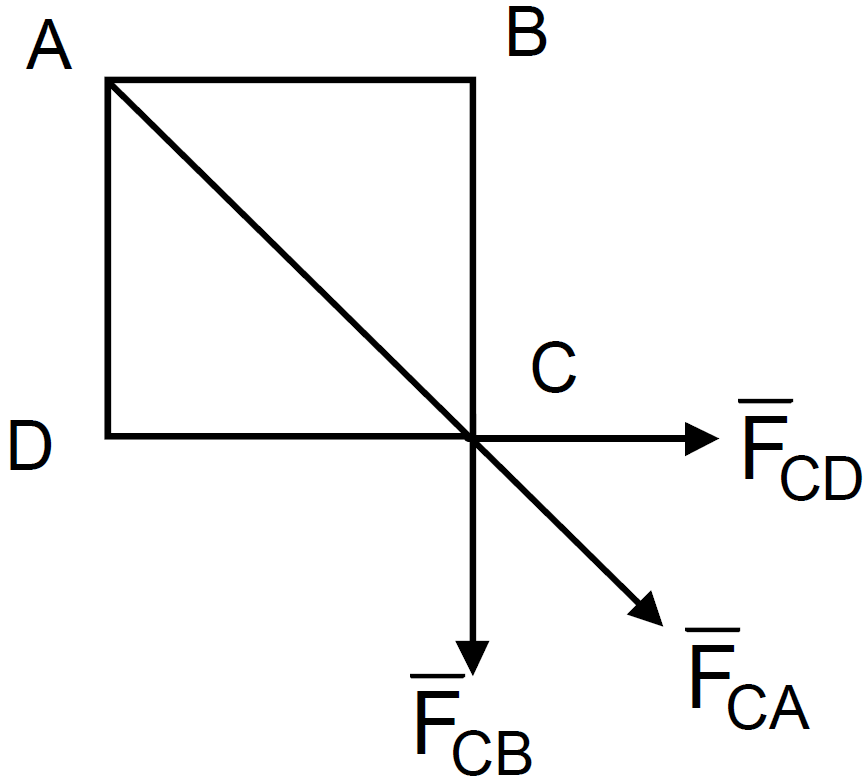
$q^1 = q^2 = q^3 = q^4 = 2 \times 10^{-6}C$
$\text{v}=5\text{cm}=5\times10^{-2}\text{m}$
So force on $\bar{\text{C}}=\bar{\text{F}}_\text{CA}+\bar{\text{F}}_\text{CB}+\bar{\text{F}}_\text{CD}$
So Force along × Component $=\bar{\text{F}}_\text{CD}+\bar{\text{F}}_\text{CA}\cos45^\circ+0$
$=\frac{\text{k}\big(2\times10^{-6}\big)^2}{\big(5\times10^{-2}\big)^2}+\frac{\text{k}\big(2\times10^{-6}\big)^2}{\big(5\times10^{-2}\big)^2}\frac{1}{2\sqrt{2}}$
$=\text{kq}^2\Big(\frac{1}{25\times10^{-4}}+\frac{1}{50\sqrt{2}\times10^{-4}}\Big)$
$\frac{9\times10^9\times4\times10^{12}}{24\times10^{-4}}\Big(1+\frac{1}{2\sqrt{2}}\Big)$
$=1.44(1.35)=19.49$ Force along % component = 19.49
So, Resultant $\text{R}=\sqrt{\text{Fx}^2+\text{Fy}^2}$
$=19.49\sqrt{2}$
$=27.56$ View full question & answer→Question 215 Marks
Repeat the previous problem if the particle C is displaced through a distance x along the line AB.
Answer
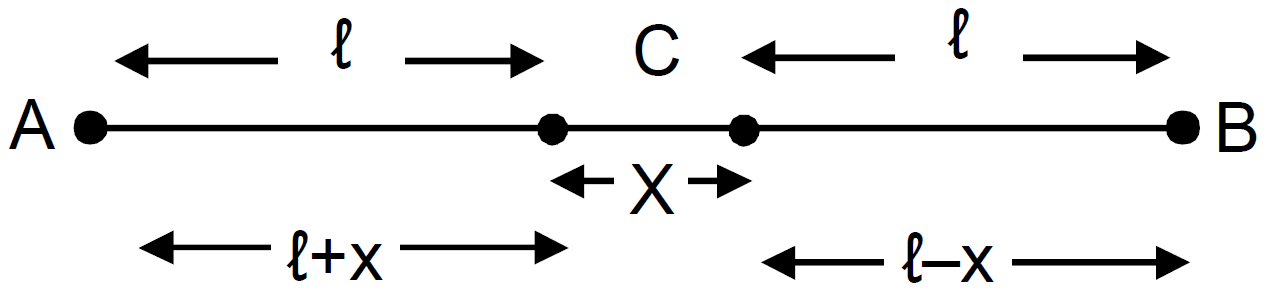 $\text{F}_\text{AC}=\frac{\text{KQq}}{(\ell+\text{x})^2}$
$\text{F}_\text{CA}=\frac{\text{KQq}}{(\ell-\text{x})^2}$
Net force $=\text{KQq}\Big[\frac{1}{(\ell-\text{x})^2}-\frac{1}{(\ell-\text{x})^2}\Big]$
$=\text{KQq}\bigg[\frac{(\ell+\text{x})^2-(\ell-\text{x})^2}{(\ell+\text{x})^2(\ell-\text{x})^2}\bigg]$
$=\text{KQq}\bigg[\frac{4\ell\text{x}}{(\ell^2-\text{x}^2)^2}\bigg]$
$\text{x}<<<\text{l}=\frac{\text{d}}{2}$ neglecting x w.r.t. $\ell$ We get
net $\text{F}=\frac{\text{KQq}4\ell\text{x}}{\ell^4}=\frac{\text{KQq}4\text{x}}{\ell^3}$ acceleration $=\frac{4\text{KQqx}}{\text{m}\ell^3}$
Time period $=2\pi\sqrt{\frac{\text{displacement}}{\text{acceleration}}}$
$=2\pi\sqrt{\frac{\text{xm}\ell^3}{4\text{KQqx}}}$
$=2\pi\sqrt{\frac{\text{m}\ell^3}{4\text{KQq}}}$
$=\sqrt{\frac{4\pi^2\text{m}\ell^34\pi\in_0}{4\text{Qq}}}$
$=\sqrt{\frac{4\pi^3\text{m}\ell^3\in_0}{\text{Qq}}}$
$=\sqrt{4\pi^3\text{md}^3\in_08\text{Qq}}$
$=\bigg[\frac{\pi^3\text{md}^3\in_0}{2\text{Qq}}\bigg]^{\frac{1}{2}}$ View full question & answer→Question 225 Marks
Two charges q and -3q are placed fixed on x-axis separated by distance 'd'. Where should a third charge 2q be placed such that it will not experience any force?
AnswerThe force on any charge will be zero only if net electric field at the position of charge is zero. Let electric field is zero at a distance x from charge q.

At point $\text{P},\vec{\text{E}_\text{A}}+\vec{\text{E}_\text{B}}=0\Rightarrow|\vec{\text{E}_\text{A}}|=|\vec{\text{E}_\text{B}}|$
$\Rightarrow\ \frac{\text{q}}{4\pi\in_0\text{x}^2}=\frac{3\text{q}}{4\pi\in_0(\text{x}+\text{d})^2}$
$\Rightarrow\ (\text{x}+\text{d})^2=3\text{x}^2$
$\Rightarrow\ \text{x}^2+\text{d}^2=2\text{dx}=3\text{x}^2$
$\therefore\ 2\text{x}^2-2\text{dx}-\text{d}^2=0$
or $\text{x}=\frac{\text{d}}{2}\pm\frac{\sqrt{3\text{d}}}{2}$
(Negative sign lies between q and -3q and hence is unaceptable.)
Hence $\text{x}=-\frac{\text{d}}{2}+\frac{\sqrt{3\text{d}}}{2}=\frac{\text{d}}{2}(1+\sqrt{3})$
Hence if charge 2q is placed at a distance $\frac{\text{d}}{2}(1+\sqrt{3})$ to the left of q. View full question & answer→Question 235 Marks
A charge Q located at a point $\vec{\text{r}}$ is in equilibrium under the combined electric field of three charges $q_1, q_2, q_3.$ If the charges $q_1, q_2$ are located at points $\vec{\text{r}}_1$ and $\vec{\text{r}}_2$ respectively, find the direction of the force on Q, due to $q_3$ in terms of $q_1, q_2, \vec{\text{r}}_1,\ \vec{\text{r}}_2$ and $\vec{\text{r}}.$
Answer$\vec{\text{F}}_1+\vec{\text{F}}_2+\vec{\text{F}}_3=0$$\Rightarrow\ \frac{1}{4\pi\in_0}\frac{\text{Qq}_1}{|\vec{\text{r}}-\vec{\text{r}}_1|^3}(\vec{\text{r}}-\vec{\text{r}}_1)+\frac{1}{4\pi\in_0}\frac{\text{Qq}_2}{|\vec{\text{r}}-\vec{\text{r}}_2|^3}(\vec{\text{r}}-\vec{\text{r}}_2)$
$+\frac{1}{4\pi\in_0}\frac{\text{Qq}_3}{|\vec{\text{r}}-\vec{\text{r}}_3|^3}(\vec{\text{r}}-\vec{\text{r}}_3)=0$
$\Rightarrow\ \frac{\text{q}_1}{|\vec{\text{r}}-\vec{\text{r}}_1|^3}(\vec{\text{r}}-\vec{\text{r}}_1)+\frac{\text{q}_2}{|\vec{\text{r}}-\vec{\text{r}}_2|^3}(\vec{\text{r}}-\vec{\text{r}}_2)=-\frac{\text{q}_3}{|\vec{\text{r}}-\vec{\text{r}}_3|^3}(\vec{\text{r}}-\vec{\text{r}}_3)$
$\Rightarrow\ \vec{\text{r}}- \vec{\text{r}}_3=-\frac{| \vec{\text{r}}- \vec{\text{r}}_3|^3}{\text{q}_3}\Big[\frac{\text{q}_1( \vec{\text{r}}- \vec{\text{r}}_1)}{| \vec{\text{r}}- \vec{\text{r}}_1|^3}+\frac{\text{q}_2( \vec{\text{r}}- \vec{\text{r}}_2)}{| \vec{\text{r}}- \vec{\text{r}}_2|^3}\Big]$
Direction of force on Q due to $q_3$ along $( \vec{\text{r}}- \vec{\text{r}}_3)$ is given by,
$\frac{\text{q}_1}{| \vec{\text{r}}- \vec{\text{r}}_1|^3}( \vec{\text{r}}_1- \vec{\text{r}})+\frac{\text{q}_1}{| \vec{\text{r}}- \vec{\text{r}}_2|^3}( \vec{\text{r}}_2- \vec{\text{r}})$
View full question & answer→Question 245 Marks
A long cylindrical wire carries a positive charge of linear density $2.0 \times 10^{-8}Cm^{-1}.$ An electron revolves around it in a circular path under the influence of the attractive electrostatic force. Find the kinetic energy of the electron. Note that it is independent of the radius.
AnswerLet the linear charge density of the wire be $\lambda.$
The electric field due to a charge distributed on a wire at a perpendicular distance r from the wire,
$\text{E}=\frac{\lambda}{2\pi\in_0\text{r}}$
The electrostatic force on the electron will provide the electron the necessary centripetal force required by it to move in a circular orbit. Thus,
$\text{qE}=\frac{\text{mv}^2}{\text{r}}$
$\Rightarrow\text{mv}^2=\text{qEr}\ \dots(1)$
Kinetic energy of the electron, $\text{K}=\frac{1}{2}\text{mv}^2$
From (1),
$\text{K}=\frac{\text{qEr}}{2}$
$\text{K}=\frac{\text{qr}}{2}\frac{\lambda}{2\pi\in_0\text{r}}$ $\Big[\because\text{E}=\frac{\lambda}{2\pi\in_0\text{r}}\Big]$
$\text{K}=\big(1.6\times10^{-19}\big)\times\big(2\times10^{-8}\big)\times\big(9\times10^{9}\big)\text{J}$
$\text{K}=2.88\times10^{-17}\text{J}$
View full question & answer→Question 255 Marks
The radius of a gold nucleus (Z = 79) is about $7.0 \times 10^{-15}m$. Assume that the positive charge is distributed uniformly throughout the nuclear volume. Find the strength of the electric field at:
- The surface of the nucleus.
- At the middle point of a radius. Remembering that gold is a conductor, is it justified to assume that the positive charge is uniformly distributed over the entire volume of the nucleus and does not come to the outer surface?
AnswerGiven:
Atomic number of gold = 79
Charge on the gold nucleus, $\text{Q}=79\times\big(1.6\times10^{-19}\big)\text{C}$
The charge is distributed across the entire volume. So, using Gauss's Law, we get:
- $\phi=\oint\overrightarrow{\text{E}}.\text{d}\overrightarrow{\text{s}}=\frac{\text{Q}}{\in_0}$
$\Rightarrow\oint\text{Eds}=\frac{\text{Q}}{\in_0}$
The value of E is fixed for a particular radius.
$\Rightarrow\text{E}\oint\text{ds}=\frac{\text{Q}}{\in_0}$
$\Rightarrow\text{E}\times4\pi\text{r}^2=\frac{\text{Q}}{\in_0}$
$\Rightarrow\text{E}=\frac{\text{Q}}{\in_0\times4\pi\text{r}^2}$
$\Rightarrow\text{E}=\frac{79\times(1.6\times10^{-10})}{(8.85\times10^{-13})\times4\times3.14\times(7\times10^{-10})^2}$
$\Rightarrow\text{E}=2.315131\times10^{21}\text{N/C}$
- To find the electric field at the middle point of the radius:
Radius, $\text{r}=\frac{7}{2}\times10^{-10}\text{m}$
Volume,
$\text{V}=\frac{4}{3}\pi\text{r}^3$
$=\frac{4}3{}\times\frac{22}{7}\times\frac{343}{8}\times10^{-30}$
Net charge $= 79 \times 1.6 \times 10^{-19}C$
Volume charge density
$=\frac{79\times1.6\times10^{-19}}{\frac{4}{3}\pi\times343\times10^{-30}}$
So, the charge enclosed by this imaginary sphere of radius $r = 3.5 \times 10^{-10}$
$=\frac{79\times1.6\times10^{-19}}{\frac{4}{3}\pi\times343\times10^{-30}}\times\frac{4}3{}\pi\times\frac{343}{8}\times10^{-30}$
$=\frac{79\times1.6\times10^{-19}}{8}$
$\Rightarrow\text{E}=\frac{79\times1.6\times10^{-19}}{8\times4\pi\in_0\text{x}^2}$ at $\text{r}=3.5\times10^{-10}$
$=1.16\times10^{21}\text{N/C}$
As electric charge is given to a conductor, it gets distributed on its surface. But nucleons are bound by the strong force inside the nucleus. Thus, the nuclear charge does not come out and reside on the surface of the conductor. Thus, the charge can be assumed to be uniformly distributed in the entire volume of the nucleus. View full question & answer→Question 265 Marks
One end of a 10cm long silk thread is fixed to a large vertical surface of a charged nonconducting plate and the other end is fastened to a small ball having a mass of 10g and a charge of $4.0 \times 10^{-5}C$. In equilibrium, the thread makes an angle of 60° with the vertical. Find the surface charge density on the plate.
Answer
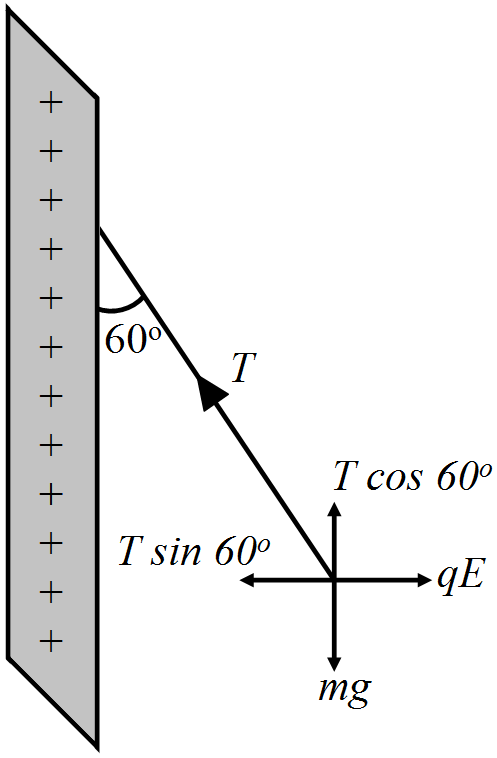
There are two forces acting on the ball. These are:
- Weight of the ball, W = mg
- Coulomb force acting on the charged ball due to the electric field of the plate, F = qE
Due to these forces, a tension develops in the thread.
Let the surface charge density on the plate be $\sigma.$
Electric field of a plate,
$\text{E}=\frac{\sigma}{2\in_0}$
It is given that in equilibrium, the thread makes an angle of 60° with the vertical.
Resolving the tension in the string along horizontal and vertical directions, we get:
$\text{T}\cos60^\circ=\text{mg}$
$\text{T}\sin60^\circ=\text{qE}$
$\Rightarrow\tan60^\circ=\frac{\text{qE}}{\text{mg}}$
$\Rightarrow\text{E}=\frac{\text{mg}\tan60^\circ}{\text{q}}$
Also, electric field due to a plate,
$\text{E}=\frac{\sigma}{2\in_0}=\frac{\text{mg}\tan60^\circ}{\text{q}}$
$\sigma=\frac{2\in_0\text{mg}\tan60^\circ}{\text{q}}$
$\sigma=\frac{2\times\big(8.85\times10^{-12}\big)\times\big(10\times10^{-3}\times9.8\big)\times1.732}{4.0\times10^{-6}}$
$\sigma=7.5\times10^{-7}\text{C/m}^2$ View full question & answer→Question 275 Marks
Two particles A and B, having opposite charges $2.0 \times 10^{-6}C$ and $2.0 \times 10^{-6}C,$ are placed at a separation of 1.0cm.
- Write down the electric dipole moment of this pair.
- Calculate the electric field at a point on the axis of the dipole 1.0m awa.y from the centre.
- Calculate the electric field at a point on the perpendicular bisector of the dipole and 1.0m away from the centre.
Answer
- Dipolemoment $=\text{q}\times\ell$
(Where q = magnitude of charge $\ell=$ Separation between the charges)

$=2\times10^{-6}\times10^{-2}\text{cm}$
$=2\times10^{-8}\text{cm}$
- We know, Electric field at an axial point of the dipole
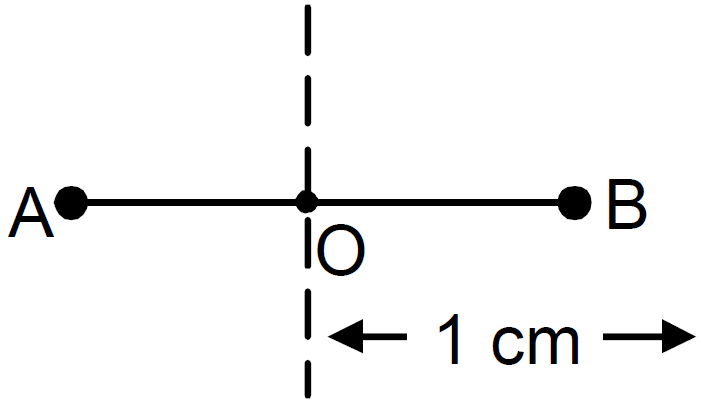
$=\frac{2\text{KP}}{\text{r}^3}$
$=\frac{2\times9\times10^9\times2\times10^{-8}}{\big(1\times10^{-2}\big)^3}$
$=36\times10^7\text{N/C}$
- We know, Electric field at a point on the perpendicular bisector about 1m away from centre of dipole.
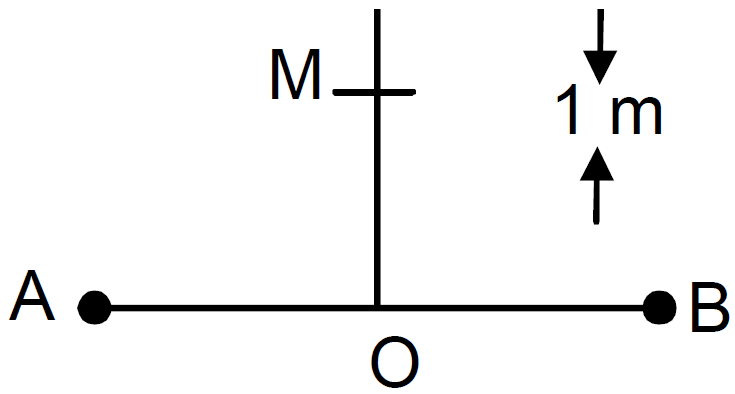
$=\frac{\text{KP}}{\text{r}^3}$
$=\frac{9\times10^9\times2\times10^{-8}}{1^3}$
$=180\text{N/C}$ View full question & answer→Question 285 Marks
State and Prove Gauss theorem in electrostatics.
AnswerStatement: The net-outward normal electric flux through any closed surface of any shape is equal to $\frac{1}{\in_0}$ times the total charge contained within that surface, $\frac{1}{\in_0}$ i.e., $\oint\text{S }\vec{\text{E}}.\vec{\text{ds}}=\frac{1}{\in_0}\Sigma\text{q}$ Where $\oint\limits_{\text{S}}$ indicates the surface integral over the whole of the closed surface, $\Sigma\text{q}$ Is the algebraic sum of all the charges (i.e., net charge in coulombs) enclosed by surface S and remain unchanged with the size and shape of the surface. Proof: Let a point charge +q be placed at centre O of a sphere S. Then S is a Gaussian surface. Electric field at any point on S is given by, $\text{E}=\frac{1}{4\pi\in_0}.\frac{\text{q}}{\text{r}^2}$Image
The electric field and area element points radially outwards, so $\theta=0^\circ,$
Flux through area $\vec{\text{dS}}$ is,
$\text{d}\Phi=\vec{\text{E}}.\text{dS}=\text{E dS}\cos0^\circ=\text{E dS}$ Total flux through surface S is, $\Phi=\oint\limits_{\text{S}}\text{d}\Phi=\oint\limits_{\text{S}}\text{E dS}=\text{E}\oint\limits_{\text{S}}\text{dS}$ = E × Area of Sphere $=\frac{1}{4\pi\in_0}.\frac{\text{q}}{\text{x}^2}.4\pi\text{r}^2$ or, $\Phi=\frac{\text{q}}{\in_0}$ which proves Gauss's theorem.
View full question & answer→Question 295 Marks
Two identical pith balls are charged by rubbing against each other. They are suspended from a horizontal rod through two strings of length 20cm each, the separation between the suspension points being 5cm. In equilibrium, the separation between the balls is 3cm. Find the mass of each ball and the tension in the strings. The charge on each ball has a magnitude $2.0 \times 10^{-8}C.$
Answer
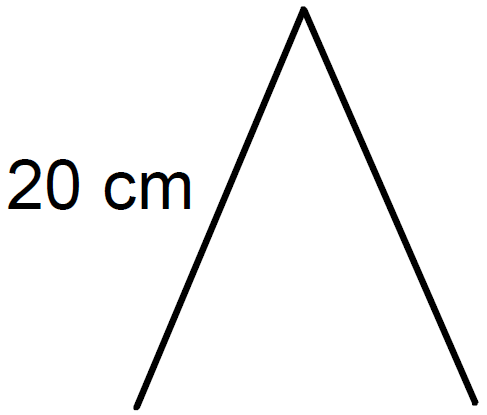
$\text{q}=2.0\times10^{-8}\text{c},\ \text{n}=?,\ \sin\theta=\frac{1}{20}$
Force between the charges
$\text{F}=\frac{\text{Kq}_1\text{q}_2}{\text{r}^2}$
$=\frac{9\times10^9\times2\times10^{-8}\times2\times10^{-8}}{\big(3\times10^{-2}\big)^2}$
$=4\times10^{-3}\text{N}$
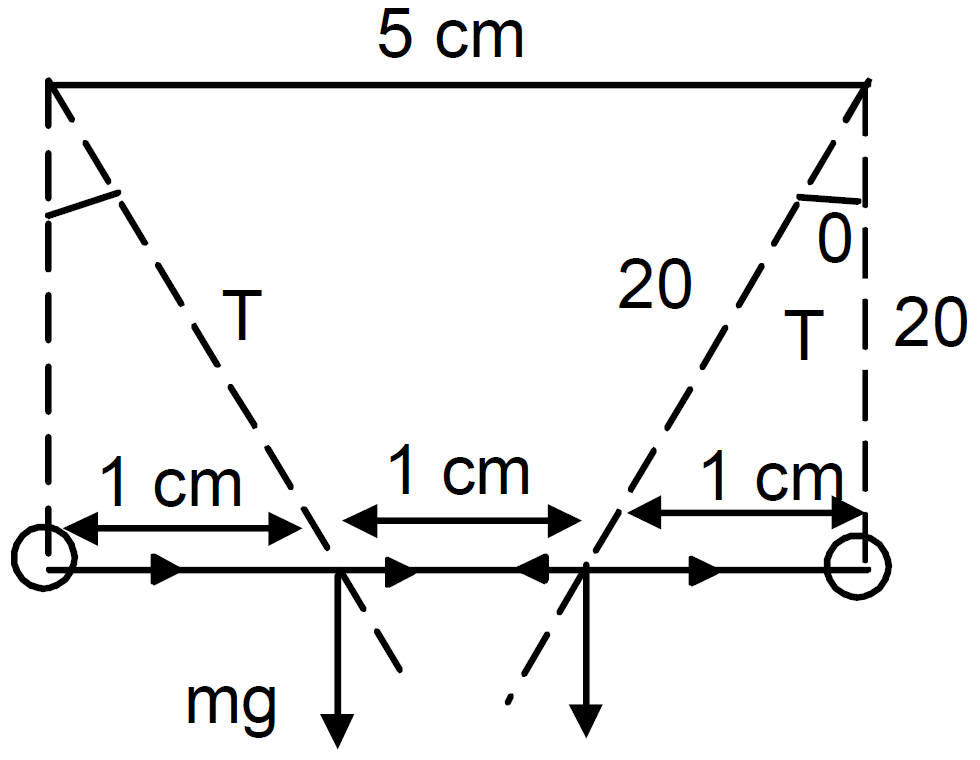
$\text{mg}\sin\theta=\text{F}$
$\Rightarrow\text{m}=\frac{\text{F}}{\text{g}\sin\theta}$
$=\frac{4\times10^{-3}}{10\times\Big(\frac{1}{20}\Big)}$
$=8\times10^{-3}$
$=8\text{gm}$
$\cos\theta=\sqrt{1-\sin^2\theta}$
$=\sqrt{1-\frac{1}{400}}$
$=\sqrt{\frac{400-1}{400}}$
$=0.99=1$
So, $\text{T}=\text{mg}\cos\theta$
$\text{T}=8\times10^{-3}10\times0.99$
$=8\times10^{-2}\text{M}$ View full question & answer→Question 305 Marks
Electric field in the given figure is directed along +X direction and given by $Ex = 5A_x + 2B,$ where E is in $NC^{-1} $ and x is in metre, A and B are constants with dimensions. Taking $A = 10NC^{-1} m^{-1}$ and $B = 5NC^{-1},$ calculate:
- The electric flux through the cube.
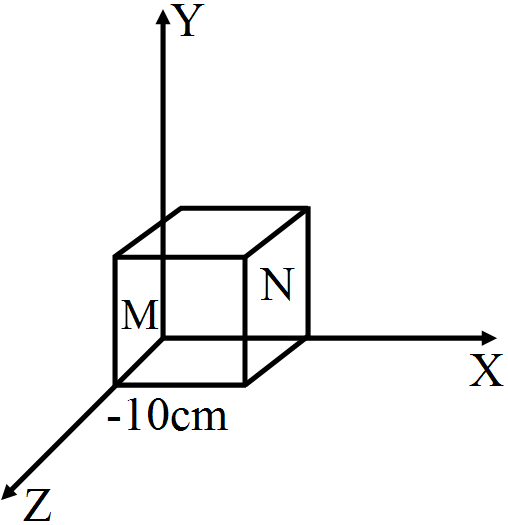
- Net charge enclosed within the cube.
Answer
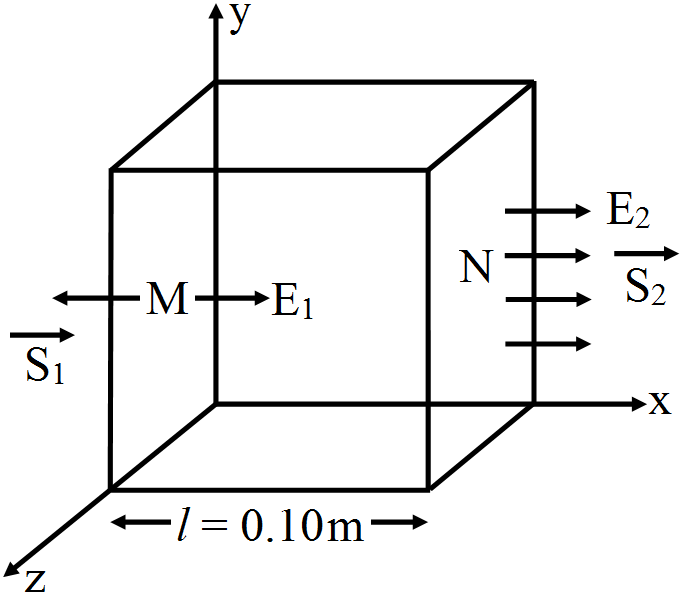
Given $E_x = 5A_x + 2B$
The electric field at face M where $x = 0$ is,
$E_1 =2B$
The electric field at face N where $x = 10cm = 0.10m$ is,
$E_2 = 5A \times 0.10 + 2B = 0.5A + 2B$
The electric flux through face M is,
$\Phi_1=\vec{\text{E}}_1.\vec{\text{S}}_1=\text{E}_1\text{S}_1\cos\pi=-\text{E}_1\text{S}_1$
$= -2B \times l^2$ where $ l = 10cm = 0.01m$
The electric flux through face N,
$\Phi_2=\vec{\text{E}}_2.\vec{\text{S}}_2=\text{E}_2\text{S}_2\cos0=(0.5\text{A}+2\text{B})\text{l}^2$
Net electric flux, $\Phi=\Phi_1+\Phi_2$
$= -2Bl^2 + (0.5A + 2B)l^2 = 0.5Al^2$
$= 0.5 \times 10 \times (0.10)^2 = 5 \times 10^{-2}$V m View full question & answer→Question 315 Marks
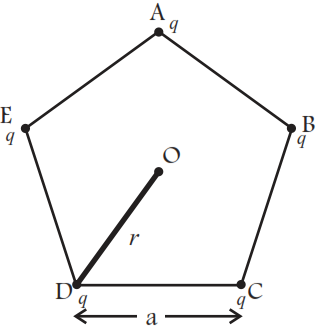
Five charges, q each are placed at the corners of a regular pentagon of side 'a' (Fig.).
-
- What will be the electric field at O, the centre of the pentagon?
- What will be the electric field at O if the charge from one of the corners (say A) is removed?
- What will be the electric field at O if the charge q at A is replaced by -q?
- How would your answer to (a) be affected if pentagon is replaced by n-sided regular polygon with charge q at each of its corners?
Answer
-
- Here, point O is equidistant from all the charges at the end point of pentagon. Thus ,due to symmetry, the forces due to all the charges are cancelled out; As a result electric field at O is zero.
- When charge q is removed, it is equivalent to placing a -q charge at the same point. The electric field at point O would be.
$\vec{\text{E}}=\frac{\text{q}}{4\pi\in_0\text{r}^2}\text{along}\vec{\text{ OA}}$
- If charge q at A is replaced by -q, which is equivalent to placing two negative charges i.e., -2q the same point. So value of electric field would be,
$\vec{\text{E}'}=\frac{2\text{q}}{4\pi\in_0\text{r}^2}\text{along}\vec{\text{ OA}}$
- If pentagon shown here is replaced by any n sided resular polygon with charge q at each of its comers. the electric firld ar O would continue to be zer.
View full question & answer→Question 325 Marks
A charge Q is placed at the centre of an uncharged, hollow metallic sphere of radius a:
- Find the surface charge density on the inner surface and on the outer surface.
- If a charge q is put on the sphere, what would be the surface charge densities on the inner and the outer surfaces?
- Find the electric field inside the sphere at a distance x from the centre in the situations (a) and (b).
AnswerGiven:
Amount of charge present at the centre of the hollow sphere = Q
We know that charge given to a hollow sphere will move to its surface.
Due to induction, the charge induced at the inner surface = -Q
Thus, the charge induced on the outer surface = +Q
- Surface charge density is the charge per unit area, i.e.
$\sigma=\frac{\text{Charge}}{\text{Total surface area}}$
Surface charge density of the inner surface, $\sigma_{\text{in}}=\frac{-\text{Q}}{4\pi\text{a}^2}$
Surface charge density of the outer surface, $\sigma_{\text{out}}=\frac{\text{Q}}{4\pi\text{a}^2}$
- Now if another charge q is added to the outer surface, all the charge on the metal surface will move to the outer surface. Thus, it will not affect the charge induced on the inner surface. Hence the inner surface charge density,
$\sigma_{\text{in}}=-\frac{\text{q}}{4\pi\text{a}^2}$
As the charge has been added to the outer surface, the total charge on the outer surface will become (Q + q).
So the outer surface charge density, $\sigma_{\text{out}}=\frac{\text{q}+\text{Q}}{4\pi\text{a}^2}$
- To find the electric field inside the sphere at a distance x from the centre in both the situations,let us assume an imaginary sphere inside the hollow sphere at a distance x from the centre.
Applying Gauss's Law on the surface of this imaginary sphere,we get:
$\oint\text{E.ds}=\frac{\text{Q}}{\in_0}$
$\text{E}\oint\text{ds}=\frac{\text{Q}}{\in_0}$
$\text{E}\big(4\pi\text{x}^2\big)=\frac{\text{Q}}{\in_0}$
$\text{E}=\frac{\text{Q}}{\in_0}\times\frac{1}{4\pi\text{x}^2}=\frac{\text{Q}}{4\pi\in_0\text{x}^2}$
Here, Q is the charge enclosed by the sphere.
For situation (b):
As the point is inside the sphere, there is no effect of the charge q given to the shell.
Thus, the electric field at the distance x:
$\text{E}=\frac{\text{Q}}{4\pi\in_0\text{x}^2}$ View full question & answer→Question 335 Marks
Two point charges of $+5 \times 10^{-19}C$ and $+20 \times 10^{-19}C$ are separated by a distance of 2m. Find the point on the line joining them at which electric field intensity is zero.
AnswerLet charges $q_1 = +5 \times 10^{-19}C$ and $q_2= +20 \times 10^{-19}C$ be placed at A and B respectively.
Distance AB = 2m. As charges are similar, the electric field strength will be zero between the charges on the line joining them.
Let P be the point (at a distance x from $q_1$) at which electric field intensity is zero.
Then, AP = x metre, BP = (2 - x) metre.
The electric field strength at P due to charge $q_1$ is, $\vec{\text{E}}_1=\frac{1}{4\pi\in_0}\frac{\text{q}_1}{\text{x}^2},$
along the direction A to P. The electric field strength at P due to charge $q_2$ is,
$\vec{\text{E}}_2=\frac{1}{4\pi\in_0}\frac{\text{q}_2}{(2-\text{x})^2},$ along the direction B to P.
Clearly, $\vec{\text{E}}_1$ and $\vec{\text{E}}_2$ and are opposite in direction and for net electric field at P to be zero,
$\vec{\text{E}}_1$ and $\vec{\text{E}}_2$ and must be equal in magnitude.
So,$ E_1 = E_2$
$ \Rightarrow\ \frac{1}{4\pi\in_0}\frac{\text{q}_1}{\text{x}^2}=\frac{1}{4\pi\in_0}\frac{\text{q}_2}{(2-\text{x})^2}$

Given,
$q_1 = 5 \times 10^{-19}C, q_2 = 20 \times 10^{-19}C$
Therefore, $\frac{5\times10^{-19}}{\text{x}^2}=\frac{20\times10^{-19}}{(2-\text{x})^2}$
Or $\frac{1}{2}=\frac{\text{x}}{2-\text{x}}$
Or $\text{x}=\frac{2}{3}\text{m}$ View full question & answer→Question 345 Marks
Answer the following Questions.
- Find expressions for the force and torque on an electric dipole kept in a uniform electric field.
OR
An electric dipole is held in a uniform electric field. (i) Using suitable diagram show that it does not undergo any translatory motion, and (ii) derive an expression for torque acting on it and specify its direction.
- Derive an expression for the work done in rotating a dipole from the angle $\theta_0$ to $\theta_1$ in a uniform electric field E.
OR
- Define torque acting on a dipole of dipole moment $\vec{\text{p}}$ placed in a uniform electric field $\vec{\text{E}}.$ Express it in the vector form and point out the direction along which it acts.
- What happens if the field is non-uniform?
- What would happen if the external field $\vec{\text{E}}$ is increasing (i) parallel to $\vec{\text{p}}$ and (ii) anti-parallel to $\vec{\text{p}}?$
AnswerLet an electric dipole be rotated in electric field from angle $\theta_0$ to $\theta_1$ in the direction of electric field. In this process the angle of orientation is changing continuously; hence the torque also changes continuously. Let at any time, the angle between dipole moment p and electric field E be then,
Torque on dipole $\tau=\text{pE}\sin\theta$
The work done in rotating the dipole a further by small angle $\text{d}\theta$ is,
dW = Torque × angular displacement $=\text{pE}\sin\theta\text{ d}\theta$
Total work done in rotating the dipole from angle $\theta_0$ to $\theta_1$ is given by
$\text{W}=\int\limits_{\theta_0}^{\theta_1}\text{pE}\sin\theta\text{ d}\theta=\text{pE}[-\cos\theta]^{\theta_1}_{\theta_0}$
$=-\text{pE}[\cos\theta_1-\theta_0]=\text{pE}(\cos\theta_0-\cos\theta_1)\dots(\text{i})$
Special case: If electric dipole is initially in a stable equilibrium position $(\theta_0=0^\circ)$ and rotated through an angle $\theta(\theta_1=\theta)$ then work done
$\text{W}=\text{pE}[\cos0^\circ-\cos\theta]=\text{PE}(1-\cos\theta)\dots(\text{ii})$
View full question & answer→Question 355 Marks
A rod of length L has a total charge Q distributed uniformly along its length. It is bent in the shape of a semicircle. Find the magnitude of the electric field at the centre of curvature of the semicircle.
Answer
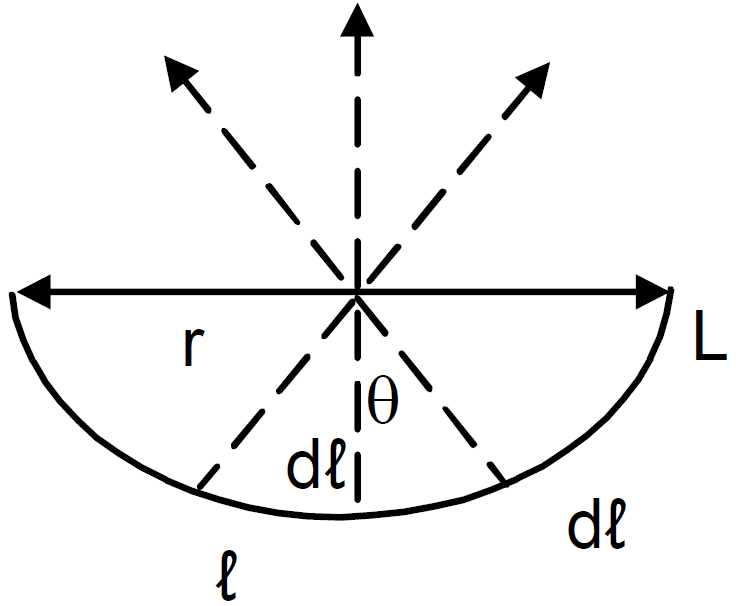
$\lambda=$ Charge per unit length $=\frac{\text{Q}}{\text{L}}$
$dq_1$ for a length d $=\lambda\times\text{dl}$
Electric field at the centre due to charge $=\text{k}\times\frac{\text{dq}}{\text{r}^2}$
The horizontal Components of the Electric field balances each other. Only the vertical components remain.
$\therefore\ $Net Electric field along vertical
$\text{d}_\text{E}=2\text{E}\cos\theta$
$=\frac{\text{Kdq}\times\cos\theta}{\text{r}^2}$
$=\frac{2\text{k}\cos\theta}{\text{r}^2}\times\lambda\times\text{dl}$ $\Big[$but $\text{d}\theta=\frac{\text{d}\ell}{\text{r}}=\text{d}\ell=\text{rd}\theta\Big]$
$\Rightarrow\frac{2\text{k}\lambda}{\text{r}^2}\cos\theta\times\text{rd}\theta=\frac{2\text{k}\lambda}{\text{r}}\cos\theta\times\text{d}\theta$
$\text{E}=\int\limits^{\frac{\pi}{2}}_0\frac{2\text{k}\lambda}{\text{r}}\cos\theta\times\text{d}\theta$
$=\int\limits_0^{\frac{\pi}{2}}\frac{2\text{k}\lambda}{\text{r}}\sin\theta$
$=\frac{2\text{k}\lambda\text{l}}{\text{r}}$
$=\frac{2\text{K}\theta}{\text{Lr}}$
but $\text{L}=\pi\text{R}\Rightarrow\text{r}=\frac{\text{L}}{\pi}$
So, $\text{E}=\frac{2\text{k}\theta}{\text{L}\times\big(\frac{\text{L}}{\pi}\big)}$
$=\frac{2\text{k}\pi\theta}{\text{L}^2}$
$=\frac{2}{4\pi\in_0}\times\frac{\pi\theta}{\text{L}^2}$
$=\frac{\theta}{2\in_0\text{L}^2}$ View full question & answer→Question 365 Marks
A pendulum bob of mass 80mg and carrying a charge of $2 \times 10^{-8}C$ is at rest in a uniform, horizontal electric field of $20kVm^{-1}.$ Find the tension in the thread.
Answer
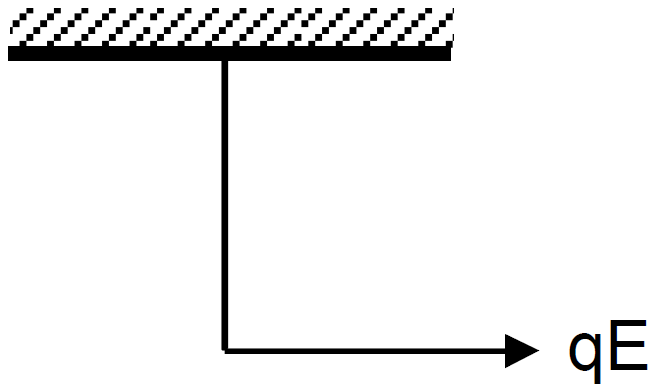
$\text{E}=20\text{Kv/m}=20\times10^3\text{v/m},$
$\text{m}=80\times10^{-5}\text{kg},\ \text{c}=20\times10^{-5}\text{C}$
$\tan\theta=\Big(\frac{\text{qE}}{\text{mg}}\Big)^{-1}$ $\big[\text{T}\sin\theta=\text{mg},\ \text{T}\cos\theta=\text{qe}\big]$
$\tan\theta=\Big(\frac{2\times10^{-8}\times20\times10^3}{80\times10^{-6}\times10}\Big)$
$=\Big(\frac{1}{2}\Big)^{-1}$
$1+\tan^2\theta=\frac{1}{4}+1=\frac{5}{4}$ $\Big[\cos\theta=\frac{1}{\sqrt{5}},\sin\theta=\frac{2}{\sqrt{5}}\Big]$
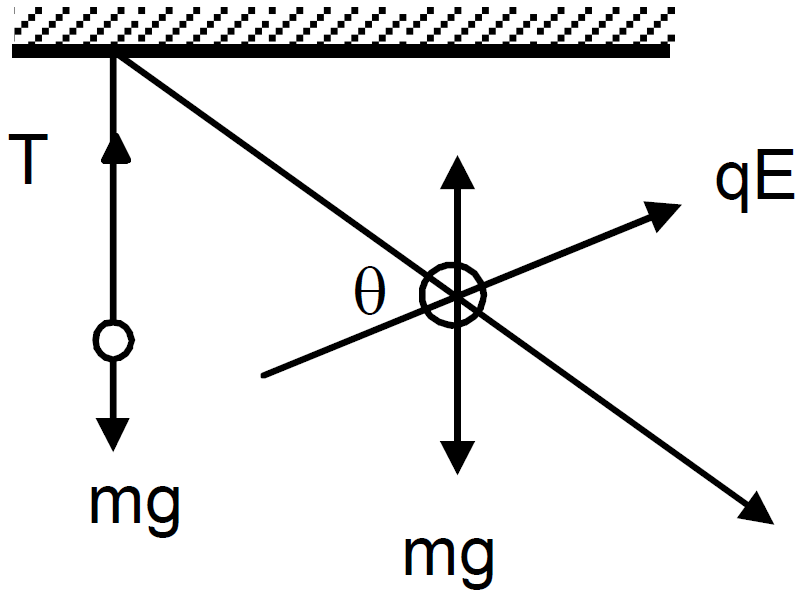
$\text{T}\sin\theta=\text{mg}$
$\Rightarrow\text{T}\times\frac{2}{\sqrt{5}}=80\times10^{-6}\times10$
$\Rightarrow\text{T}=\frac{8\times10^{-4}\times\sqrt{5}}{2}=4\times\sqrt{5}\times10^{-4}$
$=8.9\times10^{-4}$ View full question & answer→Question 375 Marks
A charge is distributed uniformly over a ring of radius ‘a’. Obtain an expression for the electric intensity E at a point on the axis of the ring. Hence show that for point’s at large distances from the ring, it behaves like a point charge.
AnswerImageConsider a point P on the axis of uniformly charged ring at a distance x from its centre O. Point P is at distance $\text{r}=\sqrt{\text{a}^2+\text{x}^2}$ from each element dl of ring. If q is total charge on ring, then, charge per metre length, $\lambda=\frac{\text{q}}{2\pi\text{a}}.$
The ring may be supposed to be formed of a large number of ring elements.
Consider an element of length dl situated at A.
The charge on element, $\text{dp}=\lambda\text{dl}$
$\therefore$ The electric field at P due to this element,
$\vec{\text{dE}}_1=\frac{1}{4\pi\in_0}\frac{\text{dq}}{\text{r}^2}=\frac{1}{4\pi\in_0}\frac{\lambda\text{dl}}{\text{r}^2},\ \text{along}\ \vec{\text{PC}}$
The electric field strength due to opposite symmetrical element of length dl at B is,
$\vec{\text{dE}}_2=\frac{1}{4\pi\in_0}\frac{\text{dq}}{\text{r}^2}=\frac{1}{4\pi\in_0}\frac{\lambda\text{dl}}{\text{r}^2},\ \text{along}\ \vec{\text{PD}}$
If we resolve $\vec{\text{dE}}_1$ and $\vec{\text{dE}}_2$ along the axis and perpendicular to axis, we note that the components perpendicular to axis are oppositely directed and so get cancelled, while those along the axis are added up. Hence, due to symmetry of the ring, the electric field strength is directed along the axis.
The electric field strength due to charge element of length dl, situated at A, along the axis will be,
$\text{dE}=\text{dE}_1\cos\theta=\frac{1}{4\pi\in_0}\frac{\lambda\text{dl}}{\text{r}^2}\cos\theta$
But, $\cos\theta=\frac{\text{x}}{\text{r}}$
$\therefore\ \text{dE}=\frac{1}{4\pi\in_0}\frac{\lambda\text{dl x}}{\text{r}^3}=\frac{1}{4\pi\in_0}\frac{\lambda\text{x}}{\text{r}^3}\text{dl}$
The resultant electric field along the axis will be obtained by adding fields due to all elements of the ring, i.e.,
$\therefore\ \text{E}=\int\frac{1}{4\pi\in_0}\frac{\lambda\text{x}}{\text{r}^3}\text{dl}$
$=\frac{1}{4\pi\in_0}\frac{\lambda\text{x}}{\text{r}^3}\int\text{dl}$
But, $\int\text{dl}=$ whole length of ring $=2\pi\text{a}$ and $\text{r}=(\text{a}^2+\text{x}^2)^{1/2}$
$\therefore\ \text{E}=\frac{1}{4\pi\in_0}\frac{\lambda\text{x}}{(\text{a}^2+\text{x}^2)^{3/2}}2\pi\text{a}$
As, $\lambda=\frac{\text{q}}{2\pi\text{a}},$ we have $\text{E}=\frac{1}{4\pi\in_0}\frac{\big(\frac{\text{q}}{2\pi\text{a}}\big)\text{x}}{(\text{a}^2+\text{x}^2)^{3/2}}2\pi\text{}\text{a}$
$\text{E}=\frac{1}{4\pi\in_0}\frac{\text{qx}}{(\text{a}^2+\text{x}^2)^{3/2}}$
or, $\text{E}=\frac{1}{4\pi\in_0}\frac{\text{qx}}{(\text{a}^2+\text{x}^2)^{3/2}},$ along the axis
At large distances i.e., x >> a, $\text{E}=\frac{1}{4\pi\in_0}\frac{\text{q}}{\text{x}^2}$
i.e., the electric field due to a point charge at a distance x.
For points on the axis at distances much larger than the radius of ring, the ring behaves like a point charge.
View full question & answer→Question 385 Marks
Two fixed, identical conducting plates $(\alpha\ \&\ \beta)$, each of surface area S are charged to -Q and q, respectively, where Q > q > 0. A third identical plate $(\gamma)$, free to move is located on the other side of the plate with charge q at a distance d (Fig.). The third plate is released and collides with the plate $\beta$. Assume the collision is elastic and the time of collision is sufficient to redistribute charge amongst $\beta\ \&\ \gamma$.
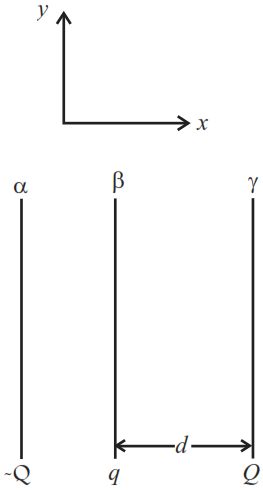
Find the velocity of the plate $\gamma$ after the collision and at a distance d from the plate $\beta$. AnswerLet the velocity be v at the distance d from plate $\beta$ after the collision. If m is the mass of the palte $\gamma$, then the gain in K.E. over the round trip must be equal to the work done by the electric field.
After the collision, electric field at plate $\gamma$ is
$\vec{\text{E}_2}=\frac{\text{Q}}{2\in_0\text{S}}(-\hat{\text{i}})+\frac{\Big(\text{Q}+\frac{\text{q}}{2}\Big)}{2\in_0\text{S}}\hat{\text{i}}=\frac{\frac{\text{q}}{2}}{2\in_0\text{S}}\hat{\text{i}}$
Just befcore collision, electric field at palte $\gamma$ is $\vec{\text{E}_1}=\frac{\text{Q}-\text{q}}{2\in_0\text{S}}\hat{\text{i}}$
If $F_1$ is force on plate $\gamma$ before collision, then $\vec{\text{E}_1}=\vec{\text{E}_1}\text{Q}=\frac{(\text{Q}-\text{q})\text{Q}}{2\in_0\text{S}}\hat{\text{i}}$
And $\vec{\text{F}_2}=\vec{\text{E}_2}\frac{\text{q}}{2}=\frac{\Big(\frac{\text{q}}{2}\Big)^2}{2\in_0\text{S}}\hat{\text{i}}$
Total work done by the elecric field is round trip movement of plate $\gamma$.
$\text{W}=(\text{F}_1+\text{F}_2)\text{d}$
$=\frac{\Big[(\text{Q}-\text{q})\text{Q}+\Big(\frac{\text{q}}{2}\Big)^2\Big]\text{d}}{2\in_0\text{S}}=\frac{\Big(\text{Q}-\frac{\text{q}}{2}^2\text{d}\Big)}{2\in_0\text{S}}$
If m is the mass of plate $\gamma$ the KE gained by the plate $=\frac{1}{2}\text{mv}^2$
According to work-energy priniciple, $=\frac{1}{2}\text{mv}^2=\text{W}\Rightarrow\ \frac{1}{2}\text{mv}^2=\frac{\Big(\text{Q}-\frac{\text{q}}{2}\Big)^2\text{d}}{2\in_0\text{S}}$
$\Rightarrow\ \text{v}=\Big(\text{Q}-\frac{\text{q}}{2}\Big)\Big(\frac{\text{d}}{\text{m}\in_0\text{S}}\Big)^\frac{1}{2}$
View full question & answer→Question 395 Marks
Consider the following very rough model of a beryllium atom. The nucleus has four protons and four neutrons confined to a small volume of radius $10^{-15}m.$ The two 1s electrons make a spherical charge cloud at an average distance of $1.3 \times 10^{-11}m$ from the nucleus, whereas the two 2s electrons make another spherical cloud at an average distance of $5.2 \times 10^{-11}m$ from the nucleus. Find the electric field at:
- A point just inside the 1s cloud.
- A point just inside the 2s cloud.
Answer
- Let us consider the three surfaces as three concentric spheres A, B and C.
Let us take $q = 1.6 \times 10^{-19}C.$
Sphere A is the nucleus; so, the charge on sphere $A, q_1 = 4q$
Sphere B is the sphere enclosing the nucleus and the 2 1s electrons; so charge on this sphere, $q_2 = 4q - 2q = 2q.$
Sphere C is the sphere enclosing the nucleus and the 4 electrons of Be; so, the charge enclosed by this sphere, $q_3 = 4q - 4q = 0.$
Radius of sphere $A, r_1 = 10^{-15}m$
Radius of sphere $B, r_2 = 1.3 \times 10^{-11}m$
Radius of sphere $C, r_3 = 5.2 \times 10^{-11}m$
As the point 'P' is just inside the spherical cloud 1s, its distance from the centre
$x = 1.3 \times 10^{-11}m$
Electric field,
$\text{E}=\frac{\text{q}}{4\pi\in_0\text{x}^2}$
Here, the charge enclosed is due to the charge of the 4 protons inside the nucleus. So,
$\text{E}=\frac{4\times\big(1.6\times10^{-19}\big)}{4\times3.14\times\big(8.85\times10^{-12}\big)\times\big(1.3\times10^{-11}\big)^2}$
$\text{E}=3.4\times10^{13}\text{N/C}$
- For a point just inside the 2s cloud, the total charge enclosed will be due to the 4 protons and 2 electrons. Charge enclosed,
$q_{en}= 2q = 2 \times (1.6 \times 10^{-19})C$
Hence, electric field,
$\text{E}=\frac{\text{q}_{\text{en}}}{4\pi\in_0\text{x}^2}$
$\text{x}=5.2\times10^{-11}\text{m}$
$\text{E}=\frac{2\times\big(1.6\times10^{-19}\big)}{4\times3.14\times\big(8.5\times10^{-12}\big)\times\big(5.2\times10^{-11}\big)^2}$
$\text{E}=1.065\times\text{10}^{12}\text{N/C}$
Thus, $\text{E}=1.1\times\text{10}^{12}\text{N/C}$ View full question & answer→Question 405 Marks
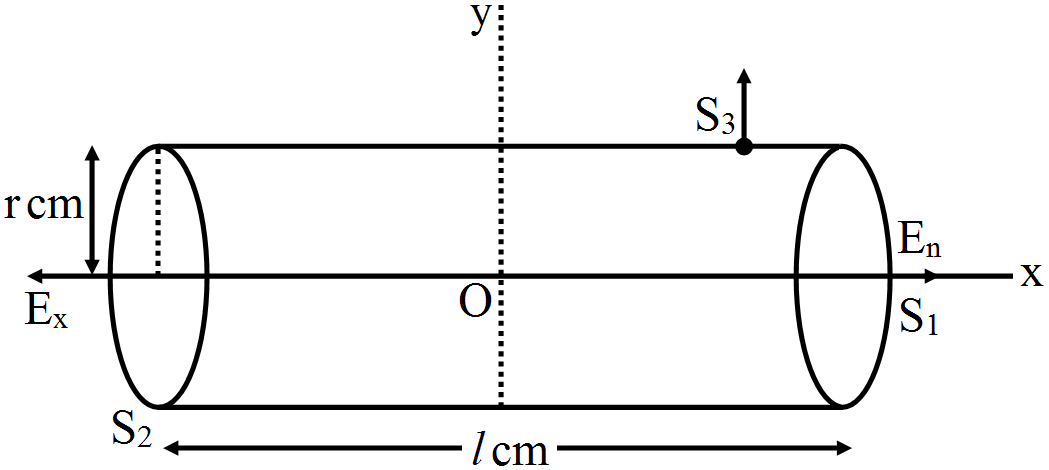
A uniform electric field $\vec{\text{E}}=\text{E}_\text{x}\hat{\text{i}}$ N/ C for x > 0 and $\vec{\text{E}}=-\text{E}_\text{x}\hat{\text{i}}$ N/ C for x < 0 are given. A right circular cylinder of length l cm and radius r cm has its centre at the origin and its axis along the X-axis. Find out the net outward flux. Using Gauss’s law, write the expression for the net charge within the cylinder.
AnswerElectric flux through flat surface $S_1, \Phi_1=\oint\limits_{\text{S}_1}\vec{\text{E}}_1.\vec{\text{dS}}_1=\oint\limits_{\text{S}_1}(\text{E}_\text{x}\hat{\text{i}}).(\text{dS}_1\hat{\text{i}})=\text{E}_\text{x}\text{S}_1$
Electric flux through flat surface $S_2,$ $\Phi_2=\oint\limits_{\text{S}_2}\vec{\text{E}}_2.\vec{\text{dS}}_2=\oint\limits_{\text{S}_2}(-\text{E}_\text{x}\hat{\text{i}}).(-\text{dS}_1\hat{\text{i}})=\oint\limits_{\text{S}_2}\text{E}_\text{x}\text{dS}_2$ $=\text{E}_\text{x}\text{S}_2$
Electric flux through curved surface $S_3,$
$\Phi_3=\oint\limits_{\text{S}_3}\Big(\vec{\text{E}}_3.\vec{\text{dS}}_3\Big)=\oint\limits_{\text{S}_3}\text{E}_3\text{dS}_3\cos90^\circ=0$
$\therefore$ Net electric flux, $\Phi=\Phi_1+\Phi_2=\text{E}_\text{x}(\text{S}_1+\text{S}_2)$
But $\text{S}_1=\text{S}_2=\pi(\text{r}\times10^{-2})^2\text{m}^2=\pi\text{r}^2\times10^{-4}\text{m}^2$ $\therefore\ \Phi=\text{E}_\text{x}2(\pi\text{r}^2\times10^{-4})\text{ units}$
By Gauss's law, $\Phi=\frac{1}{\in_0}\text{q}$ $\text{q}=\in_0\Phi=\in_0\text{E}_\text{x}(2\pi\text{r}^2\times10^{-4})$$=2\pi\in_0\text{E}_\text{x}\text{r}^2\times10^{-4}=4\pi\in_0\Big(\frac{\text{E}_\text{x}\text{r}^2\times10^{-4}}{2}\Big)$
$=\frac{1}{9\times10^9}\Big[\frac{\text{E}_\text{x}\text{r}^2\times10^{-4}}{2}\Big]$
$=5.56\text{E}_\text{x}\text{r}^2\times10^{-11}$ coulomb.
View full question & answer→Question 415 Marks
Suppose all the electrons of 100g water are lumped together to form a negatively charged particle and all the nuclei are lumped together to form a positively charged particle. If these two particles are placed 10.0cm away from each other, find the force of attraction between them. Compare it with your weight.
AnswerMolecular weight of $\text{H}_2\text{O}=2\times1\times16=16$
No. of electrons present in one molecule of $\text{H}_2\text{O}=10$
18gm of $H_2O$ has $6.023\times1023\times10\text{ electrons}$
100gm of $H_2O$ has $\frac{6.023\times10^{-24}}{18}\times100\text{ electrons}$
So number of protons $=\frac{6.023\times10^{26}}{18}\text{protons}$ (since atom is electrically neutral)
Charge of protons $=\frac{1.6\times10^{-19}\times6.023\times10^{26}}{18}\text{coulomb}=\frac{1.6\times6.023\times10^7}{18}\text{coulomb}$
Charge of electrons $=\frac{1.6\times6.023\times10^7}{18}\text{coulomb}$
Hence Electrical force $=\frac{9\times10^9\Big(\frac{1.6\times6.023\times10^7}{18}\Big)\times\Big(\frac{1.6\times6.023\times10^7}{18}\Big)}{(10\times10^{-2})^2}$
$=\frac{8\times6.023}{18}\times16.\times6.023^{25}$
$=2.56\times10^{25}\text{ Newton}$
View full question & answer→Question 425 Marks
Two particles A and B having charges q and 2q respectively are placed on a smooth table with a separation d. A third particle C is to be clamped on the table in such a way that the particles A and B remain at rest on the table under electrical forces. What should be the charge on C and where should it be clamped?
Answer
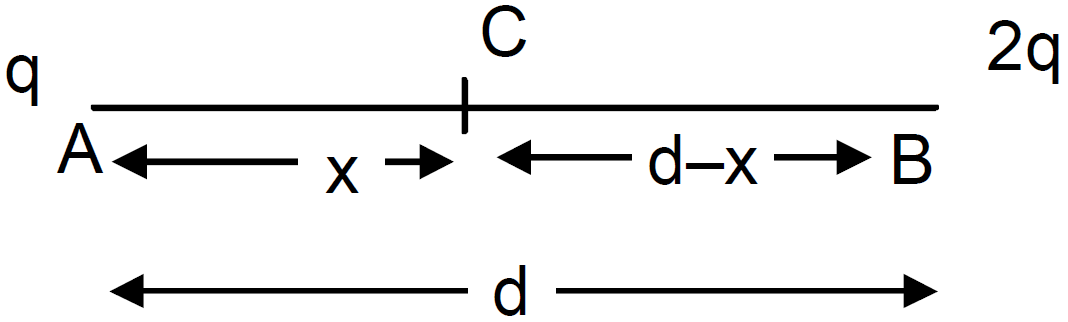 Let the charge on C = q
So, net force on c is equal to zero
So, $\text{F}_{\overline{\text{AC}}}+\text{F}_{\overline{\text{BA}}}=0,$
But $\text{F}_{\overline{\text{AC}}}=\text{F}_{\overline{\text{BC}}}$
$\Rightarrow\frac{\text{kqQ}}{\text{x}^2}=\frac{\text{k}2\text{qQ}}{(\text{d}-\text{x})^2}$
$\Rightarrow2\text{x}^2=(\text{d}-\text{x})^2$
$\Rightarrow\sqrt{2}\text{x}=\text{d}-\text{x}$
$\Rightarrow\text{x}=\frac{\text{d}}{\sqrt{2}+1}$
$=\frac{\text{d}}{\big(\sqrt{2}+1\big)}\times\frac{\big(\sqrt{2}-1\big)}{\big(\sqrt{2}-1\big)}$
$=\text{d}\big(\sqrt{2}-1\big)$
For the charge on rest, $\text{F}_\text{AC}+\text{F}_\text{AB}=0$
$(2.414)^2\frac{\text{kqQ}}{\text{d}^2}+\frac{\text{kq}(2\text{q})}{\text{d}^2}=0$
$\Rightarrow\frac{\text{kq}}{\text{d}^2}\big[(2.414)^2\text{Q}+2\text{q}\big]=0$
$\Rightarrow2\text{q}=-(2.414)^2\text{Q}$
$\Rightarrow\text{Q}=\frac{2}{-\big(\sqrt{2}+1\big)^2}\text{q}$
$=-\Big(\frac{2}{3+2\sqrt{2}}\Big)\text{q}$
$=-(0.343)\text{q}$
$=-\big(6-4\sqrt{2}\big)$ View full question & answer→Question 435 Marks
There is another useful system of units, besides the SI/mks A system, called the cgs (centimeter-gram-second) system. In this system Coloumb’s law is given by
$\text{F}=\frac{\text{Qq}}{\text{r}^2}\hat{\text{r}}$
where the distance r is measured in cm $(= 10^{-2}m)$, F in dynes $(=10^{-5}N)$ and the charges in electrostatic units (es units), where
les unit of charge $=\frac{1}{[3]}\times10^{-9}\text{C}$
The number [3] actually arises from the speed of light in vaccum which is now taken to be exactly given by $c = 2.99792458 × 10⁸ m/s$. An approximate value of c then is c = [3] × 108 m/s.
- Show that the coloumb law in cgs units yields
1 esu of charge = 1 (dyne)1/2 cm.
Obtain the dimensions of units of charge in terms of mass M, length L and time T. Show that it is given in terms of fractional powers of M and L.
- Write 1 esu of charge = x C, where x is a dimensionless number. Show that this gives
$\frac{1}{4\pi\in_0}=\frac{10^{-9}}{\text{x}^2}\frac{\text{N.m}^2}{\text{C}^2}$
With $\text{x}=\frac{1}{[3]}\times10^{-9}$, we have
$\frac{1}{4\pi\in_0}=[3]^2\times10^9\frac{\text{Nm}^2}{\text{C}^2}$
Or, $\frac{1}{4\pi\in_0}=(2.99792458)^2\times10^{9}\frac{\text{Nm}^2}{\text{C}^2}\text{(exactly).}$ Answer
- $\text{F}=\frac{\text{Qq}}{\text{r}^2}=1\text{dyne}=\frac{[1\text{esu of charge}]^2}{[1\text{cm}]^2}$
1 esu of charge $=1\text{(dyne)}^\frac{1}{2}\text{(cm)}$
Hence, $\text{[1 esu of charge]}=\text{[F]}^\frac{1}{2}\text{L}=\text{[MLT}^2]^\frac{1}{2}\text{L}=\text{M}^\frac{1}{2}\text{L}^\frac{3}{2}\text{T}^{-1}$
$\text{[1 esu of charge]}=\text{M}^\frac{1}{2}\text{L}^\frac{3}{2}\text{T}^{-1}$
Thus charge in egs units is expressed as fractional powers $\Big(\frac{1}{2}\Big)$ of M and $\Big(\frac{3}{2}\Big)$ of L.
- Consider the coloumb force on two charges, each of magnitude 1 esu of charge separated by a distance of 1 cm:
The force is then 1 dyne $= 10^{-5}N.$
This situation is equivalent to two charges of magnitude x C separated by $10^{-2}m.$
This given:
$\text{F}=\frac{1}{4\pi\in_0}\frac{\text{x}^2}{10^{-4}}$
which should be 1 dyne $= 10^{-5}N.$ thus
$\frac{1}{4\pi\in_0}\frac{\text{x}^2}{10^{-4}}=10^{-5}\Rightarrow\ \frac{1}{4\pi\in_0}\frac{10^{-9}}{\text{x}^2}\frac{\text{Nm}^2}{\text{C}^2}$
With $\text{x}=\frac{1}{[3]\times10^9}$, this yields
$\frac{1}{4\pi\in_0}=10^{-9}\times[3]^2\times10^{18}=[3]^2\times10^9\frac{\text{Nm}^2}{\text{C}^2}$
With $[3]\rightarrow2.99792458$, we have
$\frac{1}{4\pi\in_0}=8.98755\ ...\times10^9\frac{\text{Nm}^2}{\text{C}^2}$ exactly. View full question & answer→Question 445 Marks
Two particles A and B, each having a charge Q, are placed a distance d apart. Where should a particle of charge q be placed on the perpendicular bisector of AB so that it experiences maximum force What is the magnitude of this maximum force?
Answer
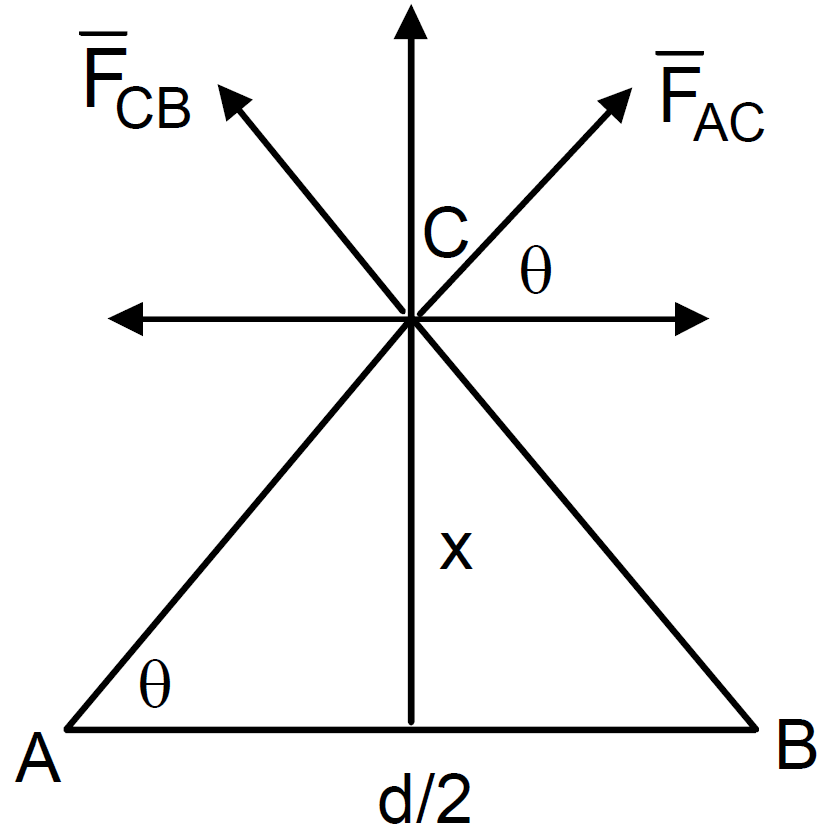 Force on the charge particle ‘q’ at ‘c’ is only the x component of 2 forces
So, $\text{F}_\text{on c}=\text{F}_\text{CB}\sin\theta+\text{F}_\text{AC}\sin\theta$
But $|\bar{\text{F}}_\text{CB}|=|\bar{\text{F}}_\text{AC}|$
$2\text{F}_\text{CB}\sin\theta$
$=2\frac{\text{KQq}}{\text{x}^2+\Big(\frac{\text{d}}{2}\Big)^2}\times\frac{\text{x}}{\Big[\frac{\text{x}^2+\text{d}^2}{4}\Big]^{\frac{1}{2}}}$
$=\frac{2\text{k}\theta\text{qx}}{\Big(\frac{\text{x}^2+\text{d}^2}{4}\Big)^{\frac{3}{2}}}$
$=\frac{16\text{kQq}}{\big(4\text{x}^2+\text{d}^2\big)^{\frac{3}{2}}}\text{x}$
For maximum force $\frac{\text{dF}}{\text{dx}}=0$
$\frac{\text{d}}{\text{dx}}\Bigg(\frac{16\text{kQqx}}{\big(4\text{x}^2+\text{d}^2\big)^{\frac{3}{2}}}\Bigg)=0$
$\Rightarrow\text{K}\begin{bmatrix}\frac{(4\text{x}^2+\text{d}^2)-\text{x}\bigg[\frac{3}{2\big[4\text{x}^2+\text{d}^2\big]^{\frac{1}{2}}}8\text{x}\bigg]}{\big[4\text{x}^2+\text{d}^2\big]^3}\end{bmatrix}=0$
$\Rightarrow\frac{\text{K}\big(4\text{x}^2+\text{d}^2\big)^{\frac{1}{2}}\Big[(4\text{x}^2+\text{d}^2)^3-12\text{x}^2\Big]}{\big(4\text{x}^2+\text{d}^2\big)^3}=0$
$\Rightarrow\big(4\text{x}^2+\text{d}^2\big)^3=12\text{x}^2$
$\Rightarrow16\text{x}^4+\text{d}^4+8\text{x}^2\text{d}^2=12\text{x}^2$ $[\text{d}^4+8\text{x}^2\text{d}^2=0]$
$\Rightarrow\text{d}^2=0$ $[\text{d}^2+8\text{x}^2=0]$
$\Rightarrow\text{d}^2=8\text{x}^2$
$\text{d}=\frac{\text{d}}{2\sqrt{2}}$ View full question & answer→Question 455 Marks
Total charge -Q is uniformly spread along length of a ring of radius R. A. small test charge +q of mass m is kept at the centre of the ring and is given a gentle push along the axis of the ring.
- Show that the particle executes a simple harmonic oscillation.
- Obtain its time period.
AnswerLet the charge q is dispaced slightly by z (z < < R) along the axis of ring. Let force on the charge q be towards O. The motion of charge q to be simple harmonic, if the force on charge q must be proportional to Z and is directed towads O.
Electric field at axis of the rign at a distance Z from the centre of ring
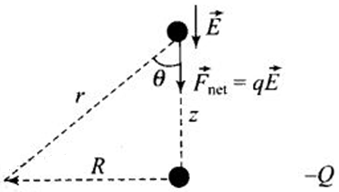
$\text{E}=\frac{1}{4\pi\in_0}\frac{\text{Qz}}{(\text{R}^2+\text{z}^2)^\frac{3}{2}};\text{towards O}$
Net force on the charge $F_{net} = qE$
$\text{F}_\text{net}=\frac{1}{4\pi\in_0}\frac{\text{qQz}}{(\text{R}^2+\text{z}^2)^\frac{3}{2}}$
$\Rightarrow\ \text{F}_\text{net}=\frac{1}{4\pi\in_0}\frac{\text{qQz}}{\text{R}^3\Big(\frac{1+\text{z}^2}{\text{R}^2}\Big)^\frac{3}{2}}$
As z < < R then, $\text{F}_\text{net}=\frac{1}{4\pi\in_0}\frac{\text{qQz}}{\text{R}^3}$
or $\vec{\text{F}}_\text{Net}=-\text{K}\vec{\text{z}}$
Where $\text{K}=\frac{\text{Qq}}{4\pi\in_0\text{R}^3}=\text{constant}$
Clearly, force on q is proportional to negative of its displacement. therefore, motion of q is simlpe harmonic.
$\text{W}=\sqrt{\frac{\text{K}}{\text{m}}}\text{ and T}=\frac{2\pi}{\omega}=2\pi\sqrt{\frac{\text{m}}{\text{K}}}$
$\text{T}=2\pi\sqrt{\frac{\text{m}4\pi\in_0\text{R}^3}{\text{Qq}}}$
$\Rightarrow\ \text{T}=2\pi\sqrt{\frac{\text{m}4\pi\in_0\text{R}^3}{\text{Qq}}}$ View full question & answer→Question 465 Marks
Two small spheres, each having a mass of 20g, are suspended from a common point by two insulating strings of length 40cm each. The spheres are identically charged and the separation between the balls at equilibrium is found to be 4cm. Find the charge on each sphere.
Answer
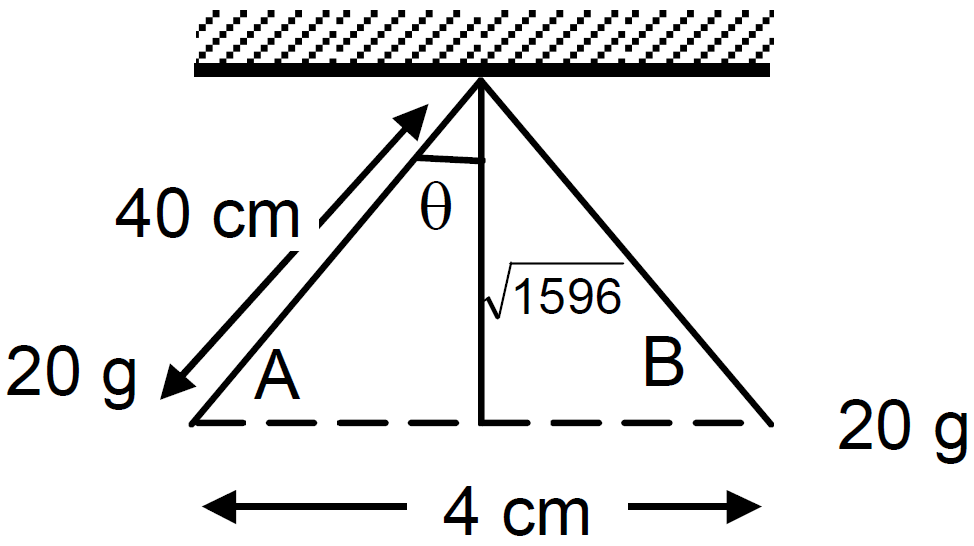 $\text{T}\cos\theta=\text{mg}\ \dots(1)$
$\text{T}\sin\theta=\text{Fe}\ \dots(2)$
Solving, $\frac{(2)}{(1)}$ we get, $\tan\theta=\frac{\text{Fe}}{\text{mg}}$
$=\frac{\text{kq}^2}{\text{r}}\times\frac{1}{\text{mg}}$
$\Rightarrow\frac{2}{\sqrt{1596}}=\frac{9\times10^9\times\text{q}^2}{(0.04)^2\times0.02\times9.8}$
$\Rightarrow\text{q}^2=\frac{(0.04)^2\times0.02\times9.8\times2}{9\times10^9\times\sqrt{1596}}$
$=\frac{6.27\times10^{-4}}{9\times10^9\times39.95}$
$=17\times10^{-16}\text{c}^2$
$\Rightarrow\text{q}=\sqrt{17\times10^{-16}}$
$=4.123\times10^{-8}\text{c}$ View full question & answer→Question 475 Marks
Two charges -q each are fixed separated by distance 2d. A third charge q of mass m placed at the mid-point is displaced slightly by x (x < < d) perpendicular to the line joining the two fixed charged as shown in Fig. Show that q will perform simple harmonic oscillation of time period.
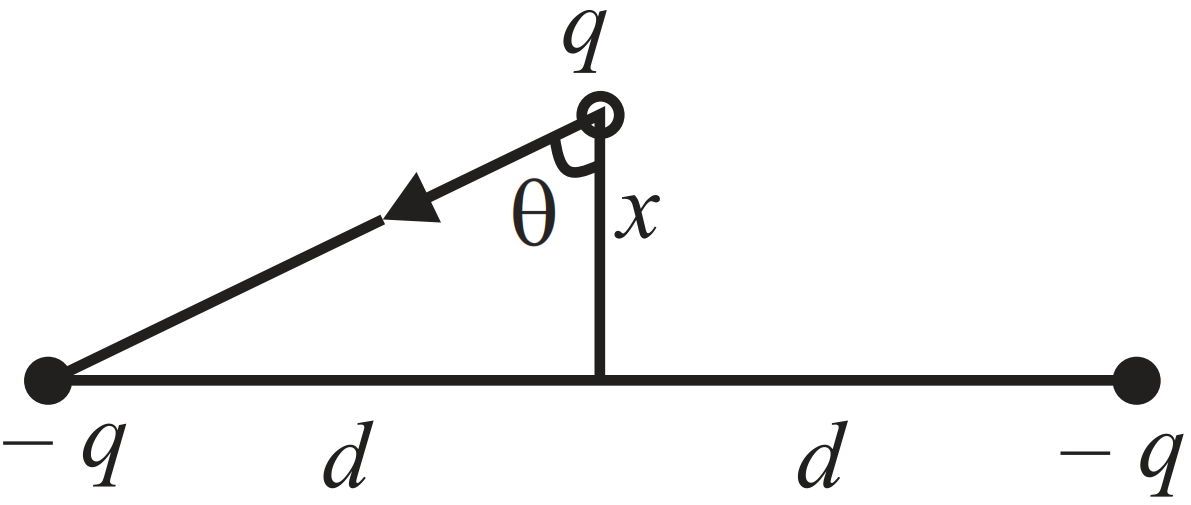
$\text{T}=\Big[\frac{8\pi^3\in_0\text{md}^3}{\text{q}^2}\Big]^\frac{1}{2}$. AnswerNet force F on q towards the centre O
$\text{F}=2\frac{\text{q}^2}{4\pi\in_0\text{r}^2}\cos\theta=-\frac{2\text{q}^2}{4\pi\in_0\text{r}^2}.\frac{\text{x}}{\text{r}}$
$\text{F}=-\frac{2\text{q}^2}{4\pi\in_0}.\frac{\text{x}}{(\text{d}^2+\text{x}^2)\frac{3}{2}}$
$\approx-\frac{2\text{q}^2}{4\pi\in_0\text{d}^3}\text{x}=-\text{k};\text{ for x}<<\text{d}$
Thus, the force on the third charge q is proportional to the displacement and is towards the centre of the two other charges.
Therefore, the motion of the third charges is harmonic with frequency
$\omega=\sqrt{\frac{\text{K}}{\text{m}}}$
$\Rightarrow\ \text{T}=\frac{2\pi}{\omega}=2\pi\sqrt{\frac{\text{K}}{\text{m}}}$
$\Rightarrow\ =2\pi\sqrt{\frac{\text{m}.4\pi\in_0\text{d}^3}{2\text{q}^2}}=\Big[\frac{8\pi^3\in_0\text{md}^3}{\text{q}^2}\Big]^\frac{1}{2}$.
View full question & answer→Question 485 Marks
What will be the total flux through the faces of the cube (Fig.) with side of length a if a charge q is placed at:
- A: a corner of the cube.
- B: mid-point of an edge of the cube.
- C: centre of a face of the cube.
- D: mid-point of B and C.
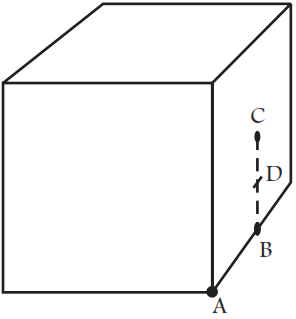
Answer
- Use of symmetry consideration may be useful in problems of flux calculation. We can imagine the charged particle is placed at the centre of a cube of side 2a. We can observe that the charge is being shared equally by 8 cubes. Therefore, total flux through the faces of the given cube $=\frac{\text{q}}{8\in_0}$.
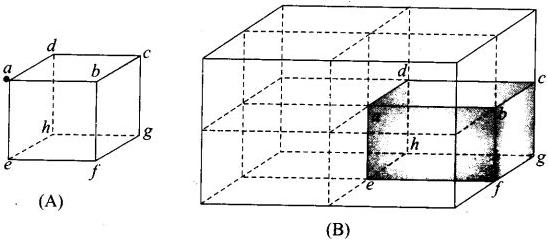
- If the charge q is placed at B, middle point of an edge of the cube, it is being shared equally by 4 cubes. Therefore, total flux through the faces of the given cube $=\frac{\text{q}}{4\in_0}$.
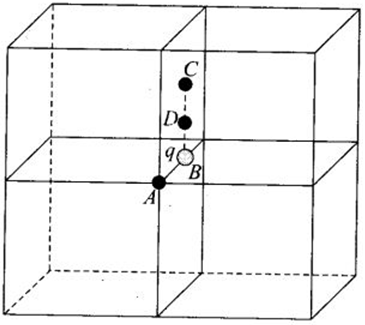
- If the charge q is placed at C, the centre of a face of the cube, it is being shared equally by 2 cubes. Therefore, total flux through the faces of the given cube $=\frac{\text{q}}{2\in_0}$.
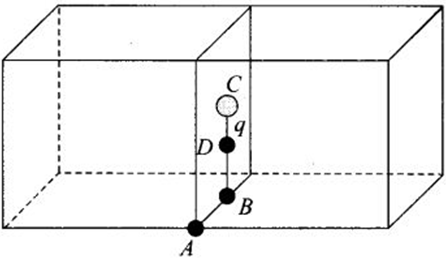
- Finally, if charge q is placed at D, the mid-point of B and C, it is being shared equally by 2 cubes. Therefore, total flux through the faces of the given cube $=\frac{\text{q}}{2\in_0}$.
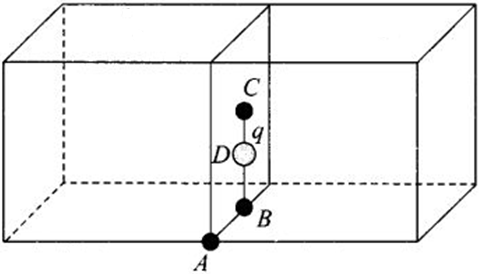
View full question & answer→Question 495 Marks
Two conducting plates X and Y, each having large surface area A (on one side), are placed parallel to each other as shown in figure. The plate X is given a charge Q whereas the other is neutral. Find:
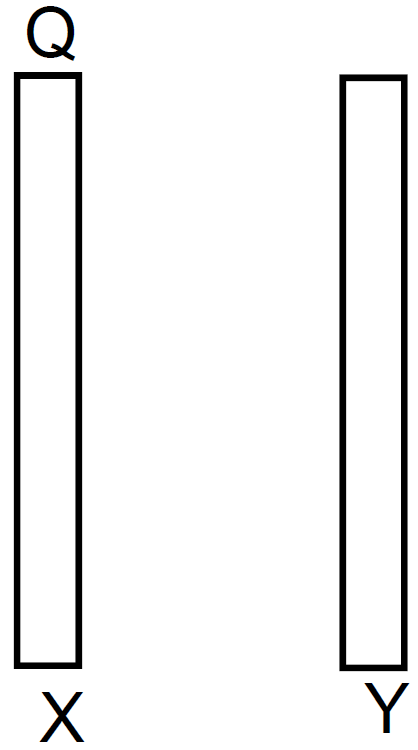
- The surface charge density at the inner surface of the plate X.
- The electric field at a point to the left of the plates.
- The electric field at a point in between the plates.
- The electric field at a point to the right of the plates.
Answer
- Given that the charge present on the plate is Q. The other plate will get the same charge Q due to convection.
Let the surface charge densities on both sides of the plate be $\sigma_1$ and $\sigma_2.$
Now, electric field due to a plate,
$\text{E}=\frac{\sigma}{2\in_0}$
So, the magnitudes of the electric fields due to this plate on each side $=\frac{\sigma_1}{2\in_0}$ and $\frac{\sigma_2}{2\in_0}$
The plate has two sides, each of area A. So, the net charge given to the plate will be equally distributed on both the sides.This implies that the charge developed on each side will be:
$\text{q}_1=\text{q}_2=\frac{\text{Q}}{2}$
This implies that the net surface charge density on each side $=\frac{\text{Q}}{2\text{A}}$
- Electric field to the left of the plates
On the left side of the plate surface, charge density,
$\sigma=\frac{\text{Q}}{2\text{A}}$
Hence, electric field $=\frac{\text{Q}}{2\text{A}\in_0}$
This must be directed towards the left, as 'X' is the positively-charged plate.
- Here, the charged plate 'X' acts as the only source of electric field, with positive in the inner side. Plate Y is neutral. So, a negative charge will be induced on its inner side. 'Y' attracts the charged particle towards itself. So, the middle portion E is towards the right and is equal to $\frac{\text{Q}}{2\text{A}\in_0}.$
- Similarly for the extreme right, the outer side of plate 'Y' acts as positive and hence it repels to the right with $\text{E}=\frac{\text{Q}}{2\text{A}\in_0}.$
View full question & answer→Question 505 Marks
A paisa coin is made up of Al-Mg alloy and weighs 0.75g. It has a square shape and its diagonal measures 17mm. It is electrically neutral and contains equal amounts of positive and negative charges.
Treating the paisa coins made up of only Al, find the magnitude of equal number of positive and negative charges. What conclusion do you draw from this magnitude?
Answer1 Molar mass M of Al has $N_A = 6.023 \times 1023$ atoms.
$\therefore$ m = mass of Al patsa coin has $\text{N}=\frac{\text{N}_\text{A}}{\text{M}}\times\text{m }\text{atoms}$
$\therefore$ Number of aliminium atoms in one paisa coin,
$\text{N}=\frac{6.023\times10^{23}}{26.9815}\times0.75=1.6742\times10^{22}$
As charge number of AI is 13, each atom of AI contians 13 protons and 13 electrons.
$\therefore$ Magnitude of positive and negative charges in one paisa coin
$ = N.Ze = 1.6782 \times 10^{22} \times 13 \times 1.60 \times 10^{-19}C= 3.48 \times 10^4C = 34.8kC$
This is an enormous amount of charge. Thus, we can conclude that ordinary neutral matter contains large amount of positive and negative charges.
View full question & answer→