A hollow sphere is released from the top of an inclined plane of inclination $\theta.$
- What should be the minimum coefficient of friction between the sphere and the plane to prevent sliding?
- Find the kinetic energy of the ball as it moves down a length 1 on the incline if the friction coefficient is half the value calculated in part (a).
Download our app for free and get started
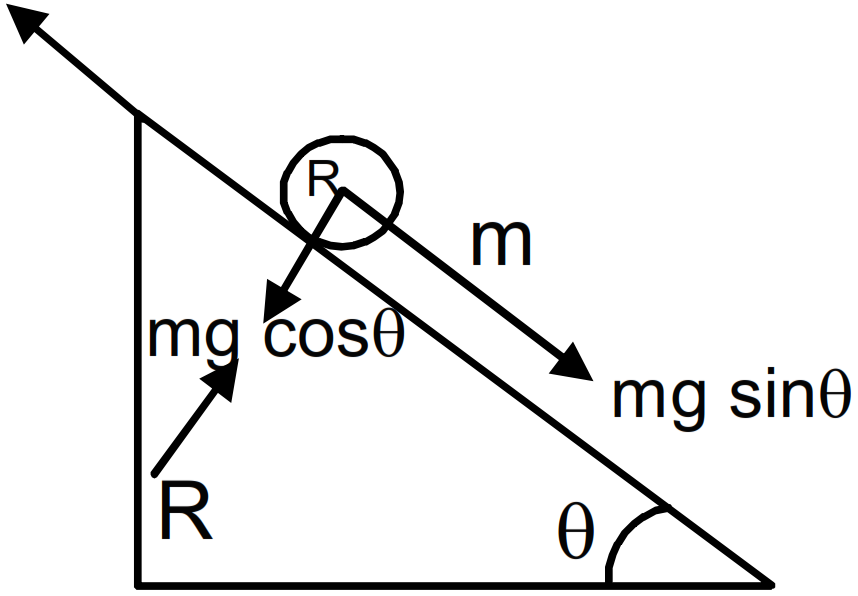
- A hollow sphere is released from a top of an inclined plane of inclination $\theta.$ To prevent sliding, the body will make only perfect rolling. In this condition,
& torque about the centre
$\text{f}\times\text{R}=\frac{2}{3}\text{mR}^2\times\frac{\text{a}}{\text{R}}$
$\Rightarrow\text{f}=\frac{2}{3}\text{ma}\ \dots(2)$
Putting this value in equation (1) we get
$\Rightarrow\text{mg}\sin\theta-\frac{2}{3}\text{ma}=\text{ma}$
$\Rightarrow \text{a}=\frac{3}{5}\text{g}\sin\theta$
$\Rightarrow\text{mg}\sin\theta-\text{f}=\frac{3}{5}\text{mg}\sin\theta$
$\Rightarrow\text{f}=\frac{2}{5}\text{mg}\sin\theta$
$\Rightarrow\mu\text{mg}\cos\theta=\frac{2}{5}\text{mg}\sin\theta$
$\mu=\frac{2}{5}\tan\theta$
- $\frac{1}{5}\tan\theta(\text{mg}\cos\theta)\text{R}=\frac{2}{3}\text{mR}^2\alpha$
$\text{a}_{\text{c}}=\text{g}\sin\theta-\frac{\text{g}}{5}\sin\theta=\frac{4}{5}\sin\theta$
$\Rightarrow\text{t}^2=\frac{\text{2s}}{\text{a}_{\text{c}}}=\frac{\text{2l}}{\big(\frac{4\text{g}\sin\theta}{5}\big)}=\frac{5\text{l}}{2\text{g}\sin\theta}$
Again, $\omega=\alpha\text{t}$
$\text{K.E.}=\Big(\frac{1}{2}\Big)\text{mv}^2+\Big(\frac{1}{2}\Big)\text{l}\omega^2$
$=\Big(\frac{1}{2}\Big)\text{m}(\text{2as})+\Big(\frac{1}{2}\Big)\text{l}\big(\alpha^2\text{t}^2\big)$
$=\frac{1}{2}\text{m}\times\frac{4\text{g}\sin\theta}{5}\times2\times\text{l}+\frac{1}{2}\\\times\frac{2}{3}\text{mR}^2\times\frac{9}{100}\frac{\text{g}^2\sin^2\theta}{\text{R}}\times\frac{\text{5l}}{2\text{g}\sin\theta}$
$=\frac{\text{4mgl}\sin\theta}{5}+\frac{\text{3mgl}\sin\theta}{40}=\frac{7}{8}\text{mgl}\sin\theta$

Download our appand get started for free
Experience the future of education. Simply download our apps or reach out to us for more information. Let's shape the future of learning together!No signup needed.*
Similar Questions
- 1A cord of negligible mass is wound round the rim of a fly wheel of mass $20 \ kg$ and radius $20 \ cm$. A steady pull of $25 N$ is applied on the cord as shown in Fig. $6.31$. The flywheel is mounted on a horizontal axle with frictionless bearings.View Solution
$(a)$ Compute the angular acceleration of the wheel.
$(b)$ Find the work done by the pull, when $2m$ of the cord is unwound.
$(c)$ Find also the kinetic energy of the wheel at this point. Assume that the wheel starts from rest.
$(d)$ Compare answers to parts $(b)$ and $(c).$ - 2A uniform sphere of mass m and radius R is placed on a rough horizontal surface. The sphere is struck horizontally at a height h from the floor. Match the following:View Solution
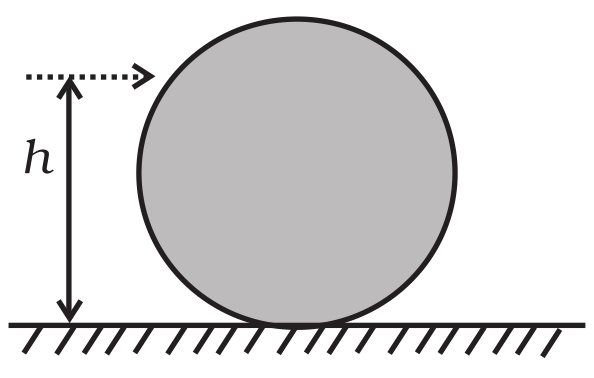
a. $\text{h}=\frac{\text{R}}{2}$ i. Sphere rolls without slipping with a constant velocity and no loss of energy. b. $\text{h}=\text{R}$ ii. Sphere spins clockwise, loses energy by friction. c. $\text{h}=\frac{3\text{R}}{2}$ iii. Sphere spins anti-clockwise, loses energy by friction. d. $\text{h}=\frac{7\text{R}}{5}$ iv. Sphere has only a translational motion, looses energy by friction. - 3Prove that the velocity v of translation of a rolling body (like a ring, disc, cylinder or sphere) at the bottom of an inclined plane of height h is given by:$\text{v}^2=\frac{2\text{gh}}{\big(1+\frac{\text{K}^2}{\text{R}^2}\big)}$View Solution
Note K is the radius of gyration of the body about its symmetry axis, and R is the radius of the body. The body starts from rest at the top of the plane. - 4In the HCl molecule, the separation between the nuclei of the two atoms is about $1.27\mathring{\text{A}}\big(1\mathring{\text{A}}= 10^{-10} \text{m}\big).$ Find the approximate location of the CM of the molecule, given that a chlorine atom is about 35.5 times as massive as a hydrogen atom and nearly all the mass of an atom is concentrated in its nucleus.View Solution
- 5Separation of Motion of a system of particles into motion of the centre of mass and motion about the centre of mass: Show $\text{p}=\text{p}'_\text{i}+\text{m}_\text{i}\text{V}$ where $p_i$ is the momentum of the ith particle (of mass $m_i$ ) and $p′_i = m_iv′_i.$ Note: $v′_i$ is the velocity of the ith particle relative to the centre of mass. Also, prove using the definition of the centre of mass.View Solution
- 6Establish the relation $\theta=\omega_0\text{t}+\frac{1}{2}\alpha\text{t}^2$ where the letters have their usual meanings.View Solution
- 7View SolutionShow that a(b × c) is equal in magnitude to the volume of the parallelepiped formed on the three vectors a, b and c.
- 8View SolutionA ball is whirled in a circle by attaching it to a fixed point with a string. Is there an angular rotation of the ball about its centre? If yes, is this angular velocity equal to the angular velocity of the ball about the fixed point?
- 9View SolutionFind the components along the x, y, z axes of the angular momentum l of a particle, whose position vector is r with components x, y, z and momentum is p with components px, py and pz. Show that if the particle moves only in the x-y plane the angular momentum has only a z-component.
- 10View SolutionA 3m long ladder weighing 20 kg leans on a frictionless wall. Its feet rest on the floor 1 m from the wall as shown in Fig.6.27. Find the reaction forces of the wall and the floor.