If light passes near a massive object, the gravitational interaction causes a bending of the ray. This can be thought of as happening due to a change in the effective refrative index of the medium given by
$\text{n}(\text{r})=1+2\frac{\text{GM}}{\text{rc}^2}$
where r is the distance of the point of consideration from the centre of the mass of the massive body, G is the universal gravitational constant, M the mass of the body and c the speed of light in vacuum. Considering a spherical object find the deviation of the ray from the original path as it grazes the object.
$\text{n}(\text{r})=1+2\frac{\text{GM}}{\text{rc}^2}$
where r is the distance of the point of consideration from the centre of the mass of the massive body, G is the universal gravitational constant, M the mass of the body and c the speed of light in vacuum. Considering a spherical object find the deviation of the ray from the original path as it grazes the object.
Download our app for free and get started
Let us consider two spherical surfaces of radius r and r + dr. Let the light be incident at an angle $\theta$ at the surface at r and leave r + dr at an angle $\theta+\text{d}\theta$. Then from Snell's law,
$\text{n}(\text{r})\sin\theta=\text{n}(\text{r}+\text{dr})\sin(\theta+\text{d}\theta)$
$=\bigg(\text{n}(\text{r})+\Big(\frac{\text{dn}}{\text{dr}}\Big)\text{dr}\bigg)(\sin\theta.\cos\text{d}\theta+\cos\theta.\sin\text{d}\theta)$
$\Rightarrow\ \text{n}(\text{r})\sin\theta=\bigg(\text{n}(\text{r})+\Big(\frac{\text{dn}}{\text{dr}}\Big)\text{dr}\bigg)(\sin\theta+\cos\theta\text{d}\theta)$
For small angle, $\sin\text{d}\theta\approx\text{ and }\cos\text{d}\theta\approx1$
Ignoring the product of differentials
$\Rightarrow\ \text{n}(\text{r})\sin\theta=\text{n}(\text{r}).\sin\theta+\Big(\frac{\text{dn}}{\text{dr}}\Big)\text{dr}.\sin\theta+\text{n}(\text{r}).\cos\theta.\text{d}\theta$
or we have, $-\frac{\text{dn}}{\text{dr}}\tan\theta=\text{n}(\text{r})\frac{\text{d}\theta}{\text{dr}}$
$\frac{2\text{GM}}{\text{r}^2\text{c}^2}\tan\theta=\Big(1+\frac{2\text{GM}}{\text{rc}^2}\Big)\frac{\text{d}\theta}{\text{dr}}\approx\frac{\text{d}\theta}{\text{dr}}$
$\int_0^\theta\text{d}\theta=\frac{2\text{GM}}{\text{c}^2}\int_{-\infty}^{\infty}\frac{\tan\theta\text{dr}}{\text{r}^2}$
Now, $\text{r}^2=\text{x}^2+\text{R}^2\text{ and }\tan\theta=\frac{\text{R}}{\text{x}}$
$2\text{rdr}=2\text{xdx}$
Now subsituting for integtals, we have
$\int_0^\theta\text{d}\theta=\frac{2\text{GM}}{\text{c}^2}\int_{-\infty}^{\infty}\frac{\text{R}}{\text{x}}\frac{\text{xdx}}{(\text{x}^2+\text{R}^2)^\frac{3}{2}}$
Put $\text{x}=\text{R}\tan\phi$
$\text{dx}=\text{R}\sec^2\phi\text{d}\phi$
$\therefore\ \theta_0=\frac{2\text{GMR}}{\text{c}^2}\int_{\frac{-\text{x}}{2}}^{\frac{\text{x}}{2}}\frac{\text{R}\sec^2\phi\text{d}\phi}{\text{R}^2\sec^3\phi}$
$\theta_0=\frac{2\text{GM}}{\text{Rc}^2}\int_{\frac{-\text{x}}{2}}^{\frac{\text{x}}{2}}\cos\phi\text{d}\phi=\frac{4\text{GM}}{\text{Rc}^2}$
$\Rightarrow\ \theta_0=\frac{4\text{GM}}{\text{Rc}^2}$. This is the required proof.
$\text{n}(\text{r})\sin\theta=\text{n}(\text{r}+\text{dr})\sin(\theta+\text{d}\theta)$
$=\bigg(\text{n}(\text{r})+\Big(\frac{\text{dn}}{\text{dr}}\Big)\text{dr}\bigg)(\sin\theta.\cos\text{d}\theta+\cos\theta.\sin\text{d}\theta)$
$\Rightarrow\ \text{n}(\text{r})\sin\theta=\bigg(\text{n}(\text{r})+\Big(\frac{\text{dn}}{\text{dr}}\Big)\text{dr}\bigg)(\sin\theta+\cos\theta\text{d}\theta)$
For small angle, $\sin\text{d}\theta\approx\text{ and }\cos\text{d}\theta\approx1$
Ignoring the product of differentials
$\Rightarrow\ \text{n}(\text{r})\sin\theta=\text{n}(\text{r}).\sin\theta+\Big(\frac{\text{dn}}{\text{dr}}\Big)\text{dr}.\sin\theta+\text{n}(\text{r}).\cos\theta.\text{d}\theta$
or we have, $-\frac{\text{dn}}{\text{dr}}\tan\theta=\text{n}(\text{r})\frac{\text{d}\theta}{\text{dr}}$
$\frac{2\text{GM}}{\text{r}^2\text{c}^2}\tan\theta=\Big(1+\frac{2\text{GM}}{\text{rc}^2}\Big)\frac{\text{d}\theta}{\text{dr}}\approx\frac{\text{d}\theta}{\text{dr}}$
$\int_0^\theta\text{d}\theta=\frac{2\text{GM}}{\text{c}^2}\int_{-\infty}^{\infty}\frac{\tan\theta\text{dr}}{\text{r}^2}$
Now, $\text{r}^2=\text{x}^2+\text{R}^2\text{ and }\tan\theta=\frac{\text{R}}{\text{x}}$
$2\text{rdr}=2\text{xdx}$
Now subsituting for integtals, we have
$\int_0^\theta\text{d}\theta=\frac{2\text{GM}}{\text{c}^2}\int_{-\infty}^{\infty}\frac{\text{R}}{\text{x}}\frac{\text{xdx}}{(\text{x}^2+\text{R}^2)^\frac{3}{2}}$
Put $\text{x}=\text{R}\tan\phi$
$\text{dx}=\text{R}\sec^2\phi\text{d}\phi$
$\therefore\ \theta_0=\frac{2\text{GMR}}{\text{c}^2}\int_{\frac{-\text{x}}{2}}^{\frac{\text{x}}{2}}\frac{\text{R}\sec^2\phi\text{d}\phi}{\text{R}^2\sec^3\phi}$
$\theta_0=\frac{2\text{GM}}{\text{Rc}^2}\int_{\frac{-\text{x}}{2}}^{\frac{\text{x}}{2}}\cos\phi\text{d}\phi=\frac{4\text{GM}}{\text{Rc}^2}$
$\Rightarrow\ \theta_0=\frac{4\text{GM}}{\text{Rc}^2}$. This is the required proof.

Download our appand get started for free
Experience the future of education. Simply download our apps or reach out to us for more information. Let's shape the future of learning together!No signup needed.*
Similar Questions
- 1A gravitational lens may be assumed to have a varying width of the formView Solution
$\text{w}(\text{b})=\text{k}_1\text{ In }\Big(\frac{\text{k}_2}{\text{b}}\Big)\ \ \text{b}_\text{min}<\text{b}<\text{b}_\text{max}$
$=\text{k}_1\text{ In }\Big(\frac{\text{k}_2}{\text{b}_\text{min}}\Big)\ \ \text{b}<\text{b}_\text{min}$
Show that an observer will see an image of a point object as a ring about the center of the lens with an angular radius
$\beta=\sqrt{\frac{(\text{n}-1)\text{k}_1\frac{\text{u}}{\text{v}}}{\text{u}+\text{v}}}$ - 2Derive the lens formula, $\frac{1}{\text{f}} = \frac{1}{\text{v}} - \frac{1}{\text{u}}$ for a concave lens, using the necessary ray diagram.View Solution
Two lenses of powers 10 D and – 5 D are placed in contact.- Calculate the power of the new lens.
- Where should an object be held from the lens, so as to obtain a virtual image of magnification 2?
- 3Find the diameter of the image of the moon formed by a spherical concave mirror of focal length 7.6m. The diameter of the moon is 3450km and the distance between the earth and the moon is $3.8 \times 10^5km.$View Solution
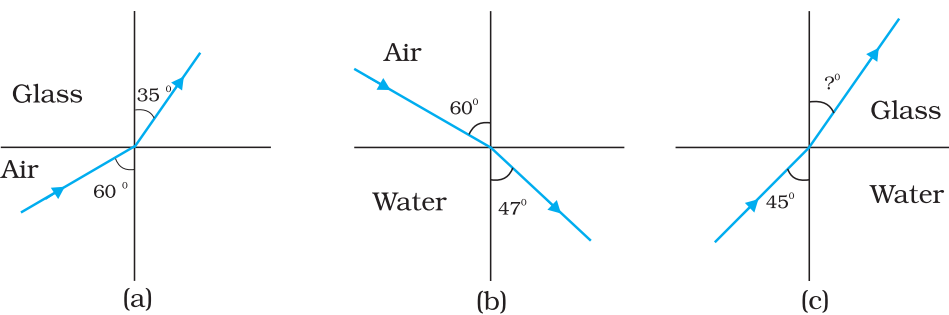
- 4View Solution(a) and (b) show refraction of a ray in air incident at 60° with the normal to a glass-air and water-air interface, respectively. Predict the angle of refraction in glass when the angle of incidence in water is 45º with the normal to a water - glass interface.
- 5View SolutionAn angular magnification (magnifying power) of 30X is desired using an objective of focal length 1.25 cm and an eyepiece of focal length 5 cm. How will you set up the compound microscope?
- 6View Solution
- Draw a ray diagram to show refraction of a ray of monochromatic light passing through a glass prism.
- Explain briefly how the phenomenon of total internal reflection is used in fibre optics.
- 7View SolutionA double convex lens has focal length 25cm. The radius of curvature of one of the surfaces is double of the other. Find the radii, if the refractive index of the material of the lens is 1.5.
- 8A point object 'O' is kept in a medium of refractive index $n_1$ in front of a convex spherical surface of radius of curvature R which separates the second medium of refractive index $n_2$ from the first one, as shown in the figure.View Solution
- Draw the ray diagram showing the image formation and deduce the relationship between the object distance and the image distance in terms of $n_1, n_2$ and R.
- When the image formed above acts as a virtual object for concave spherical, surface separating the medium $n_2$ from $n_1 (n_2> n_1)$, draw this ray diagram and write the similar (similar to (a) relation. Hence obtain the expression for the lens maker's formula.
- 9View SolutionA diverging lens of focal length 20cm and a converging lens of focal length 30cm are placed 15cm apart with their principal axes coinciding. Where should an object be placed on the principal axis so that its image is formed at infinity?
- 10View SolutionA compound microscope consists of an objective lens of focal length 2.0 cm and an eyepiece of focal length 6.25 cm separated by a distance of 15 cm. How far from the objective should an object be placed in order to obtain the final image at (a) the least distance of distinct vision (25 cm), and (b) at infinity? What is the magnifying power of the microscope in each case?