A small block of mass m and a concave mirror of radius R fitted with a stand lie on a smooth horizontal table with a separation d between them. The mirror together with its stand has a mass m. The block is pushed at t = 0 towards the mirror so that it starts moving towards the mirror at a constant speed V and collides with it. The collision is perfectly elastic. Find the velocity of the image:
- At a time $\text{t}<\frac{\text{d}}{\text{V}}$
- At a time $\text{t}>\frac{\text{d}}{\text{V}}.$
Download our app for free and get started
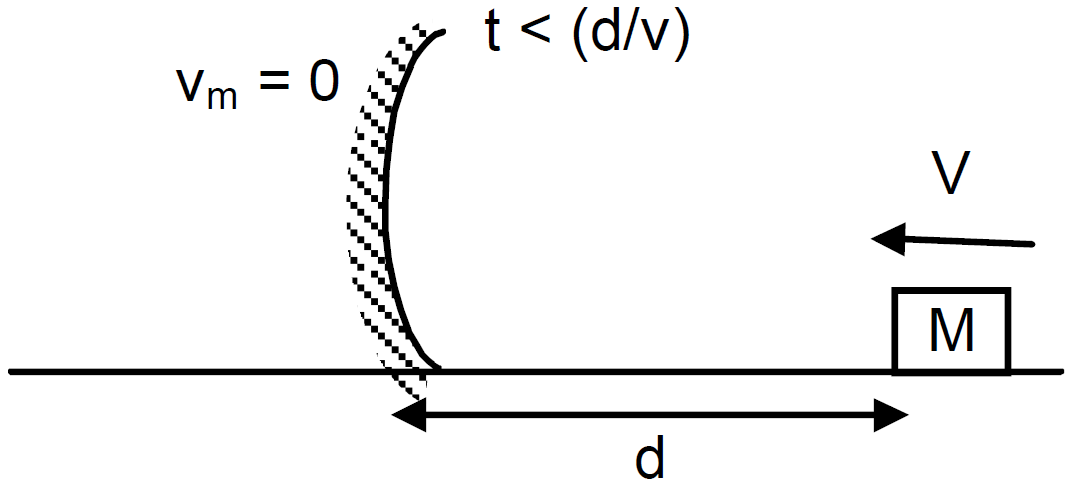
- When $\text{t}<\frac{\text{d}}{\text{V}},$ the object is approaching the mirror
$\text{V}_{\text{image}}=\frac{\text{Velocity of object}\times\text{R}^2}{\big[2\times\text{distance between them}-\text{R}\big]^2}$
$\Rightarrow\text{V}_{\text{image}}=\frac{\text{V}\text{R}^2}{\big[2\big(\text{d}-\text{Vt}\big)-\text{R}\big]^2}$ [At any time, x = d - Vt]
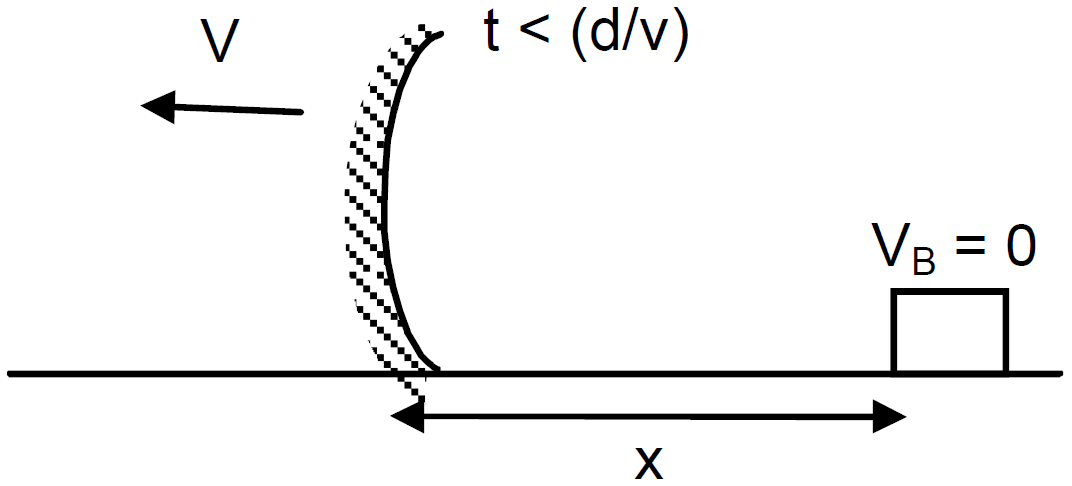
- After a time $\text{t}<\frac{\text{d}}{\text{V}},$ there will be a collision between the mirror and the mass.
At any time $\text{t}>\frac{\text{d}}{\text{V}},$ the distance of the mirror from the mass will be
$\text{x}=\text{V}\Big(\text{t}-\frac{\text{d}}{\text{V}}\Big)=\text{Vt}-\text{d}$
Here, $\text{u}=-\big(\text{Vt}-\text{d}\big)=\text{d}-\text{Vt}; \ \text{f}=-\frac{\text{R}}{2}$
So, $\frac{1}{\text{v}}+\frac{1}{\text{u}}=\frac{1}{\text{f}}\Rightarrow\frac{1}{\text{v}}=\frac{1}{\text{d}-\text{Vt}}+\frac{1}{\big(-\frac{\text{R}}{2}\big)}=-\Big[\frac{\text{R}+2(\text{d}-\text{Vt})}{\text{R}(\text{d}-\text{Vt})}\Big]$
$\Rightarrow\text{v}=-\Big[\frac{\text{R}(\text{d}-\text{Vt})}{\text{R}-2(\text{d}-\text{Vt})}\Big]= $ Image distance
So, Velocity of the image will be,
$\text{V}_{\text{image}}=\frac{\text{d}}{\text{dt}}$ (Image distance)
$=\frac{\text{d}}{\text{dt}}\Big[\frac{\text{R}(\text{d}-\text{Vt})}{\text{R}+2(\text{d}-\text{Vt})}\Big]$
Let, y = (d - Vt)
$\Rightarrow\frac{\text{dy}}{\text{dt}}=-\text{V}$
So, $\text{V}_{\text{image}}=\frac{\text{d}}{\text{dt}}\Big[\frac{\text{Ry}}{\text{R}+2\text{y}}\Big]=\frac{(\text{R}+2\text{y})\text{R}(-\text{V})-\text{Ry}(+2)(-\text{V})}{(\text{R}+2\text{y})^2}$
$=-\text{Vr}\Big[\frac{\text{R}+2\text{y}-2\text{y}}{(\text{R}+2\text{y})^2}\Big]=\frac{-\text{VR}^2}{(\text{R}+2\text{y})^2}$
Since, the mirror itself moving with velocity V,
Absolute velocity of image $=\text{V}\Big[1-\frac{\text{R}^2}{(\text{R}+2\text{y})^2}\Big]$ $($since, $V = V_{mirror}+ V_{image})$
$=\text{V}\Big[1-\frac{\text{R}^2}{[2(\text{Vt}-\text{d})-\text{R}^2}\Big]$

Download our appand get started for free
Experience the future of education. Simply download our apps or reach out to us for more information. Let's shape the future of learning together!No signup needed.*
Similar Questions
- 1View SolutionIn many experimental set-ups the source and screen are fixed at a distance say D and the lens is movable. Show that there are two positions for the lens for which an image is formed on the screen. Find the distance between these points and the ratio of the image sizes for these two points.
- 2View SolutionAn unsymmetrical double convex thin lens forms the image of a point object on its axis. Will the position of the image change if the lens is reversed?
- 3k transparent slabs are arranged one over another. The refractive indices of the slabs are $\mu_1,\mu_2,\mu_3, \ ...\mu_{\text{k}}$ and the thicknesses are $t_1, t_2, t_3, ... t_k$ . An object is seen through this combination with nearly perpendicular light. Find the equivalent refractive index of the system which will allow the image to be formed at the same place.View Solution
- 4View Solution
- State Huygen’s principle. Using this principle draw a diagram to show how a plane wave front incident at the interface of the two media gets refracted when it propagates from a rarer to a denser medium. Hence verifiy Snell’s law of refraction.
- When monochromatic light travels from a rarer to a denser medium, explain the following, giving reasons:
- Is the frequency of reflected and refracted light same as the frequency of incident light?
- Does the decrease in speed imply a reduction in the energy carried by light wave?
- 5View SolutionA normal eye has retina 2cm behind the eye-lens. What is the power of the eye-lens when the eye is
- Fully relaxed,
- Most strained?
- 6View Solution
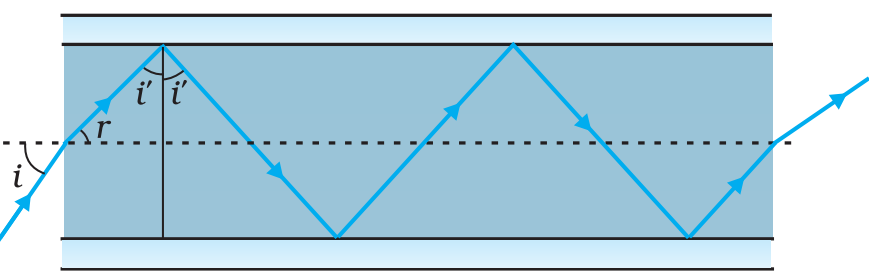
- a cross - section of a ‘light pipe’ made of a glass fibre of refractive. The outer covering of the pipe is made of a material of refractive. What is the range of the angles of the incident rays with the axis of the pipe for which total reflections inside the pipe take place, as shown in the figure.
- What is the answer if there is no outer covering of the pipe?
- 7View SolutionDetermine the ‘effective focal length’ of the combination of the two lenses in if they are placed 8.0 cm apart with their principal axes coincident. Does the answer depend on which side of the combination a beam of parallel light is incident? Is the notion of effective focal length of this system useful at all.
- 8View SolutionA converging lens of focal length 15cm and a converging mirror of focal length 10cm are placed 50cm apart. If a pin of length 2.0cm is placed 30cm from the lens farther away from the mirror, where will the final image form and what will be the size of the final image?
- 9View SolutionA particle is moving at a constant speed V from a large distance towards a concave mirror of radius R along its principal axis. Find the speed of the image formed by the mirror as a function of the distance x of the particle from the mirror.
- 10Consider the situation shown in figure. The elevator is going up with an acceleration of $2.00m/s^2$ and the focal length of the mirror is 12.0cm. All the surfaces are smooth and the pulley is light. The mass-pulley system is released from rest (with respect to the elevator) at t = 0 when the distance of B from the mirror is 42.0cm. Find the distance between the image of the block B and the mirror at $t = 0.200s$. Take $g = 10m/s^2$.View Solution