A beam of uniform cross-section and uniform mass-density of mass $20kg$ is supported at ends. A mass of $5kg$ is placed at a distance of $\frac{\text{L}}{5\text{m}} $ from one of its end. If beam is L m long, what are reactions of supports? In dealing with problems of equilibrium of a rigid body (like beam in this question). first of all draw a free body diagram of the system, indicating all of the forces acting on the system.
Download our app for free and get started
Ia given case, our system looks like
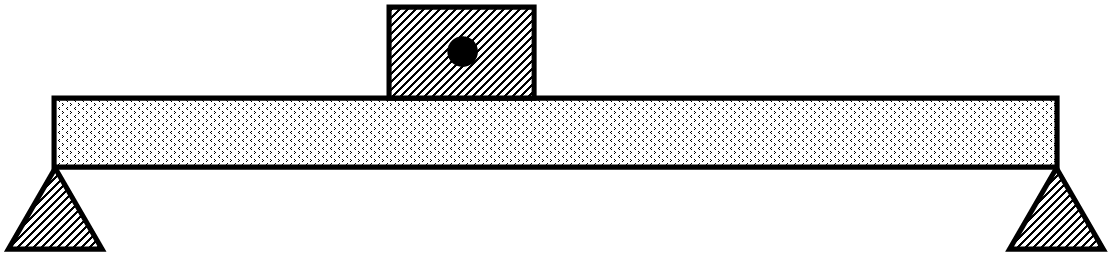
Forces involved are:
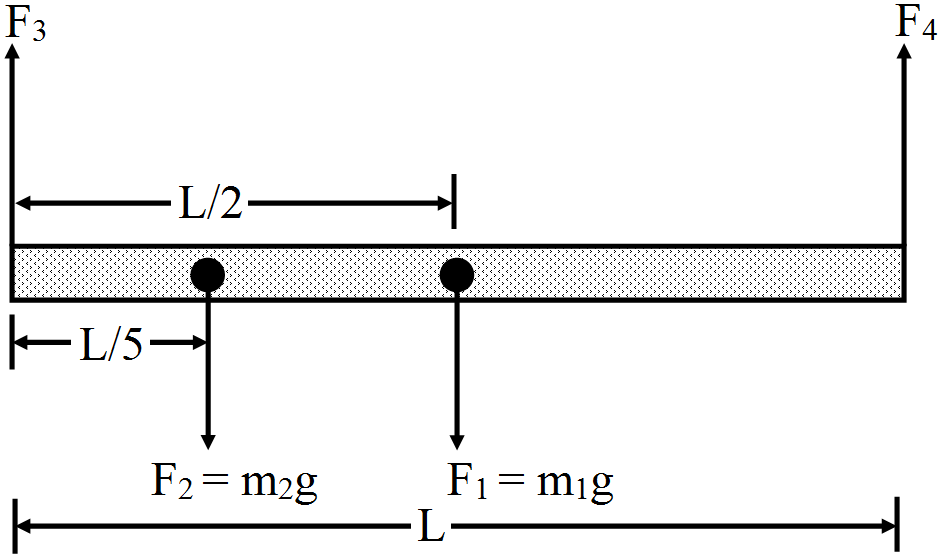
In static equilibrium problem, calculation involves the following equations Sum of all vertical (or vertical component of) forces is zero, $\Sigma\text{F}_{\text{v}}=0$ Sum of all horizontal forces or horizontal components of forces is zero, $\Delta\text{F}_{\text{H}}=0$ Sum of all torques is zero. $\Sigma\tau=0$ You may take signs as All forces along + y-direction are positive. All forces along + x-direction are positive. All forces along - y-direction are negative. All forces along -x-direction are negative. All anti-clockwise torques are positive. All clockwise torques are negative. In given problem, as the beam is in equilibrium, $\Sigma\text{F}_{\text{v}}=0$
$\text{or }\text{F}_3+\text{F}_4-\text{F}_2-\text{F}_1=0$
$\text{or }\text{F}_36+\text{F}_4-\text{m}_2\text{g}=0\dots(1)$
$\Sigma\text{F}_{\text{H}}=0$ As there is no horizontal force involved here so, this does not give any equation. and $\Sigma\tau=0$ Let us choose rotation axis through right hand corner of beam.
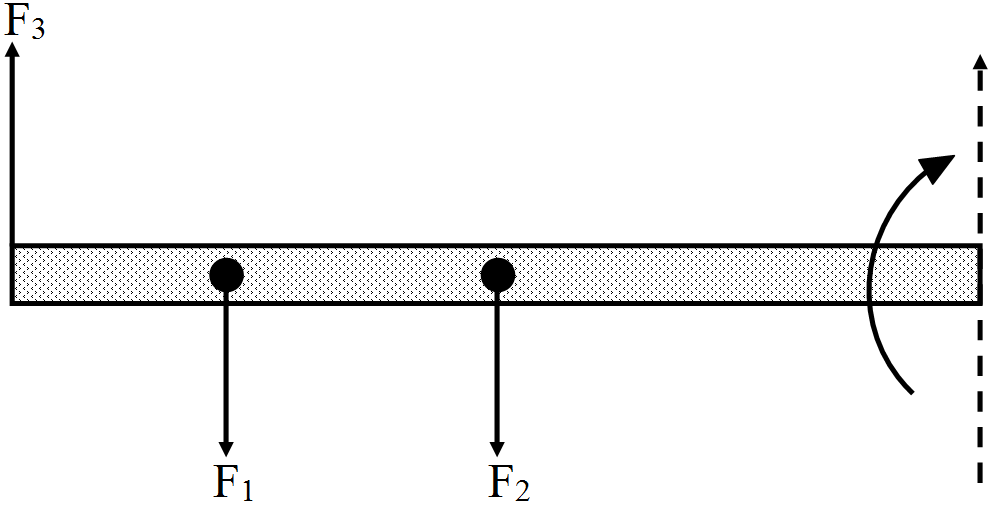
Sum of all torques is $\text{F}_2\times\frac{4}{5}\text{L}+\text{F}_1\times\frac{\text{L}}{2}-\text{F}_3=0$ (no torque due to force F_4) From above equation, $\frac{4}{5}\text{F}_2+\text{F}_1-\text{F}_3=0$
$\text{or }\frac{4}{5}\text{m}_2\text{g}+\text{m}_1\text{g}-\text{F}_3=0\dots(2)$ When all the equations are formed, solve them like linear simultaneous equations to get desired results. In given problem, from Eq. (ii) we get $\text{F}_3=\frac{4}{5}\text{m}_2\text{g}+\text{m}_1\text{g}$
$=\frac{4}{5}\times5\times10+20\times10$
$=20\times12=240\text{N}$
$\text{m}_1=20\text{kg}$
$\text{and }\text{m}_2=5\text{kg}$
$\text{g}=10\text{m/s}^2$ Substituting value of $F_3, m_1$, and $m_2$_, in Eq. (i), we get $240+\text{F}_4-5\times10-20\times10=0$
$\text{or }\text{F}_4=50+200-240$
$\text{F}_4=10\text{N}$ So, support reactions are 240N on left support and 10N on right support.
Forces involved are:
- Weight of beam = $F_1 = m_1g$.
- Weight of mass placed over bean
- Reactions of supports F1 and Fa which we have to found.
In static equilibrium problem, calculation involves the following equations Sum of all vertical (or vertical component of) forces is zero, $\Sigma\text{F}_{\text{v}}=0$ Sum of all horizontal forces or horizontal components of forces is zero, $\Delta\text{F}_{\text{H}}=0$ Sum of all torques is zero. $\Sigma\tau=0$ You may take signs as All forces along + y-direction are positive. All forces along + x-direction are positive. All forces along - y-direction are negative. All forces along -x-direction are negative. All anti-clockwise torques are positive. All clockwise torques are negative. In given problem, as the beam is in equilibrium, $\Sigma\text{F}_{\text{v}}=0$
$\text{or }\text{F}_3+\text{F}_4-\text{F}_2-\text{F}_1=0$
$\text{or }\text{F}_36+\text{F}_4-\text{m}_2\text{g}=0\dots(1)$
$\Sigma\text{F}_{\text{H}}=0$ As there is no horizontal force involved here so, this does not give any equation. and $\Sigma\tau=0$ Let us choose rotation axis through right hand corner of beam.
Sum of all torques is $\text{F}_2\times\frac{4}{5}\text{L}+\text{F}_1\times\frac{\text{L}}{2}-\text{F}_3=0$ (no torque due to force F_4) From above equation, $\frac{4}{5}\text{F}_2+\text{F}_1-\text{F}_3=0$
$\text{or }\frac{4}{5}\text{m}_2\text{g}+\text{m}_1\text{g}-\text{F}_3=0\dots(2)$ When all the equations are formed, solve them like linear simultaneous equations to get desired results. In given problem, from Eq. (ii) we get $\text{F}_3=\frac{4}{5}\text{m}_2\text{g}+\text{m}_1\text{g}$
$=\frac{4}{5}\times5\times10+20\times10$
$=20\times12=240\text{N}$
$\text{m}_1=20\text{kg}$
$\text{and }\text{m}_2=5\text{kg}$
$\text{g}=10\text{m/s}^2$ Substituting value of $F_3, m_1$, and $m_2$_, in Eq. (i), we get $240+\text{F}_4-5\times10-20\times10=0$
$\text{or }\text{F}_4=50+200-240$
$\text{F}_4=10\text{N}$ So, support reactions are 240N on left support and 10N on right support.

Download our appand get started for free
Experience the future of education. Simply download our apps or reach out to us for more information. Let's shape the future of learning together!No signup needed.*
Similar Questions
- 1View SolutionEstablish the relationship between Torque and Moment of Inertia.
- 2View SolutionTwo particles, each of mass m and speed v, travel in opposite directions along parallel lines separated by a distance d. Show that the angular momentum vector of the two particle system is the same whatever be the point about which the angular momentum is taken.
- 3View SolutionA wheel in uniform motion about an axis passing through its centre and perpendicular to its plane is considered to be in mechanical (translational plus rotational) equilibrium because no net external force or torque is required to sustain its motion. However, the particles that constitute the wheel do experience a centripetal acceleration directed towards the centre.How do you reconcile this fact with the wheel being in equilibrium? How would you set a half-wheel into uniform motion about an axis passing through the centre of mass of the wheel and perpendicular to its plane? Will you require external forces to sustain the motion?
- 4View SolutionA disc of radius R is cut out from a larger disc of radius 2R in such a way that the edge of the hole touches the edge of the disc. Locate the centre of mass of the residual disc.
- 5View SolutionA uniform rod of mass m and length l is struck at an end by a force F perpendicular to the rod for a short time interval t. Calculate:
- The speed of the centre of mass.
- The angular speed of the rod about the centre of mass.
- The kinetic energy of the rod.
- The angular momentum of the rod about the centre of mass after the force has stopped to act. Assume that t is so small that the rod does not appreciably change its direction while the force acts.
- 6Point masses $m_1$ and $m_2$ are placed at the opposite ends of a rigid rod of length L, and negligible mass. The rod is to be set in rotation about an axis perpendicular to it. Find the position on this rod through which the axis should pass in order that the work required to set the rod in rotation with angular velocity $\omega_0$ should be minimum.View Solution
- 7View SolutionFigure shows three uniform discs, along with their radii R and masses M. Rank the discs according to their rotational inertia about their central axes, greatest first.
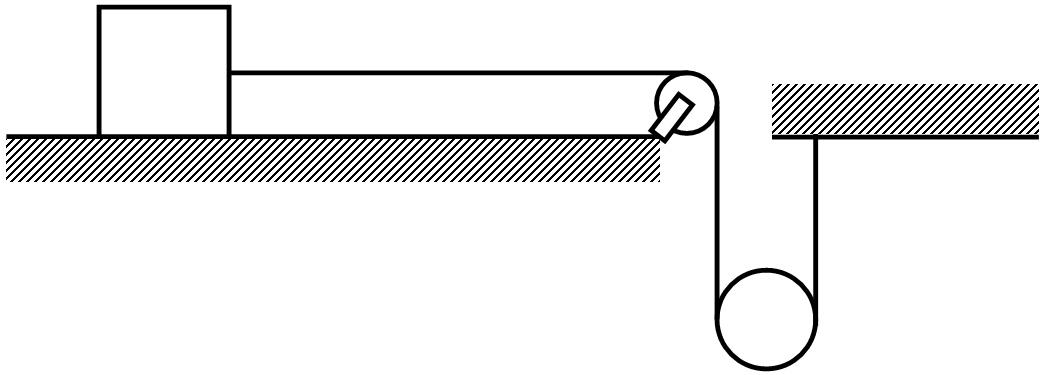
- 8The descending pulley shown in figure has a radius $20cm$ and moment of inertia $0.20kg-m^2$. The fixed pulley is light and the horizontal plane frictionless. Find the acceleration of the block if its mass is $1.0kg$.View Solution
- 9View SolutionTwo discs of same mass and thickness are made of materials having different densities. Which one of them will have larger M.I.?
- 10View SolutionA solid sphere rolls down two different inclined planes of the same heights but different angles of inclination.
- Will it reach the bottom with the same speed in each case?
- Will it take longer to roll down one plane than the other?
- If so, which one and why?