A uniform sphere of mass m and radius R is placed on a rough horizontal surface. The sphere is struck horizontally at a height h from the floor. Match the following: 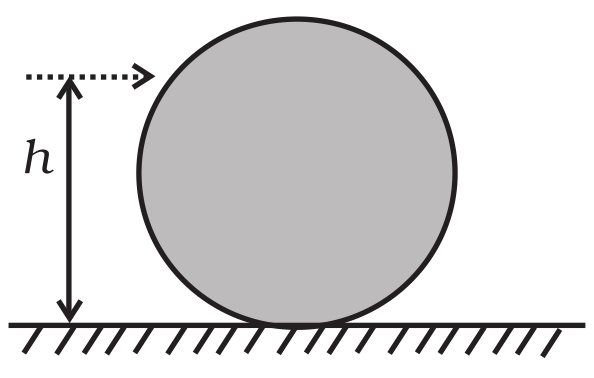
| a. | $\text{h}=\frac{\text{R}}{2}$ | i. | Sphere rolls without slipping with a constant velocity and no loss of energy. |
| b. | $\text{h}=\text{R}$ | ii. | Sphere spins clockwise, loses energy by friction. |
| c. | $\text{h}=\frac{3\text{R}}{2}$ | iii. | Sphere spins anti-clockwise, loses energy by friction. |
| d. | $\text{h}=\frac{7\text{R}}{5}$ | iv. | Sphere has only a translational motion, looses energy by friction. |
Download our app for free and get started
|
a.
|
$\text{h}=\frac{\text{R}}{2}$
|
i.
|
Sphere spins anti-clockwise, loses energy by friction.
|
|
b.
|
$\text{h}=\text{R}$
|
ii.
|
Sphere has only a translational motion, looses energy by friction.
|
|
c.
|
$\text{h}=\frac{3\text{R}}{2}$
|
iii.
|
Sphere spins clockwise, loses energy by friction.
|
|
d.
|
$\text{h}=\frac{7\text{R}}{5}$
|
iv.
|
Sphere rolls without slipping with a constant velocity and no loss of energy.
|
Mass of the sphere = m
Radius = R
h = height from the floor The sphere will roll without slipping when
$\omega=\frac{\text{V}}{\text{R}}$
where, v is linear velocity and to is angular velocity of the sphere.
Now, angular momentum of sphere, about centre of mass [We are applying conservation of angular momentum just before and after struck]
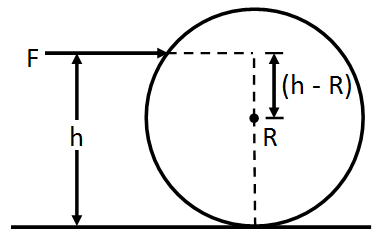
$\text{mv}(\text{h}-\text{R})=\text{I}\omega=\Big(\frac{2}{5}\text{mR}^2\Big)\Big(\frac{\text{v}}{\text{R}}\Big)$
$\Rightarrow\text{mv}(\text{h}-\text{R})=\frac{2}{5}\text{mvR}$
$\Rightarrow\text{h}-\text{R}=\frac{2}{5}\text{R}$
$\Rightarrow\text{h}=\frac{7}{5}\text{R}$
Therefore, the sphere will roll without slipping with a constant velocity and hence, no loss of energy when $\text{h}=\frac{7}{5}\text{R},$ so, (d) matches with (i).
Torque due to applied force about $\text{C.M}.,\tau=\text{F}(\text{h}-\text{R})$ (clockwise)
For, $\tau=0,\text{ h}=\text{R}$ sphereb will have only translationa motion. It would lose energy by friction.

Download our appand get started for free
Experience the future of education. Simply download our apps or reach out to us for more information. Let's shape the future of learning together!No signup needed.*
Similar Questions
- 1Prove the result that the velocity v of translation of a rolling body (like a ring, disc, cylinder or sphere) at the bottom of an inclined plane of height h given by $\text{v}^2=\frac{2\text{gh}}{\big(1+\frac{\text{K}^2}{\text{R}^2}\big)}$ using dynamical consideration. Note K is the radius of gyration of the body about its symmetry axis, and R is the radius of the body. The body starts from rest at the top of the plane.View Solution
- 2View SolutionEstablish the relationship between Torque and Moment of Inertia.
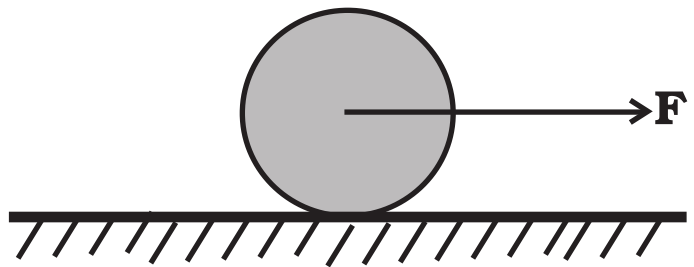
- 3A uniform disc of radius R, is resting on a table on its rim.The coefficient of friction between disc and table is $\mu.$Now the disc is pulled with a force F as shown in the figure. What is the maximum value of F for which the disc rolls without slipping?View Solution
- 4A uniform cube of mass m and side a is placed on a frictionless horizontal surface. A vertical force F is applied to the edge as shown in match the following (most appropriate choice):View Solution
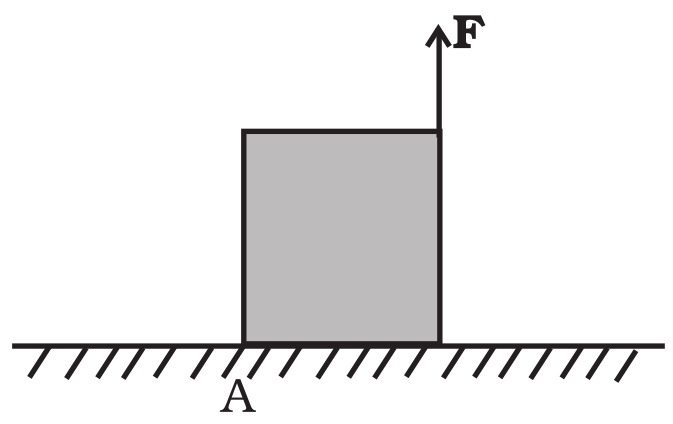
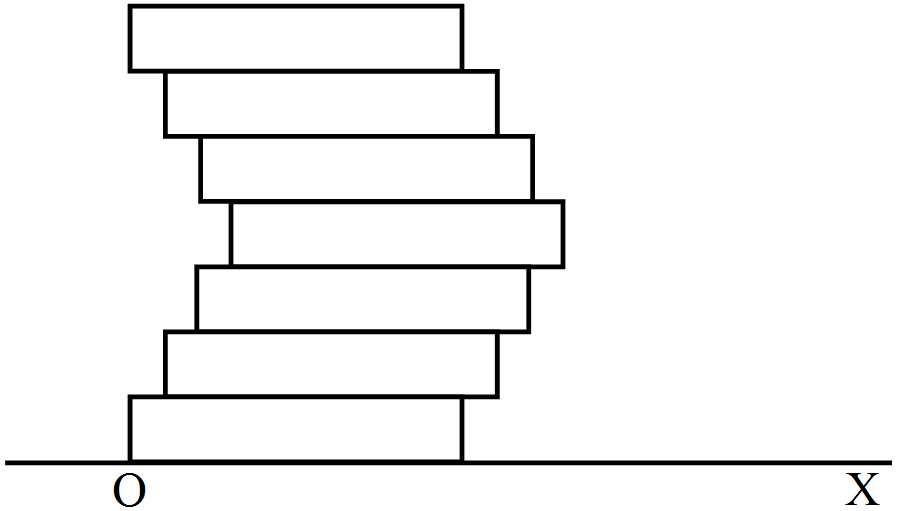
a. $\frac{\text{mg}}{4}<\text{F}<\frac{\text{mg}}{2}$ i. Cube will move up. b. $\text{F}>\frac{\text{mg}}{2}$ ii. Cube will not exhibit motion. c. $\text{F}>\text{mg}$ iii. Cube will begin to rotate and slip at A. d. $\text{F}=\frac{\text{mg}}{4}$ iv. Normal reaction effectively at $\frac{\text{a}}{3}$ - 5Seven homogeneous bricks, each of length L, are arranged as shown in figure. Each brick is displaced with respect to the one in contact by $\frac{\text{L}}{10}.$ Find the x-coordinate of the centre of mass relative to the origin shown.View Solution
- 6View SolutionObtain an expression for linear acceleration of a cylinder rolling down an inclined plane and hence find the condition for the cylinder to roll down the inclined plane without slipping.
- 7Establish the relation $\theta=\omega_0\text{t}+\frac{1}{2}\alpha\text{t}^2$ where the letters have their usual meanings.View Solution
- 8From a uniform disk of radius R, a circular hole of radius $\frac{\text{R}}{2}$ is cut out. The centre of the hole is at $\frac{\text{R}}{2}$ from the centre of the original disc. Locate the centre of gravity of the resulting flat body.View Solution
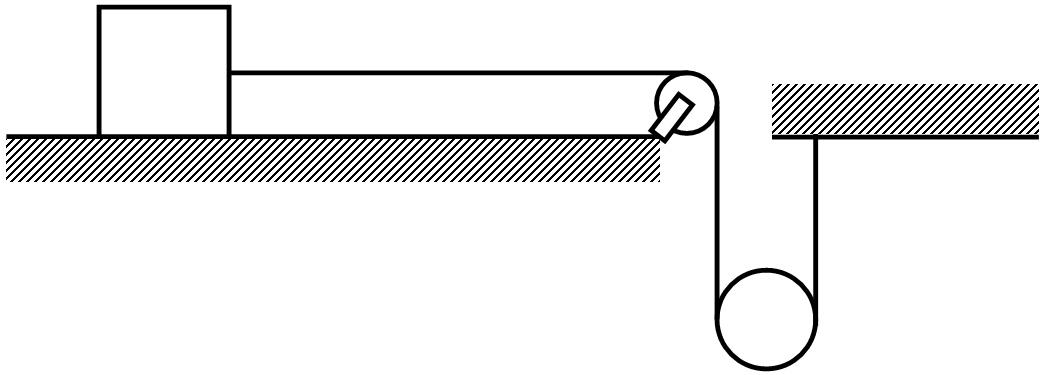
- 9The descending pulley shown in figure has a radius $20cm$ and moment of inertia $0.20kg-m^2$. The fixed pulley is light and the horizontal plane frictionless. Find the acceleration of the block if its mass is $1.0kg$.View Solution
- 10View SolutionDefine radius of gyration and give the physical significance of moment of inertia.