Two particles of mass $2kg$ and $1kg$ are moving along the same line with speeds $2ms-1$ and $5ms^{-1}$ respectively. What is the speed of the centre of mass of the system if both the particles are moving (a) in same direction (b) in opposite direction?
Download our app for free and get started
Here, $m_1 = 2kg, m_2 = 1kg v_1 = 2m/ s, v_2 = 5m/ s, v cm = ? v_1 = 2m/ s, v_2 = -5m/ s, v cm = ?$ Use $\vec{\text{v}}_{\text{cm}}=\frac{\text{m}_1\text{v}_1+\text{m}_2\vec{\text{v}}_2}{\text{m}_1+\text{m}_2}$
- $\vec{\text{v}}_{\text{cm}}=\frac{2\times2+1\times5}{2+1}=3\text{ms}^{-1}$
- $\vec{\text{v}}_{\text{cm}}=\frac{2\times2-5\times1}{2+1}=-\frac{1}{3}\text{ms}^{-1}$

Download our appand get started for free
Experience the future of education. Simply download our apps or reach out to us for more information. Let's shape the future of learning together!No signup needed.*
Similar Questions
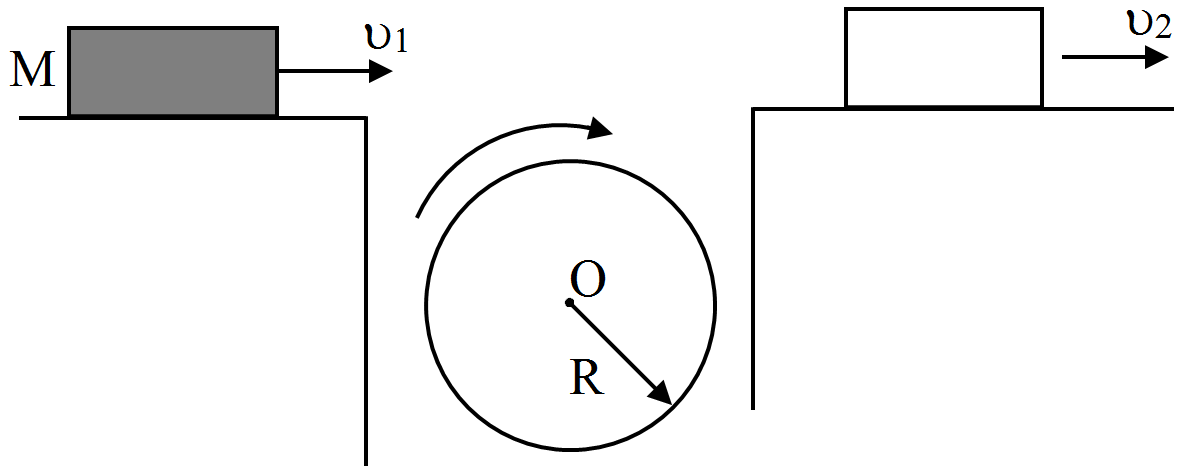
- 1A block of mass M is moving with a velocity $v_1$ on a frictionless surface as shown in fig. It passes over to a cylinder of radius R and moment of inertia I which has fixed axis and is initially at rest. When it first makes contact with the cylinder, it slips on the cylinder, but the friction is large enough so that slipping ceases before it losses contact with the cylinder. Finally it goes to the dotted position with velocity $v_2$ compute $v_2$ in terms of $v_1, M, I$ and $R$.View Solution
- 2View Solution
- Prove the theorem of perpendicular axes.
- Prove the theorem of parallel axes.
- 3View SolutionFind the components along the x, y, z axes of the angular momentum l of a particle, whose position vector is r with components x, y, z and momentum is p with components px, py and pz. Show that if the particle moves only in the x-y plane the angular momentum has only a z-component.
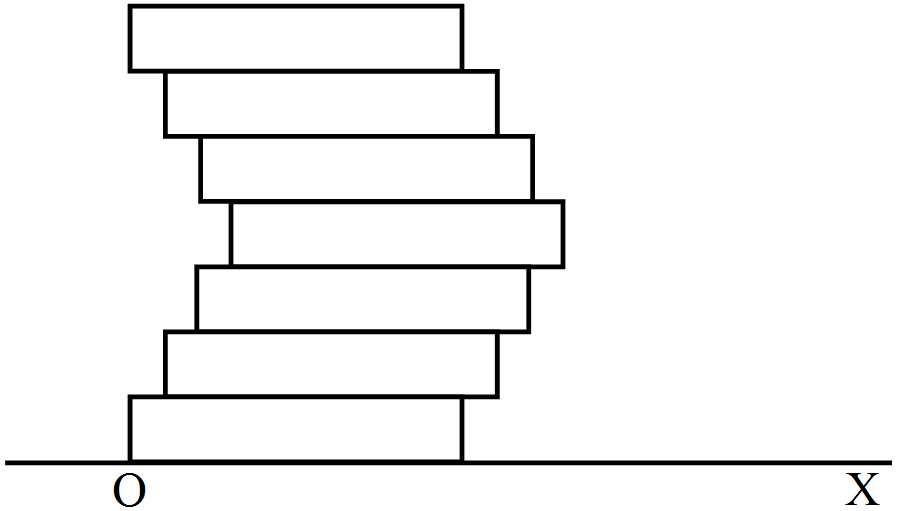
- 4Seven homogeneous bricks, each of length L, are arranged as shown in figure. Each brick is displaced with respect to the one in contact by $\frac{\text{L}}{10}.$ Find the x-coordinate of the centre of mass relative to the origin shown.View Solution
- 53 A man stands on a rotating platform, with his arms stretched horizontally holding a 5kg weight in each hand. The angular speed of the platform is 30 revolutions per minute. The man then brings his arms close to his body with the distance of each weight from the axis changing from 90cm to 20cm. The moment of inertia of the man together with the platform may be taken to be constant and equal to $7.6kgm^2$.View Solution
- What is his new angular speed? (Neglect friction).
- Is kinetic energy conserved in the process? If not, from where does the change come about?
- 6In the HCl molecule, the separation between the nuclei of the two atoms is about $1.27\mathring{\text{A}}\big(1\mathring{\text{A}}= 10^{-10} \text{m}\big).$ Find the approximate location of the CM of the molecule, given that a chlorine atom is about 35.5 times as massive as a hydrogen atom and nearly all the mass of an atom is concentrated in its nucleus.View Solution
- 7Three point masses m,, m, and m, are located at the vertices of an equilateral triangle of side length a. What is the moment of inertia about an axis along the altitude of the triangle passing through $m_1$?View Solution
- 8View SolutionA threaded rod with 12turns/ cm and diameter 1.18cm is mounted horizontally. A bar with a threaded hole to match the rod is screwed onto the rod. The bar spins at 216rev/ min. How long will it take for the bar to move 1.50cm along the rod?
- 9View SolutionA solid sphere rolls down two different inclined planes of the same heights but different angles of inclination.
- Will it reach the bottom with the same speed in each case?
- Will it take longer to roll down one plane than the other?
- If so, which one and why?
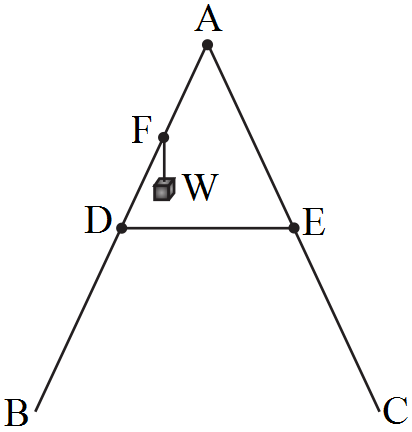
- 10As shown in the two sides of a step ladder BA and CA are 1.6m long and hinged at A. A rope DE, 0.5m is tied half way up. A weight 40kg is suspended from a point F, 1.2m from B along the ladder BA. Assuming the floor to be frictionless and neglecting the weight of the ladder, find the tension in the rope and forces exerted by the floor on the ladder. (Take $g = 9.8m/s^2$) (Hint: Consider the equilibrium of each side of the ladder separately).View Solution