Seven homogeneous bricks, each of length L, are arranged as shown in figure. Each brick is displaced with respect to the one in contact by $\frac{\text{L}}{10}.$ Find the x-coordinate of the centre of mass relative to the origin shown. 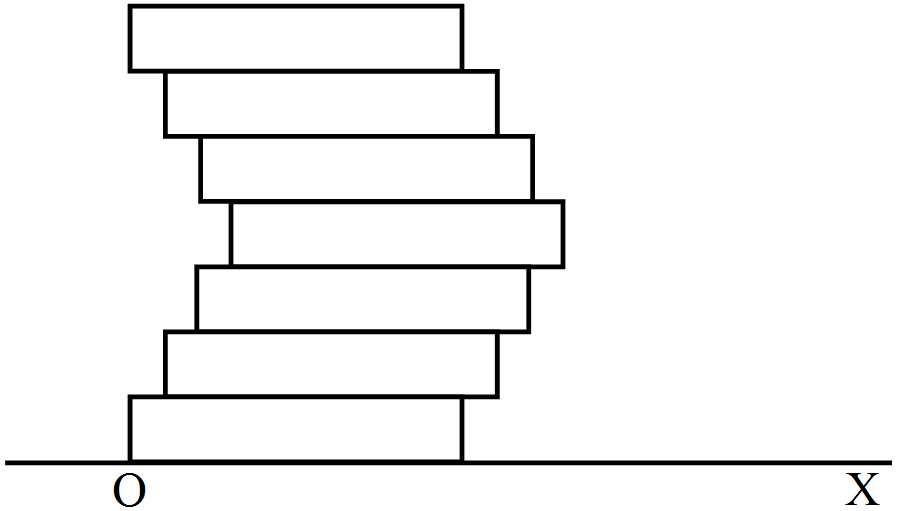
Download our app for free and get started
Let ‘O’ (0, 0) be the origin of the system. Each brick is mass ‘M’ & length ‘L’. Each brick is displaced w.r.t. one in contact by $\frac{\text{L}}{10}$ $\therefore$ The X-coordinate of the centre of mass.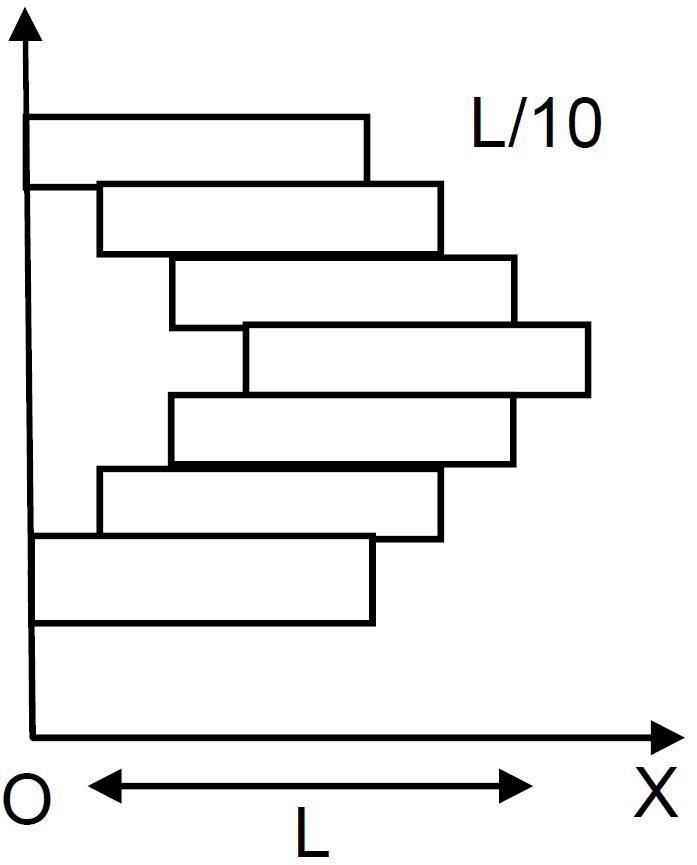
$\overline{\text{X}}_{\text{cm}}=\frac{\text{m}\Big(\frac{\text{L}}{2}\Big)+\text{m}\Big(\frac{\text{L}}{2}+\frac{\text{L}}{10}\Big)+\text{m}\Big(\frac{\text{L}}{2}+\frac{\text{2L}}{10}\Big)+\text{m}\Big(\frac{\text{L}}{2}+\frac{\text{3L}}{10}\Big)+\\\text{m}\Big(\frac{\text{L}}{2}+\frac{\text{3L}}{10}-\frac{\text{L}}{10}\Big)+\text{m}\Big(\frac{\text{L}}{2}+\frac{\text{L}}{10}\Big)+\text{M}\Big(\frac{\text{L}}{2}\Big)}{\text{7m}}$ $=\frac{\frac{\text{L}}{2}+\frac{\text{L}}{2}+\frac{\text{L}}{10}+\frac{\text{L}}{2}+\frac{\text{L}}{5}+\frac{\text{L}}{2}+\frac{\text{3L}}{10}+\frac{\text{L}}{2}+\frac{\text{L}}{5}+\frac{\text{L}}{2}+\frac{\text{L}}{10}+\frac{\text{L}}{2}}{7}$ $=\frac{\frac{\text{7L}}{2}+\frac{\text{5L}}{10}+\frac{\text{2L}}{5}}{7}$ $=\frac{\text{35L}+\text{5L}+\text{4L}}{10\times7}=\frac{\text{44L}}{70}=\frac{11}{35}\text{L}$
$\overline{\text{X}}_{\text{cm}}=\frac{\text{m}\Big(\frac{\text{L}}{2}\Big)+\text{m}\Big(\frac{\text{L}}{2}+\frac{\text{L}}{10}\Big)+\text{m}\Big(\frac{\text{L}}{2}+\frac{\text{2L}}{10}\Big)+\text{m}\Big(\frac{\text{L}}{2}+\frac{\text{3L}}{10}\Big)+\\\text{m}\Big(\frac{\text{L}}{2}+\frac{\text{3L}}{10}-\frac{\text{L}}{10}\Big)+\text{m}\Big(\frac{\text{L}}{2}+\frac{\text{L}}{10}\Big)+\text{M}\Big(\frac{\text{L}}{2}\Big)}{\text{7m}}$ $=\frac{\frac{\text{L}}{2}+\frac{\text{L}}{2}+\frac{\text{L}}{10}+\frac{\text{L}}{2}+\frac{\text{L}}{5}+\frac{\text{L}}{2}+\frac{\text{3L}}{10}+\frac{\text{L}}{2}+\frac{\text{L}}{5}+\frac{\text{L}}{2}+\frac{\text{L}}{10}+\frac{\text{L}}{2}}{7}$ $=\frac{\frac{\text{7L}}{2}+\frac{\text{5L}}{10}+\frac{\text{2L}}{5}}{7}$ $=\frac{\text{35L}+\text{5L}+\text{4L}}{10\times7}=\frac{\text{44L}}{70}=\frac{11}{35}\text{L}$

Download our appand get started for free
Experience the future of education. Simply download our apps or reach out to us for more information. Let's shape the future of learning together!No signup needed.*
Similar Questions
- 1Three point masses m,, m, and m, are located at the vertices of an equilateral triangle of side length a. What is the moment of inertia about an axis along the altitude of the triangle passing through $m_1$?View Solution
- 2A car weighs $1800kg$. The distance between its front and back axles is $1.8m$. Its centre of gravity is $1.05m$ behind the front axle. Determine the force exerted by the level ground on each front wheel and each back wheel.View Solution
- 3A hollow sphere is released from the top of an inclined plane of inclination $\theta.$View Solution
- What should be the minimum coefficient of friction between the sphere and the plane to prevent sliding?
- Find the kinetic energy of the ball as it moves down a length 1 on the incline if the friction coefficient is half the value calculated in part (a).
- 4View SolutionA hoop of radius 2m weighs 100kg. It rolls along a horizontal floor so that its centre of mass has a speed of 20cm/s. How much work has to be done to stop it?
- 5A disc of radius R is rotating with an angular speed $\omega_\text{o}$ about a horizontal axis. It is placed on a horizontal table. The coefficient of kinetic friction is $\mu_\text{k}{:}$View Solution
- What was the velocity of its centre of mass before being brought in contact with the table?
- What happens to the linear velocity of a point on its rim when placed in contact with the table?
- What happens to the linear speed of the centre of mass when disc is placed in contact with the table?
- Which force is responsible for the effects in (b) and (c).
- What condition should be satisfied for rolling to begin?
- Calculate the time taken for the rolling to begin.
- 6View SolutionExplain why friction is necessary to make the disc in roll in the direction indicated.
- Give the direction of frictional force at B, and the sense of frictional torque, before perfect rolling begins.
- What is the force of friction after perfect rolling begins?
- 7Separation of Motion of a system of particles into motion of the centre of mass and motion about the centre of mass: Show $\text{p}=\text{p}'_\text{i}+\text{m}_\text{i}\text{V}$ where $p_i$ is the momentum of the ith particle (of mass $m_i$ ) and $p′_i = m_iv′_i.$ Note: $v′_i$ is the velocity of the ith particle relative to the centre of mass. Also, prove using the definition of the centre of mass.View Solution
- 8View SolutionThree particles of masses 1.0kg, 2.0kg and 3.0kg are placed at the corners A, B and C respectively of an equilateral triangle ABC of edge 1m. Locate the centre of mass of the system.
- 9Suppose the smaller pulley of the previous problem has its radius $5.0cm$ and moment of inertia $0.10kg-m^2$. Find the tension in the part of the string joining the pulleys.View Solution
- 10View SolutionA wheel in uniform motion about an axis passing through its centre and perpendicular to its plane is considered to be in mechanical (translational plus rotational) equilibrium because no net external force or torque is required to sustain its motion. However, the particles that constitute the wheel do experience a centripetal acceleration directed towards the centre.How do you reconcile this fact with the wheel being in equilibrium? How would you set a half-wheel into uniform motion about an axis passing through the centre of mass of the wheel and perpendicular to its plane? Will you require external forces to sustain the motion?