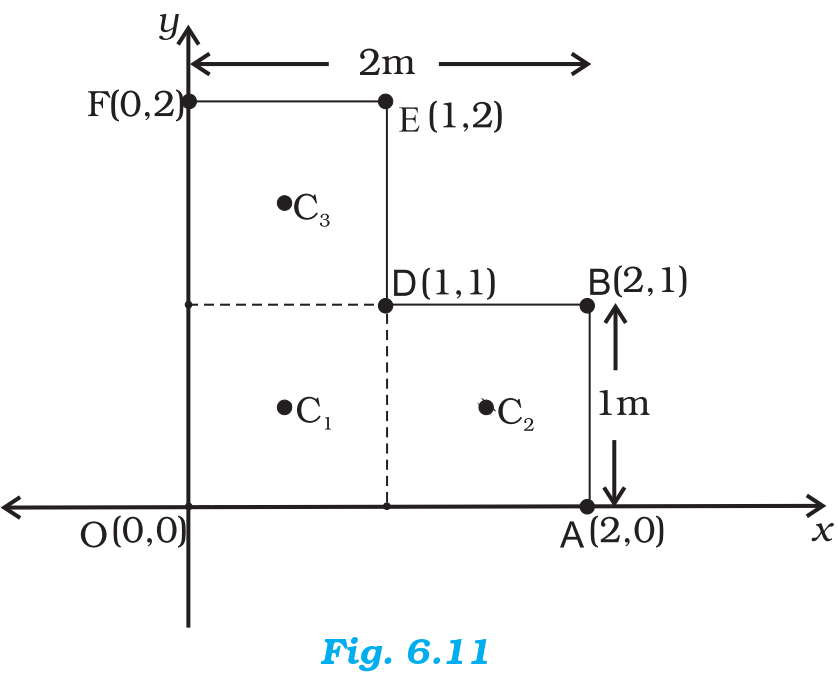
Find the centre of mass of a uniform $L-$shaped lamina $($a thin flat plate$)$ with dimensions as shown. The mass of the lamina is $3 \ kg.$
Example-(6.3)
Download our app for free and get started
Choosing the $X$ and $Y$ axes as shown in Fig. $6.11$ we have the coordinates of the vertices of the $L-$shaped lamina as given in the figure. We can think of the $L-$shape to consist of $3$ squares each of length $1 m$. The mass of each square is $1 \ kg$, since the lamina is uniform. The centres of mass $C _1, C _2$ and $C _3$ of the squares are, by symmetry, their geometric centres and have coordinates $(1/2,1/2), (3 / 2,1 / 2),(1 / 2,3 / 2)$ respectively. We take the masses of the squares to be concentrated at these points. The centre of mass of the whole $L$ shape $(X, Y)$ is the centre of mass of these mass points.
Hence
$X=\frac{[1(1 / 2)+1(3 / 2)+1(1 / 2)] \ kg m }{(1+1+1) \ kg }=\frac{5}{6} m$
$Y=\frac{[1(1 / 2)+1(1 / 2)+1(3 / 2)] \ kg m }{(1+1+1) \ kg }=\frac{5}{6} m$
The centre of mass of the $L-$shape lies on the line $OD.$ We could have guessed this without calculations. Can you tell why? Suppose, the three squares that make up the $L$ shaped lamina of Fig. $6.11$ had different masses. How will you then determine the centre of mass of the lamina?
Hence
$X=\frac{[1(1 / 2)+1(3 / 2)+1(1 / 2)] \ kg m }{(1+1+1) \ kg }=\frac{5}{6} m$
$Y=\frac{[1(1 / 2)+1(1 / 2)+1(3 / 2)] \ kg m }{(1+1+1) \ kg }=\frac{5}{6} m$
The centre of mass of the $L-$shape lies on the line $OD.$ We could have guessed this without calculations. Can you tell why? Suppose, the three squares that make up the $L$ shaped lamina of Fig. $6.11$ had different masses. How will you then determine the centre of mass of the lamina?

Download our appand get started for free
Experience the future of education. Simply download our apps or reach out to us for more information. Let's shape the future of learning together!No signup needed.*
Similar Questions
- 1A meter stick held vertically, with one end on the ground, is then allowed to fall. What is the value of the radial and tangential acceleration of the top end of the stick when the stick has turned through on angle $\theta?$ What is the speed with which the top end of the stick hits the ground? Assume that the end of the stick in. contact with the ground does not slip.View Solution
- 2View SolutionA uniform rod of mass m and length l is struck at an end by a force F perpendicular to the rod for a short time interval t. Calculate:
- The speed of the centre of mass.
- The angular speed of the rod about the centre of mass.
- The kinetic energy of the rod.
- The angular momentum of the rod about the centre of mass after the force has stopped to act. Assume that t is so small that the rod does not appreciably change its direction while the force acts.
- 3What is Mechanical Advantage (M.A.) in the principle of moments for a lever? Find the reactions forces at knife edge as shown in the figure:View Solution
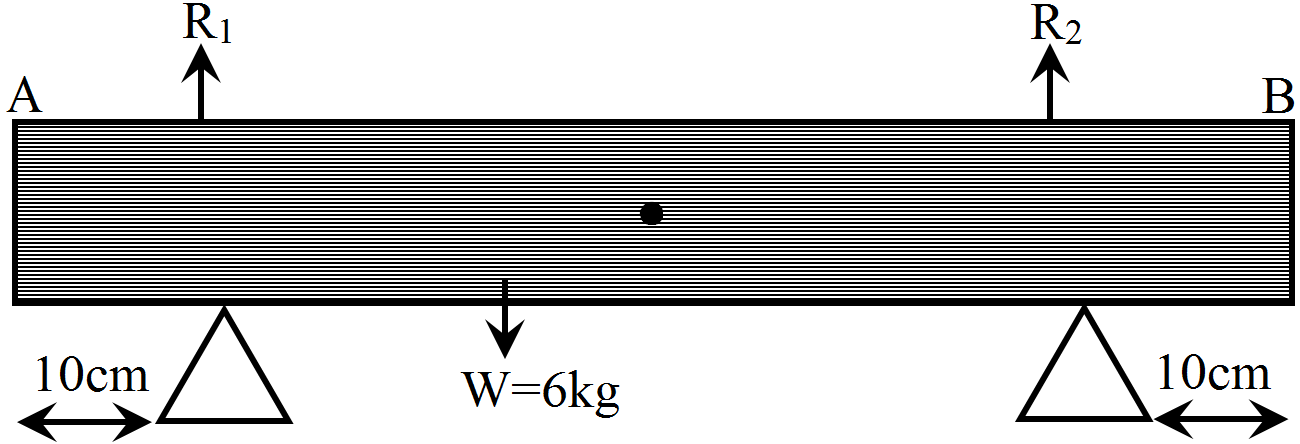
Where AB is a metal bar of $70cm$ length having mass $4kg$ and a $6kg$ load is suspended from $30cm$ from the end A. - 4View SolutionA solid sphere rolls down two different inclined planes of the same heights but different angles of inclination.
- Will it reach the bottom with the same speed in each case?
- Will it take longer to roll down one plane than the other?
- If so, which one and why?
- 5View SolutionA threaded rod with 12turns/ cm and diameter 1.18cm is mounted horizontally. A bar with a threaded hole to match the rod is screwed onto the rod. The bar spins at 216rev/ min. How long will it take for the bar to move 1.50cm along the rod?
- 6A car weighs $1800kg$. The distance between its front and back axles is $1.8m$. Its centre of gravity is $1.05m$ behind the front axle. Determine the force exerted by the level ground on each front wheel and each back wheel.View Solution
- 7Two particles of mass $2kg$ and $1kg$ are moving along the same line with speeds $2ms-1$ and $5ms^{-1}$ respectively. What is the speed of the centre of mass of the system if both the particles are moving (a) in same direction (b) in opposite direction?View Solution
- 8View SolutionShow that a(b × c) is equal in magnitude to the volume of the parallelepiped formed on the three vectors a, b and c.
- 9Prove the result that the velocity v of translation of a rolling body (like a ring, disc, cylinder or sphere) at the bottom of an inclined plane of height h given by $\text{v}^2=\frac{2\text{gh}}{\big(1+\frac{\text{K}^2}{\text{R}^2}\big)}$ using dynamical consideration. Note K is the radius of gyration of the body about its symmetry axis, and R is the radius of the body. The body starts from rest at the top of the plane.View Solution
- 10A uniform rod pivoted at its upper end hangs vertically. It is displaced through an angle of $60°$ and then released. Find the magnitude of the force acting on a particle of mass dm at the tip of the rod when the rod makes an angle of $37°$ with the vertical.View Solution