Prove the result that the velocity v of translation of a rolling body (like a ring, disc, cylinder or sphere) at the bottom of an inclined plane of a height h is given by $\text{v}^2=\frac{2\text{gh}}{\Big(\frac{1+\text{k}^2}{\text{R}^2}\Big)}$ using dynamical consideration (i.e. by consideration of forces and torques).
Note: k is the radius of gyration of the body about its symmetry axis, and R is the radius of the body. The body starts from rest at the top of the plane.
Note: k is the radius of gyration of the body about its symmetry axis, and R is the radius of the body. The body starts from rest at the top of the plane.
Download our app for free and get started
A body rolling on an inclined plane of height h,is shown in the following figure:
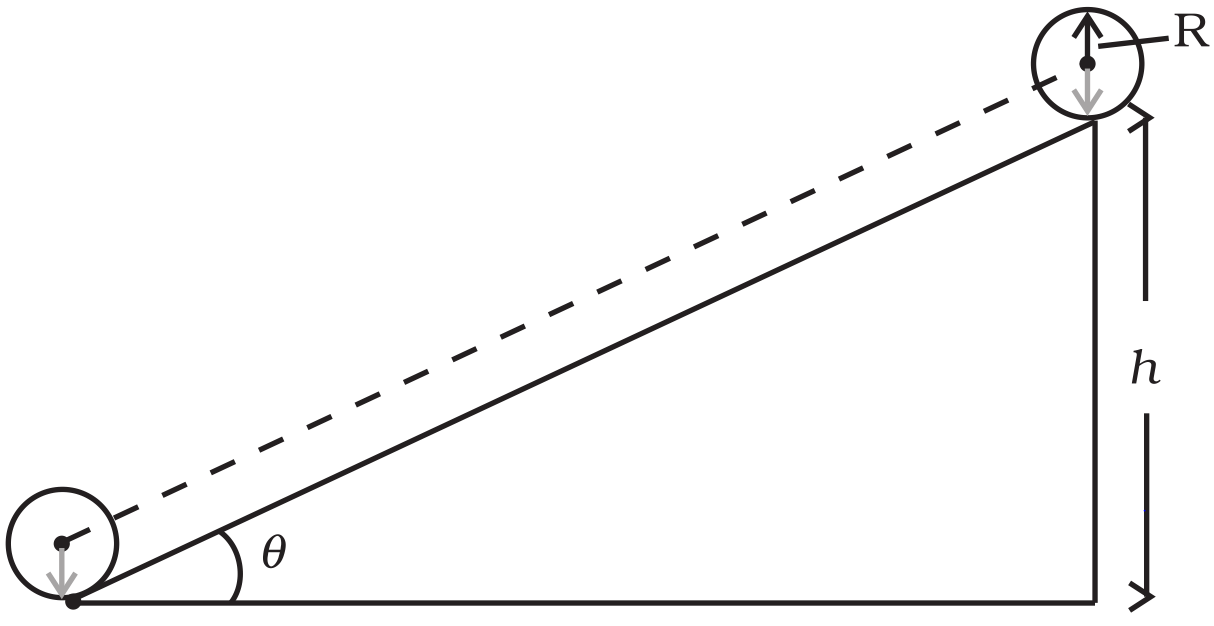
m = Mass of the body. R = Radius of the body. K = Radius of gyration of the body. v = Translational velocity of the body. h =Height of the inclined plane. g = Acceleration due to gravity. Total energy at the top of the plane, $E_1$ = mgh Total energy at the bottom of the plane, $E_b = KE_{rot} + KE_{trans} $
$=\frac{1/2}{\omega^2}+\frac{1}{2}\text{mv}^2$ But $I = mk^2$ and $\omega=\frac{\text{v}}{\text{R}}$ $\therefore\ \text{E}_{\text{b}}=\frac{1\text{mk}^2\text{v}^2}{2\text{R}^2}+\frac{1}{2}\text{mv}^2$ From the law of conservation of energy, we have, $\text{E}_{\text{T}}=\text{E}_{\text{b}}$ $\text{mgh}=\Big(\frac{1\text{mv}^21+\text{k}^2}{2\text{R}^2}\Big)$
$\therefore\ \text{v}^2=\frac{2\text{gh}}{\Big(\frac{1+\text{k}^2}{\text{R}^2}\Big)}$ Hence, the given result is proved.
m = Mass of the body. R = Radius of the body. K = Radius of gyration of the body. v = Translational velocity of the body. h =Height of the inclined plane. g = Acceleration due to gravity. Total energy at the top of the plane, $E_1$ = mgh Total energy at the bottom of the plane, $E_b = KE_{rot} + KE_{trans} $
$=\frac{1/2}{\omega^2}+\frac{1}{2}\text{mv}^2$ But $I = mk^2$ and $\omega=\frac{\text{v}}{\text{R}}$ $\therefore\ \text{E}_{\text{b}}=\frac{1\text{mk}^2\text{v}^2}{2\text{R}^2}+\frac{1}{2}\text{mv}^2$ From the law of conservation of energy, we have, $\text{E}_{\text{T}}=\text{E}_{\text{b}}$ $\text{mgh}=\Big(\frac{1\text{mv}^21+\text{k}^2}{2\text{R}^2}\Big)$
$\therefore\ \text{v}^2=\frac{2\text{gh}}{\Big(\frac{1+\text{k}^2}{\text{R}^2}\Big)}$ Hence, the given result is proved.

Download our appand get started for free
Experience the future of education. Simply download our apps or reach out to us for more information. Let's shape the future of learning together!No signup needed.*
Similar Questions
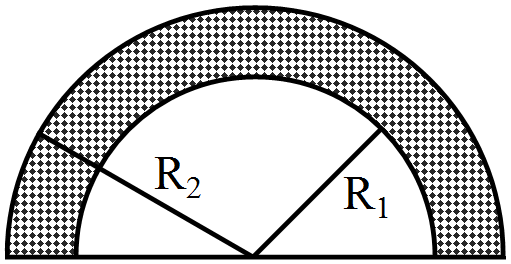
- 1Find the centre of mass of a uniform plate having semicircular inner and outer boundaries of radii $R_1$ and $R_2$.View Solution
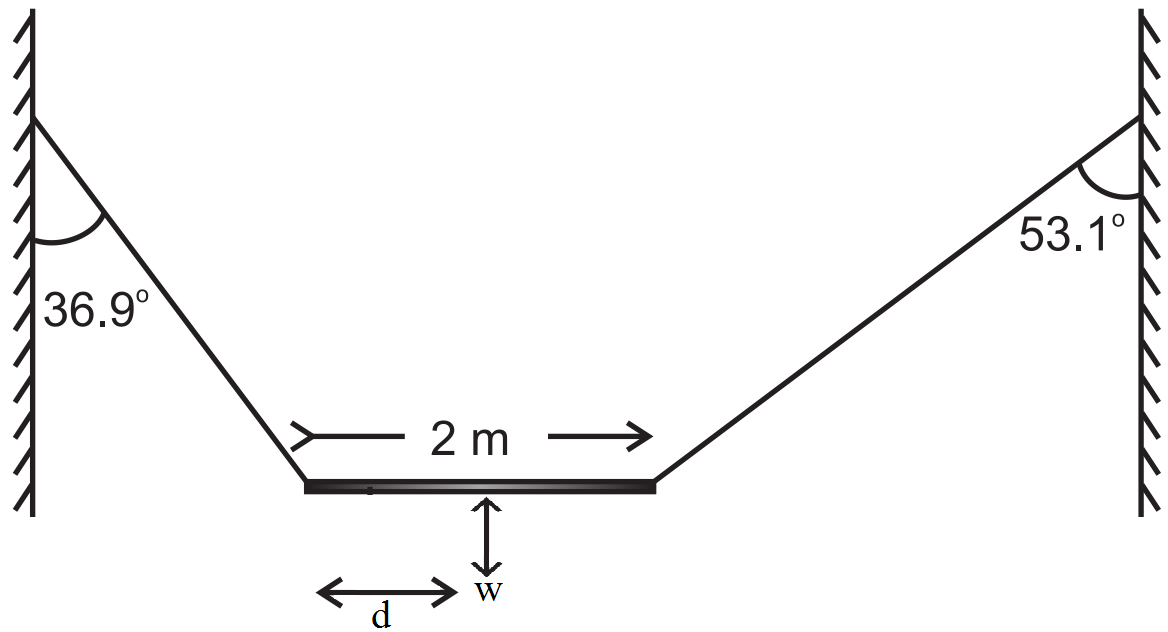
- 2A non-uniform bar of weight W is suspended at rest by two strings of negligible weight as shown in. The angles made by the strings with the vertical are $36.9°$ and $53.1°$ respectively. The bar is $2m$ long. Calculate the distance d of the centre of gravity of the bar from its left end.View Solution
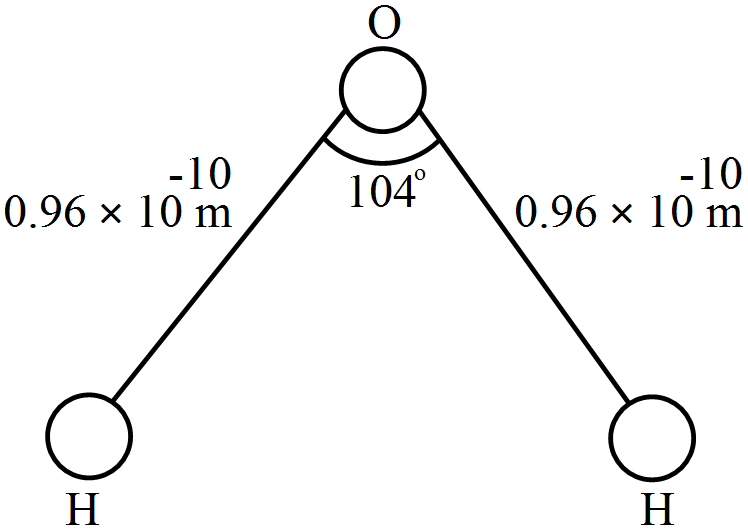
- 3View SolutionThe structure of a water molecule is shown in figure. Find the distance of the centre of mass of the molecule from the centre of the oxygen atom.
- 4A disc of radius R is rotating with an angular speed $\omega_\text{o}$ about a horizontal axis. It is placed on a horizontal table. The coefficient of kinetic friction is $\mu_\text{k}{:}$View Solution
- What was the velocity of its centre of mass before being brought in contact with the table?
- What happens to the linear velocity of a point on its rim when placed in contact with the table?
- What happens to the linear speed of the centre of mass when disc is placed in contact with the table?
- Which force is responsible for the effects in (b) and (c).
- What condition should be satisfied for rolling to begin?
- Calculate the time taken for the rolling to begin.
- 5View SolutionThe pulleys in figure are identical, each having a radius R and moment of inertia I. Find the acceleration of the block M.
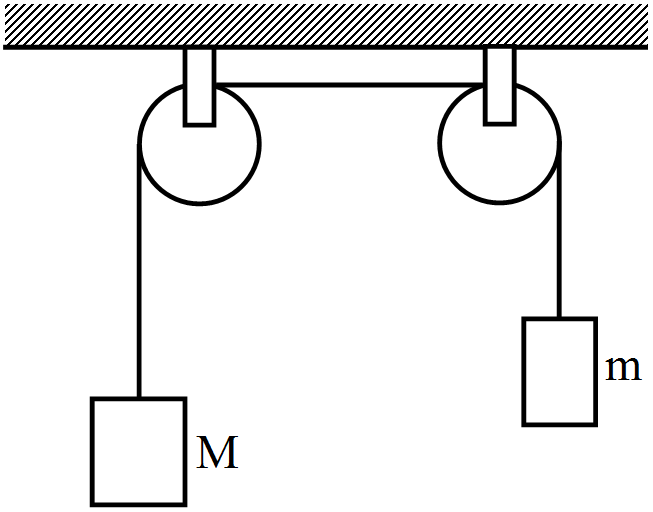
- 6View SolutionEstablish the relationship between Torque and Moment of Inertia.
- 7View Solution
- Prove the theorem of perpendicular axes.
- Prove the theorem of parallel axes.
- 8View SolutionCalculate the velocity of the centre of mass of the system of particles shown in figure.
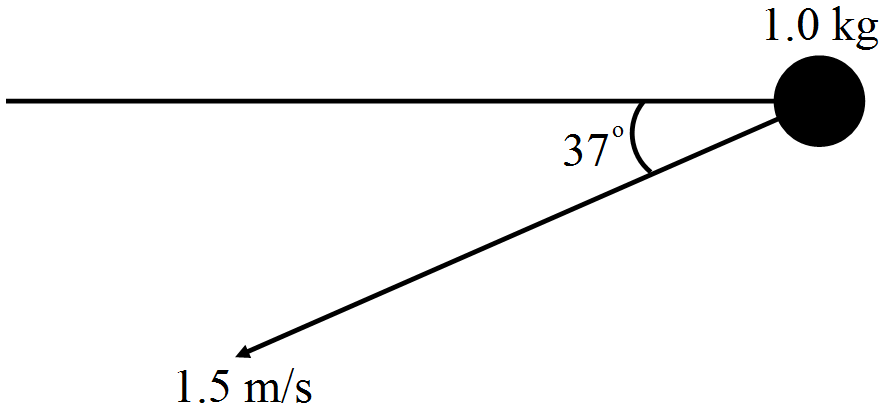
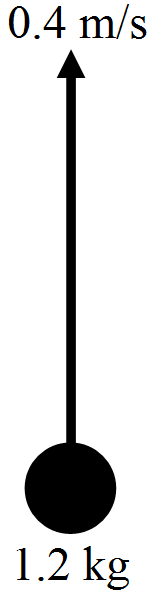
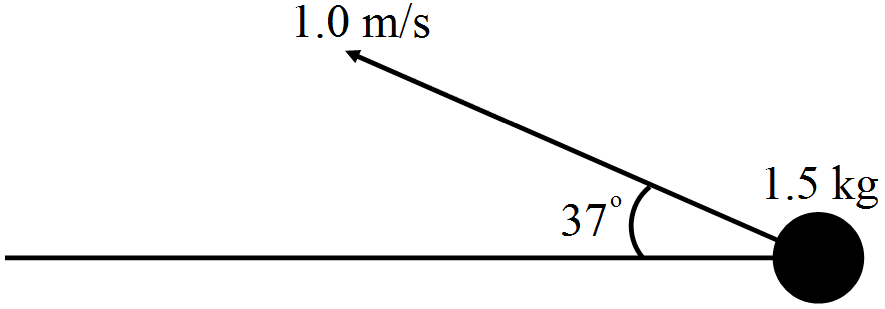

- 9A car weighs $1800kg$. The distance between its front and back axles is $1.8m$. Its centre of gravity is $1.05m$ behind the front axle. Determine the force exerted by the level ground on each front wheel and each back wheel.View Solution
- 10View SolutionA uniform disc of radius R and mass M is mounted on an axis supported in fixed frictionless bearing. A light chord is wrapped around the rim of the wheel and suppose that we hang a body of mass m from the chord. Find the angular acceleration of the disc and tangential acceleration of point on the rim.