You are given n resistors each of resistance r. They are first connected to get the minimum possible resistance. In the second case, these are again connected differently to get the maximum possible resistance. Calculate the ratio between minimum and maximum values of resistance so obtained.
Download our app for free and get started
For minimum possible resistance, the resistors should be connected in parallel
$\frac{1}{\text{r}_\text{p}}=\frac{1}{\text{r}}+\frac{1}{\text{r}}+\dots\text{n}\text{ times}$
$\frac{1}{\text{r}_\text{p}}=\frac{\text{n}}{\text{r}}$
$\text{r}_\text{p}=\frac{\text{r}}{\text{n}}$
For maximum possible resistance, the resistors should be connected in series,
$\text{r}_\text{s}=\text{r}+\text{r}+\dots\text{n times}$
$\text{r}_\text{s}=\text{nr}$
$\text{Ratio}\frac{\text{r}_\text{p}}{\text{r}_\text{s}}=\frac{\text{r}}{\text{n}}\times\frac{1}{\text{nr}}=\frac{1}{\text{n}^2}$
$\frac{1}{\text{r}_\text{p}}=\frac{1}{\text{r}}+\frac{1}{\text{r}}+\dots\text{n}\text{ times}$
$\frac{1}{\text{r}_\text{p}}=\frac{\text{n}}{\text{r}}$
$\text{r}_\text{p}=\frac{\text{r}}{\text{n}}$
For maximum possible resistance, the resistors should be connected in series,
$\text{r}_\text{s}=\text{r}+\text{r}+\dots\text{n times}$
$\text{r}_\text{s}=\text{nr}$
$\text{Ratio}\frac{\text{r}_\text{p}}{\text{r}_\text{s}}=\frac{\text{r}}{\text{n}}\times\frac{1}{\text{nr}}=\frac{1}{\text{n}^2}$

Download our appand get started for free
Experience the future of education. Simply download our apps or reach out to us for more information. Let's shape the future of learning together!No signup needed.*
Similar Questions
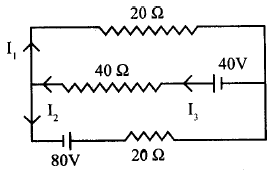
- 1View SolutionState Kirchhoff's rules of current distribution in an electrical network. Using these rules determine the value of the current I1 in the electric circuit given below.
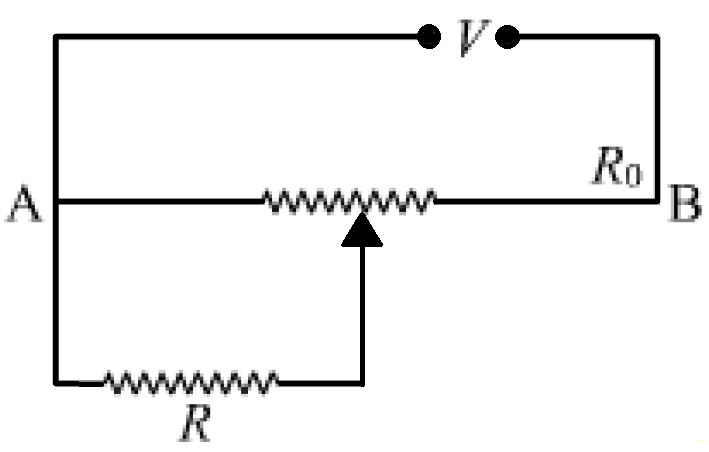
- 2A resistance of R draws current from a potentiometer. The potentiometer wire $, AB, $ has a total resistance of $R_o. A$ voltage $V$ is supplied to the potentiometer. Derive an expression for the voltage across $R$ when the sliding contact is in the middle of potentiometer wire.View Solution
- 3View SolutionA voltage of 30V is applied across a carbon resistor with first, second and third rings of blue, black and yellow colours respectively. Calculate the value of current in mA, through the resistor.
- 4A potential difference $V$ is applied across a conductor of length $L$ and diameter $D.$ How is the drift velocity, $V_d,$ of charge carriers in the conductor affected when $(i) \ V$ is halved, $(ii) \ L$ is doubled and $(iii) \ D$ is halved? Justify your answer in each case.View Solution
- 5View SolutionFor the potentiometer circuit shown in the given figure, points X and Y represent the two terminals of an unknown emf E'. A student observed that when the jockey is moved from the end A to the end B of the potentiometer wire, the deflection in the galvanometer remains in the same direction.
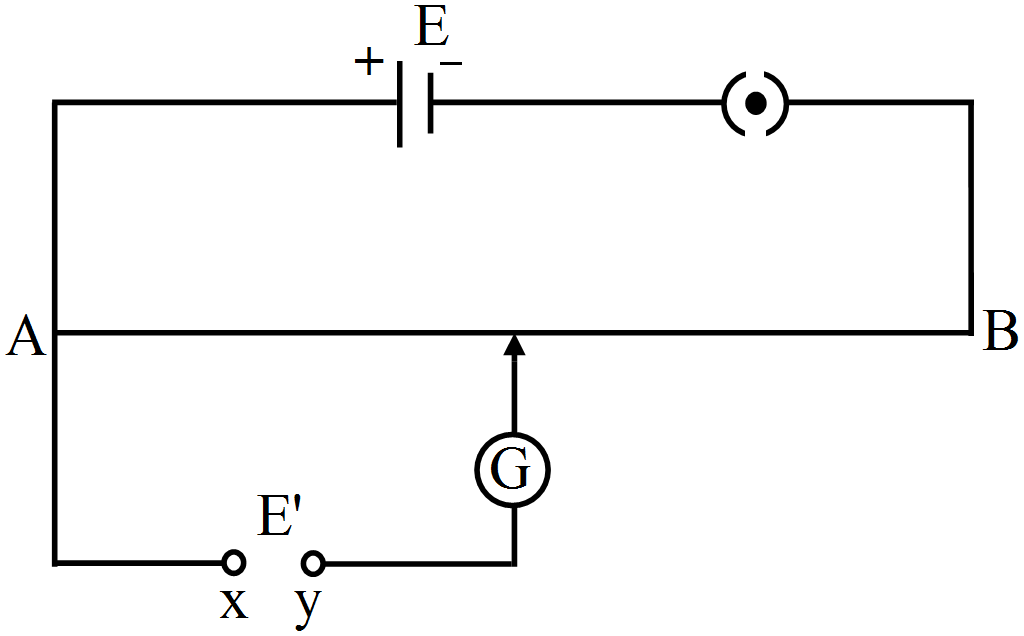
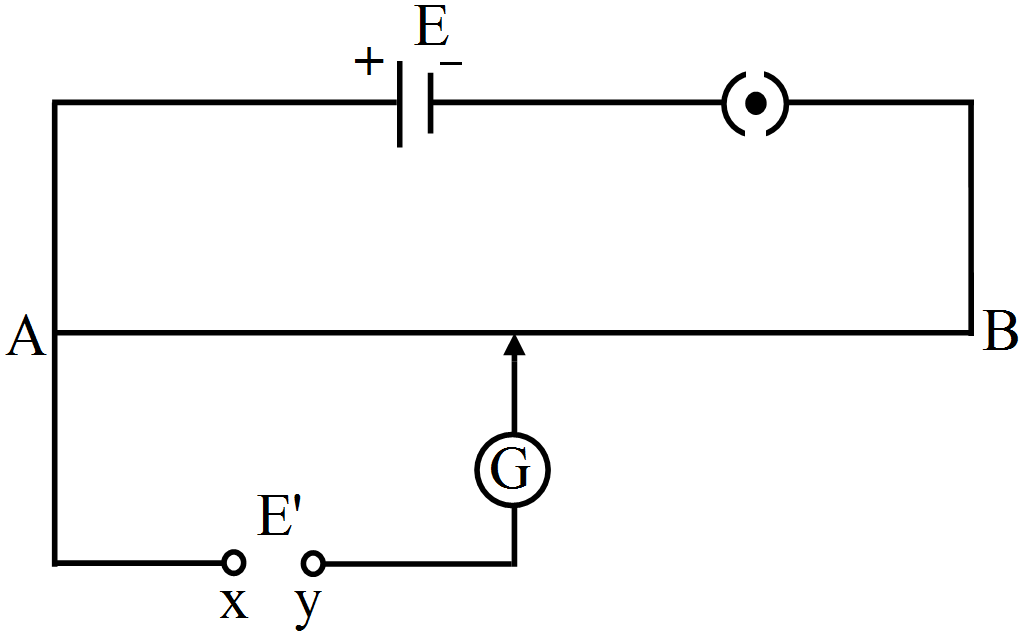
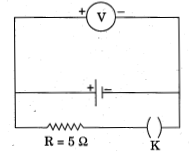
What may be the two possible faults in the circuit that could result in this observation? If the galvanometer deflection at the end B is (i) more, (ii) less than at the end A, which of the two faults, listed above, would be there in the circuit? Give reason in support of your answer in each case. - 6View SolutionWrite any two factors on which internal resistance of a cell depends. The reading on a high resistance voltmeter, when a cell is connected across it, is 2.2 V. When the terminals of the cell are also connected to a resistance of 5 Ω as shown in the circuit, the voltmeter reading drops to 1.8 V. Find the internal resistance of the cell.
- 7View SolutionFor the potentiometer circuit shown in the given figure, points X and Y reprensent the two terminals of an unknown emf E'. A student observed that when the jockey in moved from the end A to the end B of the potentiometer wire, the deflection in the galvanometer remains in the same direction.

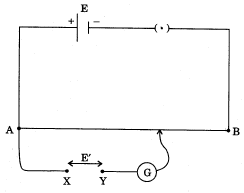 What may be the two possible faults in the circuit that could result in this obsevation?
If the galvanometer deflection at the end B is (i) more, (ii) less, than that at the end A, which of the two faults, listed above, would be there in the circuit?
Give reasons in support of your answer in each case. - 8A capacitance C charged to a potential difference V is discharged by connecting its plates through a resistance R. Find the heat dissipated in one time constant after the connections are made. Do this by calculating $\int\text{i}^2\text{R}$ dt and also by finding the decrease in the energy stored in the capacitor.View Solution
- 9View SolutionA potentiometer wire of length 1 m is connected to a driver cell of emf 3 V as shown in the figure. When a cell of 1.5 V emf is used in the secondary circuit, the balance point is found to be 60 cm. On replacing this cell and using a cell of unknown emf, the balance point shifts to 80 cm.
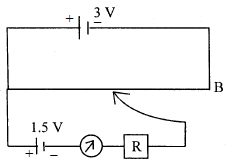
- Calculate unknown emf of the cell.
- Explain with reason, whether the circuit works, if the driver cell is replaced with a cell of emf 1 V.
- Does the high resistance R, used in the secondary circuit affect the balance point? Justify your answer.
- 10View SolutionThe following circuit shows the use of potentiometer to measure the internal resistance of a cell:
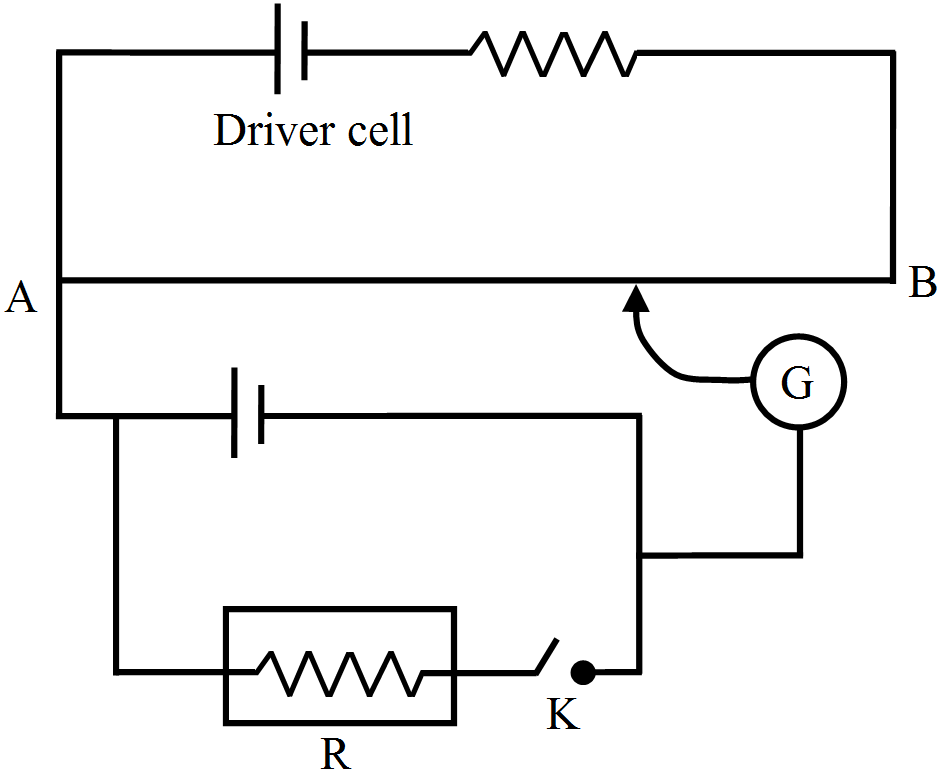
- When the key is open, how does the balance point change, if the current from the driver cell decreases?
- When the key K is closed, how does the balance point change if R is increased keeping current from the driver cell constant?