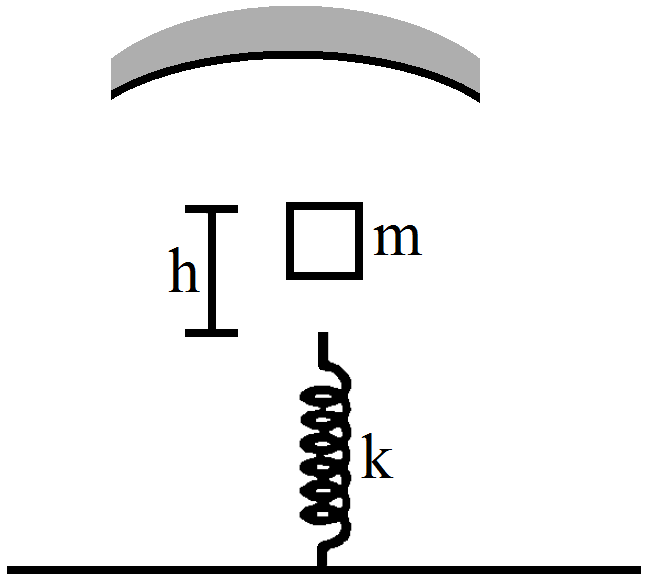
A mass m = 50g is dropped on a vertical spring of spring constant 500N/m from a height h = 10cm as shown in figure. The mass sticks to the spring and executes simple harmonic oscillations after that. A concave mirror of focal length 12cm facing the mass is fixed with its principal axis coinciding with the line of motion of the mass, its pole being at a distance of 30cm from the free end of the spring. Find the length in which the image of the mass oscillates.
Download our app for free and get started
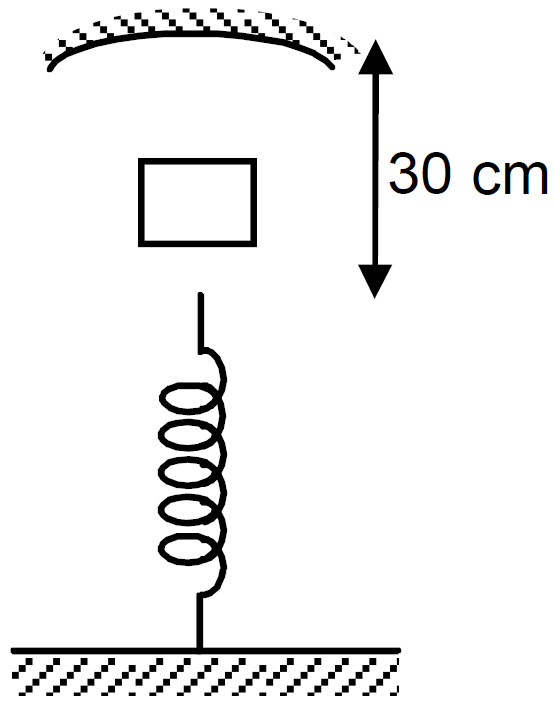
Due to weight of the body suppose the spring is compressed by which is the mean position of oscillation.
$m = 50 \times 10^{-3}kg, g = 10ms^{-2}, k = 500Nm^{-2}, h = 10cm = 0.1m$
For equilibrium, $\text{mg}=\text{kx}\Rightarrow\text{x}=\frac{\text{mg}}{\text{k}}=10^{-3}\text{m}=0.1\text{cm}$
So, the mean position is at 30 + 0.1 = 30.1cm from P (mirror).
Suppose, maximum compression in spring is $\delta.$
Since, E.K.E. - I.K.E. = Work done
$\Rightarrow0-0=\text{mg}(\text{h}+\delta)-\frac{1}{2}\text{k}\delta^2$ (work energy principle)
$\Rightarrow\text{mg}(\text{h}+\delta)-\frac{1}{2}\text{k}\delta^2\Rightarrow50\times10^{-3}\times10(0.1+\delta)-\frac{1}{2}500\delta^2$
So, $\delta=\frac{0.5\pm\sqrt{0.25+50}}{2\times250}=0.015\text{m}=1.5\text{cm}$
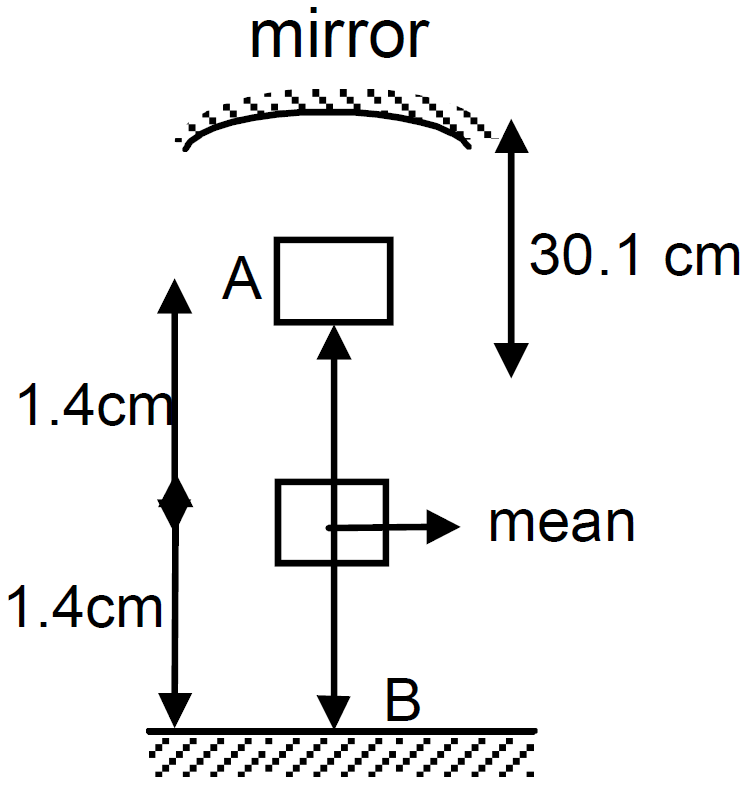
Amplitude of the vibration $= 31.5 - 30.1 - 1.4.$
Position A is $30.1 - 1.4 = 28.7cm$ from pole.
For A $u = -31.5, f = -12cm$
$\therefore \ \frac{1}{\text{v}}=\frac{1}{\text{f}}-\frac{1}{\text{u}}=-\frac{1}{12}+\frac{1}{31.5}$
$\Rightarrow\text{V}_{\text{A}}=-19.38\text{cm}$
For B $ f = -12cm, u = -28.7cm$
$\frac{1}{\text{v}}=\frac{1}{\text{f}}-\frac{1}{\text{u}}=-\frac{1}{12}+\frac{1}{28.7}$
$\Rightarrow \ \text{V}_\text{B}=-20.62\text{cm}$
The image vibrates in length $(20.62 - 19.38) = 1.24cm.$

Download our appand get started for free
Experience the future of education. Simply download our apps or reach out to us for more information. Let's shape the future of learning together!No signup needed.*
Similar Questions
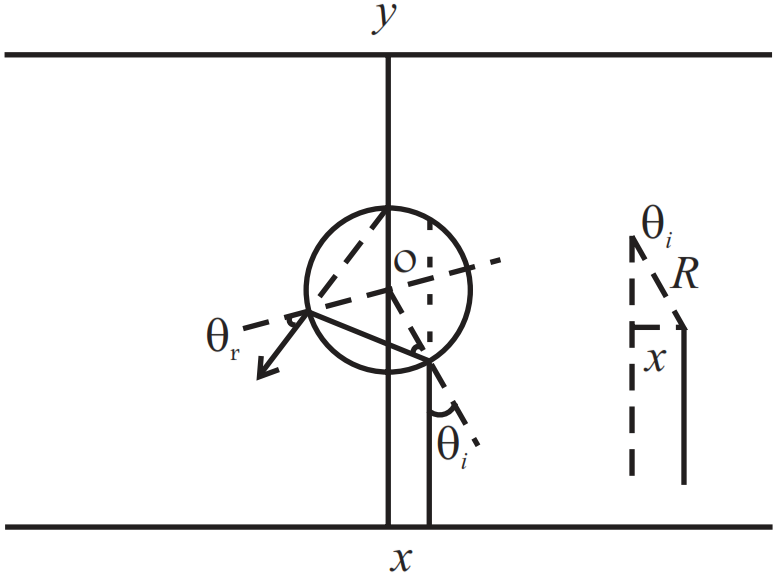
- 1View SolutionAn infinitely long cylinder of radius R is made of an unusual exotic material with refractive index -1 (Fig). The cylinder is placed between two planes whose normals are along the y direction. The center of the cylinder O lies along the y-axis. A narrow laser beam is directed along the y direction from the lower plate. The laser source is at a horizontal distance x from the diameter in the y direction. Find the range of x such that light emitted from the lower plane does not reach the upper plane.
- 2View SolutionA point object is placed at a distance of 15cm from a convex lens. The image is formed on the other side at a distance of 30cm from the lens. When a concave lens is placed in contact with the convex lens, the image shifts away further by 30cm. Calculate the focal lengths of the two lenses.
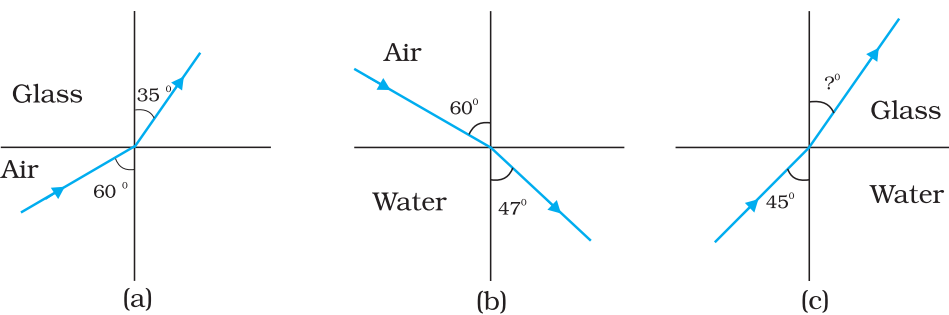
- 3View Solution(a) and (b) show refraction of a ray in air incident at 60° with the normal to a glass-air and water-air interface, respectively. Predict the angle of refraction in glass when the angle of incidence in water is 45º with the normal to a water - glass interface.
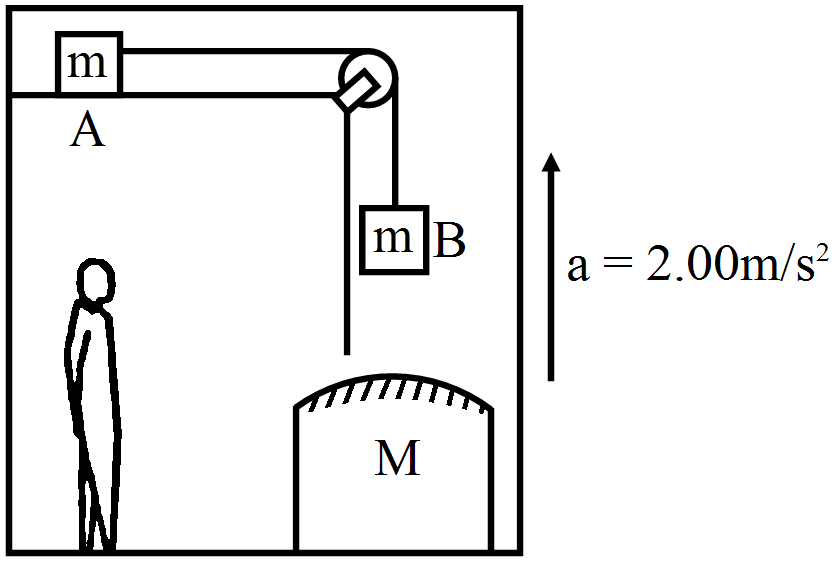
- 4Consider the situation shown in figure. The elevator is going up with an acceleration of $2.00m/s^2$ and the focal length of the mirror is 12.0cm. All the surfaces are smooth and the pulley is light. The mass-pulley system is released from rest (with respect to the elevator) at t = 0 when the distance of B from the mirror is 42.0cm. Find the distance between the image of the block B and the mirror at $t = 0.200s$. Take $g = 10m/s^2$.View Solution
- 5View Solution
- Draw the ray diagram showing refraction of light through a glass prism and hence obtain the relation between the refractive index $\mu$ of the prism, angle of prism and angle of minimum deviation.
- Determine the value of the angle of incidence for a ray of light travelling from a medium of refractive index $\mu_1=\sqrt{2}$ into the medium of refractive index $\mu_2=1$, so that it just grazes along the surface of separation.
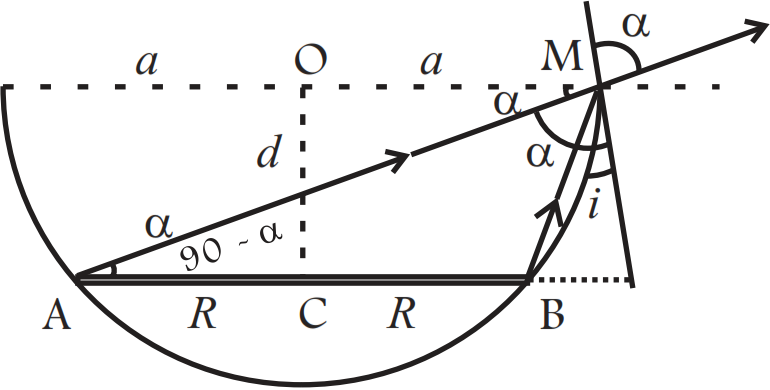
- 6View SolutionA circular disc of radius 'R' is placed co-axially and horizontally inside an opaque hemispherical bowl of radius 'a' (Fig). The far edge of the disc is just visible when viewed from the edge of the bowl. The bowl is filled with transparent liquid of refractive index μ and the near edge of the disc becomes just visible. How far below the top of the bowl is the disc placed?
- 7View SolutionA myopic adult has a far point at 0.1m. His power of accomodation is 4 diopters.
- What power lenses are required to see distant objects?
- What is his near point without glasses?
- What is his near point with glasses? (Take the image distance from the lens of the eye to the retina to be 2cm.)
- 8View SolutionA man with normal near point (25 cm) reads a book with small print using a magnifying glass: a thin convex lens of focal length 5 cm.
- What is the closest and the farthest distance at which he should keep the lens from the page so that he can read the book when viewing through the magnifying glass?
- What is the maximum and the minimum angular magnification (magnifying power) possible using the above simple microscope?
- 9View SolutionA particle executes a simple harmonic motion of amplitude 1.0cm along the principal axis of a convex lens of focal length 12cm. The mean position of oscillation is at 20cm from the lens. Find the amplitude of oscillation of the image of the particle.
- 10View SolutionAn eye can distinguish between two points of an object if they are separated by more than 0.22mm when the object is placed at 25cm from the eye. The object is now seen by a compound microscope having a 20D objective and 10D eyepiece separated by a distance of 20cm. The final image is formed at 25cm from the eye. What is the minimum separation between two points of the object which can now be distinguished?