A voltage of 30V is applied across a carbon resistor with first, second and third rings of blue, black and yellow colours respectively. Calculate the value of current in mA, through the resistor.
Download our app for free and get started
Value of first digit (blue ring) = 6
Value of second digit (black ring) = 0
Multiplier (yellow ring) = 104
$\therefore$ Resistance, $\text{R} = 60 \times104\Omega, $ Voltage, V = 30V
Current $\text{I}=\frac{\text{V}}{\text{R}}=\frac{30}{60\times10^4}=0.5\times10^{-4}\text{A}=0.05\text{mA.}$
Value of second digit (black ring) = 0
Multiplier (yellow ring) = 104
$\therefore$ Resistance, $\text{R} = 60 \times104\Omega, $ Voltage, V = 30V
Current $\text{I}=\frac{\text{V}}{\text{R}}=\frac{30}{60\times10^4}=0.5\times10^{-4}\text{A}=0.05\text{mA.}$

Download our appand get started for free
Experience the future of education. Simply download our apps or reach out to us for more information. Let's shape the future of learning together!No signup needed.*
Similar Questions
- 1View SolutionThe specification on a heater coil is 250V, 500W. Calculate the resistance of the coil. What will be the resistance of a coil of 1000W to operate at the same voltage?
- 2View SolutionDefine relaxation time of the free electrons drifting in a conductor. How is it related to the drift velocity of free electrons? Use this relation to deduce the expression for the electrical resistivity of the material.
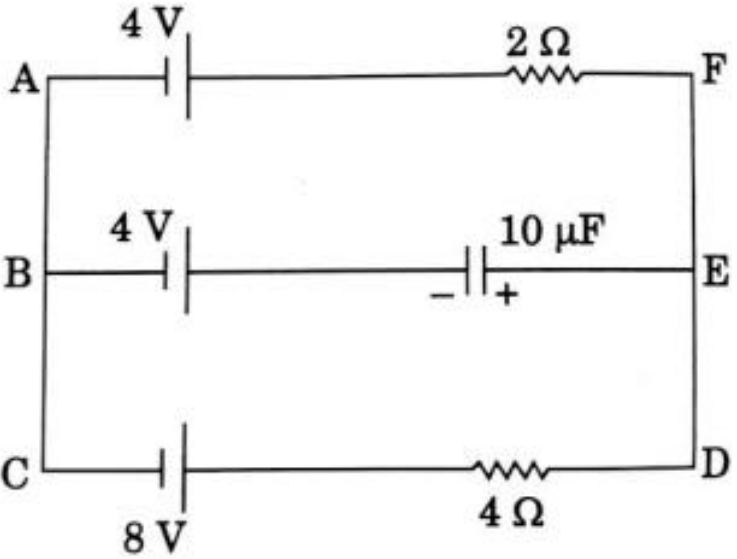
- 3View SolutionIn the given circuit, with steady current, calculate the potential drop across the capacitor and the charge stored in it.
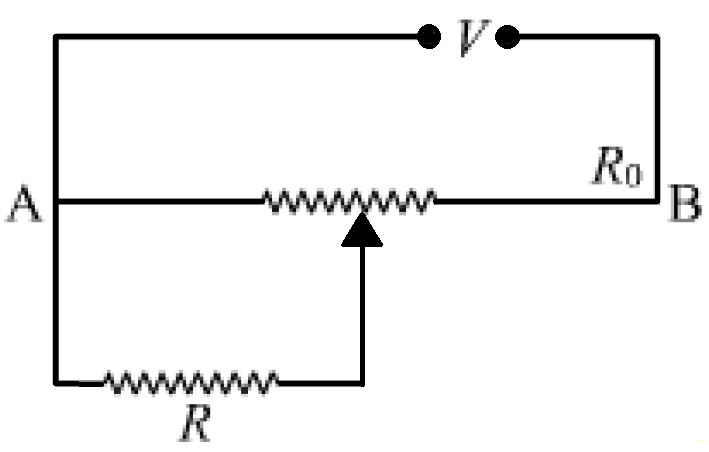
- 4A resistance of R draws current from a potentiometer. The potentiometer wire $, AB, $ has a total resistance of $R_o. A$ voltage $V$ is supplied to the potentiometer. Derive an expression for the voltage across $R$ when the sliding contact is in the middle of potentiometer wire.View Solution
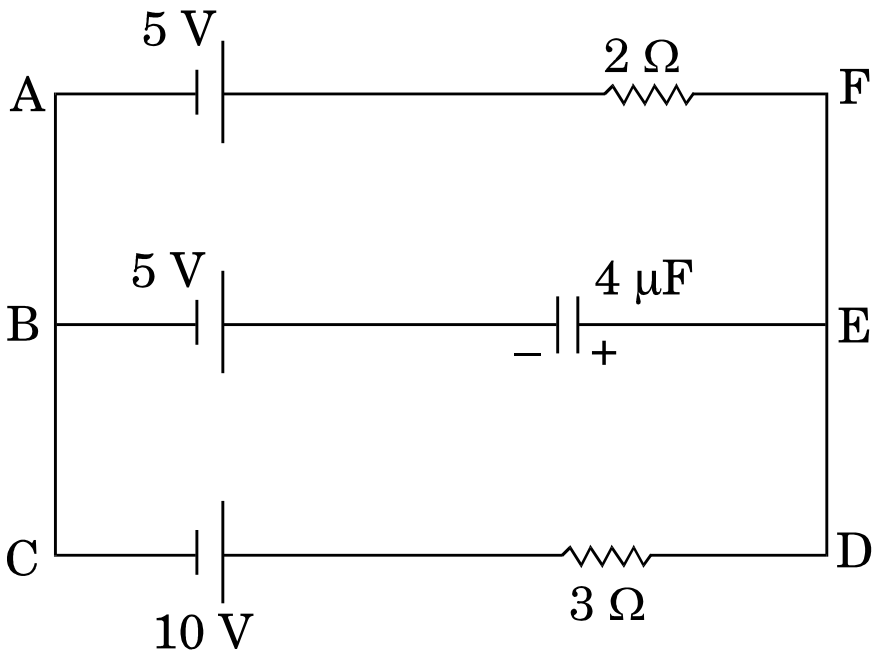
- 5View SolutionIn the given circuit, with steady current, calculate the potential drop across the capacitor in terms of V.
- 6Given $n$ resistors each of resistance $$R, how will you combine them to get the $(i)$ maximum $(ii)$ minimum effective resistance? What is the ratio of the maximum to minimum resistance?View Solution
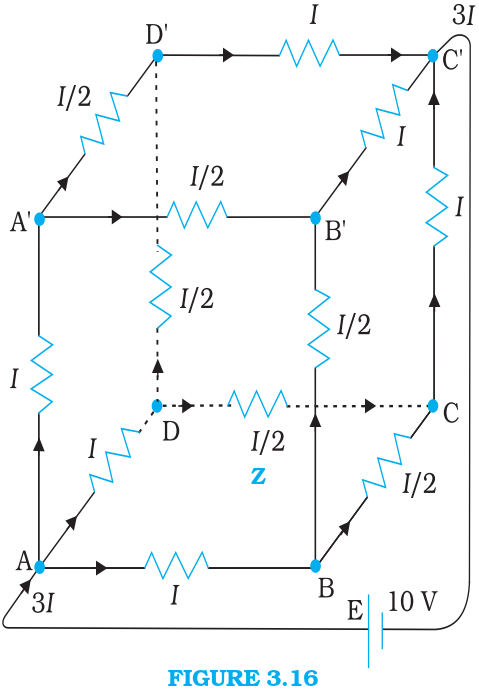
- 7A battery of $10 V$ and negligible internal resistance is connected across the diagonally opposite corners of a cubical network consisting of 12 resistors each of resistance $1 \Omega$ (Fig. 3.16). Determine the equivalent resistance of the network and the current along each edge of the cube.View Solution
- 8View SolutionTwo heated wires of the same dimensions are first connected in series and then in parallel to a source of supply. What will be the ratio of heat produced in the two cases?
- 9View SolutionElectrons are continuously in motion within a conductor but there is no current in it unless some source of potential is applied across its ends. Give reason.
- 10The earth’s surface has a negative surface charge density of $10^{-9} Cm^{-2}.$ The potential difference of $400 kV$ between the top of the atmosphere and the surface results $($due to the low conductivity of the lower atmosphere$)$ in a current of only $1800 A$ over the entire globe. If there were no mechanism of sustaining atmospheric electric field, how much time $($roughly$)$ would be required to neutralise the earth’s surface? $($This never happens in practice because there is a mechanism to replenish electric charges, namely the continual thunderstorms and lightning in different parts of the globe$). ($Radius of earth $= 6.37 \times 10^6 m.)$View Solution