Determine the ‘effective focal length’ of the combination of the two lenses in if they are placed 8.0 cm apart with their principal axes coincident. Does the answer depend on which side of the combination a beam of parallel light is incident? Is the notion of effective focal length of this system useful at all.
Exercise
Download our app for free and get started
Here, Focal length of first lens, $f_1 = 30$ cm
Focal length of second lens, $f_2 = -20$ cm
Distance between the lens, $d = 8.0$ cm
Let a parallel beam be incident on the convex lens first. If second lens were absent, then
$\text{u}_1=\infty \ \text{and} \ \text{f}_1=30 \ \text{cm}$
In the formula, as
$\frac{1}{\text{v}_1}-\frac{1}{\text{u}_1}=\frac{1}{\text{f}_1}$
$\therefore \ \frac{1}{\text{v}_1}-\frac{1}{\infty}=\frac{1}{30}$
i.e.$, v_1 = 30\ cm$
This image would now act as a virtual object for second lens.
$\therefore \ \text{u}_2=+(30-8)=+22 \ \text{cm}$
$f_2 = -20 cm$
Since,
$\frac{1}{\text{v}_2}=\frac{1}{\text{f}_2}+\frac{1}{\text{u}_2}$
$\frac{1}{\text{v}_2}=\frac{1}{-20}+\frac{1}{22}$
$=\frac{-11+10}{220}=\frac{-1}{220}$
$\therefore$ Parallel incident beam would appear to diverge from a point 220 - 4 = 216 cm from the centre of the two lens system.
Assume that a parallel beam of light from the left is incident first on the concave lens.
$\therefore \ \text{u}_1=-\infty \ \text{and} \ \text{f}_1=-20 \ \text{cm}$
As, $\frac{1}{\text{v}_1}-\frac{1}{\text{u}_1}=\frac{1}{\text{f}_1}$
$\therefore$ $\frac{1}{\text{v}_1}=\frac{1}{\text{f}_1}+\frac{1}{\text{u}_1}$
$=\frac{1}{-20}+\frac{1}{-\infty}$
$=\frac{1}{-20}$
$v_1 = -20$ cm
This image acts as a real object for the second lens
$u_2= -(20 + 8) = -28$ cm and,
$f_2= 30$ cm
Since, $\frac{1}{\text{v}_2}-\frac{1}{\text{u}_2}=\frac{1}{\text{f}_2}$
$\therefore \ \frac{1}{\text{v}_2}=\frac{1}{\text{f}_2}+\frac{1}{\text{u}_2}$
$=\frac{1}{30}-\frac{1}{28}$
$=\frac{14-15}{420}$
$\text{v}_2=-420 \ \text{cm}$
$\therefore$ The parallel beam appears to diverge from a point 420 - 4 = 416 cm, on the left of the centre of the two lens system.
We finally conclude that the answer depends on the side of the lens system where the parallel beam is incident. Therefore, the notion of effective focal length does not seem to be meaningful here.
Focal length of second lens, $f_2 = -20$ cm
Distance between the lens, $d = 8.0$ cm
Let a parallel beam be incident on the convex lens first. If second lens were absent, then
$\text{u}_1=\infty \ \text{and} \ \text{f}_1=30 \ \text{cm}$
In the formula, as
$\frac{1}{\text{v}_1}-\frac{1}{\text{u}_1}=\frac{1}{\text{f}_1}$
$\therefore \ \frac{1}{\text{v}_1}-\frac{1}{\infty}=\frac{1}{30}$
i.e.$, v_1 = 30\ cm$
This image would now act as a virtual object for second lens.
$\therefore \ \text{u}_2=+(30-8)=+22 \ \text{cm}$
$f_2 = -20 cm$
Since,
$\frac{1}{\text{v}_2}=\frac{1}{\text{f}_2}+\frac{1}{\text{u}_2}$
$\frac{1}{\text{v}_2}=\frac{1}{-20}+\frac{1}{22}$
$=\frac{-11+10}{220}=\frac{-1}{220}$
$\therefore$ Parallel incident beam would appear to diverge from a point 220 - 4 = 216 cm from the centre of the two lens system.
Assume that a parallel beam of light from the left is incident first on the concave lens.
$\therefore \ \text{u}_1=-\infty \ \text{and} \ \text{f}_1=-20 \ \text{cm}$
As, $\frac{1}{\text{v}_1}-\frac{1}{\text{u}_1}=\frac{1}{\text{f}_1}$
$\therefore$ $\frac{1}{\text{v}_1}=\frac{1}{\text{f}_1}+\frac{1}{\text{u}_1}$
$=\frac{1}{-20}+\frac{1}{-\infty}$
$=\frac{1}{-20}$
$v_1 = -20$ cm
This image acts as a real object for the second lens
$u_2= -(20 + 8) = -28$ cm and,
$f_2= 30$ cm
Since, $\frac{1}{\text{v}_2}-\frac{1}{\text{u}_2}=\frac{1}{\text{f}_2}$
$\therefore \ \frac{1}{\text{v}_2}=\frac{1}{\text{f}_2}+\frac{1}{\text{u}_2}$
$=\frac{1}{30}-\frac{1}{28}$
$=\frac{14-15}{420}$
$\text{v}_2=-420 \ \text{cm}$
$\therefore$ The parallel beam appears to diverge from a point 420 - 4 = 416 cm, on the left of the centre of the two lens system.
We finally conclude that the answer depends on the side of the lens system where the parallel beam is incident. Therefore, the notion of effective focal length does not seem to be meaningful here.

Download our appand get started for free
Experience the future of education. Simply download our apps or reach out to us for more information. Let's shape the future of learning together!No signup needed.*
Similar Questions
- 1For a glass prism $(\mu=\sqrt{3})$ the angle of minimum deviation is equal to the angle of the prism. Find the angle of the prism.View Solution
- 2View Solution
- Draw a ray diagram to show image formation when the concave mirror produces a real, inverted and magnified image of the object.
- Obtain the mirror formula and write the expression for the linear magnification.
- Explain two advantages of a reflecting telescope over a refracting telescope.
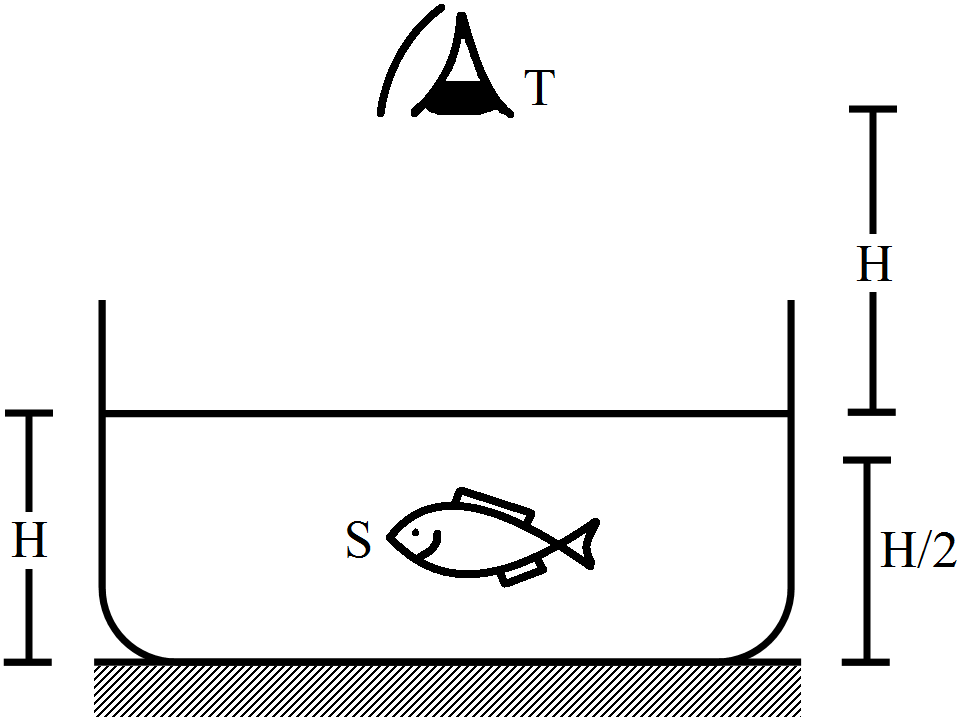
- 3View SolutionConsider the situation in figure. The bottom of the pot is a reflecting plane mirror, S is a small fish and T is a human eye. Refractive index of water is.
- At what distance(s) from itself will the fish see the image(s) of the eye?
- At what distance(s) from itself will the eye see the image(s) of the fish.
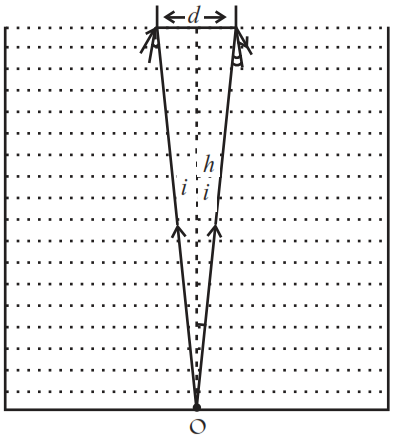
- 4View SolutionA jar of height h is filled with a transparent liquid of refractive index μ (Fig). At the centre of the jar on the bottom surface is a dot. Find the minimum diameter of a disc, such that when placed on the top surface symmetrically about the centre, the dot is invisible.
- 5View SolutionThe separation between the objective and the eyepiece of a compound microscope can be adjusted between 9.8cm to 11.8cm. If the focal lengths of the objective and the eyepiece are 1.0cm and 6cm respectively, find the range of the magnifying power if the image is always needed at 24cm from the eye.
- 6View SolutionA converging lens of focal length 15cm and a converging mirror of focal length 10cm are placed 50cm apart with common principal axis. A point source is placed in between the lens and the mirror at a distance of 40cm from the lens. Find the locations of the two images formed.
- 7View Solution
- Obtain lens makers formula using the expression
Here the ray of light propagating from a rare medium of refractive index $(n_1)$ to a denser medium of refractive index $(n_2)$ is incident on the convex side of spherical refracting surface of radius of curvature R.- Draw a ray diagram to show the image formation by a concave mirror when the object is kept between its focus and the pole. Using this diagram, derive the magnification formula for the image formed.
- 8A gravitational lens may be assumed to have a varying width of the formView Solution
$\text{w}(\text{b})=\text{k}_1\text{ In }\Big(\frac{\text{k}_2}{\text{b}}\Big)\ \ \text{b}_\text{min}<\text{b}<\text{b}_\text{max}$
$=\text{k}_1\text{ In }\Big(\frac{\text{k}_2}{\text{b}_\text{min}}\Big)\ \ \text{b}<\text{b}_\text{min}$
Show that an observer will see an image of a point object as a ring about the center of the lens with an angular radius
$\beta=\sqrt{\frac{(\text{n}-1)\text{k}_1\frac{\text{u}}{\text{v}}}{\text{u}+\text{v}}}$ - 9View SolutionA compound microscope consists of an objective lens of focal length 2.0 cm and an eyepiece of focal length 6.25 cm separated by a distance of 15 cm. How far from the objective should an object be placed in order to obtain the final image at (a) the least distance of distinct vision (25 cm), and (b) at infinity? What is the magnifying power of the microscope in each case?
- 10View Solution
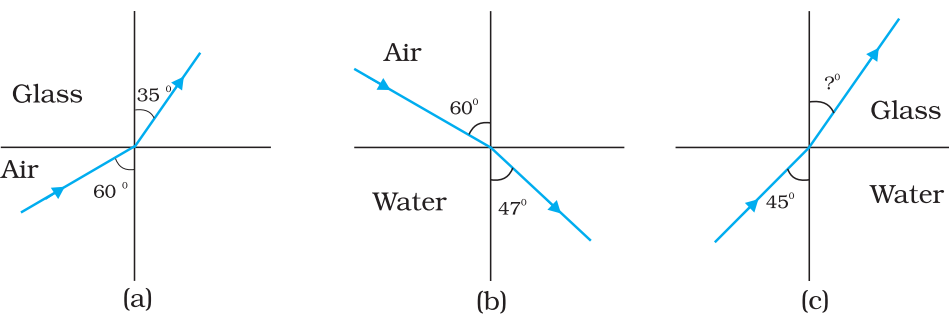
(a) and (b) show refraction of a ray in air incident at 60° with the normal to a glass-air and water-air interface, respectively. Predict the angle of refraction in glass when the angle of incidence in water is 45º with the normal to a water - glass interface.