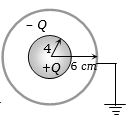
A sphere of $4\, cm$ radius is suspended within a hollow sphere of $6\, cm$ radius. The inner sphere is charged to potential $3\, e.s.u.$ and the outer sphere is earthed. The charge on the inner sphere is.....$e.s.u.$
Diffcult


Download our appand get started for free
Experience the future of education. Simply download our apps or reach out to us for more information. Let's shape the future of learning together!No signup needed.*
Similar Questions
- 1Three capacitors of $2.0,\;3.0$ and $6.0\;\mu F$ are connected in series to a $10\,V$ source. The charge on the $3.0\,\mu F$ capacitor is........$\mu C$View Solution
- 2An electric dipole of moment $\vec p$ is lying along a uniform electric field $\vec E.$ The work done in rotating the dipole by $90^o $ isView Solution
- 3The work done in carrying a charge of $5\,\mu \,C$ from a point $A$ to a point $B$ in an electric field is $10\,mJ$. The potential difference $({V_B} - {V_A})$ is thenView Solution
- 4A parallel plate capacitor with a dielectric slab completely occupying the space between the plates is charged by a battery and then disconnected. The slab is pulled out with a constant speed. Which of the following curves represent qualitatively the variation of the capacitance $C$ of the system with time?View Solution
- 5The distance between the plates of a parallel plate condenser is $\,4mm$ and potential difference is $60\;volts$. If the distance between the plates is increased to $12\,mm$, thenView Solution
- 6Two metal spheres of capacitance ${C_1}$ and ${C_2}$ carry some charges. They are put in contact and then separated. The final charges ${Q_1}$ and ${Q_2}$ on them will satisfyView Solution
- 7Two identical capacitors, have the same capacitance $C$. One of them is charged to potential $V_1$ and the other to $V_2$. The negative ends of the capacitors are connected together. When the positive ends are also connected, the decrease in energy of the combined system isView Solution
- 8A parallel plate capacitor of capacitance $2\; F$ is charged to a potential $V$. The energy stored in the capacitor is $E_1$. The capacitor is now connected to another uncharged identical capacitor in parallel combination. The energy stored in the combination is $E _2$. The ratio $E _2 / E _1$ isView Solution
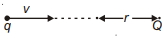
- 9The charge $q$ is fired towards another charged particle $Q$ which is fixed, with a speed $v$. It approaches $Q$ upto a closest distance $r$ and then returns. If $q$ were given a speed $2 v$, the closest distance of approach would beView Solution
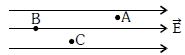
- 10$A, B$ and $C$ are three points in a uniform electric field. The electric potential isView Solution