A spherical ball contracts in volume by $0.02 \%$, when subjected to a normal uniform pressure of $50$ atmosphere. The Bulk modulus of its material is ............... $N / m ^2$
Easy


Download our appand get started for free
Experience the future of education. Simply download our apps or reach out to us for more information. Let's shape the future of learning together!No signup needed.*
Similar Questions
- 1A wire can be broken by applying a load of $20\, kg$ weight. The force required to break the wire of twice the diameter is .......... $kg\, wt$View Solution
- 2Two wires $A$ and $B $ of same length and of the same material have the respective radii ${r_1}$ and ${r_2}$. Their one end is fixed with a rigid support, and at the other end equal twisting couple is applied. Then the ratio of the angle of twist at the end of $A$ and the angle of twist at the end of $B $ will beView Solution
- 3To determine Young's modulus of a wire, the formula is $Y = \frac{F}{A}.\frac{L}{{\Delta L}}$ where $F/A$ is the stress and $L/\Delta L$ is the strain. The conversion factor to change $Y$ from $CGS$ to $MKS$ system isView Solution
- 4When the temperature of a gas is $20^{\circ} C$ and pressure is changed from $P_1=1.01 \times 10^5 \,Pa$ to $P_2=1.165 \times$View Solution
$10^5 \,Pa$, then the volume changes by $10 \%$. The Bulk modulus is $.........\times 10^5 \,Pa$ - 5View SolutionHook's law defines
- 6When a block of mass $M$ is suspended by a long wire of length $L$, the length of the wire become $(L+l) .$ The elastic potential energy stoped in the extended wire is :View Solution
- 7View SolutionShearing stress causes change in
- 8$A$ current of $(2.5 \pm 0.05)$ $A$ flows through a wire and develops a potential difference of $(10 \pm 0.1)$ $\mathrm{volt}.$ Resistance of the wire in $\mathrm{ohm},$ isView Solution
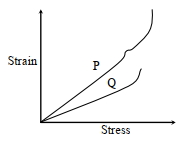
- 9In plotting stress versus strain curves for two materials $P$ and $Q$, a student by mistake puts strain on the $y$-axis and stress on the $x$-axis as shown in the figure. Then the correct statement$(s)$ is(are)View Solution
$(A)$ $P$ has more tensile strength than $Q$
$(B)$ $P$ is more ductile than $Q$
$(C)$ $P$ is more brittle than $Q$
$(D)$ The Young's modulus of $P$ is more than that of $Q$
- 10Overall changes in volume and radii of a uniform cylindrical steel wire are $0.2 \%$ and $0.002 \%$ respectively when subjected to some suitable force. Longitudinal tensile stress acting on the wire is ($Y = 2.0 × 10^{11} Nm^{-2}$)View Solution